Introduction
In a well‑structured organization, staffs’ physical and psychological health is as important as its production and efficiency. On the other hand, staffs’ psychological health is a determining factor regarding the promotion of efficiency, as well as presenting better and effective range of services.[1]
Organizational factors within an environment have the potential to change the provision of care, and consequently nurse and patient outcomes,[2] which are shortage of nurses, inappropriate working conditions, lack of organizational support, nurses’ discontent, and increase in nurses’ age.[3,4] Nurses compromise the most among hospital personnel.[5] Recruiting and maintaining nurses are a vital and crucial issue. In recent years, managers have paid more attention to nursing conditions for the sake of promoting their own hospitals’ efficiency.[6]
Because of shortage of nurses, work pressure among nurses, and financial constraints, nursing itself is considered as a primary source of stress resulting in
Abstract
Background: The practice environment pivotal role in patients and nurses better outcomes is evident. Practice Environment Scale of Nursing Work Index (PES‑NWI) is widely utilized to assess nursing work environments. The present study was conducted to demonstrate the validity and reliability of the Persian version of PES‑NWI. Materials and Methods: The instrument was translated and its psychometrics were investigated by content, construct validity (factor analysis), and homogeneity (internal consistency and intraclass correlation) on a sample of 350 nurses at educational hospitals in East Azerbaijan, Iran. Results: The 30 items loaded onto 4 factors explained 34.95–50.06% of the variance. The items across the factors differed slightly from those reported by the original author of the PES‑NWI. Cronbach’s alpha and Pearson coefficient for the entire instrument and also for extracted factors was 0.70–0.96. Conclusions: The Persian version of PES‑NWI has an appropriate level of validity and reliability in the Iranian setting for nurses. The subscale of Nursing Foundations for quality care needs modification.
Keywords: Iran, nurse, practice environment scale of nursing, reliability, validity
Validity and Reliability of the Persian Practice Environment Scale of
Nursing Work Index
Original Article
Safa Elmi1,
Hadi Hassankhani2,
Farahnaz
Abdollahzadeh3,
Mohammad Asghari Jafar Abadi4,
Judy Scott5,
Mina Nahamin6
1Student's Research Committee,
Tabriz University of Medical Sciences, Tabriz, Iran, 2Center
of Qualitative Studies, Tabriz University of Medical Sciences, Tabriz, Iran, 3Department
of Medical and Surgical Nursing, School of Nursing and Midwifery, Tabriz University of Medical Sciences, Tabriz, Iran,
4Road Traffic Injury Research
Center, Tabriz University of Medical Sciences, Tabriz, Iran,
5School of Nursing, Point Loma
Nazarene University, San Diego, California, 6PhD Student,
School of Nursing and Midwifery, Tabriz University of Medical Sciences, Tabriz, Iran
depression and psychological tension.[1] Studies have revealed that hospitals with supportive working environments have low degree of death rate than those lacking supportive environments.[7] Managers should pay close attention to the quality of work life, which has powerful impacts on the wellbeing of nurses and places them at risk of fatigue.[8]
The study of Labbaf Ghasemi et al. showed that nurses faced excessive shift turns (74.15%), nonspecialized tasks (77.6), and lack of motivation (43.9%) in their working environments; 30% to 40% of the nurses declared the tendency to quit their profession.[9] Azarang also confirmed that 75.4% of the nurses were dissatisfied with their working environment.[10]
Supportive nursing management is influential in increasing motivation, appropriate working environment, nurses’ empowerment, efficiency, and job satisfaction; in addition, it reduces working pressure.[11] Iran, similar to other countries, is experiencing a shortage of nurses; therefore, a multifactor approach for retention of nurses is required. One significant factor that has received
This is an open access article distributed under the terms of the Creative Commons Attribution‑NonCommercial‑ShareAlike 3.0 License, which allows others to remix, tweak, and build upon the work non‑commercially, as long as the author is credited and the new creations are licensed under the identical terms.
For reprints contact: [email protected]
How to cite this article: Elmi S, Hassankhani H, Abdollahzadeh F, Jafar Abadi MA, Scott J, Nahamin M. Validity and reliability of the persian practice environment scale of nursing work index. Iranian J Nursing Midwifery Res 2017;22:106-11.
Received: May, 2016. Accepted: September, 2016.
Address for correspondence:
Dr. Hadi Hassankhani, Center of Qualitative Studies, Tabriz University of Medical Sciences, Tabriz, Iran. E-mail: Hassankhanihadi@ yahoo.com
Access this article online Website: www.ijnmrjournal.net DOI:
10.4103/1735-9066.205953 Quick Response Code:
increasing attention in the last decade, particularly in USA, is the nursing practice environment, which is defined by Lake as “the organizational characteristics of a work setting that facilitate professional nursing practice.”[12]
The environment construct of Practice Environment Scale of Nursing Work Index (PES‑NWI) proposed by Lake considering favorable nursing practice indicates that there is professional autonomy, an adequate number of nurses based on patients’ needs, participative management with collaborative decision making, a mutual relationship between professionals, particularly physicians and nurse, promotion opportunities, acknowledgement of the nurses’ hierarchy for efficient leadership, and management in the hospitals.[13] The results of investigating the psychometrics of PES‑NWI in various studies indicates validity and reliability of the PES‑NWI in several countries of different contexts and languages including China, New Zealand, Spain, Australia, Switzerland, Belgium, England, Finland, Sweden, Ireland, Holland, and Norway.[14] There is dearth of knowledge regarding the Persian version of PES‑NWI, which led to the present study to investigate the validity and reliability of PES‑NWI in the Iranian setting.
Materials and Methods
The present study is a methodological research for investigating the validity and reliability of the PES‑NWI to use in a new environment in 2015. PES‑NWI comprised 31 items for which the nurses responded on a scale of four points, ranging from 1 (“strongly agree”) to 4 (“strongly disagree”). PES‑NWI includes the following 5 factors: (1) nurses’ participation in hospital affaires, (2) nursing foundations for quality of care, (3) collegial nurse– physician relationships, (4) leadership and support of nurses staffing and resource adequacy, (5) nurse manager ability.[13]
After authorization had been given by the original author (Lake) for translation of the international scale, we used content and construct validity and intraclass correlation coefficient (ICC) in the test and the retest (2‑week interval). In this study, 350 participants were considered for factor analysis, internal (Cronbach’s alpha), and retest consistency reliability of the instrument.
Following the visits to the nursing offices of the hospitals affiliated to the Tabriz University of Medical Sciences (TUMS), the nurses who were sampled randomly were eligible for the study if they were desirable to participate, had BS or higher academic degree in nursing, were working in the hospital for more than 6 months, and were able to speak, comprehend, read, and write in the Persian language. They were excluded if they chose to withdraw from the study. Initially, the consent form was filled by the participants of the study. Next, the researcher explained the objectives of the study to each participant during their free time in the morning, afternoon, and
night shifts. Thereafter, the distributed instruments were responded by the nurses. A total of 440 questionnaires were distributed, of which 350 (79.5%) questionnaires were returned.
For the purposes of translation, the English PES‑NWI was given to two translators fluent in English whose native language was Persian, and who were also familiar with the nursing practice environment. They separately translated the instrument from English to Persian. Next, the translated instruments were given to 30 nurses of the TUMS hospitals to be completed. The required discussion and recommendations about the accuracy, clarity, and simplicity of the items in the instrument were confirmed by the nurses who responded to the translated instrument. After agreement between the two translators, the initial Persian form of the instrument was prepared. Then, the instrument was given to an English native translator who fluent in Persian and was not familiar with the objective of the study or the main English form of the instrument. On comparing two forms of the translations (English and Persian), the final form of Persian instrument was prepared. There was no difference in terms of concepts between the translated version and the main version PES‑NWI.
Cronbach’s alpha and test–retest were used to investigate reliability for which the values greater than 0.7 had good reliability.[15] The reliability of internal consistency was determined by calculation of Cronbach’s alpha at the beginning of the study as a pilot with 30 nurses for the entire instrument. Finally, the total study sample (350 nurses) was considered for each factor and the complete instrument. Burns and Grove consider a 2‑week to 1‑month interval for pen and paper instrument to be sufficient for the participants to lose recall of the items of the instrument and measures of constructs which are not expected to change over time.[15] Thus, in the present study, the reliability of test–retest was done with the sample of 30 nurses in the time interval of 2 weeks by calculating Spearman–Brown correlation coefficient between the two sets of scores obtained for each factor and the entire instrument. The content validity of scale was evaluated by 10 experts in nursing administration, and phrases with scores of less than 75% were considered to be clarified and simplified.
To determine the validity of the construct, exploratory factor analysis, confirmatory factor analysis, and discriminate validity methods were used. For exploratory factor analysis, the correlation matrix was calculated between the variables. Next, extraction of factors was done by principal axis factoring (PAF), and then varimax rotation was used to investigate the relation between the factors. Finally, Kazer Meier Olkin (KMO) test was applied to investigate the adequacy of the factor analysis model, indicating that the extracted component explains a significant amount of the results.
Bartlett’s test, used for sphericity and variance, explained index by the factors and total. To evaluate the structure of the factors of exploratory factor analysis, goodness of fit of confirmatory factor analysis was done based on Chi‑squared/degrees of freedom (χ2/df) <5, Goodness of Fit Index (GFI), Adjusted Goodness of Fit Index (AGFI) >0.9, Root mean square residual (RMSR) <0.1, Root Mean Square Error of Approximation (RMSEA) <0.08, comparative fit index (CFI) >0.9, Normed Fit Index (NFI) >0.9, Non‑Normed Fit Index (NNFI) >0.9, Incremental Fit Index (IFI) >0.9, Relative Fit Index (RFI). Summarized to Confirmatory factor analysis was done based on χ2/df <5, RMSEA <0.08, GFI, AGFI, CFI, NFI, NNFI, and IFI >0.9.[15]
Data analysis was done by the Statistical Package for the Social Sciences (SPSS) version 14.0 (IBM SPSS Statistics for Windows, Version 20.0; IBM Corp., Armonk, New York, USA). P value of <0.05 was considered to be statistically significant.
Ethical considerations
Ethical approval was obtained from the TUMS before conducting the study (Ethics code No: 5/48382). The hospitals’ authorities also permitted to conduct the study. The collected data were anonymous, the consent form was obtained, and the participants were allowed to withdraw from the study anytime they wanted.
Results
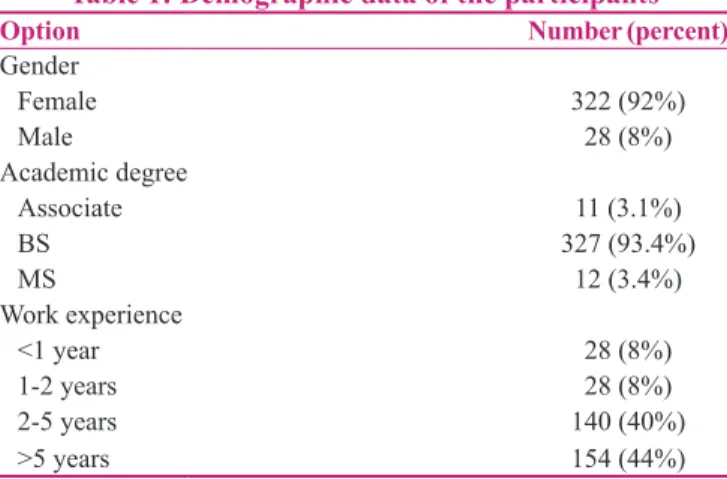
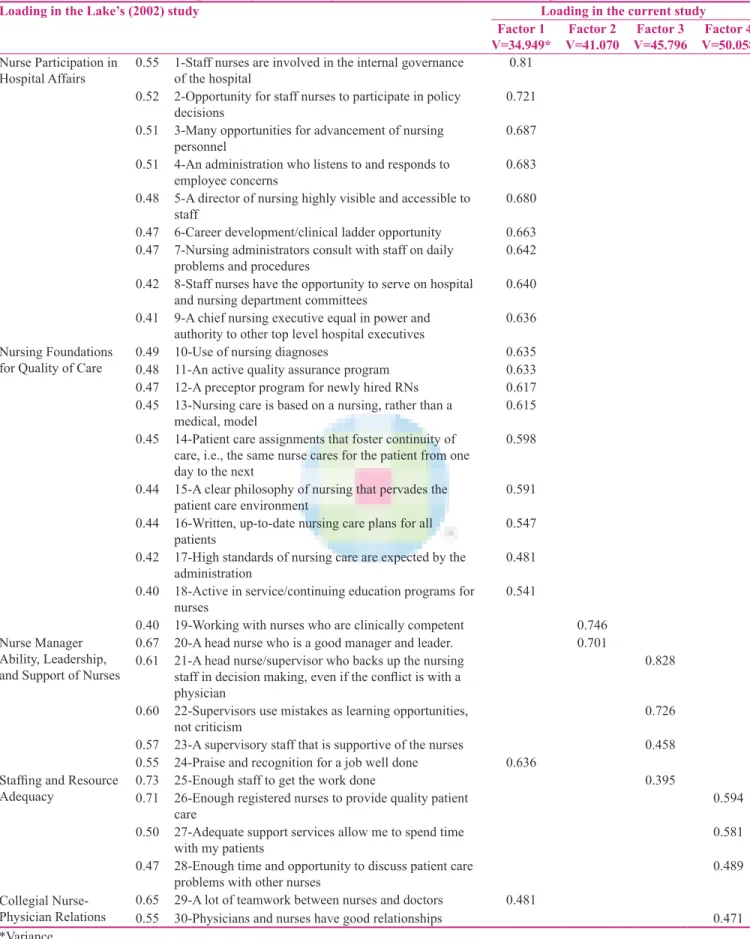
In our study, the majority (92%) of the nurses were women, had a bachelor’s degree (93.4%), and a job experience of less than 1 year (8%) [Table 1]. Thirty‑one items were confirmed as the result of PES‑NWI content validity. Exploratory factor analysis revealed four factors explaining 34.95–50.06% of the variance [Table 2]. The “Nursing Foundations for quality care” factor of the PES‑NWI needs modification. In the present study, Cronbach’s alpha coefficient was 0.935 for the entire instrument and 0.70–0.92 for the four factors. ICC was 0.95 for the entire instrument and 0.85–0.96 for the four factors [Table 3].
In the investigation of the adequacy of factor analysis model based on the values (KMO = 0.93 and for Bartlett’s test, Chi‑square of Bartlett’s test was 3947.10, degree of freedom 465, P < 0.01), the adequacy of the model was confirmed.
Discussion
The present study deals with the investigation of the reliability and validity of the Persian PES‑NWI in Tabriz educational hospitals. The findings have been extracted in terms of four factors. The first factor was leading and supporting nurses. The second factor was the cooperation between nurses and physicians, the third was adequate working staff to treat patients, and finally the fourth factor was nursing foundations for quality care. Nursing management support was another factor that was not found to be significant in this study. In a study by Hegney
et al. of the reliability and validity of PES‑NWI carried out in Queensland Australia, four factors out of five were identified. Nurses’ participation in hospital affairs were not significant in their study.[16] In the psychometrics study by Chiang and Lin of PES‑NWI among nurses who worked in 5 hospitals in Southern Taiwan, the nonsignificant factor was the relationship between physicians and nurses.[11] In a cross‑sectional study by Tominoga et al., that was aimed to study the characteristics of PES‑NWI in Japanese Magnet Hospitals, all factors except nurses’ participation in hospital affairs were significant.[17] Moreover in a cross‑sectional study by Gunnarsdottir, nursing practice environments were analyzed by modified nursing indexes via the participation of 650 nurses in the Island. The findings revealed that the nurses had better condition in terms of their relations with physicians compared to the other four factors.[18] A study by Nunez regarding cultural measurement equivalence of the PES‑NWI between two groups of Asian/Pacific Islander and White/Non‑Hispanic registered nurses (RN) revealed that the majority of the subscales were statistically significantly different except for two subscales addressing hospital affairs and nurse managers.[19] It could be concluded that, based on different contexts, we will have slightly different factor extractions.
Paying attention to the value of Cronbach’s alpha coefficient for each factor and the entire instrument, internal consistency reliability was confirmed. Other studies also confirmed its internal consistency. Similar to our study, studies by Chiang and Lin, Salgueiro et al., and Fuentelsaz et al., the Cronbach’s alpha coefficient was 0.89–0.93.[11,16,20,21]
The ICC value was 0.85–0.96 in our study, considering values ≥0.7 to be acceptable,[22] the stability of the instrument was satisfactory which is similar to other studies.[23,24]
Looking at the KMO index value of balanced factor analysis and Barttlets test, a meaningful linkage can be understood. Table 1: Demographic data of the participants
Option Number (percent)
Gender
Female 322 (92%)
Male 28 (8%)
Academic degree
Associate 11 (3.1%)
BS 327 (93.4%)
MS 12 (3.4%)
Work experience
<1 year 28 (8%)
1‑2 years 28 (8%)
2‑5 years 140 (40%)
Table 2: Exploratory factor analysis of selected items of the nursing work index
Loading in the Lake’s (2002) study Loading in the current study
Factor 1
V=34.949* V=41.070Factor 2 V=45.796Factor 3 V=50.058Factor 4
Nurse Participation in
Hospital Affairs 0.55 1‑Staff nurses are involved in the internal governance of the hospital 0.81 0.52 2‑Opportunity for staff nurses to participate in policy
decisions 0.721
0.51 3‑Many opportunities for advancement of nursing
personnel 0.687
0.51 4‑An administration who listens to and responds to
employee concerns 0.683
0.48 5‑A director of nursing highly visible and accessible to
staff 0.680
0.47 6‑Career development/clinical ladder opportunity 0.663 0.47 7‑Nursing administrators consult with staff on daily
problems and procedures 0.642
0.42 8‑Staff nurses have the opportunity to serve on hospital
and nursing department committees 0.640
0.41 9‑A chief nursing executive equal in power and
authority to other top level hospital executives 0.636 Nursing Foundations
for Quality of Care 0.49 10‑Use of nursing diagnoses0.48 11‑An active quality assurance program 0.6350.633
0.47 12‑A preceptor program for newly hired RNs 0.617
0.45 13‑Nursing care is based on a nursing, rather than a
medical, model 0.615
0.45 14‑Patient care assignments that foster continuity of care, i.e., the same nurse cares for the patient from one day to the next
0.598 0.44 15‑A clear philosophy of nursing that pervades the
patient care environment 0.591
0.44 16‑Written, up‑to‑date nursing care plans for all
patients 0.547
0.42 17‑High standards of nursing care are expected by the
administration 0.481
0.40 18‑Active in service/continuing education programs for
nurses 0.541
0.40 19‑Working with nurses who are clinically competent 0.746
Nurse Manager Ability, Leadership, and Support of Nurses
0.67 20‑A head nurse who is a good manager and leader. 0.701
0.61 21‑A head nurse/supervisor who backs up the nursing staff in decision making, even if the conflict is with a physician
0.828 0.60 22‑Supervisors use mistakes as learning opportunities,
not criticism 0.726
0.57 23‑A supervisory staff that is supportive of the nurses 0.458
0.55 24‑Praise and recognition for a job well done 0.636 Staffing and Resource
Adequacy 0.73 25‑Enough staff to get the work done0.71 26‑Enough registered nurses to provide quality patient 0.395
care 0.594
0.50 27‑Adequate support services allow me to spend time
with my patients 0.581
0.47 28‑Enough time and opportunity to discuss patient care
problems with other nurses 0.489
Collegial Nurse‑
Physician Relations 0.65 29‑A lot of teamwork between nurses and doctors0.55 30‑Physicians and nurses have good relationships 0.481 0.471 *Variance
In the Chiang and Lin study (2009),[11] KMO was 91% and Barttlet’s results was also meaningful (P < 0.001). Further, in Salgueiro et al.,[20] the KMO was 91% with positive Barttlet’s results (P < 0.001). This showed that the factor analysis could be carried out on this dataset and the adequacy of the model was confirmed.
Study limitations
The response rate (79.5%) was acceptable and suitable for covering statistical power; nevertheless, some concerns can be made about the profile of non‑respondent nurses, who potentially could have different perceptions about their practice environments. The second limitation is that the present study is confined to the university educational hospitals of one province of Iran and further research to ascertain the applicability of the PES‑NWI in different settings is recommended.
Conclusions
The Persian version of PES‑NWI has an appropriate level of validity and reliability in the Iranian setting for the nurses and could be a helpful instrument for measuring organizational factors that could play a key role in any strategic planning at healthcare centres, aimed at redesigning roles or empowering nurses. The subscale of nursing foundations for quality care needs modification, and more studies in the Iranian setting are needed to confirm these findings.
Acknowledgement
Our gratitude goes to Persian and English translators who helped us in translating the instrument and nurses participated in the study.
Financial support and sponsorship Nil.
Conflicts of interest
There are no conflicts of interest.
References
1. Rahimi A, Ahmadi F, Akhond M. An investigation of amount and factors affecting nurses’ job stress in some hospitals in Tehran. Hayat 2004;10:13‑22.
2. Motl RW, Arnett PA, Smith MM, Barwick FH, Ahlstrom B, Stover EJ. Worsening of symptoms is associated with lower physical activity levels in individuals with multiple sclerosis. Mult Scler 2008;14:140‑2.
3. Aiken LH, Sloane DM, Bruyneel L, Heede KV, Sermeus W. Nurses reports of working conditions and hospital quality of care in 12 countries in Europe. Int J Nurs Stud 2013;50:143‑53. 4. Aiken LH, Sloan DM, Clark S, Poghosyn L, Cho E, You L,
et al. Importance of work environments on hospital outcomes in nine countries. Int J Qual Health Care 2011;23:357‑64.
5. Brooks BA, Anderson MA. Defining quality of nursing work life. J Nurs Economics 2005;23:319.
6. Dargahi H, Gharib M, Goodarzi M. Quality of work life in nursing employees of Tehran university of medical sciences hospitals. Hayat 2007;13:13‑21.
7. Javadali F, Alameddine M, Dumit N, Dimassi H, Jamal D, Maalouf S. Nurses work environment and intent to leave in lebanese hospitals: Implications for policy and practice. Int J Nurs Stud 2001;48:204‑14.
8. Denigris J, Fisher K, Maley M, Nalan E. Perceived quality of work life and risk for compassion fatigue among oncology nurses: A mixed‑methods study. Oncol Nurs Forum 2016;43:121‑31. 9. Labbaf Quassemi F, Marbaghi A, Kabiri FG, Hosseini F.
Assessment of work experiences of the temporary employed nurses within the program of human resarch project. IJN 2005;18:7‑19.
10. Azarrang SH, Yaghmaei F, Shiri M. Correlation dimensions of quality of work life of nurses and demographic characteristics. Int J Nurs Res 2013;7:18‑24.
11. Chiang HY, Lin SY. Psychometric testing of the Chinese version of nursing practice environment scale. J Clin Nurs 2009;18:919‑29.
12. Aiken L, Patrician P. Measuring organizational traits of hospitals: The Revised Nursing Work Index. J Nurs Res 2000;49:146‑53. 13. Lake ET. Development of the practice environment scale of the
nursing work index. Res Nurs Health 2002;25:176‑88.
14. Warshawsky NE, Havens SD. Global use of the practice environment scale of the nursing work index. J Nurs Res 2011;60:17‑31.
15. Tinsley HEA, Brown SD. Handbook of Applied Multivariate Statistics and Mathematical Modeling. San Diego: Academic Press; 2000.
16. Hegney D, Tuckett A, Parker D, Eley RM. Workplace violence: Differences in perceptions of nursing work between those exposed and those not exposed: A cross‑sectoranalysis. Int J Nurs Pract 2010;16:188‑202.
17. Tominaga M, Tsuchiya M, Sato F. Characteristics of the work environment of magnet hospitals and job satisfaction among nurses in Japan: A Cross‑sectional study using multi‑level analysis. JNurs Care 2012;5:2167‑8.
18. Gunnarsdóttir S, Clark SP, Rafferty AM, Nutbeam D. Front‑line management staffing and nurse–doctor relationships as predictors of nurse and patient outcomes: A survey of icelandic hospital nurses. Int J Nurs Stud 2009;46:920‑7.
19. Nunez F. Examining the Cultural Measurement Equivalence of the Practice Environment Scale‑Nursing Work Index (dissertation), University of Kansas; 2015.
Table 3:The reliability of the PES‑NWI sub scores
Factors Mean Standard deviation Min (%) Max (%) Cronbach’s alpha ICC Spearman Pearson
Factor 1 2.87 0.53 0 4 (1.1) 0.925 0.94 −0.75 −0.14
Factor 2 2.50 0.61 3 (0.9) 13 (3.7) 0.787 0.85 −0.028 −0.091
Factor 3 3.12 0.61 0 36 (10.3) 0.696 0.92 −0.022 −0.24
20. Salgueiro AF, Lopes FP, Lake E. Validation of the practice environment scale of the nursing work index (PES‑NWI) for the Portuguese nurse population. Int J Caring Sci 2012;5:280‑8.
21. Fuentelsaz Gallego C, Moreno Casbas MT, GonzálezMaría E. Validation of the Spanish version of the questionnaire practice environment scale of the nursing workindex. Int J Nurs Stud 2013;50:274‑80.
22. Terwee CB, Bot SD, de Boer MR, van der Windt DA, Knol DL,
Dekker J, et al. Quality criteria were proposed for measurement properties of health status questionnaires. J Clin Epidemiol 2007;60:34‑42.
23. Ma C, Park SH. Hospital Management status, unit work environment, and pressure ulcers. J Nurs Scholarsh 2015;47:565‑73.
24. Ferreira MR, Martins JJ. Study of adaptation and validation of the Practice environment scale of the nursing work index for the Portuguese reality. Rev Esc Enferm USP 2014;48:691‑8.