Masters Paper
Creation and
Validation of a
Perceived Invincibility
Survey Instrument
Nancy Brown
Brown 2
Executive Summary
Perceived invincibility is an understudied concept in an adult population. The aim of this paper was to pilot test one survey, the Adolescent Invincibility Test (AIT), which was intended to measure perceived invincibility in an adolescent population, in an adult population. In a sample of 373 students, staff, and faculty at the University of North Carolina, the AIT was found to measure one domain and have sufficient internal consistency (Cronbach’s alpha = 0.86). The AIT did not correlate with demographic variables nor a survey assessing propensity for taking risks. However, a statistically significant difference in means was found between men and women and between those who are ages 30 and older and those younger than 30. More research is needed in a more diverse population to evaluate the performance of the AIT in an adult civilian population.
Introduction
High-risk health behaviors are a major source of preventable morbidity and mortality in the United States.i The likelihood one would engage in such behaviors is
called perceived invincibility. Perceived invincibility is an individual’s unrealistic belief that s/he will be successful in any endeavor, including high-risk ones.ii It examines an
individual’s propensity for taking risks, as opposed to perceived susceptibility that looks at one’s aversion to risk.iii Perceived invincibility is not a widely studied subject, and
there are few surveys that measure the concept. Studies that have examined perceived invincibility are limited to adolescents and individuals in the military. However, perceived invincibility has been understudied in an adult, civilian population.
The goal of this paper is to evaluate a survey created for an adolescent population, the Adolescent Invincibility Tool (AIT), in an adult, civilian population.
Evaluate the psychometric properties of the Adolescent Invincibility Tool (AIT)
through online pilot testing with the students, staff, and faculty at UNC.
My hypothesis is that overall the AIT will remain a valid survey instrument in an older population. However, some questions may not translate into strong items in an adult population and may need to be changed due to an implied individualism in the AIT’s factors and in conceptual models.
Background
There is no unified, central model surrounding the concept of perceived invincibility. Many studies have defined it in different ways. Most conceptual definitions of invincibility are built upon and around other health behavior concepts. For the purposes of this paper, I will look focus on one survey and the model it proposed, the Adolescent Invincibility Tool (AIT) that looked at perceived invincibility in adolescents. There are many health behaviors that are high risk and highly preventable, such as excessive drinking, smoking, or driving without a seatbelt. According to the American Medical Association, approximately 25 cents out of every dollar spent on health care in the United States is spent on preventable and/or changeable behaviors.iv While there is
information about individuals who do some of these high-risk behaviors, such as smoking, there is not as much data on why those populations are more prone to take these risks in the first place.
Brown 4
behaviors.v High risk behaviors have also differed by race, with minorities engaging in
more high risk behaviors such as risky sexual activity.vi Socioeconomic status, or
education and income, is also an indicator of high risk behaviors.vii For adolescents,
familial stability is an indicator for lower high risk behaviors.viii
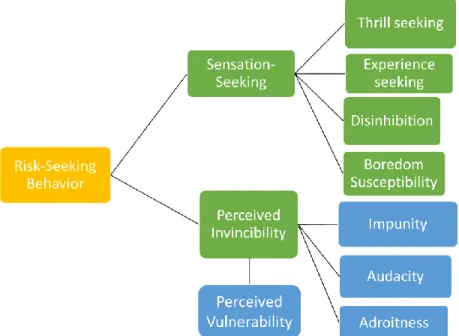
An individual’s propensity for taking risk, or risk-seeking, is made up of their perceived invincibility and sensation-seeking traits.ix Sensation-seeking is the act of
taking risks in order to derive new or multifaceted experiences.x Some research
suggests that sensation seeking is a biological construct that these individuals are more likely to seek out stimulating behavior.xi Many of these sensation-seeking behaviors are
unhealthy, such as smoking and heavy drinking.xii Currently, there are multiple survey
instruments that address sensation seeking. Survey questions can be generally categorized into four groups: adventure and thrill seeking, susceptibility to boredom, disinhibition, and experience seeking.xiii
Here is an example to better illustrate the differences between sensation-seeking and perceived invincibility. Let us say an individual is speeding in his car. One reason he may be speeding is that he enjoys going extremely fast. This would be sensation seeking. Another reason he might be going very fast is he believes that he won’t get into a car accident or get a speeding ticket. This is perceived invincibility.
One study that looked at perceived invincibility interpreted it as perceived invulnerability, or the opposite of perceived vulnerability.xiv Perceived vulnerability or
susceptibility are part of many different health behavior models, such as the Health Belief Model.xv Perceived vulnerability is defined as how one perceives one’s chances
bad/serious one deems a particular health condition, they form the concept of perceived threat.xvii When someone perceives the threat to be high, one usually does not take that
particular risk. However, if you perceive yourself to be invincible you may never perceive something as a serious threat. There are surveys that exist to assess perceived vulnerability. In these surveys, the concept of perceived vulnerability is
usually discussed in a disease-specific context, such as cancer, they are also frequently used with the context given within a survey item. For example, a common question format is “If you were to complete/not complete activity x, how likely do you think it is that you will develop condition y within a given timeframe?”xviii
There are existing surveys that assess concept of invincibility, but not in an adult, civilian population. One survey instrument that examines perceived invincibility is the Invincibility Belief Index (IBI). The IBI is a survey instrument developed in 2010 and published in Military Medicine. The survey itself was validated in active U.S. army soldiers undergoing fighter pilot training.xix There were no women included in this
population, which indicates that it is clearly not generalizable to the civilian population. The survey is comprised of 20 items; each question is a different vignette.xx Each
vignette features a different scenario, and then a question about how probable the survey-taker feels they will be successful in each different scenario. The response options are scaled from 0% to 100% in 10% increments, which can be hard to
understand for those less literate.xxi In the limitations section of the paper, the authors
Brown 6
The Invincibility Belief Index breaks down perceived invincibility into different categories, adroitness, impunity, and audacity, and has different survey items pertaining to those categories. Adroitness examines whether an individual believes they would survive a situation based on intelligence or skill.xxiii Impunity is the belief that an
individual was immune to the consequences of their actions.xxiv Audacity, or boldness,
assesses how confident an individual considers him/herself under different set of circumstances.xxv The scores for each of these questions were combined together to
form an overall perceived invincibility score.
Age and military history are known to be liked to higher perceived invincibility. Those that have served in the military, after being exposed to such high risk scenarios, are thought to have higher rates of perceived invincibility due to an altered sense of one’s vulnerability.xxvi The younger an individual is, the more likely s/he is to have higher
perceived invincibility.xxvii I believe this is why perceived invincibility has been studied in
these populations, rather than the general population. The Adolescent Invincibility Test
The Adolescent Invincibility Test (AIT) was designed to look at perceived invincibility in adolescents ages 14 through 20 years.xxviii The reason the AIT chose to
focus on adolescents was because previous research had shown that adolescents were more likely to have high perceived invincibility than adults.xxix The AIT includes 25
statements with responses on a 5 point Likert-type scale.xxx The AIT has five factors: get
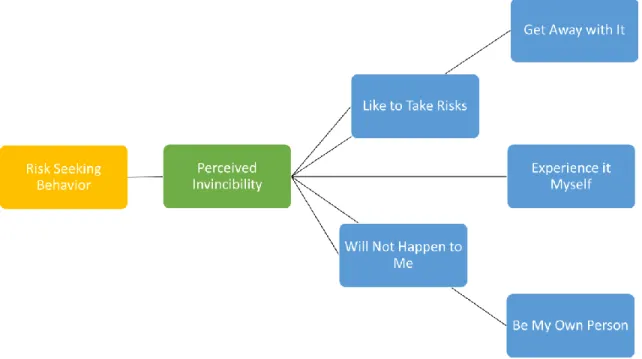
away with it, like to take risks, experience it myself, will not happen to me, and be my own person.xxxi These categories are informed by qualitative interviews done before the
developers found six factors: get away with it, experience it myself, risk taker, own person, won’t happen to me, and won’t get hurt.xxxiii The survey developers emphasized
the 5 factor framework in their discussion section.xxxiv
The AIT framework is similar to the previously discussed frameworks, but it incorporates like to take risks or risk taker, which is more like sensation-seeking in the other models. It also includes components that reflect a certain need for individualism such as AIT’s be my own person factor and experience it myself, which fall outside of the definition of perceived invincibility used in other research. The IBI and the AIT do overlap in some instances. IBI’s impunity factor seems to overlap with AIT’s won’t
happen to me. The AIT’s get away with it overlaps with audacity and adroitness from the IBI.
I have decided to focus on the AIT for the purposes of my research, rather than the IBI, because I believe the AIT is easier to understand in a general population. The IBI has a complicated scale and complicated, multipart questions. In comparison, the AIT is much more straight-forward and easier to understand.
Significance
It is important to know who the higher risk takers or the risk seekers are in our society. Those who take more risks, those who may be seen as more reckless with their health, have poorer health outcomes. By knowing who these risk seeking people are, interventions and policies can be better targeted to those particular populations.
When developing an intervention to prevent a risky health behavior, it is
Brown 8
can lead to more effective intervention development, whether it is on an individual level or a societal level.
However, there needs to be a method to identify which reasons people undertake risky behaviors. Without such a method, there is no way policies or interventions can be specific. A self-report survey is one such instrument that can be used to help identify risk-seeking individuals.
The AIT can be used in multiple ways. It can be used by a provider with a patient to determine what will help that patient, or it can be used by a health department to determine whether an intervention they are planning will be effective.
In order for surveys to be an effective tool, they need to be unambiguous and understandable to a larger civilian audience. Questions that are verbose, multi-parted, or just poorly worded can lead individuals to misunderstand the question and answer in a way the researchers did not intend, or can lead survey-takers to skip the question entirely, which generates no data. This makes the data from surveys unreliable, and potentially unusable in a research study.
A clear and understandable survey examining perceived invincibility is needed so that risk-seeking individuals can be identified through healthcare research and that policies and interventions can better target that population.
Conceptual Model
experience seeking, disinhibition, and boredom susceptibility. Perceived invincibility is the inverse of perceived vulnerability and is comprised of impunity, audacity, and adroitness. Currently, I am assuming that these concepts taken from an adult, military instrument may be valid in a larger population.
Figure 1: Conceptual Model of Risk Seeking Behavior, Perceived Invincibility, and Survey Development
Figure 2 is the conceptual model for the AIT. It contains the components mentioned in the previous section: get away with it, like to take risks, experience it myself, will not happen to me, and be my own person. As previously mentioned, some the the AIT factors overlap with the IBI factors while others overlap with the overall conceptual model.
Brown 10
adult behavior. Taken together, I believe that they comprehensively reflect perceived invincibility.
Figure 2: Conceptual Model of Risk Seeking Behavior and Perceived Invincibility based on the Adolescent Invincibility Test (AIT)
Research Methods
First, I conducted a literature review of perceived invincibility and perceived invincibility surveys. I found two surveys that assess perceived invincibility: the Adolescent Invincibility Test (AIT) and the Invincibility Belief Index (IBI). I used these surveys and other literature to develop the conceptual models seen in the previous section.
The second literature review I conducted focused on survey methods best practices. I used that literature to inform how I would collect my survey data, how I would distribute my survey, and how I would validate the survey once I collected the results.
Survey
Items
Survey Instrument
Validation
Plan
Validation
I distributed the survey instrument for pilot testing online using the survey platform Qualtrics. I tested in the UNC community, which includes students 18 years and older, faculty, and staff. This research project was reviewed by the University of North Carolina’s Internal Review Board (IRB).
The survey included two different surveys as well as a set of demographic questions. The AIT was the first survey included. The second survey was the Risk Propensity Survey (RPS), which looks at how likely an individual is to take risks based on 6 different factors: recreational risks, health risks, career risks, financial risks, safety risks, and social risks.xxxv It was selected because of its concept and it minimized
response burden.
I then analyzed my data using Stata. I tested for internal validity and conducted an exploratory factor analysis. I also looked at statistical summaries as well as inter-item correlation.
Results
The survey was sent out to 7,774 employees and 2,965 students in a mass email. In addition, the survey was sent to all students (graduate and undergraduate) in Health Policy and Management. Overall, 373 people took the survey. However, not all of the survey participants answered all of the questions. Any incomplete surveys were kept, and those answers were marked as missing.
Brown 12
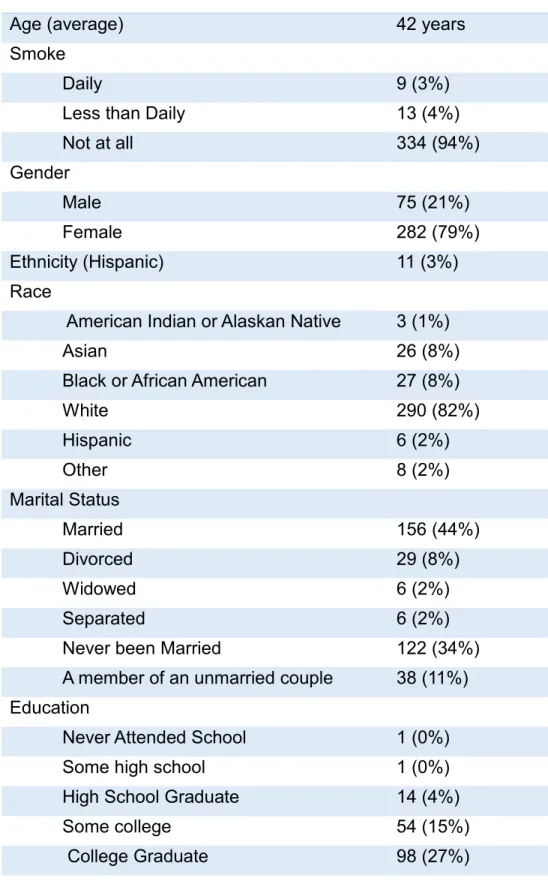
Table 1: Summary of Sample Population, Demographic Statistics
N 373
Age (average) 42 years
Smoke
Daily 9 (3%)
Less than Daily 13 (4%)
Not at all 334 (94%)
Gender
Male 75 (21%)
Female 282 (79%)
Ethnicity (Hispanic) 11 (3%)
Race
American Indian or Alaskan Native 3 (1%)
Asian 26 (8%)
Black or African American 27 (8%)
White 290 (82%)
Hispanic 6 (2%)
Other 8 (2%)
Marital Status
Married 156 (44%)
Divorced 29 (8%)
Widowed 6 (2%)
Separated 6 (2%)
Never been Married 122 (34%)
A member of an unmarried couple 38 (11%) Education
Never Attended School 1 (0%)
Some high school 1 (0%)
High School Graduate 14 (4%)
Some college 54 (15%)
Advance Degree 190 (53%)
Military Service 13 (4%)
Almost all of the AIT questions had a full range of responses. However,
questions 6 and 16 had zero responses in the strongly agree category. In general, many of the responses to questions were weighted towards disagree and strongly disagree. Question 17 was the only question that had a majority of respondents selecting strongly agree (110 responses). For more detailed information about the questions and their responses, please see the appendix.
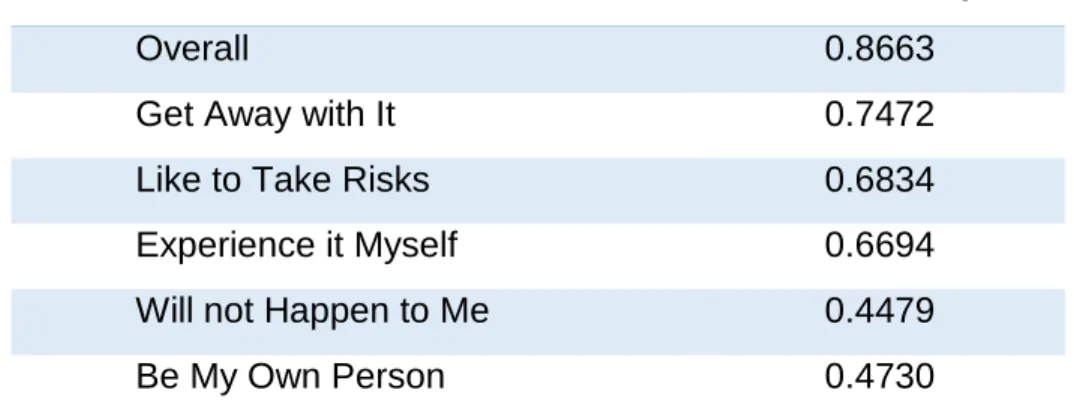
Reliability, assessed by Cronbach’s alpha, for the AIT survey was 0.866. Dropping three questions, question 4, 14, and 17, raises Cronbach’s alpha to 0.881. I also looked at the reliability for the original five factors suggested by the authors, including all of the original questions. These alphas are shown in Table 2.
Table 2: Cronbach’s Alpha Overall, of Individual Five Factors
Factor Cronbach’s Alpha
Overall 0.8663
Get Away with It 0.7472
Like to Take Risks 0.6834
Experience it Myself 0.6694
Will not Happen to Me 0.4479
Be My Own Person 0.4730
Brown 14
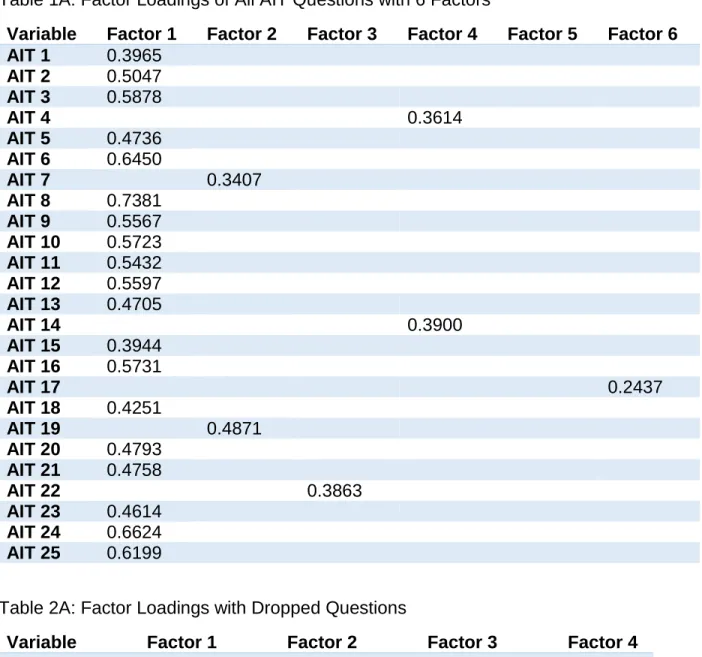
factors. Questions 4, 7, 14, 17, 19, and 22 did not load in Factor 1. I found 4 factors with eigenvalues greater than 1 when questions 4, 14, and 17 were dropped. I looked at the factor loadings of the questions with one, two, three and four factors. Factor 1
dominated in all instances, with only question 19 falling outside of Factor 1 with a four factor analysis. For more detailed analyses, please see the tables in the appendix.
I scored the AIT by adding all of the complete survey scores together to create a composite number. If a survey participant skipped an AIT question, their composite score was listed as missing; this lead to 15 participants being dropped, 11 of whom had completed fewer than half of the AIT questions. Using Pearson and Spearman
correlations, I compared the AIT score with age, marital status, smoking status,
education level, military service, race and ethnicity (Hispanic or non-Hispanic), gender, and Risk Propensity Scale score. The AIT score did not correlate with any of these other factors. However, the gender correlation was the only one that was statistically significant.
Table 2: AIT Score Correlations with Demographic Questions, Risk Propensity Survey (RPS) Score
Variable Item Correlation
Age1 0.1760*
Gender2 0.1726*
Education2 -0.0481
Smoking2 -0.0444
Military Service2 0.0053
Marital Status2 -0.1272
Ethnicity2 0.0459
Race2 -0.0656
1: Pearson Correlation 2: Spearman Correlation
*: p > 0.05
I also compared AIT scores based on gender and AIT scores by age (30 or older or less than 30 years old) using t-tests. The difference in AIT scores for gender was statistically significant, with women having a higher average score (or lower perceived invincibility). The difference in AIT score based on age was also statistically significant, with those younger than 30 years old having a lower average score (or higher perceived invincibility). Please see Table 3A in the appendix for more information.
Discussion
For the AIT survey, I would make several recommendations about future
changes. I would recommend dropping question 17. While all of the other questions in the AIT deal with feelings and values regarding behaviors, question 17 addresses specific potential health outcomes, specifically HIV and STDs. It also had a low alpha and loaded poorly. It could be its own dimension, more testing would be needed to determine that.
While I recommend dropping questions 4, 7, and 14, I do not recommend it as strongly. From a content perspective, I do not know why these three questions would not have done as well as the other questions.
I would also recommend only using one factor, which I will call perceived
Brown 16
original authors. However, in my study questions did not load in all of those factors and in the authors’ study they did; the factor loadings were not the same.
While most of my correlations were not statistically significant, the differences in scores between young and old and male and female were. These were consistent with the literature, which indicates that younger people (such as adolescents, for example) have greater perceived invincibility,xxxvi and that men have greater likelihood of high risk
behavior, as previously mentioned in the background section.xxxvii
This study has multiple limitations. The Risk Propensity Scale, while looking at the concept that needed to be addressed, was not the easiest survey to understand. I received an email from one survey participant, who noted “I am not sure of the
difference between "quite often" and "very often” [in the response scale]… They also seem to be out of order (I would think that "quite often" happens more than "often").”xxxviii
In addition, the instructions for that part of the survey were not very clearly written, and the reference period was very vague.
Another limitation is the sample. The UNC community is very highly educated, and many of the respondents were white and female. This lack of diversity can impact how generalizable my results are to a larger population. However, I less concerned about the population being highly educated because the survey was initially designed to be understandable by children and was validated in that younger (and therefore less educated) population. Because my sample was lacking diversity, it also prevented me from making statistically significant correlations.
lower ages are more likely to be in the Health Policy and Management Department, who may be more health conscious and therefore risk averse.
Next Steps and Conclusion
The AIT still needs further testing in an adult population, specifically a more diverse population. A concerted effort to recruit less educated individuals and
individuals with different ethnic and racial backgrounds should be made to validate in a larger population.
Perceived invincibility is an important component in determining why individuals undertake risky health behaviors. Surveys, such as the AIT, can help identify
Brown 18
Appendix
Table 1A: Factor Loadings of All AIT Questions with 6 Factors
Variable Factor 1 Factor 2 Factor 3 Factor 4 Factor 5 Factor 6 AIT 1 0.3965
AIT 2 0.5047 AIT 3 0.5878
AIT 4 0.3614
AIT 5 0.4736 AIT 6 0.6450
AIT 7 0.3407
AIT 8 0.7381 AIT 9 0.5567 AIT 10 0.5723 AIT 11 0.5432 AIT 12 0.5597 AIT 13 0.4705
AIT 14 0.3900
AIT 15 0.3944 AIT 16 0.5731
AIT 17 0.2437
AIT 18 0.4251
AIT 19 0.4871
AIT 20 0.4793 AIT 21 0.4758
AIT 22 0.3863
AIT 23 0.4614 AIT 24 0.6624 AIT 25 0.6199
Table 2A: Factor Loadings with Dropped Questions
Variable Factor 1 Factor 2 Factor 3 Factor 4
AIT 1 0.4032
AIT 2 0.4970
AIT 3 0.5922
AIT 5 0.4732
AIT 6 0.6395
AIT 8 0.7457
AIT 9 0.5585
AIT 10 0.5601
AIT 11 0.5532
AIT 12 0.5576
AIT 13 0.4664
AIT 16 0.5563
AIT 18 0.4287
AIT 19 0.5234
AIT 20 0.4865
AIT 21 0.4593
AIT 22 0.3782
AIT 23 0.4542
AIT 24 0.6715
AIT 25 0.6244
Table 3A: Mean AIT Scores by Age, Gender
Variable N Mean AIT
Score Age
Less than 30 110 79.7273* Greater than
or Equal to 30
240 82.7143
Gender
Male 74 78.0657*
Female 279 82.7204
Table 4A: Overall Survey Consent
You are invited to take part in a research study about personality and behaviors. Your participation will require approximately 10 minutes to complete an online survey. There are no known risks or discomforts
associated with this survey. Taking part in this study is completely voluntary. If you choose to be in the study, you can withdraw at any time. Your responses will be kept strictly confidential, and digital data will be stored in secure
computer files. Any report of this research that is made available to the public will not include any individual information by which you could be identified. If you have questions or want a copy or summary of this study’s results, you can contact the researcher at [email protected].
Please indicate how strongly agree or disagree with the following statements. Strongly agree Agree Neither
agree or disagree
Disagree Strongly disagree I like to be the first
person who tries something new.
Brown 20
I can talk my way out of most problems.
1 2 3 4 5
I like to experiment with things that others say may hurt me.
1 2 3 4 5
I don't care what others think about me.
1 2 3 4 5
I think of myself as having more ability than others.
1 2 3 4 5
It doesn't matter if I do dangerous
things, I know I'll be safe.
1 2 3 4 5
Bad things don't happen to me.
1 2 3 4 5
I'm the kind of person who likes to take risks.
1 2 3 4 5
I like to have uncertainty in my life.
1 2 3 4 5
I don't get hurt when I do risky things.
1 2 3 4 5
PAGE BREAK
Strongly agree Agree Neither agree or disagree
Disagree Strongly disagree I’m the type of
person who needs to experience things for myself.
1 2 3 4 5
I get away with just about everything.
1 2 3 4 5
People say that I’m a show off.
1 2 3 4 5
I don’t worry about tomorrow.
I like to do things that others think are cool.
1 2 3 4 5
I tend to think that consequences of risks won’t happen to me.
1 2 3 4 5
I don’t see myself getting STDs,
including HIV/AIDS.
1 2 3 4 5
I like a challenge. 1 2 3 4 5
I think of myself as being better than others.
1 2 3 4 5
I like to be different. 1 2 3 4 5
It’s easy for me to overcome
obstacles.
1 2 3 4 5
I like to be my own person.
1 2 3 4 5
I tend to do things my way no matter what anyone else says.
1 2 3 4 5
I like to take dares. 1 2 3 4 5
My friends say that I’m adventurous.
1 2 3 4 5
PAGE BREAK
We are interested in everyday risk-taking. Please could you tell us if any of the following apply to you now?
Very often Often Quite often Rarely Never recreational risks
(e.g. rock-climbing, scuba diving)
1 2 3 4 5
health risks (e.g. smoking, poor diet, high alcohol
consumption)
1 2 3 4 5
career risks (e.g. quitting a job
Brown 22
without another to go to)
financial risks (e.g. gambling, risky investments)
1 2 3 4 5
safety risks (e.g. fast driving, city cycling without a helmet)
1 2 3 4 5
social risks (e.g. standing for election, publicly challenging a rule or decision)
1 2 3 4 5
PAGE BREAK What is the highest grade or year of school you completed?
What is your marital status? Married Divorced Widowed Separated Never been married A member of an unmarried couple
Are you Latino/a or Hispanic?
Yes No What is your race or ethnicity? American Indian or Alaska Native; Asian; Black or African American; Native Hawaiian or Pacific Islander; White; Hispanic; Other Have you served or
are you currently serving in the military or armed forces?
Yes No
What is your age? (fill in #) What is your sex? Male
Female Other Do you currently
smoke tobacco on a daily basis, less than daily, or not at all?
Brown 24
Endnotes
i Eaton, D. K., et al.. Youth risk behavior surveillance--united states, 2005. MMWR.
Surveillance Summaries : Morbidity and Mortality Weekly Report. Surveillance Summaries / CDC, 55(5), 1-108. Retrieved from www.scopus.com
ii Killgore W, Kelley A, Balkin T. So You Think You're Bulletproof: Development and
Validation of the Invincibility Belief Index (IBI). Military Medicine [serial online]. July 2010;175(7):499-508. Available from: Military & Government Collection, Ipswich, MA. Accessed October 1, 2015.
iii Ibid.
iv Weinberg, Jennifer. Medicine’s Response to Lifestyle-Related Preventable Illness.
AMA Journal of Ethics, April 2013. Accessed November 2, 2015. http://journalofethics.ama-assn.org/2013/04/fred1-1304.html.
v Wickman, Mary, et al.. The Relationship of Perception of Invincibility, Demographics,
and Risk Behaviors in Adolescents of Military Parents. Journal of Pediatric Health Care, February 2010. Accessed October 27, 2010.
http://www.sciencedirect.com/science/article/pii/S0891524508003519.
vi Ibid. vii Ibid. viii Ibid. ix Ibid.
x Sensation Seeking. Consumer Health Informatics Research Resource. Accessed
October 27, 2015. http://chirr.nlm.nih.gov/sensation-seeking.php.
xi Ibid. xii Ibid. xiii Ibid.
xiv Wickman, Mary, et al.. The Relationship of Perception of Invincibility, Demographics,
and Risk Behaviors in Adolescents of Military Parents.
xv Perceived Susceptibility. Consumer Health Informatics Research Resource.
Accessed October 27, 2015. http://chirr.nlm.nih.gov/perceived-susceptibility.php.
xvi Ibid.
Brown 26
xvii Perceived Severity. Consumer Health Informatics Research Resource. Accessed
October 27, 2015. http://chirr.nlm.nih.gov/perceived-severity.php.
xviii Perceived Susceptibility.
xix Killgore W, Kelley A, Balkin T. So You Think You're Bulletproof: Development and
Validation of the Invincibility Belief Index (IBI).
xx Ibid. xxi Ibid. xxii Ibid. xxiii Ibid. xxiv Ibid. xxv Ibid. xxvi Ibid.
xxvii Wickman, Mary, et al.. The Relationship of Perception of Invincibility, Demographics,
and Risk Behaviors in Adolescents of Military Parents.
xxviii Wickman, Mary, et al.. Invincibility Fable: Tool Development to Measure Invincibility.
Journal of Pediatric Medicine, 2013.
http://www.sciencedirect.com/science/article/pii/S0882596313002455.
xxix Wickman, Mary, et al.. The Relationship of Perception of Invincibility, Demographics,
and Risk Behaviors in Adolescents of Military Parents.
xxx Wickman, Mary, et al.. Invincibility Fable: Tool Development to Measure Invincibility. xxxi Ibid.
xxxii Ibid. xxxiii Ibid. xxxiv Ibid.
xxxv Nicholson, Nigel, et al.. Personality and Domain-Specific Risk Taking. Journal of
Risk Research, March 2005.
http://www.tandfonline.com/doi/abs/10.1080/1366987032000123856#.VwaBXEfRBHU.
xxxvii Wickman, Mary, et al.. The Relationship of Perception of Invincibility,
Demographics, and Risk Behaviors in Adolescents of Military Parents.