Acknowledgements
Abstract
Breast cancer is a heterogeneous disease comprising five major subtypes including luminal A, luminal B, HER2, basal-like, and normal breast-like tumors. Of the five subtypes of breast cancer, the basal-like subtype has the shortest survival and poorest prognosis. This subtype accounts for 10-20% of all breast cancers and is particularly problematic due to its aggressive nature. Moreover, these tumors currently have limited treatment options, due in part to the absence of growth factor receptors ER, PR, and HER2, which are often used as clinical targets in breast cancer therapies. A review of the literature was conducted using multiple databases, journal publications, and citation indices to comprehensively understand the genetic, epigenetic, and environmental factors contributing to the basal-like subtype. Beginning with a diagnosis of basal-like breast cancer, through aggressive treatment and post-treatment follow-up, oncology nurses play a pivotal role in providing holistic care and support for these patients. Therefore, it is imperative that they understand the complexity of the clinical presentation, as well as the current therapies and the underlying biology of this cancer subtype.
Deconstructing Breast Cancer Heterogeneity: Clinical Implications for Women with Basal-like Tumors
One in eight women in the United States will develop breast cancer in her lifetime and breast cancer is the second leading cause of cancer death among women (DeSantis, Ma, Bryan, & Jemal, 2013). Breast cancer embodies several clinically distinct diseases that result from the interaction of varied genetic and environmental influences, many of which are not yet well understood. Specifically, breast tumors consist of several pathological subtypes with different histological appearances of the malignant cells, different clinical presentations and outcomes, and the patients show a diverse range of responses to a given treatment (Sorlie, 2004). Therefore, it is essential to investigate the subtypes of breast cancer in order to plan the optimal route of treatment for any given patient.
Historically breast tumors were classified via immunohistochemical (IHC) protein staining for estrogen, progesterone, or epidermal growth factor 2 receptors (ER, PR, and HER2, respectively), but the advent of gene expression microarrays has made a more comprehensive molecular assessment possible. Gene expression refers to the process whereby DNA is
outcomes for individual patients.
Indeed, major breakthroughs in the understanding of breast cancer heterogeneity have been made by Perou et al. (2000) and Parker et al. (2009), by showing that there are multiple types of breast tumors, each with distinct prognosis and risk indicators that are defined by differential gene expression. The currently recognized five main subtypes of breast cancer that reflect distinct gene-expression patterns are; luminal A, luminal B, normal breast-like, human epidermal growth factor receptor 2 or HER2, and basal-like (Yehiely, Moyano, Evans, Nielsen, & Cryns, 2006). Basal-like breast cancer is especially aggressive, with the highest chance of disease recurrence and the poorest survival rates. Basal-like tumors represent 10-20% of cases (Table 1), and typically do not have estrogen receptor (ER), progesterone receptor (PR), or HER2 growth factor receptors on their cell surfaces. Therefore, “triple negative” tumors (ER-PR-HER2-), would not be expected to benefit from receptor-targeted therapies such as tamoxifen or herceptin (Cheang, Voduc, Bajdik, Leung, McKinney, Chia, Perou, & Nielsen, 2008). Basal-like tumors are associated with the shortest survival of all five-breast cancer subtypes due to
increased rates of early relapse within the first five years, and their overall poor pathologic indices. Specifically, basal-like tumors are typically poorly differentiated, high-grade invasive ductal carcinomas with a high mitotic index (e.g. rapidly dividing cells), and an increased likelihood for metastases to brain and lung (Yehiely et al., 2006). Due to the aggressive nature of basal-like breast cancer and the poor treatment options available, basal-like breast cancer will be investigated in depth, with particular focus on the epigenetic risk factors and current clinical targets for this breast tumor subtype.
Distinctions Between Basal-like and Triple-negative Breast Cancer
Research shows that basal-like and triple negative cancers are not mutually exclusive as there is some degree of overlap between these classifications; however, the terms are not synonymous. Bertucci et al. (2008), showed that only 71% of triple-negative cancers (e.g., tumor cells which do not have receptors for estrogen, progesterone, or HER2, and referred to as ER-PR-HER2-), were of like subtype by gene expression profiling and that only 77% of molecular basal-like tumors were triple-negative. Currently, there are multiple IHC markers used to distinguish between basal-like and the various other subtypes of breast cancer, however, there is no
internationally accepted definition for basal-like cancers based on protein staining alone, nor is there a specific hallmark morphologic feature that can identify those tumors reliably in routine practice (Rakha, Reis-Filho, & Ellis, 2008).
In addition to often being ER-, PR-, and HER2-, basal-like tumors frequently express (or IHC stain positive for) Vimentin, EGF receptor, and CK5/CK6 proteins (Yehiely et al., 2006). One study specifically found that a panel of four antibodies comprising of ER, HER1, HER2 and Cytokeratin 5/6 could accurately identify basal-like tumors with high specificity using standard available clinical tools in pathology laboratory settings (Nielsen et al., 2004). When examining the data available on basal-like breast cancer, it is important to clarify the triple negative status and specific markers used to identify the subtype in order to obtain an accurate understanding of their complexity and corresponding clinical implications.
is incomplete, with up to 30% discordance between the two definitions (Bertucci, Finetti, & Birnbaum, 2012). Other potential confounding problems with IHC are that targeted antibodies must be able to efficiently stain protein receptors in varied locations. For example, the target protein may be located either inside or on the cell surface; therefore, a tumor may be both ER+ and ER- depending on the IHC stain. As with all IHC markers, factors such as tissue fixation, the choice of antibody, and the threshold for interpretation of positive immunostaining can
dramatically affect test accuracy and reproducibility, resulting in a wide variation in the reporting of results of estrogen and progesterone status (Gown, 2008).
This heterogeneity poses a challenge when trying to establish treatment options and effective therapies for basal-like breast cancer, and further highlights that the genes responsible for this aggressive phenotype are currently not well understood. The PAM50 (predictive analysis of microarray), measures differential expression of 50 classifier genes and five control genes to categorize tumors into 5 subtypes, providing a risk of reoccurrence score to estimate the
probability of relapse at 5 years (Goncalves & Bose, 2013). Recently, the PAM50 assay has been approved by the FDA because it is superior to the IHC tumor protein staining classification for prognosis across the full spectrum of breast cancer subtypes (Chia et al., 2012). In this paper, triple negative breast cancer (TNBC) will refer to tumors identified to be ER-, PR-, and HER2- by IHC analysis, and basal-like will refer to tumors that express the specific basal-like profile of genes identified through the PAM50 analysis based on microarray data.
Risk Factors for Basal-like Breast Cancer
The heterogeneity within breast cancer subtypes is further underscored by recent findings indicating each tumor subtype may have unique associated risk and/or protective factors.
risk was highest for basal-like tumors (Yang et al., 2007). Millikan et al (2008) studied the predominance of specific subtypes by race, and found the prevalence of basal-like breast cancer was highest among premenopausal African-American women, whereas postmenopausal white women showed the highest prevalence of the luminal A subtype. The contrast between the findings that menopausal status was protective for one subtype, and a risk factor for another, highlights that the luminal A and basal-like subtypes are biologically distinct. Lund et al. (2009) replicated these findings by showing triple negative tumors were the most common breast cancer subtype diagnosed in young African American women when concurrently considering
differences in age, stage at diagnosis, tumor grade, diagnosis delay, and socio-demographic factors. Such racial disparity is particularly pronounced among younger women diagnosed before 50 years of age.
Although African Americans showed higher breast cancer-specific mortality than whites, the effect of race was statistically significant only among women with luminal A breast cancer; therefore, basal-like breast cancer does not appear to be an inherently more aggressive disease in African American women compared with whites (O’Brien et al., 2010). Younger African
American women had a higher prevalence of each of the principal risk factors for basal-like breast cancer: higher parity, lower breastfeeding, early onset menarche, younger age at first full term pregnancy, greater use of lactation suppressants, and elevated waist-hip ratio (Millikan et al., 2008).
among premenopausal women, while increasing age at menarche was associated with lower risk of basal-like tumors than luminal A tumors (Yang et al., 2007). Millikan et al. (2008) suggested that up to 68% of basal-like breast cancer could be prevented by promoting breastfeeding and reducing abdominal adiposity, because longer duration breastfeeding, increasing number of children breastfed, and increasing number of months breastfeeding per child were each associated with reduced risk of basal-like breast cancer, but not luminal A tumors.
The Relationship of Epigenetics to Basal-like Breast Cancer
Historically, the term epigenetics, coined by Conrad Waddington in the 1940’s, was broadly defined as the interaction between an organism’s environment and genetics that
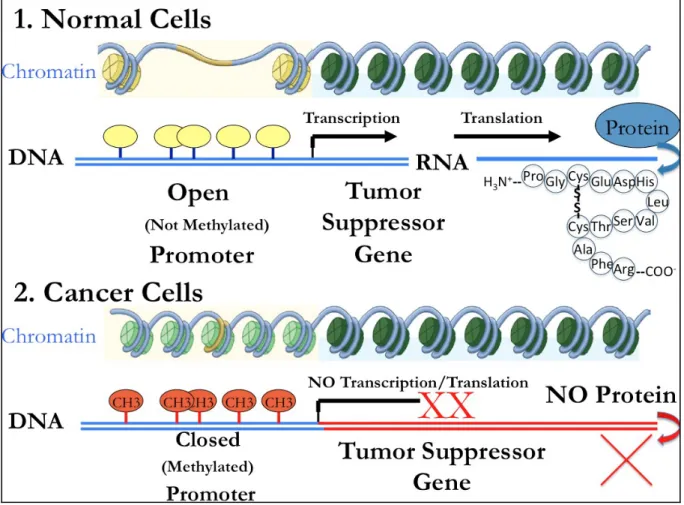
ultimately influences phenotype. Today, epigenetics is often conceptualized as changes in gene function that are not a result of genetic mutations or changes in the primary DNA coding sequence itself. Epigenetic mechanisms are of particular interest because they are heritable and reversible. Unlike genetic mutations, aberrant epigenetic changes can be reversed through pharmacologic interventions and behavioral modifications such as changes in diet and lifestyle (Feinberg, 2008).Epigenetic modifications can occur at the DNA level through DNA
Ulirsch et al., 2013). Jones and Laird (1999) suggested that epigenetic mechanisms such as DNA methylation should be included in Knudson’s two hit hypothesis, which explains that genetic mutations along with loss of heterozygosity, cause inactivation of tumor suppressor genes that contribute to cancer development.
BRCA1 is an example of a tumor suppressor gene that can be deficient as a result of genetic mutations, but it can also be silenced epigenetically through methylation (Yehiely, 2006). Turner and colleagues (2007) found that 63% of metaplastic breast cancers, a rare type of basal-like cancers, had BRCA1 methylation in comparison to 12% of controls. Therefore, BRCA1 dysfunction provides a promising avenue for treatment of basal-like cancer. Similarly, Grushko and colleagues (2010) found basal-like tumors showed the highest proportion of BRCA1
methylation relative to luminal tumors. Basal-like breast cancers display methylation patterns for additional genes involved in breast carcinogenesis including BRCA1, RARβ, CDH1 and APC1, that are distinct when compared to luminal and HER2 subtypes (Bardowell et al, 2013; Lee et al., 2010). Moreover, Bardowell (2013), found differential methylation patterns amongst and within all breast cancer subtypes, e.g., the MIA gene was hypermethylated in normal tissues as well as all tumor subtypes, except for a subset of basal-like tumors in which it was found to be
hypomethylated. These methylation signatures are of particular interest for their potential use as markers for early detection, risk assessment, and due to their reversible nature, may be attractive targets for clinical therapies.
RB1 and p16 gene inactivation, important hallmarks of basal-like breast cancer. The clinical significance of this finding relates to the importance of poly ADP ribose polymerase (PARP) inhibitors in the treatment of patients with the triple negative subtype of breast cancer wherein hypermethylation of BRCA1 could serve as a predictor of therapeutic response. Inactivating mutations of the tumor suppressor gene p53 also occur in the majority of basal-like breast cancer cases (TCGA, 2012; Jiang et al., 2011). Notably, genetic mutations in p53 are associated with epigenetic changes in other genes, such as a loss of methylation in IL-6. In a cascade effect, IL6 gene hypomethylation further induces epigenetic changes and consequent overexpression of cancer stem cell markers CD133 and CD44, ultimately transforming these tumors into a basal-like/stem cell-like aggressive cancers (De’Anello et al., 2010).
Such epigenetic modifications specific to basal-like breast cancer may help identify new targets for therapy. Due to the reversible nature of histone acetylation and DNA methylation, epigenetic therapies hold great promise. Thus far however, epigenetic therapies have only been successfully trialed in lymphoma and leukemia, but are not yet approved for use in solid tumors such as breast cancer. Nevertheless, most therapies for basal-like breast cancer take advantage of genetic mutations rather than epigenetic modifications.
Current Clinical Targets for Basal-Like Breast Cancer
anthracycline-based chemotherapies are able to induce widespread cancer cell death that normal cells with functioning DNA repair mechanisms would otherwise be able to combat.
In a related vein, BRCA1 pathway deficient cells found in a subset of basal-like tumors are susceptible to platinum-based DNA damaging agents as well as PARP inhibitors. Other clinical targets that have been identified include PI3K and EGFR/HER1 inhibitors. Many of these drugs have been found to be beneficial when used as neoadjuvant therapies or in
combination. With regard to the BRCA1 dysfunction found in basal-like breast cancer, occurring either through a germline mutation or epigenetic silencing, platinum chemotherapy agents such as carboplatin and cisplatin have shown improved clinical outcomes for women with basal-like tumors. Specifically, these agents induce DNA cross-links, which lead to DNA double-strand breaks that would normally be repaired by a functioning BRCA1 or BRCA2 pathway. This is an elegant way to target a natural vulnerability in a “rogue” cancer cell, in that BRCA1 and BRCA2 deficient cells are highly sensitive to apoptosis by DNA damage agents in comparison to normal cells (Quinn et al., 2003). For example, one study showed that BRCA2 is required for the subnuclear assembly of a repair protein called RAD51. In healthy cells, BRCA2, RAD51, and other repair proteins would normally be able to respond and repair DNA damage caused by radiation therapy. It makes sense therefore that BRCA1 deficient tumor cells are 5-fold more sensitive to the DNA damage agent cisplatinum compared with wild-type normal cells (Bhattacharyya, Ear, Koller, Weichselbaum, & Bishop, 2000). A recent study supports the biological rationale for these therapies in that 72% of n= 25 BRCA1 deficient women were observed to have complete pathologic response when treated with a cisplatin regimen (Gronwald et al., 2009).
pathway. Drug inhibitors of PARP, an enzyme involved in DNA base-excision repair, prevent the repair of breaks in DNA. This only occurs, however, when the cells are BRCA1 or BRCA2 pathway deficient, and will therefore not have the ability to repair double stranded DNA breaks (Farmer et al., 2005; Toft & Cryns, 2011). PARP inhibitors have been studied in conjunction with chemotherapy and ABT-888, a potent inhibitor of both PARP-1 and PARP-2, and have been found to increase the targeted cancer cell toxicity of platinum based chemotherapies and radiation in mouse tumor models, thus making them candidates for further clinical evaluation (Donawho et al., 2007).
The phosphoinositide 3-kinase (PI3K) pathway also has great potential for therapeutic intervention. It is responsible for promoting cell survival and growth, and is activated in numerous human cancers either through somatic mutations or receptor tyrosine kinases
(Engelman, 2009). An association between an activated enzyme PI3K pathway and the basal-like subtype suggests that inhibitors of enzyme pathways like PI3K may be potential therapeutic targets in treating the basal-like subtype of cancer (Hoeflich et al., 2009; Lopez-Knowles et al., 2010; Wong, Engelman, & Cantley, 2010). For example, Moestue et al. (2013) found that long-term treatment with PI3K inhibitors resulted in significant growth inhibition in basal-like, but not luminal-like mouse models. They also observed variable PI3K signaling activity in human biopsies of basal-like tumors.
associated with cell division and migration, cell adhesion, differentiation and apoptosis (Yardin & Sliwkowski, 2001). Studies suggest EGFR inhibitors may be a viable treatment option, as they are not only effective in a subset of basal-like tumors, but also have the potential to increase the therapeutic effects of chemotherapeutic agents such as cisplatin (Hoadley et al., 2007; Oliveras-Ferraros et al., 2008; Siziopikou & Cobleigh, 2007). Throughout, we have emphasized the inherent heterogeneity of breast cancer, and the variable signaling activity in the P53, PI3K and EGFR signaling pathways described underscores the diversity found even within the basal-like subtype itself.
Currently, neoadjuvant chemotherapies are a promising treatment option for individuals diagnosed with basal-like breast cancer. The basal-like and HER2 subtypes of breast cancer were found to be more sensitive to preoperative chemotherapies as they showed higher percentages of complete response to paclitaxel and doxorubicin than luminal and normal-like tumors. Although rates of pathological complete response for preoperative chemotherapy are higher for TNBC, the majority of women nevertheless will have residual disease, and a higher risk for relapse and death within the first 2-5 years of diagnosis (Carey et al., 2007; Liedtke et al., 2008; Rody et al., 2007; Rouzier et al., 2005).
Based on the evidence, there is reasonable expectation that a combination of
this aggressive subtype.
Nursing Implications
Great strides are being made in deconstructing the molecular and clinical heterogeneity of breast cancer. It is now known a number of subtypes have distinct genetic/epigenetic
modifications and exhibit different responses to clinical therapies. Breast tumors are as unique as the individuals in which they develop; therefore, molecular analysis of each tumor subtype will be essential to identifying the best clinical course of action for each patient. Future clinical trials investigating the effect of these novel therapies, both alone and in combination, hold much promise for women with basal-like breast cancer.
References
Bardowell, S. A., Parker, J., Fan, C., Crandell, J., Perou, C. M., & Swift-Scanlan, T. (2013). Differential methylation relative to breast cancer subtype and matched normal tissue reveals distinct patterns. Breast cancer research and treatment, 142(2), 365-380. http://dx.doi.org/10.1007/s10549-013-2738-0
Bertucci, F., Finetti, P., & Birnbaum, D. (2012). Basal breast cancer: A complex and deadly molecular subtype. Current Molecular Medicine, 12(1), 96-110.
http://dx.doi.org/10.2174/156652412798376134
Bertucci, F., Finetti, P., Cervera, N., Esterni, B., Hermitte, F., Viens, P. and Birnbaum, D. (2008), How basal are triple-negative breast cancers?. Int. J. Cancer, 123, 236–240. http://dx.doi.org/10.1002/ijc.23518
Bhattacharyya, A., Ear, U. S., Koller, B. H., Weichselbaum, R. R., & Bishop, D. K. (2000). The breast cancer susceptibility gene BRCA1 is required for subnuclear assembly of Rad51 and survival following treatment with the DNA cross-linking agent cisplatin. Journal of Biological Chemistry, 275(31), 23899-23903. http://dx.doi.org/10.1074/jbc.C000276200 Carey, L. A., Dees, E. C., Sawyer, L., Gatti, L., Moore, D. T., Collichio, F., ... & Perou, C. M.
(2007). The triple negative paradox: primary tumor chemosensitivity of breast cancer subtypes. Clinical Cancer Research, 13(8), 2329-2334. http://dx.doi.org/10.1158/1078-0432.CCR-06-1109
Cheang, M., Voduc, D., Bajdik, C., Leung, S., McKinney, S., Chia, S., Perou, C., Nielsen, T. (2008). Basal-like breast cancer defined by five biomarkers has superior prognostic value than triple-negative phenotype. Clinical cancer research, 14(5), 1368-1370.
Chia, S., Bramwell, V., Tu, D., Shepard, L., Jiang, S., Vickery, T,.…Nielsen, T. (2012). A 50-Gene intrinsic subtype classifier for prognosis and prediction of benefit from adjuvant tamoxifen. Clinical Cancer Research, 18(16), 4465-72. http://dx.doi.org/10.1158/1078-0432.CCR-12-0286
D’Anello, L., Sansone, P., Storci, G., Mitrugno, V., D'Uva, G., Chieco, P., & Bonafé, M. (2010). Epigenetic control of the basal-like gene expression profile via Interleukin-6 in breast cancer cells. Mol Cancer, 9:300. http://dx.doi.org/10.1186/1476-4598-9-300
DeSantis, C., Ma, J., Bryan, L., & Jemal, A. (2013). Breast cancer statistics, 2013. CA: A Cancer Journal for Clinicians. http://dx.doi.org/10.3322/caac.21203
Donawho, C. K., Luo, Y., Luo, Y., Penning, T. D., Bauch, J. L., Bouska, J. J., ... & Frost, D. J. (2007). ABT-888, an orally active poly (ADP-ribose) polymerase inhibitor that
potentiates DNA-damaging agents in preclinical tumor models. Clinical cancer research, 13(9), 2728-2737. http://dx.doi.org/10.1158/1078-0432.CCR-06-3039
Engelman, J. A. (2009). Targeting PI3K signalling in cancer: opportunities, challenges and limitations. Nature Reviews Cancer, 9(8), 550-562. http://dx.doi.org/10.1038/nrc2664 Eroles, P., Bosch, A., Alejandro Perez-Fidalgo, J., & Lluch, A. (2012). Molecular biology in breast cancer: intrinsic subtypes and signaling pathways. Cancer treatment reviews, 38(6), 698-707. http://dx.doi.org/10.1016/j.ctrv.2011.11.005
Farmer, H., McCabe, N., Lord, C. J., Tutt, A. N., Johnson, D. A., Richardson, T. B., ... & Ashworth, A. (2005). Targeting the DNA repair defect in BRCA mutant cells as a therapeutic strategy. Nature, 434(7035), 917-921. http://dx.doi.org/10.1038/nature03445 Feinberg, A. P. (2008). Epigenetics at the epicenter of modern medicine. JAMA: the journal of
http://dx.doi.org/10.1001/jama.299.11.1345
Foulkes, W. D., Stefansson, I. M., Chappuis, P. O., Bégin, L. R., Goffin, J. R., Wong, N., ... & Akslen, L. A. (2003). Germline BRCA1 mutations and a basal epithelial phenotype in breast cancer. Journal of the National Cancer Institute, 95(19), 1482-1485.
http://dx.doi.org/10.1093/jnci/djg050
Goncalves, R. & Bose, R. (2013). Using multigene tests to select treatment for early-stage breast cancer. The Journal of the National Comprehensive Cancer Network, 11(2), 174-182. http://www.jnccn.org/content/11/2/174.full.pdf
Gown, A.M. (2008). Current Issues in ER and HER2 testing by IHC in breast cancer. Modern Pathology, 21, 8-15. http://dx.doi.org/10.1038/modpathol.2008.34
Gronwald, J., Byrski, T., Huzarski, T., Dent, R., Bielicka, V., Zuziak, D., ... & Narod, S. (2009). Neoadjuvant therapy with cisplatin in BRCA1-positive breast cancer patients. J Clin Oncol, 27(15S), 502. http://dx.doi.org/10.1186/1897-4287-9-S2-A4
Grushko, T. A., Nwachukwu, C., Charoenthammaraksa, S., Huo, D., Khramtsov, A., Mashek, H., ... & Olopade, O. I. (2010, June). Evaluation of BRCA1 inactivation by promoter methylation as a marker of triple-negative and basal-like breast cancers. In ASCO Meeting Abstracts (Vol. 28, No. Suppl 15, p. 10510).
Hinshelwood, R. A., & Clark, S. J. (2008). Breast cancer epigenetics: normal human mammary epithelial cells as a model system. Journal of molecular medicine, 86(12), 1315-1328. http://dx.doi.org/ 10.1007/s00109-008-0386-3
Hoeflich, K. P., O'Brien, C., Boyd, Z., Cavet, G., Guerrero, S., Jung, K., ... & Lackner, M. R. (2009). In vivo antitumor activity of MEK and phosphatidylinositol 3-kinase inhibitors in basal-like breast cancer models. Clinical Cancer Research, 15(14), 4649-4664.
http://dx.doi.org/10.1158/1078-0432.CCR-09-0317
Holm, K., Hegardt, C., Staaf, J., Vallon-Christersson, J., Jönsson, G., Olsson, H., ... & Ringnér, M. (2010). Molecular subtypes of breast cancer are associated with characteristic DNA methylation patterns. Breast Cancer Research, 12:R36, 1-16.
http://dx.doi.org/10.1186/bcr2590
Jiang, Z., Jones, R., Liu, J. C., Deng, T., Robinson, T., Chung, P. E., ... & Zacksenhaus, E. (2011). RB1 and p53 at the crossroad of EMT and triple-negative breast cancer. Cell Cycle, 10(10), 1563-1570. http://dx.doi.org/10.4161/cc.10.10.15703
Jones, P. A., & Laird, P. W. (1999). Cancer-epigenetics comes of age. Nature genetics, 21(2), 163-167. http://dx.doi.org/10.1038/5947
Joosse, S. A., Brandwijk, K. I., Mulder, L., Wesseling, J., Hannemann, J., & Nederlof, P. M. (2011). Genomic signature of BRCA1 deficiency in sporadic basal-like breast tumors. Genes, Chromosomes and Cancer, 50(2), 71-81. http://dx.doi.org/10.1002/gcc.20833 Kashiwagi, S., Yashiro, M., Takashima, T., Aomatsu, N., Kawajiri, H., Ogawa, Y., ... &
Hirakawa, K. (2013). c-Kit expression as a prognostic molecular marker in patients with basal-like breast cancer. British Journal of Surgery. http://dx.doi.org/10.1002/bjs.9021 Lee, J. S., Fackler, M. J., Lee, J. H., Choi, C., Park, M. H., Yoon, J. H., ... & Sukumar, S. (2010).
(2008). Response to neoadjuvant therapy and long-term survival in patients with triple-negative breast cancer. Journal of Clinical Oncology, 26(8), 1275-1281. http://dx.doi.org/ 10.1200/JCO.2007.14.4147
López-Knowles, E., O'Toole, S. A., McNeil, C. M., Millar, E. K., Qiu, M. R., Crea, P., ... & Sutherland, R. L. (2010). PI3K pathway activation in breast cancer is associated with the basal-like phenotype and cancer-specific mortality. International Journal of Cancer, 126(5), 1121-1131. http://dx.doi.org/10.1002/ijc.24831
Lund, M., Trivers, K., Porter, P., Coates, R., Leyland-Jones, B., Brawley, O.,…Eley, J.W. (2009) Race and triple negative threats to breast cancer survival: A population-based study in Atlanta, GA. Breast Cancer Research and Treatment, 113, 357-370.
http://dx.doi.org/10.1007/s10549-008-9926-3
Millikan, R., Newman, B., Tse, C.K., Moorman, P., Conway, K., Smith,… Perou, C.M. (2008). Epidemiology of basal-like breast cancer. Breast Cancer Research and Treatment, 109(1), 123-139. http://dx.doi.org/10.1007/s10549-007-9790-6
Moestue, S. A., Dam, C. G., Gorad, S. S., Kristian, A., Bofin, A., Mælandsmo, G. M., ... & Bjørkøy, G. (2013). Metabolic biomarkers for response to PI3K inhibition in basal-like breast cancer. Breast Cancer Research, 15(1), R16. http://dx.doi.org/10.1186/bcr3391 Newton, D. A., Rao, K. M. K., Dluhy, R. A., & Baatz, J. E. (2006). Hemoglobin is expressed by
alveolar epithelial cells. Journal of biological chemistry, 281(9), 5668-5676. http://dx.doi.org/10.1074/jbc.M509314200
http://dx.doi.org/10.1158/1078-0432.CCR-04-0220
O’Brien, K., Cole, S., Tse, C., Perou, C., Carey, L., Foulkes, W.,…Millikan, R. (2010). Intrinsic breast tumor subtypes, race, and long-term survival in the Carolina breast cancer study. Clinical Cancer Research, 16(24), 6100-10. http://dx.doi.org/10.1158/1078-0432.CCR-10-1533
Oliveras-Ferraros, C., Vazquez-Martin, A., López-Bonet, E., Martín-Castillo, B., Del Barco, S., Brunet, J., & Menendez, J. A. (2008). Growth and molecular interactions of the anti-EGFR antibody cetuximab and the DNA cross-linking agent cisplatin in
gefitinib-resistant MDA-MB-468 cells: new prospects in the treatment of triple-negative/basal-like breast cancer. International journal of oncology, 33(6), 1165-1176.
http://dx.doi.org/10.3892/ijo_00000106
Parker, J. S., Mullins, M., Cheang, M. C., Leung, S., Voduc, D., Vickery, T., ... & Bernard, P. S. (2009). Supervised risk predictor of breast cancer based on intrinsic subtypes. Journal of clinical oncology, 27(8), 1160-1167. http://dx.doi.org/10.1200/JCO.2008.18.1370
Perou, C. M., Sørlie, T., Eisen, M. B., van de Rijn, M., Jeffrey, S. S., Rees, C. A., ... & Botstein, D. (2000). Molecular portraits of human breast tumours. Nature, 406(6797), 747-752. http://dx.doi.org/10.1038/35021093
Quinn, J. E., Kennedy, R. D., Mullan, P. B., Gilmore, P. M., Carty, M., Johnston, P. G., & Harkin, D. P. (2003). BRCA1 functions as a differential modulator of chemotherapy-induced apoptosis. Cancer research, 63(19), 6221-6228.
http://cancerres.aacrjournals.org/content/63/19/6221.full.pdf
http://dx.doi.org/10.1200/JCO.2007.13.1748
Rodríguez-Paredes, M., & Esteller, M. (2011). Cancer epigenetics reaches mainstream oncology. Nature medicine, 330-339. http://dx.doi.org/10.1038/nm.2305
Rody, A., Karn, T., Solbach, C., Gaetje, R., Munnes, M., Kissler, S., ... & Kaufmann, M. (2007). The erbB2+ cluster of the intrinsic gene set predicts tumor response of breast cancer patients receiving neoadjuvant chemotherapy with docetaxel, doxorubicin and cyclophosphamide within the GEPARTRIO trial. The Breast, 16(3), 235-240. http://dx.doi.org/10.1016/j.breast.2007.02.006
Rouzier, R., Perou, C. M., Symmans, W. F., Ibrahim, N., Cristofanilli, M., Anderson, K., ... & Pusztai, L. (2005). Breast cancer molecular subtypes respond differently to preoperative chemotherapy. Clinical Cancer Research, 11(16), 5678-5685.
http://dx.doi.org/10.1158/1078-0432.CCR-04-2421
Siziopikou, K. P., & Cobleigh, M. (2007). The basal subtype of breast carcinomas may represent the group of breast tumors that could benefit from EGFR-targeted therapies. The Breast, 16(1), 104-107. http://dx.doi.org/10.1016/j.breast.2006.09.003
Sorlie, T. (2004). Molecular portraits of breast cancer: Tumour subtypes as distinct disease entities. European Journal of Cancer, 40(18), 2667-2675.
http://dx.doi.org/10.1016/j.ejca.2004.08.021
Stefansson, O. A., Jonasson, J. G., Olafsdottir, K., Hilmarsdottir, H., Olafsdottir, G., Esteller, M., ... & Eyfjord, J. E. (2011). CpG island hypermethylation of BRCA1 and loss of pRb as co-occurring events in basal/triple-negative breast cancer. Epigenetics, 6(5), 638-649. http://dx.doi.org/10.4161/epi.6.5.15667
tumours. Nature, 490(7418), 61-70. http://dx.doi.org/10.1038/nature11412
Toft, D. J., & Cryns, V. L. (2011). Minireview: basal-like breast cancer: from molecular profiles to targeted therapies. Molecular endocrinology, 25(2), 199-211.
http://dx.doi.org/10.1210/me.2010-0164
Turkoz, F. P., Solak, M., Petekkaya, I., Keskin, O., Kertmen, N., Sarici, F., ... &
Altundag, K. (2013). Association between common risk factors and molecular subtypes in breast cancer patients. The Breast, 22(3), 344-350.
http://dx.doi.org/10.1016/j.breast.2012.08.005
Turner, N. C., Reis-Filho, J. S., Russell, A. M., Springall, R. J., Ryder, K., Steele, D., ... & Tutt, A. N. (2006). BRCA1 dysfunction in sporadic basal-like breast cancer. Oncogene, 26(14), 2126-2132. http://dx.doi.org/10.1038/sj.onc.1210014
Ulirsch, J., Fan, C., Knafl, G., Wu, M. J., Coleman, B., Perou, C. M., & Swift-Scanlan, T. (2013). Vimentin DNA methylation predicts survival in breast cancer. Breast cancer research and treatment, 137(2), 383-396. http://dx.doi.org/10.1007/s10549-012-2353-5 Wong, K. K., Engelman, J. A., & Cantley, L. C. (2010). Targeting the PI3K signaling pathway in
cancer. Current opinion in genetics & development, 20(1), 87-90. http://dx.doi.org/10.1016/j.gde.2009.11.002
Yang, X. R., Sherman, M. E., Rimm, D. L., Lissowska, J., Brinton, L. A., Peplonska, B.,. . . & García-Closas, M. (2007). Differences in risk factors for breast cancer molecular subtypes in a population-based study. Cancer Epidemiology Biomarkers & Prevention, 16(3), 439-443. http://dx.doi.org/10.1158/1055-9965.EPI-06-0806
Table 1
Currently Recognized Subtypes of Breast Cancer and their Corresponding IHC Classification, Risk Factors, and Selected Clinical Therapies
Subtype Approx. Percent Prevalence
Risk Factors Typical IHC
Classification* Selected ClinicalTherapies Basal-like 10-20% Premenopausal African
American, decreased breastfeeding, increasing abdominal adiposity, higher parity, early onset menarche
ER-PR-HER2- Inhibitors of PARP, PI3K, and EGFR pathways; neoadjuvant and platinum-based chemotherapy
HER2-Enriched 15-20% Older age ER-PR-HER2+ Inhibitors of HER2 growth factor (Trastuzumab/Herceptin); neoadjuvant chemotherapy
Luminal A 50-60% Older age, post-menopausal White nulliparity, increasing age at first birth, hormone replacement therapy
ER+PR+HER2- Third generation AI and SERM hormone inhibitors (e.g. Tamoxifen)
Luminal B 10-20% Younger, White, nulliparity, increased age at first full term
pregnancy
ER+PR-HER2+ Tamoxifen; AI; neoadjuvant chemotherapy;
Trastuzumab/Herceptin
Normal-like 5-10% Does not typically vary ER-PR-HER2- Neoadjuvant chemotherapy
Note. *Not all tumors within this molecular subtype express these features. Variation also occurs based on the particular IHC (Immunohistochemical) protocol. Percent prevalence, IHC