Original Article
Effect of Denture Cleansing Solutions on Retention of Two Types
of Overdenture Attachments
Farinaz Khodadadkashi1, Mohammad Alihemmati2,Niknaz Yahyazadehfar1, Ali Jamalighomi2,
Seyed Mohammad Reza Hakimaneh2, Sayed Shojaedin Shayegh3
1 Postgraduate Student, Department of Prosthodontics, Faculty of Dentistry, Shahed University, Tehran, Iran
2 Assistant Professor, Department of Prosthodontics, Faculty of Dentistry, Shahed University, Tehran, Iran
3 Associate Professor, Department of Prosthodontics, Faculty of Dentistry, Shahed University, Tehran, Iran
Corresponding author: Sayed Shojaedin Shayegh, Associate Professor,
Department of Prosthodontics, Faculty of Dentistry, Shahed University, Tehran, Iran [email protected] Received: 17 Jun 2019 Accepted: 7 Nov 2019
Abstract
Background and Aim: There is lack of information regarding the effect of different denture cleansing solutions on the retention of attachments. This study aimed to assess the effect of denture cleansing solutions on the retention of Dalbo-Plus and Locator attachment systems.
Materials and Methods: This study evaluated 160 attachments including 80 Locator and 80 Dalbo-Plus attachment systems. The attachments were mounted in acrylic resin blocks and were subjected to a universal testing machine to measure their baseline retention.Each attachment system was randomly divided into four groups for immersion in cleansing solutions namely water, 5% sodium hypochlorite diluted 1:10, Dentipur denture cleanser, and Corega denture cleanser for a period of time corresponding to 6 months of clinical service. The attachments’ retention was measured again after the immersion period. Data were analyzed using ANOVA and Tukey’s test.
Results: The retention of Dalbo-Plus attachments in water and Dentipur was significantly higher than that in other solutions (P<0.05). The Locator attachments had the highest retention in Dentipur followed by water, Corega, and sodium hypochlorite. The retention of Locator attachments was significantly higher than that of Dalbo-Plus in all solutions (P<0.05). Immersion of attachments in Dentipur increased their retention. Locator attachment showed higher retention than the Dalbo-Plus irrespective of the type of cleansing solution.
Conclusion: Dentipur can serve as a suitable denture cleanser since it increased the retention of attachments. Corega decreased the retention of attachments and should be used with care.
Key Words: Denture Cleansers, Denture, Overlay, Oral Hygiene
Cite this article as: Khodadadkashi F, AlihemmatiM, Yahyazadehfar N, Jamalighomi A, HakimanehMR, ShayeghSH. Effect of Denture Cleansing Solutions on Retention of Two Types of Overdenture Attachments. J Islam Dent Assoc Iran. 2019; 31(4):203-210. DOI: 10.30699/jidai.31.4.203
Introduction
Removable complete denture is a simple, low-cost treatment modality for replacement of the lost teeth, which is still commonly used worldwide [1,2]. However, resorption of the alveolar ridge inevitably occurs over time, which may become problematic for denture
wearers especially in the mandible due to the smaller supporting surface area and the pressure applied by the tongue [2]. Removable complete dentures can cause oral mucosal wounds in patients with resorbed alveolar ridges and lead to problems related to decreased retention and stability of denture and
poor masticatory efficiency [3,4]. Thus, following the advent of dental implants, use of
implant-supported over-dentures gained
increasing popularity, and they are
recommended to improve function and increase patient satisfaction [5,6].
Various attachment systems have been designed for implant-supported overdentures.
However, clinicians may choose the
attachments experimentally and based on the amount of retention provided by the attachment as claimed by the manufacturers [7]. Evidence shows that adequate denture retention has a significant correlation with high level of patient satisfaction. However, a uniform definition of an acceptable retention is not available, and no consensus has been reached in this respect [8]. To the best of the authors’
knowledge, only one previous study
commented on this topic and stated that an attachment requires 10 N to 20 N of retention in order to be able to retain the overdenture [9]. Several factors affect the retention of the attachment systems used in overdentures such as the inter-implant angle, the inter-implant distance, the direction of applied load, the attachment material, the attachment system design, and the dimensions of the attachment [10]. Moreover, evidence shows that the attachment systems are inevitably subjected to wear and structural changes over time, which decrease their retention or can even lead to eventual retention loss. Thus, the attachment retention should be evaluated under cyclic loading to better simulate the clinical setting [10-12].
Oral hygiene and home care are among the most important factors affecting the long-term
clinical success of implant-supported
overdentures. Denture wearers should
necessarily receive instructions regarding oral hygiene and home care measures for their overdenture to ensure their oral mucosal health [13,14]. Chemical denture cleansing solutions have been suggested as an adjunct to mechanical cleaning methods, and their optimal efficacy has been previously documented in the literature [13,15,16]. However, chemical cleansing solutions can have adverse effects as
well, such as bleaching of the acrylic resin, corrosion of the metal parts, and degrading the soft liners; the latter effect may be transient or permanent [13,16]. The effect of chemical denture cleansing solutions on overdenture attachments has been less commonly studied. A previous study evaluated the effect of cleansing solutions on the retention of O-ring attachment [17] while two other studies evaluated the effect of cleansing solutions on the retention of Locator attachment system [18,19]. However, no previous study has compared the effect of different denture cleansing solutions on different attachment types. Considering the availability of different types of attachments on the market and the gap of information regarding the effect of different denture cleansing solutions on the retention of different attachments, this study aimed to assess the effect of four frequently used denture cleansing solutions on the retention of two commonly applied attachment systems namely Dalbo-Plus and Locator to find the cleansing solution with minimal adverse effect on the retention of implant-supported overdentures.
Materials and Methods
This in vitro experimental study evaluated 160 attachments including 80 Locator and 80 Dalbo-Plus attachment systems. All attachments were brand-new and in company packaging, and all had the same physical and mechanical properties. Those with manufacturing defects were excluded and replaced with sound ones. Each attachment system (n=80) was randomly divided into four groups (n=20) for immersion in four different cleansing solutions namely water, 5% sodium hypochlorite diluted 1:10, Dentipur denture cleanser and Corega denture cleanser.
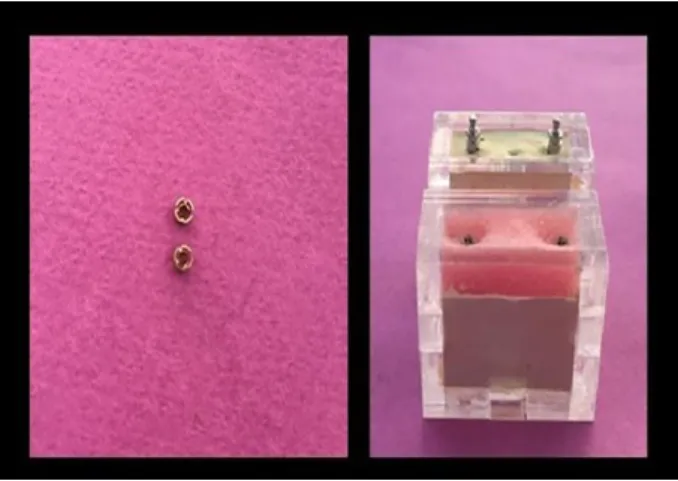
In each attachment pair, two implant analogs and attachments were mounted in a pair of cubic blocks measuring 40×15×35 mm with the same height and 23 mm inter-implant distance [20]. The Locator attachments (Zest Anchors, Zest Dental Solutions, Carlsbad, CA, USA) and the Dalbo-Plus attachments (DIO Co., Busan, Korea) were connected to their corresponding implant analogs (DIO Co., Busan, Korea). The
first block was filled with auto-polymerizing polymethyl methacrylate resin (GC Reline; GC America Inc., USA). Two pinholes were drilled (Pindex machine; Coltène/Whaledent Inc., Germany) after complete setting of resin at an equal distance from the block edges. The attachment assemblies were fixed with fresh mixture of auto-polymerizing resin in the pinholes using a dental surveyor (Saeshin Precision Co., Daegu, Korea) to be parallel to each other in a way that the crest of implant analogs was in the same height as the level of resin. The second block was filled with type IV dental stone (Vel-Mix, Kerr Dental, CA, USA) and was inverted on the implant analogs in the first block (Figures 1 and 2).
Figure 1. Mounted Dalbo Plus attachments
The two acrylic blocks were then placed in a universal testing machine (Zwick Roell, Ulm, Germany) such that the margins of the lower block were parallel to the superior borders of the lower compartment of the machine. Medium-size compartments were used. The universal testing machine separated the
attachment components by applying a
perpendicular tensile force to the crest of analogs with a constant crosshead speed of 50 mm/minute, corresponding to the speed of insertion and removal of overdenture by
patients [21]. The machine drew a graph and the peak of the graph indicated the maximum load required for separation of the attachment components in Newtons (N). This value indicated the retention of attachments. The baseline retention of attachments was measured as such.
As explained earlier, each attachment system was divided into four subgroups for immersion in different cleansing solutions namely water (control group), Corega denture cleansing tablet
(Polident GSK, Ireland), 5% sodium
hypochlorite diluted 1:10, and Dentipur denture cleansing tablet (Helago, Germany).
The nylon insert of the Locator attachment (male portion) and the metal cap of the Dalbo-Plus attachment (female portion) were immersed in the respective solutions. Duration of immersion was based on the manufacturers’ instructions to simulate 6 months of clinical use. The Corega denture cleansing tablet was used for 15 minutes daily; 45 hours of immersion in Corega solution simulated 6 months of clinical use. Sodium hypochlorite was also used for 15 minutes daily; 45 hours of immersion in sodium hypochlorite simulated 6 months of clinical use. Dentipur cleansing tablet was used for 10 minutes daily; 30 hours of immersion in Dentipur solution simulated 6 months of clinical use. Samples in the water group were immersed in water for 45 hours to simulate 6 months of clinical use.
After completion of the immersion period, the attachments were removed from the solutions and were visually inspected with the naked eye for any possible change in their shape or color. The samples were then placed again in a metal housing as paired and transferred to the universal testing machine. The maximum load that caused separation of the attachment components was recorded to determine the retention of each attachment. The values were compared with the baseline values.
Data were analyzed using two-way ANOVA, and pairwise comparisons were carried out using the Tukey’s HSD test. All statistical analyses were performed using SPSS version 22 (SPSS Inc., IL, USA) at 0.05 level of significance.
Figure 2. Mounted Locator attachments
Results
Inspection of the appearance of the attachments revealed that sodium hypochlorite caused whitening of the Locator attachments while other solutions did not cause any change in the appearance of the Locator and Dalbo-Plus attachments.
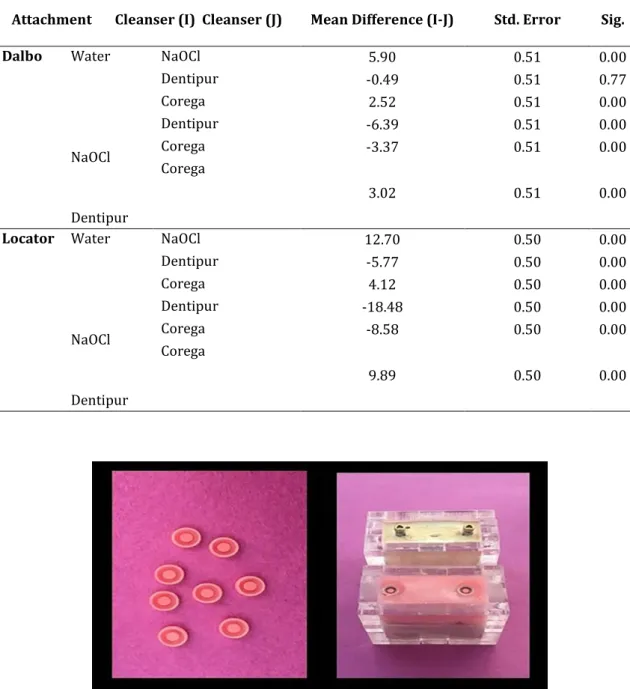
Descriptive statistics regarding the retention of Dalbo-Plus and Locator attachments are presented in Table 1. Pairwise comparisons of the retention of Dalbo-Plus and Locator attachments are presented in Table 2.
A significant difference was noted in retention of Dalbo-Plus attachments immersed in
different solutions (P<0.05). Pairwise
comparisons showed that the retention of attachments in water and Dentipur was significantly higher than the retention of attachments immersed in other solutions (P<0.05); but no significant difference was noted in this regard between water and
Dentipur (P>0.05). The retention of
attachments immersed in Corega was significantly higher than that of attachments immersed in sodium hypochlorite (P<0.05). The lowest retention was recorded for attachments immersed in sodium hypochlorite.
A significant difference was noted in retention of Locator attachments immersed in different solutions (P<0.05). The highest retention was noted in attachments immersed in Dentipur solution followed by water, Corega and sodium hypochlorite.
Comparison of the retention of Dalbo-Plus and Locator attachments in each cleansing solution revealed a significant difference (P<0.05), and the retention of Locator attachments was significantly higher than that of Dalbo-Plus in all solutions (Figure 3).
Separate assessment of the retention of Dalbo-Plus and Locator attachments in different solutions revealed that the retention of Dalbo-Plus after immersion in water was not significantly different from its baseline retention (P>0.05). The retention of Locator attachment significantly decreased after immersion in water compared with its baseline value (by 0.17%, P<0.05). The retention of Dalbo-Plus did not significantly change after immersion in Dentipur compared with its baseline value (P>0.05). The retention of Locator attachment significantly increased after immersion in Dentipur compared with baseline (by 2.3%, P<0.05). The retention of Locator
Table1. Descriptive statistics of the retention of Dalbo-Plus and Locator attachments (n=10)
attachment significantly decreased after immersion in sodium hypochlorite compared with baseline (by 10.7%, P<0.05). The retention of Dalbo-Plus significantly decreased after immersion in sodium hypochlorite compared with baseline (by 4.62%, P<0.05). The retention of Locator attachment significantly decreased after immersion in Corega compared with baseline (by 4.68%, P<0.05). The retention of
Dalbo-Plus significantly decreased after
immersion in Corega compared with baseline (by 2.07%, P<0.05; Figure 3).
Discussion
This study assessed the effect of different denture cleansing solutions on the retention of
two commonly used attachment systems namely Dalbo-Plus and Locator. The results showed that overall, the Locator attachment showed higher retention than the Dalbo-Plus irrespective of the type of cleansing solution. The retentive patrix of the Locator attachment has nylon inserts that provide retention by friction contact with the matrix. By an increase in the frequency of insertion and removal cycles of overdenture (clinical use by patient), the nylon insert may undergo corrosion and deformity and gradually lose its efficacy, necessitating its replacement. Moreover, immersion in different chemical solutions can adversely affect the nylon insert. However, this statement requires further studies on the
Attachment/Cleanser/Retention Minimum Maximum Mean Std. Deviation
Dalbo Water Before 129.51 132.36 131.51 0.91
After 129.38 132.74 131.29 1.19
NaOCl Before 129.55 132.29 131.47 0.88
After 124.12 127.56 125.39 1.08
Dentipur Before 129.27 132.37 131.43 0.94
After 129.73 132.96 131.79 0.97
Corega Before 129.52 132.37 131.49 0.88
After 126.60 130.31 128.77 1.32
Locator Water Before 140.43 143.26 142.02 1.05
After 138.21 141.11 139.49 1.08
NaOCl Before 140.24 143.16 141.98 1.05
After 125.13 128.75 126.79 1.01
Dentipur Before 140.54 143.16 141.97 0.98
After 143.24 147.86 145.27 1.35
Corega Before 140.61 143.18 142.01 0.98
After 134.14 136.61 135.37 1.03
Table2. Pairwise comparisons of the retention of Dalbo-Plus and Locator attachments
Figure 3. Mean and 95% confidence interval of the retention of attachments before and after immersion in different solutions
microscopic structure of the nylon insert. The Dalbo-Plus attachment has a different mechanism of retention and different design compared with the Locator attachment. The re-tentive part of the Dalbo-Plus attachment is in
the form of a metal lamella made of gold and noble alloys, which is screwed into a titanium cap. The lamella blades are interlocked in the attachment matrix undercuts, which is in the form of a ball abutment. By rotating the lamella
Attachment Cleanser (I) Cleanser (J) Mean Difference (I-J) Std. Error Sig.
Dalbo Water
NaOCl
Dentipur
NaOCl 5.90 0.51 0.00
Dentipur -0.49 0.51 0.77
Corega 2.52 0.51 0.00
Dentipur -6.39 0.51 0.00
Corega -3.37 0.51 0.00
Corega
3.02 0.51 0.00
Locator Water
NaOCl
Dentipur
NaOCl 12.70 0.50 0.00
Dentipur -5.77 0.50 0.00
Corega 4.12 0.50 0.00
Dentipur -18.48 0.50 0.00
Corega -8.58 0.50 0.00
Corega
9.89 0.50 0.00
inside the metal cap in a clockwise fashion, the lamella blades are approximated and provide greater retention for Dalbo-Plus. One advantage of Dalbo-Plus attachment is that the dental clinician only needs to rotate the lamella screw in the metal cap to adjust the retention of the attachment and achieve the desired retention. This postpones the need for component replacement. Moreover, since the lamella is made of metal, denture cleansing solutions have a smaller degrading effect on its structure compared with the nylon insert and it less commonly requires replacement [10-12]. Despite the significant effect of chemical cleansing solutions on overdentures and their fine attachments, studies on this topic are limited [17-19,22,23]. This study revealed that the Locator attachment had higher retention than the Dalbo-Plus irrespective of the type of cleansing solution. This finding can be due to the double retentive surface of the Locator attachment (internal and external) compared with the spherical surface of Dalbo-Plus attachment. In our study, immersion in water significantly decreased the retention of the Locator attachment while it had no significant effect on the retention of Dalbo-Plus. This finding may be attributed to the presence of nylon insert in the Locator attachment versus the metallic retentive part of Dalbo-Plus. Interestingly, our results showed that the retention of Locator attachment increased after immersion in Dentipur, which may be due to the constituents of Dentipur. According to the manufacturer, Dentipur is composed of potassium caroate, sodium bicarbonate, citric acid, sodium carbonate, sorbitol, VP/VA copolymer, sodium lauryl sulfate, sodium lauryl sulfoacetate and aroma. Potassium caroate is an oxidizing agent, which is added as an antibacterial agent in addition to citric acid and its sodium derivatives. VP/VA copolymer is a lubricating agent commonly used in cosmetic products. Aromatic compounds are also added to improve quality [13]. Water was considered as the control cleansing solution in our study. The results showed that immersion of attachments in Dentipur increased their
retention compared with their immersion in water. Thus, Dentipur seems to be a good choice for clinical use. Increased retention by Dentipur may be due to the fact that sodium bicarbonate and sorbitol are both moisture absorbent, and sorbitol has adhesive properties as well. These properties may be responsible for increased adhesion and subsequently higher retention. However, this theory needs to be confirmed by further investigations.
According to the manufacturer, Corega tablets contain sodium bicarbonate, citric acid, potassium caroate, sodium carbonate, peroxide, TAED, sodium benzoate, PEG-180, sodium lauryl sulfoacetate and aroma. Comparison of Dentipur and Corega after eliminating their common ingredients reveals that Corega has higher oxidizing and acidic compounds, which may be responsible for no increase in the retention of attachments by Corega.
Immersion in sodium hypochlorite caused a significant reduction in retention of both attachment types, which is directly related to its highly corrosive nature that negatively affects the nylon insert and metallic compounds. Watcharapichat et al. [24] evaluated the effect of Polident, Fittydent, 0.12% chlorhexidine, and sodium hypochlorite on the retention of Pink Locator attachment. They used water as the
control solution. They immersed the
attachments in the solutions for a time period corresponding to 1 year of clinical service. Retention decreased in all groups although the difference among the groups was not significant at 1 month. At 6 months, however, Fittydent and
chlorhexidine caused significantly less
reduction in retention than other solutions while the difference among other groups was not significant. At 1 year, Fittydent and
chlorhexidine caused significantly less
reduction in retention while sodium
hypochlorite significantly decreased the
retention. The difference in this respect was not significant among other groups. Watcharapichat et al. [24] advised that sodium hypochlorite should not be used as a routine denture cleanser. Their results regarding the reduction in retention caused by sodium hypochlorite
were in agreement with ours.
Derafshi et al. [17] evaluated the effect of sodium hypochlorite, Corega and Professional denture cleansing tablets on DIO O-ring and
showed that Corega and Professional
significantly decreased the retention of
attachments. Also, sodium hypochlorite
decreased the retention of O-ring attachment by 48%. Their results were in agreement with ours, which may be due to the similar elastic nature of Locator and Dio O-ring attachments. Also, the acidic and oxidizing properties of Corega and the corrosion potential of sodium hypochlorite can explain the reduction in retention of attachments. Christin et al. [18] evaluated the effect of Corega and Cool Mint Listerine denture cleansing solutions on the retention of blue, pink and transparent Locator attachments. They found that the retention of attachments significantly increased after immersion in the solutions, which was in contrast to our findings. In our study, only Dentipur significantly increased the retention of attachments while Corega caused a significant reduction in retention. In our study, Dentipur had no significant effect on retention of Dalbo-Plus. Moreover, the reduction in retention of Dalbo-Plus was less than that of Locator attachment, which may be due to the metal structure of this attachment. Nguyen et al. [19] evaluated the effect of six denture cleansers on the nylon insert of pink Locator attachment and revealed that sodium hypochlorite caused a significant reduction in retention of Locator attachment, which was in agreement with our findings. Cool Mint Lister-ine increased the retention of attachment, which was in line with the findings of Christin et al [18]. The authors advised not to use Cool Mint Listerine and 6% sodium hypochlorite for cleaning of overdentures since they alter the retention of attachments. Polident Regular and Polident Overnight did not significantly change the retention of attachments and showed an effect similar to that of Dentipur on Dalbo-Plus attachments in our study. Efferdent also caused a slight reduction in retention while Cool Mint Listerine increased the retention of Locator attachments (similar to the effect of Dentipur in
our study), which may be due to the similar chemical composition and properties of these two solutions; this issue is in need of further investigations.
Varghese et al. [22] evaluated the effect of denture cleansing solutions on the retention of bar and clip attachments and demonstrated that 6 months of immersion in denture cleansers had no significant effect on the retention of clips
while sodium hypochlorite significantly
increased the retention of clips. They suggested that increasing the attachment retention might not be beneficial since it decreases the durability of clips. Their findings were in contrast to our results and those of other studies. This controversy in the results may be due to the use of different types of attachments and their geometry, which is different from the
Locator and Dalbo-Plus attachments.
Kürkcüoğlu et al. [23] evaluated the effect
of 6-month clinical use of sodium
hypochlorite, sodium perborate and sodium
bicarbonate/sodium perborate denture
cleansers on pink, blue and transparent Locator attachments. They reported that the retention of pink Locator attachment did not significantly change following immersion in different solutions, which was in contrast to our findings. The retention of transparent attachment significantly decreased following immersion in sodium bicarbonate. Both Corega and Dentipur contain sodium bicarbonate. Corega decreased the retention of pink Locator attachment while Dentipur increased its retention. The reason for this finding is probably the chemical composition of these solutions, which calls for further studies in this respect. On the other hand, this study showed that the retention of blue Locator attachment significantly decreased following immersion in sodium hypochlorite and sodium bicarbonate. Therefore, it may be concluded that different chemical cleansers have different effects on different types of Locator attachments. It should be noted that many factors other than the cleansing solutions affect the retention of attachments in the clinical setting such as repeated removal and insertion of overdentures by patients. Sultana et al. [25] simulated the effect of 5.5 years of
fatigue on Locator and ball attachments placed at 0° and 20° angles. They showed that simulation of the clinical setting (repeated removal and insertion of overdentures) significantly decreased the retention of both systems at both angles. The reduction in retention of ball attachment at all positions was less than that of Locator attachment. Overdenture positioned in an angulated fashion showed superior clinical performance. Many other factors also affect the retention of overdenture such as the nutritional regimen and the pH of the oral environment. Thus, stronger materials with greater resistance should be used for the fabrication of
overdentures and their components.
In the present study, the Dalbo-Plus attachment showed much lower changes in retention than the Locator attachment, and was superior in this respect. As stated earlier, studies on the effect of denture cleansing solutions on the
retention of overdentures are limited
[17-19,22,23]. However, studies on the effect of cleansing solutions on complete and partial dentures have unanimously stated that sodium hypochlorite has adverse effects on the acrylic and metallic parts of dentures and is not a suitable cleanser for this purpose [26-32]. Since there are many factors in the oral environment that decrease the retention of attachments, use of cleansing solutions that can increase the retention of attachments and subsequently prolong the clinical service of overdentures is recommended. Moreover, patients should be well informed about the significance of oral hygiene and denture care and should receive instructions on maintenance of attachments. In general, it is recommended to preferably use attachments with metal components since they are less affected by the environmental and chemical factors and have a longer lifespan, which ensures patient satisfaction. Future in vivo studies are required to assess the effect of other factors such as diet on the retention of overdentures. Also, simultaneous effect of cleansing solutions and cyclic loading on retention of overdenture attachments should be evaluated to increase the generalizability of the results to the clinical setting.
Conclusion
Within the limitations of this in vitro study, the results showed that sodium hypochlorite decreased the retention of attachments and is not recommended for denture cleansing. Dentipur can serve as a suitable denture cleanser since it increased the retention of attachments and had less destructive effects on the overdenture components. Corega decreased the retention of attachments due to its oxidizing and acidic composition and should be used with care.
References
1. Carr A, Brown D. McCracken's removable
par-tial prosthodontics. 12th Ed. Mosby, 2010; chap.
1:6.
2. Zarb G, Hobkirk J, Eckert S, Jacob R.
Prostho-dontic treatment for edentulous patients. 13th
Ed. Mosby, 2012; chap. 1:23.
3. Heckmann SM, Heussinger S, Linke JJ, Graef F, Pröschel P. Improvement and long-term stability of neuromuscular adaptation in implant-supported overdentures. Clin Oral Implant Res. 2009 Nov; 20:1200-5.
4. Ueda T, Kremer U, Katsoulis J, Mericske-Stern R. Long-term results of mandibular implants supporting an overdenture: Implant survival, failure, and crestal bone level changes. Int J Oral Maxillofac Implants. 2011 Mar-Apr;26(2):365-72.
5. Dudic A, Merickse-Stern R. Retention
mechanisms and prosthetic complications of implant supported mandibular overdentures: Long-term results. Clin Implant Dent Relat Res. 2002;4(4):212-9.
6.McEntee MI, Walton JN, Glick N. A clinical trial
of patient satisfaction and prosthodontic needs with ball and bar attachments for implant retained complete overdentures: Three-year results. J Prosthet Dent. 2005 Jan;93(1):28-37.
7.Stewart BL, Edwards RO. Retention and wear
of precision-type attachments. J Prosthet Dent. 1983 Jan;49(1):28-34.
8. Alsabeeha N, Atieh M, Swain MV, Payne A.
Attachment systems for mandibular
singleimplant overdentures: An in vitro retention force investigation on different designs. Int J Prosthodont. 2010 Mar-Apr;23:
160-6.
9.Andreiotelli M, Att W, Strub JR. Prosthodontic
complications with implant overdentures: A systematic literature review. Int J Prosthodont. 2010 May-Jun;23(3):195-203.
10. Goodacre CJ, Bernal G, Rungcharassaeng K,
Kan J. Clinical complications with implants and implant prostheses. J Prosthet Dent. 2003 Aug; 90:121-32.
11.Fromentin O, Picard B, Tavernier B. In vitro
study of the retention and mechanical fatigue behavior of four implant overdenture stud-type attachments. Pract Periodontics Aesthet Dent. 1999 Apr;11(3):391-7.
12. Rutkunas V, Mizutani H, Takahashi H.
Influence of attachment wear on retention of mandibular overdenture. J Oral Rehabil. 2007 Jan; 34(1):41-51.
13. Budtz-Jørgensen E. Materials and methods
for cleaning dentures. J Prosthet Dent. 1979 Dec;42(6):619-23.
14. Mok J, Emami E, Kobayashi T, Feine J. An
oral hygiene brochure for your implant overdenture patients. J Can Dent Assoc. 2007 Oct;73(8):713.
15. Rutkunas V, Mizutani H, Takahashi H.
Influence of attachment wear on retention of mandibular overdenture. J Oral Rehabil. 2007 Jan;34(1):41-51.
16. Kobayashi M, Srinivasan M, Ammann P,
Perriard J, Ohkubo C, Müller F, et al. Effect of in vitro cyclic dislodging on retentive force and
removal torque of three overdenture
attachment system. Clin Oral Implants Res. 2014 Apr;25(4):426-34.
17. Derafshi R, Mohaghegh M, Saki M, Safari A,
Haghighi MR. The effects of denture cleansing solutions on the retention of attachments of implant supported overdentures. J Dent (Shiraz). 2015 Mar;16(1 Suppl):68-72.
18. Arnold C, Fraedrich D, Setz JM, Boeckler AF.
Effect of cleansing solutions on the retention of Locator attachments. Int Poster J Dent Oral Med. 2011; 13(2):Poster 534.
19. Nguyen CT, Masri R, Driscoll CF, Romberg E. The effect of denture cleansing solutions on retention of pink locator attachments: An in vitro study. J Prosthodont. 2010 Apr;19(3):226-30.
20. Shayegh SS, Hakimaneh SM, Baghani MT,
Shidfar S, Kashi FK, Zamanian A, et al. Effect of Interimplant Distance and Cyclic Loading on the Retention of Overdenture Attachments. J Contemp Dent Pract. 2017 Nov;18(11):1078-84.
21. Tabatabaian F, Alaie F, Seyedan K.
Comparison of three attachments in
implant-tissue supported overdentures: an in vitro study. J Dent (Tehran). 2010 Summer; 7 (3):113-8.
22.Varghese RM, Masri R, Driscoll CF, Romberg
E. The effect of denture cleansing solutions on the retention of yellow Hader clips: an in vitro study. J Prosthodont. 2007 May-Jun; 16:165-171.
23. Kürkcüoğlu I, Özkir SE, Köroğlu A, Sahin O,
Yilmaz B. Effect of denture cleansing solutions on different retentive attachments. J Prosthet Dent. 2016 May;115(5):606-10.
24. Watcharapichat P, Kunavisarut C,
Pittayachawan P, Tengrangsan T. The effect of denture cleansing solutions on the retention of Pink Locator attachment: 1 year simulation. M Dent J. 2014 Sep-Dec;34(3):204-14.
25. Sultana N, Bartlett DW, Suleiman M.
Retention of implant-supported overdentures at different implant angulations: comparing Locator and ball attachments. Clin Oral Implants Res. 2017 Nov;28(11):1406-1410.
26.Nair Borges D, Resende L, Freitas Oliveira H,
Bezzon O, Silva RF, Pagnano VO. Effect of different cleansers on the surface of removable partial denture. Braz Dent J 2011 Jun;22(5): 392-7.
27.Daniela NB, Letícia R, Helena FO, Bezzon OL,
Silva RF, Barbosa Junior F, et al. Effect of different cleansers on the weight and ion release of removable partial denture: an in vitro study. J Appl Oral Sci. 2011 Sep-Oct;19(5):483-7.
28. McGowan MJ, Shimoda LM, Woolsey GD.
Effects of sodium hypochlorite on denture base metals during immersion for short-term sterilization. J Prosthet Dent. 1988 Aug; 60(2): 212-8.
29.Peracini A, Regis RR, Souza RF, Pagnano VO,
da Silva C, Paranhos H. Alkaline peroxides versus sodium hypochlorite for removing
denture biofilm: a crossover randomized trial. Braz Dent J. 2016 Oct-Dec;27(6):700-4.
30. Arruda CN, Salles MM, Badaró MM, Oliveira V, Macedo AP, Silva-Lovato CH, et al. Effect of sodium hypochlorite and Ricinus communis solutions on control of denture biofilm: A randomized crossover clinical trial. J Prosthet Dent. 2017 Jun;117(6):729-34.
31. Salles MM, Oliveira Vde C, Souza RF, Lovato
Silva CH, Paranhos H. Antimicrobial action of
sodium hypochlorite and castor oil solutions for denture cleaning - in vitro evaluation. Braz Oral Res. 2015 Aug;29(1):1-6.
32. Mathai JR, Sholapurkar AA, Raghu A, Shenoy RP, Mallya HM, Pai KM, et al. Comparison of efficacy of sodium hypochlorite with sodium perborate in removal of stains from heat-cured clear acrylic resin. N Y State Dent J. 2011 Jun-Jul; 77(4):48-53.