
Reviewing “Death Panels”:
Policy and Medical Practice Implications of the Life Cycle of a Provision for
End-of-Life Counseling
By
Ashley Elizabeth Wofford
A Master’s Paper submitted to the faculty of the University of North Carolina at Chapel Hill in partial fulfillment of the requirements for the degree of Master of Public Health in the Public
Health Leadership Program. Chapel Hill
2011
Advisor and First Reader
Date
Second Reader
!
Advance care planning requires conversation between individuals, their families, and their physicians. In August 2009, opponents of health reform characterized the Affordable Care Act’s provision for advance care planning consultations as “death panels.” The media coverage of this event had the power to influence not only the public’s opinion of health reform, but the perception of the sanctity of the patient-provider relationship, as well. The purpose of this Master’s Paper is to determine what effect the publicity of “death panels” had on physicians’ clinical practices of advance care planning discussions. This analysis triangulates medical literature, a non-random survey, and analysis of media coverage to shape the storyline of the twenty-one months between August 2009 and June 2011. End-of-life care planning is an important topic among University of North Carolina primary care providers and
hematology/oncology specialists. It appears that although most faculty members were well aware of the “death panel” characterization, it had little effect on their clinical practice. Despite the lack of a provision for reimbursement of services for end-of-life planning in the Affordable Care Act, it appears that most providers are satisfied with their ability to facilitate these
conversations with patients, and they place an emphasis on patient values. The findings of the media content analysis reinforce that political rhetoric is powerful. University of North Carolina physicians’ behaviors and attitudes about end-of-life counseling appear to have been unaffected by the negative characterization of end-of-life planning as “death panels.” It is unclear whether this response is also true of providers in other academic settings and community clinics. !
I would like to thank everyone involved in the process of creating this paper. Dr. Sue Tolleson-Rinehart, my advisor and first reader, provided instrumental guidance for my inception of the research, and her insights and expertise in health policy have been invaluable. I would also like to thank my second reader Dr. Elisabeth P. Dellon, whose experience with designing surveys targeted for physicians was critical in crafting a useful research tool. Lastly, although I do not know their names, I am grateful for the time dedicated by each physician who answered the survey.
Abstract ... ii
Acknowledgements ... iii
Table of Contents ... iiv
List of Tables and Figures ... v
Introduction ... 1
Quantitative Methods: Survey Design and Newspaper Analyses………..….….6
The Portrayal of "Death Panels" in Public Discourse ... 9
Provider Preferences for End-of-Life Planning Among Primary Care Providers ... 15
Final Perspective ... 19
Tables and Figures ... 20
References ... 30
Appendix 1: Limited Systematic Review: Stability of Patient Preferences ... 33
Appendix 2: Detailed Survey Methods ... 44
Appendix 3: Top 10 U.S. Newspapers ... 46
Appendix 4: Survey Questions ... 47
Appendix 5: Recruitment Email Messages ... 59
Table 1. Distribution of Article Type and Perceived Purpose over Time ... 20
Table 2. Overall Distribution of Articles by Sentiment Toward Health Reform ... 21ii
Table 3. Survey Sample Characteristics ... 22
Table 4. Respondent Characteristics, by Specialty ... 23
Table 5. Provider Perceptions of Barriers and Satisfaction ... 24
Figure 1.Frequency of Articles in the Top 10 Circulating U.S. Newspapers ... 25
Figure 2.Frequency Distribution of News Articles, Aug 2009 – May 2011 ... 26
Table A-1. Articles Meeting Inclusion Criteria for Limited Literature Review ... 27
Table A-2. Appraisal of Articles in the Limited Literature Review ... 28
Figure A-1. Inclusion Decisions for Limited Systematic Review ... 29 !
In many ways, medicine has spent the last century trying to conquer death. The pastoral role of the physician has become more heroic, and advances in public health and medical technology have increased life expectancy 25 to 30 years (National Center for Health Statistics. 2011, see table 22). Our societal norms also promote youth and beauty, probably to a fault. We have learned to cling to our lives with such intensity that we all too often end up with lungs that breathe and hearts that beat beyond the point we might otherwise consider viable or desirable. Although most people would no doubt prefer a swift and peaceful death, that is no longer the reality for most people, at least in part because it is difficult to eschew aggressive medical treatment
The scope of end-of-life planning is murky and confusing. Patient-physician encounters on this subject focus primarily on a checklist of topics including presence of advance directives, which include both living wills and patient-appointed surrogate decision makers, or durable powers of attorney. (Note the absence of physician-assisted suicide and euthanasia.) The legal
terminology is perplexing in itself, and the fact that several terms can describe a single concept adds to the confusion. For instance, an individual’s durable power of attorney is, for medical purposes, the same as a health care proxy, and yet each has a distinct legal document.
Additionally, the advance directive has several pseudonyms: advance health care directive, living will, personal directive, and advance decision, among others. There are some benefits to having living wills and health care proxies, but many endeavor to push beyond the legal
documentation of a patient’s responses to questions on a form, and truly unearth the patient’s base values and health beliefs about end-of-life circumstances.
The evidence base for the stability of patient preferences about end-of-life care and advance directives suggests that patient preferences at the time of end-of-life frequently differ from the preferences they have when drafting the directive, and also suggests that a majority of people consider having such documentation valuable (see Appendix 1 for detailed review of the literature). Unfortunately, despite high desire for advanced directives, few people have official documentation.
In the health reform bills in the summer of 2009, politicians included a brief provision for
reimbursement to physicians for one end-of-life planning visit every five years, which might have helped some physicians spend more time on these issues in greater depth. Although not one person in Congress opposed the language of the provision, former Lt. Governor of New York Betsy McCaughey declared the provision would limit the amount or type of care Medicare beneficiaries might receive at the end-of-life (Saltonstall 2009, 5). This quickly escalated into a frenzied debate about “death panels,” propelled into the public eye by former Republican Vice Presidential candidate Sarah Palin when she posted a statement on her Facebook webpage (Palin 2009). The provision was quickly pulled from the bill, and did not make it into the version of the bill signed into law March 23, 2010. A similar provision was added via administrative rule in November 2010 to a list of optional topics to be covered in a “welcome to Medicare” visit for new beneficiaries, but this, too, was rescinded in January 2011 for fear of another round with “death panels” (Department of Health and Human Services 2011).
when the discussion focuses on advance directives, and others with similar views assert that end-of-life care planning is part of their job as a clinician, regardless of payment. Other
physicians are more in favor of the provision, and are quick to note that amidst the pressures of running an outpatient clinic, the reality is that other services are reimbursable and also take less time to deliver appropriately. Regardless of payment, physicians agree that they should be having these discussions with patients, and despite current inability to bill for the service, physicians do seem able to have these discussions with their patients when necessary, though perhaps not as early on as they may prefer..
The discourse of “death panels” illustrates Deborah Stone’s description of a “public interest” from the perspective of the polis, the “essential political society” (Stone 2002, 17, 21). She asserts that “public interest” can be interpreted as (1) a consensus among the polis, (2) an interest held in common – something desired by the public-spirited side of individuals in the polis, as opposed to the self-interested side of individuals, or (3) things that benefit the entire community as a community (Stone 2002, 21). The drafts of health reform initially garnered the public interest of expanding health care access to more Americans, but the introduction of “death panels” shifted the public interest away from a desire to gain access for more Americans toward a desire not to lose the known health care system. This shift depended on loyalty of politically conservative individuals in the polis who supported politicians who professed the new law would create “death panels.” The shift also hinged on the significant size of the sub-group of adults ages 65 and older in the United States, to the extent that gaining the attention of seniors by illustrating how a proposed bill may attack health care benefits is an effective way to mobilize this group.
public nature of the “death panel” debate may have affected the way in which physicians and other health care providers broach the subject with their older patients. Specifically, I was interested to know what physicians thought of the “death panel” debate and also their
perceptions of patients’ thoughts on the issue, as well as how, if at all, physicians had reshaped their clinical practice with respect to end-of-life care planning with patients.
The multiple perspectives inherent in the issue require triangulation of medical literature, survey responses, and media sources to assess the effect of the media’s characterization of “death panels” on the nature of physician’s advance care planning practices. News sources provide an account of public exposure to “death panels,” and a survey of UNC adult primary care
physicians demonstrate the effect of the news sources on physicians’ routine practices.
Certainly, this type of study has limitations. The first is the modest number of survey
participants from which to determine relationships and draw conclusions. The survey targets primary care for adults, asking about advance care planning for patients who are healthy and have no acutely severe or terminal illness or injury. For this reason, the sample of participants is limited to physicians in the Department of Family Medicine, and in the Divisions of General Medicine and Clinical Epidemiology, Geriatrics, and Hematology/Oncology within the
Quantitative Methods: Survey Design and Newspaper Analyses
When examining questions of policy, triangulating methods is useful for better determining the nature of the association between variables. Studying historical data is necessary to prepare a timeline upon which to lay the data collected in surveys or interviews. I extracted data from survey responses and newspaper articles to generate, refine, and test hypotheses about the extent to which perceptions of the portrayal of “death panels” in public media affected physicians’ routines of end-of-life care planning with healthy patients. I then used the social research process of coding to develop and examine hypotheses about my research.
The purpose of the survey is to determine physicians’ perceptions of and knowledge about “death panels” in a way that can be meaningfully imposed on a timeline of media coverage of current events. The media review served to create this timeline. Once superimposed,
analyses of the open-ended survey responses will help reveal not only the associations, but the process driving the associations, as well.
I intended to survey fellows (physicians who have completed residency but are pursuing further training in a subspecialty) in each department, as well, but I was only able to find a list of fellows in the Division of Geriatrics in public web domains. Additionally, I was unable to find a
functioning email address for one faculty member.
A non-random sample is not only permissible, but in fact, necessary for this question because the question focuses on advance care planning for patients aged sixty-five or older in an outpatient setting. Therefore, I did not want to take a random sample of all UNC physicians, which would include intensivists and emergent care physicians who discuss end-of-life care under much different circumstances, and pediatricians who may well discuss end-of-life care, but whose patients are not adults.
An appraisal of newspaper articles is a valid method for a media review because, even in the day of constant television news coverage and an explosion of web-based sources, articles in the top circulating newspapers are frequently picked up and repeated in other news outlets, including television, radio, and internet, and may be said to set the nation’s news agenda each day. I identified the top ten circulating daily newspapers in the United States by referencing the Audit Bureau of Circulations (see Appendix 3).
I was interested both in the volume and the importance of the “death panel” discussion over time (see Figure 1 and Table 1). In addition to the date of publication and type of piece, I coded the following: overall sentiment of the piece as in favor or opposition of health reform, whether “death panels” was the major focus of each article as a whole, and the intended meaning or purpose of the mention of “death panels.” I did not have a second coder.
The search strategy included articles published August 1, 2009 or later, and required a variant of health care reform (“health reform” or “health care reform” or “healthcare reform” or “health-care reform”) and either “death panel” or “death panels.” The review is limited in that it is not an exhaustive search on the provision for end-of-life counseling, and may therefore miss important pieces that had an effect on the polis’ interpretation of the public interest in the provision itself. Otherwise, the only exclusions were duplicates in the same paper on the same day and articles not containing the key phrases of the search terms in an appropriate context, and I counted each letter to the editor as a distinct mention even if published on the same day. The initial media search yielded 390 articles, of which 363 met the inclusion criteria, and 3 were
The Portrayal of “Death Panels” in Public Discourse
“Death panel”: a supposed committee of doctors and/or bureaucrats who would decide which patients were allowed to receive treatment, ostensibly leaving the rest to die.”
– The American Dialect Society, Most Outrageous Term of 2009 (Barrett G, Zimmer B, and
Barnhart DK 2010)
Reviewing the articles that include “death panels” provides a history lesson in the political evolution of health reform in the past two years. Perhaps this timeline is the most valuable information from the review: it is superimposed on the frequency of articles in Figure 2. First, I must share the narrative story before examining the results of the review.
Representative Earl Blumenauer, a Democrat from Oregon, wrote an opinion piece for The New York Times in November 2009, sharing his perspective of the debacle that began in August 2009. He begins his story with the House Ways and Means committee mark-up session of the health care bill on July 16, 2009. At that time, there had been zero opposition to the language used in the provision for end-of-life care planning. Then Betsy McCaughey, former Lt. Governor of New York, Republican, and conservative commentator, said the health reform bill “would make it mandatory, absolutely require, that every five years people in Medicare have a required counseling session that will tell them how to end their life sooner” (Blumenauer 2009, 12). Despite efforts by media sources to dispel McCaughey’s assertion, just two days later,
“Death panels” first entered the public discussion when former Alaskan Governor and 2008 Republican Vice Presidential nominee Sarah Palin, posted the statement on her Facebook web page: “The America I know and love is not one in which my parents or my baby with Down syndrome will have to stand in front of Obama’s ‘death panel’ so his bureaucrats can decide, based on a subjective judgment of their ‘level of productivity in society,’ whether they are worthy of health care. Such a system is downright evil” (Palin 2009). Although Ms. Palin’s statement is far from the truth, it was catapulted into the national spotlight, and town hall meetings
throughout the United States during Congress’ August Recess were branded by people protesting health reform on the basis of “death panels.”
Many sources posit that the emotional power of the simple two-word phrase simply trounced the numerous attempts to rationally explain the primary goals of the health reform bill, even after the provision for end-of-life counseling was stricken from the bill. Several writers also blame
President Obama and his administration for failing to explain clearly the vision for health care reform, and for waiting to react to the “death panel” assertions until mid-September.
partisan during the immediate days after the birth of “death panels” was Rep. Charles Boustany, a heart surgeon from Louisiana. His publicly reported responses were the most neutral of his fellow Republicans, saying simply that “this thing got really out of hand” and that “proponents may have to ‘back off’ and reconsider the issue ‘at some point when the temperature had cooled down’” (Kiely and Hall 2009, 4A).
President Obama signed the Patient Protection and Affordable Care Act into law on March 23, 2010 without a single Republican vote. The law, however, did not include any provision for provider reimbursement for end-of-life care planning.
The day after Christmas 2010, President Obama’s administration announced Medicare regulations for 2011 would include reimbursement for voluntary end-of-life care planning when addressed in an annual wellness visit, a new component of Medicare authorized by the health reform law passed in March 2010. The provision had been drafted in November 2010, and issued December 3, 2010, but it attracted little notice until just five days before the new
regulations would take effect on January 1, 2011. On December 26, 2010, the story ran at least once an hour on CNN, and three of the top ten newspapers – The New York Times, The
Chicago Sun-Times, and The San Jose Mercury News – covered this development.
an organization that works to improve individuals’ rights, dignity, and control of choices at the end of life (Compassion & Choices, see "About Us").
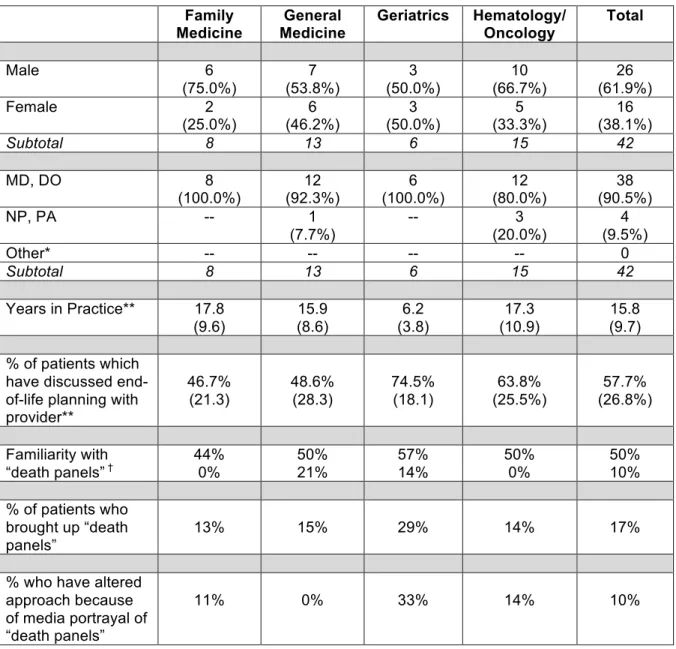
In my survey of health care providers at UNC, I asked providers to describe not only their own knowledge about and views of “death panels,” but also their patients’ reactions to the public characterization of “death panels” (see Appendix 4 for survey questions). The provider respondents tended to be rather uniform. Nearly 75% of providers were fairly or very familiar with the characterizations of “death panels,” and only four of 42 respondents had not heard of “death panels” at all. Regardless of specialty field, providers have not noticed increased interest in end-of-life planning resulting from the “death panel” coverage; neither have providers made significant changes to the way in which they facilitate such conversations with patients. Four providers reported any alteration of their approach to end-of-life counseling because of the media portrayal of “death panels,” primarily that they spend more time discussing end-of-life planning with patients, also focusing on making the content more approachable for patients in a non-threatening manner and using specific definitions to decrease confusion. Although this is a small number of providers, it represents approximately 10% of the respondents, and such a response may be considered to be “clinically significant.”.
decisions about end-of-life care for people on Medicare” (Kaiser Family Foundation 2010a, 5). An additional 17% of seniors answered they did not know whether the new law would do that. By September 2010, Kaiser Family Foundation reported that these numbers had changed to 30% believing that “death panels” were real, and 22% being unsure. However, the proportion of seniors who did not believe health reform would create “death panels” remained steady at 48% (Kaiser Family Foundation 2010b, 7), a disheartening result for health reform proponents who made continued efforts to dispel the notion that death panels exist. It is important to keep in mind that, in my survey, although some patients have broached the topic with their providers, only 12%, or five of 42 survey respondents report that their patients have mentioned “death panels” at all.
One of my respondents said that after discussing end-of-life planning with patients, telling them that the conversation they just had “is what all the ‘death panel’ fuss was about” was
enlightening to “even the Republicans.” Dissuading the public of the perception of mythical “death panels” is difficult, in the sense that it is always challenging to alter first impressions resulting from media coverage. Ultimately, the provision in the Medicare regulations was rescinded on January 5, 2011. Again, three newspapers – The San Jose Mercury News, USA
Today, and The Washington Post – covered this development.
In addition to establishing a timeline, the media review revealed some other valuable
Provider Preferences for End-of-Life Planning Among Primary Care Providers
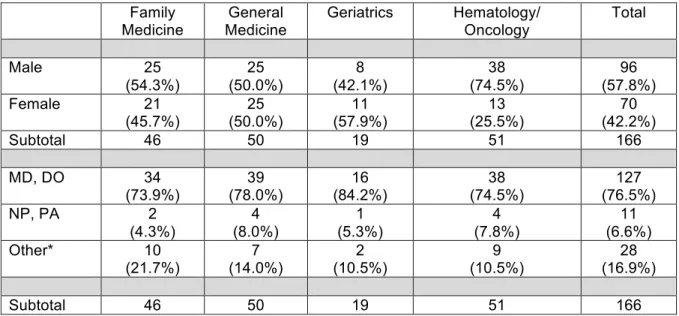
The results of the survey suggest that health care providers at UNC in the Department of Family Medicine or in the Divisions of General Medicine and Clinical Epidemiology, Geriatrics, and Hematology/Oncology within the Department of Medicine are not different in their preferences for facilitating end-of-life counseling. I included as a referent group in my survey sample the division of hematology/oncology, since these specialists routinely see patients with terminal disease states. However, there are few differences between groups at all, and no differences great enough to be statistically significant. This may be attributable to a small number of respondents (n < 5) in several sub-groups. Although the respondents fairly well represent the survey sample (see Tables 3 and 4), the sample is underpowered to detect statistically significant differences.
Conversations about patient preferences for end-of-life care usually happen whenever the patient brings it up or at the time of a new diagnosis or worsening disease state. Based on comments in open-ended answers, it seems that providers are moving toward including end-of-life planning in routine health maintenance topics and preventive care. Other common themes include when the patient is older (one respondent defined “older” as ” 80 or 85 years”), when the patient seems ready, when the family brings it up, once the patient-provider relationship is established, at an appropriate points along the illness trajectory, when a patient is hospitalized, or when a decision is made for Hospice care.
In conversations about end-of-life planning, most providers usually address the following topics: preferences about resuscitation (93%), health care power of attorney or durable power of attorney (81%), living wills (65%), and advance directives (77%). Providers overwhelmingly added that they focus on the primary goals of care based on the disease state and the patient’s preference of aggressiveness of health care. Providers also include families in these
discussions and often include hospice or other palliative care in the discussions.
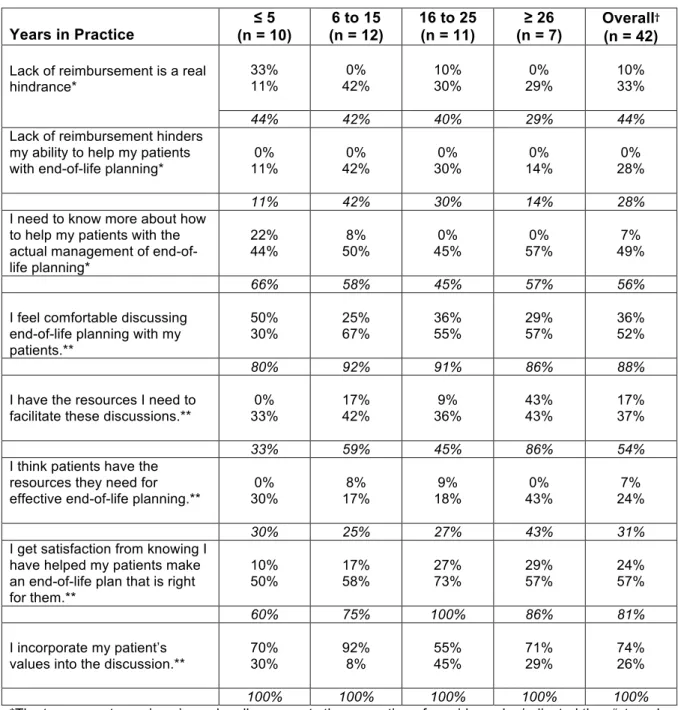
Most providers feel comfortable facilitating end-of-life planning discussions, and most feel well-equipped to do so (see Table 5). However, many providers agree they would benefit from further training – 49% “agree” and 7% “strongly agree” they need to know more. Those who have been practicing 15 years or less were more likely to agree strongly (see Table 6). Additionally, all providers felt that end-of-life counseling “usually improves” both quality of care and quality of life.
“always” sufficient by 35%, 54%, and 21% of respondents, respectively. There was no appreciable difference among providers of different specialties; however, there was a non-statistically significant trend in years of practice. Of providers practicing fewer than six years, 89% felt that there was “never” or only “sometimes” enough time to address sufficiently end-of-life planning with patients. Similarly, 64% of providers with six to fifteen years experience and 73% of provider with sixteen to twenty-six years experience felt there was “never” or only “sometimes” enough time for these discussions. However, only 43% of clinicians with twenty-six or more years of practice felt there was “never” or only “sometimes” enough time. This may reflect a career less cluttered by pursuits outside of clinic, different expectations for productivity (e.g., patient volume versus quality measures), or more expertise in facilitating these
conversations with patients.
Forty four percentof providers feel that lack of reimbursement for end-of-life counseling is a “real hindrance,” but only 28% of providers feel that lack of reimbursement hinders their own ability to help patients with end-of-life planning (see Table 6). Providers with fewer years in practice tend to see lack of reimbursement as a greater barrier than do more tenured providers. This may be due in part to expertise, and in part to a greater emphasis on coding for billing among more recently trained providers. Moreover, all providers in the survey sample are salaried, and the answers may have come from the following reasoning. The UNC health care system is not reimbursed, and therefore lack of reimbursement is a hindrance, however, providers can have these conversations with patients without concern for reimbursement because they do not directly rely on billing codes for payment at the time of service.
sample is underpowered, there may be important differences between providers in various fields that cannot be inferred from the data.
There are, however, important themes shared by all disciplines that were surveyed. Among the respondents, most felt that end-of-life counseling is important and most proactively address it with their patients. Free text responses indicate that providers are not approaching these conversations as checklists, but instead attempt to elicit and understand each patient’s motivations and values for certain health care preferences. Providers also strive to improve communication with family members and other social supports and they desire greater
Final Perspective
I am fortunate still to be very much interested in this topic at the close of this project. Reviewing the literature illustrated some of the efforts that have been made toward gaining a broader audience for end-of-life care planning. The media review highlighted the difficulty of forward progression of policy initiatives. The survey findings suggest a strong emphasis on end-of-life care planning at UNC, and I hope other academic centers and community practices reflect this same emphasis.
Putting all of this together into clinical practice requires continuing to educate physicians and other health care providers about both the technical details of end-of-life planning (e.g., advance directive, health care power of attorney) and the skill of exploring sensitive issues founded in patients’ values. For a number of reasons, reform of reimbursement schedules was not successful with the most recent efforts to reform health care. Although it may have relieved barriers for some providers to a certain degree, it would not solve what appears to be the greatest barrier – limited appointment time. The key to achieving discussions about values and general preparation for the end of life, given our time and resource constraints, is a humanistic community of providers who are committed to knowing their patients and understanding them as well as they possibly can.
20
Ta
bl
e
s
a
nd
Fi
gur
e
s
le 1. M ed ia R ev ie w : D is tr ib u ti o n o f ty p es o f ar ti cle s, an d th e p er ce iv ed p u rp o se o f “d ea th p an el” in e ac h piece, o ve r s ix m o n th in te rv als . Ty p e o f P ie c e Foc us Pe rc e iv e d Pu rp o s e o f “ D e a th Pa n e l” in Pi e c e † e rio d Ne ws Op in io n Let ter s Ed ito ria l Bu sin e ss / Fi n a n ce St yle He a lth Mi sc . Bu ild De sc rib e Di sp e l Ed u ca te Me n tio n Qu ip – 117 58 27 19 9 9 1 7 1’ 5 9 28 1 1 1 2’ 1 3 80 - 95 30 To ta l 6 12 108 1 96 31 – 26 17 4 6 3 2 3 1 1’ - - - - - 1 2’ - - 17 2 31 14 To ta l - - 17 2 31 15 – 1 15 10 5 8 1 - 2 2 1’ - - 9 3 - 1 2’ - - 13 - 15 3 To ta l - - 22 3 15 4 – 1 * 2 5 4 2 1 - - - 1’ - - 1 - - - 2’ 1 - - - 8 3 To ta l 1 - 1 - 8 3 L ‡ 160 90 40 35 14 11 6 10 7 12 148 6 150 53 e la st p e rio d is o n ly 4 m o n th s i n ste a d o f s ix . e fin e d th e in te n d e d p u rp o se o f u sin g th e p h ra se in e a ch a rti cle in to s ix c a te g o ries. “
Table 2. Overall Distribution of Articles by Sentiment Toward Health Reform
Number of Articles Proportion of Articles
Total Anti-Reform 21 5.7%
Total Neutral 156 42.6%
Total Pro-Reform 189 51.6%
Table 3. Survey Sample Characteristics
Family
Medicine Medicine General Geriatrics Hematology/ Oncology Total
Male 25
(54.3%)
25 (50.0%)
8 (42.1%)
38 (74.5%)
96 (57.8%)
Female 21
(45.7%)
25 (50.0%)
11 (57.9%)
13 (25.5%)
70 (42.2%)
Subtotal 46 50 19 51 166
MD, DO 34
(73.9%) (78.0%) 39 (84.2%) 16 (74.5%) 38 (76.5%) 127
NP, PA 2
(4.3%)
4 (8.0%)
1 (5.3%)
4 (7.8%)
11 (6.6%)
Other* 10
(21.7%)
7 (14.0%)
2 (10.5%)
9 (10.5%)
28 (16.9%)
Subtotal 46 50 19 51 166
Table 4. Respondent Characteristics, by Specialty
Family
Medicine Medicine General Geriatrics Hematology/ Oncology Total
Male 6
(75.0%)
7 (53.8%)
3 (50.0%)
10 (66.7%)
26 (61.9%)
Female 2
(25.0%)
6 (46.2%)
3 (50.0%)
5 (33.3%)
16 (38.1%)
Subtotal 8 13 6 15 42
MD, DO 8
(100.0%) (92.3%) 12 (100.0%) 6 (80.0%) 12 (90.5%) 38
NP, PA -- 1
(7.7%)
-- 3
(20.0%)
4 (9.5%)
Other* -- -- -- -- 0
Subtotal 8 13 6 15 42
Years in Practice** 17.8 (9.6)
15.9 (8.6)
6.2 (3.8)
17.3 (10.9)
15.8 (9.7) % of patients which
have discussed end-of-life planning with provider**
46.7% (21.3)
48.6% (28.3)
74.5% (18.1)
63.8% (25.5%)
57.7% (26.8%)
Familiarity with
“death panels”† 44% 0% 50% 21% 57% 14% 50% 0% 50% 10%
% of patients who brought up “death panels”
13% 15% 29% 14% 17%
% who have altered approach because of media portrayal of “death panels”
11% 0% 33% 14% 10%
*I included all individuals listed in the faculty directories in survey recruitment. This included individuals with PhDs, various nursing degrees, masters in public policy or public health, and masters in business administration. None of them completed the survey.
**The number in parentheses is the standard deviation.
Table 5. Provider Perceptions of Barriers and Satisfaction
Years in Practice (n = 10)≤ 5 (n = 12)6 to 15 16 to 25 (n = 11) (n = 7)≥ 26 Overall
†
(n = 42)
Lack of reimbursement is a real hindrance*
33%
11% 42% 0% 10% 30% 29% 0% 10% 33%
44% 42% 40% 29% 44%
Lack of reimbursement hinders my ability to help my patients with end-of-life planning*
0% 11%
0% 42%
0% 30%
0% 14%
0% 28%
11% 42% 30% 14% 28%
I need to know more about how to help my patients with the actual management of end-of-life planning*
22%
44% 50% 8% 45% 0% 57% 0% 49% 7%
66% 58% 45% 57% 56%
I feel comfortable discussing end-of-life planning with my patients.**
50%
30% 25% 67% 36% 55% 29% 57% 36% 52%
80% 92% 91% 86% 88%
I have the resources I need to
facilitate these discussions.** 33% 0% 17% 42% 36% 9% 43% 43% 17% 37%
33% 59% 45% 86% 54%
I think patients have the resources they need for effective end-of-life planning.**
0% 30%
8% 17%
9% 18%
0% 43%
7% 24%
30% 25% 27% 43% 31%
I get satisfaction from knowing I have helped my patients make an end-of-life plan that is right for them.**
10%
50% 17% 58% 27% 73% 29% 57% 24% 57%
60% 75% 100% 86% 81%
I incorporate my patient’s
values into the discussion.** 70% 30% 92% 8% 55% 45% 71% 29% 74% 26%
100% 100% 100% 100% 100%
*The top percentage given in each cell represents the proportion of providers who indicated they “strongly agreed” with the statement. The second percentage given in each cell represents those who indicated they “agreed” with the statement.
**The top percentage given in each cell represents the proportion of providers who indicated they “always” agree with the statement. The second percentage given in each cell represents those who indicated they “often” agree with a statement.
Figure 1. Frequency of Articles in the Top 10 Circulating U.S. Newspapers by Overall Sentiment Toward Health Reform
Number of articles
0! 10! 20! 30! 40! 50! 60! 70! Chicago!Sun4Times!
Chicago!Tribune! New!York!Post! New!York!Daily!News! Washington!Post! San!Jose!Mercury! Los!Angeles!Times! New!York!Times! USA!Today! Wall!Street!Journal!
AnK!
Figure 2. Frequency Distribution of News Articles, Aug 2009 – May 2011
!
A Declining Trend
30% of news articles referencing “death panels” were published in August 2009. An additional 21% were published in September 2009. By the end of 2009, 64% of the articles had been published. The end of June 2010 marks the midpoint of the time period, at which point 84% of articles had been published. By the end of 2010, 92% of articles had been published, and the remaining 8% have occurred in the first five months of 2011.
Peaks in activity occurred in March 2010, when the Patient Protection and Affordable Care Act became law, and again in January 2011, when a provision for reimbursement for end-of-life counseling was included in updated Medicare regulations only to be once more withdrawn from
27
le
A
-1
. A
28
e
A
-2
. A
p p ra is a l o f A rtic le s in t h e L im it e d S y s te m a tic R e v ie w o f t h e L it e ra tu re l Em a n u e l an d co lleag u es 1994 Da n is a n d co lleag u es 1994 Pa tr ic k a n d co lleag u es 1997 Di tto a n d co lleag u es 2003 Ma rti n a n d Ro b e rto 2 0 0 6 Wi tti n k a n d co lleag u es 2008 y D e sig n Pr o sp e cti ve Co h o rt Pr o sp e cti ve C o h o rt Pr o sp e cti ve C o h o rt Pr o sp e cti ve Co h o rt; m u ltis ite P ro sp e cti ve c o h o rt Su rv e y o f Ex is tin g Pr o sp e cti ve C o h o rt b e r o f tic ipant s 495 out pat ient s 102 from publ ic 2, 073 M edi car e re cip ie n ts c o m p le te d bot h. 341 adul ts in S eat tle; co n ve n ie n ce sa m p le 332 w ho co m p le te d a ll 3 in te rv ie w s. 21 adul ts in Co lo ra d o 818 phys ic ians in th e J o h n s H o p kin s Pr e cu rs o rs St u d y s I n clu d e d 18 and ol der 65 and ol der 18 and ol der 65 and ol der 75 -95year s ol d Me a n 8 0 .3 , S D 4 .3 y Me a n 6 9 , S D 5 .4 yr lth S ta tu s No e xc lu sio n s. He a lth y; HI V ; ca n ce r p a tie n ts; Ab le to liv e in co m m u n ity . N o o th e r exc lus ions . W ide range. We ll a d u lts ; c h ro n ic co n d itio n s; te rm in a l ca n ce r o r A ID S ; st ro ke su rv iv o rs; n u rsi n g h o m e re sid e n ts . Un cle a r. 1 8 % s e lf-ra te d h e a lth a s onl y “fai r” or “poor ” (P a tri ck e t a l. 1997, 509 -517) 81% lived at hom e at tim e of fo llo w -up. Un cle a r. No t a n in clu sio n c rite ria . ith A d va n ce cti ve s No t r e p o rte d . No t r e p o rte d . No t r e p o rte d . AD : 4 6 % HCP OA : 5 2 % 100% No t c le a r. U sed Me d ic a l Di re cti ve : 4 sce n a rio s a n d 1 1 tr eat m ent s. Tr eat m ent P ref er enc e Sc a le : t e rm in a l s ce n a rio and 6 car e opt ions . Su rv e y w ith 5 h e a lth st a te s a n d 6 tr e a tm e n ts. LS P Q of 9 sce n a rio s a n d 4 in te rv e n tio n s. 10 treat m ent s w ith 2 sce n a rio s; Li st of 24 val ues in d ic a to rs 1 sc enar io w ith 10 tr e a tm e n t in te rv e n tio n s. y of co u te rs (f ro m l in te rv ie w ) T1 = 0 T2 = 12m os . T3 = 18 -24m os . T1 = 0 T2 = 24m os . T1 = 0 T2 = 6m os T3 = 18m os T4 = 30m os T1 = 0 T2 = 12m os . T3 = 24m os . T1 = 0 T2 = 7y ear s T1 = 1999 T2 = 2002 ra ll clu sio n s Lac ks as ses sm ent of val ues dr ivi ng the pr ef er enc es . Lac ks as ses sm ent of val ues . Ag g re g a te d a ta u se d fo r a ‘gl obal ’ pr ef er enc e for tr e a m e n t in ste a d o f pr ef er enc es for eac h in d iv id u a l tr e a tm e n t. An ch o re d p a tie n t v a lu e s to “ b e tte r” o r “ w o rs e ” th a n d e a th a s a val ue agai ns t w hi ch to co m p a re st a b ilit y o f pr ef er enc es . 45% los t t o fol low -up at 30m os . Li m ited ut ilit y of LS P Q appear s t o be the lac k of as ses sm ent of val ues dr ivi ng the pr ef er enc es . Pr o b le m s w ith gener al iz abi lity. As se ss e d p a tie n t val ues as w el l as p re fe re n ce s, a ll o f wh ic h we re s ta b le . Pr o b le m s w ith gener al iz abi lity. Do e s n o t a ss e ss val ues dr ivi ng the pr ef er enc es . lity (Go o d , r, P oor ) Fai r Fai r/G ood Go o d /F a ir Go o d /F a ir Po o r Fai r = Ad va n ce D ire cti ve . H C PO A = H e a lth C a re Po w e r o f At to rn e y. Q = Li fe -Su p p o rt Pr e fe re n ce s Q u e sti o n n a ire . T h is a ss e ss e s p re fe re n ce s f o r li fe -su st a in in g tr e a tm e n t in a se rie s o f n in e ill n e ss sce n a rio s ch o se n to v a ry in rit y, n a tu re o f im p a irm e n t, p ro g n o sis , a n d le ve l o f p a in
. P
Figure A-1. Inclusion Decisions for Limited Systematic Review
“Advance)Care)Planning”[Mesh]) AND)(validation)OR)stability)
44 Limit)to)English
42
Exclude)Terminally)Ill)or)Severe) Chronic)or)Acute)Disease
13 Exclude)Papers) Not)Available)at)UNC
10
Exclude)Studies)of) Hospitalized)Patients
9
Exclude)Studies)with) <)2years)of)followUup
6
References
Barrett G, Zimmer B and Barnhart DK. 2010. 2009 word of the year press release. American
Dialect Society, ,
http://www.americandialect.org/2009-Word-of-the-Year-PRESS-RELEASE.pdf (accessed Feb 28 2011).
Earl Blumenauer, "My Near Death Panel Experience," The New York Times, Nov 15 2009, sec
WK Late Edition 12.
Christensen-Szalanski,J. J. 1984. "Discount Functions and the Measurement of Patients'
Values. Women's Decisions during Childbirth." Medical Decision Making : An International
Journal of the Society for Medical Decision Making 4 (1):47-58.
Compassion & Choices. "Choice & Care at the End of Life: Learn About Compassion &
Choices." 2/28. http://www.compassionandchoices.org/page.aspx?pid=235 .
Medicare Program: Amendment to Payment Policies Under the Physician Fee Schedule and
Other Revisions to Part B for CY 2011. 6(, 2011): (accessed January 10 2011).
Doukas,D. J., and L. B. McCullough. 1991. "The Values History. the Evaluation of the Patient's
Values and Advance Directives." The Journal of Family Practice 32 (2) (Feb):145-53.
Kaiser Family Foundation. 2010a. Kaiser health tracking poll: Public opinion on health care
issues -- July 2010. 8084.
———2010b. Kaiser health tracking poll: Public opinion on health care issues -- September
Kathy Kiely, "Some of Obama's Assertions Debatable," USA Today, Aug 12 2009, sec News
Final Edition 2A.
Kathy Kiely, and Mimi Hall, "End-of-Life Counseling Started with Bipartisan Support," USA
Today, Aug 18 2009, sec News Final Edition 4A.
National Center for Health Statistics. 2011. Health, united states, 2010: With special feature on
death and dying. Hyattsville, MD: , http://www.cdc.gov/nchs/data/hus/hus10.pdf#022
(accessed Feb 28 2011).
Palin, Sarah. 2009. Statement on the Current Health Care Debate.
http://www.facebook.com/note.php?note_id=113851103434. (Nov 28 2010).
Parker-Pope, Tara. "Well," a blod in The New York Times.
http://well.blogs.nytimes.com/2009/08/20/talking-to-patients-about-lifes-end/ see
especially comments 3 and 7 from Dr. Alex Lickerman and "vebring." Site last vistied on
26 June 2011 for this paper.
Patrick,D. L., R. A. Pearlman, H. E. Starks, K. C. Cain, W. G. Cole, and R. F. Uhlmann. 1997.
"Validation of Preferences for Life-Sustaining Treatment: Implications for Advance Care
Planning." Annals of Internal Medicine 127 (7) (Oct 1):509-17.
Robert Pear, "Obama Institutes End-of-Life Plan that Caused Stir," The New York Times, Dec
26, 2010, sec News Late Edition 1.
Peter Rogatz, "Making Choices for End-of-Life Care," The New York Times, Dec 29, 2010, sec
David Saltonstall, "Ex-Pol Goes for the Jugular. Former Lt. Gov. McCaughey Leads 'Death
Panel' Charge," Daily News (New York), Aug 13 2009, sec News 5.
Stone, Deborah. 2002. "The Market and the Polis." In Policy paradox: The art of political
Appendix 1: Limited Systematic Review of the Literature
Stability of Patient Preferences and Values About Life-Sustaining Treatment
I. Introduction
As a future physician with a strong interest in geriatrics, I believe health care providers should
diligently work to provide each patient with a “good death,” according to individual wishes.
Before suggesting providers have a moral or ethical obligation to provide such a death
experience for patients, we must first define such an event. The Institute of Medicine defines a
“decent or good death” as “one that is: free from avoidable distress and suffering for patients,
families, and caregivers; in general accord with patients’ and families’ wishes; and reasonably
consistent with clinical, cultural, and ethical standards” (Institute of Medicine Committee on Care
at the End of Life 1997).
Death is a natural paradox for health care providers: we have primum non nocere, or “first, do
no harm,” engrained into our minds, and it too often slips into synonymity with preserving life.
When it comes to matters of dying, providers who are uncomfortable with the issue may easily
forget the second maxim of beneficence. However, we must maintain practices that are both
non-maleficent and beneficent toward patients as we help them throughout the entire life
course, of which death is an integral part.
The Emanuels suggest that health care professionals are the only people in today’s society who
have enough exposure to death to develop sufficient experience and familiarity with issues of
dying and death (Emanuel and Emanuel 1998, SII21-9). As our families become smaller, life
interventions increases, it is indeed reasonable that health care providers are more equipped
than the general public to deal with and understand the dying process.
The IOM’s definition of a good death is a general principle with much room for individual
preference, therefore physicians should work to clarify patient preferences, as well as the values
undergirding those preferences. This can be done in the context of an advance care planning
session. At the same time, the Western world’s ethical framework requires respect for patient
autonomy. The problematic part about autonomy in the case of advance directives is the idea
of “precedent autonomy” – that is, a former preference may not apply at present.
Davis explores precedent autonomy from several philosophical perspectives, but most useful to
the clinician is his assertion that preference stability over extended periods of time more likely
reflects an individual’s long-standing values (Davis 2002, 114-133). Several collaborative teams
have published work in the field of preference stability, but a formal systematic review of this
literature has not been published. In particular, there are no reviews of studies among
community-dwelling individuals.
II. Systematic Review
Beginning April 12, 2011, I began exploring a variety of search parameters, determining whether
searches picked up sentinel articles. On April 14, 2011, I finalized the search parameter:
“Advance Care Planning”[Mesh] AND (validation or stability). This resulted in 44 articles, and to
be included, every article had to meet the following criteria: English publication; available
through UNC’s library; study populations that were generally well, non-hospitalized individuals
living in the community; and follow-up time was at least two years. Limiting the search by
effect on the search results. Figure A-1 illustrates the selection of articles. The final search
yielded six articles between 1994 and 2008, and they are displayed in Table 6. Additionally, I
searched the references of each article, but found no other articles that fit the inclusion criteria.
1. Advance directives: Stability of patients’ treatment choices (Emanuel et al. 1994, 209-217)
Design: This was a prospective cohort of 495 outpatients of internal medicine primary
physicians, HIV clinics, and hematology oncology clinics, and 102 non-patients living in the
general Boston area. The first questionnaire was completed in person with an interviewer.
Subsequent follow-up interviews were performed via telephone. The questionnaire included the
Emanuels’ first edition of the Medical Directive (Emanuel and Emanuel 1989, 3288-3293), which
describes four illness scenarios and presents eleven possible life-sustaining interventions.
Participants are asked to state their preferences for the treatments in each of the four scenarios.
Findings: Preferences for treatments become more stable as the number of interviews
increased. Additionally, those participants who discussed preferences with their primary care
doctors had increased preference stability compared to those who did not have those
conversations. Preferences for refusal of treatment were more stable than were preferences for
receiving treatment, with 79% of participants’ intitial refusals of treatment remaining stable at the
second interview.
Limitations: With findings that are not strikingly statistically significant, the relatively small size
of the study is a limitation. This study did not explicitly assess values that may drive the
2. Stability of choices about life-sustaining treatments (Danis et al. 1994, 567-573)
Design: A prospective cohort study of Medicare recipients were surveyed at an office
appointment and again 2 years later by telephone. The study used the Treatment Preference
Scale (Danis et al. 1991, 882-888), which includes a scenario of recent diagnosis of terminal
illness followed by a series of questions about treatment options: hospitalization, intensive care,
CPR, major surgery, mechanical ventilation, and artificial nutrition and hydration. The
participant responds with yes, no, or don’t know. Aggregate scores of these responses for each
patient were used to assess stability over time. The difference between the aggregate scores of
the two interviews for each patient represents the stability of the individual’s overall preference
for life-sustaining treatment.
Findings: Those who preferred the least life-sustaining treatment at the time of the first
interview were most stable at the time of the 2nd interview. Higher levels of education and white
demography were associated with more stability of treatment preferences. Those with fewer
financial resources tended to desire more treatment.
Limitations: This study is well-designed, however, there is no assessment of the values driving
the preferences. Also, handling the data in aggregate prevents distinguishing whether certain
preferences tend to be more stable than other preferences. For instance, opposing changes in
different treatment preferences will still sum to a net zero change, making the individual appear
stable. Additionally, the Treatment Preference Scale utilizes only one scenario, and from other
studies, we know that preferences are not entirely stable across different illness states.
Therefore, the generalizability is somewhat limited to scenarios other than new diagnosis of a
3. Validation of preferences for life-sustaining treatment: implications for advance care
planning (Patrick et al. 1997, 509-517)
Design: The objective of this prospective cohort study was to evaluate the prospective
treatment preferences by examining their concordance with ratings of health status in
hypothetical illness scenarios (permanent coma, dementia, severe pain, and severe stroke) as
well as the patient’s current health state. The six treatment options included antibiotics,
long-term mechanical ventilation, hemodialysis, tube feeding, short-long-term mechanical ventilation, and
CPR. Participants rated their health state on a seven-point scale for each scenario, and
indicated their preference for the six treatments in each of the scenarios.
Findings: Nearly all participants rated their current health better than the other four illness
states. For every illness scenario, refusal of more invasive and long-term treatments was more
likely, and the number of treatment refusals increased as the health rating for the scenario went
from much better than death to much worse than death. The authors found concordance
between health state ratings and treatment refusals: as health state ratings worsened, more
participants refused treatment. Concordance was greatest for health states rated as much
better or much worse than death; it was more discordant for health states that were rated more
equivocally with death. For those scenarios rated worse than death, both concordance and
stability of the concordance were greater than for those scenarios rated better than death.
Limitations: The sample population was representative of Seattle – predominantly white and
well educated, but this may not be generalizable to the broader U.S. population. At the
30-month interview, 55% of the original participants were available. Although this seems a low
level of follow-up, it is respectable for a longitudinal panel. However, the 45% who were lost to
follow-up may have some characteristic that changes the sample populations’s
to those who are unable to complete the study duration may have unique characteristics that
also extend into the stability of their health ratings of various scenarios and treatment
preferences.
4. Stability of Older Adults’ Preferences for Life-Sustaining Medical Treatment (Ditto et al.
2003, 605-615)
Design: This three-phase prospective cohort study followed patients aged 65 and older from six
primary care practices in Ohio over a two year period to determine stability of preferences for
life-sustaining treatment in each of nine illness scenarios presented on the Life-Support
Preference Questionnaire (LSPQ). This tool assesses preferences for life-sustaining treatment
in a series of nine illness scenarios chosen to vary in severity, nature of impairment, prognosis,
and level of pain. Participants are asked to make a preference for one of the four treatment
options in each of the nine different scenarios. The values behind each of these preference
decisions were not operationally explored with the study participants. Results only include
participants who were interviewed in all three phases of the study (n=322, 83% of initial
sample).
Findings: Preferences for life-sustaining treatment were moderately stable over time, but
stability varied greatly across judgments: preferences were more stable when the illness
scenario was on the extremes of potential severity and for refusals of treatment. Preferences
were considered stable if they were on the same side of the “want—don’t want dichotomy” at
consecutive interviews, since this reflects a more substantial shift than does a change in the
strength of the preference (e.g., from ‘want’ to ‘definitely want’). Patients who were older were
previously completed advance directives were more likely to have stable preferences, and the
authors partially attribute this to high degree of thought and commitment to their preferences.
Further, the authors suggest that advance directive status may serve as a symbol of the greater
stability of decisions to refuse treatment, since most advance directives delineate what people
do not want instead of what they do want.
Limitations: The authors point out that the participation rate was low (~ 32%) and the limited
demographic diversity of the group (European American, Protestant, educated, and healthy
overall). This study does not formally operationalize the values that drive the preferences for
life-sustaining treatments, which could perhaps account for some of the
5. Assessing the stability of values and health care preferences of older adults: A long-term
comparison (Martin and Roberto 2006, 23-31; quiz 32-3)
Design: This prospective cohort study was intended to test stability of treatment preferences
over a longer period of time, since the longest study prior to this one was Patrick and
colleagues’ work in 1997(Patrick et al. 1997, 509-517). The original sample included 62 older
adults aged 75-95 living in Colorado, and only 21 of the participants were available for follow-up
seven years later. How the original sample was obtained is not clear.
The first interviews were in-person at the participants’ homes; second interviews were
conducted via telephone. The interview reflects The Preferences for Life-Sustaining Treatment
Questionnaire included five health care procedures (bypass surgery, hip replacement,
natibiotics for pneumonia, masterectomy/prostatectomy, and cataract surgery) and five
life-sustaining treatments (CPR, permanent mechanical ventilation, dialysis, tube feeding, and
which five values from a list of 24 indicators were most important to them in making their
preference decisions.
For the five health care procedures, participants were asked to choose whether they would have
the procedure in their current health state, and alternatively, in a state of permanent confusion
(such as dementia). They were also provided three tiers of prognoses for these decisions, thus
providing a total of 30 preferences for the procedures. For the five life-sustaining treatments,
participants were asked to choose whether they would accept the treatment in their current
health state, and alternatively, in a state of permanent confusion. Prognoses were not provided
for these treatments, so participants provided a total of ten preferences for the life-sustaining
treatments. After responding to each scenario, participants were asked to discuss their
response.
Findings: Quality of life and independence were the two values most commonly identified by
participants. No significant differences were found between the values selected in the two
interviews, and four of the five values were stable at the time of second interview, on average.
Over time, participants were more likely to refuse procedures and life-sustaining treatments,
however this trend was not statistically significant. Reasoning for responses of treatment
refusal in given scenarios reveal that the participants consider experiences of friends and family,
potential for pain and suffering, and used poor prognosis to determine the treatment or
procedure was not worth the risk. Reasoning for responses of treatment consent in given
situations reveal the participants consider improved prognosis, family wishes, and the desire to
continue to live.
Limitations: The sample size in this study was remarkably small and homogeneous, and the
interview process tedious because of the detail required. The implications for exploring patient’s
physicians. However, it is not practical to assume we could use values assessment as a direct
predictor of treatment preferences, and so this is not likely to be a tool that is easily adaptable to
a clinic-based version.
6. Stability of preferences for end-of-life treatment after 3 years of follow-up: the Johns
Hopkins Precursors Study (Wittink et al. 2008, 2125-2130)
Design: This study used the existing cohort of physicians in The Johns Hopkins Precursors
Study, designed in 1946 to identify characteristics associated with early cardiovascular disease
and death. The cohort includes all 1337 students who matriculated into the graduating classes
of 1948 to 1964 at Johns Hopkins. The 1999 and 2002 questionnaires included a scenario of
irreversible brain damage without terminal illness and asked physicians to indicate their
preferences for each of ten life-sustaining treatments: CPR, mechanical ventilation, IV fluids,
feeding tubes, dialysis, chemotherapy, major surgery, invasive diagnostic tests, blood
transfusions, and antibiotics.
Findings: Preferences for life-sustaining treatment remained fairly stable across the three year
follow-up. Physicians were most likely to be in the same cluster at follow-up as at baseline if
they had made “least aggressive” preferences. Conversely, physicians who had made “most
aggressive” preferences were least likely to be in the same cluster at follow-up. Those who did
not have advance directives were twice as likely to transition to the “most aggressive”
preferences, and those who did have advance directives tended to prefer refusal of
Limitations: The findings are possibly not generalizable to the adult population, since physicians
have greater experience with life-sustaining treatments in end-of-life situations. Additionally, the
questionnaire did not include an assessment of values that might drive the preferences.
Summary of Evidence
Preferences seem to be relatively stable over a period of at least few years, and other literature
reviews suggest that the values driving those preferences are even more stable. Those who
have advance directives have more stable preferences, which tend to be less aggressive. This
is likely because treatment is the default option, so those who wish to refuse treatment have the
responsibility of making those wishes known. All of the studies, but especially those that only
examined preferences, recommend revisiting preferences and values every few years. The two
articles that incorporated evaluation of participant values reveal that quality of life,
independence, dignity, religious beliefs, and family input are reasons for preferences
participants make when presented with hypothetical arguments.
III. The Ethical Duty to Discuss with Patients Values Surrounding End-of-Life Care
Revisiting preferences for end-of-life treatment is a very good idea for individuals and their
families. However, the recommendation of annual or bi-annual follow-up is not likely
representative of the real world where there is little time and limited financial incentive for
physicians routinely to discuss advance care planning with patients. This, however, does not
release the physician from responsibility of providing non-maleficent, beneficent care to patients
The outcome of this literature review suggests that Davis’ concern about respecting “precedent
autonomy” is satisfied in that preferences for life-sustaining treatment at the end of life tend to
be stable over time. To minimize inappropriate application of “precedent autonomy,” physicians
must review with patients their preferences and values on a regular basis. The physician should
not be responsible for administering tools such as those used in these studies, for they take 30
to 45 minutes, but must have recurrent conversations with patients about the values that drive
their motivations. Indeed, in the context of the patient-physician relationship, a running
conversation over many years is more natural than administering lengthy questionnaires.
The physician is not the only party with an ethical duty to help patients achieve a “good death.”
Likewise, patients have the duty to examine their own values and determine their preferences
for life-sustaining treatment. To achieve a standard of “good death” in the United States,
patients must fulfill this duty, and health care providers must ask about and respect their
patients’ autonomous wishes for care at the end of life. When these duties are appropriately
fulfilled, advance directives should reflect the most stable version of the patient’s values and
preferences, and provide adequate guidance for family members and health care providers to
Appendix 2: Survey Methods in Detail
I created an original web-based survey to assess clinical practices of end-of-life planning and
perceived barriers to optimal practice, as well as knowledge of and attitudes about the “death
panel” debate that began in August 2009. A print version of the survey can be found in
Appendix 4. The survey targeted UNC physicians and other health care providers who provide
primary care to adults.
Subjects: From public web domains, I identified all faculty in the divisions of general medicine
and clinical epidemiology, geriatrics, and oncology in the Department of Medicine, and all faculty
in the Department of Family Medicine. I also included fellows when that information was
publicly available. I also obtained email addresses for all survey participants from public web
domains either through division websites or the UNC online directory. I chose to include
oncology so as to have a referent to a group of clinicians who routinely discuss end-of-life
planning with patients who have terminal cancer. I chose to exclude all resident physicians
within each division or department because they have a limited number of continuity patients
and are still developing their own clinical practices. With the exception of the divisions of
geriatrics and oncology, I excluded all providers in specialty or surgical departments because I
hoped to avoid contamination with data from specialties with higher-than-average proportions of
terminal illness or severe injury. If I had not been able to find email addresses for providers in
public domains, I would have excluded them; this was fortunately not the case.
The list of faculty in each division list included members without prescribing privileges. I chose
to include them in the survey recruitment process because some may have ongoing
true for them, they were free to decline to participate in the survey. The total number of UNC
faculty recruited for participation was 166. See Table 3 for details.
Recruitment: I first informed the leadership of each department or division of the survey. I then
sent a “blind cc” recruitment email message containing a link to the survey to all subjects on
June 7, 2011, and sent a follow-up message on June 15, 2011. These messages are found in
Appendix 5. The survey closed June 21, 2011, at midnight. I made no other contact with the
survey participants.
Data Analysis: I had planned to code the survey responses and perform all statistical analyses
in Stata. However, few respondents (n < 5) in several sub-groups made the study
underpowered such that there were no statistically significant findings: the standard deviations
overlapped on all questions of interest. However, there were important trends to consider,
Appendix 3: Top 10 Circulating Daily Newspapers
Compiled by Audit Bureau of Circulations
(Audit Bureau of Circulations )
October 1, 2010 – March 31, 2011
Title Circulation
1. The Wall Street Journal 2,117,796
2. USA Today 1,829,099
3. New York Times 916,911
4. Los Angeles Times 605,243
5. San Jose Mercury News 577,665
6. Washington Post 550,821
7. New York Daily News 530,924
8. New York Post 522,874
9. Chicago Tribune 437,205
Appendix 4: Survey: End-of-Life Care Planning
Please Note:
This survey has skip patterns that may be somewhat difficult to see in a printed version of the
survey. The Qualtrics preview link is included here and in the IRB application to enable the
review board to see what respondents will see:
https://uncodum.qualtrics.com/SE/?SID=SV_6g2rc9THEd2vKBu. The progression through the
sets of questions within the survey hinge on the respondent’s answer to question 4, which asks
whether they have end-of-life planning discussions.
Option 1: Agreement Page (decline ) End Survey
Option 2: Agreement Page Practices (if Q4 answered “NO”) Death Panels for “NO” to Q4
Demographics End Survey
Option 3: Agreement Page Practices (if Q4 answered “Yes”) Abilities & Barriers Death


![Figure A-1. Inclusion Decisions for Limited Systematic Review “Advance)Care)Planning”[Mesh]) AND)(validation)OR)stability) 44 Limit)to)English 42 Exclude)Terminally)Ill)or)Severe) Chronic)or)Acute)Disease 13 Exclude)Papers) Not)Available)at)UNC 10 Exclude)](https://thumb-us.123doks.com/thumbv2/123dok_us/8344537.2217274/34.918.320.596.184.902/inclusion-decisions-systematic-planning-validation-stability-terminally-available.webp)
