Abstract
Excess weight is associated with a range of adverse health outcomes, from diseases like diabetes and coronary heart disease to a diminished quality of life and increased risk of overall mortality. Obesity is a modifiable risk factor caused primarily by poor diet and inadequate physical activity, and supported by a societal environment that encourages both. Within the Canadian Forces (CF) the majority of members are now classified as either overweight or obese, with the rate of obesity rising to almost a quarter of military members. In a military context obesity is also negatively associated with operational readiness. The CF has an existing long-term strategic vision to promote a culture of health and fitness, and the Strengthening the Forces (STF) program is integral in that vision.
Qualitative research engaged staff of the CF Directorate of Force Health Protection (D FHP) through rolling interviews, in which data was collected on existing obesity-related health promotion programs and perceived barriers and challenges to success in lowering obesity rates. Interviews started with the core staff of the STF
program and expanded to other programs that touch on obesity, including food services, fitness, and clinical services. In conjunction with a literature search on the role of
Acknowledgements
I thank my program advisor Dr. David Steffen for his support and guidance throughout this MPH program, and program coordinator Sue Robeson for her invaluable and often last-minute help in just about everything.
I would also like to thank Col. MacKay for allowing me the opportunity to do my practicum and research at Force Health Protection, and Dr. Debra Reid, National Manager of Strengthening the Forces for agreeing to be my preceptor, paper reader and overall guide through the Canadian Forces Health Promotion world. This paper would not have happened without the following people who kindly agreed to be interviewed by me for this project: Mr. Daryl Allard, Director of Fitness; Dr. Maureen Carew, D FHP/Epidemiology; Ms. Deanne Chafe, Addictions Specialist Educator; Capt(N) Courchesne, Director of Medical Policy at Canadian Forces Health Services Group Headquarters; Ms Marketa Graham, Nutrition Educator; Ms Pam Hutton, HP Coordinator- Social Marketing; Ms. Lucie Laferriere, Injury Prevention Educator; Ms. Lucy MacDonald, Social Wellness Educator; and Ms. Hilda-Ann Troupe, Mat J4 Food Svcs - D Food Svcs 5-2.
Background
Impact of obesity on health
Excess weight is associated with a number of adverse health effects, including coronary heart disease, diabetes, high cholesterol, osteoarthritis, hypertension, depression, and a lower quality of life in general (Kress et al., 2004). The Body Mass Index (BMI) is a NQF-endorsed outcomes measure standard for predicting body fat when used on a population level, and increased BMI has been shown to be predictive of mortality from all causes cardiovascular disease, and cancer (Calle at al., 1999).
Increased BMI is associated with increased severity of chronic conditions, physical disabilities, mental health conditions and lower overall self-rated health (WHO, 2003). A prospective study of nearly 900,000 adults on the relationship between BMI and
mortality concluded that there was a 30% higher overall mortality for each additional 5 kg/m2 above an optimum BMI of 22.5 to 25 kg/m2 (Prospective Studies Collaboration, 2009). A study of US military veterans and their dependents showed that the number of co-morbidities increased with increasing weight class, and that in veterans even long-term active military duty was no protection against overweight and obesity (Kress et al., 2004).
Obesity in the Canadian Forces
stratified to ensure a statistically adequate number of female, officer, and recently deployed respondents. The HLIS asks respondents for their weight and height in order to calculate a BMI, as well as a number of questions about perceived health status, perceived weight, diet, physical activity, and deployment readiness.
According to the 2008/9 HLIS, 71.2% of CF members are categorized as either overweight or obese, and obesity rates are rising. The average BMI was 27.4 kg/m2. The average BMI did not increase significantly between the 2004 and the 2008/9 HLIS, but the proportion of respondents categorized as obese did increase from 20.5% to 23.5%. Of the HLIS 2008/9 respondents, 28.8% were categorized as normal weight or underweight (BMI <24.9), 47.7% as overweight (BMI 25-29.9), and 23.5% as obese (BMI >30). The proportion of respondents categorized as overweight/obese increased with age, and was also higher in the non-commissioned member group than in the officer group.
As far as physical activity is concerned, there were no significant differences in self-reported energy expenditure or average hours of sedentary activity between the weight categories. However, those in the obese category were three times more likely to fail the mandatory CF EXPRES test than those in the other weight categories, and obese men were twice as likely to be unable to deploy than men in the other weight categories. Obese women were also unable to deploy in statistically higher numbers than normal/underweight or overweight women. Since excess body fat negatively correlates with aerobic performance tasks but has little correlation with strength-type tasks like lifting/carrying and the EXPRES test is composed of both types of tasks, its pass rate may be underestimating the proportion of individuals who are unfit or
inadequately fit from a cardiovascular perspective (Vogel, 1992, p. 510).
While the majority of respondents indicated that their diet was good to excellent, most did not meet the recommended daily serving of fruit and vegetables recommended by Canada’s Food Guide. This disparity between a self-perceived healthy diet and
failure to meet healthy dietary guidelines was noted in previous surveys, and a lack of knowledge and time were among the factors identified behind this disparity
Canadian Forces Response to the Obesity Problem
Given rising obesity rates and the association of obesity with poor health outcomes and negative effects on operational readiness, effective interventions are needed to lower obesity rates in the CF population. In 2008 the CF Health and Physical Fitness Strategy, a strategic guidance document, was introduced with the goal to raise “awareness and levels of physical fitness within the CF to better meet operational requirements” (CF Health and Physical Fitness Strategy, p. 28). Leadership
accountability “at all levels” was one of four guiding principles needed to achieve that
goal (CF Health and Physical Fitness Strategy, p. 29). Seven Lines of Operation were identified as “activities that define a culture of health and physical fitness in the CF” (CF
Health and Physical Fitness Strategy, p. 33); the first was Shared Ownership,
recognizing that responsibility for creating and maintaining a culture of health goes from the individual to the top of the organization, with particular responsibility on the
leadership. The action steps outlined under the Lines of Operation have the common theme of holding the chain of command responsible for supporting fit and healthy lifestyles.
Community Preventive Services). The PHLAME study supports the effectiveness of group-based workplace education on nutrition and physical activity (Elliot et al., 2007). However, a Cochrane review looking at community-wide interventions for increasing physical activity showed no effectiveness of multi-component community wide interventions, while acknowledging that the body of evidence is plagued with
methodological issues (Baker et al., 2011). Another evidence-based intervention that is effective is professional advice and guidance from a health care provider, with
continued support for the intervention (Foster et al., 2005).
Public information campaigns have been successful in raising awareness of unhealthy eating but have failed to translate the message into action. Nutritional labeling allows for informed choice but does not necessarily result in consumption of healthier foods (Brambila-Macias et al., 2011). The evidence for nutritional labelling is
contradictory, with some studies showing consumer changes towards healthier food choices in response to labelling (Thorndike et al., 2012; Balfour et al.,1996; Pulos and Leng, 2010), while others show no effect. Although interventions in “limited access”
Strengthening the Forces (STF) is the CF’s evidence and best-practices based
health promotion program, and has four areas of focus: Nutritional Wellness, Social Wellness, Addictions Awareness and Prevention, and Injury Prevention and Active Living. Major programs and activities currently run under the Nutritional Wellness focus include:
Weight Wellness Lifestyle Program, an 8-week best practices based behavioural
modification program;
Top Fuel for Top Performance, a program designed to educate active athletes
about nutrition; and
Nutrition Month Campaign, an ongoing annual awareness campaign aimed at
increasing consumption of fruits and vegetables.
Objectives of this paper
This paper will investigate the following questions:
1. What defines an effective leader within a partnership setting.
2. What are the barriers to the creation of a culture of health and fitness in the CF and how can understanding of the role of leaders in partnerships help overcome these barriers.
Literature Review
A review of the literature increased my knowledge and understanding of
definition of leadership, according to Yukl (2006) most definitions “reflect the
assumptions that involve a process whereby intentional influence is exerted by one person over other people to guide, structure, and facilitate activities and relationships in a group or organization” (Yukl, 2006, p. 3). Maxwell (2005) stated that most of the
leadership within organizations occurs not from the top but rather from the middle, and that leading and influencing people in every direction is possible (Maxwell, 2005). Yukl agrees with this view, stating that “much of the activity of formal leaders involves
attempts to influence the attitudes and behavior of people, including subordinates, peers, superiors, and outsiders” (Yukl 2006, p. 224).
The CF is committed to creating a culture of health and fitness as per its Health and Physical Fitness Strategy, and the importance of leadership is recognized
repeatedly in the document. Kotter (1998) noted that while “producing change is about 80 percent leadership – establishing direction, aligning, motivating, and inspiring people – and about 20 percent management – planning, budgeting, organizing, and problem solving”, these numbers are often reversed in real world application (Kotter, 1998, p.
24). The focus needs to remain on leadership, and on how leaders at all levels can work together to achieve the goal. In his book Leading Change, Kotter (1996) outlined eight steps for achieving organizational change:
5. Empowering broad-based action; 6. Generating short-term wins;
7. Consolidating gains and producing more change; and
8. Anchoring new approaches in the culture (Kotter, 1996, p. 21).
Kotter’s steps are applicable to achieving a complex and long-term goal such as
decreasing obesity rates in the military population through partnership on all levels of the organization. A partnership model is important in tackling this health problem, since buy-in from non-medical military members and leadership is vital to creating a CF-wide culture of health, and these partners contribute to the understanding of the dynamics of the various community segments and therefore of what intervention might be most appropriate (Israel et al., 1998, p177).
Leadership and successful partnerships
Building effective partnerships is time and resource-intensive, often resulting in partnership failure, especially where the goal of the partnership is achieving population-level health outcomes that may not be seen for many years (Weiss et al., 2002, 684). Weiss (2002) identified leadership effectiveness as the factor most closely related to a successful collaborative process, specifically where the leaders facilitated interaction among partners by sharing power and encouraging open communication (Weiss et al., 2002, 693).
factors that contribute to successful partnerships include: 1. Trust and valuing the partner
2. Leadership and managing change 3. A partnership framework
4. Communication and interaction within the partnership 5. Equity and being involved in decision-making
6. Power
7. The role of partnership coordinator (Casey, 2008, 76).
Alexander et al. (2001) identified key leadership themes distinctive to a collaborative partnership, as illustrated in the following figure.
Figure 1: Key Leadership Themes (Alexander et al., 2001, p. 163).
In this conceptualization, mutually reinforcing relationships exist between systems thinking and vision-based leadership, and between power sharing and collateral leadership, with process-based leadership as the mechanism by which they are translated into action in a partnership (Alexander et al., 2001, p. 163). Systems thinking focuses on the population-based view of health that leads to a framework for action, and this is then communicated and guided toward long-term goals through vision. Power sharing is vital in a collaborative long-term partnership because formal leaders are likely to move on or be required to focus on another issue. Sharing power creates a sense of shared ownership and mutual accountability that empowers
partnership when time or resource constraints require a formally recognized leader to move on or focus elsewhere (Alexander et al., 2001, p. 164). Finally, process-based leadership speaks to how a leader who cannot rely on formal authority to facilitate action pursues a goal within a collaborative partnership. The leader must rely on interpersonal skills and effective communication. The respondents most frequently judged “ability to listen” was most frequently judged to be one of the top five attributes of
partnership leadership (Alexander et al., 2001, p. 171).
Sharing power is one of the factors identified by Casey (2008), and Nowell and Harrison (2010) state that shared leadership leads to more effective partnerships
(Nowell and Harrison, 2010). Pearce and Conger (2003) define shared leadership as “a
dynamic, interactive influence process among individuals in groups for which the objective is to lead one another to the achievement of group or organizational goals” (Pearce and Conger, 2003, p. 1). Partnership leaders “have only tenuous authority— and often limited means—with which to set an agenda, initiate projects, allocate
resources, and resolve conflict,” and this is true in the CF where D FHP develops health
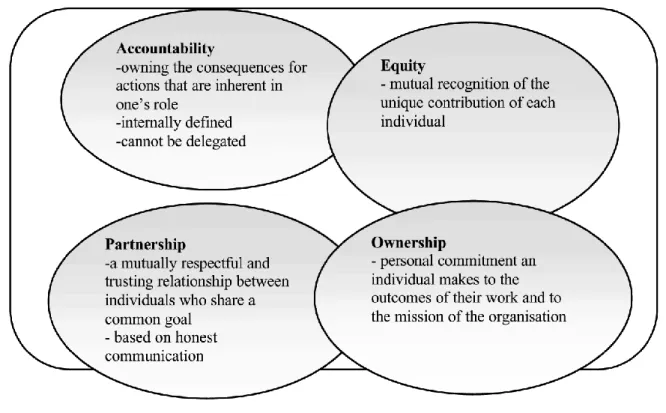
Jackson (2000) discusses four constructs that are vital to the understanding of shared leadership: accountability, partnership, equity, and ownership.
Figure 2 illustrates the interconnectedness of these concepts.
Figure 2: Shared Leadership Concepts (Porter-O'Grady et al., 1997, p. 40)
Ownership or personal commitment to the partnership’s goals is one of the key
concepts, and of course Shared Ownership is also one of the Lines of Operation in the CF Health and Physical Fitness Strategy guide. Partnership describes the collaborative relationship of individuals within the partnership, and communication is again underlined as part of this concept (Jackson, 2000, p. 168).
Methods
current situation and of the value of leadership at the various levels of the CF
organization, a goal that had personal appeal as I myself am about to step into a formal leadership role within the CF Health Services. The qualitative action research approach was used in order to draw on the insights of key stakeholders. Action research is “a style of research rather than a specific method,” and is characterized by participation
and a collaborative approach (Myers, 2000 p. 178).
As described by Coghlan and Brannick (2007), action research includes a pre-step followed by four pre-steps of diagnosing, planning action, taking action, and evaluating action. The pre-step in my research included identifying an issue and population.
Defining the problem research question through a literature search was the diagnosing step, and planning involved outlining the methodology of data gathering. My action step was face to face and telephone interviews with key experts and stakeholders, and the evaluation step consisted of data analysis and development of leadership
recommendations. Action research is uniquely appropriate as it recognizes the
researcher as a participant in the process; as I myself am a member of the organization that I was examining and hold a leadership position in the CF Health Services, my experiences became part of the conversation with the program staff and an opportunity to exchange knowledge. Action research is a cycle of “observation, reflection, and action” (Stringer, 1999, p. 19), and as a leader within the CF my final action step will be
The method for data collection was semi-structured personal interviews (Bryman, 2004). The stakeholders interviewed were chosen intentionally, beginning with core staff of the STF program and rolling outwards as other stakeholders were identified through interviews. All interviewees agreed to speak in their professional roles about their programs. Interviews were conducted mainly face to face, with telephone interviews when interviewee location made a face to face interview impossible. Questions included information on the specific programs under the interviewee’s responsibility, with
supporting documents about the programs obtained in hard copy or electronic format. Interviewees were also asked about the impact of leadership on program
implementation at the local base and unit levels, and how leaders can work to overcome barriers to the successful implementation the programs. Recording during the interviews was done by hand, and thus included meaningful phrases, general themes and specific insights rather than a full recording of the interview.
Results
The interviews yielded information about programs and initiatives being used by the CF to combat the obesity problem, as well as views of perceived barriers within the system, and about the need for engaging local leadership to achieve the program goals.
prioritized, and receive 50% of health promotion resources on bases. This is partly because the Alcohol, Other Drugs and Gambling Awareness (AODGA) program that teaches risk reduction strategies is mandatory for supervisors. The program recognizes that supervisors and middle management has the greatest direct impact on their people (D. Chafe, personal communication, May 30, 2012). Unfortunately there is no similar mandatory program relating to supporting a non-obesogenic environment.
Other barriers to providing a healthier diet include the long procurement process for combat rations, which bars inclusion of choices such as dried fruits and nuts as snacks rather than chocolate bars and cookies. Timing constraints may be a barrier to participants in the 8-week Weight Wellness program. Local leadership is necessary to successfully implement campaigns, such as the fruit and vegetable consumption campaign, since participants need to be signed up locally (M. Graham, personal communication, May 29, 2012).
P. Hutton stated that inadequate penetration of STF and the overall Health and Physical Fitness Strategy to the leadership at local bases, especially middle-level leadership, is a barrier (personal communication, May 29, 2012). Local leaders need to be more aware of health promotion programs, but also of their responsibilities to model healthy behavior and support a culture of health, and increased awareness on their part will also lead to engagement and feedback to CF Health Services personnel about what works and what doesn’t. This engagement and feedback is especially important
formative research in order to identify and target population segments with specific interventions (P. Hutton, personal communication, May 29, 2012). Such a targeted approach, tailored to specific population segments, should increase the effectiveness of the interventions (Haby et al., 2012, p 5). For example, effectively framing nutrition education as more action/military oriented could be to one of the reasons for the higher uptake of the Top Fuel for Performance program compared to the Weight Wellness program. (Nelson and Kinder, 1996; P. Hutton, personal communication, May 29, 2012).
The Weight Wellness program relies mainly on self-referral or referral from the primary care clinic, thus targeting members who already recognize a problem and are willing to take steps to change it. Participant feedback shows that label reading and portion size teaching are the most useful modules for participants (M. Graham, personal communication, May 29, 2012). This is an important feedback point as studies have shown that many people are unable to properly estimate their portion sizes,
(Champagne et al., 1998; Champagne et al., 2002; Bedard et al., 2004). In addition, overweight individuals tend to underreport energy intake more than normal-weight individuals (Pomerleau et al., 1999; Scagliusi et al., 2009). Calorie labels in fast food restaurants are less useful if a person doesn’t understand how the meal fits into their
recommended daily caloric requirement (Roberto et al., 2010, p. 313).
appropriate for their weight and activity levels (Young and Nestle, 2003, p. 231). Calories remain the currency of weight change, and teaching calorie awareness is important in a culture of oversized portions, oversized dinner plates and calorie-dense processed food. The CF has some control over the food offered in its
cafeterias/messes, but only a relatively small population (10-15%) of the CF population dines in the messes. The basis for food offerings in the messes is Canada’s Food Guide
as well as morale and diner choice. Preliminary results from a consumption study at Canadian Forces Base Saint-Jean show that recruits choose fruit often, but also consume a lot of desserts. Fruit consumption among recruits goes up when more time is given for meals (H.A. Troupe, personal communication, June 6, 2012). This
observation again underlies the importance of engaging local non-medical leaders in a partnership, so that the goal of creating good habits and maintaining a healthy diet is not too compromised by the goal of creating stress during a training course. Units are supposed to appoint a unit health promotion representative, and medical leaders on base should seek to actively engage these representatives (L. MacDonald, personal communication, May 30, 2012). There is a need for both healthy eating policies and behavior modeling at all CF-sponsored events, and at the unit level is it necessary that local health leaders engage the unit leadership to ensure awareness of this (Dr. D. Reid, personal communication, June 7, 2012).
In the area of physical fitness, the Directorate of Fitness (D Fit) is launching a fitness website, to coincide with the release of new CF “Project Force” mandatory
algorithm designed to generate the programming was developed in-house at D Fit and the website will be able to create an piloting “exercise prescription” suited to specific
military branches and even work environments like on ship (D. Allard, personal communication, June 5, 2012). The website has the potential to reach the majority of CF members since all members are required to take the fitness test, and a password to the site will be given to members at that time. In addition, bundling the launch of the website with the release of the new standards will ensure high penetration and visibility, as the mandatory fitness standards are tied to promotion rankings and therefore of importance to CF members.
Leadership and chain of command engagement again was mentioned as vital to program success and achievement of the goal of a fitness culture. The culture currently is test-centric, with no serious incentives to keep fitness a priority as long as unit
members are passing the annual fitness test. The Department of Defence does include a direction for an hour of exercise daily, but with the caveat “when time permits”, and it
is easy to prioritize other needed tasks (D. Allard, personal communication, June 5, 2012).
On the clinical side, obesity and cardiac risk factors have been identified as a priority and the CF is about to launch two clinical pilot programs aimed at obesity and obesity-related risk factors. One of the initiatives is the 5 A’s (ask, advise, assess,
gives primary health providers a tool kit on how to raise the topic of excess weight, since unlike smoking clinicians rarely raise the issue of weight with patients unless it is directly related to a co-morbidity (Scott et al., 2004). The pilot program’s first goal is to
remove the barrier to starting the conversation with patients, and the trial will validate whether the program is being used on the appropriate target population.
The issue of shifting priorities also came up during my interview with Dr. Carew. Following the release of results from the 2004 HLIS which showed a rise in
overweight/obesity from the 2000 HLIS, the Obesity Working Group was formed to address obesity from a population health perspective. A trial clinical obesity program modeled on a multi-component diabetes program that included education and health promotion was in development, with the pilot study planned. The pilot study required that dieticians be hired to support the trial; however, priorities had changed and when the budget came out the plan to hire dieticians has to be cancelled, resulting in a cancellation of the pilot study (personal communication, June 1, 2012). Again, this occurrence underlies the difficulty in keeping a vision with a long-term goal as a priority; Kotter’s first step, the sense of urgency about an issue, does rely on the periodic
release of bad news such as another HLIS that shows obesity rates rising, but without a committed partnership in which leaders strive to keep the issue active, the urgency is displaced in the intervening years as other urgent issues arise (Kotter ,1996, p. 21).
directives and by making programs available. Medical Officers and other local health providers need to collaborate with the local leadership, from Base Commanders to unit CO’s, and create enduring partnerships for health promotion (Dr. D. Reid, personal
communication, June 7, 2012).
Discussion and Recommendations
The vision communicated in the CF Health and Physical Fitness Strategy guidance document is a healthy, fit and operationally ready population. The long-term nature of this goal, especially in light of still-rising obesity rates, requires effective leadership at all levels of the CF and collaboration between health care leaders and non-health leadership on bases.
partnership. The military work environment will also lead to a high turnover of personnel as members are deployed or moved within the organization, so collaborative leadership is one way to ensure some stability of the partnership. Without it, the partnership could collapse is a formally recognized leader is posted to another location.
Effective engagement of members to a partnership requires knowing something about the priorities of those we wish to engage. In my interview with Dr. Reid I found out that FHP/Health Promotion was one of the topics mentioned during the Basic Medical Officer Course, a course I had taken myself (Dr. D. Reid, personal communication, June 7, 2012). It is the first profession-related military course most Medical Officers (MO) fresh out of residency will take, and in many cases due to scheduling it occurs prior to basic military training. At that time, most new MO’s are concentrating on learning about
how to provide health care within the military system, and in many cases how to
properly wear a uniform; information about a program with no immediate application can easily be overlooked, as it was in my case. Similarly, an MO approaching a unit CO about health promotion must become familiar with the functioning and priorities of that unit, and engage the leadership at an appropriate time. The ability to listen and learn from others was high on the list of what makes an effective leader in a partnership, and taking the time to learn about the individual units and their needs will be important in being able to engage the members and build a partnership. Of interest here is the clinical 5A’a pilot program, which aims to engage health care providers in an active fight
be a priority in the minds of health providers, providing an opportunity to widen the scope of interest towards health prevention.
Based on the literature review and the results of my interviews, I recommend the following:
Recommendation 1. Effective leaders at all levels require good communication skills. The military provides structured training for formal communication within a hierarchical structure, but since non-hierarchical collaborative partnerships are also needed to achieve long-term goals within the military community leadership
development should focus on these necessary skills.
Recommendation 2. Unit and base leadership needs to be properly engaged in a partnership for health. In order to do this, base health leaders must be encouraged both to educate themselves in the Health Prevention goals of the CF with guidance available from the STF program, and to involve themselves with the wider on-base community and leadership. MO’s carry the authority of health experts in the CF as they do in the
civilian world, and a personal interest in promoting health at the unit and base level is likely to be well received, opening the door to the possibility of a partnership.
References
1. Alexander, J. A., Comfort, M. E., Weiner, B. J. and Bogue, R. (2001), Leadership in Collaborative Community Health Partnerships. Nonprofit Management and Leadership, 12(2): 159–175. doi: 10.1002/nml.12203
2. Baker P.R.A., Francis D.P., Soares J., Weightman A.L., and Foster, C. (2011). Community wide interventions for increasing physical activity. Cochrane Database of Systematic Reviews, 4. Art. No.: CD008366.
3. Balfour ,D., Moody, R., Wise, A., and Brown, K. (1996). Food choice in response to computer-generated nutrition information provided about meal selection in workplace restaurants. J Human Nutr Dietetics, 9: 231-237.
4. Bedard, D., Shatenstein, B., and Nadon, S.(2004). Underreporting of energy intake from a self-administered food-frequency questionnaire completed by adults in Montreal. Public Health Nutr, 7(5): 675-81.
5. Brambila-Macias, J., Shankar, B., Capacci, S., Mazzocchi, M., Perez-Cueto, F.J.A., et al. (2011). Policy interventions to promote healthy eating: A review of what works, what does not, and what is promising. Food & Nutrition Bulletin, 32(4): 365-375. Bryman, A. (2004). Social research methods (2nd ed.). New York: Oxford University Press.
6. Calle, E.E., Thum, M.J., Petreli, J.M., Rodriguez, C., and Heath, C.W. Jr. (1999). Body-mass index and mortality in a prospective cohort of U.S. adults. New England Journal of Medicine, 341(15): 1097-105.
from
http://www.cg.cfpsa.ca/cgpc/Petawawa/EN/HealthPrograms/HealthPromotion/Documen ts/hpfssscpeng.pdf
8. Casey, M. (2008). Partnership – success factors of interorganizational relationships. Journal of Nursing Management, 16: 72–83. doi: 10.1111/j.1365-2934.2007.00771.x
9. Champagne, C.M., Baker, N.B., DeLany, J.P., Harshe, D.W., and Bray, G.A. (1998). Assessment of Energy Intake Underreporting by Doubly Labeled Water and
Observations on Reported Nutrient Intakes in Children. Journal of the American Dietetic Association. 98(4): 426-433.
10. Champagne, C.M, Bray, G.A., Kurtz, A.A., Monteiro, J.B., Tucker, E., et al. (2002). Energy intake and energy expenditure: a controlled study comparing dietitians and non-dietitians. Journal of the American Dietetic Association, 102 (10): 1428-32.
11. Directorate of Force Health Protection. Canadian Forces Health and Lifestyle Information Survey of Canadian Forces Personnel 2008/2009, Regular Force Version. Retrieved 25 June 2012 from http://publications.gc.ca/collections/collection_2011/dn-nd/D2-293-2010-eng.pdf
12. Elliot, D.L., Goldberg, L., Kuehl, K.S., Moe, E.L., Breger, R.K., and Pickering M.A. (2007). The PHLAME (Promoting Healthy Lifestyles: Alternative Models' Effects) firefighter study: outcomes of two models of behavior change. J Occup Environ Med, 49(2): 204-13.
obese adults. Cochrane Database of Systematic Reviews, 3. Art. No.: CD000984. DOI: 10.1002/14651858.CD000984.pub2.
14. Foster, C., Hillsdon, M., and Thorogood, M. (2005). Interventions for promoting physical activity. Cochrane Database of Systematic Reviews, 1. Art. No.: CD003180. Guide to Community Preventive Services. Obesity prevention and control: interventions in community settings. Retrieved on 20 May from
www.thecommunityguide.org/obesity/communitysettings.html
15. Haby, M.M., Doherty, R., Welch, N., and Mason, V. (2012). Community-based interventions for obesity prevention: Lessons learned by australian policy-makers. BMC Res Notes, 5(20). doi: 10.1186/1756-0500-5-20.
16. Harnack, L.J., French, S.A., Oakes, J. M., Story, M.T., Jeffery, R.W., and Rydell, S.A. (2008). Effects of calorie labeling and value size pricing on fast food meal choices: Results from an experimental trial. International Journal of Behavioral Nutrition and Physical Activity, 5(63).
17. Israel, B.A., Schulz, A., Parker, E., and Becker, A. (1998). Review of community-based research: Assessing partnership approaches to improve public health. Annual Review of Public Health 19, 173–202.
18. Jackson, S. (2000). A qualitative evaluation of shared leadership barriers, drivers and recommendations. Journal of Management in Medicine, 14(3), 166 – 178.
20. Kouzes, J.M., and Posner, B.Z. (1995). The leadership challenge. San Francisco: Jossey- Bass.
21. Kotter, J. (1996). Leading Change. Boston: Harvard Business School. 22. Kotter, J. (1998). Winning at change. Leader to Leader, 10: 27-33.
23. Kress, A.M., Hartzel, M.C., and Peterson, M.R. (2004). Burden of disease associated with overweight and obesity among U.S. military retirees and their dependents, aged 38–64, 2003. Preventive Medicine, 41:63–69.
24. Maxwell, J.C. (2005). The 360 degree leader. Nashville, TN: Thomas Nelson, Inc. 25. Mohr, J. and Spekman, R. (1994). Characteristics of partnership success:
Partnership attributes, communication behavior, and conflict resolution techniques. Strat. Mgmt. J., 15: 135–152. doi: 10.1002/smj.4250150205
26. Myers, J. (2000). Qualitative research in health care: Using qualitative methods in health-related action research. British Medical Journal, 320: 78-181. Last accessed 29 June 2012, from http://www.bmj.com/cgi/reprint/320/7228/178.pdf
27. Nelson, T.E. and Kinder, D.R. (1996). Issue Frames and Group-Centrism in American Public Opinion. The Journal of Politics 58(4): 1055-1078.
28. Nowell, B. and Harrison, L.M. (2010): Leading Change Through Collaborative
Partnerships: A Profile of Leadership and Capacity Among Local Public Health Leaders. Journal of Prevention & Intervention in the Community, 39:1, 19-34
30. Pomerleau, J., Østbye, T. and Bright-See, E. (1999). Potential underreporting of energy intake in the Ontario Health Survey and its relationship with nutrient and food intakes. European Journal of Epidemiology, 15(6): 553-557.
31. Porter-O'Grady, T., Hawkins, M. and Parker, M. (1997). Whole Systems Shared Governance. Aspen Publication, Maryland.
32. Prospective Studies Collaboration (2009). Body-mass index and cause-specific mortality in 900 000 adults: collaborative analyses of 57 prospective studies. The Lancet, 373(9669): 1083-1096.
33. Pulos, E. and Leng, K. (2010). Evaluation of a Voluntary Menu-Labeling Program in Full-Service Restaurants. American Journal of Public Health, 100(6): 1035-1039.
34. Roberto, C.A., Larsen, P.D., Agnew, H., Baik, J. and Brownell, K.D. (2010).
Evaluating the Impact of Menu Labeling on Food Choices and Intake. American Journal of Public Health. 100(2): 312-318.
35. Scagliusi, F.B., Ferriolli, E., Pfrimer, K., Laureano, C., Cunha, C.S., Gualano, B., et al. (2009). Characteristics of women who frequently under report their energy intake: a doubly labelled water study. Jr. Eur J Clin Nutr, 63(10): 1192-9.
36. Scott, J.G., Cohen, D., DiCicco-Bloom, B., Orzano, J., Gregory, P., Flocke, S.A., et al. (2004). Speaking of weight: how patients and primary care clinicians initiate weight loss counselling. Preventive Medicine, 38(6): 819–827.
38. Sproul, A., Canter, D., and Schmidt, J. (2003). Does point-of-purchase nutrition labeling influence meal selections? A test in an army cafeteria. Military Medicine, 168: 556-560.
39. Strengthening the Force. (2004b). HP Program Development, Implementation, Training and Evaluation Plans FYs 04-06.
40. Stringer, E.T. (1999). Action research (2nd ed.). Thousand Oaks, CA: Sage.
Thorndike, A.N., Sonnenberg, L., Riis, J., Barraclough, S., and Levy, D.E. (2012). A 2-Phase Labeling and Choice Architecture Intervention to Improve Healthy Food and Beverage Choices. American Journal of Public Health, 102(3): 527-533.
41. Vogel, J.A. (1992). Obesity and its relation to physical fitness in the US military. Armed Forces & Society, 18(4): 497-513.
42. Weiss, E.S., Anderson, R.M., and Lasker, R.D. (2002). Making the Most of
Collaboration: Exploring the Relationship Between Partnership Synergy and Partnership Functioning. Health Educ Behav, 29(6): 683-698.
43. World Health Organization. (2003). Diet, nutrition and the prevention of chronic disease: report of joint WHO/FAO expert consultation (WHO Technical Report Series 916). Retrieved on 12 June 2012 from:
http://www.fao.org/DOCREP/005/AC911E/AC911E00.HTM
44. Young, L.R. and Nestle, M. (2003). Expanding portion sizes in the US marketplace: Implications for nutrition counselling. Journal of the American Dietetic Association, 103(2): 231–234.