OPTIMIZING HOT DIP GALVANIZING OPERATIONS
OF STEEL SHEETS FOR BETTER QUALITY
O.R. ADETUNJI
Mechanical Engineering Department, University of Agriculture, Abeokuta, Nigeria. E-mail: [email protected]; [email protected]
mate coating layer contains from about 0.5 to 10.0% by weight of magnesium, from about 0.1 to 2.0% by weight of nickel, and from about 0.5 to 8.0% by weight of manga-nese (US Patent 6322906, 2001). The per-formance of galvanized coating is known to depend to a large extent upon the nature of the environment to which it is exposed. However, for any specific exposure condi-tion the thickness of galvanized coating is the most important factor determining its life of corrosion protection (Wall, 1989). Galvanized coating comprises an outer ‘pure’ zinc layer and several inner alloy layers of iron and zinc inter-metallic phases, the layers becoming successively richer in iron with depth. The role each of these layers plays in the overall corrosion performance of the
ABSTRACT
Hot dip galvanizing operations were conducted in the laboratory for steel sheets of 0.20 mm, 0.60 mm and 1.0 mm thicknesses. The operations were carried out using 99.8% zinc with small amounts of aluminium addition at 450oC for 1.0 min immersion duration at withdrawal speeds of 3 m/min, 4 m/ min and 5 m/min. Steel plates were withdrawn into a clean area in an open space where they were rapidly cooled. The quality of the galvanized coatings produced was evaluated by their appearance, lustre and uniformity. The results obtained showed varying quality parameters for different thick-nesses. Gauges 18, 22 and 28 steel sheets had best quality in terms of coating lustre and uniformity at respective withdrawal speeds of 3m/min, 4 m/min and 5 m/min. The differences in the heat capaci-ties of different gauges led to their different responses in cooling time which accounted for the results obtained.
Keywords; Temperature, withdrawal speed, coating, uniformity, quality.
INTRODUCTION
Protection of steel from rust through hot dip galvanizing is an age long activity. Many methods of protecting steel from corrosion are possible. Such methods are painting, electroplating, alloying addition (for exam-ple, nickel or chromium), cathodic protec-tion (using sacrificial anodes or impressed currents) or by coating with a thin layer of corrosion resistant metal. Many current cor-rosion control measures use coatings, con-version layers, material selection, design, cathodic protection, inhibition and environ-ment alterations among other control meas-ures (Lawal et al., 2006, Lee and Charackhs, 1993 and Abiola and Oforkar, 2002). A galvanized steel sheet includes a galvanized coating layer. The zinc phosphate or
chro-Journal of Natural Sciences, Engineer-ing and Technology ISSN- 2277 - 0593
galvanized coating is not yet agreed upon (Burns and Bradley, 1967).
The thickness of the alloy layers increases with increase in galvanising temperature and immersion time and is affected by certain bath additives (Adetunji et al., 1992). Alu-minium diminishes the relative thickness of the iron-zinc alloy layer in the coating by reducing the solubility of iron in zinc, thereby increasing the ductility of the coat-ing since the iron-zinc layer is brittle. It is also known to increase coating adhesion. The thickness of the outer layer is deter-mined by the bath temperature and the speed of withdrawal from the bath. Small amounts of some metals when present in the zinc bath may influence both the rate of alloying with iron and the character of the zinc coating so produced. Notably among such metals are aluminium and/or anti-mony which are usually added to the galva-nizing bath to achieve an improvement in appearance and adherence of the coating (Hanna and Nassif, 1983).
This research aims at determining the effect of withdrawal speed on the overall quality of hot dip galvanized steel sheets with re-gards to sheet metal thickness.
MATERIALS AND METHODS
Materials
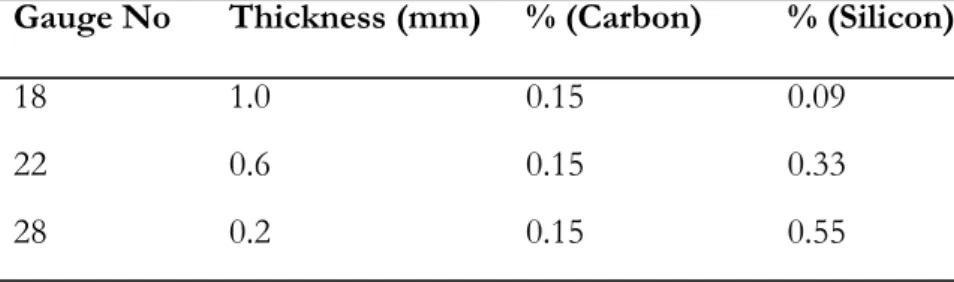
Steel sheets of compositions and thick-nesses shown in Table 1 were cut into 3 cm x 3 cm sheets. A 2 mm hole was drilled at 2 mm to the edge of each sheet on the verti-cal central line to facilitate easy withdrawal from the bath using steel and copper wires, with steel wire attached to the sheets while the copper wire was attached to the motor’s pulley. The two wires were joined together.
Laboratory Galvanizing Equipment
The equipment for galvanizing consisted of the following materials: A carbolite vertical furnace (0-1000oC) was used to melt the zinc
ingots. A cylindrical steel crucible was used to hold the zinc and lead inside the furnace. An electric (d.c.) motor was used to auto-mate the withdrawal of sample during galva-nizing. A d.c. power source provided electric power to the electric motor. Steel and cop-per wires facilitated easy withdrawal of sam-ples. A rheostat used to vary speed of elec-tric motor. Nitrogen gas cylinder was used to provide nitrogen gas to wipe the surface of molten zinc from oxidation. Valve was used to switch on and switch off the electric cir-cuit while glass and rubber tubes conveyed gas and water.
Pre treatment Operations
The steel sheets were degreased by dipping them in 99.7% ethanol solution for thirty minutes to remove all traces of grease and oil. The degreased sheets were pickled in 15% hydrochloric acid solution for thirty minutes to remove scale and oxidation prod-ucts from the samples. The acid concentra-tion was kept constant at 15% by periodic additions of concentrated acid. A pH of 2.0 was maintained.
The samples were rinsed under running tap water for ten minutes to remove all traces of iron salts formed by pickling. The samples were then dipped in aqueous zinc ammo-nium chloride solutions (prepared by mixing 3 moles of ammonium chloride with 1 mol of zinc chloride). The fluxed steel sheets were dried on the magnetic hot plate at 100oC for one minute.
pure lead which was put in the bottom of the cylindrical crucible. The crucible was put in the carbolite vertical furnace and covered with a refractory material. The fur-nace was then switched on till the set galva-nizing operations were completed. The three gauges of the samples galvanized at 450oC, for 1 min and withdrawn at speeds
of 3 m/min, 4 m/min, and 5 m/min. Low pressure and high volume of nitrogen gas was injected to the bath surface as a cover during immersion, in addition to the protection against oxidation by the flux. The oxidation of the molten zinc was found to reduce tremendously.
The galvanized samples were withdrawn into a clean area in an open space where they were normalised. They were later dipped into a dilute solution of potassium dichromate for passivation except one set of sheets galvanized at 450oC for 1 min and
withdrawn at 3 m/min. the thickness of the coatings were measured by micrometer screw gauge. They were stored in a dessica-tor for preservation before testing.
RESULTS AND DISCUSSIONS
Coating Quality
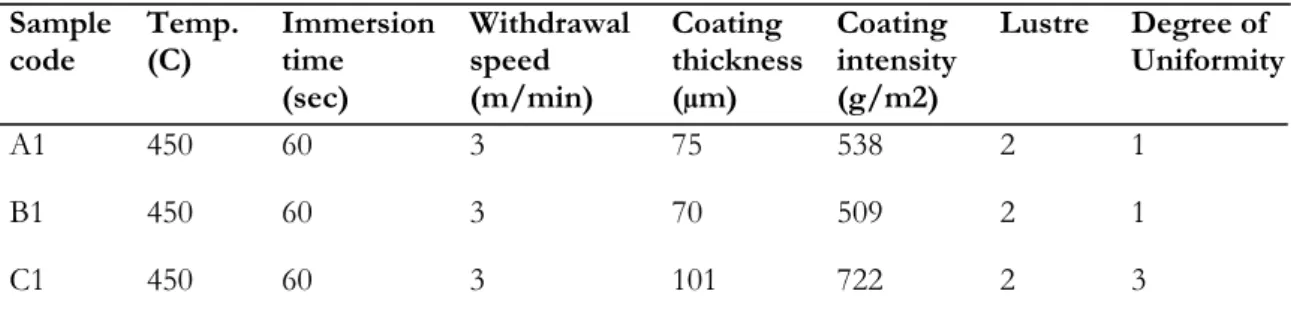
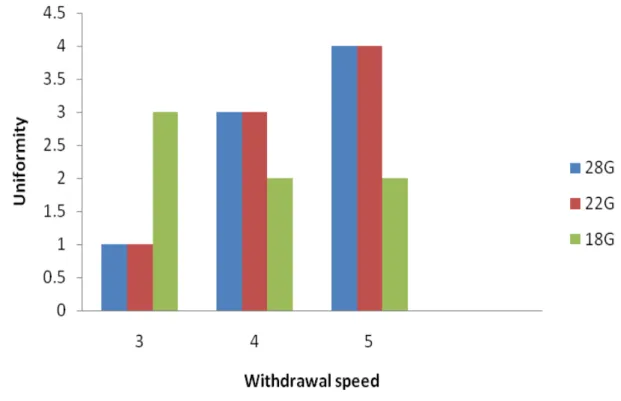
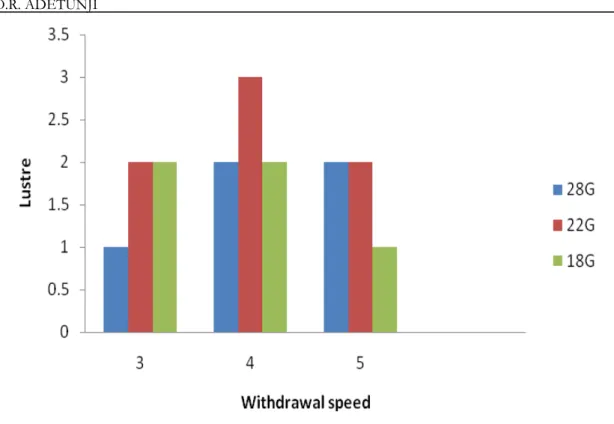
The quality of the coatings produced was evaluated by their appearances, lustre and uniformity. The uniformity of the coatings was determined by finding the difference between the thickest part of the coating and the thinnest on the same side. If the differ-ence is within 2 µm, the coating’s uniformity is regarded as being very good whereas if it is within 5µm, it is termed good. Within 10 µm difference in thickness on the same side, the coating is described as fair while poor uni-formity is ascribed to the difference exceed-ing 10 µm. Lustre which is the degree of shi-neness of the samples was evaluated by physical appearance. The carbon and silicon contents of the steel galvanized had no nega-tive effect on the results obtained as values were within mild steel classification. The results obtained are summarized in Tables 2 to 4.
Uniformity against withdrawal speeds and Lustre against withdrawal speeds are given in Figures 1 and 2 while the overall quality plot (lustre + uniformity) against withdrawal speeds is given in Figure 3.
Table 1: Composition and thicknesses of steel sheets
Gauge No Thickness (mm) % (Carbon) % (Silicon)
18 1.0 0.15 0.09
22 0.6 0.15 0.33
Table 2: Quality of gauge 28,22 & 18 samples galvanized at 450 oC, 1 min
duration and 3m/min withdrawal speed
Sample
code Temp. (C) Immersion time (sec)
Withdrawal speed (m/min)
Coating thickness (µm)
Coating intensity (g/m2)
Lustre Degree of Uniformity
A1 450 60 3 75 538 2 1
B1 450 60 3 70 509 2 1
C1 450 60 3 101 722 2 3
Note: Poor- 1, Fair- 2, Good- 3, V. Good- 4.(degree of uniformity and lustre)
A-28 Gauge,B-22 Gauge and C-18 Gauge, Withdrawal speed of 3m/min is indicated by 1
Withdrawal Speed
The quality improves with increase in with-drawal speed. The best quality was obtained at 5 m/min for gauge 28, 4 m/min for gauge 22 and 3 m/min for gauge 18. The
variation of withdrawal speeds with the qual-ity of the coating for gauge 28 showed thin-nest sheets (0.2 mm) require higher speed with shorter drainage period owing to its lower heat capacity.
Table 3:Quality of gauge 22 samples galvanized at 450 oC at 1 min duration
and various withdrawal speeds
Sample
code Temp. (C) Immersion time (sec) Withdrawal speed (m/ min)
Coating Thickness (µm)
Coating intensity (g/m2)
Lustre Degree of Uniformity
B1 450 60 3 70 509 2 1
B2 450 60 4 81 610 3 3
B3 450 60 5 85 640 2 3
Note: Poor- 1, Fair- 2, Good- 3, V. Good- 4(degree of uniformity and lustre), Withdrawal speed of 4 m/min is indicated by 2 while that of 5 m/min is indicated by 3.
Table 4: Quality of gauge 28 & 18 samples galvanized at 450 oC for 1 min
duration at various withdrawal speeds. Sample
code Temp. (C) Speed m/min Thickness ( µm) Coating intensity (g/m2)
Lustre Degree of Uniformity
A1 450 3 75 538 1 1
A2 450 4 80 630 2 3
A3 450 5 85 650 2 4
C1 450 3 101 722 2 3
C2 450 4 103 726 2 2
C3 450 5 105 730 1 2
Note: Poor- 1, Fair- 2, Good- 3, V. Good- 4.(degree of uniformity and lustre),Afor 28G and C for 18G.
Fig. 2: Plot of lustre against withdrawal speeds at 1 min immersion
CONCLUSION
The hot dip galvanized coatings in terms of lustre and uniformity determine their quality irrespective of their thicknesses. Correlating withdrawal speed with steel sheet thickness is found to improve quality of galvanized steel sheet products. Thus, the overall qual-ity of steel sheets galvanised at 450 oC for 1
minute immersion time was best at with-drawal speeds of 3 m/min,4 m/min and 5 m/min for gauges 18,22 and 28 sheets re-spectively.
REFERENCES
Abiola, O.K., Oforkar, N.C. 2002. Inhibi-tion of Corrosion of Mild Steel in Hydro-chloric Acid. Journal of Corrosion Science and Engineering, 3: 21.
Adetunji, O.R., Ali, J.A., Egundebi, G.O. 1992. Evaluation of process Variables on the Corrosion Performance of Hot Dip Galvanized Steel Sheets. Nigerian Corrosion Association Conference Proceedings, pp. 83- 89.
Burns, R.N., Bradley, W.W. 1967. Protec-tive Coatings for Metals, Reinhold, New York, 155p.
Hanna, F., Nassif, N. 1983. Factors affect-ing the Quality of Hot Dip Galvanized Steel Sheets, Surface Technology Journal, 20: 27- 37.
Lawal, G.I., Amuda, M.O.H., Fasuba, O.A. 2006. Inhibitive Behaviour of Tobacco Extract on Corrosion of Mild Steel in Acidic and Salty Media. NSE Technical Transac-tion. 41(4d).
Lee, W., Characklis, W.G. 1993. Corro-sion of Mild Steel under Anaerobic Bio film. Journal Article Corrosion, (Houston), Montana State University, Bozeman, United States 49:3.
US Patent 6322906, 2001. Perforative Cor-rosion Resistant Galvanized Steel Sheet. US Patent issued on November 27, 2001.
Wall, A.J. 1989. Applications for Zinc De-velopments and Prospects, Metals and Materi-als, 5(3): 134-137.