Sharif University of Technology
Scientia IranicaTransactions B: Mechanical Engineering http://scientiairanica.sharif.edu
Multi-objective optimization of force convective heat
transfer in a stack of horizontal channels using CFD
and genetic algorithms: A comparison with asymptotic
method results
H. Sakhani
and Z. Shirazi
Department of Mechanical Engineering, Faculty of Engineering, Arak University, Arak, P.O. Box 38156-88349, Iran. Received 24 February 2016; received in revised form 3 September 2016; accepted 28 January 2017
KEYWORDS Stack of horizontal channels;
Force convection; CFD;
Multi-objective optimization; Asymptotic method.
Abstract. In this paper, by combining the Computational Fluid Dynamics (CFD) and NSGA II algorithm, the forced convective heat transfer ow in a stack of horizontal parallel plates has been multi-objectively optimized. In the optimization process, the distance between the plates in the set of parallel channels has been changed so as to simultaneously optimize the amount of heat transfer between the plates and uid and the pressure drop of the uid (maximization of heat transfer and minimization of pressure drop). The Pareto front, which illustrates the changes of heat transfer from the plates and the pressure drop of uid, simultaneously, has been presented in the results section. This result contains important information regarding the thermal designing of stack of channels subjected to forced convective heat transfer. The Pareto front has been obtained for four dierent uids that have dierent Prandtl (Pr) numbers (mercury, air, water, and oil), and the results related to each uid have been discussed. Finally, the multi-objective optimization results obtained in this paper have been compared with the results of the asymptotic analysis method (which is a single-objective method aimed at increasing the amount of heat transfer from plates) for internal uid ows, and useful information has been obtained.
© 2018 Sharif University of Technology. All rights reserved.
1. Introduction
Heat exchangers are extensively used nowadays in various industries. One of the most frequently used types of heat exchangers is the plate heat exchanger. Today, with the diminishing of the energy resources, it is felt necessary to optimize these types of exchangers. Many investigations have been conducted in recent years on the numerical modeling, geometrical optimiza-*. Corresponding author. Tel.: +98 86 3262 5726;
Fax: +98 86 3262 5001
E-mail address: [email protected] (H. Sakhani) doi: 10.24200/sci.2017.4316
tion, and the governing conditions of this type of heat exchanger [1-6]. Bejan and Sciubba [1] applied the asymptotic method to determine the optimum geome-try of a stack of parallel plates cooled by forced uid ow. They demonstrated that the thermal conditions of channel walls, with the temperature or ux being constant, did not led to much dierence in the nal results. They used a single-objective optimization, and their goal was to increase the amount of heat transfer in the stack of plates. By applying the genetic algorithms, Wei and Joshi [2] minimized the thermal resistance of a micro-channel heat sink. The design variables in their research consisted of some geometrical parameters including the blade thickness, ratio of channel width to blade thickness, etc. They
performed their single-objective optimization process by considering two constraints: maximum permitted pressure loss and maximum permitted inlet ow rate. By combining numerical, analytical, and experimental studies and employing the asymptotic analysis method, Bejan et al. [3] optimized the natural convective ow around a stack of horizontal cylinders. They used a single-objective optimization approach; the design variable in their research was the distance between the cylinders and the constraint they had in mind was the constant volume of the region under investigation. Finally, they presented an equation for the optimal dis-tance between the cylinders and the maximum degree of heat transfer, which was a function of geometrical variables and the non-dimensional Rayleigh number. Goshayeshi and Ampofo [4] numerically investigated the performance of heat sinks, placed horizontally and vertically and subjected to natural convective ow. They concluded that the vertical heat sinks had the best performance. Bar-Cohen and Rohsenow [5] used the analytical equations to calculate the optimum chan-nel width for the maximum amount of heat transfer in a stack of vertical channels subjected to natural convection, for two boundary conditions of constant temperature and constant ux at channel walls. Using numerical modeling, Buonomo and Manca [6] explored the ow of air in vertical microchannels subjected to free convection. They investigated the slipping uid ow, and the wall boundary condition was the constant ux at the walls. Some other researchers investigated optimization methods in heat transfer engineering applications [7-12].
In recent years, some researchers have used novel optimization methods in engineering applications [13-15]. Hao et al. [13] investigated surrogate-based optimum design for stiened shells with adaptive sam-pling. They investigated two illustrative examples to demonstrate the eciency of the surrogate-based optimization method. One was a three-dimensional rigid-frame model, and the optimizations using the proposed method, direct surrogate-based optimization, and multi-island genetic algorithm were compared based on this model. The other was a typical fuel tank model congured for use in the booster of a launch vehicle. Three adaptive sampling strategies with dierent distributions of sampling points were compared with the direct surrogate-based optimiza-tion. Results indicated that the bi-step surrogate-based optimization with adaptive sampling provided an ecient and practical approach to nd the optimum design for a structure with numerous variables and various types.
In the heat exchangers performed by force convec-tion, it would be ideal to have a maximum heat transfer rate and minimum pressure drop. In fact, the heat transfer and pressure drop conict with each other;
thus, to achieve the optimal thermal behaviors in these channels, an MOO approach should be used to discover the best possible design points with appropriate heat transfer and pressure drop. NSGA II algorithm is one of the best and most complete multi-objective optimization algorithms, which is used in this paper as well. This algorithm was rst proposed by Deb et al. [16], and it has been used in recent years in various engineering-related applications [17-19].
To the best of the authors' knowledge, a multi-objective optimization using the combination of Com-putational Fluid Dynamics (CFD) and genetic algo-rithm has not been utilized yet for the optimization of a stack of parallel plates with dierent uids (dierent Prandtl numbers) passing through them. In this paper, by combining the CFD and NSGA II algorithm, the force convective heat transfer ow in a stack of horizontal parallel plates has been multi-objectively optimized. In the optimization process, the distance between the plates in the set of parallel channels has been changed so as to simultaneously optimize the amount of heat transfer between the plates and uid and the pressure drop of the uid (maximization of heat transfer and minimization of pressure drop). 2. Mathematical modeling
The data needed for performing the multi-objective optimization in this paper have been obtained by means of numerical modeling. The details of this procedure will be described in this section.
2.1. Geometry
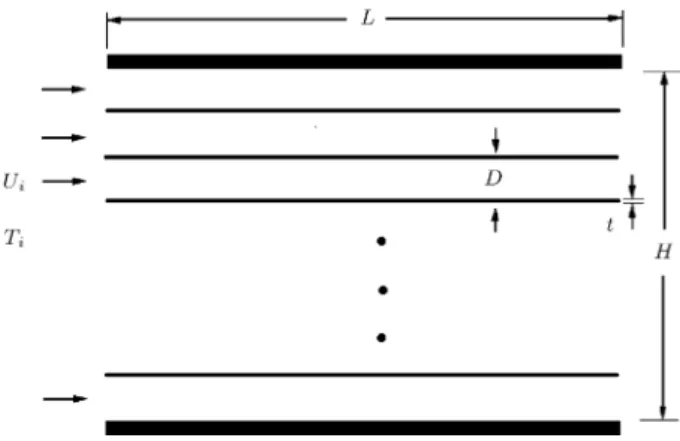
The geometry investigated in this paper has been schematically illustrated in Figure 1. As shown in this gure, a number of parallel plates have been placed next to each other, which form a stack of parallel channels. Since, in this stack, the uid ow eld in each channel is the same, the governing equations have been numerically solved for one channel of width D and length L; and, nally, the total heat transfer from the
Figure 1. Schematic of a stack of horizontal channels cooled by force convection.
Table 1. Some parameters and operating conditions used in the numerical simulations.
0:004 D=L 1 H=L = 1 t = 0 Re = 1000
Pr = 0:01; 0:72; 7; 13000 Ti= 20C
Tw= 75C
plates and pressure drop have been multiplied by the number of channels to get the total values. The total pressure drop and heat transfer for the set of channels are computed as follows:
qtot= nq1; (1)
Ptot= P1; (2)
n L
D: (3)
The thickness of the plates has been ignored in the computations (t 0). In fact, the problem in this paper is dened as: \How many channels can be established on a plate of specic dimensions (L H) so that the pressure drop of uid and heat transfer from the stack of plates are simultaneously optimized?" Some of the constants and specications used in this paper have been presented in Table 1.
2.2. Governing equations
In this paper, the governing equations constitute the continuity, Navier-Stokes, and energy equations in steady and laminar ow regimes (Re = 1000 < 2300). These equations are expressed as:
Continuity equation:
r:~V= 0: (4)
Momentum equation:
r:~V ~V= rP + r:r~V: (5)
Energy equation: r:~V CPT
= r:(krT ): (6)
2.3. Boundary conditions
For numerical simulation, the equations of the previous sections should be solved subject to the following boundary conditions:
Channel inlet:
Vx= Vi; Vy= 0; (7)
T = Ti: (8)
Fluid-wall interface:
Vx= Vy= 0; (9)
T = TW: (10)
Channel outlet:
P = Patm: (11)
The values of all the variables have been adjusted so that for uids with dierent Pr numbers, all the non-dimensional parameters (e.g., Reynolds number) are equal to each other.
2.4. Numerical methods
The numerical simulation is performed using the nite volume method. A second order upwind method is used for the convective and diusive terms and the SIMPLE algorithm is employed to solve the coupling between the velocity and pressure elds. The computations are continued until the solution converges with residuals of less than 10 8.
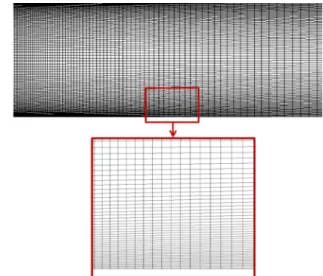
The mesh generation algorithm has been designed so that for every channel an appropriate non-uniform structured mesh is automatically generated. Due to the high gradient of the parameters, the generated elements at channel inlet and near the walls have ner sizes. The examined channels contain between 100 to 150 thousand structured elements. Figure 2 shows a sample of grid generation for computational domain in the present study. To make sure that the obtained results are independent of the size and the number of generated grids, several grids with dierent sizes along dierent directions have been tested for each structure; and it has been tried to consider the best grid, with the highest accuracy and the lowest computation cost, for each structure. Figure 3 shows the results of Grid Independency test (GI test) for 4 dierent generated grids. As shown in Figuer 3(a), all of the generated
Figure 2. Structured non-uniform grid generations performed in the present paper.
Figure 3. Grid independency test: (a) Axial velocity at center line, and (b) local Nu.
grids pass the GI test for dimensionless axial velocity (U=Ui). The generated grid with 40 80 number of nodes in y and z directions, respectively, fails in GI test of Nu (Figure 3(b)), therefore the grid with 50 120 number of nodes in y and z directions, respectively, is used in the simulations. It should be noted that the generated meshes may be distorted during the optimization process due to the changes in the distance between plates.
2.5. Validations
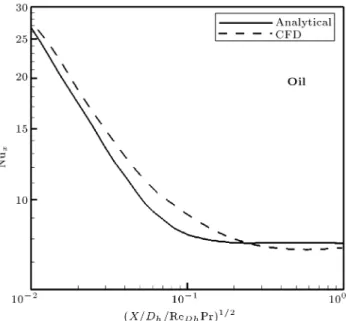
To be sure of the validity of the numerical modeling used in the optimization process, the obtained nu-merical results should be compared with similar and available data. In Figure 4, the local Nu number computed in this paper is compared with similar values obtained by [20]. As observed in Figure 4, the Nu number computed in this paper accurately complies
Figure 4. Comparison of local Nu of the present numerical calculation with the similar available data.
with those obtained by other researchers; therefore, these data can be used in the optimization process. 3. Results
In order to investigate the optimal cooling perfor-mance of stack of horizontal channels, the data of the numerical simulations presented in Section 2 are now employed in a multi-objective optimization pro-cedure using NSGA II algorithms [16]. In all runs, a population size of 60 has been chosen with crossover probability (Pc) and mutation probability (Pm) of 0.7 and 0.07, respectively. The two conicting objectives are qtot (heat transfer from stack of channels) and P (pressure drop of uid passing from stack) that should be optimized simultaneously with respect to the design variables D (or number of channels). The multi-objective optimization problem can be formulated in the following form:
8 > < > :
Maximize qtot= f1(D) Minimize Ptot= f2(D) Subject to 0:004 D=L 1
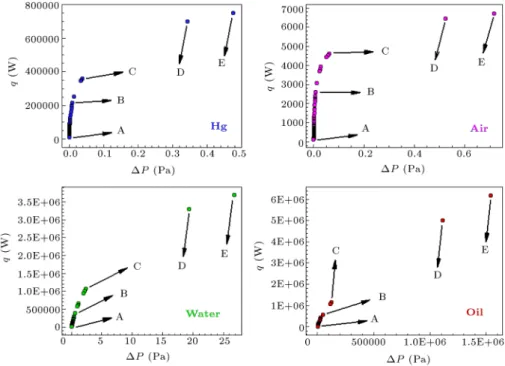
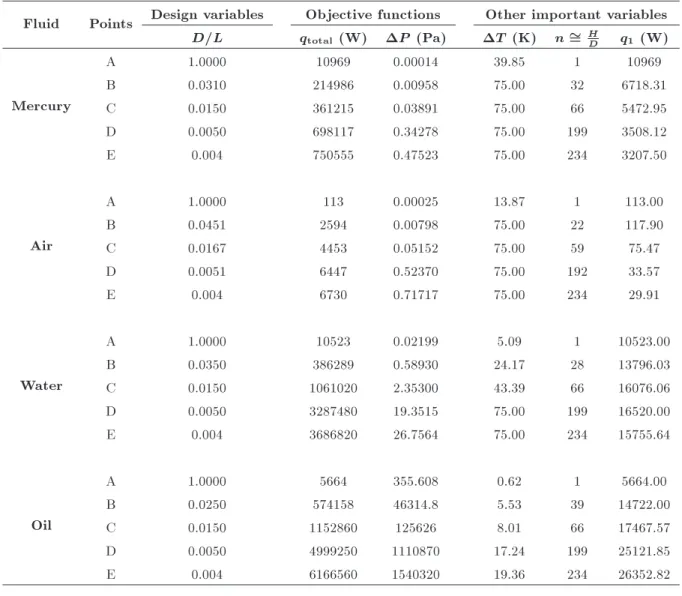
(12) Figure 5 shows the Pareto front for each of the four uids with dierent Pr numbers obtained for the mentioned two objective functions. As this gure indicates, for each uid, the points in the Pareto front have no dominancy over one another, i.e. no two points could be found with one having objective functions equal to each other and another having objective functions dierent from each other. In other words, if we move from one optimal point to another, one objective function will denitely improve and another objective function will certainly get worse. Although all the points in this Pareto front are optimal points, ve points with special and unique characteristics are also observed, which have been designated as points A, B, C, D, and E. The details of the design variables,
Figure 5. Pareto optimal points for qtot and P of the four dierent uids.
objective function values, and some of the other impor-tant parameters of these ve optimal points have been shown in Table 2. Points A and E display the best P and q, respectively.
Points B and D, known as the break points, are also interesting points in the design. In fact, as we go from point A to point B, P increases very slightly, while q increases considerably. Similarly, as we go from point E towards point D, q increases slightly, while P improves by a higher value.
In general, an optimal point in thermal design of stack of channels is a point where both of the objective functions are equally satised. In this paper, the mapping method [17] is used to compute and nd such a point. In this method, both objective functions are mapped between 0 and 1 and, then, the norm of their sum is calculated. A point with the highest norm is the point at which both objective functions have been optimized to the same value. In this paper, point C has been determined by using the mapping methods, and both objective functions are equally satised at this point.
Figure 6 shows the overlay of Pareto fronts ob-tained for the four dierent uids (mercury, air, water, and oil). An interesting point indicated by these diagrams is that the variation ranges of heat transfer and pressure drop values for oil are much greater than those for the other three uids. This demonstrates that oil can be suitably used for the cooling of dierent industrial equipment, and that the high pressure loss of oil can be compensated by means of giant pumps.
The trend of changes of the objective functions with respect to the design variables in the Pareto
Figure 6. Overlay of Pareto optimal points of the four dierent uids.
front conveys important and valuable information. The changes of pressure drop and heat transfer versus the changes of channel width have been illustrated in the Pareto diagrams in Figure 7 for the mentioned four uids. The variations of heat transfer and pressure drop have been indicated by triangles and circles, respectively. As shown in this gure, for small values of D=L, the heat transfer and pressure drop changes are negligible; however, the values of heat transfer and pressure drop increase, and the degree of their increase depends on the value of the Pr number.
Table 2. The values of objective functions and the associated design variables of the optimum points. Fluid Points Design variables Objective functions Other important variables
D=L qtotal(W) P (Pa) T (K) n = HD q1 (W)
Mercury
A 1.0000 10969 0.00014 39.85 1 10969
B 0.0310 214986 0.00958 75.00 32 6718.31
C 0.0150 361215 0.03891 75.00 66 5472.95
D 0.0050 698117 0.34278 75.00 199 3508.12
E 0.004 750555 0.47523 75.00 234 3207.50
Air
A 1.0000 113 0.00025 13.87 1 113.00
B 0.0451 2594 0.00798 75.00 22 117.90
C 0.0167 4453 0.05152 75.00 59 75.47
D 0.0051 6447 0.52370 75.00 192 33.57
E 0.004 6730 0.71717 75.00 234 29.91
Water
A 1.0000 10523 0.02199 5.09 1 10523.00
B 0.0350 386289 0.58930 24.17 28 13796.03
C 0.0150 1061020 2.35300 43.39 66 16076.06
D 0.0050 3287480 19.3515 75.00 199 16520.00
E 0.004 3686820 26.7564 75.00 234 15755.64
Oil
A 1.0000 5664 355.608 0.62 1 5664.00
B 0.0250 574158 46314.8 5.53 39 14722.00
C 0.0150 1152860 125626 8.01 66 17467.57
D 0.0050 4999250 1110870 17.24 199 25121.85
E 0.004 6166560 1540320 19.36 234 26352.82
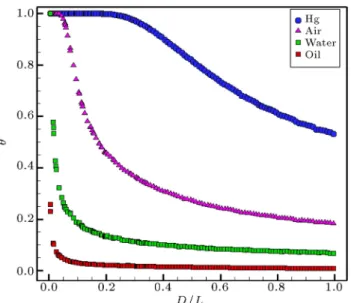
Figure 8. Optimal variations of averaged dimensionless temperature at the channel outlet with respect to D=L for four dierent uids.
variations of the heat transfer and pressure drop values for the four dierent uids, it is important to examine the changes of the outlet uid temperature. The four mentioned uids, due to having dierent Pr numbers, exhibit dierent thermal behaviors. Figure 8 shows the averaged non-dimensional outlet temperatures of the four dierent uids versus channel width in the Pareto front. As it is observed, the outlet temperature of mercury (with the least Pr number among the men-tioned uids), becomes equal to wall temperature at all the D=L values less than 0.25. Conversely, the outlet temperature of oil, which has a very high Pr number, does not become equal to wall temperature, even at the lowest value of D=L. This causes the physical properties of oil (which are temperature-dependent) not to change so easily. This characteristic of oil, i.e. change in its temperature being more dicult than that in other uids, along with its previously mentioned property, i.e. high heat transfer capacity, has led to the extensive use of oil in dierent industries.
Using the asymptotic optimization method, Be-jan [1,20] obtained and reported the optimum channel width and heat transfer values in the forced convective ow process as:
Dopt=L = 2:73Be
1 4
L ; (13)
qmax= 0:62
P Pr
1 2
HCP(TW T1); (14) where BeL is Bejan number and is dened as BeL =
P L2
. The results obtained by Bejan et al. [1,20] using the asymptotic approach have been compared in Figure 9 with the Pareto fronts obtained in this paper for air and water uids. As it is observed, there is a relatively large dierence between the results of the asymptotic method and the method presented in this paper. The reason is that the asymptotic method is not actually a classical optimization approach. In fact, no optimization takes place in this method, and only the behaviors of the internal and external ows are equalized at this point. The MOO method presented in this paper has a lot of advantages over the asymptotic method; e.g., the MOO method in this paper is CFD based; thus, it has higher accuracy. Moreover, it is a classic optimization method unlike asymptotic method. The other advantage of the presented method is the ability to recognize the break points (points B and D in this paper) in Pareto front, which is only possible in multi-objective optimization methods.
4. Conclusions
In this paper, by combining CFD and NSGA II algorithm, the forced convective heat transfer ow in a stack of horizontal parallel plates was multi-objectively optimized. In the optimization process, the distance between the plates in the set of parallel channels was changed so as to simultaneously optimize the amount of heat transfer between the plates and uid and the pressure drop of the uid (maximization
Figure 9. Overlay of Pareto optimal points calculated in present paper related to water and air and asymptotic method results.
of heat transfer and minimization of pressure drop). The Pareto front, which illustrates the changes of the heat transfer from the plates and the pressure drop of uid, simultaneously, was presented in the results section. This result contained very important information regarding the thermal designing of stack of channels subjected to forced convective heat transfer. The Pareto front was obtained for four dierent uids that had dierent Prandtl (Pr) numbers (mercury, air, water, and oil), and the results related to each uid were discussed. Finally, the multi-objective optimiza-tion results obtained in this paper were compared with the results of the asymptotic analysis method (which is a single-objective method aimed at increasing the amount of heat transfer from plates) for internal uid ows; and very useful and valuable information was obtained.
Nomenclature
Cp Specic heat (Jkg 1K 1) D Width of one channel (m) H Width of the main channel (m) h Local heat transfer coecient
(W/m2K)
h Mean heat transfer coecient (W/m2K)
k Thermal conductivity (Wm 1K 1) L Length of channels (m)
Nu Nusselt number (= hDh=k) P Pressure (Pa)
Pr Prandtl number (= =) q Heat transfer rate (W) q00 Heat ux (W/m2)
Re Reynolds number (= V Dh=) T Temperature (K)
V Velocity (ms 1) x Axial coordinate Greek symbol
Dynamic viscosity (Nsm 2) Kinematic viscosity (m2s 1) Density (kgm 3)
Subscripts
1 One channel
i Inlet conditions tot Total channels
References
1. Bejan, A. and Sciubba, E. \The optimal spacing of par-allel plates cooled by forced convection", International Journal of Heat and Mass Transfer, 35, pp. 3259-3264 (1992).
2. Wei, X., and Joshi, Y. \Optimization study of stacked micro-channel heat sinks for micro-electronic cooling", IEEE Transactions Components Packaging Technolo-gies, 26(1), pp. 156-169 (2003).
3. Bejan, A., Fowler, A.J. and Stanescu, D. \The optimal spacing between horizontal cylinders in a xed volume cooled by natural convection", International Journal of Heat and Mass Transfer, 38, pp. 2047-2055 (1995).
4. Goshayeshi, H.R. and Ampofo, F. \Heat transfer by natural convection from a vertical and horizontal sur-faces using vertical ns", Energy Power Engineering, 1(2), pp. 85-89 (2009).
5. Bar-Cohen, A. and Rohsenow, W.M. \Optimal inter-nal structure of volumes cooled by single-phase forced and natural convection", Journal of Heat Transfer, 106, pp. 106-116 (1984).
6. Buonomo, B. and Manca, O. \Natural convection slip ow in a vertical microchannel heated at uniform heat ux", International Journal of Thermal Sciences, 49, pp. 1333-1344 (2010).
7. Sakhani, H., Abbassi, A., Khalkhali, A. and Kalteh M. \Multi-objective optimization of nanouid ow in at tubes using CFD, articial neural networks and genetic algorithms", Advanced Powder Technology, 25(5), pp. 1608-1617 (2014).
8. Sada, M.H., Hosseini, R., Sakhani, H., Bagheri, A. and Mahmoodabadi, M.J. \Multi-objective optimiza-tion of solar thermal energy storage using hybrid of particle swarm optimization, multiple crossover and mutation operator", International Journal of Engi-neering Transaction B, 24, pp. 367-376 (2011).
9. Khalkhali, A., Sada, M., Rezapour, J. and Sakhani, H. \Pareto based multi-objective optimization of so-lar thermal energy storage using genetic algorithms", Transactions of the Canadian Society for Mechanical Engineering, 34(3-4), p. 463 (2010).
10. Sakhani, H. and Dolatabadi, H. \Multi-objective optimization of cooling of a stack of vertical minichan-nels and conventional chanminichan-nels subjected to natural convection", Applied Thermal Engineering, 96, pp. 144-150 (2016).
11. Sakhani, H. and Eiamsa-ard, S. \Pareto based multi-objective optimization of turbulent heat transfer ow in helically corrugated tubes", Applied Thermal Engi-neering, 95, pp. 275-280 (2016).
12. Sakhani, H. and Eiamsa-Ard, S. \Multi-objective optimization of turbulent tube ows over diamond-shaped turbulators", Heat Transfer Engineering, 37(18), pp. 1579-1584 (2016).
13. Hao, P., Wang, B. and Li, G. \Surrogate-based op-timum design for stiened shells with adaptive sam-pling", AIAA Journal, 50(11), pp. 2389-2407 (2012).
14. Hao, P., Wang, B., Tian, K. and Li, G. \Optimization of curvilinearly stiened panels with single cutout concerning the collapse load", International Journal of Structural Stability and Dynamics, 16, pp. 155-169 (2016).
15. Wang, B., Tian, K., Hao, P., Cai, Y., Li, Y. and Sun, Y. \Hybrid analysis and optimization of hierarchical stiened plates based on asymptotic homogenization method", Composite Structures, 132, pp. 136-147 (2015).
16. Deb, K., Agrawal, S., Pratap, A. and Meyarivan, T. \A fast and elitist multi-objective genetic algorithm: NSGA-II", IEEE Trans Evolutionary Computation, 6, pp. 182-197 (2002).
17. Sakhani, H., Akhavan-Behabadi, M.A., Nariman-Zadeh, N. and Mahmoodabadi, M.J. \Modeling and multi-objective optimization of square cyclones using CFD and neural networks", Chemical Engineering Research and Design, 89, pp. 301-309 (2011).
18. Sakhani, H., Hajiloo, A. and Ranjbar, M.A. \Model-ing and multi-objective optimization of cyclone sepa-rators using CFD and genetic algorithms", Computers and Chemical Engineering, 35, pp. 1064-1071 (2011).
19. Amanifard, N., Nariman-Zadeh, N., Borji, M., Khalkhali, A. and Habibdoust, A. \Modeling and Pareto optimization of heat transfer and ow coef-cients in micro channels using GMDH type neural
networks and genetic algorithms", Energy Conversion and Management, 49, pp. 311-325 (2008).
20. Bejan, A., Convection Heat Transfer, Wiley (2004).
Biographies
Hamed Sakhani is Assistant Professor of Me-chanical Engineering at Arak University, Iran. He received his PhD degree from Amirkabir University of Technology in 2014. He is one of the members of \The Promised SORAYYA Technologist" science-based industries in Iran. He has co-authored more than 40 journal and conference publications. His research interests include two-phase and single-phase convective heat transfer in macro-micro and nanoscales. He is currently working on augmentation of heat transfer by dierent passive techniques in two-phase ow and nanouid single-phase ow.
Zahra Shirazi was born in 1992 in Isfahan, Iran. She received the BSc degree in Mechanical Engineering from Arak University in 2015. The title of her BSc dissertation was \Numerical Study of Nanouid Flow in Pipes" under the supervision of Dr. Hamed Sakhani. She is currently working on augmentation of heat transfer by dierent passive techniques in single-phase ow systems.