Andrea G. Green. Preserving Collaborative Online Film Projects: Current Practices, Potential Methodologies, and User Expectations. A Master’s Paper for the M.S. in L.S degree. April, 2014. 74pages.Advisor: Christopher A. Lee
This research explores the current practices, potential methodologies, and user expectations concerning collaborative online filmmaking. Since the concept
“Collaborative Online Film Projects (COFPs)” was created for this research and since little research has investigated preservation of online participatory film projects, the paper includes an in-depth review of similar concepts and of literature addressing the
preservation of comparable areas of study, including crowdsourced art, interactive virtual worlds, and digital film.
The paper reports on a case study of the COFP platform Wreckamovie.com, including semi-structured interviews of individuals involved with the site. I also analyzed other COFP platform examples: the still-active hitRECord.org and the now inactive
opensourcecinema.org and the project A Swarm of Angels. Though more research is necessary, this paper concludes that though users value the preservation of their work, there is minimal communication about collaboratively preserving work and little engagement with active preservation.
PRESERVING COLLABORATIVE ONLINE FILM PROJECTS: CURRENT PRACTICES, POTENTIAL METHODOLOGIES, AND USER EXPECTATIONS
by
Andrea G. Green
A Master’s paper submitted to the faculty of the School of Information and Library Science of the University of North Carolina at Chapel Hill
in partial fulfillment of the requirements for the degree of Master of Science in
Library Science.
Chapel Hill, North Carolina April 2014
Approved by
Table of Contents
Table of Contents ... 1
1. Introduction ... 3
2. Literature Review... 6
2.1 Defining COFPs ... 9
2.1.1 Open Source Film ... 12
2.1.2 Remix ... 15
2.1.3 Participatory Film and Crowdsourced Art ... 18
2.2 Exploring Preservation ... 23
2.2.1 Digital Preservation ... 24
2.2.2 Virtual World Preservation ... 29
2.2.3 Web Archiving ... 32
2.2.4 The “Cousins”: Open Source, Remix, and Crowdsourced ... 34
3. Methodology ... 37
4. Case Studies ... 40
4.1 Wreckamovie.com... 40
4.1.1 Backup Methods ... 42
4.1.3 Reaction to Preservation ... 48
4.2 Other Examples ... 50
4.2.1 Opensourcecinema.org... 50
4.2.2 hitRECord.org ... 53
4.2.3 A Swarm of Angels (ASoA) ... 54
5. Discussion and Limitations ... 58
5.1 Discussion ... 58
5.2 Limitations ... 61
6. Conclusion ... 63
Notes ... 65
Bibliography ... 66
1. Introduction
Collaborative Online Film Projects (COFPs) use digital platforms and software to write, produce, and distribute films or some aspect of films (e.g. screenplays, soundtracks, special effects, etc). Though some aspects of COFPs may exist beyond the Web, COFPs’ creation, communication between collaborators, and dissemination exist primarily online via a forum, website, social network, blog, or some combination of those resources. Of the examples reviewed during preliminary research, there is little information available concerning data and/or project protection, recovery, or preservation, and it is unclear how different COFP platforms or users interpret the issue of project preservation. Existing digital preservation literature focuses on more conventional filmmaking methods, virtual worlds, social media, crowdsourcing, etc; however, COFPs have not been included in the discussion despite their similarities with these other topics. This paper’s research aims to
fill this gap and will act as an exploration of a COFP community’s expectations within the context of current moving image and digital media preservation system practices and abilities.
Many COFPs address issues of copyright and ownership, but the priority at this time seems to be finishing any given project, then moving on to the next project: “Independent filmmakers typically do not plan for their work’s archival future while they are in the
to their next project” (Academy of Motion Picture Arts and Sciences, Science and
Technology Council, 2011, p. 39). However, digital formats can be preserved in a variety of ways and lost in a variety of ways. Without considering how each project may be saved or updated to maintain continuous access, there is a danger in losing hours of work and collaboration. Often, the safekeeping of a film’s different versions and its production process can be culturally valuable as well as absolutely necessary when files or hard-drives become corrupted or lost. I hypothesize that many collaborators maintain their own backup systems and hard-drives, but spend less time establishing methods for consistently updating and tracking projects and versions, developing agreements concerning preservation between collaborators, or assigning priority to preserving the communication and process that takes place in the platforms themselves. Through semi-structured interviews, I will explore how COFP users approach self-archiving,
communication with collaborators, and preservation of their process to determine what role current digital preservation tactics may play in preserving COFPs.
2. Literature Review
Collaborative Online Film Projects (COFPs) are a special type of creative art form that share a variety of qualities with other types of film, creative, and online projects but have yet to receive their own attention and title. These types of projects create unique issues for preservation, and these issues are worth consideration because they play a role in cultural, film, and “web” heritage. COFPs represent a methodology for filmmaking while
Importantly, “communication” in this regard refers to information exchanged between collaborators regardless of format and may include: comments, personal messages, letters, audio or visual recordings, and notes. Digital assets, then, broadly refers to the many assets resulting from these communications or functioning in conjunction with them, and may include: “Interviews, scripts, correspondence, sketches of sets, special effects, out-takes, and even moving images of initial casting calls…” (Besser, 2001, para. 13). However, the flexibility of collaborative online work also lends itself to the creation of versions without a clear distinction of the “original” final product in comparison to the different iterations, copies, or copies with different metadata of that project, all of which may exist simultaneously with and/or are created any time after the initial release of material. As Catherine C. Marshall (2011) asserts, “the way we work with and share digital
media, documents, and datasets has left us with complicated notions of which copy is the
reference copy” (p. 92) – with “reference copy” in the case of COFPs meaning the “final
product.” The existence of these versions leads to a network of versions, each with different
archival values, and the version with the most metadata attached being the most valuable,
since “[i]f metadata is doing its job, it enhances the value of the digital object” (Marshall,
2011, p. 107). It is in these things – communication, digital assets, and versions – that one
can better explore and connect with the context of the item (for archival or research purposes); better understand the creative and collaborative process in general; better build or rebuild the product’s “story” and history in order to best preserve it; and better
establish or answer questions such as ownership, date of creation, and technique.
components address the issues of dealing with ephemeral products, multiple users, relationships between companies and creators, and adjustments or challenges to the norms established by conventional film archiving. Many sources about crowdsourced and collaborative projects focus on justifying these projects’ existence, often arguing that these projects deserve more attention, have earned a place in respected art communities, and hold a solid position among other forms of art and methods of creation. Typical discussions include Moosajee’s (2010) online article “Advantages of Collective Collaboration in Online Art Collectives,” in which Moosajee outlines the creative freedom and potential of these types of projects. Similarly, the blog “Indirect Collaboration: Collective Creativity on the Web” has several posts from 2010 that explore “the role of crowd-sourced input on the creative process, in anticipation of the upcoming South by Southwest Interactive Panel” (Alterio, Lillis, Grover, & Crane).
These posts include links to examples of this type of collective creativity and pose philosophical questions about the concept of collaborative art in the digital world and its implications for art and for integrity, with the consensus being that collaboration
encourages innovation, productivity, and diversity (Indirect Collaboration). However, there are not many articles that push beyond this argument of justification and into the realm of scholarship and implications – particularly for preservation and individual rights.
two-fold: to provide a clear historical context for the creation of COFPs and to establish the vocabulary and preservation issues that will be used throughout the paper. I establish what COFPs are and what they are not. Throughout this paper, I explore how COFPs function in relation to other art and production methods – referred to as COFP “cousins” – that mirror COFPs’ structure, approach, and goals.
Additionally, since there is little literature discussing preservation issues specifically in terms of COFPs, the solutions and projects that address similar complications with preserving other unconventional projects are helpful starting points. COFPs have the distinction of being creative work, often derived from original material, which means that when considering these issues, it is equally important to consider how museums,
production studios, and the art world in general address collaborative, multimedia projects, particularly in the digital realm. As Paula de Stafano (2003) notes, “the
longevity of unique copies of moving image materials, like rare books and manuscripts, is inherently more threatened because they cannot be replaced” (p. 122). This is true for
COFPs, since as a rule, their content is derived from original creative material. In order to understand the many considerations necessary for preserving COFPs, I explore literature across a range of topics, including film archiving and digital preservation, virtual reality preservation, web-archiving, and the preservation of COFPs’ “cousins.”
2.1
Defining COFPs
group or type. In addition, when a project or type of project did fit within the scope of a COFP, it was inconsistently labelled as one of many other things, accompanied with a different set of qualifiers. In a sense, COFPs are a cousin to many other types of film projects, sharing some, but not all, characteristics with them, much like Ludwig Wittgenstein’s (2009, 4th
ed.) concept of family resemblance as applied to language where there is “a complicated network of similarities overlapping and criss-crossing: sometimes overall similarities, sometimes similarities of detail” (section 66).
I will provide an overview of the most prominent COFP cousins in order to provide the best context and to allow for the proper connection and understanding of terminology used in the readings and interviews. COFP cousins include: open source
cinema/film/movies, remix art/projects, participatory film, and crowdsourced
cinema/film/movies/art. Most importantly, what sets COFPs apart from their cousins is the combination of the terms “collaborative,” “online” and “film.” For the purposes of this paper, the following are the working definitions of these terms:
Collaborative – two or more people working together toward a common goal, often within the context of a developed and supportive community. Collaboration involves active involvement, though at varying degrees, with the collaborators’ identities available or protected through the use of a user name or nickname.
Online – primarily existing in a digital, web-based space with project organization and collaborators’ communication facilitated in an online format. Online in this sense also means connected to the Internet, though not all aspects of online work require an internet connection.
Cassarino and Richter (2008) define the “reference production model for distributed collaborative creation” as peer-production, which is “[r]adically decentralized,
collaborative, and non proprietary; based on sharing resources and outputs among widely distributed, loosely connected individuals who cooperate with each other without relying on either market signals or managerial commands” (p. 2). Perhaps most important to COFPs is their collaborative nature as supported by this concept of peer-production.
The word “collaboration” is often used to describe networks and initiatives that do not necessarily match “collaborative” as it is defined in COFPs. For instance, the online network the Film Collaborative (http://www.thefilmcollaborative.org/) is not a space for people to collaborate online, but instead a place for people with often completed projects to network and request distribution, marketing, or facilitation assistance. Launched in 2010, it advertises itself as the “first non-profit committed to distribution education and facilitation of independent film” (http://www.thefilmcollaborative.org/) “Collaborative” in
this sense refers to the network of services provided to filmmakers through a certain non-profit service and not to the collaborative efforts of a community to create or develop a creative work. “Collaboration” in COFPs does not refer to the recruitment of
post-production distribution and financial consultation. Collaboration in COFPs centers on the creative process of the project, at whatever stage, and it is facilitated through an online platform, meaning the “online” element of COFPs is not simply the exchange of contact
instead use the site itself or the tools provided by the site for their development, collaboration, or communication.
2.1.1 Open Source Film
“Open Source” conventionally refers to a particular type of source code that is available
to the public and may be built on or borrowed from to create derivative works
(http://opensource.org/osd). However, the use of “open source” has been adopted by some film projects relevant to this research and may alternately be called open content films or open access films. For these films, open source often applies to the type of software used in the making of a particular film project. Though the film itself may not follow open access guidelines, the use of open source software categorizes it in a certain collaborative community who has worked in some way to generate the tools used in the creation of the project. Alternately, open source film may repurpose the phrase “open source” to move beyond the reference to code and software, and instead use it to denote that the film adopts similar principles of open access and the encouragement of creating derivative works.
An example of both types of open source is the Blender Community and its subsequent films. The Blender software is an open source 3D animation suite that draws from a large community of volunteer users and programmers to develop its design and build its tools. Anyone may use the software for free and contributing to the software development is actively encouraged on the Blender website. Blender productions incorporate the
open source software created by the Blender community in order to debut new features to the software and to encourage collaboration and creativity through using the Blender 3D suite (http://www.blender.org/about/). The films – called Open Movies or Open Projects – are then released under the Creative Commons license, which allows for the reuse and
adoption of the final product by the public. For instance, the 2012 Open Movie Tears of Steel – a sci-fi short film set in a robot-vs-humans post-apocalyptic world – was reshot in 2013 by the Chinese Academy of Sciences Institute of Automation who used Tears of Steel’s computer graphic assets. Thus, the film was created using open source software,
made available as an “open source/content” film, then recreated using a mixture of original and openly available content a year later. (http://mango.blender.org/about/).
Alternately, Blender software can be used by any filmmaker or artist to create his or her own content, without any obligation to maintain open access to that work. Regardless, Blender films are not examples of COFPs since COPFs fall more closely in line with participatory filmmaking (discussed below). As Antoni Roig Telo (2013) explains, “Blender movie projects … are not considered participatory filmmaking, as they select
only a small number of participants from among the most skilled members of the Blender community and proceed under tight creative control” (p. 2315). Blender movies are not
As earlier stated, many sources use the phrase “open source” more loosely to apply not only to software source code but also to the film itself, which means that the software involved may or may not be open source, but that the content created and the final film product is created with the intent to be freely and universally accessible. The resulting film exists under an open license of some kind, such as the Creative Commons license, whose purpose is “to create a middle ground between ‘All rights reserved’ and the Public
Domain” (Cassarino & Richter, 2008, p. 18) where creators maintain a level of ownership of the original works but allow the work to be manipulated or shared openly. In either case, open source film functions more as a designation that often involves collaboration, but does not require it. Thus, open source encourages the open access and sharing of content and product, which means anyone can use, change, or see the content. It does not mean that more than one person created the content nor that the content was created or developed using an online platform.
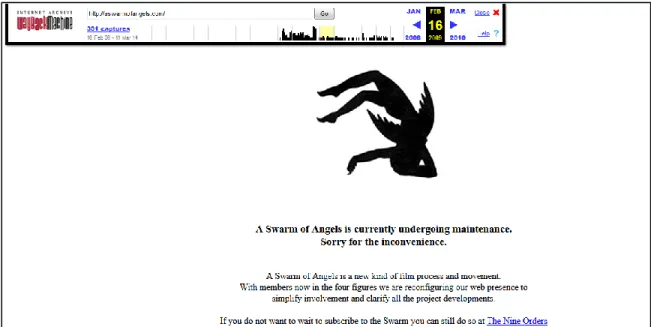
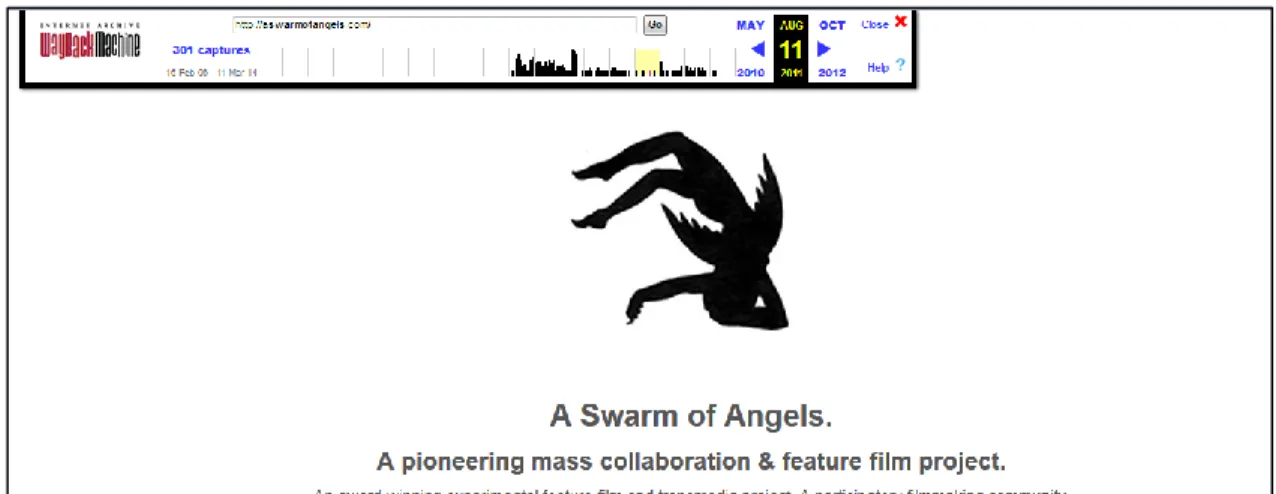
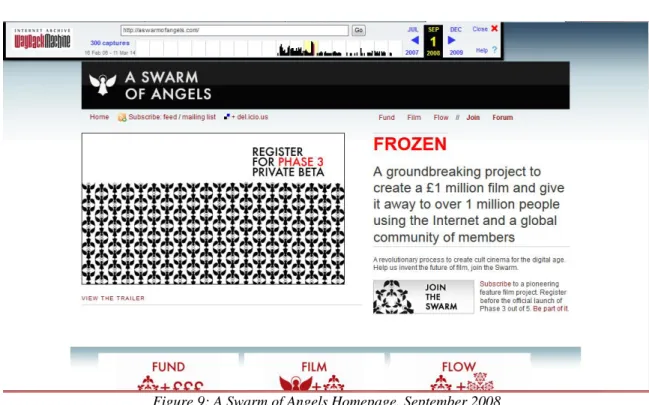
Another example of an open source film project is A Swarm of Angels (ASoA), which began in 2006 and has since been disbanded or postponed.1 The film is open source because every aspect of the film is created, voted on, and developed by an open
community, with the intention being that the final product would be openly available as well. Community participation created and revised the film’s script, character
the project included an interactive, collaborative community, an online format or platform, and a film-based project.
“Open source film” is a broad category and includes to an extent remixed film,
crowdsourced film, and COFPs. However, despite this broadness, it is not all-encompassing and does not apply to all remixed art, crowdsourced art, or COFPs. Concerning COFPs in particular, some COFPs qualify as open source because the ultimate goal of the project is to produce a freely available film and/or the process of creating the project involves open source software. However, these projects do not have to subscribe to open source doctrines and may instead rely on commercial software and function as collaborative efforts to create a for-profit, independent film. In other words, some COFPs are open source films, but not all of them, and some open source films are not COFPs at all. Importantly, the literature that discusses issues pertinent to COFPs uses “open source film/cinema/movies/content” as a general classifier. However, the issues
that may arise with COFPs are not necessarily the same as those that occur with other open source content and films, particularly because of COFPs’ strong collaboration
element.
2.1.2 Remix
existing artifacts and changing or recombining these elements to create something new”
(p. 16). It embraces the concept that art can be built upon and inspired by other art. Issues such as ownership and final products are less serious and play second fiddle to the larger goals of exploring creativity and encouraging art through collaboration. Remixed film can involve actively collaborating on a single product through remixing others’ work or can involve taking an already existing work and remixing it with something else, essentially creating an all new work. Because of the disinterest in or at times blatant disregard of copyright law, remixed art has issues with copyright and ultimately exists in a gray area when works such as popular music, images, or other work not yet in the public domain are incorporated. The philosophical argument behind remix art is similar to the “death of the author” argument - i.e. once a work is created and shared, it exists independent from its creator, and in the case of remix, is open to repurposing and “re-ownership.”
Remix builds on existing works, unlike COFPs that can involve existing material but can also focus on wholly new and original content created collaboratively over time. Remix does not necessarily just involve film or video, and can instead feature visual art, music, performance art, etc. With such a spectrum and variety of artistic formats, remix does not require an online presence at all. For instance, Tuite and Smith (2012) developed a mobile application called Sketch-a-bit to explore remix creative culture. This application focused on drawing and allowed users to build off of other participants’ drawings where “the value created in Sketch-a-bit comes from enjoyment of participating in the
specific task or deliver a concrete artifact at the end” (p. 16). Remix, in this sense, becomes a sort of rebel amongst these types of projects, since its existence and the participation in it does not necessarily value the production of a single item, the ownership of a particular work, or the legal or commercial benefits of a collaborative work. Whereas open source content emphasizes the concept of open access and
crowdsourcing and COFPs emphasize the end goal of creating a particular production or work, remix emphasizes the process of creation and the experience and freedom of taking something someone else created and adding to or repurposing it. In essence, as Tuite and Smith (2012) conclude, remix projects provide “a place to exercise one's creativity, both through practicing the technical skill of drawing to produce an artifact, as well as through consuming (interpreting, appreciating, critiquing) the creative works of others” (p. 22).
Another example, beyond Sketch-a-bit, is the practice of machinima, in which gamers use the gaming world to script, perform, and record artistic projects, such as films. Roig Telo (2013) defines machinima as “the production of linear audiovisual content from a computer-generated virtual environment, such as a videogame or a virtual world” (p. 2319). Many of these projects use online games such as MMORPGs (Massively-Multiplayer Online Role-Playing Games) and are organized largely within these interactive worlds, using players’ avatars and the game’s features to create the works. These works function as forms of remix art, because the “machinimasts” remix and
permission to create through contract rights with the game developers (Kraus, 2011, p. 103):
By such acts of civil disobedience, machinima makers generate ‘counter-friction in the machine,’ to use Henry David Thoreau’s resonant phrase, forcing game publishers to negotiate with them about the production and dissemination of their art (p. 105).
Importantly, as much as machinima functions as remix art, it also can be classified as participatory film as defined and explored in the following section, since in addition to remixing an original work, machinima is also collaboratively creating new work through an integrated community and environment.
2.1.3 Participatory Film and Crowdsourced Art
Tuite and Smith (2012) define crowdsourcing as “the method of breaking down a large task into small pieces that can be accomplished by a large number of often non-expert individual contributors” (p. 16). The value of these types of works as creative projects “comes from the distinct style that each individual brings to the piece and how no single artist would have been capable of such variety” (Tuite & Smith, 2012, p. 17). The
flexibility, anonymity, and global nature of the online environment support
independently at the same level, or sometimes at a few separate levels with clear pathways between them” (Tuite & Smith, 2012, p. 17), as is typical with crowdsourced projects. An alternate way to approach the distinction is to reference one of the first uses of “crowdsourcing” by Jeff Howe:
Simply defined, crowdsourcing represents the act of a company or institution taking a function once performed by employees and outsourcing it to an undefined (and generally large) network of people in the form of an open call. This can take the form of peer-production (when the job is performed
collaboratively), but is also often undertaken by sole individuals. The crucial prerequisite is the use of the open call format and the large network of potential laborers (2006b, para. 4).
In this sense, COFPs function more closely with the peer-production model of
crowdsourcing than with the “simply defined” idea Howe suggests, which focuses on an indefinite number of participants responding to an “open call.”
Participatory film would be more in line with COFPs; however, participatory film functions within a broader scope. It does not necessarily exist online, nor does it have to have the same sense of collaboration. Roig Telo (2013) classifies projects that could arguably be COFPs (his example of Star Wreck Studio’s Iron Sky, for instance) and
evaluates the role that practice theory plays when scholars consider the development of COFPs. “Practices” in this sense refers to the social behaviors that influence or populate a person’s and group’s interactions, choices, actions, and motivations (Roig Telo, 2013, p. 2319). Roig Telo’s goal is to show “how the observation of emerging practices is crucial
in participatory projects' early stages, when participants are negotiating meanings related to hierarchies, internal organization, relationship with other cultural domains…,
structure and organization of participatory filmmaking, which he can then apply to multiple examples. Importantly, Roig Telo defines participatory film as something distinct from crowdsourced or crowdfunded projects. As has already been acknowledged, none of these categories are mutually exclusive, each with exceptions that allow for multiple types being assigned one example. However, crowdsourced and crowdfunded projects typically ask “people to contribute to a project (in terms of labor or money, even if rewards or tokens are given in exchange),” which is “an insufficient condition of participation” since there is no implicit element of collaboration or creation for a greater
artistic, mutually beneficial purpose (Roig Telo, 2013, p. 2315).
What sets participatory film apart is the sense of involvement and collaboration. Roig Telo (2013) acknowledges the similarities that participatory film may have with remix projects and open source media, concluding:
On the other hand, releasing a creative project under an open license allowing appropriation and remixing is also insufficient, unless it is an integral part of a participatory project. In view of the previous statements, it must also be said - contrary to some widespread discourses, and despite the importance of
engagement - that just making people feel part of the project is not a sufficient condition in itself; nor is engaging people in a multimodal experience, as in a transmedia project (which is not to deny the potential of the combination of transmedia and the participatory) (p. 2316, emphasis added).
original work without clearly defining the level of participation or integrating the remixed version with the parent version. However, Star Wreck’s - and thus wreckamovie.com’s - film Iron Sky is an example of participatory film since the project established from the beginning how every participant contributed something new to build and create the final product. Under the COFP model, both hitRECord and wreckamovie’s Iron Sky are
COFPs, since they encourage collaboration in an online format to create, develop, and revise a film project. Regardless of the differences, considering crowdsourced projects and participatory film projects enables us to better contextualize and approach COFPs.
Building on the concept of open source, Winget (2011) highlights the qualities of participatory filmmaking and, by extension, of COFPS:
Further, the open-source movement and the ensuing “maker” culture have given the general public tools and the mindset to interact with media in a way that was not possible even fifteen years ago. Instead of passively receiving media like movies, music, and art created by professionals, individuals are participating in cultural production, creating their own materials, often based on the objects of material culture. These artifacts of participatory culture include objects ranging from materials that look a lot like traditional media movies, music, and art that simply have different production and distribution models to materials for which we have no vocabulary to describe and no model to provide access (p. 33, emphasis added).
However, scholars are attempting to create a vocabulary to describe these materials and to design models that improve access while also protecting ownership.
Participatory and crowdsourced films can and likely do exist on a much larger scale than COFPs, with the potential for an unlimited number of participants. As a concept,
Concerning the former, Iona Literat (2012) provides a comprehensive and in-depth overview of crowdsourced projects, with an aim to create a working vocabulary and category group so that these types of projects can officially be included in the scholarship for art, creativity, and crowdsourcing. She includes all forms of art – written, visual, audio, etc. – with examples of each type (p. 2970). Literat (2012) focuses primarily on online crowdsourced art, which she acknowledges is a disputed term (p. 2963), but for her purposes conventionally involves a large crowd of people who are “not yet a
community” (p. 2972). Roig Telo (2013) incorporates Literat’s language when discussing
participatory film, acknowledging that in the beginning stages of a participatory project, the project “can be either the task of a creative core team (what Literat calls the ‘alpha artist’) or the self-organizational effort of a community” (p. 2315).
Significantly, Literat (2012) argues, “in view of its reliance on the artistic contribution of a large pool of usually anonymous participants, this type of art raises important questions about notions of collective creativity, authorship, collaboration, and the shifting structure of artistic production in the new digital environment” (p. 2963). Online crowdsourced art represents the “radical democratization of the artistic process,” which challenges
participating that all depend on a predesigned project; and structural, which formally involves participants in the authorship and design process of the project (p. 2975). Each type of participation carries its own challenges, and based on Literat’s presentation, one
may infer that the more transparent and structured the participation, the more community-oriented the project becomes, which leads to fewer people overall being involved. This type, based on Literat’s vocabulary, best represents COFPs, though some better qualify as
executor because of their predesigned nature. Overall, Literat (2012) concludes, “Online Crowdsourced art can be seen as the product of two specific structures: the conceptual or aesthetic structure of the project itself and the technological structure of the Internet as a facilitating platform,” which are interrelated and present “their own particular
affordances and pitfalls” (p. 2979). For Literat, hosting crowdsourced art online presents the art’s biggest challenges as well as its most promising innovations. These challenges
with online crowdsourced art mirror COFPs’ challenges, even if COFPs generally involve smaller, more focused communities in more open access environments.
2.2
Exploring Preservation
There are two main components to Collaborative Online Film Projects (COFPs) that require deeper exploration in order to fully orient COFPs in the discussion of
preservation: film and digital. The “film” aspect encapsulates the current trends and issues in digital moving image preservation as understood by production studio archives and preservationists. The “digital” aspect refers to the issues surrounding digital
2.2.1 Digital Preservation
Understanding the current best practices for motion picture preservation and archiving will provide insight into what the film industry prioritizes when processing a moving image project for cultural and commercial preservation. The current methods for film-based objects allow for an expected lifespan of 100 years within a controlled environment (Academy of Motion Picture Arts & Sciences, 2007, p.1); however there is not a reliable method to preserve digital assets for longer than a fraction of that, due to issues with obsolescence and the requirement to continually migrate content to new formats (2007, p. 21). Though when actively managed, migration and other archiving tactics become the most viable options, “[t]he consensus is that although digital videotape stored in proper environmental conditions can last for at least 5 to 10 years (or longer), there may be no new
videotape format to migrate to when the medium nears the end of its shelf life” (Academy of
Motion Picture Arts & Sciences, 2007, p. 33). As pointed out in the Academy of Motion Picture Arts & Sciences’ Digital Dilemma, the best methods for long term preservation
are still relatively immature compared to the methods for preserving analog film. Because of the continuing evolution of the archival standards for formats and access of digital content, preservationists must be mindful and active in how they approach the
By discussing digital moving image preservation practices, one must explore not only what professionals are doing but also how digital filmmaking practices in general are shifting. This includes trends towards collaborative work, independent filmmaking, digital filmmaking, and the use of open source software. An important conclusion from motion picture preservation literature is the assertion that digital film contains more than just the final product:
When considering a digital object for preservation, there is not simply a single file that must be filed away. Instead, one object is made up of various components that not only create the whole, but that also contribute to the contextual make-up of the object. One should also consider whether it is important to retain multiple formats or versions that accompany any copy of a digital video. This is even more important in the age of digital filmmaking, when independent filmmakers can easily create and distribute their work cheaply and when several versions and formats of one movie can exist at any given time. COFPs are most likely comprised of independent filmmakers and artists, who operate “outside of the major Hollywood studios [and] supply 75 percent of feature film titles screened in U.S. cinemas” (Academy of Motion Picture Arts and Sciences, Science and
Technology Council, 2011, p. 3). These are the people contributing the most to modern cinema, but as the Academy’s 2011 report Long-term management and storage of digital
motion picture materials: A digital motion picture archive framework project case study
points out:
Most of the filmmakers surveyed for this report have given little thought to what happens to their work once it is completed. Most pay for some type of storage for the master version of the completed work, but few store their film masters in proper environmental conditions or manage their digital masters using appropriate preservation practices. Many depend on distributors (traditional theatrical
distributors, packaged media, pay TV) or new “streaming” platform providers to take responsibility for preservation” (p. 4).
Independent filmmakers often aim to develop and finish a project, then to move on to the next project (2011, p. 4). Without proactively considering ways to preserve and manage the digital content created by these artists, archivists and cultural heritage librarians risk losing an enormous amount of creative content to preventable issues, such as
not one independent filmmaker, but several, all collaborating at various levels, potentially from all over the world. The decentralized nature of COFPs coupled with the online environment enables artists to engage with a variety of projects at one time, but it also confounds the issue of moving quickly through digital content without thinking critically about storage and preservation. This becomes even more complicated, because “in the United States, the widely dispersed and diverse use of motion picture film and now, digital recording technology, has made motion picture preservation a highly decentralized activity spread across hundreds of institutions and organizations” (Maltz, A., Shefter,
M.R., & Academy of Motion Picture Arts and Sciences, Science and Technology Council, 2012, p. 42). Currently, it is unclear how sites that host these collaborative efforts support or manage the content created on them or if, at all, collaborators are encouraged to save and migrate their work.
This idea of proactive archiving is vital to the preservation of COFPs, and its practice within the creative community is unclear – an element that this research seeks to clarify. Since “archives estimate that their collective digital holdings will grow from
approximately 183 terabytes in 2009 to more than 2.7 petabytes by 2014” (Academy of Motion Picture Arts & Sciences, et al., 2011, p.5), the ability of archives to retroactively preserve that amount of data is unlikely. Additionally, the consensus seems to be that in their current state and with the current demands on archival staff to digitize and “go digital,” archives are ill-equipped to handle the burden of maintaining the hundreds of
effective way for independent film work ‒ on- and offline, collaborative and individual ‒ to survive past its creation is to encourage the culture of filmmakers to preserve, backup, and archive their own work. As Winget and Aspray (2011) argue:
New titles move into the distribution library faster than they are added to the archive because the distribution library is used to generate revenue while the archive is intended to act as insurance against any loss of corporate assets. But if digital motion pictures can become “born archival,” they can be ingested into the archive quickly and easily as part of a largely automated file-transfer process (p. 7).
However, filmmaking by its nature is a collaborative process and preserving
documentation of the trends in filmmaking ‒ the versions created during one production, and the contributions of the community involved ‒ requires acknowledgment of
preservation’s importance and clearly established methodologies to incorporate proactive
preservation into online filmmaking projects. As the Academy of Motion Picture Arts & Sciences (2007) asserts, “We believe that standards are most likely to be successfully implemented and adopted when the user community of those standards takes an active and leadership role in their development” (p. 55). It is much easier and more realistic to prevent something from being lost than trying to regain it once it is gone; and when one considers the sheer volume of content created for any single project, assessing the value of a project’s individual parts most reasonably relies on the creator or creators. In film archiving, “Image file formats, their associated ’wrappers,’ filenames, metadata, and
metadata registries all are of limited usefulness unless there is industry-wide agreement on what they are and how they are to be used” (Academy of Motion Picture Arts and
2.2.2 Virtual World Preservation
COFPs exist primarily in a digital world. As such, many of the issues in capturing, preserving, and archiving born digital, interactive media share basic similarities with COFPs. This includes discussions around preserving websites, crowdsourcing initiatives, and virtual world preservation. COFPs involve communities that exist almost strictly online, where participants’ primary form of interaction and production is in the digital
world and identity and credibility are blurred and hidden behind monikers and profiles. This brings up concerns about authenticity, credibility, and joint authorship rights.
Additionally, the product itself, be it a completed film or an element of a film – a scene, a script, the special effects, etc. – exists as a digital artifact whose creation may have happened in several ways – physical and digital, all over the world, etc – but whose “final” version exists online, possibly in various locations including the designated
program or website shared by the community. The nonlinear and data-heavy process of conceptualizing, adding to, finalizing, and possibly re-visiting the project raises issues about original order, what pieces deserve preservation, and what technology best captures the project. This differs from analog media, since digital media “consist of complex interactions between technologies and users, and necessitate fundamental shifts in the way we think about preservation,” including considerations of “the nature of the digital system” and “what makes a particular artifact of digital media important or noteworthy”
(Christensen, 2002, p. 39), which Christensen (2002) notes as the “greatest challenge to the archives and cinematheques” (p. 39).
As Catherine C. Marshall (2011) points out, copies or versions of one digital object may exist at the same time, in many locations, leading to the question: “Where, then, does the ’real‘ or reference copy of any digital artifact reside? Which version(s) do we consider
archival? How will we find this reference copy when we once again want it?” (p. 90). The online environment allows for the sharing and manipulation of one item across a multitude of networks and digital spaces in addition to supporting communities “who use
new media [and] have a much more autonomous and collaborative attitude” (Aspray & Winget, 2011, p. ix). Conceptualizing the type of relationship one must develop with these types of items is key to preserving them since they have no linear trajectory, and instead have a life cycle that potentially includes multiple final versions, each with different contexts and elements. Part of this context is the metadata created within any given situation, which provides important and unique contextual information worth saving and considering. As Marshall (2011) says, “the authoritative copy of any of our personal digital belongings is spread among many stores, and what we regard as the authoritative, archival digital item, the one we want to keep (possibly forever), has
become essentially decentralized” (p. 91). Though Marshall specifically refers to personal
Furthermore, when considering this in terms of COFPs, we must consider that these versions may exist in a variety of formats on each collaborator’s personal computer or at
his or her workstation. There is no uniform way to save or share the content, and the conversations and interactions between the collaborators in the online communities act as one of the few ways one can connect the versions to a larger digital object and
contextualize the creation of a product. The interactions that happen on the platforms hosting COFPs contextualize the otherwise decentralized projects, and thus it becomes advantageous to explore ways to preserve these interactions in addition to the content eventually created.
As Lowood (2011) asserts when discussing virtual worlds and interactive online gaming preservation, it is important to preserve not only the virtual worlds created at any given time, but also the events, history, and social aspects of the players within those worlds (p. 4-5). Without doing so, historians’ “utility for the interpretation of specific events is quite limited” (Lowood, 2011, p. 11). Instead, “we need to devote more attention to the kinds
of events and activities that occur in these places and how to document them, much as an archivist or historian would in the real world” (Lowood, 2011, p. 15), which leads “us away from thinking about the preservation problem in terms of objects and artifacts and toward focusing our attention instead on events, actions, and activities” (Lowood, 2011,
significance behind this form of filmmaking. Additionally, like COFPs, much of the realistic preservation decision-making rests with the users, gamers, and creators, since they are the most familiar with the content created, the most emotionally and contextually informed and invested in the content, and the best positioned legally due to the
established adaptation rights between the game creators and the gamers or users (Kraus, 2011, p. 108-109).
2.2.3 Web Archiving
When discussing the preservation of digital objects in the online world, it is important to consider the current practices for web archiving. Web archiving, loosely defined, is the process of systematically capturing web content – particularly websites or webpages. The most common method is using a web crawler or website copier – also known as “client-side archiving” – to capture content using technology similar to the crawlers used by
search engines (Masanès, 2006, p. 22). Other methods include more manual efforts called “transaction archiving,” which depends on the user, and “server-side archiving,”
which depends on the web publisher (Masanès, 2006, p. 22). A prominent web archiving initiative is the Internet Archive, which regularly crawls websites and catalogs them by URL on its website. Archive-It is a service of the Internet Archive that provides tools for crawling sites, supporting digital collections of websites, and displays via the Wayback Machine. The most comprehensive approaches to web archiving depend on the
cooperation and commitment of the administrators of the websites being archived, since the crawlers cannot capture pages or certain content without the participation or
to capture, however, other times the site has special built-in code built whose sole purpose is to block web crawlers.
Additionally, the design of the website may mean there is a large amount of hidden content or content stored on private servers that require special permissions or “insider” access in order to capture content. Ultimately, web archiving’s biggest hurdle in terms of
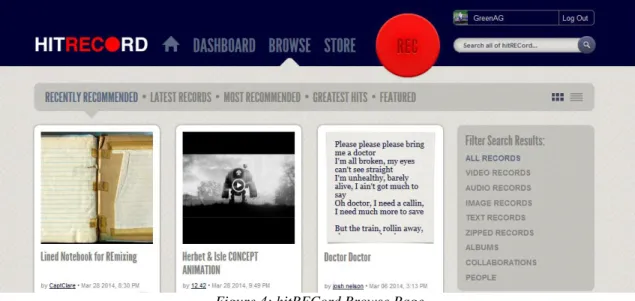
COFP preservation is generating enough support and awareness to start archiving the sites beyond the homepages and to do so with enough permissions. As is, sites like hitRECord.org, which is in essence a remix culture for-profit production company, have homepages and external webpages captured – such as: about, contact, browse. However, deeper or internal content is not captured and the site administrators would need to give permission and work collaboratively with an organization like the Internet Archive to capture this content. Or it would need to actively build its own web archive and account for format difficulties inherent in trying to preserve streaming media, audio visual files, web images, and interactive comment sections. Sites like wreckamovie.com would similarly require special permissions from website owners to allow for complete capture, and even then, this process likely would not capture personal messages between
self-archiving of the users are also essential to capturing and self-archiving the full “story” and context surrounding any given COFP.
2.2.4 The “Cousins”: Open Source, Remix, and Crowdsourced
With film, digital media, and web archiving and preservation in mind, let us now revisit the “cousins” discussed earlier. Prominently, remix projects have garnered a diverse
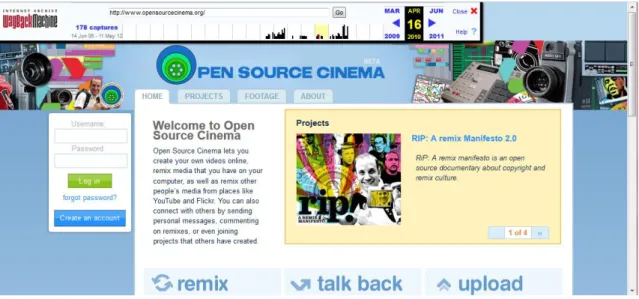
amount of preservation attention. The documentary film RiP!: A Remix Manifesto and the website www.opensourcecinema.org associated with the film are great examples of a remix project experiencing a mixture of web archiving and a lost opportunity to better preserve its content. The now defunct website has some captures available through the Internet Archive’s Wayback Machine, but captures are sporadic and incomplete. They do include comment sections and discussions connected to projects on the site as well as general homepage and website information, with 178 homepage captures (many starting in 2010 reading “offline”) and under ten captures for each deeper webpage. The site was
essentially a COFP platform, encouraging people – much like hitRECord.org – to upload and remix various types of media, create collaborative projects, and build a community of collaborative work and artists. Though some of these pages were captured by the Internet Archive, clearly not all elements and pieces were preserved – such as uploaded video content and images. As a result, future access to materials from these projects – at whatever stage of completion or dissemination – is at the mercy of their creators and the site’s administrators. Since the Wayback Machine’s captures only represent a sampling of
no access to the type of art resulting from them. In this case, a piece of remix culture’s history depends on the few Internet Archive captures of opensourcecinema.org and a brief Wikipedia article created in 2009. A part of the digital revolution of remixing, touted as the future of art in the documentary, is threatened with obsolescence. Issues of preserving remix projects are not limited to the opensourcecinema.org example. Tuite and Smith (2012) observed:
The key difference from past [remix] work is how Sketch-a-bit users work from the output of an anonymous peer who had access to the same tools and peer-inspirations they did, as opposed to a single, centrally-provided reference artifact (such as a blank canvas or a music video frame) (p. 17).
In such a collaborative environment, there is relatively little hierarchical structure, and ownership is shared among many, leading to no authoritative force to represent or initiate a preservation plan.
Concerning participatory film, Roig Telo (2013) listed the following sets of practices in participatory filmmaking: performative, organizing, production, community, self-promotion, finance, and circulation (p. 2326-2328). These can overlap and at times completely encompass one another. For the purposes of this paper, I would add to Roig Telo’s list of practices the “preservation or protection practice,” which involves the act of
preserving, backing up, and versioning content created in these communities. Roig Telo (2013) defines self-promotion practices as a set of practices “around the promotion of the organizational form itself, as distinct from promotion of the film proper” (p. 2327). He
provides the following examples of performative practices:
practices represent playing with the rules as much as playing by the rules, thus clearing the way to the transformative and innovative… (2013, p. 2328).
It follows, then, that preservation or protection practices would represent the systems of preservation adopted by users as individuals and as groups to safeguard and catalog their activity and created content. These systems easily exist on an individual, independent level, which means they are only structurally acknowledged or confronted when
something goes wrong (something is lost, deleted, obsolete, etc.). This is particularly true for Roig Telo’s example of A Swarm of Angels, whose tasks depended on a complex and
mixed hierarchical structure that would unravel if its participants failed to back up the contributions on which the rest of the community depended in order to interact, vote, and delegate.
In order to support preservation practices in such a collaborative and extensive community, communication and organization are essential. If “[t]heir most important feature may be their inextricable connection to decision making...their distribution of creative control,” (Roig Telo, 2013, p. 2315), then, Roig Telo theorizes, the community
needs to maintain a level of transparency in communication among all its factions (p. 2315). This would include decision making concerning preservation and archiving, if and when it became an issue or topic. As mentioned above, the focus often is not on
3. Methodology
I conducted a case study of the website and community for wreckamovie.com. Because reviewing one example of a COFP community does not adequately represent the
aforementioned issues, I also interviewed filmmakers familiar with these types of projects and also reviewed similar projects. The goal of this research was to explore participants’ priorities, approaches, and understanding of their relationship with COFP preservation. The exploratory nature of this research means that my participant scope was broad and included a mixture of people directly involved in wreckamovie.com and people related in some way to collaborative online filmmaking. Of the twelve interview requests I sent over the course of two months, I received eight responses, and six useable sets of answers. Two sets of answers are not included in the final paper because they were received at too late a date or did not provide the necessary permission to use the answers in the paper.
Participants were selected based on one or more of the following criteria:
a) Recent activity (within the last 2 months prior to the initial interview request) on the COFP website
b) High “Karma” points - which indicate activity on the site and reliability, and peer support as voted by other users
c) Involvement in past or current COFP projects or related “cousin” filmmaking projects
Initial iterations of the research included reaching out to site administrators for these projects in addition to users. However, the lack of response led to a redesign of the overall approach and a refocus to users and individuals who may have relevant insight into COFPs and COFP preservation. Professional independent filmmakers, amateur filmmakers, and hobbyists were all included in the selection criteria. Additionally, producers, bloggers, designers, writers, and system engineers were all considered for interviews if they matched one or more of the above qualifications. Because of the global nature of COFPs and of wreckamovie.com in particular, interviews were conducted via email or Skype, with most interviews being conducted through email. Though follow-up questions occasionally occurred, most answers are results from the initial set of interview questions.3 Because of the exploratory nature of this research, semi-structured interviews were the ideal format for questions and information gathering, as opposed to surveys. Questions were developed by reviewing the literature and assessing what preservation questions have been asked before to filmmakers and artists, and what would be relevant to web users. The questions focused on user experience, personal approaches to backing up content, and impressions of preservation of online content.
In addition to the interviews, I reviewed other COFP sites to provide more examples and context for COFPs and for the primary case study. Websites that discuss collaboration online and its preservation were explored to gain more insight into the active internet filmmaking community as it presents itself. This helps to contextualize how the
All interview transcripts were coded with random letters. The random letters
4. Case Studies
In the following pages, I will first review the primary case study wreckamovie.com and the results of my interviews, with the following names used as pseudonyms: Tyler, Felicia, Thomas, Joshua, Amanda, or Arthur. I have organized the results into three categories: Backup Methods, Collaborator Interactions, and Reaction to Preservation. To supplement these findings, I will provide three additional COFP examples:
opensourcecinema.org, hitRECord.org, and A Swarm of Angels.
4.1
Wreckamovie.com
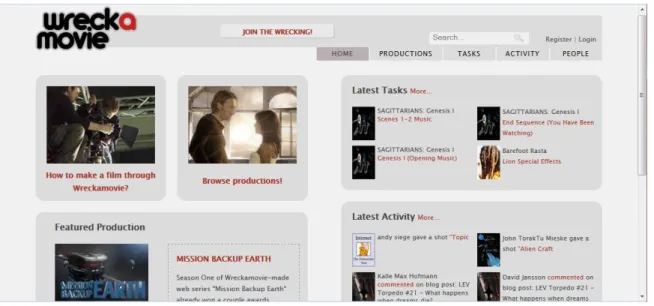
Figure 1: Wreckamovie.com Homepage
encourage online film collaboration, using open source software, and providing an environment for filmmakers to post film projects (of a variety of genres) in order to recruit collaborators. Wreckamovie has a hierarchal structure to its collaborations, typically including a project leader and a linear production plan for individual projects. The goal of wreckamovie is to provide a platform through which people may produce and create professional-looking films and distribute them using a myriad of internet tools. It was inspired by the production process of the first Star Wreck movie and originated as a forum, which developed into a full-fledged website as demand and involvement grew. Now, almost eight years later, the community is much less active and there are only a handful of “wreckers” still actively and consistently engaged with the site. According to all of those interviewed for this paper, the site is “dying” and will likely be phased out
completely in the next few years, partly because it is difficult to maintain financially in its current state and partially because production activity has slowed down tremendously.
The community is open to anyone to join and all collaborators are searchable, though sending messages and viewing complete profiles requires a user password. Wreckers can start a production, enlist help, post results, comment and provide feedback on projects, and maintain a blog to track production news and highlights. The platform does not support large file sharing or streaming, so many files are shared through third party mechanisms – links to other sites or via emails. This decentralizes the process of using wreckamovie even more, since many users store their production with wrecker feedback on the site, but store other materials related to their collaboration in email
global, with many of its most active members being European filmmakers who also worked on the original Star Wreck production. Users “earn” karma points by performing
tasks and providing support in reliable and consistent ways, which helps to build users’ reputations. Each user’s profile lists the productions s/he is or has been involved in and for how long. As one participant put it:
[T]he whole Wreckamovie platform is about people getting things done together. . . Wreckamovie gives us an awesome place to meet and share our work with like-minded people, but it is only a tool provided “as is,” as far as I have seen and experienced so far, most of the work is done “behind the scenes” and only sent through using the forum system.
4.1.1 Backup Methods
Backup methods ranged from regular, multiple unit backup systems to rarely fleshed out, after-thought backup systems. The most popular methods were a combination of hard-drives and cloud storage, with a focus on the final product versus versions and process. Arthur emphasized the advantages of publishing a final product online as a form of preservation – a point also made by Kraus (2011) when discussing machinima – and as a way to avoid backup failures. Felicia and Tyler depend largely on cloud storage to both share projects and versions over long distances and to store final versions, in addition to storing locally on a hard-drive. When asked if there had been any instances of losing data or content and how that may have affected current approaches, all participants had
Multiple locations for storage are ideal because they provide duplicates if one backup options fails. However, these are not necessarily consistent. Generally, participants either had technical expertise advanced enough to easily develop complex backup systems or they had more of a focus on filmmaking and a more casual approach to maintaining backup systems. Everyone acknowledged the importance of backing up work, but the reasons varied. Felicia and Tyler were much more concerned with saving the final
version of the project and did not see the value in saving anything else once the project is completed. This supports assertions made by Catherine C. Marshall (2011), who argues, that when people “actually handle versions” (p. 107) of their work, “sometimes they are only
interested in the most recent version; infrequently, it makes sense to keep an ordered set of
evolving versions” (p. 107). Amanda and Arthur acknowledged the potential need for
other versions and for drafts of works, but also voiced concern in how complicated the process of tracking and storing that much data may become over time. However,
overwhelmingly, the participants expressed a desire to keep content due to sentimental or practical reasons while admitting that realistically doing so presents challenges. As Thomas succinctly put it, “I try to keep all in-between versions as much as possible, but constantly running out of space makes me delete them at one point.” Joshua, who is not a
wrecker but who has worked with many filmmakers, observed, “The final product is important but I know filmmakers who have lost their original footage and regretted it when an opportunity came to create a new work out of it,” which illustrates the
also noted by Thomas, being able to revisit old works can also function as sources of inspiration and learning.
Backing up content requires regular migrations and attention, particularly for active projects. Participants’ opinions on this issue ranged broadly, with one person saying that he only updates his system once a year at most and another saying that she spends a few hours every week moving and backing up data. The variety of formats used for any given film contributes to the level of attention given to the backup method, since if the wrecker is primarily saving text files and contributing text to the project, his or her backup system will require much less space and time than the head of the project who is likely storing the text contributions in addition to the audio and video files. Additionally, Arthur spoke at length about the burdens of “saving everything” even if that is his ultimate goal:
I try to keep everything. I have about 20 external Harddrives [sic] containing all of my work of the last 13 years. I even kept 2 old editing computers with old software configurations. Just in case that at some point I want to open a project and it is not running on a modern computer system. I have stored all tapes, mainly miniDV or HDV but also BETASP tapes and even old Hi8 stuff. So video and sound files are there on the original tapes or CDs and everything is backed on Harddrives [sic]. Additionally to the 2 old editing computers there are my 2 current “new”ones.
important for during the production process beyond the conventional names given to shots from the camera:
...it was not really in the need of metadata because it was…I was the only one working on it so I just need to know, I mean for the video clips we could just look, double take and watch what it is … so we didn’t have metadata because it wasn’t really necessary since we only got two people doing the job so, but that would have taken a lot of time for something we didn’t really even use.
Joshua directly indicated that he “[relies] on the metadata generated by cameras, sound equipment, etc,” for personal projects. Meanwhile, Amanda outlined her process in more detail:
All images and other attachments to my shots are kept in separated folders of [sic] my hard drive (which I try to back-up regularly). I of course keep several more versions than those (“final”) uploaded for others to see; most frequently different stages of development (marked with progressive numbers and sometimes a distinctive word in the file name), and variations.
Something like:
Wreckamovie/Iron Age/Cover/ (Website/project name/item) will contain: Cover v.0 sketch.psd
Cover v.1 red.psd Cover v.2 blue.psd Cover v.3 FINAL.psd Cover v.3 FINAL.jpg
Amanda also mentioned that she often uses dates to better organize collaboration work sessions in order to better visualize versions and brainstorming results.
4.1.2 Collaborator Interactions
collaboration, and there are several film projects using the site to announce updates, recruit collaborators, and gain feedback. Under the wreckamovie model, there is an understood hierarchy of actors, starting with the production leader and production assistants and ending with occasional contributors. The site’s community guidelines
stress the need to establish order and to respect the decision-making by production leaders: “...decisions must be made to make things go forward. If you are a member of a production, trust your Production Leader the visionary of your project and don’t take rejection personally” (www.wreckamovie.com/guidelines). This sentiment was reflected in participants’ responses, with several people asserting that ultimately, preservation is the leader’s responsibility:
Amanda: If I am a simple member of the crew, I will not discuss the matter and just back-up my work for my own pleasure and purposes. As a project leader, I will keep most valid contributions submitted by my crew in separated folders within the production one, and probably ask them privately to send me better quality versions of their work (or different stages) than those publicly shared…I keep my own files when I contribute to a larger production on WAM
[wreckamovie], even assuming the project leaders will keep their own back-ups of everything we send them…
Arthur: As the creator and producer of Mission Backup Earth, which is my first collaborative project, I try to archive everything as I do it usually with other film projects.
Tyler: Yeah, that [preservation of content and projects on the platform or shared through the platform] seems more like it’s more up to the project leader to do that.
Even with the expectation on the project leader, as Arthur pointed out, there is a lot of content that could be lost if conversations and plans are not established early in the project concerning expectations of backing up content and sharing the content:
But nevertheless I recently started to ask everybody to not only upload the final product but also the project files and the footage they used. So I am collecting more and more data and project files that could be of later use.
This is important because it is not sure how the others preserve their work (if at all). And as this is an ongoing project done by volunteers, people come and go. So in order to build on previous work or reuse it at a later stage, it is nessesary [sic] to backup the data.
This illustrates the potential issues of working in a collaborative environment, both online and in real life – orchestrating the sharing and the storing of every piece of the project and clearly communicating those goals to your team. At wreckamovie, these participants acknowledged the need to preserve certain parts of their work but openly admitted to not putting forth much effort to establish active preservation and organization plans with their collaborators, no matter the level of participation.
The assumption is that every player will be responsible and sensible enough to back up his/her content and work. However, participants rarely spoke with others about their methods or about the overall project preservation strategy:
Felicia: I never spoke with other wreckers about their storage method (I am just interested in my own data).
Arthur: There have not really been conversations about how to preserve the work. We only managed data transfer through cloud servers or wreckamovie.
4.1.3 Reaction to Preservation
Interestingly, participants either saw the value in preservation and in archiving sites like wreckamovie and expressed an overwhelming amount of support: “It’s crucial to save people’s hard work for future.”; “Every type of preservation of art is valuable.” Or
participants did not think that saving the projects, content, or versions created with or through sites like wreckamovie deserved the effort and time it may demand: “None of our work has a status of ‘important cultural heritage’, so I think there is no need of
complicated preservations. It’s just for my own ‘memorie.’” In other words, all
participants had an opinion about preserving COFPs and these opinions varied and at times were contradictory. Though some saw the works created in collaborative settings as hobby and personal projects that did not constitute the extra attention or effort of
preservation, these same participants spoke at length about the sentimental and cultural value of accessing old home videos or films that, due to the easier preservation of such formats, have survived over decades: