Kelsey C.H. Chandler. Virtual Spaces and Physical Places: Analyzing Patron use of Digital and Physical Collections at the Louis Round Wilson Library, University of North Carolina, Chapel Hill. A Master’s Paper for the M.S. in L.S degree. April. 2015. Year. 89 pages. Advisor: Dr. Denise Anthony
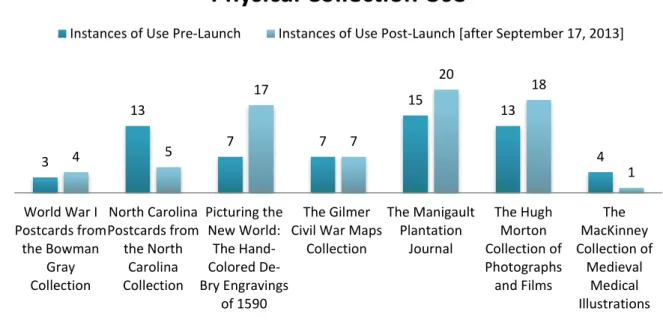
This study describes a multi-modal use assessment of the digital collections and corresponding special collections materials at Wilson Library, the University of North Carolina at Chapel Hill. The study includes: a study of Google Analytics data relating to specific digital collections, an analysis of physical collections use based on metadata provided by the Aeon request system, and a survey-based exploration of current user experiences and expectations regarding materials in Wilson Library’s Special Collections.
Collections that data indicated were more popular had a higher bounce rate and a lower depth of exploration by patrons than collections with a smaller user population, the use of which
suggested an in-depth, purposeful exploration of the collections. Subjects indicated interest as the most likely reason to use physical collection materials or visit a physical exhibit incorporating said materials, but also privileged accessibility and outreach as key components in use decisions. The study indicated an interest, among subjects, in more visible outreach and advertising
regarding programming at Wilson Library and a need for greater awareness regarding the accessibility of special collections materials at Wilson Library.
Headings:
VIRTUAL SPACES AND PHYSICAL PLACES: ANALYZING PATRON USE OF DIGITAL AND PHYSICAL COLLECTIONS AT THE LOUIS ROUND WILSON LIBRARY,
UNIVERSITY OF NORTH CAROLINA, CHAPEL HILL
by
Kelsey C.H. Chandler
A Master’s paper submitted to the faculty of the School of Information and Library Science of the University of North Carolina at Chapel Hill
in partial fulfillment of the requirements for the degree of Master of Science in
Library Science.
Chapel Hill, North Carolina May 2015
Approved by
Table of Contents
1.1 INTRODUCTION 2
1.2 LITERATURE REVIEW 6
1.3 METHODOLOGY 29
1.3.1 BASIC METHODOLOGY AND SITE SELECTION CRITERIA 29
1.4 DATA COLLECTION 34
1.5 LIMITATIONS OF THIS STUDY 39
1.6 DATA 40
1.6.1 GOOGLE ANALYTICS DATA 40
1.7 PATRON USE OF PHYSICAL COLLECTIONS MATERIALS 56
1.8 SURVEY RESULTS 57
1.9 FINDINGS 68
1.9.1 DISCUSSION OF FINDINGS 68
1.10 WORKS CITED 72
1.1
Introduction
In an information environment firmly rooted in the use and continued
development of digital space, cultural heritage institutions and archives are faced with the struggle of maintaining the role that defined their purpose just decades ago: that of the physical space where information meets the public.1 The increasing dependence on the functionality of Web 2.0 may mean that users of digital collections space come to expect a greater degree of interactivity with digital collections. Academic libraries and archives are, in the broad sense, cultural heritage institutions. The culture that they promote may adhere to an established status-quo that privileges academia and demands a level of exclusivity, but the accessibility of archival resources and the opportunities for archivists to interact with patrons outside of their immediate communities are changing as libraries and archives open up to the public via digital spaces. Optimizing the use of digital space promotes access to potential patrons who do not have the ability or inclination to access the physical collections space, but may threaten the continued viability of traditional archival spaces due to an increased perception that all information is available digitally, when, in fact, it comprises only a miniscule section of the information available to the
1 Jimerson, Randall C. "Embracing the power of archives." American Archivist 69, no. 1
public.2 The opportunity for interaction posed by Web 2.0 has increasingly broadened the
scope of what information individuals are able to access, how they interact with that information, and what they value as meaningful interaction with information.
While librarians, archivists, and some public historians explored digital methods for disseminating information to an increasingly technically savvy public, as early as the 1970s, the early 21st century is seeing an increase in institution-specific initiatives, inter-institutional collaboration, and personally developed projects on an unprecedented scale. This is particularly true in the subject area of the humanities, where qualitative methods are increasingly accepted means of displaying humanistic inquiry. The increasing popularity of digital initiatives and the plethora of open-source, user-friendly content management systems have, collectively, made this shift possible. Open source content management systems and other digital platforms are allowing academic departments, special collections, cultural heritage institutions, and independent researchers to develop a digital presence at little to no financial cost with minimal technical expertise.
“Everyman” is capable of becoming his own historian in a more public manner than Carl
2 Shan Sutton presents a series of case studies on digital collections spaces within special
collections. Sutton states that libraries and, particularly special collections, are at a “point of no return” in fostering digital initiatives. The practice is becoming expected in the archival environment, but is outside of the purview of some special collections’ areas of original focus and cannot reasonably include the entirety of most collections. Sutton advocates for greater collaboration and standardization of best practices in digital initiatives among archives professionals.
Becker could have imagined possible and this freedom is not limited to personal historical scholarship.3
Academic institutions, particularly special collections with designated research spaces, often maintain the exclusivity of being open, primarily, to students and faculty researchers. In physical form, some maintain the appearance of grand reading rooms, as does Wilson Library at the University of North Carolina, Chapel Hill, while others
employ an increasingly popular modern, open spaces with increasingly new technological advances.4 Regardless of physical appearance, research spaces are becoming increasingly digitally oriented, while those that do not make accommodations for technology suffer via the loss of a convenience factor for patrons. Via digital means, the collections space is extended into an intangible arena where patrons interact with information differently, but more frequently. The increasingly digital nature of information retrieval and use calls into question the continued viability and use of physical collection spaces as research spaces. Archives, after all, are only as valuable as they are useful. A well-appointed repository does little to further the archivist’s mission if the items that it stores remain unused. 5 Yet,
reading room visitation is at an all-time low and, as archivist of the United States, David Ferrerio, stated in his address to the Society of American Archivists at Archives New
3 Becker, Carl. "Everyman his own historian." The American Historical Review 37, no. 2
(1932): 221-236.
4Latimer, Karen. "Collections to connections: changing spaces and new challenges in
academic library buildings." Library trends 60, no. 1 (2011): 112-133.
5 “Code of Ethics for Archivists.” Society of American Archivists. (As approved by the
Orleans, Joint Annual Meeting of CoSA and SAA.6 In response to this trend, academic
and cultural heritage institutions continue to explore the use of digital collection space over traditional, physical collection display. Although the digital user experience is, necessarily, different and, according to some cultural theorists, potentially less
meaningful, it is increasingly popular due to ease of accessibility and the increasingly popular nature of a digital medium.7
The keyword at the crux of this trend is “digital humanities,” and, while scholars debate the exact meaning of the term and parameters of its practice, the move towards a community-oriented, interactive patron space has been in motion for the past several decades. Regardless of how “buzzword worthy” the term, digital humanities offers the
potentiality of humanistic practice within formulaic space. At its best, digital humanities initiatives offer the opportunity to create collaborative intellectual spaces that draw the best of scholarly resources into conversation with a knowledgeable public, thus, providing a sense of ownership and investment in knowledge extending beyond academia. Alternately, the increased use of open-source, user-friendly software by independent historians and archivists and an increased reliance on remote, digital retrieval of information by the “Google generation,” may produce a plethora of poorly curated and improperly-sourced material, while decreasing the visibility and viability of
6 Chandler, Kelsey. (2013, August 13) Personal notes from Plenary Session I, Archives
New Orleans 2013.
7 Lynch, Clifford. "Digital collections, digital libraries & the digitization of cultural
physical repositories.8 The study seeks to answer whether the launch of a digital exhibit
serves as a potential advertising tool for corresponding physical collections or whether it, effectively, displaces the need to use corresponding physical material by providing a highly-accessible alternative to visiting a physical location. This study would, ultimately, judge the effectiveness of digital exhibits as a tool for increasing patron use of collections and aid in the understanding of how the shift towards digital display has affected patrons’
perception of the usefulness and their personal use of physical repositories.
1.2
Literature Review
The term “digital humanities” used in modern scholarship with interest, cachet, and
skepticism. While digital humanities emerged as a separate discipline in the late 20th archives and museums are becoming increasingly eager to practice digital humanities: curating online exhibits, digitizing manuscripts, and creating virtual user experiences that can be engaged with remotely.9 The increasing accessibility of digital
humanities-focused, open source tools, like Omeka and, more recently, DHPress, allow repositories with small budgets to extend their exhibit space without necessitating the use of
8 Rowlands, Ian, David Nicholas, Peter Williams, Paul Huntington, Maggie Fieldhouse,
Barrie Gunter, Richard Withey, Hamid R. Jamali, Tom Dobrowolski, and Carol Tenopir. "The Google generation: the information behaviour of the researcher of the future." In
Aslib Proceedings, vol. 60, no. 4, pp. 290-310. Emerald Group Publishing Limited, 2008.
9 Digital Humanities Quarterly, an academic journal focused on aspects of emergent
limited physical space.10 Although museums and archives do not sharea common field or
set of scholarship officially, conjectures regarding patron use in both spaces may be applicable. More recently, museums and archives are embracing the commonalities within their shared goal to make information accessible to the public and, while museums and cultural heritage institutions are traditionally the institutions that provide a contextual framework for this information, archives and special collections are moving, increasingly into that purview.11
While a study cannot determine definitively whether digital humanities is a tenable discipline, it can investigate the ability of digital humanities projects to provide access to archival materials and the practical use implications that the launch of a digital humanities initiative has on the use of a repository’s physical space. Does the virtual
presentation of physical materials significantly change the user experience for those who access both digital exhibits and physical exhibits? More pressingly, what kinds of
impacts do digital exhibits have on the physical use of the sponsoring repository? Are
10 meka is an open-source content management system created by the Roy Rosenzweig
Center For History and New Media at George Mason University. DHPress is a project of the Digital Innovation Lab at the University of North Carolina, Chapel Hill. DHPress is a digital humanities toolkit built on the Wordpress platform.
"About Omeka". Omeka Project: Roy Rosenweig Center for History and New Media. Accessed March 10, 2015. https://omeka.org/about/.
“DH Press.” Digital Innovation Lab, University of North Carolina, Chapel Hill. Accessed March 10, 2015. http://digitalinnovation.unc.edu/projects/dhpress/
11 Bishoff, Liz. "The Collaboration Imperative: If Librarians Want to Lead in Creating the
they significantly more used than physical collections, or are they simply click bait, garnering little depth of use. An institution-specific study can aid in establishing a sense of how digital exhibits may correlate with the physical use of a repository. While the information gathered will only apply to the studied repository, it will add to scholarly literature on this subject and provide examples of how a space might optimize the use of both digital and physical collections within an academic special collections environment. This inquiry is important because small archives and cultural heritage institutions do not have the luxury of being permanently necessary, as large, government-funded institutions like the National Archives and Records Administration of the United States. Rather, smaller cultural heritage institutions are subject to budget cuts, decreases in visitation, and the continued need to justify and defend their existence in the modern era.
The Louis Round Wilson Library is part of a public academic institution, barring the library from some of the funding and support issues faced by small, non-profit
Library an integral part of the University Library system at the University of North Carolina at Chapel Hill. 12
Prior to this study, many students chose the Louis Round Wilson as a subject for master’s papers, presumably as the accessibility of the institutions to students interested
in academic libraries and special collections. In 2014, Jennifer Coggins submitted, “Telling the ‘Carolina Story’: An Assessment of UNC’s Virtual Museum of University History.” Coggins’ study assessed the Carolina Story Virtual Museum, a digital exhibit
space concentrated on the history of the University of North Carolina at Chapel Hill. Specifically, Coggins surveyed potential users and current users of the Virtual Museum to assess whether the current design best facilitated usability and access. Coggins’ study discovered a moderate to high interest in University history as the primary reason for use of the Virtual Museum. The top three qualities of the Virtual Museum were, “quality of information (accuracy, thoroughness, etc.),” “ease with which one can find something/ ease of searching,” and “ease with which one can browse interesting information.”13
While the “Carolina Story” is different from Wilson Library’s digital exhibits, specifically in terms of web platform, layout, and its broad scope of content, Coggins’ inquiry into use and accessibility precludes the information gathered in this study. Mary
12 Coggins, Jennifer. Telling the "Carolina Story": An Assessment of UNC's Virtual
Museum of University History, A Master’s Paper submitted under Dr. Christopher (Cal) Lee to the University of North Carolina at Chapel Hill, School of Library and
Information Science, Spring 2014.
13Mellon, Mary. The Use of Cyrillic Metadata for Enhancing Discovery of Russian
Mellon, a SILS graduate in 2014, studied the digital collections at Louis Round Wilson Library, specifically, the Bowman Gray WWI Postcards Collection. Mellon used Google Analytics data to assess the use of this collection after Cyrillic metadata was added for the subset of Cyrillic language postcards in the digital collection. Mellon used Google Analytics data to analyze demographics of use for the Bowman Gray Collection.
Specifically, Mellon studied whether the collection experienced greater remote use from Russian patrons after the inclusion of Cyrillic text. Mellon’s paper focused on issues of access for non-English speakers and the bars to access potentially facilitated by the use of Anglo-centric metadata. Within Mellon’s study, Russian postcards were, still,
underutilized by remote patrons in Russia.14 Access, it seems, is always an issue within archives and, while the Archivist’s Code of Ethics, created by the Society of American Archivists, privileges “access and use” as the first ethical responsibility of the American archivist.15 Access in academic libraries and special collections, like access in historical societies, is a complicated issue. Not only must patrons be physically able to access the space, they must feel welcome to access the space and of value as a potential user. The archive is, as Randall Jimerson states, a place of power. The manner in which the institution exercises this power is dependent on the individual institution, but has been significantly changed by the preponderance of open-source, easy-to-use, digital options
14 Society of American Archivists. (Approved by the SAA Council February 2005;
revised January 2012.) Code of Ethics for Archivists. Retrieved from:
http://www2.archivists.org/statements/saa-core-values-statement-and-code-of-ethics
15Williams, George H. "Disability, Universal Design, and the Digital Humanities."
for expanding archives space into digital space. The Internet, unlike an academic library building, is more universally accessible to interested individuals, regardless of geographic location.
Archives evolved, quite literally, from sacred spaces and places of power.
Monastic libraries with chained books and government offices served as the first keepers of written records, placing Church and King in charge of the keeping, curation, and representation of the historical record. Places of information storage became, implicitly, spaces filled with pre-determined power. In this sense, the archive and the museum are not at odds in their evolution. Products of conquest symbolic of forcibly attained knowledge, the library of Alexandria and the British Museum held something in
common. No matter how publically-oriented their scope, these collections were created by and for a public in power, physically isolating and making curiosities out of otherness and exoticism. The transition of these institutions to the digital arena was and is long process. However, the digital arena, with its malleable, intangible space, offers a level of public participation unrealized prior to the “digital turn.”16 The “digital turn,” in this
context refers to the shift in scholarship that is increasingly centered upon the use of digital materials, big data, and remotely accessed resources.
The relative accessibility of digital materials, the possibilities for user-collaboration and crowdsourcing with these materials, and the ability of digital
16 The phrase “digital turn” is referenced later and was initially adopted in reference to
humanities initiatives to provide alternate perspectives on resources points to the reality that this trend in scholarship and use is dramatically changing the profession. This reality was staggeringly apparent when, at the 2012 Society of American Archivists’ Conference in New Orleans, Louisiana, Archivist of the United States, David Ferriero, offered the large goal of digitizing all of the materials within public record in the National Archives and Records Administration. Ferriero’s goal is, presumably, to provide greater archival
access to the Google generation and to maintain the public use and relevance of NARA into the future.17 However, with a change of space and a shift towards the digital arena, a shift in power and in the role of the physical archival spaces from which these materials are shifted is implicit, calling into question the effect of digital humanities initiatives on the use and continued relevance of traditional archival spaces. Ideally, this study will focus on cultural heritage institutions which present literary and historical material from niche scholarship, specifically women’s literature and social history. The inclusive term, “cultural heritage institution” is used liberally to refer to any repository, museum or
archive, that may be deemed a collector, keeper, and disseminator of materials related to the historical, cultural, and artistic development of a community, while user population refers to patrons of an institution whose purpose for use is not explicitly academic, for example, those users of a repository who do not have the increased access to materials afforded as beneficiaries of an academic institution.
17 Specifically, referring to “public use” and “public relevance” because a large-scale
Central to early inquiries was how users would interact differently with digital materials and how the growing popularity of the digital might impact the use of physical resources.18 Conferences, specifically the Association of Digital Humanities
Organizations (ADHO), emerged in the late 1980s and early 1990s, and continue to flourish in an attempt to promote interdisciplinary discourse on the use and effect of digital cultural heritage materials on the continued development of academic and cultural practice. Though many of the studies reviewed here relate to general theories regarding cultural heritage institutions’ assimilation into “culture 2.0,” the concepts offered can be applied to the use of digital vs. physical materials in a variety of arenas, offering a practical application of these larger concepts to an often-overlooked arena: the small, underfunded cultural heritage institution struggling to remain current and keep its doors open.
Digital humanities scholarship focused on access and use is becoming increasingly prominent and increasingly complex.19The interdisciplinary critical discourse Theorizing Digital Cultural Heritage, edited by Fiona Cameron and Sarah Kenderdine, provides a comprehensive introduction to the issues
surrounding digital cultural heritage, defined as in the UNESCO Charter on Digital Heritage “resources of information and creative expression…increasingly
18 Gilliland-Swetland, Anne J. Enduring Paradigm, New Opportunities: The Value of the Archival Perspective in the Digital Environment. Council on Library and Information Resources, 1755 Massachusetts Ave. NW, Suite 500, Washington, DC 20036, 2000.
produced, distributed, accessed, and maintained in digital form.”20 The articles in
this discourse that were especially pertinent include, Peter Walsh’s “The Rise and Fall of the Post-Photographic Museum,” Anita Whitcomb’s “The Materiality of Virtual Technologies,” Fiona Cameron’s “Beyond the Cult of the Replica: Museums, Objects-Traditional Concerns, New Discourses,” Susan Hazan’s “A Crisis of Authority-New Lamps for Old,” and Angelina Russo and Jerry Watkins’ “Digital Cultural Communication: Audience and Remediation, and Beryl
Graham’s “Redefining Digital Art: Disrupting Borders.”
Walsh’s article offers a new interpretation of the digital turn in museology by studying the trajectory of another technological turn: the development of commercial photography and its effect on the art museum. Walsh posits that the development of photography did not necessarily detract from an appreciation of and a patronage of art, but, rather, created an “aura” of sanctity and uniqueness around original art that could not be replicated by a more accessible photographic duplicate. The concept of an “aura” surrounding original art was first posited by Walter Benjamin and has been investigated by theorists and artists alike.21
Though Walsh’s argument deals specifically with the art world within the microcosm of the 19th century post-photographic art museum, he parallels this earlier phenomenon with the current popularity of new media. In Walsh’s
20 Webb, C., & Canberra National Library of Australia. (2003). Guidelines for the preservation of digital heritage. Information Society Division, United Nations Educational, Scientific and Cultural Organization.
interpretation, physical patronage is privileged over the intangible presence of artifacts’ and exhibits’ less evocative and less-physical digital counterparts.22 The concept of an audience experience unique to being in the physical presence of an object that existed in a certain period of time is encapsulated in the term “power of place,” which is used to describe a unique, visceral reaction exclusive to being in the presence of the object in question. Though the importance and validity of this concept is occasionally questioned, the presence of physical objects appears to correlate strongly with a heightened emotional response in patrons.23 This concept, applied to digital collections, suggests that the digital exhibit may not eventually privilege the physical. Like the initial allure of the photograph, the “power of place” and the desire to be physically near actual objects may trump the
current popularity of the digital exhibit.
This concept is elaborated upon and challenged in Fiona Cameron’s “Beyond the Cult of the Replicant.” Cameron investigates the relationship of the digital object to its
traditionally privileged physical counterpart, noting that longstanding cultural associations with the physical object are shifting, as the “object-centeredness” of
22 Walsh, P. (2007). Rise and fall of the post-photographic museum: Technology and the
transformation of art. Theorizing Digital Cultural Heritage A Critical Discourse, 19-34, (20).
23Wright, P. (1989). The quality of visitors' experiences in art museums. The new
historical objects becomes part and parcel of the Web.24 Cameron suggests that the
“object-centeredness” of museum culture contributes to the idea that physical objects
have a distinct value based upon their tangibility, but argues that these concepts are being challenged by post-modern theories/ Cameron notes that 3-D imaging in digital displays is increasing the fear that the materiality value of museum objects will be threatened. However, Cameron notes the work of several prominent historians who claim that a post-modern approach defines museum objects and exhibits as decontextualized and reframed representations of an object’s original setting. The act of museum interpretation acts, in
much the same manner as a digital exhibit, to challenge the immediate materiality of an artifact by removing it from its original and irreplaceable original environment.25 Libraries, archives, and special collections are not exempt from this fear, though the focus on materiality in archives is less prominent than it is in museum culture and theory. Cameron also cites the concept of the “aura,” and suggests the following:
In terms of digital copies, I would argue the opposite [that digital replication does not affect authenticity]. Deciding what to digitize and render in 3D—and what not to—involves an active process of value and meaning making equivalent to that of the physical object. It enacts the curatorial process of selection of what is
significant, what should be remembered and forgotten, and what categories of meaning such as classification, cultural values, or aesthetic attributes are, given pre-eminence. And the value of the ‘‘real’’ increases when digitized, enhancing its social, historical, and aesthetic importance, owing to the resources required in the compilation of a 3-D rendering, and through distribution.26
24Cameron, Fiona. "Beyond the cult of the replicant–museums and historical digital
objects: traditional concerns, new discourses." Theorizing digital cultural heritage: A critical discourse (2007): 49-75, 50.
25 Cameron, Fiona. "Beyond the cult of the replicant–museums and historical digital
objects: traditional concerns, new discourses," 59.
26 Cameron, Fiona. "Beyond the cult of the replicant–museums and historical digital
Although Cameron is, specifically, addressing 3-D renderings of museum artifacts, the concept that selection for digitization increases an object’s importance is a
salient consideration for digital exhibits within archives. What an institution chooses to display online determines what is made most accessible and what is limited in
accessibility and in dissemination to the public. The archivist, despite his attempts at objectivity, often decides which stories are told and which are silenced. The digital exhibit component of many archives challenges the tradition of unbiased appraisal, bringing archival theory into communication with best practices in museology. While both disciplines seek to display an unbiased, content-rich story, the choice of what is displayed digitally and how it will be displayed challenges these ideals in Cameron’s view. However, the theoretical privilege and materiality granted by the digital exhibit does not necessarily imply the experiences of individual patrons with the use of artifactual materials. Whitcomb offers a more user-oriented perspective in his article, “The Materiality of Virtual Technologies.”
“The Materiality of Virtual Technologies” offers the alternate perspective
that a digital object, including a digital reproduction, though intangible, “is an object in its own right,” not simply a digital facsimile.27 Whitcomb’s proposed perspective on digital materials offers a stance unique from that of Walsh by
27 Witcomb, A. “The Materiality of Virtual Technologies: A New Approach to Thinking
positioning the digital object as an object of equal value to the object in a museum display, rather than an inferior form of a similar item. Whitcomb’s concept of the digital object is more congruent with the modern archival perspective that counts digital objects and records as an essential and increasingly prevalent part of the archival collection. Born-digital materials do not have a tangible counterpart, aside from the devices on which they may or may not be stored. Consequently, most archivists are trained to assess the digital object as its own entity with specific preservation requirements and a specific lifecycle within the archive.28 Tangible, printed instances of born-digital material and 3-D printed models of such material are not considered within the scope of this study because these types of printed material represent parallel forms that are, essentially, a replication in an entirely different medium from the original. While digital facsimiles are similar in this regard, the transference of a digital entity into a physical object is not being considered in this specific study, though it does point to an interesting aspect of emergent museology and archival practice which will soon be ripe for study.
However, this preservation-centric aspect of archival training does not account for the scholarly and perceptual divide between physical objects and their digitally rendered components, i.e. the physical/digital divide. A tendency still exists to triumph one form over the other, though digitally rendered exhibits are
28Witcomb, A. “The Materiality of Virtual Technologies: A New Approach to Thinking
gaining ground in institutions that can afford them. Susan Hazan explores this phenomenon in her article “A Crisis of Authority-New Lamps for Old,” in which she investigates the way in which digital exhibits “modify the relationship
between the museum and the visitor in “any meaningful way.” Looking closely at exhibits in the British Museum and the Smithsonian, Hazan offers a theoretical discourse on how the audience experience and, consequently, an audience’s use of an institution’s resources may be affected by the existence of a digital component of the physical institution’s exhibitions. Specifically, museum patrons felt that the physical museum was not fully integrated into or inclusive of the community. Patrons cited feeling as though the museum was “floating above the community,” a euphemistic phrasing intended to communicate the perceived disconnect
between the museum’s physical space and its community. While the digital exhibit included in Hazan’s study was not intended as a “replacement of the physical object with an electronic surrogate,” the community feelings regarding the museum and the subsequent perceived accessibility of the digital exhibit echoes stubborn concepts that physical space is sacrosanct, reserved for academic study or highbrow culture, and inaccessible to patrons in a community-oriented manner.29
29 DH initiatives are often cited as attempts to mitigate these feelings of exclusion. One
Benjamin Flynn’s “The Morphology of Space in Virtual Heritage,” expands upon the concepts offered in Hazan’s article by proposing theoretical approaches for maximum audience satisfaction in the experience of virtual history exhibits, specifically, recreations of physical spaces in a virtual arena. Flynn notes that the tendency of audience members to take the virtual as an unadulterated replica is problematic and offers solutions for improving the user experience, while realistically owning that virtual recreations will bear some difference from their physical counterparts-past and present. Flynn suggests that digital humanists borrow concepts from virtual reality video games and scholarly theory on virtual heritage, specifically interrogating what can be sufficiently rendered in a digital environment, specifically experiences, rituals, and cultural acts; how users can interact in a meaningful way with digital space, and how museums and archives think about patron agency in exploring the digitally created spaces of these institutions. Flynn’s work is particularly relevant to highly complex digital humanities projects that bridge the gap into the “virtual humanities” which incorporates virtual reality elements into the digital humanities practice.30
While each of these articles are highly-theoretical and rooted in academic discourse independent of experimentation, each presents a unique facet of user experience with digital cultural heritage materials and is highly applicable to studies of the digital humanities in general. While a majority of the scholarship in
30 Flynn, Bernadette Mary. The morphology of space in virtual heritage. The MIT Press,
A Critical Discourse focuses on the use of digital components in museums and
includes information about art museums within its discourse, many of the ideas put forth in the discourse are applicable to archival repositories that exhibit materials from their collections or engage patrons with physical collections materials via a reading room. The movement from academic theory to practical application of theoretical concepts is, ultimately, the goal of the access-centered archivist. The conjecture of an overly scholarly focus may also be made about The Virtual and the Real: Media in the Museum and The Wired Museum, both
academic texts on the nature of museology in the information age.31 While both specifically deal with the museum in the information age, not all of the concepts offered by the contributing scholars are inherently museum-specific. It is
important to note that, while museums and archives diverge monumentally in their historical development, particularly within the United States, and continue to diverge in theoretical approaches to practice, both sets of institutions are currently struggling with maintaining relevance and embracing modernity in the era of Web 2.0.
Museums, as a whole, have been more willing to embrace the dichotomy between the digital and physical space, as patrons have come to expect the integration of technology and virtual experience in those institutions that can
31American Association of Museums.|. The Virtual and the Real : Media in the Museum.
Washington, DC: American Association of Museums, 1998.
Jones-Garmil, Katherine. The Wired Museum : Emerging Technology and Changing
afford it. Archival institutions are not necessarily lagging in this trend, but many are less open to the public due to the fact that they reside in academic institutions and are less popularly advertised than museums, which are more commonly associated with some degree of entertainment accompanying patron edification. The distinction between the museum and the archive is both practical and philosophical, based in sources of origin, sources of funding, and the trajectories of scholarship within the profession. It is also largely dependent upon the culture in which the institution exists.
Archives and museums in America are discovering increasing
association with the roles of keepers of history and culture which, however problematic these roles may be, imbue such institutions with a sense of authority.
Studies related to user frequency and experience in digital versus physical arenas are less numerous than theoretical pieces about the nature of digital
humanities as a discipline and the theoretical conjectures regarding humanities computing, but they do exist. Studies of archival use include Helen Tibbo’s "Primarily history: historians and the search for primary source materials” which studied the “first phase of an international project” assessing access to primary source materials at the dawn of the digital age.32 The study advocated for a multi-faceted approach to providing physical and digital access, as scholars used both means. However, this study was conducted in the early 2000s before the boom of digital humanities proper. A number of studies explore the use and effectiveness of the digital finding aid, including: “Colophons and Annotations: New Directions for the Finding Aid,” "Popularizing the finding aid: exploiting EAD to enhance online discovery and retrieval in archival information systems by diverse user groups,” and "The evolution of the finding aid in the United States: from physical
to digital document genre.”33 The general consensus is that digitization of finding aids encourages access, offering information more readily to an emerging
32Tibbo, Helen R. “Primarily history: historians and the search for primary source
materials.” In Proceedings of the 2nd ACM/IEEE-CS joint conference on Digital libraries, pp. 1-10. ACM, 2002.
33 Trace, Ciaran B., and Andrew Dillon. "The evolution of the finding aid in the United
generation that considers Google and its counterparts to be the most reliable, extensive, and available archive. Digitization of finding aids and providing features of interactivity, like samples of digitized documents, and entire digitized folders prevents the archive from suffering extreme lack of use in an era of extreme convenience.34
Published studies on use of digital humanities materials in archives focus, almost exclusively, on scholarly use of archives, perhaps in part because the archive is still considered part of the purview of academia and is often less useful or accessible to those outside of the academy. Private and special-interest archives are less numerous, if only due to a lack of stakeholders and the decreased longevity often associated with being independent of a larger institution. User-focused studies of the use of digital archival materials include: “Why Study Users? An environmental scan of use and users of digital
resources in social sciences and humanities undergraduate education.” This study
determined that, within academia, a variety of resources in digital and non-digital formats were used, depending on the preference of the instructor and that a primary reason for eschewing use of digital resources stemmed from discrepancies in pedagogy between their disciplines and the mode of presentation for the materials. Furthermore, what is deemed “good enough” for users will depend on the problem at hand; a single individual
may have different standards and strategies that are determined by the immediate objective, time constraints, budgets, personal and institutional equipment, and support
34 The Southern Historical Collection digitizes entire folders within the Digital Southern
staff, among other variables. Related to this issue is the large majority of faculty who maintain their own personal digital “collections” for teaching.”35 Although the prevalence
of faculty-curated and distributed materials raises further inquiries about future potential use of emergent digital humanities tools, the observation that use of materials is largely focused on individual research motivation is useful to consider when studying use outside of a strictly academic environment. It would be useful, though not explicitly necessary or feasible, to obtain information about the intended use of research materials when
studying use. Much has also been focused on user-generated content, particularly within museum websites, an example being “Museums Curating Online Content Using Web 2.0: Making Cultural Production More Democratic?” though less so on explicitly museum or
archive generated content.36 Since the nature of Web 2.0 relies on conversation between
users and creators, this focus is a logical progression.
Those studies that have looked explicitly at use of digital archival and/or museum materials include: “Four steps in the history of museum technologies and visitors’ digital participation,” and “Embracing Web 2.0: Archives and the Newest Generation of Web Applications,” a masters’ paper by SILS graduate Mary Samouelian, approved by
Christopher Lee. Both studies found that digital participation and use is an emergent, but highly popular area of patron participation. Christensen’s paper provided a theoretical
35 Harley, Diane. "Why study users? An environmental scan of use and users of digital
resources in humanities and social sciences undergraduate education." First Monday 12, no. 1 (2007), 1.
36 Samouelian, M. “Embracing Web 2.0: Archives and the newest generation of web
exploration of the development of user-theory in the modern museum, citing that the use of digital means to display objects and information has moved “towards increased user participation,” and “away from the historical context of the object and towards the contemporary world of the visitor,” in the sense that a displayed object is always
intimately related to the context in which it is displayed. Samouelian’s text studies “college and university repository websites in the United States,” to determine how the use of digital content defines and redefines an institution’s relationship to its patrons.
Both studies suggest that the increasingly user-centric and user-engaged environment implicit in Web 2.0 resituates the user experience from one of passive reception to active engagement, effectively changing the power dynamic between patrons and collecting institution.
Claire Warwick’s article “Library and information resources and users of digital resources in the humanities,” at University College London is most similar to the proposed study below. Warwick’s paper explored the results of the Log Analysis of
Internet Resources in the Arts and Humanities (LAIRAH) study which used web long analysis of portals for humanities scholars “to determine which resources were accessed most often,” while collecting data about user perceptions of digital resources via a
survey.37 The study found that, in the United Kingdom, both physical and digital materials were used with a fair degree of equality. Neither resource seemed to be in
37 Warwick, Claire, Melissa Terras, Isabel Galina, Paul Huntington, and Nikoleta Pappa.
"Library and information resources and users of digital resources in the humanities."
immediate danger of overtaking the other, but Warwick’s focus was on academic use;
furthermore, a similar study has not yet been conducted on this scale in the United States. While scholars struggle to define the digital humanities and repositories
struggle to define their place in an increasingly digital information environment, the multifaceted, extensive discussions on these issues display a strong case for their importance. It is difficult to move, as scholars and as practitioner, from important, but intangible theory to concrete studies monitoring the user experience beyond mere academic conjecture. Digital finding aids provide evidence of increased patron use of and access to archives, at least on the level of a specific institution. European scholars are beginning to theorize how digital exhibits, digitization projects, and other digital humanities related projects would change the face of cultural heritage and individual experiences of a collective cultural identity. Technology has the power to be both harmonizing and
monopolizing, publicly and accessibly promoting a shared concept of culture that may or may not accept outlying perceptions of that culture.38 As professionals, objectivity, access, and transparency are key qualities in exhibit preparation. Studying how an institution’s patrons respond to interactive digital arenas as opposed to their static physical counterparts focus on pertinent emergent issues
38 Badenoch, Alexander. "Harmonized Spaces, Dissonant Objects, Inventing Europe?
1.3
Methodology
1.3.1 Basic Methodology and Site Selection Criteria
In analyzing use data of several digitized collections at the Louis Round Wilson Library, this study seeks to determine potential trends between digital and physical use of collection materials. The Louis Round Wilson Library maintains data on physical use for all of its materials, via the Aeon database and maintains Google Analytics on all of their Content.dm collections. A corresponding survey, presented to the library’s user population and master’s students in Library and
Information Science, will provide subjective, qualitative data to assess alongside relevant use data.
The research methods used in this study are both quantitative and
qualitative. The study used convenience sampling to determine several potential repositories from which to develop a case study. Prior to choosing a set of
use of their collections; 4) a reliable and measurable means of determining this information, including some form of server-side transaction log analysis for digital use such as Google Analytics, and a form of steady recordkeeping for physical repository use, defined as patron interaction with physical collections materials or digital renderings of those materials to meet a pre-determined information need. The repository does not need to self-identify as an institution involved in the digital humanities. Though digital exhibits and digitization of collections may be theoretically classed as DH projects, not all institutions view them as such or are willing to associate themselves with the “digital humanities”
buzzword.39
Wilson Library was chosen as the proposed location for the study due to its convenient location and wide range of Digital Collections curated primarily from Wilson Library’s Special Collections. The specific area of study
encompassed Wilson Library’s Digital Collections. These collections are intended for “teaching, research, and discovery.”40 Wilson Library met the criteria for the
39 THE DPHL does not consider itself to be a digital humanities-based program,
although its projects could easily be classed as such by theorists because they involve the digitization of collections materials. In speaking with other professionals in the field, I have noticed a strong dichotomy between an
enthusiastic adoption of the term “digital humanities” and a reticence to claim the term as something practiced by one’s institution or as a part of one’s profession. The reticence appears to be linked to the general consensus that “digital
humanities” means many things to many people, and that it is often associated with an indefinable “buzzword” and trendy, specialized projects.
40 “Digital Collections.” UNC Chapel Hill Libraries. Accessed February 26, 2015,
study based upon 1) its wide range and high number of digital collections, a majority of which correspond to collections materials available for use in Wilson Library, 2) a willingness to participate in the study and to aid in the process of conducting the study insofar as was necessary, and 3) the ability to efficiently and safely provide de-identified use data on their collections, including their use of Google Analytics to monitor the use of digital collections and a corresponding set of data for users in their Aeon database. The Louis Round Wilson Library was chosen as a repository due to its physical closeness to the study site, the accessibility of relevant data, and the extensive and varied selection of digital exhibits offered on the library website.
The selected digital exhibits were chosen based upon a collaboration of Google Analytics use data, suggestions from Louis Round Wilson’s Special
Collections librarians, and academic advisors. Selection criteria also considered the perceived likelihood of patrons viewing both digital and physical collections materials. Perceived likelihood of patron use was based upon the following criteria: 1) input based upon informal informational interviews with Wilson Library’s staff which revealed some inside knowledge on which collections
seemed most popular, 2) whether the materials in the collection have an
exhibit intended for an audience. 41 Based upon the aforementioned criteria, the
collections chosen for study were, as follows:
o World War I Postcards from the Bowman Gray Collection
o North Carolina Postcards from the North Carolina Collection at the
University of North Carolina, Chapel Hill
o Picturing the New World: The Hand-Colored De-Bry Engravings
of 1590
o The Gilmer Civil War Maps Collection
o Historic Moneys in the North Carolina Collection
o I Raised My Hand to Volunteer: Student Protest in 1960s Chapel
Hill
o The James Lawrence Dunsbury Journal (1841-1842) o The Manigault Plantation Journal
o The MacKinney Collection of Medieval Medical Illustrations o Carolina Keepsakes: Treasured Artifacts from the University’s
History
o The Hugh Morton Collection of Photographs and Films
41 Jason Tomberlin, Head of Research and Instructional Services, suggested
An “Other” option was provided in the survey to account for respondents
who were familiar with the digital collections and chose to respond to a collection with which they were already experienced.
Two collections, the Carolina Keepsakes Collection and the Historic Monies in the North Carolina Collection, were chosen, specifically, to provide
feedback to the Library, to aid in future promotion and use of the collection. While Google Analytics data is available on these collections, the use material is not included in Aeon, as the items are stored and requested separately, and many are rotated on display in the North Carolina Collection Gallery. These collections are the only collections included in this study with materials on permanent or continually rotating display. The artifacts and other materials are displayed in the North Carolina Collection Gallery on the second floor of Wilson Library.
Materials in the Carolina Keepsakes Collection are also available by request for patron study, congruent with other collections included in this study.
Additionally, I Raised My Hand to Volunteer: Student Protest in 1960s Chapel Hill and The James Lawrence Dunsburry Journal (1841-1842) are Omeka-based
exhibits. While Wilson uses both Contentdm and Omeka for the creation of its digital exhibits, the difference in web platforms caused issues with data
collection, as Google Analytics data were only available for Contentdm
collections outside of those specific parameters in the interest of providing useful information to the library.
1.4
Data Collection
Data collected in this study included Google Analytics data on the entirety of Wilson’s digital collections on Contentdm, as well as specific data on the
individual digital collections included in the study; de-identified patron use data for specific collections materials;, and responses to two similar Qualtrix-based surveys, one distributed via static links on the selected Digital Collections webpages and the other distributed via the School of Information and Library Science Master’s listserv. These two surveys were created to accommodate
slightly different user experiences and to ensure an adequate number of
respondents. Subjects include all respondents to the surveys, and all users of the physical collections. The expected demographic of the survey, based upon current use data and the nature of the survey distribution, includes adults over the age of 18, many of which are current graduate students.
For the purposes of this study, the Google Analytics data consisted of all of the data for Wilson Library’s Contentdm-based collections. Due to being
limited to Contentdm collections , Google Analytics data for I Raised My Hand to Volunteer: Student Protest in 1960s Chapel Hill and The James Lawrence
of this study. Both of these collections use Omeka as their content management system. Consequently this set of Google Analytics data is not stored with the data for the Contentdm collections and not available to the researcher thus, not
comparable. Using a different content management system than the other collections also complicated the task of posting a static link to the Qualtrix
survey. Consequently, the only data collected on these collections was based upon responses to the student-based survey.
In order to more easily identify and analyze the Google Analytics Collections use data, the researcher created “sections” based on the designated keyword embedded in each collection’s homepage. This allowed each collection
to be viewed separately, in comparison to other collections, and as part of the larger Google Analytics data for all Contentdm collections. Patron use data was extracted from the entirety of the Aeon database. The original Aeon database included 87,055 records, including all special collections patron requests from October 13, 2011 to February 23, 2015. This data was stripped of identifying information and transferred to a .CSV file for analysis by the researcher. All non-relevant data, determined as transactions records clearly not applicable to the digital collections included in the study were separated from the database. Each record included the following metadata. Stuff about appendix:
be not only impractical, but also nearly impossible. For the purposes of this study, an Access database was created to retrieve relevant items related to the digital collections. Suggested and attempted search terms for the Access database included:
Hugh Morton Collection of Photographs and Films Hugh Morton
Collection P081
WWI Postcards from the Bowman Gray Collection Gray
postcard Gray_PC Bowman Gray
Rare Book Collection, UNC WWI Postcards
The MacKinney Collection of Medieval Medical Illustrations Loren Carey MacKinney
MacKinney
Loren Carey MacKinney Collection on Medieval Medicine #3665, Southern Historical Collection, The Wilson Library, University of North Carolina at Chapel Hill
Southern Historical Collection, Coll. #3665 University of North Carolina at Chapel Hill
North Carolina Postcards from the North Carolina Collection at the University of North Carolina, Chapel Hill
North Carolina Postcard Collection "Postcards - North Carolina."
Durwood Barbour Collection of North Carolina Postcards
Picturing the New World: The Hand-Colored De-Bry Engravings of 1590 Thomas Hariot's A Briefe and True Report of the New Found Land of
Virginia. This book is held by the North Carolina Collection, located in North Carolina Collection Photographic Archives
P052
Wilson Library at the University of North Carolina at Chapel Hill, call number
FVCC970.1 H28w DeBry, Theodore
The Gilmer Civil War Maps Collection Collection Number: 00276
Jeremy Francis Gilmer
The James Lawrence Dunsbury Journal (1841-1842): James Lawrence Dusenbery
James Lawrence Dusenberry Papers (#2751-z) of the Southern Historical Collection (SHC)
James Lawrence Dusenberry Papers The Manigault Plantation Journal
Collection Number: 00484 Manigault
Louis Manigault
The Access database was created with the help of Odum Research Lab and utilized to dump relevant data into separate Excel spreadsheets. The selection and sorting process was not flawless, primarily due to discrepancies in metadata entry. For example, not all entries included collection-level metadata, numerous metadata fields were inconsistently spelled and/or capitalized, and the high volume of the data, combined with issues of
inconsistent metadata entry, indicated that these errors might have affected the quality of data retrieval. However, the results presented in this study are rendered with the best accuracy possible for the scope of the study, as the researcher manually sorted the retrieved data and excluded any irrelevant items retrieved.
distributed to two different user populations: actual users and potential users. Actual users were defined as any patron who visited the digital collection’s
webpage and opted to take the voluntary survey. Actual users were expected to come to the page organically, without prior knowledge of the option to participate in a survey. The second survey was an adaptation of the first intended to direct subjects to a selection of individual digital collections, based upon which collections were chosen to display a static link of the first survey. Subjects chose a digital collection based upon the title, took some time to explore the collection, and were asked to provide feedback on the collection based on a series of multiple choice, Likert-style scale, and open-ended
questions. The option of a second survey was chosen to ensure that the study generated adequate feedback on patron use. It was distributed, primarily, via the SILS masters’ student listerv, both for convenience and for the purpose of
having information professionals weigh in on the issues presented in the study.
1.5
Limitations of this study
The study, intended to analyze the use of digital materials versus physical materials in archival or museum settings will be limited in its ability to draw conclusive correlations between the launch of a digital humanities initiative and subsequent use of a repository’s physical collection materials. A large part of this
1.6
Data
1.6.1 Google Analytics Data
The study used the time period covered in the Aeon database transactions (October 3, 2011 to February 23, 2015) to set the parameters for the Google Analytics data. While the Google Analytics data also covers the date range October 3, 2011 to February 23, 2015, the Contentdm-based collections included in this study are not recorded in Google Analytics until September 17, 2013, which is considered the official launch date for the collections in this study. Overall, the Contentdm-based collections at Wilson Library, both those included in his study and others using the Contendm platform, had 432,794 sessions from 312,525 users, averaging 1,888,143 page views and 4.36 pages per session. In Google Analytics, a session is defined as “a group of interactions that take place
on your website within a given time frame.”42Average session duration was 3 minutes and 58 seconds with a bounce rate of 56.79%, meaning a little over half of users did not stay on the site after landing on the page. 83.55% of users are from the United States, with a smaller percentage of users from Europe,
specifically, Russia. The top-ten user cities were: Chapel Hill, Raleigh, Charlotte, Moscow, Durham, Greensboro, New York, (not set), i.e. unspecified,
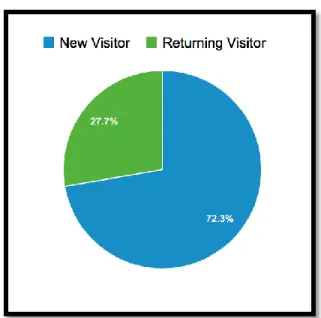
Wilmington, and Asheville. 28.6% of visitors were returning users, indicating a
42 “How a Session is Defined in Google Analytics.” Google.com, accessed March
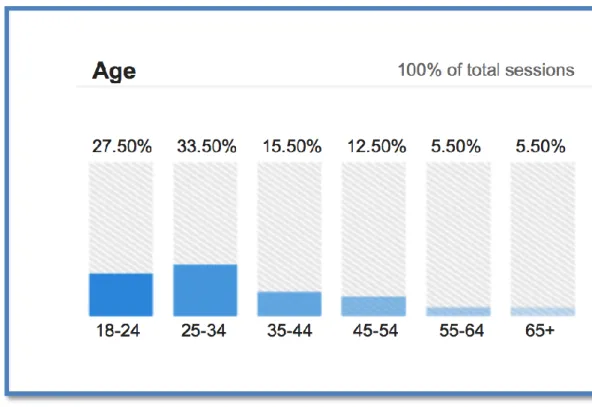
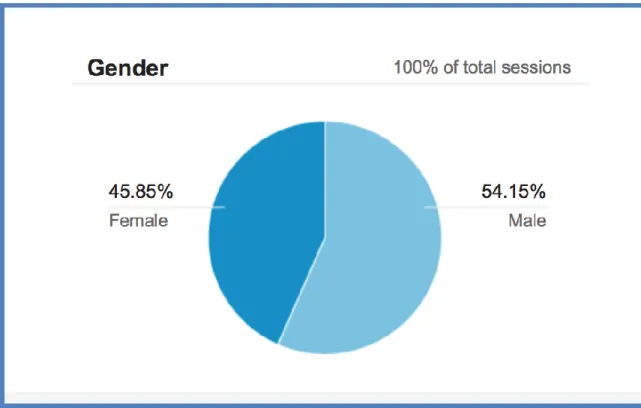
low, but steady rate of return. The Google Analytics data for overall collections use reflects the data in the more-frequently used collections in this study, with a slightly higher incidence of male users than female users and most users falling within the young adult (25-25) age range.
Fig. 1: The overall rate of return was low, but indicated a subset of
Fig 3: Only slightly more men visited the sites than women. As noted, the overall collections use demographic data is problematic in that it is gathered via cookies, and reflects a series of categories used by Google, but not, necessarily, reflective of its user population.
Of the collections for which Google Analytics data was available,
excluding The James Lawrence Dunsbury Journal (1841-1842) and I Raised My Hand to Volunteer: A History of Student Protest at Chapel Hill, the data collected
was as depicted in the following graphics. The results are based upon Google Analytics sampling procedures, which select “a subset of data from your traffic and reporting on the trends available to the sample set.”43
43 “How Sampling Works.” Google.com. Accessed March 10, 2015,
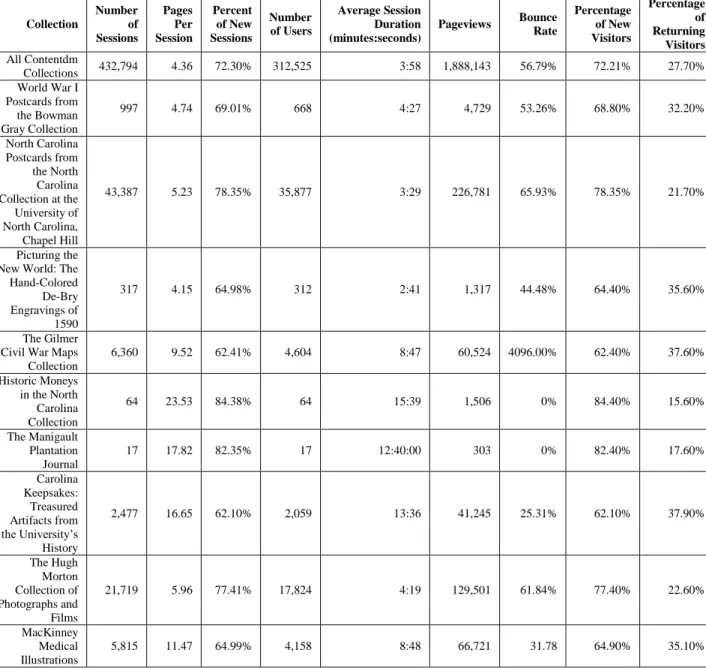
Fig 4: This chart displays a full rendering of Google Analytics data for the Contentdm collentions included in this study.
Collection Number of Sessions Pages Per Session Percent of New Sessions Number of Users Average Session Duration (minutes:seconds)
Pageviews Bounce Rate Percentage of New Visitors Percentage of Returning Visitors All Contentdm
Collections 432,794 4.36 72.30% 312,525 3:58 1,888,143 56.79% 72.21% 27.70% World War I
Postcards from the Bowman Gray Collection
997 4.74 69.01% 668 4:27 4,729 53.26% 68.80% 32.20%
North Carolina Postcards from the North Carolina Collection at the University of North Carolina, Chapel Hill
43,387 5.23 78.35% 35,877 3:29 226,781 65.93% 78.35% 21.70%
Picturing the New World: The Hand-Colored De-Bry Engravings of 1590
317 4.15 64.98% 312 2:41 1,317 44.48% 64.40% 35.60%
The Gilmer Civil War Maps Collection
6,360 9.52 62.41% 4,604 8:47 60,524 4096.00% 62.40% 37.60%
Historic Moneys in the North Carolina Collection
64 23.53 84.38% 64 15:39 1,506 0% 84.40% 15.60%
The Manigault Plantation Journal
17 17.82 82.35% 17 12:40:00 303 0% 82.40% 17.60%
Carolina Keepsakes: Treasured Artifacts from the University’s History
2,477 16.65 62.10% 2,059 13:36 41,245 25.31% 62.10% 37.90%
The Hugh Morton Collection of Photographs and Films
21,719 5.96 77.41% 17,824 4:19 129,501 61.84% 77.40% 22.60%
MacKinney Medical Illustrations
Fig. 5: Use data indicated that the NC Postcards Collection experienced the highest percentage of overall use, with the Manigault Plantation Journal experiencing the least use, as measured by number of sessions in the specified date range.
100%
0.82% 10.50% 1.42% 1.47% 0.01% 0% 0.57% 1.35%
Percentage of Overall Use
Percentage of Use in Comparision to All
Contentdm Collections
All Sessions GrayPostcards
NCPostcards DeBry
Gilmer Money
Manigault CarolinaKeepsakes
Fig. 6: The North Carolina Postcards Collection and the Hugh Morton Collection of Photographs and Films experienced the highest number of sessions for the specified date range, with the Historic Moneys in the North Carolina Collection and the Manigualt Plantation Journal experiencing the smallest number of sessions within the specified date range.
.
World War I Postcards from the
Bowman Gray Collection
North Carolina Postcards
Picturing the New World: The
Hand-Colored De-Bry Engravings of 1590 The Gilmer Civil
War Maps Collection Historic Moneys in
the North Carolina Collection The Manigault Plantation Journal Carolina Keepsakes: Treasured Artifacts from the University’s History
The Hugh Morton Collection of Photographs and
Films
MacKinney Medical Illustrations
Fig: 7: The percentage of new sessions was comparable over all collections, with the Manigault Plantation Journal, the Historic Moneys in North Carolina, the North Carolina Postcards Collection and The Hugh Morton Collection of Photographs and Films experiencing the highest percentages of new use.
World War I Postcards from the Bowman Gray Collection 11% North Carolina Postcards 12% Picturing the New World: The Hand-Colored De-Bry Engravings of 1590 10%
The Gilmer Civil War Maps Collection 10% Historic Moneys in the North Carolina Collection 13% The Manigault Plantation Journal 13% Carolina Keepsakes: Treasured Artifacts from the University’s History 9% The Hugh Morton Collection of Photographs and Films 12% MacKinney Medical Illustrations 10%
11%
13%
9%
15% 15%
6% 7%
15%
9%
Percentage of Returning Visitors
All Contentdm Collections
World War I Postcards from the Bowman Gray Collection
North Carolina Postcards
Picturing the New World: The Hand-Colored De-Bry
Engravings of 1590
The Gilmer Civil War Maps Collection
Historic Moneys in the North Carolina Collection
The Manigault Plantation Journal
Fig. 10: Bounce rate reflects the percentage of sessions that do not extend past the initial page discovery. The North Carolina Postcards
Collection and the Hugh Morton Collection of Photographs and Films experienced the highest bounce rates, but are among the most popular
collections in the study. The Manigault Plantation Journal experienced a zero percent bounce rate. The total number of users in this collection was low, but patrons consistently viewed more than one page while utilizing the collection. The visual versus narrative content difference may be related to this discrepancy. 16% 20% 14% 13% 0% 0% 8% 19% 10%
Bounce Rate
World War I Postcards from the Bowman Gray Collection
North Carolina Postcards
Picturing the New World: The Hand-Colored De-Bry Engravings of 1590
The Gilmer Civil War Maps Collection
Historic Moneys in the North Carolina Collection
The Manigault Plantation Journal
Carolina Keepsakes: Treasured Artifacts from the University’s History
Fig. 11-13: The following charts reflect more detailed use data for each collection, including pages per session, session length, and the number of total pageviews for each collection.
4.36 4.74 5.23 4.15
9.52
23.53
17.82
16.65
5.96
Pages Per Session
5.00
3.00 2.00 8.00
15.00
12.0013.00
4.00 8.00
0.00 2.00 4.00 6.00 8.00 10.00 12.00 14.00 16.00
Average Session Duration in Minutes
(approximated for visualization)
According to Google Analytics, the most visited collection was the North Carolina Postcards from the North Carolina Collection at the University of North
Carolina, Chapel Hill, followed by The Hugh Morton Collection of Photographs
and Films. These collections also logged the highest number of sessions with
35,877 and 17, 924, respectively. In Google Analytics, a session is defined as “a group of interactions that take place on your website at any given time.”44 Since
each session incorporates a variety of related interactions with the site from a single source, the number of sessions indicated in Google Analytics is a decent
44 "How a Session Is Defined in Analytics." - Analytics Help. Accessed April 6,
2015. https://support.google.com/analytics/answer/2731565?hl=en. 1,888,143
4,729 226,781 1,317 60,524 1,506 303 41,245 129,501 0
200,000 400,000 600,000 800,000 1,000,000 1,200,000 1,400,000 1,600,000 1,800,000 2,000,000