Sarah K. Bankston. Toward a More Effective Online Library Tutorial: An Experimental
Study of UNC Libraries’ Introduction to Library Research Tutorial. A Master's paper for
the M.S. in L.S. degree. April, 2012. 46 pages. Advisor: Diane Kelly
Due to increased Internet access and the prevalence of distance education, online instruction is increasing, and libraries generate a great deal of online library instruction content to meet the needs of users. This study investigates the UNC University Libraries’
Introduction to Library Research tutorial in an effort to evaluate the tutorial and gather evidence to guide future updates. Twenty-four undergraduate students filled out a pre-test questionnaire, completed the tutorial, and answered a post-test questionnaire and an engagement questionnaire. While the average number of correct answers slightly increased in the post-test, the result was not statistically significant. The engagement questionnaire revealed that a recent design update was well-received and that while students do not necessarily consider the tutorial ‘fun,’ they would recommend it to others. This experimental approach provides evidence of student engagement with the online tutorial, serves as a possible model for evaluating the tutorial in the future, and provides benchmark data on which to compare future findings.
Headings:
Library orientation for college students
Web-based instruction -- Evaluation
TOWARD A MORE EFFECTIVE ONLINE LIBRARY TUTORIAL: AN
EXPERIMENTAL STUDY OF UNC LIBRARIES’ INTRODUCTION TO LIBRARY
RESEARCH TUTORIAL
by
Sarah K. Bankston
A Master's paper submitted to the faculty of the School of Information and Library Science of the University of North Carolina at Chapel Hill
in partial fulfillment of the requirements for the degree of Master of Science in
Library Science.
Chapel Hill, North Carolina
April, 2012
Approved by:
________________________
Table of Contents
List of Figures ...2
List of Tables ...3
Introduction ...4
Literature Review ...9
Method ...16
Results ...20
Discussion...26
Conclusion ...33
References ...35
Appendix A ...37
Appendix B ...38
Appendix C ...40
List of Figures
Figure 1: Previous Design of the Tutorial………6
Figure 2: Updated Design of the Tutorial………7
Figure 3: Webpage with Links to the Questionnaires and the Tutorial…………...…..…18
List of Tables
Table 1: Majors by Discipline………..…..…...….20
Table 2: Pre-test Questions and Number and Percentage of Correct Answers…..………21
Table 3: Post-test Questions and Number and Percentage of Correct Answers..……..…22
Introduction
With the widespread availability of computers and Internet access, academic
libraries in particular are moving library instruction content online. As a result of this,
Bowles-Terry, Hensley, and Hinchliffe (2010) point out “the line blurs between students
who approach the Internet as distance learners and students who prefer online learning”
(p. 19). In an effort to meet the needs of their users at their point of need, or “just in time,”
many librarians create online tutorials that offer guidance on everything from
constructing keyword searches to an overview of the research process to plagiarism. As
interfaces change, librarians find that their once state-of-the-art tutorials quickly become
dated, and these online learning objects can become quite a drain on work time. Martin,
Birks, and Hunt (2010) and Veldof and Beavers (2001) all note this problem as an
impetus for their own studies. Given this, I am interested in studying how students use
these tutorials, specifically the Introduction to Library Research tutorial created by the
librarians at the University of North Carolina at Chapel Hill.
Online library instruction content is delivered in many different ways: commercial
products such as LibGuides, home-grown subject guides and course pages, videos created
with software such as Camtasia and Captivate, and even simple HTML pages. Library
instruction content here encompasses a variety of types of instruction: learning about
library services, such as how to request interlibrary loan materials and how to check out
books; learning about the library website, such as using the OPAC; and learning about
research and how to avoid plagiarism. The focus of this experimental study will be a
tutorial that falls into this last category, more specifically, UNC Libraries’ Introduction to
Library Research tutorial (http://www.lib.unc.edu/instruct/tutorial). This tutorial is often used as an introduction to concepts that will be covered in face-to-face library instruction
session. While this study will investigate a research process-oriented tutorial, it will be
informed by studies of similar tutorials as well as studies conducted on tutorials that
address using library websites and services.
Many people within the library are involved in the creation of tutorials, from
librarians to graduate students to staff members, and the production of this content can
potentially span several departments. From inception to delivery, these tutorials are
time-consuming and the final product often is not ‘final’ since the continual update of
platforms and interfaces requires updating and maintenance lest the tutorial file formats
become obsolete or the content contained within appears dated. Given this, tutorials,
though only one aspect of a librarian’s work duties, can quickly dominate the majority of
librarian’s schedule. The librarians at R.B. House Undergraduate Library (UL), a part of
UNC Libraries, where I work as the Undergraduate Library Carolina Academic Library
Associate (CALA), maintain the library’s online tutorials and the graduate students are
often tasked with updating content.
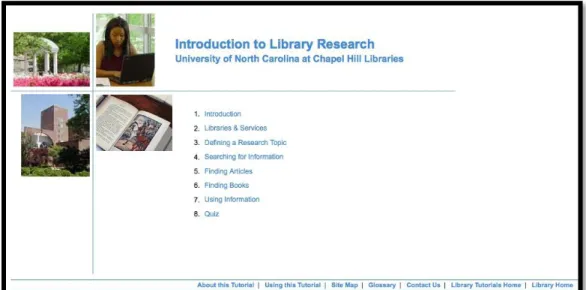
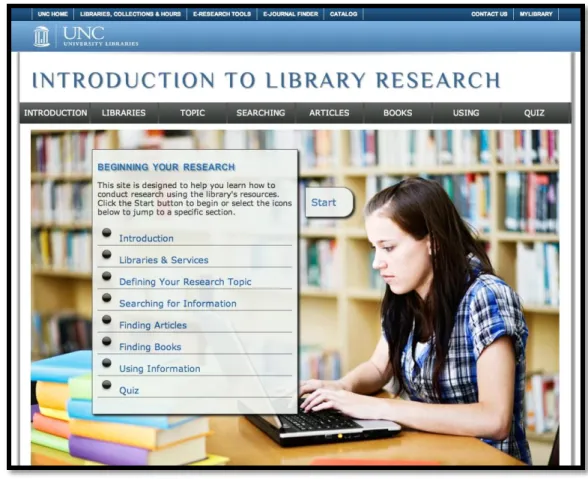
The Introduction to Library Research tutorial underwent a design update and content refresh in 2011. The updates to the design of this tutorial grew out of research
conducted by a School of Information and Library Science graduate student on the needs
of students studying abroad. This research led to a consolidation of the many study
same time the content was consolidated, the design of the Studying Abroad tutorial was also updated (see Figure 1 and Figure 2), inspired by the Department of State’s Students
Abroad website (http://studentsabroad.state.gov/). Once the Studying Abroad tutorial was
updated, the other online tutorials, including the Introduction to Library Research tutorial,
were updated to have the same design. The updates to the content of the Introduction to
Library Research tutorial were mostly guided by anecdotal evidence provided over the years by Teaching Fellows (graduate students and lecturers who teach English 100, 101,
and 102 at UNC) regarding what they believed their students needed (K. Vassiliadis,
personal communication, March 18, 2012).
Figure 2 – Updated Design of the Tutorial
The library has no recent empirical evidence to guide the editing and updating
process for tutorials. It occurs to me that while we as librarians know what students need
to know to successfully conduct research based on the knowledge of the library’s
resources and conversations with faculty members, we do not have empirical evidence
for how the students are actually interacting with and learning through online library
instruction. Since these tutorials are time-consuming for librarians and staff, and since the
current budget situation often leads to the need to do more with less, it is important that
we optimize librarian and staff labor by investigating how students are actually using the
tutorials, discovering what is retained, and basing our future efforts on empirical evidence.
The primary purpose of this study will be to find out what students are learning
ultimate goal of this is to inform the library of student practices and attitudes in order to
optimize time spent in the creation and maintenance of tutorials and in order to deliver
better online library instruction content to our users. Among the questions I seek to
answer are:
1. How engaged are students with this tutorial?
2. Does student learning about the library increase as a result of this tutorial?
The problem of usability of online library instruction content is important because
students want to access as much as possible online and they attempt to do most of their
work online. To stay vital and relevant, the library needs to meet students where they are
already doing work. Also, while librarians may find it ideal for users to enter the library,
the increase of distance education programs means that realistically many of our users are
not local and may find it impossible to enter the physical library. In order to serve all of
our users, we need to make sure that the online learning components created by the
library are useful and usable.
My study will help improve UNC Libraries’ existing tutorial by providing
empirical evidence concerning students’ engagement with the tutorial and student
learning as a result of the tutorial. Although there have been similar studies done by other
universities, there have not been any recent studies conducted on the UNC Libraries
tutorials, so a need exists to get local user feedback in order to identify strengths and
weaknesses. By conducting research, the library can provide evidence-based answers to
Literature Review
The following literature review summarizes studies that have been conducted on
online library tutorials, including student surveys. Of particular interest are the methods
involved in these studies, the types of online tutorials studied, the debate concerning
interactivity, the benefits of these tutorials, and the question of whether they should
replace or supplement face-to-face instruction.
There have been several approaches to assessing online library tutorials, from
large-scale analyses of tutorials created by libraries across the United States and Canada
to assessments of individual tutorials at universities. Dewald’s (1999) analysis of tutorials
from across the United States and Canada is often cited because of its contributions
toward developing “best practices” for tutorial creation. Recognizing that libraries
increasingly need to meet the needs of students in online environments, Dewald (1999)
applied criteria for good in-person bibliographic instruction to web-based instruction
tutorials. In doing so, she examined whether these in-person instruction criteria were used
in online environments and the ways in which they were applied. Originally identifying
20 online tutorials recognized by the Library Instruction Round Table (LIRT), Dewald
examined 19 tutorials, 18 of which were geared toward a post-secondary education
audience. She found that online library tutorials are best used as a supplement to
in-person instruction, and especially stressed that these tutorials should allow for active and
collaborative learning, include graphics, and point users toward librarians for further
and Hinchliffe (2010) also offer “best practices” for tutorial creation based on the results
of their usability study.
Somoza-Fernández and Abadal (2009) followed this model of large-scale analysis
and applied pre-identified criteria to online tutorials. While Dewald (1999) selected
tutorials highlighted by LIRT, Somoza-Fernández and Abadal (2009) examined 180
online tutorials specifically created by academic libraries worldwide in terms of “general
characteristics, content, teaching methodology, usability and technology” (p. 127).
Somoza-Fernández and Abadal (2009) noted that tutorials addressing information literacy
account for almost 43% (n=77) of the tutorials studied with the next largest subject area
being “searching in information sources” at almost 13% (n=23) (p. 129). Perhaps as a
result of Dewald’s (1999) study, three-fourths of the tutorials they examined had an
interactive component. In their discussion, Somoza-Fernández and Abadal (2009)
asserted that “web-based tutorials offered by academic libraries are at an early stage of
development” and identify the inclusion of “explicit indication of the educational
objectives,” “information on the time that students will need in order to follow the
tutorial,” and “ some form of evaluation of students’ previous knowledge” as the areas
needing the greatest improvement (p. 130). These sorts of large-scale analyses of
web-based tutorials are helpful to get an overall perspective on the state of online tutorials and
give librarians creating tutorials useful guidance for “best practices;” however, in order to
meet the needs of their particular users, it is important for librarians to also conduct
user-centered research on the tutorials created by their library. The rest of the articles selected
for this review address these sorts of local studies, and I have focused on the methods
interactivity, the benefits of these tutorials, and the question of whether online tutorials
should replace or supplement face to face instruction.
The three methods of data collection used in the individual studies were surveys,
focus groups, and usability studies. A popular strategy for the surveys was to administer a
questionnaire as a pre-test and post-test (Armstrong & Georgas, 2006; Churkovich &
Oughtred, 2002; Friehs & Craig, 2008; Martin, Birks, & Hunt, 2010; Petit, 2006; Van
Scoyoc, 2003). The other frequently used data collection method was usability studies
(Bowles-Terry, Hensley, & Hinchliffe, 2010; Bury & Oud, 2005; Mestre, 2010; Veldof &
Beavers, 2001). Mestre (2010), in her study of the use of learning styles to develop online
learning objects, took a two-pronged approach to data collection: she surveyed librarians
about their considerations when creating tutorials and she conducted a usability study
with 10 students. Martin, Birks and Hunt (2010) utilized focus groups to formulate their
surveys. Veldof and Beavers (2001) also employed a focus group, but as a means toward
understanding students’ mental models rather than redesigning the tutorial. Bury and Oud
(2005) used a survey to assess the redesign that occurred as a result of their usability
testing. The pre-test and post-test survey design will be important to answering my
research questions, and the examples here provide a model for structuring my
questionnaires.
The format of tutorials investigated varied widely. The majority were videos
created using Captivate or Camtasia (Bowles-Terry, Hensley, & Hinchliffe, 2010; Friehs
& Craig, 2008). Others used static HTML pages (Bury & Oud, 2005; Martin, Birks, &
Hunt, 2010; Veldof & Beavers, 2001). Still others were Flash based animations
explicitly mentioned, except for the use of a phrase like “computer-assisted instruction”
or “computer-based tutorials” (Van Scoyoc, 2003). In one case a commercial tutorial was
used (Churkovich and Oughtred, 2002). Mestre’s (2010) study is notable because it was
the only one that I identified that investigated and conducted usability testing on three
technologies used to create tutorials: a Camtasia tutorial, static HTML pages, and an
animated Flash tutorial. Mestre (2010) found that “those who used the static Web pages
with screen shots and a directive to open a new Web browser and do the search along
with the steps on the Web page were all able to go back and recreate the search” whereas
8 out of the 10 were unable to do so using the Camtasia tutorial (p. 821). Her findings are
of interest to my study since the Introduction to Library Research was created using
static HTML pages and a natural question is whether this is the most appropriate format
for the content.
Van Scoyoc (2003) found, in her comparison of in-person bibliographic
instruction and online tutorial instruction, that students who attended in-person
instruction exhibited significantly less anxiety about using the library than those taking
online tutorials. However, she noted that “those students who completed the
computer-based tutorial experienced significantly less library anxiety compared to those students
who did not participate in either” in-person or online instruction (p. 337). Of interest to
librarians, “analysis of the first subscale [of library anxiety], barriers with staff…revealed
that students who participated in library staff-led bibliographic instruction experienced
significantly less library anxiety compared to those students” who did not have an
in-person or online session as well as “compared to those students who completed the
Oughtred’s (2002) study support this finding, showing that students who had face-to-face
instruction had “higher confidence levels” (p. 33). These two studies are fascinating
because although it is not an explicit research question for my own study, library anxiety
and student comfort levels are implicit in my desire to learn more about students’ opinion
and use of tutorials.
Dewald (1999) maintained that interactivity (quizzes, media, etc.) plays a role in
successful online tutorials. Armstrong and Georgas (2006) found that “students are
receptive to and often enthusiastic about learning through interactive tutorials” (p. 496).
During their usability study, Bury and Oud (2004) stated that “students responded very
favorably” to interactive portions of the tutorial and that “there was a consensus that this
approach helped hold student attention” and more importantly, “students requested that
more modules use this interactive approach” (p. 61). Martin, Birks, and Hunt (2010) also
found “that students liked and used the images and movies created” in their online
tutorials, and “62 percent of…students stated that the images helped them to understand
the information” (p. 61). They do state that “50 percent…of students claimed not to have
used the movies” included in the tutorials despite the fact that “limited research…done in
relation to learning styles among Arab students indicates a preference for auditory and
visual perceptual styles” (p. 61). Mestre (2010) found in her testing that “students did
better on the post tests when they had something active to do in the tutorial” (p. 827).
Despite all the evidence for interactivity, Friehs and Craig (2008) found in their
study that the interactivity did not have to be very involved; the responses of the students
in their two-part survey “support the value of streaming media tutorials,” especially
and Craig’s (2008) findings somewhat contradicted the widely held belief in the
importance of interactivity to online tutorials, but they did acknowledge that “more
studies need to be done to test the value of non-interactive, streaming media tutorials” (p.
505). Bowles-Terry, Hensley, and Hinchliffe (2010) found that the students who
participated in their usability study did not think that the tutorials needed to have any
more entertainment value and noted that “students view library tutorials in a utilitarian
light and want to get the necessary information and move forward with the
information-seeking process” (p. 24).
The role of online tutorials is also debated: while some studies have shown that
in-person instruction cannot be replaced by online tutorials, others have shown that there
is no significant difference between the two approaches. For example, Friehs and Craig
(2008) reported that the students they surveyed liked the online tutorial but preferred
face-to-face instruction (p. 505). On the other hand, Armstrong and Georgas (2006)
reported that the students they studied said they prefer online learning to face-to-face
instruction (p. 495). They go on to discuss the ways in which the tutorial is being shown
at the beginning of face-to-face instruction as a ‘jumping off’ point to supplement
instruction (p. 496). Those who argued that in-person instruction cannot be replaced with
online tutorials make the point that the usefulness of such web-based tutorials is as
supplement material to support classroom instruction (Churkovich and Oughtred, 2002).
Others, such as Bowles-Terry, Hensley, and Hinchliffe (2010), argued that web-based
tutorials are well-suited to ‘just-in-time’ instruction, addressing the point-of-need issues
that users face (p. 19). Interestingly, the students in their study also responded that they
online tutorials (Bowles-Terry, Hensley, & Hinchliffe, 2010, p. 19). While not
necessarily preferring tutorials over in-person instruction, the students in Mestre’s (2010)
study did prefer “learning objects…[be] available at point-of-need” (p. 827).
While not explicitly arguing the role of online tutorials, Veldof and Beavers
(2001) examined mental models of students and librarians and ultimately made the
argument that for these online tutorials to be successful, librarians need to situate them in
the mental models of students rather than designing from the point of view of librarian
mental models of research. This concept of mental models is of interest since my study
seeks student opinion through a questionnaire such opinion is based on existing mental
models. Blummer (2007), too, took into account “learning from the student’s perspective”
when she discussed individual assessment of tutorials (p. 126). Her article is important to
this study because it offers three views of assessment of tutorial: general, individual, and
program assessment. Her discussion of program assessment regarding the tutorial,
focusing on things like learning outcomes, is especially informative for my study since
the Introduction to Library Research tutorial is underpinned by information literacy standards. Also, Blummer (2007) noted that “program assessment considers the attitude
of the students and their professor’s toward the tutorials value” (p. 129). The engagement
questionnaire in my study will be completed by students and will elicit their opinions of
Method
In order to gather data to provide evidence of student learning as a result of the
tutorial, as well as student opinion, an experimental study was devised. The study
consisted of a pre-test skills test, a treatment (the Introduction to Library Research
tutorial), and a post-test skills test to measure student learning. This was accompanied by
an engagement questionnaire, which explored student opinion of the tutorial.
The experimental design was a pre-experimental design because it investigated “a
single group and provide[d] intervention during the experiment” and there was no
“control group to compare with the experimental group” (Creswell, 2009, p. 158). In
order to explore student opinion of the tutorial, an engagement questionnaire was
administered after the post-test. Churkovich and Oughtred (2002) made good use of
pre-tests and post-pre-tests in their study. They were evaluating student learning in the context of
in-library versus web-based so the pre-test/post-test set up was useful.
These methods are appropriate to this study since I am seeking not only to
evaluate student learning as a result of this tutorial but also student opinion of and
engagement with the tutorial. Previously I had considered conducting a traditional
usability study, which, after reviewing the literature and reconsidering my research
questions, would not meet my needs since they tend to examine design and usability of a
site rather than content.
The sample consists of undergraduate students in UNC who had not yet taken the
to the UNC Mass Email system and a flyer that was placed at the reference desk in the
R.B. House Undergraduate Library. Both the email and the flyer indicated that students
who participated would be given $15 cash for their time. When students emailed
expressing interest in the study, a follow-up email was sent confirming that they were 1)
undergraduate students, and 2) had never before taken the Introduction to Library
Research tutorial. This follow-up email contained two screenshots of the first page of tutorial: one of the previous version and one of the current version. Since the study was
open to all undergraduate students, it was necessary to include the screenshot of the old
tutorial. Once students confirmed that they meet both criteria, they were scheduled for the
study.
The study was conducted in the Undergraduate Library in the computer classroom
with multiple students participating at one time. When students arrived, they were seated
at a computer station and given a consent form to read. After they each read the consent
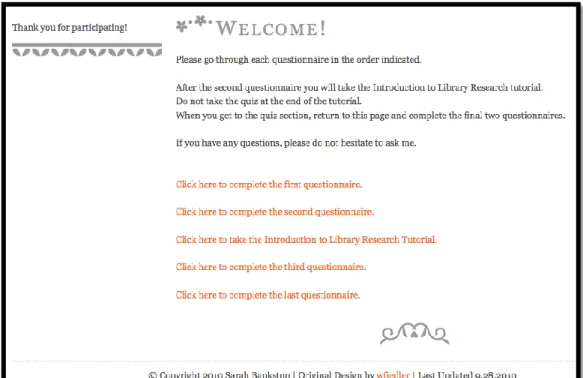
form, I opened a browser on their computer and navigated to a website which had the
links to each of the questionnaires and the tutorial (see Figure 3). I oriented students to
the webpage by verbally instructing them to click on each link and fill out the
questionnaires in order. I pointed out that the third link was for the tutorial itself and told
them that when they got to that link they were to take the tutorial. Students were told to
not complete the quiz associated with the tutorial but instead return to the webpage with
the questionnaires and complete the remaining questionnaires. The webpage also
included these instructions. Each student drew a number to enter at the beginning of each
questionnaire before beginning the study. After each student completed the last
complete the study was 45 minutes, though most students finished within 30 minutes.
The questions in the pre-test and post-test helped evaluate prior knowledge as well as
what learning took place as a result of the tutorial while the questions in the engagement
questionnaire addressed student attitudes and opinions about the tutorial.
Figure 3 - Webpage with Links to the Questionnaires and the Tutorial
The four questionnaires were created in Qualtrics, and the first question of each
questionnaire prompted the student to input the number they drew. This was done so that
comparisons could be made across questionnaires without having to collect identifying
information from the students. The first questionnaire was a demographic questionnaire,
which asked students about their age, sex, year in school, and major. The pre-test and
post-test skills test questionnaires each consisted of twelve multiple choice questions that
addressed information literacy skills or library system information that was taught in the
process, finding sources, evaluating sources, and ethical use of information. The structure
of the pre-test and post-test were similar so that like skills could be compared. For
example, the second question in the pre-test asked about a particular library service so the
second question in the post-test also asked about a particular library service.
The engagement questionnaire administered after the post-test was adapted from a
User Engagement Scale that was originally developed for measuring e-commerce
experiences (O’Brien and Tom, 2010). It has been adapted for studying interactive
information retrieval, and was adapted here for studying engagement with online tutorials.
The engagement questionnaire consisted of 31 questions divided into 6 categories, or
factors: Focused Attention, Perceived Usability, Aesthetics, Endurability, Novelty, and
Felt Involvement. A 5-point Likert scale was employed with the response choices being
Strongly Agree, Agree, Neither Agree Nor Disagree, Disagree, and Strongly Disagree.
In order to avoid any possible ethical conflict that might have existed because the
study was administered within the Undergraduate Library, I included a statement in the
recruitment email and in the consent form that said that participants would receive no
special consideration for their participation in the study. The consent form also indicated
that students could withdraw from participation at any time.
The quantitative data obtained through the multiple-choice pre-test and post-test
and through the Likert scale engagement questionnaire was generated by and analyzed in
Results Demographics
A total of 24 students participated in this study, of which 15 were female and 9
were male. The average age of the participants was 21.17 years old. The median age was
19.5. The standard deviation was 5.15 years, and two of the participants were
nontraditional undergraduate students with ages more than 2.5 standard deviations and
3.5 standard deviations from the mean. All of the participants were undergraduate
students, 33% of whom were freshmen, 35% were sophomores, 17% were juniors, and
25% were seniors. Of the 24 participants, only 23 responded when asked their major.
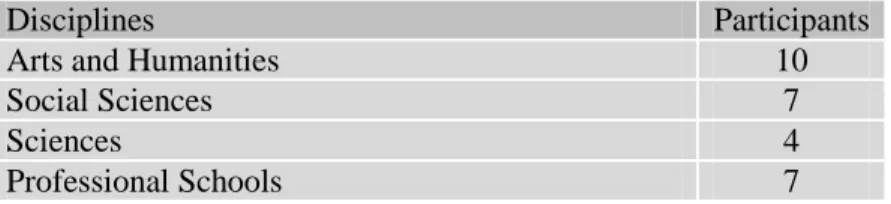
Five of the participants indicated a double-major. Table 1 shows the breakdown of
disciplines represented in this study and reflects double-majors when the majors fall in
two different disciplines.
Disciplines Participants
Arts and Humanities 10
Social Sciences 7
Sciences 4
Professional Schools 7
Table 1 – Majors by Discipline
Pre-test and Post-test Pre-test
Results of the pre-test are shown in Table 2. Among the twenty-four participants,
only two answered every question correctly on the pre-test. Overall, the participants
correctly answered an average of 9.29 questions for an average score of 77.46%.
correctly answered an average of 10.17 questions (84.83%), juniors correctly answered
an average of 9 questions (75%), and seniors correctly answered an average of 8.17
questions (68%). Seventy-one percent of the students scored 75% or higher on the
pre-test. No one scored below 50% on the pre-pre-test.
Of the twelve questions asked, only 2 questions had a response rate of 100%
correct answers. Five of the questions had correct answer responses above 90%. Three of
the questions had response rates of correct answers below 70%. One of those questions
dealt with evaluating websites while the other two, which had much lower scores, dealt
with UNC Libraries’ physical and online library spaces.
Table 2 - Pre-test Questions and Number and Percentage of Correct Answers
Post-test
Post-test results are shown in Table 3. Among the twenty-four participants, only
two answered every question correctly on the post-test. Overall, the participants correctly
answered an average of 9.38 questions for an average score of 78.17%. Freshmen
answered an average of 9.83 questions (82%), juniors correctly answered an average of
9.25 questions (77.25%), and seniors correctly answered an average of 8.67 questions
(72.17%). Seventy-nine percent of the students scored 75% or higher on the post-test. No
one scored below 50% on the pre-test
Of the twelve questions asked, only 1 question had a response rate of 100%
correct answers. Six of the questions had correct answer responses above 90%. Four of
the questions had response rates of correct answers below 70%. One of those questions
dealt with the uses for a reference book, one dealt with whether peer-reviewed articles
could be found using Google, and the other two dealt with UNC Libraries’ physical
spaces and services.
Table 3 - Post-test Questions and Number and Percentage of Correct Answers
Comparison of Pre-test and Post-test
Only one student, a sophomore, answered every question correctly on both the
every question correctly on the pre-test, and only one other student, another sophomore,
answered every question correctly on the post-test.
In comparing the pre-test and post-test, of the 12 questions asked, the number
correctly answered either stayed the same or improved for six of the questions. On the
pre-test, the average number of correct questions was 9.29, or 77.46%. On the post-test,
the average number of correct questions increased to 9.38, or 78.17%. A paired samples
t-test conducted in SPSS revealed a t statistic of -.249 and a p-value of .806, confirming
that the slight increase in the average number of correctly answered questions was not
statistically significant.
Engagement Questionnaire
The engagement questionnaire was comprised of 31 questions divided into 6
factors: Focused Attention, Perceived Usability, Aesthetics, Endurability, Novelty, and
Felt Involvement. For the purposes of analysis, the 5-point Likert scale responses were
assigned numerical values as follows: Strongly Agree=5, Agree=4, Neither Agree Nor
Disagree=3, Disagree=2, and Strongly Disagree=1. When the questions were negatively
worded, the responses were reverse-coded to reflect this. For example, several questions
within the Perceived Usability factor addressed confusion and frustration, and were
worded in such a way that the desirable result would be a “Strongly Disagree” or
“Disagree” response. For questions like these, the numerical values assigned were
Strongly Agree=1, Agree=2, Neither Agree Nor Disagree=3, Disagree=4, and Strongly
Disagree=5. Results are shown in Table 4.
Five questions received less than 24 responses. “I was absorbed in the online
online tutorial was visually pleasing,” and “I consider my experience with this online
tutorial a success” all received 23 responses. “The content of the online tutorial incited
my curiosity” only received 22 responses.
Figure 4 depicts the factor means for each engagement factor. The three factors
that had the highest mean responses were Perceived Usability, Aesthetics, and
Endurability. Perceived Usability had a mean response of 3.80. Aesthetics had a mean
response of 3.65. Endurability had a mean response of 3.60.
Focused Attention and Felt Involvement had mean responses of 2.76 and 2.81,
respectively. Novelty had a mean response of 3.02.
Figure 4 - Means of Engagement Factors
0.00 0.50 1.00 1.50 2.00 2.50 3.00 3.50 4.00
Focused Attention
Perceived Usability
Aesthetics
Endurability
Novelty
Discussion
The results of the pre-test are interesting because they give an indication of
students’ prior knowledge. To qualify for this study, students had to be undergraduate
students who had never taken the Introduction to Library Research tutorial. However, no
questions were asked about their previous library interaction or whether they had
attended a library instruction session in the past. Future studies may want to further
restrict participants or ask questions to determine library interaction prior to the study.
There were two questions in the pre-test for which students scored extremely low.
The first asked the students “Which library maintains the print and electronic reserves
collection?” The correct answer is the Undergraduate Library, but only 33% answered
correctly. None of the seniors were able to provide the correct answer, with the majority
choosing the “all of the above” option. This may reflect either a sense that this library
service is offered at the main three libraries or it may reflect a lack of knowledge because
this may not be a service they have used before or at least recently. The sophomores as a
group scored the highest on this question with 67% of them choosing the correct answer.
The other question that many students answered incorrectly was “If you want to
find the library databases, which link should you click on?” Once again, only 33% of the
students were able to identify the correct answer, which was “E-Research Tools.”
However, 58% of the students chose “Library Catalog,” which technically is correct. All
of the subscription databases are cataloged and can be found by searching the UNC
database or else they will have to sift through many catalog records pertaining to books
about databases, database management, or similar. So while databases can technically be
found through the catalog, this was not considered a correct answer because it is not the
link to click on to find all the databases in one place. In future studies, this question
should be made clearer to avoid confusion. Interestingly, if “Library Catalog” had been
an acceptable answer, the average number of correct questions would have been 9.92, and
the average score would have been 82.63%. This question and its answer may also have
implications for library website design. If students believe that the catalog search box is
the place to go to find everything the library has, then perhaps libraries should work to
promote that idea and teach users how to more effectively use the catalog and build
features into the catalog rather than build special tools like the E-Research Tools page.
This is an area that could be explored in greater detail in future studies.
The most surprising result was the high rate of correct answers in response to the
question “Which search would result in the narrowest set of results?” Boolean logic is
often a source of confusion for students, so it was surprising to see 75% chose the correct
answer. One cause could be that the question is asking for the narrowest set of results,
and students may be making the logical conclusion that “and” makes the focus narrower.
It may also be that students are able to choose correctly when presented with
multiple-choice answers, but would struggle to actually construct a search using Boolean operators.
While there were no questions on the post-test that had as low of scores as the two
questions on the pre-test, the post-test did have four questions that had much lower scores.
The first two dealt with library services. The first asked students to identify a service
allows you to recall books that are already checked out or reserve a group study room?”
Thirty-three percent of the students selected “Reserves” as the right answer, though
“Circulation” was the correct choice. There could be several reasons for this. For one, the
word “reserve” in the question may have influenced students to choose “Reserves”
because of the similarity. Another reason may be that in the Undergraduate Library the
desks for the Reserves and for Circulation are in a shared area, though several feet away
from each other. Even though the tutorial explicitly discusses this function of Circulation,
it may be that the term “Circulation” just does not hold as much meaning for students.
The other two questions that received low results on the post-test dealt with
reference sources and Google. The Google question asked students to select “true” or
“false” in response to the statement that “Regular Google searches can find scholarly,
peer-reviewed articles.” Forty-six percent of the students said this was true. It is possible
this question may be too nuanced for a true-false response, and in the future researchers
should consider altering this question.
Comparing the pre-test and post-test reveals that there was only a very slight
increase in the average number of questions answered correctly (from a 9.29 to a 9.38)
and average overall score (from a 77.46% to a 78.17%). After running a paired sample
t-test, it was clear this increase was not statistically significant. Comparing the pre-test and
post-test scores shows that 15 of the 24 students (62.5%) scored the same score or higher
on the post-test and, conversely, 9 (37.5%) scored worse. There could be a variety of
reasons that individuals scored worst on the post-test, including the possibility that the
questions were harder since they were asked directly following the completion of the
If this study is replicated, future researchers may want to do a pilot test to test out
question order and question integrity.
Overall there was an increase in average overall score for 5 individual questions
on the post-test over the pre-test counterpart question. One question had the same score
for the pre-test and post-test counterpart questions. Since the same questions were not
asked in the pre-test and post-test, but rather questions addressing the same subject were
compared, it is possible that good equivalency questions were not chosen. Perhaps some
of the pre-test questions were too easy or the post-test counterparts too hard. This will
have to be an area for further investigation.
The engagement questionnaire was really helpful in identifying student opinion
about and engagement with the tutorial. In the Focused Attention portion of the
questionnaire, which O’Brien and Toms (2010) said consists of “items related to users'
perceptions of time passing and their degree of awareness about what was taking place
outside of their interaction,” the students indicated that they disagree or strongly disagree
that they ‘lost themselves in the tutorial,’ ‘lost track of the world around’ them, or ‘let
themselves go’ (p. 17). However, when the question referred to blocking things out while
taking the tutorial, students were more likely to agree.
The Perceived Usability section of the engagement questionnaire, which O’Brien
and Toms (2010) said “pertained to the emotions experienced by respondents when
completing their…task,” indicated that students for the most part disagreed or strongly
disagreed that the tutorial experience was annoying, frustrating, discouraging, or
confusing (p. 17-18). This category also assessed “whether users felt they could perform
tutorial was mentally taxing or demanding (O’Brien and Toms, 2010, p. 18). Students
also indicated that they felt in control of their experience and disagreed that they were
unable to do things they wanted to within the tutorial.
This tutorial scored very high in the Aesthetics category with the majority of
students agreeing that they found the tutorial visually pleasing, attractive, and
aesthetically appealing. The graphics and images in the tutorial, as well as the layout, also
scored high with the students. This response regarding the aesthetics of the tutorial is
encouraging since the anecdotal evidence indicated that students liked the new design of
the tutorial; having empirical evidence to back up anecdote helps make a stronger case
for refreshing and updating the design of online tutorials.
According to O’Brien and Toms (2010), the next category, Endurability,
“measured respondents' willingness to return to the shopping Website and to recommend
the Website to others, as well as their overall evaluations of the experience” (p. 18). In
this case, since the scale was adapted for use for online library tutorials, endurability
measures the likelihood that students would recommend the tutorial or whether students
consider their own experience worthwhile or successful. For the most part students found
the tutorial worthwhile and their experience successful. Fifty percent of the students
neither agreed nor disagreed that the experience was rewarding; however, 59% would
recommend the tutorial to a friend or family member who needed to learn about library
research. Even though the students may not have strong opinions regarding whether the
tutorial experience is rewarding, it is remarkable that they found it worthwhile enough to
The Novelty category addressed “the curiosity evoked by or participants' interest
in the shopping task,” or in this case the tutorial experience (O’Brien and Tom, 2010, p.
18). While the majority indicated that they did not continue to explore the tutorial out of
curiosity, 50% did say that the tutorial piqued their curiosity. This may seem
contradictory, but one possible explanation for this is that the students did not feel free to
continue to explore the tutorial since they needed to finish all the questionnaires.
The final category in the engagement scale addressed Felt Involvement, which
according to O’Brien and Toms (2010), “pertained to respondents feeling of being drawn
into and involved,” was a fairly low-scoring category for the tutorial (p. 18). In general,
students did not feel drawn into the tutorial experience, and they did not feel involved in
the tutorial nor did they feel it was fun. The low scores in this Felt Involvement category
coupled with the literature that discusses the need for interactivity makes a case for
revisiting the content of the tutorial in order to make it more interactive and hopefully
create an experience that will allow students to feel involved and drawn into the tutorial.
One limitation of this study was the small sample size. Since only 24 students
participated, it was difficult to generalize and draw specific conclusions about the tutorial.
Another limitation was that no qualitative data was gathered that might have given more
context to some of the negative responses. For example, students indicated that they
disagreed that the tutorial was “fun;” however, if there had been a follow-up focus group,
I might have discovered, as Bowles-Terry, Hensley, and Hinchliffe (2010) did in their
usability study at the University of Illinois, that UNC students are not interested library
The reliability of this study, both in the pre-test/post-test and the engagement
questionnaire can be determined by how varied the responses are; for example,
Choemprayong and Wildemuth (2009) discussed reliability in terms of “an inventory’s
internal consistency” and noted that this “addresses the issue of whether all the items are
measuring the same construct” (p. 284). In the case of this study, the emphasis is on
student opinion of content and student understanding of content. The validity of this
study relates to how well the questions asked in the questionnaires relate back to the
research questions: are my data collecting methods gathering information that will
answer my questions? Choemprayong and Wildemuth (2009) refer to this as “content
validity” (p. 285). I developed the pre-test and post-test questions myself based on the
content of the tutorial, though ideas for questions were adapted from Churkovich and
Oughtred’s (2002) questionnaires as well as from the quiz within the tutorial itself, and
Choemprayong and Wildemuth (2009) warned that “small changes in wording can affect
the reliability or validity of the inventory” (p. 286). This is a concern, too, with the
engagement scale that was adapted from O’Brien and Toms’ (2010) scale which was
Conclusion
The creation and maintenance of library tutorials consume a great deal of a
librarian’s time. In order to maximize and streamline these efforts, evidence needs to be
gathered about what students learn from the tutorial, as well as their engagement with and
opinions of the tutorials. This data will be used to provide evidence for the future tutorial
design process as well as for the value of the Introduction to Library Research tutorial,
both for library administration and the larger university community.
A review of the literature revealed that while formats of tutorials and methods for
studying them vary, in general the typical discussion surrounds the concept of
interactivity, the benefit of easing library anxiety, and the role these online tutorials play
in the realm of library instruction. Since there is such variation from study to study,
uncertainty exists whether tutorials should be more interactive or remain as they are. This
uncertainty made a good case for investigating the Introduction to Library Research
tutorial focusing on the local user group of undergraduates at the University of North
Carolina at Chapel Hill.
In an attempt to begin to provide this evidence, data was gathered from an
experimental study involving a pre-test, treatment, and post-test, as well as from an
engagement questionnaire. Twenty-four undergraduate students from UNC took part in
this study. Data gathered from the pre-test and post-test revealed a slight, though
statistically insignificant, increase in overall student scores. Individual performance
24 students (62.5%) scored the same score or higher on the post-test. Data gathered from
the engagement questionnaire showed that while students did not feel drawn into or
involved in the tutorial, they were interested in the content of the tutorial and felt that it
incited their interest. Additionally, 76% said they felt taking the tutorial was worthwhile,
and 59% said they would recommend the tutorial to friends and family needing to learn
about library research. Also, the majority of students like the aesthetics of the tutorial,
finding it attractive and visually pleasing.
While not conclusive, these results begin to give a picture of student engagement
with the online tutorial, and somewhat reflect what students have learned from the
tutorial. Certainly the pre-test/post-test design can be revisited and the questionnaires
edited to gain a better sense of student learning through future studies. Future researchers
may want to experiment with delaying the post-test or including a task-based post-test
rather than a multiple-choice design. Since students indicated an interest in and curiosity
about the content, but indicated that they did not think the current tutorial was fun nor did
it drawn them in, future researchers could find a scale that measured interactivity more
explicitly or form a focus group to get more qualitative input about this aspect of the
tutorial. At the very least, this study has served as a model for one possible way data can
References
Armstrong, A., & Georgas, H. (2006). Using interactive technology to teach information
literacy concepts to undergraduate students. Reference Services Review, 34(4),
491-497.
Bowles-Terry, M., Hensley, M. K., & Hinchliffe, L. J. (2010). Best practices for online
video tutorials in academic libraries: A study of student preferences and
understanding. Communication in Information Literacy, 4(1), 17-28.
Blummer, B. (2007). Assessing patron learning from an online library tutorial.
Community & Junior College Libraries, 14(2), 121-138.
Bury, S., & Oud, J. (2005). Usability testing of an online information literacy tutorial.
Reference Services Review, 33(1), 54-65.
Choemprayong, S., & Wildemuth, B. (2009). Developing new measures. In B.
Wildemuth (Ed.), Application of Social Research Methods to Questions in
Information and Library Science (pp. 166-177).Westport, CT: Libraries Unlimited.
Churkovich, M., & Oughtred, C. (2002). Can an online tutorial pass the test for library
instruction?: An evaluation and comparison of library skills instruction methods
for first year students at Deakin University. Australian Academic and Research
Libraries, (33)1, 25-38.
Creswell, J.W. (2009). Research design: Qualitative, quantitative, and mixed methods
Dewald, N.H. (1999). Transporting good library instruction practices into the web
environment: an analysis of online tutorials. Journal of Academic Librarianship,
25(1), 26-32.
Friehs, C.G., & Craig, C.L. (2008). Assessing the effectiveness of online library
instruction with finance students. Journal of Web Librarianship, 2(4), 493-509.
Martin, J., Birks, J., & Hunt, F. (2010). Designing for users: online information literacy
in the Middle East. portal: Libraries and the Academy, 10(1), 57-73.
Mestre, L.S. (2010). Matching up learning styles with learning objects: what’s effective?
Journal of Library Administration, 50(7-8), 808-829.
O’Brien, H.L., & Toms, E.G. (2010). The development and evaluation of a survey to
measure user engagement in e-commerce environments. Journal of the American
Society for Information Science & Technology, 61(1), 50-69.
Petit, J. A. (2006). A usability study of Flash tutorials for library instruction (Master’s paper) University of North Carolina, Chapel Hill, NC.
Somoza-Fernández, M., and Abadal, E. (2009). Analysis of web-based tutorials created
by academic libraries. The Journal of Academic Librarianship, 35(2), 126-131.
Van Scoyoc, A.M. (2003). Reducing library anxiety in first-year students: the impact of
computer-assisted instruction and bibliographic instruction. Reference and User
Services Quarterly, 42(4), 329-341.
Veldof, J., and Beavers, K. (2001). Going mental: tackling mental models for the library
Appendix A
Demographic Questionnaire
Please enter your number __________
What is your sex?
Male
Female
What is your age? __________
What year are you in school?
Freshman
Sophomore
Junior
Senior
Appendix B
Pre-test Questionnaire
Please enter your number __________
Which library maintains the print and electronic reserve collections?
Wilson Library
Undergraduate Library
Davis Library
All of the above
Which library service allows you to borrow materials not available at UNC-Chapel Hill?
Reserves
Circulation
Interlibrary Loan
Reference
The library has movies I can check out or watch in the library.
True
False
Why should you gather background information before you begin your research?
To get an overview of your topic
To learn specialized language in that field
Finding background information is unnecessary—you can just figure it out as
you research
A and B
None of the above
If your topic is too broad, what is NOT a way to narrow it?
By time period
By population group
By switching topics
Where is the best place to go for up-to-the-minute information about an event that just happened?
Website like CNN
Newspaper
Magazine
Scholarly journal
The library has information that can’t be found through a Google search.
True
False
Which search would result in the narrowest set of results?
college OR university AND grade point average
college AND athletics AND grade point average
college OR athletics OR grade point average
college OR university AND athletics AND grade point average
What is the difference between scholarly journal articles and magazine articles?
Scholarly journal articles are better than magazine articles
Magazine articles are poorly researched
Scholarly journal articles undergo a rigorous review process
Scholarly journal articles are written for a wide audience
If you want to find the library databases, which link should you click on?
E-Research Tools
Library Catalog
E-Journals
Google Scholar
Which is an example of a question to ask yourself when evaluating a website’s currency?
Who is the author and what are his/her credentials?
When was the content on the website last updated?
Does the website have relevant information for my topic?
Is the information presented in an objective manner?
In which case is citing a source unnecessary?
When paraphrasing
When quoting a source directly
When presenting common knowledge
Appendix C
Post-test Questionnaire
Please enter your number __________
Which of the following can be found in Davis Library?
Microforms
Media Resources Collection
Reserves
Special Collections
Which library service allows you to recall books that are already checked out or reserve a group study room?
Reserves
Circulation
Interlibrary Loan
Reference
The library has a lab where I can work on multimedia projects.
True
False
Which is NOT a reason to use a specialized dictionary or encyclopedia?
To get an overview of your topic
To learn specialized language in that field
To get a sense of how the topic relates to other issues
To cite first-hand, original research
Which of the following is an example of a topic for which it may be hard to find published information because of limited available research?
Risk factors for AIDS among 18-20 year old males in Chapel Hill
Advances in AIDS treatments over the past 10 years
Economic impact of AIDS on South Africa
Where is the best place to go for peer-reviewed analysis of an event that took place a year ago?
Newspaper
Magazine
Scholarly journal
Website like CNN
Regular Google searches can find scholarly, peer-reviewed articles.
True
False
Which search would result in the broadest set of results?
climate change OR global warming AND ice caps
climate change AND global warming AND ice caps
climate change OR global warming OR ice caps
climate change OR global warming AND ice caps AND polar bears
Which of the following would indicate that an article is from a magazine rather than a scholarly journal?
It has in-text citations and a list of references
The author is a well-known researcher in that particular field
It is full of jargon and specialized language
It was written for a wide audience
If you want to find out if the library has a particular book, which link should you click on?
E-Research Tools
Library Catalog
E-Journals
Google Scholar
Which of the following indicates a website may NOT be a good source for your research?
You can find the author
The information is presented with a strong bias
The sponsor of the website is reputable
The website was recently updated
Which of the following is NOT true of plagiarism?
It is not as serious if you accidently misuse someone else’s work
It is a violation of the UNC Honor Code
You can avoid it by citing sources
Appendix D
Engagement Questionnaire
Please enter your number __________
I lost myself while taking the online tutorial.
Strongly Disagree Disagree Neither Agree nor Disagree Agree Strongly Agree
I was so involved while taking the online tutorial that I lost track of time.
Strongly Disagree Disagree Neither Agree nor Disagree Agree Strongly Agree
I blocked out things around me when I was taking the online tutorial.
Strongly Disagree Disagree Neither Agree nor Disagree Agree Strongly Agree
When I was taking the online tutorial, I lost track of the world around me.
Strongly Disagree Disagree Neither Agree nor Disagree Agree Strongly Agree
The time I spent taking the online tutorial just slipped away.
Strongly Disagree Disagree Neither Agree nor Disagree Agree Strongly Agree
I was absorbed in online tutorial.
Strongly Disagree Disagree Neither Agree nor Disagree Agree Strongly Agree
During the online tutorial I let myself go.
Strongly Disagree Disagree Neither Agree nor Disagree Agree Strongly Agree
I felt frustrated while using this online tutorial.
Strongly Disagree Disagree Neither Agree nor Disagree Agree Strongly Agree
I found this online tutorial confusing to use.
Strongly Disagree Disagree Neither Agree nor Disagree Agree Strongly Agree
I felt annoyed while using this online tutorial.
Strongly Disagree Disagree Neither Agree nor Disagree Agree Strongly Agree
I felt discouraged while using this online tutorial.
Using this online tutorial was mentally taxing.
Strongly Disagree Disagree Neither Agree nor Disagree Agree Strongly Agree
The online tutorial experience was demanding.
Strongly Disagree Disagree Neither Agree nor Disagree Agree Strongly Agree
I felt in control of my online tutorial experience.
Strongly Disagree Disagree Neither Agree nor Disagree Agree Strongly Agree
I could not do some of the things I needed to do with this online tutorial.
Strongly Disagree Disagree Neither Agree nor Disagree Agree Strongly Agree
This online tutorial is attractive.
Strongly Disagree Disagree Neither Agree nor Disagree Agree Strongly Agree
This online tutorial was aesthetically appealing.
Strongly Disagree Disagree Neither Agree nor Disagree Agree Strongly Agree
I liked the graphics and images used on this online tutorial.
Strongly Disagree Disagree Neither Agree nor Disagree Agree Strongly Agree
This online tutorial appealed to my visual senses.
Strongly Disagree Disagree Neither Agree nor Disagree Agree Strongly Agree
The screen layout of this online tutorial was visually pleasing.
Strongly Disagree Disagree Neither Agree nor Disagree Agree Strongly Agree
Taking this online tutorial was worthwhile.
Strongly Disagree Disagree Neither Agree nor Disagree Agree Strongly Agree
I consider my experience with this online tutorial a success.
Strongly Disagree Disagree Neither Agree nor Disagree Agree Strongly Agree
The online tutorial experience did not work out as I had planned.
Strongly Disagree Disagree Neither Agree nor Disagree Agree Strongly Agree
My online tutorial experience was rewarding.
Strongly Disagree Disagree Neither Agree nor Disagree Agree Strongly Agree
I would recommend taking this online tutorial to my friends and family if they had to learn about library research.
I continued to explore the online tutorial out of curiosity.
Strongly Disagree Disagree Neither Agree nor Disagree Agree Strongly Agree
The content of the online tutorial incited my curiosity.
Strongly Disagree Disagree Neither Agree nor Disagree Agree Strongly Agree
I felt interested in the online tutorial information.
Strongly Disagree Disagree Neither Agree nor Disagree Agree Strongly Agree
I was really drawn into the online tutorial.
Strongly Disagree Disagree Neither Agree nor Disagree Agree Strongly Agree
I felt involved in the online tutorial.
Strongly Disagree Disagree Neither Agree nor Disagree Agree Strongly Agree
The online tutorial experience was fun.