Courtney Blair Minton. For Rhyme and Reason: Multiculturalism and the Study of
Library Poetry Collections in Ethnically Diverse Elementary Schools. A Master's paper
for the M.S. in L.S. degree. April, 2012. 99 pages. Advisor: Sandra Hughes-Hassell.
The steady rise of multicultural children’s poets in the twenty-first century has provided
children more opportunities to see themselves and others reflected in authentic words and
images. Unfortunately, poetry collections in school libraries are often neglected in
regards to collection development, circulation, and promotion. This study examined the
poetry collections in the school libraries of 26 ethnically diverse elementary schools in
the southeastern United States to determine how well they reflected a diverse community
of learners and supported the notion of multiculturalism. Although each school library
contained an average of 19.71% of multicultural poetry books, these resources were
collected in fewer numbers compared to other poetry books, and many cultures were
underrepresented within collections. Based on these results, it is recommended that
elementary school librarians serve as change agents by enriching poetry collections to
include additional multicultural resources and, ultimately, by promoting collections for
use in the classroom and beyond.
Headings:
Children’s literature -- Authorship
Children’s poetry
Elementary school libraries -- Collections
Multicultural education
FOR RHYME AND REASON: MULTICULTURALISM AND THE STUDY OF
LIBRARY POETRY COLLECTIONS IN ETHNICALLY DIVERSE ELEMENTARY
SCHOOLS
by
Courtney Blair Minton
A Master's paper submitted to the faculty
of the School of Information and Library Science
of the University of North Carolina at Chapel Hill
in partial fulfillment of the requirements
for the degree of Master of Science in
Library Science.
Chapel Hill, North Carolina
April, 2012
Approved by:
Introduction
In classrooms, businesses, and households all over the United States,
poetry
is
often thought of as a four-letter word. Vardell (2006b), School of Library and
Information Studies professor at Texas Woman’s University, reiterates this notion in her
statement, “Even the word
poetry
puts off many adults. It reminds them of forced
memorization, searching for hidden symbolism, or counting meter for iambic
pentameter” (p. 4). As a result, school practitioners may fear poetry instruction, exercise
apathy toward the genre, and, ultimately, cease to share a rich spectrum of poetry with
students. This reality is especially disheartening considering the flourishing array of
children’s poetry that exists in the twenty-first century. According to Sloan (2001),
At the beginning of the twentieth century, the number of poets whose words were
intended solely for children was relatively small. At the century’s end, however,
poetry and verse for children is a burgeoning field, the roster of writers lengthy
and growing (p. 47).
This lengthy and growing roster includes poets, such as Janet Wong, Pat Mora,
Nikki Grimes, Joseph Bruchac, and Francisco X. Alarcón, who represent the cultural
tapestry that permeates local communities, businesses, government entities, and public
schools. As numerous studies (discussed below) indicate, exposure to an assortment of
multicultural literature is essential for classroom success, identity formation, and cultural
understanding for every student. The very essence of poetry and the steady rise of
reflected in authentic words and images.
As the resource center of the school, the library should be filled with
resources in
multiple formats that reflect the informational, instructional, curricular, and pleasurable
needs of the school community. All of these resources must provide students ample
opportunities to see visual and textual images of themselves and other cultures
throughout the world. To borrow the words of Arsenault and Brown (2007), “If students
are to gain respect for and understanding of others, the library’s collection must
encompass books that address all ethnicities” (p. 20). Unfortunately, in past years, the
poetry section in some elementary school libraries has been a neglected area in regards to
collection development, circulation, and promotion. Previous studies have indicated the
need for larger, more comprehensive collections and a focus away from providing only
the gimmicky and slapstick words of white poets, such as Prelutsky and Silverstein, and
classics from “dead white guys” (York, 2005, p. 46).
This study will examine the poetry titles in the school libraries of the 26 most
ethnically diverse elementary schools in a large school district in the southeastern United
States in order to establish the cultural makeup of the collection. Ultimately, the
Literature Review
Multicultural Children’s Literature
A plethora of research exists regarding the benefit of authentic multicultural
children’s literature for both minority and majority students. According to Bishop (1997),
multicultural literature can serve five broad functions for all students:
impart knowledge or information
change the way students look at the world by suggesting varying perspectives
promote or foster an appreciation for diversity
stimulate critical inquiry
provide enjoyment and illuminate the human experience
A study by Wham, Barnhart, and Cook (1996) further expands on the critical
function that multicultural literature serves in promoting or fostering an appreciation for
diversity. The researchers compared the attitudes of an experimental group of
kindergarten, second-grade, and fourth-grade public school students involved in a seven
month multicultural literature-intensive program with the attitudes of a control group of
students from the same grades whose school curriculum and home environment were
lacking in multicultural resources. Throughout the study, the students from the
experimental group displayed steady or increasingly positive attitudes toward
without education and intervention, negative attitudes actually increase as children
mature” (p. 53). Bishop (1997) explains that the negative attitudes may be due to the
normalcy the majority students internalize when faced with only representations of
themselves in cultural works. Without a pervasive view of other cultures in literature,
these students begin to interpret their own cultural attitudes and values as normal; “the
other” is viewed as “exotic at best, and deviant at worst” (p. 4)
Although multicultural literature is an essential component of a quality education
for all students, the benefits of a culturally rich education for minorities, immigrants, and
English language learners (ELLs) are exceptional. Multicultural resources can help
immigrant and minority-youth find a place in both school and the greater society (Agosto,
2001; Arsenault & Brown, 2007), and they can serve as mirrors reflecting and affirming
their own experiences (Bishop, 1990). In addition, for immigrant students or
first-generation Americans, books about their cultures provide a way to “value and revere their
roots” (p.20); thus resulting in an increased sense of identity and an easier assimilation
process (Arsenault & Brown, 2007). For young bilingual students and ELLs, the familiar
images and concepts and culturally relevant materials facilitate reading and writing
development (Agosto, 2001). Furthermore, students in schools that serve diverse
literature-based curriculum because of its effectiveness in conveying abstract notions for
young children.
Not surprisingly, an education void of culturally relevant literature is detrimental
to young minority students’ academic functioning and self-image (Agosto, 2001;
Johnson, 2002; Bishop, 1997). According to Agosto (2001), “Students who feel welcome
in their schools are more likely to succeed both socially and educationally than are
students who feel unwanted and insignificant” (p. 27). Bishop (1997) cites a domino
effect of multicultural literature for impacting self-worth and educational achievement.
When students are provided realistic images of themselves and their cultures in literature
that fills the school, they are likely to have a higher sense of self-worth which results in
increased academic achievement. On the other hand, students who are invisible or
unrealistically portrayed in literature may believe they have little value in society—
specifically, in school.
Subsequently, the issue of authenticity inevitably arises in regards to multicultural
literature. Mikkelson (1998) states, “There is no one way to create a multicultural book,
certainly no one ‘right’ way, since no cultural experiences, even of the ‘same’ ethnicity,
are ever the same” (p. 35). However, the question remains; can a person accurately
portray, in language and/or image, a culture in which he or she does not belong?
According to Bishop (1997), the question is inherently political and related to issues of
“power, ownership, and definition” (p. 16). Due to a history of children’s literature rife
with stereotypes, distortions, and inaccuracies, oppressed groups are not always willing to
trust the oppressing group to tell their stories (Bishop). This lack of trust may be a cause
of the proliferation of minority writers who are eager to tell their own stories. In 1997,
Harris pointed to 50 blacks actively engaged in editing, writing, or illustrating children’s
books. With the proliferation of African American writers beginning in the second half of
the twentieth century, African Americans want nothing less than to tell their own stories
(Mikkelson, 1998).
After examining a variety of African American themed children’s books,
culture compared to whites; “There is solidarity created between black illustrators and
children that may not exist with a white illustrator” (pp. 98-99). Despite whether the book
is written and/or illustrated by a member of the culture it depicts, Agosto (2007) cites five
unique criteria that high-quality multicultural materials share: accuracy, expertise,
respect, purpose, and quality.
Multicultural Children’s Literature in Public Schools
Research has shown the invaluable place that multicultural children’s literature
has in a culturally rich education, and it has also depicted the negative impact an
education void of culturally relevant resources can have on a diverse community of
learners. However, more than a decade into the twenty-first century, are all students
provided a multicultural intensive education? Do students have the opportunities they
need to see themselves and others accurately portrayed in literature? To accurately
answer these questions, research and studies focusing on the presence of minorities in
books as well as the notion of a multicultural pedagogy have been examined.
Pacifics/Asian Pacific Americans, and 55 were by Latinos. More published books were
written
about
each culture than
by
a member of the culture; less than 7% of the books
received at the CCBC were authored by a cultural insider. Although children’s literature
has progressed toward a multiethnic offering, literature featuring children of color is still
infrequent compared to literature featuring European Americans (Joshua, 2002; Roethler,
1998).
The small percentage of existing children’s books by and about minorities renders
greater pertinence that the resources are appropriately included in culturally rich
instruction. Banks (2004) argues that teachers can use his
Stages of Cultural Identity
Typology
to help students reach Stage 3 of the typology,
Cultural Identity Clarification
.
In this stage, individuals are able to clarify and develop positive, genuine attitudes toward
their cultural group. Unfortunately, research has revealed a lack of teacher knowledge
regarding culture (Kruse, 2001; McKinney, Fry, & Pruitt, 1997; Pattnaik, 2003; Sue, Lin,
Torino, Capodilupo, & Rivera, 2009) and a cultural hegemony favoring the majority
(Agosto, 2001; Rodriguez-Valls, 2009) which, ultimately, stalls student progression
through the stages.
common microaggression of multicultural literature in her description of its
“ghettoization” (p. 23). According to Grimes, literary works by African American authors
are only routinely shared during Black History Month, works by Asian Americans shared
during the Chinese New Year, and works by Hispanic Americans shared on Cesar
Chavez Day or Cinco de Mayo.
Recurring microaggressions and marginalization of multicultural children’s
literature may be caused by a number of factors. First, white teachers consistently
outnumber teachers of all other races and ethnicities combined; in the 2007-2008 school
year, white teachers made up approximately 83% of all teachers (U.S. Department of
Education, National Center for Education Statistics, 2011). Many of these teachers do not
see the social forces that produce inequality among cultural groups in society and at their
own schools (Duesterberg, 1999; Jennings & Potter, 2002; King, 1991). Furthermore, the
participants in Sue et al.’s 2009 study mentioned that teachers seemed unaware of racial
issues, and they could not identify what their “whiteness” (p. 189) meant to them. King
(1991) coins this phenomenon “dysconscious racism” (p. 135); whites silently or
implicitly accept dominant white norms and, through a distorted conscious, cannot
identify racial inequalities. As a result, teachers often present a tourist view of
multiculturalism in which food and festivals are emphasized during specific times of the
year. Diversity is presented in a superficial manner, and deeper cultural issues remain
unexamined (Pattnaik, 2003).
The lack of cultural materials combined with instructional methods that
native culture by rejecting the hegemony of the majority culture” (Agosto, 2001, p. 48).
Rodriguez-Valls (2009) describes his fourth-grade Latino students’ experiences with
scripted and monochrome texts that “discolored” (p. 11) the students and produced
students who did not have the cultural literacy to think holistically. Furthermore, students
from different cultures are likely to obtain different meanings from the same text and to
value certain texts above others; thus, the single standard of literacy that favors the
majority places minority children at an academic disadvantage (Agosto, 2001).
Multicultural School Library
A school library that is dedicated to providing students and teachers with an
assortment of culturally authentic materials can help mitigate the negative effects of a
colorless education. Agosto (2007) underscores the significance of the library and the
librarian in her statement, “Because the school library is a central part of the school,
cutting across classroom and grade-level boundaries, teacher-librarians are in ideal
positions for effecting attitudinal change throughout the school” (p. 28). A library
program founded with a mission to provide for
all
learners will not only contain
resources reflecting the demographic of the school, it will also include materials
Multicultural Children’s Poetry
Famed children’s poet Lee Bennett Hopkins once described poetry as “power,
strength, a way to look at the world like we’ve never seen it before—all in a minimum of
words and lines” (Lesesne, 2000, p. 62). Professor and author Charlotte Huck
underscores the distinction between poetry and other forms of literature by specifying the
impact of emotion and experience in providing a poem with power (Kiefer & Tyson,
2010). Poetry naturally offers users opportunities to gain new perspectives, learn about
and experiment with language, identify with others, and ultimately, create meaning by
responding to its intrinsic qualities that induce emotion and experience (Harms & Lettow,
1987).
Many poets express the genre’s unique ability to unify cultures and shape
communities. In her work on the novel,
Bronx Masquerade
, Nikki Grimes (2005) began
to truly realize the “genuine power poetry has to break down racial barriers, shatter
cultural stereotypes, and forge community” (p. 24). Chicano poet Francisco X. Alarcón
feels similarly; “The role of the poet is to establish a social relationship with his
community. A voice is developed through interaction with community” (MacNeil
,
1997,
p. 3). He goes on to say, “Poetry is a universal language dealing with the human
condition—solitude, lack of love, coming to terms with the modern world” (p. 3). The
uniqueness of poetry is that it can provide a universal language and introduction to
various cultural components in a few powerful words (Vardell, 2006b).
embracing students’ and families’ experiences. Vardell, Hadaway, and Young (2006)
find that many of the natural elements of poetry—brevity, rhythm, repetition, and
rhyme—create an inviting entry for ELLs and for students developing their oral language
capabilities. Dickson (2009) advocates for the use of culturally relevant poetry because it
will “help many more students enjoy poems, which in turn will allow them to be adults
who may still like reading them” (pp. 26-27).
Webster and Walters (2008) created the following the checklist for professionals
to consult in selecting multicultural poetry (p. 45):
Is the poet’s voice authentic?
Is the language used authentically?
Is the culture portrayed from the point of view of someone inside the cultural
group?
Is the culture portrayed multi-dimensionally?
Are cultural details naturally integrated with the text?
Are characters portrayed as individuals without stereotyping?
Are issues presented in their true complexity?
Will children see “mirrors” of their own heritage?
Will children see many “windows” into other people’s lives?
Clearly, the issue of authenticity is essential when selecting sound examples of
multicultural poetry. With at least 35 prominent ethnic children’s poets representing most
of the micro-cultures existing within the United States (Vardell, 2006b), the issue of
authenticity in children’s poetry is less of a concern compared to other genres of
Harris (1997) pinpointed the resurgence of poetry, including the revival of old classics,
such as
Knoxville, Tennessee
(Giovanni, 1995) and
Honey, I Love
(Greenfield, 1995),
into poetry picture books. Many of these poets’ anthologies and picture books are
illustrated by notable artists of color, such as John Steptoe, Leo Dillon, Jan Spivey
Gilchrist, Jerry Pinkney, and Tom Feelings. In fact, Eloise Greenfield has it written in her
contracts that her books must be illustrated by African American artists (Roethler, 1998).
Multicultural Children’s Poetry in Public Schools
If there is a lack of multicultural literature included in public school curriculum,
questions indubitably arise regarding the inclusion of multicultural poetry in classroom
instruction. Ultimately, research not only reveals a lack of multicultural poetry usage in
classrooms but also a significant lack of overall poetry instruction. There is considerable
debate regarding the reasons behind the lack of attention given to poetry in the classroom.
Some professionals believe adult negativity or ambivalence toward the genre is to blame.
Professors Darigan, Tunnel, and Jacobs (2002) informally surveyed future teachers
enrolled in their classes and found that two-thirds of the students admitted they have
negative attitudes toward poetry (as cited in Miguez, 2005).
Lettow, 1987). As a result, children are exposed to only a fraction of the poetry that exists
today. In looking back on her first years as a middle school teacher, Beers (2002)
remembered her “tidy, four week” poetry unit (p. 4). The class read “a lot of Shel
Silverstein. For diversity I threw in Jack Prelutsky” (p. 4).
Other researchers and professionals in the field have found that educators working
with young children may not have negative attitudes or feelings of fear toward the genre
but, instead, have a general apathy toward poetry. Some teachers and educators do not
take the time to learn about new poets and poetry book releases and are generally
uninformed. Wilson and Kutiper (1994) cite a study at two Texas universities that
focused on knowledge of children’s poetry among 200 graduate students in education
who were teaching language arts, reading, literature and/or English at elementary and
middle schools during the time of the study. The survey asked the teachers to name two
children’s poets that first come to mind. Sixty-eight percent of teachers responded with
either Shel Silverstein or Jack Prelutsky. A second question asked respondents to name
two
other
poets for children. Only 28% of the respondents could name two other
children’s poets. Besides Silverstein and Prelutsky, the names most often cited were
Robert Louis Stephenson, Dr. Seuss, and Bill Martin, Jr.
Unfortunately, the poetry books that fill school library shelves often mirror this
lack of knowledge regarding children’s poets. In a study of 12 elementary school libraries
in Texas, Vardell (2006a) found the shelves filled with multiple copies of Shel
to come by” (p. 40). Silverstein and Prelutsky are excellent poets and write poetry that
children adore, but like Singer (2010) exclaims, “We do children a disservice when we
only show them poetry that is funny and rhymed” (p. 31). Educators must expose
children to a variety of poems and help them discover new poets.
In addition to a lack of diversity, poetry collections in school libraries are also
lacking in size. In her 2010 analysis of poetry collections in 72 elementary school
libraries, Enochs found that 90% of the poetry collections accounted for 2.24% or less of
the libraries’ overall collections. Although poetry circulation was low for the existing
materials, Enochs concluded that the overall low circulation of the poetry collections may
indicate either a misunderstanding of poetry’s abilities to complement the curriculum or
an unwillingness to use the poetry collection for those purposes. Enochs specifically
points to school librarians “to promote the poetry collection to teachers and students,
bridging the gap between reluctance and enthusiasm for the genre” (p. 77). Numerous
other researchers and professionals in the field also cite a need for poetry expansion in
school libraries and an increased effort in promotion (Gill, 2007; Harms & Lettow, 1987;
Miguez, 2005; Singer, 2010; Vardell, 2006a; Wilson & Kutiper)
Methodology
Purpose of Study
libraries serving the most racially and ethnically diverse populations constitutes an
inadequate percentage of overall poetry resources cataloged in the 811 Dewey Decimal
Classification (DDC) system. This inadequate percentage is hypothesized as 25% or less.
Location and Context of Study
In the context of this study, elementary school libraries are part of a large school
district in the southeastern United States that will remain anonymous for reasons related
to privacy. This district was chosen as the ideal study location because of size and
diversity. From 2011-2012, more than 146,000 students were actively enrolled in the
district. Approximately 49% of the students were classified as
white
and 51% were
classified in a racial and/or ethnic group other than white. Furthermore, the district serves
populations of students living in suburban, urban, and rural environments.
The poetry collections in the school libraries of the 26 most ethnically diverse
elementary schools were examined. The school library is the physical space in the
elementary school or used by the school that is designated and recognized by faculty,
administrators, and students as the school library and/or media center. Overall, 25% of
the district’s active elementary schools were examined. Schools were considered
Table 1:
Due to limitations in the school’s online catalog functioning, data related to
poetry titles for one of the most ethnically diverse elementary schools could not be
obtained. Therefore, that school was replaced with the 27
thmost ethnically diverse school
identified as School S. Overall, each school’s population of white students ranged from
6.43% to 34.90%. The average amount of white students among the sample was 22.8%.
Student population ranged from 345 to 841 students with an average student population
of 585 students.
School American Indian or Alaska Native Asian Black or African American Hispanic or Latino Native Hawaiian or Other Pacific Islander Two or More Races White Total Minority Total Number of Students
A 0.71% 4.29% 32.14% 24.46% 0.18% 4.82% 33.39% 66.61% 560
B 0.66% 1.18% 59.58% 28.61% 0.26% 3.28% 6.43% 93.57% 762
C 0.00% 3.22% 39.11% 46.04% 0.25% 2.23% 9.16% 90.84% 404
D 0.82% 3.08% 75.15% 6.98% 0.00% 4.52% 9.45% 90.55% 487
E 0.69% 2.25% 50.43% 6.74% 0.17% 5.01% 34.72% 65.28% 579
F 0.00% 1.23% 48.67% 28.83% 0.00% 4.09% 17.18% 82.82% 489
G 3.15% 1.20% 54.57% 26.09% 0.00% 4.20% 10.79% 89.21% 667
H 0.00% 1.50% 40.75% 24.36% 0.00% 6.02% 27.37% 72.63% 665
I 0.36% 4.99% 48.75% 30.08% 0.24% 4.28% 11.30% 88.70% 841
J 0.76% 41.78% 30.81% 10.21% 0.00% 2.46% 13.99% 86.01% 529
K 0.00% 8.94% 35.76% 18.71% 0.00% 4.99% 31.60% 68.40% 481
L 0.27% 1.92% 32.51% 50.07% 0.00% 3.43% 11.80% 88.20% 729
M 0.87% 9.86% 20.87% 27.54% 0.00% 8.12% 32.75% 67.25% 345
N 0.35% 1.56% 40.80% 30.03% 0.17% 4.69% 22.40% 77.60% 576
O 0.18% 1.46% 36.13% 25.36% 0.00% 5.47% 31.39% 68.61% 548
P 0.28% 0.70% 36.61% 26.93% 0.14% 3.51% 31.84% 68.16% 713
Q 0.00% 1.00% 44.26% 16.31% 0.00% 6.82% 31.61% 68.39% 601
R 0.00% 2.13% 47.13% 28.75% 0.00% 5.63% 16.38% 83.63% 800
S 0.28% 2.77% 34.63% 22.16% 0.00% 5.26% 34.90% 65.10% 361
T 0.71% 3.57% 53.57% 6.67% 0.00% 5.24% 30.24% 69.76% 420
U 2.02% 5.28% 33.70% 36.65% 0.31% 6.06% 15.99% 84.01% 644
V 0.00% 0.54% 49.11% 31.25% 0.00% 3.93% 15.18% 84.82% 560
W 0.57% 0.76% 42.18% 24.43% 0.00% 3.82% 28.24% 71.76% 524
X 0.55% 26.59% 24.95% 11.84% 0.36% 2.37% 33.33% 66.67% 549
Y 0.32% 5.09% 47.38% 23.05% 0.16% 5.56% 18.44% 81.56% 629
Poetry Classification
The district-wide online library catalog was used to collect poetry titles for each
school. Each elementary school in the district uses Follet Destiny Library Manager™ to
catalog, search, report, and manage library materials (Follet International, 2012). The
general public is able to gain access to each school’s Destiny Library Manager™ through
the school’s website or from the district’s website. After entering each school’s online
catalog, the author entered “poetry” into the search box and searched using the
keyword
function. The results were sorted by call number. For this particular study, the poetry
collection consists of individual tangible resources and materials that exist in the school
library and are available for student use. Poetry resources must be classified
American
Poetry in English
(811 section) in accordance with the Dewey Decimal Classification
(DDC) system. Using the functionality of the cataloging system, the author was able to
create a unique list of titles for each school that fit the criteria identified as poetry. Poetry
books that were available to students (not identified as professional resources) and
cataloged as an 811 resource or an 811 resource with additional identifiers (such as
811.008
) were included in each list. The individual lists were exported as citations into
Microsoft Excel 2010 for further analysis and coding.
One purpose of this study was to examine the collective frequency of individual
poetry titles across all 26 schools. Due to variations in cataloging methods and
represented the same poetry title and, as a result, were included in the same grouping for
the title,
Brown Honey in Broomwheat Tea.
Thomas, Joyce Carol. Brown honey in broomwheat tea : poems. [New York] :
HarperCollins, c1993.
Thomas, Joyce Carol. Brown honey in broomwheat tea. [New York] :
HarperCollins, c1993.
A slight variation in title and differences in publishing companies and publication
dates (due to reissuing of books and new editions) did not alter the poetry classifications.
However, if it was unclear whether one title was the same resource as another title,
NoveList K-8 Plus and Children's Literature Comprehensive Database were consulted for
more information about the resources. NoveList K-8 Plus allows users to search by
author, title, series, reading level, and plot to find descriptions, reviews, and related
information. Children’s Literature Comprehensive Database contains an abundance of
records pertaining to children’s books, authors, and illustrators as well as full-text
reviews of various materials. For example, using information obtained from the
databases, it was determined that the two below citations (taken directly from the
schools’ catalogs) were essentially different books because the title poem from
Honey, I
Love, and Other Love Poems
was recreated 25 years later as a picture book.
Greenfield, Eloise. Honey, I love, and other love poems. New York : Crowell,
c1978.
Greenfield, Eloise. Honey, I love. 1st ed. [New York] : HarperCollins, [2003],
In compiling titles from each school, a cataloged title that contained multiple copies was
counted as only one holding. However, if a school had several different versions of the
same title that were cataloged separately, each of those titles counted toward the
collective total.
Multicultural Poetry Classification
Once the poetry titles were grouped and counted for frequency, several criteria
were employed to determine which poetry titles would be categorized as multicultural.
Overall, multicultural materials were determined based on the following definition of
multicultural children’s literature adapted from Bishop (1997) and revised based on the
parameters of the study:
Multicultural children’s literature includes literature by or about the minority. It
describes specific people, characteristics, behaviors, actions, and/or history of a
culture that does not constitute the white majority in the United States. Therefore,
multicultural children’s literature contains material written by or about American
Indians or Alaska Natives, African Americans, Asian Americans, Hispanic
Americans/Latinos, Hawaiian or Pacific Islanders, and biracial or multiracial
Americans. In addition, “In an effort to connect with various
ethnicities…multicultural children’s literature include(s) literature that originated
in or is set in places outside the United States, generally those places from which
people emigrated or were brought involuntarily to this country…” (Bishop, 2007,
p 2). Therefore, multicultural children’s literature also includes literature about
cultures living outside the United States.
Three steps were taken to determine if the poetry titles within the 26 schools
represented in the study fit the definition of multicultural. The steps are outlined below:
Step one
: York (2005), an author of multiple guides for educators regarding
that matched the poetry titles from York’s bibliography and were recommended
for students in at least one of the following grades—kindergarten, first, second,
third, fourth, fifth, sixth, and seventh—were deemed multicultural for this study.
Step two
: Through the process of reviewing literature, knowledge was gained
regarding specific multicultural poetry books as well as multicultural authors. In
addition, knowledge was gained regarding which authors were classified as white.
Thus, the author was able to use this information to determine which authors
represented a minority culture. If a poet was deemed multicultural, all of his/her
works were included in the collective list of multicultural titles. Books that were
noted as multicultural in the professional literature were also included in the list.
Step three
: To determine if the remaining titles were multicultural, functions of
NoveList K-8 Plus and Children’s Literature Comprehensive Database were used.
The author and/or poetry title was entered into one or both of the databases to
determine if information could be obtained on the ethnicity, race, or cultural
background of the author and the subject(s) of the resources. Author
characteristics and subject headings determined if an author or title in question
was multicultural. The author characteristics in NoveList K-8 Plus generally listed
the ethnicity or race of the author, so books by authors that were of a race or
ethnic group other than white were included in the collective list. If the subject
headings or genre headings for a resource in either NoveList K-8 Plus or
African-Americans
;
Culture and customs
;
Hispanic-American children
;
Mexican-American poetry
; and
Picture books for children, Japanese-American
. Books that
were translated into another language, such as Spanish, were not deemed
multicultural unless the content in the original version met the criteria. In the rare
instance that a poetry book and/or author could not be identified in either
database, the author made the final classification determination using information
gathered from other web resources, including the author’s online biography or
information obtained from online booksellers, such as Amazon.
If a title was classified as multicultural, it was further classified by the culture,
race, or ethnic group it represented based on the demographics of the schools represented
in Table 1. Classification was determined through the subject headings, genre headings,
and/or professional reviews obtained from NoveList K-8 Plus and/or Children’s
Literature Comprehensive Database. Again, in the rare instance that a poetry book could
not be identified in either database, the author made the final classification determination
using information gathered from other web resources. As stated above, if a book was
written by an author representing a demographic other than white, his or her works were
included in the list of multicultural titles. However, in classifying titles based on culture,
race, and ethnicity represented in each book,
not applicable
was used to identify books
that did not depict an aspect of multiculturalism but were written by minority authors.
Books that represented cultures outside the United States, such as African or Eastern
European, were deemed
other
. Books depicting multiple cultures were classified as
Study Limitations
The proposed methodology and research study does have limitations that need to
be addressed. First, cataloging variances among 26 schools’ collections created
challenges in accurately grouping and combining titles across the collections. In addition,
different editions, publication companies, and publication dates further complicated the
process. Furthermore, some books with similar publication information listed an author
while others did not, so copies that may have essentially deserved one unique title were
provided separate titles based on author assignment. Two poetry titles from the schools
could not be accounted for in the list of finalized data specifying unique titles and
numbers of copies across the libraries. This could be due to researcher error caused by the
hand manipulation of more than 6,100 poetry titles by one person or due to the
aforementioned cataloging variances.
Another limitation is also linked to cataloging differences. Poetry classification
can be subjective based on the librarian’s cataloging preference; thus, some children’s
poetry books are shelved separately from the Dewey 811 section. Thus, each library’s
entire collection of poetry books may not be adequately represented in this study. Poetry
classification preferences vary from one librarian to another or from bookseller to
bookseller who often offer cataloging options, so one school may catalog a book in the
Dewey 811 section while another school catalogs the same book in a separate Dewey
section.
Author subjectivity and bias is an inherent limitation that cannot be overlooked when one
person completes coding. Ideally, multiple coders would determine which titles were
multicultural and which culture(s) the titles represented; however, time limitations
restricted this option. Furthermore, final conclusions and recommendations regarding the
status of multicultural poetry in elementary school libraries were the author’s opinion.
Guidelines specifying the number or percentage of multicultural poetry books that should
be present in a school library could not be found, so the author formulated study
conclusions based on knowledge gained from literature and research reviews.
Lastly, although the school district selected for the study includes 26 rural, urban,
and suburban schools, it may be difficult to generalize the findings to other schools and
school districts within the United States due to this exclusivity. The study also lacks a
control group due to the purposive data sampling method; schools were chosen based on
ethnic and racial makeup. Moreover, this study relies on 2010-2011 demographic data
and 2012 cataloging data. The ethnic and racial make-up of the schools has most likely
shifted within the past year; thus, the poetry titles pulled in 2012 are not serving the exact
populations of students reported for each school.
Results
All Poetry Titles
Figure 1:
A total of 1,264 unique poetry titles were identified across the sample. Appendix
A contains a list of the unique poetry titles collected from all 26 schools and reports the
frequency that each title occurred. There was an average of less than five (n=4.9) copies
of the same titled book among the libraries. Due to human error on the part of the
researcher and/or cataloging variances among the libraries in the sample, two of the 6,191
titles could not be accounted for in the appendix. However, 99.97% of the data was coded
and reported.
Title Frequency
top titles ranged from 64 collective copies across the libraries to 20 copies. Twenty-four
copies separated the first and second most frequently held titles. Due to the high outlier,
the median of 20 is the most accurate measurement for the average of the collective 648
titles among the libraries. The mode for the grouping was also 20 with eight of the titles
producing 20 copies across the libraries.
Table 2:
Dewey 811 Poetry Titles
Title
Frequency
Author
Demographics
Moore, Clement C. The night before Christmas. 64 WMLongfellow, Henry Wadsworth. Paul Revere's ride. 40 WM
Thayer, Ernest L. Casey at the Bat. 36 WM
Silverstein, Shel. Where the sidewalk ends: The poems &
drawings. 33 WM
Prelutsky, Jack. The new kid on the block: Poems. 25 WM Willard, Nancy. A visit to William Blake's inn: Poems for
innocent and experienced travelers. 23 WF
Fleischman, Paul. Joyful noise: Poems for two voices. 23 WM Prelutsky, Jack. Something big has been here. 23 WM Lewis, J. Patrick. Please bury me in the library. 22 WM
Prelutsky, Jack. Scranimals: Poems. 22 WM
Silverstein, Shel. A light in the attic. 21 WM
Prelutsky, Jack. It's Thanksgiving! 21 WM
Frost, Robert. Stopping by woods on a snowy evening. 21 WM Lewis, J. Patrick. Doodle dandies: Poems that take shape. 20 WM Shields, Carol Diggory. Almost late to school: And more
school poems. 20 WF
Peters, Lisa Westberg. Earthshake: Poems from the ground
up. 20 WF
Ryder, Joanne. Earthdance. 20 WF
Prelutsky, Jack. Tyrannosaurus was a beast: Dinosaur
poems. 20 WM
Silverstein, Shel. Runny Babbit: A billy sook. 20 WM Viorst, Judith. If I were in charge of the world and other
worries: Poems for children and their parents. 20 WF *Greenfield, Eloise. Night on Neighborhood Street. 20 AAF *In Daddy's arms I am tall: African Americans celebrating
Dewey 811 Poetry Titles
Title
Frequency
Author
Demographics
*Grimes, Nikki. Meet Danitra Brown. 19 AAF
Prelutsky, Jack. The dragons are singing tonight. 19 WM Prelutsky, Jack. What a day it was at school! : Poems. 19 WM
Updike, John. A child's calendar: Poems. 19 WM
*Denotes a multicultural poetry title
WF = White Female; WM = White Male; AA = African American; AAF = African American Female; AAM = African American Male
Clement C. Moore’s classic poem,
The Night Before Christmas,
which was first
published in 1823, was the most frequently occurring title with an average of 2.5 copies
in each school library. In fact, the next two most frequently occurring titles,
Paul
Revere’s Ride
and
Casey at the Bat
were also first published in the nineteenth century.
Four of the 27 most popular titles, including a 2001 edition of
Casey at the Bat
, were
Newbery Medal winners and/or Caldecott Honor Books. The sixth most frequently
occurring title,
A Visit to William Blake's Inn: Poems for Innocent and Experienced
Travelers
, was both a Newbery Medal winner and a Caldecott Honor Book. Seven of the
27 most popular titles were books by Jack Prelutsky, a contemporary white male author
known for his humorous and nonsensical poetry. Overall, approximately 23% (n=149) of
the 648 book copies constituting the top 27 titles were books written by Jack Prelutsky.
Shel Silverstein, who is now deceased, was another contemporary, white author known
for his humorous and nonsensical poetry. Three of his poetry books, a total of 74 copies,
also landed on the top 27 list. Thus, more than 34% of the most popular titles were by
either Jack Prelutsky or Shel Silverstein.
remaining four titles were written by authors identified as African American. One of the
titles,
In Daddy's Arms I Am Tall: African Americans Celebrating Fathers
, was written
by a combination of African American authors. Overall, these four titles constituted less
than 12% (n=77) of the 648 most popular books among the libraries.
Night on
Neighborhood Street
by Eloise Greenfield, an African American female, was the most
popular multicultural book with 20 copies found among the libraries.
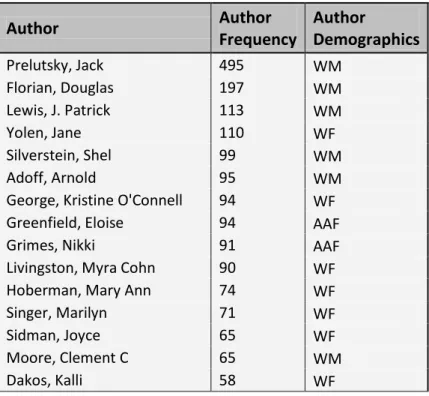
Author Frequency
Table 3 reveals the top 25 authors and the number of books they authored among
the 26 libraries. The top 25 authors were responsible for approximately 37% (n=2271) of
the poetry books present in all 26 libraries. Jack Prelutsky was the most frequently
occurring author with 45 of his books scattered among the libraries and a total of 495
collective copies. Douglas Florian came in a distant second with 197 total copies of 19
unique titles. The median of the data is 65 copies per author.
Table 3:
Author
Author
Frequency
Author
Demographics
Prelutsky, Jack 495 WM
Florian, Douglas 197 WM
Lewis, J. Patrick 113 WM
Yolen, Jane 110 WF
Silverstein, Shel 99 WM
Adoff, Arnold 95 WM
George, Kristine O'Connell 94 WF
Greenfield, Eloise 94 AAF
Grimes, Nikki 91 AAF
Livingston, Myra Cohn 90 WF
Hoberman, Mary Ann 74 WF
Singer, Marilyn 71 WF
Sidman, Joyce 65 WF
Moore, Clement C 65 WM
Author
Author
Frequency
Author
Demographics
Longfellow, HenryWadsworth 57 WM
Frost, Robert 57 WM
Merriam, Eve 51 WF
Myers, Walter Dean 48 AAM
Alarcón, Francisco X. 43 HM
Hughes, Langston 43 AAM
Hopkins, Lee Bennett 42 WM
Kuskin, Karla 41 WF
Stevenson, James 39 WM
Thomas, Joyce Carol 39 AAF
WF = White Female; WM = White Male; AAF = African American Female; AAM = African American Male; HM = Hispanic Male
In terms of race and ethnicity, 10 of the most popular authors were white males.
Their books constituted the majority (n=55.43%) of the books on this list. White females
were the next most popular group constituting nine of the authors and approximately 29%
(n=654) of the books on the list. Six of the top 25 authors were from a racial or ethnic
demographic other than white; three were African American females, two were African
American males, and one was a Hispanic male. Collectively, their books constituted
approximately 16% (n=358) of copies written by the most popular authors. The most
popular ethnic author was Eloise Greenfield with 94 copies of 11 unique titles present
across the libraries.
Multicultural Poetry Titles
Out of the 1,263 unique poetry titles that were collected, 188 were identified as
multicultural. Thus, only 14.9% of the unique poetry titles were classified as
schools and reports the frequency that each title occurred. Frequency ranged from 20
copies of each title to one copy of the title present in the libraries. The average number of
copies for each multicultural title present across the libraries was 6.38. Overall, of the
6,189 poetry titles collected, approximately 19.4% were multicultural.
Figure 2 reveals the number of multicultural poetry titles within each school’s
poetry collection. School O, which had the largest (n=400) poetry collection, and School
B, which had the second largest (n=377) poetry collection, both contained the largest
number (n=86) of multicultural poetry books. School P, which had the sixth smallest
(n=166) poetry collection, had the smallest number (n=22) of multicultural poetry titles
present in the collection.
Figure 3 reveals the percentage of each school’s poetry collection that was
identified as multicultural. The poetry collection at School H had the highest percentage
of multicultural books with approximately 28% (n= 61) of the school’s 219 poetry titles
classified as multicultural. School N had the lowest percentage of multicultural books
with less than 11% (n=22) of the collection of 204 poetry books classified as
multicultural. On average, each school’s collection contained 47 (n=46.92) multicultural
books which was an average of 19.71% of the collection. Thus, slightly fewer than one in
five of the poetry books present in each school library were identified as multicultural.
Figure 3:
school library, there was less than one (n=.41) book available per student. An average of
46.9 multicultural poetry books per school equates to only .08 multicultural books per
student. As a result, more than 12 (n=12.46) students would have to share one
multicultural poetry book at a time if all students needed access to a book. An average of
2.5 (n=2.46) students would have to share any Dewey 811 poetry book at any one time.
Figure 4:
Figure 5, which shows the number of students needed to share any one poetry
book as well as one multicultural poetry book, further depicts this phenomenon. Students
at School P had the fewest multicultural poetry books available per student, so 34
book at School R which had the smallest number of overall poetry books available per
student.
Figure 5:
Title and Author Frequency
Table 4:
Dewey 811 Multicultural Poetry Titles
Title
Frequency
Author
Demographics
Greenfield, Eloise. Night on Neighborhood Street. 20 AAFIn Daddy's arms I am tall: African Americans celebrating
fathers. 19 AA Authors
Myers, Walter Dean. Brown angels: An album of pictures
and verse. 19 AAM
Grimes, Nikki. Meet Danitra Brown. 19 AAF
Shange, Ntozake. Ellington was not a street. 18 AAF Weatherford, Carole Boston. Birmingham, 1963. 18 AAF Bruchac, Joseph. Thirteen moons on turtle's back: A Native
American year of moons. 18 AIM
Ho, Minfong. Hush! : A Thai lullaby. 18 ASF
Nikola-Lisa, W. Bein' with you this way. 17 WM
Thomas, Joyce Carol. Brown honey in broomwheat tea:
Poems. 17 AAF
Greenfield, Eloise. For the love of the game: Michael
Jordan and me. 17 AAF
Greenfield, Eloise. Honey, I love and other love poems. 17 AAF Hughes, Langston. The dream keeper and other poems:
Including seven additional poems. 17 AAM
Johnson, James Weldon. The creation. 17 AAM
My Black me: A beginning book of black poetry. 15 AAM Bryan, Ashley. Ashley Bryan's ABC of African American
poetry. 14 AAM
Families: Poems celebrating the African American
experience. 14 AA Authors
Medina, Tony. Love to Langston. 14 AAM
Pass it on: African-American poetry for children. 14 AA Authors Giovanni, Nikki. Spin a soft Black song: Poems for children. 14 AAF
Love to mamá: A tribute to mothers. 13 H/L Authors
Myers, Walter Dean. Harlem: A poem. 13 AAF
Soul looks back in wonder. 13 AA Authors
Woodson, Jacqueline. Locomotion. 13 AAF
AAF = African American Female; AA = African American; AAM = African American Male; AIM = American Indian Male; ASF - Asian Female; WM = White Male; H/L = Hispanic/Latino
were fewer than 26 copies across the libraries; thus, it was impossible for all 26 libraries
to have at least one copy of the book. Eloise Greenfield was also the most popular poet
on the list with three multicultural titles constituting 54 copies in the top 24 list. Walter
Dean Myers followed with two multicultural titles constituting 32 copies.
In terms of author demographics, 20 of the top 24 multicultural titles were written
by African Americans. Ten of these titles were written by African American females, six
by African American males, and four were anthologies containing poems by multiple
African American authors. Collectively, they authored almost 83% (n=322) of the 388
volumes constituting the top 24 multicultural titles. The remaining four titles and 17%
(n=66) of books from the list were authored by an American Indian male, an Asian
female, a white male, and a collection of Hispanic/Latino authors.
Figure 6:
Cultural/Racial/Ethnic Makeup of Titles
cultures. Five unique titles constituting 17 copies represented cultures outside of the
United States, such as African or Eastern European. Lastly, 10 of the multicultural titles
were deemed multicultural because the racial or ethnic identification of the author, but
the content of the book was not specifically cultural. Therefore, those books, constituting
65 copies across the libraries, were not applicable and, thus, were not provided with a
cultural label.
Table 5:
Culture/Race/Ethnicity
# of
Unique
Titles
# of
Books
American Indian or
Alaska Native 12 46
Asian 8 58
Black or African American 108 740
Hispanic or Latino 22 150
Native Hawaiian or Other
Pacific Islander 10 35
Two or More Races 1 11
Multiple Cultures 12 78
Other 5 17
Not Applicable 10 65
multicultural books that did not focus on culture constituted 1.4% and 5.4% of the
collection, respectively.
Figure 7:
Table 6 compares the demographics of each school to the cultural representations
within their respective poetry collections. Books identified as
Not Applicable
or
Other
as
well as books representing multiple cultures are not included in this table because
Table 6:
Out of the sample, School Z had the largest number (n=5) of multicultural poetry
books representing American Indians or Alaska Natives. School G had the highest
percentage (n=3.15%) of American Indian or Alaska Native students and three poetry
books representing the culture. With only .54% of its population identified as Asian,
School V had the largest number (n=5) of multicultural poetry books representing the
School
% Students # of Books % Students # of Books % Students # of Books % Students # of Books % Students # of Books % Students # of BooksA 0.71% 2 4.29% 3 32.14% 24 24.46% 5 0.18% 1 4.82% 0
B 0.66% 2 1.18% 4 59.58% 48 28.61% 16 0.26% 3 3.28% 0
C 0.00% 1 3.22% 1 39.11% 16 46.04% 3 0.25% 1 2.23% 1
D 0.82% 1 3.08% 1 75.15% 22 6.98% 8 0.00% 1 4.52% 0
E 0.69% 3 2.25% 1 50.43% 44 6.74% 4 0.17% 3 5.01% 1
F 0.00% 0 1.23% 2 48.67% 28 28.83% 2 0.00% 1 4.09% 1
G 3.15% 3 1.20% 3 54.57% 47 26.09% 16 0.00% 2 4.20% 0
H 0.00% 2 1.50% 4 40.75% 36 24.36% 10 0.00% 1 6.02% 0
I 0.36% 1 4.99% 2 48.75% 27 30.08% 3 0.24% 1 4.28% 1
J 0.76% 1 41.78% 0 30.81% 27 10.21% 0 0.00% 0 2.46% 1
K 0.00% 2 8.94% 2 35.76% 29 18.71% 3 0.00% 3 4.99% 1
L 0.27% 2 1.92% 1 32.51% 34 50.07% 4 0.00% 4 3.43% 1
M 0.87% 2 9.86% 0 20.87% 13 27.54% 2 0.00% 0 8.12% 1
N 0.35% 1 1.56% 1 40.80% 16 30.03% 1 0.17% 2 4.69% 0
O 0.18% 3 1.46% 3 36.13% 52 25.36% 15 0.00% 1 5.47% 0
P 0.28% 0 0.70% 1 36.61% 13 26.93% 2 0.14% 2 3.51% 0
Q 0.00% 1 1.00% 3 44.26% 20 16.31% 3 0.00% 1 6.82% 0
R 0.00% 2 2.13% 1 47.13% 34 28.75% 3 0.00% 0 5.63% 0
S 0.28% 1 2.77% 2 34.63% 20 22.16% 10 0.00% 0 5.26% 1
T 0.71% 2 3.57% 1 53.57% 19 6.67% 1 0.00% 0 5.24% 0
U 2.02% 2 5.28% 4 33.70% 48 36.65% 15 0.31% 2 6.06% 0
V 0.00% 2 0.54% 5 49.11% 22 31.25% 1 0.00% 0 3.93% 0
W 0.57% 2 0.76% 4 42.18% 38 24.43% 12 0.00% 2 3.82% 0
X 0.55% 1 26.59% 3 24.95% 22 11.84% 3 0.36% 2 2.37% 1
Y 0.32% 2 5.09% 2 47.38% 28 23.05% 4 0.16% 1 5.56% 0
Z 0.54% 5 6.79% 3 41.98% 29 12.50% 5 0.00% 1 4.35% 1