Megan Astolfi. Are Our Students Seeing Reflections of Themselves in the
Texts that They are Being Read?: A Case Study of Read Aloud Texts in a
North Carolina Elementary School. A Master's paper for the M.S. in L.S.
degree. April, 2012. 67 pages. Advisor: Sandra Hughes-Hassell
Today’s schools are becoming increasingly diverse and classroom
teachers are being held accountable for the achievement of all students.
However, recent statistics show that students of color are not performing as
well as their white peers on standardized reading achievement tests. This case
study looks at the read aloud texts used by classroom teachers in a North
Carolina elementary school. Texts were analyzed for their inclusion of
characters of color. Teacher interviews were conducted to gain an
understanding of how and why these specific read aloud texts were chosen.
Results of the content analysis are compared to the student population to
determine whether or not the students of color at the case study school are
seeing reflections of themselves in the read aloud texts. Case study results show
that students of color at this elementary school are underrepresented in the read
aloud texts used by teachers.
Headings:
Multiculturalism
Children’s Literature -- Characters of Color
Children’s Literature -- Selection
TEXTS THAT ARE BEING READ BY THEIR TEACHERS?: A CASE STUDY OF READ ALOUD TEXTS FROM A NORTH CAROLINA ELEMENTARY SCHOOL
by Megan Astolfi
A Master's paper submitted to the faculty of the School of Information and Library Science of the University of North Carolina at Chapel Hill
in partial fulfillment of the requirements for the degree of Master of Science in
Library Science.
Chapel Hill, North Carolina April, 2012
Approved by:
Table of Contents
Introduction 3
Literature Review 5
The Importance of Multicultural Literature 5
The Inclusion of Black Characters in Children’s Literature 9
The Inclusion of Hispanic Characters in Children’s Literature 12
Methodology 15
Content Analysis 16
Teacher Interviews 17
Limitations of Study 17
Results 18
The Books: Results from the Content Analysis 18
Teacher Interviews 23
Discussion 29
The Books Chosen as Read Alouds 30
How Teachers Select Books to Read Aloud 34
Implications 35
Future Research 42
Conclusion 43
Appendix A: Teacher Book List Form 50
Appendix B: Teacher Interview Questions 51
Introduction
The Pew Research Center (2008) projects that by 2050, 53% of the United States’ population will be people of color; making non-Hispanic whites the minority. The start of each new school year brings a more diverse student population than the one before. According to the Digest of Education Statistics (U.S. Dept. of Education, 2010) students of color accounted for 43.9% of the total student population in the United States in 2009. Research released by The Southern Education Foundation in 2010 found that the South has the nation’s most diverse population of public school children. During the 2008-2009 school year, the South became the nation’s second region where students of color made up the majority (51%) of public school children. In the state of North Carolina, nearly 46% of students in public schools were children of color at this time.
Historically, children of color have been an underserved population in our schools. Research has shown that students of color are not performing on par with their white counterparts on literacy measures and other indicators of school success (Ladson-Billings, 1992). In 2008, the average scores of African American and Hispanic1 students on reading comprehension tests were at least 20 points below those of their white peers (Digest of Education Statistics, U.S. Dept. of Education, 2010). Students of color also have a higher dropout rate than their white peers. According to the National Center for Education Statistics (U.S. Dept. of Education, 2011), 9.3% of black 16 to 24 year olds
1 The term “Hispanic,” instead of the preferred term “Latino,” was used in this case study because this was the term used by the case-‐study elementary school to describe this group of the student
were either not enrolled in high school or had not earned a high school credential
(diploma or GED) in 2009 and the percentage of Hispanic dropouts during this year was almost double (17.6%) that of black 16 to 24 year olds.
Many ideas for how to close the achievement gap that exists between non-Hispanic white students and children of color have been proposed. Some researchers emphasize the importance of providing children with opportunities to interact with texts through which they can see reflections of themselves, arguing that students of color become more engaged in texts that are being read when they see reflections of themselves in the characters of the story (Freeman & Freeman, 2004). Others note that the use of culturally relevant texts also helps connect minority students to the school curriculum (Rodriguez, 2009), increases their reading comprehension (Bell & Clark, 1998), and leads to an increased motivation to read (Freeman & Freeman, 2004).
As the demographics of school populations quickly change, educators need to think critically about the texts they are using during reading instruction. It is no longer sufficient for these texts to only reflect the lives of the white children in the classroom, especially since these children are quickly becoming the minority, especially in Southern schools. In order to become proficient readers, children must be able to make
connections, predictions, and inferences, as well as retell and summarize what they have read. If our students of color are not seeing reflections of themselves and their
during whole group reading instruction? 2) What race or ethnicity are the characters in these stories? Do these characters reflect the racial and ethnic diversity of the students that attend the school? Are the students of color at this elementary school seeing reflections of themselves, or others like them, in the literature being reading during literacy instruction? 3) How and why do the teachers at this school choose the texts they use for their read alouds? What factors do they take into account? What indicators do they look for to determine whether or not their students are enjoying and comprehending the texts being read?
Literature Review
This literature review discusses the importance of multicultural children’s
literature and the benefits provided to students of color when this type of literature is used in the classroom. Several studies that look at the inclusion of and representation of black and Hispanic persons in children’s literature are also be reviewed since these are the two groups of children of color who attend the elementary school studied in this case study.
The Importance of Multicultural Children’s Literature
Heflin and Barksdale-Ladd (2001) argue that one of our children’s primary
motivations for reading fiction is the pleasure they receive from relating to the characters, their lives, their problems, and their experiences. As greater numbers of culturally and linguistically diverse children become participating members of our classroom
Research suggests that children’s literature plays a role in identity formation; helping children gain a sense of personal identity (Vandergrift, 1980) and influencing the ways children view themselves and others in the world around them (Chall et al., 1979). If students of color are to develop a positive self-image, they must see reflections of themselves depicted positively in written and visual texts (Hurley, 2005). Children of color develop a higher self-esteem when they see reflections of themselves in the
literature to which they are exposed (Barry, 1998; Nilsson, 2005). Alternately, children’s books can reinforce negative notions of self-image in children of color (Hurley, 2005) if these individuals are represented in stereotypical ways or are left out of children’s books all together.
In addition to contributing to the development of positive self-image and to increasing children’s self-esteem, stories also provide visual images to children that give them cultural information about themselves, others, and the relative status of their group membership (Hurley, 2005). Multicultural literature provides validation of the heritages of students of color (Nilsson, 2005) and can help children of color find out about the valuable contributions their cultures have provided to the United States and the world (Barry, 1998). This type of literature also encourages children’s development of respect for diverse cultures (Barry, 1998; Nilsson, 2005). Bettelheim (1977) states, “literature represents one of the most powerful vehicles through which children assimilate their cultural heritage” (in Pescosolido et al., 1997, pg. 444 ).
trivialization in children’s literature, devalues these groups in our society. In her TED Talk Chimamanda Adichie (2009), a Nigerian author, states, “[b]ecause all I had read [as a child] were books in which characters were foreign [from American and British
literature], I had become convinced that books, by their very nature, had to have
foreigners in them and had to be about things with which I could not personally identify.” The unintended consequence of reading only American and British literature as a child was that Adichie “did not know that people like [herself] could exist in literature.”
However, when Adichie discovered books written by other Africans, “[she] went through a mental shift in [her] perception of literature. [She] realized that people like [her], girls with skin the color of chocolate whose kinky hair could not form ponytails, could also exist in literature.” As Adichie’s experience demonstrates, seeing reflections of themselves in the literature that they read allows children of color to feel that they are important and valued by society enough to be included in books.
reflections are distorted and ridiculous, there is danger that they will absorb negative messages about themselves and others like them” (in Hurley, 2005, pg. 228).
Research also suggests that reading motivation and achievement are increased when children are exposed to literature that offers them personal stories, a view of their cultural surroundings, and insight on themselves (Heflin & Barksdale-Ladd, 2001). Harris (1993) states, “[a]ll children need to see themselves and their experiences in the books they read. Children prefer, and become more engaged with, books related to their personal experiences and cultural backgrounds” (in Barry, 1998, pg. 636). Rudine Sims Bishop argues that children should be exposed to “mirror” books or books that reflect the child, his/her family, community, and culture. She believes that to become proficient readers, students must be able to make connections with what they read and she asserts that these “mirror” books must be present for proficient reading to begin (in Gangi, 2008). If our children are not encountering characters that they can relate to in the literature that they read, they may become frustrated with reading and have little motivation to engage with literature (Strickland, 2009).
As our schools become more diverse and the population of children of color grows, it is essential that the literature being used in our nation’s classrooms be
identity, providing them with little motivation to read, and hindering their growth as proficient readers.
The Inclusion of Black Characters in Children’s Literature
Over the years, many researchers have looked at the inclusion and representation of African Americans in children’s literature. In her 1965 landmark study, Nancy Larrick surveyed over 5,000 children’s trade books published between 1962 and 1964 for their inclusion of black characters. Her findings were disturbing: only 6.7% of these books included even one black character in the text or illustrations (Larrick). Over a decade after Larrick’s study, Chall, Radwine, French, and Hall (1979) conducted a study of the representation of blacks in children’s trade books published between 1973 and 1975. The researchers were interested in discovering how the situation had changed in the eleven years between Larrick’s study and their own (Chall et al.). The results showed that of the 4,775 children’s trade books published between 1973 and 1975, 14.4% included one or more black characters in the text or illustrations, more than double what Larrick found in 1965 (Chall et al.). Chall, Radwine, French and Hall (1979) also found that 94% of publishers had published books with at least one black character. While the situation seemed to be improving, the picture was still grim.
or patronizing attitude towards black children (Sims). Forty of the 150 books analyzed by Sims were classified as “melting pot books” or books that focused on integration and ignored the important aspects of the African American experience. In these texts, the differences between African American culture and white culture were not highlighted and typically only the illustrations indicated the racial or ethnic identities of the characters (Sims). Finally, Sims discovered that over half (n=89) of the books she surveyed were “culturally conscious books” that were told from the point of view of the black
characters, dealt with a black family or neighborhood, and emphasized the African American experience and culture (Sims).
Sims argues that the absence of characters that “mirror” themselves is a clear signal to black children that they have little worth in society (Sims, 1983). In this case, black children do not develop a strong sense of their own humanity, do not affirm their sense of self-worth, and do not discover their own identity in a group (Sims). She also asserts that children of color are not the only ones who are damaged when black characters are absent from children’s books. She believes that this absence leads white children to believe in an inherent “rightness to whiteness” (Sims, 1983, pg. 650 ) and to develop the idea that other races have no important place or function in society.
that only 2.2% of the children’s books had only black characters (Pescosolido et al.). Pescosolido, Grauerholz, and Milkie noted that the Caldecott Medal winners and honor books had the highest percentage (9%) of books with only black characters. While this research shows that the inclusion of black characters in children’s books is increasing, the majority of the books published for children in the United States are still dominated by white characters.
In a recent research study, Agosto, Hughes-Hassell, and Gilmore-Clough (2003) looked at youth genre fiction, published between 1992 and 2001, for titles with
multicultural protagonists or major secondary characters. They found that only about 16% of the 4,255 book reviews analyzed featured people of color in significant roles (Agosto et al.). In order to be a more realistic representation of the cultural diversity in the United States at the time, about one-third of the characters would need to be people of color (Agosto et al.). Clearly, the inclusion of people of color in children’s literature is still not representative of the cultural diversity of our country.
Hughes-Hassell, Koehler, and Barkley (2010) looked at books for transitional readers, children who are moving from “early readers” to more difficult texts, for the inclusion of characters of color. They found that only 16.9% of transitional books, leveled J through M from the Fountas & Pinnell’s Leveled Book List Database, included African American characters. Since the Fountas & Pinnell leveled booklist is used by many schools and educators, it can be assumed that many of the African American
students in today’s schools are not seeing reflections of themselves in the texts being used during classroom reading instruction.
Thus, multiple studies conducted since the 1960s have found that few black characters have been included in children’s books. Moreover, these studies also found that when black characters have been included in children’s literature they were often in stereotypical or derogatory roles (Chall et al., 1979). Author Sharon Flake (2008) has these words to say about the inclusion of blacks in literature,
“In the world of young adult literature, black youth aren’t just a minority on the pages of books, they are an endangered species. They are
practically invisible; missing in action from the written word. I believe this is one of the reasons it’s difficult to get many black boys engaged in reading. They don’t see their place, or their faces, in literature” (pg. 14).
The Inclusion of Hispanic Characters in Children’s Literature
In 1994, Gillespie, Powell, Clements and Swearingen looked at Newbery Medal books from a multicultural perspective. They worked to identify the ethnicity of the characters found in Newbery Medal books dating back to 1922 (Gillespie et al., 1994). Their results indicated that only 10% of the books included Hispanic main, minor, or mentioned characters (Gillespie et al.). In 1996, Van Gelder examined a decade of Newbery Medal books (from 1986-1996) and found that none of these books portrayed Hispanics as either major or minor characters (Van Gelder,). In their study, “The All-White World of Middle School Genre Fiction: Surveying the Field for Multicultural Protagonists,” Agosto, Hughes-Hassell, and Gilmore-Clough (2003) looked at historical fiction, fantasy, science fiction, mystery, horror, western, romance, and sports books for their inclusion of diverse characters. They found that only 10% of all of the books that were analyzed included characters that were Hispanic, a severe under-representation compared to the country’s demographics at that time (Agosto et al.).
fails to improve. From her study, Nilsson also found that studies throughout all decades show evidence of stereotyping of Hispanic characters in both fiction and non-fiction texts.
In 2007, Jamie Naidoo analyzed the social and cultural messages transmitted through children’s literature about Latino peoples and their subcultures in Pura Belpré and The Américas award winning picture books. During this study, he looked at both the textual representations of Latinos as well as the visual representations (pictures) of these people of color. Naidoo found that over half (51.3%) of the picture books analyzed were focused on the Mexican and Mexican American subcultures. Another 16.2% of the texts included in this study represented the Caribbean subculture of Latinos. The other five Latino subgroups (general Latino, Central American, Puerto Rican, Cuban, and South American) were marginally represented, indicating a lack of representation of the diversity of Latino subcultures in these award-winning texts (Naidoo).
During this research, Naidoo (2007) also discovered that some stereotypes about Latinos were present in these texts: female characters were often portrayed as subservient housewives or submissive girls, and over one-half of the books exclusively depicted characters with the “Latin Look,” brown eyes and dark hair and skin. On a more positive note, Naidoo’s research found that over 90% of the books from the sample depicted characters who were embracing their cultural diversity rather than abandoning aspects of their cultural heritage to achieve success.
children to see accurate and positive representations of Hispanic and Latino people in children’s literature, so that they may develop positive self-images and form connections with their cultures (Naidoo, 2007).
Methodology
Research indicates that it is important that children see reflections of themselves and their experiences in the texts that they read. Seeing themselves in stories not only helps children develop positive self-images and higher self-esteems, but for children of color, the inclusion of characters that reflect themselves validates that they, and their cultures, are important. The use of culturally relevant texts also leads to increased reading comprehension for students of color (Bell & Clark, 1998) and to an increased motivation to read (Freeman & Freeman, 2004). This case study was designed to determine whether or not students of color are seeing reflections of themselves in the books that are being read aloud by teachers during literacy instruction.
This case study was conducted at a North Carolina elementary school that serves 525 pre-kindergarten through fifth grade students. During the 2011-2012 school year, the majority of the student population (58%) was identified as children of color: 18% were identified as black/African American, 36% of the children were identified as Hispanic, and 4% were identified as multiracial. White children made up just over two-fifths (42%) of the total student body during this time. The diverse student population was the reason that this school was chosen for this case study.
agreed to participate. Data for this case study was gathered in two ways: 1) a content analysis was conducted of the books teachers read aloud during whole-group literacy instruction; and 2) individual interviews with teachers were conducted.
Content Analysis
Each participating teacher was asked to provide a list of the books they read aloud during whole class literacy instruction, including both the title of the text and the
author(s) or contributor(s). This information was necessary so that a content analysis of the texts could be completed. The form that participating teachers were asked to complete can be found in Appendix A.
The books listed by the participating teachers were analyzed for their inclusion of characters of color. For this case study, a “character” was defined as an individual who was named in the text and who also spoke during the story, signifying importance. Books were denoted as either being non-fiction or fiction.
Human characters in both non-fiction and fiction texts were coded as being male or female and either white (Caucasian), black, Hispanic (Spanish speaking), or other (included Asians and Native Americans). These race/ethnicity categories were based on the demographics of the school population. Non-human and animal characters found in fictional and non-fictional texts were coded as such and neither gender nor race/ethnicity were recorded.
After data was gathered from the texts it was compared to the demographic data of the case study school. These results and analyses can be found in the discussion below.
Teacher Interviews
Face-to-face interviews were conducted with three participating language arts teachers. Each participating classroom teacher was asked a series of questions to gain insight into how and why these specific read aloud texts were chosen. Questions
regarding indicators of student interest and enjoyment, as well as comprehension during the read aloud were also included. The list of interview questions asked to each
participating classroom teacher can be found in Appendix B. Answers to the interview questions were coded and categorized. Analysis of the interview results can be found in the discussion below.
Limitations of Study:
This case study is also limited in scope because it only looks at one aspect of diversity: race/ethnicity. A more comprehensive case study would look at the many different aspects of diversity (religion, family structure, socioeconomic status, sexuality, and disability) to determine whether or not texts being used in schools are culturally relevant for students. A story is not considered culturally relevant for a child just because the story includes a character that reflects the child’s race or ethnicity (Freeman & Freeman, 2004). For texts to be culturally relevant, the characters must reflect the readers’ age and gender, as well as their socioeconomic status and family structure
(Freeman & Freeman). The settings in these stories should contain places that are familiar to the readers and the children engaged with the stories should be able to make
connections with the experiences of the characters throughout the book (Freeman & Freeman). The language used by the characters in culturally relevant books must
resemble the language used by the readers and their families; containing familiar phrases and figures of speech for the students (Freeman & Freeman,). Due to the large sample size analyzed during the content analysis in this case study, it was not feasible for this level of depth to be reached.
Results
The Books: Results from the Content Analysis
The teachers that participated in this case study provided a list of 292 unique children’s book titles for this content analysis: 143 of these titles were used for read aloud in kindergarten classrooms; 70 of the texts were used during whole group reading
in fifth grade classrooms. Of these 292 unique titles, eight of the texts were used during literacy instruction by multiple grade levels (see Table 1).
Table 1: Texts Read Aloud by More Than One Grade Level Title Race/Ethnicity of
Characters
Grade Levels Using
Stellaluna Non-human/animal
characters
Kindergarten, 2nd, & 4th
The Great Kapok Tree Other (Brazilian, non-Spanish speaking) character
Kindergarten, 2nd, & 5th
Legend of the Indian
Paintbrush Other (Native American/American Indian) 2
nd and 5th
The Lorax Non-human/animal
character Kindergarten and 5
th
Sweet Clara and the
Freedom Quilt Black/African American 4
th and 5th
Henry’s Freedom Box Black/African American &
white/Caucasian 4
th and 5th
Officer Buckle and Gloria White/Caucasian Kindergarten and 2nd If I Ran the Rainforest Non-human/animal
character Kindergarten and 2
nd
Figure 1: Percent of Titles by Genre (n=292)
Only 56% (164) of the titles contained human characters; the rest contained non-human/animal characters or inanimate objects. A total of 472 individual human
characters were identified in the 164 titles. Fifty-one percent, or 238 characters, were identified as male and 49% (232 characters) were identified as female.
The characters were also coded by race/ethnicity and were identified as “white/Caucasian,” “black/African American,” “Hispanic,” or “other (includes
Asian/Asian American and Native American).” As shown in Figure 2, the majority of the characters (n=359) were coded as being “white/Caucasian.” Only 24% of the 472
characters were characters of color. The majority of the characters of color were black/African American. Only six of the characters were identified as Hispanic.
25.68%
71.92% 2.40%
Non-‐Fiction
Fiction
Figure 2: Percent of Characters by Race/Ethnicity (n=472)
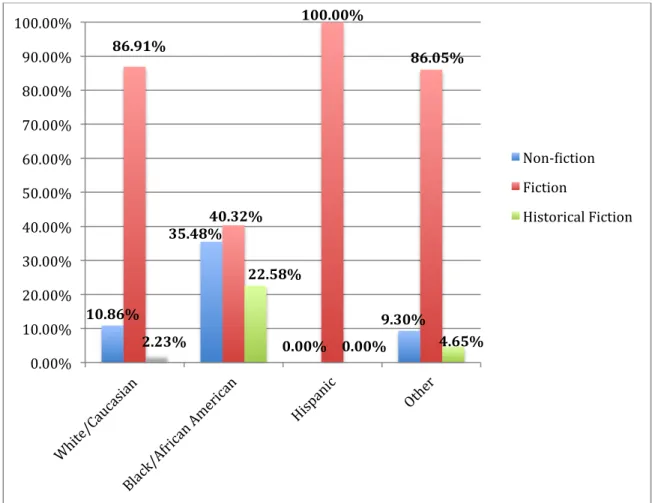
Figure 3 shows the breakdown of race/ethnicity by genre. Hispanic characters were found only in general fiction texts. Similarly, 87% of the white/Caucasian characters were found in general fictional texts In contrast, only 40% of the
black/African American characters were found in general fictional texts. The majority of the books that included black/African American characters or subjects were either non-fiction texts (35%) or historical non-fiction stories (23%).
76.06%
13.14%
1.27%
9.11%
White/CaucasianBlack/African American
Hispanic
Figure 3: Percent of Characters by Genre
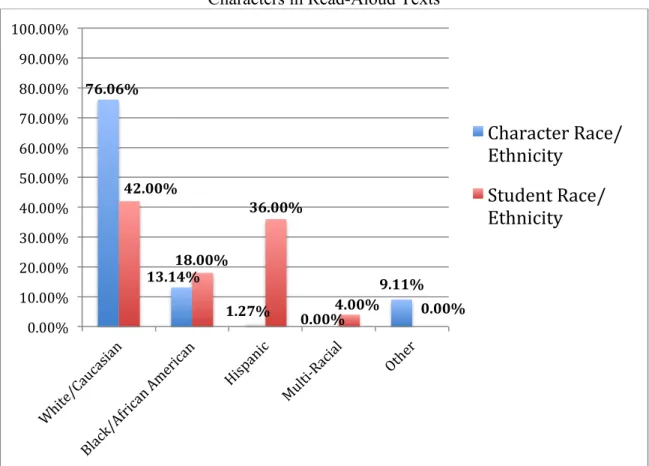
Children of color were the majority at the case study school in the 2011-2012 school year. Figure 4 compares the school’s student population (in terms of
race/ethnicity) with the characters identified in the texts used for this content analysis. While white/Caucasian students make up only 42% of the school’s population (making them the school’s the minority), 76% of the characters in the books that are read aloud to students during whole group literacy instruction are white/Caucasian. Hispanic children are the largest group of color at the case study school (36% of the student body), yet only 1% of the characters identified in the read aloud texts were Hispanic. Thirteen percent of the characters found in the read-aloud texts were identified as black/African American, as compared to 18% of the student population at the case study school. The
10.86%
35.48%
0.00%
9.30% 86.91%
40.32%
100.00%
86.05%
2.23%
22.58%
0.00% 4.65%
0.00% 10.00% 20.00% 30.00% 40.00% 50.00% 60.00% 70.00% 80.00% 90.00% 100.00%
Non-‐[iction
Fiction
multi-racial students at the case study school (4% of the student population) are not represented in the literature used during whole group reading instruction at all, but characters from “other” racial/ethnic groups (9%) that are not present in the student population at the school were found in the texts that are being read aloud during whole group reading instruction.
Figure 4: Race/Ethnicity of Student Population Compared to Race/Ethnicity of Characters in Read-Aloud Texts
Teacher Interviews
At the case study school, the literacy program requires that language arts teachers include a 30-45 minute read aloud component each day, in addition to vocabulary
development, word work/grammar, and fluency practice. During this read aloud time, teachers perform “think alouds” for the particular comprehension skill(s) that the students
76.06%
13.14%
1.27% 0.00%
9.11% 42.00%
18.00%
36.00%
4.00% 0.00%
0.00% 10.00% 20.00% 30.00% 40.00% 50.00% 60.00% 70.00% 80.00% 90.00% 100.00%
Character Race/
Ethnicity
will be working to master that week during small group instruction and independent reading time. Language arts teachers often involve their students during the read alouds by asking comprehension questions, tasking the students with using the comprehension skill of the week (i.e. making connections, inferring, summarizing), or having them turn-and-talk with a neighbor. Many of the language arts teachers also have their students complete a graphic organizer about the story after the read aloud has finished.
For this case study, the three interview participants included second, fourth, and fifth grade language arts teachers at the school. Each interviewee was asked seven questions regarding read aloud text selection; student input, interest, and comprehension during the read aloud portion of whole group literacy instruction; and the importance of students seeing reflections of themselves in the texts being read. Results from the interviews can be found below. All of the teachers interviewed for this case study were white/Caucasian females.
Question 1: How do you choose the books you read-aloud? What factors do you consider
when choosing a text to read aloud?
texts are appropriate for teaching specific comprehension or vocabulary skills. One teacher stated that some texts are not chosen for use “because they are on the protected book list for use by higher grade levels, or because they are read by another grade level, either below or above ours.”
Question 2: Where do you find the books that are used for read aloud? (Prompts: Do you
look for books in the school library? Books in your current collection?)
All of the interviewees indicated that they use Scholastic Book Club, the school library, and local public libraries to find texts for read aloud. Scholastic Book Club was popular with the teachers because they could use their “bonus points” to purchase read aloud texts without having to spend money out of their pockets. All three of the teachers also stated that they sometimes purchase read aloud texts from local retailers, such as Barnes & Noble or used bookstores, or from online retailers, like Amazon. The school bookfair was also a place where one of the teachers looked to find read aloud books. One interviewee commented that she also borrows books from other teachers, since she needs “four copies of each read aloud text so that all of the teachers at that grade level can read the same text at the same time.”
Question 3: What resources do you use for book suggestions? (Prompts: Do you use
booklists? Selection guides? Do you have a required reading list? Do you ask for ideas
from other teachers?)
suggestions were: the school library catalog; teacher preference (“sometimes we choose stuff that we like and just do it”); magazines or catalogs sent to teachers from vendors; and Google. One teacher specifically mentioned that she has never used selection guides or tools to locate resources for literacy instruction. She stated that she has “never really sat down and used these selection tools.” She made no mention, however, that she even knew what selection tools were available for her use. None of the teachers interviewed stated that they use selection guides or tools with annotated bibliographies and reviews of the books when they are choosing read aloud texts.
Question 4: What role do students play in the selection of the read-aloud texts?
we might change the books based on how the students reacted [to those texts] the previous year.” However, it did not seem to be taken into account that the students change from year to year, and current students might have different preferences and interests than the previous year’s students. One interviewee stated that she and her co-teacher select texts based on what their children enjoy because their children are about the same age as the students they teach. They did not take into account though that their children are white/Caucasian while most of the students they teach are children of color.
Question 5: How do you gauge the students’ interest in the texts being read-aloud?
All of the interviewees stated that they gauge student interest during read alouds by observing on-task behaviors. If students are fidgeting or whispering to their neighbors, the teachers can easily see or hear that the students are having trouble staying engaged in the story. Facial expressions are also important indicators of student engagement during read alouds for the teachers. Participating teachers did not indicate that they stop reading the selected text and choose another read aloud book if the students are not interested in the story. The interviewees mentioned that they know students are enjoying the read aloud texts when they laugh, applaud, or ask the teacher to continue reading. Making connections and asking meaningful questions about the texts are also indicators for the teachers that the students are engaged in the read alouds.
Question 6: How do you determine whether or not the students are understanding or
comprehending the texts being read-aloud?
comprehension. Two of the teachers used in-class independent work, verbal summaries, and comprehension questions to determine whether or not the students understood the read aloud texts. One grade level used Accelerated Reader (AR) quizzes and graphic organizers to determine student comprehension of the read aloud stories.
Question 7: How important do you think it is that students see themselves in the texts you
read-aloud? (Prompt: Can you elaborate on what it means for students to see themselves
in a text?)
Interviewees were asked to consider the question, how important do you think it is that students see reflections of themselves in the texts you read aloud? All of the
participating teachers believed that it was important that their students be able to see reflections of themselves in the texts that are read aloud so that they can make
connections with the characters, their experiences and feelings, and better understand the stories. One interviewee stated that this is “really important because if the [students] don’t make any type of connection with the text then they won’t remember it. The books that I invested in and made a connection with are the ones that I get excited about reading to the kids. The book becomes more meaningful if the students can make more
connections with the text.” Another interviewee stated,
[Students] can relate to the book if it is something that they have experienced, is something they are used to, or is something they have incorporated into their surroundings. This helps them better understand the book, so we try as hard as possible to incorporate what they would
Another participating teacher said, “It is important that they see themselves, or someone else they know, so that they are better able to understand the story and characters better. If the [students] can put themselves in the characters shoes, that helps them to know what is going on and to remember the stories better. Making these connections also helps keep the students interested in the read aloud texts.” The interviewees asserted that it is
necessary that the students be able to see reflections of themselves in the stories that they read so that they are better able to relate to and empathize with the characters in the texts. The teachers also believed that making these connections with the texts will increase the students’ enjoyment from reading and will help them develop a love for reading and stories.
Discussion
The Books Chosen as Read Alouds
Children of color at this elementary school are clearly underrepresented in the literature that is used during the read aloud portion of whole group literacy instruction. When the language arts teachers at this case study school are reading aloud texts that have human characters (only 57% of the time), over three-quarters of the characters in the books are white/Caucasian. The percentage of black/African American characters found in the books used for read alouds was relatively close to the total population of
black/African American students at the school. However, though Hispanic students make up 36% of the school’s total student body, only 6 out of the 472 characters (1%)
identified were Hispanic. These students are rarely seeing reflections of themselves in the texts that their teachers are choosing to use during whole group literacy instruction.
For the literature used by the teachers at this school to be representative of their student population, 42% of the characters found in the read aloud texts should be
white/Caucasian, 36% should be Hispanic, 18% should be black/African American, and 4% should be multi-racial characters. That is, the majority of the characters found in the read aloud texts should be characters of color.
“reflections” of themselves in the texts they engage with (Hurley, 2005). For students of color, the texts being read aloud in the classroom can reinforce or counter negative notions of self-image (Hurley, 2005).
To become proficient readers, research shows students must be able to make connections with the texts they read. White children, whose experiences are depicted in most of the books read aloud to the students in this case study will be able to make many more text-to-self, text, and world connections than the children of color in these
classrooms. As Gangi (2008) notes, proficient reading begins with “mirror” books, texts that mirror a child, his/her family, his/her community, and his/her culture. Without these “mirror” books, the children of color in these classrooms are less likely to become proficient readers.
Reading motivation and achievement are also increased when children are exposed to literature that offers them personal stories, a view of their cultural
surroundings, and insight on themselves (Hughes-Hassell et al., 2010). Literature helps children gain a more realistic picture of the world they live in (Chall et al., 1979). Since we do not live in an “all-white” world, the literature that is used in today’s increasingly diverse classrooms must not include only white/Caucasian characters. The inclusion of diverse characters in literature increases respect and appreciation for diverse cultures and people of color (Nilsson, 2005).
of non-fiction texts about Hispanic persons may lead Hispanic students to believe that there are no individuals from their culture who have made important contributions to the development of the United States or the world. Since these non-fiction texts are absent, Hispanic children may not find out about the valuable contributions their culture has provided to the United States and the world, thus leading them to believe that they have nothing to contribute to society (Barry, 1998).
While the black/African American students at the case study school are
underrepresented in the literature used during read alouds, the inclusion of black/African American characters in the texts is balanced among the three literary genres: non-fiction, fiction, and historical fiction. Thus these students of color are seeing reflections of themselves, and others like them, in non-fiction texts, fictional literature, and historical fiction books. When non-fiction texts read aloud by teachers have black/African American subjects, these students of color are learning that others like them have made valuable contributions to society, in both the United States and the world. Understanding that their culture is valued may increase their self-esteem and help them form a positive image of themselves and their culture (Barry, 1998; Chall et al., 1979; Hurley, 2005; & Nilsson, 2005). These students may also begin to appreciate their own culture, knowing that others value it, feeling pride instead of shame, in their differences.
themselves, or others like them, in fictional texts being read aloud by the teachers, they are able to connect with the characters and enjoy the texts they are reading.
Likewise, the inclusion of black/African American characters in historical fiction is important because it conveys to these students of color that they were recognized and had a place in the past, not just in the present. Due to this balanced inclusion, these students of color are seeing that they were included in the past, that they are important in the present, and that others like them have provided valuable contributions to society (in both the United States and the world at large).
The lack of racial/ethnic diversity among characters found in the read aloud texts at this school is problematic not only for the students of color, who are the majority of the population, but also for the white/Caucasian students as well. According to Rudine Sims (1983), “literature is an important vehicle through which we socialize children and transmit our cultural values to them. White children finding in the pages of books, only others like themselves, come to believe in an inherent “rightness of whiteness” that grants to other races no important place or function in society” (p. 650). This absence of
characters of color in children’s literature may negatively affect the ways in which white/Caucasian children view individuals from other cultures in the world around them (Chall et al., 1979).
While the participating teachers indicated in their interviews that it was important that they use unique texts not being read by other grade levels during whole group
Clara and the Freedom Quilt and Henry’s Freedom Box) were read aloud to students in consecutive grade levels (4th and 5th). Of these eight texts, two included black/African American characters, two included characters from “other” racial/ethnic groups (one had Native American characters, while the other had a Brazilian character), one included white/Caucasian characters, and the other three included non-human/animal characters. While these overlapping texts make up only a small percentage (just under 3%) of the total sample size, they may indicate a breakdown in communication and vertical planning among grade-level language arts teachers.
How Teachers Select Books to Read Aloud
While all of the teachers who participated in this case study believed that in order for their students to make connections and better comprehend the stories it was essential that their students see reflections of themselves, and others like themselves, in the texts that they were read, none of the teachers mentioned the racial/ethnic diversity of the characters as a factor that they considered when selecting texts to use during literacy instruction. Since these participating teachers did not see the racial/ethnic diversity of the characters as an important factor for text selection, the end result was a collection of read aloud texts that had very little inclusion of characters of color, thus meaning that the students of color at this case study school are not seeing reflections of themselves, and others like them, in the stories read by teachers.
aloud texts that have characters of color that reflect their students and their students’ experiences, the teachers continue to choose texts that they can relate and connect to, books with mostly white/Caucasian characters. This comment suggests that the teachers still expect their students to have the same prior knowledge and experiences that they do, which is not the case since all of the teachers involved in this case study were
white/Caucasian and a majority of their students are children of color (either black/African American, Hispanic, or multi-racial).
Implications
During the 2007-2008 school year, 83.1% of the classroom teachers in U.S. public schools were white (AACTE, 2010), indicating that most of the pre-service teachers enrolled in schools of education and teacher education programs throughout the country were also white/Caucasian. While the educators in today’s classrooms are mostly white/Caucasian, the students in today’s classrooms are more racially and ethnically diverse, especially in the South (Southern Education Foundation, 2010). The lack of diversity of today’s classroom teachers is problematic because “most teachers…often fondly remember their years as students and seek to consciously or unconsciously reproduce those classrooms. Unfortunately, such models are more often than not
It is essential that today’s schools of education and teacher preparation programs prepare pre-service teachers to work in classrooms with high populations of children of color. These schools of education and teacher preparation programs must make a concerted effort to have a more diverse faculty and staff for their pre-service teachers to interact with and learn from. In 2007, there was very little diversity among professors and staff in schools of education and teacher education programs: 78% of these educators were white (AACTE, 2010). Schools of education and teacher preparation programs must also work harder to attract and retain pre-service teachers of color.
Since many of the pre-service teachers attending schools of education are white/Caucasian, a multicultural component must also be included in today’s teacher preparation programs in order to provide pre-service teachers with the necessary
know what can go wrong in cross-cultural communication and know how to set it right; familiarize themselves with the students’ cultures so that behaviors may be understood within cultural contexts; and have knowledge of how to adapt and adjust their teaching practices to accommodate cultural differences (Moule, 2012). If today’s teachers are being held accountable for the achievement levels of all populations of students, then schools of education and teacher preparation programs must provide them with the necessary skills and knowledge in order to achieve this (Moule, 2012).
In these teacher education programs, pre-service teachers must also be made aware of the impacts of the use of “all-white” literature on students of color, as well as white/Caucasian students. Schools of education and teacher education programs must introduce pre-service teachers to current research regarding the importance of children of color seeing reflections of themselves in texts. Pre-service teachers must be made aware of the benefits of using these “culturally relevant texts” in their classrooms and the impact that the absence of these texts can have on students of color and white/Caucasian students alike. Schools of education and teacher preparation programs must lead pre-service teachers to resources where they can find culturally relevant children’s literature that includes characters of color. It would also be beneficial to pre-service teachers if schools of education and schools of information and library science worked closely together. Through these partnerships, pre-service teachers would learn to go to their school library media specialists when they are seeking out culturally relevant literature to use in their classrooms.
characters of color in their classrooms, teachers may fail to include books with characters of color in their classroom instruction. According to Moule (2012), these
microinvalidations are “communications that subtly exclude, negate, or nullify…the thoughts, feelings, or experiential reality of people of color” (p. 59), and are a form of unintentional racism. Uninformed teachers may “accept as appropriate the omissions of people of color from the curriculum” (Tatum, 1997, p. 11; Moule, 2012, p. 33), not out of malice, but because they do not recognize what message this “omission” or “absence” sends to the children of color in their classrooms.
Several of the participating teachers expressed during their interviews that they have difficulty locating read aloud texts that include characters that are representative of their student population. Today’s school library media specialists are “information specialists” who provide both the teachers and students within their school communities with access to and assistance in finding information and resources (School of Information and Library Science, UNC Chapel Hill). As collaborative partners, school library media specialists work alongside classroom teachers to ensure that resources are available that meet the needs of the students in the school building. School library media specialists can guide the classroom teachers to multicultural literature that is representative of the
student population and includes characters of color.
teachers who participated in this case study to look for books that include characters that are representative of their student population.
Lee and Low is an independent children’s book publisher that focuses on diversity. The company’s mission is “to meet the need for stories that all children can identify with and enjoy.” (Lee and Low website). On Lee and Low’s website, educators can find categories of books organized by race and ethnicity. Book entries include annotations and the resources can be purchased directly from the website. Children’s Book Press is an imprint of Lee and Low publishers and was the first independent press in the country to focus on publishing first voice literature for children by and about people from the Latino, African American, Asian/Pacific Islander, and Native American communities. Titles published by Children’s Book Press can be purchased directly from their website. Groundwood Books is dedicated to the production of children’s books for all ages, including fiction, non-fiction, and picture books. Many of the texts published by Groundwood Books tell the stories of people whose voices are not always heard. Books on Groundwood’s website are organized by genre and users can then browse through each genre using different categories (i.e. emigration and immigration, reluctant readers, etc). Arte Público Press is the “nation’s largest and most established publisher of
contemporary and recovery literature by U.S. Hispanic authors” (website). Piñata Books is an imprint of Arte Público Press, which publishes books for children and young adults, and is dedicated to the realistic and authentic portrayal of the themes, languages,
There are also journals and annotated bibliographies focused on multicultural resources that would be helpful for the teachers who participated in this case study to use when they are looking for books to use for their read alouds. Multicultural Review is a quarterly journal that is “solely dedicated to reviews of a better understanding of diversity” and focuses on differences in ethnicity, race, spirituality, religion, disability, and language. Multicultural Review contains 120-150 annotated book reviews of new English-language or bilingual books and non-print materials in each issue. Reviews can be found on Multicultural Review’s website as well. Multicultural Literature for Children and Young Adults is a selective bibliography that includes more than 350 books
published by and about people of color. This two-volume set also includes appendices listing authors and illustrators of color. Kaleidoscope: A Multicultural Booklist for Grades K-8 is published by the National Council of Teachers of English and offers students, teachers, and librarians a helpful guide to the best multicultural literature for elementary and middle school readers published between a specific time period.
short stories, Latino folklore, drama, poetry and anthologies, and non-fiction. Lists of Latino writers and publishers are also included in this text.
There are also several different book awards that are given each year to books that are written by or are about people of color. These book award lists are also helpful
resources that can be used by school library media specialists and teachers when they are searching for books that include characters of color.
The Coretta Scott King Awards and John Steptoe Award for New Talent are given to black/African American authors and illustrators. The Coretta Scott King Award is given to an African American author and an African American illustrator for
exceptional books that “promote understanding and appreciation of the culture of all peoples and their contribution to the realization of the American dream” (13). The list of Coretta Scott King Award winners can be found online at
http://www.ala.org/ala/emiert/corettascottkingbookawards/corettascott.htm. The John Steptoe Award for New Talent is given annually to a black author and black illustrator at the beginning of their career, for text or illustrations for an outstanding book.
The Tomas Rivera Mexican-American Children’s Book Award, the Americas Book Award for Children’s and Young Adult Literature, and the Pura Belpre Award are given for outstanding work by or about Latino people. The Americas Award for
Children’s and Young Adult Literature is given annually in recognition of U.S. published works of fiction, poetry, folklore, or selected nonfiction that authentically and engagingly portray Latin America, the Caribbean, or Latinos in the United States. The Tomas Rivera Mexican American Children’s Book Award encourages authors, illustrators, and
young adults in the United States. Both fiction and non-fiction texts are eligible for this annual award. The Pura Belpre Award is sponsored by the Association for Library Service to Children and the National Association to Promote Library Service to Speakers of Spanish. This award is given every two years to honor Latino writers and illustrators whose work celebrates the Latino cultural experience in a work of literature for youth.
These publishers and small presses, journals and annotated bibliographies, and awards lists provide school library media specialists and literacy teachers with a large number of possible titles to use during read alouds and literacy instruction that include characters of color.
Future Research
Future research in this area may be interesting and necessary. To make the findings from this case study more generalizable, similar case studies on the inclusion of characters of color in read aloud texts would need to be conducted at other schools with similar demographics. The results yielded from these studies would provide information regarding the prevalence of the underrepresentation of students of color in children’s literature used in classrooms. Looking at texts used by white/Caucasian teachers in schools with high populations of students of color compared with texts used by teachers of color in these settings would also yield interesting results. Analyzing library
Conclusion
Despite a growing number of people of color in our country and increasing diversity in our schools and classrooms, children of color are still underrepresented in children’s literature. Historically, African American and Hispanic characters have been nearly absent from the books that children engage with. This case study found that even in a school with a majority of the population being made up by children of color, these groups were still severely underrepresented in the texts that were being chosen and used for read alouds during literacy instruction. This study found that the texts being used by the teachers during this instructional time are not representative of the student population, therefore the children of color in these classrooms are not seeing reflection of themselves, or others like them, in the books that their teachers are choosing to read.
In today’s culturally diverse schools, it is essential that classroom teachers and school personnel be “culturally competent” individuals. Schools of education and teacher preparation programs must develop pre-service teachers into culturally competent
individuals, by providing them with the knowledge and skills that are necessary for working with students of color. If pre-service teachers are not prepared to work with diverse student populations, they will do a disservice to their students of color. Schools of education and teacher preparation programs must also inform teachers of the current research regarding culturally relevant texts. Pre-service teachers must be aware of the benefits that these texts provide for children of color and white/Caucasian children alike, as well as the implications of not using texts with characters of color with their students.
Bibliography
AACTE (2010). An emerging picture of the teacher preparation pipeline. Washington, DC: American Association of Colleges for Teacher Education.
Adichie, C. (2009). The danger of a single story [Online Video]. TED Talks. TEDGlobal. Agosto, D., Hughes-Hassell, S., Gilmore-Clough, C. (2003). The all-white world of
middle school genre fiction: surveying the field for multicultural protagonists. Children’s Literature in Education, 34 (4), 257-275.
Arte Público Press. Online. http://www.latinoteca.com/arte-publico-press.
Barry, A. (1998). Hispanic representation in literature for children and young adults. Journal of Adolescent and Adult Literacy, 41 (8), 630-637.
Bell, Y. & Clark, T. (1998). Culturally relevant reading material as related to
comprehension and recall in African American children. Journal of Black
Psychology, 24 (4).
Bettelheim, B. (1977). Uses of enchantment. New York: Vintage Books.
Bishop, R.S. (1994). Kaleidoscope: a multicultural booklist for grades K-8. National Council of Teachers of English.
Chall, J., Radwine, E., French, V., & Hall, C. (1979). Blacks in the world of children’s books. The Reading Teacher, 32 (5), 527-533.
Flake, S. (2008). Who says black boys won’t read? Journal of Children’s Literature, 34 (1), 13-14.
Freeman, Y. & Freeman, G. (2004). Connecting students to culturally relevant texts.
Talking Points, April/May.
Gangi, J. (2008). The unbearable whiteness of literacy instruction: realizing the
implications of the proficient reader research. Multicultural Review, Spring, 30-35.
Gillespie, C.S., Powell, J.L., Clements, N.E., & Swearingen, R.A. (1994). A look at the Newbery medal books from a multicultural perspective. The Reading Teacher, 48, 40-50.
Groundwood Books. Online. http://www.houseofanansi.com/Default.aspx.
Harris, V.J. (1993). African American children’s literature. Freedom’s Plow, 167-183. New York: Routledge.
Hecker, N. & Jerrolds, B.W. (1995). Cultural values as depicted in Hispanic
contemporary fiction books written for children. Linking Literacy: Past, Present, and Future, 115-124.
Heflin, B.R. & Barksdale-Ladd, M.A. (2001). African American children’s literature that helps students find themselves: selection guidelines for K-3. The Reading
Teacher, 54 (8), 810-819.
Hughes-Hassell, S. & Cox, E. (2010). Inside board books: representations of people of color. The Library Quarterly, 80 (3), 211-230.
Hurley, D. (2005). Seeing white: children of color and the Disney fairy tale princesses. The Journal of Negro Education, 74 (3), 221-232.
Kane Miller EDC Publishing. Online. http://www.kanemiller.com/.
Kids Count Data Center (2009). Child population by race – 2009. The Annie E. Casey Foundation. Retrieved online at http://datacenter.kidscount.org/.
Knowles, L. & Smith, M. (2007). Understanding diversity through novels and picture books. Westport, CT: Libraries Unlimited.
Ladson-Billings, G. (1992). Reading between the lines and beyond the pages: a
culturally relevant approach to literacy teaching. Theory into Practice, 31 (4),
312-320.
Larrick, N. (1965). The all-white world of children’s books. Saturday Review, 48, 63-65 & 84-85.
Lee and Low Books. Online. http://www.leeandlow.com/
Moule, J. (2012). Cultural competence: a primer for educators (second edition). Belmont, CA: Wadsworth.
Multicultural Review. Online. http://www.mcreview.com/index.html.
Naidoo, J.C. (2007). Forgotten faces: examining the representations of Latino subcultures in Américas and Pura Belpré picture books. New Review of Children’s Literature and Librarianship, 13 (2), 117-138.
National Center for Education Statistics (2011). The condition of education 2011,
indicator 20 (NCES 2011-033). Washington, D.C.: Institute of Education
National Center for Education Statistics (2011). Digest of education statistics 2010
(NCES 2011-015). Washington, D.C.: Institute of Education Sciences, U.S.
Department of Education.
A new diverse majority: students of color in the South’s public schools. (2010). The Southern Education Foundation. Atlanta, Georgia.
Nilsson, N. (2005). How does Hispanic portrayal in children’s books measure up after 40 years? The answer is “it depends”. The Reading Teacher, 58 (6), 534-548.
Passel, J. & D’Vera, C. (2008). U.S. population projections: 2005-2050. Pew Research Center, Washington, D.C.
Pescosolido, B., Grauerholz, E., & Milkie, M. (1997). Culture and conflict: the portrayal of blacks in U.S. children’s picture books through the mid- and late-twentieth centuries. American Sociological Review, 62 (3), 443-464.
Piñata Books: An Imprint of Arte Público Press. Online. http://www.latinoteca.com/arte-publico-press.
Rodriguez, A. (2009). Culturally relevant books: connecting Hispanic students to the
curriculum. GiST.
Sims, Rudine. (1983). What has happened to the ‘all-white’ world of children’s books? The Phi Delta Kappan, 64 (9), 650-653.
Strickland, J. (2009). The portrayal of African Americans in Coretta Scott King and Michael L. Printz award books (2000-2009). Unpublished master’s paper. University of North Carolina, Chapel Hill, NC.
Tuchman, G. (1978). Introduction: the symbolic annihilation of women by the mass media. Hearth and Home: Images of Women in the Mass Media, 3-38. New York: Oxford University Press.
Van Gelder, M. (1996). Multiethnic representation in Newbery award books. Unpublished master’s project. University of Kansas, Lawrence, KS.
Vandergrift, K. (1980). Child and story: the literary connection. Diversity and Direction in Children’s Literature Series. Neal Shuman Publishers, Inc.
York, S. (2002). Children’s and young adult literature by Latino writers: a guide for librarians, teachers, parents, and students. Worthington, OH: Linworth Publishing, Inc.
Appendix A: Teacher Book List Form
Please list the titles of ALL of the books (and their authors) you read aloud to your students throughout the year. Place your completed booklist journal in the enclosed envelope, seal it, and return it by Friday, November 11th, 2011. Do not include any identifying information on the outside of the envelope, such as your name or grade level.
Book Title: Author:
________________________________ ________________________________ ________________________________ ________________________________ ________________________________ ________________________________ ________________________________ ________________________________ ________________________________ ________________________________ ________________________________ ________________________________ ________________________________
Appendix B: Teacher Interview Questions
1.) How do you choose the books you read-aloud? What factors do you consider when choosing a text to read aloud?
2.) Where do you find the books?
Prompts: Do you look for books in the school library? Books in your current collection? 3.) What resources do you use for book suggestions?
Prompts: Do you use booklists? Selection guides? Do you have a required reading list? Do you ask for ideas from other teachers?
4.) What role do students play in the selection of the read-aloud texts?
5.) How do you gauge the students’ interest in the text being read-aloud?
6.) How do you determine whether or not the students understand/comprehend the text being read-aloud?
7.) How important do you think it is that see themselves in the texts you read-aloud? Prompt: Can you elaborate on what it means for students to see themselves in a text?
If diversity is mentioned in the above responses, these questions will be used as a follow-up:
1.) Why do you think that diversity is important?
Appendix C: Content Analysis Book List Adler, D. (1994). A picture book of Anne Frank. Holiday House.
Adler, D. (2009). A picture book of Benjamin Franklin. Holiday House. Aillaud, C.L. (2005). Recess at 20 below. Alaska Northwest Books. Allard, H. (1986). Miss Nelson is back. Sandpiper.
Allard, H. (1985). Miss Nelson is missing. Sandpiper. Allard, H. (1988). Miss Nelson has a field day. Sandpiper. Allen, P. (1996). Who sank the boat? Puffin.
Ancona, G. (1994). The golden lion tamarin comes home. Simon & Schuster Children’s Publishing.
Andreae, G. (2009). K is for kissing a cool kangaroo. Scholastic Paperbacks. Appelt, K. (1998). Bat jamboree. HarperCollins.
Arnold, T. (2002). Huggly’s thanksgiving parade. Scholastic, Inc. Arnosky, J. (2003). Raccoon on his own. Puffin.
Aylesworth, J. (2003). Goldilocks and the three bears. Scholastic Press. Ballard, R. (1993). Finding the Titanic. Cartwheel.
Bancroft, H. (1996). Animals in winter. Collins.
Barrett, J. (1999). Old MacDonald had an apartment house. Scholastic.
Barrett, J. (1978). Cloudy with a chance of meatballs. Atheneum Books for Young Readers.
Beaumont, K. (2004). I like myself. Harcourt Children’s Books.
Berger, M. (1995). The big bears. Sundance/Newbridge Educational Publishing. Berger, M. (2009). Scholastic true/false: storms. Scholastic, Inc.
Berkes, M. (2007). Over in the jungle. Dawn Publications. Bethel, E. (2008). Michael recycle. Worthwhile Books.
Bland, C. (1997). Bats (Eyes on Nature). Kidsbooks Incorporated. Blume, J. (1978). Freckle juice. Yearling.
Blume, J. (2007). Tales of a fourth grade nothing. Puffin.
Bourgeois, P. (1996). Franklin’s Halloween. Scholastic Paperbacks. Bourgeois, P. (1997). Franklin’s new friend. Kids Can Press.
Brett, J. (2007). The three snow bears. Putnam Juvenile.
Bridges, R. (2009). Ruby Bridges goes to school: my true story. Cartwheel Books. Bridwell, N. (2010). Clifford the big red dog. Cartwheel Books.
Bridwell, N. (1995). Clifford & the big storm. Cartwheel Books. Bridwell, N. (2011). Clifford’s Christmas. Cartwheel Books. Bridwell, N. (2006). Clifford’s first Halloween. Cartwheel Books. Bridwell, N. (2010). Clifford the firehouse dog. Cartwheel Books. Bridwell, N. (1999). Clifford grows up. Cartwheel Books.
Bridwell, N. (2011). Clifford’s happy Easter. Cartwheel Books. Bridwell, N. (2001). Clifford’s hiccups. Cartwheel Books. Bridwell, N. (2010). Clifford’s puppy days. Cartwheel Books. Bridwell, N. (1997). Clifford’s spring clean-up. Cartwheel Books. Brown, J. (2006). Flat Stanley. HarperCollins.