Nelligan | 1
U N I V E R S I T Y O F N O R T H C A R O L I N A G I L L I N G S S C H O O L O F G L O B A L P U B L I C H E A L T H – D E P A R T M E N T O F M A T E R N A L A N D C H I L D H E A L T H
08
ADOLESCENTS’ PRESENCE IN BRAZIL:
A REVIEW OF DEMOGRAPHIC, SEXUAL AND REPRODUCTIVE
HEALTH TRENDS TO GUIDE RECOMMENDATIONS FOR THE
FUTURE
Caitlin A. Nelligan April 04, 2017
A paper presented to the faculty of the University of North Carolina at Chapel Hill in partial fulfillment of the requirements for the degree of Master of Public Health in the Department of
Maternal and Child Health. Chapel Hill, N.C.
Approved by:
_____________________________________ First Reader
ACKNOWLEDGEMENTS
I would like to thank my readers, Drs. Tamar Ringel-Kulka and Janine Barden-O’Fallon, for their patience and wisdom throughout this process. Their feedback was instrumental in guiding the success of this paper, and I am deeply grateful for the time they dedicated to my efforts.
Table of Contents
ABSTRACT ... 4
I. BACKGROUND: BRAZIL’S CHANGING DEMOGRAPHICS ... 6
Figure 1. Total Fertility Rate, Brazil 1960-2010 ... 7
Figure 2. Population by Age Group and Sex, Brazil 2010 ... 8
Figure 3. Population Pyramid Projection by Age Group, Brazil 1980-2020 ... 9
1. ADOLESCENT DEMOGRAPHICS ... 10
Figure 4. Projected Population of Adolescents, Brazil 1980-2020 ... 10
Table 1. Race and ethnicity of adolescent resident population, Brazil 2010 ... 11
Figure 5. Percentage of adolescents ages 15 to 17 that are enrolled in school by type of activity, Brazil 2005-2015 ... 12
II. METHODS ... 13
III. RESULTS ... 14
1. ADOLESCENT SEXUAL AND REPRODUCTIVE HEALTH TRENDS ... 14
1.1 MODERN CONTRACEPTIVE USE ... 15
Table 2. Percentage of young women aged 15 to 24 years who used a condom during their sexual debut according to selected characteristics, Brazil 1996 and 2006 ... 16
1.2 HIV/AIDS ... 17
Figure 6. AIDS Incidence rate (per 100,000 habitants) among young people aged 15 to 24 years, by sex and age of diagnosis, Brazil 1985 - 2010 ... 17
Figure 7. Number of AIDS cases in young people aged 15 to 24 according to year of diagnosis, Brazil 1985 – 2010 ... 18
1.3 PREGNANCY RATES AND BIRTH RATES ... 19
Table 3. Percent of adolescents aged 15 to 19 years that are currently or that have ever been pregnant, organized by socio-demographic characteristics, Brazil 2006 ... 22
1.4 FEDERAL POLICIES AND PROGRAMS THAT HAVE POSITIVELY AFFECTED ADOLESCENT SEXUAL AND REPRODUCTIVE HEALTH ... 23
2. GAPS IN ADOLESCENT SEXUAL AND REPRODUCTIVE HEALTH PROGRAMS ... 25
V. DISCUSSION ... 27
1. IMPLEMENTATION SCIENCE AS A FRAMEWORK FOR ADDRESSING PROGRAMMATIC GAPS ... 27
1.1. APPLICATION OF THE IMPLEMENTATION STAGES FRAMEWORK FOR IMPROVING CONTRACEPTIVE SUPPLY ... 28
Figure 8. Implementation Stages Framework ... 28
1.2. APPLICATION OF THE IMPROVEMENT CYCLE FRAMEWORK FOR STRENGTHENING IMPLEMENTATION OF THE HEALTH AND PREVENTION IN THE SCHOOLS PROGRAM ... 31
Figure 9. Improvement Cycles Framework ... 31
2. STRENGTHS AND LIMITATIONS ... 34
VI. CONCLUSIONS ... 35
ABSTRACT
Brazil’s decline in fertility has had a significant impact on its rapidly changing population, creating a demographic dividend that lends to the potential for accelerated economic growth. With adolescents comprising 17% of Brazil’s total population, they make up an exceptionally large age group that requires ongoing support to guarantee their positive contributions to society as they age.
Observations of adolescents’ sexual and reproductive health (SRH) trends demonstrate areas of progress, as well as improvement. Although adolescents are having sexual
intercourse at earlier ages, contraceptive method use, particularly the condom, has increased considerably over a 10-year period from 23.8% in 1996 to 67.4% in 2006. Overall, Brazilians are having fewer children; however, they are also having them earlier. The share of total fertility has increased among adolescents, signaling a pattern of rejuvenation that is cause for concern. In addition, the incidence rate of AIDS cases among young people peaked in 1995 and dramatically declined in 1996, and has since remained stable at 9.5 per 100,000 people. Nevertheless, young adults represent one of the highest prevalence groups of HIV/AIDS, denoting a vulnerability among adolescents aging into this group due to the possibility of undiagnosed disease or a failure to create positive habits of using protection when they begin having sexual intercourse in adolescence.
I. BACKGROUND: BRAZIL’S CHANGING DEMOGRAPHICS
Since the 1960’s Brazil has been experiencing a demographic transition much like many countries across the developing world, causing a significant transformation in its population’s age structure.1 Setting it apart, however, is the pace at which such change has taken place. The main determinant of this transition has been fertility, whose decline is one of the more dramatic observed among the world’s most populous countries in modern times.2,3,4 The Total Fertility Rate (TRF) is the most widely used measure of fertility, defined as the average number of live births per woman according to current age-specific fertility rates.5 As depicted in Figure 1, over the course of 50 years the Brazilian TFR has dropped from an average of 6.3 births per woman in 1960 to 1.9 births per woman in 2010, falling below replacement fertility, which is normally presented as being 2.1 births per woman.1,3,6 This decline has been observed across all age groups and regions in Brazil, although it began later in the poorer regions of the north and northeast than in the higher income south and
southeast.7
Several factors can be attributed to the steady TFR reduction observed, among them being a period of social change from the late 1960’s to early 1980’s that was marked by increases in schooling, as well as higher levels of female labor force participation and contraceptive use taking place simultaneously.8 During this time Brazil was also undergoing important political changes with the end of a military coup in 1984 and the installation of a democratic government and new constitution in 1988, resulting in periods of economic fluctuation that curtailed desires for larger families.7 Cultural influences in the form of soap operas also contributed to the uptake of contraception and attractiveness of smaller
Figure 1. Total Fertility Rate, Brazil 1960-2010
Data Source: Berquó and Cavenaghi, 2006; IGBE, 2010
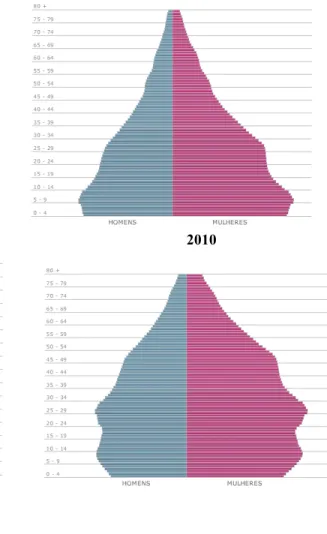
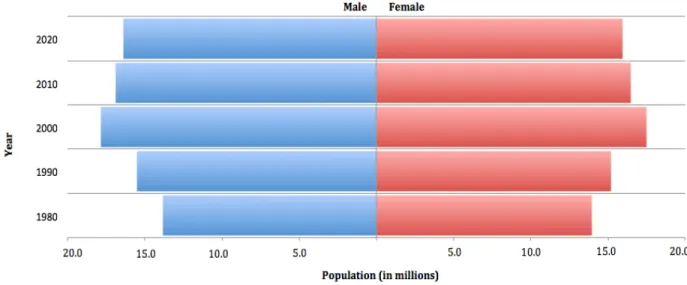
While the TFR has fallen significantly over the past decades, Brazil’s population continues to age and life expectancy has risen, also contributing to the demographic transition. The population pyramid in Figure 2 represents the most recent census data from 2010 by age group and sex, and appears in the shape of a beehive. This shape denotes a large population’s slowing growth, which is caused by the decline in birth rates. Taking a further step back to observe the population’s changing age structure over the past 30 years, Figure 3 illustrates the population pyramids in Brazil from 1980-2010, with projections into 2020 depicting a
pyramid that will be diamond shaped as a result of continued declines in the TFR, causing the proportion of the population under age 15 to begin to decrease relative to the adult working-age population. As a result of this shift, families will be much smaller with more resources to invest in the health, education, and the well being of each child.
6.3
5.8
4.4
2.7
2.4
1.9
0 1 2 3 4 5 6 7
1960 1970 1980 1990 2000 2010
Total Fertility R
ate
Figure 2. Population by Age Group and Sex, Brazil 2010
Image Source: IGBE, 2010, http://www.censo2010.ibge.gov.br/sinopse/index.php?dados=12&uf=00
Referred to as a demographic dividend, the potential for accelerated economic growth begins with changes in the age structure of a country’s population as it transitions from high to low birth and death rates, such as the case of Brazil.9 With fewer young people relative to the population of working-age adults, nations that take advantage of this window of
opportunity by investing in human capital via health and education initiatives experience rapid economic growth that bolsters its population’s well-being.9 Demographers caution, however, that populations made up of more elderly people than young can result in a greater dependency ratio, causing a significant burden on younger generations to maintain the larger aging population.4 Nevertheless, if nations moving towards this trend implement sound
submerged in this situation, a closer look at their adolescent population will help to further explain this course.
Figure 3. Population Pyramid Projection by Age Group, Brazil 1980-2020
1980 1990
2000 2010
2020
Image Source: IGBE, 2008,
1. ADOLESCENT DEMOGRAPHICS
Defined by the World Health Organization as individuals aged 10 to 19 years,11 the adolescent population in Brazil was 34,887,041 in 2015, comprising 17% of the total population.12 While the number of adolescents has continued to increase over the past decades, as illustrated in Figure 4, the percentage proportion of this age group is declining, falling from 23% to 17% between 1980-2015, respectively.13 Although this age group has growth rates below 0.5% due to the increasing number of older Brazilians,14 adolescents still make up an extremely large population that require ongoing support, especially in education and capacity building, to ensure their positive contributions to the State’s systems.
Figure 4. Projected Population of Adolescents, Brazil 1980-2020
Data Source: IGBE, 2008,
http://www.ibge.gov.br/home/estatistica/populacao/projecao_da_populacao/2008/piramide/piramide.shtm
In Brazil there exist five racial and ethnic classifications on the official census: pardo,
(42.4%), with 7% identifying as Black, and less than 2% as Asian or Indigenous.3 The majority (81%) of adolescents live in urban areas, with the remaining 18.1% living in rural areas.3
Table 1. Race and ethnicity of adolescent resident population, Brazil 2010
Age Group
Resident Population
Total
Race or color
White Black Asian Brown Indigenous Undeclared
10 to 14 17,166,761 7,196,738 1,155,472 161,453 8,557,952 94,826 320 15 to 19 16,990,872 7,311,734 1,264,183 177,008 8,155,126 82,500 321
Total 34,156,633 14,508,472 2,419,655 338,461 16,713,078 177,326 641
Data Source: IGBE, 2012a
As of 2013 with an amendment to the Brazilian Constitution, basic education is mandatory for children ages four to 17. Organized in three levels, preschool serves children ages zero to five, primary school ages six to 14, and high school ages 15 to 17.15 The 1990’s
marked a period of efforts to expand access to primary education, yielding results that have approached universal attendance. By 2015, the gross school attendance rate of children and adolescents ages six to 14 reached 98.6%.16
2010, while the percentage who reported to only be a student increased, suggesting improvements in increased family support and/or a more stable economic situation.16
Figure 5. Percentage of adolescents ages 15 to 17 that are enrolled in school by type of activity, Brazil 2005-2015
Data Source: IGBE, 2016
Nevertheless, a significant number of adolescents remain outside of the education system. As of 2015, 15% of adolescents aged 15 to 17 were not enrolled in school, totaling roughly 1.6 million young people. Of those who dropped out without finishing high school (1.3 million), 61.4% left without having completed primary school, accentuating the vulnerable young age at which a significant portion of school dropout occurs.16
Adolescents also face economic vulnerabilities in Brazil, with 3.7 million young people aged 12 to 17 living in extreme poverty, defined as less than 25% of the minimum monthly salary (roughly $71 dollars).17 This number becomes even more alarming when compared across all age groups. Although income inequality has been declining in Brazil since 2004, having reached its lowest level since 1960, the percentage of adolescents living in
59.30% 70.90%
22.30% 14.10%
0% 10% 20% 30% 40% 50% 60% 70% 80% 90% 100% 2005
2015
Percent
Ye
ar
families of extreme poverty has increased between 2004 and 2009, from 16.3% to the current 17.6%.15
Reflecting on the demographic characteristics of Brazil’s adolescent population has provided the contextual framework in which to further examine their sexual and reproductive health (SRH). In the sections to follow, this paper will focus on several specific indicators of SRH, including modern contraceptive use, HIV/AIDS rates, pregnancy and birth rates, continuing to pay special attention to the shifts in trends over time.
II. METHODS
In order to provide a comprehensive overview of adolescent SRH trends in Brazil, the author conducted a desk review of a number of primary-source documents and publications. The main source of information for the review are the publications of nationally
representative data, collected and published principally by the Brazilian Institute of Geography and Statistics (IBGE). With the last USAID Demographic and Health Survey completed in Brazil in 1996, the IBGE, run by the federal administration, is the main provider of data and information about Brazil, collecting and disseminating data that addresses the social, demographic, economic, and geographic characteristics of the country.
One of these sources of data is the Demographic Census, which is completed every ten years and was most recently conducted in 2000 and 2010. The Census is a meticulous survey of all the households in the country, covering 5,565 Brazilian municipalities in order to obtain information about the main socioeconomic characteristics of people and their households. Also included in this survey are general health-related questions, including fertility.
on the health on women aged 15 to 49 years and children under five years old. The survey gathers data on the topics of reproductive health, sexual behavior, housing conditions, sociodemographic characteristics, health status, and health care access.
Finally, the author draws on information from the National Adolescent School-Based Health Survey (PeNSE), which took place in 2009 and 2012 in a partnership with the Ministry of Health. The survey centers around 9th graders, conducted in accordance with norms and guidelines applied at the national and international level with studies involving minors, and holds as its main objectives the identification and measurement of health risk factors and protection measures among students in public and private schools. The survey has wide geographic coverage, presenting data relative to the country, its Major Regions, 26 state capitals and the Federal District.
In addition to the publications by the IBGE, the author conducted a literature review through PubMed and SciElo to identify secondary sources of information that draw on data from the surveys listed above. One of the search criteria was that all information presented must be nationally representative, to be in line with the focus of this overview.
III. RESULTS
1. ADOLESCENT SEXUAL AND REPRODUCTIVE HEALTH TRENDS
Throughout most countries, sexual activity begins in late adolescence, typically between ages 15 and 19.18,19 This holds true for Brazilians, as well, with the median age for
had experienced sexual intercourse at least once in their life, the percentage being
significantly higher for boys (40.1%; 95%CI 37.6 – 42.6) than for girls (18.3%; 95%CI 15.3 – 21.8). (IBGE, 2013) Among those adolescents aged 14 years who already had their sexual debut, more than a third (35.4%) reported experiencing their first intercourse when they were 12 years old or younger.21
Multiple studies both in Brazil and across other continents demonstrate that early sexual debut is associated with unprotected sex and more partners over a lifetime, increasing the risk of sexually transmitted infections (STIs) and pregnancy.20,22 These associations observed among adolescents will be further examined below.
1.1 MODERN CONTRACEPTIVE USE
Among the students in the aforementioned PeNSE survey who had already had sexual intercourse (28.7%), 75.3% reported using contraception during their last sexual encounter, with the condom being the most utilized method (74.7%).21 Contraceptive use was not
always so present in Brazilian SRH culture, however. According to the National Demographic and Health Survey of Children and Women, which was carried out in 1996 and 2006, the percentage of female adolescents aged 15 to 19 who used a condom during their sexual debut increased dramatically over the 10-year period, tripling from 23.8% to 67.4%.23
Table 2. Percentage of young women aged 15 to 24 years who used a condom during their sexual debut according to selected characteristics, Brazil 1996 and 2006
Characteristics
Year
P- value
1996 2006
% N % N
Age Group (years)
15 to 19 23.8% 138 67.4% 839 < 0.0001
20 to 24 14.6% 158 60.10% 1,254 < 0.0001
Years of Education
None 1.5% 1 28.9% 6 < 0.0001
1 to 3 5.7% 19 21.8% 42 < 0.0001
4 10% 24 26.6% 78 < 0.0001
5 to 8 16.6% 119 55% 664 < 0.0001
9 to 11 34.3% 102 72.4% 1,104 < 0.0001
12 or more 54.2% 30 81.3% 183 0.001
Data Source: IGBE, 2009
Among female adolescents aged 15 to 19, 89.3% understood the condom’s dual function to prevent pregnancy as well as to protect against STIs and HIV/AIDS.23
Nevertheless, this knowledge has not always translated into action. More than half (53.3%) of these same females did not use a condom during the last sexual encounter.23 Furthermore, when measuring the consistent use of condoms among sexually active female adolescents aged 15 to 19, only 36.4% reported to use them “Always”, 35.5% “Sometimes”, and 28.2% “Never”.23
The PeNSE survey in 2012 revealed a similarly worrisome trend among male students aged 12 to 16. When comparing by gender, the odds that male students had unprotected sex were higher than the odds for female students (OR = 2.53; 95% CI).21 In addition, male
Although adolescents’ consistent-use of contraception has yet to reach perfect
percentages, it is important to recognize the role that the schools have played in disseminating information. With 69.7% of students reporting to have received information in school about where to obtain free condoms,21 educational institutions have been proven to be a place that can positively contribute to adolescents’ SRH behavior.
1.2 HIV/AIDS
Since the beginning of the epidemic in the 1980’s, the incidence rate of AIDS cases among young people aged 15 to 24 has fluctuated significantly, steadily increasing to peak in 1993 and 1995, and then dramatically declining in 1996 to remain relatively stable through 2010 (Figure 6).24 With regard to new cases of AIDS among young people, in 2010 the country reported an incidence rate of 9.5 per 100,000 people.24
Figure 6. AIDS Incidence rate (per 100,000 habitants) among young people aged 15 to 24 years, by sex and age of diagnosis, Brazil 1985 - 2010
Image Source: Ministério da Saúde, 2012,
When observing the sex ratio of AIDS cases among young people aged 15 to 24, Figure 7 illustrates the narrowing gap in the ratio of cases between men and women since the beginning of the epidemic. Between 1985 and 2010, the sex ratio decreased from 27 to 1.4 AIDS cases in men per one case in women. Between 2000 and 2004, there was a reversal of the sex ratio, with 0.9 cases in men for every one case among women.24 Nevertheless, over the last ten years from 2006 to 2016 there has been an increase in detection rates among men, principally those aged 15 to 19 and 20 to 24 years. Rates among adolescent males have more than tripled, from 2.4 to 6.9 cases per 100,000 people, and among young adults have doubled, from 15.9 to 33.1 cases per 100,000 people.25
Figure 7. Number of AIDS cases in young people aged 15 to 24 according to year of diagnosis, Brazil 1985 – 2010
Image Source: Ministério da Saúde, 2012,
Focusing on the adolescent age group, data from 2012 revealed a total of 2,478 cases of HIV/AIDS among adolescents aged 10 to 14 years, 12,246 cases among adolescents aged 15 to 19, and 94,517 among young adults aged 20 to 24, with the total corresponding to 16.6% of the general population infected with the virus.24 Although young adults represent one of the highest prevalence age groups of HIV/AIDS, totaling almost 6.5 times as many cases as adolescents, theinability to account for when the infection occurred can be interpreted several ways: that there is just as much likelihood that it took place during
adolescence and wasn’t diagnosed until later, or that habits of not using protection when first becoming sexually active in adolescence influenced a similar behavior as young adults. Regardless, the high prevalence of HIV/AIDS among young adults indicates absolute priority of prevention measures targeting the adolescent population.
1.3 PREGNANCY RATES AND BIRTH RATES
The timing in a woman’s life when she gives birth has lasting consequences for her life trajectory, as well as that of her children. Concerns about the implications of adolescent pregnancy arise because of its association with curtailed educational careers and school abandonment, reduced earning potential, and greater risk of living in poverty.18,26
An important aspect of Brazil’s fertility trends is the high fertility rates observed at young ages.1 While fertility rates have consistently decreased among women above the age of
census, nearly 20% of children were born to adolescents aged 15 to 19, compared to 9% in 1990.26 Having fewer children overall, coupled with having them earlier, are the most striking features of Brazilian reproductive behavior.
Table 3 presents the most recent data from the National Demographic and Health Survey of Children and Women from 2006, looking at socio-demographic measures for adolescents aged 15 to 19 who were currently or had ever been pregnant. The total percentage of adolescents pregnant with their first child at the time of the interview was 6.2%, higher in urban (5.6%) than rural areas (2.4%).28 It is also worth noting that this proportion increased with age, from 3.7% at age 15 to 9.6% at 18 years. There is also a clear association between pregnancy and years of education, declining from 40.7% for those with one to three years of school, to zero among those with 12 or more years of education. Disparities by race also stood out, with black adolescent women reporting the highest percentage of those currently pregnant (7.5%) when compared to white adolescents (4.8%).28
Table 3 also highlights the fact that 23.1% of adolescent women have already been pregnant at least once or are currently pregnant. When looking at years of education, the highest percentage of pregnancies is among those with two to four years of study (67.1%), dropping to 2.1% among those with 12 or more years of education.28 The contrast by race and ethnicity is also maintained here. While causality cannot be established from these statistics, it is nonetheless important to recognize the correlation between such indicators and their SRH outcomes.
Between 1996 and 2006, unwanted pregnancy among adolescents aged 15 to 19 rose from 12.7% to 13.8%, despite the increases in contraceptive use over the same time period discussed in the previous section.23
Table 3. Percent of adolescents aged 15 to 19 years that are currently or that have ever been pregnant, organized by socio-demographic characteristics, Brazil 2006
Characteristics
Percentage of the total of adolescents who are currently pregnant with their first child
Percentage of the total of adolescents who
are currently or have ever been pregnant Number of adolescents interviewed
Urban Rural Total Urban Rural Total Urban Rural Total
Age
15 3.2% 3.6% 3.7% 10.0% 6.7% 9.6% 335 149 484
16 4.4% 1.0% 4.6% 11.0% 9.5% 10.9% 313 154 467
17 4.4% 0.3% 4.5% 19.5% 21.6% 20.0% 365 153 518
18 9.0% 3.5% 9.6% 28.5% 33.0% 29.2% 393 146 539
19 5.3% 4.0% 6.6% 38.4% 49.2% 42.0% 334 144 478
Total 5.6% 2.4% 6.2% 22.3% 26.9% 23.1% 1,740 746 2,486
Years of Education
None * * * * * * 4 0 4
1 – 3 * * 40.7% * * 52.3% 33 39 72
2 – 4 15.1% 3.9% 16.9% 71.4% 57.7% 67.1% 79 36 115
5 – 8 4.8% 3.3% 5.6% 26.3% 28.5% 26.7% 814 210 1,024
9 – 11 4.8% 1.4% 5.1% 15.0% 16.8% 15.2% 1,037 165 1,202
12 or more 0.0 * 0.0 2.3% * 2.1% 67 6 73
Total 5.6% 2.4% 6.1% 22.2% 27.0% 23.1% 2,034 456 2,490
Race
White 4.0% 3.1% 4.8% 15.1% 21.1% 16.3% 610 272 882
Black 7.1% 1.7% 7.5% 27.8% 20.6% 28.3% 992 415 1,407
Other 2.5% * 3.3% 15.2% * 16.4% 128 55 183
Total 5.7% 2.4% 6.2% 22.4% 26.8% 23.2% 1,730 742 2,472
*Less than 50 cases
1.4 FEDERAL POLICIES AND PROGRAMS THAT HAVE POSITIVELY AFFECTED ADOLESCENT SEXUAL AND REPRODUCTIVE HEALTH
From 1964 until the mid 1980’s, Brazil was governed by military regimes that had little
interest in investing in programs or policies regarding women’s SRH. Towards the end of this
period, a strong women’s movement began to campaign for reproductive rights, and in 1984 the
Ministry of Health designed a Comprehensive Program for Women’s Health (PAISM),
integrating antenatal, delivery and postnatal care, cancer prevention, STI care and adolescent
health, in addition to including, for the first time, a public mandate for free access to
contraceptive methods.30
The new Brazilian Constitution, adopted in 1988, was the most critical breakthrough of
the decade, launching the Unified Health System (SUS), a public, universal and decentralized
health system that expanded health care access to all citizens, regardless of employment status or
contributions to Social Security.31 Financed primarily through taxes with contributions from
federal, state, and municipal budgets, SUS offers primary care in localized community clinics, in
addition to providing in-patient hospital services, supporting vaccination programs, prevention
campaigns, basic dental care, and mental health services.32
In addition to SUS’s creation, the Constitution recognized family planning as a people’s
right and guaranteed reproductive choice, establishing both as responsibilities of the State in
promoting educational and scientific resources to allow and promote their exercise.30,33
Regulated by Law 9,263 of 1996, the federal government further elaborated that family planning
is the right that every person has to information, specialized assistance, and access to
contraceptive methods that permit one to choose freely and consciously to have children or not.
birth control method are options that every woman and couple should have, with available
information and without discrimination, coercion, or violence.34
In an effort to further promote its population’s SRH, in 2007 the federal government
launched the National Family Planning Policy with the objective to provide free contraception to
men and women of reproductive age (aged 10 to 49), in addition to mandating that the purchase
of contraceptives should be available in the Federally Subsidized “Popular Pharmacy” network at
significantly reduced cost, oftentimes 90% off the retail price.35
Since the creation of SUS almost three decades ago, the Brazilian government has made
great strides in strengthening its health systems. These efforts have been particularly visible in
the Family Health Strategy (FHS). Having evolved greatly from its development in 1994 in name
and in reach, the FHS (previously known as The Family Health Program) is a community-based
approach that now provides primary care in clinics for 62% of Brazil's population as of 2014,
compared to only covering 4% of the population in 1998.31 Comprised of interdisciplinary health
professionals that are permanent fixtures in each clinic, the FHS health team includes a
physician, a nurse, a nurse assistant, and 4-6 community health agents, depending on the size of
the community. Also addressing adolescents’ SRH needs, 27% of sexually active adolescents
used the FHS to obtain contraceptives, according to data from the PNDS in 2006.29
In 2007 the Health and Prevention in the Schools Program (SPE) was created as an
intersectoral initiative implemented by the Ministries of Health and Education, with support from
UNESCO, UNICEF, and UNFPA.36 Championing the school as a valuable place in which to
positively impact adolescents SRH knowledge and behavior, the SPE has been implemented in
schools from all 27 states in Brazil. The framework of the program covers the themes of
prevention of drug use. In addition, an important component of the SPE is increasing access to
condoms, which are provided for free at participating schools.15
2. GAPS IN ADOLESCENT SEXUAL AND REPRODUCTIVE HEALTH PROGRAMS
Although not all of the aforementioned policies and programs were created to specifically
target adolescents, it is undeniable that this population has benefited, through the examination of
SRH trends, since their inception and implementation. The progress of adolescent SRH reviewed
throughout this paper would not be complete, however, without the additional assessment of
shortcomings and areas for improvement among certain initiatives. This reflection will in turn
inform implementation science-based recommendations, to follow.
According to the Ministry of Health, SUS offers a variety of contraceptive methods to
best meet individuals’ and couples’ needs: the male and female condom, oral contraception,
injectable methods, IUD, diaphragm, emergency contraception, and sterilization.35 In practice,
however, the availability of these methods is limited. A national study was completed to evaluate
the performance of SUS in the area of women’s health, looking specifically at the provision of
modern contraceptive methods in 2,207 municipalities that are a part of the SUS network (95%
of the total).37 The study revealed worrisome data regarding the variety of methods actually
available, with most clinics restricted to two methods. Condoms and oral contraception are
distributed in 53% and 47% of the SUS clinics, respectively, with only 16% offering IUDs,
13.5% injectable methods, and 6.6% diaphragms.37 Failing to ensure access to a range of
contraceptives and safeguarding women’s choice to select the most appropriate method for their
needs is a violation of the Brazilian Constitution and Law 9,263, which establishes family
planning and contraceptive method choice as rights for every woman and couple, including
The SPE program is another initiative that, although advantageous for those fortunate to
participate, reaches only slightly more than half of all adolescents in public schools. As of the
most recent survey in 2009, there are 53,000 schools that have reported implementing the SPE
program, which represents 51% of public schools.15,38 In addition to gaps in the program’s
coverage, educators appear to be lacking training regarding the curriculum’s uniform
implementation. The SPE program expects teachers to integrate SRH topics into their classes,
provided with a 150-page guide of activities and lesson plans. Not all professors working at
schools participating in the SPE program have received training to be a sexual health educator,
however. In a study conducted in 22 municipalities within 14 different states, less than half
(41.6%) of the 563 teachers interviewed reported attending any training, capacity building or
workshop to discuss issues regarding STIs and HIV/AIDS in the schools.36 Not only does this
put the quality of the information students are receiving around these topics into question, it
could potentially jeopardize their health, as well. The percentages of public schools participating
in the SPE program and teachers trained in SRH issues are inadequate, underlining issues of
coverage and effective implementation.
Evidence suggests that the FHS provides better access, quality, and user satisfaction than
traditional health centers and even some private-sector healthcare facilities.31 The FHS expansion
has resulted in improvements in children and adult’s health, including reductions in infant
mortality and post neonatal mortality, in addition to reduced mortality from cardiovascular
causes and large reductions in hospitalization rates from ambulatory-care conditions.31 Despite
the relevance of the FHS, looking specifically at its service history with the adolescent
population reveals very low levels of care. A study carried out in 2011 with health professionals
the unit and activities outside of it. Women were identified as the most frequent users (70.9%),
followed by the elderly (64.8), children (56.3), adolescents (27.2%), and men (11.7%).39 It is
worth noting that the sum exceeds 100%, given that the professionals could select more than one
option. When asked about the difficulties related to adolescent participation in the FHS, the top
problems identified were the fact that adolescents did not know about the services offered to
them via the FHS (42.3%), and that the clinic did not have specific actions developed for
adolescents (26.3%).39 The low percentage of adolescents receiving health services from the FHS
and the lack of specific actions developed for them highlights a glaring gap where efforts are
falling short.
V. DISCUSSION
1. IMPLEMENTATION SCIENCE AS A FRAMEWORK FOR ADDRESSING PROGRAMMATIC GAPS
From the time that evidence-based action became a pillar of good public health practice,
there has been consistent concern about the science-to-service, or research-to-practice gap.40
Research efforts have historically focused on the improvement of innovations, while by and large
overlooking how will they be implemented. This underlines the crux of the problem, for
populations cannot benefit from innovations they do not experience.41 In order to address the
shortcomings of programmatic efforts geared towards improving adolescent SRH,
implementation science will be utilized to guide recommendations for actions moving forward.
The term ‘implementation science’ is recognized as the study of factors that influence the
full and effective use of innovations in practice,41 creating generalizable knowledge that
contributes to the development of recommendations and guidelines for specific health system
and sustainability of health programs and interventions, including the influence on patients,
practitioners, and systems,and ultimately promoting iterative changes to guide the adaption and
advancement of future actions.43
1.1. APPLICATION OF THE IMPLEMENTATION STAGES FRAMEWORK FOR IMPROVING CONTRACEPTIVE SUPPLY
The first issue that must be addressed is the limited availability of modern contraceptive
methods within SUS clinics. Resource shortages have significantly restricted the contraception
options available to adolescents, which, in some cases, could affect the fidelity and consistency
of how and if they are used at all. The Implementation Stages Framework will be applied to
guide recommendations, seen as necessary for successful new practices to be used and for
organizations and systems to change in order to support new ways of work.44 There are four
functional implementation stages that make up this framework, pictured in Figure 8: Exploration,
Installation, Initial Implementation, and Full Implementation. It is also important to recognize
that each stage does not abruptly end as another begins. In many cases, stages overlap with
activities relating to one stage continuing to occur as activities related to the following stage are
initiated.
Figure 8. Implementation Stages Framework
The goal of the Exploration Stage is to determine the needs of a population, identifying
possible programs and innovations to meet those needs, and assessing the fit and feasibility of
implementing and sustaining such practices.44 To do so, it is first necessary to look to health
professionals and data to better understand this need and root of the problem. In the case of
modern contraceptive methods in SUS clinics, possible examples might include holding focus
groups with health professionals and clinic directors to better understand the logistical and
management challenges, in addition to studying existing publications and surveys that have
already been conducted on this issue to inform and drive actions. Equally as important,
adolescents must be included in this process. As recommended by the International Planned
Parenthood Federation (IPPF) and the World Health Organization (WHO), it is imperative that
young people are included and take an active role in discussing their needs and potential
solutions to programs and policies that affect their lives.45,46 When identifying possible programs
and strategies to fill this resource shortage, it is recommended to first look within the SUS
network to see if there are any states or municipalities that are able to keep their clinics stocked
with the full range of contraceptive methods. What are they doing differently? Is it possible to
model new actions around their system? Finally, to assess the fit and feasibility of new actions, it
should be ensured that they align with the priorities of the SUS program and clinics, in addition
to having the proper amount of resources reallocated to cover the cost of the other methods.
The Installation Stage focuses on the practical preparations needed to initiate the new
program or innovation, keeping in mind that changes often must be made in multiple settings to
accommodate and fully support the new practice.44 Developing the knowledge, skills and
phase include refresher trainings with health care professionals and community health workers
on the effectiveness and function of various contraceptive methods, creating a dissemination plan
to educate and inform communities of their new contraceptive options, and establishing new
policies for staff with the use of a logistics management information system (LMIS) to manage,
collect and track data for family planning commodities and supply ordering procedures.
The Initial Implementation Stage begins when the new program or practice is first put to
use. Everyone is learning and adapting to a new protocol, and it is inevitable that challenges will
emerge as the status quo is changed.44 During this stage in particular, it is import to remember
that all the stages in this framework are not linear, bur rather part of an iterative process. For
example, in the contraceptive method situation, weaknesses may be identified among clinics
having trouble restocking methods in low supply. This would require further work to be done in
the Installation Stage in the form of a step-by-step protocol for how and when to order new
supplies. As problems emerge teams must develop and engage in strategies to promote
continuous improvement and rapid problem solving to avoid their reoccurrence.
The final stage is Full Implementation, which occurs when the new learning becomes
fully integrated into practitioner, organizational, and community practices and procedures, over
time becoming standard practice.44 In the case of modern contraceptive methods in SUS clinics,
the health system would be recalibrated to always carry the variety of modern methods, as well
as accurately educate SUS users of their reproductive health options.
By employing the Implementation Stages Framework to address gaps and shortages in
contraceptive method supply, adolescents can be encouraged to find the right method for their
body and circumstances, protecting their SRH and potentially reducing unmet need. Additional
family planning methods, and reductions in pregnancy rates, particularly unwanted pregnancy, as
well as HIV/AIDS.
1.2. APPLICATION OF THE IMPROVEMENT CYCLE FRAMEWORK FOR
STRENGTHENING IMPLEMENTATION OF THE HEALTH AND PREVENTION IN THE SCHOOLS PROGRAM
Programmatically, the SPE appears to be well-thought out and designed; in practice,
however, it is lacking standardized capacity building activities for all teachers who are required
to implement the curriculum, as well as scale-up initiatives for the program to reach full
coverage of public school students. To address these problems the Improvement Cycle
Framework will be applied, identified to promote purposeful building and systems-level
implementation and consisting of four phases: Plan, Do, Study and Act (PSDA), depicted in
Figure 9. The PSDA phases are useful in identifying and alleviating barriers, embedding
solutions, and achieving expected outcomes.47
Figure 9. Improvement Cycles Framework
Image Source: NIRN, 2015, http://implementation.fpg.unc.edu/module-1/improvement-cycles
Rapid-cycle problem solving is one type of improvement cycle that uses the PDSA
rollout or use of the innovation; in this case, shortcomings within the SPE program to educate
adolescents about their SRH.48
The Plan Phase identifies the barriers and challenges to implementing the innovation or
program, using data whenever possible, and specifying the plan to move the initiatives forward
as well as the outcomes that will be monitored.47 It also requires clarity about the problem at
hand, which can be achieved by asking the following SPE-specific questions: What are the
dimensions of the problem? Which municipalities and schools are having the most difficulty
integrating the curriculum? In what subject areas do the educators feel inadequate? How much
training would they need to become sexual health educators? What is our hypothesis about what
might work and why? What data will be collected and analyzed to indicate that a solution will be
reached, or that another PDSA is needed? Students participating in this program are also a
valuable resource that should be included in the Plan Phase, providing feedback regarding what
they like about the curriculum and what they would change, in addition to specific topics they
want to know more about. With these answers, the Goal, Hypothesis, and Action Plan must then
be defined.48 For example, the Goal could be stated as: Improve the capacity of teachers required
to implement the SPE curriculum by increasing the percentage of those having received
standardized sexual health education training from 41.6% to 80% over the course of five years.
The Hypothesis might read: The majority of teachers in public schools do not have the training to
integrate SRH-specific topics from the SPE curriculum into their classes, therefore threatening
the quality of information reaching the students. Finally, the Action Plan could be: Carry out one
weekend-long workshop per month over the course of a semester with teachers, covering all
SRH topics included in the SPE curriculum to promote their capacity-building as sexual health
educators new to the program, providing feedback and support on how to execute different
activities and SRH topic areas.
The Do Phase consists of executing the strategies as specified to address the challenges.47
In addition to the trainings, other examples of this phase might be supplementary action steps
geared towards the coaching provided by teachers experienced with the SPE curriculum who
have received trainings in the past. Establishing norms by having them coach the newly trained
teachers in a role-playing format, practicing the activities they may carry out in the classrooms,
answering difficult questions from students, and receiving feedback can encourage the
curriculum’s uniform implementation across the schools and municipalities.
The Study Phase requires the use of indicators identified during the planning phase to
assess and track progress.47 This could be evaluating the proportion of teachers enrolled in and
attending monthly workshop trainings, the proportion of teachers who have finished the
trainings, whether those receiving the trainings are implementing the curriculum to fidelity, and
the percent of role-play coaching sessions that occur in classrooms over a three-week period
following the trainings. With this information it is possible to ensure that the initiative is staying
on track to achieve its desired goal and improvements.
Lastly, the Act Phase is utilized to determine if the desired outcome was achieved, and
make changes to the next iteration of the plan to further improve implementation if need be.47 In
the case of teachers receiving training to implement the SPE curriculum, it must be determined
whether the goal to increase the percentage of those having received standardized sexual health
education training from 41.6% to 80% over the course of five years was achieved; if so, the
teachers working at schools participating in the SPE program are trained. If the goal is not
achieved, a new PDSA should be developed based-on the lessons learned.
Utilizing the Improvement Cycle Framework to address problems impacting the use of
the SPE curriculum is an approach that can promote the implementation of new practices at the
systems-level. In doing so, adolescents attending schools invested in the SPE program can
receive quality, standardized information regarding their SRH, informing their future decisions
and having the potential to positively affect their future health outcomes through improvements
in increased contraception use and reductions in unwanted pregnancy and HIV/AIDS rates.
2. STRENGTHS AND LIMITATIONS
One of the primary strengths of this paper is that it explores a significant gap in women’s
SRH research in Brazil. Female adolescents comprise a substantial proportion of the total of
women of reproductive age, yet they are often overlooked in research or grouped together with
all women despite their vast emotional, cognitive and developmental differences. Despite a
thorough review of the literature, there were very few recent publications looking expressly at
adolescent SRH in Brazil. Teasing out adolescent-specific data from larger reports and
highlighting the Brazilian programs and policies that have had effects on their SRH, this paper
contributes in several ways to addressing this critical research gap.
An additional strength of this paper is its commitment to producing the highest quality
results and observations possible, using primarily nationally representative data form the IBGE
to ensure consistency and accuracy. As such, it includes references in both English and
Portuguese, allowing for a larger catchment area of literature and data to be used.
With all the strengths of this research come several limitations that also merit mention.
patterns of adolescents in Brazil. The most recent National Demographic Survey on the Health of
Children and Women (PNDS) is from 2006, and the latest National Adolescent School-Based
Survey (PeNSE) is from 2012; while they are helpful in observing trends, both are out-of-date,
highlighting a critical need for more recent national-level studies and/or household surveys
specifically addressing this population. Furthermore, the reports that do include adolescents
oftentimes group them with young adults up to 24 years, making it difficult to analyze trends
solely among adolescents aged 10-19. Without indicators to measure, monitor and evaluate
adolescent SRH, creating effective programs and policies to accurately target these needs
becomes much more difficult.
Finally, an additional limitation is the exclusion of abortion as a SRH trend. Because
abortion is illegal in Brazil, accurate data, particularly specific to adolescents, is virtually
nonexistent. While this topic is an extremely pertinent issue that merits extensive discussion
regarding the implications on maternal and adolescent health, it was outside the scope of this
paper and therefore not included.
VI. CONCLUSIONS
With adolescents comprising 17% of Brazil’s total population, it is undeniable that they
make up an exceptionally large age group with unique SRH needs. Analysis of several SRH
indicators to observe trends such as modern contraceptive use, HIV/AIDS, pregnancy and birth
rates reveal substantial progress that has been made over the past decades since the creation of
SUS, as well as critical gaps that must be addressed moving forward. Since the mid-1980’s, the
Brazilian government has taken steps to invest in women and adolescents’ SRH through the
creation of rights-centric policies, in addition to programs to promote access to contraceptive
remain. Improvement and strengthening of existing sound policies and programs that invest in
the human capital of adolescents by targeting their SRH needs can ensure a healthier,
independent and more fiscally stable future workforce, ultimately increasing the quality of life of
VII. REFERENCES
1. Berquó E, Cavenaghi S. Fecundidade em declínio: Breve nota sobre a redução no número
médio de filhos por mulher no Brasil. Novos Estud. 2006;75:11-15.
doi:https://dx.doi.org/10.1590/S0101-33002006000100001.
2. Moreira M de M. Structural Changes in the Brazilian Age Distribution: 1950-2050.
Presented at the XXVI General Population Conference International Union for the Scientific Study of Population Salvador, Bahia; 2001.
http://www.abep.nepo.unicamp.br/docs/PopPobreza/MorvanMoreira.pdf. Accessed February 05, 2017.
3. Instituto Brasileiro de Geografia e Estadística (IBGE). Censo demográfico 2010:
Características da populacão. Rio de Janeiro; 2012.
http://www.ibge.gov.br/home/estatistica/populacao/censo2010/caracteristicas_da_populac ao/tabelas_pdf/tab3.pdf. Accessed February 05, 2017.
4. Haag C. Brazil is undergoing a demographic shift. Pesqui FAPESP. 2012;(246).
http://revistapesquisa.fapesp.br/en/2012/02/27/brasil-em-transição-demográfica/. Accessed February 05, 2017.
5. MEASURE Evaluation. Total fertility rate.
https://www.measureevaluation.org/prh/rh_indicators/specific/fertility/total-fertility-rate. Accessed February 02, 2017.
6. Smallwood S, Chamberlain J. Replacement fertility, what has it been and what does it
mean? Popul Trends. 2005;(119):16-27.
7. Marteleto L. Family size and schooling throughout the demographic transition: Evidence
from Brazil. Demogr Res. 2010;23(15):421-445. doi:10.4054/DemRes.2010.23.15.
8. Martine G. Brazil’s fertility decline, 1965-95: A fresh look at key factors. Popul Dev Rev.
1996;22(1):47. doi:10.2307/2137686.
9. Gribble J, Bremner J. Achieving a demographic dividend. Vol 67. Washington DC; 2012.
http://www.prb.org/pdf12/achieving-demographic-dividend.pdf. Accessed February 05, 2017.
10. Cleland J, Bernstein S, Ezeh A, Faundes A, Glasier A, Innis J. Family planning: The
unfinished agenda. Lancet. 2006;368(9549):1810-1827.
doi:10.1016/S0140-6736(06)69480-4.
11. World Health Organization (WHO). Adolescent development.
12. Unicef. The state of the world’s children 2016 statistical tables by country. 2016. https://data.unicef.org/wp-content/uploads/2016/06/SOWC-2016-all-tables-by-country_261.xlsx.
13. Instituto Brasileiro de Geografia e Estadística (IBGE). População total: 1980 - 2010. http://brasilemsintese.ibge.gov.br/populacao/populacao-total-1980-2010.html. Published 2017. Accessed February 02, 2017.
14. Rodriguez-Wong L, Carvalho, AM de. Age structural transition in Brazil: Demographic bonuses and emerging challenges. In: Committee for International Cooperation in National Research in Demography (CICRED); 2004.
http://www.cicred.org/Eng/Seminars/Details/Seminars/Popwaves/PopwavesWongCarvalh o.pdf. Accessed March 07, 2017.
15. UNESCO. Brasil: The development and institutionalization of the Health and Prevention
in Schools Program.; 2011. http://unesdoc.unesco.org/images/0019/001928/192896E.pdf. Accessed March 07, 2017.
16. Instituto Brasileiro de Geografia e Estadística (IBGE). Síntese de indicatores sociais: Uma
análise das condições de vida da população Brasileira. Rio de Janeiro; 2016.
http://biblioteca.ibge.gov.br/visualizacao/livros/liv98965.pdf. Accessed March 07, 2017.
17. Unicef. O direito de ser adolescente: Oportunidade para reduzir vulnerabilidades e
superar desigualdades. Brasilia; 2011. https://www.unicef.org/brazil/pt/br_sabrep11.pdf. Accessed March 07, 2017.
18. Oliveira-Campos M, Nunes ML, Madeira F de C, et al. Comportamento sexual em
adolescentes brasileiros, Pesquisa Nacional de Saúde do Escolar (PeNSE 2012). Rev Bras
Epidemiol Suppl PeNSE. 2014:116-130. doi:10.1590/1809-4503201400050010.
19. Secor-Turner M, Kugler K, Bearinger LH, Sieving R. A global perspective of adolescent
sexual and reproductive health: Context matters. Adolesc Med State Art Rev.
2009;20(3):1005-1025.
20. Wellings K, Collumbien M, Slaymaker E, et al. Sexual behaviour in context: A global
perspective. Lancet. 2006;368(9548):1706-1728. doi:10.1016/S0140-6736(06)69479-8.
21. Instituto Brasileiro de Geografia e Estadística (IBGE). Pesquisa Nacional de SaúdedDo
Escolar 2012. Rio de Janeiro; 2013.
http://biblioteca.ibge.gov.br/visualizacao/livros/liv64436.pdf. Accessed March 25, 2017.
22. Rozenberg R, Silveira K, Silva D, Bonan C, Ramos EG. Contraceptive practices of
Brazilian adolescents: Social vulnerability in question. Cien Saude Colet.
23. Instituto Brasileiro de Geografia e Estadística (IBGE). Pesquisa Nacional de Demografia e Saúde da Criança e da Mulher 2006: Dimensões do processo reprodutivo e da saúde da criança. Rio de Janeiro; 2009.
http://bvsms.saude.gov.br/bvs/publicacoes/pnds_crianca_mulher.pdf. Accessed March 10, 2017.
24. Ministério da Saúde (MS). Secretaria de Atenção a Saúde. Programa Nacional de
DST/Aids. Boletim Epidemiológico AIDS e DST. Brasilia; 2012.
http://www.aids.gov.br/sites/default/files/anexos/publicacao/2011/50652/boletim_aids_20 11_final_m_pdf_26659.pdf. Accessed March 10, 2017.
25. Brasil. Ministério da Saúde (MS). Secretaria de Atenção a Saúde. Programa Nacional de
DST/Aids. Boletim Epidemiológico Aids e DST. Brasilia; 2016.
http://www.aids.gov.br/sites/default/files/anexos/publicacao/2016/59291/boletim_2016_1 _pdf_16375.pdf. Accessed March 10, 2017.
26. Marteleto L, Dondero M. Maternal age at first birth and adolescent education in Brazil.
Demogr Res. 2013;28:793-820. doi:10.4054/DemRes.2013.28.28.
27. Cavenaghi S, Alves JED. Diversity of childbearing behaviour within population in the
context of below replacement fertility in Brazil. In: United Nations Department of Social
and Economic Affairs. United Nations Expert Group Meeting on Recent and Future Trends in Fertility, Population Division. New York; 2009.
http://www.un.org/esa/population/meetings/EGM-Fertility2009/P10_Cavenaghi.pdf. Accessed March 12, 2017.
28. Instituto Brasileiro de Geografia e Estadística (IBGE). Pesquisa Nacional de Demografia
e Saúde da Criança e da Mulher 2006: Relatório final. Rio de Janeiro; 2008.
http://livroaberto.ibict.br/bitstream/1/534/1/relatorio_final_PNDS2006_04julho2008.pdf. Accessed March 12, 2017.
29. Berquó E, Garcia S, Lima L. Reprodução na juventude: Perfis sociodemográficos,
comportamentais e reprodutivos na PNDS 2006. Rev Saúde Pública. 2012;46(4):685-693.
www.scielo.br/rsp. Accessed March 12, 2017.
30. Corrêa S, McIntyre P, Rodrigues C, Paiva A, Marks C. The population and reproductive
health programme in Brazil 1990-2002: Lessons learned. Reprod Heal Matters.
2005;13(25):72-80. http://www.jstor.org.libproxy.lib.unc.edu/stable/3776230?pq-origsite=summon&seq=1#page_scan_tab_contents. Accessed March 19, 2017.
31. Macinko J, Harris MJ. Brazil’s family health strategy: Delivering community-based
primary care in a universal health system. N Engl J Med. 2015;372(23):2177-2181.
doi:10.1056/NEJMp1501140.
March 05, 2017.
33. Adelman M, Azevedo MC de. Families, gender relations and social change in Brazil:
Practices, discourse, policy. J Child Fam Stud. 2012;21(1):65-74.
doi:10.1007/s10826-011-9504-x.
34. Brasil. Lei N° 9.263, de 12 de Janeiro de 1996.; 1996.
http://www2.camara.leg.br/legin/fed/lei/1996/lei-9263-12-janeiro-1996-374936-normaatualizada-pl.pdf. Accessed March 01, 2017.
35. Brasil. Ministério da Saúde (MS). Conheça os métodos contraceptivos oferecidos pelo SUS. http://www.blog.saude.gov.br/index.php/materias-especiais/51645-saiba-mais-sobre-os-metodos-contraceptivos-oferecidos-pelo-sus. Published 2016. Accessed March 05, 2017.
36. UNESCO. Pesquisa “saúde e educação: Cenários para a cultura de prevenção nas
escolas” Briefing.; 2007. http://unesdoc.unesco.org/images/0018/001840/184073por.pdf. Accessed March 19, 2017.
37. Guilhem D, Azevedo AF. Brazilian public policies for reproductive health: Family
planning, abortion and prenatal care. Dev World Bioeth. 2007;7(2):68-77.
doi:doi:10.1111/j.1471-8847.2007.00201.x.
38. Russo K, Arreguy ME. Projeto “Saúde e Prevenção nas Escolas”: Percepções de
professores e alunos sobre a distribuição de preservativos masculinos no ambiente escolar.
Physis Rev Saúde Coletiva. 2014;25(2):501-523. doi:10.1590/S0103-73312015000200010.
39. Vieira RP, Gomes SHP, Machado M de FAS, Bezerra IMP, Machado CA. Participation of adolescents in the Family Health Strategy from the theoretical-methodological structure of
an enabler to participation. Rev Latino-Am Enferm. 2014;22(2):309-316.
doi:10.1590/0104-1169.3182.2417.
40. National Implementation Research Network (NIRN). Implementation science defined. http://nirn.fpg.unc.edu/learn-implementation/implementation-science-defined. Published 2015. Accessed March 09, 2017.
41. Fixsen D, Blasé K, Van Dyke M, Metz A. Implementation for the masses. Chapel Hill;
2016.
http://implementationscience.web.unc.edu/files/2015/01/Dean-Fixsen_Implementation-for-the-Masses-UNC_3.3.15.pdf. Accessed March 09, 2017.
42. Peterson HB, Haidar J, Merialdi M, et al. Preventing maternal and newborn deaths globally: Using innovation science to address challenges in implementing life-saving
interventions. Int J Gynaecol Obs . 2014;34(1):12-13.
43. Kroelinger CD, Rankin KM, Chambers DA, Diez Roux A V., Hughes K, Grigorescu V. Using the principles of complex systems thinking and implementation science to enhance
maternal and child health program planning and delivery. Matern Child Heal J .
2014;18(7):1560-1564. doi:10.1007/s10995-014-1586-9.
44. National Implementation Research Network (NIRN). Module 4: Implementation stages. http://implementation.fpg.unc.edu/module-4. Published 2015. Accessed March 09, 2017.
45. Hunt F, Castagnaro K, Monterrosas Castrejón E. Evaluation of the implementation of the Ministerial Declaration preventing through education from commitment to action;
advances in Latin America and the Caribbean. International Planned Parenthood Federation, Western Hemisphere Region. Demysex. Mexico: 2014. Accessed April 04, 2017.
46. World Health Organization (WHO). Health for the world's adolescents: A second change
in the second decade. http://apps.who.int/adolescent/second-decade/. Published 2014. Accessed April 04, 2017.
47. National Implementation Research Network (NIRN). Module 5: Improvement cycles. 2015. http://implementation.fpg.unc.edu/module-5. Accessed March 09, 2017.