Received 2 February 2017; received in revised form 20 April 2017; accepted 23 May 2017.
To cite this article: Aiman and Syahrullail (2017). Development of palm oil blended with semi synthetic oil as a lubricant using four-ball tester. Jurnal Tribologi 13, pp.1-20.
Development of palm oil blended with semi synthetic oil as a lubricant using four-ball tribotester
Y. Aiman*, S. Syahrullail
Faculty of Mechanical Engineering, Universiti Teknologi Malaysia, 81310 UTM, Skudai, Johor, Malaysia.
*Corresponding author: [email protected]
HIGHLIGHTS
Coefficient of friction for all sample is reduce compare to engine oil. Improvement in wear scar diameter performance at 40% of palm olein. Improvement in surface roughness from all sample compare to engine oil.
ABSTRACT
Due to environment concern, the current lubricant such mineral oil-based lubricant is not environmentally friendly as it were not readily biodegradable and toxic. Therefore, the vegetable oil-based lubricant has been promoted in order to replace mineral oil-based. In this study, the performance of lubricant for six different ratios between RBD Palm Olein and Semi-Synthetic oil were tested in different loads and been discussed in different parameters including coefficient of friction, wear scar diameter, surface roughness, flash temperature parameter and wear worn surface. Four-ball tribotester machine used to evaluate performance of sample lubricants using ASTM D4172 standard. From the results, it shows that the sample lubricants for engine oil mixing with RBD Palm Olein reduce in 38% of coefficient of friction compared to pure engine oil. From overall of the results, the performance of lubricant was improved as RBD Palm Olein mixing with engine oil.
Keywords:
1.0 INTRODUCTION
Lubricant is being developed not only based on their properties but it also requires the parameters such as load, temperature and speeds for the scientist to investigate the change that occurs on bulk material when the surface of material contact and moving relatively to each other. Lubrication is simply the use of material to improve the smoothness of movement of one surface over another, and the material, which is used in this way called a lubricant (Lansdown, 1982). Lubricants are also commonly used in reducing and minimising the friction and wear of interacting surface in mechanical system so that the system can operate smoothly and running in long period.
Mineral oil-based lubricants such as petroleum has been used widely in industrial lubrication especially for mechanics and engines industry. However, the used of this lubricants brought a risks to our environment which can cause a greenhouse effect and the issue of global warming since the mineral oil-based lubricants are not readily biodegradable and are toxic (Castro et al., 2006; Zulkifli et al., 2013). Therefore, nowadays the vegetable oil-based have started to replace mineral oil-based as lubricants in lubrication industry as the increase of worldwide concerns on the production of environmental-friendly lubricants. The used of vegetable oil as lubricant in lubrication industry is not a new finding where in India, they used coconut oil as lubricants for two-stroke engine (Ajithkumar et al., 2009). There are many advantages of substituting mineral oil with vegetable oil as lubricants since vegetable oil-based are biodegradable, non-toxic, renewable resources and inexpensive. Additional beneficial properties of vegetable oil, such as a high viscosity index, good lubricity, high flash point and low evaporative loss, have also made it preferable for use instead of mineral oil-based lubricants (Syahrullail et al., 2013; Ghani et al., 2015; Zulkifli et al., 2014).
Palm oil is one of vegetable oil-based that been test widely in lubrication industry because of their advantages over mineral oil which are inexpensive, readily available, biodegradable, environmental-friendly and renewable (Lewate, 2002; Battersby, 2000). Malaysia is now the second largest country as palm oil producer in the world after Indonesia. There are many researches being done on testing the performance of palm oil as lubricants and it reports that they have the abilities to be a good lubricant since its give a low coefficient of friction (Jabal et al., 2014).
Palm oil has been tested by several researches for different engineering application. Syahrullail and his colleagues (Syahrullail et al., 2013; Syahrullail et al., 2011) investigated the characteristic of palm oil as a metal forming lubricant. Besides, palm oil was also investigated to be used as biodiesel engine and hydraulic fluid as proposed by Bari et al. (2002) and Wan Nik et al. (2005).
additive (Chew and Bhatia, 2009) and uses palm oil emulsion (Husnawan et al., 2009). All of the research proved and found out that palm oil shows satisfactory results and has a bright future to be used widely in engineering applications. There is no argument on the performance of palm oil as lubricant. It has also been proven that palm oil has good performance in term of lubrication and has the potential to reduce the dependency on mineral based oil lubricants.
Currently, mineral oil and synthetic oil based has been used widely in lubrication industry. Because of the major damage to the environment due toxicity and not readily biodegradable of these current lubricant, it increases the worldwide concern about health. An alternatives lubricant such as vegetable oils maybe able to solve the problem since its nontoxic, biodegradable and renewable. However, vegetable oil has a poor low temperature behavior, low oxidative stability and poor thermal stability which limit their potential application to be used in industrial lubricants. Therefore, this study will be conducted where vegetable oils which is palm oil will be used as mixture in current lubricant. This paper investigates the tribological properties, such as wear, anti-friction, viscosity index and flash parameter point of RBD palm olein with mineral oil in different blending volume ratio by using a four-ball tribotester.
2.0 MATERIALS AND METHODS
2.1 Apparatus
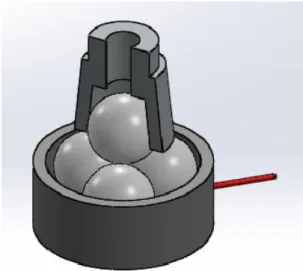
Four-ball tester is to be used to determine the Wear Preventive (PV) properties, Extreme Pressure (EP) properties and the friction of lubricants. There are three parameters than can be controlled for this machine which are applied load, rotating speed and also the temperature of ball cup. The controlled parameter is adjusted according to ASTM D4172 standard used in this experiment.
Figure 1: Four-ball schematic diagram
2.2 Material
The standard balls used in this experiment are made from AISI E-52100 chrome alloy steel, with the following specifications: diameter 12.7 mm; extra polish (EP) grade 25; hardness 64–66 HRC (Rockwell C Hardness). Four new balls were used for each test. Each time before starting a new test, the balls were cleaned with acetone and wiped dry using a fresh lint-free industrial wipe.
2.3 Lubricants
This experiment used palm olein (PO) that mixed with engine oil (EO). The oil composition is (100% - 0%), (80% - 20%), (60% - 40%), (40% - 60%), (20% - 80%) and (0% -100%). This palm olein was mixed with semi synthetic engine oil 15W-50. This oil composition was prepared by measure it using biker. The total of oil that prepare is 400ml for every oil composition. The calculation that use to gets the oil composition as per equation (1).
Oil composition = 100
X
Y (1)
2.4 Wear Scar Diameter
After the experiment, wear scar diameter at the surface of balls can be measured using a charge-couple device (CCD) of low and high resolution microscope. To observe the wear scar on the balls. By using CCD microscope, the wear scar at the three balls bearing can be measured right after finish a set of experiment or all the ball can be keep until it cold and measure by group of test. The wear scar diameter of each of the three bottom test balls was measured to determine the lubricity performance of the test lubricant. In general, the larger the wear scar diameter, the more severe the wear.
2.5 Friction Torque and Coefficient of Friction
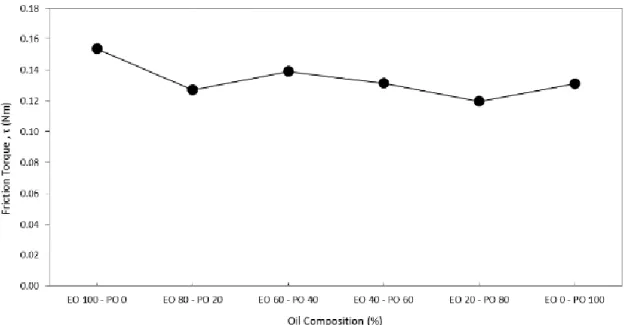
From the four-ball tribotester machine, the friction torque was recorded using specific data acquisition system. The friction torque for all test lubricants increased rapidly at the beginning of the test after 5–10 min, the friction torque data became a steady-state condition. The average of friction torque at the steady state condition was recorded and the friction coefficient.
Golshokouh (Golshokouh et al., 2013) mentioned that the dimensionless scalar value and plays a major role in determining transmission efficiency through the moving parts. From the four-ball tribotester result, all the value of the friction torque is recoded and coefficient of friction will calculate using the equation (2).
Wr T COF 3 6 (2)
Where COF is the coefficient of friction, T is frictional torque (kg.mm), W is the applied load (kg) and r is the distance from the center of the contact surface on the lower balls to the axis of rotation, which was determined to be 3.67 mm.
2.6 Surface Roughness
2.7 Flash Temperature Parameter
The flash temperature parameter (FTP) is a single number that is used to express the critical flash temperature at which a lubricant will fail under given conditions. The FTP refers less possibility of lubricant film to breakdown (Masjuki and Maleque, 1997). High value of FTP means excellent performance of the lubricant. The FTP is usually measured by using the Equation (3) (Ing et al., 2012).
4 . 1
WSD W
FTP (3)
Where W is the applied load in kg and WSD is the wear scar diameter in μm.
2.8 Experimental Conditions
The test is run according to standard ASTM D4172 which is the standard test for Wear Preventive Characteristic of Lubricating Fluid. There are six different ratio of lubricant sample being tested which are the mixture between RBD Palm Olein (PO) and Semi-Synthetic Oil (EO). The condition of the experiment is given as below:
Table 1: Experimental condition
Properties Value
Speed 1200rpm
Temperature 75°C
Time 1 hour
Load 40kg, 60kg, 80kg and 100kg
3.0 RESULTS AND DISCUSSION
The results and data are collected from the experiment. The lubricity performance was analysed with five different parameters which are coefficient of friction (COF), wear scar diameter (WSD), surface roughness (Ra), wear worn surface and flash temperature parameter (FTP).
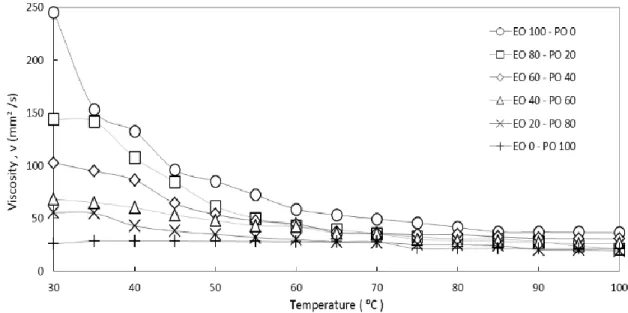
3.1 Density and Kinematic Viscosity
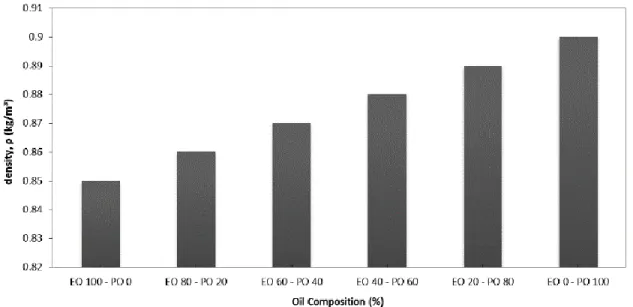
the density value was increase 0.01 kg/m³. As mention by Obasi et al. (2014) the ASTM specification for the density of multigrid engine oil falls within the range of 0.886 to 0.906. But since the value of the 100% of semi syntactic engine oil is without the range this result still valid because the value that get from experiment is same as the value that provide by the manufacture of this semi syntactic engine oil. Base on density condition it shown that all of oil composition can be used as engine oil. But the best density is EO80-PO20 because the value of the density is not different from the EO100-PO0.
Figure 2: Density for all oil composition
Figure 3: Viscosity for all the oil composition
3.2 Friction Torque
Figure 4: Average friction torque for the oil composition
3.3 Coefficient of Friction
Figure 5 shows the coefficient of friction for all sample at 40kg according to ASTM D4172.
Figure 5: Average coefficient of friction at 40kg for all the oil composition
semi syntactic engine oil. This patent happens because of the fatty acids in the palm olein. This fatty acid helps to maintain the lubricant layer and also giving a lower coefficient of friction compare to the semi syntactic engine oil.
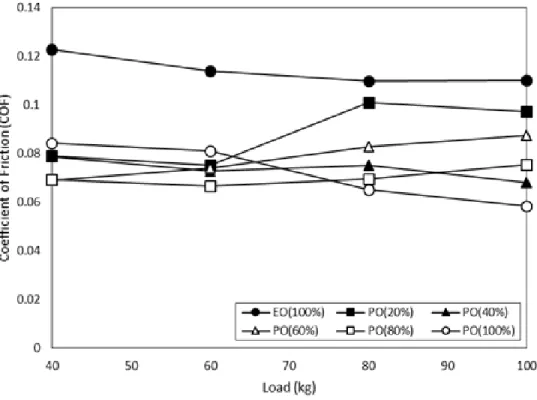
Figure 6 shows the graph of coefficient of friction (COF) against load for six different ratio of sample oil between palm oil and engine oil.
Figure 6: Coefficient of friction of sample lubricant at varies load
From the graph, the sample of lubricant of pure engine oil shows highest COF for every load apply. The value of COF starts to decrease slightly as the load increase from 40kg to 60kg and continue to decrease from 60kg to 80kg. While from 80kg to 100kg of load, the COF for pure engine oil does not show any significant different where 0.109 and 0.11. As the engine oil was mixed with palm oil for certain percentage, the value of
RBD palm olein is start to decrease as the load is applied at 80kg and 100kg and it shows the lowest COF compare to other sample of oil.
3.4 Wear Scar Diameter
All the ball bearing that used during experiment were observed using CCD camera. By using CCD camera, the wear scar picture was captured and the diameter of the wear scar was measured.
Figure 7: Average wear scar diameter at 40kg for all oil composition.
The average wear scar diameter in Figure 7 shown that the value for PO100-PO0 is 354.80µm and for EO0-PO100 the value for wear scar diameter is 615.22µm. For mixed oil between semi syntactic engine oil and palm olein the value for wear scar diameter is lower than the value of EO100-PO0. The value that get is between 315.08µm to 326.98µm. For EO20-PO80 is shown the best result for wear scar diameter. The value of the palm olein is slightly larger compare to the wear scar that has the semi syntactic engine oil. This behavior is likely due to chemical attack on the surface of the balls by the fatty acids present in vegetable oil. This fatty acid is the product of hydrogenation process that takes place during running this experiment and it will contribute to the corrosive effect to the metal.
diameter is nearly the same as other sample of lubricant that mixed with palm olein. When 60 kg of load is applied, the diameter is start to increase until it is same as the wear scar diameter of pure RBD palm olein that is 735µm. The wear scar diameter is remaining constant as 80kg of load is applied and increase slightly until 100 kg applied. While for the sample of oil with mixture of 20%, 40%, 60% and 80% RBD palm olein in engine oil show a same diameter of wear scar around 360µm for 40kg and 410µm at 60kg. As 80 kg and 100 kg load is applied, all sample of lubricant with palm olein as mixture starts to show different value of diameter. The diameter of wear scar for sample of lubricant with 20%, 60% and 80% mixture of RBD palm olein is increase drastically but diameter of wear scar for oil with mixture of 40% RBD palm olein retain at range of 350µm - 550µm and it shows the smallest diameter of wear scar among all sample of oil. For the overall of the analysis, it can be concluded that the RBD palm olein that mixing with engine oil, increase the diameter of wear scar.
Figure 8: Wear scar diameter of sample lubricants at varies load.
3.5 Surface Roughness
Figure 9: Average surface roughness for all oil composition at 40kg
The average value for all the mixed oil composition between semi syntactic engine oil and palm olein is less than the value of 100% of semi syntactic engine oil and palm olein. The value for mixed oil is 0.053µm (EO80-PO0), 0.056µm (EO60-PO40), 0.058µm (EO40-PO60) and 0.052µm (EO20-PO80). From the values that get it shown that the mixed oil can reduce the surface roughness. The value for palm olein 100% highest compare to others because of the possibility happen oxidized by reacting with free fatty acid, this will cause the physical properties of inner metal surface change brittle and experience abrasive wear. This is one of the factors that cause the surface roughness of wear scar become worst.
Figure 10: Surface roughness of sample lubricants at varies load
3.6 Flash Temperature Parameter
The flash temperature parameter (FTP) is a single number that is used to express the critical flash temperature at which a lubricant will fail under given condition as mention by Jabal et al. (2014).
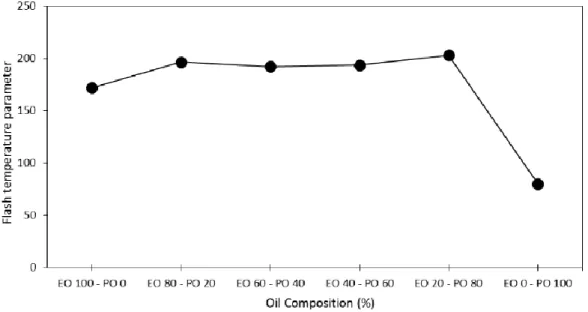
From Figure 11 it shown that the lowest value is 80.16 for flash temperature parameter is get from EO0 – PO100 and the second lowest is EO100 –PO0 was 171.92. The mixed oil the value that get is slightly same around 192.2 to 203.07. From that result it shown that the mixed oil has good flash temperature parameter.
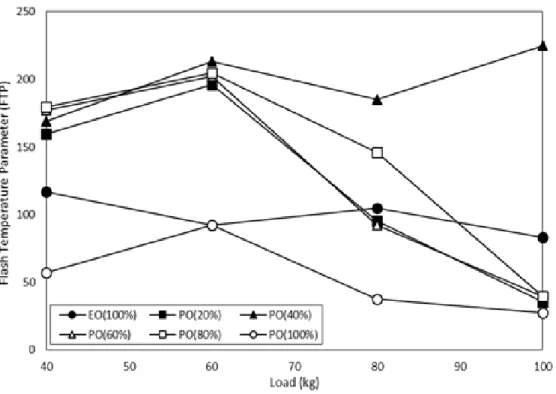
Figure 12: Flash temperature parameter of sample lubricant at varies load
For overall of the values, it can be seen that the sample of lubricant that mixing with 40% RBD palm olein shows the highest value of FTP. The maximum values of FTP
for this sample of lubricant is when 100kg of load is applied with reading of 224.6. While the lowest values of FTP are recorded by pure RBD palm olein for every load applied. In general, it shows that most of the sample of oil increase in FTP as the load increase from 40kg to 60kg but they start to decrease when the load applied is increase to 80 kg and 100 kg.
3.7 Worn Surface Observation
Due to upper ball bearing rotation, the worn material was swept out to others balls surface and lubricant. The contact surface is destroyed if the thickness of lubricant film was less than particles size as mention by Golshokouh et al. (2013).
region) also found on the worn surface for every load applied. As the 100 kg applied on this lubricant, the worn surface start to show black dot as label with A which mean a material removed occur due to metal to metal contact during sliding at high load.
Figure 13: Semi-synthetic engine oil
Figure 14 shows the image of worn surface on ball specimen that lubricated with 20% of RBD palm olein that adding with engine oil. At 40 kg of load applied, the parallel groove can be seen at the worn surface. As the load increase to 60 kg, the worn surface seem rougher than before as there were few parallel grooves shows. This is due to abrasive wear start to occur on this surface of ball specimen. The grooves become deeper and bigger when the load applied increase to 80kg and 100kg. The black region was found on worn surface where it indicates metal to metal contact occurred. Furthermore, it seems to develop a large pit or cavity between the scratches as the surface are plastically deformed and welded together during sliding as label with B.
Figure 14: EO 80 – PO 20
Figure 15: EO 60– PO 40
For Figure 16, the image of worn surface was shows for ball specimen that lubricated using 60% mixture of RBD palm olein with engine oil. The image of worn surface for load applied at 40kg and 60kg shows only fine grooves. As the load applied increase to 80kg and 100kg, both abrasive and adhesive wear occur. From the image, the grooves seem deeper as black region line can be seen clearly and it seems rougher due to cavity look alike develop between the grooves. The big black spot also found on this worn surface with label C which implying the metal to metal contact occurred and the surface were plastically deformed and welded together.
Figure 16: EO 40– PO 60
Then, Figure 17 shows the worn surface image of ball specimen that lubricated with engine oil adding with 80% of RBD palm olein. At load of 40kg, 60kg and 80kg, the worn surface was smooth as there were relatively fine grooves that can be seen. However, at 60kg there were a few of small black spot found. While at 100kg of load applied, the worn surface shows coarse grooves and high scratch which can be seen clearly in the image with label D. It also shown the massive removal of particles. This is due to abrasive and adhesive of wear that occurred.
Figure 17: EO 20– PO 80
seems very smooth where the grooves look very fine. While at 60kg of load applied, the shallow grooves can be seen with a small particle that been remove due to metal to metal contact that occurred in label E. However, when 80kg and 100kg of load applied, the worn surface look very coarse with a deep scratch and the adhesive wear was occurred as the massive particles that been removed can be seen clearly through the image as it labels with F. While at massive load of 100 kg, the surface shows plastically deformed and finally welded together because of the high pressure that is created.
Figure 18: EO 0– PO 100
CONCLUSION
It can be con conclude that by mixed oil between semi syntactic engine oil and palm olein the coefficient of friction was reduce compare if used the 100% of semi syntactic engine oil (EO100-PO0) which is 0.087. The value coefficient of friction for others of oil composition is below 0.079. From this research the best of coefficient of friction was found at EO80-PO20 which is 0.071 and EO20-PO80 which are 0.068.
Wear scar diameter for 100% of palm olein (615.22 µm) and 100% of engine oil (354.80 µm) is highest compare to the all the mix oil. The value for all the mix oil is slightly same is below 327 µm. From this research the best of Wear scar diameter was found at EO80-PO20 which is 324.49 µm and EO20-PO80 which are 315.08 µm. Most of the desired lubricity performance is occur when EO80-PO20.
REFERENCES
Ajithkumar, G., Jayadas, N.H. and Bhasi, M., 2009. Analysis of the pour point of coconut oil as a lubricant base stock using differential scanning calorimetry. Lubrication Science, 21(1), 13-26.
American Society for Testing and Materials, 2010. ASTM D4172 – 94, 2010. Standard test method for wear preventive characteristics of lubricating fluid. (four-ball method).
Bari, S., Lim, T.H. and Yu, C.W., 2002. Effects of preheating of crude palm oil (CPO) on injection system, performance and emission of a diesel engine. Renewable Energy, 27(3), 339-351.
Castro, W., Perez, J.M., Erhan, S.Z. and Caputo, F., 2006. A study of the oxidation and wear properties of vegetable oils: soybean oil without additives. Journal of the American Oil Chemists' Society, 83(1), 47-52.
Chew, T.L. and Bhatia, S., 2009. Effect of catalyst additives on the production of biofuels from palm oil cracking in a transport riser reactor. Bioresource Technology, 100(9), 2540-2545.
Farhanah, A.N., Syahrullail, S. and Sapawe, N., 2015. Tribological performance of raw and chemically modified RBD palm kernel. In Proceedings of Malaysian International Tribology Conference 2015, 207-208.
Ghani, J.A., Kian, Y.S. and Harun, C.H.C., 2015. Performance of commercial and palm oil lubricants in turning FCD700 ductile cast iron using carbide tools. Jurnal Tribologi, 7, 1-9.
Golshokouh, I., Wira, J.Y., Ani, F.N. and Syahrullail, S., 2013. Palm fatty acid distillate as an alternative source for hydraulic oil. Applied Mechanics and Materials, 315, 941-945.
Ing, T.C., Mohammed Rafiq, A.K., Azli, Y. and Syahrullail, S., 2012. The effect of temperature on the tribological behavior of RBD palm stearin. Tribology Transactions, 55(5), 539-548.
Jabal, M.H., Ani, F.N. and Syahrullail, S., 2014. The tribological characteristic of the blends of rbd palm olein with mineral oil using four-ball tribotester. Jurnal Teknologi, 69(6), 11-14.
Lansdown, A.R., 1982. Lubrication: A practical guide to lubricant selection. 1st Ed. United Kingdom: Pergamon Press.
Masjuki, H.H. and Maleque, M.A., 1997. Investigation of the anti-wear characteristics of palm oil methyl ester using a four-ball tribometer test. Wear, 206(1), 179-186.
Syahrullail, S., Azwadi, C.S.N. and Ing, T.C., 2011. The metal flow evaluation of billet extruded with RBD palm stearin. International Review of Mechanical Engineering, 5(1), 21-27.
Syahrullail, S., Wira, J.Y., Wan Nik, W.B. and Fawwaz, W.N., 2013. Friction characteristics of RBD palm olein using four-ball tribotester. Applied Mechanics and Materials, 315, 936-940.
Tiong, C.I., Azli, Y., Kadir, M.R.A. and Syahrullail, S., 2012. Tribological evaluation of refined, bleached and deodorized palm stearin using four-ball tribotester with different normal loads. Journal of Zhejiang University Science A, 13(8), 633-640. Wan Nik, W.B., Ani, F.N. and Masjuki, H.H., 2005. Thermal stability evaluation of palm
2198-Zulkifli, N.W.M., Kalam, M.A., Masjuki, H.H., Shahabuddin, M. and Yunus, R., 2013. Wear prevention characteristics of a palm oil-based TMP (trimethylolpropane) ester as an engine lubricant. Energy, 54, 167-173.