Open Access
Research article
GP and nurses' perceptions of how after hours care for people
receiving palliative care at home could be improved: a mixed
methods study
Heather M Tan*
1, Margaret M O'Connor
1,2, Gail Miles
3, Britt Klein
4and
Peter Schattner
5Address: 1Palliative Care Research Team, School of Nursing and Midwifery, Monash University, Frankston, Victoria 3199, Australia, 2Vivian
Bullwinkel Chair of Palliative Care Nursing, Monash University, Victoria, Australia, 3Royal District Nursing Service, Melbourne, Victoria, Australia, 4National eTherapy Centre, Faculty of Life and Social Sciences, Swinburne University of Technology, Hawthorn, Victoria, Australia and 5Department of General Practice, Monash University, Notting Hill, Victoria, Australia
Email: Heather M Tan* - [email protected]; Margaret M O'Connor - [email protected]; Gail Miles - [email protected]; Britt Klein - [email protected]; Peter Schattner - [email protected] * Corresponding author
Abstract
Background: Primary health care providers play a dominant role in the provision of palliative care (PC) in Australia but many gaps in after hours service remain. In some rural areas only 19% of people receiving palliative care achieve their goal of dying at home. This study, which builds on an earlier qualitative phase of the project, investigates the gaps in care from the perspective of general practitioners (GPs) and PC nurses.
Methods: Questionnaires, developed from the outcomes of the earlier phase, and containing both structured and open ended questions, were distributed through Divisions of General Practice (1 urban, 1 rural, 1 mixed) to GPs (n = 524) and through a special interest group to palliative care nurses (n = 122) in both rural and urban areas.
Results: Questionnaires were returned by 114 GPs (22%) and 52 nurses (43%). The majority of GPs were associated with a practice which provided some after hours services but PC was not a strong focus for most. This was reflected in low levels of PC training, limited awareness of the existence of after hours triage services in their area, and of the availability of Enhanced Primary Care (EPC) Medicare items for care planning for palliative patients. However, more than half of both nurses and GPs were aware of accessible PC resources.
Factors such as poor communication and limited availability of after hours services were identified the as most likely to impact negatively on service provision. Strategies considered most likely to improve after hours services were individual patient protocols, palliative care trained respite carers and regular multidisciplinary meetings that included the GP.
Conclusion: While some of the identified gaps can only be met by long term funding and policy change, educational tools for use in training programs in PC for health professionals, which focus on the utilisation of EPC Medicare items in palliative care planning, the development of advance care plans and good communication between members of multidisciplinary teams, which include the GP, may enhance after hours service provision for patients receiving palliative care at home. The role of locums in after PC is an area for further research Published: 14 September 2009
BMC Palliative Care 2009, 8:13 doi:10.1186/1472-684X-8-13
Received: 14 May 2009 Accepted: 14 September 2009
This article is available from: http://www.biomedcentral.com/1472-684X/8/13 © 2009 Tan et al; licensee BioMed Central Ltd.
Background
Palliative care (PC) emerged as a discipline during the twentieth century [1] with notable advances made in Aus-tralia, beginning in the 1980s [2]. As health services pro-vided for those 'whose disease is not responsive to curative treatment', the PC movement reached acute hos-pitals, the home and sub-acute settings such as aged care [3,4].
Another development has been the acceptance of the ben-efits of PC being delivered beyond those with a diagnosis of cancer to those people suffering from a chronic illness [3]. The Australian government has remained supportive of maintaining a person's optimal health status whilst liv-ing in the community [5].
The literature has established that PC service delivery has changed from a focus on institutional settings to home service style delivery [6,7] and from a single discipline service to a multidisciplinary, supportive service within all settings [8]. The necessity for GPs and primary care pro-viders, such as nurses, to be educated and skilled in PC is also the focus of a number of articles [9,10]. There is, how-ever, limited evidence of how PC after hours services are accessed by clients and carers when it is not part of a par-ticular PC service. Support, anxiety and sleep problems have been reported as concerns in after hours telephone enquiries received by GPs and hospitals [11].
Rurality features significantly in the Australian literature and the significance of this setting for PC provision has been reported [12] with PC support services provided by differing models of care. Enhanced Primary Care, under Medicare (Australia's system of universal access to health care) is one of a number of initiatives for chronic disease management through a multidisciplinary team approach, which when extrapolated equates to the delivery of a pal-liative approach in community settings [13]. The recogni-tion of the significant carer contriburecogni-tion required to maintain a dying person at home was at the centre of an Australian study of carer's physical and mental wellbeing [14].
The provision of 24 hours a day, seven days per week PC services has been advocated, [15] though the question arises as to how these PC services operate in rural and urban communities where limited availability has been reported. There is an expectation for all community serv-ices offering a palliative approach to be equitable in rural and urban communities. Twenty four hour access is described as the 'gold standard' for PC service delivery, yet little data is available to justify the cost of this initiative to health care planners [15]. The means of distribution of concise, relevant and timely information about unstable patients to nurses and GPs involved in after hours care is
challenging [16]. One rural region of Northern Victoria (Australia) reported that due to the shortage of GPs, an after-hours PC rural telephone triage system added an extra burden to the nursing staff addressing PC enquiries [17]. This is the first published report of the extra burden on nursing staff for PC after hours services.
Access to after hours PC community services by people receiving PC and their carers, in both rural and urban environments of Victoria is the central focus of this Aus-tralian study conducted in three phases. Participants were drawn from three Divisions of General Practice, one urban, one urban and semi-rural and the other rural and remote. The findings of phase 1, a qualitative study of stakeholders' experience of after hours palliative care serv-ice provision [18], also support many of the findings described above and formed the basis for this mixed methods phase 2 of the project reported in this paper.
Methods
Participants
Only GPs (n = 524) who were affiliated with the partici-pating Divisions of General Practice in Victoria and nurses (n = 112) who were members of the Palliative Care Special Interest Group of the Australian Nursing Federation (Vic-torian Branch) were invited to participate in this phase of the study.
Study Instruments
Key findings of the qualitative phase 1 [18] of the project were utilised in the design of questionnaires, for GPs (see Additional file 1) and nurses (see Additional file 2), to facilitate further exploration of the challenges of provid-ing after hours care for people receivprovid-ing palliative care at home. These questionnaires consisted of six main sections which collected information about demographic details, service for which the participant worked, after hours serv-ices in their area, patient management, barriers to effective after hours care (9 items) and strategies to improve this care (13 items). The latter two sections included a five point Likert Scale (1-5) allocated as follows: "strongly agree" = 1, "agree" = 2, "disagree" = 3, "strongly disagree" = 4 and "don't know" = 5. Questionnaires were distrib-uted to both GPs in the participating regions and nurses involved in palliative care provision.
and asking them to contact the project officer for the study to obtain more information and the questionnaire. These were mailed, along with a reply paid envelope to those who requested it. A reminder notice was sent via email to all the GPs and nurses one month after initial contact had been made by the relevant Divisions of General Practice and the PC Nurses Special Interest Group.
Data Analysis
Data were coded, entered and analysed with the assistance of SPSS data analysis software version 16.0. Descriptive analysis using frequency distribution and mean scores was carried out. To compare GP's and nurse's responses to questions relating to 'factors which would impact on after hours PC service' and 'strategies which may improve after hours PC service', a comparative analysis was carried out.
Ethics Approval
Ethics approval was granted by the Monash University Standing Committee on Ethics in Research Involving Humans.
Results
Response rates
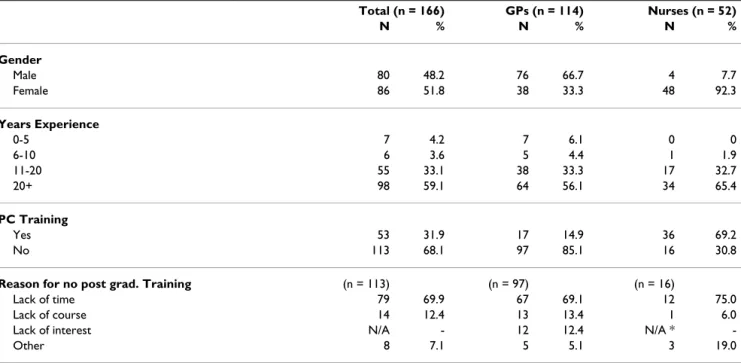
Five hundred and twenty four GPs and 122 nurses were informed about the study. Of the above, 114 GPs (22% response rate) and 52 nurses (43% response rate) returned completed questionnaires. Participant demo-graphic data including gender, years of experience, spe-cialist PC training and reasons for not having any are outlined in Table 1. It was found that only 15% of
partic-ipating GPs had undertaken post graduate PC training, 70% of those who had not citing lack of time as the reason for not doing so. 69% of participating nurses had under-taken postgraduate PC training, lack of time again being the dominant reason for not doing so.
Service provision
Data relating to the provision of after hours service, the use of Enhanced Primary Care Medicare items, the exist-ence of a telephone triage service in their area, access to palliative care resources and level of satisfaction with serv-ice provision are shown in Table 2.
Some GPs indicated that they did not use the EPC items because they do not like the paper work involved. Some also said that they would find it useful to have more infor-mation about what PC services are available in their area and what they can provide. Additional resources such as more access to specialist PC consultants and PC nurses, patient data after hours and to RDNS palliative care guide-lines were suggested.
It should be noted that in most cases in urban and semi-rural areas GP after hours service was provided by locums. Of the 83 respondents in the urban and mixed urban/ semi-rural divisions only 14 indicated that there was no locum service and all of these were located in the urban/ semi-rural division. However, only 2 of the 29 GP partici-pants in the rural/remote division had access to a locum service.
Table 1: Sample characteristics of the participants (GPs and Nurses)
Total (n = 166) GPs (n = 114) Nurses (n = 52)
N % N % N %
Gender
Male 80 48.2 76 66.7 4 7.7 Female 86 51.8 38 33.3 48 92.3
Years Experience
0-5 7 4.2 7 6.1 0 0
6-10 6 3.6 5 4.4 1 1.9
11-20 55 33.1 38 33.3 17 32.7 20+ 98 59.1 64 56.1 34 65.4
PC Training
Yes 53 31.9 17 14.9 36 69.2 No 113 68.1 97 85.1 16 30.8
Reason for no post grad. Training (n = 113) (n = 97) (n = 16)
Factors impacting on after hours PC service
Participating GPs and nurses were also asked about factors which they considered may impact on effective after hours service provision. Table 3 shows the percentage of partici-pants who strongly agreed or agreed with the given state-ment. Poor communication between nurses and GPs was considered the most important factor while, of the possi-bilities considered, poor phone coverage was the least important.
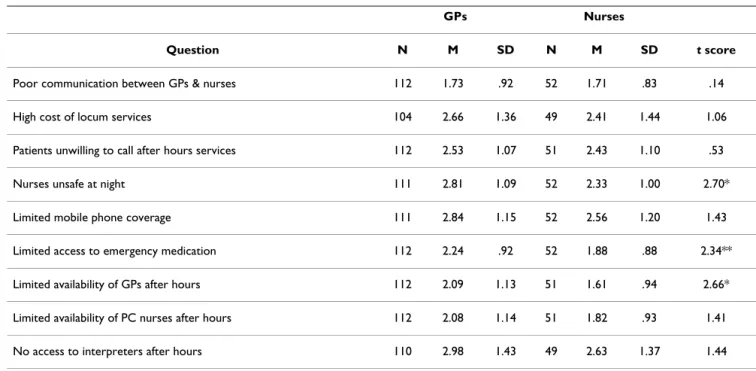
Further analysis including mean, standard deviation and t test were undertaken comparing the responses of GPs and nurses to the questions in this section of the question-naire. The results of this analysis are shown in Table 4. Note that lower scores equate to higher rating. Nurses and GPs held similar views on six of the nine factors which potentially impact on after hours PC. There were however three factors on which they held significantly different views nurses consistently rating them as more likely to be
Table 2: Service provision in their service/area frequency (percentage) data
Total (n = 166) GPs (n = 114) Nurses (n = 52)
N % N % N %
After Hours Service Provision by their Service
Calls 102 61.4 68 59.6 34 65.3* Visits 122 73.5 80 70.2 42 80.7
EPC Items
Use generally N/A 84 73.7 N/A** Aware can use for PC planning N/A 60 52.6 N/A**
Tel. Triage Protocol in Area
Yes 50 30.1 16 14.0 34 65.4 No 52 31.3 42 36.9 10 19.2 Don't Know 64 38.6 56 49.1 8 15.4
Aware of PC Resources
Yes 102 61.5 67 58.8 35 67.3 No 64 38.5 47 41.2 17 32.7
Current Services Satisfactory
(agree or strongly agree combined) Hospital discharge
planning
107 64.5 79 69.3 28 53.8 Home care
planning
141 84.9 100 87.7 41 78.8 After hours
service provision
123 74.1% 88 77.2 35 67.3
Note *8 nurse participants did not currently work in PC service; * *Enhanced Primary Care Items (EPC) not available to nurses
Table 3: Factors which may impact on after hours PC services as endorsed by GPs and Nurses (Percentage frequencies)
Factors which may impact on after hours PC services GPs Nurses
Table 4: Means, Standard Deviations and scores on the factors which may impact on after hours PC services(Mean scores)
GPs Nurses
Question N M SD N M SD t score
Poor communication between GPs & nurses 112 1.73 .92 52 1.71 .83 .14 High cost of locum services 104 2.66 1.36 49 2.41 1.44 1.06 Patients unwilling to call after hours services 112 2.53 1.07 51 2.43 1.10 .53 Nurses unsafe at night 111 2.81 1.09 52 2.33 1.00 2.70* Limited mobile phone coverage 111 2.84 1.15 52 2.56 1.20 1.43 Limited access to emergency medication 112 2.24 .92 52 1.88 .88 2.34** Limited availability of GPs after hours 112 2.09 1.13 51 1.61 .94 2.66* Limited availability of PC nurses after hours 112 2.08 1.14 51 1.82 .93 1.41 No access to interpreters after hours 110 2.98 1.43 49 2.63 1.37 1.44 *p < 0.01; ** p < 0.05
Table 5: GPs and Nurses views of strategies which may improve after hours PC service using percentage frequencies
Strategies that may improve after hours PC GPs Nurses
barriers to care. These were: nurses feeling unsafe at night, limited access to emergency medication after hours and limited availability of GPs after hours.
Strategies to Improve After Hours PC Services
Participants were invited to rate suggested strategies which may improve after hours services. Table 5 indicates the percentage of participants who either strongly agreed or agreed (categories combined) with the suggested strategy. Individual patient protocols, accessible to after hours staff and PC trained respite carers were the two strategies con-sidered most likely to improve after hours service provi-sion by both GPs and nurses. On the other hand the allocation of more specific PC beds in local hospitals and the referral of patients to PC services at time of diagnosis were considered by both GPs and nurses to be least likely to improve after hours PC services.
Further analysis to examine the differences between the two groups -including mean, standard deviation and t test - was undertaken. This revealed significant differences between the two groups on seven of the 13 suggested strat-egies for improvement of after hours PC. These seven
strategies were: a formal protocol between PC service and indigenous Australians, regular multidisciplinary team meetings, more nurses for home visits, PC trained nurses on after hours telephone service, PC trained respite carers, more support and debriefing for GPs and nurses and leg-islation to allow nurse evaluation of death. The results of is analysis this shown in Table 6
Discussion
The findings of this phase of the project provided more detailed information about some of the main areas of concern regarding the provision of after hours palliative care that were identified in phase 1 of the project [18]. In particular these data present the views of two different groups of health professionals, GPs and palliative care nurses, regarding how after hours care of palliative patients in the community might be improved.
Demographic Profile
The demographic details of the participants provided some points of interest. Almost all (GPs 89% and nurses 98%) who participated in the study had more than 11 years experience and in both cases the majority of those
Table 6: Mean, Standard Deviation and t scores on strategies which may improve after hours PC service between GPs and Nurses
GPs Nurses
Question N M SD N M SD t
who responded had more than 20 years experience. If this is representative of the general GP and PC nurse work force, this has important implications for future palliative care services in the community as many of these people are approaching retirement age. In the case of GPs this is consistent with other findings [19], which identified that in a sample of GPs working in the southern and north western regions of Sydney, those not involved in provid-ing PC were likely to be younger and have less GP experi-ence than those who did provide this care. In our study the percentage of GPs who had undertaken postgraduate palliative care training (14%) was higher than that identi-fied in the above Sydney study (9.1%) [19]. It should be noted that our finding of 69% of nurses having under-taken palliative care training is not representative of the general nursing population, as participants were all drawn from a PC nurses special interest group.
Service provision
While many (more than 60%) of the participants were associated with practices or organisations which provided after hours PC services there was a notable lack of knowl-edge about service provision. For example, 47% of GPs were unaware that EPC Medicare items could be used for care planning for people receiving PC, both in the devel-opment of advance care plans and for team meetings with multidisciplinary PC teams, even though this information is provided on relevant Division of General Practice web-sites. It was also found that 49% of GPs did not know if after hours triaged telephone services were available in their area. One explanation for this may be that the major-ity of the participating GPs did not personally provide after hours services but relied on locum services, a notion supported by the data presented above in relation to the use of locum services. Clearly the availability of locum services is one of the inequitable situations in the provi-sion of health care (and no doubt after hours palliative care) between urban and rural/remote areas. Phase 1 of this study also indicated that some of the problems expe-rienced with after hours locum services included costs, lack of PC training among locum doctors, lack of knowl-edge of specific patient needs and very long delays in get-ting service [18]. Limited literature is available regarding provision of after hours PC services by locum GPs in Aus-tralia and so this offers opportunity for further investiga-tion.
It was also observed that GPs (77%) considered that cur-rent after hours services were either very satisfactory or sat-isfactory (combined result) compared to only 67% of nurses who participated. Given that nurses participating in this study were recruited from a PC nurses' special inter-est group, this difference may be a reflection of greater nurse involvement in the provision of after hours PC serv-ices.
Factors which may impact of after hours PC services
Both nurses and GPs were asked to indicate their agree-ment or otherwise with a number of stateagree-ments about fac-tors which may impact on after hours service provision. For six of the nine factors listed there was no significant difference in the views of GPs and nurses. The factor on which there was closest agreement and which also had the lowest mean score across the two groups (i.e closest to 'strongly agree') was 'poor communication between GPs and nurses will impact on after hours PC service provi-sion'. Another factor on which there was close agreement was 'patients being unwilling to call after hours services when they were available'. These factors have also been identified in earlier studies [20-24].
The three factors on which there was a significant differ-ence of view between the two groups were: nurses feeling unsafe at night, limited access to after hours emergency medication, and limited availability of GPs after hours. In each case the nurses indicated that these issues were more likely to impact on after hours services than did the GPs. There are two likely factors which may have contributed to the difference of views in relation to nurse safety. Nurses are more likely to be focused on that than other work force sectors. Also in this study, as already indicated very few of the GPs personally attended to after hours calls these being addressed by locum services. It is very likely that among the participants of this study nurses were much more likely to be making after hours calls than the GPs. Limited access to emergency medication after hours has also been reported as problematic [22]. There is potential for further investigation of this issue. Are factors such as poor communication, incomplete planning and lack of access to GPs and pharmacies after hours contrib-uting to this problem? As already indicated the use of locum services in the provision of after hours PC, includ-ing the issue of cost to patients, needs further investiga-tion. Greater access to GPs after hours was also cited as important by patients in a UK study [25].
Strategies which may improve after hours PC service provision
A high percentage of both nurses and GPs agreed or strongly agreed that standardised written or individual patient protocols would improve after hours services. It needs to be acknowledged that these are only helpful in relation to after hours care if after hours on call staff, including locums, have access to them.
services and aboriginal Australians. Some of the partici-pants (more GPs than nurses) in this study indicated that lack of experience with aboriginal clients prevented them from forming an opinion on this matter.
One important area of significant difference between the two groups was the usefulness of multidisciplinary team meetings, which include the GP, in improving after hours PC services. Possibly GP concerns about the time involved in such meetings and that 49% were unaware that they can use EPC Medicare items to fund this activity, may in part explain this difference. One study has reported that GPs expressed concern about the degree to which they should refer to specialist teams [21]. It is not known if this was a contributing factor to GPs lesser enthusiasm for multidisciplinary team meetings in our study.
Another area of significant difference of view between the two groups related to having more PC trained nurses staff-ing after hours telephone services. It has been reported [24] that referral and the type of follow-up of triaged after hours calls was related to nurse training and confidence in palliative care. This would support the very strongly held view of nurses that after hours service provision would be improved by increasing the number of PC trained nurses available to these after hours call services.
Support both for carers, either the provision of such opportunities as support groups or respite care provided by PC trained respite carers, or for professionals in the form of great opportunities for debriefing, were other strategies considered. Nurses were significantly more likely to consider that PC trained respite carers would improve after hours service. They were also more likely to consider that service provision would be improved by greater support for staff. This difference may have occurred because participating nurses, who were all mem-bers of a PC nurses' special interest group, were much more likely than GPs to be working on a daily basis with people receiving PC and their carers.
The other contentious issue related to changing legislation to allow nurse evaluation of death. Of the thirteen strate-gies considered this one resulted in the greatest variation in mean scores between the two groups. It is noteworthy that the Victorian Department of Human Services (DHS) has recently (July 2009) issued a Guidance Note [26] relating to the verification of death. This note reinforces that Division 1 and 3 Registered Nurses (as defined by the Health Professionals Registration Act 2005) and Paramed-ics (as certified by Ambulance Victoria) in an employment context, can verify death, allowing the removal of a body from the site of death. Only registered medical practition-ers may certify death by completing the required form.
While all of the issues raised by the participants in this sec-ond phase of the project were considered important, it was not possible within the scope of the project to address them all in the final phase, which focused on the produc-tion and evaluaproduc-tion of educaproduc-tional tools. For example, some issues such as the shortage of PC trained staff and respite carers cannot be addressed by a project of this nature. However, four main areas, which were considered most feasible in the context of the project, were selected for action. These were: perceived reluctance of patients and carers to utilise available after hours services; poor uti-lization by GPs of Enhanced Primary Care Medicare Items for palliative care planning and team communication; the importance of advance care planning in relation to appro-priate after hours care and communication within multi-disciplinary teams which include the GP. A brochure directed to patients and their carers and a DVD, with web-site version, for health professionals, were produced pro-moting these main areas. The web address is: http:// www.med.monash.edu.au/ahpc.
Limitations
There are two limitations evident in this study. The very low response rate, particularly from GPs (22%) is clearly an issue in terms of generalisability of the outcomes. Although the response rate of nurses was about twice as high as that of GPs the number of nurse participants was les than half the number of GPs. As already indicated all the nurses had a declared interest in PC where as this was not necessarily an area of interest for the GPs. The deci-sion was made to work with the general GP population as this was thought to be important in getting a clear picture of environment in which community palliative care serv-ices are provided. This most likely is a contributing factor to some of the differences of views of the two groups.
It was also evident that there was opportunity for multiple interpretations of some questions. This may well explain the very high level of 'missing' answers to the question relating to the provision of more specific PC beds in local hospitals (see Table 6). It was evident from added com-ments that some participants considered that the question was not applicable if beds were already provided in their area. The questionnaires will be refined for further use in a larger study.
Conclusion
wide-spread use of locums in the provision of after hours care also exacerbates provision difficulties and would benefit from further exploration. Communication within multi-disciplinary teams, and in particular the inclusion of the GP, remains an inhibitor to the provision of good after hours care. Equitable after hours care in all areas contin-ues to provide a major challenge.
Competing interests
The authors declare that they have no competing interests.
Authors' contributions
HMT was involved in data analysis and interpretation, wrote the draft version of this article and has given final approval for the version to be published. MOC was the chief investigator for the project, was involved in the development and design of the project, has revised the article critically for important intellectual content and given final approval for the version to be published. GM was involved in the design and development of the project, has edited and given final approval for the version to be published. BK was involved in the design and devel-opment of the project, has edited and given final approval for the version to be published. PS was involved in the design and development of the project, has edited and given final approval for the version to be published.
Additional material
Acknowledgements
1. This project was funded by the Commonwealth Government of Australia Department of Health and Aging.
2. The work of Dr Lisa Ceichomski in the collection and some of the anal-ysis of data for this phase of the project is acknowledged.
References
1. Hudson R, O'Connor M: Palliative Care and Aged Care: A Guide to Prac-tice New York: Ausmed Publications Pty Ltd; 2007.
2. Allen S, Chapman Y, O'Connor M, Francis K: Discourses associ-ated with nursing aged people who are dying in the
Austral-ian context: a review of the literature. Int Nurs Rev 2008,
55:349-354.
3. Australian Government Department of Health & Ageing: Guidelines for a Palliative Approach in Residential Aged Care: The National Palliative Care Program Canberra: Department of Communications, Information Technology and the Arts; 2004.
4. Kuebler KK, Berry PH, Heidrich DE: End of Life Care: Clinical Practice Guidelines Philadelphia: W.B. Saunders Company; 2002.
5. Palmer GR, Short SD: Health Care & Public Policy: An Australian Analysis
South Yarra. MacMillan Publishers Australia Pty Ltd; 2007. 6. Boyd CO, Vernon GM: Primary care of the older adult with
end-stage Alzheimer's disease. Nurse Practitioner: American Jour-nal of Primary Health Care 1998, 23(4):63-64.
7. Walshe C, Caress A, Chew-Graham C, Todd C: Implementation and impact of the Gold Standards Framework in community palliative care: a qualitative study of three primary care trusts. Palliat Med 2008, 22:736-743.
8. Evans R, Stone D, Elwyn G: Organizing Palliative care for rural populations: a systematic review of the evidence. Fam Pract
2003, 20:304-310.
9. Farber NJ, Urban SY, Collier VU, Metzger M, Weiner J, Boyer EG:
Frequency and perceived competence in providing palliative care to terminally ill patients: a survey of primary care phy-sicians. J Pain Symptom Manage 2004, 28(4):364-372.
10. Goldschmidt D, Groenvold M, Johnsen AT, Stromgren AS, Krasnik A, Schmidt L: Cooperating with a palliative home-care team: expectations and evaluations of GPs and district nurses. Pal-liat Med 2005, 19(3):241-250.
11. Jo S, Brazil K, Lohfeld L, Willison : Caregiving at the end of life: Perspectives from spousal caregivers and care recipients.
Palliat Support Care 2007, 5:11-17.
12. Elsey B, McIntyre J: Assessing a supportive and learning net-work for palliative care net-workers in a country area of South Australia. Aust J Rural Health 1996, 4:159-164.
13. Australian Department of Health and Ageing: Enhanced Primary Care Medicare Items: Note A30 2000 [http://www.health.gov.au/internet/ main/publishing.nsf/Content/pacd-epc-dev-proforma.htm].
14. Zapart S, Kenny P, Servis B, Wiley S: Home-based palliative care in Sydney, Australia: the carer's perspective on the provision of informal care. Health Soc Care Community 2007, 15(2):97-107. 15. Philips J, Davidson PM, Newton PJ, DiGiacomo M: Supporting
Patients and Their Caregivers After-Hours at the End-of-Life: The Role of Telephone Support. J Pain Symptom Manage
2008, 36(1):11-21.
16. Brumley D, Fisher J, Robinson H, Ashby M: Improving access to clinical information in after hours community palliative care.
Aust J Adv Nurs 2006, 24(1):27-31.
17. Chan SQ, Yong E, Ting A, Kendrick M, DeWitt DE: Rural health-care provider options about implementation of an after-hours rural telephone triage system. Rural Remote Health 2007,
7(1):1-3.
18. Ciechomski L, Tan H, O'Connor M, Miles G, Klein B, Schattner P:
After Hours Palliative Care Provision in Rural and urban Vic-toria, Australia. Asia Pacific Journal of Health Management 2009,
4(1):57-63.
19. Rhee J, Zwar N, Vagholkar S, Dennis S, Broadbent A, Mitchell G:
Attitude and Barriers to Involvement in Palliative Care by Australian Urban General Practitioners. J Palliat Med 2008,
11(7):980-985.
20. Low JA, Liu RK, Strutt R, Chye R: Specialist, community pallia-tive care services - a survey of general practitioners' experi-ences in Eastern Sydney. Support Care Cancer 2001, 9(7):474-476. 21. Mitchell GK: How well do general practitioners deliver pallia-tive care? A systematic review. Palliat Med 2002, 16:457-464. 22. Worth A, Boyd K, Kendall M, Heaney D, Macleod U, Cormie P,
Hockley J, Murray S: Out of hours palliative care: a qualitative study of cancer patients, carers and professionals. Br J Gen Pract 2006, 56(522):6-13.
23. Wilkes L, Mohan S, White K, Smith H: Evaluation of an after hours telephone support service for rural palliative care patients and their families: A pilot study. Aust J Rural Health
2004, 12:95-98.
24. Aranda SK, Hayman-White K, Devilee L, O'Connor M, Bence G:
Inpatient hospital triage of 'after-hours' calls to a community palliative care service. Int J Pall Nurs 2001, 7(5):214-220.
Additional File 1
GP survey questionnaire. Questionnaire sent to GPs in participating Divisions of General Practice.
Click here for file
[http://www.biomedcentral.com/content/supplementary/1472-684X-8-13-S1.doc]
Additional File 2
Nurse survey questionnaire. Questionnaire sent to nurses who are mem-bers of Palliative Care Nurses special interest group.
Click here for file
Publish with BioMed Central and every scientist can read your work free of charge "BioMed Central will be the most significant development for disseminating the results of biomedical researc h in our lifetime."
Sir Paul Nurse, Cancer Research UK
Your research papers will be:
available free of charge to the entire biomedical community
peer reviewed and published immediately upon acceptance
cited in PubMed and archived on PubMed Central
yours — you keep the copyright
Submit your manuscript here:
http://www.biomedcentral.com/info/publishing_adv.asp
BioMedcentral
25. Borgsteed S, Graafland-Riedstra C, Deliens L, Francke A, van Eijk J, Willems D: Good end-of-life care according to patients and their GPs. Br J Gen Pract 2006, 56(522):20-26.
26. Victorian Department of Health Services: Verification of Death by Nurses and Paramedics - Guidance Note 2009 [http:// www.health.vic.gov.au/nursing/verification-of-death-by-nurses-and-paramedics].
Pre-publication history
The pre-publication history for this paper can be accessed here: