USING AUDIT COMMITTEE AND INTERNAL
AUDIT FUNCTION INTER-RELATIONSHIPS
TO DRIVE UP EFFECTIVENESS
1
Naqiah Razak* and Rusnah Muhamad
Abstract
The Audit Committee (AC) has become a common mechanism for ensuring good corporate governance in firms. The interaction between the AC and Internal Audit Function (IAF) is important for the AC in fulfilling its oversight responsibilities. Hence, it is very important that the interaction between the respective roles of the AC and IAF is of good quality. However, little is understood about the quality of the interaction between these two roles. Extant literature suggests that a conclusive theory and/or theories are lacking that can provide an in depth understanding of how the AC and IAF foster a quality working relationship between their respective roles. Hence, we are proposing the relational coordination theory as a framework to enrich the understanding of the interaction between the AC and IAF. This conceptual paper reviews the literature on the AC effectiveness (ACE) and process, and analyses how the interaction quality can be determined using the proposed conceptual model encapsulating this theory.
Keywords: Audit Committee Effectiveness; Internal Audit Function; Relational Coordination Theory
JEL classification: M42
1. Introduction
Corporate Governance (CG) is an imperative concept as it concerns corporate performance enhancement through monitoring or evaluation of management performance, and ensuring the accountability of management to shareholders and other stakeholders (Keasey and Wright, 1997 as cited in Spira, 1999). However, mega scandals across the globe in the past decade have called for stronger CG, and prompted the public to question the integrity and effectiveness of the monitoring system in an organisation (Raphaelson and Wahlen, 2004). Thus, many countries began to reform their CG mechanisms in response to the risks that poor monitoring systems pose. Major reforms were made concerning the responsibilities of the principal actors in the CG mosaic, such as the management, external and internal auditors, board of directors (BoD), as well as the Audit Committee (AC) (Cohen, Krishnamoorthy, and Wright, 2004; 2010).
The AC is widely promoted as a CG mechanism by regulatory and professional bodies in many countries because the AC monitors management on behalf of shareholders. This monitoring role by the AC is vital to ensure a ‘true and fair view’ of financial statements and effective internal controls, thus making it an integral part of most CG systems. The information asymmetry that exists between the agents and the principal (i.e. agency problem) is reduced when the AC acts as a monitoring mechanism. The level and intensity of this agency problem is argued to be further reduced or resolved when ACs are effective in their monitoring role (Chen, Chen and Wei, 2008; Dey, 2008). However, the efficacy and efficiency of an AC may be compromised when the AC is composed of non-executive directors, as information asymmetries may occur between these directors and management, which may cause doubt concerning the ability of ACs to protect the credibility of financial statements (Raghunandan, Read, and Rama, 2001). In order to resolve these doubts, the impact and effectiveness of the AC can be improved through several significant factors. One of these factors is its relationship with the IAF as a resource provider to the AC on organization-specific matters (Bishop, Hermanson, Lapides, and Rittenberg, 2000).
Raghunandan et al. (2001), and Scarbrough, Rama, and Raghunandan, (1998) attest that information asymmetry between the AC and operational people is likely to be reduced when good quality interaction exists between the AC and IAF. Prior studies indicate that a quality reciprocal relationship between the AC and IAF entails the AC strengthening the IAF whilst the internal auditors are an important resource to the AC (Bishop et al., 2000; Braiotta, 1999; Verschoor, 1992 and Turley and Zaman, 2004). Nevertheless, these studies reveal little concerning how to achieve quality AC-IAF interaction and how this interaction impacts the effectiveness of the decision-making process of the AC. This is because these studies applied an economic perspective by focusing on the measureable features of the AC (such as the number of financial experts or independent members) through quantitative methodologies. The outcome of these studies merely revealed that ACs with greater independence and members with financial expertise (i.e. technical expertise) interact more extensively with internal auditors. This simply tells us that the mutual interdependent relationship between the AC and IAF is an interdependent relationship between tasks (i.e. technical work process). However, the mutual interdependency that is shared between the AC and IAF should not be viewed simply as interdependence between tasks, but as interdependence between the people who perform these tasks (i.e. behavioural process). Therefore, research to identify ACE fulfilling its oversight role needs to move beyond the neoclassical economics theoretical framework and encapsulate a more behavioural and psychological perspective. One way of doing this is through the use of qualitative methodology.
and capture a richer depth of information. This makes qualitative methods valuable for theory building and elaboration (Glaser and Strauss, 1967; Strauss and Corbin, 1988). Through the use of qualitative research, adopting a behavioural and psychological theoretical lens (in the form of relational coordination) opens up a new perspective for understanding the ACE, as current research in the AC process and behaviour is limited (Beasley, Carcello, Hermanson and Neal, 2009; Cohen, Krishnamoorthy and Wright, 2008; 2010).
The main objective of this conceptual paper is to extend the prior research on the ACE framework. In this paper, we are proposing a framework using qualitative methodology by adopting a behavioural and psychological theoretical lens (in the form of relational coordination theory) to understand the ACE through the interaction quality of the AC and IAF. The importance of this proposed conceptual framework is described as follows. First, this research adds to the understanding of the ACE through the process dimension. Secondly, this research provides a new conceptual framework that adopts a behavioural and psychological perspective in extending prior ACE frameworks. This paper is organized into the following parts. The first part provides the literature review, which discusses prior literature concerning the interaction of ACE and AC-IAF. The second part provides the proposed conceptual framework. Finally, the conclusion together with the discussion concerning the implications of the research and the direction for future research are presented.
2. Literature Review
2.1. Audit Committee Effectiveness (ACE)
moved from its earlier focus of whether companies possessed an AC and what was the impact of the AC presence on a range of company characteristics and behaviour to issues such as its composition and expertise, and relationship with other elements of governance within companies (Ghafran and O’Sullivan, 2013). Most ACE studies primarily focused on the economic perspective by espousing the agency theory framework. In order to investigate effectiveness, prior researchers essentially relied on a “black box” approach in which analysis was restricted to the quantitative examination of relationships between the measurable features of the AC and the indicators of effectiveness. Spira (2003) states that detailed accounts of the role, membership characteristics and duties of the AC are unlikely to improve CG without understanding how it works in practice. Carcello, Hermanson and Ye (2011) argue that to capture the ACE the agency theory is not the only theory and neither are the formal AC characteristics the only factors to be considered. Anecdotal evidence shows that ACs with mandated characteristics of effectiveness still fail. Therefore, it is possible that although ACs may appear to structurally follow the agency perspective, the actions of its members may follow the institutional perspective. As a result of ‘black boxing’, Gendron and Bedard (2006) argue that regulators and professional bodies are implementing regulations and providing best practices based on shaky foundations. This is because amendments in regulations or best practices on the promotion of the ACE (such as described earlier) are based on unproven, and, to a great extent, unquestioned assumptions, which can be misleading to those who must have assumed (i.e. shareholders) that the existence of such structures and processes protects their interests (Spira, 2003). Past studies espousing the “black box” approach do not provide insights into the nature of the work carried out by the AC members per se, nor do they identify the way in which the meaning of ACE is socially constructed (Gendron and Bedard, 2006). In short, these studies have more or less neglected the process and behaviour through which the AC members operate (Beasley et al., 2009).
to elicit information, and the relational process of informal networks of the AC members to better understand ACE. Hence, it cannot be stressed enough that understanding the AC process is the key to developing a better understanding of ACE (Gendron, Bedard and Gosselin, 2004). In order to shape the meaning of ACE, there are different theories that can provide different perspectives. Future researchers are encouraged to use different theoretical perspectives to examine the process associated with the operations of the AC to which researchers like DeZoort et al. (2002), and Bedard and Gendron (2010) claim is the key to developing a better understanding of ACs in action. Therefore, it can be concluded that more research needs to be conducted on the AC process by utilising other theoretical perspectives.
2.2. The AC process and AC-IAF relationship
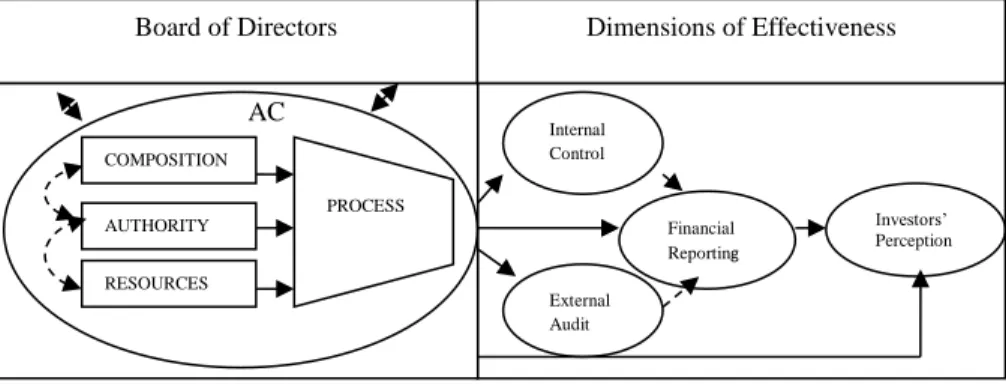
Bedard and Gendron (2010) identify “relationship” as one of six process
dimensions, whereby process in itself is a component for determining ACE (Figure 1).
Figure 1: AC and dimensions of effectiveness (Bedarad and Gendron, 2010)
However, as mentioned earlier, most studies that examined ACE have more or less neglected the process and behaviour concerning how the AC members operate (Beasley et al., 2009). Interrelationships between the CG actors are essential (Cohen, Krishnamoorthy and Wright, 2004), and, to effectively execute their CG duties, ACs rely in part on the IAF (Abbott, Parker, and Peter, 2010) as one of their primary resources (KPMG AC Institute (ACI) Roundtable Highlights, 2007) for ensuring quality CG (KPMG ACI, 2003; McHugh and Raghunandan, 1994). Internal auditing plays a unique role in the governance process (Bishop et al., 2000) and has been recognized as an important role in helping the AC to effectively discharge its responsibilities (Blue Ribbon Committee (BRC), 1999; Treadway Commission, 1987). Although the two are different control bodies in that the IAF operates within the company and the AC comprises members of the BoD, the two functions have related purposes. One of the objectives of the AC is to monitor and evaluate the internal control system, which is also the primary goal of the IAF (see for instance COSO, 1992; BRC,
AC
COMPOSITION
AUTHORITY
RESOURCES
Board of Directors Dimensions of Effectiveness
PROCESS
Internal Control
Financial Reporting
External Audit
1999). The Institute of Internal Auditors (IIA) promotes internal auditing in the evaluation of internal controls and contends that, "where scoped and resourced adequately, internal audit is well placed to provide the board with an objective opinion on risk management and internal control across all the activities of the company (IIA, 1999)”. Because of their position and role within a company, internal auditors possess a good and objective understanding of the culture, system of internal control, operations, and industry. As the role of the IAF mainly pertains to providing assurance regarding a company’s governance, risk assessment, and control processes, its function essentially becomes the “eyes and ears” of the AC and is largely instrumental in acting as an independent sounding board to the AC concerning areas of weaknesses or deficiencies in the risk management, governance and control processes (BMCGG, 2009). Several authors contend that a quality reciprocal relationship between the AC and IAF is beneficial as the AC can strengthen the IAF, and internal auditors, in turn, can be an important resource to the AC as it strives to fulfil its responsibilities (Bishop et al., 2000; Braiotta, 1999; Verschoor, 1992 and Turley and Zaman, 2004).
As with the argument made in most the ACE research, authors such as Gramling, Maletta, Schneider, and Church (2004) have contended that studies (e.g. Goodwin and Yeo, 2001; Raghunandan et al., 2001; Scarbrough et al., 1998) examining the AC interactions with internal auditors have not provided much insight into the nature and quality of the interaction between the AC and IAF. This is because these studies have mostly utilized an economic perspective through the association of ideal-typical AC characteristics and their interaction with the IAF. They conclude that ACs with mandated characteristics (i.e. member independence and/or with financial or accounting expertise) are more likely to be effective in their internal control oversight responsibilities when they:
i. have private meetings with the Chief Audit Executive (CAE); ii. are involved in the decision to hire and/or fire the CAE; and iii. review the work of the IAF.
Turley and Zaman (2004) have also called for research to focus more attention on the process issues and to the people involved in the day-to-day activities of the AC. Thus, rather than focusing primarily on the measurable features of the AC as a means to determine the effectiveness of the AC in fulfilling its oversight role, the nature and quality of the interaction between the AC and IAF constitute a new means to identify the effectiveness of the AC. This acts as an extension to prior frameworks in understanding the interaction quality between the AC and IAF.
Most prior frameworks on AC-IAF interactions were researched using quantitative methods, which mostly involved surveys of internal auditors. The results of these studies show that the composition of the AC is associated with the strength of the interaction between the AC and the IAF. However, the limitation of quantitative studies is that they provide limited in-depth insight into the interactions between the two functions. This is because the interactions among people are difficult to capture with the existing measures. For instance, the measures of the AC composition can deflect from the truth when the independence of the AC members is only measurable in appearance and not in fact. As a result, Raghunandan et al. (2001) suggest that the nature of this relationship should be examined by delving into the issues brought into the relationship by the AC, such as personality, attitude and character, which is achievable by espousing a qualitative approach. In fact, Spira (1999) argues that: “...there is a dearth of studies which explore the perceptions of those involved in the AC activity through the use of qualitative research methodologies.”
Likewise, Turley and Zaman (2004) are convinced that qualitative research methods incorporating case studies and interviews provide significant potential for research into the interaction of ACs with other parties, such as auditors. Beasley et al. (2009) also used the qualitative approach by incorporating qualitative inquiries to comprehend CG processes in action. Most recently, Zaman and Sarens (2013) have also encouraged the use of qualitative methods as they argue that they have greater potential to provide a more substantive contextual understanding of the AC-IAF informal interactions.
Since the goal of the research is to have detailed insights into the interaction quality between the AC and the IAF, the interview method should be used to gather such insights, because this method allows the researcher to explore issues that are difficult to examine using archival methods (Beasley et al., 2009). In order to undertake future research using a new theoretical lens, it is encouraged that researchers adopt a phenomenological methodology as the best means for this type of research. This is because the epistemological position for the study is that data are contained within the perspectives of the people that are responsible for CG oversight in a public limited company. According to Welman and Kruger (1999, p. 189) (as cited in Groenewald, 2004) “the phenomenologists are concerned with understanding social and psychological phenomena from the perspectives of people involved.”
include a more qualitative behavioural and psychological research concerning the quality of the AC-IAF relationship. To reiterate, a new conceptual framework is suggested in order to undertake this endeavour. The next section discusses how the new proposed conceptual framework will help mould a more thorough understanding of AC-IAF relationship quality.
3. Proposed Conceptual Framework
3.1. Relational Coordination Theory
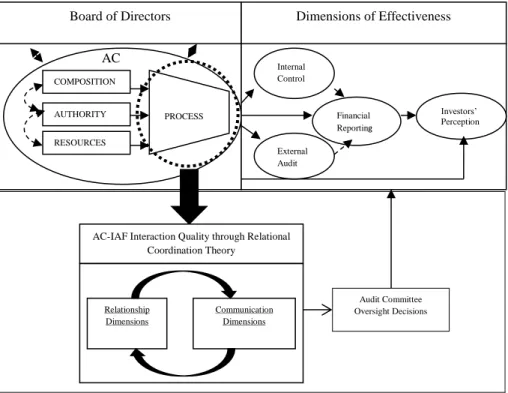
There is a need for more research on the dynamic process surrounding ACs, such as communication and coordination between the IAF and AC (Goodwin and Yeo, 2001). In order to conduct further research on the AC’s “relationship” process with the IAF, this paper expands the current ACE framework by introducing the use of the relational coordination theory (as depicted in Figure 2) to further understand the quality of the interaction between the AC and IAF during the oversight work process.
Figure 2: Extension of current ACE framework by introducing AC-IAF interaction quality through Relational Coordination Theory
(adapted from Bedard and Gendron, 2010 and Gittell, 2002)
This paper suggests the use of the relational coordination theory (Gittell, 2002) as a means of identifying the quality of the interaction between the AC and IAF. Relational coordination is an emerging theory that offers a unique way
AC
COMPOSITION
AUTHORITY
RESOURCES
Board of Directors Dimensions of Effectiveness
PROCESS
Internal Control
Financial Reporting
External Audit
Investors’ Perception
Relationship Dimensions
Communication Dimensions AC-IAF Interaction Quality through Relational
Coordination Theory
of understanding the relational dynamics of coordinating work. Relational coordination is defined as a mutually reinforcing process of the interaction between communication and the relationships carried out for the purpose of task integration (Gittell, 2002, p. 301). Developed and tested in the context of air travel (Gittell, 2001), surgical care (Gittell, Fairfield, Bierbaum, Jackson, Kelly, Laskin, Lipson, Siliski, Thornhill and Zuckerman, 2000) and long term care (Gittell, Weinberg, Pfefferle, and Bishop, 2008), the relational coordination theory is defined as a communication and relationship-intensive form of coordination carried out by workers that can span multiple functions, and, potentially, multiple organizations. In the context in which it has been explored, relational coordination appears to have a significant positive impact on the key measures of performance, including both quality and efficiency (Gittell et al., 2008; Gittell, 2006).
It is proposed that relational coordination be used in the context of CG due to the arguments made by prior researchers. For example, some qualitative research that explored the interaction process between the AC and IAF (e.g. Beasley et al., 2009; Davies, 2009; Gendron and Bédard 2006, Gendron et al., 2004, Zain and Subramaniam 2007, Sarens, DeBeelde and Everaert, 2009; and Turley and Zaman, 2007) reveals that AC communication (either formal or informal) is an important aspect in understanding how the interaction between the two roles aids the AC in performing its oversight responsibilities. Zaman and Sarens (2013) argue that communication, including communication outside of the formal pre-scheduled meetings, plays a significant role in CG. In addition to communication, studies examining the interaction between the AC and IAF (e.g. Davies, 2009; Sarens et al., 2009; and Zain and Subramaniam, 2007) have also revealed that shared mental models are important in determining how well the coordination between the two roles takes place. Mental models are knowledge structures or cognitive representations that people use to organize information (Smith-Jentsch, Zeisig, Acton and McPherson, 1998). Shared mental models are shared knowledge structures that enable members of a team to accurately assess tasks and coordinate their actions with other team members (Cannon-Bowers, Salas and Converse, 1993). The general argument of the shared mental model (SMM) literature is that team effectiveness will improve if team members have adequate shared understanding of task objectives and team process (Mohammed and Dumville, 2001) SMMs developed by individual board members represent knowledge and understanding about the board’s purpose and characteristics, connections and linkages among collective actions and various roles and behaviour patterns required of individual members to successfully formulate and implement collective governance activities for the firm (e.g. task objectives and team processes). The AC and IAF are highly interdependent and must work as a team in order to be effective.
process. Organizations can improve their desired outcomes through the coordination of frequent, high quality communication supported by the relationships of shared goals, shared knowledge, and mutual respect (Gittell, 2006). The sections below provide a brief explanation of the attributes of these relationships, and how these attributes are significant in understanding the AC-IAF interaction quality.
3.1.1. Shared Goals
The shared goals that surpass the specific functional goals of participants motivate the participants to work optimally. According to Gittell (2011), when participants have a set of shared goals for the work process, they will tend to have a powerful bond and can more easily arrive at compatible conclusions about how to respond as new information becomes available. The participants of the work process must work to reach their own objectives while knowing how they contribute to the overall process. The monitoring and evaluation of the internal control system, as well as the identification and management of risks, are the major objectives/goals of both the AC and IAF (BRC, 1999; COSO, 1992; NACD, 2000). However, prior qualitative research (e.g. Zain and Subramaniam, 2007) reveals that, sometimes, ACs and IAFs do not share the same sense of urgency or the same goals in terms of their oversight responsibilities. In order for the overall oversight process to be effective, the AC must realize that its objective is to not only assess the information presented to them by the IAF, but to provide an environment of support to the IAF, which, in turn, allows the IAF to be effective in providing information to the AC (Gramling, 2004). The IAF must also realize that it must conduct its responsibilities with independence and objectivity in order to disseminate quality information to the AC, which, in turn, will allow the AC to discharge its oversight responsibilities effectively. Hence, it can be assumed that the AC and IAF must both share the same values of maintaining high governance standards. Therefore, it is contingent for both roles to know their respective objectives, to know how they contribute to the overall process as well as recognise the objectives of other roles, and how those objectives also contribute to the overall process.
3.1.2. Shared knowledge
knowledge of the specific tasks that each role undertakes in achieving the said goals. Shared knowledge of the task interdependencies between the two roles is essential in maintaining coordination at its optimum between the AC and IAF in the oversight process. The participants in the work process must have a clear mental model of the overall process. They must understand the links between their own jobs and the jobs of others. This collective mind or shared understanding of the overall work process then enhances the coordination efforts between the roles (Gittell, 2006). Hence, it can be interpreted that shared knowledge is imperative, as participants will not only understand ‘what’ and ‘why’, but also the degree of urgency. This then allows them to enhance their communication with greater accuracy and timeliness.
3.1.3. Mutual respect
Finally, mutual respect encourages the participants of a work process to value what others have contributed and enables the participants to overcome the status barriers that prevent them from seeing and taking account of the work of others. Gittell (2006) states that effective coordination depends upon the participants having respect for other participants in the same work process. Disrespect serves as a potential reason for division among the participants who fulfil different roles in the work process, which could undermine the coordination process between the roles (Gittell, 2006). Conversely, Gittell (2006) contends that respect for the competence of others creates a powerful bond, which is important for the effective coordination of highly interdependent work. The importance of the role of the AC is to provide the IAF with an environment of support, which is viewed as a key safeguard mechanism for internal auditors in managing their professional objectivity (Stewart and Subramaniam, 2010). The feeling of mutual respect is present when the participants of both roles have a collective identity and appreciate the roles of others, which will inevitably lead to a more comfortable interaction between the two roles. Both the AC and IAF should not harbour any feelings of animosity, offend or feel offended, which, as portrayed in Gittell (2006), are indicators of disrespect. Together, the three relational attributes discussed above reinforce and are reinforced by communication that is frequent, timely, accurate, and problem-solving (rather than blaming), as briefly explained below.
is not an attribute as proposed by Gittel (2002), prior AC-IAF research shows that having frequent informal communication encourages strong ties between the two roles. Zaman and Sarens (2013) find evidence that informal communication between the AC and IAF complement formal meetings with the AC and represent additional opportunities for the AC to monitor the IAF. In addition, the findings from Turley and Zaman (2007), Gendron and Bedard (2006), and Beasley et al. (2009) indicate that substantive communication takes place outside of the formal meetings, and that this informal channel of communication is an important means for the AC to gain more information. They argue that the AC is significantly more effective in its oversight responsibilities when informal voluntary interaction is undertaken with the IAF. Hence, it is argued that uncovering the frequency of both formal and informal communication between the AC and IAF will help to better understand the interaction quality between the two roles during an oversight work process.
3.1.5. Timeliness of Communication
Although Gittell (2011) does not provide an estimated measure of time to indicate timeliness, she defines it as communication that is not delayed unnecessarily. The timeliness of communication was thought of as being how soon pertinent information needs to be communicated to the AC. Schneider (2009 p. 25) claims that “the timing of information provided by the IAF to ACs varies according to its importance. Important information needs to be conveyed as soon as possible.”
3.1.6. Accurate Communication
matters affecting management (Goodwin and Yeo, 2001). Management may influence the IAF concerning the selection of information that is communicated to the AC. Prior studies, such as Spira (1999), reveal that managers are able to influence control on various aspects of the AC meetings, such as the selection of information to send to members before meetings. Christopher, Sarens and Leung (2009) argue that having an improved control environment in which the IAF can trust that the AC will provide them support will reduce reporting errors. Hence, when there is a level of mistrust, inaccurate information may be brought to the AC.
3.1.7. Problem Solving Communication
In an environment in which a work process consists of task interdependencies, such as the task interdependencies between the AC and IAF, problems that occur may require joint problem solving communication (Gittell, 2011). Problem solving communication allows the participants of a work process to adapt quickly and work together (Gittell, 2002). The act of questioning is an important element in problem solving communication. Cohen et al. (2010) and Beasley et al. (2009) agree that the skill in questioning is the prime quality of an AC member. The key role of the AC is in asking management and auditors challenging questions, which was also a central issue in the paper by Gendron et al. (2004). In addition, the act of questioning, blame avoidance and fault-finding should be deterred as it is counteractive to effective problem solving communication. The findings of Gittell (2002) reveal that information sharing was hampered when her research participants tended to avoid blame. Likewise, when one resorts to fault-finding rather than problem solving, it can undermine both the performance and the potential to improve performance over time (Deming, 1986). Hence, both the AC and IAF need to discuss with one another regarding disputes or problems that may occur during an oversight work process. Engaging in problem solving communication will ensure that these disputes or problems will be resolved accordingly and warrant effective coordination between the two parties.
3.1.8. AC-IAF Interaction Quality and the Mutually Reinforcing Process of Relational Coordination
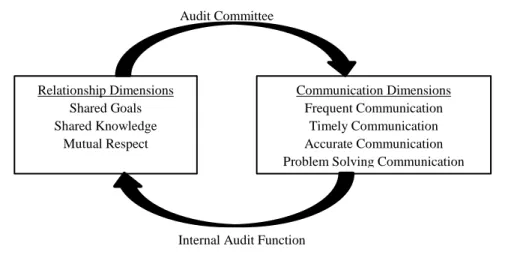
Relational coordination is defined as “a mutually reinforcing process of interaction between communication and relationships carried out for the purpose of task integration” (Gittell, 2002, p. 301), as illustrated in Figure 3. It is
their own specific tasks but also knowing how their tasks relate to the tasks of the participants in other functions. In addition, knowledge of what each participant contributes to the overall work process enables him or her to communicate in a timely way with participants in other functions, which is grounded in an understanding of who needs to know what, why, and with what degree of urgency. Furthermore, mutual respect increases the likelihood that participants will be receptive to communication from their colleagues in other functions. Together, these mutually reinforcing relationship and communication ties form the basis for coordinated collective action (Gittell, 2006).
Figure 3: Mutual Reinforcement between Relational Coordination Dimensions during an AC-IAF oversight work process (adapted from Gittell, 2002)
This “mutually reinforcing process of interaction between communication and relationships” (Gittell, 2002) has been featured in the context of AC-IAF
interaction. For instance, in their study, Zain and Subramaniam (2007) discover that CAEs perceive that the existing audit practices and attitudes, such as the AC’s submissive approach when dealing with management and limited private meetings, hinder the opportunity for more open and frank discussions that lead to a lack of trust in the AC, which may act as a barrier to an effective relationship between the AC and IAF. Having a climate of trust is vital for a healthy relationship between the AC and IAF (Gul and Subramaniam, 1994) as cited in Zain and Subramaniam (2007). In addition, the study finds that in order to promote values, such as professionalism, honesty and integrity, there needs to be mutual respect between the CAE and AC members. In addition, it is shown that the understanding of ACs concerning the adequacy of the internal audit programmes and the work of the IAF is still lacking (Zain and Subramaniam, 2007 and Davies, 2009). Despite the fact that some AC members may lack an understanding of the internal auditor’s work, Sarens et al. (2009) reveal that ACs
Relationship Dimensions Shared Goals Shared Knowledge
Mutual Respect
Communication Dimensions Frequent Communication
Timely Communication Accurate Communication Problem Solving Communication Audit Committee
seek comfort from the IAF with respect to the control environment and internal controls, two areas in which the ACs experience considerable discomfort. Their case study reveals that due to the IAF’s traditional assurance role, knowledge about risk management, its involvement in improving internal controls, and combined with appropriate interpersonal and behavioural skills, enables them to provide a significant level of comfort to the AC.
The use of the relational coordination theory in understanding the interaction quality between the AC and IAF is further promoted due to the uniqueness of the theory, which focuses on the development of the relationship between the roles rather than between individuals. The emphasis is on the role rather than on the individuals because coordination is the management of interdependencies between tasks. As people are typically assigned to tasks through their roles, relational coordination is measured as coordination between roles rather than between unique individuals. The importance of a role-based relationship is highlighted by Klein, Ziegert, Knight, and Xiao (2006):
“Organizational members grant one another respect, authority, and information not because of their personal knowledge of one another’s competencies and personalities but because of their trust in the wisdom of the role structures (and role allocation decisions) that guide their coordination and collaboration.” (p. 617)
Hence, it is quite apt to use the relational coordination theory in terms of the AC-IAF interaction as the two roles do not work together on a day-to-day basis. If coordination is successful between the two roles, then integration across the differing organizational tasks and activities of both the AC and IAF are deemed effective. Therefore, it can be assumed that the ultimate goal of governance, with which the two roles are entrusted, is achieved. With that being said, we believe that the relational coordination theory is able to provide the foundation for understanding the vital role which the relationships play in successful coordination – like that of the assurance of the work process coordination between the AC and IAF.
4. Conclusion and directions for future research
(i.e. technical work process), but as the interdependence between the people who perform these tasks.
Thus, in meeting this objective, one can no longer only rely on the traditional agency theory to understand the AC process, and other theories must come into play. Abbott (2001) and Flyvberg (2001) argue that the value of social sciences lies in their capacity to provide multivocality in the study of social objects through diverse perspectives and lenses. Multivocality relates to the belief that no single theory, perspective of analysis, or way of producing knowledge can account for the complexity of human behaviour. The study of the AC and its effectiveness in its oversight responsibilities is no exception to this need for theoretical pluralism. Shapiro (2006) attests that, “we need multiple perspectives to understand the interconnected economic, political, and social dimensions of CG and accountability” (p. 53). Eisenhardt (1989) asserts the need
to look beyond the economics literature as a recommendation to organizational researchers. She cautioned that those who rely too heavily on economics due to its restrictive assumptions, such as efficient markets and its single-perspective style, risk doing second-rate economics without contributing first-rate organizational research. Similarly, Gendron (2009) posits that social life is too complex, ambiguous, contradictory, and ever-changing to study it only from a univocal approach (which in accounting research tends to be neoclassical economics). Hence, concerning the effectiveness of the AC process, researchers have moved beyond the neoclassical economics theoretical framework and have begun to encapsulate a more sociological and psychological perspective together with the classical agency or institutional theory perspective. Moreover, due to the lack of a conclusive theory and/or theories that can provide an in depth understanding of how the AC and IAF foster a quality working relationship with each of their specific roles, the relational coordination theory has been proposed as a framework to enrich the understanding of the interaction between the AC and IAF.
qualitative methodology. Overall, this conceptual paper is expected to contribute to the conception of ACE and oversight not only in Malaysia but in other countries as well.
Acknowledgement
This research was supported in part by a grant from the University of Malaya Research Grant (UMRG).
References
Abbott, A. (2001). Chaos of disciplines. Chicago: University of Chicago Press. Abbott, L. J., Parker S., & Peters G. F. (2010). Serving Two Masters: The
association between audit committee internal audit oversight and internal audit activities. Accounting Horizons, 24(1), 1-24.
Ardalan, K. (2007). Corporate Governance: A Paradigmatic Look. International Journal of Social Economics, 34(8), 506-524.
Beasley, M. S., Carcello, J. V., Hermanson, D. R., & Neal, T. L. (2009). The Audit Committee Oversight Process. Contemporary Accounting Research,
26(1), 65- 122.
Bedard, J., & Gendron, Y. (2010). Strengthening the financial reporting system: Can audit committees deliver? International Journal of Auditing, doi:10.1111/j.1099-1123.2009.00413.x
Bishop, W., D. R. Hermanson, P. D. Lapides, & L. E. Rittenberg. (2000). The Year of the Audit Committee. Internal Auditor, 57(2), 46-51.
Blue Ribbon Committee on Improving the Effectiveness of Corporate Audit Committees (1999). Report and recommendations of the Blue Ribbon Committee on improving the effectiveness of corporate audit committees (New York Stock Exchange and National Association of Securities Dealers, New York)
Braiotta, L. (1999). The audit committee handbook. 3rd Edition, New York: John Wiley and Sons Inc.
Bursa Malaysia Corporate Governance Guide (BMCCG) (2009). Corporate Governance Guide: Towards Boardroom Excellence. Bursa Malaysia Berhad, Kuala Lumpur.
Carcello, J. V., Hermanson, D. R., & Ye., Z. (2011). Corporate Governance Research in Accounting and Auditing: Insights, Practice Implications, and Future Research Directions. Auditing: A Journal of Practice and Theory,
30(3), 1-31.
Cohen, J., Krishnamoorthy, G., & Wright, A. (2008). Form versus Substance: The Implications for Auditing Practice and Research of Alternative Perspectives on Corporate Governance. Auditing: A Journal of Practice and Theory, 27(2), 181-198.
Cohen, J., Krishnamoorthy, G., & Wright, A. (2004). The corporate governance mosaic and financial reporting quality. Journal of Accounting Literature, 23, 87-152.
Chen, K. C. W., Chen, Z. H., & Wei, K. C .J. (2008). Agency costs of free cash flow and the effect of shareholder rights on the implied cost of equity capital. Working paper. Hong Kong University of Science and Technology. Christopher, J., Sarens, G., & Leung, P. (2009). A critical analysis of the
independence of the internal audit function: evidence from Australia.
Accounting, Auditing and Accountability Journal, 22(2), 200-220.
COSO, Report of the Committee of Sponsoring Organizations of the Treadway Commission: Internal Control- Integrated Framework (New York: American Institute of Certified Public Accountants, 1992)
Dey, A. (2008). Corporate Governance and Agency Conflicts. Journal of Accounting Research, 46, 1143-1181. doi:10.1111/j.1475-679X.2008.00301.x
Deming D. J. (1986). Out of the Crisis, MIT Press, Cambridge, MA.
DeZoort, F. T., Hermanson, D. R., Archambeault, D. S., & Reed, S. A. (2002). Audit Committee Effectiveness: A Synthesis of The Empirical Audit Committee Literature. Journal of Accounting Literature, 21.
DeZoort, F. (1998). An Analysis of Experience Effects on Audit Committee Members' Oversight Judgments. Accounting, Organizations and Society, 23
(1), 1-21.
Davies, M. (2009). Effective working relationships between audit committee and internal audit- the cornerstone of corporate governance in local authorities, a Welsh perspective. Journal of Management and Governance, 14, 41-73. Eisenhardt, K. M. (1989). Building theories from case study research. Academy
of Management Review, 14, 532-550.
Flyvbjerg, B. (2001). Making social science matter. Chicago: University of Chicago Press.
Glaser, B., & Strauss, A.L. (1967). The discovery of grounded theory: Strategies for qualitative research. Chicago: Aldine.
Ghafran, C., & O'Sullivan, N. (2013). The Governance Role of Audit Committees: Reviewing a Decade of Evidence. International Journal of Management Reviews, 15, 381-407. doi:10.1111/j.1468-2370.2012.00347.x Gendron, Y. (2009). Discussion of "The Audit Committee Oversight Process":
Advocating Openness in Accounting Research. Contemporary Accounting Research, 26, 123-134. doi:10.1506/car.26.1.4
Gendron, Y., &Bédard, J. (2006). On the constitution of audit committee effectiveness. Accounting, Organizations and Society, 31(3), 211-39. Gendron Y., Bédard J., & Gosselin M. (2004). Getting inside the black box: a
field study of practices in effective audit committees. Auditing: A Journal of Practice and Theory, 23(1), 153-171.
Gittell, J. H. (2002). Coordinating mechanisms in care provider groups: Relational coordination as a mediator and input uncertainty as a moderator of performance effects. Management Science, 48(11), 1408-1426.
Gittell, J. H. (2006). Relational coordination: coordination work through relationships of shared goals, shared knowledge and mutual respect. In Kyriakidou, O. & Ozbilgin, M. F. (Eds.), Relational perspectives in organizational studies: A research companion (pp. 74-94). Northampton, MA: Edward Elgar Publishing.
Gittell, J. H. (2011). Relational Coordination: Guidelines for Theory,
Measurement and analysis. [PdfFile], URL
http://rcrc.brandeis.edu/downloads/Relational_Coordination_Guidelines_8-25-11.pdf
Gittell, J. H., Fairfield, K., Bierbaum, B., Jackson, R., Kelly, M., Laskin, R., Lipson, S., Siliski, J., Thornhill, T., & Zuckerman, J. (2000). Impact of relational coordination on quality of care, postoperative pain and functioning, and length of stay: a nine-hospital study of surgical patients.
Medical Care, 38(8), 807-819.
Gittell, J. H., Weinberg, D., Pfefferle, S., & Bishop, C. (2008). Impact of relational coordination on job satisfaction and quality outcomes: a study of nursing homes. Human Resource Management Journal, 18(2), 154-170. Goodwin, J. & Yeo, T. Y. (2001). Two factors affecting internal audit
independence and objectivity: Evidence from Singapore. International Journal of Auditing, 5(2), 107-25.
Gramling, A. A. (2004). Role of the internal audit function in corporate governance: a synthesis of the extant internal auditing literature and directions for future research. Journal of Accounting Literature, 23, 194-244.
Gramling, A. A., Maletta, M. J., Schneider, A., & Church, B. K. (2004). The Role of the Internal Audit Function in Corporate Governance: A Synthesis of the Extant Internal Auditing Literature and Directions for Future Research. Journal of Accounting Literature, 23, 194-244.
Groenewald, T. (2004). A phenomenological research design illustrated.
International Journal of Qualitative Methods, 3(1).
International Standards for the Professional Practice of Internal Auditing. (2009). Almonte Springs, FL: The Institute of Internal Auditors, 2009 The Institute of Internal Auditors, Definition of Internal Auditing (Altamonte
Springs, FL: The Institute of Internal Auditors, 1999). Available at www.theiia.org/ecm/guidance.cfm?doc_id=123.
Kalbers, L., & Fogarty, T. (1998). Organizational and economic explanations of audit committee oversight. Journal of Managerial Issues, 10(2), 129-150. Klein, K., Ziegert, J. C., Knight, A. P., & Xiao Y. (2006). Dynamic delegation:
Shared, hierarchical and deindividualized leadership in extreme action teams. Administrative Science Quarterly, 50, 590-621.
Oversight. Montavale. NJ: KPMG from URL http://www.kworld.com/aci/docs/roundtablespring03.pdf
KPMG Audit Committee Institute (ACI). (2007). Audit Committee Roundtable Highlights Fall: Roundtable on Audit Committee Effectiveness-Post SOX: Thinking back, looking ahead. Montavale, NJ: KPMG from URL http://www.kworld.com/aci/docs/aci_publications/080318_ACI_Fall07_pos t.pdf
McHugh, J., & Raghunandan, K. (1994). Hiring and firing the chief internal auditor. Internal Auditor (August), 34-39.
National Association of Corporate Directors (NACD) (2000). Report of the NACD Blue Ribbon Commission on Audit Committees: A practical guide (National Association of Corporate Directors, Washington, DC) Practice Advisory 2060-1 (1)
Raghunandan, K., Read, W., & Rama, D. (2001). Audit committee composition, grey directors, and interaction with internal auditing. Accounting Horizons, 15(2), 105-118.
Raphaelson, I. H., & Wahlen, J. (2004). Effective compliance programs in the aftermath of corporate mega scandals. Insights: The Corporate and Securities Law Advisor, 18(5), 12-18.
Rittenberg, L. E., & Nair, R. D. (1993). Improving the effectiveness of audit committees. Montvale, N. J: Institute of Management Accountants.
Scarbrough, D. P., Rama, D. V., & Raghunandan, K. (1998). Audit committee composition and interaction with internal auditing: Canadian evidence.
Accounting Horizons, 12(1), 51–62.
Spira, L. F. (1999). Ceremonies of governance: perspectives on the role of the audit committee. Journal of Management and Governance, 3, 231-260. Sarens, G., De Beelde, I., & Everett, P. (2009). Internal audit: the expert in
providing comfort to the audit committee – the case of risk management and internal control. British Accounting Review, 41, 90-106.
Schneider, A., (2009). Informing the audit committee: information and reports provided by internal audit. Internal Auditing, 24(2), 24-32.
Spira, L. F. (2003). Audit Committees: begging the question?. Corporate Governance: An International Review, 11, 180-188. doi: 10.1111/1467-8683.00317
Shapiro, B. P. (2006). Accounting science's contribution to the corporate governance and executive accountability problem. Accounting and the Public Interest, 6(1), 51-69.
Stewart, J., & Subramaniam, N. (2010). Internal audit independence and objectivity: emerging research opportunities. Managerial Auditing Journal, 25(4), 328-360.
Treadway Commission. (1987). Report of the national commission on fraudulent financial reporting. Washington DC, National Commission on Fraudulent Financial Reporting.
Turley, S., & Zaman, M. (2004). The corporate governance effects of audit committees. Journal of Management and Governance, 8(3), 305-332. Turley, S., & Zaman, M. (2007). Audit committee effectiveness: Informal
processes and behavioural effects. Accounting, Auditing and Accountability Journal, 20(5), 765-88.
Verschoor, C.C. (1992). Evaluating outsourcing of internal auditing.
Management Accounting, 73(8), 27-30.
Zain, M. M., & Subramaniam, N. (2007). Internal Auditor Perceptions on Audit Committee Interactions: a qualitative study in Malaysian public corporations. Corporate Governance: An International Review, 15(5), 894-908.