Received 15 October 2019; received in revised form 28 November 2019; accepted 20 January 2020.
To cite this article: Ismail et al. (2020). Surface characterization of heat-affected zone in robot-based increment sheet
Surface characterization of heat-affected zone in robot-based
increment sheet forming
Nazarul Abidin Ismail 1,2*, Mohd Idris Shah Ismail 1, Mohd Khairol Anuar Mohd Ariffin 1,
Azizan As’arry 1
1 Department of Mechanical and Manufacturing Engineering, Faculty of Engineering, Universiti
Putra Malaysia, 43400 UPM Serdang, Selangor, MALAYSIA.
2 Industrial Automation Control Section, Electrical Engineering Department, German Malaysian
Institute, Jalan Ilmiah, Taman Universiti, 43000 Kajang, Selangor, MALAYSIA.
*Corresponding author: [email protected]
KEYWORDS ABSTRACT
Topography Adhesive Wear
1.0 INTRODUCTION
Incremental sheet forming (ISF) process is a modern approach for fabrication of sheet metals by the step-by-step of forming tool to the workpiece without the need of dies or molds, which costs in term of time and money. This process is performed by a forming tool that forms the sheet in a series of localized incremental deformations. ISF has been used for various materials including aluminum alloys (Al-Ghamdi and Hussain, 2015, Durante et al., 2011), steels (Jeswiet and Young, 2005; Li et al., 2017), magnesium alloys (Leonhardt et al., 2018), titanium (Uheida et al., 2017; Khazaali and Fereshteh-Saniee, 2016) and polymer (Shubhamkar, 2016; Sabater et al., 2018). However, aluminum alloys are receiving more attention from researchers for conducting research. Nimbalkar and Nandedkar (2013) analyzed the current status of incremental sheet metal forming in terms of types of ISF, equipment used in ISF, tool path generation and comparison between robot forming with conventional forming methods.
A new incremental bending method has been proposed by Li et al. (2016) for complicated curved sheet metal which design mainly including three degree-of-freedom working tables, supporting and the punching system, control system, and a 3D scanning system. However, this method still utilizes additional supporting and punching system to form complex shapes. Pandivelan and Jeevanatham, (2015) noted the formability evaluation of AA6061 aluminum alloy sheets on single point incremental forming (SPIF) using a CNC vertical milling machine. It concluded that the formability decreases as the step depth increase during the SPIF. Since the CNC machine is rigid and easier to control, it still needs improvement towards complex product shapes. ISF process with an industrial robot can be an innovative and feasible method to comply with complex products.Due to the dynamic working range of industrial robots, the ability of the robot based ISF process to create a larger and complex workpiece can be enhanced.
The friction applies locally external heat has been proven to improve the ductility of sheet metals and enhance formability using ISF (Shubhamkar, 2016). Zhaobing, (2018) analyzed the development of heat-assisted ISF (HA-ISF) such as laser heat, friction heat, and electric heat. It noted that the friction in HA-ISF is easy to be implemented, but two major challenges are uncontrollable forming temperature and severe tool wear. The wear of forming tools and metal sheets could be kept at a relatively low level when the forming temperature is properly controlled (Meier et al., 2013). Increasing spindle speed and tool diameter influence in friction and temperature resulting in lower force values (Sabater et al., 2018). Gupta and Jeswiet (2017) stated that the effect of increasing feed rate and tool rotational speed on temperature for the aluminum alloy of AA 5754-H32. The observation was conducted by a flat tool to form a variable wall angle geometry and the temperature was recorded using an infrared camera. It concluded that increasing temperature could reduce the force needed to form the materials.
on the forming tool under different forming shapes, robot speeds, wall angles, and step sizes. The energy dispersive spectrometry also was used to analyze the elemental distribution on the surface of the forming tool.
2.0 EXPERIMENTAL WORK
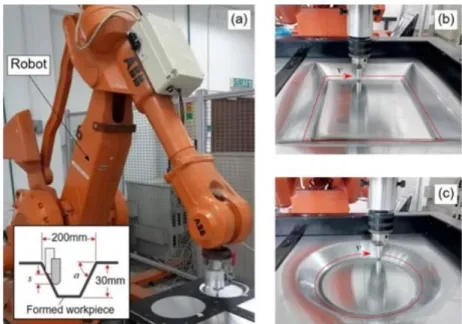
In this study, the AA3003 aluminum alloy sheet with 0.5 mm thickness was used as the workpiece. The forming tool with a hemi-spherical tip of a 10mm in diameter was fabricated from AISI D2 tool steel. The chemical composition of the workpiece and forming tool are shown in Table 1. Figure 1(a) shows the experimental setup for incremental sheet forming using a six-degree-of-freedom industrial robot. The forming tool was held by a standard collet tool holder that attached to the robot head. The robot has great movement capability and suitable for performing a continuous path-controlled movement. The continuous-path movement of the robot was guided using robot teach pendant, in which the sequence of forming points was defined to the robot in teach mode. The blank workpiece was fixed vertically on the worktable. The tool path used was a helical tool path and the experiments has been conducted to perform the required shape profiles of a truncated pyramid and truncated cone as shown in Figure 1(b) and 1(c), respectively, with a depth of 30 mm. The truncated pyramid cone profile has 200 mm x 200 mm top square, while the truncated cone profile has 200 mm in outer diameter.
Figure 1: Experimental set-up and tools.
Table 1: Chemical composition of the workpiece.
Material Elements
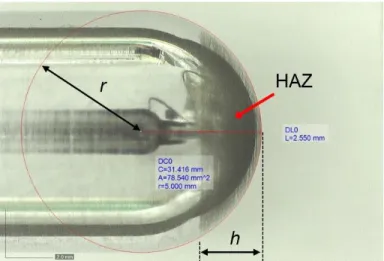
Three processing parameters considered in this study are robot speed (v), step size (s) and wall angle (a). Robot speed is referred to as feed rate, while the step size is the vertical movement of the tool. However, the final shape of the truncated pyramid and cone differs in the wall angle, as the wall angle is a manipulated parameter. Wall angle was manipulated by controlling the step of the tool along the length or width, and radius of the truncated pyramid and cone, respectively. For example, on a truncated cone profile, a 45-degree wall angle for a 0.3 mm step size is achieved by moving the tool by 0.3 mm along the radius before the tool moves vertically by 0.3 mm. After the robot based ISF process, the forming tool was cleaned using an ultrasonic cleaner machine for the observation and measurement of HAZ by a digital microscope that integrated with the measurement system as shown in Figure 2. The area of HAZ, AHAZ (in mm2) could be calculated using Equation (1) (Weisstein, 2019; Harris and Stocker, 1998).
𝐴HAZ= 2𝜋𝑟ℎ (1)
Where r is the radius of forming tool and h is the dome height of HAZ on forming tool. Furthermore, to analyze the element containing on the forming tool surface, the energy dispersive spectrometry (EDS) was utilized.
Figure 2: Forming tools under observation.
3.0 RESULTS AND DISCUSSION
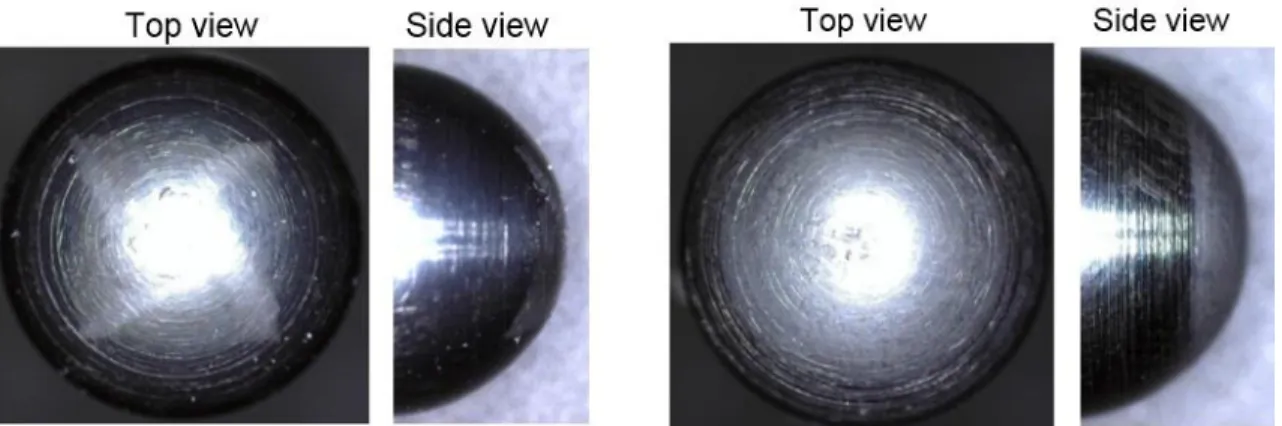
in curved path to form the circular shape of HAZ. From this result, the next discussion is focused only on the workpiece with truncated cone profile.
To investigate the effects of processing parameters on HAZ for producing truncated cone profile, the robot speed of 150 mm/s and 250 mm/s, step size of 0.3 mm and 0.5 mm, and wall angle of 45° and 60° were used. Based on the results from Figure 4, it reveals that the area of HAZ under 45° wall angle is greatly smaller compared to the 60° wall angle. This result confirms the workpiece with a higher angle of tapered wall possess larger contact interface between forming tool and workpiece (Fritzen et al., 2013; Otsu et al., 2014). In addition, the step size also plays a significant factor that influences the area of HAZ. It can be seen from Figure 4; the higher 0.5 mm step size generates a larger area of HAZ due to the large incremental step down compared to the 0.3 mm step size. This large incremental step down also leads to having a larger contact interface between forming tool and workpiece and also obtained by Li et al., (2014, 2015). For the effect of robot speed, the faster movement of forming tool resulted in the larger area of HAZ as illustrated in Figure 4. It can be stated that the robot speed or relative sliding velocity has a positive linear relationship with frictional heating (Uheida et al., 2018), in which the robot speed has a marginal impact on the heat generated at the contact interface.
Figure 3: The HAZ pattern generated on the forming tool after the robot based ISF process.
Figure 4: Effects of processing parameters on HAZ for producing truncated cone profile.
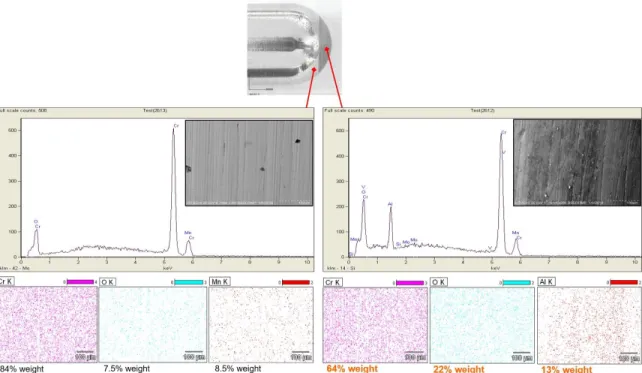
45° wall angle. Figure 5 shows the SEM images and EDS analysis with three main elements detected at HAZ and non-HAZ of forming tools. It can be seen that the element of oxygen (O) is higher three times at HAZ compared to non-HAZ, which caused by oxidation as a reaction of frictional heating between the forming tool and workpiece interface (Hutchings, 2017). It can be indicated that the presence of deposited elements of aluminum (Al) from the workpiece. This result confirms the material transfers from the workpiece to the forming tool and as an evidence of the adhesive wear on the forming tool (Kato, 2002). At the HAZ also reveals the reduction of chromium (Cr) and manganese (Mn) elements, since it has been replaced by the elements of O and Al.
Figure 5: The SEM images and EDS analysis with three main elements detected at HAZ and non-HAZ of forming tools.
4.0 CONCLUSION
ACKNOWLEDGEMENT
The authors would like to acknowledge the Universiti Putra Malaysia for financial support under the Putra Grant (GP-IPS/2016/9503100).
REFERENCES
Abeyrathna, B., Rolfe, B., & Weiss, M. (2017). The effect of process and geometric parameters on longitudinal edge strain and product defects in cold roll forming. International Journal of Advanced Manufacturing Technology, 92(1-4), 743-754.
Al-Ghamdi, K.A., & Hussain, G. (2015). Threshold tool-radius condition maximizing the formability in SPIF considering a variety of materials: experimental and FE investigations. International Journal of Machine Tools and Manufacture. 88, 82-94.
Araghi, B. T., Manco, G. L., Bamabach, M., & Hirt, G. (2009). Investigation into a new hybrid forming process: Incremental sheet forming combined with stretch forming. CIRP Annals –
Manufacturing Technology, 58(1), 225-228.
Arfa, H., Bahloul, R., & Bel Hadj Salah, H. (2013). Finite element modeling and experimental investigation of single point incremental forming process: Influence of process parameters on punch force monitoring and on mechanical and geometrical quality of parts. International Journal Materials Forming, 6, 483-510.
Bagundach, I., Centeno, G., Vallellano, C., & Garcia-Romeu, M. L. (2013). Forming force in single point incremental forming under different bending condition. Procedia Engineering, 63, 354-360.
Durante, M., Formisano, A., & Langella, A. (2011). Observations on the influence of tool-sheet contact conditions on an incremental forming process. Journal of Materials Engineering and Performance, 20(6), 941-946.
Fritzen, D., Daleffe, A., Castelan, J., & Schaeffer, L. (2013). Brass 70/30 and incremental sheet forming process. Key Engineering Materials, 554, 1419-1431.
Gupta, P., & Jeswiet, J. (2017). Observations on heat generated in single point incremental forming. Procedia Engineering, 183, 161-167.
Harris. J. W., & Stocker, H. (1998). Handbook of Mathematics and Computational Science. New York: Springer-Verlag.
Hutchings, I., & Shipway, P. (2017). Tribology: friction and wear of engineering materials. Butterworth-Heinemann.
Jeswiet, J., & Young, D. (2005). Forming limit diagrams for single-point incremental forming of aluminium sheet. Proceedings of the Institution of Mechanical Engineers - Part B: Journal of Engineering Manufacture, 219(4), 359-364.
Kato, K. (2002). Classification of wear mechanisms/models. Proceedings of the Institution of Mechanical Engineers, Journal of Engineering Tribology, 216(6), 349-355.
Khazaali, H., & Fereshteh-Saniee, F. (2016). A comprehensive experimental investigation on the influences of the process variables on warm incremental forming of Ti-6Al-4V titanium alloy using a simple technique. International Journal of Advanced Manufacturing Technology, 87(9-12), 2911-2923.
Li, J. L., Li, C., & Zhou, Y. G. (2012). Thickness distribution and mechanical property of sheet metal incremental forming based on numerical simulation. Transactions of Nonferrous Metal Society of China, 22, 54-60.
Li, J., Dang, X., He, K., Zuo, Q., & Du, R. (2016). A new type of incremental bending method for complicated curved sheet metal. Transactions of the Canadian Society for Mechanical Engineering, 40(4), 433-443.
Li, Y. J., Ai, C. S., Men, X. H., Zhang, C. L., & Zhang, Q. (2013). Research on on-line monitoring
technology for steel ball’s forming process based on load signal analysis method. Mechanical
Systems and Signal Processing, 36(2), 317-331.
Li, Y., Daniel, W. J., Liu, Z., Lu, H., & Meehan, P. A. (2015). Deformation mechanics and efficient force prediction in single point incremental forming. Journal of Materials Processing Technology, 221, 100-111.
Li, Y., Liu, Z., Lu, H., Daniel, W. B., Liu, S., & Meehan, P. A. (2014). Efficient force prediction for incremental sheet forming and experimental validation. The International Journal of Advanced Manufacturing Technology, 73(1-4), 571-587.
Li, Z., Lu, S., & Chen, P. (2017). Improvement of dimensional accuracy based on multistage single point incremental forming of a straight wall cylinder part. International Journal of Precision Engineering and Manufacturing, 18(9), 1281-1286.
Liu, Z. (2018). Heat-assisted incremental sheet forming: A state of the art review. International Journal of Advanced Manufacturing Technology, 98(9-12), 2987-3003.
Liu, Z., Li, Y., & Meehan, P. A. (2013). Experimental investigation of mechanical properties, formability and force measurement for AA7075-O aluminum alloy sheets formed by incremental forming. International Journal of Precision Engineering and Manufacturing, 14(11), 1891-1899.
Lu, B., Ou, H., Shi, S. Q., Long, H., & Chen, J. (2016). Titanium-based cranial reconstruction using incremental sheet forming. International Journal of Material Forming, 9(3), 361-370.
Lu, H. (2016). Investigation of control of the incremental forming processes. Ph.D. dissertation, University of Queensland, Brisbane.
MacAnulty, T., Jeswiet, J., & Doolan, M. (2016). Formability in single point incremental forming: A comparative analysis of the state of the art. CIRP Journal of Manufacturing Science and Technology, 16, 43-54.
Meier, H., Magnus, C., Buff, B., & Zhu, J. (2013). Tool concepts and materials for incremental sheet metal forming with direct resistance heating. Key Engineering Materials, 549, 61-67.
Mohammadi, A., Qin, L., Vanhoe, H., Seefeldt, M., Van-Bael, A., & Duflou, J. R. (2016). Single point incremental forming of an aged Al-Cu-Mg alloy: Influence of pre-heat treatment and warm forming. Journal of Materials Engineering and Performance, 25(6), 2478-2488.
Mugendiran, V., Gnanavelbabu, A., & Ramadoss, R. (2014). Parameter optimization for surface roughness and wall thickness on AA5052 aluminum alloy by incremental forming using response surface methodology. Procedia Engineering, 97, 1991-2000.
Nimbalkar, D. H., & Nandedkar, V. M. (2013). Review of incremental forming of sheet metal components. International Journal of Engineering Research and Applications, 3(5), 39-51. Otsu, M., Yasunaga, M., Matsuda, M., & Takashima, K. (2014). Friction stir incremental forming of
A2017 aluminum sheets. Procedia Engineering, 81, 2318-2323.
Sabater, M., Luisa, M. G. R., Marina, V. M., Ferrer, I., & Bagundanch, I. (2018). Process parameter effects on biocompatible thermoplastic sheets produced by incremental forming. Materials, 11(8), Article ID 1377.
Shubhamkar, K. (2016). Heat assisted single point forming of polymer sheets. M.S. thesis, Clemson University, South Carolina.
Uheida, E, H., Oosthuizen, G, A., & Dimitrov, D. (2017). Investigating the impact of tool velocity on the process conditions in incremental forming of titanium sheets. Procedia Manufacturing, 7, 345-350.