Vehicular Networking Road Weather Information
System Tailored for Arctic Winter Conditions
Timo Sukuvaara
1, Kari Mäenpää
1, Daria Stepanova and Virve Karsisto
21Arctic Research Centre, Finnish Meteorological Institute, Sodankylä, Finland 2Meteorological Research, Finnish Meteorological Institute, Helsinki, Finland
Abstract: In order to conduct successful long-term service and system architecture development, permanent infrastructures and development environment are essential. For this purpose, FMI is operating a vehicle winter testing track with advanced communication capabilities within ITS-G5 and 5G test network, along with accurate road weather data and services supported by road weather stations, IoT road weather sensor network and on-board weather measurements. The track is in Sodankylä, Northern Finland, where the long arctic winter period of more than half year allows road weather services development in (and for) severe weather conditions. This environment provides appropriate conditions for the development of advanced ITS safety services equally for traditional, autonomous and alternate energy vehicles, tailored road weather services for each special use case and accurate estimation of performance. Not forgetting the energy efficiency of traffic and communication infrastructures themselves, which are critical elements in the development of the future ITS. This paper introduces the test track infrastructures, related research ambitions and future plans.
Keywords: ITS-G5, 5G, road weather services, autonomous driving, energy efficiency.
1.
Introduction
The vehicular industry is on the verge of entirely different way of driving. New challenges caused by modern market and regulatory trends include green technology, vehicular intelligence, alternative energy vehicles, online services and automatic vehicles. Engine efficiency presents its own types of challenges, but for many of the topics listed above, communications and networking are expected to play a major role in future traffic system developments.
Autonomous driving, improved driving safety as well as energy-efficient and low-carbon traffic solutions are major trends in future traffic. Intelligent Transport Systems (ITS) provide technological approaches improving traffic safety and efficiency by advanced communication systems. Vehicular V2V Vehicle) and V2I (Vehicle-to-Infrastructure) communication with ITS-G5, along with 4G/5G cellular networking are the key technological approaches. Advanced communication systems are critical enablers for autonomous vehicles in real-time support as well as in advanced safety features allowed by real-time accident, incident and weather warnings. Along with these topics, interest in modern energy efficiency methods in traffic is growing rapidly. Low-carbon or even carbon-free solutions in vehicles and in traffic infrastructure are very critical elements when, e.g., European Union is setting up objectives of reducing use of and eventually phasing out fossil fuels in the following decades.
The traffic possesses relatively large share of fossil fuel consumption in the world, and especially in the European
Union has ambitious objectives in reducing heavily the traffic-oriented carbon emissions.
The Finnish Meteorological Institute (FMI) has a long history in development of ITS-enabled road weather services. Advancing safety has always been a major target of FMI research, but now the merging trends of automated driving, alternative energy solutions along with reduced carbon emissions in the traffic environment must be carefully considered as well.
Seamless interoperability in highly mobile environments like VANET (Vehicular Ad Hoc Networking) is crucial while developing cooperative applications that can make full use of networking infrastructure. Cooperative applications for VANET require seamless communication between V2I and V2V. The IEEE 802.11p [1] has been developed for this purpose, with its European counterpart ITS-G5 tailored by ETSI for European frequency bands and channels. These systems work well in the short range (less than 500 m distances), but in wide area communication the main problem is that the network coverage is low as roadside infrastructure is nowadays sparsely implemented. For the general safety services of ITS-G5 are designed for vehicle-to-vehicle type of local messaging, not requiring real-time connectivity with dense infrastructure. However, for the popular online streaming services and especially autonomous driving require continuous communication. The cost of such dense network infrastructure dedicated for ITS seem to be too high for traffic stakeholders and authorities.
infrastructure [3]. C-V2X (Cellular Vehicle-to-Everything) approach is presenting the idea of hybrid communication in the practical approach, cellular networking with embedded support for vehicle-to-everything (V2X) communication [4]. Next generation cellular networking, known as 5G, is tackling with these issues, and is expected to provide considerable improvements for these issues, among other advances like superior bandwidth and ultra-low end-to-end delays. Reliable and efficient communication is very important aspect in autonomous driving vehicles, to assure safety and comfortability [5].
Along with the communication, road weather services are another essential element of future driving. Autonomous vehicles are relying on the real-time knowledge of the accurate location of themselves and co-existing traffic actors and infrastructures and all the knowledge related to their mutual safety margins. They require mutual distances, but also very accurate road weather information to estimate safety margins and furthermore ensure safe driving in all conditions. Alternative energy vehicles like electric vehicles are highly dependent on their consumption of very limited energy resources, consumption varying heavily in different weather conditions. The production of accurate road weather forecasts covering the full road network is a big challenge due to scarcity of observations. Road weather stations (RWS) are mainly located along major roads and are typically several kilometers apart. A growing number of available mobile observations are expected to be beneficial in solving the observation data void issue [6].
Road weather services exploiting road traffic data allow more accurate instantaneous service generation directly to different traffic and transport actors. The next step is to generate more extensive piloting of services in more controlled conditions and under real-life traffic conditions. Exploiting both ITS-G5 and cellular networking (4G/5G) features offers the best communication approach at hand, until the ITS-G5, cellular or C-V2X is not clearly the superior approach. FMI has constructed large-scale test environments for these purposes: the Sod5G controlled vehicle winter testing area for both ITS-G5 and 4G/5G cellular networking, and the Arctic Intelligent Trucks vehicle fleet for operational testing within a normal highway traffic environment under challenging weather. For the Sod5G test environment 5G-Safe project introduced demanding applications for enhanced user experience and safety, exploiting the enhanced capacity and mobile edge computing of upcoming 5G cellular architecture.
Energy-efficient, low-carbon solutions within the intelligent traffic is emerging topic raising more and more interest especially in Europe. Employing energy-efficient solutions in the Arctic winter conditions is an extreme challenge, showcasing the usability of these methods. If they work in Arctic conditions, most likely they will work in milder conditions as well. Therefore, it is beneficial to study such kind of energy-efficient methodologies in Arctic traffic environment, by FMI, possessing long experience with intelligent traffic in Arctic conditions and high expertise in Arctic meteorology.
This paper introduces FMI’s combined ITS-G5 and 5G test facility for vehicle winter testing, advanced road weather services development and energy-efficient methods in the
Arctic traffic. The preliminary pilot services developed and tested for 5G-enabled vehicular networking are introduced, along with ITS-G5 day one services. Both 5G and ITS-G5 services have been tested in the test track. Semi-operational pilot services utilizing an operational truck fleet with on-board environmental sensors and communications are also presented. Lastly, plans for a future research and development direction planned for the test facility – energy-efficiency of traffic infrastructures – are outlined and introduced. The paper introduces the test network entities, underlying data technologies and presents the preliminary evaluation of the test track communication systems.
This paper is organized as follows: section 2 introduces the FMI testing infrastructures for ITS research. Section 3 provides an overview of the pilot services and their performance evaluation. In section 4 energy efficiency in traffic infrastructures is considered from the test track perspective. Finally, conclusions are drawn.
2.
Infrastructures for ITS-enabled traffic and
advanced road weather services
ITS research is nowadays increasingly targeting operational systems, services and devices, expected to be ready for commercial vehicle fleets and private vehicles within a certain period. Therefore, testing in real-life conditions is essential – initially in specific and controlled testing areas, followed by tests within real traffic. FMI has long experience of the development of advanced road weather services. Based on this experience, FMI has built 5G and ITS-G5 testing environment with advanced road weather infrastructure into the institute’s vehicle winter testing site. The site is supplemented with mobile road weather observation instrumentation deployed with an operational truck fleet equipped with advanced communication capabilities to deliver observation data in real time as well as to receive near-real-time services. With these facilities, FMI can test and analyze the ITS and road weather services in controlled conditions and furthermore in operational real-life environment and offer this “facility” to third parties as well.
3.1 Vehicle winter testing track
traditional Wi-Fi hardware with IEEE 802.11n [8] compatible devices, allowing for comparative measurements with Wi-Fi. Wi-Fi network will be updated to IEEE 802.11ax compatible devices within the near future.
Figure. 1. Sod5G test track. The Road Weather Stations are
marked as RWS1 and RWS2, IoT road weather sensors as red circles.
The 5G test network consists of a single TD-LTE 16A base station, based on 3GPP Rel.12. It has 4x4 closed loop MIMO system with 2x20MHz channels in 2.3 GHz band, located to the North of the track, just outside the top of the Figure 1. With this one base station unit we can’t offer constant quality of service throughout the track – in the Southern part of the track the signal strength is very low, in snowy conditions below the threshold. However, this allows us to test communication in fading signal conditions as well. If continuous communication is required, we can use the shortcuts of the track. The 5G test network is supplying an LTE-A communication system with 5G communication architecture components and service modules through 5GTNF-open innovation ecosystem for 5G technology and service development, coordinated by VTT.
Accurate road weather services for the test track are generated by combining 1) general meteorological road
weather information for the area produced by FMI, 2) road weather station (RWS) measurements in the area, 3) recently implemented IoT weather sensor network embedded into the test track, providing less-accurate but more dense weather observation system and 4) supplemental mobile data provided by the vehicles on the test track. Both 5G cellular networking test system and ITS-G5 vehicular networking are employed in this scenario and the experiments have been conducted with both systems.
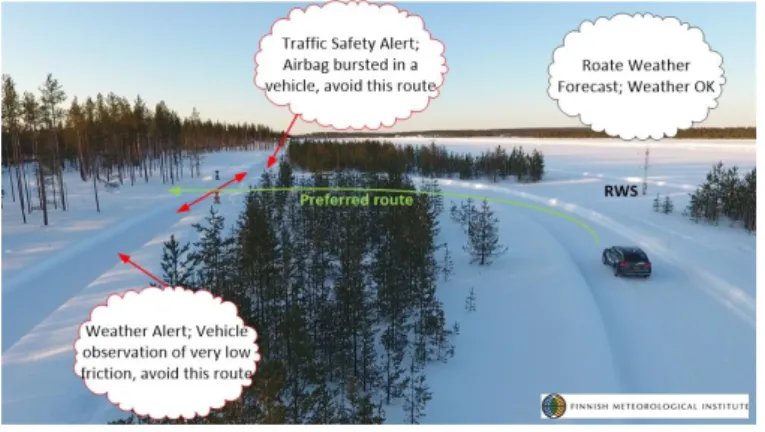
In the pilot system, two vehicles are driving on the test track with embedded friction instrumentation. Surface friction data are transmitted during the pass of an RWS with ITS-G5, or continuously with the 5G test network. Along with the vehicle data, also both RWS units collect weather data with their fixed friction instrumentation. Thereafter, the entire data are delivered to the test site road weather service computer. This computer combines these different data sources to form a specific test track road weather service and delivers information back to test track vehicles in real-time manner during each RWS pass.
Currently we are studying the possibility to employ automatic drones as part of road weather observation network. We have already tested automatic flights in the road section between road weather stations, but the monitoring instrumentation, landing manoeuvres and independent charging are still under research in ERDF VED and Interreg Nord Arctic Airborne 3D projects.
3.2 On-board measurements in the mobile observation environment
The Intelligent Arctic Trucks project, also funded by the ERDF, comprises a 260 km road stretch along which equipment attached to 12 heavy trucks carry out different environmental measurements, see Figure. 2. The trucks form a mobile real-time test laboratory for studying and developing ITS and road weather applications. Based on synthesis of the on-board measurements and the FMI meteorological services, effective and accurate local road weather information is composed for the road stretch between Kevitsa and Kemi. The current pilot application, viewed in the Figure 3, presents the road weather forecast data to the whole pilot route, supplemented with local observations in the location of the end user (black spot in Sodankylä). The route is color-coded by the level of observed/forecasted friction. Alternately the presented observation can also be road temperature or traffic weather index (three-level estimate of traffic weather).
Figure 2. Intelligent Arctic Trucks route and the existing RWS network. The filled blue dots are RWSs operated by Traficom (the Finnish Transport and Communications Agency) the interactive research RWS of FMI is marked with an open blue dot.
The project also investigated the relationships between factors such as quality (e.g., accuracy, sampling frequency) of data produced by vehicle on-board instrumentation, the number of vehicles carrying out such observations and the coverage – i.e., the frequency with which observing vehicles pass through a given stretch of road. The aim was to come up with guidelines as well as resource needs assessment for achieving more comprehensive observational coverage of the road network using this type of vehicle-based, mobile observations. The observational approach (being piloted in this project) would be convenient to be expanded to cover at least major roads with large volumes of commercial traffic with larger vehicles. Even if the Intelligent Arctic Trucks project itself has already ended, the measurements on the route with concept instrumentation are continuing. The future work employs camera data observations as one additional source of on-board weather monitoring data, researched especially in our on-going 5G-SAFE-PLUS project (funded by Business Finland).
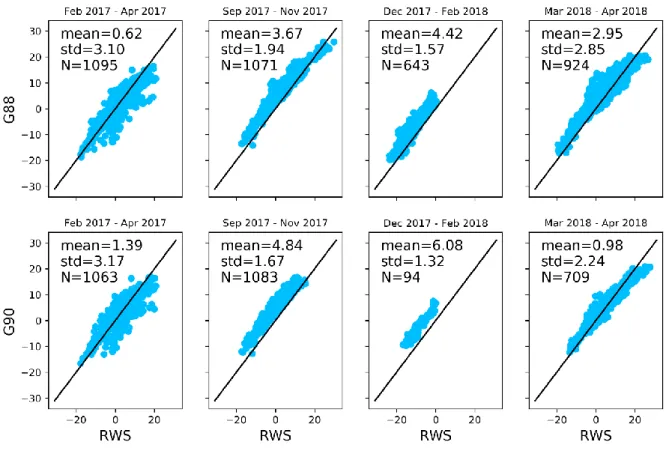
The quality of used mobile road surface temperature observations were assessed by comparing them to the measurements done at RWSs. Mobile observations were picked to the RWS points by taking the average of observations which were done within 50 meters from the RWS point and where the speed of the vehicle was more than 5 km/h. Figure 4 show scatter plots for different Teconer devices where the columns represent different time periods. For some devices the average difference to RWS seems to change over time. The Teconers installed in mining trucks in February 2017 (RCMG88 and RCMG90) give on average around 1 ͦC warmer measurements than the RWSs
during the spring period. However, the warm bias is much stronger for periods September 2017 – November 2017 and December 2017 - February 2018. The other device has even mean difference of 6 ͦC to RWS measurements during the latter period, but this is affected by the small number of measurements. The warm bias is considerably lower for period March 2018- April 2018. However, asphalt embedded sensors at RWS have tendency to warm too much during sunny spring days. This is one reason for the Teconer sensor having lower bias during this period. Statistical correction can be applied to Teconer observations to get them more in line with RWS observations [9].
Figure 3. User interface of local road weather application.
3.
ITS-enabled
advanced
road
weather
services
data and warnings, ultimately delivered to the vehicles in near-real-time by the 5G test network. Furthermore, the V2V communication in the 5G test network and the ITS-G5 was tested with special “see-through” application, tailored to deliver vehicle camera data information from the front of a vehicle queue during the poor visibility conditions, allowing preparedness for unexpected anomalies in the traffic. Video streaming between vehicles allows for entirely new types of services for enhancing traffic safety and convenience. See- through application is very sensitive to the transmission delay and possesses also juridical questions, therefore it is not ready for the operational traffic environment yet[10][11]. Similar kind of application has been introduced in [12], using IEEE 802.11p DSRC communication for video data transmission between vehicles.
We were also testing services tailored for automated vehicles. Automated vehicles can utilize warnings and information from weather and safety services in order to improve route planning and safety. For example, an automated vehicle may select its route according to factors such as route length, weather conditions and accidents. Our solution enabled an automated vehicle to receive warnings from two services, the weather alert service described earlier and lidar-based obstacle detection. The obstacle detection algorithm receives lidar data from vehicles and detects obstacles (e.g. human, animal or large debris) based on the data. Whenever an obstacle is detected, the algorithm transmitted a warning to nearby vehicles so that they could avoid colliding with the obstacle [11].
Nevertheless, the set of pilot services tailored for 5G and autonomous driving are available on the test track, along with C-ITS (Cooperative Intelligent Transport Systems) so called “day 1 services”[13], which have been tested on our test track at “proof-of-concept” level. More detailed evaluation of day 1-services will be conducted in the future. The work continues in the follow-up project 5G-SAFE-PLUS.
Figure 5. Pilot road weather services tailored for
autonomous vehicles and 5G.
The delivery of road weather services directly to vehicles as well as collecting observation data directly from vehicles require a high level of security and trust. We must be able to ensure that the data transmissions and data handling procedures in the vehicles, service clouds and within the road weather service generation process are not disturbed or contaminated in any way. For this purpose, FMI was participating in two projects providing security methodologies for our vehicular networking use cases. The EU ECSEL JU (Electronic Components and Systems for European Leadership project, Joint Undertaking) SafeCOP introduced additional safety and trust for wireless
communication with a specific runtime engine controlling the security and validity of each communication entity’s internal operation, with supporting safety layer functionalities ensuring the general communication safety. These methodologies were employed especially in the road weather service cloud used in the Intelligent Arctic Trucks and in our vehicular communication entity. The Celtic Plus project CyberWI generated tailored safety features for pre-defined operational environments and FMI’s RWS structures both in the Sod5G test track as well as in the interactive RWS along the route of the Intelligent Arctic Truck fleet.
4.
Test track evaluation
The test track general operability has been demonstrated in the operation of the track infrastructure. Several pilot services have been generated and successfully operated within the track. We have also conducted more specific analysis of the ITS-G5 based V2V and V2I information sharing on the test track, for performance evaluation purposes. The general environment-of-operation is as follows. The RWS provides road weather information based on its observations. The road friction data, along with possible accident information is collected by observing vehicles in the test track. The RWS collects the observation information from the vehicles passing by (using V2I communications), to be used in these services. The RWS also delivers the combined weather information to the vehicle (also with V2I). The vehicle encountering another vehicle will forward this RWS data to the other vehicle (V2V) thus spreading the RWS data and extending the RWS range.
In our field measurements, two RWSs and two vehicles are involved. The vehicles were driving in the test track, two RWSs acting as the V2I counterparts. Communication between the vehicles and the RWSs was conducted with Cohda Wireless MK5 transceivers, compatible with ITS-G5 (IEEE 802.11p). SUNIT F-series vehicle PC was the user interface (UI) in vehicles, Android tablets being an optional solution. In-vehicle communication, the data is collected solely from the external road condition monitoring measurement instrument installed in the vehicle. In these measurements we used Teconer RCM 411 devices with road temperature, road state and road friction data.
In the first stage, the vehicles collected RWS data in V2V and V2I communication mode, while driving on the test track. RWS delivered the up to date road weather information to the vehicles, while passing. Furthermore, encountering vehicles exchanged their latest road weather information received from RWS. The resulting connectivity is presented in Figure 6. The yellow marks are pointing the locations where the packets were received by a vehicle from the RWS in V2I scenario and from another vehicle in V2V scenario.
The connectivity tests consisted of 10 passes vehicles driving both in the same and opposite directions.
In the second stage we evaluated the general performance of the communication, in terms of data throughput and delay. We conducted 10 measurement drives for V2I communication using the ITS-G5 network, the standard, commercially operational 4G network and the 5G test network. In the ITS-G5 scenario, the RWS was sending a standard road weather station message continuously and the test vehicle captured as many of those packets as possible. In cellular scenarios the same data were delivered through the cellular network. In each scenario the test vehicle was randomly driving along the test track. As a result, we got an estimate of general performance within the test track, presented in the Table 1. The latency of ITS-G5 is significantly better compared to cellular systems. However, by the introduction of the edge computing features and higher carrier frequency would benefit 5G test network performance (e.g., reduce latency) significantly. The higher carrier frequency allows higher throughput and the edge computing reduced the need for fetching the data through the fixed network. The share of lost packets was particularly high in cellular systems, due to relatively long initialization time included to the measurements. As our test devices are not constantly in the test network and the test network itself not in continuous use of multiple users, it takes time for the end device to initiate the link. When connected, cellular network packet loss rate decreases dramatically.
To illustrate the capacity difference in 5G test network (LTE-A) and IEEE 802.11p, we conducted one more set of measurements. We measured the communication data throughput while driving 7 laps through the test track, both LTE-A cellular communication and IEEE 802.11p communication. The results of this measurement set are presented in the Figure 7. In IEEE 802.11p communication there is one section in which the range of communication is clearly exceeded and data throughput dropping to zero. The throughput performance seems to be clearly lower level compared to the Table 1. The reason for this difference is most likely relying on the software tools employed. In the first measurements (presented in the Table 1) the performance evaluation results have been collected from Iperf software, used for the generating the UDP data traffic. In the latter measurements, the throughput data is collected with Wireshark software, allowing the packet-level evaluation of traffic. Most likely Iperf throughput data also contain the connection creation related packet exchange, while with the Wireshark we can separate the “goodput” of transmitted information.
In the final stage of our evaluation we estimated the 5G test network performance in the delivery of real-time video data.
Table 1. Performance measurements in the test track.
Description ITS-G5 4G cellular network, V2I
LTE-A cellular test network, V2I
Measurements 26 45 44
Latency 0.18s 0.83s 0.65s
Lost packets 10% 75% 80%
Average throughput
1.46 Mbps
2.58 Mbps 2.66 Mbps
Figure 7. 5G test network (LTE-A) and IEEE 802.11p
comparison test.
In the 5G-Safe project we developed a special “see-through” test application described above in the previous chapter. This video image delivery was evaluated in the 5G test network, between two vehicles travelling on the track. The result of this test is presented in the Figure 8. One can see that the latency in video transmission mainly varies between 0.2 s and 0.4 s. For the video delivery the latency needs to be reduced to ensure the noise-free video delivery without delay. However, the limited bandwidth and contented test network operation frequency (2.3 GHz) are decreasing the delay performance of the test network.
In the presented test track evaluation, we were focusing on the communication performance. We were not paying attention to the arctic conditions, but the test measurements were conducted in optimal (clear, not too cold) weather
Figure 8. Test network latency in video transmission from
vehicle to vehicle.
conditions. However, the test track has been operative throughout the extreme weather conditions as well, and no interference or performance lacking have been observed, neither in 5G test network nor the ITS-G5 communication. The detailed analysis of arctic weather effect is an interesting topic for the further research.
IoT road weather sensors were not employed in the test track evaluation, due to their recent deployment and the nature of their observation. As the data from IoT sensor network is collected periodically by independent Lorawan IoT, the monitoring data can be exploited in the weather forecasting as an additional data source.
5.
Conclusions
experience of the development of advanced road weather services. The research work and the development of services can be conducted in the 5G pilot- and ITS-G5 testing environment with advanced road weather infrastructure at the FMI vehicle winter testing site, along with mobile road weather observation instrumentation deployed with an operational truck fleet equipped with advanced, low-latency communications capabilities to both deliver observational data in near-real time as well as to receive road weather services. Based on authors experience, in operative autonomous driving in the arctic conditions the road weather stations are essential roadside infrastructure, clearly supported by mobile friction measurements. The FMI test site is located in the Northern Finland, at Sodankylä, allowing for testing of arctic winter conditions for nearly half of the year. With these facilities, FMI can test and analyze the ITS and road weather services. This infrastructure is available for similar kind of testing and evaluation purposes for any existing or upcoming partner/co-operator of FMI as well.
This paper presents a general performance evaluation of the communication network systems implemented into the FMI vehicle winter testing track in Sodankylä, Northern Finland. The test track is designed for road weather services development and is equipped with different ITS communication systems, but the facility can be adapted to any kind of vehicle, road weather and communication testing scenarios.
The services and infrastructures presented above are all existing systems. During this year test track start facing entirely new type of services and systems. 5G test network will be updated to follow operative 3.5 GHz system. It will be also supplemented with support for the Lorawan IoT operation. The fixed meteorological and communication infrastructure will be supplemented with automated mobile systems, hosted by drones and miniature ground vehicles with automated routines. Several types of roadside instrumentation will be deployed, benefiting IoT along with other available communication systems. At the same time, the various security issues of IoT communication, reviewed in [14] have to be considered. Operator-hosted Lorawan IoT possesses advanced level of security due to its controlled environment, but with more independent IoT sensors, security issues need to be considered more carefully. Vehicle-oriented camera data and weather radar data are exploited as part of road weather service upgrading. The possibility to reduce the carbon emissions of the track existing and new infrastructure will be carefully analysed, by introducing methods or combination of existing methods optimizing the energy-efficiency. The ultimate target is to maintain the test track facility as the main development site of FMI intelligent traffic systems, as well as the state-of-the-art roadside and networking infrastructure.
6.
Acknowledgement
This work has been supported in part by the European Regional Development Fund (ERDF), Business Finland and the EU EUREKA Celtic Plus and EU Interreg Nord programs. The authors wish to thank all our partners of the Sod5G, Intelligent Arctic Trucks, 5G-Safe, Wirma, CyberWI, Arctic Airborne 3D, Energy-efficient methods in Arctic traffic, VED and 5G-SAFE-PLUS projects.
References
[1] IEEE Standard Association, “IEEE Std. 802.11p/D9.0: Draft Standard
for Information Technology – Telecommunications and information exchange between systems – Local and metropolitan area networks – Specific requirements, Part 11: Wireless LAN Medium Access Control (MAC) and Physical Layer (PHY) specifications, Amendment 7: Wireless Access in Vehicular Environments”, Institute of Electrical and Electronics Engineers Inc., New York, U.S.A. 2009.
[2] S. Mumtaz et Al., “Cognitive Vehicular Communication for 5G”,
IEEE Communications Magazine, Vol. 53, No.7, July 2015, pp. 109-117, 2015.
[3] T. Sukuvaara, “Development, implementation and evaluation of an
architecture for vehicle-to-vehicle and vehicle-to-infrastructure networking”, Doctoral Thesis, University of Oulu, Department of Communications Engineering, Oulu, Finland, 118pp, 2015.
[4] 5G Automotive Association, “The case for cellular V2X for safety and
cooperative driving”, White paper, 2016.
[5] D.Zheng et Al.., “Reliable and efficient autonomous driving: the need
for heterogeneous vehicular networks”, IEEE Communications Magazine, Vol. 53, No.12, December 2015, pp. 71-80, 2015.
[6] V. Karsisto and L Lovén, “Verification of road surface temperature
forecasts assimilating data from mobile sensors”, Wea. Forecasting, No. 34, pp. 539–558, 2019.
[7] T. Sukuvaara and K. Mäenpää, “Arctic vehicular wireless
communication testing and development environment”, 2nd 6G Wireless Summit, organised as virtual event 17-18.3.,2020.
[8] IEEE Standard Association, “IEEE 802.11n-2009—Amendment 5:
Enhancements for Higher Throughput”, IEEE-Standard Association, 29 October 2009.
[9] L Lovén. et Al., “Mobile road weather sensor calibration by sensor
fusion and linear mixed models”, PLOS ONE, 14(2):e0211702, 2019:
[10] M. Lu (ed.), “Cooperative Intelligent Transport Systems - Towards
high-level automated driving”, Published by The Institution of Engineering and Technology, Chapter 11: 5G for road safety services by Ojanperä T., Mäkelä J., Sukuvaara T., Kutila M. and Pyykönen P., London, United Kingdom, , 612 pp., 2019.
[11] T. Ojanperä et Al., “Development and Piloting of Novel 5G-Enabled
Road Safety Services”, IEEE WCNC 2019 Advanced 5G radio access network features and performance workshop, Marrakech, Morocco 15.-18.4.2019.
[12] K. Liu., X. XU,, M. Chen , L. Wu and V. Lee, “A hierarchical
Architecture for the Future Internet of Vehicles”, IEEE
Communications Magazine, Vol. 57, No.7, July 2019, pp. 41-47, 2017
[13] ETSC European Transport Safety Council Briefing, “Cooperative
Intelligent Transport Systems (C-ITS)”, European Traffic Safety Council, 2017.
[14] A. Abuagoub, “IoT Security Evolution: Challenges and