O R I G I N A L R E S E A R C H
Open Access
Structured classification for ED presenting
complaints
–
from free text field-based approach
to ICPC-2 ED application
Tomi Malmström
1*†, Olli Huuskonen
2†, Paulus Torkki
1†and Raija Malmström
3†Abstract
Background:Although there is a major need to record and analyse presenting complaints in emergency departments (EDs), no international standard exists. The aim of the present study was to produce structured complaint classification suitable for ED use and to implement it in practice. The structured classification evolved from a study of free text fields and ICPC-2 classification.
Methods:Presenting complaints in a free text field of ED admissions during a one-year period (n=40610) were analyzed and summarized to 70 presenting complaint groups. The results were compared to ICPC-2 based complaints collected in another ED. An expert panel reviewed the results and produced an ED application of ICPC-2 classification. This study implemented the new classification into an ED.
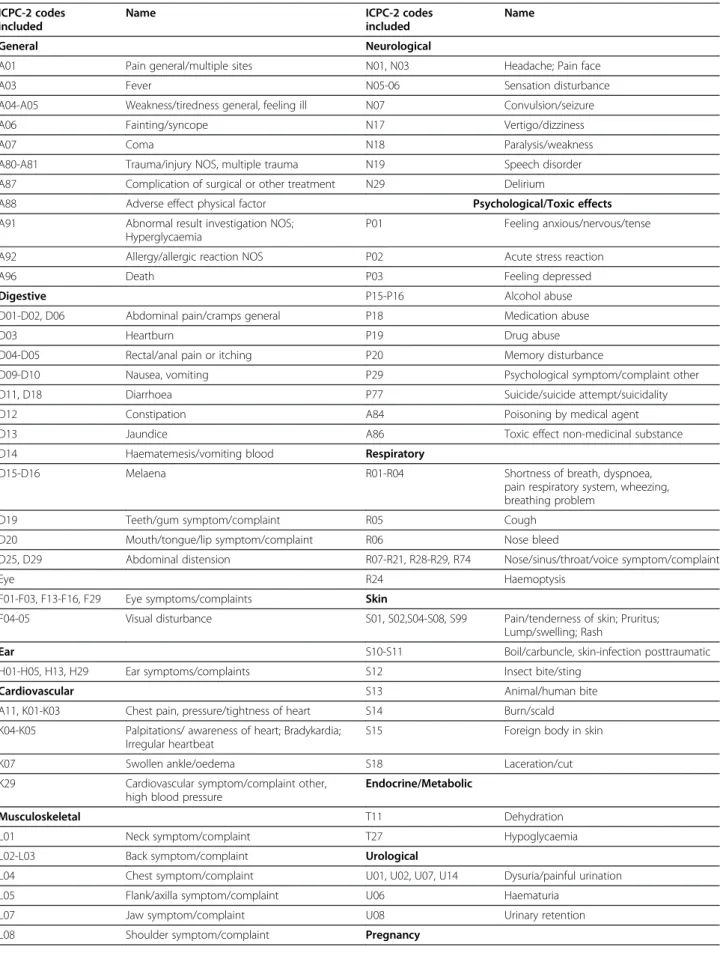
Results:The presenting complaints summarized from free text fields and those from ICPC-2 categories were remarkably similar. However, the ICPC-2 classification was too broad for ED; an adapted version was needed. The newly developed classification includes 89 presenting complaints and ED staff found it easy to use.
Conclusions:ICPC-2 classification can be adapted for ED use. The authors suggest a list of 89 presenting complaints for use in EDs adult patients.
Background
When a patient enters an emergency department (ED), important decisions are made at the very beginning of the visit concerning the necessity for, and the urgency of, medical examinations and care required by the pa-tient. The presenting complaint, other anamnesis avail-able, and a short status assessment determines the urgency of the treatment. Information from the referral notes or ambulance staff is also useful, if available. The presenting complaint is the patient’s reason for the en-counter, interpreted and recorded by the triage nurse. Although the importance of triage on patients’ progno-ses is recognized [1], there exists only sparse data on the presenting complaints of ED patients.
Over the last 20 years, hospitals have developed differ-ent formal triage systems and these systems are in wide use [1]. No golden standard for triage exists, and careful attention should be paid on the studies, and the follow-ups, of the competence and validity of the triage process in each ED. For example, studies on children [2], patients with unspecific complaints [3], and patients with sepsis [4] have shown the difficulties of triage.
To be able to study the impact of triage on the prog-noses of different patient groups, structured information of the presenting complaints is needed. The process, from presenting complaint to diagnosis, is the core com-petence of emergency departments and failures at the beginning of the process - specifically, in triage - often lead to prolonged visits, endangered patient safety, and decreased patient satisfaction. Designing and controlling emergency departments with end diagnosis based infor-mation may result in inappropriate processes. A system that allows EDs to classify patients and define compar-able case-mix groupings will help EDs describe their pa-tient populations, workloads, staffing, and resource
* Correspondence:[email protected] †Equal contributors
1Institute of Healthcare Engineering and Management, Department of
Industrial Engineering and Management, Aalto University, Otaniementie 17, 00076 Aalto, Finland
Full list of author information is available at the end of the article
needs, and enable comparison across sites and regions [5]. In addition, it allows the development of automated decision support systems to specific patient groups, such as the automated evaluation of the Pneumonia Severity Index [6], or the reminder of stroke assessment form [7]. However, such a classification system should be rela-tively easy to adopt and implement, in order to be rou-tinely utilized by ED staff.
No international standard for recording presenting complaints exists, and in many EDs, recording is not systematic. Even though the need for a systematic way to record presenting complaints was raised over a dec-ade ago by Aronsky and colleagues [7], studies around the world report vast use of free-text fields and a general lack of a structured way to record presenting complaints (Australia [8,9]; US [10]; Finland [11]). The Canadian ED Information System (CEDIS) Working Group’s Pre-senting Complaint List [5,12] linked to the Canadian Triage and Acuity Scale (CTAS) has achieved good coverage in Canadian EDs. Other large international tri-age systems (ATS, MTS, ESI) do not provide structured classifications for PCs. Other than CEDIS, there are few other classifications presented in literature. Aronsky et al. [7] aimed at developing a generally applicable set of coded chief complaints for EDs and their study resulted in a list of 54 presenting complaints. Other clas-sifications are presented in relation to single studies [3,8,13-17].
In contrast to fragmentation of presenting complaint classifications in EDs, there are established classifications for ambulatory care. Reason for Visit Classification (RVC) is used by the Centres for Disease Control and Prevention (CDC) and for the annually reported Na-tional Hospital Ambulatory Care Survey (NHAMCS) in United States [18,19]. The International Classification for Primary Care (ICPC-2) is used for both diagnostic classification in family practice and primary care, and classification of ambulatory patients’ Reasons for En-counter. WHO has accepted ICPC-2 within the WHO’s Family of International Classifications (FIC), mainly as a method of encounter classification. ICPC-2 has been used in few studies within emergency services [20] and EDs [21,22]. However, neither RVC nor the ICPC-2 is ideal for use in EDs. Both systems are designed for pri-mary care office hours and they each include several hundred complaints. (RVC includes 770 different com-plaints and the shortened version of the ICPC-2 has 687 codes for RFEs.)
The aim of the current study was to investigate whether the ICPC-2 could be adjusted to an ED present-ing complaint classification, and thus, achieve an ED classification compatible with other areas of health care using the ICD-10 and the ICPC-2. The main reason for selecting the ICPC-2 was to employ an already
internationally established classification as a foundation for the new classification. This study presents a struc-tured classification for adult patients’ ED presenting complaints based on ICPC-2 classification. The authors developed the ED presenting complaint classification by using free text analysis of 40,610 visits in one ED and by collecting presenting complaint data, using the ICPC-2, from 2,400 visits in another ED. Both EDs are respon-sible for primary care and special care urgent and emer-gent patients. An expert panel finalized the classification and the authors of this study implemented the new sys-tem in the Jorvi ED. This paper discusses the results.
Terminology
The presenting complaint in EDs refers to a professional interpretation of the symptoms or condition that made the patient seek emergency care. Presenting complaint is a term more established in Europe and Canada and its counterpart term in the U.S. is chief complaint (CC). Other terms sometimes used/mixed include Reason for Encounter (RFE), Reason for Visit, Presenting Problem, Problem on Admission, and Reason for Presenting. RFE refers to the pure reason for seeking medical advice, not including expert interpretation.
Figure 1 illustrates the use of presenting complaint ter-minology and related classification systems. A diagnostic classification is necessary in both elective and emergency care. Therefore, the ICD-10, with a broad diagnostic range, is used in both situations. The ICPC-2 was devel-oped for diagnostic classification in family practice and primary care and it is based on the prevalence of health problems in primary care. The term patient’s perspective represents the demand for care of that patient, and using the ICPC-2, it can be recorded as the reason for encoun-ter both in elective and emergency care.
In emergency care, the triage nurse assesses the pa-tient and makes decisions of urgency and requisite resources at the beginning of visits. In elective care, there is no need for the triage process or for the record-ing of the presentrecord-ing complaint durrecord-ing the patient’s visit. The presenting complaint should not be confused with RFE, although it is based partly on RFE.
Methods Study design
In the second phase, the objective was to implement the ICPC-2 classification in ED. As the ICPC-2 is an established classification system, mostly used in primary care diagnosis classification, the authors wanted to test its suitability for ED environments. The presenting com-plaints were collected with a two-week survey.
The third phase focused on creating an ICPC-2 based presenting complaint classification suitable for use in ED environments, and subsequently, in phase four to imple-ment it in ED environimple-ments. The resulting classification system was based on the results of the first two phases and evaluated by an expert panel.
The study conducted the first phase in the Hyvinkää Hospital ED and the three others in the Jorvi Hospital ED. The following section presents both study sites and gives a more detailed description of each study phase.
Study setting
In Finland, 24/7 emergency services are mainly centra-lized to joint emergency units in charge of urgent and emergency services for special and primary health care. Two emergency units from Helsinki University Hospital District (HUCH) participated in this study, the Hyvinkää Hospital ED and the Jorvi Hospital ED.
The Hyvinkää Hospital ED serves a population of 185,000 inhabitants and the ED has 49,700 visits/year (2008). The Jorvi Hospital ED serves a population of 295,000 and has 62,500 visits/year (2010). During daytime
hours, the health centres in the both regions also treat urgent primary care patients. Hyvinkää Hospital situates 50 kilometres, and Jorvi Hospital 15 kilometres, from the main University Hospital clinics in Helsinki. Patients with multiple injuries, candidates for thrombolytic ther-apy for stroke, and patients with an ST-elevation myocar-dial infarction were excluded from the study because according to HUCH policy, they were forwarded to the speciality emergency departments of the HUCH hospitals in Helsinki directly, by emergency services. In addition, childbirths were excluded from the study.
Phase 1: identification of presenting complaints from free text field
In the first phase, the objective was to identify pre-senting complaints of an ED using recordings from free text field. At Hyvinkää, the patients' presenting complaints are recorded in a free text field in the in-formation system. If the patient comes without a referral, the presenting complaint is assessed by a nurse, based on the reason for the visit stated by the patient and possible information given by emergency services. If a patient has a referral, the presenting complaint is taken from the referral and entered by the department secretary. All presentations to the Hyvinkää ED during 2008 were included in the study.
Typically, if a patient is transferred from a general practitioner to a physician in specialized medical care Reason for
encounter Diagnosis
Reason for encounter
Presenting
complaint Diagnosis
Elective care
Emergency care
Patient
Triage nurse
ICPC-2
ICPC-2
ICPC-2;ICD-10
ICPC-2;ICD-10 CEDIS; study
specific classifications
ICPC-2 ED application
Medical doctor
Figure 1Terminology and classification systems.
Identification of presenting complaints from free
text field
ICPC-2 implementation and
two-week survey
Comparison of Phase 1 and Phase 2;
Expert panel
Phase 1 Phase 2 Phase 3
Expert panel; Implementation of new classification
Phase 4
because of a consultation, a presenting complaint is entered in the system. However, this study used the ori-ginal reason for encounter entered when the patient first came to the emergency clinic.
The data were reworked by selecting the presenting complaint for each patient in the free text of the field. If several reasons for encounter were entered for a single patient, the one requiring the most urgent care was selected. The prioritised reasons were shortness of breath, chest pain, and abdominal pain, respectively. Functions in the spreadsheet application MS Excel 2007 were used to select the reasons for encounter. The data rework was done by RM and TM.
In most of the cases, obvious presenting complaints could be picked up from the free text, and therefore, grouping of the synonyms and trimming of the different writing formats comprised the majority of the work. Un-clear presenting complaints were discussed case by case, and the reason selected was based on a clinician's assess-ment (RM). If the presenting complaint could not be determined from the field, or if the field contained just individual symptoms, the encounter was excluded from the list.
Phase 2: ICPC-2 implementation and two-week survey In the second phase, the objective was to implement the ICPC-2 classification to ED and evaluate its suitability to ED use. This phase was carried out in the Jorvi Hospital ED and data were collected from a survey. In Jorvi, ICPC-2 classification was already familiar, because visits to primary care had been recorded by triage nurses using ICPC-2 since 2007. However, the use of classifica-tion had not been systematic, and the concept of pre-senting complaint and diagnosis had been mixed. Researchers administered the survey over a continuous 14-day period, from 8:00 am Monday, November 15 to 8:00 am Monday, November 29 2010.
The presenting complaints were recorded on a paper-format questionnaire at the point of triage using ICPC-2 codes. To help staff record different ICPC-2 codes for presenting complaints, a two-page summary of codes was available at the triage facility. The two-page docu-ment is available in several languages on the WONCA website (http://www.globalfamilydoctor.com/wicc/) and it includes 687 different codes. Staff was allowed to rec-ord several presenting complaints for a single patient. However, the data analysis used only the most urgent presenting complaint.
Phase 3: development of new ICPC-2 based ED application
In the third phase, the objective was to develop a new ICPC-2 based ED application for recording the presenting complaints. The results of the first two phases were
analysed and compared to see how case mix and present-ing complaints differed between the Jorvi ED and the Hyvinkää ED. Jorvi’s ICPC-2 based presenting com-plaints were coded to respond to the categories of the Hyvinkää ED’s study. The presenting complaints from both sites were used for the frequency comparison.
Using the data of these two EDs and experiences of ICPC-2 use in Jorvi the expert panel discussions defined the new classification for use in the ED. The panel con-sisted of three senior medical doctors and one nurse. TM made notes and participated to the discussion. The expert panel first reviewed the results of phases 1–3 and used the ICPC-2 based classification system. The panel also made use of other presenting complaint lists [5,12,16,17] where it was suitable and the panel members modified the ICPC-2 presenting complaint list based on the discussions. The most important criteria in selecting presenting complaints were prevalence, urgency and pos-sible streaming to different patient pathways.
The short, two-page version of the ICPC-2 classifica-tion already included 687 RFEs; therefore, in most cases, the panel grouped overly detailed complaints into one more general group.
To preserve compatibility with the original ICPC-2, the original codes remained. However, complex codes, such as F01-F04, F13-F16, and F28-F29 would be difficult for staff to use, and most of the IT-systems could not make such an exception. Therefore, in implementation, they were changed for the Jorvi ED by using only the nu-merical first code of the group (in the previous example of F01, F02, F03, and F04, the code would be F01).
Presenting complaints of patients with multiple injur-ies, candidates for thrombolytic therapy for stroke, and patients with ST-elevation myocardial infarctions who were originally excluded from the study were taken into consideration in the new classification.
Phase 4: implementation of ICPC-2 ED application
by RM. Each nurse was asked the following three questions:
Question 1. Are you satisfied with the new classification?
Question 2. Have you had patients with presenting complaint which you have had difficulties to classify? If yes, please specify.
Question 3. Have you some suggestions for further development of classification or other comments?
Results
Results from phase 1: identification of presenting complaints from free text field
There were 49,700 patient presentations in 2008 in the Hyvinkää ED and 40,610 of them were adults (16 or over). Complete data were available in 35,334 (87,0%) patient encounters and used in the presenting complaint analysis.
The data categorization resulted in a list of 65 present-ing complaints. There were 5,051 visits where the pre-senting complaint could not be determined. Out of these, 1,516 came for control visit due to recent visit in the ED and had only limited information about present-ing complaint. In few cases the presentpresent-ing complaint was due to rare disease or was related to very specific symptoms and in such a case it was not meaningful to form they own groups. The rest of the visits had either non-comprehensible or not presenting complaint related value in the free-text field. In addition, there were 225 empty presenting complaint fields. Therefore, 5,276 encounters were excluded - 13.0% of all visits. There were 9,300 patients (18.8% of all visits) with a referral.
Table 1 presents the presenting complaints used in the Hyvinkää ED and their frequencies.
Results from phase 2: ICPC-2 implementation and two-week survey
During the two-week survey, there were 2332 presen-tations at the Jorvi ED, of which 1309 (56,1%) were in primary care and 1023 (43,9%) in secondary care. A complete data set was gathered from 1837 presentations (78,8%). Incomplete data was due to missing values in patient IDs, ages and presenting complaint information. Out of 1837 visits, 1284 were adults (16 or over) and were included to the study. Table 2 presents the divisions of presenting complaints from the Jorvi ED among gen-eral categories of the ICPC-2.
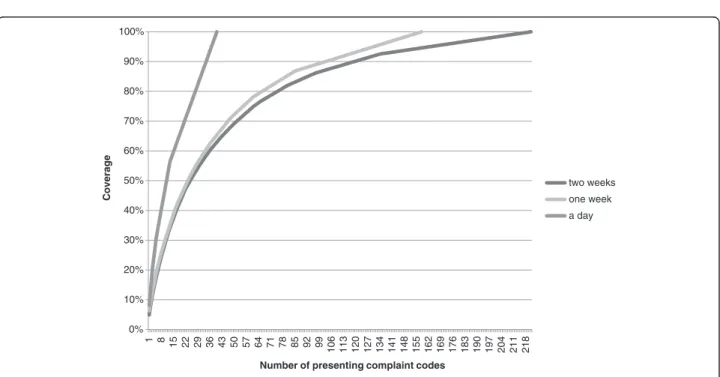
At the Jorvi ED, 254 (237 for adults) out of 687 differ-ent ICPC codes were used to record presdiffer-enting com-plaints during the two-week survey period. Figure 3 shows the coverage achieved by the number of present-ing complaint codes used. The amount is dependable on volume, and therefore, different curves are given for a
day (second Monday, n=72), a week (second week, n=604), and the total period (n=1284). The two-week period represented presenting complaints quite well; a longer period, with larger volume, would not have radic-ally increased the number of presenting complaints. Coverage of 70%-90% was achieved from 50–120 differ-ent ICPC-2 based presdiffer-enting complaints.
The experiences of using ICPC-2 showed in practise, that it was difficult to find a representative code for pre-senting complaints from ICPC-2 code list in ED. The list was far too long and included large number of codes not needed in ED. Regardless the fact that some codes require information not available at the point of triage, these codes (such as pneumonia and pulmonary embolism) were used anyway. Although the results from the phase 2 demon-strated the unsuitability of ICPC-2 classification in the raw for ED environments, it showed that ICPC-2 can be used as a basis of the ED classification. This conclusion was supported by the results of phase 3 showing that ICPC-2 classification include almost all the presenting complaints revealed in Hyvinkää data in phase 1.
Results from phase 3: development of new ICPC-2 based ED application
Table 3 illustrates differences in the most common presenting complaints between the Jorvi ED and the Hyvinkää ED. Presenting complaints of both EDs are relatively close to each other. The biggest differences in Hyvinkää, compared to Jorvi, are in presenting complaints related to trauma mechanisms such as electric shock or carbon monoxide poisoning, for which the ICPC-2 classi-fication does not elaborate. Some of Hyvinkää’s presenting complaints are also more diagnoses-based, such as pneu-monia and urinary tract infection. In addition, in the Hyvinkää ED, the triage nurse sometimes recorded that patients came simply for a doctor’s certificate of sick leave. In Finland, most organizations allow sick leaves of 2–3 days without a certificate, but EDs are often used for sick leaves exceeding that because of the convenience of access.
The classification of presenting complaints produced from the Hyvinkää ED’s free text fields classifies all mus-culoskeletal symptoms and complaints under one group. Such a generic group becomes too large, covering over one fifth of all the presenting complaints.
Results from phase 4: implementation of ICPC-2 ED application
The staff experiences about implemented ICPC-2 ED application are described in the following.
Question 1. Are you satisfied with the new classification?
Question 2. Have you had patients with presenting complaint which you have had difficulties to classify? If yes, please specify.
All nurses answered that the suitable code was found for all presenting complaints. Two nurses reported that if a patient has many complaints, it is difficult to decide the main presenting complaint. One nurse asked, if it could be possible to get a code for pneumonia as a presenting complaint.
Information of using the most urgent presenting complaint was further addressed to triage nurses as well as the problem of too early decision of possible diagnosis.
Question 3. Have you some suggestions for further development of classification or other comments?
Four nurses asked for more feedback of the results of analysis of presenting complaints. They found it important to get reports to motivate the recording.
In the weekly staff meetings people felt that the new classification was easy to use and staff members found all the presenting complaints with no difficulties except the cases with many complaints. The staff was satisfied with the new system. The original ICPC-2 list had been in use in the Jorvi ED, and therefore, the staff compared the new list to the original ICPC-2 list. They had com-plained that the original ICPC-2 list was too long and that the right presenting complaints were difficult to lo-cate. As the new list was based on the ICPC-2 list, the staff felt immediately familiar with the codes. They also
Table 1 Presenting complaints and frequencies in Hyvinkää ED
Presenting complaint Amount Percentage Presenting complaint Amount Percentage
Musculoskeletal symptoms/complaints 8596 21,17% Blood pressure related problem 198 0,49%
Abdominal pain 3084 7,59% Intravenous antibiotic infusion 183 0,45%
Upper respiratory infection/throat symptom 2862 7,05% Bronchus/lung related symptom 182 0,45%
Shortness of breath 1567 3,86% Allergic reaction 163 0,40%
Chest pain 1503 3,70% Rash 149 0,37%
Diarrhoea/vomiting 1492 3,67% Blood and blood forming organs 127 0,31%
Cardiac arrhythmia 1206 2,97% Nose bleed 123 0,30%
Back symptom 1161 2,86% Icterus or ascites 118 0,29%
Fever 1079 2,66% Nausea 102 0,25%
Headache 906 2,23% Complication of medical treatment 98 0,24%
General weakness 873 2,15% For sick leave 93 0,23%
Infection of urinary tract 823 2,03% Haemorrhoid 77 0,19%
Eye symptom 672 1,65% Burn injury 72 0,18%
Symptoms of venous embolism 652 1,61% Neurological symptoms 65 0,16%
Psychological problems 609 1,50% Pregnancy related problem 65 0,16%
Vertigo/dizziness 589 1,45% Constipation 64 0,16%
Cough 570 1,40% Female genital symptoms 61 0,15%
Ear symptoms 524 1,29% Sleep disturbance 55 0,14%
Pneumonia symptoms 452 1,11% Symptoms of chronic bowel disease 49 0,12%
Cerebrovascular disorder symptoms 393 0,97% High value of C-reactive protein 46 0,11%
Convulsion 389 0,96% Catheter related 34 0,08%
Urological symptoms 380 0,94% Dental 31 0,08%
Blood test for drunk driving suspect 344 0,85% Cramp 30 0,07%
Intoxication 299 0,74% Trigeminal neuralgia 23 0,06%
Cancer related symptom 298 0,73% Tremor/shivering 22 0,05%
Drug or alcohol abuse 295 0,73% Tick 20 0,05%
Symptoms of acute sinusitis 270 0,66% Electric shock 17 0,04%
Lump or abscess 256 0,63% Hypothermia 16 0,04%
Skin infection 247 0,61% Dehydration 12 0,03%
Heart related problem, other 212 0,52% Carbon monoxide poisoning 7 0,02%
Fainting/syncope 212 0,52% Exposure to gas 7 0,02%
felt that the length and groupings were improvements to the previous list.
The feedback from the staff generated still a few adjust-ments regarding hyperglycaemia and delirium, which are included in final list in Table 4. The final list includes 89 presenting complaints. The list is now in routine use in Jorvi ED and the recording percent is high (over 95 %).
Discussion
This study created a structured complaint classification suitable for ED use and implemented it to practice. The classification is based on two stand-alone studies; one focused on identifying presenting complaints from data of 40,610 ED presentations and the other on a two-week survey while using the ICPC-2 as a classification for recording presenting complaints. The study produced a classification based on the ICPC-2, including 89 present-ing complaints. The results from implementation were positive and encouraging and the classification is cur-rently in routine use in the Jorvi ED.
Two major factors motivated the selection of the ICPC-2 as the foundation of the new classification. Firstly, the ICPC-2 is symptom-oriented. In the triage process, patients have no predefined diagnoses per se, and the triage nurse’s should base his/her interpretation of urgency and requisite resources on symptoms. Sec-ondly, the ICPC-2 is compatible with the ICD-10. The ICPC-2 is a part of WHO’s Family of International Clas-sifications (FIC) and all of the complaints can be traced back to related ICD-10 codes. However, the ICPC-2 has too much detail for effective use in EDs.
Table 2 Use of general categories of the ICPC-2 in Jorvi ED
General category
Name Amount Share
- Process codes 6 0,47%
A General and unspecified 172 13,40%
B Blood, Blood Forming Organs and immune Mechanism
6 0,47%
D Digestive 172 13,40%
F Eye 12 0,93%
H Ear 13 1,01%
K Cardiovascular 149 11,60%
L Musculoskeletal 275 21,42%
N Neurological 87 6,78%
P Psychological 75 5,84%
R Respiratory 141 10,98%
S Skin 93 7,24%
T Endocrine/Metabolic and Nutritional
10 0,78%
U Urological 50 3,89%
X Pregnancy, Childbearing, Family Planning
13 1,01%
Y Female genital 2 0,16%
Z Male genital 4 0,31%
W Social problems 4 0,31%
0% 10% 20% 30% 40% 50% 60% 70% 80% 90% 100%
1 8 15 22 29 36 43 50 57 64 71 78 85 92 99
106 113 120 127 134 141 148 155 162 169 176 183 190 197 204 211 218
Coverag
e
Number of presenting complaint codes
two weeks
one week
a day
A short list of presenting complaints is simple and re-liable, but if the list is too short, it does not present enough information. When the list is long, the specificity is higher but the system is complex and data analysis becomes difficult. With a long list, shortened modifica-tions emerge and their use jeopardizes data comparison. ED-specific presenting complaint lists range between 33 [16] and 165 [12] in the number of different codes. The current study indicates that a list of 89 presenting com-plaints is well suited for ED use. In triage, time for recording codes is scarce; the system has to be easy to use. Obtaining presenting complaint information from a free text field is very time-consuming and not suitable for routine use.
Unlike the ICPC-2 based classification of this study, Canadian CEDIS classification is ED-specific. Although many presenting complaints are similar in both lists, there are remarkable differences. The main difference in this study’s shorter list is that the presenting complaints of many organs, such as ear, eye, or gynaecological symp-toms, are not divided into as many subclasses as those in the CEDIS; patients in these subclasses have the same pathways and use the same resources in EDs. However, the study’s list included more subclasses to code traumas and symptoms of the extremities; symptoms of the ankle, knee, and hip have their own codes. Rare but urgent cases, such as periorbital oedema, were omitted because the inclusion of one such item would soon increase the
list with other equally urgent, but rare, symptoms. One must keep in mind that almost all presenting complaints can include emergent cases.
In some cases the CEDIS list had more interpretation of the symptoms than did the list in the current study. The study list, for example, listed hyperventilation with dyspnoe to prevent premature conclusions of possible diagnoses. Hyperventilation can be a harmless symptom, but it can also be a symptom of ketoasidosis or pulmon-ary embolism. This same principle led to the decision to keep chest pain as one presenting complaint without try-ing to divide it into more or less specific cardiac features. This is important because a cardiac event is difficult to diagnose [23].
The ICPC-2 was quite easily modified and suites the classification of ED presenting complaints well. Many codes for the ED list were combined from two or three codes of the ICPC-2. However, some symptoms had to be modified from the ICPC-2. Hyperglycaemia is under abnormal investigation results in the ICPC-2, while hypoglycaemia has its own code and allergic reaction, which the new list had to include despite its features of diagnosis and the fact that it is coded as a diagnosis in the ICPC-2.
Classification of presenting complaints does not re-move the need for using free text communication in EDs, it is highly important and codes or rules should not restrict its use. In the Jorvi Hospital ED, the presenting
Table 3 Top 20 presenting complaints in Hyvinkää ED and in Jorvi ED
Top 20 presenting complaints in Hyvinkää ED (Year 2008)
Share Top 20 presenting complaints in Jorvi ED (two weeks, Nov-2010)
Share
Musculoskeletal symptoms/complaints 21,17% Musculoskeletal symptoms/complaints 20,43%
Abdominal pain 7,59% Abdominal pain 8,38%
Upper respiratory infection/throat symptom 7,05% Psychological problems 4,11%
Shortness of breath 3,86% Shortness of breath 3,89%
Chest pain 3,70% Chest pain 3,89%
Diarrhoea/vomiting 3,67% General weakness 3,82%
Cardiac arrhythmia 2,97% Fever 3,75%
Back symptom 2,86% Skin infection 3,31%
Fever 2,66% Back symptom 3,23%
Headache 2,23% Upper respiratory infection/throat symptom 3,09%
General weakness 2,15% Cardiac arrhythmia 2,87%
Infection of urinary tract 2,03% Headache 2,20%
Eye symptom 1,65% Diarrhoea/vomiting 2,06%
Symptoms of venous embolism 1,61% Infection of urinary tract 1,76%
Psychological problems 1,50% Convulsion 1,25%
Vertigo/dizziness 1,45% Vertigo/dizziness 0,96%
Cough 1,40% Ear symptoms 0,96%
Ear symptoms 1,29% Eye symptom 0,96%
Pneumonia symptoms 1,11% Female genital symptoms 0,88%
Table 4 ICPC-2 ED application
ICPC-2 codes included
Name ICPC-2 codes
included
Name
General Neurological
A01 Pain general/multiple sites N01, N03 Headache; Pain face
A03 Fever N05-06 Sensation disturbance
A04-A05 Weakness/tiredness general, feeling ill N07 Convulsion/seizure
A06 Fainting/syncope N17 Vertigo/dizziness
A07 Coma N18 Paralysis/weakness
A80-A81 Trauma/injury NOS, multiple trauma N19 Speech disorder
A87 Complication of surgical or other treatment N29 Delirium
A88 Adverse effect physical factor Psychological/Toxic effects
A91 Abnormal result investigation NOS; Hyperglycaemia
P01 Feeling anxious/nervous/tense
A92 Allergy/allergic reaction NOS P02 Acute stress reaction
A96 Death P03 Feeling depressed
Digestive P15-P16 Alcohol abuse
D01-D02, D06 Abdominal pain/cramps general P18 Medication abuse
D03 Heartburn P19 Drug abuse
D04-D05 Rectal/anal pain or itching P20 Memory disturbance
D09-D10 Nausea, vomiting P29 Psychological symptom/complaint other
D11, D18 Diarrhoea P77 Suicide/suicide attempt/suicidality
D12 Constipation A84 Poisoning by medical agent
D13 Jaundice A86 Toxic effect non-medicinal substance
D14 Haematemesis/vomiting blood Respiratory
D15-D16 Melaena R01-R04 Shortness of breath, dyspnoea,
pain respiratory system, wheezing, breathing problem
D19 Teeth/gum symptom/complaint R05 Cough
D20 Mouth/tongue/lip symptom/complaint R06 Nose bleed
D25, D29 Abdominal distension R07-R21, R28-R29, R74 Nose/sinus/throat/voice symptom/complaint
Eye R24 Haemoptysis
F01-F03, F13-F16, F29 Eye symptoms/complaints Skin
F04-05 Visual disturbance S01, S02,S04-S08, S99 Pain/tenderness of skin; Pruritus; Lump/swelling; Rash
Ear S10-S11 Boil/carbuncle, skin-infection posttraumatic
H01-H05, H13, H29 Ear symptoms/complaints S12 Insect bite/sting
Cardiovascular S13 Animal/human bite
A11, K01-K03 Chest pain, pressure/tightness of heart S14 Burn/scald
K04-K05 Palpitations/ awareness of heart; Bradykardia; Irregular heartbeat
S15 Foreign body in skin
K07 Swollen ankle/oedema S18 Laceration/cut
K29 Cardiovascular symptom/complaint other, high blood pressure
Endocrine/Metabolic
Musculoskeletal T11 Dehydration
L01 Neck symptom/complaint T27 Hypoglycaemia
L02-L03 Back symptom/complaint Urological
L04 Chest symptom/complaint U01, U02, U07, U14 Dysuria/painful urination
L05 Flank/axilla symptom/complaint U06 Haematuria
L07 Jaw symptom/complaint U08 Urinary retention
complaint code is not used for communication at all; it is registered only for purposes of data analysis and qual-ity studies and free text is used for communication.
Decisions made in triage regarding urgency and tracks have significant effects on the duration and the quality of the care process. The presenting complaint is one of the most important variables affecting these decisions. The variety of patients entering EDs is wide, and to evaluate triage performance and care quality, divisions between different patient groups are necessary. Often studies concerning EDs make divisions and give ment recommendations based on diagnoses or treat-ments but such information is not available at the point of triage. Presenting complaints provide more relevant divisions for studying quality, process, and outcomes of care; for such research, structured information regarding presenting complaints is essential.
In addition, routine research in the classification of presenting complaints in ERs enables several practical data usage possibilities. Presenting complaint informa-tion, for example, aids demand and capacity planning, streaming, and patient flow control, quality control, and benchmarking of performance.
Limitations
Although the studied EDs represent medium-sized joint EDs, which are typical to Finnish healthcare system, there may be need for customization and for more detailed presenting complaints classification in highly specialized units. Moreover, the new classification was tested only in one ED and to ensure reliability and validity with differ-ent case-mixes further studies may be needed.
It should be noted that the evaluation method of new classification is not strictly following any qualitative method and is not reported according to any qualitative standard.
All classifications need continuous improvement. There-fore, our study classification is not suitable for broad use without centralized national or international actor for development. The study focused only in adult patients and the classification is not directly generalizable to presenting complaints of children.
Conclusions
The ICPC-2 classification can be easily modified for use in EDs by decreasing the number of codes. The use of structured classification for recording presenting com-plaints in EDs helps to compare and improve EDs, both nationally and internationally. Recording presenting complaints provides information from ED case-mixes and helps in the planning and control of patient flows.
It is essential that future research develops a similar, ICPC-2 based presenting complaint list for pediatric emergency care. Further validation studies should also be conducted to the classification in different environ-ments using standard evaluation protocols such as COREQ [24].
The authors recommend the use of the ICPC-2 based list for recording ED presenting complaints; the new list with 89 presenting complaints was more convenient and easy to use. The classification is easily transferable to dif-ferent EDs, although such a classification needs to be developed and improved continually. To ensure data comparability, all such improvement modifications should be centralized, either by national actor or by an international organization willing to take the classifica-tion forward, such as the WONCA Internaclassifica-tional Classi-fication Committee.
Competing interests
The authors declare that they have no competing interests. TM and PT are employed by Nordic Healthcare Group, NHG. NHG is a commercial company that focuses on healthcare and welfare industries and designs models to enhance productivity, cost-effectiveness and process quality. The business is Table 4 ICPC-2 ED application(Continued)
L09 Arm symptom/complaint W03 Antepartum bleeding
L10 Elbow symptom/complaint Female genital
L11 Wrist symptom/complaint X01, X03, X08, X09, X12, X14-X17
Female genital symptoms
L12 Hand/finger symptom/complaint X18 Breast symptoms
L13 Hip symptom/complaint Male genital
L14 Leg/thigh symptom/complaint Y01-Y06 Male genital symptoms
L15 Knee symptom/complaint Social problems
L16 Ankle symptom/complaint Z25 Assault/harmful event/ problem
L17 Foot/toe symptom/complaint Z29 Social problem
L18-L19 Muscle pain; Muscle symptom/complaint NOS
Process codes
−50 Medication/prescription/renewal/injection
based on research and has employees in Stockholm, Sweden and Helsinki, Finland.
Authors’contributions
TM designed the study, conducted the data analysis for Hyvinkää and Jorvi data, and drafted the manuscript. OH helped in the data collection (Jorvi and expert panel) and revised the manuscript. PT helped in the data analysis and revised the manuscript. RM co-designed the study, organized the data collection (Hyvinkää, Jorvi, and expert panel), performed the interviews, and helped to draft the manuscript. All authors read and approved the final manuscript.
Acknowledgements
The authors express their gratitude to RN Kristina Nyholm and MD Salla Kumpulainen for participating on the expert panel and MD Juha Valli and M. Sc Sirpa Salinto for Hyvinkää Hospital data.
Author details
1Institute of Healthcare Engineering and Management, Department of
Industrial Engineering and Management, Aalto University, Otaniementie 17, 00076 Aalto, Finland.2Jorvi Hospital, Division of Emergency Care, Meilahti
Hospital, Helsinki University Hospital District, Helsinki, Finland.3Department of Medicine, Division of Emergency Care, Meilahti Hospital, Helsinki University Hospital District, Helsinki, Finland.
Received: 11 May 2012 Accepted: 22 November 2012 Published: 24 November 2012
References
1. FitzGerald G, Jelinek GA, Scott D, Gerdtz MF:Emergency department triage revisited.Emerg Med J2010,27:86.
2. Nijman RG, Zwinkels RL, Van Veen M, Steyerberg EW, Van Der Lei J, Moll HA, Oostenbrink R:Can Urgency Classification of the Manchester Triage System Predict Serious Bacterial Infections in Febrile Children?Arch Dis
Child2011,96:715–722.
3. Nemec M, Koller MT, Nickel CH, Maile S, Winterhalder C, Karrer C, Laifer G, Bingisser R:Patients Presenting to the Emergency Department With Non-specific Complaints: The Basel Non-Non-specific Complaints (BANC) Study.
Acad Emerg Med2010,17:284–292.
4. Cronshaw HL, Daniels R, Bleetman A, Joynes E, Sheils M:Impact of the Surviving Sepsis Campaign on the Recognition and Management of Severe Sepsis in the Emergency Department: Are We Failing?Emerg Med J2011,28:670–675.
5. Grafstein E, Unger B, Bullard M, Innes G:Canadian Emergency Department Information System (CEDIS) Presenting Complaint List (Version 1.0).
Can J Emerg Med2003,5:27.
6. Fine MJ, Auble TE, Yealy DM, Hanusa BH, Weissfeld LA, Singer DE, Coley CM, Marrie TJ, Kapoor WN:A prediction rule to identify low-risk patients with community-acquired pneumonia.New Engl J Med1997,336:243–250. 7. Aronsky D, Kendall D, Merkley K, James BC, Haug PJ:A comprehensive set
of coded chief complaints for the emergency department.Acad Emerg Med2001,8:980–989.
8. Wagholikar AS, Lawley MJ, Hansen DP, Chu K:Identifying Symptom Groups from Emergency Department Presenting Complaint Free Text using SNOMED CT.AMIA Annu Symp Proc2011,2011:1446–1453. 9. Hansen DP, Kemp ML, Mills SR, Mercer MA, Frosdick PA, Lawley MJ:
Developing a national emergency department data reference set based on SNOMED CT.Med J Aust2011,194:S8–S10.
10. Matheny ME, FitzHenry F, Speroff T, Green JK, Griffith ML, Vasilevskis EE, Fielstein EM, Elkin PL, Brown SH:Detection of infectious symptoms from VA emergency department and primary care clinical documentation.Int
J Med Inform2012,81:143–156.
11. Malmström T, Torkki P, Valli J, Malmström R:Patient flow analysis of Hyvinkää Hospital joint emergency unit.Finnish Med J2012,5:345–351. in Finnish.
12. Grafstein E, Bullard MJ, Warren D, Unger B:Revision of the Canadian Emergency Department Information System (CEDIS) Presenting Complaint List version 1.1.Can J Emerg Med2008,10:151–173. 13. Gupta M, Tabas JA, Kohn MA:Presenting complaint among patients with
myocardial infarction who present to an urban, public hospital emergency department.Ann Emerg Med2002,40:180–186.
14. Thompson DA, Eitel D, Fernandes CMB, Pines JM, Amsterdam J, Davidson SJ:Coded Chief Complaints—Automated Analysis of Free-text Complaints.Acad Emerg Med2006,13:774–782.
15. Ruger JP, Lewis LM, Richter CJ:Identifying high-risk patients for triage and resource allocation in the ED.Am J Emerg Med2007,25:794–798. 16. Safwenberg U, Terént A, Lind L:The Emergency Department presenting
complaint as predictor of in-hospital fatality.Eur J Emerg Med2007,
14:324.
17. Safwenberg U, Terént A, Lind L:Differences in Long-term Mortality for Different Emergency Department Presenting Complaints.Acad Emerg Med2008,15:9–16.
18. Schneider D, Appleton L, McLemore T:A reason for visit classification for ambulatory care.Vital Health Stat 21979,i–vi:1–63.
19. Niska R, Bhuiya F, Xu J:National hospital ambulatory medical care survey:
2007 emergency department summary. Stat Report: Natl Health; 2010:26.
20. Zakariassen E, Burman R, Hunskaar S:The epidemiology of medical emergency contacts outside hospitals in Norway - a prospective population based study.Scand J Trauma Resusc Emerg Med2010,18:9. 21. Huber CA, Rosemann T, Zoller M, Eichler K, Senn O:Out-of-hours demand
in primary care: frequency, mode of contact and reasons for encounter in Switzerland.J Eval Clin Pract2011,17:174–179.
22. Chmiel C, Huber CA, Rosemann T, Zoller M, Eichler K, Sidler P, Senn O:
Walk-ins seeking treatment at an emergency department or general practitioner out-of-hours service: a cross-sectional comparison.BMC
Health Serv Res2011,11:94.
23. Christenson J, Innes G, McKnight D, Boychuk B, Grafstein E, Thompson CR, Rosenberg F, Anis AH, Gin K, Tilley J,et al:Safety and efficiency of emergency department assessment of chest discomfort.Can Med Assoc J 2004,170:1803–1807.
24. Tong A, Sainsbury P, Craig J:Consolidated criteria for reporting qualitative research (COREQ): a 32-item checklist for interviews and focus groups.
Int J Qual Health Care2007,19:349–357.
doi:10.1186/1757-7241-20-76
Cite this article as:Malmströmet al.:Structured classification for ED presenting complaints–from free text field-based approach to ICPC-2 ED application.Scandinavian Journal of Trauma, Resuscitation and Emergency Medicine201220:76.
Submit your next manuscript to BioMed Central and take full advantage of:
• Convenient online submission
• Thorough peer review
• No space constraints or color figure charges
• Immediate publication on acceptance
• Inclusion in PubMed, CAS, Scopus and Google Scholar
• Research which is freely available for redistribution