R E S E A R C H A R T I C L E
Open Access
The desire to die in palliative care: a
sequential mixed methods study to
develop a semi-structured clinical approach
Kerstin Kremeike
1*, Gerrit Frerich
1, Vanessa Romotzky
1, Kathleen Boström
1, Thomas Dojan
1, Maren Galushko
1,
Kija Shah-Hosseini
2, Saskia Jünger
3, Gary Rodin
4,5,6, Holger Pfaff
7, Klaus Maria Perrar
1and Raymond Voltz
1,8,9Abstract
Background:Although desire to die of varying intensity and permanence is frequent in patients receiving palliative care, uncertainty exists concerning appropriate therapeutic responses to it. To support health professionals in dealing with patients´ potential desire to die, a training program and a semi-structured clinical approach was developed. This study aimed for a revision of and consensus building on the clinical approach to support proactively addressing desire to die and routine exploration of death and dying distress.
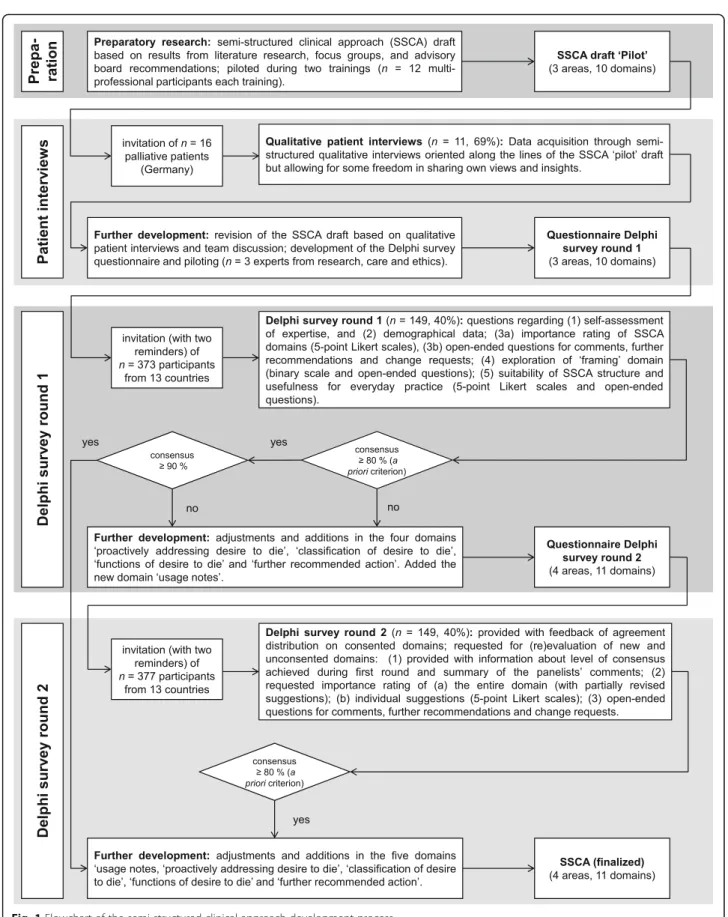
Methods:Within a sequential mixed methods design, we invited 16 palliative patients to participate in semi-structured interviews and 377 (inter-)national experts to attend a two-round Delphi process. Interviews were analyzed using qualitative content analysis and an agreement consensus for the Delphi was determined according to predefined criteria.
Results:11 (69%) patients from different settings participated in face-to-face interviews. As key issues for conversations on desire to die they pointed out the relationship between professionals and patients, the setting and support from external experts, if required. A set of 149 (40%) experts (132/89% from Germany, 17/11% from 9 other countries) evaluated ten domains of the semi-structured clinical approach. There was immediate consensus on nine domains concerning conversation design, suggestions for (self-)reflection, and further recommended action. The one domain in which consensus was not achieved until the second round was“proactively addressing desire to die”.
Conclusions:We have provided the first semi-structured clinical approach to identify and address desire to die and to respond therapeutically–based on evidence, patients’views and consensus among professional experts.
Trial registration:The study is registered in the German Clinical Trials Register (DRKS00012988; registration date: 27.9.2017) and in the Health Services Research Database (VfD_DEDIPOM_17_003889; registration date: 14.9.2017).
Keywords:Desire to die, Wish towards hastened death, Suicidal ideation, relationship, communication, Palliative care, Professionals, Consensus, Patients, Germany
© The Author(s). 2020Open AccessThis article is licensed under a Creative Commons Attribution 4.0 International License, which permits use, sharing, adaptation, distribution and reproduction in any medium or format, as long as you give appropriate credit to the original author(s) and the source, provide a link to the Creative Commons licence, and indicate if changes were made. The images or other third party material in this article are included in the article's Creative Commons licence, unless indicated otherwise in a credit line to the material. If material is not included in the article's Creative Commons licence and your intended use is not permitted by statutory regulation or exceeds the permitted use, you will need to obtain permission directly from the copyright holder. To view a copy of this licence, visithttp://creativecommons.org/licenses/by/4.0/. The Creative Commons Public Domain Dedication waiver (http://creativecommons.org/publicdomain/zero/1.0/) applies to the data made available in this article, unless otherwise stated in a credit line to the data.
* Correspondence:[email protected]
1Department of Palliative Medicine, Medical Faculty, University of Cologne, Kerpener Str. 62, 50937 Cologne, Germany
Background
Desire to die is a complex phenomenon with individual reasons, forms and consequences [1,2]. We use the term desire to die in a broad sense including an acceptance of death, a wish for hastened death without requiring any accelerating action [3], a request for assisted dying and suicidal ideation [4]. This understanding of desire to die differs from the international consensus definition of the wish for hastened death [5] and refers to the German palliative care guideline for patients with incurable can-cer [6]. The broad definition is meant to foster a more open communication with patients as it supports health professionals’ acceptance of desire to die as a potential way to cope with a terminal illness.
Desire to die can coexist with a simultaneous will to live [7], with both prone to change over time [1, 8]. De-sire to die is connected with physical and psychological distress [9] and can be the beginning of a suicidal process [10], but studies have shown that communication con-cerning therapeutic options may ease patient’s burden, and even prevent suicides [11]. Current recommendations suggest proactively addressing desire to die [6], refer-encing studies which found positive effects on patients [8,12,13]. These effects include opening communica-tion about emocommunica-tional condicommunica-tions, even in absence of desire to die [13]. Additionally, desire to die may also be assessed by validated instruments such as the Schedules of Attitudes for Hastened Death (SAHD; primary for research purposes) [8] or the Desire for Death Rating Scale (DDRS; initially developed for clin-ical interviews) [14].
Some forms of desire to die are frequent in patients in their last months of life. In a 1995 study, 45% of 200 ad-vanced cancer patients showed at least occasional desire to die and almost 10% reported a strong and persistent one [15]. A recent survey of 377 cancer patients found that 18% reported an occasional desire to die and 12% a serious one [16]. Although health professionals are fre-quently confronted with a patient’s desire to die [3], it is not routinely assessed in palliative care. A lack of prep-aration on how to deal with the complex and sensitive topic as well as the controversial German legal situation contribute to uncertainty in health professionals about how to approach desire to die in clinical practice [17]. Both euthanasia ("termination of life on request"; § 216 national criminal code) and physician-assisted suicide ("assistance of suicide with intent of repeated conduct; § 217 national criminal code) were prohibited in Germany at the time of the study. As a consequence, patients who desire physician-assisted suicide may have travelled to neighboring countries with less restrictive regulations [18]. Between 2008 and 2012, nearly half (44%) of all so called “suicide tourists” in Switzerland came from Germany [18]. Nevertheless, 74% of German doctors
stated in 2017 that they had been asked by their patients to assist suicide [19]. In February 2020, the Federal Court of Justice declared the prohibition of assistance of suicide with the intent of repeated conduct to be inad-missible, thereby repealing §217 [20]. The court decided this law introduced in 2015 to violate the German Con-stitution; there is a right to die in a self-determined way including the freedom to take one’s own life and to take advantage of offers from third parties. It remains to be seen what consequences this ruling will have. What is certain is that it will continue to be the subject of con-troversial discussions.
A restrictive as well as unclear legal situation in com-bination with a lack of preparation and knowledge can lead health professionals to neglect or insufficiently dis-cuss desire to die [17], even if raised by the patient. Training programs and recommendations for talking about difficult issues [21, 22] may also support health professionals in dealing with desire to die [23]. A train-ing program regardtrain-ing desire to die has been developed in a previous project, based on a literature review and results of focus groups with multi-professional German palliative care providers [24]. This training program has been piloted and evaluated through a 32-item-scale cov-ering the dimensions of self-confidence, skills, know-ledge and attitudes [25]. Descriptive changes indicate a major improvement in self-confidence and at least minor improvements on all dimensions after 3 months, with only one item concerning knowledge reaching statistical significance, though [24]. Within the development of the training program, a semi-structured clinical approach was drafted, building on published recommendations on dealing with desire to die [26, 27] and based on results from an interdisciplinary advisory board discussion. The draft was refined and structured within a framework analysis approach [24]. The present study aimed at fur-ther developing and refining the clinical approach for routinely assessing death and dying distress, reacting to and (proactively) addressing desire to die – taking into account international expertise from a wider range of professions, patient representatives and relatives as well as the voices of patients.
Methods
Declaration of Helsinki. Ethical approval for this study was obtained from the Ethics Committee of the Univer-sity of Cologne (#17–265).
Patient interviews
Interviews were conducted to consider the perspective of patients receiving palliative care and thereby strengthen the appropriateness of the approach. A convenience sam-ple of 16 adult patients was invited to participate in face-to-face interviews on the appropriate approach to desire to die in palliative care. Participants were recruited via palliative care providers known to the research team. A leaflet for patients and health professionals included sur-vey aims, procedure and contact details of the research team. Health professionals contacted the researchers in case of patients’ willingness to participate. The research team approached these patients to obtain written in-formed consent for study participation. All data relat-ing to the patients were anonymized to protect their identity and prevent retrospective matching of per-sons and information.
Interviewees chose the location of the interview, which were conducted by either one of three female (KK, VR, KB) or one male (GF) interviewers. Two researchers hold doctoral degrees (KK, GF), one was a doctoral student (VR), the other a graduate student (KB). At the time of data acquisition, all researchers worked for the Department of Palliative Medicine at the University Hospital of Cologne and were trained and experienced in conducting semi-structured interviews. This approach to data acquisition allowed the research agenda to be pre-defined to some extent and at the same time enabled respondents to freely present a range of views and new insights [31]. The interview guide was developed by a group of social scientists (KK, GF, MG), psychologists (TD, KB), a pedagogue (VR) and a physician (KMP). It assessed aspects relevant to addressing desire to die, desir-able traits in interviewer as well as interviewees’potential personal desire to die. The complete interview guideline is added as an additional file (see Additional file 1). Social demographics were assessed using a brief questionnaire.
Delphi survey
In addition to patient interviews, an online Delphi survey was performed to achieve expert consensus on content and structure of the clinical approach. We invited partic-ipants from 13 countries aiming to compose a balanced sample of 50–70 researchers and clinical practitioners. Recruitment took place through personal contacts and an internet search. Potential participants were asked via email to take part in the survey and to propose further experts. As nurses were initially underrepresented in re-cruitment, we reached out to the nursing mailing list of the German Society for Palliative Medicine, which
distributed our call to a selection of its members. This pushed the number of invited participants to 377.
To develop the Delphi questionnaire, we revised the existing version of the semi-structured clinical approach [24] based on our preceding patient interviews. The re-vised draft included three sections (B to D in Table 3) with a total of ten domains each containing a set of sug-gestions for health professionals to take into account when (proactively) discussing desire to die with patients receiving palliative care. The Delphi survey was designed accordingly and conducted in co-operation with an ex-ternal partner (UZ Bonn, Society for Empirical Social Research and Evaluation). Each panelist received a link to the survey via email. During both Delphi rounds two reminders were sent out to motivate non-respondents to participate. During the first Delphi round, participants evaluated each domain of the approach by a) rating the importance of the entire section presented on a five-point Likert scale ranging from 0 (“not important at all”) to 5 (“very important”) and b) giving free text comments on the suggestions listed in the domain they just rated. In the second Delphi round, participants were asked to reevaluate the semi-structured approach in light of the results of the first round. Participants were also fed back information about the first rounds’sample seize such as distribution of professions and the sample’s experience with desire to die and suicidality.
Data analysis
Patient interviews were transcribed verbatim and ana-lyzed by three researchers (KB, KK, GF) applying quali-tative content analysis [32]. Inductive and deductive categories were derived and applied using the qualitative data analysis software MAXQDA 12. Inter-coder reli-ability was ensured by constant comparison between coders and according adjustments throughout the entire process. Transcripts were not returned to participants and they were not asked to provide feedback on the findings.
Further details on sampling, data collection and ana-lysis are reported in the study protocol [28].
Results
Patient interviews
Between 9/2017 and 1/2018, 11 (69%) patients receiving palliative care participated in face-to-face interviews last-ing nine to 79 minutes. Reasons for patients refuslast-ing to partake or health professionals judging the patient incap-able of participation were (acute) deterioration of physical (3/5) or mental (2/5) health status. Table 1 presents fur-ther details on interviewees.
All but one of the interviewees reported desire to die either as a wish for hastened death or as acceptance of death without requiring to hasten it. A desire for physician assisted suicide was reported explicitly once, and two interviewees preferred death to deteriorating symptoms. Isolation, the feeling of being a burden, hopelessness and fear of pain were reasons reported for desire to die.
Deductive categories based on topics from the interview guideline were complemented with inductive coding of the interviews, producing five main categories with various sub-categories:“Actively building the relationship”,“ Con-versation partner”, “Conversation context and structure”,
“Conversation set up and framework”and“Own Desire to Die”. Within the formulated categories, patients mainly confirmed the dimensions and recommendations of the clinical approach draft, yet emphasized individuality:
Well, you can’t develop a very RIGID guideline, I think. It’ll need to cover a vast spectrum, starting from one point at the bottom and spreading VERY, VERY wide apart at the top.(patient 1)
However, some sub-categories added valuable insight and contributed to the revision of the semi-structured clinical approach draft. Those sub-categories are re-ported below.
Almost all of the interviewees appreciated theproactive assessment of desire to dieby health professionals:
Interviewer: Would it have been helpful to you, if [the health professional] had addressed [the desire to die]?
Patient:Yes. I think so. […] I don’t know how other patients feel, but talking about it was very difficult for me.(patient 3)
To initiate and discuss problems, establishing atrustful
health-professional-patient-relationship is a
pre-requisite, which both sides have to allow for. Unobtru-sively signaling an appreciative attitude best frames the setting: conscious eye contact and relational touch can help to establish intimacy, if appropriate:
Who among you [health professionals] even gives hugs anymore or takes someone’s arm? […] You all have a hard time with that.
Interviewer:This would be something important to you? Patient:Of COURSE.(patient 7)
When arranging for an appropriate environment to talk about desire to die, privacy and the patient’s mental state should be taken into account. Furthermore, taking Table 1Sociodemographic data of the interviewees
N 11
Age
M,SD 71.7 (13.9)
Min, Max 51, 89
Gender
Male (n, %) 7 (63.6)
Female (n, %) 4 (36.4)
First language
German (n, %) 11 (100.0)
Educational level
Higher education entrance qualification (n, %) 5 (45.5)
Higher secondary school (n, %) 5 (45.5)
Lower secondary school (n, %) 1 (9.1)
Vocational training
Professional training (n, %) 6 (54.5)
University degree (n, %) 2 (18.2)
None (n, %) 2 (18.2)
Not specified (n, %) 1 (9.1)
Diagnosis
Cancer (colon, lung, liver, breast & abdominal, lower jaw, larynx, glioblastoma) (n, %)
7 (63.6)
Geriatric multimorbidity (n, %) 2 (18.2)
Chronic obstructive pulmonary disease (COPD) (n, %) 2 (18.2) Care Setting
Home care (n, %) 4 (36.4)
Residential care (n, %) 2 (18.2)
Hospice care (n, %) 3 (27.3)
In-patient care (n, %) 2 (18.2)
Interview Setting
At home (n, %) 4 (36.4)
Hospice (n, %) 3 (27.3)
Residential care facility (n, %) 2 (18.2)
Table 2Sociodemographic data of the Delphi sample
N 149
Age Mean(Minimum, Maximum) 49.3 (19, 72)
n (%)
Gender Female 107 (71.8)
Male 42 (28.2)
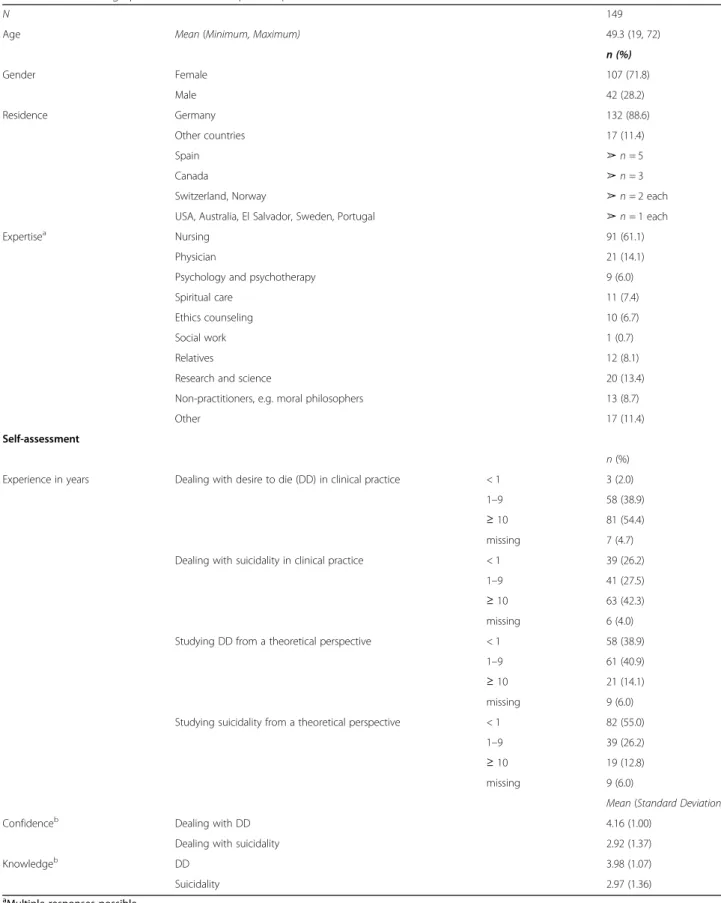
Residence Germany 132 (88.6)
Other countries 17 (11.4)
Spain ➢n= 5
Canada ➢n= 3
Switzerland, Norway ➢n= 2 each
USA, Australia, El Salvador, Sweden, Portugal ➢n= 1 each
Expertisea Nursing 91 (61.1)
Physician 21 (14.1)
Psychology and psychotherapy 9 (6.0)
Spiritual care 11 (7.4)
Ethics counseling 10 (6.7)
Social work 1 (0.7)
Relatives 12 (8.1)
Research and science 20 (13.4)
Non-practitioners, e.g. moral philosophers 13 (8.7)
Other 17 (11.4)
Self-assessment
n(%)
Experience in years Dealing with desire to die (DD) in clinical practice < 1 3 (2.0)
1–9 58 (38.9)
≥10 81 (54.4)
missing 7 (4.7)
Dealing with suicidality in clinical practice < 1 39 (26.2)
1–9 41 (27.5)
≥10 63 (42.3)
missing 6 (4.0)
Studying DD from a theoretical perspective < 1 58 (38.9)
1–9 61 (40.9)
≥10 21 (14.1)
missing 9 (6.0)
Studying suicidality from a theoretical perspective < 1 82 (55.0)
1–9 39 (26.2)
≥10 19 (12.8)
missing 9 (6.0)
Mean(Standard Deviation)
Confidenceb Dealing with DD 4.16 (1.00)
Dealing with suicidality 2.92 (1.37)
Knowledgeb DD 3.98 (1.07)
Suicidality 2.97 (1.36)
aMultiple responses possible
enough time was unanimously appreciated and consid-ered helpful in signaling special attention.
One patient reported that thoughts concerning has-tened death primarily arose upon first confrontation with the cancer diagnosis. Breaking bad news was also experienced as traumatic by other cancer patients.
While most of the patients preferred to talk to their physician, all members of the palliative care team were deemed fit for a dialogue about desire to die. If required, participants indicated that support from external ex-pertsshould be sought:
[The health professional said:] “We can call a pas-toral worker for you [ …] to talk to.”[… ] I didn’t KNOW what to talk about with a pastoral worker. But he was here for an hour and there WAS a lot to talk about, apparently.(patient 5)
Delphi survey
Based on the clinical approach draft revised after the pa-tient interviews, a Delphi survey was conducted between 1/ 2018 and 3/2018. Round one was open for 22 days; round two for 16 days. There was almost no dropout (5.0%) be-tween rounds; during the first round 210 invitees partici-pated and 200 during round two. We excluded 61/51 panelists that did not meet inclusion criteria from analysis.
Therefore, in both rounds, 149 participants were fit for data analysis according to inclusion criteria. This number goes far beyond our original recruitment plans, encompassing 50–70 panelists and is due to the overwhelming feedback from German (nursing) experts. With 91% of the sample reporting to work in direct patient contact, it consists largely of practitioners. For socio-demographic details on the Delphi sample see Table2.
Suitability and usefulness
87% of the respondents (n= 129) valued the structure of the clinical approach as ‘(very) suitable’, 95% (n = 141) rated the clinical approach to be’(very) useful’for every-day clinical practice.
Importance of individual domains
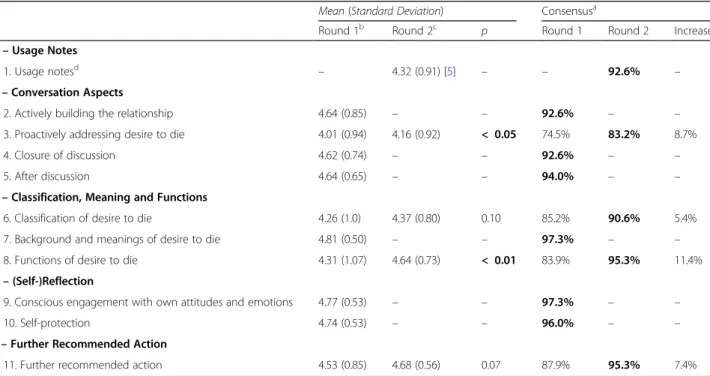
Table3displays the results of the importance ratings for Delphi round one and two.
For all domains except ‘proactively addressing desire to die’, the a priori consensus criterion (≥80% agreement) was met during the first Delphi round (see Table 3). As only four domains did not reach 90% of agreement, we took reaching < 90% to indicate potential for optimization and therefore asked our panelists to reevaluate all such domains (proactively addressing, classification, functions, further recommended action) in the second round. During
Table 3Clinical approach domains and Delphi survey importance ratings
Mean(Standard Deviation) Consensusa Round 1b Round 2c
p Round 1 Round 2 Increase
A–Usage Notes
1. Usage notesd – 4.32 (0.91) [5] – – 92.6% –
B–Conversation Aspects
2. Actively building the relationship 4.64 (0.85) – – 92.6% – –
3. Proactively addressing desire to die 4.01 (0.94) 4.16 (0.92) < 0.05 74.5% 83.2% 8.7%
4. Closure of discussion 4.62 (0.74) – – 92.6% – –
5. After discussion 4.64 (0.65) – – 94.0% – –
C–Classification, Meaning and Functions
6. Classification of desire to die 4.26 (1.0) 4.37 (0.80) 0.10 85.2% 90.6% 5.4%
7. Background and meanings of desire to die 4.81 (0.50) – – 97.3% – –
8. Functions of desire to die 4.31 (1.07) 4.64 (0.73) < 0.01 83.9% 95.3% 11.4%
D–(Self-)Reflection
9. Conscious engagement with own attitudes and emotions 4.77 (0.53) – – 97.3% – –
10. Self-protection 4.74 (0.53) – – 96.0% – –
E–Further Recommended Action
11. Further recommended action 4.53 (0.85) 4.68 (0.56) 0.07 87.9% 95.3% 7.4%
a
Likert scale items were labeled‘5’(‘very important’) to‘1’(‘not important at all) with the option to report‘don’t know’(exclusion from analysis). Consensus was assumed if participants rated domains with‘4’(‘quite important’) or‘5’(‘very important’). Percentages are quotas of all participants who answered a respective question, not of the entire sample
b
For all ratings the full range of possible answers was used except for‘conscious engagement with own attitudes and emotions’(Min= 2,Max= 5) and‘ self-protection’(Min= 3,Max= 5)
c
For all ratings the full range of possible answers was used expect for‘further recommended action’(Min= 2,Max= 5)
d
round two, all domains except‘proactively addressing de-sire to die reached an agreement ≥90%. As our panelists opposed too narrow prompts on how to address desire to die, we changed all interrogative clauses and prompts in the original draft into the instructions and circumscrip-tions found in the final version of the semi-structured clinical approach (see Additional file2). Other modifica-tions based on Delphi results are reported in Table4.
No significant statistical differences in ratings for all domains were found among subsamples (e.g. gender, expertise, self-assessments).
Controversial aspects
Aside from the relatively moderate agreement on ‘ pro-actively addressing desire to die’ during the Delphi process, classifying desire to die as thoughts of terminat-ing life prematurely, wish for assisted suicide or euthan-asia in the clinical approach was also met with concern. In the final version of the semi-structured approach, these classifications were nonetheless included but go hand in hand with introductory information that points out the broadness of the desire to die phenomenon. The introductory information in Additional file 3 shows this in more detail.
Discussion
(Proactively) addressing desire to die within trustful health professional-patient-relationships
Since desire to die may be a potential way to cope with advanced disease at some point during the disease trajectory [33], exploring it and allowing its emotional expression in conversation may be beneficial to all pa-tients. A desire to die can be expressed in different ways and proactively addressing it may help to clarify reasons more openly and at an earlier stage. However, in clinical practice, desire to die is not yet routinely assessed by health professionals and talking about it is associated with discomfort [23].
Concerns about adverse effects of discussing desire to die, e.g. triggering suicidal thoughts in patients, are widespread [23] and became apparent in our Delphi sur-vey. Current studies confirm that asking about suicidal-ity causes no harm but may reduce experienced burden and distress [34]. Based on preliminary studies [23, 35] these findings can likely be extrapolated to palliative care. Currently, our clinical approach is only available for health professionals attending the related multi-professional training program. Within this training, we present the aforementioned findings and the broad defin-ition of desire to die prior to handing out the semi-Table 4Modifications of the semi-structured clinical approach based on Delphi comments
Contents of comments Implementationa
free text answers across all domains pointed to the need to provide general notes on proper usage of the clinical approach
added a new domain: ➪‘usage notes’ suggestion on asking whether patients think about terminating
life prematurely criticized as being too direct
added a new suggestion:
➪‘Explore thoughts related to not wanting to live anymore’ clinical approach seen to be at danger of provoking checklist
type of interrogation due to bullet point setup
changed interrogative clauses to instructions: ➪‘Exists or existedExplore fear of death and dying?’
➪‘Exists or existedExplore thoughts related to terminating life prematurely?’ complexity and changeability of desire to die in palliative patients
seen to run counter to unambiguous classification
added a new suggestion:
➪‘In general, keep in mind: desire to die is complex and prone to change’
“manipulate”in the respective function of desire to die seen to be poor choice of words
changed wording:
➪‘Attempting tomanipulateinfluence family or health professionals’
“attracting attention”in the respective function of desire to die seen to be poor choice of words
changed wording:
➪‘AttractingDrawing attention to oneself and one’s trouble’
“treatment contracts”seen as bad practice, especially when involving handshakes for sealing the contract as it seemed to suggest“clean hands practice”
changed wording, rated old and new version during round 2:
➪‘Entering into a treatment contract with handshake in cases of latent suicidality’ (32.9% agreement,M= 3.00,SD= 1.19)
➪‘Entering into a treatmentcontract with handshakeagreement in cases of latent suicidality in order to win time for interventions’(79.2% agreement,
M= 4.17,SD= 0.96) suggestion on passive euthanasia seen as poorly worded changed wording:
➪Letting die (passive euthanasia) as a legal option (foregoing, restriction or cancellation of life sustaining and life prolonging measures)’
selection of therapeutic approaches listed as examples in respective suggestions seen as too narrow
added a new suggestion during round 2:
➪‘Offering other (psycho-)therapeutic interventions (e.g. family therapy, psychotherapy, art therapy)’summed up all related suggestions into one for the finalized clinical approach:
➪‘Offering counseling or (psycho-)therapy for individuals or groups’ a
structured clinical approach. This is meant to alleviate concerns about iatrogenic risks of addressing desire to die. A recent descriptive study employed an ad hoc semi-structured clinical interview for proactive assessment of a wish to hasten death among advanced cancer patients [35]. Participants did not experience this as distressing, but considered it important regardless of whether they were personally affected. The patients we interviewed indicated that they appreciated the initiation of desire to die conversations by health professionals. (Proactively) ad-dressing the issue in this way can open communication about patients’emotions, even in absence of desire to die [13], which may help to build a trusting relationship that can help to preserve the will to live [36] and perhaps di-minish suicidality. The German National Ethics Advisory Board recommends suicide prevention programs to coun-teract requests for assisted suicide and the importance of communication is stressed for suicide prevention [37]. These have been the reasons for including the recommen-dation that desire to die should be (proactively) addressed in the 2019 edition of the German palliative care guideline for patients with incurable cancer [6]. Establishing and maintaining a relationship are essential in addressing pa-tients’ desire to die [23], so that the establishment of a therapeutic relationship should precede conversations about desire to die. Therefore, the semi-structured clinical approach places a special focus on actively building relationships.
Framing, timing and patient-attunement of communication
Although patients do not object to enquiries about po-tential desire to die, even when they do not personally have one [35], the impact is likely to depend onhow and when such conversations take place. Various guidelines have been developed for the improvement of health professional-patient-communication in palliative care settings, e.g.“NURSE–Naming, Understanding, Respect-ing, SupportRespect-ing, Exploring”for difficult conversation tasks in oncology [38] and “SPIKES– A Six-Step Protocol for Delivering Bad News” for breaking bad news [21]. An evaluation of the SPIKES implementation found that privacy positively influence patients’ rating of their knowledge gained and the experience of the amount of time devoted to it as being sufficient [39]. This is consistent with our interview results that the framing of conversations is of particular importance. As re-ceiving bad news was experienced as traumatic and a trigger for desire to die by some of our interviewees suffering from cancer, it may be appropriate to delay this discussion to follow-up conversations.
As has been found regarding breaking bad news in on-cology [40] and in light of the feedback from our Delphi panelists, the clinical approach is designed to promote a patient-centered procedure, giving suggestions on how
to address potential desire to die while avoiding checklist-type interrogations [41]. As it is also stated in the approach’s usage notes, there is no need to address desire to die in the same way for all patients and not all thematic aspects need to be addressed in every conversa-tion about desire to die.
Appropriate (therapeutic) responses towards desire to die
The first intervention advised with respect to every patient with desire to die is the initiation of an open communication about it. The semi-structured clinical approach suggests before considering any other action, health professionals should aim to understand the pa-tient’s wish, its backgrounds, meanings and functions. As severe physical symptoms are also related to desire to die [42], optimal symptom control is especially import-ant in patients expressing such desire. Discussion of the expected disease trajectory and options for treatment can also decrease anxiety [43]. For patients who experi-ence physical suffering as unbearable, sensitively point-ing out that therapy withdrawal or palliative sedation until death are legal possibilities to alleviate suffering. Its administration needs to be tailored towards the individ-ual’s needs and in sensitive coordination with relatives [6]. Pointing out these and other options early on can be part of a more general discussion of a patients’Advance Care Plan (ACP). ACP, the discussion about possible further treatment or discontinuation of treatment for se-vere illnesses, is provided in Germany according to §132 g social security code V. Up to now, the national statu-tory health insurance system has only financed the ACP for those insured who are undergoing inpatient care in nursing homes [44]. It has been implemented increas-ingly [45] in palliative care regardless of setting with up to 44% of people aged 60 and older reporting the com-pletion of an ACP [46]. As of today, there is no standard procedure for the implementation of ACP. It can vary across situations and should be seen as a dynamic, con-tinuous process including all involved parties. A recent qualitative review of the international literature points out that patients unanimously prefer ACP discussions being proactively initiated by health professionals [47]. These characteristics of ACP are consistent with our ap-proach to proactively addressing desire to die.
Controversy concerning physician-assisted suicide and euthanasia
Our Delphi panelists expressed only moderate agree-ment for directly addressing wishes for euthanasia or assisted suicide. Since euthanasia (§216 national criminal code) and physician-assisted suicide (§217 national crim-inal code) were forbidden in Germany at the time of data collection, participants may have preferred to avoid naming such wishes because their realization would be illegal. Another concern expressed by our Delphi panel-ists was that acknowledging desire to die could pressure patients into actively seeking hastened death, maybe by seeking help in neighboring countries with a less re-strictive legal situation [18]. Both scenarios point to a fundamental conviction that the question of the desire to die causes the emergence of such desires. This view can lead health professionals to avoid talking about it. We emphasize the importance of a clear distinction be-tween acknowledging and agreeing with or even endors-ing and supportendors-ing desire to die.
Also, the legal situation in Germany and its contro-versial discussion is duly addressed in the mandatory training course that introduces the semi-structured clinical approach as a practical tool. The repeal of §217 (the prohibition of physician-assisted suicide by the Federal Court of Justice in February 202020 does not end the controversial discussion about it. A state-ment issued by the German Society for Palliative Medicine opposes the repeal [53]. However, it is also emphasized that allowing open and respectful conver-sations about desire to die will always remain vital re-gardless of changes in the legal context [53]. We fully agree with this last statement: allowing room for pa-tients to talk about their desire to die and supporting health professionals in dealing with it is important in-dependent of legal and therefore also of national con-text. The developed semi-structured clinical approach offers that support.
Self-protection and self-care
In addition to recommendations aimed at improving the patients’ well-being, protecting the well-being of health professionals is also important. Conversations about de-sire to die can be enriching but might also cause emo-tional stress [54]. It is therefore important for health professionals to develop a sensitive grasp of their own feelings and to protect themselves from emotional over-load [54]. In order to manage discussions of desire to die appropriately, health professionals should also be aware of own values, norms and their personal stance concern-ing death wishes. Supervision, case meetconcern-ings and every-day peer exchange can help to deal with stress or difficult situations [55].
Study limitations
With 16 invited and 11 interviewed patients, the sample may appear small. However, a sample size of 10–20 is both common and suitable for a qualitative analysis [56,
57], if textual saturation is achieved. Due to usual diffi-culties in the recruitment of palliative patients [58] and limited resources, a convenience sampling strategy was applied, yielding a low heterogeneity in diagnoses of our interview partners. As 64% of them were cancer patients the results appear applicable to oncological settings, but the generalizability of findings onto other palliative pa-tients may be limited. Although we aimed to compose a balanced sample of research and clinical practice per-spectives for our Delphi survey, we ultimately recruited mostly practitioners, only a small number of relatives and no patient representatives. Participating health pro-fessionals were multi-professional experts with more than 60% of them being nurses. Statistical analyses dis-played no significant differences between professions. However the numbers in each profession may not have been sufficient to detect such differences.
Clinical implications
As health professionals are frequently confronted with desire to die, a semi-standardized communication guide for dealing with desire to die has great potential for clinical practice. The fact that more practitioners partici-pated in the Delphi survey than originally planned shows their great interest in the topic and its particular relevance in palliative care. The semi-structured clinical approach thus became a tool tailored directly towards everyday practice of people working in the field. This can include all professions directly in contact with palliative patients provided they have partaken in the mandatory training course: physicians, nurses, psychologists, social and spirit-ual care workers as well as volunteers. We expect the semi-structured clinical approach in conjunction with our training program to foster multi-professional competen-cies across all health care structures, especially on dealing with desire to die in patients with serious health-related suffering due to severe illness.
Conclusions
Supplementary information
Supplementary informationaccompanies this paper athttps://doi.org/10. 1186/s12904-020-00548-7.
Additional file 1.Semi-structured interview guideline; Interview guide-line with all questions for patient interviews.
Additional file 2.Semi-structured clinical approach for addressing De-sire to Die; Finalized version of the clinical approach after revision through patient interviews and consensus finding through Delphi process.
Additional file 3.Introductory information to the semi-structured clin-ical approach; complementary information on the clinclin-ical approach not consented in the Delphi process.
Abbreviations
ACP:Advance Care Planning; CALM: Managing cancer and living
meaningfully; COREQ: Consolidated criteria for reporting qualitative research; CREDES: Guidelines for Conducting and reporting Delphi Studies in palliative care; DDRS: Desire for Death Rating Scale; SAHD: Schedules of Attitudes for Hastened Death; StGB: National criminal code
Acknowledgements
The authors would like to thank all interviewees and all participants of the Delphi survey for their cooperation.
Authors’contributions
KK is principal investigator, responsible for study design, project
management, recruitment, data collection, data analysis and dissemination. GF and VR are responsible for study design, recruitment, data collection, data analysis and dissemination. KB and TD are responsible for recruitment, data collection, data analysis and dissemination. MG, SJ, GR, KMP, HP and KS contributed to study design, data analysis and dissemination. RV is principal investigator and responsible for study design, project management, data analysis and dissemination. All authors read and approved the final manuscript.
Funding
The study was funded by the German Federal Ministry of Education and Research (grant number 01GY1706). The German Federal Ministry of Education and Research had no influence in the design of the study, the collection, analysis, and interpretation of data, in writing the manuscript, or in any other part of the study.
Availability of data and materials
The datasets generated during and/or analyzed during the current study are not publicly available, but are available from the corresponding author on reasonable request.
Ethics approval and consent to participate
Ethical approval for this study was obtained from the Ethics Committee of the University of Cologne (#17–265). The study is registered in the German Clinical Trials Register (DRKS00012988). All participants signed a declaration of consent.
Consent for publication
Not applicable.
Competing interests
The authors declare that they have no competing interests.
Author details
1Department of Palliative Medicine, Medical Faculty, University of Cologne, Kerpener Str. 62, 50937 Cologne, Germany.2Institute of Medical Statistics and Computational Biology, Medical Faculty, University of Cologne, Cologne, Germany.3Cologne Center for Ethics, Rights, Economics, and Social Sciences of Health (ceres), University of Cologne and University Hospital of Cologne, Cologne, Germany.4Department of Supportive Care, Princess Margaret Cancer Centre, University Health Network, Toronto, Canada.5Institute of Medical Science, University of Toronto, Toronto, Canada.6Department of Psychiatry, University of Toronto, Toronto, Canada.7Institute of Medical
Sociology, Health Services Research, and Rehabilitation Science (IMVR), University of Cologne, Medical Faculty, Cologne, Germany.8Center for Integrated Oncology Aachen Bonn Cologne Düsseldorf (CIO ABCD), University of Cologne, Cologne, Germany.9Clinical Trials Centre Cologne (ZKS), University of Cologne, Cologne, Germany.
Received: 23 December 2019 Accepted: 17 March 2020
References
1. Rodriguez-Prat A, Balaguer A, Booth A, et al. Understanding patients' experiences of the wish to hasten death: an updated and expanded systematic review and meta-ethnography. BMJ Open. 2017;7:e016659.
https://doi.org/10.1136/bmjopen-2017-016659.
2. Ohnsorge K, Rehmann-Sutter C, Streeck N, et al. Wishes to die at the end of life and subjective experience of four different typical dying trajectories. A qualitative interview study. PLoS One. 2019;14:e0210784.https://doi.org/10. 1371/journal.pone.0210784.
3. Nissim R, Gagliese L, Rodin G. The desire for hastened death in individuals with advanced cancer: a longitudinal qualitative study. Soc Sci Med. 2009; 69:165–71.https://doi.org/10.1016/j.socscimed.2009.04.021.
4. Balaguer A, Monforte-Royo C, Porta-Sales J, et al. An International Consensus Definition of the Wish to Hasten Death and Its Related Factors. PLoS One. 2016;11:e0146184.https://doi.org/10.1371/journal.pone.0146184. 5. Rodríguez Prat A, Balaguer A, Crespo I, et al. Feeling like a burden to others
and the wish to hasten death in patients with advanced illness: A systematic review. 2019.
6. Leitlinienprogramm Onkologie (Deutsche Krebsgesellschaft, Deutsche Krebshilfe, AWMF). Palliativmedizin für Patienten mit einer nicht-heilbaren Krebserkrankung - Langversion 2.1, AWMF-Registernummer: 128/001OL,
https://www.leitlinienprogramm-onkologie.de/leitlinien/palliativmedizin/
(2020, Accessed 05.03. 2020).
7. Voltz R, Galushko M, Walisko J, et al. Issues of "life" and "death" for patients receiving palliative care-comments when confronted with a research tool. Supportive Care Cancer. 2011;19:771–7. Research Support, Non-U.S. Gov't Validation Studies.https://doi.org/10.1007/s00520-010-0876-z.
8. Galushko M, Strupp J, Walisko-Waniek J, et al. Validation of the German version of the schedule of attitudes toward hastened death (SAHD–D) with patients in palliative care. Palliative Supportive Care. 2015;13:713–23.
https://doi.org/10.1017/S1478951514000492.
9. Jones JM, Huggins MA, Rydall AC, et al. Symptomatic distress, hopelessness, and the desire for hastened death in hospitalized cancer patients. J Psychosom Res. 2003;55:411–8.
10. Lapierre S, Boyer R, Desjardins S, et al. Daily hassles, physical illness, and sleep problems in older adults with wishes to die. Int Psychogeriatr. 2012; 24:243–52.https://doi.org/10.1017/s1041610211001591.
11. Lindner R, Foerster R, von Renteln-Kruse W. Physical distress and relationship problems: exploring the psychosocial and intrapsychic world of suicidal geriatric patients. Z Gerontol Geriatr. 2014;47:502–7. 2013/11/10.
https://doi.org/10.1007/s00391-013-0563-z.
12. Buecken R, Galushko M, Golla H, et al. Patients feeling severely affected by multiple sclerosis: how do patients want to communicate about end-of-life issues? Patient Educ Couns. 2012;88:318–24.https://doi.org/10.1016/j.pec. 2012.03.010.
13. Rodin G, Zimmermann C, Rydall A, et al. The desire for hastened death in patients with metastatic cancer. J Pain Symptom Manag. 2007;33:661–75. 2007/05/29.https://doi.org/10.1016/j.jpainsymman.2006.09.034.
14. Bellido-Perez M, Monforte-Royo C, Tomas-Sabado J, et al. Assessment of the wish to hasten death in patients with advanced disease: A systematic review of measurement instruments. Palliat Med. 2017;31:510–25. 2017/01/ 27.https://doi.org/10.1177/0269216316669867.
15. Chochinov HM, Wilson K, Enns M. Desire for death in the terminally ill. Am J Psychiatr. 1995;152:1185–91.
16. Wilson KG, Dalgleish TL, Chochinov HM, et al. Mental disorders and the desire for death in patients receiving palliative care for cancer. BMJ Support Palliat Care. 2016;6:170.https://doi.org/10.1136/bmjspcare-2013-000604. 17. Udo C, Melin-Johansson C, Henoch I, et al. Surgical nurses’attitudes
18. Gauthier S, Mausbach J, Reisch T, et al. Suicide tourism: a pilot study on the Swiss phenomenon. J Med Ethics. 2015;41:611–7. 2014/08/22.https://doi. org/10.1136/medethics-2014-102091.
19. Jansky M, Jaspers B, Radbruch L, et al. Einstellungen zu und Erfahrungen mit ärztlich assistiertem Suizid. Bundesgesundheitsbl Gesundheitsforsch Gesundheitsschutz. 2017;60:89–98.https://doi.org/10.1007/s00103-016-2476-7. 20. Bundesverfassungsgericht. Urteil des Zweiten Senats vom 26. Februar 202. 2
BvR 2347/15, Rn (1–343).
21. Baile WF, Buckman R, Lenzi R, et al. SPIKES-A six-step protocol for delivering bad news: application to the patient with cancer. Oncologist. 2000;5:302–11. 22. Bumb M, Keefe J, Miller L, et al. Breaking bad news: An evidence-based
review of communication models for oncology nurses. Clin J Oncol Nurs. 2017;21:573–80.https://doi.org/10.1188/17.CJON.573-580.
23. Galushko M, Frerich G, Perrar K, et al. Desire for hastened death: how do professionals in specialized palliative care react? Psycho-Oncology. 2016;25: 536–43.
24. Frerich G, Romotzky V, Galushko M, et al. Communication about the desire to die: Development and evaluation of a first needs-oriented training concept–a pilot study. Palliative Supportive Care 2020; 1–9 DOI:https:// doi.org/10.1017/S1478951520000097.
25. Morita T, Murata H, Hirai K, et al. Meaninglessness in Terminally Ill Cancer Patients: A Validation Study and Nurse Education Intervention Trial. J Pain Symptom Manag 2007; 34: 160–170. DOI:https://doi.org/10.1016/j. jpainsymman.2006.10.021.
26. Hudson PL, Schofield P, Kelly B, et al. Responding to desire to die statements from patients with advanced disease: recommendations for health professionals. Palliat Med. 2006;20:703–10.https://doi.org/10.1177/0269216306071814. 27. Royal College of Nursing. When someone asks for your assistance to die.
RCN guidance on responding to a request to hasten death. 2011. 28. Kremeike K, Galushko M, Frerich G, et al. The DEsire to DIe in Palliative care:
Optimization of Management (DEDIPOM) - a study protocol. BMC Palliat Care. 2018;17:30. 2018/02/21.https://doi.org/10.1186/s12904-018-0279-3. 29. Tong A, Sainsbury P, Craig J. Consolidated criteria for reporting qualitative
research (COREQ): a 32-item checklist for interviews and focus groups. Int J Qual Health Care. 2007;19:349–57.https://doi.org/10.1093/intqhc/mzm042. 30. Jünger S, Payne SA, Brine J, et al. Guidance on conducting and REporting
DElphi studies (CREDES) in palliative care: recommendations based on a methodological systematic review. Palliat Med. 2017;31:684–706.https://doi. org/10.1177/0269216317690685.
31. Payne S. Qualitative methods of data collection and analysis. In: Addington-Hall JM, Bruera E, Higginson IJ, et al., editors. Research methods in palliative care. Oxford: Oxford University Press; 2007. p. 139–61.
32. Bengtsson M. How to plan and perform a qualitative study using content analysis. NursingPlus Open. 2016;2:8–14.https://doi.org/10.1016/j.npls.2016.01.001. 33. Vehling S, Malfitano C, Shnall J, et al. A concept map of death-related
anxieties in patients with advanced cancer. BMJ Supportive Palliative Care. 2017;7:427.https://doi.org/10.1136/bmjspcare-2016-001287.
34. DeCou CR, Schumann ME. On the iatrogenic risk of assessing Suicidality: A meta-analysis. Suicide Life Threat Behav. 2018;48:531–43.https://doi.org/10. 1111/sltb.12368.
35. Porta-Sales J, Crespo I, Monforte-Royo C, et al. The clinical evaluation of the wish to hasten death is not upsetting for advanced cancer patients: A cross-sectional study. Palliat Med. 2019;33:570–7.https://doi.org/10.1177/ 0269216318824526.
36. Khan L, Wong R, Li M, et al. Maintaining the will to live of patients with advanced cancer. Cancer J (Sudbury, Mass). 2010;16:524–31.https://doi.org/ 10.1097/PPO.0b013e3181f45b90.
37. Deutscher Ethikrat. Zur Regelung der Suizidbeihilfe in einer offenen Gesellschaft: Deutscher Ethikrat empfiehlt gesetzliche Stärkung der Suizidprävention, https://www.ethikrat.org/fileadmin/Publikationen/Ad-hoc-Empfehlungen/deutsch/empfehlung-suizidbeihilfe.pdf(2014, Accessed 28 Jan 2019).
38. Back AL, Baile WF, Tulsky JA, Kelly Fryer-Edwards P. Approaching difficult communication tasks in oncology. Cancer J Clin. 2005;55:164–77. 39. Marschollek P, Bakowska K, Bakowski W, et al. Oncologists and Breaking Bad
News-From the Informed Patients' Point of View. The Evaluation of the SPIKES Protocol Implementation. J Cancer Educ 2018: 1–6. DOI:https://doi. org/10.1007/s13187-017-1315-3.
40. Bousquet G, Orri M, Winterman S, et al. Breaking bad news in oncology: A Metasynthesis. J Clin Oncol. 2015;33:2437–43.https://doi.org/10.1200/JCO. 2014.59.6759.
41. Stiefel F, Bourquin C. Communication in oncology: now we train - but how well?†. Ann Oncol. 2016;27:1660–3.https://doi.org/10.1093/annonc/mdw229. 42. Rodin G, Lo C, Mikulincer M, et al. Pathways to distress: the multiple
determinants of depression, hopelessness, and the desire for hastened death in metastatic cancer patients. Soc Sci Med. 2009;68: 562–9.https://doi.org/10.1016/j.socscimed.2008.10.037.
43. Chan WCH. Being aware of the prognosis: how does it relate to palliative care Patients' anxiety and communication difficulty with family members in the Hong Kong Chinese context? J Palliat Med. 2011;14: 997–1003.https://doi.org/10.1089/jpm.2011.0099.
44. Sozialgesetzbuch (SGB V). § 132g Gesundheitliche Versorgungsplanung für die letzte Lebensphase. last change by Art. 2 G v. 15.11.2019 I 1604.https:// www.sozialgesetzbuch-sgb.de/sgbv/132g.html. Accessed 27 Feb 2020. 45. Brinkman-Stoppelenburg A, Rietjens JA, van der Heide A. The effects of
advance care planning on end-of-life care: a systematic review. Palliat Med. 2014;28:1000–25. 2014/03/22.https://doi.org/10.1177/0269216314526272. 46. forsa. Verbreitung von Patientenverfügungen in Deutschland nach
soziodemografischen Merkmalen im Jahr 2014,https://de.statista.com/ statistik/daten/studie/318912/umfrage/patientenverfuegung-verbreitung-nach-soziodemografischen-merkmalen/(2014, Accessed 27 Feb 2020). 47. Hall A, Rowland C, Grande G. How Should End-of-Life Advance Care
Planning Discussions Be Implemented According to Patients and Informal Carers? A Qualitative Review of Reviews. J Pain Symptom Manage. 2019;58: 311–35. 2019/04/21.https://doi.org/10.1016/j.jpainsymman.2019.04.013. 48. Parpa E, Tsilika E, Galanos A, et al. Depression as mediator and or moderator
on the relationship between hopelessness and patients’desire for hastened death. Support Care Cancer. 2019.https://doi.org/10.1007/s00520-019-04715-2. 49. Saracino RM, Rosenfeld B, Breitbart W, et al. Psychotherapy at the end of life.
Am J Bioeth. 2019;19:19–28.https://doi.org/10.1080/15265161.2019.1674552. 50. Rodin G, Lo C, Rydall A, et al. Managing Cancer and living meaningfully
(CALM): A randomized controlled trial of a psychological intervention for patients with advanced Cancer. J Clin Oncol. 2018;36:2422–32.https://doi. org/10.1200/JCO.2017.77.1097.
51. Serfaty M, King M, Nazareth I, et al. Manualised cognitive-behavioural therapy in treating depression in advanced cancer: the CanTalk RCT. Health Technol Assess. 2019;23:1–106.https://doi.org/10.3310/hta23190. 52. Chochinov HM, Kristjanson LJ, Breitbart W, et al. Effect of dignity therapy on
distress and end-of-life experience in terminally ill patients: a randomised controlled trial. Lancet Oncol. 2011;12:753–62.https://doi.org/10.1016/ S1470-2045(11)70153-X.
53. Deutsche Gesellschaft für Palliativmedizin e. V. Deutsche Gesellschaft für Palliativmedizin zur mit Spannung erwarteten Entscheidung des Bundesverfassungsgerichts zum Verbot der geschäftsmäßigen Sterbehilfe. Berlin: Deutsche Gesellschaft für Palliativmedizin e. V.,, 2020.
54. Rizo-Baeza M, Mendiola-Infante SV, Sepehri A, et al. Burnout syndrome in nurses working in palliative care units: An analysis of associated factors. J Nurs Manag. 2018;26:19–25.https://doi.org/10.1111/jonm.12506. 55. Medeiros de Oliveira S, Sousa LVD, do Socorro Vieira Gadelha M, et al.
Prevention actions of burnout syndrome in nurses: An integrating literature review. Clin Pract Epidemiol Mental Health. 2019;15:64–73.https://doi.org/ 10.2174/1745017901915010064.
56. An E, Wennberg E, Nissim R, et al. Death talk and relief of death-related distress in patients with advanced cancer. BMJ Support Palliat Care 2017 2017/08/05. DOI:https://doi.org/10.1136/bmjspcare-2016-001277. 57. Vasileiou K, Barnett J, Thorpe S, et al. Characterising and justifying sample
size sufficiency in interview-based studies: systematic analysis of qualitative health research over a 15-year period. BMC Med Res Methodol. 2018;18:148.
https://doi.org/10.1186/s12874-018-0594-7.
58. Gysels M, Shipman C, Higginson IJ. "I will do it if it will help others:" motivations among patients taking part in qualitative studies in palliative care. J Pain Symptom Manage. 2008;35:347–55. 2008/02/05.https://doi.org/ 10.1016/j.jpainsymman.2007.05.012.
Publisher’s Note