Fast Train to DT: a practical guide to coach design
thinking in software industry
Muktha Hiremath1 and Visvapriya Sathiyam1 1 SAP Labs India, User Experience, ITPL Main Road. 138,
560066 Bangalore, India
{muktha.hiremath, visvapriya.sathiyam}@sap.com
Abstract. In this paper, we explain best practices of bringing together diverse teams from business, technology and user experience in a large-scale software development setup and coaching them to use design thinking as a methodology to product definition and innovation, in less than 5 weeks. This paper can serve as a primer for those who are new to design thinking and coaching. It contrib-utes to a better understanding of the importance of a coach in nurturing a design thinking mindset.
Keywords: Design Thinking, Innovation, Human Centered Design, Coaching
1
Introduction
Design Thinking as a human centered approach to innovation has gained immense popularity amongst multinational organizations1 in recent years. In our organization, we define Design Thinking as
“an effective approach to developing the right products, with the right people, in the right environment”.
Design Thinking (DT) is also increasingly used in software product development companies as a tool for innovation (examples: Nokia, SAP, General Electric). It fol-lows a human centered triad approach to thinking giving equal importance to human needs, business requirements and technical feasibility [3].
In the past, we used User Centered Design (UCD) methods in our software product development process that did not succeed due to three critical flaws 1) UCD was part of an assembly-line approach to software development. Business experts stood first in line and defined the solution. Designers visualized and passed the designs to technical teams to implement it 2) We could not mandate end user research due to stringent timelines for delivery 3) It was too late to change the product road map even if end user research was conducted and usability testing only fixed interaction-level issues of the developed product. Design Thinking could fix all these flaws because 1) It is a
1
Ideo popularized Design Thinking and has applied Design Thinking to a whole host of con-sumer companies (P&G; Nike; ConAgra etc); apart from using it to redesign Services (hos-pital emergency rooms; restaurants; NGOs etc)
radical collaborative approach to software product definition where the business, technical and user experience experts together define the solution along with their customers 2) End user focus formed the core of human centered design 3) The process by itself is agile and therefore complements an agile development project. We practice design thinking in just 4-5 weeks (equivalent to 1 takt or sprint cycle in an agile de-velopment setup).
We coach design-thinking projects in our organization and this paper is a culmina-tion of our best practices, especially in a software development setup. The projects we coached focused on designing different parts of our business software for small, me-dium and large enterprises. Our teams consisted of people with diverse backgrounds (business experts, technical architects, user researchers, interaction designers, devel-opers and quality experts) and we typically run them for five weeks long. Here below we have summarized 1) overall best practices to coaching, 2) specific techniques and methods that can be used in each of the design thinking phases to nurture a design thinking mindset. The paper aims to provide a checklist to keep in mind for coaches and therefore does not go deep into project specific use cases and examples or com-parisons empirical in nature. It serves as a “primer” to kick-start and successfully coach teams in a small-scale agile setup.
2
Design Thinking Coaching
Our role as coaches for design thinking in our organization was two-fold:
1. To coach the team to use the methodology for re-defining their software within 5 weeks, in a way that the design can be productized immediately.
2. To nurture and develop a design thinking mindset within the organization. Our coaching practice began with a thorough understanding of how design thinking is taught in Stanford D-School [6] and by IDEO’s online initiative that brings all design thinking educators on the same platform [3]. We fine-tuned the process to fit our software development model, the essentials of which we share below.
2.1 Challenges
As design thinking was still nascent in our organization, we had several challenges of which the critical ones were:
1. Stakeholder Buy-in and Mindset change: Our first hurdle was to convince management to experiment a collaborative definition process that is NOT driv-en only by solution experts.
2. Employee participation: As the process demands 4 weeks of full-time com-mitment, we had to plan several months in advance for participant availability. 3. End User Reach: In a business setup, getting direct access to our end users
posed several legal and organizational constraints. We had to plan for end user research several months ahead and even use our personal networks to tap users
from a diverse set of background (potential customers, customer’s social net-work, and next generation users).
Overtime we learnt that the key to coaching and running a successful design-thinking project is to plan well ahead and to ensure we live by its truest spirit. There were five aspects we paid close attention, to make coaching effective.
1. A good preparation and presentation: We introduced a scoping phase for team
members to plan ahead, involve stakeholders in the process and get acclimatized to the design thinking mindset [6]. Similarly we wrapped up with a presentation phase to prepare and showcase the results of the design-thinking project.
2. Design Thinking Space: We used a dedicated space for the duration of the
pro-ject to ensure that an immersive environment can be created with sufficient wall space, air, water, sunlight, music, projectors, sketching and modeling tools. 3. Teaming strategy: We split teams into two groups (4-6 participants each) to
create a sense of competition, agility and bring in diverse perspectives. We also balanced the group based on gender, age, experience and expertise. Our ideal team setup had an interaction designer, user researcher, product owner, technical architect and a developer or a quality expert. We also analyzed individual person-alities before forming the groups to ensure teams can self-regulate conflicts. 4. Integrated coaching: We had two coaches full-time with the team for the 5
weeks of the design-thinking project. Anything lesser (one coach, part-time coaching, consulting hourly) would be a compromise and would affect team’s agility and quality of deliverables.
5. Obsessive Time boxing and Concrete Deliverables: Every phase began with a
coach led practice session, followed by tightly time-boxed execution that con-cluded with concrete deliverables ready for the next phase.
3
Best Practices: Design Thinking Process
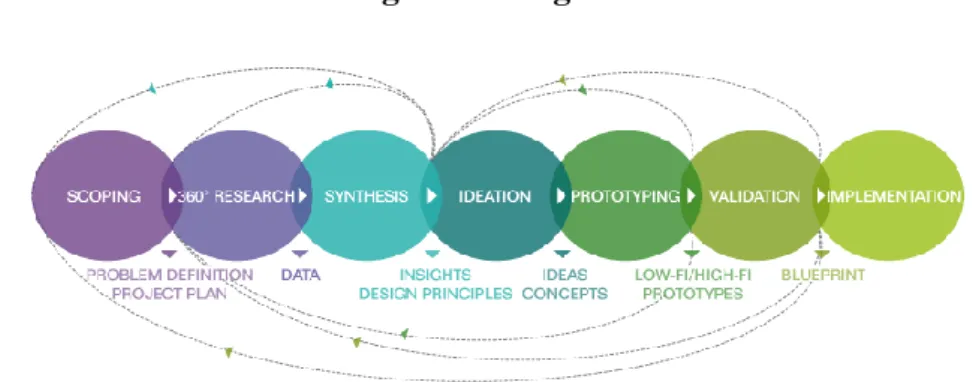
Fig. 1. Design Thinking process as followed in our organization
In our practice, we adapted the 5-step approach to design thinking (DT) by adding a ‘scoping’ phase at the beginning and culminating in a ‘presentation’ phase. In this
section, we highlight the most important techniques and methods for each of these phases
3.1 Scoping:
A scoping phase is especially important in large-scale design thinking projects to a) plan customer and stakeholder interactions across the globe b) plan project member’s availability from different teams for 5 consecutive weeks c) plan the 5 week design thinking project efficiently. Our best practices for this phase are the following.
a. Start early: Team members meet for 1-2 hours every day in the 1st week to get
acclimatized into the mindset and the process.
b. Co-define the problem space. The coached lead the teams to articulate the
prob-lem space and putting down their hypothesis, assumptions and constraints. Though the problem space will be revisited during the synthesis phase after meet-ing users, we found that a free-flow dialogue with the team brmeet-ings everyone on the same page and helps team put down “what is known” versus “what is un-known”.
c. Share knowledge “stories”. Teams share their current understanding using
sto-ries. We avoid using any documents or presentations.
d. Plan ahead for research. Teams identify end user profiles to reach out to them
and arrange for all local or remote meetings, ahead of research.
e. Game every meeting: Gaming brings agility and creativity and breaks any biases
towards action. We even create games together that become an addiction [7]. f. Plan for trials for every phase. We quickly try out a technique without any bias
towards action. In our practice, we have experimented by running a one-day crash-DT within the scoping phase of a longer DT of 5 weeks to get the team ori-ented to the spirit of the process.
g. Kick-off as a team officially with stakeholders at the end of this phase when the team has a detailed plan of the weeks ahead and in particular demonstrates a col-laborative mindset already. This boosts stakeholder and team confidence and en-sure higher rate of success and buy-in from everyone. A project that starts with a grand kick-off early without a team or a concrete plan often dies after a few weeks.
3.2 Research
In the research phase, design thinkers learn first-hand about their problem space by observing and interviewing end users and finding their needs and motivations. As coaches, we found that learning to be empathetic cannot be taught in classroom only and devised measures to help teams practice it in the field with heightened awareness.
1. Use an empathy stick as a self-regulatory mechanism to observe the basic rules:
ended and deferring judgment. Our teams have innovated using hand signs, pic-ture cards and gespic-tures to warn their group members.
2. Keep the roles clear and simple: Teams split themselves into groups of three with each one playing the role of a) initiator who watches what users say b) ob-server who watches what users do c) facilitator who watched how user feels. 3. Prepare to ask empathetic questions. We spent significant time framing the
‘right’ questions to ask users along with the teams.
4. Game all interactions with end users. Gaming keeps users engaged in an
activi-ty with ‘all’ his senses and elicits his ‘unsaid’ needs. As coaches we prescribed suitable games and also let our teams create new games.
5. Take 30 minutes at end of day together as a team. Often preached, but never
practiced, we use the time to share our learning and to plan our next day.
6. Plan for adjacent and analogous user analysis. The ‘wild’ ideas during idea-tion stemmed up from making a connecidea-tion to insights from these alternate situa-tions. (studying how ants collect food as a colony to understand ‘management’)
7. Take extreme users seriously. We observed and interviewed users three levels
down the value chain: our direct customers, our customer’s customers and cus-tomers customer’s end users to develop a holistic understanding of the problem.
3.3 Synthesis:
Synthesis is most grueling of all the phases, as the teams work towards seeing connec-tions over hundreds of facts obtained from research and making intuitive leaps about their understanding of the problem.
1. Make one participant the persona or a user to steer the discussion from the user’s point of view and to make quick decisions where conflicts arise.
2. Target minimum 3 conceptual models. We have used several frameworks to analyze research data such as customer journey maps, semantic and temporal zoom and conceptual mind maps [5].
3. Visualize and headline insightful moments before they die. We kept a space on
the design wall to record insights visually along with a user statement or story. 4. Moderate to think as a group. To think as a group requires one to listen to one’s
own thoughts and to listen to others, build on each other, and articulate it appro-priately. We regulated the individual thinking time and the group sharing time until the team was able to group-think on its own.
5. Check the team mood periodically. We used two techniques – a fish bowl after
every phase and the ‘I like, I wish’ 2at the end of every day
2
A fishbowl is a form of dialog that can be used in large participatory setup of more than 10 members with the coach moderating the conversation.
The 'I like I wish' is a method adapted from Stanford d-school’s method cards and used to get quick and frequent feedback from colleagues and end users.
3.4 Ideation:
Design thinkers use the ‘brainstorming’ technique popularized by Alex Faickney Os-born [10] for group ideation. The coaches play the role of a guide taking the partici-pants through the steps of ideating, sharing, voting, selecting and generating actiona-ble ideas. The coach also moderates the sessions ensuring the fundamental brain-storming rules [6] are not violated and in time keeping.
1. Invite experts, customers and stakeholders to brainstorm. Stakeholders’
buy-in to build or sell the product buy-increases when they contribute to the creative pro-cess. We have run brainstorming sessions with 15 participants in one session. 2. Brainstorm in rapid-fire rounds. We aim for 100+ ideas. Our brainstorming
session has a 10-20-20-10 minute split with 10 minutes individual think time, 20 minutes sharing and building on other’s ideas, 20 minute consolidating and agreeing on the most promising ideas, followed by a 10 minute break.
3. Try a fantasy question as a teaser to push imagination and think out of the box. This could be a teaser exercise when the creative spirit is dropping.
4. Use a gong to enforce rules. We hit the gong when a member does not follow any brainstorming rule. The gong has been more effective in regulating the group than a shout, whistle or any other prop.
3.5 Prototyping:
In this phase, teams come together and use rudimentary materials and techniques to give their ideas a physical form and shape. The most commonly cited problem during this phase is when the team is building “one” prototype that is a mash of “all” ideas from the ideation phase. The primary aim of a coach would be to push the teams to deliver several different prototypes they can take to their customers to find out which one works best. A coach also can demonstrate methods of quick prototyping using paper, magnets and Lego blocks and ensure all members are creating parts of the pro-totypes atleast.
1. Plan ahead for validation: Planning for the validation phase brings better clarity on what to prototype.
a. Decide the storyboards or user scenarios to prototype.
b. Agree on the number of prototypes (alternatives, variations) to create. c. Fix the validation schedule with end users.
2. Prototype alternativesandvariations, and seek for end user feedback. We split
teams into sub-groups of 2 and prototype different parts or variations of the pro-totype to speed up the process. The aim is to create a bunch of propro-totypes.
3. Time-box the phase so that teams don’t spend time re-thinking about the ideas,
and build them rapidly. We split the phase into smaller sessions.
4. Make experimental prototypes only. The prototypes should also reflect the nature of the thought process – experimental. We use paper, magnets and stickies.
3.6 Validate:
Validation is a second chance to meet the end users, but this time with physical proto-types to trigger deeper discussions with the end user. The most common pitfall in this phase is when the group sells the idea to the users instead of receiving feedback and learning from them. To avoid this, the coach guides the team into every detail of the validation process including planning of activities with the end user, creating the vali-dation scripts, identifying the prototypes to be tested and techniques of deriving quan-titative and qualitative feedback from the validation sessions. Here below are some good practices for productive validation sessions with end users.
1. Plan for an action packed validation. Our validation sessions are short and action-driven. Users interact with the prototype quickly and go by their intuition instead of spending time thinking and interpreting the prototypes. The validation sessions are 30 minutes and are repeated successively with 8-10 users a day.
2. Meet and refine end of day religiously adding, removing or modify prototypes
based on user feedback.
3. Use the empathy stick within the group using gestures, postcards and other
self-regulatory mechanisms to follow the rules of empathetic listening.
4. Test with extreme users. We often fail to involve customer’s customer’s users in validation process due time constraints, though we might have met them during the research phase. Never fall into the rushing-to-finish syndrome.
3.7 Presentation:
We mark the closure of the project when we have a design blueprint well received by our stakeholders and ready for production. Coaching in the phase could include help-ing the team define a communication strategy to their stakeholders, creathelp-ing a busi-ness case if needed and in creating a design proposal.
Make a persuasive presentation. The teams showcase their work in the form of an
interactive demonstration, role-play or as a narrative. They also make a video demon-stration that can be distributed to other stakeholders in other geographical locations. Though teams choose their medium of communication, we coach them in persuasive communication techniques and help them build their presentation content [9].
Create a blueprint that combines the best of all the prototypes so that production team can use it directly. This is done in collaboration with the production teams and other stakeholders and the design thinking project comes to a closure [8].
4
Conclusion
In the past we had experimented design coaching through other mechanisms such as consulting over a period of 3-6 months hourly or weekly and building a one-year classroom program. But with no real project or timelines, or dedicated coaching ef-forts these attempts were worthless. In contrast, the integrated approach to coaching
with a five-week live project has just the right momentum, motivation and magic to create perfectly useful solutions and in the process creates passionate design thinkers. The best practices described in the paper helped achieve our goals as a coach, of: 1.Agility: we create a design blue print within 5 weeks that is ready for production 2.Skill building: our hands-on techniques help teams understand and cultivate a
de-sign thinking mindset within 5 weeks with heightened awareness and long-term re-tention.
And once the first project became a success we saw the organization embracing the approach more willingly. We also witnessed our trained design thinkers spreading awareness and becoming junior design thinking coaches and advocates over time.
4.1 Limitations
Our practices reflect the human desirability perspective in depth, but not business viability or technical feasibility. In particular we had not invested in creating business cases and models, as business viability was assumed to be a given. We also did not focus on technical feasibility as our architects in the projects evaluated feasibility after the design-thinking phase. As a word of caution, this process is best applicable for a software product definition scenario and the same has not been tested for designing customer or business services. It best fits a project setup that aims at creating a realis-tic design vision within a short time of 4-5 weeks without getting into the details of project and cost estimation, planning and delivery. It guarantees problem clarity, de-sign roadmap, stakeholder and customer buy-in within a very short timeframe.
References
1. Katja Thoring, Roland M. Müller : Understanding the creative mechanisms of design thinking: an evolutionary approach In DESIRE '11: Procedings of the Second Conference on Creativity and Innovation in Design (October 2011)
2. Brown, T., 2008. Design thinking. Harvard Business Review,86(5), pp. 84-92. 3. HCD toolkit, https://hcd-connect-production.s3.amazonaws.com
4. Ideo’s Design Thinking for Educators, http://www.designthinkingforeducators.com/ 5. Kolko, J: Exposing the Magic of Design: A Practitioner’s Guide to the Methods and
Theo-ry of Synthesis, Oxford University Press, (2011) 6. Stanford d.school’s Bootcamp Bootleg
http://dschool.stanford.edu/wp-content/uploads/2011/03/BootcampBootleg2010v2SLIM.pdf 7. Gray, D., Brown, S., Macanufo, J : Gamestorming : A Playbook for Innovators,
Rule-breakers, and Changemakers, O'Reilly Media (Jul 2010)
8. Osterwalder, A., Pigneur., Y: Business Model Generation, Wiley (2010)
9. Reynolds,G : Presentation Zen –Simple ideas on presentation design and delivery, New Riders (2008)