Page 1
________________________________
(Please enter the name of Your Unit, Department, School, etc.)Unit Emergency Response Plan (UERP)
mm/dd/yyyy
Emergency Management – (561)297-2889
CONTENTS
Description Page No.
Contents 2
Preface
Abbreviations 3
Key Terms 3
1. Unit Operations, Functions and Facilities
1.1 Operations and Functions 5
1.2 Facilities and Equipment 5
1.3 Hazard Analysis 5
2 Unit Plan – General
2.1 General Actions 6
3. Preparation
3.1 Planning 8
3.2 Emergency Equipment and Supplies 9
4. Emergency Notifications, Reporting and Communications
4.1 Initial Report 10
4.2 Secondary Reports 11
5. Situation Assessment and Response
5.1 Situation Assessment 12
5.2 Response Actions 13
5.2.1 Incident Command System 13
5.2.2 University Crisis Action Guide 13
6. Recovery
6.1 Recovery Actions 14
7. Personnel
7.1 Responsibilities 15
7.2 Special Assignments, Training, and Expertise 15
8. Appendices
A.1 Notification – FAU Emergency Telephone Numbers 16
A.2 Unit Telephone Tree 17
B.1 Forms – Unit Damage Assessment – Space 21
B.2 Forms – Unit Damage Assessment – Offices and General Operations
22
B.3 Forms – Unit Damage Assessment – Labs 23
9. Reference Material
Page 3
KEY TERMS
Alert – Advanced notification that a disaster situation may occur. This forewarns participants of the possible implementation of the COOP.
Backup - The practice of copying information, regardless of media (paper, microfilm, audio or video tape, computer disks, etc.) to provide a duplicate copy. This is done for protection in case the active
information is unreadable or destroyed. Backups to support a recovery effort must include a storage strategy which physically separates the backup data from the original data so there is a minimum of chance that the same event could destroy both copies. Backups may be of various media types. Contingency Plan - A document containing the recovery timeline methodology, test-validated documentation, procedures, and action instructions developed specifically for use in restoring organization
Continuity of Operations Plan: A plan which ensures the performance of an organization’s mission essential functions during any emergency or situation that may disrupt operations over a 30-day period. Business Interruption - Any event, whether anticipated or unanticipated which disrupts the normal course of operations at a business location.
Call Tree - A list of key individuals to be contacted. Many of these individuals are responsible for contacting additional individuals linked below them on the list. With a call tree, you can help ensure that all of the employees assigned to the plan will be notified promptly.
Emergency Coordination Center - A coordination center will typically be a location with ample voice communications capabilities as well as office space, furniture, and office equipment to support
ABBREVIATIONS
List all
abbreviations
List full words
Example:
Example:
COB
Campus Operations Building (FAU Building 69)
COOP
Continuity of Operations
ECC
Emergency Coordination Center (Campus)
EH&S
FAU Environmental Health and Safety
EMP
Emergency Management Plan
EOC
Emergency Operations Center (University)
EOT
Emergency Operations Team (University)
FAU
Florida Atlantic University
FAU PD
Florida Atlantic University Police Department
GTK
Go-to Kit
HAZMAT
Hazardous Materials
IC
Incident Commander
MEF
Mission Essential Function
MR/PI
FAU Media Relations/Public Information
MR/PIO
FAU Media Relations/Public Information Officer
TT&E
Testing, Training, and Evaluation
emergency management team members. The coordination center can be located in an alternate recovery facility, mobile facility, in another building, or in a facility such as a hotel or conference center, remote from the normal business facilities.
Mission Essential Function – An essential function is one necessary for the continued success of the unit. If an essential function is non-operational, the unit could suffer serious legal, financial, goodwill, or other serious losses or penalties. Generally, mission essential function(s) must operate continuously or sustain only brief interruptions.
Data Integrity - Information and data that accurately reflects the status of a business function at a given point of time, representing complete, synchronized information that has passed all data validation and error checking routines. Data integrity is critical in the post interruption environment when data is reconstructed from backups.
Disaster Recovery - The ability to respond to an interruption in services by implementing a recovery plan that ensures the orderly and timely restoration of an organization’s business capabilities and supporting resources.
Exercise - A test or drill in which actions in the contingency plan are performed or simulated as though responding to an event. It is during the exercise that planners and participants can evaluate whether the planned activities and tasks properly address potential situations.
Mitigation - Any measure taken to reduce or eliminate the exposure of assets or resources to risk. Recovery - Those long-term activities and programs which are designed to be implemented beyond the initial crisis period of an emergency or disaster in order to return all systems to normal status or to reconstitute those systems to a new condition that is less vulnerable.
Restoration - The act of returning a piece of equipment or some other resource to operational status. Commercial service companies provide a restoration service with staff skilled in restoring sensitive equipment or large facilities. Such vendors often work with insurance companies and may restore equipment for a fee or may purchase damaged equipment with the intent of restoring the equipment and re-marketing the product.
Risk - The potential for harm or loss. The chance that an undesirable event will occur.
Risk Analysis - An analysis of potential threats to an organization's ability to maintain current business operations.
Threat - Threats are the events that cause a risk to become a loss. Threats include natural phenomena such as storms and floods as well as man-made incidents such as cyber-terrorism, sabotage, power failures, and bomb threats.
Vital Records - Records or documents, regardless of media (paper, microfilm, audio or video tape, computer disks, etc.) which, if damaged or destroyed, would disrupt business operations and information flows and cause considerable inconvenience and require replacement or recreation at considerable expense.
Page 5
1.
Unit
Operations, Functions, and Facilities
1.1 Operations and Functions:
1.2 Facilities:
Unit FACILITIES
Building Use Location
1.3. HAZARD ANALYSIS
1. Based on data contained in the Palm Beach County CEMP, general emergencies that could affect Unit
directly include, in order of descending risk:
Hurricanes (esp. Category 1 and 2 storms) and Tropical Storms
Floods
Thunderstorms and Lightning
Fires
Terrorism/Sabotage
Radiological accidents
Electrical Outages
Tornadoes
Hazardous Materials Release or Accident
Pandemic
2. Unit specific emergencies include:
SECTION 2. GENERAL
2.1 General Actions
Units throughout the University are strongly encouraged to develop their own Emergency Response Plans since they bet understand the nature of the work, workplace hazards, facility layouts and specials needs of the unit. The ERP should address preparedness measures and emergency response. It is a way for the unit to plan for potential emergencies. Advanced planning, completion and routine review of the UERP will help reduce risk and loss of life.
Planning Assumptions:
These plans are limited to emergencies that affect Unit operations directly. Campus or University-wide emergency response is described in the FAU CEMP.Plan Integration:
The Enter Title (usually the UERP writer) will ensure that its plan is integrated with all appropriate Division, Campus and University Plans for all Unit facilities.UERP Author and Point of Contact:
________________________. (insert name here)Execution:
UERP activation is dependent on the following circumstances:
Known threats and emergencies (with warning): There are some threats to operations that may afford advance warning that will permit the orderly alert, notification, and evacuation or sheltering in place Situations that might provide such warning include a hurricane, a transportation accident resulting in a threat of a release of hazardous material (HAZMAT) or a threat of a terrorist incident.
Unanticipated threats and emergencies (no warning) During Duty or Non-Duty Hours: Incidents may not be preceded by warning, e.g., arson, HAZMAT, or terrorist incidents. In these circumstances, execution of the UERP, if indicated by the circumstances of the event, would begin by executing duties to support notification, resource protection, evacuation or shelter-in-place, and situation assessment.
General Actions
Preparation Planning involves establishing plans, including contact trees for internal and external contacts, having agreements with external vendors and others for supplies, equipment and space. The Unit will exercise communication and call trees as well as participate in applicable campus and University-wide tests, training and exercises.
Emergency Event Occurs
The emergency event or threat can be natural, for example, hurricanes, tornadoes, floods, or man-made, for example, cyber terrorism, hazardous materials spills or releases, and hostile intruder.
Initial Report Once notified of an emergency event or threat, the Unit will inform first responders; 911, University PD, Fire Rescue, etc..
Notification The Unit will inform internal and external contacts of the emergency event or threat.
Situation
Assessment and Response
Response will be directed by the Unit Leader or designee and conducted by members of the Unit, Building Safety Personnel and first responders as appropriate.
Page 7
Preparation can include equipment protection, scaling back of functions to just mission essential
functions, reduction of staff to just essential personnel, etcetera. Informing unit staff and those whom you serve; employees, students and/or visitors is essential. Evacuation or sheltering in place actions may also begin at this stage.
Response can be considered as those actions that begin when the emergency event occurs and continue during the event. These include sheltering in place, evacuation, informing building safety personnel and first responders of unit status, etc.
Recovery includes damage assessment and reporting, re-occupancy, re-staffing, re-building, etc. Emergency occurs
Preparation
Response
Recovery
Time
Emergency ends or is effectively managedSECTION 3. PREPARATION
3.1 Planning
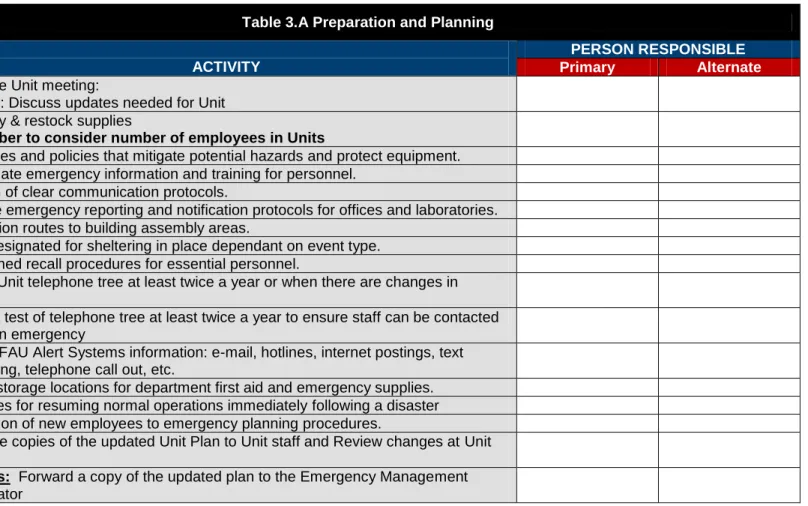
Table 3.A Preparation and Planning
ACTIVITY
PERSON RESPONSIBLE Primary Alternate
Schedule Unit meeting:
Purpose: Discuss updates needed for Unit Inventory & restock supplies
Remember to consider number of employees in Units
Work rules and policies that mitigate potential hazards and protect equipment. Appropriate emergency information and training for personnel.
Creation of clear communication protocols.
Effective emergency reporting and notification protocols for offices and laboratories. Evacuation routes to building assembly areas.
Areas designated for sheltering in place dependant on event type. Pre-defined recall procedures for essential personnel.
Update Unit telephone tree at least twice a year or when there are changes in staffing.
Conduct test of telephone tree at least twice a year to ensure staff can be contacted during an emergency
Monitor FAU Alert Systems information: e-mail, hotlines, internet postings, text messaging, telephone call out, etc.
Secure storage locations for department first aid and emergency supplies. Strategies for resuming normal operations immediately following a disaster Orientation of new employees to emergency planning procedures.
Distribute copies of the updated Unit Plan to Unit staff and Review changes at Unit meeting
All Units: Forward a copy of the updated plan to the Emergency Management Coordinator
Page 9
Section 3.2. Emergency Equipment and Supplies
Emergency Supplies and Equipment
Item Use Quantity Location Purchase
/Replacement Date
See Secondary Reports Notify University Police,
campus security and Building Safety Supervisors if none of these were initial informants
Threat involves fire/smoke, radiological, biological or chemical
materials
Inform EH&S
Threat involves leak or outage e.g. power, water,
gas
Inform Work Control Notify Unit Leader or
designee Notify Unit Leader
or designee and Unit staff
Notify University Police, campus security and Building
Safety Supervisors if none of these were initial informants
Closely monitor situation
Discovery of event or threat by Unit Or Unit informed of event or threat
Event/Threat poses potential to affect unit – one not currently affecting or indirectly affecting
Unit
Event or threat is affecting or will soon be directly affecting Unit due to rapidly deteriorating
conditions
SECTION 4. EMERGENCY NOTIFICATIONS, REPORTING AND COMMUNICATIONS
The weakest link in most emergency management plans is usually communication. Our ability to assure coordinated and timely response for this Unit depends on the following: Being available to receive and transmit notification via the established mechanisms
Transmitting notification in clear and specific language
Transmitting notification in a timely manner
Section 4.1. Initial Report
When an emergency event or threat occurs, the initial report should involve the following:
911, University Police or campus security
Unit personnel on duty, Unit Leader or designee first
Page 11
Section 4.2. Secondary Reports
When an emergency event or threat occurs, the secondary reports should involve the following:
Unit staff in the following order: on-site/on duty, off duty/en route, other locations
Units that yours interacts with, works with or is dependent upon to perform the functions of the unit
External contacts such as vendors and regulatory agencies
See Appendix A for Unit call tree
See Appendix _________ for Inter-Unit call tree
(insert # here)
See Appendix _________ for External contacts
(insert # here) Notify Unit Staff (intra-Unit)
-on duty - off duty -different locations
Notify other Units (inter-Unit) - Units that interact or are
dependant on your Unit - units that yours is
dependant on
Notify external contacts (vendors, regulatory
Discovery of event or threat by Unit Or Unit informed of event or threat
Event/Threat poses potential to affect unit – one not currently affecting or indirectly affecting
Unit
Event or threat is affecting or will soon be directly affecting Unit due to rapidly deteriorating
conditions
Closely monitor situation
Initiate Unit response
Evacuation Shelter-In-Place Other/Combination
SECTION 5. SITUATION ASSESSMENT AND RESPONSE
Section 5.1. Situation assessment
This is vital to initiating the correct response.Page 13
SECTION 5.2. RESPONSE
These actions are to save lives and property and to effectively manage or end the emergency event or threat.
Section 5.2.1. Incident Command System (ICS)
FAU uses the Incident Command System (ICS) to respond to and manage the emergency event. ICS is a standard method of responding to emergency situations. Emergency response organizations and their responders are all familiar with ICS. The ICS is a flexible, expandable framework that may be used to manage incidents of any type or size. The five major functions of ICS are shown below.
Guide.
SECTION 5.2.2. CRISIS ACTION GUIDE:
Use the Crisis Action Guide located to prepare hazard-specific (for example, hurricane, hostile intruder, etc.) plans for your facilities. These can be attached as appendices.
Visit http://www.fau.edu/emergency for the current version). COMMAND
Single, Unified
Operations Planning Logistics Finance
COMMAND Staff Safety Officer Agency Liaison Public Information Officer Responsible for getting the objective accomplished. Restores services, repairs damage, etc. Evaluates current status of incident Forecasts course of incident Prepares plans of action Provides facilities, supplies and support i.e. communication, transportation, medical, food service, etc. Responsible for financial records associated with the incident Handles insurance claims and recovers costs when possible
SECTION 6. RECOVERY
When the cause of the crisis situation has been eliminated and the situation brought under control, the focus will turn to restoration of the Unit to pre-crisis conditions. As in all phases of crisis response, documentation of items lost, expenses incurred, and actions taken, is critical. If in doubt, write it down. The recovery phase will involve calculating losses, filing claims, rebuilding and making repairs, paying contractors, counseling victims and responders, and critiquing the Unit’s overall response.
6.1. Recovery Actions
See Appendix B for Forms.
Loss Reporting/Claims through EOC/ECC and EH&S
---Use Damage Assessment Forms
Unit cannot resume essential functions within
12 hours/Unit primary facility rendered inoperable
Activate Unit COOP (See UCOOP Plan)
Repair of damage/re-building through Division of
Facilities
Debrief of Unit’s preparedness and response capability between Unit leadership and staff and incorporate solutions
into UERP
Unit can resume essential functions within 12 hours at
primary facility Unit response
complete
Emergency event ends or is effectively managed by first
responders
Damage Assessments
Page 15
SECTION 7. PERSONNEL
7.1. Personnel Responsibilities
7.2. Staff with Special Assignments, Training or Expertise:
Table 3.3.A. Personnel and Responsibilities
Title Location Essential Person Group Emergency Responsibilities Preparation Notification/ Reporting Situation Assessment & Response Recovery
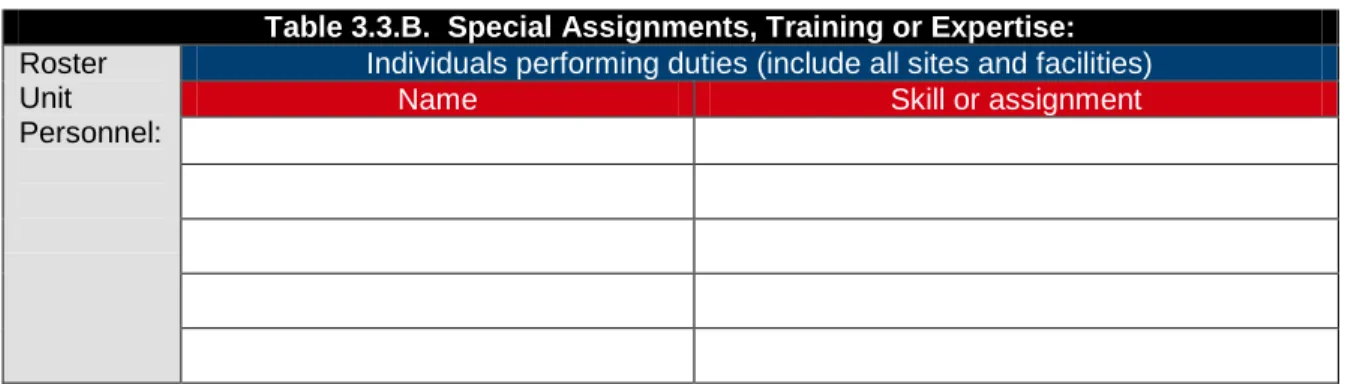
Table 3.3.B. Special Assignments, Training or Expertise:
Roster Unit Personnel:
Individuals performing duties (include all sites and facilities)
SECTION 8. APPENDICES
Appendix A.1. Emergency Agency Telephone Numbers
FAU Emergency Telephone Numbers
Unit Telephone
EH&S Main Office 561-297-3129
FAU Boca Raton ( FAU Police) 561-297-3500
FAU Broward
Davie (FAU Police) Davie (Security)
954-236-1140 954-236-1018 Fort Lauderdale - AT Building (Security)
Fort Lauderdale - HE Building (Security)
954-762-5611 954-762-5352
FAU Dania Beach 954-924-7000
FAU MacArthur (FAU Police) 561-799-8700
FAU HBOI (FAU Police) 772-216-1124
Page 17
Appendix A.2. Unit Telephone Tree
PRIMARY & ALTERNATE CONTACT TREE
The Primary/Alternate contact will be notified by: ______________________________ Direct supervisor of Unit or their designee
The Primary/Alternate contact will make at least ____ attempts over a period of ____ hours to notify each Number Number
of the following persons, at any/all of the numbers listed:
Name & Email
Contact Numbers Contact Date & Time
(To be completed at the time of emergency) Primary Contact 1 (See list 1.01 to 1.08)
Work
Home AM/PM
Pager Cell
Alternate Contact 1 (See list 1.01 to 1.08) Work
Home AM/PM
Pager Cell
Primary Contact 2 (See list 2.01 to 2.08) Work
Home AM/PM
Pager Cell
Alternate Contact 2 (See list 2.01 to 2.08) Work
Home AM/PM
Pager Cell
Primary Contact 3 (See list 3.01 to 3.08) Work
Home AM/PM
Pager Cell
Alternate Contact 3 (See list 3.01 to 3.08) Work
Home AM/PM
Pager Cell
CONTACT 1 notifies the following individuals:
Name & Email
Contact Numbers Contact Date & Time
(To be completed at the time of emergency) 1.01 Work Home AM/PM Pager Cell 1.02 Work Home AM/PM Pager Cell 1.03 Work Home AM/PM Pager Cell 1.04 Work Home AM/PM Pager Cell 1.05 Work Home AM/PM Pager Cell 1.06 Work Home AM/PM Pager Cell 1.07 Work Home AM/PM Pager Cell 1.08 Work Home AM/PM Pager Cell
Page 19
CONTACT 2 notifies the following individuals:Name & Email
Contact Numbers Contact Date & Time
(To be completed at the time of emergency) 2.01 Work Home AM/PM Pager Cell 2.02 Work Home AM/PM Pager Cell 2.03 Work Home AM/PM Pager Cell 2.04 Work Home AM/PM Pager Cell 2.05 Work Home AM/PM Pager Cell 2.06 Work Home AM/PM Pager Cell 2.07 Work Home AM/PM Pager Cell 2.08 Work Home AM/PM Pager Cell
CONTACT 3 notifies the following individuals:
Name & Email
Contact Numbers Contact Date & Time
(To be completed at the time of emergency) 3.01 Work Home AM/PM Pager Cell 3.02 Work Home AM/PM Pager Cell 3.03 Work Home AM/PM Pager Cell 3.04 Work Home AM/PM Pager Cell 3.05 Work Home AM/PM Pager Cell 3.06 Work Home AM/PM Pager Cell 3.07 Work Home AM/PM Pager Cell 3.08 Work Home AM/PM Pager Cell
Page 21
Appendix B - Forms
B.1. UNIT DAMAGE ASSESSMENT FORM - SPACE
Email completed form to [email protected] hand deliver to the Emergency Operations Center. DO NOT SUBMIT THIS FORM TO WORK CONTROL
______________ _______________________ _________ ________
Campus Building Name Bldg # Room #
REMEMBER, YOUR SAFETY COMES FIRST! Space is (check all that apply):
Not usable
Usable
Wet/Damp
DryIn the aftermath of a disaster, evaluating and reporting damages in your unit’s facilities is everybody’s responsibility. Check which basic services are operational:
Phone Internet Yes No Power Water Yes No
Ceiling tiles (e.g., wet, sagging, missing): ___________________________________________________ ____________________________________________________________________________________ Walls (e.g., cracks, watermarks, soot): _____________________________________________________ ____________________________________________________________________________________ Floor/Carpet (e.g., wet, burnt, torn, mildew):_________________________________________________ ____________________________________________________________________________________ Water leaks (e.g., from roofs, through walls, windows): ________________________________________ ____________________________________________________________________________________ Doors & Windows (e.g. broken locks, hinges, awnings): _______________________________________ ____________________________________________________________________________________ Fixtures (e.g., electrical outlets, lightning): __________________________________________________ ____________________________________________________________________________________ Other: ______________________________________________________________________________ ____________________________________________________________________________________ Contact Person: ____________________________ Telephone _____________________________ Department: _______________________________ Fax Number: ___________________________
B.2. UNIT DAMAGE ASSESSMENT - OFFICES & GENERAL OPERATIONS
Email completed form to [email protected] hand deliver to the Emergency Operations Center. DO NOT SUBMIT THIS FORM TO WORK CONTROL
Building: _______________________ Room: _________________________
Inspected By: ___________________ Date: ______________ Phone: ___________________
Category Description (Brief description of damage) Condition*
Electrical Equip. Computers Printers Monitors Peripherals (identify) Copiers Other Communications Telephone Service University Network Two-way Radios Fax Machines Email Other Supplies Paper Forms Books Files Other Furniture Chairs Desks Credenzas Tables Cabinets Other
* Please use your best judgment for assigning condition assessment ranking based on the following: Good No Damage
Fair Damage appears superficial, can be used as is Moderate Damage appears moderate, repairs may be possible Severe Damage appears to be severe, repairs unlikely Destroyed Damaged beyond recovery
Page 23
B.3. UNIT DAMAGE ASSESSMENT – LABS
Email completed form to [email protected] hand deliver to the Emergency Operations Center. DO NOT SUBMIT THIS FORM TO WORK CONTROL
Building ____________ Lab Room # __________
Inspected By: ___________________ Date: __________________________ Phone: _________________________ Category Condition* Animals Cultures Compressed Gasses Controlled Substances Flammable Materials Laser Equipment Radioactive Materials Temperature Sensitive Materials Other Other Other
Locations with hazardous materials, where such materials have been identified to be in poor condition, must be immediately reported to University Police.
* Please use your best judgment for assigning condition assessment ranking based on the following: Good No Visible Damage/Leakage
Fair Damage appears superficial/No Leakage Poor Damage appears moderate/Possible Leakage Unknown Inaccessible, due to facility condition or contamination