Who’s in Charge Here?
Direct and Indirect Accusations and Voter Punishment of Corruption
Forthcoming in Political Research Quarterly
Matthew S. Winters University of Illinois Department of Political Science 315 David Kinley Hall, MC-713
1407 W. Gregory Drive Urbana, IL 61801
1-917-929-5965 1-217-244-5712 (fax) [email protected] Rebecca Weitz-Shapiro
Brown University Department of Political Science
36 Prospect Street Providence, RI 02912
1-401-863-2825 [email protected]
Acknowledgments: This is part of an ongoing collaboration in which the position of first author will alternate between the authors. Both authors contributed equally to this paper. Thanks to Andy Baker, Gabriel Cepaluni, José Cheibub, Miguel de Figueiredo, Danny Hidalgo, Jim Kuklinksi, Andrew Little, René Lindstaedt, Jordi Muñoz, David Nickerson, Nara Pavão, Sergio Praça, Luis Schiumerini as well as audiences at seminars at the Autonomous University of Barcelona, Brown University, Columbia University, Harvard University, Michigan State University, MIT, São Paulo State University, Tulane University, University of California – Riverside, the University of Illinois at Urbana-Champaign, University of Missouri, and the University of São Paulo for useful comments and conversations. A previous version of this paper was presented at the 2014 annual meeting of the American Political Science Association. Thanks to George Avelino, Fernando Limongi, the Fundação Getulio Vargas, and the University of São Paulo for help in organizing focus group discussions. Marina Merlo and Leandro Rodrigues provided excellent assistance in running the focus group discussions. Thanks to Eduardo Azevedo, Silvia Cervellini, Priscila Ratnieks, and the other staff at IBOPE. Camila Moraes and Jazmin Sierra provided excellent research assistance. We thank the Lemann Institute for
1 Abstract
There is a growing consensus that voters withdraw support from a politician when they receive clear information that the politician has engaged in corruption. But will voters punish an elected official for corrupt acts carried out under his or her watch, even if the politician is not personally implicated in corruption? To answer this question, we present the results of an embedded
experiment from a nationally-representative survey in Brazil. Using vignettes that describe a hypothetical mayor, we find that citizens punish all mayors who are linked to corruption, but that punishment is attenuated when members of the municipal administration, and not the mayor per se, are charged with corruption. The difference is particularly pronounced when corruption information comes from a credible source and among politically sophisticated respondents. Our findings highlight that both the nature of information and the characteristics of citizens who receive that information have implications for political accountability.
2 In June 2005, an embattled Brazilian legislator revealed that the ruling Partido do
Trabalhadores (PT, Worker’s Party) had been paying certain congressional deputies R$30,0001
every month to secure their support for the government’s legislative initiatives. As the media focused attention on the mensalão (“big monthly payment”) scandal over the next six months of 2005, two high-ranking presidential advisers and the president of the PT all resigned, and public opinion toward incumbent president Luiz Inácio Lula da Silva soured (Hunter and Power 2007). Yet, despite the additional resignation in March 2006 of the finance minister, Lula had regained enough ground by October 2006 to capture the plurality of votes in the first round presidential election and the majority of votes in the second round, in which voters returned him to office for a second four-year term.2
Arguably, Lula was able to avoid electoral punishment because he himself was never directly implicated in the scandal. In this paper, we ask whether this is emblematic of a more general trend: do citizens punish corruption when the target of corruption allegations is the elected politician himself, yet overlook corruption when appointed officials are involved?
The answer to this question has important implications for the nature of democratic accountability. In a modern state, much of the work of government is carried out by unelected officials who voters cannot directly sanction. As a result, citizen control of bureaucrats and appointed officials is indirect, at best. In order to create incentives for unelected officials to faithfully perform the duties of their office, citizens must rely on threats to sanction elected officials for the actions of those unelected officials they oversee. On the one hand, this indirect
1
Around US$12,000 at the time. 2
3 control may be desirable: if politicians do not fear any electoral sanctions as the result of poor performance by others, they may lack the incentives to control and oversee bureaucrats and administration officials. On the other hand, indirect control has drawbacks for accountability, as well. If citizens sanction elected officials to an extreme extent for the behavior of their
subordinates, high-performing politicians may lose elections for actions that are truly beyond their own control.
We hypothesize that citizen punishment of corruption will vary with the target of corruption information. We also hypothesize that punishment will vary with the credibility of that
information and with the sophistication of voters themselves. We report the results of an original survey experiment conducted in Brazil that – with the goal of abstracting from the circumstances of any particular scandal – included a vignette describing allegations of corruption in a
4 Assigning Responsibility and Punishing Corruption
Among their many functions, elections can be understood as sanctioning devices that induce elected officials to act in voters’ interests (e.g., Barro 1973; Ferejohn 1986).3 This electoral connection may encourage politicians to enact policies on divisive issues (e.g., tax policy, abortion policy) that are congruent with the ideological preferences of a plurality or majority of the population. The threat of electoral punishment should create an even stronger incentive for politicians to respond to citizen preferences in arenas where there is broad popular consensus. These valence issues reflect common preferences over outcomes like economic performance, as well as over the process by which politics is conducted—like a widely shared preference for clean over corrupt government.
Yet even when citizens share preferences about politician behavior and government
performance, this does not guarantee that the signals voters send on election day will be a clear expression of those preferences. To hold politicians to account, citizens must first decide who they deem responsible for the actions and outcomes they care about and which they observe. This attribution of responsibility is far from a straightforward task. Actual outcomes that voters observe might be the product of the individual or combined actions of myriad elected politicians, unelected officials, and external shocks, making the attribution of responsibility difficult (see also Rudolph 2003b).4 All else equal, the more voters attribute responsibility for an outcome to a
3
For an important exception that argues that elections are devices for selection, see Fearon (1999).
4
According to the “triangle model of responsibility” presented in Schlenker et al. (1994),
5 given elected official, the greater the connection we should observe between that outcome and the official’s electoral fate.5 Conversely, the harder it is for a voter to attribute responsibility for some outcome to a given official, the less likely it is that the official will be held to account for that outcome.
Studies of economic voting are consistent with this basic logic. For example, scholars have shown that economic voting is contingent on political clarity of responsibility, understood as the “perceived unified control of policymaking by the incumbent government” (Powell Jr. and
Whitten 1993, 398). As that literature attests, power-sharing arrangements complicate efforts to assign responsibility for economic outcomes, and as a result, coalition governments, which put elected officials from a variety of parties into power in parliamentary systems, are linked to weaker economic voting (e.g., Powell Jr. and Whitten 1993; Anderson 1995; Anderson 2000; Duch and Stevenson 2008).6
an observed event and a prescriptive approach to that event, (2) the individual being judged and the prescription, and (3) the individual being judged and the event.
5
Arceneaux (2006) develops and tests similar hypotheses, focusing on attribution of responsibility across levels of government in a federal system. Using survey data from the United States, he finds that, contingent on an issue being accessible to a survey respondent, a respondent is more likely to punish or reward a politician for performance in policy arenas that the respondent believes to be under the purview of the level of government (national, state, local) corresponding to that politician.
6
6 Although that literature focuses on the relationship between elected politicians from different parties, the relationship between elected politicians and unelected bureaucrats might similarly obscure responsibility. When voters become aware of actions taken by government bureaucrats, they may not know whether—or the extent to which—elected politicians exercise control over those actions.
On the other hand, in the study of corruption, some scholars take the view that politicians are, by definition responsible for bureaucratic malfeasance. Drawing on Gerring and Thacker’s (2004) definition of corruption as “an act by a public official (or with the acquiescence of a public official) that violates legal or social norms for private or particularistic gain” (300), Tavits
(2007) notes that politicians should be held responsible “for not only their own corrupt activities
but also for the failure to combat bureaucratic corruption” (220, emphasis added). This fits with
the idea of a “chain of delegation” that characterizes representative democracy: voters delegate
to elected officials, who in turn delegate to top appointed officials, who then oversee civil servants (Strøm 2000). In this view, the act of voting has the potential to allow citizens to control both elected and unelected officials.
But do voters understand the corrupt actions of appointed officials to be subject to public oversight in this manner? If voters do understand elected politicians as responsible for the behavior of bureaucracies under their purview, we should expect them to be punished for corruption within their administrations, even when those politicians themselves are not directly implicated in corrupt acts. On the other hand, voters may fail to attribute responsibility for corruption by unelected officials to elected politicians, in a sense breaking the chain of
7 avoid punishment. This could be true at all levels of government, from the national chief
executive to the mayor of a small town. The existing literature on corruption, which has overwhelmingly focused on the punishment of specific elected politicians who are clearly and personally implicated in scandals, does not speak to this question.7
More specifically, in situations where scandals directly implicate non-elected officials, elected executive politicians may be able to plausibly deny any knowledge of, or complicity in, illicit activities, weakening the link between actors and events that is crucial for the attribution of responsibility.8 Citizens who believe that corrupt, non-elected officials act of their own volition are less likely to assign responsibility for these corrupt acts to elected politicians. To the extent that at least some citizens believe that elected politicians are not responsible for malfeasance carried out by officials in their administrations, such politicians should be punished somewhat
7
For example, Peters and Welch (1980), Welch and Hibbing (1997), Chang, Golden, and Hill (2010), de Figueiredo, Hidalgo, and Kasara (2010), and Carlin, Love, and Martinez-Gallardo (2015) find evidence that scandal adversely affects legislative or mayoral candidates in elections in the United States, Italy, Brazil, and cross-nationally in Latin America. Similarly, the recent wave of survey experimental studies that document strong citizen rejection of corruption almost all involve vignettes in which an elected politician is directly implicated in the corrupt act (Klašnja and Tucker 2013; Konstantinidis and Xezonakis 2013; Winters and Weitz-Shapiro
2013; Anduiza, Gallego, and Muñoz 2013). In a discussion of the Mensalão scandal in Brazil, Rennó (2011, 64) points to the fact that Lula’s opponents accused him either of “direct
complicity in corruption or of passive toleration of wrongdoing,” although he does not explore the implications of this distinction.
8
8 less, ceteris paribus, as compared to politicians who are personally implicated in corruption.9 This leads to our first hypothesis.
H1: Politicians will suffer greater electoral punishment when they are directly implicated in corruption as compared to when non-elected officials under their supervision are implicated in corruption.
In addition, we explore the possibility that the quality of information citizens receive about corruption mediates the relationship posited in H1. We know from work by Lupia and
McCubbins (1998), Boudreau (2009), and Alt et al. (2015) that citizens across disparate
empirical contexts are more responsive to information from more credible sources. In addition, in other work based on the same data, we find that citizens are especially responsive to
corruption accusations when they come from a credible source (Weitz-Shapiro and Winters 2014). Therefore, we posit that respondents will be more sensitive to the specificity of corruption information when that information is also credible. This leads us to our second hypothesis. H2: The difference in the degree of punishment politicians experience when directly versus indirectly implicated in corruption will be greater when corruption accusations are more credible. While H1 and H2 focus on the characteristics of information about corruption, the political behavior literature also demonstrates that responses to information vary with characteristics of the individual receiving that information. Of particular interest to us here, previous scholars have shown that political sophisticates enjoy greater levels of political awareness and understanding
9
9 than other citizens.10 In addition, politically sophisticated citizens are more likely to recall information they receive and to be sensitive to specific details of that information (Druckman and Nelson 2003; Chong and Druckman 2007).
In the survey we analyze here, each respondent learns about corruption carried out either by a hypothetical mayor or unelected administration officials. Although each prompt references only one type of official, political sophisticates are more likely to understand that a range of
government officials, both elected and appointed, might potentially be implicated in any given corruption allegation. As a result, when these respondents hear the prompt that links corruption to administration officials, they are likely to attribute less responsibility to the mayor. Similarly, these respondents are more likely to recognize the gravity of the accusations in the vignettes that do directly implicate the mayor, heightening the attribution of responsibility for corruption in these cases. In contrast, less sophisticated respondents are less likely to have in mind the full range of political actors who might engage in corruption. As a result, these respondents should focus on the highly salient information about corruption that the prompts share, rather than on
the target of that information, which differs across the prompts. This leads us to our third
hypothesis.
H3: Differences in responses to politicians directly versus indirectly implicated in corruption should be greater among politically sophisticated respondents.
10
10 Finally, we note that just as sophisticates should be particularly attentive to the specificity of corruption information, we expect them to be more sensitive than other respondents to the credibility of the information they encounter.11 Sophisticated respondents should be more likely than other voters to recall, recognize, and be sensitive to a source’s incentives to tell the truth in
disseminating information about which political actors are implicated in corruption. Thus, we expect to find particularly strong evidence for H3 when information comes from a credible source.
Note that H3 assumes that political sophisticates vary from non-sophisticates in their
understanding of politics and attentiveness to information, but not in their views about politician responsibility for bureaucratic behavior. Alternatively, it is possible that more and less politically sophisticated respondents have systematically different views on the extent to which elected politicians should be held accountable for malfeasance that occurs under their watch. Politically sophisticated respondents may be more likely to recognize that one way to punish unelected officials is to sanction the elected politician who has authority over them. If this is true, then sophisticated respondents should respond in similar ways to information about corruption regardless of whether the mayor himself or administration officials are named. We propose this as an alternative hypothesis to H3:
H3’: Differences in responses to politicians directly versus indirectly implicated in corruption
should be attenuated among politically sophisticated respondents.
11
11 An Embedded Survey Experiment about the Specificity of Corruption Accusations
We test these hypotheses with data from an original, nationally-representative survey experiment on attitudes towards municipal corruption in Brazil. Brazil is a particularly apt context in which to examine the political consequences of municipal corruption. Like many countries in Latin America, Brazil enacted decentralizing reforms after its transition to
democracy in the 1980s. Under the 1988 constitution, Brazilian municipalities are recognized as constitutive parts of the Federal Republic of Brazil and enjoy substantial autonomous fiscal powers (Souza 2002; Afonso and Araújo 2006). In contrast to many other countries in the region, these reforms actually achieved a substantial transfer of policy-making power to municipalities, as well, notably in the areas of health care and education (Falleti 2010). Importantly for our focus on the attribution of responsibility, Brazilian mayors enjoy considerable control over hiring municipal employees and setting their salaries (Afonso and Araújo 2006, 384). This means that these officials are truly agents of the mayor rather than, for instance, bureaucrats within national line ministries who operate at the local level.
Although many are familiar with the high-profile, national corruption scandals that have shaken Brazil recently, municipal corruption is also a long-running scourge. According to Ferraz and Finan (2011, 1275), approximately US$550 million is lost to local government corruption in Brazil each year. Studying audits of federal health grants to municipalities, Avelino, Barberia, and Biderman (2014) found that one in five grants suffered from procurement fraud, over-invoicing, or outright fund diversion, and they identified at least one corrupt transaction in more than half of the municipalities in their sample.
12 federal funds in the municipality during the preceding two years and makes its findings publicly available (Avelino, Barberia, and Biderman 2014; see also the description in Ferraz and Finan 2008; Zamboni and Litschig 2013). Existing studies have shown that the release of this audit information, when it contains charges of corruption, reduces the likelihood that incumbent mayors will be reelected (Ferraz and Finan 2008; Brollo et al. 2013) and may have additional externalities, including leading citizens to reduce payment of property taxes (as a protest against municipal mismanagement) and to mobilize to create participatory budgeting institutions
(Timmons and Garfias 2015).12
All of these factors mean that the scenarios we describe in our survey should resonate with respondents.In the survey, we employ vignettes in which we vary information about corruption in a hypothetical municipal administration, and we then examine respondents’ declared support
for the mayor of that hypothetical city. Describing a hypothetical mayor allows us to maintain significant control over the information environment and is a technique that has now been used frequently in studies of citizen responses to different types of politician behavior, including clientelism (Weitz-Shapiro 2012) and corruption (Muñoz, Anduiza, and Gallego 2013; Klašnja and Tucker 2013; Winters and Weitz-Shapiro 2013; Anduiza, Gallego, and Muñoz 2013). Focusing on municipal politics should make it easier for respondents to abstract from their own experiences and imagine another city in Brazil (as we ask them to do), increasing the internal
12
13 validity of the survey.13 Although each respondent hears only one vignette, we randomly vary several pieces of information contained in the vignette, including whether the mayor has been directly accused of corruption or whether instead members of the mayor’s administration have
been accused of corruption.14 All versions of the vignette begin by describing this hypothetical, high-performing mayor as follows:15
Imagine that you live in a neighborhood similar to your own but in a different city in Brazil. Let’s call the mayor of that hypothetical city in which you live Carlos. Imagine that Mayor Carlos is running for reelection. During the four years that he has been mayor, the municipality has experienced a number of improvements, including good economic growth and better health services and transportation.
13
In contrast, we expect that respondents would have greater difficulty if they were asked to abstract from their current country or state, which would create a greater risk that responses would be contaminated by respondents’ views of actual politicians.
14
We developed the vignettes and survey questions during focus groups in the city of São Paulo in August 2012. The survey was administered by IBOPE, Brazil’s oldest and largest survey firm, to 2,002 individuals across 25 of Brazil’s 27 states in a multi-stage sample, with PPS
sampling of cities across the states and then quota sampling at the level of the individual. As we describe in the online appendix, we believe that the vignettes were not administered in a
completely random order in the field. Nonetheless, examining balance on observable
characteristics using two different methods, we find no more differences across treatment groups than we would expect due to random chance. For more details on the sampling procedure and randomization checks, see the appendix.
15
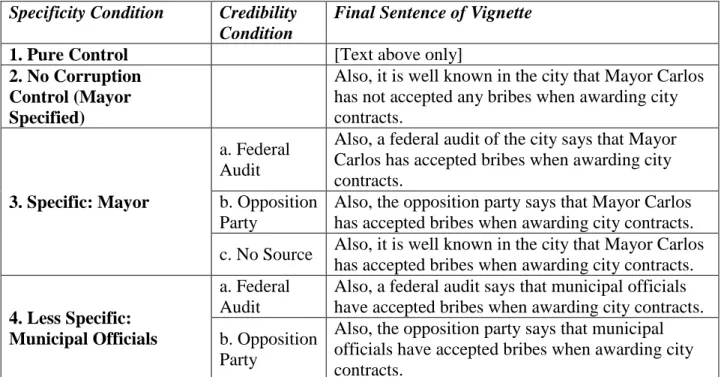
14 The variation across the vignettes is contained in the next sentence, which presents different types of information about corrupt behavior in the municipality. In a pure control condition, no information about corruption is provided, and in a “clean” condition, the mayor is explicitly
described as not engaging in corruption. The remaining five variants of the vignette include allegations of corruption, varying either the precise target of the accusations and/or the source of the accusations. All seven versions are described in Table 1.
<<Table 1 Here>>
In this paper, we focus on comparing the effects of accusations made specifically against the mayor as compared to those made against municipal officials (“ocupantes de cargos na
prefeitura,” a phrase that connotes high-level administrative officials, like municipal
secretaries).16 In the latter case, the information comes in a vignette about the mayor but does not explicitly name the mayor as having been involved in or aware of the corruption. As the table makes clear, some of the vignettes also vary the source of the corruption accusations, referring either to a federal audit or else the opposition party, where the federal audit is a more credible source as compared to the opposition party.17 We examine attitudes towards the mayor by asking the respondent how likely she would be to vote for the mayor, on a scale from one (not at all likely) to four (very likely).
16
Note that this phrase clearly excludes other elected officials in the municipality, like city council members (vereadores in Portuguese).
17
We treat an opposition party as a less credible source of allegations of corruption because, in a context where corruption is punished, an opposition party stands to gain electorally from
15 Specific, Credible Accusations Increase Punishment of Corruption
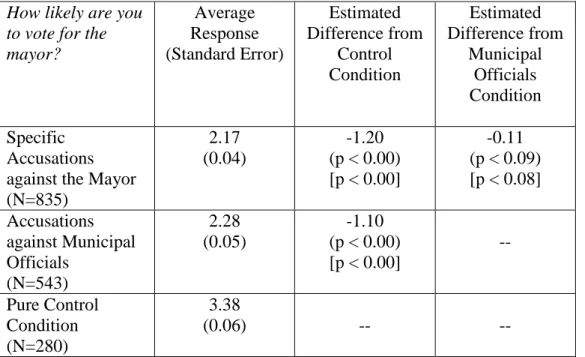
Table 2 presents our results for H1, comparing respondent vote intention for the mayor in the control condition against conditions in which either the mayor directly or municipal officials are linked to corruption in the vignette.18 First, it is worth noting that the table shows that
respondents react negatively to both types of corruption charges. As compared to the pure control condition,19 where positive information is provided about the mayor’s performance while in office and corruption is simply not mentioned at all, the willingness to vote for the mayor drops by more than one point on the four-point scale when any sort of claim of corrupt behavior by the mayor or within the mayor’s administration is mentioned. This is consistent with a large
body of experimental and observational data that shows that information about corrupt behavior leads to political punishment.20 More importantly for the current study, the drop in support for the mayor is more pronounced among respondents assigned to the vignettes that include accusations directed specifically against the mayor as compared to accusations against the mayor’s administration. Respondents who heard accusations against municipal officials report
an average vote intention of 2.28 on the 4-point scale, whereas those who heard accusations
18
In each case, we pool together the versions of the specific and non-specific vignettes that vary the source of the information in the vignette. See the note in Table 2 for precise details.
19
We do not include a comparison to the control condition in which the mayor is explicitly described as not corrupt, since we do not have a parallel condition in which officials are
explicitly described as not corrupt. Mayoral approval, however, is almost identical between the pure control and the explicitly clean condition, suggesting that respondents assume a clean mayor/administration in the pure control condition.
20
16 against the mayor himself report an average vote intention of 2.17. This difference is statistically significant at the 0.10 level, although it is relatively small, especially when compared to the substantial decrease in reported vote intention from the control condition (where average vote intention is 3.38) to either one of the corrupt conditions.21
<<Table 2 Here>>
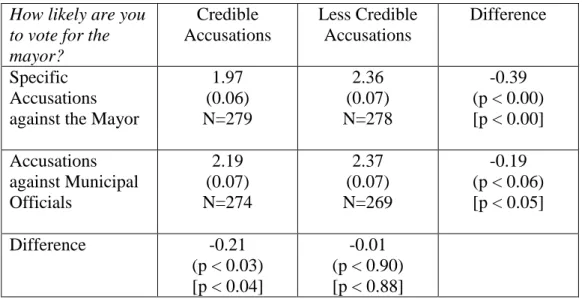
To test H2, that sensitivity to the target of corruption accusations is heightened when
information is credible, we disaggregate these results by the credibility of the source making the accusation. Table 3 presents these results. In column 1, we compare vote intention when the target of corruption accusations is the mayor versus administration officials for the credible source only (the federal audit). In column 2, we compare vote intention when the target is the mayor versus administration officials for less credible accusations only (i.e., those attributed to an opposition party). Our results provide strong support for H2. As column 1 illustrates, when information is credible, vote intention for the mayor suffers an additional decline when the mayor is directly implicated in corruption in the vignette. In the credible information condition in which municipal officials are accused of corruption, 39 percent of our respondents report that they would be likely or very likely to vote for the mayor. In contrast, in the credible information condition in which the mayor is accused directly, only 30 percent of respondents still express this level of support for the mayor. This difference is statistically significant at conventional levels. In contrast, when accusations are less credible, respondents’ reported vote intention does not vary with the target of the accusations. Also in these conditions, overall punishment is somewhat
21
17 less (indicated by the higher average reported vote intention), as we would expect given the decreased credibility of the information.
<<Table 3 Here>>
Political Sophistication and Reactions to More and Less Specific Information
As discussed above, we expect politically sophisticated respondents to be more likely to bring to mind the range of government officials who might potentially be implicated in corruption and thus to implicitly compare the target of accusations they learn about (either the mayor or administration officials, depending on the treatment group) to other possible targets. In contrast, less sophisticated respondents are likely to focus on the highly salient issue of
corruption and to be less attentive to the possibility that other types of officials might be the target of corruption accusations. As a result, we expect differences in vote intention in response to the more and less specific prompts to be amplified for politically sophisticated respondents (H3). We also consider an alternative hypothesis (H3’) that sophisticated respondents are more likely to believe that chief executives are responsible for the performance of their underlings. If this is the case, differences in vote intention across the prompts that mention the mayor versus municipal officials would actually be diminished for sophisticated respondents.
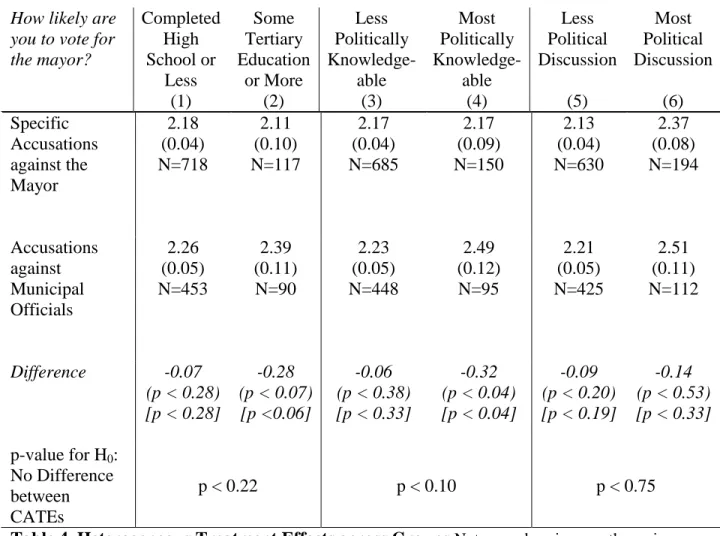
We operationalize sophistication using three measures that capture different dimensions of political sophistication: respondents’ level of education, political knowledge measured by responses to two factual questions, and self-reported political engagement, measured by discussion of politics.22 In Table 4, below, we use all of these measures to examine how more
22
18 and less politically sophisticated respondents change their stated vote intention for the mayor as the target of corruption accusations varies (the mayor himself versus municipal officials).
<<Table 4 here>>
Table 4 offers moderate support for our expectation that politically sophisticated respondents are especially sensitive to the target of corruption information (H3) and clear evidence against the alternative hypothesis that these citizens are especially likely to hold executives responsible for bureaucratic performance (H3’). For two out of our three measures of sophistication, the
difference in vote intention when the target of corruption information varies from the mayor to municipal officials is in the expected direction and statistically significant for sophisticated voters. Differences for less sophisticated voters are in the expected direction but not statistically significant. At the same time, however, the difference in treatment effects between more and less sophisticated respondents are not themselves consistently statistically significant according to a randomization inference based test of the equality of conditional average treatment effects.
<<Table 5 here>>
As indicated in our discussion of H3 above, however, sophisticates are likely to be most sensitive to the target of corruption information when information comes from a credible source. Table 5 replicates Table 4 for the credible treatment conditions only, providing strong evidence that this is the case. 23 For example, respondents with the highest level of education (column 2) report very different vote intention for the mayor depending on whether he is directly named or
23
19 not in corruption accusations. The statistically significant difference is 0.7 points, more than one-sixth of the range of the four-point scale. Among those who report discussing politics the most (column 6), results are almost identical: reported vote intention for the mayor increases by 0.74 points from the specific and less specific conditions. Among less educated or less politically interested respondents facing the same credible-information prompts, estimated differences in vote intention decrease in magnitude and no longer achieve statistical significance. For both the highly educated and those who discuss politics frequently, the difference in treatment effects between more and less sophisticated respondents itself achieves statistical significance. When we operationalize sophistication using political knowledge, a similar trend emerges, although
differences between more and less knowledgeable respondents are not as pronounced. As documented in Tables 4 and 5, more sophisticated respondents’ greater differentiation appears to be driven both by their tendency to punish the mayor somewhat more when he is directly named as corrupt and to punish the mayor less when administration officials are described as corrupt. Contrary to H3’, we find no evidence that sophisticated respondents are more likely to treat mayors as culpable for corruption by officials in their administrations. These results thus are consistent with the claim that different patterns of responses among more and less sophisticated respondents reflect a differential understanding of politics and ability to process and recall information, rather than any differences in attitudes towards the culpability of elected executive politicians for wrongdoing by subordinate officials.24
Another way of approaching H3 is to study differential responses in the face of variation in government complexity. Presumably it is harder for mayors to exercise intense oversight of all
24
20 government staff as city government grows in size. In the online appendix, we use municipality size as a rough proxy of local government complexity25 and find that the difference in the likelihood of voting for the mayor between the more- and less-specific conditions is most pronounced in large cities among political sophisticates. In those cities where the mayor has plausible deniability about awareness of and responsibility for the behavior of subordinates, political sophisticates appear to be the most forgiving of the mayor, again supporting H3 and offering evidence against H3’. Because of small sample size and the fact that we do not experimentally manipulate municipality size, we treat these results as preliminary.
Conclusions
Existing literature on performance voting demonstrates that clarifying or obscuring
responsibility for outcomes citizens care about affects how and whether those citizens respond to those outcomes at the ballot box. In contrast, studies of political corruption have not directly grappled with the question of whether electoral punishment is contingent on how voters assign responsibility for corrupt acts to elected officials. Here, we argue that an elected politician will be able to mitigate the consequences of corruption and scandal when unelected officials under his or her watch – rather than the politician him or herself –are implicated in corrupt acts. Using an experiment with hypothetical vignettes embedded in a nationally representative survey in Brazil, ours is the first study that attempts to isolate how the target of corruption accusations affects citizen punishment of corrupt acts. We find that hypothetical mayors are punished for corruption regardless of who is accused but that punishment is attenuated when municipal officials, rather than the mayor per se, are implicated in corruption. This effect is heightened
25
21 when information about corruption comes from a credible source and among politically
sophisticated respondents.
Our study builds on a large and growing literature on the electoral consequences of
corruption, and it may help resolve some apparently discrepant results among existing studies. In two studies of the conditional effects of economic performance on the punishment of corruption, for example, Zechmeister and Zizumbo-Colunga (2013) find that the relationship between corruption and presidential approval varies across economic conditions in Latin America, while Rosas and Manzetti (2015) do not. Where Rosas and Manzetti use a measure that refers to bureaucratic corruption – approximately paralleling our “less specific” condition – Zechmeister and Zizumbo-Colunga use a more general measure of perceived corruption that might elicit opinions related to the president specifically. To the extent that these measures cue respondents to think about corruption in different ways, and as a result respondents are more likely to directly associate the chief executive with corruption in one measure than the other, this might explain the discrepant results on the consequences of corruption for presidential approval.
Differences in the type of official who is responsible for corruption might also help explain differences in the results across two important recent studies that examine the effects of
22 natural experiment, we cannot say for certain how local media covered the results of audit
reports, but it seems likely that media coverage would often directly name the mayor of the audited municipality, which may contribute to the stronger results in their study. Our results and these comparisons suggest that it would be fruitful for future work to be more sensitive to how the target of corruption information may affect study results.
Unlike studies that employ field experiments and observational data, we rely on survey experimental methods. The experimental method and the highly controlled vignettes give us confidence in the internal validity of our claims that respondents will express different preferences for voting for a hypothetical politician when confronted with different corruption scenarios involving that politician. This approach allows us to isolate the effects of the involvement of different political actors (mayor versus municipal officials) while the act of corruption remains the same. At the same time, reliance on a hypothetical experiment raises questions about the extent to which we can reasonably extrapolate from our results to the real world behavior that we would observe when citizens learn about corruption involving actual mayors or municipal officials.
The literature comparing the results found in survey and laboratory experiments to those found in field experiments is still in its infancy. Results so far, however, have been more
positive than many would have expected. Reviewing six studies that contain comparable lab and field experiments, Camerer (2015) finds significant behavioral differences in only one and concludes, “There is no replicated evidence that experimental economics lab data fail to generalize to central empirical features of field data” (277). In a meta-analysis of 12 different
23 that “it is remarkable to find such a high degree of lab-field correspondence when so many features of the lab and field differ” (127). In one study specifically comparing information
absorption and attitude change in a survey experiment context to a natural experiment context, the authors conclude that the results “suggest that what occurs in survey experiments resembles what takes place in the real world” (Barabas and Jerit 2010, 239; see also Barabas et al. 2014).
Where the stimulus and the context in a laboratory or survey experiment can be made to appear like that which would be encountered in the field, treatment effects are often comparable if not of the same magnitude.
In our particular case, one benchmark that gives us confidence that the survey experimental evidence we present corresponds to likely real-world voting behavior is the correspondence between the results obtained in the natural experiment in Ferraz and Finan (2008) and those found in the survey experiment in Winters and Weitz-Shapiro (2013). The survey experimental results in the latter paper make use of vignettes about hypothetical mayors in order to provide the microfoundational evidence in favor of “the information hypothesis” (i.e., that voters will react to political corruption if they have information about it) that can explain the municipal-level patterns of corrupt politicians being voted out of office that are the central aspect of the former paper. While we lack the observational data that would allow us to examine election-level reactions to more or less specific accusations against mayors, in this previous case where the survey experimental stimulus about corruption paralleled a real-world stimulus, the results corresponded one to another.
24 long-standing, wealthy democracies.26 In our survey, political sophisticates—measured by knowledge, education, and interest—are more attentive to subtle differences in the information environment, much as we would expect. They also respond negatively to corruption information, consistent with the vast majority of their compatriots. However, those negative views of
corruption, when coupled with increased sensitivity, do not necessarily lead to increased punishment of corruption. Instead, sophisticates sometimes punish corruption more severely (when the mayor is directly implicated) and sometimes punish corruption less severely (when municipal officials are directly implicated). Future work might usefully explore whether this result extends to the many other democracies which, like Brazil, have a complex or even byzantine state apparatus that might make politically sophisticated citizens reluctant to blame politicians for the misdeeds of other officials.
Ultimately, the implications of our findings for political accountability and the quality of democracy are mixed. Existing literature has shown that perceptions of corruption in local government and direct experience with bureaucratic corruption in Latin America are negatively correlated with citizen support for regime institutions (Seligson 2002) and even support for democracy per se (Weitz-Shapiro 2008). As such, controlling corruption seems crucial for increasing citizen confidence in the state. Yet, in showing that responses to corruption may vary both with the type of information provided and the individual who receives that information, our findings demonstrate the challenges of achieving that control. As the modern state grows larger and more complex, citizens are still left with one main tool—the vote—to control an increasing
26
26 Works Cited
Afonso, José Roberto Rodrigues, and Erika Amorim Araújo. 2006. “Local Government
Organization and Finance: Brazil.” In Local Governance in Developing Countries, edited
by Anwar Shah, 381–418. Washington, D.C.: The World Bank.
Alt, James E., David D. Lassen, and John Marshall. 2015. “Credible Sources and Sophisticated Voters: When Does New Information Induce Economic Voting.” Harvard University.
Anderson, Christopher J. 1995. Blaming the Government: Citizens and the Economy in Five
European Democracies. Armonk, NY: M.E. Sharpe.
———. 2000. “Economic Voting and Political Context: A Comparative Perspective.” Electoral
Studies 19 (1): 151–70.
Anduiza, Eva, Aina Gallego, and Jordi Muñoz. 2013. “Turning a Blind Eye: Experimental
Evidence of Partisan Bias in Attitudes Toward Corruption.” Comparative Political
Studies 46 (12): 1664–92.
Avelino, George, Lorena G. Barberia, and Ciro Biderman. 2014. “Governance in Managing Public Health Resources in Brazilian Municipalities.” Health Policy and Planning 29 (6):
694–702.
Barabas, Jason, and Jennifer Jerit. 2010. “Are Survey Experiments Externally Valid?” American
Political Science Review 104 (2): 226–42.
Barabas, Jason, Jennifer Jerit, William Pollock, and Carlisle Rainey. 2014. “The Question(s) of Political Knowledge.” American Political Science Review 108 (4): 840–55.
Barro, Robert J. 1973. “The Control of Politicians: An Economic Model.” Public Choice 14 (1):
27 Boudreau, Cheryl. 2009. “Closing the Gap: When Do Cues Eliminate Differences between
Sophisticated and Unsophisticated Citizens?” Journal of Politics 71 (3): 964–76.
Brollo, Fernanda, Tommaso Nannicini, Roberto Perotti, and Guido Tabellini. 2013. “The Political Resource Curse.” American Economic Review 103 (5): 1759–96.
Camerer, Colin F. 2015. “The Promise and Success of Lab-Field Generalizability in
Experimental Economics: A Critical Reply to Levitt and List.” In Handbook of
Experimental Economic Methodology, edited by Guillaume R. Fréchette and Andrew
Scotter. New York: Oxford University Press.
Carlin, Ryan E., Gregory J. Love, and Cecilia Martínez-Gallardo. 2015. “Cushioning the Fall: Scandals, Economic Conditions, and Executive Approval.” Political Behavior 37 (1):
109–30.
Chang, Eric C. C., Miriam A. Golden, and Seth J. Hill. 2010. “Legislative Malfeasance and Political Accountability.” World Politics 62 (2): 177-220.
Chong, Alberto, Ana De la O, Dean Karlan, and Leonard Wantchekon. 2015. “Does Corruption
Information Inspire the Fight or Quash the Hope? A Field Experiment in Mexico on Voter Turnout, Choice and Party Identification.” Journal of Politics 77 (1): 55–71. Chong, Dennis, and James N. Druckman. 2007. “Framing Theory.” Annual Review of Political
Science 10 (1): 103–26.
Coppock, Alexander, and Donald P. Green. 2015. “Assessing the Correspondence between
Experimental Results Obtained in the Lab and Field: A Review of Recent Social Science Research.” Political Science Research and Methods 3 (1): 113–31.
28 Druckman, James N., and Kjersten R. Nelson. 2003. “Framing and Deliberation: How Citizens’
Conversations Limit Elite Influence.” American Journal of Political Science 47 (4): 729–
45.
Duch, Raymond M., and Randolph T. Stevenson. 2008. The Economic Vote: How Political and
Economic Institutions Condition Election Results. New York: Cambridge University
Press.
Falleti, Tulia G. 2010. Decentralization and Subnational Politics in Latin America. Cambridge University Press.
Fearon, James D. 1999. “Electoral Accountability and the Control of Politicians: Selecting Good Types versus Sanctioning Poor Performance.” In Democracy, Accountability, and
Representation, edited by Adam Przeworski, Susan C. Stokes, and Bernard Manin, 55–
97. New York: Cambridge University Press.
Ferejohn, John. 1986. “Incumbent Performance and Electoral Control.” Public Choice 50 (1): 5–
25.
Ferraz, Claudio, and Frederico Finan. 2008. “Exposing Corrupt Politicians: The Effects of Brazil’s Publicly Released Audits on Electoral Outcomes*.” Quarterly Journal of
Economics 123 (2): 703–45.
———. 2011. “Electoral Accountability and Corruption: Evidence from the Audits of Local Governments.” American Economic Review 101 (4): 1274–1311.
Gerring, John, and Strom C. Thacker. 2004. “Political Institutions and Corruption: The Role of Unitarism and Parliamentarism.” British Journal of Political Science 34 (2): 295–330.
29 Hunter, Wendy, and Timothy J. Power. 2007. “Rewarding Lula: Executive Power, Social Policy,
and the Brazilian Elections of 2006.” Latin American Politics and Society 49 (1): 1–30. Klašnja, Marko, and Joshua A. Tucker. 2013. “The Economy, Corruption, and the Vote:
Evidence from Experiments in Sweden and Moldova.” Electoral Studies 32 (3): 536–43. Konstantinidis, Iannis, and Georgios Xezonakis. 2013. “Sources of Tolerance towards Corrupted Politicians in Greece: The Role of Trade Offs and Individual Benefits.” Crime, Law and
Social Change 60 (5): 549–63.
Lupia, Arthur, and Mathew D. McCubbins. 1998. The Democratic Dilemma: Can Citizens Learn
What They Need to Know? New York: Cambridge University Press.
Muñoz, Jordi, Eva Anduiza, and Aina Gallego. 2013. “Why Do Voters Forgive Corrupt Politicians? Implicit Exchange, Noise, and Cynicism.” Unpublished manuscript.
Universitat Autònoma de Barcelona.
Pereira, C., M. A. Melo, and C. M. Figueiredo. 2009. “The Corruption-Enhancing Role of
Re-Election Incentives?: Counterintuitive Evidence from Brazil’s Audit Reports.” Political
Research Quarterly 62 (4): 731–44.
Peters, John G., and Susan Welch. 1980. “The Effects of Charges of Corruption on Voting Behavior in Congressional Elections.” American Political Science Review 74 (3): 697–
708.
Powell Jr., G. Bingham, and Guy D. Whitten. 1993. “A Cross-National Analysis of Economic Voting: Taking Account of the Political Context.” American Journal of Political Science
30 Rennó, Lucio. 2011. “Corruption and Voting.” In Corruption and Democracy in Brazil, edited
by Timothy J. Power and Matthew M. Taylor. Notre Dame, IN: University of Notre Dame Press.
Rosas, Guillermo, and Luigi Manzetti. 2015. “Reassessing the Trade-off Hypothesis: How
Misery Drives the Corruption Effect on Presidential Approval.” Electoral Studies 39 (September): 26–38.
Rudolph, Thomas J. 2003a. “Institutional Context and the Assignment of Political Responsibility.” Journal of Politics 65 (1): 190–215.
———. 2003b. “Who’s Responsible for the Economy? The Formation and Consequences of Responsibility Attributions.” American Journal of Political Science 47 (4): 698. Samuels, David. 2004. “Presidentialism and Accountability for the Economy in Comparative
Perspective.” American Political Science Review 98 (3): 425–36.
Schlenker, Barry R., Thomas W. Britt, John Pennington, Rodolfo Murphy, and Kevin Doherty. 1994. “The Triangle Model of Responsibility.” Psychological Review 101 (4): 632-52. Seligson, Mitchell A. 2002. “The Impact of Corruption on Regime Legitimacy: A Comparative
Study of Four Latin American Countries.” Journal of Politics 64 (2): 408–33.
Sniderman, Paul M., Richard A. Brody, and Philip E. Tetlock. 1991. Reasoning and Choice:
Explorations in Political Psychology. New York: Cambridge University Press.
Souza, Celina. 2002. “Brazil’s System of Local Government, Local Finance, and
Intergovernmental Relations.” EngKaR Research Projet 8070: Building Municipal Capacity for Finance and Budgeting. University of Birmingham (U.K.).
Strøm, Kaare. 2000. “Delegation and Accountability in Parliamentary Democracies.” European
31 Taber, Charles S., and Milton Lodge. 2006. “Motivated Skepticism in the Evaluation of Political
Beliefs.” American Journal of Political Science 50 (3): 755–69.
Tavits, M. 2007. “Clarity of Responsibility and Corruption.” American Journal of Political
Science 51 (1): 218–29.
Timmons, Jeffrey F., and Francisco Garfias. 2015. “Revealed Corruption, Taxation, and Fiscal
Accountability: Evidence from Brazil.” World Development 70 (June): 13–27. Weitz-Shapiro, Rebecca. 2008. “The Local Connection Local Government Performance and
Satisfaction With Democracy in Argentina.” Comparative Political Studies 41 (3): 285–
308.
———. 2012. “What Wins Votes: Why Some Politicians Opt Out of Clientelism.” American
Journal of Political Science 56 (3): 568–83.
Weitz-Shapiro, Rebecca, and Matthew S. Winters. 2014. “Can Citizens Discern? Information Credibility, Political Sophistication, and the Punishment of Corruption in Brazil.” Paper
presented at the Annual Meeting of the American Political Science Association, Washington, D.C.
Welch, S., and J. R Hibbing. 1997. “The Effects of Charges of Corruption on Voting Behavior in
Congressional Elections, 1982–1990.” Journal of Politics 59 (1): 226–39.
Winters, Matthew S., and Rebecca Weitz-Shapiro. 2013. “Lacking Information or Condoning Corruption: When Do Voters Support Corrupt Politicians?” Comparative Politics 45 (4):
418–36.
32 Zechmeister, Elizabeth J., and Daniel Zizumbo-Colunga. 2013. “The Varying Political Toll of
Concerns about Corruption in Good versus Bad Economic Times.” Comparative Political
33 Biographical Paragraphs
Matthew S. Winters is Associate Professor in the Department of Political Science at the University of Illinois at Urbana-Champaign. He received his Ph.D. in Political Science from Columbia University and was a Postdoctoral Research Fellow at the Niehaus Center for Globalization and Governance at Princeton University. His research interests include the political economy of foreign aid and voter attitudes toward corruption. He has conducted research in Indonesia, Brazil, Bangladesh, and Uganda. He has published articles in
Comparative Politics, International Studies Quarterly, World Development, and World Politics, among other outlets.
34 Tables and Figures
Specificity Condition Credibility Condition
Final Sentence of Vignette
1. Pure Control [Text above only]
2. No Corruption Control (Mayor Specified)
Also, it is well known in the city that Mayor Carlos has not accepted any bribes when awarding city contracts.
3. Specific: Mayor
a. Federal Audit
Also, a federal audit of the city says that Mayor Carlos has accepted bribes when awarding city contracts.
b. Opposition Party
Also, the opposition party says that Mayor Carlos has accepted bribes when awarding city contracts. c. No Source Also, it is well known in the city that Mayor Carlos
has accepted bribes when awarding city contracts.
4. Less Specific: Municipal Officials
a. Federal Audit
Also, a federal audit says that municipal officials have accepted bribes when awarding city contracts. b. Opposition
Party
Also, the opposition party says that municipal officials have accepted bribes when awarding city contracts.
35 How likely are you
to vote for the mayor? Average Response (Standard Error) Estimated Difference from Control Condition Estimated Difference from Municipal Officials Condition Specific Accusations against the Mayor (N=835)
2.17 (0.04)
-1.20 (p < 0.00) [p < 0.00]
-0.11 (p < 0.09) [p < 0.08] Accusations against Municipal Officials (N=543) 2.28 (0.05) -1.10 (p < 0.00) [p < 0.00]
--
Pure Control Condition (N=280)
3.38
(0.06) -- --
Table 2: Accusation Specificity and Vote Intention. Note: Specific accusations against the mayor include those attributed to a credible source, a less credible source, and no source (cells 3a, 3b, and 3c from Table 1). Accusations against municipal officials include those attributed to a credible source and a less credible source (cells 4a and 4b from Table 1). Cells in columns 2 and 3 present difference-in-means tests among the means reported in column 1. p-values in
36 How likely are you
to vote for the mayor?
Credible Accusations
Less Credible Accusations
Difference
Specific Accusations against the Mayor
1.97 (0.06) N=279
2.36 (0.07) N=278
-0.39 (p < 0.00) [p < 0.00] Accusations
against Municipal Officials
2.19 (0.07) N=274
2.37 (0.07) N=269
-0.19 (p < 0.06) [p < 0.05]
Difference -0.21
(p < 0.03) [p < 0.04]
-0.01 (p < 0.90) [p < 0.88]
37 How likely are
you to vote for the mayor? Completed High School or Less (1) Some Tertiary Education or More (2) Less Politically Knowledge-able (3) Most Politically Knowledge-able (4) Less Political Discussion (5) Most Political Discussion (6) Specific Accusations against the Mayor 2.18 (0.04) N=718 2.11 (0.10) N=117 2.17 (0.04) N=685 2.17 (0.09) N=150 2.13 (0.04) N=630 2.37 (0.08) N=194 Accusations against Municipal Officials 2.26 (0.05) N=453 2.39 (0.11) N=90 2.23 (0.05) N=448 2.49 (0.12) N=95 2.21 (0.05) N=425 2.51 (0.11) N=112
Difference -0.07
(p < 0.28) [p < 0.28]
-0.28 (p < 0.07)
[p <0.06]
-0.06 (p < 0.38) [p < 0.33]
-0.32 (p < 0.04) [p < 0.04]
-0.09 (p < 0.20) [p < 0.19]
-0.14 (p < 0.53) [p < 0.33]
p-value for H0: No Difference between CATEs
p < 0.22 p < 0.10 p < 0.75
38
How likely are you to vote for the mayor? Completed High School or Less (1) Some Tertiary Education or More (2) Less Politically Knowledge-able (3) Most Politically Knowledge-able (4) Less Political Discussion (5) Most Political Discussion (6) Specific & Credible Accusations against the Mayor 2.03 (0.07) N=246 1.58 (0.15) N=33 2.00 (0.07) N=230 1.86 (0.14) N=49 2.03 (0.07) N=224 1.78 (0.13) N=50 Credible Accusations against Municipal Officials 2.17 (0.08) N=231 2.28 (0.15) N=43 2.16 (0.07) N=229 2.33 (0.18) N=45 2.10 (0.07) N=216 2.52 (0.16) N=54
Difference -0.14
(p < 0.17) [p < 0.25]
-0.70 (p < 0.01) [p < 0.01]
-0.16 (p < 0.13) [p < 0.14]
-0.48 (p < 0.04) [p < 0.06]
-0.07 (p < 0.52) [p < 0.56]
-0.74 (p < 0.01) [p < 0.01] p-value for H0:
No Difference between CATEs
p < 0.03 p < 0.20 p < 0.01