On Why Coarse Class Classification is a Bottleneck for Noun Compound
Interpretation
Girishkumar Ponkiya
Dept. of CSE,
IIT Bombay, India
[email protected]
Pushpak Bhattacharyya
Dept. of CSE,
IIT Bombay, India
[email protected]
Girish K. Palshikar
TCS Research,
Tata Consultancy Services, India
[email protected]
Abstract
Sequences of long nouns, i.e., noun com-pounds, occur frequently and are productive. Their interpretation is important for a variety of tasks located at various layers of NLP. Ma-jor reasons behind the poor performance of au-tomatic noun compound interpretation are: (a) lack of a well defined inventory of semantic relations and (b) non-availability of sufficient, annotated, high-quality dataset.
Tratz and Hovy (2010) presented an inventory of semantic relations. They compared existing inventories with their two-level hierarchy, and created a large annotated dataset.
We performed both theoretical as well as data-driven analysis of this inventory. Theoretical analysis reveal ambiguities in the coarse rela-tions. Data-driven analysis report similar per-formance for coarse as well as fine relations prediction. Our experiments show that im-proving the coarse classification accuracy can improve the performance of fine class predic-tor by 13 to 30 points in F-score.
1
Introduction
An important characteristic of a language is the pro-cess of creating new words by means of compounding. Especially, in English, technical and scientific litera-ture produces long sequences of nouns, such aslaptop screen, Internet connection, colon cancer symptoms, etc. Following Downing (1977)’s definition (for En-glish language), these long sequences of nouns, acting as single noun, are known asnoun compounds(NCs). NLP tasks cannot ignore such long sequences of nouns as they are abundant and productive type of compounds in English.
Most noun compounds appear only once in a large corpus. Baldwin and Tanaka (2004) analyzed the BNC corpus and found that 63.4% of total noun compounds appear only once in the corpus. In addition to the productive nature, noun compounds are compositional. These characteristics of the noun compounds make them a special case, and demand a special treatment.
The conventional approach to tackle this problem is a pipeline of three steps: (1) find noun compounds from text, (2) parse them if required, and (3) extract the se-mantic relationships between components of the noun compounds. The task of extracting semantic relations between components of a noun compound, or para-phrasing it using verbs and/or prepositions is known as interpretation of noun compound (or noun compound interpretation).
Our primary interest resides in interpretation of two-word noun compounds using predefined semantic la-bels as classes. The lala-bels have been arranged in a two level hierarchy - coarse classes and fine classes. In this paper, we report the technical and linguistic challenges that we faced while performing classification task. Par-ticularly, we discuss the challenges with coarse level classification.
The rest of the paper is organized as follows: Sec-tion 2 covers the related work. SecSec-tion 3 discusses our approach, the experiments and results for the same are shown in Section 4. Section 5 discusses the results, which is followed by conclusion and future work.
2
Related Work
In computational domain, most work uses either of two representations for semantic relations: (1) set of ab-stract relations, or (2) paraphrasing a noun compound. Among these two, the former is most popular; repos-itories of such relations are generally proposed by the linguists.
2.1 Semantic Relations
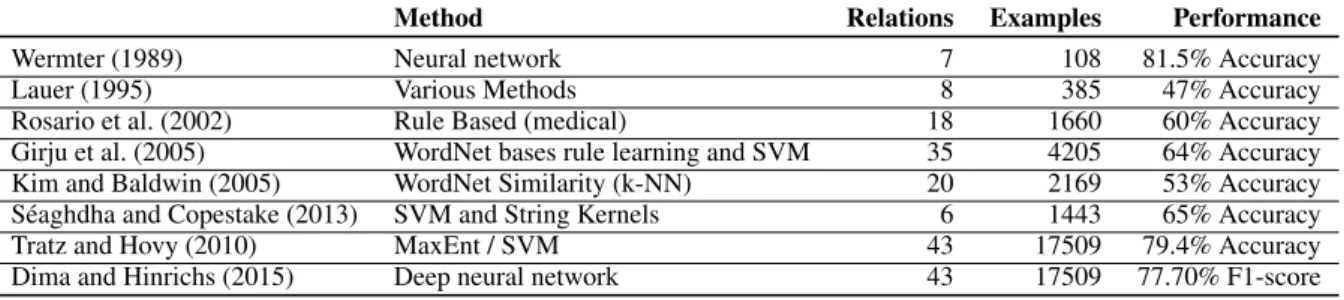
Method Relations Examples Performance
Wermter (1989) Neural network 7 108 81.5% Accuracy
Lauer (1995) Various Methods 8 385 47% Accuracy
Rosario et al. (2002) Rule Based (medical) 18 1660 60% Accuracy Girju et al. (2005) WordNet bases rule learning and SVM 35 4205 64% Accuracy Kim and Baldwin (2005) WordNet Similarity (k-NN) 20 2169 53% Accuracy S´eaghdha and Copestake (2013) SVM and String Kernels 6 1443 65% Accuracy
Tratz and Hovy (2010) MaxEnt / SVM 43 17509 79.4% Accuracy
Dima and Hinrichs (2015) Deep neural network 43 17509 77.70% F1-score
Table 1: Performance of past approaches for noun compound interpretation. Note that (almost) all methods use different relation inventory and different dataset making it difficult to compare performance.
Levi (1978)’s study is purely based on linguistics. On the other hand, Warren (1978) analyzed the Brown corpus and proposed a four-level hierarchy of seman-tic relations. Nastase and Szpakowicz (2003) extended Warren (1978)’s approach. Their proposed set of rela-tions is also based on Barker and Szpakowicz (1998)’s semantic relations.
Vanderwende (1994) proposed a set of 13 relations based on the syntactical category and types of ques-tions. Girju et al. (2005) provided another inventory of semantic relation based on Moldovan et al. (2004) for semantic relation in noun phrases.
Finally, Tratz and Hovy (2010) compared and con-solidated most of these theories and proposed a two level hierarchy of 43 semantic relations, which are grouped in 9 coarse relations. This inventory of rela-tions was iteratively refined to improve inter-annotator agreement. Tratz and Hovy (2010) used crowd sourc-ing for the iterative process. We have used this relation repository for our experiments and analysis.
2.2 Automatic Interpretation
Researchers have proposed various methods for au-tomatic interpretation (Wermter, 1989; Nakov, 2013; Dima and Hinrichs, 2015). Unfortunately, these meth-ods have been tested on different relation inventories and datasets, which makes it hard to compare their per-formance. Table 1 summarizes various methods for au-tomatic interpretation.
All these methods can be categorized in two cate-gories based on how it models the relation: (1) model the relation using only component features (Kim and Baldwin, 2005, 2013), or (2) directly modeling the re-lation based on how components of a compound can interact in real world (Nakov and Hearst, 2008). A sys-tem based on the latter approach should ideally perform better. But, generalization of such information needs large annotated data and a Web scale resource for para-phrase searching.
2.3 Word Embeddings
For classification task, we need to represent a given noun compound as a feature vector. One way is to concatenate the word embeddings of its constituent words. Mathematically, a word embedding is a
func-tion V : D → Rn, whereD is a dictionary of the words in a language andRn is ann-dimensional real space.
Word embeddings are based on the distributional hy-pothesis. So, the words which occur in similar context have similar vectors. As word vector captures the con-text, the embedding technique approximates the inter-action of a word with other words. This intuition can help us in modeling semantic relation using vectors of the components only.
Dima and Hinrichs (2015) has shown that the noun compound interpretation using only word embeddings, without any feature engineering, gives results compa-rable to the state-of-the-art. For our experiments, we used Google’s pre-trained word embeddings1(Mikolov et al., 2013a,b).
3
Approach
Our aim is to classify a given noun compound into one of fine classes. The classes are arranged in two level hierarchy. We want to exploit the hierarchy to improve the system.
Noun Compound
coarse class Coarse Classifier
Fine Classifier
Fine Class
Figure 1: Pipeline architecture
If the coarse class of a noun compound is known, then inter coarse class confusion can be avoided. We try to leverage this fact by proposing a pipeline archi-tecture (refer Figure 1) for the classification task. We
System Type Input Output Remark
Type-1 vectors of the components + 1-hot presentation 43 fine relations of a coarse relations
Type-2 vectors of the components + coarse class number 43 fine relations
Type-3 vectors of the components only 9 coarse relations Coarse Classification Type-4 vectors of two components only 43 fine relations End-to-end
Table 2: System types based on input features and output classes/relations.
define various systems based on the input and output to experiment with.
4
Experiments and Results
In this section we explain dataset creation, experiment setup, and the results. An analysis of experiments is discussed in the next section.
4.1 Dataset Pre-processing
For our experiment, we used Tratz and Hovy (2010)’s relation inventory and dataset. This inventory has 43 fine relations, grouped under 9 coarse relations. In this dataset, each example has been labeled with one of 43 fine semantic relations. We can get coarse class label indirectly as each fine relation belongs to exactly one coarse relation.
There are totally 19036 examples of noun-noun compounds in the Tratz and Hovy (2010)’s dataset. Some examples in the dataset contain more than one word as a component, e.g., health-care legislation, real-estate speculation. We eliminated such examples. We also eliminate examples for which at least one com-ponents has no word vector. This result in 18857 ex-amples. We used Google’s pre-trained word vectors to create feature vectors. For example, feature vector of
passenger trafficis concatenation of two vectors: vec-tor ofpassengerand vector oftraffic.
We shuffled our dataset, and split it into three dis-joint sets: train set (65%), validation set (15%), and test set (20%). The system was trained on the train set. The validation set was used for validation and hyper-parameter searching. The system was evaluated on the test set.
4.2 Experimental Setup
To check our hypothesis, we defined four types of sys-tems. Table 2 defines system types based on the input feature vector and the output classes. Given the word embeddings of a noun compound, Type-3 and Type-4 systems predict a coarse relation and a fine relation, re-spectively.
Type-1 and Type-2 systems are modeled as follows: given a noun compound and true coarse relation, pre-dict a fine relation. The sole difference between them is how coarse-class information is represented. It is rep-resented as 1-hot encoding in Type-1 system, whereas as a single numeric value in Type-2.
We used the following classifiers for our experiment with the above mentioned four types of settings:
• Naive Bayes
• k-nearest neighbor (kNN)
• SGD: Various linear classifiers with standard loss functions and stochastic gradient descent opti-mization (implemented as SGD in scikit-learn (Pedregosa et al., 2011))
• Decision tree (ID3 algorithm)
• Support vector machine (SVM)
• Deep neural network (DNN) (similar to Dima and Hinrichs (2015)’s architecture)
In addition to the above four types of systems and the classifiers, we use a pipeline architecture (proposed in Section 3), where predicted output of Type-3 sys-tem (coarse relation predictor) was fed to the Type-1 or Type-2 system.
For all of these multi-class classifications, we used one-vs-one and one-vs-rest techniques. Performance of the system in both sets of techniques are very similar.
4.3 Results
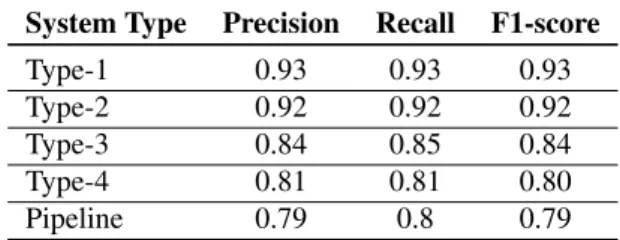
Figure 2 summarizes the results of various classifiers with different settings. SVM with polynomial ker-nel (degree=2, and soft margin constant C=10) out-performs all classifiers for all the mentioned systems. SVM results are separately shown in Table 3.
System Type Precision Recall F1-score
Type-1 0.93 0.93 0.93
Type-2 0.92 0.92 0.92
Type-3 0.84 0.85 0.84
Type-4 0.81 0.81 0.80
Pipeline 0.79 0.8 0.79
Table 3: SVM (polynomial, degree 2, C 10) Results for all system types.
There are some interesting patterns across all classi-fiers. Most important patterns are: (a) performance of Type-3 (coarse predictor) and Type-4 (fine predictor) are almost same for most classifiers, (b) when coarse relation information was fed to a classifier in addition to word vectors (Type-1 or Type-2), performance of the system boosts up by 13 to 30 points in F-score.
Figure 2: Performance (F-score) of combination of classifiers and system types. The system types are defined in Table 2.
Results for pipeline architecture (with SVM classifier) are shown in Figure 2. Similarly, slightly less F-scores are observed for other classifiers.
5
Discussions
Typically, it is expected that prediction among fine classes is difficult compared to prediction among coarse classes. A fine class predictor requires more in-formation/samples compared to coarse class predictor. Particularly, the number of required training examples increases as the number of parameter to be estimated increases. We have the same number of examples for coarse and fine prediction. So, coarse classification is supposed to outperform fine classification. Despite such expectation, there is no significant difference in Type-3 (coarse predictor) and Type-4 (fine predictor) with most classifiers.
To check whether a better coarse class predictor can help the system in predicting the fine class, we used true coarse class labels as features in the fine class pre-dictor (Type-1 and Type-2). Additional coarse class in-formation boosts the performance of fine class predic-tor by 13 to 30 points in F1-score. This is evident from the difference in performance of Type-1 and Type-2 systems as compared to Type-4 system shown in Figure 2.
We analyzed the semantic relations and annotated dataset to understand the main reasons behind the poor performance of coarse relation predictor. Following are some important observations:
• The definition of OTHERis too vague. There are two fine relations under this coarse relation:Other
andFixed Pair / Special / Lexicalized. For ‘Other’ subcategory, the annotator guideline says “ rela-tionship between the two words is fairly clear, but no category seems appropriate.”
Precision Recall F1-score # Test Sample
C1 0.79 0.78 0.79 217
C2 0.84 0.91 0.88 1275
C3 0.78 0.78 0.78 361
C4 0.89 0.84 0.86 95
C5 0.79 0.72 0.76 258
C6 0.79 0.77 0.78 232
C7 0.89 0.90 0.90 867
C8 0.90 0.84 0.87 393
C9 0.55 0.14 0.23 77
Table 4: Confusion matrix for the coarse class pre-dictor (Type-3) using SVM. (C1: “Causal Group”,
C2: “Function / Purpose Clusters”, C3: “Ownership, Employment, and Use”, C4: “Time”, C5: “Location & Whole+Part”, C6: “Composition / Containment”,
C7: “Topical”,C8: “Coreferential / Attributive”,C9: “Other”)
C1 C2 C3 C4 C5 C6 C7 C8 C9
C1 170 20 11 0 5 2 9 0 0
C2 15 1166 19 3 13 12 32 7 8
C3 10 38 281 1 8 6 11 6 0
C4 1 7 1 80 0 0 2 4 0
C5 4 18 18 0 187 9 19 3 0
C6 2 31 5 0 5 179 4 6 0
C7 6 43 13 5 8 4 781 6 1
C8 4 21 6 0 8 12 12 330 0
C9 3 38 4 1 3 3 8 6 11
Table 5: Confusion matrix for the coarse class predictor (Type-3) using SVM. For the labels, refer Table 4.
• PURPOSE/ACTIVITY GROUP has overlap with
holds true for the row.
• Fixed Pair / Special / Lexicalized are multiword expressions, and such expressions should be han-dled separately. Typically, we can interpret com-positional compounds only. If we feed a multi-word expression to a system which is trained to interpret noun-noun compounds, then the system will try to predict the semantic relation based on semantics of the components. This was clear from error analysis and the confusion matrix. The last row (ref. Table 5) is heavy as compared to last column.
• Partial Attribute/Feature/Quality Transfer, be-longing to ATTRIBUTIVE ANDCOREFERENTIAL
coarse relation, is defined as “The {attribute2}
is metaphorically (but not literally) a/the/made of
{attribute1}.” Like multiwords, the interpretation of metaphoric noun compounds cannot be inferred from the composition of the semantics of its com-ponents.
6
Conclusion and Future Work
In this paper, we claimed that the main bottleneck in noun compound interpretation task is the ambiguity be-tween coarse classes. We analyzed an inventory of se-mantic relations and annotated data to understand such ambiguities. In addition, we also used a data driven ap-proach to show that coarse relation prediction is a major bottleneck in the system. Experiment results also show that if one can improve coarse predictor, then overall system will improve significantly.
The SVM classifier with polynominal kernel (de-gree=2, and C=10) outperforms Tratz and Hovy (2010) and Dima and Hinrichs (2015) by a small margin. The salient points of our system are: 1) our system uses only word vectors, and 2) our system does not rely on computationally complex algorithms and resources.
To solve the ambiguity in semantic relation, we ob-serve two possible directions:
1. Separate interpretable semantic relations from the rest, and define (or reshape) the coarse relation boundary accordingly.
2. Refining the definitions by adding more informa-tion. Such revised definitions may help the re-searcher in clarifying the class boundary. Such information can later be used to make the system more robust.
Acknowledgments
We thank CFILT members at IIT Bombay for their valuable comments and suggestions. This work is funded by Tata Consultancy Services Limited (TCS) under NGIE (Next Generation Information Extraction) with project code 13TCSIRC001.
References
Baldwin, T. and Tanaka, T. (2004). Translation by machine of complex nominals: Getting it right. In
Proceedings of the Workshop on Multiword Expres-sions: Integrating Processing, pages 24–31. Associ-ation for ComputAssoci-ational Linguistics.
Barker, K. and Szpakowicz, S. (1998). Semi-automatic recognition of noun modifier relationships. In Pro-ceedings of the 17th international conference on Computational linguistics-Volume 1, pages 96–102. Association for Computational Linguistics.
Dima, C. and Hinrichs, E. (2015). Automatic noun compound interpretation using deep neural networks and word embeddings.IWCS 2015, page 173.
Girju, R., Moldovan, D., Tatu, M., and Antohe, D. (2005). On the semantics of noun compounds. Com-puter speech & language, 19(4):479–496.
Kim, S. N. and Baldwin, T. (2005). Automatic inter-pretation of noun compounds using wordnet similar-ity. InNatural Language Processing–IJCNLP 2005, pages 945–956. Springer.
Kim, S. N. and Baldwin, T. (2013). A lexical seman-tic approach to interpreting and bracketing english noun compounds. Natural Language Engineering, 19(03):385–407.
Lauer, M. (1995). Corpus statistics meet the noun com-pound: some empirical results. InProceedings of the 33rd annual meeting on Association for Com-putational Linguistics, pages 47–54. Association for Computational Linguistics.
Levi, J. N. (1978). The syntax and semantics of com-plex nominals. Academic Press New York.
Mikolov, T., Chen, K., Corrado, G., and Dean, J. (2013a). Efficient estimation of word representations in vector space.arXiv preprint arXiv:1301.3781.
Mikolov, T., Yih, W.-t., and Zweig, G. (2013b). Lin-guistic regularities in continuous space word repre-sentations. InHLT-NAACL, pages 746–751.
Moldovan, D., Badulescu, A., Tatu, M., Antohe, D., and Girju, R. (2004). Models for the semantic clas-sification of noun phrases. In Proceedings of the HLT-NAACL Workshop on Computational Lexical Semantics, pages 60–67. Association for Computa-tional Linguistics.
Nakov, P. (2013). On the interpretation of noun com-pounds: Syntax, semantics, and entailment. Natural Language Engineering, 19(03):291–330.
Nakov, P. and Hearst, M. A. (2008). Solving relational similarity problems using the web as a corpus. In
ACL, pages 452–460. Citeseer.
´
O S´eaghdha, D. (2007). Annotating and learning com-pound noun semantics. InProceedings of the 45th Annual Meeting of the ACL: Student Research Work-shop, pages 73–78. Association for Computational Linguistics.
Pedregosa, F., Varoquaux, G., Gramfort, A., Michel, V., Thirion, B., Grisel, O., Blondel, M., Prettenhofer, P., Weiss, R., Dubourg, V., Vanderplas, J., Passos, A., Cournapeau, D., Brucher, M., Perrot, M., and Duch-esnay, E. (2011). Scikit-learn: Machine learning in Python. Journal of Machine Learning Research, 12:2825–2830.
Rosario, B., Hearst, M. A., and Fillmore, C. (2002). The descent of hierarchy, and selection in relational semantics. InProceedings of the 40th Annual Meet-ing on Association for Computational LMeet-inguistics, pages 247–254. Association for Computational Lin-guistics.
S´eaghdha, D. O. and Copestake, A. (2013). Interpret-ing compound nouns with kernel methods. Natural Language Engineering, 19(03):331–356.
Tratz, S. and Hovy, E. (2010). A taxonomy, dataset, and classifier for automatic noun compound inter-pretation. InProceedings of the 48th Annual Meet-ing of the Association for Computational LMeet-inguistics, pages 678–687. Association for Computational Lin-guistics.
Vanderwende, L. (1994). Algorithm for automatic in-terpretation of noun sequences. InProceedings of the 15th conference on Computational linguistics-Volume 2, pages 782–788. Association for Compu-tational Linguistics.
Warren, B. (1978). Semantic patterns of noun-noun compounds. Acta Universitatis Gothoburgensis. Gothenburg Studies in English Goteborg, 41:1–266.
Wermter, S. (1989). Learning semantic relationships in compound nouns with connectionist networks. In