C M Y CM MY CY CMY K
Don’t be afraid!
Don’t be afraid!
Population PK-PD modeling as the basis for individualized
dosing in children and critically ill
Proefschrift
ter verkrijging van
de graad van Doctor aan de Universiteit Leiden, op gezag van Rector Magnificus prof.mr. P.F. van der Heijden,
volgens besluit van het College voor Promoties te verdedigen op woensdag 28 november 2007
klokke 15.00 uur
door
Mariska Yvonne Michaela Peeters
Promotiecommissie
Promotoren: Prof. Dr. M. Danhof
Prof. Dr. D. Tibboel
Co-promotor: Dr. C.A.J. Knibbe
Referent: Prof. Dr. A. Dahan
The investigations described in this thesis were performed at the Department of Clinical Pharmacy and the Department of Anaesthesiology and Intensive Care of the St Antonius Hospital in Nieuwegein, the Division of Pharmacology of the Leiden/Amsterdam Center for Drug Research, University of Leiden and the Department of Pediatric Surgery, Erasmus Medical Center-Sophia Children’s Hospital, Rotterdam, The Netherlands.
ISBN: 978-90-6464-192-3
No part of this thesis may be reproduced, stored in a retrieval system, or transmitted in any form or by any means without permission of the author, or when appropriate, the publisher of the manuscript.
Layout, cover design and photographs:
Contents
Introduction
Chapter 1 Population PK-PD modeling as the basis for individualized dosing
in children and critically ill 11
Sedation in pediatrics
Chapter 2 Propofol 6% as a sedative in children under 2 years of age following
major craniofacial surgery 25
Chapter 3 Propofol pharmacokinetics and pharmacodynamics for depth of
sedation in nonventilated infants after major craniofacial surgery 37
Chapter 4 Pharmacokinetics and pharmacodynamics of midazolam and
me-tabolites in nonventilated infants after craniofacial surgery 57
Sedation in critically ill patients
Chapter 5 Comparative evaluation of sedation guidelines and clinical practice
in long-term sedated critically ill patients 81
Chapter 6 Disease severity is a major determinant for the pharmacodynamics
of propofol in critically ill patients 93
Chapter 7 Pilot study on the influence of liver blood flow and cardiac output
on the clearance of propofol in critically ill patients 111
Discussion and perspectives
Chapter 8 Population PK-PD modeling of propofol and midazolam in children
and critically ill: discussion and perspectives 125
Samenvatting (Synopsis in Dutch) 139
Nawoord (Epilogue in Dutch) 145
Chapter 1
13
Introduction on sedation in pediatrics and long-term intensive care
Anxiety, agitation, delirium and pain are common in the adult and pediatric intensive care unit ((P)ICU). These “unhealthy” states may lead to increased discomfort, motor activity, self-extubation and psychological derangements leading to hypertension, tachycardia, and even cardiac ischemia. The appropriate treatment of these conditions may lead to a decreased morbidity and mortality in critically ill patients.1-3 In the past decade, the level
of sedation thought to be optimal has changed from deeply sedated and even paralyzed to light sedation.4 Improvements in ventilator technology have been associated in this
respect. In the meantime there is strong evidence that patients who are over sedated may be exposed to excessive mechanical ventilation, leading to associated complications such as ventilator-associated pneumonia,5 delirium,6 and post-ICU psychological effects.7 Daily
interruptions of sedation and the use of a sedation protocol have been shown to reduce the length of mechanical ventilation and the length of stay in the ICU.8-10 In infants and children
the increased use of sedatives in the first 24 h of weaning from mechanical ventilation has been associated with failure of extubation.11 As a result of these and other observations,
consensus recommendations to guide analgesic and sedative therapy were provided for both the adult and the pediatric intensive care unit (ICU).12,13
Recommended choices of sedatives in the adult intensive care are: for rapid sedation: midazolam or diazepam; for short-term sedation (≤ 24 h): midazolam; for long-term sedation: lorazepam; and when rapid awakening is crucial: propofol.12 In pediatrics, midazolam is the
recommended and most commonly used sedative.13
Midazolam is a short acting benzodiazepine.14 Disadvantages are the formation of active
metabolites by the cytochrome P450 isoenzyme 3A4 which can accumulate, particularly in renal failure,15 the possibility of the development of paradoxical reactions in children and
elderly, and its longer and more variable recovery time after stopping compared to propofol. Moreover, with long-term infusion, drug-drug interactions may become important. Finally, in preterm neonates an increased incidence of poor neurological outcome (as intraventri-cular hemorrhage) has been reported.16
Lorazepam is a benzodiazepine, of which the pharmacokinetics is relatively independent of liver function or co-medication with other drugs.17 Due to its longer terminal half-life
compared to midazolam,18 questions have been arisen about its value for long-term use.19
Propofol (2,6-diisopropyl phenol) allows a quick recovery in patients receiving either short-term or long-short-term sedation, as well as an easily controllable level of sedation, because of its unique pharmacokinetic profile.20 Known adverse effects of propofol administration include
cardiovascular depression, transient oxygen desaturation and in case of long sedation times (> 72h) a progressive rise in triglycerides, probably due to the fat vehicle.21 This fact has
motivated the development of a more concentrated formulation (60 mg/L; propofol 6%), which reduces fat load three to six times compared to the commercially available Diprivan-10 (Propofol 1%) and Diprivan-20 (Propofol 2%), while maintaining the same pharmacoki-netic and pharmacodynamic properties.22-27 Propofol has also gained great popularity in the
14
Chapter 1
care unit and even contraindicated, because of the association with the “propofol infusion syndrome,” which manifests itself as dysrhythmias, heart failure, metabolic acidosis, hyper-kalemia, and rhabdomyolysis.28-30 To date, use of propofol in the ICU in neonates have been
reported for short procedural sedation.31
Although consensus recommendations have been established for sedation, the management of sedation in the ICU is not ideal in practice.32-34 As a result optimization of sedation is
still a matter of debate.17,32,35 One of the reasons is that no single dose is appropriate for the
critically ill (pediatric) patient, while trial and error may lead to oversedation and adverse events.
Thus, optimal sedation of patients in the ICU requires individualized dosing. The investiga-tions in this thesis focus on the use of population PK-PD modeling as the basis for individu-alized dosing of sedatives in pediatrics and critically ill.
Mechanisms of intra- and interindividual variability in response
Patients’ responses to sedatives are often unpredictable, because of large inter-individu-al differences in the pharmacokinetics and the concentration-effect relationships between patients.23,36-41 Especially in critically ill patients who usually present with changing
hemo-dynamic instability and failure of one of more organs, large differences in infusion rates are required to achieve the same degree of sedation. For example the infusion rate of midazolam required has been shown to vary among patients by a factor of five.42 In pediatric intensive
care patients (aged 2 days to 17 years) no clear pharmacokinetic – pharmacodynamic rela-tionship was found.37 During childhood, many physiological changes take place, which may
have an impact on the PK and PD of a certain sedative.
According to the literature, the optimal dose of midazolam may vary as a result of many factors, including hepatic blood flow which may be affected by mechanical ventilation, hepatic and renal function, the condition of patients and the enzyme activity of the cyto-chrome P450 3A subfamily during the first year of age.18,40,43,44
For propofol, covariates as weight, age, gender, cardiac output and albumin have been shown to influence the pharmacokinetics,23,45-49 whereas an increased sensitivity to propofol
has been shown in elderly patients.50 In children, larger doses are required and it has been
suggested that this is due to differences in pharmacokinetics and/or sensitivity.51,52
15
Research on intra- and interindividual variability in response to
sedative drugs
As a response to the clinical need for safe and correct dose administration, dosing schemes should be developed with accurate endpoints.
Several observational sedation scoring systems have been developed and tested in a variety of clinical settings.53 The Ramsay score,54 a six point scale, is the most widely used scale
for monitoring sedation in adult ICU patients as well as in clinical research. The Ramsay score has a demonstrated good inter-rating reliability,55 but it has been criticized by the fact
that it is based on a motor response. In children, the COMFORT scale56 is recommended,13
which scores the variables – mean arterial blood pressure, heart rate, muscle tone, facial tension, alertness, calmness/agitation, respiratory behavior and physical movement –after a 2-min period of observation. The COMFORT-behavior (COMFORT-B) scale,57,58 is a
reliable alternative and is routinely used in most PICUs in the Netherlands. The Bispectral Index (BIS) is based in part on a bispectral analysis of the electroencephalogram. In the bispectral analysis, the weight factors of the various subparameters were assigned in a mul-tivariate model based on a prospectively collected database of EEG recordings from adults and matched to the corresponding states of hypnosis. The BIS algorithm uses a complex formula with advanced techniques to define a dimensionless BIS value from 0 (complete cortical EEG suppression) to100 (fully awake).59 The Bispectral index has been developed
as a tool to measure the level of consciousness during anesthesia and has theoretical benefits in comparison to clinical measures of sedation, because it assesses sedation continuously and may provide an objective, quantitative measure of the level of sedation. The Bispectral index has been approved for use in the operating room. However, it is also used to evaluate depth of sedation in the ICU patients. BIS values have shown a marginal to good correla-tion with sedacorrela-tion scores in children and adults.60-62 In pediatric patients older than 1 year
of age, the technology appears to perform in a similar manner to the adult population. In younger infants, brain maturation and development may render processed EEG measures unreliable. Technical limitations have been reported for the critical care environment such as EMG interference63 and influence of environmental factors.64 As a result, at present the BIS
requires more validation before its role is established in the (P)ICU.12,13,62
An important tool for development of dosing guidelines is pharmacokinetic and pharma-codynamic modeling. In particular, Nonlinear Mixed Effect Modeling (NONMEM) is an interesting approach for clinical practice, as it describes and explores factors (covariates) influencing intra- and inter-patient variability, in contrast to traditional study designs in which variability is typically minimized by restricting inclusion criteria.65 The approach
16
Chapter 1
PD (e.g. the level of sedation, this may be a sigmoid Emax model for continuous data such
as the COMFORT-B and BIS or a proportional odds model for categorical data such as the Ramsay sedation scale. The statistical sub-model accounts for variability by using two levels of random effects: inter-individual variability and intra- or residual variability. The covariate sub-model expresses relationships between covariates and PK or PD model parameters, using fixed effects parameters. Covariate analysis involves the modeling of the distribution of the individual parameter estimates as a function of patient characteristics (e.g. age, body weight, gender), pathophysiological factors (e.g. renal or hepatic function), genetic/environ-mental factors and/or the concomitant use of other drugs, which may influence the PK and/or PD. The identification of predictive covariates for variability provides the scientific basis for rational and individualized dosing schemes. In NONMEM parameters are estimated via a maximum likelihood approach, whereby the joint function (the objective function) of all model parameters and the data (the observations) is evaluated. The maximum likelihood parameter estimates are the parameter estimates yielding the greatest probability that the given data occur. Goodness of fits plots including observationsvs. individual predictions, observations vs. population predictions, weighted residuals vs. time and population predic-tions vs. weighted residuals are used for diagnostic purposes of both pharmacokinetic and continuous pharmacodynamic data. For categorical pharmacodynamic data “naïve pooled observed” probabilities are defined. Furthermore, the confidence interval of the parameter estimates, the correlation matrix and the visual improvement of the individual plots are used for evaluation. For the identification of covariates, scatter plots of covariatesvs. individual post-hoc estimates and the weighted residuals are valuable for visualization of potential rela-tionships followed by stepwise testing for statistical significance. For testing the developed model, external validation provides the most stringent method. When a test data set is not available and the sample size is small (especially in pediatric studies), the bootstrap approach can be useful, in which the mean parameter values obtained by repeatedly fitting the final model to the bootstrap replicates are compared to the final parameter estimates from the original data set.
In the meantime, population PK-PD modeling has been successfully implemented in many clinical studies, mostly initiated by the industry and it is encouraged for use in clinical investigations in children nowadays. In children, only 25-50% of drugs used are licensed for this population.66,67 As a result, the common approach for dosing of unlicensed or
off-label drugs in children is to use clinical data from adults and to adjust the dose according to the child’s weight.68 It has been amply demonstrated that this may result in adverse events
17
Objective of the thesis
The overall goal was to develop novel strategies to individualize sedative dosing in the special group of infants and critically ill patients, on the basis of population pharmacoki-netic-pharmacodynamic (PK-PD) modeling. In the investigations the emphasis was on the modeling of the influence of the covariates age, severity of illness and organ failure on the pharmacokinetics and pharmacodynamics of the sedatives propofol and midazolam.
Outline of the thesis:
Sedation in pediatrics
Propofol and midazolam were studied in a population of relatively healthy non-ventilated infants aged 3-24 months following craniofacial surgery. Chapter 2 describes the clinical results obtained with propofol in this patient group and focuses specifically on the evalua-tion of the safety as the use of propofol is still controversial in the pediatric intensive care. No adverse events in terms of increased triglycerides, creatine phosphokinase or metabolic acidosis were observed, using dosages < 4 mg · kg-1 · h-1, during a median of 11 h. In Chapter
3 dosing guidelines are developed for propofol, based on population pharmacokinetic and
pharmacodynamic modeling, using the COMFORT-B score and the BIS as pharmacody-namic endpoints. A remarkably high clearance of propofol was found, which was shown to be influenced by bodyweight. Moreover, a very high interindividual variability in the pharmacodynamics (i.e. the brain sensitivity to propofol) was described. The investigations
in Chapter 4 focus on the pharmacokinetic-pharmacodynamic modeling of midazolam. As
found for propofol, the clearance of midazolam was relatively high. The interindividual variability in pharmacodynamics on the COMFORT-B was 89%, thereby showing a less predictable effect than propofol (47%).
Sedation in critically ill patients
Propofol was studied in the population of critically ill patients, who are characterized by high variability in dosing requirements between and within patients. In Chapter 5 we evaluated the implementation of a sedation protocol in the ICU. The findings of our study show, that in practice, on average patients were deeper sedated by the nurses than was intended by the physicians. In Chapter 6 the influence of the severity of illness (expressed as Sequential Organ Failure Assessment; SOFA score) of the patients was studied on the pharmacokinetics and pharmacodynamics, using the Ramsay and BIS as pharmacodynamic endpoints. It was shown that severity of illness is a major determinant of the response to propofol, with the patients with the highest SOFA score requiring the lowest doses for adequate sedation. In
Chapter 7 the influence of variability in liver blood flow (as determined on the basis of the
18
Chapter 1
a preliminary study. It was shown that the variability in hepatic blood explains a large part of the variability in propofol clearance. It was also shown that in this patient group variability in hepatic blood flow is unrelated to variability in cardiac output.
Discussion and perspectives
The results of the investigations described in this thesis are reviewed and discussed in
Chapter 8. In addition, prospective use of developed population models were tested for
their predicted value in the youngest pediatric age group, namely neonates, using allometric scaling (between species and within children) and the per kg model.
References
1. Fraser GL, Prato BS, Riker RR, Berthiaume D, Wilkins ML: Frequency, severity, and treatment
of agitation in young versus elderly patients in the ICU. Pharmacotherapy 2000; 20: 75-82
2. Atkins PM, Mion LC, Mendelson W, Palmer RM, Slomka J, Franko T: Characteristics and
out-comes of patients who self-extubate from ventilatory support: a case-control study. Chest 1997; 112: 1317-23
3. Woods JC, Mion LC, Connor JT, Viray F, Jahan L, Huber C, McHugh R, Gonzales JP, Stoller JK,
Arroliga AC: Severe agitation among ventilated medical intensive care unit patients: frequency, characteristics and outcomes. Intensive Care Med 2004; 30: 1066-72
4. Sydow M, Neumann P: Sedation for the critically ill. Intensive Care Med 1999; 25: 634-6
5. Kollef MH, Levy NT, Ahrens TS, Schaiff R, Prentice D, Sherman G: The use of continuous i.v.
sedation is associated with prolongation of mechanical ventilation. Chest 1998; 114: 541-8
6. Pandharipande P, Shintani A, Peterson J, Pun BT, Wilkinson GR, Dittus RS, Bernard GR, Ely
EW: Lorazepam is an independent risk factor for transitioning to delirium in intensive care unit patients. Anesthesiology 2006; 104: 21-6
7. Kress JP, Gehlbach B, Lacy M, Pliskin N, Pohlman AS, Hall JB: The long-term psychological
effects of daily sedative interruption on critically ill patients. Am J Respir Crit Care Med 2003; 168: 1457-61
8. Brook AD, Ahrens TS, Schaiff R, Prentice D, Sherman G, Shannon W, Kollef MH: Effect of a
nursing-implemented sedation protocol on the duration of mechanical ventilation. Crit Care Med 1999; 27: 2609-15
9. Kress JP, Pohlman AS, O’Connor MF, Hall JB: Daily interruption of sedative infusions in
criti-cally ill patients undergoing mechanical ventilation. N Engl J Med 2000; 342: 1471-7
10. Schweickert WD, Gehlbach BK, Pohlman AS, Hall JB, Kress JP: Daily interruption of sedative
infusions and complications of critical illness in mechanically ventilated patients. Crit Care Med 2004; 32: 1272-6
11. Randolph AG, Wypij D, Venkataraman ST, Hanson JH, Gedeit RG, Meert KL, Luckett PM,
Forbes P, Lilley M, Thompson J, Cheifetz IM, Hibberd P, Wetzel R, Cox PN, Arnold JH: Effect of mechanical ventilator weaning protocols on respiratory outcomes in infants and children: a randomized controlled trial. Jama 2002; 288: 2561-8
12. Jacobi J, Fraser GL, Coursin DB, Riker RR, Fontaine D, Wittbrodt ET, Chalfin DB, Masica MF,
19
Murray MJ, Peruzzi WT, Lumb PD: Clinical practice guidelines for the sustained use of sedatives and analgesics in the critically ill adult. Crit Care Med 2002; 30: 119-41
13. Playfor S, Jenkins I, Boyles C, Choonara I, Davies G, Haywood T, Hinson G, Mayer A, Morton
N, Ralph T, Wolf A: Consensus guidelines on sedation and analgesia in critically ill children. Intensive Care Med 2006; 32: 1125-36
14. Blumer JL: Clinical pharmacology of midazolam in infants and children. Clin Pharmacokinet
1998; 35: 37-47
15. Bauer TM, Ritz R, Haberthur C, Ha HR, Hunkeler W, Sleight AJ, Scollo-Lavizzari G, Haefeli
WE: Prolonged sedation due to accumulation of conjugated metabolites of midazolam. Lancet 1995; 346: 145-7
16. Anand KJ, Barton BA, McIntosh N, Lagercrantz H, Pelausa E, Young TE, Vasa R: Analgesia and
sedation in preterm neonates who require ventilatory support: results from the NOPAIN trial. Neonatal Outcome and Prolonged Analgesia in Neonates. Arch Pediatr Adolesc Med 1999; 153: 331-8
17. Liu LL, Gropper MA: Postoperative analgesia and sedation in the adult intensive care unit: a
guide to drug selection. Drugs 2003; 63: 755-67
18. Swart EL, Zuideveld KP, de Jongh J, Danhof M, Thijs LG, Strack van Schijndel RM:
Compara-tive population pharmacokinetics of lorazepam and midazolam during long-term continuous in-fusion in critically ill patients. Br J Clin Pharmacol 2004; 57: 135-45
19. Price SR: Rotation of propofol and midazolam for long-term sedation. Crit Care Med 2004; 32:
1435-6; author reply 1436
20. Young C, Knudsen N, Hilton A, Reves JG: Sedation in the intensive care unit. Crit Care Med
2000; 28: 854-66
21. Barrientos-Vega R, Sanchez-Soria MM, Morales-Garcia C, Cuena-Boy R, Castellano-Hernandez
M: Pharmacoeconomic assessment of propofol 2% used for prolonged sedation. Crit Care Med 2001; 29: 317-22
22. Knibbe CA, Naber H, Aarts LP, Kuks PF, Danhof M: Long-term sedation with propofol 60 mg
ml(-1) vs. propofol 10 mg(-1) ml in critically ill, mechanically ventilated patients. Acta Anaes-thesiol Scand 2004; 48: 302-7
23. Knibbe CA, Zuideveld KP, DeJongh J, Kuks PF, Aarts LP, Danhof M: Population
pharmacoki-netic and pharmacodynamic modeling of propofol for long-term sedation in critically ill patients: a comparison between propofol 6% and propofol 1%. Clin Pharmacol Ther 2002; 72: 670-84
24. Cox EH, Knibbe CA, Koster VS, Langemeijer MW, Tukker EE, Lange R, Kuks PF, Langemeijer
HJ, Lie AHL, Danhof M: Influence of different fat emulsion-based intravenous formulations on the pharmacokinetics and pharmacodynamics of propofol. Pharm Res 1998; 15: 442-8
25. Knibbe CA, Voortman HJ, Aarts LP, Kuks PF, Lange R, Langemeijer HJ, Danhof M:
Pharmaco-kinetics, induction of anaesthesia and safety characteristics of propofol 6% SAZN vs propofol 1% SAZN and Diprivan-10 after bolus injection. Br J Clin Pharmacol 1999; 47: 653-60
26. Knibbe CA, Koster VS, Aarts LP, Langemeijer HJ, Danhof M: Pilot study in humans on the
pharmacokinetics and safety of propofol 6% SAZN. Pharm World Sci 1999; 21: 239-40
27. Knibbe CA, Aarts LP, Kuks PF, Voortman HJ, Lie AHL, Bras LJ, Danhof M: Pharmacokinetics
and pharmacodynamics of propofol 6% SAZN versus propofol 1% SAZN and Diprivan-10 for short-term sedation following coronary artery bypass surgery. Eur J Clin Pharmacol 2000; 56: 89-95
28. Vasile B, Rasulo F, Candiani A, Latronico N: The pathophysiology of propofol infusion
syn-drome: a simple name for a complex syndrome. Intensive Care Med 2003; 29: 1417-25
20
Chapter 1
(long-term) sedation and literature review. Anesthesiology 2006; 105: 1047-51
30. Parke TJ, Stevens JE, Rice AS, Greenaway CL, Bray RJ, Smith PJ, Waldmann CS, Verghese
C: Metabolic acidosis and fatal myocardial failure after propofol infusion in children: five case reports. Bmj 1992; 305: 613-6
31. Allegaert K, de Hoon J, Verbesselt R, Naulaers G, Murat I: Maturational pharmacokinetics of
single intravenous bolus administration of propofol. Pediatr Anesth in press
32. Mehta S, Burry L, Fischer S, Martinez-Motta JC, Hallett D, Bowman D, Wong C, Meade MO,
Stewart TE, Cook DJ: Canadian survey of the use of sedatives, analgesics, and neuromuscular blocking agents in critically ill patients. Crit Care Med 2006; 34: 374-80
33. Martin J, Franck M, Fischer M, Spies C: Sedation and analgesia in German intensive care units: how is it done in reality? Results of a patient-based survey of analgesia and sedation. Intensive Care Med 2006; 32: 1137-42
34. Tallgren M, Pettila V, Hynninen M: Quality assessment of sedation in intensive care. Acta Anaes-thesiol Scand 2006; 50: 942-6
35. Prins S, van Dijk M, Tibboel D: Sedation and analgesia in the PICU: many questions remain.
Intensive Care Med 2006; 32: 1103-5
36. Swart EL, Zuideveld KP, de Jongh J, Danhof M, Thijs LG, Strack van Schijndel RM: Population
pharmacodynamic modelling of lorazepam- and midazolam-induced sedation upon long-term continuous infusion in critically ill patients. Eur J Clin Pharmacol 2006; 62: 185-94
37. de Wildt SN, de Hoog M, Vinks AA, Joosten KF, van Dijk M, van den Anker JN:
Pharmacody-namics of midazolam in pediatric intensive care patients. Ther Drug Monit 2005; 27: 98-102
38. Somma J, Donner A, Zomorodi K, Sladen R, Ramsay J, Geller E, Shafer SL: Population
phar-macodynamics of midazolam administered by target controlled infusion in SICU patients after CABG surgery. Anesthesiology 1998; 89: 1430-43
39. Hughes J, Gill AM, Mulhearn H, Powell E, Choonara I: Steady-state plasma concentrations of
midazolam in critically ill infants and children. Ann Pharmacother 1996; 30: 27-30
40. de Wildt SN, de Hoog M, Vinks AA, van der Giesen E, van den Anker JN: Population
pharmaco-kinetics and metabolism of midazolam in pediatric intensive care patients. Crit Care Med 2003; 31: 1952-8
41. Wagner BK, O’Hara DA: Pharmacokinetics and pharmacodynamics of sedatives and analgesics
in the treatment of agitated critically ill patients. Clin Pharmacokinet 1997; 33: 426-53
42. Swart EL, van Schijndel RJ, van Loenen AC, Thijs LG: Continuous infusion of lorazepam versus
medazolam in patients in the intensive care unit: sedation with lorazepam is easier to manage and is more cost-effective. Crit Care Med 1999; 27: 1461-5
43. Lacroix D, Sonnier M, Moncion A, Cheron G, Cresteil T: Expression of CYP3A in the human
liver--evidence that the shift between CYP3A7 and CYP3A4 occurs immediately after birth. Eur J Biochem 1997; 247: 625-34
44. Stevens JC, Hines RN, Gu C, Koukouritaki SB, Manro JR, Tandler PJ, Zaya MJ: Developmental
expression of the major human hepatic CYP3A enzymes. J Pharmacol Exp Ther 2003; 307: 573-82
45. Schuttler J, Ihmsen H: Population pharmacokinetics of propofol: a multicenter study. Anesthesi-ology 2000; 92: 727-38
46. Kurita T, Morita K, Kazama T, Sato S: Influence of cardiac output on plasma propofol concentra-tions during constant infusion in swine. Anesthesiology 2002; 96: 1498-503
47. Hiraoka H, Yamamoto K, Okano N, Morita T, Goto F, Horiuchi R: Changes in drug plasma
21
48. Takizawa D, Hiraoka H, Nakamura K, Yamamoto K, Horiuchi R: Influence of the prone position
on propofol pharmacokinetics. Anaesthesia 2004; 59: 1250-1
49. Upton RN, Ludbrook GL, Grant C, Martinez AM: Cardiac output is a determinant of the initial
concentrations of propofol after short-infusion administration. Anesth Analg 1999; 89: 545-52
50. Schnider TW, Minto CF, Shafer SL, Gambus PL, Andresen C, Goodale DB, Youngs EJ: The
influence of age on propofol pharmacodynamics. Anesthesiology 1999; 90: 1502-16
51. Murat I, Billard V, Vernois J, Zaouter M, Marsol P, Souron R, Farinotti R: Pharmacokinetics of propofol after a single dose in children aged 1-3 years with minor burns. Comparison of three data analysis approaches. Anesthesiology 1996; 84: 526-32
52. Knibbe CA, Melenhorst-de Jong G, Mestrom M, Rademaker CM, Reijnvaan AF, Zuideveld KP,
Kuks PF, van Vught H, Danhof M: Pharmacokinetics and effects of propofol 6% for short-term sedation in paediatric patients following cardiac surgery. Br J Clin Pharmacol 2002; 54: 415-22
53. De Jonghe B, Cook D, Appere-De-Vecchi C, Guyatt G, Meade M, Outin H: Using and
under-standing sedation scoring systems: a systematic review. Intensive Care Med 2000; 26: 275-85
54. Ramsay MA, Savege TM, Simpson BR, Goodwin R: Controlled sedation with
alphaxalone-alph-adolone. Br Med J 1974; 2: 656-9
55. Ely EW, Truman B, Shintani A, Thomason JW, Wheeler AP, Gordon S, Francis J, Speroff T,
Gau-tam S, Margolin R, Sessler CN, Dittus RS, Bernard GR: Monitoring sedation status over time in ICU patients: reliability and validity of the Richmond Agitation-Sedation Scale (RASS). Jama 2003; 289: 2983-91
56. Ambuel B, Hamlett KW, Marx CM, Blumer JL: Assessing distress in pediatric intensive care
environments: the COMFORT scale. J Pediatr Psychol 1992; 17: 95-109
57. Carnevale FA, Razack S: An item analysis of the COMFORT scale in a pediatric intensive care
unit. Pediatr Crit Care Med 2002; 3: 177-180
58. Ista E, van Dijk M, Tibboel D, de Hoog M: Assessment of sedation levels in pediatric intensive care patients can be improved by using the COMFORT “behavior” scale. Pediatr Crit Care Med 2005; 6: 58-63
59. Johansen JW: Update on bispectral index monitoring. Best Pract Res Clin Anaesthesiol 2006; 20: 81-99
60. Courtman SP, Wardurgh A, Petros AJ: Comparison of the bispectral index monitor with the
Com-fort score in assessing level of sedation of critically ill children. Intensive Care Med 2003; 29: 2239-46
61. Berkenbosch JW, Fichter CR, Tobias JD: The correlation of the bispectral index monitor with
clinical sedation scores during mechanical ventilation in the pediatric intensive care unit. Anesth Analg 2002; 94: 506-11
62. LeBlanc JM, Dasta JF, Kane-Gill SL: Role of the bispectral index in sedation monitoring in the ICU. Ann Pharmacother 2006; 40: 490-500
63. Vivien B, Di Maria S, Ouattara A, Langeron O, Coriat P, Riou B: Overestimation of Bispectral
Index in sedated intensive care unit patients revealed by administration of muscle relaxant. An-esthesiology 2003; 99: 9-17
64. Kim DW, Kil HY, White PF: The effect of noise on the bispectral index during propofol sedation. Anesth Analg 2001; 93: 1170-3
65. Beal SL, Sheiner LB: NONMEM User’s Guide. NONMEM Project Group, University of
Cali-fornia at San Francisco, CA 1999
66. t Jong GW, Vulto AG, de Hoog M, Schimmel KJ, Tibboel D, van den Anker JN: A survey of the
22
Chapter 1
67. Roberts R, Rodriguez W, Murphy D, Crescenzi T: Pediatric drug labeling: improving the safety
and efficacy of pediatric therapies. Jama 2003; 290: 905-11
68. Anderson BJ, McKee AD, Holford NH: Size, myths and the clinical pharmacokinetics of
Chapter 2
Propofol 6% as sedative in children
under 2 years of age following
major craniofacial surgery
Sandra A. Prins1*, Mariska Y.M. Peeters2*, Robert Jan Houmes1,3, Monique van
Dijk1, Catherijne A.J. Knibbe2, Meindert Danhof4 and Dick Tibboel1.
1 Department of Pediatric Surgery, Erasmus MC - Sophia Children’s Hospital,
Rotterdam, The Netherlands. 2 Department of Clinical Pharmacy, St. Antonius
Hospital, Nieuwegein, The Netherlands. 3 Department of Anesthesiology, Erasmus
MC - Sophia Children’s Hospital, Rotterdam, The Netherlands. 4 Division of
Phar-macology, Leiden/Amsterdam Center for Drug Research, Leiden University, Leiden, The Netherlands.
*S. A. Prins and M.Y.M. Peeters contributed equally to this paper
Br J Anaesth 2005;94:630-5
Chapter 2
Propofol 6% as sedative in children
under 2 years of age following
major craniofacial surgery
Sandra A. Prins1*, Mariska Y.M. Peeters2*, Robert Jan Houmes1,3, Monique van
Dijk1, Catherijne A.J. Knibbe2, Meindert Danhof, Meindert Danhof, Meindert Danhof and Dick Tibboel44 1.
27
Propofol 6% as sedative in children
Abstract
Background: After alarming reports concerning deaths after sedation with propofol, infusion
of this drug was contraindicated by the US Food and Drug Administration in children <18 yr receiving intensive care. We describe our experiences with propofol 6%, a new formula, during postoperative sedation in nonventilated children following craniofacial surgery.
Methods: In a prospective cohort study, children admitted to the pediatric surgical intensive
care unit following major craniofacial surgery were randomly allocated to sedation with propofol 6% or midazolam, if judged necessary on the basis of a COMFORT-Behavior score. Exclusion criteria were respiratory infection, allergy for proteins, propofol or midazolam, hypertriglyceridemia, familial hypercholesterolemia or epilepsy. We assessed the safety of propofol 6% with triglycerides (TG) and creatine phosphokinase (CPK) levels, blood gases and physiological parameters. Efficacy was assessed using the COMFORT-Behavior scale, Visual Analogue Scale and Bispectral index™ monitor.
Results: Twenty-two children were treated with propofol 6%, 23 were treated with midazolam
and 10 other children did not need sedation. The median age was 10 (IQR 3-17) months in all
groups. Median duration of infusion was 11 (range 6-18) h for propofol 6% and 14 (range 5-17) h for midazolam. TG levels remained normal and no metabolic acidosis or adverse events were observed during propofol or midazolam infusion. Four patients had increased CPK levels.
Conclusion: We did not encounter any problems using propofol 6% as a sedative in children
with a median age of 10 (IQR 3-17) months, with dosages < 4 mg kg-1 h-1, during a median
period of 11 (range 6-18) h.
Introduction
Propofol for sedation in children has become controversial after reports describing the propofol infusion syndrome, which is characterized by increased triglyceride (TG) levels,1,2
myocar-dial failure,1-3 rhabdomyolysis,2,3 metabolic acidosis,1-3 hyperthermia1 and death.1 Therefore a
warning was issued against use of propofol as a sedative in children < 18 years in intensive care.4
In Diprivan®-10, propofol is formulated in Intralipid® 10 %. Long-term infusions of Diprivan®-10
have been associated with increases in serum lipid levels, notably TG.3 In order to reduce the
volume and amount of lipids, a new formulation of propofol 6% in Lipofundin® MCT/LCT
10% (propofol 6%) was developed and tested in animals,5 adults6 and six children.7
In contrast with propofol, midazolam is a widely used sedative for children.8,9 On initial
admin-istration, it has a short duration of action.10 However, paradoxical reactions such as agitation,11
convulsions, hyperactivity or adverse reactions12 have been reported in neonates and children.13
Also, the active metabolites and prolonged effect of midazolam often delay awakening and weaning from mechanical ventilation.14,15 A new formula for propofol would be an alternative
controver-28
Chapter 2
sies, we present our experiences with propofol 6% as a postoperative sedative in nonventilated children < 2 yr of age following major craniofacial surgery.
Materials and Methods
With approval from the Erasmus MC research ethics board and written consent from a parent or legal guardian, from July 2002 until September 2003 we studied children aged between 1 month and 2 yr of age admitted to our pediatric surgical intensive care unit (PSICU) during the first 24 h after elective craniofacial surgery. Exclusion criteria for propofol were known allergies for proteins, egg or propofol, respiratory infections, hypertriglyceridemia, epilepsy, familial hypercholesterolemia or weight < 6 kg.
At least 1 day before surgery, the parents of eligible patients were asked to give written informed consent for either propofol or midazolam. If consent for propofol was refused, consent was asked for midazolam, even though midazolam is our standard of care. Four patients were excluded from receiving propofol on the ground of familial hypercholesterolemia, one patient was excluded as his TG level was 2.62 mmol litre-1 the day before surgery, probably because
he had been fed just before blood sampling, and parents of two patients refused consent for propofol. These seven patients received midazolam for sedation instead of propofol.
Perioperative procedure
Anesthesia was induced with either sevoflurane or i.v. thiopental. An arterial line and a central venous line were placed for clinical purposes and blood was drawn to evaluate liver and kidney function, TG level and creatine phosphokinase (CPK) level. After i.v. administration of vecuronium 0.1 mg kg-1 and fentanyl 2.5 μg kg-1, the trachea was intubated and ventilated with
air, oxygen and isoflurane. Approximately 2 h before anticipated extubation, acetaminophen 40 mg kg-1 was administered rectally as previously described.16 After surgery, the trachea was
extubated and the patient was transferred to the PSICU, where heart rate, arterial pressure, oxygen saturation and central venous pressure were monitored continuously. Body tempera-ture was measured every 2 h. Routine postoperative care included evaluation of haemoglobin, haematocrit, thrombocytes, white blood count and arterial blood gases. The children received no parenteral nutrition during the study period.
Sedation and analgesia protocol
29
Propofol 6% as sedative in children
17 after administration of a sedative, propofol and midazolam dosing were increased by 0.1 ml h-1 and 0.025 mg kg-1h-1, respectively. If scores remained ≥ 17 during propofol infusion of
a maximum of 4 mg kg-1h-1, midazolam was added. At scores < 9, propofol and midazolam
dosing were decreased by 0.1 ml h-1 and 0.025 mg kg-1h-1, respectively.
At 8 a.m. the next morning, the sedatives were stopped to allow the patients to wake up and prepare for transfer to medium care.The effects of stopping the infusion were assessed using the COMFORT, VAS and BIS for the next 2 h. At approximately 11 a.m., all children were transferred to medium care.
The COMFORT-Behavior scale
The COMFORT-Behavior scale is an adapted version of the scale that was originally developed by Ambuel et al.17 in 1992 and consists of six behavioural items and two physiological
param-eters, heart rate and blood pressure. Marx et al.18 showed that this scale was useful to assess
sedation. We showed that, leaving out the physiological items, the scale was still valid for both postoperative pain and sedation in children aged 0-3 yr.19 The COMFORT-Behavior scale
assesses six patterns of behaviour: alertness, calmness, muscle tone, body movement, facial tension, crying (nonventilated children) or respiratory response (ventilated children). The total score ranges from 6 to 30: the higher the score, the more uncomfortable the child is. All nurses were trained to use the COMFORT-Behavior scale, as reported in our earlier analgesia study. Inter-observer reliability, represented by linearly weighted κ was satisfactory, with κ > 0.65 for all nurses and principal investigator. A COMFORT-Behavior score < 9 represents over-sedation, score between 9 and 17 represents no distress and ≥ 17 represents distress.
Bispectral index monitor
Sedation was assessed continuously using a Bispectral A 2000 version 3.12 monitor (Aspect Medical Systems, Natick, MA, USA) with commercially available pediatric BIS sensors applied according to the manufacturer’s instruction manual. We used the impedance limits set in the monitor: if the signal quality index was > 50, the BIS value was recorded.
Visual Analogue Scale
To determine whether restlessness might be induced by pain, analgesia levels were assessed using the VAS. At VAS scores ≥ 4, more analgesia was given. If the VAS score was < 4 and the COMFORT-Behavior ≥ 17, a sedative was given.
Determining safety
Before, during and 2 h after stopping the infusion of propofol or midazolam, we determined TG and CPK levels to evaluate the influence of propofol on these variables. We used an enzymatic and colorimetric in vitro test, with a Hitachi analyser (Roche Diagnostics, GmbH, Mannheim, Germany). TG levels in the range 0-1.6 mmol litre-1 and CPK levels < 230 U litre-1
were considered normal.20 We defined desaturation as saturation < 95% for > 5 s and requiring
30
Chapter 2
period of time when a patient’s heart rate was <80 beats min-1 (see Table 1). Hyperthermia was
defined as body temperature > 38.3ºC. Metabolic acidosis was defined as arterial pH < 7.30 with a concomitant PaCO2 < 4.7 kPa. All physiological parameters, except temperature, were
screened hourly using a computer-guided patient data management system.
Determining efficacy
To compare efficacy of propofol with that of midazolam, we considered COMFORT-Behavior, VAS scores and BIS values in four groups: children receiving propofol, children receiving propofol with additional midazolam, children receiving midazolam and children who did not need sedation. Additionally, we determined the dose change frequency, i.e. the number of times that dosing of propofol or midazolam was adjusted.
Medication preparation
Propofol 6% was prepared in the Department of Clinical Pharmacy, St. Antonius Hospital,
Nieuwegein, The Netherlands.21 Propofol 6% was given through the central venous line in
order to prevent pain from injection. Midazolam hydrochloride was dissolved in glucose 5% to make an i.v. solution.
Statistical analysis
The data were analysed using SPSS for Windows (version 10,0; SPSS, Chicago, IL). The safety parameters of children receiving propofol 6% and those receiving no propofol 6% were compared using the Mann-Whitney U-test. Statistical differences were considered signifi-cant if P < 0.05. A correlation r of 0.10-0.29 was considered small, 0.30-0.49 was considered medium and ≥ 0.50 was considered large.
Total n=55
Propofol n=17
Propofol + midazolam n=5
Midazolam n=23
No sedatives needed n=10
Patients, M/F 11 / 6 4 / 1 17 / 6 5 / 5 Age, months 9 (4-17) 12 (11-17) 11 (3-15) 9 (4-13) Weight, kg 9 (6-13) 10 (9-10) 10 (5-12) 8 (6-10) Duration of surgery, h 5 (4-7) 4 (4-5) 5 (3-7) 5 (3-6) Duration of infusion of
sedatives, h 12 (6-17) 10 (7-18) 13 (4-17) *N/a
Doses, mg kg-1 h-1 2.4 (1.8-4.0) Propofol 3.0 (1.8-3.6)
Midazolam 0.1 (0.05-0.10) 0.05 (0.05-0.20) *N/a Baseline arterial pressure,
mm Hg 55 (35-100) 50 (40-60) 51 (35-82) 52 (45-55) Baseline heart rate,
beats min-1 129 (90-180) 127 (95-150) 113 (80-153) 121 (105-140)
31
Propofol 6% as sedative in children
Results
We studied 55 patients, with a median age of 10 (IQR 3-17) months and weight 9 (5-13) kg.
Pre-operative diagnoses were scaphocephaly (n=26), trigonocephaly (n=18), brachycephaly (n=2), encephalocele (n=1), plagiocephaly (n=5) and Saethre-Chotzen syndrome (n=3). There was no significant differences between the groups with regard to age, weight, duration of surgery or duration of infusion of sedatives (Table 1).
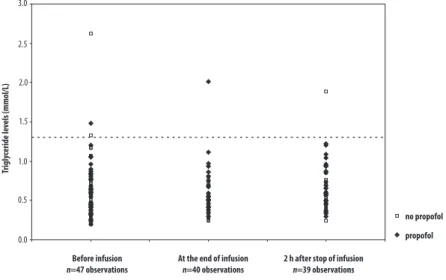
In one patient the TG level was 2.00 mmol litre-1 during propofol infusion without metabolic
acidosis, disturbance in physiological parameters or increase of CPK levels (Figure 1). Four patients had raised CPK levels, ranging from 261 to 313 U litre-1 during and after the end of
infusion (Figure 2). Three patients had received propofol and one patient had no medication. Two patients receiving propofol had elevated CPK levels before the start of infusion and one of these patients had elevated CPK levels during and after infusion. The first patient had CPK levels of 261 U litre-1 before infusion. The second patient had CPK levels of 336 U litre-1
before infusion, 276 U litre-1 during infusion and 240-282 U litre-1 after infusion. One patient
receiving propofol had a CPK level of 313 U litre-1 after infusion. These patients showed no
acidosis, no abnormal physiological parameters and no increased TG levels.
There were no respiratory complications. Three patients, one receiving propofol and two receiving midazolam, experienced short periods of desaturation with spontaneous recovery. Median minimal arterial pressure was 56 mm Hg and 59 mm Hg for propofol 6% and no propofol 6%, respectively (Mann-Whitney U-test, 330; P=0.57). Median minimal heart rate was 110 beats min-1 and 111 beats min-1 for propofol 6% and no propofol 6%, respectively
(Mann-Whitney U-test, 353; P=0.86). One episode of bradycardia lasting 90 s (median of 77
beats min-1) was observed in a patient receiving midazolam. The median maximal
tempera-ture was 37.8ºC during propofol and 37.7ºC with no propofol (Mann-Whitney U-test, 352;
P=0.84).
���
���
���
���
���
���
���
������
���������
�������������
���������������
����������������� ��������������������������������������� �������������������������������������������
�����������
��������
32
Chapter 2
A total of 915 paired COMFORT-Behavior scores, VAS and BIS values were obtained with a median of 15 (IQR 13-18) observations per patient. During infusion of propofol 6% median
COMFORT and BIS values were 11 (9-18) and 78 (65-91), respectively. During infusion of midazolam, median COMFORT and BIS values were 11 (9-15) and 77 (63-91), respectively. VAS was ≥ 4 in only seven observations in seven children (less than 1% of all observations). The starting dose of propofol was sufficient in three children (< 14 %). A propofol infusion of 4 mg kg-1 h-1 was not sufficient in five cases (~ 23% of the propofol group), and these patients
received additional sedation with either a single dose of midazolam (two patients), multiple doses (two patients) or continuous midazolam infusion (one patient) (median rate 0.05 mg kg-1h-1).
One of the patients receiving midazolam became agitated and more restless after administra-tion of up to 0.2-mg kg-1h-1 maintenance infusion and five doses of midazolam.
Discussion
We did not encounter any problems with propofol 6% in dosages < 4 mg kg-1h-1 in children
with a median age of 10 (IQR 3-17) months during a median period of 11 (range 6-18) h.
Propofol doses of 2 mg kg-1h-1 were insufficient to maintain an adequate sedation level in >
86% of the children. Midazolam was insufficient in only 21% of the children. The TG level was 2.0 mmol litre-1 in only one patient, during propofol infusion, without abnormalities in other
physiological parameters.This patient had been fed with formula milk Nutrilon 1 (Nutricia, Zoetermeer, The Netherlands), just before blood sampling. Four other patients had increased Figure 2 Creatine phosphokinase levels
���
���
���
���
�
��
��
�������������
��������
����������
���������������
����������������� ��������������������������������������� �������������������������������������������
�����������
33
Propofol 6% as sedative in children
CPK levels, without other signs of the propofol infusion syndrome.22,23 An increase of the CPK
level can also be a valid indication of the extent of muscle damage. Muscle damage due to major muscle-cutting surgery, such as craniofacial surgery, has been reported and should be taken into account when interpreting CPK levels postoperatively.23 CPK levels 10 times higher
than normal are regarded as a warning sign for rhabdomyolysis.23
A review of the literature yields reports both for and against the use of propofol as a sedative in children. Seventeen publications support propofol use in children at the pediatric intensive care unit (PICU). Pepperman and Macrae24 found no differences in mortality between propofol
and other sedative agents in 198 children. Cornfieldet al.25 described continuous infusion of
propofol in 142 critically ill children, with a mean age of 5 yr 9 months. Ten showed metabolic acidosis and 10 died during the first week of propofol infusion. These deaths could all be at-tributed to the primary diagnosis. Martin et al.20 described nine children on mechanical
ven-tilation receiving propofol for sedation and concluded that it was useful and safe. Knibbe et al.7 evaluated propofol for sedation for < 6 h sedation in six children aged 1-5 yr, following
cardiac surgery, and found no adverse events. A number of authors have published guides to drug selection and use in the PICU.8,14,26,27 They acknowledge that propofol infusion may cause
problems and therefore suggest avoiding it in patients with sepsis, respiratory infections or underlying metabolic problems,8 avoiding infusion for > 24 h8,14 and taking into account the
lipid content of propofol when calculating patients’ daily caloric intakes.14,26
Fourteen publications and one unpublished trial outline adverse events and deaths associated with propofol. Twelve publications pertain to children, four of which are case reports describ-ing a total of eight children, aged from 4 weeks to 13 yr.1,8,28,29 Parke et al.1 reported five
criti-cally ill children who received propofol for > 90 h at a rate of > 5 mg kg h-1 and died. The high doses and long duration may explain these deaths. Regrettably, these case reports reveal no details on use of parenteral feeding. Bray2 reviewed propofol infusion in a PICU and found
a significant association between long-term high-dose propofol infusion and the development of progressive myocardial failure. However, full details on comorbidity and parenteral feeding are lacking. Bray,22,30,31 Cray et al.29 and Cravero (unpublished data) expressed concerns about
propofol as a sedative in children. Strickland et al.32 reported an 11-year-old girl with an
astro-cytoma who died after long-term propofol infusion. However, a cause-and-effect relationship could not be determined. More recently, Koch et al.33 described a 5-year-old child receiving
short-term propofol infusion at a high rate who developed lactic acidosis.
Based on 14 publications, describing 27 patients, and one unpublished trial, the US Food and Drugs Administration contraindicated propofol for sedation of children < 18 yr receiving intensive care.4 However, 17 other publications appeared in support of propofol, reviewing a
total of 395 patients without evidence for a relationship between propofol infusion and death. This paper describes a prospective cohort study comparing safety and efficacy of propofol and midazolam in children < 2 yr. Clearly, our study has limitations. First, the number of children receiving propofol 6% in this study is too small to allow conclusions to be drawn. Reviewing the total of 422 children, described in the above publications with regards to safety, eight children (< 2%) had evidence of propofol infusion syndrome.3 Thus, to encounter one
34
Chapter 2
receiving propofol. Secondly, all studied children were healthy, apart from their major cranio-facial deformities. Therefore these children are not representative of the general ICU popula-tion. Thirdly, the children received low doses of propofol; higher doses might have produced adverse events. Fourthly, blinding was not possible in this study, because of propofol’s charac-teristic consistency. Fifthly, randomization was aimed at but failed due to unforeseen logistic reasons.
Despite the limitations of our study, it is important to note that we did not encounter any problems using propofol 6% as a sedative with dosages less than 4 mg kg-1h-1 in children with
a median age of 10 (IQR 3-17) months during a median period of 11 (6 to 18) h in postoperative patients without multiple organ failure or critical illness. Based on this study, it is too early to state that propofol is safe for sedation in children. However, we believe that it is important to share our experiences with propofol 6% and call for randomized controlled trials in pediatric patients to establish the safety of propofol as a sedative.
References
1. Parke TJ, Stevens JE, Rice AS, Greenaway CL, Bray RJ, Smith PJ, Waldmann CS, Verghese
C: Metabolic acidosis and fatal myocardial failure after propofol infusion in children: five case reports. Bmj 1992; 305: 613-6
2. Bray RJ: Propofol infusion syndrome in children. Paediatr Anaesth 1998; 8: 491-9
3. Vasile B, Rasulo F, Candiani A, Latronico N: The pathophysiology of propofol infusion
syn-drome: a simple name for a complex syndrome. Intensive Care Med 2003; 29: 1417-25
4. FDA: Pediatric Exclusivity Labeling Changes: Center for Drug Evaluation and Research. 2003
5. Cox EH, Knibbe CA, Koster VS, Langemeijer MW, Tukker EE, Lange R, Kuks PF, Langemeijer
HJ, Lie AHL, Danhof M: Influence of different fat emulsion-based intravenous formulations on the pharmacokinetics and pharmacodynamics of propofol. Pharm Res 1998; 15: 442-8
6. Knibbe CA, Naber H, Aarts LP, Kuks PF, Danhof M: Long-term sedation with propofol 60 mg
ml(-1) vs. propofol 10 mg(-1) ml in critically ill, mechanically ventilated patients. Acta Anaes-thesiol Scand 2004; 48: 302-7
7. Knibbe CA, Melenhorst-de Jong G, Mestrom M, Rademaker CM, Reijnvaan AF, Zuideveld KP,
Kuks PF, van Vught H, Danhof M: Pharmacokinetics and effects of propofol 6% for short-term sedation in paediatric patients following cardiac surgery. Br J Clin Pharmacol 2002; 54: 415-22
8. Bennett NR: Paediatric intensive care. Br J Anaesth 1999; 83: 139-56
9. Pitetti RD, Singh S, Pierce MC: Safe and efficacious use of procedural sedation and analgesia by nonanesthesiologists in a pediatric emergency department. Arch Pediatr Adolesc Med 2003; 157: 1090-6
10. Allonen H, Ziegler G, Klotz U: Midazolam kinetics. Clin Pharmacol Ther 1981; 30: 653-61
11. Cheng C, Roemer-Becuwe C, Pereira J: When midazolam fails. J Pain Symptom Manage 2002;
23: 256-65
12. Booker PD, Beechey A, Lloyd-Thomas AR: Sedation of children requiring artificial ventilation
using an infusion of midazolam. Br J Anaesth 1986; 58: 1104-8
13. Ng E, Taddio A, Ohlsson A: Intravenous midazolam infusion for sedation of infants in the
35
Propofol 6% as sedative in children
14. Tobias JD: Sedation and analgesia in paediatric intensive care units: a guide to drug selection and use. Paediatr Drugs 1999; 1: 109-26
15. Shafer A: Complications of sedation with midazolam in the intensive care unit and a comparison with other sedative regimens. Crit Care Med 1998; 26: 947-56
16. van der Marel CD, van Lingen RA, Pluim MA, Scoones G, van Dijk M, Vaandrager JM, Tibboel
D: Analgesic efficacy of rectal versus oral acetaminophen in children after major craniofacial surgery. Clin Pharmacol Ther 2001; 70: 82-90
17. Ambuel B, Hamlett KW, Marx CM, Blumer JL: Assessing distress in pediatric intensive care
environments: the COMFORT scale. J Pediatr Psychol 1992; 17: 95-109
18. Marx CM, Smith PG, Lowrie LH, Hamlett KW, Ambuel B, Yamashita TS, Blumer JL: Optimal
sedation of mechanically ventilated pediatric critical care patients. Crit Care Med 1994; 22: 163-70
19. van Dijk M, de Boer JB, Koot HM, Tibboel D, Passchier J, Duivenvoorden HJ: The reliability
and validity of the COMFORT scale as a postoperative pain instrument in 0 to 3-year-old infants. Pain 2000; 84: 367-77
20. Martin PH, Murthy BV, Petros AJ: Metabolic, biochemical and haemodynamic effects of
infu-sion of propofol for long-term sedation of children undergoing intensive care. Br J Anaesth 1997; 79: 276-9
21. Peeters MYM, Lange R, Aarts LPHJ, Talsma H, Knibbe CAJ: Stability of an intravenous fat
emulsion containing 6% propofol and a low amount of emulsifier. European Journal of Hospital Pharmacy 2004; 10: 201-8
22. Bray RJ: Propofol-infusion syndrome in children. Lancet 1999; 353: 2074-5
23. Laurence AS: Serum myoglobin and creatine kinase following surgery. Br J Anaesth 2000; 84:
763-6
24. Pepperman ML, Macrae D: A comparison of propofol and other sedative use in paediatric
inten-sive care in the United Kingdom. Paediatr Anaesth 1997; 7: 143-53
25. Cornfield DN, Tegtmeyer K, Nelson MD, Milla CE, Sweeney M: Continuous propofol infusion
in 142 critically ill children. Pediatrics 2002; 110: 1177-81
26. Aun CS: New i.v. agents. Br J Anaesth 1999; 83: 29-41
27. Fulton B, Sorkin EM: Propofol. An overview of its pharmacology and a review of its clinical
efficacy in intensive care sedation. Drugs 1995; 50: 636-57
28. Bray RJ: Fatal myocardial failure associated with a propofol infusion in a child. Anaesthesia 1995; 50: 94
29. Cray SH, Robinson BH, Cox PN: Lactic acidemia and bradyarrhythmia in a child sedated with
propofol. Crit Care Med 1998; 26: 2087-92
30. Bray RJ: Heart block following propofol in a child. Paediatr Anaesth 2000; 10: 226 31. Bray RJ: Propofol infusion for ICU sedation in children. Anaesthesia 2002; 57: 521
32. Strickland RA, Murray MJ: Fatal metabolic acidosis in a pediatric patient receiving an infusion of propofol in the intensive care unit: is there a relationship? Crit Care Med 1995; 23: 405-9
33. Koch M, De Backer D, Vincent JL: Lactic acidosis: an early marker of propofol infusion
Chapter 3
Propofol pharmacokinetics and
pharmacodynamics for depth of sedation
in nonventilated infants after major
craniofacial surgery
Mariska Y.M. Peeters1*, Sandra A. Prins2*, Catherijne A.J. Knibbe1,3, Joost
DeJongh3, Ron H.N. van Schaik4, Monique van Dijk2, Ilse P. van der Heiden4, Dick
Tibboel2 and Meindert Danhof3
1 Department of Clinical Pharmacy, St. Antonius Hospital, Nieuwegein, The
Nether-lands 2 Department of Pediatric Surgery, Erasmus MC-Sophia Children’s Hospital,
Rotterdam, The Netherlands 3 Division of Pharmacology, Leiden/Amsterdam Center
for Drug Research, Leiden University, Leiden, The Netherlands 4 Department of
Clinical Chemistry, Erasmus MC, Rotterdam, The Netherlands
* M.Y.M. Peeters and S.A Prins contributed equally to this paper
39
Population model for propofol sedation in infants
Abstract
Background: To support safe and effective use of propofol in nonventilated children after
major surgery, a model for propofol pharmacokinetics and pharmacodynamics is described.
Methods: After craniofacial surgery, 22 of the 44 evaluated infants (aged 3-17 months) in
the pediatric intensive care unit received propofol (2-4 mg·kg-1 · h-1) during a median of 12.5
h, based on the COMFORT-Behavior score. COMFORT-Behavior scores and Bispectral index values were recorded simultaneously. Population pharmacokinetic and pharmacody-namic modeling was performed using NONMEM V (GloboMax LLC, Hanover, MD).
Results: In the two-compartment model, body weight (median, 8.9 kg) was a significant
covariate. Typical values were CL = 0.70 · (BW/8.9)0.61 l/min, V
c = 18.8 l, Q = 0.35 l/min and
Vss = 146 l. In infants who received no sedative, depth of sedation was a function of baseline,
postanesthesia effect (Emax model) and circadian night rhythm. In agitated infants, depth of
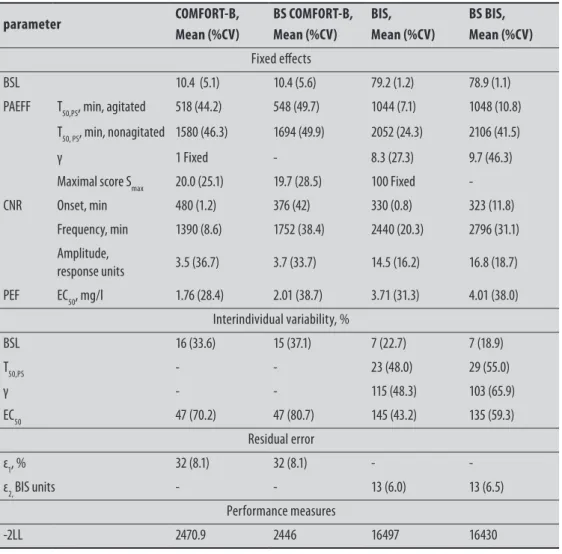
sedation was best described by baseline, postanesthesia effect, and propofol effect (Emax model). The propofol concentration at half maximum effect was 1.76 mg/l (coefficient of variation = 47 %) for the COMFORT-Behavior scale and 3.71 mg/l (coefficient of variation =145%) for the Bispectral index.
Conclusion: Propofol clearance is two times higher in nonventilated healthy children than
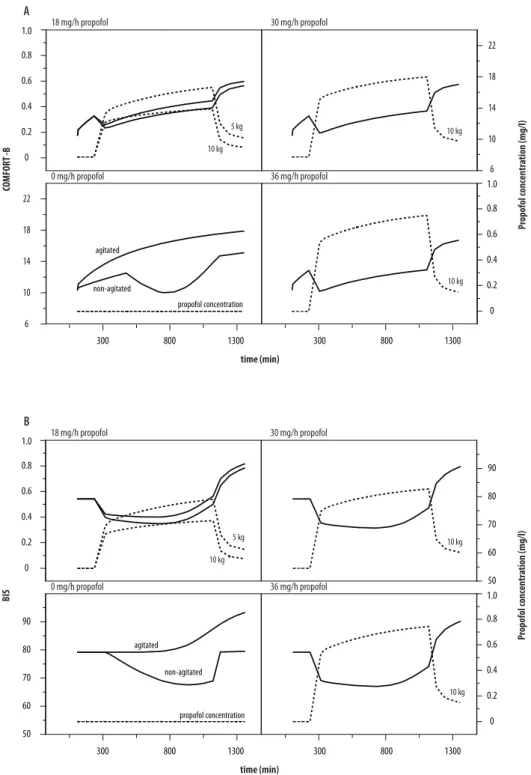
reported in the literature for ventilated children and adults. Based on the model, we advise a propofol dose of 30 mg/h in a 10 - kg infant to achieve values of 12-14 on the COMFORT-Behavior and 70-75 on the Bispectral index during the night. Wide pharmacodynamic vari-ability emphasizes the importance of dose titration.
Introduction
To correct craniosynostosis, most infants undergo surgery in the first years of life. Because of edematous eyelids, separation from parents and the need to stay at the intensive care unit for control of vital signs, and the possible development of neurological sequelae, these children often experience stress postoperatively. Although propofol is widely used for sedation in the adult intensive care, its use is subject to debate in sedated children in the pediatric intensive care since the report of five deaths in children receiving high doses (> 5 mg · kg-1 · h-1) of
propofol.1 In general, larger doses of propofol are required in children, and it is suggested
that this is because of differences in pharmacokinetics,2 sensitivity,3 or both.
To date, there are no population models in children investigating the pharmacodynamics to study the variability between and within children. As a pharmacodynamic endpoint, a number of clinical sedation scores have been devised for use in children, in which the
COMFORT-Behavior (COMFORT-B) scale4,5 would be a reliable alternative to the original,
most used COMFORT scale.6 The Bispectral Index (BIS) may have benefits in comparison
40
Chapter 3
been validated in children older than 1 yr.
Our clinical experiences regarding the use of propofol evaluated by COMFORT-B in young children in the pediatric surgical intensive care unit (PSICU) have recently been published by Prins et al.8 In the current article, propofol pharmacokinetics and pharmacodynamics
characterized by use of the COMFORT-B and BIS on the postoperative sleep pattern in nonventilated infants are described using population modeling, to select appropriate doses in infants and to support the safe and effective use of propofol.
Materials and Methods
The study was performed in the PSICU of the Erasmus Medical Center – Sophia Chil-dren’s Hospital, Rotterdam, The Netherlands. The study protocol was approved by the ethics committee of the Erasmus Medical Center – Sophia Children’s Hospital. Written informed consent was obtained from the parents. The studied infants, the design, sedative and analgesic regimen, and safety parameters are presented in detail in the article of Prins et al.8 and shortly repeated as relevant to this article.
Patients
Eligibility criteria included major craniofacial surgery, age between 1 month and 2 yr, and postoperative admitted to the PSICU. The children were randomly allocated to receive propofol or midazolam if sedative medication was judged necessary on the basis of the COMFORT-B score (score ≥ 17). Infants were excluded when they had respiratory infec-tions, epilepsy, hypertriglyceridemia or family histories of hypercholesterolemia, or history of allergy to propofol, eggs or soybean oil.
41
Population model for propofol sedation in infants
Anesthesia
Standardized anesthesia was induced with thiopental (5 mg/kg) or sevoflurane and fentanyl (2.5 μg/kg) and the infants were paralyzed with vecuronium (0.1 mg/kg). Thereafter, the infants underwent intubation and mechanical ventilation. Anesthesia was maintained with isoflurane, oxygen, and air, and fentanyl was given as needed. A median total dose of 17.9 (10.0-32.9) μg/kg fentanyl was administrated during surgery. Approximately 2 h before ex-tubation, a loading dose of acetaminophen (40 mg/kg) was administered rectally. After the operation, the patients were admitted to the PSICU for a minimum of 24 h, depending on the clinical condition.
Sedative and Analgesic regimen
Pharmacodynamic data collection was started at arrival at the PSICU. The COMFORT-B score, which has been validated in pediatric intensive care, was used as a
pharmacodynam-ic endpoint.4,5 The COMFORT-B scale assesses six behavioral items: alertness, calmness,
muscle tone, body movement, facial tension, crying (nonventilated children) or respiratory response (ventilated children). All items range from 1 (no distress) to 5 (severe distress), resulting in a total score varying from 6 to 30. The interobserver reliability represented by linearly weighted κ was greater than 0.65 for all nurses and the principal investigator. In addition, the BIS was recorded continuously and noted at 15-min intervals (BIS® A 2000 version 3.12, Aspect Medical Systems, Natick, MA; with pediatric BIS® sensors). The BIS
Agitated Nonagitated
Propofol No sedative No sedative
Sex, M/F 15 / 7 8 / 5 5 / 4
Age, months 10 (3.8-17.3) 10.9 (3.2-18.5) 8.8 (4.0 – 12.4) Weight, kg 8.9 (4.8-12.5) 9.3 (5.1-11) 8.3 (5.5 – 9.6) Height, cm 71 (60-76) 72 (58-80) 70 (61.5-77) CYP genotype
mutant frequencies 2B6*1/*5 2B6*1/*6 2B6*6/*6 2B6*1/*7 2C9*1/*2 2C9*1/*3 2C19*1/*2 2C19*2/*2
2 5 1 1 4 3 7 1
Infusion duration, h 12.5 (6.0-18.1) -
-Data are median (minimum-maximum).