Running head: LEARNING WITH DYNAMIC AND STATIC ILLUSTRATIONS
Do animations in multimedia stories foster learning for all children?
Visual attention and vocabulary acquisition of preschoolers during listening to storybooks with dynamic and static illustrations.
Vaia Galanou, s1352113
Master Thesis
to fulfill the requirements of the
Master of Science in Education and Child Studies Specialization Learning Problems and Impairments
The Palace of Curtains, III. René Magritte, 1929
First reader Zsofia Takacs, MSc
Abstract
In previous studies, digital storybooks with dynamic illustrations have been found to be beneficial for expressive language acquisition of second language learners with limited vocabularies (Verhallen, Bus & de Jong, 2006; Verhallen & Bus, 2010). In this experiment, we examined the effects of digital storybooks with dynamic and static illustrations on the expressive vocabulary of 39 native Dutch speakers from 4 to 6 years of age. We investigated the role of visual attention at the illustrations in children’s vocabulary acquisition. Eye
movements were recorded using eye-tracking methodology and showed that moving parts of the illustrations attract children’s attention. Furthermore, static illustrations were more facilitative than their dynamic counterparts for learning words expressively. In the dynamic condition longer fixation time at the depiction of targeted words was associated with lower word learning. In the static condition there was no relationship between looking behavior and word learning.
Keywords: digital storybooks, animation, vocabulary acquisition, eye movements
Illustration on the cover under creative commons license via:
Do animations in multimedia stories foster learning for all children?
Visual attention and vocabulary acquisition of preschoolers during listening to storybooks with dynamic and static illustrations.
Storybook reading to children is a widespread activity both at home and in the preschool classroom. It is considered to be a stepping stone for children’s reading skills and
vocabulary development (Bus, van IJzendoorn, & Pellegrini, 1995). Early exposure to storybook reading is especially beneficial for children’s emergent literacy skills (Bus et al.,
1995; Scarborough & Dobrich, 1994) and vocabulary development (for meta-analytical evidence see Bus et al., 1995; Mol, Bus, de Jong, & Smeets, 2008; Mol, Bus, & de Jong, 2009).
When reading to children as young as 17 months, adults point and name details in illustrations (Ninio, 1983) and the amount of these early literacy experiences is associated with expressive and receptive vocabulary development (Arterberry, Midgett, Putnick, & Bornstein, 2007). However, as infants become preschoolers, parents simply read to them instead of explaining the meaning of words (Evans & Saint-Aubin, 2013). Nonetheless, their vocabulary develops beyond the limits of explicit teaching; as a result of incidental learning through exposure to the stories (Evans & Saint-Aubin, 2013).
Nowadays children frequently listen/view and explore stories independently, without adult support, on the screen (Miller & Warschauer, 2013). Traditional storybooks have been transformed for computer use and are vastly available for PCs, tablets and mobile devices. They are referred to as book apps, e-books, CD-ROM story books, talking books, living books, interactive books, disc books or computer books (de Jong & Bus, 2003). The emergence of an array of these digital storybooks led to research comparing them to print storybooks (e.g. de Jong & Bus, 2002, 2004) This line of research initially found e-books to be a good supplement for parents and educators to include in children’s reading practices (de Jong & Bus, 2002, 2004). Later on it was proven that kindergartners can recall not only the story of the books encountered electronically on a level comparable to adult-child shared reading, but also the language of the stories (de Jong & Bus, 2004). Specifically for second language learners (L2 children) e-book readings were found to lead to vocabulary gains similar to those in other experiments with explicitly practiced vocabulary from print storybooks (Verhallen, Bus & de Jong, 2006) and more than those in whole-class readings by an adult (Verhallen & Bus, 2010).
Goldfield, 1983; Weizman & Snow, 2001) and story language recall (Paivio, 1986). According to the approach of Sipe (1998), children are invited to a meaning making process through the provision of both text and concomitant illustrations while reading picture books. Using the semiotic theory of transmediation, Sipe (1998) explains the relationship of text and pictures in storybooks as interplay, where the reader, or viewer in the case of pre-readers, sways back and forth from one sign system to the other (verbal and non-verbal) in order to comprehend.
Stimuli from these two different sign systems are processed cognitively again in two different systems according to Dual Coding Theory (DCT), a general theory of cognition and literacy (Sadoski, 2005). Paivio (1986) put forward the idea that the processing of verbal and nonverbal information happens in two separate channels of the brain. These two channels however, co-operate and it is better for comprehension to code a piece of information, for example a word, in both the verbal and the nonverbal channel. This is because nonverbal processes are also important for the construction of word meaning, due to the associative structure of knowledge (Clark & Paivio, 1991). Apart from comprehension, the presentation of both verbal and visual stimuli, can also assist memory for this stimuli. Dual coding of a word means, that the word can be later retrieved either verbally or nonverbally or both ways at the same time (Paivio, 1986).
What possibly happens in storybook reading according to the DCT, is that children read or listen to a word, which is coded in the verbal channel and the corresponding image for this word in the illustration is coded in the non-verbal channel, whilst creating mental connections with other verbal and non-verbal concepts from the story and their prior knowledge. Successful matching of word to image and other concepts can lead to word meaning construction.
In order to unveil this process, eye-tracking studies have been employed to study children’s looking behavior while reading or being read to a storybook. The results of these
studies show that children predominantly fixate illustrations instead of print (Evans & Saint-Aubin, 2013). Furthermore, it appears that text influences where children look in illustrations, with fixations on details highlighted by the text being more frequent and longer than those on details that are not mentioned in the text (Verhallen & Bus, 2011). These findings suggest that children listen to the oral narration and try to integrate what they hear with the illustration they see.
However, there is limited research on how children’s looking behavior within the
illustrations relates to their story comprehension and vocabulary learning (Verhallen & Bus, 2011). A recent eye-tracking study with print storybooks by Evans & Saint-Aubin (2013) revealed that children’s eye movements and processing style of stories are associated with
general receptive vocabulary, fixation duration on details highlighted by the text in the first reading partially mediated this relationship. In line with this research, the present study aimed at expanding the idea of a connection between children’s visual attention and vocabulary acquisition, but during listening to digital storybooks instead of print storybooks.
Previous research has found that animated illustrations are more supportive than their static counterparts for story retelling and expressive vocabulary acquisition (Verhallen et al., 2006). In a study focusing on the different effects of story presentation-static and animated illustrations- on vocabulary acquisition, both versions were facilitative of learning words receptively, but animated illustrations were more beneficial for learning words expressively (Verhallen & Bus, 2010). Receptive as well as expressive vocabulary are important for literacy acquisition, but expressive vocabulary has been found to be more strongly related to literacy skills such as word recognition and reading comprehension (Ouellette, 2006).
Expressive vocabulary reflects deeper knowledge of a word and the ability to not only understand it but also to be able to use it, whereas receptive vocabulary is indicative of only a basic understanding (Sénéchal, 1997). Literature suggests that receptive word knowledge precedes and is most likely a prerequisite for expressive word knowledge (Henriksen, 1999). Children encountering a novel word learn the meaning of the word first; and with more encounters with the word in more contexts children learn the word to an extent that allows them to use the word themselves (Henriksen, 1999). Taking into consideration these differences, the superiority of dynamic illustrations for expressive word acquisition could be explained from the perspective of DCT (Paivio, 2007). Both static and dynamic illustrations provide a visualization of the corresponding event in the narration, but the dynamic one is richer and more concrete in the sense that the story unfolds while being narrated. Since dynamic illustrations can direct children’s attention, via cinematic techniques, to the parts that
are highlighted by the text in contrast to static pictures, which show the whole event at once. So animated illustrations have a better chance of facilitating image and word connections, enabling stronger memory traces between them and therefore promote more expressive vocabulary gain (Verhallen & Bus, 2010).
In order to go beyond simple recognition of a word, it may not be enough to present children with a static illustration. Perhaps it is necessary to compliment the oral narration with a more synchronized illustration where events are animated and thus both draw children’s attention and are rich enough to allow for effective coding and storing of the word (Verhallen & Bus, 2010). Nonetheless, dynamic illustrations may also prove to be more beneficial for learning words expressively because of the fact that they can capture and retain children’s attention more than static illustrations (Alwitt, Anderson, Lorch & Levin, 1980).
and sound effects. Moreover, some e-books designed for children offer games and hotspots. However, the specific effects of these various features have not been researched to date (de Jong & Bus, 2004). Therefore, it is interesting to see whether animated, dynamic illustrations that differ only in movement and zooming from their static equivalents are more effective in directing children’s attention to the visualization of the narration and particularly to the
animated items corresponding to words of the narration. The main goal of the present study was to investigate which of the two versions of the digital storybooks (dynamic vs. static) is more facilitative of learning words and how looking behavior at the illustrations relates to word learning.
The target words used in the present study were verbs well depicted by movement. DCT postulates that concrete words are in a favorable position for dual coding when compared with abstract words, since they evoke both verbal and non-verbal referents (Sadoski, 2005). Similarly, children remember salient actions that are depicted in pictures or by animation more frequently than implied actions mentioned in a story (Gibbons, Anderson, Smith, Field & Fischer, 1986). It is hypothesized that dynamic illustrations are more likely to attract children’s attention and guide them towards the parts of the illustrations that are
moving (Alwitt et al., 1980). On the contrary, in the static version the complete event is shown at once (Verhallen & Bus, 2010). Children need to actively search for the corresponding item in the illustration that is mentioned in the text. The absence of motion in the static picture cannot direct children’s attention and they could spend just as much time at
the parts that imply movements as at any other visual elements referred to in the narration. So the first hypothesis of the present study was that children would fixate longer at the parts of the illustration that correspond to the verbs in the narration in the dynamic than in the static version of the digital storybooks.
If the hypothesis that dynamic illustrations are more effective than the static ones in leading visual attention to the verbs mentioned in the narration holds true, then it can be expected that they aid more effectively in the matching of the verbs to their animated depiction. Dual coding of the verbs will give them a better chance of being stored efficiently and recalled afterwards for the needs of an expressive vocabulary test. Therefore dynamic illustrations are considered to be more facilitative than static for learning verbs expressively.
corresponding elements in the picture depicting verbs from the narration was hypothesized to be positively correlated with expressive vocabulary acquisition.
Method Sample
Forty-two Dutch-speaking children between the ages of four and six years were recruited from three different schools in the area of Leiden. Data from 39 children were available for analyses, since two children were excluded because they were siblings of other participants and one child’s eye-tracking data was lost due to technical errors. The age of the
39 children (22 boys, 17 girls) ranged from 48 to 77 months (M = 61.26, SD = 7.69 months). Participation was granted based on the consent of the parents; no additional criteria had to be met.
Design
In the present study a within-subject design was used. In order to compare visual attention at static and moving pictures, three digital children’s books, either with animated (dynamic condition) or static illustrations (static condition), were presented on the screen of an eye tracker, which recorded the eye movements of the children on the illustrations. Since the focus of the present study was on how the illustrations facilitate word learning and story comprehension from storybooks, no print text was displayed on the screen, rather the pictures were accompanied by oral narration of the story. The three digital storybooks were counterbalanced in all possible combinations for the three conditions: dynamic, static and control (Table 1). Each child was randomly assigned to a combination. Participants were evenly distributed across conditions, with 27 listening to the story Bear is in love with Butterfly (14 in the dynamic and 13 in the static condition), 25 listened to the Imitators (12 in the dynamic and 13 in the static condition) and 26 listened to Little Kangaroo (13 in the dynamic and 13 in the static condition).
Table 1
Reading Schedules of the Different Reading Groups
Reading group Dynamic book Static Book Control book
1 Little Kangaroo Imitators Bear is in love with butterfly
2 Little Kangaroo Bear is in love
with butterfly Imitators
3 Imitators Little Kangaroo Bear is in love with butterfly
4 Imitators Bear is in love
with butterfly Little Kangaroo
5 Bear is in love
with butterfly Imitators Little Kangaroo
6 Bear is in love
with butterfly Little Kangaroo Imitators
Procedure
Data collection lasted, on average, for two weeks in each of the three schools. The sessions were held in a separate room available at the school. Each child was collected from the classroom by one experimenter during school hours and was accompanied back to the classroom after each session.
The experiment was spread over three sessions. The first session started with the two tests of executive functions. One experimenter was applying the tests to the children and the other one or two experimenters were scoring and/or videotaping the procedure. One child could not be videotaped due to refused permission by the parents and so notes from the scoring forms filled on the spot were used to acquire data.
The second session began with the third measure of executive functions. Afterwards, the same procedure as before followed for listening the two stories on the eye tracker screen once after successful calibration results in the opposite order as compared to the first session. The second session ended with one of the two post-tests (four vocabulary tests and a story retelling task), whereas the third session consisted of the other post-test. Children are randomly assigned to the order of post-tests, so that half start with and half finish with each post-test. One experimenter is applying the tests to the children in front of a computer screen and one experimenter is taking notes and videotaping.
After each test or story the children were rewarded with a sticker of their choice which they could place on their diploma of participation. The diploma was awarded to them at the end of all sessions. The gap between the first and second session ranged from one to four days, whereas the third session always followed the second session on the same day.
Materials
The digital version of three Dutch storybooks was chosen: Imitators (Na-apers - Veldkamp, 2006), Little Kangaroo (Kleine Kangaroe - Van Genechten, 2009), Bear is in love with Butterfly (Beer is op Vlinder – Van Haeringen, 2004). These electronic books served as the materials for the dynamic condition, including animated illustrations. However, the background music, sound effects and the narration were excluded and a recording of the oral narration including the non-words was used to create videos for each page of the storybook. The same sound track was used for the static condition as well, with the only difference that static illustrations were added to create videos of the pages for the static conditions. The static illustrations used were created for the purpose of the present study from the digital books, by capturing still images from each animated illustration, most representative of the animated fragments. This way the two conditions were comparable since the static illustrations actually contained one frame of the dynamic illustration.
Measures
Four vocabulary tests were used to test receptive and expressive knowledge of the target words. Moreover, story comprehension was measured with a story recall task. However, only the Context Integration vocabulary test is discussed in the present study.
Context Integration test.
The experimenter read nine how, what, when sentences to the child each including one of the target non-words, for example “Hoe kun je een vuur blukkeren (aanwakkeren)?” ( How can you “fuel” a fire?), “Wat gebruik je om te drimmelen (schrijven)” (What do you use to “write”?). This test was developed to measure expressive vocabulary knowledge of the nine
Tobii eye-tracker.
The Tobii TX120 is an eye tracking device. Using infrared lights it detects the pupils of the eyes, records their movements and can project the reflection of these movements on the picture the eyes are looking at on the screen (Verhallen & Bus, 2011). It provides information on where and how long the eyes fixate on the pictures. This information is presented both in visual formats ( heatmap, gaze pattern) and in numerical measures, such as fixation duration. Analysis
Repeated measures analysis of variance was used for contrasting visual attention (mean fixation time) in the different conditions, at the areas. The illustrations were divided into elements depicting the non-words (Areas Of Interest, AOIs) and elements that do not (non-AOIs). AOIs were created to include the depiction of non-words that was moving (Figure 1). A paired t-test was employed for comparing the vocabulary scores of the participants in the two conditions, whereas independent samples t-tests were run to investigate the relationship between visual attention and word learning separately for each condition.
Figure 1. The area of interest was created around the depiction of the non-word beteenen, which replaced the verb speelen (play). In the picture Bear is playing an instrument. All other elements constitute non-AOIs.
Results
The distribution of the variables was normal, based on the inspection of the descriptive characteristics such as standardized skewness and kurtosis and on visual inspection of the distributions on histograms with display of the normal distribution curve. There were only missing values for the fixation time at the AOIS and non-AOIs in the separate sessions, however the average fixation time over the three pictures and over the three sessions was calculated and used as fixation time at AOIs and fixation time at non-AOIs over the sessions. The score of one participant on the fixation time at the non-AOIs in the static condition was extremely low, so winsorization was used by replacing it with the value of the 5th percentile, the next lowest possible value. The same process was used to adjust a very high value on the ratio of fixation time between AOIs and non-AOIs.
The data quality (DQ) was high on average and similar in the different conditions and over the different sessions, with a range of 86% to 90%.
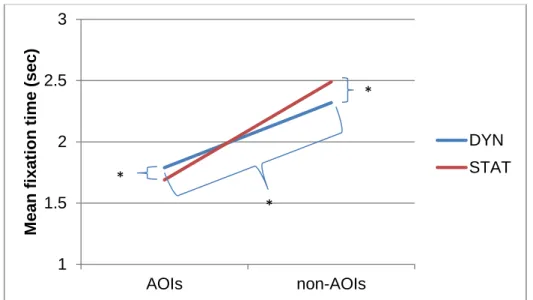
on average over the three pictures for 1.79 seconds at the areas depicting the non-words, whereas in the static condition the same area was on average fixated for 1.69 seconds, just one decisecond less, which is a minor difference, considering that average presentation time for a picture was between four and five seconds. The fixation time ratio seemed to be higher in the dynamic condition (M=0.86, SD=0.56) than the static (M=0.76, SD=0.43).
Table 2
Fixation Time at the Areas in the Conditions
Fixation on AOIs (seconds)
Fixation on non-AOIs
(seconds) Condition M(SD) M(SD) Dynamic 1.79(.81) 2.32(.49) Static 1.69(.62) 2.49(.57)
Fixation time at the depiction of non-words (AOIs) in the dynamic versus the static condition
A repeated measures analysis of covariance was conducted with condition (dynamic vs. static) as a within subject factor. Book in the dynamic condition (BV, NA, KK)and Book in the static condition (BV, NA, KK) as between subject factors and data quality over the sessions dynamic and static as covariates on fixation time at the depiction of non-words. As shown in Table 3 there was a significant main effect of condition (F(1, 31) = 12.61, p < .001, partial ²= .29). This was a large effect (Kroonenberg, 2013) with longer fixation times at the
Table 3
The Effects of Condition on Children’s Fixation at the AOIs after Controlling for Books and
Data Quality(DQ)
Source
Type III Sum of Squares df
Mean
Square F Sig.
Partial Eta Squared
condition 1.948 1 1.948 12.614 <.001 .289
condition * DQ dynamic .139 1 .139 .901 .350 .028
condition * DQ static .258 1 .258 1.672 .205 .051
condition * Dynamic book 12.733 2 6.366 41.233 <.001 .727 condition * Static book 10.160 2 5.080 32.903 <.001 .680 condition * Dynamic book *
Static book
.222 1 .222 1.437 .240 .044
Error(condition) 4.786 31 .154
Fixation time at the picture outside of the areas depicting the non-words (non-AOIs) in the dynamic versus the static condition
A repeated measures analysis of covariance with the same between- and within-subject factors and covariates as in the previous analysis was conducted on fixation time at the non-AOIs. It can be seen in Table 4 that there was a significant main effect of condition (F(1, 31) = 6.22, p = .018, partial ²= .17). This was a large effect (Kroonenberg, 2013) with longer fixation time at the non-AOIs in the static than in the dynamic condition. There was also a significant interaction effect of condition and Dynamic book (F(2, 31) = 11.06, p < .001, partial ²= .42) and condition and Static book (F(2, 31) = 5.84, p = .007, partial ²= .27). Significant main effects of DynamicBook (F(2, 31) = 4.12, p = .026, partial ²= .21)
Table 4
The Effects of Condition on Children’s Fixation at the non-AOIs after Controlling for Books
and Data Quality(DQ)
Source
Type III Sum of Squares df
Mean
Square F Sig.
Partial Eta Squared
condition 1.443 1 1.443 6.221 .018 .167
condition * DQ DYN .019 1 .019 .082 .777 .003
condition *DQSTAT .414 1 .414 1.785 .191 .054
condition * Dynamic book 5.129 2 2.564 11.056 <.001 .416 condition * Static book 2.707 2 1.353 5.835 .007 .273 condition * Dynamic book * Static
book
.040 1 .040 .173 .680 .006
Error(condition) 7.190 31 .232
To investigate the differences between the books, suggested by the significant main effects of the books used in the conditions and the significant interaction effects they had with condition, the ratio of fixation time at the AOIs to the presentation time of AOIs over the three pictures in the three books were examined. It appeared that looking time at the depiction of non-words on the picture in the book Little Kangaroo (Kleine Kangaroe) in the dynamic condition was much longer than that in the other books, whereas looking time at the AOIs in the static condition and at non-AOIs in both conditions was comparable among the three books. This may have occurred because of the difference in illustration style among the books. Size, range of motion, position or other characteristics of the areas of interest could have an effect.
Fixation time at the AOIs versus the non-AOIs separately in the two conditions
quality was also included as a covariate. There was a trend of a main effect of AOI, F(1, 35) = 2.72, p = .108, partial ²= .07, suggesting longer mean fixation times at non-AOIs. There was also a significant interaction effect of AOI and Static book (F(2, 35) = 58.66, p < .001, partial ²= .78). Also, Static Book (F(2, 35) = 3.56, p =.04, partial ²= .17) had asignificant
main effect.
In Figure 2 the effects of condition and area of interest on fixation time can be observed as well as an interaction between condition and area of interest.
Figure 2. Effects of condition and area of interest on mean fixation time. Significant effects are marked with an asterisk (*).
Word learning in the dynamic versus the static condition
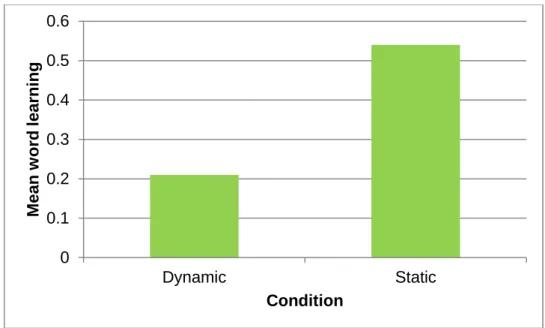
Overall children learned either one of the three words per condition or none, so the range of the scores was between zero and one, therefore this variable was treated as a categorical variable. A paired-samples t-test was conducted to compare word learning in the dynamic and static condition. There was a significant difference between the dynamic (M=0.21, SD=0.41) and the static (M=0.54, SD=0.51) conditions; t(38)= -2.97. p = 0.005, a large effect Cohen’s d=-0.71 (Cohen, 1988). This result suggests that children learned
significantly more words in the static condition as compared to the dynamic condition (Figure 3).
1 1.5 2 2.5 3
AOIs non-AOIs
M
ea
n
fi
xa
ti
on
t
ime
(se
c)
DYN STAT *
*
Figure 3. Mean difference of word learning between the dynamic and the static condition.
The relationship between fixation time at the depictions of the non-words and word learning.
Dynamic condition
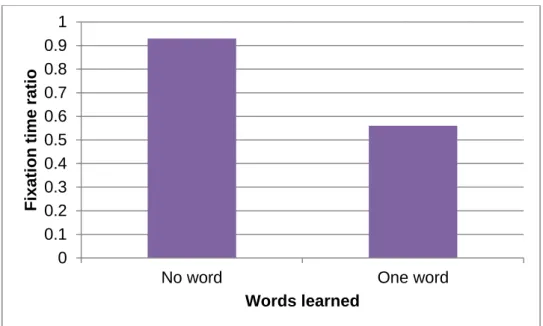
An independent-samples t-test was conducted to compare fixation time at the depictions of the non-words between children who did not learn any words and children who learned one word in the dynamic condition. There was a significant difference in the fixation time ratio (ratio of fixation time at the AOIs to fixation time at the non-AOIs) of children who did not learn any words (M= 0.93, SD= 0.58) and children who learned one word (M= 0.56, SD= 0.15); t (37) = 3.20. p= .003. In the dynamic condition, the fixation time ratio was significantly higher for children who did not learn any words than for children who learned one word, with a large effect size, Cohen’s d= 0.87, (Cohen, 1988) as can be seen in Figure 4. This suggests that children who did not learn any words, spent more time fixating at the parts of the pictures illustrating the non-words as compared to the parts that did not contain illustrations of the non-words ,whereas children who learned one word, spent less time fixating at the parts of the pictures illustrating the non-words as compared to the parts that did not contain illustrations of the non-words.
0 0.1 0.2 0.3 0.4 0.5 0.6
Dynamic Static
M
ea
n
w
ord
lea
rni
ng
Figure 4. Mean difference on the ratio of fixation time at AOIs to non-AOIs between children who learned no words and those who learned one word.
Static condition
An independent-samples t-test was conducted to compare fixation time at the depictions of the non-words between children who did not learn any words and children who learned one word in the static condition. There was no significant difference in the fixation time ratio of children who did not learn any words (M= 0.81 SD=0.42) and of those who learned one word (M= 0.72, SD= 0.44); t (37) = 0.64 p= .52. Thus, there was no relationship found between fixation behavior and word learning in the static condition.
Discussion
In both conditions, children fixated significantly more at all other elements in the illustrations as compared to the areas depicting the non-word. However, children fixated longer at areas depicting the non-word than the rest of the picture in the dynamic condition in contrast to the static condition. On the contrary, children fixated longer at the areas outside of the non-word depictions in the static rather than in the dynamic condition, but not significantly more than at the depiction of non-words. There was therefore an interaction between condition and area of interest.
Concerning word learning, children learned more words in the static condition as compared to the dynamic, even though the range was from zero to one word. With regards to the relationship between fixation time and word learning, there were differences in the two conditions. In the dynamic condition children who did not learn any words fixated longer at the areas depicting the non-words as compared to the rest of the pictures, whereas those who
0 0.1 0.2 0.3 0.4 0.5 0.6 0.7 0.8 0.9 1
No word One word
Fixati
on
t
ime
rat
io
learned one word spent less time looking at the non-word depiction in comparison to the rest of the picture. In the static condition there was no association between fixation time and word learning.
The interaction between condition and area of interest, where areas depicting the non-word are fixated longer than areas outside the depiction of non-non-word in the dynamic condition and areas outside the depiction of the non-word are fixated longer, than areas depicting the non-word in the static condition, could indicate that movement, zooming and simultaneous presentation of narration and illustrations or lack thereof are factors that influence where children look.
Children looked overall more at the rest of the picture, as compared to the non-word depiction. This result is not unexpected, since the areas depicting the non-words were much smaller than the rest of the pictures. Still, in the dynamic condition they attracted more attention, suggesting the superiority of movement in drawing attention, considering that the illustrations in both conditions were the same, apart from the dynamic features like movement and zooming.
The results reveal that children spent more time looking at the depictions of non-words in the dynamic than in the static condition. The 9 non-non-words depicted in both conditions were verbs, acted out by the story’s main or supportive character(s), thus providing the opportunity in the dynamic version to be illustrated as a movement. Following the trail of previous research, the oral narration probably guided children to fixate longer on the visual elements mentioned in the text (Verhallen & Bus, 2011). But especially movement was, as expected, an enabling factor that engaged children and directed them to look at these parts of the illustration (Alwitt et al., 1980).
On the other hand, children fixated at the areas outside of the depictions of non-words shorter than at the areas depicting non-non-words in the dynamic condition. However, in the static condition they tended to fixate at areas outside of the depictions of non-words longer, although not significantly different than looking time at the depiction of non-words. The observed looking behavior in the static condition could be attributed to the fact that, in static illustrations the complete event is presented altogether, as opposed to dynamic illustrations, where the narration is at the same time matched with the corresponding part of the illustration (Verhallen & Bus, 2010). Considering the lack of motion, it seems reasonable that children spent more time looking at other elements of the picture than those implying movement in the static condition.
the whole picture may include more interesting details or even other moving elements. Differences in illustrations could be further investigated as contributors to looking behavior.
Although from the examination of fixation time the animated versions of the depictions of non-words (dynamic condition) proved to be more captivating than the static ones, they did not lead to more word learning on an expressive level. In fact children learned significantly more words, when they were presented with the books in the static (M= 0.54) than in the dynamic condition (M= 0.21). The children either learned no words or at most one word out of three per condition.
Learning one word out of six is a small proportion (16.67%), still children did learn some non-words after just three encounters with the stories. Similar results have been reported in previous studies with multimedia storybooks after four exposures, with 15.75% and 10.1% average expressive vocabulary gain on the posttest respectively (Verhallen et al., 2006; Verhallen & Bus, 2010).
It was hypothesized that the presentation of the non-words in the dynamic condition, being more concrete and simultaneous to the narration, would be more beneficial for the construction of strong memory traces between the non-words heard in the narration and their depiction in the illustration (Paivio, 2007). Contrary to the findings of Verhallen and Bus (2010), the dynamic format of the digital storybooks proved to be less beneficial for expressive vocabulary acquisition. However, there were certain differences between the participants and the materials used in that study (Verhallen & Bus, 2010) and the present one. The effect of static versus dynamic (video) format in the study of Verhallen and Bus (2010) was examined with L2 participants from low-income, immigrant families. Children in this situation have difficulty comprehending stories, due to the large amount of unknown words they contain. Therefore, the participants were expected to have a higher need, compared to native speakers, for a detailed visualization of the story and to be inclined to use the information provided by the dynamic (video) illustration to draw inferences about the story (Verhallen & Bus, 2010).
Furthermore, the dynamic (video) condition in the study of Verhallen and Bus (2010) was much richer than the dynamic condition of the present study in that it contained, apart from movement and zooming, sounds and music to highlight the plot. This means that there was an additional source of nonverbal information, which could have helped children in understanding the story and learning new words.
Moreover, the expressive knowledge of the L2 children was assessed with a test, asking them to complete the last word of an orally presented sentence, which was depicted on the computer screen by means of a matching picture from the digital storybook. Again, the children had additional visual help, in comparison to the Context Integration test used in the present study, which consisted of an orally-presented sentence and asked children to answer a how, what, when sentence containing the non-word, requiring deeper knowledge of the word and transfer of the newly acquired knowledge into a new situation. So recall of the word, assisted by a visual aid, could be considered an easier task than that of recalling both the non-word (after simple oral presentation) and its meaning and so enabling enhanced performance of the L2 children in the expressive vocabulary test of the Verhallen and Bus study (2010).
Based on the distinction made by Ouellette (2006) the expressive vocabulary test in the present study could be classified as a test measuring depth of vocabulary knowledge, whereas the one used in the study of Verhallen and Bus (2010) could be regarded as measuring expressive vocabulary breadth. Expressive vocabulary breadth indicates the number of words stored in one’s lexicon together with their (partial) meaning, while depth of
vocabulary knowledge reflects elaborated semantic knowledge (Ouellette, 2006). Although expressive vocabulary breadth may be important for visual word recognition, vocabulary depth was found to predict reading comprehension (Ouellette, 2006).
Alternatively, another explanation that could be ascribed to less word learning of children in the dynamic condition is that offered in part by the static-media hypothesis (Mayer, Hegarty, Mayer, & Campbell, 2005). This hypothesis states that text and static pictures, rather than animation and narration, provide children with more possibilities of the type of cognitive processing that leads to better learning, that is, less extraneous and more germane processing (Mayer et al., 2005). Although in the present study the static condition consisted of pictures and narration, instead of text, the dynamic condition is identical to that mentioned by the static-media hypothesis. It could be argued that the dynamic condition called for more extraneous processing, by drawing too much attention on the movement in the picture. According to the cognitive theory of multimedia learning, attention is limited (Mayer & Moreno, 2002) and therefore using more of it for extraneous processing implies less resources left for germane processing.
knowledge of words depicted dynamically. It seems that the more children looked at the dynamic depiction of the non-words the less likely they were to recall their meaning and be able to reflect on them. More specifically, the ratio of fixation time at the depiction of non-words to the time spent visually inspecting the rest of the picture of the children who did not learn any words expressively was significantly higher than that of children who learned one word.
This outcome contradicts the hypothesis that longer fixation on the depiction of the non-words in the dynamic condition, being more realistic and simultaneous to the narration, would allow a more effective construction of connections between the verbal (words in the narration) and the nonverbal (animated depiction of those words) information. It was also hypothesized that these connections would be stored more effectively in memory and that this knowledge would be reflected on the expressive vocabulary test, as compared to static illustrations (Verhallen & Bus, 2010).
However, it should be taken into account that the area considered for the depiction of non-words was only the area moving in the dynamic condition and the corresponding area in the static condition. The area moving was either a character or even just one specific body part of the character, sometimes together with an object (Figure 1). Since the focus was on movement, only moving parts were included constituting small areas compared to the whole picture. In our model only fixation time at the small areas depicting the non-word was used to investigate the relationship between fixation time and word learning, whereas fixation at other parts of the character and/or picture could also aid word learning.
Undoubtedly, the children need to look at the depiction of non-words for some time in order to forge links between the animation and the non-word. But, they do not necessarily need to and should not spend all or most of the time, in which the picture is presented, on the non-word depiction for best story comprehension. Perhaps, what the negative relationship between looking time and word learning in the dynamic condition suggests is that there could be an optimal looking time at the non-word depiction accompanied by looking at the rest of the character and the picture. This balance effect between the different elements of the picture was revealed by the lower ratio of fixation time at the depiction of non-words to fixation time at the rest of the picture of children who learned one word expressively.
Therefore the effect of story comprehension on the relationship between visual attention and word learning should be studied. As Jenkins, Stein and Wysocki (1984) suggest, a story can be understood without complete knowledge of the vocabulary used. In another study containing text, reading comprehension contributed to inferring the meaning of words from context (Cain, Lemmon & Oakhill, 2004). Hence, the idea put forward by Verhallen et al. (2006), that story understanding can help deduct the meaning of words which are unknown, can be investigated further as a contributor to the connection between looking behavior and vocabulary acquisition.
Understanding the story content could also prove beneficial for the expressive vocabulary test. For example, when a child hears the item question ‘how can you enhance
(changed for non-word) a fire?’, it may not be enough to recall the movement that depicted this non-word in the illustration, but the intention of the character, Bear, to boost the fire in order to send smoke signals to Butterfly. In this context the metaphorical meaning of enhancing the fire, increasing the heat between the two characters, could also be extracted had the goal of Bear (to show Butterfly that he is in love with her) been understood by the child. Although such depth of understanding is not required to answer the item question, it may be helpful as a non-verbal association for stronger memory traces and as a promoter for understanding the coherence of a story (Verhallen et al., 2006).
Lastly, the finding that, in the static condition there was no significant difference in the fixation time ratio between the children who learned no words and those who learned one word, was contrary to hypothesis and previous research (Evans & Saint-Aubin, 2013). Longer fixation time at the depiction of the non-words would mean that the words would be most likely learned expressively. However, this previous study used a receptive vocabulary test, multiple (seven) exposures to the storybooks and the whole object (corresponding to a noun in the narration) as area of interest (Evans & Saint-Aubin, 2013).
The absence of a significant difference in the present study could point to the fact that, in static illustrations, where children are not facilitated by any extra features such as movement, word learning may depend more on learner characteristics, such as level of vocabulary knowledge (Sénéchal, Thomas & Monker, 1995). That is for children with larger vocabularies it would be easier to learn and match new words to a known concepts, without them necessarily fixating longer on the depiction of the non-words. Apart from prior knowledge, as suggested before, it is possible that fixations on the other parts of the character and the picture as a whole could be involved in word learning, besides the longer fixation at the specific part of the illustration that corresponds to the word targeted.
Limitations and future directions
non-word. Fabricating non-words is in an intricate process and although the words must sound like real words they may end up being confusing. For example ‘beteenen’, a non-word for the word playing, was incorrectly interpreted by a child in relation with ‘tenen’, the Dutch word for toes that sounds quite similar. This may mean that the similar morphology of the word interrupted the matching of the new word to the known concept and/ or the extraction from memory of the correct meaning of the word, when the child was presented with it in the expressive vocabulary test.
Word learning is also influenced by the number of encounters the child has with the storybook (Verhallen & Bus, 2010). An optimal frequency is not easy to determine; however four repetitions are suggested to have a positive outcome for word learning in L2 children (Verhallen & Bus, 2010). In the study by Evans and Saint-Aubin (2013), seven exposures were necessary for native speakers to make modest vocabulary gains. It is possible that the participants in the present study, who were native speakers and were exposed to the stories three times, would also have benefited more from four or more encounters with the stories.
Apart from measurement and material properties, learner characteristics should also be studied. Behavioral regulation has been found highly associated with vocabulary skills of four-year-olds (McClelland, Cameron, Connor, Farris, Jewkes & Morrison, 2007). In a meta-analysis of the influence of spatial ability in learning with visualizations Hoeffler (2010) found that, dynamic visualizations have proven to be beneficial for low-spatial-ability learners. It would be interesting to investigate how executive function skills influence vocabulary learning through exposure to digital storybooks.
Future research could also focus on the differences in word learning between L2 children and native speakers, when listening to storybooks with animated and static illustrations. Perhaps dynamic illustrations are more beneficial for L2 participants than static illustrations and vice versa for native speakers. Children lagging behind in vocabulary knowledge need a richer visualization of the story to help them comprehend it and learn new words, whereas for children with higher vocabulary knowledge a simple static illustration may be more helpful than an animated one, where movement seems to be distracting.
Practical implications
What can be concluded from this study could come as a response to the question whether digital books are more or less beneficial than print books. One could argue that, digital storybooks with static illustrations are in many ways similar to typical print storybooks. Comparing digital storybooks with static illustrations to their equivalents with animated illustrations, can be interpreted as a comparison of typical print storybooks with typical digital storybooks.
multimedia books by the child alone. During shared book reading adults may point, explain, ask labelling questions and discuss with the children (Evans & Saint-Aubin, 2013), whereas the present study did not involve adult-child interaction. Still, the children in the present study were not able to explore the books on their own, for example repeat readings of certain parts as they did in previous studies, where they could navigate through the storybook and where more multimedia features, such as hotspots, were also available (de Jong & Bus, 2004).
Nevertheless, the results suggest that preschoolers can learn story language expressively after only 3 brief exposures with digital storybooks. Adding to previous research on digital storybooks it can be argued that they can be a good supplement for house or classroom practice (de Jong & Bus, 2004). According to the present study, storybooks presented on the computer screen with static illustrations may be more facilitative for native speakers in learning words on an expressive level, as compared to their animated version.
The difference in word learning between the animated and the static conditions does not suffice for abnegating the beneficial effect of multimedia books found in multiple other studies (Verhallen et al., 2006, Verhallen & Bus, 2010), due to the fact that the present animation is not as rich as the animation used previously, since it lacks sounds and music. The amount, size, quality of movements and the presence of details irrelevant to the story may as well be different among the dynamic illustrations of the books. What this contradiction could indicate, is an interaction of learner characteristics (e.g. mother tongue, general vocabulary knowledge, story comprehension ability) and elements of presentation (movement, zooming, music, sounds), as was found for example in the study by Smeets, van Dijken and Bus (2012). Children with severe language impairments benefited equally from storybooks with either dynamic or static illustrations, but the addition of background music hindered word learning. It is therefore suggested that, different features may work differently for different groups of children.
In conclusion, the additional features, such as movement, sounds, music and perhaps even word difficulty, should be adjusted to the needs of the learners. In this case, L2 children could listen to the dynamic version of the stories, whereas their classmates who are native speakers could listen to the static version. In their various formats, digital storybooks could prove to be useful instruments in the process of differentiating the classroom instruction to accommodate all types of learners and styles of learning.
References
Alwitt, L. F., Anderson, D. R., Lorch, E. P., & Levin, S. R. (1980). Preschool children’s
Arterberry, M. E., Midgett, C., Putnick, D. L., & Bornstein, M. H. (2007). Early attention and literacy experiences predict adaptive communication. First Language, 27, 175–189. doi:10.1177/0142723706075784
Bus, A. G., van Ijzendoorn, M. H., & Pellegrini, A. D. (1995). Joint book reading makes for success in learning to read: A meta-analysis on intergenerational transmission of literacy. Review of Educational Research, 65(1), 1-21. doi: 10.3102/00346543065001001
Cain, K., Lemmon, K., & Oakhill, J. (2004). Individual differences in the inference of word meanings from context: the influence of reading comprehension, vocabulary knowledge, and memory capacity. Journal of Educational Psychology, 96(4), 671-681. doi: 10.1037/0022-0663.96.4.671
Clark J. M. & Paivio, A. (1991). Dual Coding Theory and Education. Educational Psychology Review, 3(3) 149–210. doi:10.1007/BF01320076
Cohen, J. (1988). Statistical power analysis for the behavioral sciences (2nd ed.). Mahwah, NJ:Lawrence Erlbaum.
de Jong, M. T., & Bus, A. G. (2002). Quality of book-reading matters for emergent readers: An experiment with the same book in a regular or electronic format. Journal of Educational Psychology, 94(1), 145-155. doi: 10.1037//0022-0663.94.1.145
de Jong, M. T., & Bus, A. G. (2003). How well suited are electronic books for supporting Literacy? Journal of Early Childhood Literacy, 3, 147-164. doi: 10.1177/14687984030032002
de Jong, M. T., & Bus, A. G. (2004). The efficacy of electronic books in fostering kindergarten children's emergent story understanding. Reading Research Quarterly, 39(4), 378-393. doi: 10.1598/rrq.39.4.2
Evans, M.A., & Saint-Aubin, J. (2013). Vocabulary acquisition without adult explanations in repeated shared book reading: An eye movement study. Journal of Educational Psychology, 105(3), 596-608. doi: 10.1037/a0032465
Gathercole, S. E. (2006). Nonword repetition and word learning: The nature of the relationship. Applied Psycholinguistics, 27, 513–543. doi: 10.1017.S0142716406060383
Gibbons, J., Anderson, D. R., Smith, R., Field, D. E., Fischer, C. (1986). Young children's recall and reconstruction of audio and audiovisual narratives. Child Development, 57(4),1014-1023. doi: 10.2307/1130375
Guttmann, J., Levin, J. R., & Pressley, M. (1977). Pictures, partial pictures, and young children’s oral prose learning. Journal of Educational Psychology, 69(5), 473-480. doi:
10.1037//0022-0663.69.5.473
Language Acquisition, 21, 303–317. doi:10.1017/S0272263199002089
Hoffler, T. N. (2010). Spatial Ability: Its Influence on Learning with Visualizations-a Meta-Analytic Review. Educational Psychology Review, 22(3), 245-269. doi: 10.1007/s10648-010-9126-7
Jenkins, J.R., Stein M. L., & Wysocki, K. (1984). Learning Vocabulary Through Reading. American Educational Research Journal21, (4), 767–87. doi: 10.2307/1163000
Kroonenberg, P. M. (2013). The role of statistics in applied research [PDF document]. Retrieved from https://blackboard.leidenuniv.nl/bbcswebdav/pid-2507661-dt-content-rid-1546974_1/courses/PEO-PED-314FSW/Lecture5StatisticsInResearch%202010.pdf Mayer, R. E., Hegarty, M., Mayer, S., & Campbell, J. (2005). When static media promote
active learning: Annotated illustrations versus narrated animations in multimedia instruction. Journal of Experimental Psychology-Applied, 11(4), 256-265. doi: 10.1037/1076-898x.11.4.256
Mayer, R., & Moreno, R. (2002). Animation as aid to multimedia learning. Educational Psychology Review, 14(1), 87–99. doi: 10.1023/A:1013184611077
McClelland, M. M., Cameron, C. E., Connor, C. M., Farris, C. L., Jewkes, A. M., & Morrison, F. J.(2007). Links between behavioral regulation and preschoolers’ literacy, vocabulary, and math skills. Developmental Psychology, 43, 947–959. doi: 10.1037/0012-1649.43.4.947
Miller, E., & Warschauer, M. (2013). Young children and e-reading: research to date and questions for the future. Learning, Media and Technology, doi:10.1080/17439884.2013.867868
Mol, S. E., Bus, A. G., & de Jong, M. T. (2009). Interactive book reading in early education: a tool to stimulate print knowledge as well as oral language. Review of Educational Research, 79(2), 979-1007. doi: 10.3102/0034654309332561
Mol, S. E., Bus, A. G., de Jong, M. T., & Smeets, D. J. H. (2008). Added value of dialogic parent-child book readings: A meta-analysis. Early Education and Development, 19(1), 7-26. doi: 10.1080/10409280701838603
Ninio, A. (1983). Joint book reading as a multiple vocabulary acquisition device. Developmental Psychology, 19, 445–451. doi:0.1037/0012-1649.19.3.445
Ouellette, P. (2006). What's meaning got to do with it: The role of vocabulary in word reading and reading comprehension. Journal of Educational Psychology, Vol 98(3), 554-566. doi: 10.1037/0022-0663.98.3.554
Paivio A (1986) Mental Representations. A Dual Coding Approach. Oxford, UK: Oxford University Press.
Pressley, M., Cariglia-Bull, T., Deane, S., & Schneider, W. (1987). Short-term memory, verbal competence and age as predictors of imagery instructional effectiveness. Journal of Experimental Child Psychology, 43, 194–211. doi:10.1016/0022-0965(87)90059-2 Sadoski, M. (2005). A dual coding view of vocabulary learning. Reading & Writing
Quarterly, 21, 221-238. doi:10.1080/10573560590949359.
Sénéchal, M., Thomas, R., & Monker, J.-A. (1995). Individual differences in 4-year-old children’s acquisition of vocabulary during storybook reading. Journal of Educational
Psychology, 87, 218–229. doi:10.1037/0022-0663.87.2.218
Sénéchal, M. (1997). The differential effect of storybook reading on preschoolers’ acquisition
of expressive and receptive vocabulary. Journal of Child Language, 24, 123–138. doi:10.1017/S0305000996003005
Sipe, L.R. (1998). How picture books work: A semiotically framed theory of text-picture relationships. Children’s Literature in Education, 29(2), 97–108. doi: 10.1023/A:1022459009182
Scarborough, H. S., & Dobrich, W. (1994). On the efficacy of reading to preschoolers. Developmental Review, 14(3), 245-302. doi: 10.1006/drev.1994.1010
Smeets, D. J. H., Van Dijken, M. J. & Bus, A. G. (2012). Using electronic storybooks to support word learning in children with Severe Language Impairments. Journal of Learning Disabilities. doi: 10.1177/0022219412467069
Snow, C. E., & Goldfield, B. A. (1983). Turn the page please - situation-specific language-acquisition. Journal of Child Language, 10(3), 551-569. doi: 10.1017/S0305000900005365
Van Genechten, G. (2009). Kleine kangoeroe [Little kangaroo]. Hasselt, Belgium: Clavis.
Van Haeringen, A. (2004). Beer is op vlinder [Bear is in love with Butterfly]. Amsterdam, Netherlands: Leopold.
Veldkamp, T. (2006). Na-apers [Imitators]. Tielt/Arnhem, Belgium: Lannoo.
Verhallen, M., & Bus, A. G. (2010). Low-income immigrant pupils learning vocabulary through digital picture storybooks. Journal of Educational Psychology, 102(1), 54-61. doi: 10.1037/a0017133
Verhallen, M., & Bus, A. G. (2011). Young second language learners’ visual attention to
illustrations in storybooks. Journal of Early Childhood Literacy, 11(4), 480-500. doi: 10.1177/1468798411416785
10.1037/0022-0663.98.2.410