SUPRANATIONAL INTEGRATION IN THE SHARED NEIGHBORHOOD: DEMOCRATIZATION AND REGIME CHOICE IN EASTERN EUROPE AND THE
CAUCASUS
Emmett Michael Strickland
A thesis submitted to the faculty at the University of North Carolina at Chapel Hill in partial fulfillment of the requirements for the degree of Master of Arts in Political Science in the
Department of Political Science (Trans-Atlantic Relations).
Chapel Hill 2015
©2014
ABSTRACT
Emmett Michael Strickland: Supranational Integration in the Shared Neighborhood: Democratization and Regime Choice in Eastern Europe and the Caucasus
(Under the direction of Robert Jenkins)
In post-communist Central Europe, the European Union effectively used democratic conditionality to generate political reform in candidate states. With the Eurasian Economic Union, Russia now offers the former Soviet countries an alternative to EU integration, without the strings of democratic reform attached. Are less democratic regimes therefore more likely to side with Russia’s organization in order to avoid committing to the stringent political reforms needed for EU association? This thesis applies theory on democratic change to four post-Soviet states to evaluate the nature of their political systems and their trajectories towards EU
TABLE OF CONTENTS
LIST OF TABLES AND FIGURES ...vi
LIST OF ABBREVIATIONS ...vii
CHAPTER 1: INTRODUCTION ...1
Section 1.1: The Eurasian Economic Union ... 3
Section 1.2: The Association Agreement: Europe’s Alternative ... 5
Section 1.3: European Conditionality and Emergent Democracies ... 6
Section 1.4: Regime Typology ... 10
Section 1.5: Case Selection and Methodology ... 18
CHAPTER 2: DEMOCRATIZATION UNDER PERESTROIKA ...20
Section 2.1: Belarus ... 22
The Popular Front: A Suppressed Opposition ...23
Backlash Against Gorbachev: An Unreformed Communist Party ...24
Communist Victory in the Multiparty Era ...25
Section 2.2: Moldova ... 26
Between Democracy and Nationalism: The Rise of a Fragmented Popular Front ....27
A Partially Reforming Communist Party ...30
The Triumph of the Moderates: A Partial Victory for the Popular Front ...31
The Armenian Opposition: Nationalist Roots and Irredentist Ambition ...32
The Victory of Nationalism ...36
Section 2.4: Georgia ... 37
An Anti-Russian Opposition ...37
An Increasingly Repressive Communist Government ...39
Opposition Victory in the Supreme Soviet ...40
CHAPTER 3: THE POST-COMMUNIST ERA ...42
Section 3.1: Post-‐Communist Belarus ... 43
Halted Reform in the Post-Communist Era ...44
Thwarting Competition ...49
Section 2.2: Moldova ... 52
Nationalist Illiberalism in the post-Soviet Era ...52
Competition and Turnover ...54
Section 3.3: Georgia ... 57
A Nationalist Government ...57
Competition in Georgia ...60
Section 3.4: Post-‐Communist Armenia ... 64
Illiberalism and Ethnonationalism ...65
Poor Political Turnover ...67
CHAPTER 4: DISCUSSION AND CONCLUSION ...70
CITATIONS ...78
LIST OF TABLES AND FIGURES
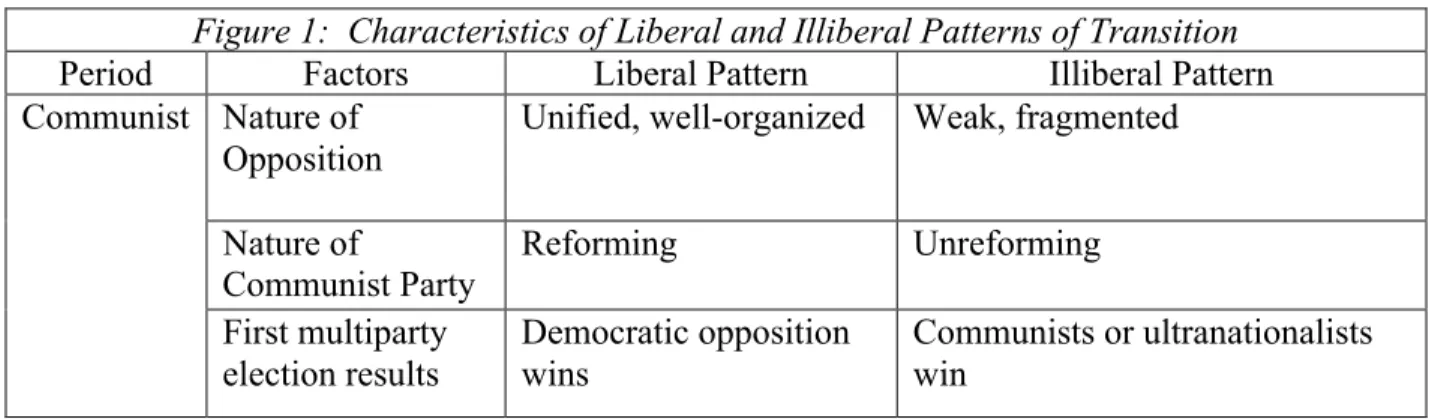
Figure 1 – Characteristics of Liberal and Illiberal Patterns of Transition ...16
Figure 2 – Case Studies ...18
Table 1: Outcome of 1990 Belarus Supreme Soviet Elections ...25
Table 2: Outcome of 1990 Moldova Supreme Soviet Elections ...32
Table 3: Results of the 1990 Armenia Supreme Soviet Elections ...36
Table 4: Results of the 1990 Georgia Parliamentary Elections ...40
Table 5: Indicators of Political Freedom in Belarus Since 2002 ...49
Table 6: Select Belarusian Parliamentary Elections Since 1990 ...50
Table 7: Indicators of Political and Economic Freedom in Moldova Since 2002 ...54
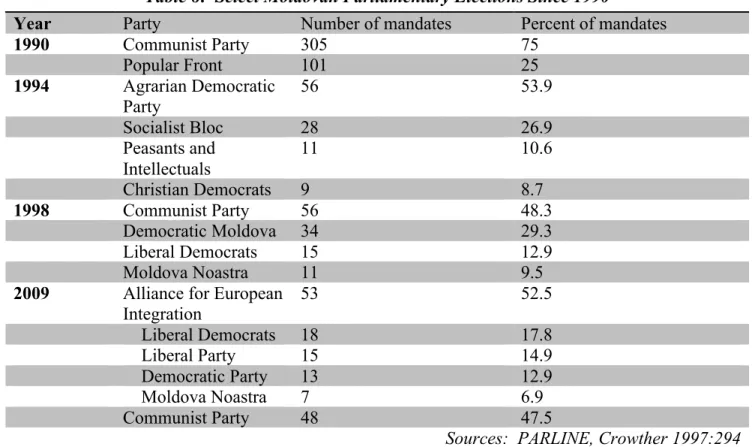
Table 8: Select Moldovan Parliamentary Elections Since 1990 ... ...55
Table 9: Indicators of Political and Economic Freedom in Moldova Since 2002 ...60
Table 10: Select Georgian Parliamentary Elections Since 1990 ...62 62 Table 11: Indicators of Political and Economic Freedom in Armenia Since 2000 ...67
LIST OF ABBREVIATIONS
ANM Armenian National Movement AA Association Agreement
EU European Union
CHAPTER 1: INTRODUCTION
In 2004, the European Union enlarged its borders into the former Soviet republics of Northeastern Europe. Countries like Estonia, Latvia, and Lithuania which were little over a decade prior governed by single-party communist regimes were officially given membership to the world’s largest union of democratic, free-market economies. In addition to marking the symbolic spread of democratic ideals into the former Soviet bloc, this enlargement also expanded the EU’s frontiers directly to the borders of other former Soviet states. The enlargement brought with it a new range of literature on the European Union’s ability to leverage democratic reform in post-communist regimes using the carrot of EU membership. With many of the newly independent Soviet republics now located along the eastern periphery of the European Union, current literature on EU leverage now calls into question the EU’s ability to push democratization in the former USSR through the promise of greater political and economic integration (Lavenex and Schimmelfennig 2011).
itself as a potential economic superpower in the former communist world, how do countries lying in the two organizations’ shared neighborhood choose between two supranational models of political and economic integration? In the last decade, the EU has proven itself as a substantial driver of economic growth in its eastern member states. Why, then, is the nascent EEU, despite having a relatively weak economy comprised of poor ex-Soviet states, able to attract members in Europe? Is it the EEU’s lack of democratic conditionality which is able to attract unconsolidated democracies towards Eurasian integration, even when EU integration would offer far more substantial economic benefits?
In this thesis, I will explore these questions by applying existing frameworks on EU expansion into East-Central Europe to four ex-Soviet states of Eastern Europe and the Caucasus. Initially, I hoped to establish a causal relationship between the nature of a country’s democracy and its choice between EU Association and EEU membership. To do so, I used each country’s current political alignment to predict the nature of that country’s political system. However, because I did not give due attention to the internal processes and politics of supranational integration, it has been impossible to demonstrate a truly causal relationship. As a result, my final product serves mostly as a historical analysis on the emergence of various regime types in the former Soviet Union.
models of democratization. In the following section, I discuss the trajectories of democratization in each of the case studies in the period following 1991 and explore parallels with existing literature on patterns of regime change in the ex-communist states of East-Central Europe. Then, I conclude with a summary of my results before discussing the limitations of my thesis in establishing a causal relationship between a country’s regime type and its choice of supranational integration. I also use this conclusion as an opportunity to discuss possible directions for future research.
Section 1.1: The Eurasian Economic Union
The Eurasian Economic Union was launched on January 1, 2015. The new institution largely marks a continuation of Russia’s efforts to reintegrate the former Soviet Union into a more cohesive economic and political space (Popescu 2014:9-13). The EEU is divided into a four-tiered system of governance that is in many ways modeled after the institutions of the European Union, including a Eurasian Economic Commission which functions as an executive branch and is comprised of an equal number of appointed ministers from each member member state (Popescu 2014:9). This institution is roughly analogous to the European Commission (Popescu 2014:9). The deputy prime ministers of each EEU member state form a Council of the Eurasian Economic Commission which oversees the executive. This body features a rotating presidency and is roughly equivalent to the European Council (Popescu 2014:9). Meanwhile, member state presidents and prime ministers form the two High Eurasian Economic Councils (Popescu 2014:9).
Russia, and the foundations of the EEU were laid by the Eurasian Customs Union of 2010, which quickly evolved into a Common Economic Space between its members in 2012 (Popescu 2014:9). While the EEU is largely an extension of this integration process, the project also contains a number of innovations that distinguish it from its predecessors. In the days of the Customs Union, Russia formally held the majority of decision-making power. The EEU on the other hand has adopted an intergovernmental framework that requires unanimity among its member states in decision-making processes (Popescu 2014:11). This policy has proven popular among the smaller member states of the EEU that would otherwise be marginalized by the political hegemony of the Russian Federation (Popescu 2014:11).
Vladimir Putin has been a champion of Eurasian integration, and argues that the project will encourage the free movement of labor and capital (Putin 2011). In addition to abolishing tariffs between member states, the project seeks to improve the business environment by harmonizing technical regulations. Putin (2011) argues that the project will benefit Eurasian enterprises by allowing them to register their businesses in any EEU state. Market liberals are hopeful that this freedom will encourage competition among member states, which will be forced to improve their business environments in order to prevent their enterprises from moving to other Eurasian member states (Popescu 2014:15).
of the Russian Ruble has greatly impacted trade within the EEU (Dobbs 2015:2-4). Despite the EEU’s lofty ambitions, customs disputes have persisted among member states, showing that the creation of a unified economic space may prove more difficult than originally hoped (Michel 2015). This more pessimistic outlook on the future of the Eurasian Economic Union calls into question the organization’s ability to provide its members with meaningful benefits in the long-term. This position is in stark contrast with the European Union, whose economic benefits and make it an extremely attractive goal to outside states (Vachudova 2005:65).
Section 1.2: The Association Agreement: Europe’s Alternative
While Moscow is working to attract the former Soviet Republics into a common Eurasian economic space, the European Union is also offering its own form of integration. Although the EU is for the time being uncommitted to enlargement into Eastern Europe or the Caucasus, it nevertheless offers a robust package of economic integration in the form of the Association Agreement. As part of a political initiative known as the Eastern Partnership, the EU seeks to promote democratization in the former Soviet Republics by offering greater political integration with Europe in exchange (Park 2014). By signing an Association Agreement, a state benefits from a Deep and Comprehensive Free Trade Agreement with the EU, which offers access to EU markets much like that enjoyed by member states. While these Association Agreements do not provide the political benefits of participation in EU decision-making institutions, the economic aspect should provide substantial long-term benefits to participants (Pugsley 2014).
2014, Pifer 2014). Meanwhile, Belarus and Armenia have joined the Eurasian Economic Union. Russia is greatly concerned by the European Union’s growing involvement in the former Soviet Union, seeing the Eastern Partnership as a direct threat to its own sphere of influence (Pugsley 2014).
Section 1.3: European Conditionality and Emergent Democracies
Much like EU membership, the possibility of signing an Association Agreement is dependent on fulfilling liberalizing economic and political reforms (Park 2014). Vachudova’s (2005) framework on the democratization and Europeanization of post-communist regimes has emphasized the importance of consolidated democracy as a driving force for European integration. Since attaining certain standards of democracy is critical for a state’s eligibility for EU integration, states with well-functioning democracies are able to fulfill EU requirements much more easily than more authoritarian regimes.
This concept of political conditionality is a critical part of EU enlargement studies because a given state’s ability to integrate into the EU depends chiefly on its ability to fulfill these three fundamental criteria. For a state emerging from authoritarianism, fulfilling these criteria requires drastic reforms to the economy and political system. The European Union was able to encourage these reforms among the ECE states through the benefits associated with EU membership. Joining the EU allowed these countries greater access to European markets and decision-making institutions. Meanwhile, a decision not to join the European Union becomes extremely costly for a state when its neighbors go forward with European integration, effectively leaving that country in a state of economic isolation from the rest of Europe (Vachudova 2005:65).
Schimmelfennig and Sedelmeier (2004) outline several models of EU leverage which account for why the EU is able to attract outside states even when implementing the demands of conditionality can be extremely costly for local elites. The External Incentives Model helps to explain this phenomenon. According to this model, the EU offers outside states tangible rewards for adopting pro-European reforms. Two major rewards include the possibility of an Association Agreement and even full EU membership. If countries are able to achieve the conditions set by the EU, they will be rewarded with these external incentives. If not, the countries will be denied membership or association. The possibility of stronger EU integration creates a powerful incentive to enact difficult reforms (Schimmelfennig and Sedelmeier 2004:671).
political prerequisites for these rewards, European integration can carry high costs for elites who rely on illiberal tactics to maintain power. According to this model, states will only pursue European integration when the rewards of membership outweigh the domestic costs of the reform process (Schimmelfennig and Sedelmeier 2004:672). In democratic states run by reform-minded parties, the adoption costs of EU reforms are relatively small because these countries’ political systems already enshrine many of the EU’s political ideals (Schimmelfennig and Sedelmeier 2004:677). Such countries can fulfill the Copenhagen Criteria with relative ease in order to gain access to the vast benefits of EU integration.
In authoritarian states, however, the adoption costs of reform are extremely high. For despots and ultranationalists who rely on media censorship and ethnic scapegoating to maintain power, adopting democratic reform carries the enormous cost of doing away with the tactics that keep them in power (Schimmelfennig and Sedelmeier 2004:678). Rationally, leaders who face high adoption costs will be less inclined to pursue EU integration (Schimmelfennig and Sedelmeier 2004:678). Fear of the high adoption costs has prevented a number of leaders from orienting their countries towards the European Union, including Slobodan Milošević in Serbia, Vladimír Mečiar in Slovakia, and Franjo Tuđman in Croatia (Schimmelfennig and Sedelmeier 2004:668). However, this is not to say that an authoritarian elite will necessarily prevent EU membership indefinitely, as continued isolation from the EU can mobilize voters to elect opposition parties to overthrow illiberal elites that they see as a hindrance to reform (Schimmelfennig and Sedelmeier 2004:678).
driven so much by rational cost-benefit analysis as by leaders’ own identities and values (Schimmelfennig and Sedelmeier 2004:675).
These conceptualizations of EU attraction towards outside states were written at a time when potential member states were forced to choose between the difficult reforms process associated with EU integration and the vulnerability of economic isolation from neighboring states. The founding of the Eurasian Economic Union may change this dynamic by giving emerging democracies a third way: modest economic gains without having to adopt rigid democratic reform. By joining the EEU, states can enjoy the economic and political benefits of free movement and trade with a neighboring sphere without putting themselves through the rigorous reform process demanded by the EU.
required for EU membership? At the same time, will more liberal, competitive democracies be more likely to go forward with EU integration to reap the greater economic benefits?
Section 1.4: Regime Typology
In order to go forward with this question of whether or not regime types impact a country’s path of supranational integration, it is important to understand how Vachudova (2005) differentiates between the various models of regime change in the former communist countries of East-Central Europe (ECE). Her work serves as a useful model that demonstrates how a nascent democracy’s ability to fulfill economic and political preconditions can either be facilitated or hindered by internal factors that impact the quality of that country’s democratic process. This model can in turn be used to test my thesis that a former Soviet state’s regime type has a direct influence on whether the country gravitates towards EU association or EEU membership.
manipulation of the media by the political elite. The base similarities between these countries make it possible to identify the factors which account for their varying trajectories following the end of communism.
Vachudova’s (2005) model groups these countries into two basic patterns of regime change. The first pattern is characterized by the rapid transition from authoritarian communism to liberal, consolidated democracy. Hungary, Poland, and the Czech Republic constitute this liberal democratic pattern. In these cases, there are a number of factors which pave the way for a smooth transition towards post-communist democracy. In the prototypical liberal democracy, there exists a well-organized opposition movement during the communist period. The opposition is strong enough to win the first democratic elections and begins implementing the liberalizing reforms which necessarily establish an open, competitive democracy and fulfill the EU’s Copenhagen Criteria (Vachudova 2005:18). After this step, the most rapid path towards consolidating the new democracy is for the old rulers of the Communist era to reform their platforms and adopt a more pro-EU stance in order to remain politically relevant.
For a country to follow such a pattern, there must be a strong, well-organized opposition movement during the communist period. There are a number of factors which determine the opposition’s strength at the point of transition, including the relative tolerance of dissidence during the Communist era. It is no coincidence that the communist governments of Poland and Hungary were historically much more tolerant of opposition movements than the illiberal pattern states like Romania and Bulgaria. However, the case of Czechoslovakia shows that organized opposition can come about even in countries where dissidents were brutally repressed during the Communist period. In this case, memories of the violent suppression of dissidents in 1968 helped to make way for a population that was sympathetic to the democratic cause (Vachudova 2005:28). While a tolerant communist government can certainly make way for a well-organized opposition during the introduction of democracy, the Czech case shows that other historical factors can play a role as well.
(Vachudova 2005:36). This illiberal turn was not resolved until an opposition gained enough traction to make the political system more competitive in the late 1990s (Vachudova 2005:195). This case shows that even if opposition movements do win the first democratic elections, a strong alternative must exist for democracy to remain competitive. As the Hungarian or Polish cases show, this alternative can come from a reformed Communist Party. Otherwise, competition can come from another strong political party, such as the organized opposition that appeared in the Czech Republic in the late 1990s.
With no credible democratic alternative to keep their policies in check in the post-communist era, these elites began adopting platforms of ethnic scapegoating and economic fear mongering to convince their populations that extensive economic reform would result in poverty and instability. The leaders pursued only partial economic reform, often utilizing corrupt practices of rent seeking1 to privatize areas of the economy which directly benefitted themselves and their political allies. Meanwhile, these groups retained a significant amount of control over the media, preventing widespread exposure to opposition parties and helping to skew public opinion in favor of their political allies. Through these practices, the illiberal elites were able to dominate early multiparty elections, essentially granting them free reign over the process of political and economic liberalization. With the weak opposition parties posing no significant threat to their rule, these parties faced little pressure to reform.
The illiberal rule that continued past 1989 essentially prevented these countries from fulfilling the Copenhagen Criteria early in the post-communist period. The weakness of the opposition parties in these countries could often be traced back to the policies of the communist governments in the 1980s. During the communist periods, countries falling into this illiberal regime pattern were among the most repressive in Europe in regard to their treatment of political dissidents. In these cases, widespread crackdown on the political opposition prevented dissidents from gaining the valuable experience, leadership, and organization that would have been critical during the first multiparty elections. Instead, opposition groups which were so brutally
suppressed during the communist period were suddenly forced to fend for their own in the first democratic elections with little experience or publicity of which to speak.
The victors of the first elections were given the freedom to write the rules of the new democratic game with little oversight from an organized opposition. In these countries, the simple attraction of EU membership was not enough to encourage these elites to implement meaningful reform, as doing so would undermine the ethnic scapegoating, media manipulation, and superficial economic liberalization upon which they relied to stay in power. While these countries would eventually join the European Union, extensive democratization only occurred because of the EU’s influence over the nature of the opposition and the information environment. Because illiberal elites in these states actively used their influence over the media to give them the upper hand in elections, international organizations like the EU had to tip the balance in favor of the democratic opposition by disseminating information about alternative parties and the way in which entrenched elites’ authoritarian tactics were impeding European aspirations (Vachudova 2005:142). The role of international organizations helped to close the informational gap between the ruling elites and the opposition groups that did not enjoy the advantages of media support (Vachudova 2005:142). Perhaps more importantly, the European Union provided a common goal for otherwise fragmented opposition parties. The failure of corrupt elites to reform their political systems created an incentive for rival parties to cooperate and form coalitions in order to overthrow their illiberal governments.
involves an organized opposition party that is present at the moment of democratization, is ideologically opposed to communism, and is strong enough to win the first democratic elections. This path can be the result either of a relatively tolerant policy towards dissident groups during the communist period, or of other country-specific historical factors which shape opposition groups such as a deeply-engrained memory of injustices committed by the Communist Party.
Ideally, the victory of the democratic opposition is followed by pro-democratic reform within the former Communist Party, or the rise of some other democratic party which is able to act as a competitive opposition. The presence of multiple competitive parties leads to a consolidated democracy with turnover between the major parties. The prototypical illiberal regime change, meanwhile, is characterized by a relatively weak democratic opposition which is unable to win the first elections, sometimes due to the suppression of opposition groups during the communist period. The lack of a strong opposition causes the first elections to be dominated either by communist-era elites or nationalistic parties. The result is a relatively uncompetitive political system in which undemocratic elites are given them a free hand over the process of transition, and manage to hold power through manipulation of the media and incomplete reform of the economy.
The liberal and illiberal patterns of change can be summed up in the following table. Figure 1: Characteristics of Liberal and Illiberal Patterns of Transition
Period Factors Liberal Pattern Illiberal Pattern
Communist Nature of Opposition
Unified, well-organized Weak, fragmented
Nature of
Communist Party Reforming Unreforming
First multiparty election results
Democratic opposition wins
Post-Communist
Nature of government
Enacts comprehensive economic and political liberalization
Economic rent-seeking, incomplete reform. Ethnic
scapegoating, media manipulation to stay in power.
Nature of political
competition Competitive politics with frequent turnover Uncompetitive politics with little turnover.
This paper aims to apply this logic to the former Soviet states of Eastern Europe and the Caucasus in order to determine the strengths and weaknesses of the model in a setting where states are faced with a choice between strengthening their relations with the European Union and joining the Eurasian Economic Union of former Soviet countries. I will discuss not only the process of democratization in these ex-communist regimes, but will also explore whether or not there is any causal link between a country’s pattern of democratization and its choice between association with the EU or the EEU.
different enlargement policies, I hypothesize that the more liberal democratic post-Soviet democracies pursue EU integration, while the more illiberal states pursue integration with the Eurasian Economic Union.
Section 1.5: Case Selection and Methodology
This paper will offer an analysis of the post-communist trajectories of four former Soviet states which are geographically favorable for both EU and EEU integration. My focus on the shared neighborhood rules out the non-European states of Central Asia, as well as the Baltic states which are already EU members. As a result, Eastern Europe and the Caucasus are the geographic focus of my paper. Within each region, I compare the democratization processes of two states: one that has signed an EU Association Agreement and another which is pursuing EEU integration. The final selection of case studies is as follows.
Figure 2: Case Studies
Orientation Eastern Europe The Caucasus
EU Integration Moldova Georgia
EEU Integration Belarus Armenia
closely with Vachudova’s (2005) prototypical liberal democracies than do the states which have decided to join the Eurasian Union.
CHAPTER 2: DEMOCRATIZATION UNDER PERESTROIKA
For the majority of Soviet history, popular elections acted little more than as a rubber stamp for the Communist Party’s appointees. Under the Soviet constitution, the Communist Party had nearly complete control over which candidates were nominated for office, leaving voters with little freedom to choose their representatives or their platforms (White 1990:59). Realistically, the only major influence voters could have had in Soviet elections was to reject a given candidate, but even this was unheard of at the Union level (White 1990:59).
Greater democratic freedom took root under the leadership of the reformist Communist Party General Secretary Mikhail Gorbachev, who ruled the Soviet Union from 1985 until its dissolution in 1991. During his reformist period of Perestroika, Gorbachev argued that introducing democratic elements into Soviet elections would make deputies more accountable to Soviet citizens (White 1990:60). By 1988, Gorbachev passed a new electoral law that extended the power to nominate political candidates to voters’ meetings with 500 or more participants (White 1990:61). The reform effectively broke the Communist Party’s monopoly over the political system and made way for candidates who were not officially nominated by the Communist Party.
voters a direct outlet to participate in the election of the Supreme Soviet, the USSR’s highest legislative body.
The Union-wide election to the Congress of People’s Deputies proved to be one of two watershed moments for the formation of participatory democracy in the Soviet republics. Opposition groups throughout the USSR seized the opportunity to support independent candidates and challenge the Communist monopoly on the political system (Montgomery and Remington 1994:62). Opposition leaders in the various republics frequently organized under “Popular Fronts,” which acted as broad umbrella organizations for liberal dissidents (Montgomery and Remington 1994). Even when opposition candidates failed to win a sizeable majority in the elections to the Congress of People’s Deputies, their campaign experience proved invaluable for opposition leaders adjusting to competition in multicandidate democracy (Montgomery and Remington 1994:63).
The second watershed moment came in 1990, when the various republics held elections to their own Supreme Soviets. Unlike the Supreme Soviet of the USSR, these republic-level Soviets were directly elected by popular vote rather than by the elected Congress of People’s Deputies. These elections were particularly significant because these republic-level Soviets would become the first national parliaments following the dissolution of the USSR. The outcomes of these elections would determine what groups held power in each republic immediately following independence, and who was able to set the terms of the democratic transition.
reforms, with some tolerating dissidents much more than others. Movements that recruited openly in some republics were effectively forced underground in others. These differences created a great deal of variation in the election results in each republic, representing one of the first major divergences between the countries in their road to democratization (Montgomery and Remington 1994:62). These variations play a key role in determining which parties win the first democratic elections, and how well multiparty democracy develops in the years following independence.
In the following section, I begin to test the hypothesis that patterns of regime change are related to choice between EU and EEU integration by examining the nature of the various political actors during the communist period in each republic. In states which have signed an Association Agreement, I expect to find a strong opposition with a commitment to democratic reform, as well as a reforming Communist Party. In the EEU member states, I expect a weaker or less democratically-oriented opposition, as well as an unreforming Communist Party.
Section 2.1: Belarus
Belarus, along with Russia and Kazakhstan, stands as one of the founding members of the Eurasian Economic Union. The country’s modern-day political climate has been described as “Europe’s Last Dictatorship,” with Aleksander Lukashenko acting as an authoritarian head of state for over twenty years (Dynko 2012). The repressive authoritarianism in Belarus is in part rooted in the repressive practices of the Byelorussia Soviet Socialist Republic during Perestroika. Although Perestroika was used in many Soviet republics as a means to liberalize
The Popular Front: A Suppressed Opposition
Opposition to the Communist Party in Belarus was rooted largely in the Soviet government’s poor handling of the environmental disaster that occurred in neighboring Ukraine’s Chernobyl. When the Chernobyl nuclear incident occurred in 1986, the majority of the fallout landed in Belarus. For political reasons, the Soviet government put off evacuating affected populations for as long as possible (Mihalisko 1997:238). The full extent of the disaster was unknown to the majority of Belarusians until 1988, when Gorbachev’s reforms began allowing newspapers to cover the incident in detail. The Soviet government’s cover-up of the disaster, coupled with the recent excavation of a Stalinist-era mass grave outside of Minsk, sparked a wave of anti-Soviet opposition (Mihalisko 1997:238).
the organization was forced to hold its very first congress in Lithuania, which had a more open political climate (Mihalisko 1997:238, Beichelt 2004:118)
The leadership of the Belarusian SSR also actively tried to limit the extent to which the USSR’s liberalizing reforms allowed opposition groups to gain influence within the Belarusian government. During the first multiparty elections to the Belarusian Supreme Soviet in 1990, the Belarusian Communist Party took a unique approach to limiting the amount of seats that could be won by the Popular Front. Unlike the other republics which hosted relatively free elections, Belarus engaged in the exceptional practice of reserving fifty out of 360 seats to the war veterans’ and handicapped associations, two highly conservative groups sympathetic to the Communist Party cause (Mihalisko 1997:239). Communist Party members also ran unopposed in key rural districts, allowing them to win regional mandates with little competition from the Popular Front (Mihalisko 1997:239). The unfree nature of the Belarusian Supreme Soviet election made way for a relatively weak opposition movement which was unable to mobilize effectively during the first multiparty elections, a common trait among the illiberal pattern regimes.
Backlash Against Gorbachev: An Unreformed Communist Party
large part by Boris Yeltsin’s decision to leave the Communist Party of the Soviet Union (Mihalisko 1997:240). This mass defection effectively left the Belarusian Communist Party under the leadership of an unusually conservative group of Communist hardliners and removed any chance that the Communists would become a moderate democratic left in the years to come (Mihalisko 1997:240). Once again, the lack of a reformed Communist Party reflects the illiberal regimes outlined in Vachudova (2005).
Communist Victory in the Multiparty Era
The combination of a suppressed opposition and an unreformed Communist Party impeded the development of democracy in Belarus. The Communist Party’s manipulation of the political system against an already suppressed opposition caused the Popular Front to win a small minority of seats in the Supreme Soviet. The Communist Party won an overwhelming 86 percent of seats, while the Popular Front alone won only 7.5 percent (Beichelt 2007:118, Mihalisko 1997:239). The victory of the unreformed Communists against a weak democratic opposition directly parallels the illiberal regimes.
Table 1: Outcome of 1990 Belarus Supreme Soviet Elections
Party Number of Mandates Percent of Mandates
Communist Party 309-102 86
Popular Front 26 7.5
Others 34-35 6.5
Sources: Mihalisko 1997:239, Beichelt 2007:118
Given the number of Popular Front candidates elected to the Supreme Soviet, the Front’s performance appears almost insignificant. However, the organization’s influence seems
somewhat greater if we consider the number of deputies who were supported by the Front. Estimates by Slider (1990) suggest that the number of candidates backed by the opposition may have made up as much as thirty percent of the new Parliament (Slider 1990, Montgomery and Remington 1994:63). Going by this more generous picture, the moderate opposition did not win nearly enough seats to secure victory against the largely unreforming Communist Party, but they still managed to have a substantial influence on the makeup of the Supreme Soviet. Even so, the Supreme Soviet election of 1990 left Belarus largely under the control mostly unreformed Soviet-era hardliners. Like in the illiberal democracies of East-Central Europe, these developments greatly diminished the amount of electoral competition and consensus on the need for liberalization in the formative years of Belarusian democracy (Mihalisko 1997:242). With a relatively weak opposition, an unreformed Communist Party, and election results that primarily favored the Communists, Belarus’ transition follows an almost ideal model of illiberal regime change.
Section 2.2: Moldova
well-organized opposition. However, this opposition was driven largely by ethnic nationalism rather than the pursuit of liberal democracy.
Between Democracy and Nationalism: The Rise of a Fragmented Popular Front
The development of a strong Moldovan opposition in the 1980s is rooted largely in ethnolinguistic identity. Moldova is home to a particularly complex linguistic geography which includes sizeable populations of Slavic russophones and Turkic-speaking speaking Gagauz (Chinn and Kaiser 1996:163). However, most Moldovans speak an Eastern Romance language often considered to be a dialect of Romanian (Popescu 2014:46). Moldova’s large Slavic population can be linked to the early days of Soviet Moldova, when an influx of Russian-speaking immigrants came to form the bulk of the workforce in urban and industrial centers (Crowther 1997:286). Slavic immigration left other ethnic groups to take on the less prestigious agricultural jobs in rural areas (Crowther 1997:286). The Russians’ privileged socioeconomic status triggered resentment among the poorer Moldovan population, who perceived a pro-Russian discrimination on the part of the Soviet government (Crowther 1997:286).
writing system in Moldova even though the Latin alphabet was used in Romania, marking a superficial and somewhat artificial means of distancing the language from Romanian (Way 2003:471, Chinn and Kaiser 1996:167).
By 1987, anti-Soviet activists began organizing under two major dissident groups, each with a different set of goals. The first organization, the Democratic Movement in Support of Restructuring, was committed primarily to democratic and economic reform (Crowther 1997:288). The second group, the Aleksey Mateevich Literary-Musical Circle, was significantly more nationalist in nature (Crowther 1997:288). The lack of pro-democratic consensus among the opposition is at odds with the ideal pattern of liberal change. By the time the Popular Front was founded as an umbrella group in 1989, the nationalist ambitions of the opposition seemed to dominate the political discourse (Chinn and Kaiser 1996:167, Way 2003:471).
Despite conflicting priorities within the movement, the Moldovan Popular Front managed to attract a significant degree of support in the period leading up to the election to the Moldovan Supreme Soviet. At first, the movement had trouble gaining traction. For example, in the 1989 elections to the Congress of People’s Deputies, the Communist Party’s control over nomination meetings caused the vast majority of candidates to be Communist Party members (Crowther 1997:289). Nevertheless, voting patterns during the election seemed to favor independent candidates over Communist Party members in districts where candidates from multiple backgrounds were available (Crowther 1997:289). These trends show that the Communist Party’s electoral manipulation was successful enough to secure electoral victory even against popular will.
with that of Romanian, reflecting an increasingly pro-Romanian sentiment in the country (Ciscel 2006:576).
While the group’s protest movements led to open clashes with Soviet police, the movement managed to become a major opposition group during the partially free elections to the Moldovan Supreme Soviet in 1990 (Way 2003:471). This election allowed independent candidates to run in the majority of the Republic’s electoral districts (Crowther 1997:293). Here, Popular Front candidates ran on a platform of democratization, national sovereignty, and a transition to free market capitalism (Crowther 1997:292). In addition to enjoying relative freedom to run in the majority of electoral districts, Popular Front candidates were able to campaign openly and were allowed advertising space in newspapers published by the republican Central Committee (Crowther 1997:292).
The nature of the opposition seems to lie somewhere in between the liberal and illiberal patterns of regime change. Like the opposition in the ideal liberal patterns of Vachudova (2005), the Moldovan popular front managed to organize openly and became an influential force in the political scene. However, while the Front campaigned on democratic reform during the Supreme Soviet elections, their focus on nationalistic issues like language reform over democratic reform shows that liberalization may not have been the organization’s biggest priority.
A Partially Reforming Communist Party
Front during the 1990 Supreme Soviet election, which reflected a certain degree of consensus on the need for democratic reform between both the opposition and segments of the Communist Party (Crowther 1997:293). One notable personality was Mircea Snegur, a reformist member of the Communist Party who in the mid-1980s acted as a Central Committee Secretary and was appointed as the president of the Moldovan Supreme Soviet in 1989 (Crowther 1997:292). By the 1990 elections to the Supreme Soviet, Snegur adopted many of the pro-democratic positions of the Popular Front moderates, even though he remained a member of the Communist Party (Crowther 1997:293). Vachudova (2005) demonstrates that a reforming Communist Party can be an important ingredient in the development of a liberal democracy, making this aspect of the Moldovan transition much more liberal in nature than the unreforming Communist Party in Belarus.
The Triumph of the Moderates: A Partial Victory for the Popular Front
Table 2: Outcome of 1990 Moldova Supreme Soviet Elections
Party Number of mandates Percent of mandates
Communist Party 305 75
Popular Front 101 25
Source: Crowther 1997:294
All things considered, Moldova proves to be somewhat of a mixed case when it comes to its pattern of democratic reform in the Soviet era. The presence of a reforming Communist Party and a well-organized opposition are compatible with liberal transitions, though the ethnonationalist leanings of certain opposition members is a decidedly more illiberal trait. Unlike the liberal regimes, the democratic opposition alone did not win an outright majority in the first democratic elections. However, the fact that the elections were nevertheless dominated by a combination of opposition candidates and moderate Communists makes the early period of Moldova’s transition much more liberal than that of Belarus, which was dominated almost entirely by hardline Communists desperate to reverse the liberalizing reforms of Gorbachev. For these reasons, Moldova’s communist period follows the liberal pattern much more closely than does Soviet Belarus.
Section 2.3: Armenia
The Armenian Opposition: Nationalist Roots and Irredentist Ambition
an ethnoreligious minority within the Ottoman Empire. Although many Armenians enjoyed substantial influence within the Empire, a rising nationalist movement throughout the 18th and 19th centuries sought to restore Armenia’s national autonomy (Dudwick 1997:72). The Armenian Genocide3 which occurred during the breakup of the Ottoman Empire only strengthened the calls for statehood and the growing anti-Turkish sentiment among ethnic Armenians (Dudwick 1997:72).
Armenia was quickly annexed into the Soviet Union, first as part of the short-lived Transcaucasian SFSR and then as an independent republic from 1936 onward (Tsutsiev 2014:201). Many Armenians tolerated the Soviet regime because it offered protection from Turkish aggression as well as nominal self-rule as a Soviet republic (Dudwick 1997:76). The rapid industrialization and cultural revival that occurred under the Armenian SSR helped legitimize Soviet rule to Armenian nationalists, who viewed these developments as a national renaissance after the dark ages of Turkish oppression (Dudwick 1997:73-76). Nevertheless, nationalist opposition groups gained traction as early as the 1960s. The irredentist National Unification Party, founded in 1966, called for the independence of Armenia as well as the annexation of Armenian-majority regions in Turkey and Nagorno-Karabakh, then an autonomous oblast of the Azerbaijan SSR (Dudwick 1997:76).
Until the 1980s, the Soviet government identified the nationalist movement as a threat and worked to crush nationalist opposition, but the liberalized political climate of Perestroika made way for a resurgence of nationalism. While many Armenians still viewed Moscow as a protector from Turkish aggression, protestors saw Perestroika and Glastnost’ as an opportunity
to exert greater pressure on the government to reform or to transfer Nagorno-Karabakh to the Armenian SSR (Dudwick 1997:78). Other issues like environmental protection and political reform were politically salient among certain segments of the opposition, but the ethnonationalist aspect of the movement seemed to be the only unifying force for Armenian dissidents (Dudwick 1997:77). The reformist and nationalist segments of the opposition often found themselves at odds with one another during this period of renewed civil activism, with the nationalists seeing the anti-corruption movements of the liberal reformists as a threat to Armenia’s leadership (Dudwick 1997:78).
The various opposition groups organized themselves under the name of the Armenian National Movement (ANM). Under this umbrella organization, one of the most influential groups was the irredentist Karabakh Committee, showing that the nature of opposition in Armenia was still dominated more by ethnic irredentism than other issues such as democratic reform and environmental protection (Dudwick 1997:79). The largely nationalist nature of the opposition is at odds with the liberal pattern of regime change.
Committee candidates, the government continued to suppress the opposition until democratization.
In December 1988, the Soviet government arrested the Karabakh Committee (Dudwick 1997:80). The release of the political prisoners became a key issue during the elections to the Congress of People’s Deputies that year. Because the election featured only candidates sponsored by the Communist Party, voters responded by boycotting the elections, forcing the government to hold runoff elections in four districts. Voters then mobilized to place candidates associated with the ANM into office via these repeat elections, reflecting the beginnings of a transfer of power from the Communist Party to the opposition (Dudwick 1997:80). These developments show that while the Armenian government took a relatively firm stance against the opposition, the movement remained organized enough to maintain a sizeable influence.
The Communist Party: Co-Opting Nationalism
1994:848). Communist Party members began supporting the ANM’s call for the annexation of Nagorno Karabakh, a fact which attracted nationalists to the Communist Party (Dudwick 1997:81). When the ANM ran for the Moldovan Supreme Soviet in 1990, the majority of its candidates were in fact Communist Party members (Dudwick 1997:81). This overlap demonstrates a changing dynamic within the Communist Party, which adopted elements of the nationalist opposition in order to remain politically relevant. By the elections of 1990, the Communist Party and the ANM agreed on the vast majority of issues on the table (Rutland 1994:852). While a reforming Communist Party is an important component of a liberal transition towards democracy, the nationalist nature of this reform deviates from the ideal liberal pattern.
The Victory of Nationalism
The opposition proved enormously successful in the election to the Supreme Soviet in 1990. Once the members of the Karabakh Committee were released from prison, they quickly ran for office in the Supreme Soviet in 1990 (Dudwick 1997:80). In these multiparty elections, the Communist Party emerged as the dominant political force, winning 136 seats compared to the ANM’s 59 seats (Grotz and Rodriguez McKey 2001:335).
On the surface, Armenia’s communist-era history appears to mirror the liberal regime Table 3: Results of the 1990 Armenia Supreme Soviet Elections
Party Number of mandates Percent of mandates
Communist Party 136 69.7
ANM 59 30.3
reforming Communist Party are all common to the liberal regime pattern. However, the majority of the opposition was predominantly irredentist in nature, while the new platforms adopted by the Communist Party were similarly nationalistic While the ANM did win a significant minority of the vote, it is also important to note that nearly half of the ANM deputies were associated with the Communist Party, a fact that many voters tolerated because of their support for the annexation of Nagorno-Karabakh (Rutland 1994:852, Dudwick 1997:81). By co-opting the nationalist cause, the old communist leadership was able to maintain a sizeable amount of influence both within and outside the ANM. In Armenia’s case, it was ethnic irredentism—not democratization—that was the motivating force for both the opposition and the “reforming” Communists. The lack of commitment to democratic reform makes Armenia’s case fundamentally different from the liberal regime pattern.
Section 2.4: Georgia
An Anti-Russian Opposition
support for secession from the USSR was driven primarily by ambitions of annexing Nagorno-Karabakh, Georgia’s opposition was more directly anti-Russian in nature.
The largely pro-democratic nature of the Georgian opposition movement might appear more compatible with a liberal pattern of regime change. However, the developments that occurred in 1989 served to strengthen the anti-Russian aspects of the cause, and helped to empower radical nationalists rather than liberal democrats. During a public demonstration on 9 April 1989, Soviet troops were deployed used to break up a political protest. Sixteen died and many more injured at the hands of the Soviet forces (Allison et al. 1996:519). This “April Tragedy” resulted in a strengthened opposition movement in favor separation from the Soviet Union, and caused many to support ultranationalists who shared the same cause (Slider 1997:161, Allison et al. 1996:519). Following the tragedy, the Communist government arrested opposition leaders, further radicalizing Georgians frustrated with Moscow’s repressive policies (Slider 1997:161). Georgian intellectuals convened and founded the Democratic Choice for Georgia (Slider 1997:160). This period following the April Tragedy was characterized by an explosion of opposition groups. Over one hundred movements were founded, ranging from nationalist parties to social democratic parties to groups intending to establish the old Georgian monarchy (Slider 1997:161-62). While these groups were organized into multiple parties, they managed to unite into an umbrella organization known as the Round Table, headed by dissident Zviad Gamsakhurdia (Montgomery and Remington 1994:86).
regime change. While democracy was given greater emphasis than in Armenia, the influence of radical nationalists means that the opposition was not entirely liberal in nature.
An Increasingly Repressive Communist Government
The nature of the communist government of Georgia also changed significantly over the course of the 1980s. A government which initially tolerated a certain degree of political opposition became more oppressive as time went on. During the early 1980s, Communist Party First Secretary Eduard Shevardnadze was moderately tolerant of opposition (Slider 1997:159). Although certain dissidents were monitored during his administration, Shevardnadze was also known to meet with dissident leaders to discuss their viewpoints and draft policies which were a compromise between Communist and opposition positions (Slider 1997:157). At the same time, however, Shevardnadze did authorize arrests of two founders of the Georgian branch of the Helsinki Group, showing that despite his reformist demeanor, Shevardnadze was still wary of his political opponents (Slider 1997:157). While it appeared that opposition leaders had some influence during Sheverdnadze’s rule, his successor, Jumber Patiashvili was much more active in the suppression of dissidents. He openly considered nationalists as a dangerous force within Georgia, and worked to prevent the Georgian Popular Front from being founded, forcing its leaders to organize underground (Slider 1997:160).
some regions did succeed in pressuring local communists to put competitors on the ballot (Slider 1997:160). The oppressive nature of the communist party in this case aligns well with the illiberal pattern of change.
Opposition Victory in the Supreme Soviet
While the hardline communist government succeeded in minimizing the opposition’s influence during the elections to the Congress of People’s Deputies, the elections to the Supreme Soviet nevertheless proved to be an overwhelming success for the opposition. In 1990, Gamsakhurdia’s Round Table was able to win the first democratic elections to the Georgian Parliament, the republic’s equivalent to the Supreme Soviet. (Slider 1997:163). The organization won 54 percent of the vote, compared to the Communist Party’s 29.6 percent (Slider 1997:176). Their success can be considered surprising considering the history of repression and the opposition’s negligible impact on the election to the Council of People’s Deputies. However, the April Tragedy which galvanized opposition leaders against the Communist Party government proved to be a watershed moment in the formation of an opposition movement (Montgomery and Remington 1994:86).
Table 4: Results of the 1990 Georgia Parliamentary Elections
Party Number of mandates Percent of mandates
Round Table – Free
Georgia 155 63
Communist Party 64 26
Others 27 11
Sources: Slider 1997:176, Kuchina-Lančava and Grotz 2001:399
CHAPTER 3: THE POST-COMMUNIST ERA
While the developments that occurred during the communist period give us an important background to understand the post-Communist trajectories of each case study, it is equally important to analyze the developments that occurred after the Communist period. Using Vachudova’s (2005) model as an example, a liberal regime is characterized by political pluralism, electoral turnover between the major parties, and a general consensus on the need for democratic reforms. Illiberal regimes, meanwhile, will be characterized by little competition to the leading party, which leads to unconsolidated democracy and illiberal efforts to keep opposition groups from gaining influence.
Section 3.1: Post-Communist Belarus
Following the overwhelming victory of the unreformed Belarusian Communist Party in the 1990 election to the Supreme Soviet, the vast majority of Belarusians supported continued membership within the USSR (Mihalisko 1997:241-242). However, the Communist Party of Belarus was forced to shed all ties with its union-wide counterpart in order to avoid the Soviet Union ban on the Communist Party after the August 1991 coup attempt (Mihalisko 1997:241-242). In order to ensure the possibility of future communist governance, the Belarusian Communist Party chose to support the Popular Front initiative for independence and vote for secession in a last-ditch effort to perpetuate communism in Belarus. Considering the hardline Communist Party’s uncompromising platform, this grand bargain with the opposition may appear surprising. However, the vote for independence was necessary for the survival of the communist ideology. In exchange for their support of the Popular Front initiative, the Belarusian Communist Party demanded that the Front only push for “political and economic” independence as opposed to national independence, a largely semantic distinction that reflected the Communists’ pro-Russian cultural identity (Mihalisko 1997:242). In a self-sacrificial move, the Communist Party agreed to a country-wide ban on their activities in return (Mihalisko 1997:242).
replace the Soviet-era parliament with a proper Belarusian parliament (Mihalisko 1997:247). Their proposal also included a new election code that would implement single-member districts and voting based on party lists in order to ensure a more representative parliament. The Popular Front managed to gather over 400,000 signatures during a public petition for the reforms, the threshold needed for the reforms to be considered by government (Mihalisko 1997:247). The Front’s ability to attract public support for its initiative would have been a positive development in the democratization of post-communist Belarus, with the establishment of a more representative electoral code that would favor the opposition and hasten the dissolution the hardline communist government. However, the Communist majority within the Supreme Soviet worked to block this reform by rejecting the proposal completely, and instead decided that elections be held in 1994 (Mihalisko 1997:247). The stillborn reform failed to bring a new election to the table, allowing the hardline Soviet-era elites to set the terms of the new political system and dominate the political system for several more years.
Halted Reform in the Post-Communist Era
The new government seized the opportunity to offset reform and erode democracy soon after independence from the Soviet Union. Because the Popular Front opposition failed to organize into a competitive force in the 1990 Supreme Soviet elections, the communists in power faced little need to adopt any of the democratizing positions of the opposition to stay relevant. On the contrary, the Belarusian government actively worked to prevent reformist leaders from getting any sort of media publicity. The old communist hardliners took advantage of the Soviet-era censorship apparatus, and prevented any images of the Russian reformist Boris Yeltsin from being aired for fear that he might inspire anti-communist movements in Belarus (Mihalisko 1997:241). The leader of this government was Prime Minister Vyacheslav Kebich, a hardline Communist. (Mihalisko 1997:242; Hill 2005:5). Speaking out against the dangers of free-market capitalism, Kebich engaged in a form of economic fear mongering to convince his electorate that rapid reform would unavoidably lead to instability. Instead, Kebich espoused a much slower process of transition, an argument that gave him the justification to maintain government authority in most sectors of Belarus’s economy (Mihalisko 1997:250-251).
The unreforming nature of the government continued long after Kebich’s mandate. In 1994, a Belarusian presidency was established. The Communist leader Kebich himself was thought of as the most likely candidate for the new office, though other prominent candidates included Supreme Soviet Chairman Stanislav Shushkevich as well as the Popular Front Opposition Candidate, Zyanon Pozniak (Ash 1994:6). All three candidates were defeated in a landslide by Alexander Lukashenko, a Communist Party deputy in the Supreme Soviet who ran for the presidency in March 1994 as an independent on a populist anti-corruption platform (Ash 1994:6). The independent managed to attract overwhelming popular support for unapologetically condemning high-ranking government figures for corruption (Mihalisko 1997:253). Lukashenko also played upon the weakness of the Popular Front by encouraging oppositionist media outlets to support his campaign instead, arguing that Front candidate Pozniak had little chance of winning against Kebich (Mihalisko 1997:253).
Despite Lukashenko’s independent candidacy, the new President nevertheless had deep-running links to the Communist Party. Like many other Soviet-era politicians in Belarus, Lukashenko did not find it politically advantageous to openly associate himself with the Communist Party after it was re-legalized. Instead, his disassociation with the Communist Party represents a more superficial attempt to re-brand his political image, rather than a genuine commitment to economic liberalization (Mihalisko 1997:256). Lukashenko’s rule has marked a continuation of the authoritarian practices of the Soviet-era government.
1997:255). The majority of newspapers remained under the control of the Belarusian government, with the largest paper, Sovetskaia Belorussiia, being used as a mouthpiece for Lukashenko’s administration (Mihalisko 1997:255). A number of independent newspapers, meanwhile, had their printing facility contracts revoked by the government, effectively ending their rights to publish (Mihalisko 1997:256). Media freedom in Belarus quickly found itself in a worse state than it did even during the Glastnost’ period of the Soviet Union, as Freedom House’s press freedom survey demoted Belarus from “Partly Free” to “Not Free” during the first year into Lukashenko’s presidency (Mihalisko 1997:256). The economic front also reflects a highly illiberal situation. Belarus remains largely a command economy (Nuti 2005:97). Private enterprises account for only one fourth of the country’s GDP, the lowest ratio among the post-Soviet countries (Nuti 2005:99). This indicates that privatization has been incomplete during the transition era, a common trait among the illiberal regime types.
1997:262). The President went as far as to appear on television voiding his own ballot for the parliamentary elections, telling audiences that he thought that there was nobody on the ballot worthy of voting for (Mihalisko 1997:262).
While Lukashenko worked to delegitimize the parliamentary elections, he also began pushing forward his own agenda by supporting his own popular referendum in 1995. The referendum aimed to implement Lukashenko’s pro-Russian policies by replacing the Belarusian national flag with its Soviet-era counterpart, re-establishing Russian as an official language, and making way for economic integration with the Russian Federation (Korosteleva 2005:46). Meanwhile, the referendum also granted Lukashenko’s presidency greater powers over Parliament by establishing the right to dissolve the body in the event of a national crisis (Korosteleva 2005:46, Mihalisko 1997:262).
Lukashenko’s illiberal tactics proved to be an overwhelming success. Due in part to lack of public awareness in the elections, many districts failed to meet the 50 percent threshold of voter turnout needed to select a candidate (Mihalisko 1997:264). The election was particularly disastrous for the Popular Front, which failed to win any seats (Mihalisko 1997:264). Even after two repeats, the election failed to attract enough voters to meet the 50 percent minimum turnout (Mihalisko 1997:264). While another runoff succeeded in attracting enough votes to form a functioning parliament, the National Front failed to win any seats, effectively eliminating the democratic-leaning opposition (Mihalisko 1997:267). In subsequent elections, Lukashenko has used media manipulation and even arrests of opposition leaders to ensure victory in future elections (Ash 1994).
ratings of nearly 7.0 to Belarus in evaluations of both press freedom and overall democracy in the country. Meanwhile, foreign direct investment has generally been an extremely low portion of the country’s overall GDP, indicating a closed, non-liberalized economy. These indices provide clear evidence that political and economic liberalization have not taken place in Belarus in the post-communist era.
Table 5: Indicators of Political Freedom in Belarus Since 2002
Year Press Freedom
1 (free)-7 (not free)
FDI as percent of
GDP
Democracy Score 1 (free)-7 (not free)
2002 -- 1.69 6.38
2003 6.75 0.96 6.46
2004 6.75 0.71 6.54
2005 6.75 1.01 6.64
2006 6.75 0.97 6.71
2007 6.75 3.99 6.68
2008 6.75 3.60 6.71
2009 6.75 3.81 6.57
2010 6.50 2.52 6.5
2011 6.75 7.26 6.57
2012 6.75 2.46 6.68
2013 6.75 - 6.71
2014 6.75 - 6.71
Sources: Freedom House, World Bank
Thwarting Competition