IMPACTS OF REDUCTION-IN-FORCE (RIF) ON THE ASSISTANT PRINCIPALSHIP IN NORTH CAROLINA PUBLIC SCHOOLS: A REPEATED MEASURES TWO-WAY
ANOVA ANALYSIS
Betty Phelps Davidson
A dissertation submitted to the faculty at the University of North Carolina at Chapel Hill in partial fulfillment of the requirements for the degree of Doctor of Education in the School
of Education.
Chapel Hill 2015
Approved by:
Catherine Marshall Kathleen Brown
ABSTRACT
BETTY P. DAVIDSON: Impacts of Reduction-In-Force (RIF) on the Assistant Principalship in North Carolina Public Schools: A repeated measures two-way
ANOVA analysis
(Under the direction of Catherine Marshall)
School systems have been facing an environment of continuous and accelerating change since the onset of the Great Recession (North Carolina Department of Public Instruction [NCDPI], 2011). Over a four year period from 2008-2012, more than six thousand educators received RIF notices in North Carolina and greater than seventeen thousand jobs were eliminated. Given the strong emphasis on improving student
AKNOWLEDGEMENTS
This achievement would not have been possible without the guidance, advice and support of so many people. I would like to express my thanks to my dissertation committee members—Dr. Kathleen Brown and Dr. James Veitch— whose feedback, guidance, and support gave rise to this finished product and helped me grow as an educator and scholar. A special thank you goes out to Dr. Catherine Marshall, the Chair of the committee, who believed in me even when it seemed my dissertation journey might come to an end. Major interruptions and uncertainty in the future challenged me during this process. Throughout it all, Dr. Marshall was steadfast in her confidence in me. She remains a great source of support and perspective both as an academic “significant other” and importantly, as a friend. I am
eternally grateful to you, Dr. Marshall.
My amazing husband, Troy, deserves a medal for all that he has done over these dissertation years. He kept our family and farm going when I was away at class, studying, or writing. Love is so precious and he restores me every day. Without him, this would all be meaningless. This achievement is also yours, honey.
To my children, Thomas and Alex, you are my pride and joy. My life, as your mom, has been so full and enriching. When I look at you, I know I have done something right. My hard work is because of you and for you. You simply make me better. Being your mother is the single most heartfelt role I possess. I hope I have performed it well. My mother used to say, “You will understand when you become a mother.” Yes, I do. There is nothing I would not do
you for reminding me that young people are so capable and strong. Your accomplishments are huge – personal and professional. I appreciate you and still learn from you. You are a part of this accomplishment too. Thank you for being a part of this family.
I miss my mother and father. I so wish they were here to share in this joy. They always said I could do anything I put my mind to. This one took a while, Mom and Dad, but I finally did it. Thank you for being my very first teachers and fiercest advocates. I owe so much of this to you.
A special thank you goes to my sister, Margaret Anne, who reminds me not only of where I come from but from whom I come. The “Phelps” factor is an important variable she
says. I remember, sister, and I love you for being by my side encouraging me throughout all of this. I am blessed to be surrounded by such an amazing woman. This one is yours too.
To Katie, Robby, and Elijah….you are so important to me. Katie, you inspire me to persevere
and never give up. I feel your unconditional love and belief in me. I am so lucky and grateful to have you in my life. Robby, your music remains in my heart and soul. Details are not needed here but you were there when I needed you most. I will never forget that. Remember that when I walk across the stage with diploma in hand.
To Leah – wow, you helped me so much. I cannot say enough about how much your editorial presence meant. You were my first reader and a true difference maker. You helped me make sense of my good writing days and bad writing days. From my heart, you are a forever friend. This would not have happened without you.
TABLE OF CONTENTS
ABSTRACT... ...iii
ACKNOWLEDGEMENTS... v
TABLE OF CONTENTS... ...viii
LIST OF FIGURES...xii
LIST OF TABLES...xiii
CHAPTER ONE...1
Introduction...1
Background...1
Why Focus on the Assistant Principal...5
Statement of Problem...7
Purpose of Study...8
Research Design...9
Assumptions...13
Limitations...14
Hypotheses...15
Major Research Question/Hypothesis...15
Definition of Terms...17
CHAPTER TWO: LITERATURE REVIEW...20
Introduction...20
The Great Recession...20
Impacts on North Carolina Educators...21
Background of RIF...26
Concentration of Issues of Social Justice in this Business Paradigm...29
District Characteristics Affecting the Business Paradigm Applied to Education...32
Evolution of the Assistant Principalship...35
Dilemmas in Role Definition...37
The Reluctant Principal Candidate...38
The Value of the Assistant Principal in the Context of Leadership Theory...39
Educational Leadership Theory...39
Scientific management...39
Instructional leadership...40
Transformational leadership...41
Post-recession leadership model...42
Models of Assistant Principal Leadership...43
Leadership development and succession...47
Conclusions...50
CHAPTER THREE...53
Introduction...53
Purpose...53
Conceptual Framework...53
Major Research Question/Hypotheses...54
Rationale for Quantitative Method Approach...57
Site Selection and Participants...58
Analysis...60
Reliability and Validity...63
Limitations...63
Significance...64
CHAPTER FOUR...66
Results...66
Descriptive Statistics...67
Research Question 1...70
Research Question 2...75
Summary of Findings...76
CHAPTER FIVE...79
Summary and Implications...79
Purpose and Hypotheses...80
Overview of Methodology...83
Summary...84
Research Question 1...84
Research Question 2...86
Characteristics of districts that issued assistant principal RIF notices...87
Geographical regional location...87
District size...88
Urban status...88
Student achievement...89
Discussion...89
Conclusions...92
REFERENCES...97
LIST OF FIGURES
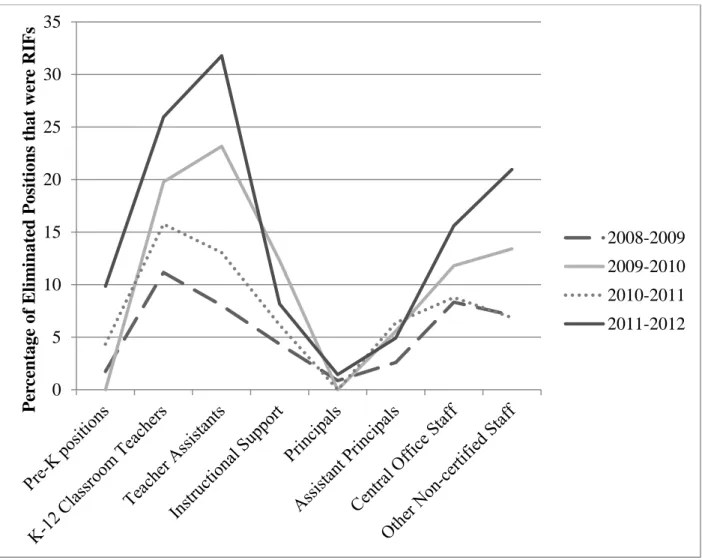
Figure 1. Conceptual framework for this study...10 Figure 2. Brofenbrenner (1998) model of environmental influence...11 Figure 3. Percentage of eliminated positions that were RIFs as a function
of position type for each year of the study...69 Figure 4. North Carolina map showing the 21 RIF districts for the
LIST OF TABLES
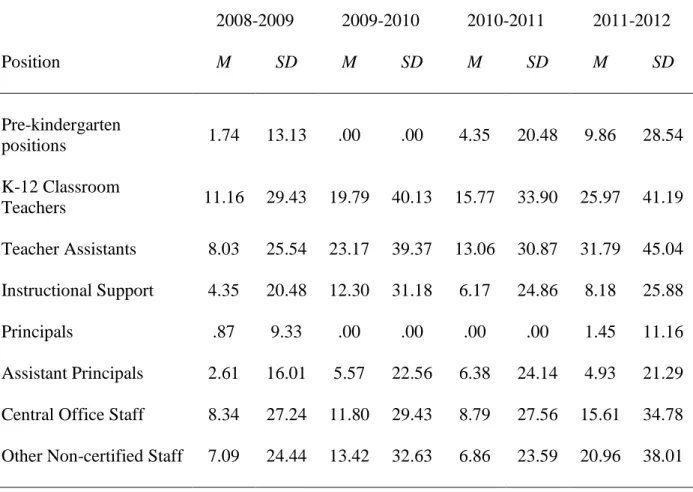
Table 1. Descriptive Statistics for the Percentage of Eliminated Positions That Were RIFs as a Function of Position Type for Each Year
of the Study (N=115)...68 Table 2. Percentage of Districts in Which RIFs Were Sent to One or More
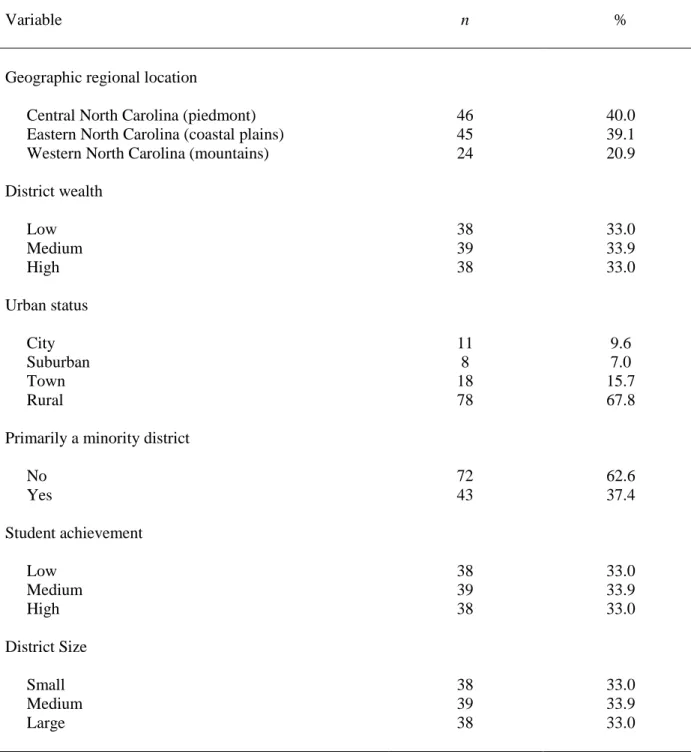
Assistant Principals (N=115)...70 Table 3. Descriptive Statistics for Independent Variables
for Research Question 1 (N=115)...72 Table 4. Results from ANOVA for Research Question 1 (N=115)...74 Table 5. Results from Chi-Square Tests of Independence
CHAPTER ONE
Introduction
It would be profoundly reassuring to view the current economic crisis as simply another rough spell that we need to get through. Unfortunately, though, today’s mix of urgency, high stakes, and uncertainty will continue as the norm even after the recession ends. The immediate crisis… merely sets the stage for a sustained or even permanent crisis of serious and unfamiliar challenges. (Heifetz, Grashow, and Linksky, 2009, p. 62)
Background
A school leadershipcrisis is emerging in America’s public schools due to continuing economic uncertainty and ongoing deep cuts to public spending. The U.S. economic recession that began in December 2007, often referred to as the Great Recession, “has presented a more punishing combination of length, breadth and depth” than any other since the Great Depression (Pew Research Center, 2011, p. 7). Bresser-Pereira (2010) concurred that the global crisis of 2008, brought on by banking instability during 2007, has been the most significant economic crisis since 1929. The impact of the Great Recession can be seen “in terms of rapidly rising unemployment rates, unprecedented post-war government intervention in the management of the economy and wide ranging consequences for labor, and the management of labor” (Sheehan &
Sparrow, 2012, p. 2393). In May 2010, United States Department of Education Secretary Arne Duncan estimated that school layoffs could total from 100,000 to 300,000 unless Congress acts. “It is brutal out there, really scary. We’re seeing massive layoffs all over the country” Duncan told reporters on Capitol Hill. “This is a real emergency. What we're trying to avert is an
education catastrophe” (NEA, 2010).
School systems have been facing an environment of continuous and accelerating change since the onset of the Great Recession (North Carolina Department of Public Instruction [NCDPI], 2011). In a recently released report, NCDPI (2014) revealed that funding has been reduced by over $1 billion since the economic instability began in late 2007. Furthermore, public school leaders have been mandated with demonstrating that they are providing an adequate education for all students as measured by annual state and federal benchmarks. Given the strong emphasis on improving student achievement for all students in public K-12 schools, it is crucial that we understand which human resources school districts consider vital to preserve in this high-stakes era of accountability (Daly, 2009; Guskey, 2007; Ladd & Zelli, 2002; McDonnell, 2013; Schoen & Fusarelli, 2008).
One example of the deleterious effect of the Great Recession is the lack of sustainability of emergency funds issued. For example, North Carolina Public Schools received $297 million in funds from the Federal Education Jobs Program in August 2010, but these funds expired on September 30th, 2012, and are not recurring (NCDPI, 2011). Many school districts believed that resource availability would be greatly limited during the 2009-2010 school year and even more constrained during the 2010-2011 school year as evidenced in the news headlines of the drastic measures school districts considered in the State of Virginia (Chandler, 2009; Coe, 2009; Lizamo, 2009). State policy decisions provide further substantive evidence pointing to job loss in the education sector. In 2011, funding appropriations by the North Carolina House included an 18.8% reduction in assistant principal position allotments (or approximately 385 AP
proposed by the North Carolina General Assembly featured an 8.8% reduction in funding for public education, including elimination of funding for teacher assistants beyond first grade and a nearly 20% decrease in funding for assistant principals (Raleigh Public Record, April 27, 2011). According to a press release from the Charlotte-Mecklenburg Schools (CMS) in 2010, “If all the scenarios are put into operation, CMS would make cuts of more than $78 million and reduce its work force by more than 1,000 employees” (Davidson News, May 12). The Guilford County Board of Education approved a budget in August 2013 that left their school system in
Greensboro, North Carolina, with a $21 million funding gap. According to the NCDPI (2011), the Great Recession marks the first time since the Great Depression that the number of teachers had decreased while the number of students had increased. In 2011, the NCDPI reported that public schools in the state cut more than 8% of staff since 2008-2009. This means that 16,678 positions were eliminated and 6,097 individuals lost their jobs in response to state budget cuts, according to data reported by local school districts (NCDPI, 2011). Deteriorating economic conditions of this period have resulted in significant floundering in the labor market with an increase in job loss, working for low wages or in temporary positions, or working in jobs unrelated to one’s career goals (Johnson, Sage, & Mortimer, 2012).
the ‘Great Recession’ has altered North Carolina’s labor market in unexpected ways.
Three significant trends merit attention: (1) the severity of the economic downturn; (2) the slowness of the labor market recovery; and (3) the shift in the composition of the population of low-income and poor households. (p. 2)
Add to the misery a “record number – 49.1 million – Americans are poor, based on a new Census measure that for the first time takes into account rising medical costs and other expenses” (Associated Press, 2011).
The financial downturn has limited federal, state, and local government’s ability to fund
school districts; difficult budgetary decisions ensue. A very common response by organizations to economic instability and fiscal restraint is some form of downsizing or a reduction in force (RIF). “Drastic measures, such as downsizing, outsourcing, firing workers and cutting back on pension benefits are among the array of decisions contemplated and taken when managers formulate strategies to survive economic crises” (Dalen & Henkens, 2013, p. 308).
These developments underscore the magnitude of the impact of the Great Recession on the overall labor market, and the education sector is no exception. Every year school district leaders must balance their budgets. When faced with constricted budgets, resource allocation decisions become critically important. Not only are funds more limited, but, in this
implementing a RIF might help balance an otherwise deficit budget (Cambron-McCabe,
McCarthy, & Thomas, 2004), but there are negative personal and organizational consequences to such forced job eliminations within an organization.
Why Focus on the Assistant Principal
Undervalued and often unacknowledged, the assistant principal is the often unseen, yet cohesive element that contributes to an efficient and effective school. (Glanz, 2004, p. 2)
There is a critical need for effective public school leadership that transforms schools into learning communities where all children may grow, prosper, and succeed academically.
Numerous studies have concluded that these school-site administrators — principals and assistant principals —play a central role in developing and maintaining effective schools with high levels of student achievement (Brewer 1993; Hallinger & Heck 1998; Leithwood, Louis, Anderson, & Wahlstrom, 2004). Qualified and talented leaders are essential for our schools to meet the challenges posed by North Carolina’s ABC Accountability system, the federal No Child Left Behind Act, and the State of North Carolina’s acceptance of federal Race to the Top grant
money. Such federal and state policy decisions have far-reaching local impacts on school-based educational leadership practice, specifically as they relate to “early exiting” of much needed assistant principals. According to Marshall and Hooley (2006), “early exiting” from the assistant
principal position has historically paralleled that of teachers and has been understandable as they have “…the most unmanageable stress and unanswerable demands…” as any school leader, with
the exception of the superintendent (p. 44).
Foleno, & Foley 2001; Whitaker 2003). In Massachusetts, for example, over 63% of principals reported that they intended to leave the profession within 5 years (Gajda & Militello, 2008). Pounder and Crow (2005) determined that there is an “alarming shortage of qualified
administrators available to fill current and foreseeable school principal openings” (p. 56). A
closer examination of the literature, however, reveals disagreement about the magnitude and characteristics of the leadership shortage (Farkas, Johnson, Duffett, & Foleno, 2001; Pijanowski & Brady, in press; Pounder & Crow, 2005; Roza 2003; Whitaker 2001). In fact, several studies indicate a modest to nonexistent decrease in principal candidate pools and a surplus of
credentialed administrators for available positions (Bowles, 1990; Davis, 2005; McCormick, 1987; National Association of Secondary School Principals, 1998; Portin, Shen, & Williams, 1998). Other research cites declining principal applicant pools despite evidence that the number of certified administrators is nearly twice the number of available leadership positions (Gajda & Militello, 2008). The research describes a myriad of possible reasons for the administrator shortages, including reaching retirement age, poor compensation, increased time demands, and stress (DiPaola & Tschannen-Moran, 2003; Fink & Brayman, 2004; Frankel & Hayot, 2001; Institute for Educational Leadership [IEL], 2000; Jones, 2001; Maddern, 2009; National Association of Elementary School Principals & National Association of Secondary Schools Principals (NAESP/NASSP), 1998; Roza, Celio, Harvey & Wilson, 2003).
Since assistant principals represent a major pipeline of applicants for future principals and superintendents, this study focuses on understanding how the economic downturn has affected them. The natural progression in educational leadership is to evolve from a teacher, to assistant principal, to principal, and ultimately achieving the position of superintendent
Glass (2000) reported that “nearly all superintendents previously worked as building principals,
and a majority are former assistant principals” (p. 28). Notably, most of these studies were conducted prior to the Great Recession of 2008. This represents yet another reason to have conducted this study. Exploiting detailed data on school position eliminations and RIF measures over a four-year time period (2008-2012) during the Great Recession and the years of fiscal retrenchment following, this study examined how assistant principals may be disproportionately impacted by RIF relative to six other school positions in the state of North Carolina.
Confounding demographic and fiscal characteristics of each district were also considered.
Statement of Problem
Despite education’s fundamental role in human capital formation and growth, there is
little research that examines the effect of the Great Recession on schools and the people who lead them. The continued erosion of revenue for state and local school budgets stemming from the Great Recession may greatly impact the educators who provide leadership within public schools (Berger, 2007; Bottery, 2006; Held & McGrew, 2007; Litz, 2011; Mulford, 2008; Tikly, 2001). The endurance of the recession has forced increasingly significant changes, including a marked increase in cuts to the position of assistant principal (NCDPI, 2011). Since the assistant principal is often assigned the role of instructional leader within a school and, as such, is responsible for facilitating effective teaching and learning with the overall mission of enhancing student
identified as a contributing factor to higher student achievement (Andrews & Soder, 1987; Brewer, 1993; Edmonds, 1979; Hallinger & Heck, 2000; Leithwood, Louis, Anderson, & Wahlstrom, 2004; Lezotte, 1994; Waters, Marzano, & McNulty, 2003). Is there a relationship, then, between the instructional leadership behaviors of the assistant principal and student achievement? Will the loss of the assistant principal position, as a result of RIFs, negatively impact student achievement? This study does not answer these questions directly but it does provide interesting trends that merit further review. The continuing reduction of this critical entry-level position in some schools may threaten the quality of the educational opportunities provided to students and weaken the pipeline to future leaders who have the capacity to deliver essential services.
Although RIFs and their organizational impacts have been prominent issues in the business literature, there is scant attention paid to this important topic in recent educational literature. This study purported to fill the knowledge gap by exploiting detailed archival data on school position eliminations (including RIF) and an analysis of trend shifts to the position and status of the assistant principal in North Carolina’s public schools. This examination begins to
shed light on how the Great Recession has affected school leadership in the State of North Carolina.
Purpose of Study
assistant principals vary from those districts that did not issue RIF notifications to assistant principals.
Research Design
The goal of this research was to investigate a new and emerging social phenomenon of RIF that may be preferentially impacting assistant principal leadership in the North Carolina Public Schools (North Carolina Public Schools, 2011). The stated goal fits with the philosophy, strategies, and intentions of the social constructivist view that seeks to understand a human phenomenon by studying those directly impacted (Higgs, 2001) and is based on the epistemology of idealism where such knowledge is viewed as a social construction (Bullock & Trombley, 2000).
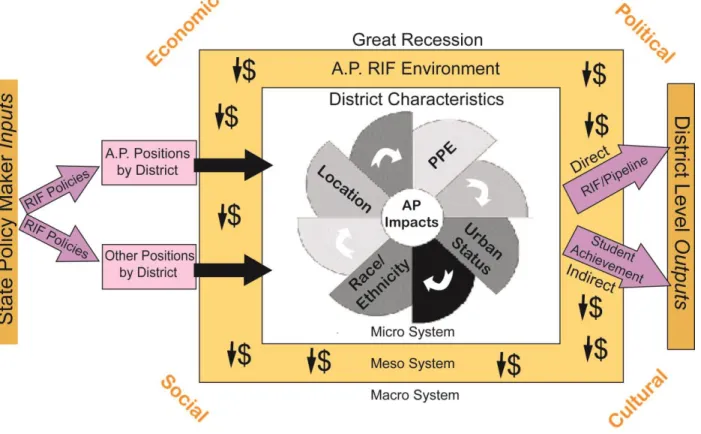
The research design for this study follows a framework (see Figure 1) that is loosely based on the Bronfenbrenner (1998) social ecological model of development (Figure 2). Bronfenbrenner (1998) built this model that shows how human development occurs within concentric circles of environmental influence, such as family, school, peer interactions, and community relations (Figure 2). This framework (Figure 1) was utilized to determine if assistant principals have been disproportionately affected by RIFs relative to individuals in “Other
Positions” including pre-kindergarten positions, kindergarten-12th grade teachers, teacher
assistants, instructional support personnel, principals, central office staff, and other non-certified staff. Further, the social ecology of the model influences the position and status of assistant principals in the form of multiple embedded and overlapping demographic and fiscal
characteristics surrounding centrally located “AP Impacts”. These district characteristics require
attention in order to understand and interpret the main RIF phenomenon as a whole.
Figure 1. Conceptual framework for this study.
student achievement encircle the AP where convergence of multiple environmental forces act upon the position and status of the leader. All of these complex multi-layered interactions occur within the backdrop of an Assistant Principal Environment (“A.P. Environment”) of lowered school funding ( “↓ $”) represented on a meso-system level. Social, cultural, political, and
economic contexts of the larger society contribute further to the complexity of the phenomenon and are seen at the macro-system level. According to Coatsworth (2002), the ecology of the model also includes a macro-system of social, cultural, political, and economic contexts within the domain of the larger society.
Figure 2. Brofenbrenner (1998) model of environmental influence.
conceptualized at the school-level (“School Level”) and may be viewed directly as loss of position and status (“Job Loss”) and indirectly as student achievement affects (“Student Achievement”). Outputs may be viewed directly as loss of position and status (“RIF”) and reduction of principal candidates (“Pipeline”) or indirectly as student achievement affects (“Student Achievement”). The study hypothesized that there may be direct (or indirect) RIF
consequences to those served, the students.
each of the seven positions to be included in this study (assistant principals as well as pre-kindergarten positions, pre-kindergarten-12th grade teachers, teacher assistants, instructional support personnel, principals, central office staff, and other non-certified staff).
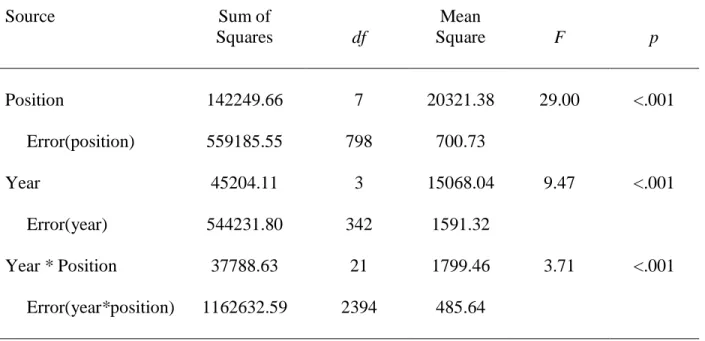
For each position the percentage of total eliminated positions that were RIFs was computed. For example, if, in a given school district, there were four eliminated positions for assistant principals, two of which were RIFs, then the RIF percentage would be 2/4 = 50%. This percentage, computed for each position in each school district in each of the four years under study, was the dependent variable in this study. The independent variable is position (assistant principals, pre-kindergarten positions, kindergarten-12th grade teachers, teacher assistants, instructional support personnel, principals, central office staff, and other non-certified staff). In order to test the null hypothesis of this study, an 8 (positions) by 4 (years) repeated-measures ANOVA was performed with the percentage of eliminated positions that were RIFs as the dependent variable. The sample size was the 115 school districts.
To accomplish an examination of fiscal and demographic characteristics of RIF school districts, data on geographic regional location, size, income wealth of the district (poverty), urban status, racial characteristics, and student achievement were utilized in this study. The most recent published data that include all of the variables were available for the four consecutive years of the study (the 2008-2009, 2009-2010, 2010-2011, and 2011-2012 school years), and may be acquired from the North Carolina Public Schools website (North Carolina Public
Schools, 2011), a document published by North Carolina’s Department of Public Instruction and
distributed to all school systems and the public.
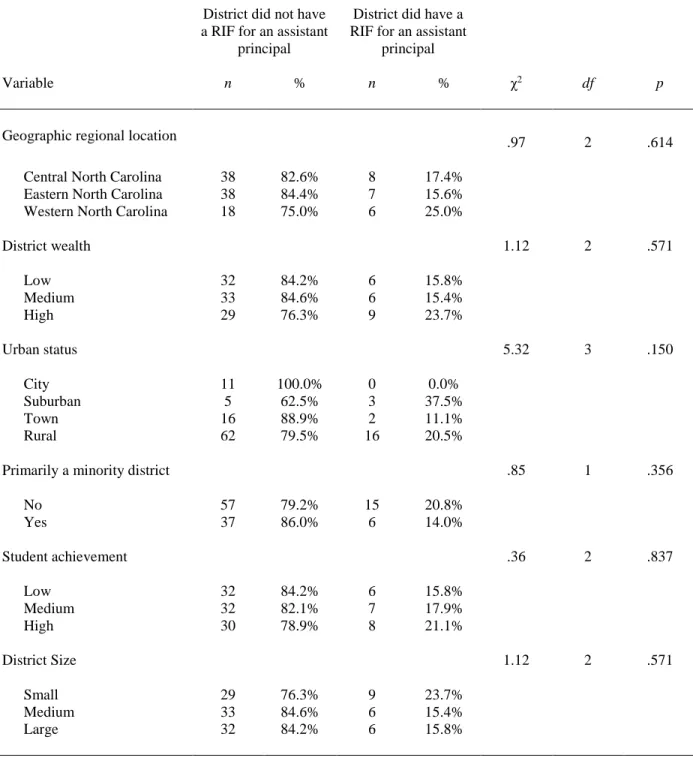
individuals in other positions including those in pre-kindergarten positions, kindergarten-12th grade teachers, teacher assistants, instructional support personnel, principals, central office staff, and other non-certified staff. The variables examined in the second research question were whether or not the district sent one or more RIFs to assistant principals, geographic regional location, district size, wealth, urban status, identified racial/ethnicity groups, and student achievement. Other variables previously mentioned from all 115 school districts were also collected and analyzed, permitting an examination of the correlations between RIF and non-RIF districts as well as possible correlations of assistant principal RIFs to the previously mentioned variables. A series of six chi-square tests of independence were performed to answer the second research question of this study.
Assumptions
Limitations
One limitation of this study is that only state-level archival data were used. It is
important to note that local policy makers may allocate resources in such a way as to prevent RIF of assistant principals even though state-level data may suggest otherwise. A limitation, then, is that local data were not included in this analysis. Also, many small districts have very few assistant principal positions to begin with. This study does not control for district size and an already reduced assistant principal workforce due to scant resources. In addition, the researcher has no control over the accuracy of the data collection or the particular variables assessed. However, this is a minor limitation in this study because the reputation of the data required for this study is that they were collected by the NCDPI in an accurate and reliable manner. All data were reported by each school to the district office and then finally to the NCDPI. The integrity of the data collection process may be a limitation due to self-reporting. In addition, all of the variables required to test the hypothesis of this study were contained in the archival data used.
Another limitation of this study was that data for other variables such as work experience that could be predictive of RIFs were not included. Also, this study focused on 115 school districts in North Carolina. Data do not include charter schools. The sample is sufficient to establish credibility and discern variance, however. Since the research questions are relatively unexplored in the current body of literature, this sample size offers an entrance into the
investigation and discussion of RIF impacts during a period of fiscal retrenchment; yet, findings will not be generalizable. Assuming that differences are found between the various positions and district characteristics in terms of RIFs, future researchers can attempt to build more
Hypotheses
Major Research Question/Hypothesis
There are two research questions in this study corresponding to the two purposes stated above. The first research question to be addressed was: Have assistant principals been
disproportionately affected by RIFs relative to individuals in other positions including those in pre-kindergarten positions, kindergarten-12th grade teachers, teacher assistants, instructional support personnel, principals, central office staff, and other non-certified staff? The hypotheses corresponding to this research question were:
Ho1: Assistant principals have not been disproportionately affected by RIFs relative to individuals in other positions including those in pre-kindergarten positions, kindergarten-12th grade teachers, teacher assistants, instructional support personnel, principals, central office staff, and other non-certified staff.
Ha1: Assistant principals have been disproportionately affected by RIFs relative to individuals in other positions including those in pre-kindergarten positions, kindergarten-12th grade teachers, teacher assistants, instructional support personnel, principals, central office staff, and other non-certified staff.
(according to the “urban-centric” classification system [NCES, 2006]—one of four major locale categories—city, suburban, town, and rural), identified racial/ethnicity groups, and student achievement as a function of percent of students who passed ABCs End-of-Grade (EOG) tests in both math and reading. Based on those six characteristics, there are six sets of hypotheses for the second research question:
Ho2: Districts that issued RIF notifications to assistant principals and districts that did not issue RIF notifications to assistant principals do not differ in terms of geographic regional
location.
Ha2: Districts that issued RIF notifications to assistant principals and districts that did not issue RIF notifications to assistant principals differ in terms of geographic regional location.
Ho3: Districts that issued RIF notifications to assistant principals and districts that did not issue RIF notifications to assistant principals do not differ in terms of size.
Ha3: Districts that issued RIF notifications to assistant principals and districts that did not issue RIF notifications to assistant principals differ in terms of size.
Ho4: Districts that issued RIF notifications to assistant principals and districts that did not issue RIF notifications to assistant principals do not differ in terms of wealth.
Ha4: Districts that issued RIF notifications to assistant principals and districts that did not issue RIF notifications to assistant principals differ in terms of wealth.
Ho5: Districts that issued RIF notifications to assistant principals and districts that did not issue RIF notifications to assistant principals do not differ in terms of urban status.
Ho6: Districts that issued RIF notifications to assistant principals and districts that did not issue RIF notifications to assistant principals do not differ in terms of identified racial/ethnicity groups.
Ha6: Districts that issued RIF notifications to assistant principals and districts that did not issue RIF notifications to assistant principals differ in terms of identified racial/ethnicity groups. Ho7: Districts that issued RIF notifications to assistant principals and districts that did not issue RIF notifications to assistant principals do not differ in terms of student achievement.
Ha7: Districts that issued RIF notifications to assistant principals and districts that did not issue RIF notifications to assistant principals differ in terms of student achievement.
Definition of Terms
The following definitions are provided to facilitate understanding of the terms throughout the study:
District size. School district size is defined as small, medium, or large districts as a function of average daily membership (ADM).
Eliminated positions. Eliminated positions are defined as those positions that were lost, both vacant and filled (NCDPI, 2012).
Geographic regional location. In this study, geographic regional location is defined as Western North Carolina (mountains), Central North Carolina (piedmont), and Eastern North Carolina (coastal plains).
Identified racial/ethnicity groups. In this study, this variable is operationalized as whether or not 50% or more of the district’s students are from minority groups.
Involuntary turnover. Involuntary turnover occurs when administrators or managers within an organization make the decision to terminate an individual’s employment with the
organization (Zimmerman, 2008).
Locale codes. Locale codes identify the geographic status of a Local Education Agency (LEA) on an urban continuum ranging from “large city” to “rural.” They are based on the locale codes assigned to the schools within the LEA, which in turn are based on a school’s
physical address. The urban-centric locale codes in this file are assigned through a methodology developed by the U.S. Census Bureau’s Population Division in 2005. The
urban-centric locale codes apply current geographic concepts to the NCES locale codes used from 1986 through the present. (The original locale codes are referred to as “metro-centric locale codes” for ease of distinguishing the two systems.) The new urban-“metro-centric
methodology supplements, and will eventually replace, the older locale code methodology. (National Center for Educational Statistics, 2014)
Per Pupil Expenditure (PPE). Simplistically, per pupil expenditure, when taking into account local, state, and federal funds, can be defined as the “total current operating expenditures
on a per pupil basis. Some examples are instructional materials, maintenance, and transportation” (Report Card Terminology, 2002). The PPE for each school district in
North Carolina was obtained from an annual publication by North Carolina Public Schools called North Carolina Public Schools Statistical Profile.
the number of positions due to reorganization, decreased enrollment, or a reduction in funding. The North Carolina General Assembly institutes its RIF process by state statute.
RIF positions. RIF positions are positions that are eliminated. An individual lost their job (NCDPI, 2012).
Student achievement. Student achievement is measured by the performance of each student group on ABCs End-of-Grade (EOG) tests. Precisely, the percentage of students, grouped by gender, ethnicity and other factors, which passed both the reading and math tests, is the metric used (North Carolina Report Cards, 2008-2012).
Voluntary turnover. Voluntary turnover occurs when an employee makes the decision to terminate employment with an organization (Zimmerman, 2008).
Urban status. Urban status is defined according to the “urban-centric” classification system (NCES, 2006) as one of four major locale categories: city, suburban, town, and rural.
CHAPTER TWO
LITERATURE REVIEW
Introduction
Given the scarcity of scholarly research on the specific issue addressed by this study, this chapter places the implications of reduction in force, or RIF, on assistant principals within the broad context of educational leadership and impacts to a career pipeline system. During the literature review, it was discovered that very little research exists on the assistant principalship during (and after) the Great Recession and even less was found on RIF of assistant principals. In order to provide a synthesis of the current literature relating to this dissertation topic, the
literature is grouped into seven major categories: The Great Recession, A Business Paradigm Applied to Education, District Characteristics Affecting the Business Paradigm Applied to Education, Evolution of the Assistant Principalship, The Reluctant Principal Candidate, The Value of the Assistant Principal in the Context of Leadership Theory, and Models of Assistant Principal Leadership.
The Great Recession
The World’s economy teetered at the edge of an abyss in late 2008 and early 2009. (Zumeta, 2010, p. 29)
1. providing $140 billion in aid to state governments;
2. making federal loans and equity purchases to General Motors, Chrysler, and large banks;
3. extending unemployment benefits;
4. reducing interest rates to near-zero levels;
5. providing $8,000 in tax credits to first-time home buyers to stimulate home purchases; and
6. providing a $4,000 credit to trade in less fuel-efficient cars for new cars. In the end, the federal government spent over $4.7 trillion to jump-start the economy. Without action by the federal government, the economic conditions of the 1930s could have repeated. By mid-2009, the recession was officially over (Zumeta, 2010). Unofficially, however, the stage was set for a “sustained or even permanent crisis of serious and unfamiliar challenges” (Heifetz,
Grashow, & Linksky, 2009, p. 62).
Impacts on North Carolina Educators
The term draconian sometimes appears in the media to describe the rampant reductions in educational funding sweeping across the United States. 1 In North Carolina, the 2011-2012 academic year marked the first time since the Great Depression that public schools reduced the size of the teaching force amidst a growing student population (North Carolina, 2011). Teachers were not the only school personnel affected by the massive layoffs – principals, assistant
principals, teaching support personnel, and various non-educational staff were also affected. In response to the prospect of the severe cuts in educational spending, North Carolina
Representative Rick Glazier (D) declared that the relentless reductions would ultimately produce “huge damage to the educational system” (Robertson, 2011, p. 16).
Teaching positions and teaching assistant positions comprise roughly one-third each (35% and 33%, respectively) of the positions eliminated in North Carolina since 2008 (North Carolina, 2011). Teacher shortages and their impact on student learning have long been a focus of educators, educational researchers, and policymakers. However, when scrutinized carefully, the problem is not so much that there is a shortage of teachers, per se, but rather that there is a shortage of highly qualified teachers in the economically disadvantaged schools that are most in need of capable teachers (Amrein-Beardsley, 2007; Clotfelder, Ladd, Vigdor, & Wheeler, 2006; Darling-Hammond, 2004). Disadvantaged schools also need the most effective principals, not only to lead school improvement efforts, but also to attract good teachers. The quality of principal leadership is the overriding factor in attracting expert teachers to challenging schools. The prospect of working in a school with a “controlling, uncaring, ineffective, and unsupportive principal” is the biggest deterrent to recruiting teachers to work in a high needs school
(Amrein-Beardsley, 2007, p. 66).
leadership ranks second only to classroom teaching for its impact on student learning (Leithwood et al., 2007). The principal’s leadership sets the stage for the culture and climate in which
teaching and learning unfold. Teacher and principal effectiveness and student academic
performance are the critical indicators of education improvement efforts (Strategic Management of Human Capital, 2009).
In the same way that the purported shortage of teachers is more a shortage of effective teachers in high needs schools, there is scant evidence for an actual or impending shortage of principal candidates (Browne-Ferrigno & Muth, 2008). Principal preparation programs are thriving with expanding enrollments and the number of candidates exceeds the number of
vacancies in school administration (Browne-Ferrigno & Muth, 2008). Analogous to the situation with teachers, the challenge lies in filling administrative positions in economically disadvantaged communities where resources are scarce, turnover is high, and salaries – as well as student achievement – are low (Browne-Ferrigno & Muth, 2008; Clotfelter et al., 2006; Roza, Celio, Harvey, & Wishon, 2003). Furthermore, there is frequently a difference between what school districts want in a principal and the criteria human resource (HR) professionals use to determine the qualifications of principal candidates (Roza et al., 2003).
Although teachers and principals both impact student achievement, the teacher’s
The education reforms of the 1980s and 1990s generated an upsurge of interest in the assistant principal’s role (Glanz, 1994; Marshall, 1992; Mertz, 2000; Michel, Cason, Jennings,
Palmer, & Pressley, 1993). As instructional leadership became a dominant leadership paradigm, assistant principals began to assume a role as instructional leaders (Marshall, 1992). The ability to manage interpersonal relationships within the school and with the local community took on more importance with increasing attention to the accountability of school leaders to various stakeholder groups (Michel et al., 1993). However, the literature on the assistant principal remains scarce compared to the voluminous body of research on teachers and the expanding body of research on the school principal. More than two decades after Marshall (1992) described the assistant principal as virtually invisible and ignored by scholars, other researchers have made the same observation (Cranston, Tromans, & Reugebrink, 2004; Dunleavy, 2011; Johnson, 2004; Oliver, 2005; Singletary-Dixon, 2012; Wong, 2009).
In the current context of RIF in the North Carolina Public Schools, assistant principals have not been ignored – the data released by the NCDPI covering all 115 local education
authorities (LEAs) suggested an accelerated elimination of assistant principal positions between 2008 and 2012 (North Carolina, 2011). Though the figures vary from state to state, the extensive cuts in administrative positions are not unique to any state, geographic region, or school district.
school administration. According to Domenech, that percentage was expected to escalate. In sharp contrast to the historical pattern where job cuts were due to attrition or voluntary leaving, half of those impending reductions in administrative positions were expected to come from
involuntary terminations. Since APs are key figures in maintaining the organizational stability of schools, one cannot study instructional leadership (and thus student achievement) without also including the role of the AP (Hallinger, P., & Heck, R. H. (1996a)). Related studies in the United States and other countries assert that high-performing schools are led by effective leaders
(Dinham, 2007; Gurr et al., 2005; Hallinger & Heck, 1996a; Hoy & Miskel, 2001; Jacobson, 2010; Leithwood & Riehl, 2005; Wong, 2005). Further, research has identified compelling linkages between educational leadership, teacher development, school improvement, and student achievement (Bush, 2009; Dinham, 2007; Seashore-Louis et al., 2010). The next section
explores further the new and emerging phenomenon seen in the education sector, involuntary
attrition due to RIF.
A Business Paradigm Applied to Education
RIF has been a business strategy for more than 30 years, more familiarly known by a variety of euphemisms such as downsizing, re-sizing, re-engineering, and the most painful to incumbents who unwillingly lose their jobs, rightsizing (Gandolfi, 2010). In the context of education reform, the most common term is restructuring and the connotation is frequently positive, implying a more collaborative and distributed model of leadership (Day et al., 2008; Hallinger & Heck, 2010; Leithwood et al., 2007).
jobs (Marshall, 1992). Some school districts have implemented early retirement policies, and principals of underperforming schools may be replaced by a turnaround leader (Mascall & Leithwood, 2010). Though typically caused by voluntary turnover, rapid principal turnover of any type can be disruptive to school improvement efforts. Massive budget cuts depleting human and material resources may be especially detrimental to schools undergoing improvement (Kober & Rentner, 2011).
Background of RIF
RIF denotes the release of a permanent employee from his or her position within the organization (Gandolfi, 2010). In addition to the various euphemisms, a less positive sounding term is layoff, which once “referred exclusively to a temporary interruption to work,” but “now applies to the permanent elimination of jobs and positions as a cost-cutting measure” (p. 4). Technical distinctions between concepts are a topic of debate for management scholars and HR professionals but from the perspective of the employee confronted with job loss, the meaning is very clear: whatever the term the result is the “permanent separation from the firm” (p. 4).
RIF became a staple of the business literature with the massive changes in organizational structure and leadership that began in the late 1970s, gaining momentum in the 1980s and 1990s (Gandolfi, 2010). The most drastic type of RIF involves large-scale redundancy programs, or mass layoffs, a strategy used by large corporations since the 1970s to resolve a firm’s financial
problems. Further, with no precedents in the education workforce, there is no evidence of how current RIF programs will turn out. However, there are dire predictions of the potential negative consequences of mass layoffs and budget cuts (Kober & Rentner, 2011; Robinson, 2011;
of school district—city, suburban, town, or rural—has been immune from declining budgets” (Kober & Rentner, 2011, p.15).
In response to the budget cuts, half the school districts across the U.S. have had cuts in their teaching force, and numerous activities have been reduced or eradicated – including staff professional development, purchases of teaching materials and technology, building
maintenance, and student services (Kober & Rentner, 2011). The elimination of school administrator positions is the latest consequence of the funding cuts (Schachter, 2011). The majority of school districts have gone off “the dreaded ‘funding cliff’” where they depleted their
funds from the American Recovery and Reinvestment Act of 2009 (ARRA) and have no additional resources to offset budget cuts (Kober & Rentner, 2011, p. 1). Domenech used the “cliff” metaphor to underscore the negative ramifications of state level cuts in the education
budget combined with the end of the federal stimulus funds (Schachter, 2011).
The consequences of RIF for education administrators range from the elimination of entire district office departments (such as departments of assessment and operations) to the elimination of school leadership team members (Schachter, 2011). Assistant principals seem to have gone from an invisible species (Marshall, 1992) to an “endangered species” at the school
level despite the burgeoning public school student enrollments (Schachter, 2011, p. 30). Veteran school administrators with 30 or more years of experience report they have never seen such a scale of mass layoffs. Several states are eliminating administrator positions at a faster rate than teaching positions. The reason lies in the effort to “make the cuts as far away from the
classroom,” according to one school superintendent in Wichita, Kansas (Schachter, 2011, p. 30).
of an effort to protect instruction at all costs. This study hypothesized that there may be an
indirect (and measurable) impact to student achievement as a result of assistant principal loss. RIF targets those charged with evaluating classroom instruction, the assistant principals.
Larger class size is one of the consequences of the education budget cuts (Kober & Rentner, 2011; Schachter, 2011). At the national level, for the 2010-2011 school year, the reduction or elimination of teaching positions in subjects other than core academic subjects accounted for the highest proportion of reductions (68%), followed by a reduction in teaching positions in core academic areas (54%; Kober & Rentner, 2011). These reductions were followed by support staff at the school or district level (49%), administrative staff at the district level (38%), administrative staff at the school level (33%), early retirements and/or buyouts (28%), staff benefits (23%), and staff furloughs (15%). These estimated reductions were projected to accelerate in future years (Kober & Rentner, 2011).
Gandolfi (2010) noted that as long as organizations are concerned with cost cutting (regardless of reason) they will resort to mass layoffs despite questionable outcomes (Gandolfi, 2010). A very common consequence is that the remaining employees are faced with new or increased responsibilities. In education this implies larger class size and perhaps fewer opportunities for distributed leadership, while smaller classes and planned distribution of leadership are features of high performing schools (Leithwood et al., 2007; Mascall & Leithwood, 2010).
innovation. Some of the companies reduced their workforce to focus on core operations, which could mean research and development, thereby accounting for the positive impact. However, RIF for the purpose of cutting costs had a significant negative impact on product innovation.
While there is no direct parallel between corporate downsizing and product innovation and downsizing in education and student outcomes, it may be possible to compare product innovations with educational innovations. Budget cuts in education have a direct impact on innovations as the cuts are targeting areas such as staff training, professional development, and the purchase of new materials and technology (Kober & Rentner, 2011). However, beyond the direct impact of cuts in material resources and training, the reduction in human resources is likely to interrupt education improvement efforts. Leadership turnover has a disruptive effect on school improvement programs and student outcomes (Graczewski et al., 2009; Mascall &
Leithwood, 2010). The short-term and long-range impacts of the drastic education cuts are unknown but the predictions are not positive (Kober & Rentner, 2011; Robinson, 2011; Schachter, 2011). We do know that the Great Recession has changed the employment and financial situations of millions of American families as the next section will highlight.
Consideration of Issues of Social Justice in this Business Paradigm
The Great Recession has had a devastating effect on poverty level and income disparity. In 2013, 14.5% of the population (or 45.3 million people) were poor—up from an all-time low of 11.3% in 2000 and higher than in 1979. Even more significant, the historically higher Black (27.2%) and Hispanic (23.5%) rates and lower non-Hispanic White (9.6%) rate rose from their all-time lows in the 2000s. Non-Hispanic Whites accounted for 62.4 percent of the total
household income over the past six years shows that income is 8.0 percent lower than in 2007, the year before the nation entered the Great Recession. The income disparity between men and women continues. In 2013, the median earnings of women who worked full time, year-round ($39,157) was 78 percent of that for men working full time, year-round ($50,033) ─ not statistically different from the 2012 ratio. The earnings ratio has not experienced a statistically significant annual increase since 2007 (DeNavas-Walt, C. & Proctor, B. D., U.S. Census Bureau, 2013). The United States is becoming an increasingly multiracial and multicultural society; at the same time, conditions of economic inequality by gender and race have not improved. These trends in the substance and structure of society challenge educators to evaluate how to address these demographic shifts.
North Carolina has a culturally and socioeconomically diverse school population
(Clotfelder et al., 2006). For comparison, California may also be viewed as a microcosm of the inequities in the American educational system (Darling-Hammond, 2004). In both states, disparities based on income are especially sharp and schools with the highest needs have a shortage of excellent teachers and principals.
(Clotfelder et al., 2006). Similar evidence for the detrimental impact of teachers with lower credentials is reported in California (Darling-Hammond, 2004).
The influence of principals on academic performance is indirect and difficult to measure precisely (Leithwood et al., 2004, 2006, 2007). The North Carolina researchers faced the same challenge in analyzing the impact of principal qualifications on achievement in schools based on income (poverty) quartiles (Clotfelder et al., 2006). At the same time, two types of evidence supporting the premise that differences in principal qualifications matter for student performance were found in previous research. First, schools led by principals with higher credentials tend to have a higher proportion of students who achieve proficiency on the state standardized tests. Second, and probably a contributor to the first outcome, principals with stronger qualifications are more successful in attracting and retaining effective teachers. According to Waters, Marzano and McNulty (2003), students’ scores may increase up to 10 percentile points on standardized
tests in just one year with a highly effective principal. A study by the CALDER Center found that the impact of principals, as measured by the value-added scores based on student test scores, was nearly twice as large in high-poverty schools as in low-poverty schools (Branch, Hanushek & Rivkin, 2012). Their study also found the impact to be greater in large high-poverty schools than in large low-poverty schools, which has been found in other studies as well (Branch,
second or third schools typically enrolled 89 percent fewer poor and minority students than their first position (Beteille, Kalogrides & Loeb, 2011; Miller, 2009).
Among expert teachers, principal leadership is the decisive factor in considering a
teaching position in an underperforming, high poverty school (Amrein-Beardsley, 2007). On the whole, teachers and principals with stronger qualifications self-select into more affluent, higher performing schools (Amrein-Beardsley, 2007; Clotfelder et al., 2006; Darling-Hammond, 2004). In short, a mismatch between the qualifications of teachers and principals and the needs of the schools works to perpetuate the inequities in the educational system. This effect may be further exacerbated by incongruities between principal qualifications as interpreted by HR departments and the attributes sought by district officials (Roza et al., 2003).
District Characteristics Affecting the Business Paradigm Applied to Education
District size has an impact on per pupil funding, human resources, and academic
achievement. Smaller districts spend more to support fiscal and human resources, which means that during periods of fiscal retrenchment, smaller districts will have a more difficult time
directly affected student graduation rates. A child’s economic level was also shown to be related
to his or her educational attainment level and to be further affected by the duration of the family’s poverty. However, Borland and Howsen (2003) showed poverty level of students was
statistically insignificant regarding student achievement.
Pennington (2009) found district size was negatively correlated with per pupil expenditures. Small districts had to spend more in order to meet the minimum accreditation standards required by law. For example, minimum fund balances must be maintained (3% reserve) in order to avoid a negative budget certification. In a four state study by Howley and Bickel (1999), smaller schools were beneficial to student achievement in lower socioeconomic communities and larger schools were more beneficial in more affluent communities. Higher student achievement was documented in moderate-sized high schools (600-900 students), especially for those with high percentage of minority and low socioeconomic students (Lee & Smith, 1997). However, larger schools tend to offer students more opportunities to enroll in advanced or alternative courses (Haller, Monk, Spotted Bear, Griffith, & Moss, 1990).
Yet, when Borland and Howsen (2003) investigated optimal school size, their
investigation established a non-linear relationship between student achievement and school size. Their results implied “that as school size increases, at first, student achievement increases…up to 760 students and decreases thereafter” (p. 470). Wainer and Zwerling (2006) conducting a study
of the Pennsylvania System of School Assessment mathematics and reading scores found no apparent relationship exists between school size and student performance.
findings supported that schools, families, and peers were not very important in determining an increase in student achievement, thus increasing expenditures was not the answer to improving student achievement.In 2011, Cullen, Jones, and Slate found lower student achievement on state mandated exams by students in Texas who were enrolled in districts that spend less than 60% of their operating budgets on instructional expenditures. Jones, Bingham, and Jackson (2007) investigated the relationship between instructional expenditures and student achievement as measured by SAT and TAKS tests. They used released Texas AEIS data on 702 public, independent school districts for the 2003-04 school year. Their study concluded there was no statistical correlation between TAKS or SAT test scores and percent budget for instruction. Roper (1996) conducted a study using Stanford Achievement Test scores from 127 Alabama public school districts. He used test scores from the districts fourth, seventh, and tenth grade students and found student academic achievement was not related to instructional support expenditures.
Other research that followed suggested that resource inputs can be powerful predictors of multiple student outcomes suggesting that per-pupil funding is a strong predictor of student achievement (Borland & Howsen, 2003; Jones & Slate, 2010; Pan, Rudo, Schnieder, & Smith-Hansen, 2003). Arrington (2010) analyzed the effects of instructional expenditures on students’ state mandated exams over a three year period starting in 2006. She documented a weak and positive correlation between student performance and instructional expenditures for all three years of the study. She broke out administrator and teacher salaries and found they had the largest, positive impact on student achievement on the state mandated exams. For North Carolina’s 4th grade students, Okpala, Okpala, and Smith (2001) found a low, positive
correlation between student achievement on free and reduced lunches and per pupil expenditures. They revealed student success was much higher on state mandated math exams when they
attended wealthier districts. Other studies have focused on portions of each of the factors such as demographics and instructional expenditures or student-teacher ratios and administrative salaries (Alcorata, 2011; Early-McBrayer, 2008, Jones, 2007; Turner, 1999; Walters, 2005; Wenglinsky, 1997) and their effects on student achievement.
How do these fiscal and demographic characteristics contribute to the loss of position and reduced status of assistant principals? The review of literature next explores how this key player in the career pipeline to become a future principal (or district leader) has evolved. In general, there is a dearth of research on assistant principals, with most studies focused on the roles and responsibilities of the job and the future career aspirations of the incumbents (focused on whether or not they aspire to be promoted to principal). Marshall (1992) pioneered the study of the career trajectories of assistant principals, and her classifications of upwardly mobile, career,
and plateaued assistant principals continue to serve as a framework for research. The next section describes the beginnings of the assistant principalship.
Evolution of the Assistant Principalship
The assistant principalship dates back to the 1920s and 1930s (Glanz, 1994).
Historically, principals or head teachers (the term still used in the U.K.) were placed at the helm of schools but their authority was minimal. School operations were supervised by the
with the responsibility of advising less experienced teachers in instruction, curriculum, and classroom management.
In the same way that the increasingly complexity of the school system removed the superintendent from school operations, the principal became further removed from classroom instruction (Glanz, 1994). The dominance of scientific management played a pivotal role in shifting the principal’s focus from instruction to management (Brooks & Miles, 2006). As the principal assumed more managerial duties, tasks such as classroom observation and supervision and curriculum development were gradually delegated to a new group of school administrators originally called general supervisors (Glanz, 1994). Beyond their responsibilities for
supervising instructional matters, the general supervisors helped the principal with an array of managerial tasks and became known as assistant principals. Absent from this job description of the exercise of formal authority: assistant principals served as advisors who were subordinate to the principal.
Two interrelated phenomena in the 1980s produced a major shift in the assistant principal’s role: the drive for effective schools and the emergence of instructional leadership
(Marshall, 1992; Michel et al., 1993; Wong, 2009). Activities related to instruction were entirely absent from a survey of the tasks performed by assistant principals in 1965, but ranked high on the list in importance in 1987 (Marshall, 1992). Providing incentives and motivation to teachers was another recent addition to the assistant principal’s role and tasks related to school policy, and public relations also increased in importance during the 20-year span. Whether they have the title of principal or assistant principal, principals are instrumental to creating a school climate conducive to the success of students and teachers (Kelley et al., 2005).
Dilemmas in Role Definition
The assistant principal seldom has a consistent, well-defined job description, delineation of duties, or way of measuring outcomes from accomplishment of tasks. (Marshall & Hooley, 2006, p. 7)
Responsibilities and expectations of the assistant principal are vague and diversified; these conflicting role demands place great stress on assistant principals. Job descriptions and organizational hierarchies oftentimes place these entry-level building administrators as low status, overlooking the reality that these beginnings oftentimes produce future district leaders and superintendents.
With such undefined and varied roles, Kelly (1990) concludes, “One of the enduring myths of education is that the position of the assistant is a proper and useful training ground for the principalship” (p. 9). In October 2008, National Association of Secondary School Principal (NASSP) Executive Director, Gerald N. Tirozzi, commented that “assistant principals have one of the toughest jobs in education” (NASSP Newsletter, 56(2)). It would seem that such
(2000) found that role ambiguity has led to present constructions of the assistant principalship that are simply inadequate for creating strong leaders.
The Reluctant Principal Candidate
The recommendations for creating a pipeline to the urban principalship include
redesigning the principal’s job to make it more attractive to potential candidates (Coggshall et al., 2008). Pressures imposed by accountability measures and school reform agendas play a powerful role in the decisions of some qualified candidates not to apply for a principal job (Coggshall et al., 2008; Winter, Rhinehart, Kheedy, & Bjork, 2004). Challenging societal conditions beyond the control of the school (specifically poverty and related issues) influence a candidate’s choice of school (Amrein-Beardsley, 2007; Browne-Ferrigno & Muth, 2008) and in
some cases dissuade the graduates of principal education programs from their intended career path. Work-life balance is routinely cited as a potential barrier to becoming a principal (Jordan, 2012).
have reflected concerns about being in charge of an underperforming school in a state with stringent accountability measures. However, the magnitude of concerns about job insecurity is intensified in the present environment of rampant budget cuts and workforce reductions.
The Value of the Assistant Principal in the Context of Leadership Theory
The dominant leadership paradigms of each era shaped the roles and values of both the principal and assistant principal in parallel but not identical fashion. The assistant principal’s
role and value have largely evolved since the 1950s onward (Marshall, 1992). Instructional leadership and team leadership both have powerful implications for the direction of the assistant principal’s professional role, career mobility, and value-added definitions. It is possible that the
predominant modes of educational leadership interact with RIF in influencing the value of assistant principals as they move along a career path.
Educational Leadership Theory
Scientific management. The 20th century began with the philosophy that the principal could serve as a moral or spiritual force for human “perfectibility” by being sensitive to the problems experienced by students (Brooks & Miles, 2006). That naive approach was not practical for a growing public school population and was quickly abandoned by a “field moving quickly toward professionalism and systematic preparation.” Recognition that a pragmatic
approach was needed ushered in the First Wave of Scientific Management, which extended to World War II. Management was defined by terms such as efficiency, control, and effectiveness.
Educational leadership ground in strong democratic principles arose with the onset of World War II when school leaders were expected to inspire their students with distinctively “American” values (Brooks & Miles, 2006). One of the principal’s roles was to promote civic
with courses on curriculum development, supervision, personnel development, and group coordination. The post-World War II era was characterized by escalating numbers of students, trends toward centralization, and advancing technologies, symbolized by the Soviet launch of the satellite Sputnik which fueled educational innovation and improvement in the U.S.
In a situation that seems curiously reminiscent of the current emphasis on accountability, principals during the 1960s were held accountable for their decisions and practices to an
unprecedented degree (Brooks & Miles, 2006). The late 1960s and early 1970s also saw the start of expanding federal involvement in local schools and districts and a rise in the influence of special interest groups. The 1983 publication of A Nation at Risk triggered extensive school reform efforts. In the quest for effective schools, instructional leadership emerged as the “model of choice” in most U.S. principal education programs (Hallinger, 2003, p. 330). Between 1980
and 2000, instructional leadership was the focus of more than 125 research studies.
Instructional leadership. The term instructional leadership has become so ubiquitous that its real meaning is often lost. Leithwood et al. (2006) observed that the terms “instructional leadership” in North America and “learning-centred leadership” in England are routinely used to
denote whatever the person regards as “good” leadership (p. 7). Fullan (2009) argues that most school principals are neither aware of the meaning of instructional leadership nor how to carry it out. His key recommendation is ongoing job-embedded professional development, which would be an excellent vehicle for assistant principals aspiring to the principalship.
Hallinger’s (2003) model of instructional leadership is credited with having a sound theoretical and instructional base (Leithwood et al., 2006). Instructional leadership is composed of three dimensions: definingthe school’s mission, managing the instructional program, and