MULTISERVICE NETWORKS OF
NEXT GENERATION
General overview of NGN
Considering new market realities characterized by factors such as:
open competition among operators due to deregulation of markets,
explosion of digital traffic, e.g., due to the increasing use of "the Internet", increasing demand for new multimedia services, increasing demand for a general mobility,
convergence of networks and services, etc.,
the NGN (Next Generation Network) is conceived as a concrete implementation of the
GII (Global Information Infrastructure).
Abbreviations
3G Third Generation Wireless Systems
API Application Programming Interface
DNS Domain Name System
GII Global Information Infrastructure
GPRS General Packet Radio Service
GSM Global System for Mobile communications
ISDN Integrated Services Digital Network
NAPT Network Address Port Translation
NGN Next Generation Network
OSA Open Service Access
PC Personal Computer
PSTN Public Switched Telephone Network
QoS Quality of Service
SDO Standards Development Organization
SIP Session Initiation Protocol
TML telecommunications Markup Language
UMTS Universal Mobile
Telecommunications System
UPT Universal Personal Telecommunication
URI Unified Resource Identifier
URL Unified Resource Locator
VHE Virtual Home Environment
WLAN Wireless Local Area Network
ITU – INTERNATIONAL TELECOMMUNICATION UNION
ITU-T – TELECOMMUNICATION STANDARDIZATION SECTOR OF ITU
Definitions (ITU-T Y.2001)
Next Generation Network (NGN):
A packet-based network able to provide telecommunication services and able to make use of multiple broadband, QoS-enabled transport technologies and in which service-related functions are independent from underlying transport service-related technologies. It enables unfettered access for users to networks and to competing service providers and/or services of their choice. It supports generalized mobility which will allow consistent and ubiquitous provision of services to users.
Generalized mobility:
Objectives of the NGN
NGN should fulfil the requirement of the environment described in ITU-T Recs Y.100,
Y.110 , Y.130 and Y.140 or Y.140.1, for example to:
promote fair competition;
encourage private investment;
define a framework for architecture and capabilities to be able to meet various regulatory requirements;
provide open access to networks;
while:
ensuring universal provision of and access to services;
promoting equality of opportunity to the citizen;
promoting diversity of content, including cultural and linguistic diversity;
Fundamental characteristics of NGN
The term NGN as defined is commonly used to give a name to the changes to the service provision infrastructures that have already started in the telecommunication industry.
The NGN can be further defined by the following fundamental characteristics:
packet-based transfer;
separation of control functions among bearer capabilities, call/session, and application/service;
decoupling of service provision from transport, and provision of open interfaces;
support for a wide range of services, applications and mechanisms based on service building blocks (including real time/ streaming/ non-real time and multimedia services);
broadband capabilities with end-to-end QoS (Quality of Service);
Fundamental characteristics of NGN
generalized mobility;
unrestricted access by users to different service providers;
a variety of identification schemes;
unified service characteristics for the same service as perceived by the user;
converged services between fixed/mobile;
independence of service-related functions from underlying transport technologies;
support of multiple last mile technologies;
NGN capabilities
NGN shall provide the capabilities (infrastructure, protocols, etc.) to make the creation,
deployment and management of all kinds of services (known or not yet known)
possible. This comprises of services using different kinds of media (audio, visual, audiovisual), with all kinds of encoding schemes and data services, conversational, unicast, multicast and broadcast, messaging, simple data transfer services, real-time and non-real-time, delay-sensitive and delay-tolerant services.
Services with different bandwidth demands from a few kbit/s to hundreds of Mbit/s, guaranteed or not, should be supported within the capabilities of the transport technologies. Within the NGN there is an increased emphasis on service customization
NGN capabilities
One of the main characteristics of NGN is the decoupling of services and transport, allowing them to be offered separately and to evolve independently. Therefore in the NGN architectures, there shall be a clear separation between the functions for the services and the functions for the transport. NGN allows the provisioning of both existing and new services independently of the network and the access type used.
In NGN the functional entities controlling policy, sessions, media, resources, service delivery, security, etc., may be distributed over the infrastructure, including both existing and new networks. When they are physically distributed, they communicate over open interfaces. Consequently, the identification of reference points is an important aspect of NGN. Protocols need to be standardized to provide the communication between communicating functional entities.
Interworking between NGNs of different operators and between NGN and existing networks such as PSTN (Public Switched Telephone Network), ISDN (Integrated Services Digital Network) and GSM (Global System for Mobile communications) is provided by
NGN capabilities
NGN will support both existing and "NGN aware" end terminal devices. Hence terminals connected to NGN will include analogue telephone sets, fax machines, ISDN sets, cellular mobile phones, GPRS (General Packet Radio Service) terminal devices, SIP (Session Initiation Protocol) terminals, Ethernet phones through PCs (Personal Computers), digital set top boxes, cable modems, etc.
Specific issues include the migration of voice services to the NGN infrastructure, Quality of Service related to real-time voice services (with guaranteed bandwidth, guaranteed delay, guaranteed packet loss, etc.) as well as Security. NGN should provide the security mechanisms to protect the exchange of sensitive information over its infrastructure, to protect against the fraudulent use of the services provided by the Service Providers and to protect its own infrastructure from outside attacks.
Ubiquitous networking and its support in
NGN
Definitions and abbreviations
Object [ITU-T Q.1300]: An intrinsic representation of an entity that is described at an appropriate level of abstraction in terms of its attributes and functions. Objects include terminal devices (e.g., used by a person to access the network such as mobile phones, personal computers, etc.), remote monitoring devices (e.g., cameras, sensors, etc.), information devices (e.g., content delivery server), products, contents, and resources.
User [ITU-T Y.2201]: A user includes end user (ITU-T Y.2091), person, subscriber, system, equipment, terminal (e.g., FAX, PC), (functional) entity, process, application, provider, or corporate network.
Definitions and abbreviations
Ubiquitous networking: The ability for persons and/or devices to access services and communicate while minimizing technical restrictions regarding where, when and how these services are accessed, in the context of the service(s) subscribed to. Although technical restrictions to access services and communicate may be minimized, other constraints such as regulatory, national, provider and environmental constraints may impose further restrictions.
ANI Application to Network Interface
API Application Programming Interface
BT Bio Technology
CT Content Technology
IT Information Technology
ITS Intelligent Transportation System
NNI Network to Network Interface
NT Nano Technology
PDA Personal Digital Assistant
PSTN Public Switched Telephone Network
QoS Quality of Service
RFID Radio Frequency Identifier
SCM Supply Chain Management
Overview and objectives of ubiquitous
networking
The term "ubiquitous networking" as defined is used for naming the networking capabilities which are needed to provide the support of various classes of applications/services which require "any services, any time, any where and any objects" type of operation. One of the ultimate objectives of ubiquitous networking is to meet the challenge of seamless communications of "anything" (e.g., persons and objects).
Ubiquitous networking will have to encompass the following:
ubiquitous connectivity allowing for whenever, whoever, wherever, whatever types of communications;
pervasive reality for effective interface to provide connectable real world environments;
ambient intelligence allowing for innovative communications and providing increased value creation.
The vision of ubiquitous networking
The vision of ubiquitous networking
The concept of "5C+5Any", illustrated in Figure 1, represents key characteristics of ubiquitous networking.
New businesses using ubiquitous networking require multiple technologies to operate together such as RFID/sensors, protocols, security, and data processing. In order to communicate with related technical parties accommodated in new business relationships, one of the most urgent needs consists in the integration and combination of technologies (BT, NT or CT). In particular attention needs to be paid to "fusion" technologies which combine BT, NT, CT as well as IT using ubiquitous networking capabilities. Thus, integrated engineering for new "Fusion Revolution" will emerge allowing for extension of services to other industries beyond the IT industry, and constituting the vision of ubiquitous networking.
NGN communication types (
ITU-T Y.2002
)
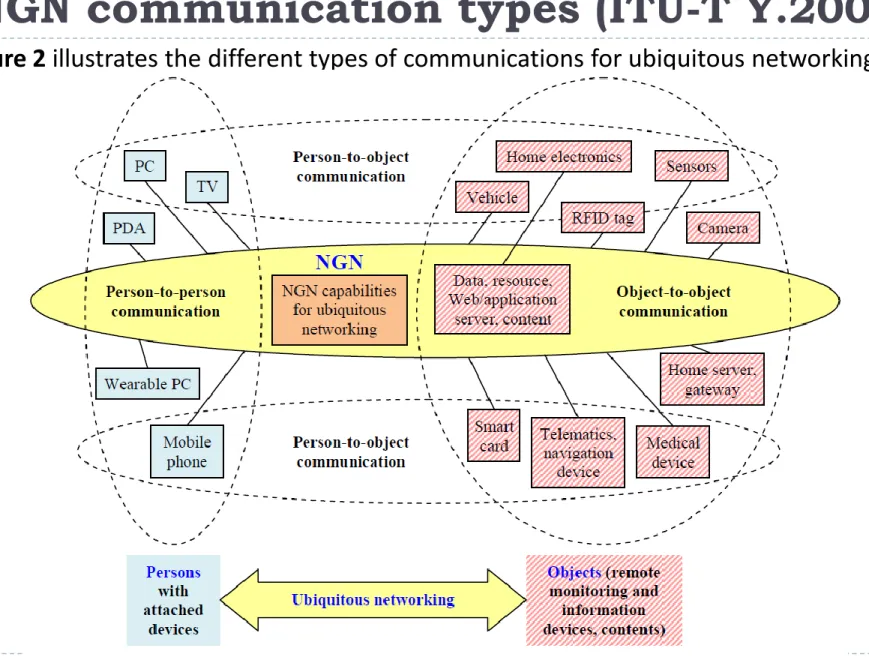
Figure 2 illustrates the different types of communications for ubiquitous networking.
Ubiquitous networking communication
types
Figure 2 makes a distinction between the following users of ubiquitous networking: persons (using attached devices such as PC, PDA, mobile phones) and objects (such as remote monitoring and information devices, contents).
As shown in Figure 2, ubiquitous networking supports three types of communications:
person-to-person communication: using attached devices (e.g., mobile phone, PC);
person-to-object communication: persons communicate with a device in order to get specific information (e.g., IPTV content, file transfer);
object-to-object communication: an object delivers information (e.g., sensor related information) to another object with or without the involvement of persons.
Ubiquitous networking aims to provide seamless communications between persons, between objects as well as between persons and objects while they move from one location to another.
Fundamental characteristics of
ubiquitous networking
Fundamental characteristics of ubiquitous networking are as follows:
IP connectivity
IP connectivity will allow objects involved in ubiquitous networking to communicate with each other within a network and/or when objects have to be reachable from outside their network. Particularly, as many new types of objects will be connected to networks, IPv6 will play a key role in object-to-object communications and also mitigate against address exhaustion of IPv4.
Personalization
Fundamental characteristics of
ubiquitous networking
Intelligence
Numerous network requirements in terms of data handling and processing capabilities will emerge from various industries involved in the field of ubiquitous networking (e.g., the car industry, semiconductor industry or medical industry). Making these capabilities available for use by business and assisting this business in terms of efficient and timing decision making is very important. Intelligence which enables network capabilities to provide user-centric and context-aware service is therefore essential. Introduction of artificial intelligence techniques in networks will help to accelerate the synergies and ultimately the "fusion" between the involved industries.
Tagging objects
Fundamental characteristics of
ubiquitous networking
Smart devices
High-level capabilities for ubiquitous
networking in NGN
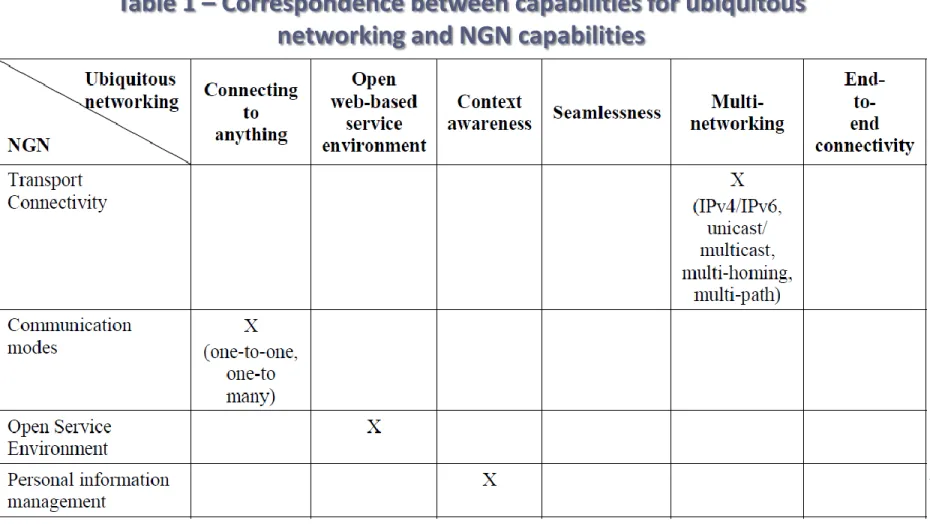
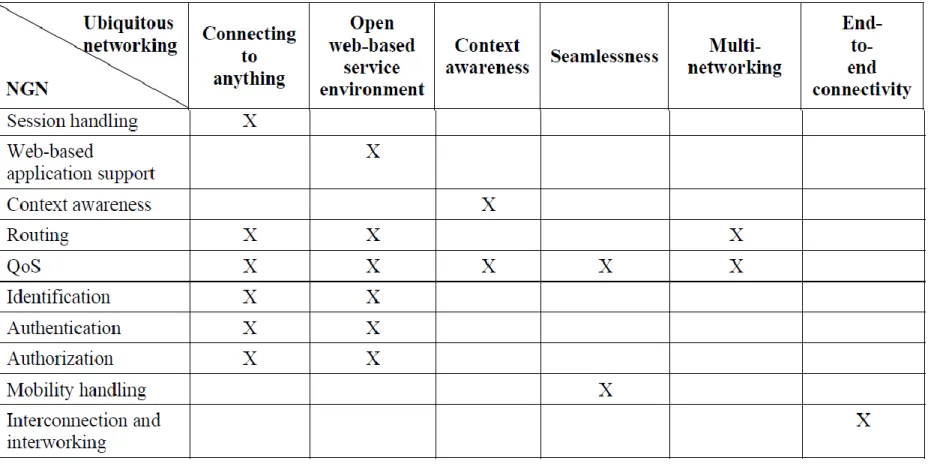
The following high-level capabilities are required in order to support ubiquitous networking in NGN. Table 1 provides a mapping of these high-level capabilities to the capabilities of the NGN defined in [ITU-T Y.2201].
The high-level capabilities for the support of ubiquitous networking in the NGN are listed as follows:
Connecting to anything capabilities
The capabilities of "connecting to anything" refer to the support of the different ubiquitous networking communication types and include the support of tag-based devices (e.g., RFID) and sensor devices. Identification, naming, and addressing capabilities are essential for supporting "connecting to anything".
Open web-based service environment capabilities
High-level capabilities for ubiquitous
networking in NGN
Context-awareness and seamlessness capabilities
Context-aware means the ability to detect changes in the status of objects. Intelligence systems associated with this capability can help to provide the best service which meets the situation using user and environmental status recognition. Seamlessness is a key capability for "5Any" (i.e., any time, any where, any service, any network, and any object). Seamlessness is a capability that can be supported in many different ways: at the network level using handover and roaming in heterogeneous networks, at the device level with no service interruption during device changing and recognition, and at the content level for providing personalized content delivery services, e.g., based on the user's situation, the user's device, and network conditions.
Multi-networking capabilities
High-level capabilities for ubiquitous
networking in NGN
End-to-end connectivity over interconnected networks
High-level architectural model for
ubiquitous networking in NGN
High-level architectural model for
ubiquitous networking in NGN
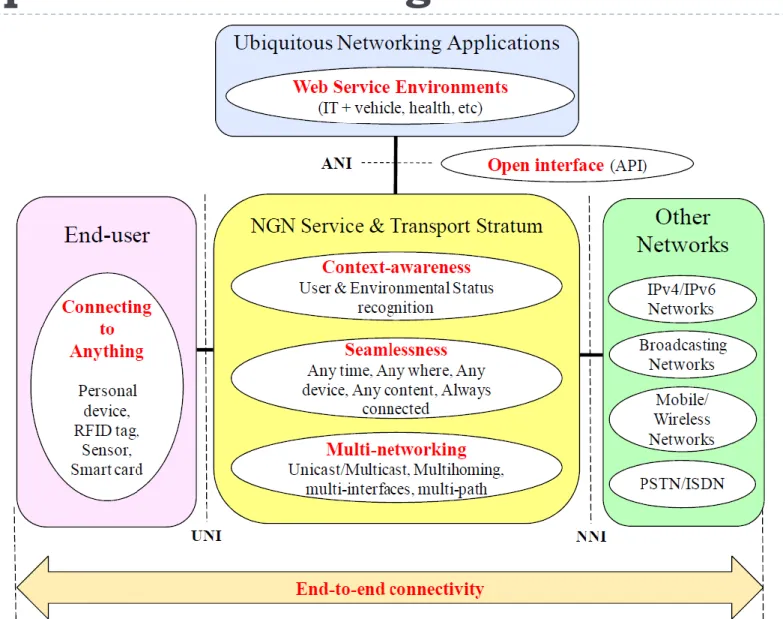
Figure 3 shows the high-level architectural model for ubiquitous networking in NGN. This model is based upon the NGN overall architecture as described in [ITU-T Y.2012] and includes the high-level capabilities identified earlier.
Correspondence between capabilities for
ubiquitous networking and NGN capabilities
In Table 1, each column represents a high-level capability as described above, while each
row corresponds to relevant NGN capabilities [ITU-T Y.2201]. A cross indicates a correspondence between a high-level capability and a NGN capability.