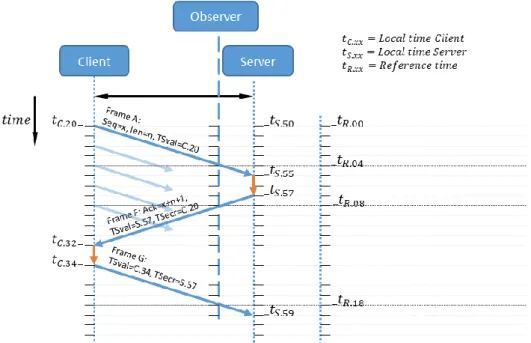
Evaluating server-side internet proxy
detection methods
An MSc thesis presented to the Cybersecurity Academy*
in partial fulfilment of the requirement for the degree of
Master of Cybersecurity
Author:
J.M. (Hans) Hoogstraaten
Supervisors: Dr ir. P. Burghouwt (Pieter) Prof. Dr ir. J. van den Berg (Jan)
Version: 1.1 final
Date: 10 November 2018
2
C
ONTENT
Content... 2
List of figures ... 5
List of tables ... 5
1 Introduction ... 7
1.1 Problem description ... 7
1.2 Research objective ... 8
1.3 Research design ... 8
1.4 Scope ... 9
2 Domain description ... 10
2.1 Proxy characteristics ... 10
2.1.1 Overlay network/ Proxied connections ... 10
2.1.2 Pseudo source address configurations ... 10
2.1.3 Multiple IP address setup ... 10
2.1.4 Proxying at different protocol layers ... 11
2.1.5 Routing and other services at the proxy ... 12
2.1.6 Authentication and encryption ... 12
2.1.7 Internal structure overlay network ... 12
2.1.8 Reverse proxy/ port forwarding ... 13
2.1.9 Ownership ... 13
2.2 Quantifying accuracy... 13
2.2.1 Estimating the population: a priori odds ... 13
2.2.2 False positives ... 14
2.2.3 Available datasets ... 15
2.2.4 False negatives ... 15
2.2.5 Other criteria ... 16
2.3 Summary ... 16
3 Inventory of proxy techniques ... 18
3.1 HTTP proxy ... 18
3.2 Socket Secure proxy (SOCKS) ... 19
3.3 Point-to-Point Tunnelling Protocol (PPTP) ... 19
3.4 Secure Socket Tunnelling Protocol (SSTP)... 19
3.5 L2TP ... 20
3.6 OpenVPN ... 20
3.7 IPsec ... 21
3.7.1 IPsec over L2TP... 22
3.7.2 IKEv2 ... 22
3.8 The Onion Routing (Tor)... 22
3.9 Other proxy techniques and implementations ... 22
3.10 Summary ... 23
4 Inventory of detection techniques... 24
4.1 Introduction ... 24
4.1.1 Method properties ... 24
3
4.2.1 Temporality ... 25
4.2.2 Accuracy ... 26
4.2.3 Properties and success factors ... 26
4.3 Information databases ... 26
4.3.1 Residential user vs. datacentres ... 27
4.3.2 WHOIS and reverse DNS ... 27
4.3.3 Proxy databases ... 28
4.3.4 Properties and success factors of methods ... 28
4.4 Port and service scanning ... 30
4.4.1 OpenVPN ... 30
4.4.2 IPsec ... 30
4.4.3 PPTP ... 30
4.4.4 Other scan techniques ... 31
4.4.5 Port and service scan databases ... 31
4.4.6 Properties and success factors of methods ... 31
4.5 Latency and timing ... 33
4.5.1 Round-trip time measurements ... 33
4.5.2 Transport-layer round-trip time ... 36
4.5.3 Application-layer round-trip time ... 39
4.5.4 Probing IP addresses ... 40
4.5.5 Triangulation of third-party measurements ... 40
4.5.6 Comparing times ... 40
4.5.7 Related research ... 42
4.5.8 Properties and success factors ... 43
4.6 MTU size ... 44
4.6.1 Maximum Transmission Unit ... 44
4.6.2 TCP Maximum Segment Size ... 44
4.6.3 Properties and success factors ... 45
4.7 HTTP header fields ... 45
4.7.1 Properties and success factors ... 46
4.8 Summary ... 46
5 Detecting proxies ... 48
5.1 List of known proxies ... 48
5.1.1 Experiment and results ... 48
5.1.2 Other observations ... 49
5.1.3 Conclusion ... 49
5.2 Proxy databases ... 49
5.2.1 Experiment and results ... 50
5.2.2 Conclusion ... 50
5.3 Provider- and proxy-related Keywords in WHOIS and rDNS... 50
5.3.1 WHOIS ... 51
5.3.2 Reverse DNS ... 52
5.3.3 Conclusion ... 53
5.4 Residential vs. datacentre IPs using WHOIS and rDNS ... 54
4
5.4.2 Determining WHOIS keywords ... 57
5.4.3 Determining rDNS keywords ... 57
5.4.4 Dataset representing residential users ... 58
5.4.5 Test results ... 58
5.4.6 Conclusion ... 60
5.5 Port and service scanning ... 60
5.5.1 Experiment and results ... 61
5.5.2 Conclusion ... 62
5.6 Timing internet-layer proxies ... 62
5.6.1 Test setup ... 63
5.6.2 Test using known originators ... 63
5.6.3 Test using combined methods ... 64
5.6.4 Other observations ... 66
5.6.5 Conclusion ... 67
5.7 MSS fingerprinting ... 67
5.7.1 MSS value and OpenVPN ... 67
5.7.2 MSS Reference values ... 68
5.7.3 Conclusion ... 69
5.8 Summary ... 70
6 Conclusions and further research ... 72
6.1 Detailed conclusions ... 72
6.2 Summary of selected methods ... 72
6.3 Future work ... 74
7 Bibliography ... 76
Appendix I. HTTP proxy headers ... 78
5
L
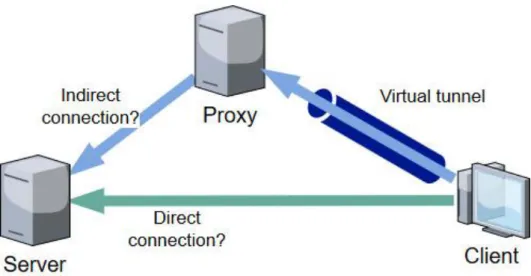
IST OF FIGURESFigure 1 Is the connection originating from a client directly or was it relayed through a proxy? ... 7
Figure 2 Single address proxy setup ... 11
Figure 3 Separated address proxy setup... 11
Figure 4 The SSTP protocol stack ... 20
Figure 5 The traffic flow of OpenVPN ... 21
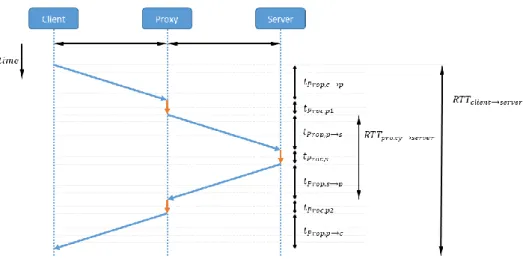
Figure 6 Standard round-trip time (RTT) ... 34
Figure 7 The Round-trip time of a proxy setup, measured by the client. ... 34
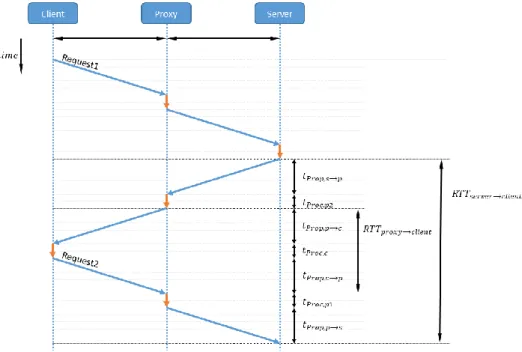
Figure 8 The Round-trip times of a proxy setup, measured by the server ... 35
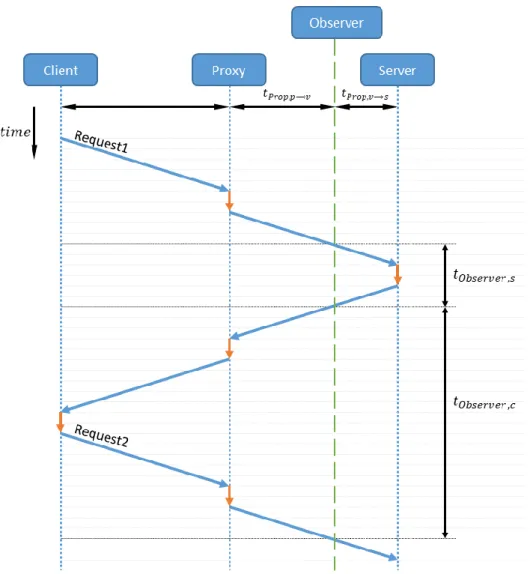
Figure 9 The ‘full’ round-trip time of a proxy setup, measured by an observer... 36
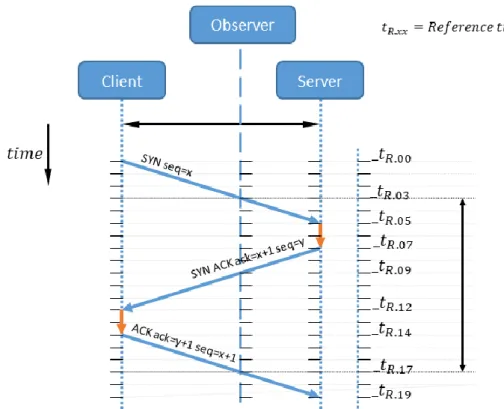
Figure 10 Full round-trip time of the TCP three-way handshake ... 37
Figure 11 Measuring full-RTT using timestamps included in the TCP header ... 38
Figure 12 Two time measurements with different spreads compared by mean ... 41
Figure 13 Two time measurements with different spreads compared using a z-score ... 42
Figure 14 The MTU and MSS of an Ethernet packet ... 45
Figure 15 Method for testing residential vs. datacentre WHOIS records... 55
Figure 16 Method for testing residential vs. datacentre rDNS records ... 56
Figure 17 The 𝛥𝑡𝑖𝑚𝑒 of known direct and proxy connections (times in ms) ... 63
Figure 18 Time differences of identified proxies by using different methods... 64
Figure 19 Categorised measurements based on timing thresholds ... 65
Figure 20 the TPRs and FNRs of the methods assuming the timing methods is correct ... 65
Figure 21 The 𝛥𝑡𝑖𝑚𝑒 of 13,878 random connections. ... 66
Figure 22 Time difference of a connection over a 24-hour period ... 67
L
IST OF TABLES Table 1 Properties of the method "List of known proxies" ... 26Table 2 Properties of the method "Proxy databases" ... 28
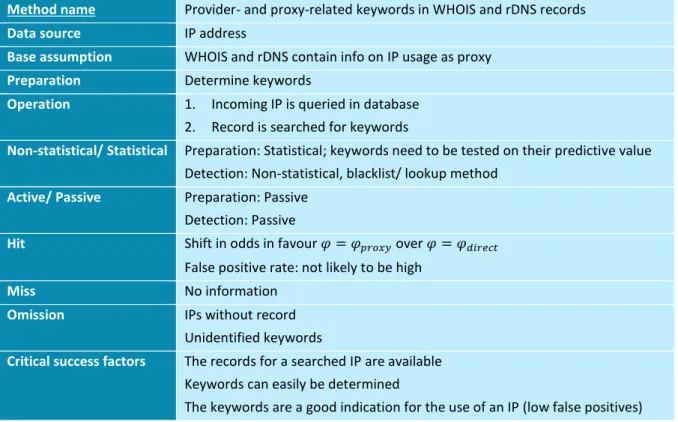
Table 3 Properties of the method "Provider- and proxy-related keywords in WHOIS and rDNS records" ... 29
Table 4 Properties of the method "Datacentre- vs. residential-related keywords in WHOIS and rDNS records" ... 29
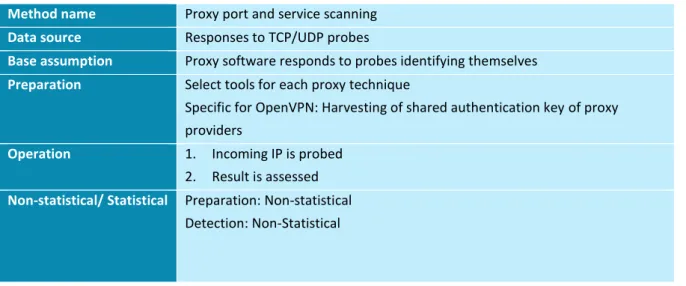
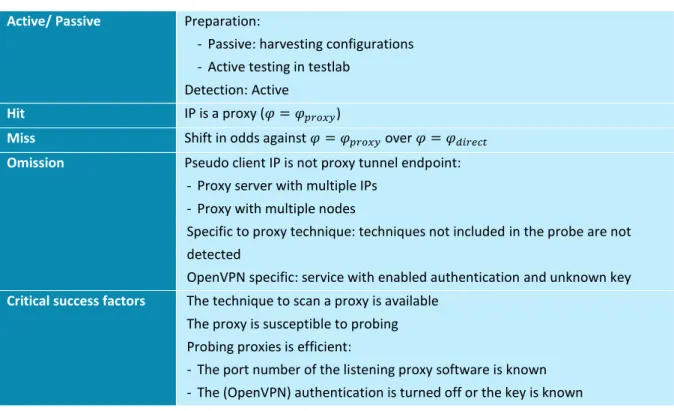
Table 5 Properties of the method "Proxy port and service scanning" ... 31
Table 6 Properties of the method "General port and service scanning" ... 32
Table 7 Properties of the method "Port and service scan database" ... 33
Table 8 Properties of the method "Timing internet-layer proxies" ... 43
Table 9 Properties of the method "Timing application-layer proxies" ... 43
Table 10 Properties of the method "List of known proxies" ... 45
Table 11 Properties of the method "HTTP header fields" ... 46
Table 12 Test results of proxy IPs found in a proxy database ... 50
Table 13 Test results of implementation-specific keywords in the WHOIS database ... 52
Table 14 Test results of proxy-related keywords in the WHOIS database ... 52
Table 15 Test results of implementation-specific keywords in the rDNS database ... 53
Table 16 Test results of general proxy-related keywords in the rDNS database... 53
6
Table 18 Datacentre-related keywords in selected residential WHOIS records... 58
Table 19 Residential-related keywords in known proxy WHOIS records ... 59
Table 20 Datacentre-related keywords in known proxy rDNS records ... 59
Table 21Datacentre-related keywords in selected residential rDNS records ... 59
Table 22 Residential-related keywords in known proxy rDNS records... 59
Table 23 Residential-related keywords in selected residential rDNS records ... 60
Table 24 Default OpenVPN and IPsec ports of known providers ... 62
Table 25 OpenVPN authentication of known providers ... 62
Table 26 TCP MSS values for various OpenVPN settings ... 68
Table 27 Top 20 MSS values... 69
7
1
I
NTRODUCTION
In today’s use of the internet it is popular to obfuscate the originating Internet Protocol (IP) address to the receiving end of the internet connection. This can be achieved by using an intermediate service that forwards the user request (by proxy) to the destination on his behalf and returns the responses to him.† Typically this is done using a small overlay network like a VPN or a Socket Secure (SOCKS) proxy.
There are situations where people, observing connections on the internet, want to know if these incoming connections originate from a proxy or come directly from a client. An example of such a situation is when an online streaming video service places restrictions on specific geo-locations, or when illicit cyber activities are investigated. Identifying incoming connections as a proxy or a direct connection is a first step in enforcing policy or investigating cybercrime.
Figure 1 Is the connection originating from a client directly or was it relayed through a proxy?
1.1
P
ROBLEM DESCRIPTIONIt is difficult to decisively determine if the originator of an internet connection is a direct client or an intermediate proxy device. There is no single method that is capable of identifying this for all possible proxy types and implementations. Although there are various detection techniques, it has been acknowledged that these methods all have advantages and disadvantages and can at best only detect specific proxy implementations (Pannu et al. 2016). If we assume that no single technique is capable of detecting all proxy implementations, the best detection method would be one where several techniques are combined. However, there is currently no structured overview of the available detection techniques and their capabilities and limitations. The work at hand closes that knowledge gap by providing this overview. This knowledge aids the design of effective detection systems that detect the use of a proxy from the perspective of a server in the internet.
Proxy techniques can be implemented in numerous ways, not least with the aim to avoid detection. Motivated by social and economic drives, people create proxy services that are hard to
8
distinguish from direct client connections. Likewise, there are similar drives that motivate endeavours to detect proxies. This ‘cat-and-mouse’ game makes the detection of proxies a dynamic process: detection methods that worked previously are not guaranteed to work in future situations, and new proxy implementations give cause to new detection methods.
1.2
R
ESEARCH OBJECTIVEThe objective of this work is to create a structured overview of the available proxy detection techniques as well as their capabilities and limitations. In order to achieve this, the following research questions are answered:
1. What are the current commonly used proxy techniques?
2. What are the theoretical capabilities and limitations of detection techniques? a. What techniques can be used to detect a proxy in general?
b. How can a detection technique be implemented into a more practical detection method?
c. What are the distinguishable properties of a detection method?
d. What are the reasoned critical success factors of the detection methods? 3. What are the practical capabilities and limitations of detection methods?
a. Can the theorised success factors be met in practice?
This study takes the perspective of the server receiving the connections. The point of departure is the (captured) network traffic on the receiving server.
1.3
R
ESEARCH DESIGNThe overview of proxy detection methods with relevant properties is developed by taking the following steps:
1. First, for a better understanding of the problem, the context is described in detail. The topic of discussion is conceptualised and the domain and the scope of this study are defined (Chapter 2).
2. Then, an overview of today’s popular available proxy techniques is created (Chapter 3). This will answer research question 1.
3. Next, an inventory of various detection techniques is presented (Chapter 4). For each technique, the thesis:
a. describes how it works; b. assigns selected properties;
c. provides reasoned caveats and foreseen limitations; and d. present a list of critical success factors.
This will answer research question 2.
9
5. Based on the test results and experiences gained during this research, the capabilities and limitations of each of the identified detection methods are assessed (detailed in Chapter 5, summarised in Chapter 6). This will answer the main research question.
6. Finally, conclusions are drawn and suggestions for improvements and further research are presented (also in Chapter 6).
This study clearly distinguishes between a theoretical and an empirical approach. The approach in step 3 (Chapter 4) is mainly by reasoning from theory, while the approach in step 4 (Chapter 5) is focused on experiments.
1.4
S
COPE10
2
D
OMAIN DESCRIPTION
This chapter describes the domain of internet proxies and their detection. It outlines a conceptual framework and provides context to this study by establishing definitions.
2.1
P
ROXY CHARACTERISTICS2.1.1 Overlay network/ Proxied connections
When people use the internet, they make their software client connect to a server on the internet. In this client-server model the server has a public IP address that a client can connect to. In order to create a connection, the IP packets are routed over the internet by the client’s Internet Service Provider (ISP) and several network operators, or autonomous systems, between the client and the server. This routing of IP packets over the internet is beyond the control of the client because it is subject to agreements between the network operators (Staff 2008). However, when a proxy server is used, the client does, to some extent, have control over the routing.
The network packets between the client and the proxy are encapsulated and transported to the proxy server. However, the proxy is not the final destination. Effectively this creates a network tunnel or an overlay network (Tanenbaum and Wetherall 2011, para. 5.5.3). Because the user selects a proxy, this routing through a proxy is within the control of the user, therefore the tunnel is on top of the internet protocol.‡ A consequence of the use of a proxy is that the source IP address of the client no longer needs to be exposed to the server. This provides the possibility to obfuscate the original IP of the client to a server on the internet.
2.1.2 Pseudo source address configurations
The source IP address, the proxy is using to connect to the destination server on behalf of a client, can be regarded as the pseudo-source address of the client: the source IP address a server observes is not the real address of the client, but a pseudonym.
A proxy server can be used by a single or by multiple clients at the same time. In addition, a proxy can have one or multiple IP addresses at its disposal. These options make various configurations possible. For example, a pseudo source IP address can be shared with other clients. A proxy then has to keep a status of the connected clients to map them to the proxied outgoing connections. It is also possible to use an IP address dedicated to a single client (for a period of time).
2.1.3 Multiple IP address setup
In a single IP address proxy setup, the IP address the client connects to, is also used as the pseudo source address. For example, in Figure 2 the client creates a tunnel between its IP address 1.1.1.1 and the IP of the proxy 2.2.2.2. The proxy then makes connections to the server using the pseudo IP address 2.2.2.2, which is the same address as that used for the tunnel endpoint.
11
Figure 2 Single address proxy setup
When a proxy has multiple IP addresses at its disposal, the proxy server can also be configured to separate the addresses the client connects to from the outgoing pseudo source addresses. In that case the proxy software does not listen to incoming client connections on the IP that is also used as a pseudo source address (see Figure 3). This setup can be expanded where the proxy has multiple separated outgoing IP addresses. It should be noted that a proxy can also consist of several physical servers that have the same functionality and form a proxy network (see also Paragraph 2.1.7).
Figure 3 Separated address proxy setup
2.1.4 Proxying at different protocol layers
Proxies can be created on three different levels in the TCP/IP stack: on the application layer (OSI layer 7), on the internet or network layer (OSI layer 3), and on the link layer (OSI layer 2)(“Proxy Server” 2018).§**
Application-layer proxies. When a client uses an application-layer proxy, the application
of the client sends its data to a proxy. The proxy configuration of the client is done in the user’s application. For example, when a web browser is configured to use a proxy, all HTTP traffic is passed through that proxy. The tunnel is setup between the client application and the proxy. With application-layer proxies, from the perspective of the client, it is as if the application of the client is running on the proxy. Application-layer proxies make it possible for other applications on the user’s computer to avoid using the proxy.
Internet-layer proxies. When a client uses an internet-layer proxy, the client creates a
virtual IP interface that directly connects to the proxy by a tunnel network. With internet-layer proxies, from the perspective of the client, it is as if the client is running on the same network as the proxy. The operating system of the client has a (virtual) IP interface, and all protocols on top of IP are routed through the proxy. All applications on the user’s computer that communicate with the same destination make use of the proxy. It is
§ The TCP/IP reference model of Tanenbaum is used (Tanenbaum and Wetherall 2011). The numbers refer to the ISO Open System Interconnection (OSI) standard.
12
possible to make exceptions for specific IP addresses to not to use the proxy (also called split tunnel).
Link-layer proxies. When a client uses a link-layer proxy, the client creates an Ethernet
interface that directly connects to the proxy by a tunnel network. With link-layer proxies, from the perspective of the client, it is as if the client is running on the same network segment as the proxy. All low-level communication makes use of the proxy, including ICMP and ARP protocols.
2.1.5 Routing and other services at the proxy
When a client connects to a proxy, the tunnelled connections can be routed in different ways. For example, a dual-homed proxy server can give access to an internal network that is normally not accessible from the internet. A typical example of this is the remote VPN of a company, where an employee connects to the proxy to access internal servers and the internet as if he or she were physically present in the office. Another common configuration is where connections of a proxy client are directly routed to the outgoing gateway of the proxy. In this case, a client cannot connect to any device on the local network of the proxy. This is a typical configuration for a (commercial) proxy service.
In addition to the routing, the proxy has additional control over the tunnelled connections. For example, the connections can be filtered by firewalls or access control systems, analysed by anti-malware or intrusion detection systems, protocol can be scrubbed to remove identifiable fingerprints, and contents can be cashed for faster downloads.
2.1.6 Authentication and encryption
When a proxy provider wants to place limitations on the users of the proxy, some form of access control can be added. For example, a commercial proxy provider only allows paying customers access to the proxy service. When a client wants to use the service, he or she needs to authenticate him or herself, for example with a username/ password combination or a certificate.
Proxies can also be secured with encryption. In that case the communication between the client and the proxy is protected with encryption to ensure the confidentiality of the communication (secure tunnel). When a proxy uses encryption, the proxy is usually called a VPN. Note that for this study it makes no difference whether authentication or encryption is used or not. The terms VPN, proxy and overlay network are used interchangeably.
2.1.7 Internal structure overlay network
An overlay network can consist of a single node as in the previous examples, or can be made using multiple nodes. With multi-node proxies, the tunnel extends over more than one server. Commonly the first node of the tunnel, to which the client connects, is referred to as entry-node, whereas the last node, which determines the pseudo-source address, is called exit-node.
13
and sent over an OpenVPN connection, into a Tor network connection, printed out on a screen, read by a camera, and finally sent to the internet, en route to its final destination (although this setup would cause significant latency).
2.1.8 Reverse proxy/ port forwarding
Some proxy configurations allow the user to forward incoming connections back to the client through the tunnel. One or more TCP or UDP ports can be configured to be forwarded back to the client once the tunnel has been established. An internet user can then connect to that port on the pseudo source address and the connections will pass through the tunnel to the proxy client. This effectively creates a reverse proxy. Note that this can potentially be a security risk, especially if the proxy or VPN service provider does this by default without the user’s knowledge.
2.1.9 Ownership
There is a difference between proxy services that are owned by proxy providers (either commercial or free) and proxies that are privately owned. This difference is the respective exposure. Commercial or free proxy providers expose their services and proxies to a wider public to attract more (paying) clients. It therefore possible to find these providers by searching internet pages. On the other hand, privately owned proxies are not advertised.
Many tutorials explain how to create a proxy using a cloud server. For example, a cheap Virtual Private Server (VPS) can be rented from Vultr.com, DigitalOcean or Amazone EC., and VPN packages can be installed on it such as Algo VPN (“Meet Algo, the VPN That Works” 2016). It is also possible to setup a proxy on a server located at home or on home routers.
2.2
Q
UANTIFYING ACCURACYIt is recognised that proxy detection methods do not provide absolute certainty (Pannu et al. 2016). Still, there is a need to evaluate individual detection methods and compare them with each other. Therefore some criteria must be chosen and preferably quantified. In an ideal situation, the accuracy of a test is represented in a single metric. This would require a dataset representing all proxy and all direct connections. However, gathering a presentative set of known direct connections has proven very difficult. Therefore, the accuracy of a detection method is represented with multiple metrics.
Furthermore, choosing the proper criteria for evaluating the detection methods depends a great deal on the environment in which they are used. An example analogy can be a method for weighing apples that has a measuring accuracy of 1 gram. Although this is a convenient accuracy in some situations, it is an irrelevant criterion for market vendors. By analogy, it is appropriate to look at some practical issues.
2.2.1 Estimating the population: a priori odds
The main question this study tries to answer is:
14
In order to identify what the important factors in determining the accuracy of detection it is expedient to have a sense of the order of magnitude a connection can be a proxy. Therefore, an educated guess is made on the a priori odds 𝑃(ℋ𝑃(ℋ𝑝𝑟𝑜𝑥𝑦)
𝑑𝑖𝑟𝑒𝑐𝑡). The following numbers are estimated:
The total number of IP addresses that can make a connection from the internet. This is estimated as the total number of IPv4 addresses possible (232≈ 4.3 ∙ 109), minus the
number of reserved IP addresses (≈ 0.6 ∙ 109) (“Reserved IP Addresses” 2018). This results in an estimated 3.7 ∙ 109 usable IP addresses.
The total number of proxies on the internet. Based on the number of proxies in a reliable database that is limited to publicly known proxies (IP2Location n.d.) (≈ 0.2 ∙ 106 proxies), the estimate of existing proxy IP addresses is 20 ∙ 106.
This results in a rough estimation of the odds of a random IP address connecting to an internet facing server that is a proxy:
𝑃(ℋ𝑝)
𝑃(ℋ𝑑)
= 20 ∙ 10
6
3.7 ∙ 109− 20 ∙ 106= 1: 184 ≈ 0.0054
This shows that proxies are relatively rare. Therefore, for any technique to significantly contribute to detection, the false positive rate should be low (Buchanan 2007).
2.2.2 False positives
False positives, also called type I errors, are known to have an misleading effect on large data sets with few true positives (Buchanan 2007). Given the estimate on the a priori odds of the total population in the environment considered here, this misleading effect can easily occur. This is illustrated using the following example:
A proxy test has a false positive rate of 𝐹𝑃𝑅 = 𝑛𝑢𝑚𝑏𝑒𝑟 𝑜𝑓 𝑓𝑎𝑙𝑠𝑒 𝑝𝑜𝑠𝑖𝑡𝑖𝑣𝑒𝑠
𝑡𝑜𝑡𝑎𝑙 𝑛𝑢𝑚𝑏𝑒𝑟 𝑜𝑓 𝑛𝑒𝑔𝑎𝑡𝑖𝑣𝑒𝑠= 0.01. This seem to be a
fairly good test based on the FPR. If the population consists of all the usable IP addresses, the following can be calculated:
𝑁𝑢𝑚𝑏𝑒𝑟 𝑜𝑓 𝑓𝑎𝑙𝑠𝑙𝑦 𝑖𝑑𝑒𝑛𝑡𝑖𝑓𝑖𝑒𝑑 𝑝𝑟𝑜𝑥𝑖𝑒𝑠: (𝑝𝑜𝑝𝑢𝑙𝑎𝑡𝑖𝑜𝑛 − #𝑝𝑟𝑜𝑥𝑖𝑒𝑠) × 𝐹𝑃𝑅 = (3.7 ∙ 109− 20 ∙ 106) × 0.01 = 36.8 ∙ 106
This means that the number of incorrectly identified proxies is almost twice the number of existing proxies!
If the test is able to detect all the proxies (𝑇𝑃𝑅 = 𝑛𝑢𝑚𝑏𝑒𝑟 𝑜𝑓 𝑡𝑟𝑢𝑒 𝑝𝑜𝑠𝑖𝑡𝑖𝑣𝑒𝑠
𝑡𝑜𝑡𝑎𝑙 𝑛𝑢𝑚𝑏𝑒𝑟 𝑜𝑓 𝑝𝑜𝑠𝑖𝑡𝑖𝑣𝑒𝑠= 1), the following can
be calculated using Bayes’ theorem: 𝑃(𝜑𝑝 | 𝑇𝑒𝑠𝑡𝑅𝑒𝑠𝑢𝑙𝑡𝑝𝑜𝑠) =
𝑃(𝑇𝑒𝑠𝑡𝑅𝑒𝑠𝑢𝑙𝑡𝑝𝑜𝑠 | 𝜑𝑝) 𝑃(𝜑𝑝)
𝑃(𝑇𝑒𝑠𝑡𝑅𝑒𝑠𝑢𝑙𝑡𝑝𝑜𝑠 | 𝜑𝑝) 𝑃(𝜑𝑝) + 𝑃(𝑇𝑒𝑠𝑡𝑅𝑒𝑠𝑢𝑙𝑡𝑝𝑜𝑠 | 𝜑𝑑)𝑃(𝜑𝑑)
15 1.0 ∙ 0.0054
1.0 ∙ 0.0054 + 0.01 ∙ (1 − 0.0054)≈ 0.35 Which is equivalent to:
𝑃(ℋ𝑝)
𝑃(ℋ𝑑)
= 0.35
1 − 0.35= 0,54 ⇒ 𝐼𝑃 𝑖𝑠 (𝑎𝑙𝑤𝑎𝑦𝑠) 𝑎 𝑑𝑖𝑟𝑒𝑐𝑡 𝑐𝑜𝑛𝑛𝑒𝑐𝑡𝑖𝑜𝑛
The example shows that a test with a low false positive rate is still not able to distinguish a proxy from a direct connection. In the example all tested IPs are classified as direct connections. As the rate between proxies and non-proxies is very small, special attention should be placed on the false positive rate to assess a detection method. Even if the false positive rate of a detection method is 𝐹𝑃𝑅 = 0.00543, a positive result still means that at best there is only a 50:50 chance that it is actually a proxy. Therefore, the ratio between true positive (TP) and false positive (FP) results is a good indication for the accuracy of the test: the positive predictive value (PPV):
𝑃𝑃𝑉 = 𝑛𝑢𝑚𝑏𝑒𝑟 𝑜𝑓 𝑡𝑟𝑢𝑒 𝑝𝑜𝑠𝑖𝑡𝑖𝑣𝑒𝑠 (𝑇𝑃) 𝑛𝑢𝑚𝑏𝑒𝑟 𝑜𝑓 𝑝𝑜𝑠𝑖𝑡𝑖𝑣𝑒 𝑡𝑒𝑠𝑡 𝑟𝑒𝑠𝑢𝑙𝑡𝑠 (𝑃)
2.2.3 Available datasets
Positive and negative predictive values can be calculated when a representative labelled dataset is available (Borovicka et al. 2012). Unfortunately, this has proven to be a very difficult task. This is mainly because there are many different implementations to a proxy technique that are unknown, and because the availability of representative direct connections was limited. Therefore, the predictive values could not be determined. Instead, the True Positive Rate (TPR) is determined using biased or unilaterally labelled datasets. In some cases, a qualitative indication can be given on the false positives rate (FPR) by reasoning based on the theory of the detection technique.
2.2.4 False negatives
False negatives, or type II errors, are test results that are negative while in fact they should be positive. In this case a connection is a proxy, while the result of the test is that it is not a proxy. In the context of detection proxies these false negatives are mainly due to a lack of information and knowledge. By analogy, a medical doctor diagnoses a patient by eliminating known diseases, taking the observed symptoms into account. However, if no illness is detected, he or she cannot know for certain that the patient has no illness. Similarly, most detection techniques in this thesis are based on knowledge of known proxies: a detection technique can determine if a connection is a proxy, but if the test is negative it is still unknown if the connection is a proxy or a direct connection.
16
For each detection method these false negatives are described as omissions of the method. These omissions are reasoned from theory. Detection methods that are based on non-statistical techniques, such as lookup lists or similar ‘signature based’ techniques, are particular prone to this type of omission.
2.2.5 Other criteria
You could argue that a good detection technique is one that detects many proxies. This however depends on the popularity of specific techniques or implementations. For example, if 90% of all proxy connections are through a Tor proxy, a Tor proxy detector is a useful and overall more valuable detection method. The segment of the total proxy connections that are detectable by a detection method is a good metric for assessing the quality. However, this metric is only a hypothetical one, because if a proxy method cannot be detected, total proxy population cannot be determined. Practically however, the popularity of a technique or implementation can be determined by other means, for example by the amount of attention it receives on internet fora.
Another criterion is the trustworthiness of the knowledge or data used for a detection technique. This is particularly the case when relying on data from third parties such as databases. For example, a detection method based on a timing technique that was extensively tested is more reliable than a lookup method that uses a free database that is maintained by volunteers. Although this is not straightforward, a qualifying metric can indicate this quality aspect of the detection method.
2.3
S
UMMARYThis chapter describes the domain of internet proxies and their detection. Proxies can be assigned various characteristics. Clients on the internet can use a proxy to make their connection take a more controlled route over the internet. The connection between the client and the proxy is a virtual network, also called overlay network or proxy tunnel. The IP address the client appears to use to connect to a server is the pseudo-source address of the client. A proxy can have one or more IP addresses at its disposal, creating various configurations. On a proxy with a single IP address the tunnel endpoint address is the same as the pseudo source address. On a proxy with multiple IP addresses the tunnel endpoint could be a different IP address than the outgoing pseudo source address.
Proxying the traffic can be done on the three different layers in the TCP/IP protocol stack: the application layer, the internet layer, and the link layer. In addition, the traffic of the client can be routed in various ways at the proxy before it is sent on its way. The traffic can also be filtered or cached at the proxy.
To access and use a proxy it is possible to have an access control mechanism in place on the proxy service. It is also common to encrypt the overlay network to prevent eavesdropping. A proxy can consist of a single machine or node, or can be a configuration of multiple nodes. In that case the overlay network expands over these nodes. The first node of the tunnel is referred to as entry-node, while the last node is the exit-node.
17
Proxies can be owned by commercial or free proxy providers, making their service available for their clients. A proxy can also be setup and created by an individual. In that case the proxy is privately
owned or controlled.
In order to quantify the accuracy of a proxy detection method, it is imperative to take the context into account. Because of the relatively few proxies on the internet compared to the total number of usable IP addresses, the false positive rate is an important metric to indicate the accuracy of a detection method. It turns out that it is very difficult to create a representative dataset to test the accuracy of the detection methods in the best way possible. Therefore, biased or unilaterally labelled datasets are used to determine the true positive rates, partly representing the accuracy of the methods.
18
3
I
NVENTORY OF PROXY TECHNIQUES
To be able to detect a proxy it is important to know how the proxy techniques work. Tunnelling the data of a client and forwarding them on behalf of a user can be done in many different ways. For example, calling a friend and asking him to buy some concert tickets on the internet for you can also be considered as using an internet proxy. The techniques that can be used are in that sense only limited to the imagination of the people creating a proxy tunnel. In the next paragraphs the most well-known and frequently used proxy techniques are described.
3.1
HTTP
PROXYA Hypertext Transfer Protocol (HTTP) proxy handles HTTP requests on behalf of a client application. A user application creates a request and sends it to the HTTP proxy. The HTTP proxy receives the request, unaware of the method used to transport the data; the tunnel between client and proxy is created between the two applications. Any lower level protocol features, such as fragmentation or DNS, are not visible to the applications and therefore not transported through the proxy. Only complete application data frames are sent through the proxy.
The HTTP protocol is described in several Request For Comments (RFCs) standards (RFC7230 through RFC7240, RFC7615, and RFC7616). Information from the originating client or the proxy is often added by the HTTP proxy for debugging and statistics. The proxy does this by adding extra lines to the HTTP header, sometimes with the original IP address of the client. For example, the following headers are added by HTTP proxies:
FORWARDED;
X-FORWARD-* as defined by RFC 7239 (Petersson and Nilsson 2014); X-FORWARDED-FOR Identifies the originating IP addresses of a client;
X-FORWARDED-HOST Identifies the original host requested that a client used to connect; VIA provides information about the proxy itself as defined by RFC 7230 (R. Fielding and J.
Reschke 2014).
In addition, some proxy software or appliances add specific and non-standardised lines to the HTTP header (see also Appendix I and par. 4.7).
An HTTP proxy often has a store-and-forward functionality, meaning that the content is cached at the proxy in order to increase the speed for other users. It is possible for a client to start a Secure HTTP (HTTPS) connection to a HTTP proxy. In that case the encrypted tunnel is terminated at the proxy and a new encrypted tunnel is initialised between the proxy and the server. This means that there is no end-to-end encryption between the client and the server. However, there is an HTTP CONNECT method described in the standards that can facilitate end-to-end encryption, although most servers have not implemented this feature (Fielding and Reschke n.d., para. 4.3.6).
19
Popular HTTP proxy software are Squid, TinyProxy, and node-http-proxy. In addition, there are many free and commercial HTTP proxy services available. The free services often change their domain name and can be found using index pages, for example on http://www.publicproxyservers.com.
3.2
S
OCKETS
ECURE PROXY(SOCKS)
The socket secure (SOCKS) protocol was originally developed by David Koblas and published in 1992 (Koblas 1992). There are currently three major SOCKS version in use: SOCKS4, SOCKS4a and the latest version SOCKS5 that is described in RFC1928 (Leech 1996). The version SOCKS4 is especially designed to allow proxying of TCP traffic to a specific IP address. The version SOCKS4a extends the protocol by allowing a client to specify a destination domain name rather than an IP address, even if the client cannot resolve the IP address. The latest version SOCK5 offers more choices for authentication and adds support for IPv6 and UDP (“SOCKS” 2018).
A SOCKS client informs the proxy server about the connection the client tries to make. The proxy then acts as transparently as possible. This in contrast to a HTTP proxy, which tries to interpret and rewrite headers. For example, a SOCKS proxy simply forward the HTTP headers without altering them. A SOCKS proxy can forward any TCP. UDP and IPv6 connection. The SOCKS service commonly uses TCP port 1080.
3.3
P
OINT-
TO-P
OINTT
UNNELLINGP
ROTOCOL(PPTP)
The point-to-point tunnelling protocol was developed by Microsoft and published in July 1999 as RFC 2637. It is the oldest and the most commonly used protocol on both LAN and WAN networks. Although the traffic can be encrypted it is regarded as insecure (Constantin 2012). PPTP is considered one of the fastest proxy protocols because of its simplicity and fast encryption. PPTP uses the TCP port 1723 for communication.
3.4
S
ECURES
OCKETT
UNNELLINGP
ROTOCOL(SSTP)
20
Figure 4 The SSTP protocol stack††
3.5
L2TP
The Layer-2 tunnelling protocol (L2TP) was published in 1999 as RFC2661. The L2TP protocol is a combination of the PPTP protocol and the Layer-2 Forwarding Protocol (L2F). A new version of this protocol, L2TPv3, appeared as the proposed standard RFC 3931 in 2005. L2TPv3 provides additional security features, improved encapsulation, and the ability to carry data links other than simply Point-to-Point Protocol (PPP) over an IP network, such as Frame Relay, Ethernet, and ATM (“Layer 2 Tunneling Protocol” 2018).
The two endpoints of an L2TP tunnel are called the LAC (L2TP Access Concentrator) and the LNS (L2TP Network Server). The LNS waits for new tunnels. Once a tunnel is established, the network traffic between the peers is bidirectional. Either the LAC or LNS may initiate sessions. The traffic for each session is isolated by L2TP, so it is possible to set up multiple virtual networks across a single tunnel. L2TP only provides encapsulation and does not provide encryption, integrity or authentication. The packets are transported over UDP, and typically port 1701 is used.
3.6
O
PENVPN
OpenVPN is an open-source VPN project created by James Yonan and was initially released in May 2001. OpenVPN runs a custom security protocol based on SSL and TLS. Implementations use the OpenSSL library for authentication and encryption. OpenVPN has many configurable features, making it a versatile proxy application. The tunnel between client and the proxy can run over the UDP or TCP protocol. OpenVPN offers two types of interfaces for networking via the Universal TUN/TAP driver. It can either create an internet-layer proxy (TUN), or a link-layer proxy (TAP) that can carry any type of Ethernet traffic. Port 1194 is the official IANA assigned port number for OpenVPN (“OpenVPN” 2018).
21
Figure 5 The traffic flow of OpenVPN‡‡
3.7
IP
SECThe internet Engineering Task Force (IETF) IP Security Working Group published a number of security protocols developed for the internet under the name IPsec in 1995. The IPsec protocol suite was published in RFC-1825 through RFC-1827 and later extended and updated in many other RFCs (“IPsec” 2018).
An IPsec tunnel is created by first creating Security Associations (SA) between the client and the proxy. Once the SA is established, data can be transported by using either the Authentication Header protocol (AH) or the Encapsulating Security Payload protocol (ESP). The authentication header protocol does not provide encryption but only encapsulate the packet. It also provides an integrity functionality of the new outer IP header. Because of this, the AH protocol does not work when the IP header is changed somewhere in the line, for example by the Network Address Translation protocol (NAT). The AH protocol is therefore not a popular protocol. However, the Encapsulating Security Payload protocol does provide encapsulation for encryption and authentication of user traffic.
The IPsec protocol suite includes a framework for authentication and key exchange: the Internet Security Association and Key Management Protocol (ISAKMP). The most popular key exchange protocols are the Internet Key Exchange protocols (IKE) used to establish the Security Association (SA) between the client and the proxy. The first version of this key exchange protocol (IKEv1) consists of two phases. In the first phase a management channel is created for the health status of the proxy and the like. In the second phase two uni-directional Security Associations (SA) are established.
22
The IKEv2 protocol is the next generation standard for secure key exchange between client and proxy and is defined in RFC5996. In this protocol the SA is established without phases by creating child SAs within the same negotiation.
Both AH and ESP protocols can be used as link-layer proxies (transport mode) and internet-layer proxies (tunnel mode). Commonly used ports are UDP port 500 for IKE and UDP port 4500 for NAT-traversal. When used as link-layer proxy (transport mode) the IP protocols 50 (AH) and 51 (ESP) are used.
In practice the IPsec protocol suite is used in two ways: IPsec over L2TP and IKEv2.
3.7.1 IPsec over L2TP
Before the IKE version 2 was developed it was common to use the L2TP protocol to setup the VPN tunnel, and to only use IPsec for the encryption. With the IKEv2 protocol the L2TP protocol is no longer needed, however most proxy providers still offer IPsec in combination with L2TP, commonly referred to as L2TP/IPsec (“Layer Two Tunneling Protocol” n.d.).
3.7.2 IKEv2
Most commercial proxy providers offer IKEv2 protocol. It is considered to be faster than PPTP and L2TP and offers the highest security. Most operating systems provide native support for this protocol.
3.8
T
HEO
NIONR
OUTING(T
OR)
One of the most popular proxy services is The Onion Routing (Tor), which is based on the software maintained by The Tor Project Inc. Tor directs internet traffic through a free, worldwide, volunteer overlay network consisting of more than seven thousand relays (“Tor (Anonymity Network)” 2018).
Onion routing is implemented by encryption in the application layer of a communication protocol stack, nested like the layers of an onion. Tor encrypts the data, including the next node destination IP address multiple times, and sends them through a virtual circuit comprising successive, random-selection Tor relays. Each relay decrypts a layer of encryption to reveal the next relay in the circuit to pass the remaining encrypted data on to it. The final relay decrypts the innermost layer of encryption and sends the original data to their destination without revealing or knowing the source IP address.
Not only does the Tor network provide a proxy service to the internet, it also includes hidden services that can be hosted anonymously. These hidden services can only be reached using a Tor client. Typically, Tor uses TLS over TCP as its transport protocol. The well-known TLS port for Tor traffic is 443 TCP. Tor commonly uses TCP ports 9001 and 9030 for network traffic and directory information.
3.9
O
THER PROXY TECHNIQUES AND IMPLEMENTATIONS23
ICMP tunnelling. An ICMP tunnel establishes a covert connection between two remote computers (a client and a proxy), using ICMP echo requests and reply packets. An example of this technique is to tunnel complete TCP traffic over ping requests and replies (“ICMP Tunnel” 2018).
DNS tunnelling. DNS tunnelling is the ability to encode the data of other programs or protocols in DNS queries and responses (“What Is DNS Tunneling?” 2016).
Stunnel. Stunnel is an open-source multi-platform application used to provide a universal TLS/SSL tunnelling service. Stunnel can be used to provide secure encrypted connections for clients or servers that do not speak TLS or SSL natively. It runs on a variety of operating systems, including most Unix-like operating systems and Windows. Stunnel relies on the OpenSSL library to implement the underlying TLS or SSL protocol (“Stunnel” 2018). Shadowsocks. Shadowsocks is a free and open-source encrypted proxy project that is
widely used in mainland China to circumvent internet censorship. Typically, the client software will open a SOCKS5 proxy on the machine where it is run, which internet traffic can then be directed towards. Additional features are implemented that make it hard to recognise (and block) the encrypted tunnel.
3.10
S
UMMARYTo be able to detect a proxy it is important to know how the techniques work. Well-known and frequently used proxy techniques are:
HTTP Proxy;
Socket Secure proxy (SOCKS);
Secure Socket Tunnelling Protocol (SSTP); Point-to-point tunnelling Protocol (PPTP); OpenVPN;
IPsec over L2TP; IKEv2 IPsec;
24
4
I
NVENTORY OF DETECTION TECHNIQUES
Different techniques can be used to detect whether an incoming connection is a proxy or a direct connection. A technique can be used in different ways or on different data. Therefore, more concrete methods are derived from a general technique. This chapter includes an overview of detection techniques with corresponding detection methods. In addition, for each detection method, the properties are provided, as well as the critical success factors for each method to work in practice. The next chapter describes how some of these success factors are tested in experiments.
4.1
I
NTRODUCTIONThe problem a detection technique has to solve is fairly simple: to distinguish between the situations 𝜑 = 𝜑𝑑𝑖𝑟𝑒𝑐𝑡 and 𝜑 = 𝜑𝑝𝑟𝑜𝑥𝑦 by regarding incoming connections. It is however not an easy
task, mainly because it is well conceivable that a proxy can be created where this is indistinguishable from the perspective of the server. Detection is possible when the proxy somehow reveals information that makes it distinguishable from a direct client connection.
The next paragraphs introduce several techniques or approaches that reveal information about the incoming connection’s IP address. These techniques were found ‘browsing the internet’ looking for similar initiatives, proof-of-concept projects, and discussions on various fora. It was generally observed that no single technique stood out as being perfect. In fact, the general sentiment on various fora is that it is difficult, if not impossible, to detect all possible proxy types on the server side. It was also observed that there is very little scientific literature available on the subject.
4.1.1 Method properties
Utilising a detection method can be divided into a preparation and a detection activity or phase. In the preparation phase information and data are gathered and analysed to prepare for the detection. In the detection phase an incoming connection is exposed to testing. Based on the study of the methods, each detection method can be assigned general features that distinguish it from other methods. The following features are determined for each method:
Data source. The type of data or information that is used as input to the detection
method, for example the IP address or the packet latency.
Base assumption. The assumption that forms the basis of the detection method.
Preparation. A short description of the type of preparation that is needed for the method
to be able to detect.
Operation. A short description of how the method operates.
Statistical/ non-statistical. The technique that is applied to the data in the preparation
25
Active/ Passive. A detection method can be based on actively probing an incoming IP
address to retrieve additional information. A method can also be purely passive or retrieve information from out-of-band sources like databases. This feature is determined separately for the perpetration phase and the detection phase.
In addition, each method can be characterised according to capabilities and limitations: Hit. This feature describes how a positive result should be interpreted; i.e. what does it
mean when the method produces a ‘hit’ (i.e. the method determined it was a proxy)? This accuracy is based on the theoretical knowledge of the detection method.
Miss. This feature describes the meaning of a negative test result. Due to the nature of
the tests, in most cases a ‘miss’ (i.e. the method determined it was not a proxy) reveals very little information (see also Paragraph 2.2.4).
Omission. By considering how a detection method works, its omission can also be
recognised. While a 'hit' and a ‘miss’ describe what can be detected, the omission describes what the method cannot detect.
Finally, for each method to be able to function as intended in a practical situation, some conditions must be met. These are described as the critical success factors of the method. Some of these critical success factors have been tested; the results are presented in the next chapter.
Critical success factors. The factors that are crucial for the detection method to work in
practice.
4.2
L
IST OF KNOWN PROXIESFor a user to be able to use a proxy, he must know where to connect to. Proxy providers must give the IP address where a client can connect to and what configuration to use. This information can be harvested and reverted into lists of known proxies. A list of the IP addresses that are known to be used as proxies makes detection very easy. When an IP address of an incoming connection is on such a list it is highly likely to be a proxy. This lookup technique is also known as a white/blacklist technique. Different proxy providers and their (commercial) implementations view these lists with different sentiments. For example, for the popular proxy service Tor such a list is not a problem. In fact, the publication of this list is part of the design: any Tor client that initiates a proxy downloads the current available nodes, including if it functions as an exit-node. Other techniques and (commercial) implementations try to obfuscate their proxies in the best possible way and thus evade identification.
4.2.1 Temporality
26
4.2.2 Accuracy
For all detection methods involving lists of known proxy IP addresses it is assumed that a positive result of the test (the lookup) is unlikely to be false (the FPR is nearly zero). It is reasoned that a false positive could only occur if a typo was made, or if the IP address was removed from the influence of the proxy provider (e.g. reassigned to another user). The latter scenario means that the administration of the service is incorrect. It is assessed that these scenarios are unlikely to happen, and it is therefore deemed very unlikely that a false positive can occur.
When the lookup results in a negative (a ‘miss’ in the lookup), this by no means guarantees that the IP address was not a proxy. This is because the list of known proxies can in practice never be complete. In addition, privately owned proxies cannot be known with this method. Based on the nature of the test and the internet environment, it is assessed that a negative result provides no additional information to what is already known.
4.2.3 Properties and success factors
The following method is based on the above described technique: List of known proxies
Table 1 Properties of the method "List of known proxies"
Method name List of known proxies
Data source IP address
Base assumption Information can be harvested at proxy providers
Preparation Harvesting IP addresses and configurations from proxy providers’ services
Operation Incoming IP is looked up in a list
Non-statistical/ Statistical Preparation: Non-statistical
Detection: Non-statistical, blacklist/ lookup method
Active/ Passive Preparation: Passive Detection: Passive
Hit IP is proxy (𝜑 = 𝜑𝑝𝑟𝑜𝑥𝑦)
false positive rate: nearly zero.
Miss No information (not a known proxy)
Omission Only known proxy providers
No private/ proprietary service
Critical success factors The information can be harvested from proxy providers The data harvested are complete and accurate
4.3
I
NFORMATION DATABASES27
The following databases have been identified as useful sources: WHOIS;
Reverse DNS; Specific databases;
o Proxy database;
o Usage type (ISP or Data Centre);
o Port scan search platforms (see Paragraph 4.4.5).
4.3.1 Residential user vs. datacentres
A common assumption is that proxy servers are more commonly located in datacentres than hosted on home users’ systems. This is based on the assumption that (commercial) proxy service providers use (virtual private) servers that need to be located in a reliable environment. Hosting providers provide these environments, and it is therefore more likely that proxies can be found in datacentres. Information databases can assist in determining if an IP address is located in a datacentre or if it is designated for residential users.
A detection method based on this assumption produces results that are not conclusive: an IP address of a residential user can still be used as a proxy, and a hosted server can still connect directly. In addition, there are proxy services (mostly application-layer proxies) that advertise they use millions of residential IPs or IP addresses that belong to mobile providers, for example: geosurf.com, luminati.io, and proxyrotator.com. Therefore, tests based on the above assumption provide a shift in odds: when an IP is located in a datacentre the odds increase in favour of it being a proxy. Likewise, when the IP is designated to residential users, the odds increase in favour of it being a direct connection.
4.3.2 WHOIS and reverse DNS
WHOIS and DNS are protocols for retrieving information from databases that are part of the internet. The WHOIS is a method for checking information about ownership of a domain name, an IP address or an autonomous system (“WHOIS” 2018). The WHOIS method queries regional internet registers like ARIN (American Registry for internet Numbers), RIPE (Réseaux IP Européens) and APNIC (Asia-Pacific Network Information Centre). Checking an IP address with WHOIS gives information on who owns or controls the range of IP addresses the queried IP address is part of. In some cases, the record shows a VPN provider owns the IP range, which is a strong indication that the IP address is used as a proxy. In other cases, the IP address is owned by an ISP providing services for home users. This is an indication the IP address is likely not a proxy, under the assumption proxies are commonly not hosted by home users.
28
reverse DNS record of an incoming IP connection includes proxy-related information. This can for example be the name of the proxy service or indication of the type of proxy (e.g. a tor-node). On the other hand, it is also possible that an rDNS record holds information on whether or not the IP is owned or used by domestic or users. For example, keywords such as “adsl” or “ppp” indicate the IP addresses are used by home user.
Unfortunately, the information from the WHOIS and rDNS queries does not unambiguously identify the usage of an IP address. This is because the owner of the IP address can fill these records as he or she sees fit. To use the information, keywords need to be determined to classify a proxy by its WHOIS and rDNS records. This makes the detection using WHOIS and rDNS queries a two-step method. Some keywords are strong indicators the IP is a proxy, like the name of a proxy provider, while others are weaker indicators.
4.3.3 Proxy databases
Identifying proxies has been of interest to some people for some time, and there are several commercial lookup services for proxies. These services can be used to check if an incoming connection is a proxy. The trust in the accuracy of the data lies with the third party providing the service. It is not known how the data are gathered, handled, maintained and assessed. Nevertheless, a hit in a proxy database significantly increases the odds in favour that the IP is a proxy.
4.3.4 Properties and success factors of methods
The following methods are based on the above described technique: Proxy databases
Provider- and proxy-related keywords in WHOIS and rDNS records Datacentre- vs. residential-related keywords in WHOIS and rDNS records
Table 2 Properties of the method "Proxy databases"
Method name Proxy databases
Data source IP address
Base assumption Third-party databases hold proxy IPs
Preparation None
Operation Incoming IP is queried in database
Non-statistical/ Statistical Preparation: Non-statistical
Detection: Non-statistical, blacklist/ lookup method
Active/ Passive Preparation: Passive Detection: Passive
Hit Shift in odds in favour 𝜑 = 𝜑𝑝𝑟𝑜𝑥𝑦
False positive rate: unknown (see omissions)
Miss No information (not a known proxy)
Omission 3rd party database:
29
Critical success factors The proxy database is: -Accurate
-Complete -Up-to-date
Table 3 Properties of the method "Provider- and proxy-related keywords in WHOIS and rDNS records"
Method name Provider- and proxy-related keywords in WHOIS and rDNS records
Data source IP address
Base assumption WHOIS and rDNS contain info on IP usage as proxy
Preparation Determine keywords
Operation 1. Incoming IP is queried in database 2. Record is searched for keywords
Non-statistical/ Statistical Preparation: Statistical; keywords need to be tested on their predictive value Detection: Non-statistical, blacklist/ lookup method
Active/ Passive Preparation: Passive Detection: Passive
Hit Shift in odds in favour 𝜑 = 𝜑𝑝𝑟𝑜𝑥𝑦 over 𝜑 = 𝜑𝑑𝑖𝑟𝑒𝑐𝑡
False positive rate: not likely to be high
Miss No information
Omission IPs without record
Unidentified keywords
Critical success factors The records for a searched IP are available Keywords can easily be determined
The keywords are a good indication for the use of an IP (low false positives)
Table 4 Properties of the method "Datacentre- vs. residential-related keywords in WHOIS and rDNS records"
Method name Datacentre- vs. residential-related keywords in WHOIS and rDNS records
Data source IP address
Base assumption Proxies are more often located in datacentres Proxies are less often hosted on residential IPs WHOIS and rDNS contain info on usage
Preparation Determine keywords
Operation 1. Incoming IP is queried in database 2. Record is searched for keywords
Non-statistical/ Statistical Preparation: Statistical; keywords need to be tested on their predictive value Detection: Non-statistical, blacklist/ lookup method
Active/ Passive Preparation: Passive Detection: Passive
Hit Shift in odds in favour 𝜑 = 𝜑𝑝𝑟𝑜𝑥𝑦 over 𝜑 = 𝜑𝑑𝑖𝑟𝑒𝑐𝑡 Miss Shift in odds against 𝜑 = 𝜑𝑝𝑟𝑜𝑥𝑦 over 𝜑 = 𝜑𝑑𝑖𝑟𝑒𝑐𝑡
Omission IPs without record
30
Critical success factors The base assumption is correct (proxies are more likely hosted in datacentres than at designated residential IP addresses)
The records for a searched IP are available Keywords can easily be determined
The keywords are a good indication for the use of an IP (low false positives)
4.4
P
ORT AND SERVICE SCANNINGWhen a client uses a proxy, it does so by connecting to the IP address of a proxy server. When the proxy service consists of a single node and the IP address is reused as a pseudo source address, the server receiving a connection is able to scan the originating IP address for indications of the proxy service. Scanning for open ports and services running on the source of the incoming connection can therefore indicate whether it is a proxy.
The TCP and UDP port numbers used by the proxy service can be configured as the provider sees fit. This means that ports other than the default can be chosen. It is also observed that port numbers are designated on demand: when a client wants to connect to the proxy, a (random) port number is allocated which the client can use. In the observed case, once a client has connected, no new proxy connections are permitted at the open port and the port no longer responds to probes.
Subject to the used proxy server software and its implementation, scanning the service returns useful information for detecting the presence of the proxy. In some cases this information identifies the IP as a proxy, while in other cases the open port only indicates its use. The probing technique is specific to the type of proxy used. Three proxy methods are examined more closely.
4.4.1 OpenVPN
A prepared packet can be sent to an OpenVPN server to trigger a response. Because of the protocol, the response provides a high level of certainty that the IP is a proxy. However, if the server is configured to accept only TLS authenticated connections on an UDP port, the server will not respond unless the probe has a correct HMAC. A response can be elicited if the correct authentication key and hash algorithm is known. Some (commercial) OpenVPN providers use a shared authentication key. Once this key is known, all proxies of that provider can be scanned and identified.
4.4.2 IPsec
Like with OpenVPN, a packet sent to an IPsec proxy service that is listening on a port can trigger a response. With both L2TP over IPsec and IKEv2, the port 500/UDP is used for key exchange and always returns a response when a proper packet is sent. The response can either be a returned handshake or a notification. In some cases, the vendor and device type can also be revealed.
4.4.3 PPTP
The default port for PPTP is 1723/TCP. A targeted probe reveals the firmware version, vendor, and the hostname when available. This can for example be done using for nmap: nmap -Pn -sV -p
31
4.4.4 Other scan techniques
Some proxy services have other identifiable responses to probes. These can be unrelated to specific proxy techniques, but nevertheless reveal the server is used as a proxy. This can be a wide range of scan types, for example:
Home routers running the MircoTik RouterOS can be configured as a proxy. In default mode the proxy shows an error page for unauthorised access. In that webpage the text “Mikrotik HttpProxy” is present, revealing it is used as a proxy.
Kerio Control Proxies (http://www.kerio.com/support/kerio-control) also serve a webpage with the text “Forbidden” when probed on port 80. It also includes the text “This message was created by Kerio Control Proxy”, revealing it is used as a proxy.
Proxy providers sometimes also host a webpage on their proxy server advertising their proxy service. This also reveals it is a proxy when probed.
Some proxy servers also host an HTTPS webpage using a socket-layer encryption, where the name of the company is in the certificate.
4.4.5 Port and service scan databases
Instead of actively scanning the IP addresses, it is also possible to use databases with scan results. Services like Shodan (shodan.io), Censys (censys.io) and URLScan (URLScan.io) periodically scan the internet for open ports and services and publish their results. A query of an IP address provides information that can be used for classifying the IP.
A disadvantage is that not every IP address is scanned, and the frequency of scans is not always clear. Therefore, the scan result might be old or outdated. In addition, not all ports and services are scanned, especially the non-standard ports.
4.4.6 Properties and success factors of methods
The following methods are based on the above described technique: Proxy port and service scanning
General port and service scanning Port and service scan database
Table 5 Properties of the method "Proxy port and service scanning"
Method name Proxy port and service scanning
Data source Responses to TCP/UDP probes
Base assumption Proxy software responds to probes identifying themselves
Preparation Select tools for each proxy technique
Specific for OpenVPN: Harvesting of shared authentication key of proxy providers
Operation 1. Incoming IP is probed
2. Result is assessed
32
Active/ Passive Preparation:
- Passive: harvesting configurations - Active testing in testlab
Detection: Active
Hit IP is a proxy (𝜑 = 𝜑𝑝𝑟𝑜𝑥𝑦)
Miss Shift in odds against 𝜑 = 𝜑𝑝𝑟𝑜𝑥𝑦 over 𝜑 = 𝜑𝑑𝑖𝑟𝑒𝑐𝑡 Omission Pseudo client IP is not proxy tunnel endpoint:
-Proxy server with multiple IPs -Proxy with multiple nodes
Specific to proxy technique: techniques not included in the probe are not detected
OpenVPN specific: service with enabled authentication and unknown key
Critical success factors The technique to scan a proxy is available The proxy is susceptible to probing Probing proxies is efficient:
-The port number of the listening proxy software is known -The (OpenVPN) authentication is turned off or the key is known
Table 6 Properties of the method "General port and service scanning"
Method name General port and service scanning
Data source Responses to TCP/UDP probes
Base assumption Scanned open ports and services give info on the use of the IP addresses
Preparation Exploration of identifiable characteristics that can be scanned or probed. Strongly depends on provider/ software/ hardware.
Operation 1. Incoming IP is probed
2. Result is assessed
Non-statistical/ Statistical Preparation: Non-statistical
Detection: Non-statistical, blacklist/ signature based
Active/ Passive Preparation: Active Detection: Active
Hit IP is a proxy (𝜑 = 𝜑𝑝𝑟𝑜𝑥𝑦)
Miss No information (no known port or service)
Omission Pseudo client IP is not proxy tunnel endpoint: -Proxy server with multiple IPs
-Proxy with multiple nodes Hardened servers are not identified Unknown identifiers are not detected
Probing services that are forwarded through the tunnel are mistakenly seen as a direct connection