Address for correspondence Dr. Ravikumar B.C., M.B.B.S, M.D
Professor of Department of Dermatology and Dean of Hassan Institute of Medical Sciences Hassan -573201, India
Email: [email protected]
Original Article
Knowledge, attitude and practices about sun
exposure, photoprotection and sunscreen usage
among college students of Hassan in Karnataka: A
cross-sectional study
Introduction
The deleterious effects of ultraviolet rays on the skin may be in the form of sunburn, skin cancer and pigmentary disorders to name a few. Erythema due to sunburn is the most common
symptom of overexposure to sun whereas pigmentation is the commonest change.1,2
Sharma and Basnet demonstrated that
pigmentary disorders are a major concern in India and have a great psychological impact on the quality of life.3 There is evidence indicating that sunburn plays as an important risk factor for melanoma.4 Besides, approximately 90% of all non-melanoma skin cancers are caused by sunlight exposure.5 A recent study by Panda revealed that there are indirect indicators
Yashovardhana DP, Ravikumar BC, Sucheta S Swamy, Sonia Raghukumar, Archit Aggarwal Department of Dermatology, Hassan institute of medical sciences, Hassan, Karnataka state, India.
Abstract
Background The adverse effects of sun exposure in the form of pigmentary changes, burning, premature skin aging and skin cancers are major concerns among the general public which often require photoprotective measures such as sunscreen usage and life style modifications. Hence we undertook this study to assess the knowledge, attitude and practices about sun exposure, photoprotection and sunscreen usage.Methods A descriptive cross sectional study was conducted on 1000 college students from three different colleges by a closed end questionnaire, in which questions were based on knowledge, attitude and practices of sun exposure, photoprotection and usage of sunscreens.
Results Out of 1000 students, 879 responses were considered for analysis. Amongst these, 605 (68.82%) students said they had a tendency to tan, 204 (23.2%) tendency to burn and 341 (38.8%) tendency for pigmentary changes. A total of 343 (39.0%) knew about the harmful effects of sunlight. Only 244 (27.8%) students used sunscreen, of which 202 (82.7%) knew meaning of SPF, 29 (11.8%) knew the SPF value of their sunscreen, 29 (11.88%) knew quantity of sunscreen to be applied and 16 (6.6%) students used sunscreens always. Among 635 sunscreen non-users 508 (80%) were unaware of it.
Conclusion This study reveals that in comparison to western population, the knowledge concerning the detrimental effects of sunlight exposure and its prevention is lacking among the adolescent Indian population. This perhaps explains why millions of Indians silently suffer the deleterious consequences of sunlight exposure and tend to ignore it due to its non-lethal nature.
Key words
demonstrating that the non-melanoma skin cancers (NMSCs) may be on the rise in India.6 It was further shown that regular use of sunscreen has reduced the incidence of NMSC.7,8
These adverse effects of sunlight can be prevented by adopting photoprotective measures such as usage of sunscreen and life style modifications.2,9 Hence, we undertook this study to assess the knowledge, attitude and practices of photoprotection and sunscreen usage in the adolescent Indian population as studies among the Indian population are lacking.
Methods
A descriptive cross-sectional type of study with purposive sampling was conducted on 1000 adolescents pursuing bachelor’s degree course i.e., Bachelor of Arts (BA), Bachelor of Science (BSc), Bachelor of Commerce (BCom) or Bachelor of Business Management (BBM). The adult age group was selected as they were more physically active and could comprehend the questionnaire better. The ethical committee approval was taken before conducting the study.
A questionnaire comprising 28 closed-end questions (7 knowledge + 7 attitude + 7 practice based questions + 7 general parameters) in both English and Kannada (regional language in Hassan, Karnataka) was prepared. The questions based on knowledge comprised of awareness of the dangerous effects of excessive sunlight
exposure, photoprotective habits if any,
awareness of sunscreens and its advantages. The
importance of sun protection factor (SPF) and
the value of SPF of the sunscreen among the users were also assessed. The attitude was assessed based on their views on the use of sunscreen in children, recommendations of sunscreen to others and reasons for non-usage. Practice parameters were computed based on frequency and quantity of sunscreen usage,
whether it was used when only outdoors and applications in relation to swimming and sweating. Additionally, other general aspects were also taken into account such as, tendency to adverse effects of sunlight, family history, mean duration of daily sun exposure and current symptoms in the patient due to sunlight over exposure
The questionnaire was distributed to each student under the supervision of their teacher and one of the investigators. Fifteen minutes were allotted for the completion of questionnaire by each student without any discussions.
Each variable was given 1 point and statistical analysis was done using the two-way ANOVA test for knowledge and practice variables and chi-square test for attitude variable.
Results
Out of 1000 responses, 121 were rejected due to incompletion and the remaining 879 completely answered questionnaires were taken up for the assessment. Of these, 471 (53.6%) were males and 408 (46.4%) were females. The mean age of the study participants was 19.4 years (17-30 y). With respect to the family income, 659 (75.0%) had an income less than one lakh per year. In regards to the bachelor’s degree, 231 (26.3%) belonged to BA, 268 (30.5%) to BSc, 262 (29.8%) to BCom and 118 (13.4%) to BBM.
Knowledge regarding the harmful effects of sun exposure was exhibited by 343 (39.0%). Overall, 672 (76.4%) were using some form of photoprotection with some of them following
more than one measure (Table 1). 585 (66.6%)
students claimed to have no knowledge of sunscreen. A greater level of awareness about sunscreens was exhibited by females 156/408 (38.2%) in comparison to males 138/471
(29.3%) with a significant p value of 0.017.
Similarly, science students 123/267 (40.1%) displayed a considerably higher consciousness
(p = 0.031) compared to others.
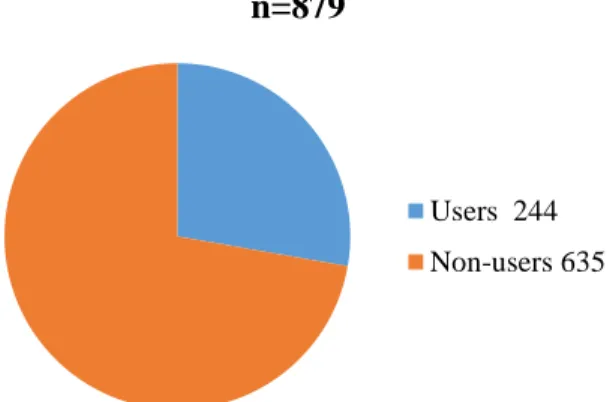
Sunscreen as a photoprotective measure was
used by 244 (27.8%) students (Figure 1).
Among these, 202 (82.7%) knew the meaning of SPF, 29 (11.8%) knew the SPF value of their sunscreen, 29 (11.9%) knew quantity of sunscreen to be applied. Only 16 (6.6%) students used sunscreens always (Table 2). The reasons for not using sunscreens were varied (Table 3)
with the most striking being unawareness, amounting to 508 (80%) students. The mean knowledge score amongst the 879 students was
computed to be an appalling 24.5% (1.47/6).
Table 1 Different photoprotective methods adopted Other protective
measures Hat Sunglasses Protective clothing Shaded areas
No. 353/879 181/879 531/879 658/879
% 40.2% 20.6% 60.4% 74.8%
Males 52.0% (245/471) 25.5% (120/471) 60.1% (283/471) 74.3% (350/471) Females 26.2% (107/408) 14.5% (59/408) 60.3% (246/408) 74.8% (305/408)
Table 2 Frequency of sunscreen usage.
Always Mostly Sometimes Rarely Total
16 23 126 79 244
6.55%(16/244) 9.4% (23/244) 51.6% (126/244) 32.4% (79/244) 27.8% of 879
Table 3 Reason for not using sunscreen.
a) unaware, b) oily, c) expensive, d) reduces vitamin D production, e) cumbersome to use frequently, f) not useful, g) forgets to use, h) No time to apply, f) not useful in winter/ indoors, j) others
Figure 1 Depiction of sunscreen users and non-users.
n=879
Users 244 Non-users 635 Reason for not using
sunscreen a b c d e f g h i j
Multiple
reasons Others No
reason Total
No. 508 14 14 11 6 20 1 4 4 15 18 1 19
635
Discussion
India being a tropical country with the predominant population having type IV and V Fitzpatrick skin types, vulnerability to the adverse effects of sunlight due to overexposure is naturally more. Sunlight is an avoidable risk factor for skin diseases.3 Consistent with the prior research, the knowledge level of our study population regarding adverse effects of sun exposure was inadequate. The studies done by Al Mutari et al.10 and Suppa et al.11 revealed that 95.98% and 65% of the subjects had better knowledge about adverse effects of sunlight. In contrast, only 39.0% of our study population had knowledge in this regard. This may be due to the extensive public health campaigns that are carried out in those countries due to high prevalence of skin cancer.
Tanning is the skin’s response to UV damage, representing a preventive measure to further harm.11 In our study, 91.0% of study subjects claimed to have a tendency to burn and tan contrary to Al Mutari et al.10 where 56.9% of study subjects having skin type IV-VI had tendency to tan and burn, suggesting tanning is more in our study group. This further adds to the previously held notion that tanning is the most common adverse effect due to sun exposure in the Indian skin type.
Gavelan et al.12 showed that intermittent use of photo-protectors was associated with a higher likelihood of sun damage compared to daily use of photo-protectors like sunscreen which actually reduces the harmful effects of sun radiation on the exposed skin. Additionally, there is epidemiological research linking the ill practices of photoprotective measures with risk factor for melanoma.13 In our study, 33.4% of the population were aware about sunscreens with most of them receiving information from doctors followed by magazines, friends,
newspapers, internet, family members and television. Dobbinson et al.14 showed that TV programs on public education on skin cancer
was strongly associated with improved
compliance in sun-related attitudes and behaviors among youths. Similarly, mass media was the most common source in study done by Al Mutari et al.10 and Suppa et al.11 Patients often rely on exaggerated and often inaccurate information available in the media especially in countries where prevalence of sunlight induced cancers are less.15 This suggests that urgent implementations are required to create general mindfulness about sunscreen and sun protective measures through mass media in our locality along with increased efforts from doctors.
Several types of barriers to sun protection among youth have been described.16 Overall, photoprotective measures other than sunscreens such as hats, sunglasses, shaded areas and protective clothing were more popular in our study group which again points to the
inadequacy of awareness regarding the
photoprotective effects of sunscreens.
A whopping 508 (80%) individuals claimed that the reason for sunscreen non-usage was due to unawareness. The users of sunscreens exhibited poor knowledge regarding SPF, average quantity
of application and time interval for
Conclusion
This study demonstrates that the awareness of sun damage and the usefulness of sunscreen is minimal in our study group and consequently, only moderate sun protective measures are being followed. Although the lethal effects of sun damage such as skin cancers are more
commonly seen in the western world,
pigmentary and aging changes are commoner in our country and can be prevented with adequate photo protective measures. This emphasizes that impactful health advisory campaigns are need of the hour with interventional programs educating the general public about the adverse effects of sun exposure, necessity and modes of sun protection, sunscreens and their usage.
References
1. Battie C, Verschoore M. Cutaneous solar ultraviolet exposure and clinical aspects of photodamage. Indian J Dermatol Venereol Leprol. 2012;78 Suppl:S1:9-14
2. Khanna N, Rasool S. Facial melanoses: Indian perspective. Indian J Dermatol Venereol Leprol. 2011;77:552-63.
3. Sharma L, Basnet A. A
clinicoepidemiological study of polymorphic light eruption. Indian J Dermatol Venereol Leprol. 2008;74:15-7 4. Planta MB. Sunscreen and melanoma: is our
prevention message correct? J Am Board Fam Med. 2011;24:735-39.
5. Koh HK, Geller AC, Miller DR, Grossbart TA, Lew RA. Prevention and early detection strategies for melanoma and skin cancer. Current status. Arch Dermatol. 1996;132:436-43.
6. Panda S. Non-melanoma skin cancer in India: Current scenario. Indian J Dermatol. 2010;55:373-8.
7. Van der Pols JC, Williams GM, Pandeya N, Logan V, Green AC. Prolonged prevention of squamous cell carcinoma of the skin by
regular sunscreen use. Cancer Epidemiol Biomarkers Prev. 2006;15:2546-8.
8. Green AC, Williams GM. Point: sunscreen use is a safe and effective approach to skin cancer prevention. Cancer Epidemiol Biomarkers Rev. 2007;16:1921-2.
9. Rai R, Srinivas C R. Photoprotection. Indian J Dermatol Venereol Leprol. 2007;73:73-9 10. Al-Mutairi N, Issa BI, Nair V.
Photoprotection and vitamin D status: A study on awareness, knowledge and attitude towards sun protection in general population from Kuwait, and its relation with vitamin D levels. Indian J Dermatol Venereol Leprol. 2012;78:342-9.
11. Suppa M, Cazzaniga S, Fargnoli MC, Naldi L, Peris K. Knowledge, perceptions and behaviors about skin cancer and sun protection among secondary school students from central Italy. J Eur Acad Dermatol Venereol. 2013;27:571-9.
12. Thomas-Gavelan E, Sáenz-Anduaga E, Ramos W, Sánchez-Saldaña L, Sialer MC. Knowledge, Attitudes and practice with respect to sun exposure and photoprotection in outpatients attending Dermatology clinics at four hospitals in Lima, Peru. An Bras Dermatol. 2011;86:1122-8.
13. Coups EJ, Stapleton JL, Hudson SV, Forrester AM, Pereira AN, Goydos JS. Sun protection and exposure behaviors among Hispanic adults in the United States: differences according to acculturation and among Hispanic subgroups. BMC Public Health. 2012;12:985.
14. Dobbinson SJ, Volkov A, Wakefield MA. Continued impact of sunsmart adverstising on youth and adults behaviors. Am J Prev Med. 2015;49:20-8.
15. Magdum A, Leonforte F, McNaughton E, Kim J, Patel T, Haywood R. Sun protection-Do we know enough? J Plast Reconstr Aesthet Surg. 2012;65:1384-9.