ISSN: 2147-611X
www.ijemst.com
Does a Modified Math Emporium Work
for All Students?
Shannon Guerrero, Amanda Atherton, Amy Rushall, Robert Daugherty
Northern Arizona University, United States
To cite this article:
Guerrero, S., Atherton, A., Rushall, A., & Daugherty, R. (2020). Does a modified math
emporium work for all students?
International Journal of Education in Mathematics,
Science and Technology (IJEMST), 8
(3), 233-244.
This article may be used for research, teaching, and private study purposes.
Any substantial or systematic reproduction, redistribution, reselling, loan, sub-licensing,
systematic supply, or distribution in any form to anyone is expressly forbidden.
Authors alone are responsible for the contents of their articles. The journal owns the
copyright of the articles.
Volume 8, Number 3, 2020
Does a Modified Math Emporium Work for All Students?
Shannon Guerrero, Amanda Atherton, Amy Rushall, Robert Daugherty
Article Info
Abstract
Article History
Received: 25 October 2019
Mathematics Emporia, or dedicated technology-supported learning environments designed to support large numbers of students in predominantly developmental mathematics courses, are a relatively recent phenomenon at community colleges and universities across the nation. While the size and number of these emporia has grown, empirical research into the impact of an emporium model on student learning and affect is only now emerging. This is especially true when looking at the impact of an emporium approach on students from diverse backgrounds. This study attempts to fill in the gaps in existing research related to how well emporium models address the needs of students based on gender, race/ethnicity, international status, and first- versus continuing-generation. Findings indicate that not all populations are served equally well by a modified mathematics emporium approach. The need for action to address inequities in student performance and implications for future research are discussed.
Accepted: 14 April 2020
Keywords
Math emporium Developmental mathematics
Technology-supported learning environment
Introduction
Due to expanding enrollment patterns in post-secondary educational institutions across the United States throughout the latter part of the 20th century, enrollment in and attention toward the development, assessment, and administration of developmental classes across university campuses has increased substantially since the 1970’s (Boylan, 2002; Rutschow, 2019). Given that math has long been a strong focus for reform efforts, ensuring student success and retention through a variety of developmental mathematics reforms has become a priority (Rutschow, 2019). Recent research (Chen, 2016) shows that 33% of all students at four-year institutions enroll in developmental mathematics courses while only 58% of those students successfully complete their developmental math requirement. Despite the rapid expansion of developmental math reform, very little rigorous evidence exists regarding student outcomes within various models for reform (Rutschow, 2019). One such reform effort that has exploded across the country in the last decade is the math emporium model.
Math emporia (ME) use technology and online delivery of content to reformat instruction, especially for lower-level, high-enrollment developmental or introductory mathematics courses. Originating at Virginia Tech in 1997, the critical component of a math emporium is a pedagogical approach that “...eliminate[s] lecture and use[s] interactive computer software combined with personalized, on-demand assistance” (Twigg, 2011, p. 26). Beyond the emphasis on interactive computer software and personalized assistance, math emporia can vary based on the size of a computer lab, the required number of lab hours per week, and the amount and type of scheduled meeting time with instructors or assistants. “Each institution makes design decisions in the context of the constraints it faces,” (Twigg, 2011, p. 26).
Although existing research touts the benefits of an emporium model, very little empirical evidence exists that investigates the relationship between student achievement in an emporium approach and student characteristics such as gender, race, socioeconomic status, or first- versus continuing-generation. While first-generation is defined as a student with neither parent/guardian having earned a bachelor’s degree, continuing-generation indicates a student with at least one parent/guardian having earned a bachelor’s degree or higher. As was highlighted by Webel, Krupa, and McManus (2016), “The emporium appears to be effective, but reports do not often identify for whom the emporium is effective…” (p. 356). This project has been designed to address this gap in existing research by investigating the relationship between student characteristics and pass rates in four courses offered at a medium sized public institution in the southwest region of the United States. These courses include a remedial mathematics foundation course, a developmental algebra for precalculus course, a quantitative reasoning course, and a precalculus course. The goal of this research is not to highlight achievement gaps for various populations of students nor make sweeping generalizations regarding student performance as it relates to characteristics such as race, gender, or ethnicity. Rather, the goal is to better understand how various populations of students are or are not having their learning needs met under a math emporium model.
The Mathematics Emporium Model
According to NCAT, the goal of university-level mathematics course redesign via an emporium model is to think about “...the way we deliver instruction, especially large-enrollment core courses, in light of the possibilities that technology offers,” (Twigg, 2011, p. 26). This shift allows students to move from “...a passive learning environment to an active one in which the student controls and individualizes the learning,” (Twigg, 2004, p. 15). Built upon a foundation of mastery learning, a true emporium model allows students to watch videos, utilize online learning software, and work through problems at a pace suited to their own needs and abilities, reaching mastery of various topics and concepts at different times throughout the semester, independent of their peers’ progress. The emporium model is designed around four core principles. First, mathematics software, such as ALEKS, Hawkes Learning Systems, or MyMathLab, allows students to spend the bulk of their course time working through math problems, receiving instant feedback, and utilizing guided solutions when they do not get correct answers. Second, because of the mastery approach of ME, students spend more time on concepts and procedures they do not understand and less time on concepts and procedures on which they have demonstrated mastery. Third, students get in-the-moment assistance when they encounter difficulties through the program’s computerized instant feedback, online tutorials and guided solutions, and interactions with fellow students, instructors, teaching assistants, or peer tutors during lab time. Finally, course redesign has been found to be most successful when computer lab time is a required component of ME courses. Increased contact points and time-on-task distributed throughout each week and throughout the semester ensure students regularly spend time doing mathematics.
Of course, there are pedagogically questionable assumptions underlying many of the core principles outlined by NCAT and other proponents of the emporium model. The foundation for NCAT’s course redesign is that “(s)tudents learn by doing math, not by listening to someone talk about doing math,” (Twigg, 2011, p. 26). This statement implies that traditional face-to-face classes consist of little more than a talking head and minimizes the efforts of many university-level faculty to incorporate elements of active engagement in their instruction via discourse, inquiry-based learning, and the like. Similarly, a common argument for ME is that students learn best by doing mathematics and emporia approaches allow students to actively engage with mathematics by continually working through problems. As Carol Twigg (2004), president and CEO of NCAT noted, “In mathematics, student learning is directly related to the amount of time students spend working,” (p. 11). However, simply doing math does not necessarily equate with deep conceptual knowledge or a true understanding of math.
Having noted these drawbacks, the intent of this paper is not to debate the inherent pedagogical strengths or weaknesses of the emporium model for mathematics teaching or learning at the college level. Rather, the intent is to recognize existing research on ME, acknowledge potential pedagogical shortcomings, and investigate the impact of a modified emporium on student performance based on various attributes such as race, ethnicity, gender, and first- versus continuing-generation. A lengthier discussion on the conceptual framework for ME and their alignment with research-based best practice for mathematics teaching and learning will be saved for a later time.
Impacts of the Math Emporium
Recent summaries from NCAT on various projects intended to engage community colleges in successful redesign (e.g. Changing the Equation, 2009 - 2012) or implement full course redesign with higher education systems (e.g. State-System Course Redesign Projects, 2006 - 2013) indicate that math emporia models are largely successful (NCAT, 2005b) . Characteristics inherent in a math emporium approach, including multiple attempts to take exams and variations in grading practices, may be contributing factors in supporting student success rates as part of this approach. Similarly, close alignment of instruction, support structures, and assessment approaches via the online learning software ensure minimal deviation from how a concept is taught, developed, practiced, and tested. While this type of quality control in how concepts are treated from introduction to evaluation ensures alignment in instructional practice, it potentially limits the potential for the development and the application of content understanding to novel situations (e.g. Webel et al., 2016).
Independent researchers have reported similarly positive results as those reported by NCAT. Krupa, Webel, and McManus (2015) found that ME students scored significantly higher on common exams, when compared to more traditional instruction in Intermediate Algebra, and showed greater ability to remember and apply procedures to some open-ended tasks. Others (e.g. Cousins-Cooper et al. 2017) showed that students enrolled in emporium classes in college algebra and trigonometry outperformed students enrolled in traditional classes on a common post-test. Wilder and Berry (2016) found that, though success rates for emporium versus traditional were similar in algebra, students in the emporium had significantly higher retention of content than students in traditional sections. Potential benefits extend beyond achievement. Taylor (2008) demonstrated that an emporium approach can have positive impacts on students’ math anxiety and attitudes toward mathematics.
As more research emerges in the field of emporium-style instructional approaches for mathematics, cautionary findings with respect to impact on student learning and engagement are becoming apparent. By focusing on getting correct answers in most emporia models, students are allowed to focus on procedures and bypass the meaning of certain concepts (Webel et al., 2016). Krupa et al. (2015) noted that students in both emporium and traditional classes demonstrated a limited ability to represent novel contextual situations with algebraic equations. Helming and Schweinle (2014) found a math emporium approach had no impact on student self-efficacy or motivation and Webel et al. (2016) concluded that 37% of students claimed the ME made them like math less. Aichele et al. (2012) found mixed results regarding students’ perception of computer-assisted approaches to instruction with students reporting feelings of isolation, being overly responsible for their own learning, and often feeling overwhelmed by the technological emphasis of the course. It is worth noting that Aichele et al. (2012) concluded that students were generally favorable about the autonomy and flexibility of an emporium approach, while Webel et al. (2016) found that participants expressed concerns about the level of flexibility and autonomy. Taken together, independent research provides mixed results; while it appears that students may perform well on final exams or other in-course measures, the impact on student attitudes, dispositions toward mathematics, and mathematical reasoning remains unclear.
The Modified Math Emporium
Full emporium models often utilize a mastery approach to learning, where students work individually and only move on to subsequent course material when they have demonstrated mastery of prior topics. As such, ME often require students to meet in large computer labs and engage with individualized computer-based instruction via course delivery software. A modified math emporium approach (or MME) allows program coordinators and instructors to vary instructional components like the type and amount of technology integration into instruction or the type and amount of face-to-face interaction. A more structured format and pace, as supported by an MME, allows for meeting with smaller subsets of students via clab (synchronous computer lab sessions) or face-to-face instructional sessions, thereby incorporating delivery of some course materials outside of the technology-mediated instructional environment.
SSU’s Modified Math Emporium
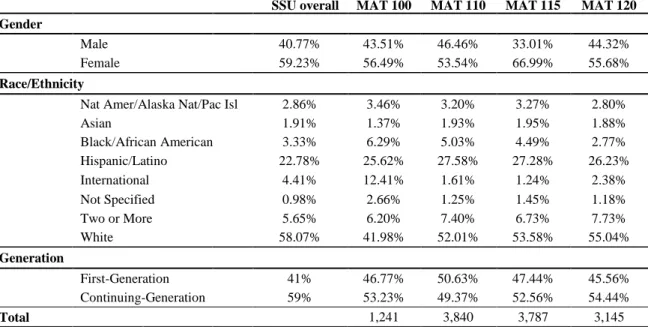
In order to better understand how students from various backgrounds perform in an MME setting, this study investigated the pass rates of students in four introductory college mathematics courses over a four-semester period. Southwest State University (SSU) is an accredited, research intensive, medium sized public university in the Southwest United States serving almost 23,000 on campus students per year. SSU offers 93 baccalaureate programs, 51 master’s degree programs, and 14 doctoral programs. SSU prides itself on its commitment to diversity and serving the needs of all students through its many student-centered learning and retention initiatives. SSU’s student population is predominantly white, though it is worth noting that almost a quarter of students identify as Hispanic/Latino. With 3% of the student population identifying themselves as Native American, Alaskan Native, or Pacific Islander, SSU is recognized as a top educational option for Native Americans and located near one of the largest Native American reservations in the US. In addition, SSU has a healthy international program, with over 4% of all students attending SSU from abroad (see Table 1).
Table 1. Percentage Breakdown Gender, Race/ethnicity, and Generation of Undergraduate Students by Course
SSU overall MAT 100 MAT 110 MAT 115 MAT 120
Gender
Male 40.77% 43.51% 46.46% 33.01% 44.32%
Female 59.23% 56.49% 53.54% 66.99% 55.68%
Race/Ethnicity
Nat Amer/Alaska Nat/Pac Isl 2.86% 3.46% 3.20% 3.27% 2.80%
Asian 1.91% 1.37% 1.93% 1.95% 1.88%
Black/African American 3.33% 6.29% 5.03% 4.49% 2.77% Hispanic/Latino 22.78% 25.62% 27.58% 27.28% 26.23%
International 4.41% 12.41% 1.61% 1.24% 2.38%
Not Specified 0.98% 2.66% 1.25% 1.45% 1.18%
Two or More 5.65% 6.20% 7.40% 6.73% 7.73%
White 58.07% 41.98% 52.01% 53.58% 55.04%
Generation
First-Generation 41% 46.77% 50.63% 47.44% 45.56%
Continuing-Generation 59% 53.23% 49.37% 52.56% 54.44%
Total 1,241 3,840 3,787 3,145
Office of Institutional Research and Analysis (2017)
course for MAT 110, MAT 115, and a mathematics content course for elementary education students, while MAT 110 is a prerequisite for MAT 120.
SSU uses an MME with several key features: a lab with 256 computers, a check-in counter to the computer lab, two 40-student classrooms, two 80-student classrooms, various smaller study rooms, and a 50-computer testing room. Students are required to complete a course-specified number of lab minutes in the large 200-computer lab. The computer lab is open 12 hours on weekdays, 4 hours on Saturdays, and 7 hours on Sundays with anywhere from 5 to 13 circulating peer-tutors offering individualized help at all times. The majority of these tutors are undergraduate mathematics, mathematics education, or statistics students trained specifically in how to tutor mathematics for courses offered in the MC. In the computer lab, students receive just-in-time tutoring as they complete homework, take quizzes, practice for upcoming tests, or just have general questions. As students enter the computer lab and sign in with their SSU Student ID, they are greeted by several front desk workers available for student questions or concerns. Students are able to complete course proctored tests anytime the testing room is open, which has limited hours compared to the computer lab.
Under current SSU math placement guidelines, students receive math placement based on at least one of the following measures: ACT/SAT results, math placement test results, or number of years of high school mathematics. Students with four years of high school mathematics are automatically placed above MAT 100 and into MAT 110, MAT 115, or MAT 125 based on their ACT/SAT score or SSU’s mathematics placement test score. Students may become eligible for subsequent courses by successfully completing the prerequisite course, transferring in successful completion of the prerequisite course, or earning AP credit for the prerequisite course.
Enrollment patterns for gender and ethnicity for most courses in the MC vary only slightly from enrollment patterns for SSU, with two notable exceptions (see Table 1). MAT 115 has over double the number of female students compared to male students and almost 7% higher female enrollment than SSU as a whole. Although not explored in depth, this difference is most likely due to individual degree requirements associated with certain majors with higher female representation than other majors (e.g. nursing, hotel/restaurant management, etc.). It is also worth noting the relatively lower percentage of white students enrolled in all courses in the MC as compared to the university as a whole. While white students make up 58% of students enrolled at SSU, they account for 52-55% of students in MAT 110, 115, and MAT 120 and 42% of students in MAT 100. The long documented prevalence of underrepresented populations of students placing into developmental courses at higher rates than White students, while disturbing, is not uncommon (e.g. Aud, Fox, & Kewal Ramani, 2010). While students who identify as Hispanic/Latino are placing out of MAT 100 at slightly higher rates than other MC classes, MAT 100 ultimately serves higher percentages of students from Native American and Black/African American backgrounds as compared to SSU’s overall enrollment patterns.
Similarly interesting patterns emerge for international and first- versus continuing-generation students. MAT 100 has a much higher enrollment of international students than other MC courses. Students with less than 4 years of high school mathematics must score above certain thresholds on the ACT/SAT or math placement test to place out of MAT 100. International students often do not arrive at SSU with four years of high school mathematics or an ACT/SAT score and must rely on their placement test scores, thereby ending up in MAT 100 at a much higher rate than non-international students. In a similar vein, first-generation students end up in MC courses at rates closer to first-time, full time freshmen (46%) than the overall population at SSU (41%). The fact that first-generation rates in the MC more closely mirror first-time, full time freshmen rates is not surprising since most MC courses are introductory courses for early-career students. It is interesting to note, though, that half of all students in MAT 110, a course that serves as a stepping stone into major coursework in MAT 115 or MAT 120, are generation students. The unintended consequence of these high placement rates for first-generation students into MAT 110 is that these students must take at a minimum 2 mathematics classes in order to meet the mathematics foundation requirement for their major.
Course Structure
move through the same content modules (or chapters) with similar deadlines and due dates. The structure of these courses allows for self-advancing where students are free to work ahead of the schedule but are not allowed to fall behind.
Specifics on each of the four courses in the MC are provided below.
Mathematics Pathways (MAT 100)
MAT 100 is a developmental course designed to promote basic math skills that will help students be successful in their eventual college-level mathematics courses. Although this course can provide students with elective credits, it does not count as a general education mathematics foundation course or count toward any degree program. This course reviews several algebra topics including the simplification of algebraic expressions, solution of algebraic equations, graphing of linear equations and factoring of polynomials. Each section of this course has a capacity of up to 150 students, with total enrollment typically around 600 students in fall semesters and 200 students in spring semesters.
Unlike other courses in the MC, MAT 100 is a mastery-based course where students need to earn at least 85% on all homework to unlock tests and 70% on each quiz or test to move to the next module or to the final exam. Modules begin with a pre-test that allows the software to filter the homework, so students spend time on what they do not know. There are multiple attempts on tests and unlimited attempts on homework problems. Students meet with their instructor one day per week for 75 scheduled minutes in the MC lab and are then required to log at least 75 minutes weekly in individual open lab time working through content in the online content management system. Almost all time in the scheduled class meeting is spent working through online course material with little or no structured, direct instruction from the instructor to the entire class.
Algebra for Precalculus (MAT 110)
MAT 110 is a course that provides students with elective credits but does not serve as a general education mathematics foundation course. MAT 110 serves as a prerequisite for Precalculus, Introductory Statistics, Finite Mathematics, and Mathematics for Elementary Teachers I. This course provides review of fundamental concepts and skills required for precalculus and covers concepts such as algebraic operations, simplifying expressions, solving equations and inequalities, and multiple representations of various linear and nonlinear functions.
In MAT 110 students have one weekly meeting in a classroom for 75 minutes in which they explore some of the core concepts in groups through lecture, lessons, and hands-on activities. Students also spend an additional minimum of 150 minutes in the open lab. Once students take a module pre-test that allows the software to filter homework designed to address each student’s content deficiencies, students are allowed two attempts on tests and unlimited attempts on homework (up until the deadline for each assignment). After the deadline, students are allowed to complete homework for up to 75% credit. Each section of MAT 110 has a capacity of about 75 students and is co-taught by two graduate teaching assistants. Total academic year enrollment is typically around 1600 students in fall semesters and 600 students in spring semesters.
Math Foundations and Quantitative Reasoning (MAT 115)
MAT 115 fulfills the general education mathematics foundation requirement at SSU and serves as the terminal math requirement for non-mathematics secondary education degrees, environmental science, and several health science degrees. It also serves as a prerequisite course for students pursuing business degrees who ultimately need to take Finite Mathematics, with or without a calculus emphasis. MAT 115 course content includes contemporary quantitative methods, especially descriptive statistics; elementary probability; limited statistical inference; linear and exponential models of growth and decay; and applicable discrete models.
Precalculus (MAT 120)
MAT 120 fulfills the general education mathematics foundation requirement at SSU and serves as the terminal math requirement for degree programs in forestry, psychological sciences, exercise science, and construction management. It also serves as a prerequisite course for continued studies in calculus and beyond. MAT 120 covers concept of function; graphs; absolute value, linear, polynomial, rational, exponential, logarithmic, and trigonometric functions; systems of equations; and analytic geometry. In addition to the two 50-minute class periods per week in a classroom with their instructor, students spend an additional minimum of 200 minutes in the MC lab. As with MAT 110, a module pre-test allows the software to determine which content areas students need to focus on for proficiency. Students are allowed two attempts on tests and unlimited attempts on homework (up until the deadline for each assignment). After the deadline, students are allowed to complete homework for up to 75% credit. Each section of MAT 120 has a capacity of about 75 students and is co-taught by graduate teaching assistants. Total academic year enrollment is typically around 900 students in fall semesters and 900 students in spring semesters.
Methods
This study focuses on student success in the MC since moving to a new space and structure in Spring 2016. As such, student background information and pass rates were gathered for the Spring 2016, Fall 2016, Spring 2017, and Fall 2017 semesters. Summer school data was excluded from this study due to varying enrollment patterns and modified instructional approaches and timelines used to accommodate a summer schedule. Student success in each of the courses as part of this study is described as “pass rate” and includes the percent of students who earned an A, B, or C as an overall course grade. The exclusion of D’s as part of the pass rate reflects the university’s emphasis on analyzing student success in undergraduate courses as measured by A/B/C rates versus D/F/W (D, F, or withdrawal) rates. Although using only final course grades does not provide an accurate or detailed picture of students’ engagement with course materials or an indication of various factors that may influence student success, it does provide a broad indication of student achievement across courses and student subgroups.
Data Analysis
Cumulative pass rates, as determined by the percentage of students who earned an A, B, or C as an overall course grade between Spring 2016 and Fall 2017, were compiled across the four indicated semesters for each of the courses included in this study. Within the MME at SSU an A indicates an overall grade percentage of 90-100%, a B indicates 80-90%, and a C indicates 70-79%. Overall percentages were calculated to establish a base-line pass rate for all students enrolled in each class during the period indicated. Pass rates for sub-groups based on gender, race/ethnicity, international status, and first- versus continuing-generation were calculated by comparing the number of students in the indicated sub-group with the total number of students not in the indicated sub-group. This process allowed researchers to compare the pass rate for an indicated sub-group with non-sub-group students rather than with the entire population and reduced the influence of performance of any single sub-group on the overall pass rates of the entire population. Cumulative pass rates, by sub-group for the 4-semester period for both the indicated sub-group and non-sub-group members, are shown in the tables below for each course. Significance of findings was determined by randomization tests of a difference in proportions between stated subgroup members and non-subgroup members assuming an equality of proportions. The p-values listed represent the probability of the observed difference in the percentages if, in fact, the two percentages are equal. Because these data do not constitute random samples from any identifiable populations, the idea of a hypothesis test of population parameters is not relevant here. Conventionally, a difference is deemed significant if the p-value is less than 0.05; however, because there are multiple comparisons performed on what is essentially the same data set, this study will focus on findings that adhere to a stricter standard when determining if the p-values indicate significance, namely when p < .01.
Results
Gender
As indicated in Table 2, female pass rates are significantly higher than males pass rates within all four courses in the MME (p < .01). The largest gap in pass rates occurs in MAT 110 with females passing at a rate over 10% higher than males. The smallest gap in pass rates occurs in MAT 115 with females passing at a rate over 7% higher than males. In general, females tend to perform better in all MME classes offered through the MC at SSU.
Table 2. Pass Rate by Gender by Course for Spring 2016 through Fall 2017
Female Males p-value
MAT 100 58.20% 50.74% 0.005
MAT 110 76.99% 66.65% 0.000
MAT 115 84.79% 77.20% 0.001
MAT 120 80.01% 71.59% 0.000
Race/Ethnicity
Pass rates for students in indicated racial/ethnic subgroups were calculated and compared to pass rates for students not in the indicated racial/ethnic subgroup. This allowed researchers to compare overall performance of students in a given racial/ethnic subgroup to students not included in the indicated racial/ethnic subgroup.
Table 3. Pass Rate by Race/ethnicity by Course for Spring 2016 through Fall 2017
Racial/ethnic subgroup Non-racial/ethnic subgroup p-value
MAT 100 (overall pass rate 54.96%)
Nat Amer/Alaska Nat/Pac Isl 41.86% 55.43% 0.050
Asian 47.06% 55.07% 0.684
Black/African American 50.00% 55.29% 0.298
Hispanic/Latino 51.89% 56.01% 0.224
Two or More 48.05% 55.41% 0.160
White 61.61% 50.14% 0.050
MAT 110 (overall pass rate 72.19%)
Nat Amer/Alaska Nat/Pac Isl 56.91% 72.69% 0.000
Asian 70.27% 72.23% 0.614
Black/African American 59.59% 72.85% 0.000
Hispanic/Latino 70.07% 73.00% 0.084
Two or More 76.41% 71.85% 0.082
White 74.96% 69.18% 0.000
MAT 115 (overall pass rate 82.28%)
Nat Amer/Alaska Nat/Pac Isl 70.16% 82.69% 0.001
Asian 86.49% 82.20% 0.264
Black/African American 64.12% 83.14% 0.000
Hispanic/Latino 80.15% 83.08% 0.044
Two or More 80.78% 82.39% 0.553
White 85.71% 78.33% 0.000
MAT 120 (overall pass rate 76.28%)
Nat Amer/Alaska Nat/Pac Isl 60.23% 76.74% 0.001
Asian 86.44% 76.09% 0.050
Black/African American 68.97% 76.49% 0.140
Hispanic/Latino 73.09% 77.41% 0.013
Two or More 73.25% 76.53% 0.218
White 79.90% 71.85% 0.000
Native American/Alaskan Native/Pacific Islander passed at significantly lower rates (p < .01) than students from other backgrounds in all classes in the MC except MAT 100 (p < .05). Native students passed at rates 12-16% lower than their non-Native counterparts in all 4 courses and 13-16% lower than the average pass rates for each course. Though not statistically significant at the .01 level, the 16% difference between Native and non-Native student performance in MAT 100 is both profound and disconcerting. Native students passed at lower rates than students in any other racial/ethnic category in all four courses.
Hispanic student pass rates mirror those of Native students, however the disparities in pass rates were nowhere near as high for Hispanic students as they were for Native students. Hispanic students passed at lower rates than non-Hispanic students in all 4 courses, with only slightly significant differences in MAT 115 and MAT 120 (p < .05). Hispanic students passed at rates 3-4% lower than their non-Hispanic counterparts in all 4 courses and 2-3% lower than the average pass rates for each course.
Black/African American student pass rates mirror those of both Native and Hispanic students, but with a much wider range of performance. Black students passed at lower rates than non-Black students in all 4 courses. MAT 115 seems to be of particular difficulty for Black students, with the pass rate for Black students 18% lower than the overall pass rate for the course and with the pass rate for Black students 19% lower than non-Black students (p < .01). A close second, in terms of difficulty for Black students, was MAT 110 where Black students pass at a rate 12% lower than the overall pass rate and 12% lower than non-Black students (p < .01).
Though Asian students passed at higher rates than the overall pass rate and then their non-Asian counterparts in MAT 115 and MAT 120, they passed at a rate 8% lower than non-Asian students in MAT 100 and 2% lower than non-Asian students in MAT 110. Similarly, students with two or more races/ethnicities, technically considered an underrepresented population, passed at lower rates than non-multi-racial/ethnic students in all courses but MAT 110. Although none of these differences in performance for Asian or multi-racial students were statistically significant, they are noteworthy.
International Students
As indicated in Table 4, international students perform close to or better than non-international students in MAT 110 and MAT 115 and slightly lower than non-international students in MAT 100. The only statistically significant difference between international and non-international students occurs in MAT 120, where international students pass at a rate 15% lower than non-international students (p < .01). International students often enter SSU without four years of high school mathematics or an ACT/SAT score. These students also often miss spring and summer orientation thereby missing early opportunities to take a scheduled mathematics placement exam. While they have the opportunity to take the placement exam upon their arrival at SSU in late summer, many student often skip the exam and take the lower mathematics course placement. This may explain the statistically similar pass rates for international and non-international students in MAT 100, MAT 110, and MAT 115.
Table 4. Pass Rate for International versus Non-international Students by Course for Spring 2016 through Fall 2017
International Non-international p-value
MAT 100 51.30% 55.47% 0.296
MAT 110 72.58% 72.18% 0.999
MAT 115 89.36% 82.19% 0.124
MAT 120 61.33% 76.64% 0.006
First Generation versus Continuing Generation
Table 5. Pass Rate by First- versus Continuing-generation by Course for Spring 2016 through Fall 2017
First-Generation Continuing-Generation p-value
MAT 100 44.54% 48.08% 0.186
MAT 110 63.78% 71.13% 0.000
MAT 115 74.58% 79.17% 0.000
MAT 120 69.19% 74.27% 0.001
Discussion
The results of this study are consistent with other research showing that certain populations of students may not do as well as others in an ME setting. While NCAT argues that emporium approaches benefit low-income students and students of color in equal measure (Twigg, 2011), this study shows that some students are not as well served as others in an emporium setting. Based on our analysis, it is quite apparent that non-White students generally perform worse than White students in all classes in the MC. Students who identify as Native American/Alaskan Native/Pacific Islander or Black/African American systematically underperform compared to overall course pass rates and compared to students from other racial/ethnic backgrounds. Hispanic students, though generally outperforming Native American/Alaskan Native/Pacific Islander and Black/African American students, mirror these results. This is an alarming trend that duplicates similar success, enrollment, and retention patterns for minority students enrolled two- and four-year colleges (Aud, Fox, & KewalRamani, 2010), and, more specifically, in remedial mathematics courses (Chen, 2016; Kolodner, Racino, & Quester, 2017). It is interesting to note that there is a substantial gap in the performance of females versus males across all four classes as well. While much attention is paid to promoting STEM programs among female students, our findings mirror current concerns related to the reversal of the college gender gap (Goldin, Katz, & Kuziemko, 2006; Tyre 2008).
Krupa et al. (2015) found that students with higher incoming achievement typically performed better in an emporium structure. Higher achieving students were more likely to be successful in an ME while students who performed poorly were more likely to benefit from face-to-face instruction. In a similar vein, students who enjoyed math, who took more time on tests, and who believed less strongly that math is memorization did better in ME settings (Webel et al., 2016). Taken together, these findings indicate that students must enter an emporium setting with a certain set of skills and dispositions that support their success within this instructional paradigm. Based on the rates at which first-generation students and students of color are being placed into lower-level developmental mathematics classes at SSU, it is clear that these students are not coming in with background experiences and skills that enable them to succeed in an MME setting.
Xu and Jaggers (2014) found that online classes, whose instructional approach is similar to those used in ME, exacerbate achievement gaps for gender and race. Males, black students, and those with weaker academic backgrounds were more negatively impacted by online instruction than students in other subgroups. Webel et al. (2016) argue these differences might be due to “...lack of supports for self-directed learning in online courses, and might also be related to students’ familiarity and comfort with technology, since both online courses and the ME requires extensive use of computers and virtual resources” (p. 359). Technology mediated courses require students to be self-regulated learners with well-developed self-discipline, motivation, and organizational and metacognitive skills. Also like online courses, students spending a substantial amount of time every week in an open lab setting must have the motivation, discipline, and metacognitive skills necessary to persevere, decode content delivered via technology, and engage in course structures.
It should be noted that this study does not compare the effectiveness of the MME model to other instructional approaches or modifications. In fact, findings from this study mirror performance gaps for most populations of students in other developmental math classes regardless of instructional approach, course design/format, or other reformation efforts (Chen, 2016). Based on this and other studies, the emporium model is no better but no worse than other instructional interventions when it comes to best serving the needs of our most at-risk student populations. Given the widespread adoption of mathematics emporia across the country and in light of different outcomes for students based on race, gender, and first-generation status, further research is needed to better understand underlying obstacles to student success.
investigation relates specifically to international versus non-international student performance in MAT 120. Better understanding the relative performance of students who place directly into a class such as MAT 120 based on their mathematics placement exam scores versus those who matriculate from prerequisite courses such as MAT 110 will aid placement directors as well as instructors and researchers.
A final area of investigation needs to focus on what actions can be taken to support and increase student success in ME/MME courses. Now that SSU has data showing some populations of students are systematically underserved by the current MME structure, what actions can be taken by university support services, support staff, and MC instructors to better serve these students within the existing structure? Additional trainings and skills that focus on pedagogically appropriate research-based instruction and authentic engagement of students might increase MC instructor efficacy and impact during face-to-face instructional time and contribute to the development of more productive student dispositions. Similarly, examining the use of supplemental instruction or co-requisites that focus on the development of self-regulated learning skills might aid students in becoming more autonomous learners. As highlighted by Chen (2016), improving student progress and success in developmental courses requires an integrated approach that emphasizes shifts in systemic structures as well as instruction beyond a “one size fits all” model.
There are some obvious limitations to this study that hinder the widespread applicability of findings to other emporium settings but which might lead to further studies. First, the MME of SSU is quite different than emporium models employed at other universities or two-year colleges. Generalizability may be limited to universities of similar size and structure who employ a similar model. Second, many of the courses in the MC are taught by first and second year graduate mathematics, statistics, or mathematics education students. The high rate of instruction by graduate teaching assistants in the MC may further exacerbate the struggles of students who could benefit from more experienced instructors who are also able to assist with the transition to the university and requisite study skills.
Conclusion
With the explosion of mathematics emporia across the country as a way to rethink teaching and learning in developmental and college-level mathematics courses at two- and four-year universities, there is an increasing need to examine the effectiveness of this instructional paradigm for students from various backgrounds. Existing research on the overall impact of an ME or MME approach on student achievement as measured by student retention, course grades, and success in future courses is generally positive. However, very little research exists that examines the impact of such an approach on students from various backgrounds. This study attempted to fill that gap by examining the pass rates of students, based on gender, race/ethnicity, and first- versus continuing-generation, in four introductory college mathematics courses over a four-semester period.
The intent of this article has not been to reinforce achievement gap theories or deficit views regarding student achievement. Instead, this article should serve as a call to action regarding the continued expansion of ME without supporting empirical evidence related to the impact of this approach to teaching and learning mathematics, especially with respect to at-risk populations of students who might not have the requisite knowledge, skills, or dispositions to do well in this type of computer-mediated environment. At the very least, attention needs to be paid to the development and implementation of instructional and support structures that better serve all students’ needs in MME and ME settings. Providing students with varied learning experiences, more personalized attention, and supports for self-directed learning would benefit all students, but are a must for indicated subpopulations of students entering ME.
References
Aichele, D.B., Tree, D.R., Utley, J., & Wescoatt, B. (2012). Computer-aided instruction: College algebra students’ perception. MathAMATYC Educator, 4(1), 54 - 62.
Aud, S., Fox, M.A., & KewalRamani, A. (2010). Status and trends in the education of racial and ethnic groups. Washington, DC: National Center for Education Statistics.
Boaler, J. (1998). Open and closed mathematics: Student experiences and understandings. Journal of Research in Mathematics Education, 29(1), 41–62.
Boylan, H. (2002). What Works: Research-Based Practices in Developmental Education. Boone, NC: Continuous Quality Improvement Network with the National Center for Developmental Education, Appalachian State University.
Chen, X. (2016). Remedial Coursetaking at U.S. Public 2- and 4-Year Institutions: Scope, Experiences, and Outcomes (NCES 2016-405). U.S. Department of Education. Washington, DC: National Center for Education Statistics. Retrieved from http://nces.ed.gov/pubsearch
Cousins-Cooper, K., Staley, K.N., Kim, S., & Luke, N.S. (2017). The effect of the math emporium instructional method on students’ performance in college algebra. European Journal of Science and Mathematics Education, 5(1), 1-13.
Goldin, C., Katz, L.F., & Kuziemko,I. (2006). The homecoming of American college women: The reversal of the college gender gap. Journal of Economic Perspectives, 20(4), 133-156.
Helming, L.M. & Schweinle, A. (2014). Transitioning to math emporium, the impact on student motivation and
performance. SoTL Commons Conference, 21.
http://digitalcommons.georgiasouthern.edu/sotlcommons/SoTL/2014/21
Kolodner, M., Racino, B., & Quester, B. (2017). The community college “segregation machine.” The Hechinger Report. Retrieved from https://hechingerreport.org/community-college-segregation-machine/
Krupa, E., Webel, C., & McManus, J. (2015). Undergraduate students’ knowledge of algebra: Evaluating the impact of computer-based and traditional learning environments. PRIMUS: Problems, Resources, and Issues in Mathematics Undergraduate Studies, 25(1), 13 - 30.
National Center for Academic Transformation (NCAT) (2005a). Welcome to the National Center for Academic Transformation. Retrieved from http://www.thencat.org/
National Center for Academic Transformation (NCAT) (2005b). A summary of NCAT program outcomes.
Retrieved from http://www.thencat.org/Program_Outcomes_Summary.html
National Research Council (2001). Adding it Up: Helping Children Learn Mathematics. Washington, DC: The National Academy Press.
Office of Institutional Research and Analysis (2017) Fact Book 2016-2017. Retrieved from: https://nau.edu/institutional-research/fact-book/
Rutschow, E.Z. (2019). The National Academies of Sciences, Engineering, and Medicine Workshop on Understanding Success and Failure of Students in Developmental Mathematics: Developmental Mathematics Reforms. Board on Science Education. Washington, DC: The National Academies of Science, Engineering, and Medicine. Retrieved from http://nationalacademies.org
Taylor, J.M. (2008). The effects of a computerized-algebra program on mathematics achievement of college and university freshmen enrolled in a developmental mathematics course. Journal of College Reading and Learning, 39(1), 35 - 53.
Twigg, C.A. (2004). Using asynchronous learning in redesign: Reaching and retaining the at-risk. Journal of Asynchronous Learning Networks, 8(1), 7 - 15.
Twigg, C.A. (2011). The math emporium: Higher education’s silver bullet. Change, 43(3), 25-34.
Tyre, P. (2008). The trouble with boys: A surprising report card on our sons, their problems at school, and what parents and educators must do. New York, NY: Crown Publishers.
Webel, C., Krupa, E.E., & McManus, J. (2016). The math emporium: Effective for whom, and for what?
International Journal of Research in Undergraduate Mathematics Education, 3(2), 355 - 380.
Wilder, S. & Berry, L. (2016). Emporium model: The key to content retention in secondary math courses. The Journal of Educators Online, 12(2), 53 - 78.
Xu, D. & Jaggars, S.S. (2014). Performance gaps between online and face-to-face courses: Difference across types of students and academic subject areas. Journal of Higher Education, 85(5), 633-659.
Author Information
Shannon GuerreroNorthern Arizona University PO Box 5717
Flagstaff AZ 86011-5717 United States
Contact e-mail: [email protected]
Amanda Atherton Northern Arizona University PO Box 5717
Flagstaff AZ 86011-5717 United States
Amy Rushall
Northern Arizona University PO Box 5717
Flagstaff AZ 86011-5717 United States
Robert Daugherty Northern Arizona University PO Box 5717
Flagstaff AZ 86011-5717 United States