Effect Of Computer-Mediated Peer Written Feedback on ESL/EFL Writing: A Systematic Literature Review
Wei Jiang
Texas A&M University, [email protected] Angelica Ribeiro
Texas A&M University, [email protected]
Abstract
The current systematic literature review intends to obtain a comprehensive understanding of the effect of computer-mediated peer written feedback on adult English as a second language (ESL)/English as a foreign language (EFL) writing through a systematic synthesis of primary peer-reviewed studies published from 2000 to 2016. Using a Grounded Theory approach, the included 12 studies were carefully reviewed and coded in a theme-based coding system by the authors. This review summarized information on research design, results, discussions, and limitations extracted from the included studies. The findings confirmed the conclusion from previous research syntheses on the effect of peer feedback and CMC in second language acquisition and acknowledged the positive impact of computer-mediated peer written feedback on adult ESL/EFL writing. However, factors that could fluctuate the effect of this approach were also identified, including CMC technology, types and content of peer feedback, learners' language proficiency and technology anxiety. Based on the findings, this review further proposed a) research needs in the areas of peer feedback in SLA and b) implications for ESL/EFL teachers to effectively employ computer-mediated peer written feedback as an instructional strategy in writing classrooms.
Introduction
As one of the main language skills for English as a second language (ESL)/English as a foreign language (EFL) learners to acquire, writing has not received as much interests as speaking in second language acquisition (SLA) until the 1980s (Warshchauer, 2013). Ortega (2012) indicated that SLA researchers often view writing as "a culture-dependent, secondary manifestation of human language" (p. 405). However, the development of computer-mediated communication (CMC) has brought SLA researchers' attention to ESL/EFL writing, focusing on how CMC benefit ESL/EFL writing performance and development. Some of the benefits are that CMC allows learners to generate more complex and formal texts than face-to-face (FTF) setting (Warshchauer, 2013), enables easy editing and text organization (Kessler, 2009), facilitates authoring flexibility, content creation, generation of new knowledge (Elola & Oskoz, 2010), and enhances learners’ motivation for learning and writing (Arnold, Ducate & Kost, 2012). Moreover, CMC can also support peer collaboration (Alvarez, Espasa, & Guasch, 2012). Compared to individual ESL/EFL writing, collaborative mode is shown to be a more effective approach for writing practices and exchange of peer feedback (Chen, 2016; Shintani, 2015; Strobl, 2014).
As a key facilitator to collaboration and writing, peer feedback can promote noticing of linguistic gaps, provide mutual learning opportunities, and facilitate independent studies (Cho & MacArthur, 2010; Guasch, Espasa, Alarez & Kirschner, 2013; Yang, Badger & Yu, 2006). Furthermore, researchers indicated that peer written feedback could be more beneficial for ESL/EFL learners compared to oral feedback. Because through written feedback, ESL/EFL learners could have more time to process language input and produce language output (Sauro, 2009). In addition, peer written feedback has more visual saliency that allows learners to revisit the feedback as needed for repeated input (Sachs & Polio, 2007). For the purpose of improving ESL/EFL writing ability, peer written feedback offers more opportunities for learners to critique and reflect their own writing and facilitates learners to become independent writers (Hyland & Hyland, 2006). Comparing peer written feedback in CMC and FTF settings, researchers found that CMC offers features that cannot take place in FTF settings, such as generating feedback with better quality, enabling more evidence for noticing of linguistic gaps, enhance learning
computer-mediated peer written feedback on writing in language classrooms. Theoretical Frameworks
Vygotsky’s (1978) Sociocultural Theory (SCT) and Interactionist Theory (Long, 1981) support the value of computer-mediated peer written feedback. First of all, both theoretical frameworks emphasize on the importance of interaction in learning (Lantolf & Thorne, 2007; Polio, 2012). Specifically, SCT highlights the influence of context on language learning and underlines the importance of scaffolding (Ozfidan, Machtmes, & Demir, 2014). In SLA,
feedback is considered as a scaffolding strategy that promotes language learning, which occurs in Zone of Proximal Development (ZPD; Ellis & Shintani, 2015). ZPD represents the distance between the learners' actual self-learning level and the assisted-learning level, in which certain form of guidance or collaboration is needed (Vygotsky, 1978). It occurs that feedback functions as guidance for language learning in ZPD. From an interactionist perspective, learning is a cognitive process that requires not only language input, but also conscious awareness of the input (Long, 1981; Peterson, 2009). In other words, learning can only occur through noticing (Schmidt, 1990, 2001). Researchers acknowledge the crucial role of noticing in SLA and indicate that language development requires ESL/EFL learners to attend to the target language and be aware of the specific instances of language (Robinson, 1995; Schmidt, 2001). To raise learners’ attention to notice, a form of language input (e.g., feedback) is needed. Recent studies on ESL/EFL writing favor the use of peer feedback as a means of input to facilitate language development (Ellis & Shintani, 2015).
Computer-Mediated Peer written feedback
allow learners to employ different learning strategies that individualize learning. Consequently, learners are able to take more effort to engage in learning and possibly provide more precious and constructive feedback (e.g., Braine, 1997; Rodgers et al., 2014; Shintani, 2015; Wu, Petit, & Chen, 2015).
However, the variations (e.g., characteristic of learners, technological features, and types of feedback) of studies on computer-mediated peer written feedback were suspected to
differentiate its effectiveness on SLA. For instance, the proficiency of ESL/EFL learners might influence learners’ participation in interactions and writing, given our common conception that higher proficient learners could have be more confident and actively engaged in communications (Sotillo, 2005; Watanabe, 2008; Ozfidan & Burlbaw, 2017). Additionally, the
computer-mediated peer written feedback in synchronous CMC and asynchronous CMC settings could distinguish the impacts on writing and SLA (Bower & Kawaguchi, 2011; Shintani, 2015). Moreover, types of feedback, ranging from simple marks of errors to metalinguistic feedback, could have an impact on writing development and learning outcomes (Alvarez et al., 2011). Therefore, to gain a comprehensive understanding of the nature of computer-mediated peer written feedback necessitates a research synthesis that systematically summarize the effects of peer written feedback in CMC setting for the purpose of classroom implementation.
To bring researchers and educators' attention to peer feedback, Chen (2016) reviewed 20 qualitative research studies from 1990 to 2010 concerning the characteristics, advantages and disadvantages of mediated peer feedback. The findings confirmed that computer-mediated peer feedback could benefit ESL/EFL learners in SLA. However, the included studies in Chen’s review varied on the CMC technology used for peer feedback, the types and content of peer feedback, which induced difficulties to draw a generalizable conclusion on the effectiveness of this approach. Moreover, according to other meta-syntheses on the effectiveness of CMC in SLA (Lin, 2015), writing produced the largest effect from CMC facilitation. Therefore, directed by Chen's and Lin’s (2015) reviews, this systematic literature review focuses distinctly on computer-mediated peer written feedback and its effect on writing. Because successful
questions, this review intends to examine the effectiveness of computer-mediated peer written feedback on adult ESL/EFL writing and then based on the findings, further propose implications for effective implementations of computer-mediated peer written feedback as an instructional approach in ESL/EFL writing classrooms.
1) What are the aspects that influence the effectiveness of computer-mediated peer written feedback on adult ESL/EFL writing? If any, how do these aspects affect its effectiveness?
2) How can language teachers effectively implement computer-mediated peer written feedback as a teaching strategy in ESL/EFL writing instruction?
Method Data Collection
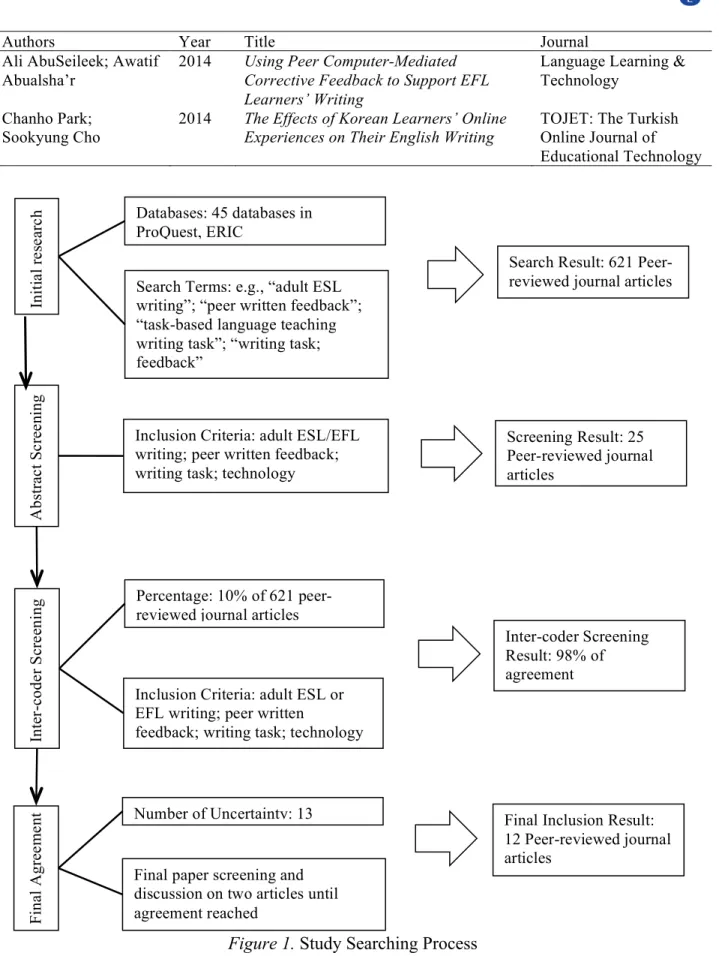
The authors followed a four-step searching process to retrieve studies for current
systematic literature review (See Figure 1). First, 45 electronic database were searched through the ProQuest search engine and the ERIC databases using the following search terms: "adult ESL writing" or "adult EFL writing" or "collaborative writing" or "collaborative writing task", and "peer written feedback" or "peer written corrective feedback" or "corrective feedback" or "feedback", and "computer-mediated communication" or "CMC" or "technology-mediated communication" or "technology". Searches were limited to peer-reviewed journal articles published from 2000 to 2016 in English. The initial searches yielded 621 studies. Second, the primary author screened the abstracts using the following four inclusion criteria:
1. The study carried out among adult ESL/EFL learners that include learners who were adult learners (e.g., age above 18) and learning English in a native-English speaking or a non-native-English speaking country/region/area.
2. The study investigated certain aspects of peer written feedback, which includes any type of written feedback provided by peers on linguistic knowledge and writing skills. 3. The study addressed the effect of computer-mediated peer written feedback on
writing, including learning linguistic knowledge through writing, develop writing skills, individual and collaborative writing activities, and any other form of language learning carried on writing.
blogs, computer software, online discussion, websites, emails, online conference and online system.
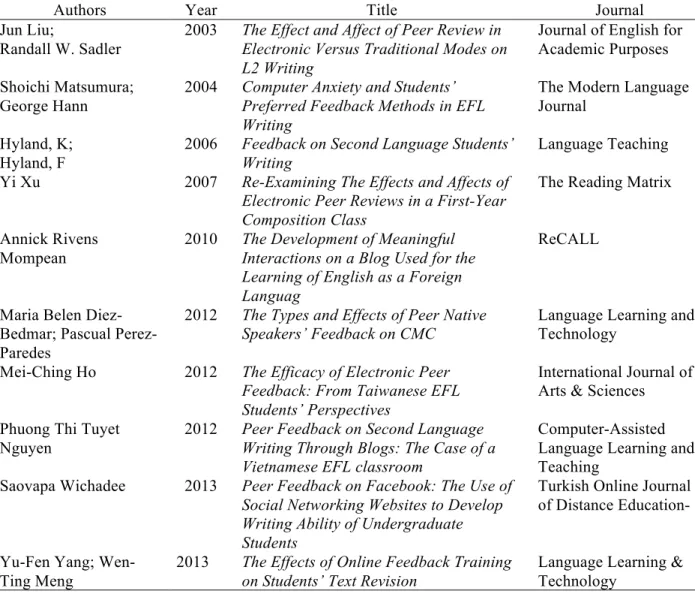
Third, in order to maintain inter-coder reliability, the second author reviewed 10% of initial search results using the same inclusion criteria. The inter-coder screening reached 98% of agreement and the number of included studies was narrowed down to 25 studies. Last, the two authors carefully read and reviewed the 25 studies identified after abstract screening. Through a close reading, 13 out of 25 studies could not be included in the analysis due to the nature of their research purposes and questions. Therefore, 12 studies were included for the final review (See Table 1).
Table 1. Included Studies
Authors Year Title Journal
Jun Liu;
Randall W. Sadler
2003 The Effect and Affect of Peer Review in Electronic Versus Traditional Modes on L2 Writing
Journal of English for Academic Purposes
Shoichi Matsumura; George Hann
2004 Computer Anxiety and Students’ Preferred Feedback Methods in EFL Writing
The Modern Language Journal
Hyland, K; Hyland, F
2006 Feedback on Second Language Students’ Writing
Language Teaching
Yi Xu 2007 Re-Examining The Effects and Affects of Electronic Peer Reviews in a First-Year Composition Class
The Reading Matrix
Annick Rivens Mompean
2010 The Development of Meaningful Interactions on a Blog Used for the Learning of English as a Foreign Languag
ReCALL
Maria Belen Diez-Bedmar; Pascual Perez-Paredes
2012 The Types and Effects of Peer Native
Speakers’ Feedback on CMC Language Learning and Technology
Mei-Ching Ho 2012 The Efficacy of Electronic Peer Feedback: From Taiwanese EFL Students’ Perspectives
International Journal of Arts & Sciences
Phuong Thi Tuyet Nguyen
2012 Peer Feedback on Second Language Writing Through Blogs: The Case of a Vietnamese EFL classroom
Computer-Assisted Language Learning and Teaching
Saovapa Wichadee 2013 Peer Feedback on Facebook: The Use of Social Networking Websites to Develop Writing Ability of Undergraduate Students
Turkish Online Journal of Distance Education-
Yu-Fen Yang; Wen-Ting Meng
2013 The Effects of Online Feedback Training on Students’ Text Revision
Figure 1. Study Searching Process
Authors Year Title Journal
Ali AbuSeileek; Awatif Abualsha’r
2014 Using Peer Computer-Mediated Corrective Feedback to Support EFL Learners’ Writing
Language Learning & Technology
Chanho Park;
Sookyung Cho 2014 The Effects of Korean Learners’ Online Experiences on Their English Writing TOJET: The Turkish Online Journal of Educational Technology Abstr ac t S cr ee ning
Inclusion Criteria: adult ESL/EFL writing; peer written feedback; writing task; technology
Screening Result: 25 Peer-reviewed journal articles In ter -co de r S cre en in g
Inclusion Criteria: adult ESL or EFL writing; peer written
feedback; writing task; technology Percentage: 10% of 621 peer-reviewed journal articles
Inter-coder Screening Result: 98% of agreement Fi na l A gr ee me nt
Number of Uncertainty: 13
Final paper screening and discussion on two articles until agreement reached
Final Inclusion Result: 12 Peer-reviewed journal articles In it ia l re se arc
h Databases: 45 databases in ProQuest, ERIC
Search Terms: e.g., “adult ESL writing”; “peer written feedback”; “task-based language teaching writing task”; “writing task; feedback”
Data Analysis
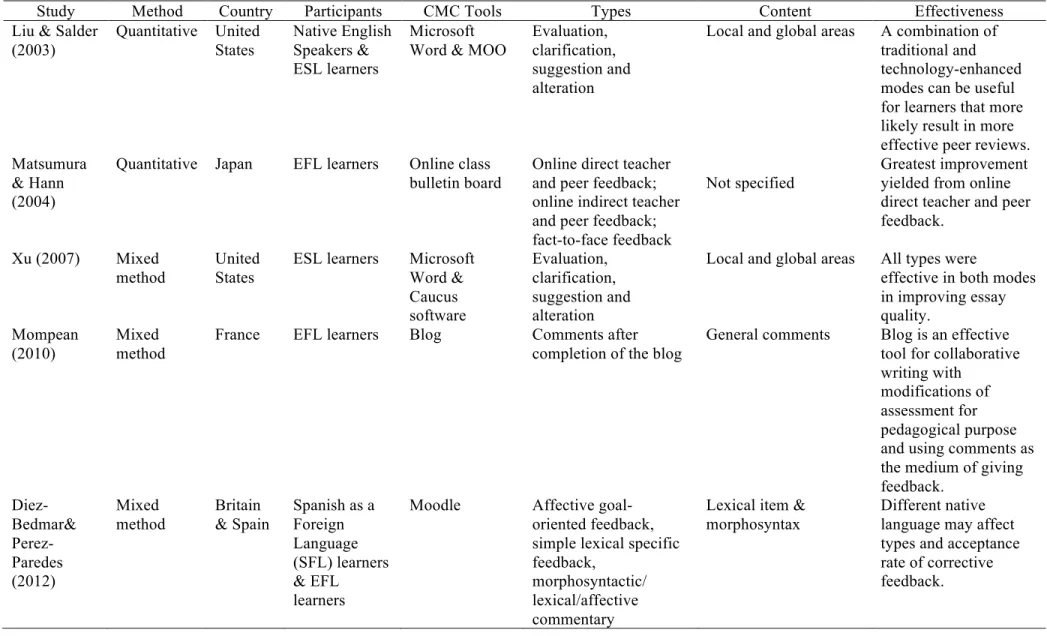
This review used the Grounded Theory approach to analysis the 12 included studies (Kim, 2014). A theme-based initial coding system was formed after both authors read the 12 studies in-depth (See Table 2). The coding system built a matrix for analyzing each detail of the studies focusing on four areas: research design, results, discussion, and limitations. Specifically, the coding system includes the following themes: methodology, country in which the study was conducted (i.e., Country), participants, CMC technology used for writing and feedback (i.e., CMC Tools), types of peer written feedback (i.e., Types), content of peer written feedback (i.e., Content), and effectiveness of computer-mediated peer written feedback (i.e., Effectiveness). One of the 12 studies was a literature review, from which the authors were not able to locate the above four coding areas. Therefore, only the 11 empirical studies were coded in the coding system; the one literature review was included in finding discussions. The two authors coded all 11 included studies and reached agreements on all decisions.
Findings
This review included 12 peer-reviewed journal articles, published from 2003 to 2014. Eleven studies were empirical studies that used mixed method (n=6), quantitative methods (n=4) or qualitative methods (n=1) for data collection and data analysis. One of the 12 included studies was a literature review (Hyland & Hyland, 2006) that was not included in coding. For
demographic information of the participants in each study, nine of the 11 empirical studies were conducted with EFL adult learners (i.e., learners from France, Japan, Jordan, Korea, Spain, Taiwan, Thailand and Vietnam). The other two studies were conducted with ESL adult learners in the United States. The wide range of geographical areas showed that studies on computer-mediated peer written feedback and writing had received a worldwide attention from SLA
researchers in recent decades. Furthermore, two themes emerged from the coding analysis: 1) the types and content of computer-mediated peer written feedback and the associated effect on ESL/EFL writing, and 2) the influence of technology on the effectiveness of computer-mediated peer written feedback.
Types and Content of Computer-Mediated Peer Written Feedback
Table 2. Theme-based Coding System with Descriptive Information
Study Method Country Participants CMC Tools Types Content Effectiveness
Liu & Salder (2003)
Quantitative United States
Native English Speakers & ESL learners
Microsoft Word & MOO
Evaluation, clarification, suggestion and alteration
Local and global areas A combination of traditional and technology-enhanced modes can be useful for learners that more likely result in more effective peer reviews. Matsumura
& Hann (2004)
Quantitative Japan EFL learners Online class bulletin board
Online direct teacher and peer feedback; online indirect teacher and peer feedback; fact-to-face feedback
Not specified
Greatest improvement yielded from online direct teacher and peer feedback.
Xu (2007) Mixed method
United States
ESL learners Microsoft Word & Caucus software Evaluation, clarification, suggestion and alteration
Local and global areas All types were
effective in both modes in improving essay quality.
Mompean (2010)
Mixed method
France EFL learners Blog Comments after completion of the blog
General comments Blog is an effective tool for collaborative writing with
modifications of assessment for pedagogical purpose and using comments as the medium of giving feedback. Diez-Bedmar& Perez-Paredes (2012) Mixed method Britain & Spain
Spanish as a Foreign Language (SFL) learners & EFL learners
Moodle Affective goal- oriented feedback, simple lexical specific feedback,
morphosyntactic/ lexical/affective commentary
Lexical item & morphosyntax
Study Method Country Participants CMC Tools Type Content Effectiveness Ho (2012) Mixed
method
Taiwan EFL learners Microsoft Word & Online Meeting
Revision-driven comments
Not specified Modes of peer review don’t influence the number of incorporated review in revision.
Nguyen (2012)
Qualitative Vietnam EFL learners Blog Revision-oriented or non-revision-oriented
Language usage & content
Students reflected on the language use in their own writing while providing peer feedback. Wichadee (2013) Mixed method
Thailand EFL learners Facebook Revision-oriented or non-revision-oriented Content, grammar, language use, organization, creativity Learners writing performance significantly improved after receiving peer comments.
Yang & Meng (2013)
Mixed Method
Taiwan EFL learners Computer-supported collaborative learning
(CSCL) system
Not specified Local and global areas Less-proficient students made more improvement on writing than the more- proficient students did. AbuSeileek
&
Abualsha’r (2014)
Quantitative Jordan EFL learners Microsoft Word
Track changes, recast, or metalinguistic
Content, structural organization (text and sentence levels), grammatical accuracy, lexical appropriateness, punctuation, and spelling Providing computer-mediated corrective feedback by peers seemed to have enhanced students' writing performance
Park & Cho (2014)
Quantitative Korea EFL learners Blog
Text message
Clarification and suggestion
Not specified Regular online writers were more active in improving their writing drafts with peer
feedback, technique-based feedback, and non-specified types. Purpose-driven feedback
categorized feedback based on the functional objectives, such as revision-oriented feedback and non-revision-oriented feedback, direct and indirect feedback (Ho, 2012; Matsumura & Hann, 2004; Nguyen, 2012; Wichadee, 2013). Content-specific feedback was categorized based on the content areas of the feedback, including simple lexical specific feedback,
morphosyntactic/lexical/affective commentary (Diez-Bedmar & Perez-Paredes, 2012). Another group of studies adapted Lyster and Ranta's (1997) classification, focusing on the techniques of providing feedback, such as evaluation, clarification, alteration, and suggestions (AbuSeileek & Abualsha'r, 2014; Liu & Salder, 2003; Park & Cho, 2014; Xu, 2007). However, not all studies specified the investigated feedback types. For instance, Mompean (2010) only focused on the general peer comments ESL/EFL learners provided on blog writing. Yang and Meng (2013) investigated the effect of peer written feedback provided through a computer-mediated language learning system without specific types.
In terms of content area of feedback, six studies mainly addressed the effectiveness of feedback on local areas (i.e., lexical appropriateness, grammar, punctuation and spelling) and global areas (i.e., idea development, purpose, organization of writing, and sentence level
structural organization; AbuSeileek & Abualsha’r, 2014; Liu & Salder, 2003; Nguyen, 2012; Xu, 2007; Wichadee, 2013; Yang & Meng, 2013). Diez-Bedmar and Perez-Paredes (2012) only examined lexical items and morphosyntax learning in writing. Whereas, the other four studies intended to study the effectiveness of computer-mediated peer written feedback on writing as a whole (Ho, 2012; Matsumura & Hann, 2004; Mompean, 2010; Park & Cho, 2014).
The findings also revealed that adult ESL/EFL learners tended to provide more direct feedback on local areas of writing. One explanation was that if the CMC technology used for writing and feedback had supportive functions for providing feedback (e.g., track changes in Microsoft Word), learners would take advantage of the technology and make less effort on spotting other areas for improvement (AbuSeileek & Abualsha’r, 2014; Liu & Salder, 2003; Nguyen, 2012; Xu, 2007). If the technology was not equipped with such functions (e.g., blogs), learners tended to provide less focused and less direct feedback (Mompean, 2010).
with the types and content of the feedback. First of all, even though this review only limited to computer-mediated peer written feedback, the diverse classification of the types restricted generalization of the findings. Even so, regarding the content of peer written feedback, learners showed a tendency of employing feedback on local areas in revisions. For instance, Yang and Meng (2013) found that the learners incorporated only feedback on local errors. Participants in Wichadee’s (2013) and Nguyen’s (2012) studies also preferred feedback that can help with detecting local errors in writings. Similarly, Xu (2007) mentioned that the participants were more comfortable with making local revisions based on their peers’ feedback compared to global areas. The following aspects can explain such preference on local feedback. First is that local error revisions took less effort to correct; therefore, ESL/EFL learners had less resistance to accept local feedback from their peers (Yang & Meng, 2013; Wichadee, 2013; Xu, 2007). Second, ESL/EFL learners have less faith in the quality of global area peer feedback, because learners can use other tools (e.g., CMC technology, dictionary, online resources) to spot local errors, which is not applicable for global errors. Naturally, the quality of local peer feedback could be higher than global feedback (Yang & Meng, 2013; Xu, 2007). Third, because of the lack of support to provide global feedback, learners could provide less global feedback because of the lack of confidence in English and writing or resist making more effort on review peer’s writing (Nguyen, 2012).
CMC Technology
This review also confirmed Chen’s (2016) and Lin’s (2015) findings that CMC
technology has a positive effect when used for learning purposes in SLA. Due to differences in research purposes, included studies have employed a variety of CMC technology, ranging from single computer software (e.g., Microsoft Word) to a mixture of systems (e.g., Microsoft Word + online discussion). Four studies used Microsoft Word for both writing and feedback (AbuSeileek & Abualsha’r, 2014; Ho, 2012; Liu & Salder, 2003; Xu, 2007); three studies investigated
which type and what content they used to provide feedback. Additionally, we also found two features of CMC technology – the existence of editing function and the publicity of the software – contributed the most to the impact on feedback effectiveness.
As a widely used word-processing software, Microsoft Word had the most developed and mature functions for text editing compared to other tools. The track-change and the
error-highlighting functions of Microsoft Word can lead learners’ attention to local errors (AbuSeileek & Abualsha’r, 2014; Liu & Salder, 2003; Xu, 2007). However, the peer written feedback
provided through blogs and other online systems had less focus on local areas because of the lack of editing function (Matsumura & Hann, 2004; Wichadee, 2013; Xu, 2007; Yang & Meng, 2013). As for the publicity, among the selected CMC technology in this review, Microsoft Word is a private software in which information is not shared publicly unless the authors intentionally published it on public platforms; blogs could be either public or semi-public with restricted-access; the other online systems were accessible to registered users only. The findings showed that ESL/EFL learners felt more comfortable and confident in providing peer feedback in a private or a semi-public setting (e.g., Microsoft Word, restricted-accessed blogs) because they felt less embarrassed when making mistakes in writing and feedback (Nguyen, 2012; Park & Cho, 2014). On the other hand, CMC technology with public access (e.g., blogs) might not provide such sense of security for learners (Mompean, 2010). As a result, the quantity and quality of peer written feedback were affected. Furthermore, in a private or semi-public setting, the quantity of feedback was higher; the content of feedback was more focused and direct on local errors (AbuSeileek & Abualsha’r, 2014; Liu & Salder, 2003; Nguyen, 2012; Park & Cho, 2014). Whereas in a public setting, learners provided fewer numbers of feedback that were more general and focused on global areas (e.g., comments on the overall structure; Mompean, 2010).
Discussion
ESL/EFL learners’ preferences on types and content of feedback, regardless of the quantity and quality of the feedback, also affected the frequency of feedback application in revisions.
Moreover, this review did not find any differences between EFL and ESL learners’ attitudes about peer written feedback in writing.
Several possibilities may cause the inconclusive findings on the effectiveness of
computer-mediated peer written feedback. First of all, although evidence showed that compared to writing with no feedback, peer written feedback could promote writing development and language learning, it was not clear whether the correction and the improvement could sustain over time and eventually facilitate SLA. According to Schmidt’s (1990, 2001) Noticing
Hypothesis, learning only occurs through conscious awareness of the errors. Viewing corrections made based on feedback provided through technological editing function as the evidence of learning can be questionable. Hyland and Hyland (2006) identified the drawbacks of automated feedback by technology that it had the “potential dangers of ignoring meaning negotiation in real world contexts” (p. 95). Yang (2010) suggested that learners need to self-reflect on the errors and corrections, monitor and evaluate their writing to pursue text improvement rather than only rely on the feedback. Therefore, CMC technology with editing functions needs to be carefully evaluated and assessed to limit automated feedback and give learners more opportunities to self-reflect and self-evaluate.
training. Third, individual technology anxiety could also differentiate on the effectiveness of computer-mediated peer feedback (Matsumura & Hann, 2004). Studies on computer-mediated learning indicated that learner’s familiarity about the technology strongly influenced the learning outcomes (Lin, 2015). Lin (2015) synthesized 59 peer-reviewed studies on CMC in SLA
concluded that incorporating CMC as in-class activities supplemented with sufficient technical instruction generated a significantly larger effect than CMC after-class activities, which are lack of guidance on technology. Therefore, proper technology training is encouraged to be included before CMC activity or instruction to maximize the learning effect in CMC setting.
To promote the use of CMC technology in ESL/EFL writing classroom, Mompean (2010) indicated that using single CMC technology might not result the best learning outcome and
recommended SLA researchers and teachers to implement multiple CMC technology in one setting. For example, Mompean anticipated that a combination of public writing platforms (e.g., blogs) and private communication systems (e.g., discussion board) could be more effective, given that learners were able to publish the writing and gain sense of authorship, at the same time, feel more comfortable and confident while exchanging peer feedback. However, studies
Conclusion and Recommendations
This review confirmed that computer-mediated peer written feedback has a positive impact on language learning and writing development in SLA. However, the effect of this approach could be influenced by several factors, such as types and content of peer feedback and other contextual factors (e.g., CMC technology, learner’s proficiency). However, this systematic literature review is not without limitations, which may affect the generalizability of the findings. Compared with other systematic literature reviews, the present review only included peer-review journal studies that may underrepresent the studies on computer-mediated peer written feedback. The relatively specific search terms and inclusion criteria may also cause the relative small number of included studies. Another limitation is that although the review focused on computer-mediated peer written feedback only, the classifications of types of feedback were relatively diverse, which may influence the interpretation of findings. Therefore, this review only reveals part of the findings of computer-mediated peer written feedback on ESL/EFL writing in SLA.
In recent decades, SLA has been reconnected with classroom instruction and researchers' attention was raised on the importance of classroom teaching (Loewen, 2014; Ortega, 2005). The findings of this review revealed that the effects of computer-mediated peer written feedback on writing might fluctuate depending on contextual variables, such as learner features, technology availability and learning objectives in writing. Therefore, to ensure ESL/EFL learners were able to effectively obtain both linguistic knowledge and writing skills from their peer in computer-mediated writing and interaction, here are some implications that ESL/EFL teachers could take away from the current systematic literature review.
are highly proficient, metalinguistic feedback could be beneficial according to previous studies in SLA. Then teachers will need to teach learners how to provide metalinguistic feedback on the learning target before the actual tasks.
References
AbuSeileek, A., & Abualsha'r, A. (2014). Using peer computer-mediated corrective feedback to support EFL learners’ writing. Language Learning & Technology, 18, 76-95.
doi:10.1111/jcal.12004
Alvarez, I., Espasa, A., & Guasch, T. (2012). The value of feedback in improving collaborative writing assignments in an online learning environment. Studies in Higher Education, 37, 387-400. doi:10.1080/03075079.2010.510182
Arnold, N., Ducate, L., & Kost, C. (2012). Collaboration or cooperation? Analyzing group dynamics and revision processes in wikis. CALICO Journal, 29, 431-448.
doi:10.11139/cj.29.3.431-448
Bennett, S., Bishop, A., Dalgarno, B., Waycott, J., & Kennedy, G. (2012). Implementing Web 2.0 technologies in higher education: A collective case study. Computers & Education, 59, 524-534. doi:10.1016/j.compedu.2011.12.022
Bower, J., & Kawaguchi, S. (2011). Negotiation of meaning and corrective feedback in Japanese/English eTandem. Language Learning & Technology, 15, 41-71. Retrieved from http://llt.msu.edu/issues/february2011/bowerkawaguchi.pdf
Braine, G. (1997). Beyond word processing: Networked computers in ESL writing classes. Computers and Composition, 14, 45–58. doi:10.1016/S8755-4615(97)90037-2
Caulk, N. (1994). Comparing teacher and student responses to written work. TESOL Quarterly, 28, 181–188. doi:10.2307/3587209
Chen, T. (2016). Technology-supported peer feedback in ESL/EFL writing classes: a research synthesis. Computer Assisted Language Learning, 29, 365-397.
doi:10.1080/09588221.2014.960942
Cho, K., & MacArthur, C. (2010). Student revision with peer and expert reviewing. Learning and Instruction, 20, 328-338. doi:10.1016/j.learninstruc.2009.08.006
Diez-Bedmar, M. B., & Perez-Paredes, P. (2012). The types and effects of peer native speakers' feedback on CMC. Language Learning & Technology, 16, 62-90. Retrieved from: http://llt.msu.edu/issues/february2012/diezbedmarperezparedes.pdf
Elola, I., & Oskoz, A. (2010). Collaborative writing: Fostering foreign language and writing conventions development. Language Learning & Technology, 14(3), 51-71. Retrieved from: http://llt.msu.edu/vol14num3/elolaoskoz.pdf
Guasch, T., Espasa, A., Alvarez, I. M., & Kirschner, P. A. (2013). Effects of feedback on
collaborative writing in an online learning environment. Distance Education, 34, 324-338. doi:10.1080/01587919.2013.835772
Gutiérrez, X. (2008). What does metalinguistic activity in learners' interaction during a collaborative L2 writing task look like? The Modern Language Journal, 92, 519-537. doi:10.1111/j.1540-4781.2008.00785.x
Ho, M. (2012). The efficacy of electronic peer feedback: from Taiwanese EFL students' perspectives. International Journal of Arts & Sciences, 5, 423-428. Retrieved from: http://universitypublications.net/ijas/0505/pdf/PRG405.pdf
Hyland, K., & Hyland, F. (2006). Feedback on second language students' writing. Language Teaching, 39, 83-101. doi:10.1017/S0261444806003399
Kessler, G. (2009). Student-initiated attention to form in wiki-based collaborative writing. Language Learning & Technology, 13, 79-95. Retrieved from:
http://llt.msu.edu/vol13num1/kessler.pdf
Kim, H. N. (2008). The phenomenon of blogs and theoretical model of blog use in educational contexts. Computers & Education, 51, 1342-1352. doi:10.1016/j.compedu.2007.12.005 Kim, H. Y. (2014). Learning opportunities in synchronous computer-mediated communication
and face-to-face interaction. Computer Assisted Language Learning, 27, 26-43. doi:10.1080/09588221.2012.692386
Lantolf, J. & Thorne, S. L. (2007). Sociocultural Theory and Second Language Learning. In. B. van Patten & J. Williams (eds.), Theories in Second Language Acquisition (pp. 201-224). Mahwah, NJ: Lawrence Erlbaum.
Lin, H. (2015). A meta-synthesis of empirical research on the effectiveness of
computer-mediated communication (CMC) in SLA. Language Learning & Technology, 19, 85-117. Retrieved from: http://llt.msu.edu/issues/june2015/lin.pdf
Liu, J., & Sadler, R. W. (2003). The effect and affect of peer review in electronic versus
traditional modes on L2 writing. Journal of English for Academic Purposes, 2, 193-227. doi:10.1016/S1475-1585(03)00025-0
Loewen, S. (2014). Introduction to instructed second language acquisition. New York, NY: Routledge.
Long, M. H. (1981). Input, interaction, and second‐language acquisition. Annals of the New York Academy of Sciences, 379(1), 259-278. doi:10.1111/j.1749-6632.1981.tb42014.x Lyster, R., & Ranta, L. (1997). Corrective feedback and learner uptake. Studies in Second
Language Acquisition, 19, 37-66. doi:10.1191=1362168804lr146oa
Matsumura, S., & Hann, G. (2004). Computer anxiety and students' preferred feedback methods in EFL writing. The Modern Language Journal, 88, 403-415.
doi:10.1111/j.0026-7902.2004.00237.x
Min, H. T. (2006). The effects of trained peer review on EFL students’ revision types and writing quality. Journal of Second Language Writing, 15, 118-141.
doi:10.1016/j.jslw.2006.01.003
Mompean, A. R. (2010). The development of meaningful interactions on a blog used for the learning of English as a Foreign Language. ReCALL, 22, 376-395.
doi:10.1017/S0958344010000200
Nguyen, P. T. T. (2012). Peer feedback on second language writing through blogs: The case of a Vietnamese EFL classroom. Computer-Assisted Language Learning and Teaching, 2, 13-23. doi:10.4018/ijcallt.2012010102
Novakovich, J. (2016). Fostering critical thinking and reflection through blog‐mediated peer feedback. Journal of Computer Assisted Learning, 32, 16-30. doi:10.1111/jcal.12114 Ortega, L. (2005). Methodology, epistemology, and ethics in instructed SLA research: An
Ortega, L. (2012). Epilogue: Exploring L2 writing-SLA interfaces. Journal of Second Language Writing, 21, 404-415. doi:10.1016/j.jslw.2012.09.002
Ozfidan, B., Machtmes, K., & Demir, H. (2014). Socio-cultural Factors in Second Language Learning: A Case Study of Adventurous Adult Language Learners. European Journal of Education Research, 3 (4), 185-191. doi. 10.12973/eu-jer.3.4.185
Ozfidan, B. & Burlbaw, L. (2017). A Literature-Based Approach on International Perspectives of Bilingual Education. Journal of Educational Issues. 3 (2), 25- 40.
doi.10.5296/jei.v3i2.11551
Paulus, T. M. (1999). The effect of peer and teacher feedback on student writing. Journal of Second Language Writing, 8, 265–289. doi:10.1016/S1060-3743(99)80117-9
Park, C., & Cho, S. (2014). The Effects of Korean Learners' Online Experiences on Their
English Writing. Turkish Online Journal of Educational Technology-TOJET, 13, 202-209. Peterson, M. (2009). Learner interaction in synchronous CMC: A sociocultural perspective.
Computer Assisted Language Learning, 22, 303-321. doi:10.1080/09588220903184690 Polio, C. (2012). The relevance of second language acquisition theory to the written error
correction debate. Journal of Second Language Writing, 21, 375-389. doi:10.1016/j.jslw.2012.09.004
Qi, D. S., & Lapkin, S. (2001). Exploring the role of noticing in a three-stage second language writing task. Journal of Second Language Writing, 10, 277-303. doi:10.1016/S1060-3743(01)00046-7
Robinson, P. (1995). Attention, memory, and the “noticing” hypothesis. Language Learning, 45, 283-331. doi:10.1111/j.1467-1770.1995.tb00441.x
Rodgers, K. J., Horvath, A. K., Jung, H., Fry, A. S., Diefes-Dux, H., & Cardella, M. E. (2014). Students’ perceptions of and responses to teaching assistant and peer feedback.
Interdisciplinary Journal of Problem-based Learning, 9, 36-56. doi:10.7771/1541-5015.1479
Sachs, R., & Polio, C. (2007). Learners' uses of two types of written feedback on a L2 writing revision task. Studies in Second Language Acquisition, 29, 67-100.
Sauro, S. (2009). Computer-mediated corrective feedback and the development of L2 grammar. Language Learning & Technology, 13, 96-120. Retrieved from:
http://llt.msu.edu/vol13num1/sauro.pdf
Schmidt, R. W. (1990). The role of consciousness in second language learning. Applied Linguistics, 11, 129-158. doi:10.1093/applin/11.2.129
Schmidt, R. (2001). Attention. In P. Robinson (Ed.), Cognition and second language instruction (pp. 3-32). Cambridge, UK: Cambridge University Press.
Sheen, Y. (2010). Differential effects of oral and written corrective feedback in the ESL classroom. Studies in Second Language Acquisition, 32, 203-234.
doi:10.1017/S0272263109990507
Shintani, N. (2015). The effects of computer-mediated synchronous and asynchronous direct corrective feedback on writing: A case study. Computer Assisted Language Learning, 29, 517-538. doi:10.1080/09588221.2014.993400
Sotillo, S. (2005). Corrective feedback via instant messenger learning activities in NS-NNS and NNS-NNS dyads. CALICO Journal, 22, 467-496. doi:10.1558/cj.v22i3.467-496
Strobl, C. (2014). Affordances of Web 2.0 technologies for collaborative advanced writing in a foreign language. CALICO Journal, 31, 1-18. doi:10.11139/cj.31.1.1-18
Vygotsky, L. (1978). Interaction between learning and development. Readings on the Development of Children, 23(3), 34-41.
Wang, Y. C. (2015). Promoting collaborative writing through wikis: a new approach for advancing innovative and active learning in an ESP context. Computer Assisted Language Learning, 28, 499-512. doi:10.1080/09588221.2014.881386
Warschauer, M. (2013). Comparing face-to-face and electronic discussion in the second language classroom. CALICO Journal, 13(2/3), 7-26. doi:10.1558/cj.v13i2-3.7-26 Watanabe, Y. (2008). Peer-peer interaction between L2 learners of different proficiency levels:
Their interactions and reflections. Canadian Modern Language Review, 64, 605-635. doi:10.3138/cmlr.64.4.605
Wu, W. C. V., Petit, E., & Chen, C. H. (2015). EFL writing revision with blind expert and peer review using a CMC open forum. Computer Assisted Language Learning, 28, 58-80. doi:10.1080/09588221.2014.937442
Xu, Y. (2007). Re-examining the effects and affects of electronic peer reviews in a first year composition. The Reading Matrix: An International Online Journal, 7(2), 1-21. Retrieved from: http://www.readingmatrix.com/articles/xu/article.pdf
Yang, Y. F. (2010). Students’ reflection on online self-correction and peer review to improve writing. Computers & Education, 55, 1202-1210.
Yang, M., Badger, R., & Yu, Z. (2006). A comparative study of peer and teacher feedback in a Chinese EFL writing class. Journal of Second Language Writing, 15, 179-200.
doi:10.1016/j.compedu.2010.05.017