Address for correspondence Brig. Dr. Ajmal Rashid, Dermatology Department, PNS Shifa Hospital, Karachi
Original Article
Antibiotic sensitivity patterns of staphylococcal
skin infections
Farhan Mir*, Ajmal Rashid*, Muhammad Farooq**, Muhammad Irfan*, Aamir Ijaz**
* Dermatology Department, PNS Shifa Hospital, Karachi ** Pathology Department, PNS Shifa Hospital, Karachi
Abstract Objectives To determine the current sensitivity pattern against staphylococci found in skin and soft tissue infections.
Methods Patients were enrolled from OPD of Dermatology Department, PNS Shifa Hospital, Karachi. All the patients with skin infections showing growth of Staphylococcus aureus on culture medium were selected. After informed consent, swab specimens were collected under aseptic measures from skin lesions for microbial analysis and sensitivity pattern.
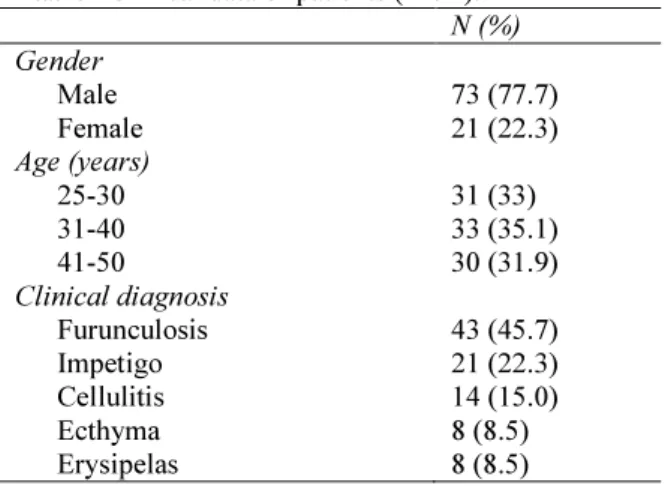
Results Among skin infections, furunculosis was found most common, comprising of 45.7% (n=43), cellulitis 15.0% (n=14), ecthyma 8.5% (n=8), erysipelas 8.5 % (n=8) and impetigo 22.3% (n=21). According to drug sensitivity patterns, vancomycin was found sensitive in 100%, linezolid 98.9%, mupirocin 96.8%, rifampicin 95.7%, chloramphenicol 94.7%, clindamycin 86.2%, amikacin 84%, moxifloxacin 83%, fusidic acid 79.8%, gentamicin 76.6%, oxacillin 69.1%, ciprofloxacin 68.1%, amoxicillin-clavulanic acid 62.8%, erythromycin 60.6% and trimethoprim-sulphamethaxazole 57.4% of cases
Conclusion Vancomycin, linezolid, rifampicin, clindamycin, moxifloxacin and chloramphenicol showed highest efficacy in this study. However, clinical studies are required to confirm in vivo efficacy and side effect profile of these drugs.
Key words
Staphylococcus aureus, antibiotic sensitivity.
Introduction
Staphylococci are the most common cause of
skin and soft tissues infections, the most
common cause of nosocomial cases of
pneumonia and surgical wound infections,1
endocarditis in patients with prosthetic valves2
and of nosocomial bloodstream infections.3
Staphylococcal infections are significant cause of morbidity and mortality in tropical countries. If repeated cultures are performed, up to 80% adults harbor staphylococci in the nose at one
time or the other.4
Staphylococcus aureus makes up about 20% of microbial load in the air. It is also suggested that staphylococci are commonly disseminated from the nasal cavity during talking, breathing and even exercising.5 This important pathogen not
only causes mild to severe skin infections like impetigo, furuncle, ecthyma, cellulitis etc., it may also cause some invasive infections including pneumonia, endocarditis, deep-seated
abscesses, toxic shock syndrome etc.6
explained intrinsic resistance mechanisms are also important factor.4,7
In case of S. aureus, the most common and
important species of staphylococci, it produces
Panton-Valentine leukocidin (PVL) most
commonly in community-acquired infections, which is related with high morbidity and mortality.8
S. aureus is developing a lot of resistance,
among which methicillin-resistant S aureus
(MRSA) is very common. MRSA has two types:
healthcare-acquired (HA-MRSA) and
community-acquired (CA-MRSA). Both can cause serious and invasive infections; however, CA-MRSA is associated with more serious complications like sepsis, bone and joint infections and even death.9
It is suggested that all MRSA strains are resistant to pencillinase stable penicillins.10
According to Center for Drug Control report,
20-30% of population is colonized with S.
aureus, 1% are MRSA among them, although all of them are not infected. MRSA sometimes called superbug, as it is difficult to treat.11
According to two meta-analyses there is 23.4% mortality associated with methicillin-susceptible
S. aureus (MSSA) vs. 36.4% with MRSA.12
Antimicrobial susceptibility patterns are
important for clinicians for the selection of
empirical antibiotic therapy, rationale
formulation of healthcare policies and useful information on the global surveillance of this
organism.6 The paucity of such data in Pakistan
has led to injudicious use of antibiotics, which not simply produces economical loss to the developing country but also develops antibiotic resistance.13 Rationale of the present study is to
acquire the current sensitivity pattern of antimicrobials against staphylococci so that
patients can be managed properly and
injudicious use of antibiotics can be minimized.
Methods
Patients were enrolled from out-patient clinic of dermatology department, PNS Shifa Hospital, Karachi. All the patients with skin infections, showing growth of staphylococci on culture medium and meeting inclusion criteria were
selected. After informed consent, swab
specimens were collected under aseptic
measures from skin lesions for microbial analysis and sensitivity pattern. Specimens were transported in microbiology department, PNS Shifa hospital within two hours of collection. Specimens were inoculated on 5% horse blood
agar (Laboratories Britania®, Argentina)/
mannitol salt agar (Oxoid Basingstoke®, UK).
These plates were incubated at 35-37ºC
aerobically. Staphylococci and their species were identified by colony morphology, Gram staining, catalase, slide and tube coagulase and DNAse tests under the supervision of consultant microbiologist. Antibiotic sensitivity pattern were tested by standard antibiotic discs using modified Kirby-Bauer disc diffusion method and read and classified as either sensitive or resistance as per recommendations of Clinical Laboratory Standards Institute.10
Results
Ninety-four of those who developed
staphylococcus species on culture were further
selected for sensitivity pattern. Gender
distribution of patients (Table 1), showed 73
Table1 Clinical data of patients (n=94). N (%) Gender
Male 73 (77.7)
Female 21 (22.3)
Age (years)
25-30 31 (33)
31-40 33 (35.1)
41-50 30 (31.9)
Clinical diagnosis
Furunculosis 43 (45.7)
Impetigo 21 (22.3)
Cellulitis 14 (15.0)
Ecthyma 8 (8.5)
Erysipelas 8 (8.5)
Table 2 Sensitivity and resistance pattern of drugs against Staphylococcus aureus.
Drugs Sensitivity Resistance Vancomycin 94 (100%) 0 (0.0) Linezolid 93 (98.9%) 01 (1.1%) Mupirocin 91 (96.8%) 03 (3.2%) Rifampicin 90 (95.7%) 04 (4.3%) Chloramphenicol 89 (94.7%) 05 (5.3%) Clindamycin 81 (86.2%) 13 (13.8%)
Amikacin 79 (84.0%) 15 (16.0%)
Moxifloxacin 78 (83.0%) 16 (17.0%) Fusidic acid 75 (79.8%) 19 (20.2%) Gentamicin 72 (76.6%) 22 (23.4%) Oxacillin 65 (69.1%) 29 (30.9%) Ciprofloxacin 64 (68.1%) 30 (31.9%) Amoxi-clav 59 (62.8%) 35 (37.2%) Erythromycin 56 (60.6%) 38 (39.4%)
Tmp-smx 54 (57.4%) 40 (42.6%)
Among cutaneous infections (Table 1),
furunculosis was the most common disease,
comprising of 43 (45.7%) patients. Table 2
shows the drug sensitivity patterns. Of all the samples, vancomycin (100%) was found most
sensitive, while
trimethoprim-sulphamethaxazole (57.4%) was found least sensitive antimicrobial.
Discussion
In this study we compared the sensitivity of S. aureus against fifteen different antibiotics including the old conventional drugs and the novel available newer therapies in our set-up.
Hanif et al.13 in 2006 showed in their study that
amikacin was 98.6% sensitive, oxacillin 91.7%, ciprofloxacin 97.2%, amoxi-clav 91.7%, fusidic
acid 100%, chloramphenicol 90.3%,
clindamycin 95.8%, trimethoprim-
sulphamethaxazole 30.6% and gentamicin
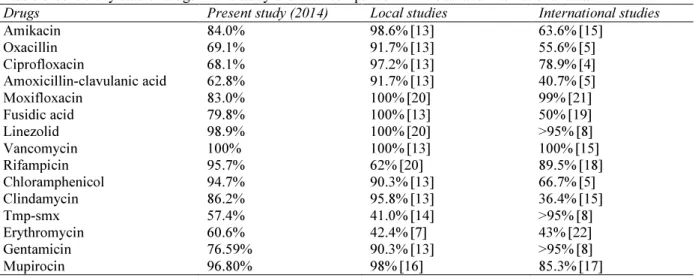
90.3% against staphylococcus. While this study showed amikacin 84% sensitive, oxacillin 69.1%, ciprofloxacin 68.1% ciprofloxacin,
amoxi-clav 62.8%, fusidic acid 79.8%,
chloramphenicol 94.7%, clindamycin 86.2%,
trimethoprim-sulphamethaxazole 57.4% and
gentamicin 76.29% as shown in Table 3. Now
these data suggest that except chloramphenicol and trimethoprim-sulphamethaxazole all drugs
have shown reduced sensitivity against
staphylococcus that may be because of injudicious use of these antibiotics in the community in last 6 years, especially by the
quacks and general practitioners. While
chloramphenicol and
trimethoprim-sulphamethaxazole are the older drugs and are no longer in common use mainly because of their side effects. This may be the reason that
their efficacy has gradually increased.
Chloramphenicol was the fifth most sensitive drug of our study. National data (90.3%)13also
suggested that it was an effective antibiotic against staphylococci in 2006. It has shown 90% sensitivity, against MRSA according to one local study.14 Chloramphenicol is routinely used for
the management of vancomycin-resistant
enterococci (VRE) infections at some
institutes.14
Further clinical studies specially
against MRSA and vancomycin-resistant S.
aureus should be carried on this cost effective precious drug, to see its efficacy and side effect profile, so that it may be utilized for the benefit of community.
Vancomycin showed (100%) sensitivity, results
are comparable with national (100%)13
and international data (100%).15 It is suggested that it
Table 5 Sensitivity data of drugs in this study and their comparison with local and international data.
Drugs Present study (2014) Local studies International studies
Amikacin 84.0% 98.6%[13] 63.6%[15]
Oxacillin 69.1% 91.7%[13] 55.6%[5]
Ciprofloxacin 68.1% 97.2%[13] 78.9%[4]
Amoxicillin-clavulanic acid 62.8% 91.7%[13] 40.7%[5]
Moxifloxacin 83.0% 100%[20] 99%[21]
Fusidic acid 79.8% 100%[13] 50%[19]
Linezolid 98.9% 100%[20] >95%[8]
Vancomycin 100% 100%[13] 100%[15]
Rifampicin 95.7% 62%[20] 89.5%[18]
Chloramphenicol 94.7% 90.3%[13] 66.7%[5]
Clindamycin 86.2% 95.8%[13] 36.4%[15]
Tmp-smx 57.4% 41.0%[14] >95%[8]
Erythromycin 60.6% 42.4%[7] 43%[22]
Gentamicin 76.59% 90.3%[13] >95%[8]
Mupirocin 96.80% 98%[16] 85.3%[17]
against all type of staphylococci. Linezolid was the 2nd most sensitive drug in our study. It is effective drug against VRE and MRSA. Results of national data (100%)13
and international data
(95%)5 are also well consistent with these
results. Mupirocin was the third most sensitive
drug in the present study. National data (98%)16
also supports its effectiveness; international data
(85.3%)17 suggests that resistance is also
emerging to this novel topical antibiotic. Rifampicin was fourth most sensitive drug. Staphylococci get resistance against it by alteration of enzymes. It is having comparable results with the international data (89.5%).18 As
this is the mainstay of antituberculous therapy, this drug always being given along with some other antibiotic to prevent its resistance.
Fusidic acid (79.8%), is commonly prescribed topical antibiotic. This is also an effective oral antistaphylococcal agent. Just because of its injudicious use, especially in combination with steroid it is rapidly developing resistance. National data obtained 6 years back showed sensitivity of 100%.13 International data (50%)19
is indicating that it will lose its efficacy with progress of time in Pakistan, as well. Moxifloxacin 83.9% is still a good choice but
comparison with national (100%)20 and
international data (99%)21 suggests that
resistance is emerging against this drug in our community. It may be because of substandard and poor-quality antibiotic preparations along with substandard dosages and quality in marketed tablets. Oxacillin was (69.1%) sensitive with comparison to the national data
(91.7%).13This suggests increased prevalence of
MRSA in our community. Ciprofloxacin’s resistance (68.%) is also emerging. This study has comparable results with international data (78.9%).4
Amoxi-clav is the most commonly prescribed
antibiotic in our outpatient department.
Staphylococcus has multiple mechanisms of getting resistance against it, like enzymatic inhibition, membrane impermeability, alteration of target enzymes etc. This drug has shown 62.8% efficacy, which is quite less than the 6 yrs old national data (91.7%).13
International data (40.7%)5is indicating the future of this drug in
Pakistan. Erythromycin showed increased
sensitivity (60.6%) with comparison to the national (42.4%)7 and international data (43%),22
that may be because of decreased use of erythromycin in the clinical practice, nowadays.
Aminoglycosides, amikacin (84.0%) and
with other antibiotic, in life threatening staphylococcal infection.
Conclusion
Vancomycin, linezolid, rifampicin, clindamycin, moxifloxacin and chloramphenicol showed highest efficacy in this study. However, clinical studies are required to confirm in vivo efficacy and side effect profile of these drugs. It is alarming that the most commonly prescribed antibiotic of our OPD, amoxicillin-clavulanic acid has developed a lot of resistance.
References
1. Lowy FD. Staphylococcus aureus infections. N Engl J Med. 1998;339:520-32.
2. Fernandez-Guerrero ML, Verdejo C, Azofra J, de Gorgolas M. Hospital-acquired infectious endocarditis not associated with cardiac surgery: an emerging problem. Clin Infect Dis. 1995;20:16-23.
3. Emori TG, Gaynes RP. An overview of nosocomial infections, including the role of the microbiology laboratory. Clin Microbiol Rev. 1993;6:428-42.
4. Onwubiko NE, Sadiq NM. Antibiotic sensitivity pattern of Staphylococcus aureus from clinical isolates in a tertiary care institute in Kano, North-Western Nigeria. Pan Afr Med J. 2011;8:4.
5. Smith SI, Opere B, Goodluck HT, Akindolire OT. Antibiotic susceptibility pattern of staphylococcus species isolated from telephone receivers. Singapore Med J. 2009;50:208-11.
6. Shittu A, Lin J, Kolawole D. Antimicrobial susceptibility patterns of staphylococcus aureus and characterization of MRSA in South western Nigeria. Wounds. 2006;18 (4):77-84.
7. Bashir A, Mujahid TY, Jehan N. Antibiotic resistance profile: Isolation and characterization of clinical isolates of staphylococci from patients with community acquired skin infections. Pak J Pharm Sci. 2007;20:299-304.
8. Tillotson GS, Draghi DC, Sahm DF et al. Susceptibility of staphylococcus aureus isolated from skin and wound infections in
surveillance study. J Antimicrob Chemother. 2008;62:109-15.
9. Magliner D, Byerly MM, Cline DM. The prevalence of community acquired Methicillin resistant staphylococcus aureus (CA-MRSA) in skin abscesses presenting to the pediatric emergency department. N C Med J. 2008;69:351.
10. Clinical and Laboratory Standards Institute. Performance Standards of Antimicrobial Susceptibility Testing. 10th ed. Wayne, PA: Clinical and Laboratory Standards Institute; 2011. P. 60-8.
11. Akhtar R, Khan KMA, hasan F. Isolation and antimicrobial suscepHibility pattern of methicillin resistant and methicillin sensitive Staphylococcus aureus. J Surg Int. 2009;14:161-65.
12. Cosgrove SE, Sakoulas G, Perencevich EN. Comparison of mortality associated with methicillin-resistant and methicillin-susceptible Staphylococcus aureus bacteremia: a meta-analysis. Clin Infect Dis. 2003;36:53-9.
13. Hanif MM, Butt T, Amjad M. Pathogens involved and antibiotic sensitivity pattern of isolates in community acquired common bacterial skin infections presenting in a tertiary care hospital. Pak Arm Forces Med J. 2006;3:289-94.
14. Idrees F, Jabeen K, Khan MS, Zafar A. Antimicrobial resistance profile of methicillin resistant Staphylococcus aureus from skin and soft tissue isolates. J Pak Med Assoc. 2009;59:266-9.
15. Samba Z, Gadba R. Antibiotic susceptibility and phage typing of methicillin-resistant staphylococcus aureus clinical isolates from blood cultures of 692 patients in 15 Israeli hospitals. Eur J Epidemiol. 1993;9:559-62. 16. Farooq M, Abbassi SA, Butt T et al.
Antibacterial activity of pseudomonic acid (mupirocin) against, clinical isolates of methicillin resistant Staphylococcal aureus. Infect Dis J. 2010;19:204-7.
17. McNeil JC, Hulten KG, Kaplan SL, Mason EO. Mupirocin resistance in staphylococcus aureus causing recurrent skin and soft tissue infections in children. Antimicrob Agents Chemother. 2011;55:2431–2433.
19. Shah M, Mohanraj M. High levels of fusidic acid-resistant Staphylococcus aureus in dermatology patients. Br J Dermatol. 2003;148:1018-20.
20. Imran M, Faheem M, Aslam V et al. Wound infections and culture sensitivity. Pattern in pediatric burn patients. J Postgrad Med Inst. 2009;23:304-308.
21. Krasemann C, Meyer J, Tillotson G. Evaluation of the clinical microbiology
profile of moxifloxacin. Clin Infect Dis. 2001;32 (supplements1):S51-S63