
Address for correspondence
Dr. Samia Salman, Senior Registrar, Department of Dermatology
Nawaz Sharif Social Security Teaching Hospital
Multan Road Lahore, Pakistan E mail: [email protected]
Original Article
Facial abuse of topical steroids and fairness
creams: a clinical study of 200 patients
Samina Naz Chohan*, Majid Suhail*, Samia Salman*, Umair Mansoor Bajwa*, Mohummad Saeed*, Samina Kausar*, Taqdees Suhail**
* Department of Dermatology, Nawaz Sharif Social Security Teaching Hospital, Multan Road Lahore
** Final year MBBS, Allama Iqbal Medical College, Lahore
Abstract Objectives To estimate the magnitude of problem with reference to social demography, motivation and to record adverse effects of topical steroids (TCs) and fairness creams abuse on face.
Methods This study was conducted at Dermatology Department of Nawaz Sharif Social Security Teaching Hospital affiliated with University of Lahore. Patients with steroidal rosacea reporting to the investigator were asked about their current use of topical steroids and fairness creams and observations recorded.
Results Out of 200 patients studied 152 (76%) were females and 48 (24%) males, the majority belonging to low income group from urban area. Sixty six (33%) patients used potent TCs, 100 (50%) patients used TCs in combination with various fairness creams and 34 (17%) patients used fairness creams exclusively. The main indications for these creams, in order of preference were acne, improving dark complexion and melasma. Patients were ignorant of the ingredients and the adverse effects of TCs versus fairness creams among abusers were comparable.
Conclusions Unwarranted cosmetic use of TCs with or without fairness creams is quite common in facial dermatoses resulting in steroidal dermatitis resembling rosacea.
Key words
Topical corticosteroids, fairness creams, steroidal dermatitis resembling rosacea. Introduction
Topical corticosteroids (TCs) were first
introduced in dermatology in 19521 and are now
one of the most widely used therapeutic formulations in practice. TCs creams offer rapid symptomatic relief in many inflammatory dermatoses, especially in short-term and even its improper use, for instance in infectious
dermatoses, produces an initial clinical
improvement. In addition to their
antiinflammatory effects, TCs also have potent antipruritic, atrophogenic, melanopenic, sex-hormone-like and immunosuppressive effects on the skin and can lead to significant local adverse effects if used indiscriminately.2 Not only the
abuse, even the excessive, regular use of topical fluorinated steroids on the face is associated with eruption that is clinically indistinguishable from rosacea and is known by various names by different authors like, light sensitive seborrheid,3
perioral dermatitis,4 rosacea-like dermatitis,5
steroid rosacea,6 steroid dermatitis resembling
dermatitis.8 Since there is no agreement on
nomenclature we prefer to use the term of steroidal dermatitis resembling rosacea (SDRR) where it describes the comparable morphology of the disease due to TCs and fairness creams abuse on the face. The main clinical presentation of this dermatosis is diffuse facial redness with or without papulopustular lesions in addition to the development of rebound phenomenon after
withdrawal of TCs.6This dermatosis is routinely
seen in the daily clinical practice, but there is dearth of reports describing it in the medical
literature.6,8 In addition to steroid rosacea,
prolonged use of TCs cause acneiform eruption, hypertrichosis, steroid addiction, and red face syndrome associated with severe rebound erythema, burning and scaling on the face on
any attempted cessation of the application.9
Another dimension of TCs misuse is its cosmetic application particularly in combination with bleaching creams to make the skin fair among dark complexioned people. In spite of the widely perceived enormity of the problem, there are a few studies from Pakistan to highlight this issue. This cosmetic misuse of TCs is global and has been the subject of studies mainly from Africa,10 Asia11,12,13and even developed countries
like the USA are facing this problem.14 The
abuse of TCs is intertwined with fairness creams in our colour conscious society where people are obsessed with fair colour due to various social and historical reasons. Like fairness creams, TCs are readily available over the counter and in most instances, these are used as a depigmenting agent in combination with hydroquinone or mercury based bleaching creams in conditions such as acne, melasma, freckles, and many a times just to improve the dark complexion. Thus, the combination of factors like easy availability, lack of awareness regarding side effects, obsession for fair skin and poor access to
dermatologists makes the situation in Pakistan ripe for their misuse in the community.
Methods
This observational, descriptive study involved a total of 200 patients diagnosed as steroidal dermatitis resembling rosacea (SDRR) who consulted the Department of Dermatology at Nawaz Sharif Social Security Teaching Hospital affiliated with University College of Medicine,
The University of Lahore, from 15th March 2013
to 30th October 2013. The study was approved by the ethical committee and inclusion criteria for patients to be enrolled were selective only for those, with clinical features suggestive of SDRR and who had history of TCs and/or fairness creams use on the face continuously for more than 1 month or intermittently (for more than 3 months) due to any purpose other than classical rosacea. Patients with natural history of rosacea and pregnancy and those taking systemic steroids were excluded.
The diagnosis was established on clinical basis and formal consent was sought from each patient. Patients were interviewed directly by the dermatologist using structured questionnaire,
recording relevant clinical data like
adverse effects of the creams and if they had read the leaflet (package insert) before use.
Results
Out of the 200 patients studied, 152 (76%) were females and 48 (24%) males. The age distribution of patients was from 15 to 35 years and 128 (64%) were unmarried and 72 (36%) were married. The urban-rural ratio was 166: 34, and 176 (88%) patients belonged to lower and 24 (12%) to middle socioeconomic class. Regarding skin colour 158 (79%) patients had brown to light brown skin while 42 (21%) were fair complexioned. Majority of the patients 82 (41%) were students, followed by 76 (38%) household workers and 42 (21%) were factory employees. Regarding literacy status 128 (64%) were literate with minimum qualification of secondary school certificate and 72 (36%) were either uneducated or under matric. The different formulations used by the patients are highlighted in Table 1 and popular TCs and fairness cream
brands are shown in Table 2. Most of the
patients used more than one brand of fairness creams and none of the patients was familiar with the ingredients or acknowledged awareness about adverse effects of these creams. Various indications for which TCs and fairness creams
were used are delineated in Table 3. We also
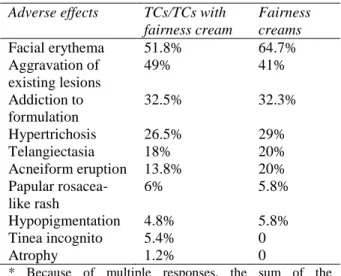
ascertained the advice or recommendation regarding the misuse of these creams and found that in majority of the patients, these were prescribed by friends, relatives and peers in 128 (64%), physicians or general practitioners in 32 (16%), beauticians in 16 (8%), self in 14 (7%), chemists in 8 (4%), and others 2(1%). Source of supply was pharmacy in 118 (59%), general stores in 72 (36%) and beautician in 10 (5%) cases. The adverse effect profile of TCs with or without fairness creams versus fairness creams only was comparable as highlighted in Table 4,
and in majority of the patients more than one
adverse effect was observed.
Table 1 Type of topical formulations used by patients (n=200).
Topical formulations N (%)
Potent steroids plus fairness 100 (50) Potent topical steroids: betamethasone
valerate and clobetasol propionate
66 (33)
Fairness creams 34 (17)
Table 2 Different brands used by the patients (n=200).
Trade name N (%)
Betnovate® cream 162 (76)
Dermovate® cream 68 (34)
Fair & Lovely® cream 60 (30)
Golden Pearl® cream 40 (20)
Stillman’s Bleach® cream 32 (16)
Archie® cream 32 (16)
Face Fresh® cream 16 (8)
Faiza Beauty® cream 8 (4)
* Because of multiple responses, the sum of the percentages is above 100.
Table 3 Indications of topical steroids/fairness creams.
Condition N (%)
Acne 103 (51.5)
Dark complexion 37 (18.5)
Acne with melasma 34 (17)
Melasma with freckles 13 (6.5)
Tinea faciei 9 (4.5)
Nonspecific dermatoses 4 (2)
Table 4 Adverse cutaneous reactions Adverse effects TCs/TCs with
fairness cream
Fairness creams
Facial erythema 51.8% 64.7%
Aggravation of existing lesions
49% 41%
Addiction to formulation
32.5% 32.3%
Hypertrichosis 26.5% 29%
Telangiectasia 18% 20%
Acneiform eruption 13.8% 20% Papular rosacea-
like rash
6% 5.8%
Hypopigmentation 4.8% 5.8%
Tinea incognito 5.4% 0
Atrophy 1.2% 0
Discussion
The excessive facial use of TCs for
inflammatory dermatoses and its abuse for cosmetic purposes is a common problem, often associated with eruption resembling rosacea. The rapid symptomatic relief in many dermatoses prompts the patients to abuse the medication resulting in the array of the adverse effects, dependence to TCs and this dilemma is confronted by dermatologists not only in Pakistan but also reported from many countries across the globe.12,15,16,17
In Pakistan, like India problem is complex as patients are under influence of disinformation, where TCs have acquired reputation of being antiacne and antiblemish cream among dark
complexioned people.15 The adverse effects in
patients using TCs with or without fairness creams observed in our study as depicted in Table 4, were facial erythema associated with irritation in 86 (51.8%), aggravation of preexisting dermatosis like acne 82 (49%), steroid addiction in 54 (32.5%), hypertrichosis in 44 (26.5%), telangiectasia 30 (18%), acneiform eruption 23 (13.8%), papular rosacea like rash 10 (6%), hypopigmentation 8 (4.8%), tinea incognito 9 (5.4%) and atrophy in 2 (1.2%) patients. Similar findings with some variations were observed in other studies.18,19,20 It has been
suggested that multiple pathways including rebound vasodilatation and proinflammatory cytokine release by chronic steroid use induce
erythema and rosacea-like eruption.21 Most of
the patients in our study 166 (83%) patients used potent to very potent TCs, which is in concordance with aforementioned studies from
other countries.15,16,17,20 The most preferred
brands in our study was betamethasone valerate (Betnovate®) followed by clobetasol propionate (Dermovate®/ Clobevate®) and this preference
is attributed to increased familiarization, inexpensiveness and poor regulatory oversight.
In our study the profile of a typical abuser is a young female from lower socioeconomic status and urban background, totally ignorant to the
adverse effects of topical formulations
irrespective of the educational status and who uses a potent TCs with or without fairness creams usually recommended by a friend or relative for the quest of fairness or underlying skin ailment. This attitude is prevalent across the board with minor variations in other countries dwelled by dark-complexioned inhabitants where cosmetic use of TCs as a depigmenting agent has become quite common as published in series of population based studies. In a
representative sample of adults visiting
dermatology center in Nigeria, 58.7% were using TCs for cosmetic purposes associated with
many adverse effects.22,23These statistics may be
comparable to other prevalence studies carried out in Senegal and Togo, where TCs used as bleaching agents in 37.7% and 18.2% people, respectively.24,25 Considering this craziness, there
is yearning for the developing a safe, non-toxic, non-irritating skin whitening agent for both beauty and therapeutic purposes that is devoid of
adverse effects.26 Some of the products used for
this purpose may be harmless, but many contain potentially hazardous ingredients such as inorganic mercury compounds, hydroquinone, steroids as active agents and some additives to
enhance the bleaching effect.27
Apparently, this cocktail formulation with multidimensional mechanisms seems to be seductive to optimize dark complexion in pursuit of fair skin, and thus reinforcing the widely held belief "fair is beautiful”. This obsession crosses boundaries of age, caste, religion, and social status particularly in South Asia.28 The TCs are
less-pigmented melanocytes in the skin, mercury bleaches the skin by inactivating the sulfhydryl enzymes and hydroquinone is a known inhibitor of melanin synthesis by suppressing tyrosinase
activity.26,29 Percutaneous absorption of this
blend increases with long-term use particularly in hot and humid conditions resulting in plethora of adverse cutaneous reactions and systemic
complications.29 Most important adverse effect
of hydroquinone is exogenous ochronosis, while contact dermatitis, discoloration of nails and
postinflammatory hyperpigmentation are
categorized as acute and higher concentrations
of hydroquinone lead to irreversible
hypopigmentation leading to leukoderma.29
In Pakistan, a Lahore-based study revealed 59% of female university students and staff were using fairness creams30 and PCSIR laboratories
determined the variable amount of hydroquinone in 11 out of 22 various skin lightening creams flooding the Pakistani market and labels on the packages noticeably did not indicate the levels
of hydroquinone.31 Similarly in Nigeria, ten
fairness creams were randomly sampled and all revealed level of hydroquinone varying from
below 0.4% to 6.2%.32 Until 2006, hydroquinone
2% was declared safe concentration and allowed for over the counter (OTC) by US Food and Drug Administration (FDA) but after 29th August 2006, all hydroquinone products were banned until they comply with the new drug application process.33
Products tested in a variety of countries in Africa, Asia, Latin America and North America have contained mercury from 660 to 57,000 parts per million (ppm), very much above the safe limit of 1ppm set by FDA.34 In India, 61%
of the dermatological market consists of skin
lightening products containing toxic
ingredients.35 According to WHO report
Pakistan is included in the list of countries
manufacturing mercury contaminated fairness
creams.36 Like TCs abuse, dermatologic
complications associated with mercury include dyschromia, acne, hypertrichosis, striae, tinea corporis, pyoderma, erysipelas, scabies, and contact dermatitis.37
In our study 100 (50%) patients used fairness creams in combination with TCs and 34 (17%) patients used only the fairness creams and adverse effects were almost similar to steroidal dermatitis resembling rosacea (SDRS) in both the groups with minor differences as highlighted in the Table 4. Increased frequency of erythema in patients using only fairness creams might be irritant contact due to combined effect of mercury and hydroquinone present in fairness creams. Similarly addictive potential and comparable adverse reactions of fairness creams in our study may be attributed to the contamination of fairness creams with steroids, in addition to mercury, and this is in concurrence to other aforementioned analytical study from
India.12 This study concluded that more than
60% of all marketed skin cosmetics in India that promise to produce instant fairness, glow and brightening of skin contain one or another steroid which can lead to serious cutaneous side effects.12 Similarly a Saudi Arabian study on
skin-lightening creams, documented the toxic presence of mercury, hydroquinone and steroids
in analyzed samples.27,28 Another study from
Saudi Arabia highlighted the potential of systemic toxicity of popular Fair and Lovely cream and found the traces of mercury in ovarian tissue of mice despite the level of mercury was less than 1 ppm in the tested samples and authors warned that women who regularly use such products are at particular risk, despite having no early symptoms of mercury toxicity.38 Similarly a Mexican study concluded
the use of mercury containing beauty cream.39
Even in USA, mercury containing skin-lightening creams were a source of exposure for increased urinary secretion of mercury among dark complexioned adult New Yorkers and recommended these formulations dangerous and illegal.40
In our study the use of TCs was entwined with fairness creams as 100 (50%) of the patients screened in our study, used fairness creams in combinations with TCs and 34 (17%) used only fairness creams and the most popular brands used were Fair & Lovely® cream 60 (30%) followed by Golden Pearl® cream 40 (20%), Stillman’s Bleach® cream 33 (16.5%), Archie® cream 32(16%), Face Fresh® cream14 (7%) and Faiza Beauty® cream 6 (3%) as shown in Table 2. Most of the patients used more than one brand of fairness creams and none of the patients was familiar with the ingredients and adverse effects of these creams. According to WHO report many of these creams used in local market were contaminated with very high toxic levels of mercury like Stillman’s Bleach® cream (39000 to 42000mg/kg), Golden Pearl® (4750mg/kg) and Face Fresh® cream (3500mg/kg), Faiza Beauty® cream (5940mg/kg) and Brite Face® Cream (1500mg/Kg) and no warning was found
on the label or leaflet.41,42,43 Another study
revealed the presence of lead, cadmium, copper and other heavy metals in Fair & Lovely® cream
from Pakistani market.44 In other regional
countries, similar situation prevails as Sri Lankan research report, revealed presence of mercury in 25 out of 46 samples of fairness
creams.45 In Bangladesh, 56% consumers
purchase beauty products of Unilever, and analytical report revealed the high concentration of mercury in Fair & Lovely Ayurvedic® (4004 ppm) and Fair & Lovely Max Fairness® cream (4174 ppm).47 Fair & Lovely® cream was also
the popular brand in our study like the India
where its market share is whooping 76%,48
reflecting the magnitude of fairness obsession, brand consciousness on the part of consumers in subcontinent.
In our study as depicted in Table 3 main
indications for using most of these creams were
acne, dark complexion and melasma,
comparable to that of an Indian and other
aforementioned studies.15,16,20 We also
ascertained the advice regarding the prescription of these creams and found that in majority of the patients, these were recommended by friends, relatives and peers in 128 (64%), general practitioners in 32 (16%), beauticians in 16 (8%), self in 14 (7%), chemists in 8 (4%), and others 2(1%). In our study, effortless source of supply of these products were pharmacies in 118 (59%), general stores in 72 (36%) and beauty parlors in 10 (5%) of the cases, reflecting the lax regulatory oversight, social factors and influence
of aggressive marketing and advertising
strategies of manufactures to dupe the people.
Limitations
As this was an OPD-based study and, therefore, it may or may not accurately reflect the community data but it certainly highlights misuse of TCs with or without fairness creams particular among dark complexioned people.
Conclusion
Unwarranted cosmetic use of TCs with or without fairness creams is quite common in
facial dermatoses resulting in steroidal
business with appropriate oversight and change the public perception and attitude to accept their natural skin tone despite social resistance to such advice. It is also incumbent that primary health care providers be sensitized regarding the adverse effects of TCs / fairness creams abuse on the face and enable them to recommend suitable and safe alternatives.
Conflict of interest
The authors declared no potential conflict of interests with respect to the research, authorship, and/or publication of this paper.
References
1. Sulzberger MB, Witten VH. Effect of topically applied compound F in selected dermatoses. J Invest Dermatol. 1952;19:101-2.
2. Hengge UR, Ruzicka T, Schwartz RA, Cork MJ. Adverse effects of topical glucocorticosteroids. J Am Acad Dermatol. 2006;54:1-15.
3. Frumess GM, Lewis HM. Light sensitive seborrheid. Arch Dermatol. 1957;75:245-8. 4. Mihan R, Ayres S Jr. Perioral dermatitis.
Arch Dermatol. 1964;89:803-5.
5. Chen AYY, Zirwas MJ. Steroid-induced rosacea like dermatitis: case report and review of the literature. Cutis. 2009;83:198-204.
6. Leyden J, Thew M, Kligman AM. Steroid rosacea. Arch Dermatol. 1974;110:619-22. 7. Ljubojeviæ S, Basta-Juzbaˇsviæ A,
Lipozen`eiæ J. Steroid dermatitis resembling rosacea: aetiopathogenesis and treatment. J Eur Acad Dermatol Venereol. 2002;16:121-6.
8. Del Rosso JQ. Management of papulopustular rosacea and perioral dermatitis with emphasis on iatrogenic causation or exacerbation of inflammatory facial dermatoses. J Clin Aesth Dermatol. 2011;4:20-30.
9. Rapaport AMJ, Rapaport V. Eyelid dermatitis to red face syndrome to cure: clinical experience in 100 cases. J Am Acad Dermatol. 1999;41:435-42.
10. Mahe A, Ly F, Aymard G, Dangou JM. Skin diseases associated with the cosmetic use of bleaching products in women from Dakar, Senegal. Br J Dermatol. 2003;148:493-500. 11. Lu H, Xiao T, Lu B et al. Facial
corticosteroid addictive dermatitis in Guiyang city, China. Clin Exp Dermatol. 2009;35:618-21.
12. Agarwal A, Singhvi IJ, Bele D et al. Evaluation of steroids in face creams of different marketed brands. Int J Pharm Technol. 2011;3:2480-6.
13. Rathi S. Abuse of topical steroid as cosmetic cream: A social background of steroid dermatitis. Indian J Dermatol. 2006;51:154-5.
14. Solomon BA, Glass AT, Rabbin PE. Tinea incognito and over the counter potent topical steroids. Cutis. 1996;58:295-6.
15. Mahe A, Ly F, Aymard G, Dangou JM. Skin diseases associated with the cosmetic use of bleaching products in women from Dakar, Senegal. Br J Dermatol. 2003; 148:493-500. 16. Al-Dhalimi MA, Aljawahiri N. Misuse of topical corticosteroids: A clinical study from an Iraqi hospital. East Mediterr Health J. 2006;12:847-52.
17. Semiz S, Balci YI, Ergin S et al. Two cases of Cushing’s syndrome due to overuse of topical steroid in the diaper area. Pediatr Dermatol. 2008;25:544-7.
18. Bhat YJ, Manzoor S, Qayoom S. Steroid induced rosacea: A clinical study of 200 patients. Indian J Dermatol. 2011;56:30-2. 19. Hameed AF. Steroid dermatitis resembling
rosacea: A clinical evaluation of 75 patients. Dermatology 2013; Article ID 491376, 4 pages, doi:10.1155/2013/491376.
20. Abir S, Koushik L, Manas C et al. Topical corticosteroid abuse on face: A Prospective multicenter study of dermatology outpatients. Indian J Dermatol Venereol Leprol. 2011;77:160-6.
21. Goldman D. Tacrolimus ointment for the treatment of steroid-induced rosacea. A preliminary report. J Am Acad Dermatol. 2001;44:995-8.
22. Nnoruka E, Okoye O. Topical steroid abuse: its use as a depigmenting agent. J Natl Med Assoc. 2006;98:934-9.
23. Olumide Y. Abuse of topical steroids in Nigeria. Nig Med Practitioner. 1986;11:7-12.
cosmetics in two areas in Dakar, Senegal (French). Dakar Med. 2000;45:154-7. 25. Pitche P, Afoune A, Amage U et al.
Prevalence of skin disorders associated with the use of bleaching cosmetics by Lome women (French). Sante. 1997;7(3):1 614. 26. Ebanks JP, Wickett R, Boissy RE.
Mechanisms regulating skin pigmentation: the rise and fall of complexion coloration. Int J Mol Sci. 2009;10:4066-87.
27. Al-Saleh I, Elkhatib R, Al-Rouqi R et al. The dangers of skin-lightening creams. Toxicol Environ Chem. 2012;94:195-219. 28. Shankar PR, Subish P. Fair skin in South
Asia: an obsession. J Pak Assoc Dermatol. 2007;17:100-4.
29. Olumide YM, Akinkugbe AO, Altraide D et al. Complications of chronic use of skin lightening cosmetics. Int J Dermatol. 2008;47:344-53.
30. Askari H, Sajid A, Faran Z et al. Skin-lightening practice among women living in Lahore: prevalence, determinants, and user’s awareness. 3rd International Conference on
Business Management 2013.
http://cgr.umt.edu.pk/icobm2013/papers/Pap ers/IC3-Dec-2012-066.pdf.
31. Siddique S, Parveen Z, Ali Z, Zaheer M. Qualitative and quantitative estimation of hydroquinone in skin whitening cosmetics. J Cosmet Dermatol Sci Applic. 2012;2:224-8. 32. Odumosu PO, Ekwe TO. Identification and
spectrophotometric determination of hydroquinone levels in some cosmetic creams. Afr J Pharm Pharmacol. 2010;4:231-4.
33. Dadzie O, Petit A. Skin bleaching: highlighting the misuse of cutaneous depigmenting agents. J Eur Acad Dermatol Venereol. 2009;23:741-50.
34. Sin KW, Tsang HF. Large-scale mercury exposure due to a cream cosmetic: community-wide case series. Hong Kong Med J. 2003;9:329-34.
35. Ladizinski B, Mistry N, Kundu RV. Widespread use of toxic skin lightening compounds: medical and psychosocial aspects. Dermatol Clin. 2011;29:111-23. 36. WHO, 2013. Mercury in skin lightening
products: Available from:
www.who.int/ipcs/assessment/public_health /mercury_flyer.pdf (Accessed on Dec 24,2013)
37. Morand JJ. Complications of cosmetic skin bleaching in Africa. Med Trop. 2007;67:627-34.
38. Al-Saleh I, Shinwari N, Al-Amodi M. Accumulation of mercury in ovaries of mice after the application of skin lightening creams. Biol Trace Elem Res. 2009;131:43-54.
39. Weldon MM, Smolinski MS, Maroufi A et al. Mercury poisoning associated with a Mexican beauty cream. West J Med. 2000;173:15-8.
40. McKelvey W, Jeffery N. Clark N et al. Beastly beauty products: exposure to inorganic mercury in skin-lightening creams. Environ Health Perspect. 2011;119:203-9.
41. The Rapid Alert System for Non-Food Products. RAPEX 2011. Available from: http://ec.europa.eu/consumers/dyna/rapex/ra pex_archives_en.cfm; (Accessed December 25, 2013).
42. The Rapid Alert System for Non-Food Products, RAPEX 2011. Available from: http://ec.europa.eu/consumers/dyna/rapex/cr eate_rapex.cfm?rx_id=385 (Accessed December 25, 2013).
43. RAPEX notifications. Report 29, 2007.
Available from:
http://ec.europa.eu/consumers/dyna/r....cfm? rx_id=142(Accessed December 25, 2013). 44. Ullah H, Noreen S, Fozia et al. Comparative
study of heavy metals content in cosmetic products of deferent countries marketed in Khyber Pakhtunkhwa, Pakistan. Arabian J Chem. 2013. Available from: http://dx.doi.org/10.1016/j.arab Accessed December 25, 2013).
45. Rubesinghe C, Withanage H. Mercury and lead contamination in selected whitening / fairness cream samples in Sri Lanka. CEJ MERC 2013. Available from: https://groups.google.com/d/topic/srilanka-toxics-info/o8TltimPA28 (Accessed December 25, 2013).
46. Country situation of mercury sources and hotspots in Bangladesh 2012. Available from:
www.zeromercury.org/.../Report_of_Hg_sit uation_of_bangladesh.pdf (Accessed December 25, 2013).
![All your private keys are belong to us [P3tEr] pdf](data:image/gif;base64,R0lGODlhAQABAIAAAP///wAAACH5BAEAAAAALAAAAAABAAEAAAICRAEAOw==)