Original Paper
Brain Behav Evol 2017;89:219–230 DOI: 10.1159/000471784
Sex Differences in Forebrain
Monoaminergic Response to Song
Performance
Susan M. Lyons
a
Keith W. Sockman
a, b
a Department of Biology, and b Curriculum in Neurobiology, University of North Carolina, Chapel Hill, NC , USA
mance measures the rate at which a song syllable is pro-duced relative to the syllable’s frequency bandwidth and is thought to reflect the difficulty with which songs are pro-duced. High-performance trills are more threatening to males but more attractive to females. We found that the ef-fects of trill performance on monoaminergic activity were sex-dependent. Relative to the response to low-performance songs, exposure to high-performance songs decreased nor-adrenergic activity in the caudomedial nidopallium, and tended to decrease serotoninergic activity in the caudome-dial mesopallium and caudomecaudome-dial nidopallium of the audi-tory telencephalon in females, but in males, the monoamine measurements were indistinguishable between song treat-ments. These results suggest that the mechanisms underly-ing sensory processunderly-ing of male sexual signals differ between
the sexes. © 2017 S. Karger AG, Basel
Introduction
A sexual signal from a male can have profoundly dif-ferent effects depending on whether the receiver is a male or female. Signals that are high quality or challenging to Keywords
Auditory telencephalon · Catecholamine · Dopamine · Monoamine · Norepinephrine · Pallium · Serotonin · Sex differences · Songbird · Song performance
Abstract
In many species, successful reproduction is dependent on the ability to adjust social behavior in response to an ever-changing social environment. Because a sexual signal’s val-ue and meaning can differ between females and males, responses to those signals should also differ. One way individuals can modulate social behavior is through experi-ence-dependent modulation of the sensory systems that process social signals. Central monoamines (norepineph-rine, dopamine, serotonin) modulate neural sensitivity to so-cial stimuli and are key regulators of experience-dependent neuroplasticity in vertebrate sensory systems. However, few studies have examined how exposure to different sexual sig-nals influences monoaminergic activity in female compared to male sensory systems. We used Lincoln’s sparrows (Me-lospiza lincolnii) to examine sex differences in how variation in the trill performance of song influences central monoam-inergic activity in the auditory telencephalon. Trill
Received: August 22, 2016
Lyons/Sockman
Brain Behav Evol 2017;89:219–230 DOI: 10.1159/000471784
220
produce might be attractive to females, who may be pros-pecting for quality mates. However, the same high-quality, challenging signals might be threatening to males, who may encounter the signal in competition for resourc-es [Searcy, 1992; Nowicki and Searcy, 2004; Searcy and Beecher, 2009]. These sex differences in perception of the valence of a sexual signal suggest sex differences in the underlying neural systems that regulate receiver respons-es to social signals.
Neural differences between the sexes in response to a sexual signal could manifest in perceptual, motor, or mo-tivational centers of the brain. Within perceptual centers of the brain, monoamines are implicated in modulating aspects of perception and sensory processing. Mono-amines, which include serotonin, dopamine, and norepi-nephrine, function by integrating information about the internal state of the individual with information about external stimuli [Bao et al., 2001; Berridge and Water-house, 2003; Hurley et al., 2004; Castelino and Schmidt, 2010; Hurley and Hall, 2011]. Serotonin facilitates sen-sory encoding in mammalian auditory systems [Hurley and Hall, 2011]. Dopamine is involved in regulating learning and neuroplasticity [Bao et al., 2001] and in en-coding aspects of stimulus reward [Berridge and Robin-son, 1998; Maney, 2013]. Norepinephrine regulates at-tention and memory formation throughout sensory sys-tems by increasing the signal-to-noise ratio of neuronal responses to sensory stimuli [Oades, 1985; Aston-Jones and Cohen, 2005; Sara, 2009; Castelino and Schmidt, 2010]. One or all of these monoamines may be involved in modulating sensory perception in response to experi-ence with the value of a sexual signal [Sockman, 2007; Salvante et al., 2009; Sewall et al., 2013]. However, because the valence of sexual signals differs between the sexes, we predicted that the monoaminergic responses to sexual signals would also differ.
In this study, we examined sex differences in the effects of bird song quality on monoaminergic activity in percep-tual, auditory-processing regions of songbird brains. We
first exposed male and female Lincoln’s sparrows
(Me-lospiza lincolnii) to one morning of songs of either high or low trill performance. Trill performance is a sexually selected component of bird song that reflects a biome-chanical constraint between the rate with which individu-als produce trilled syllables (trill rate) and the frequency bandwidth of those syllables [Podos, 1997; Wilson et al., 2014]. It is difficult for males to produce high-perfor-mance songs compared to low-perforhigh-perfor-mance songs [Po-dos, 1996; Po[Po-dos, 1997; Po[Po-dos, et al. 1999], and studies have found a positive association between aspects of male
quality and trill performance [Ballentine, 2009; Vehren-camp et al., 2013]. Furthermore, the valence of high-per-formance songs differs for females and males. Studies in multiple species of songbirds, including 2 studies in Lin-coln’s sparrows, indicate that females find high-perfor-mance songs more attractive than low-perforhigh-perfor-mance songs [Ballentine et al., 2004; Caro et al., 2010; Lyons et al., 2014], while male songbirds, including Lincoln’s spar-rows, are more threatened by and aggressive towards high-performance songs than low-performance songs [Illes et al., 2006; Sewall et al., 2010; DuBois et al., 2011; Moseley et al., 2013; Lyons, 2016].
Following song exposure, we measured monoaminer-gic activity in 2 regions of the songbird auditory telen-cephalon: the caudomedial mesopallium (CMM) and the caudomedial nidopallium (NCM). The CMM and NCM are analogous to regions of the mammalian secondary au-ditory cortex [Vates et al., 1996; Pinaud and Terleph, 2008], and they process information about variation in conspecific song in both female and male songbirds [Gentner et al., 2001; Gentner et al., 2004; Sockman, 2007; Knudsen and Gentner, 2010]. Due to the sex differences in the valence of song performance, we predicted that the effect of song performance on monoaminergic activity in perceptual, auditory regions of the brain would differ be-tween the sexes.
Methods
Animals and Housing
Song Treatments
From 2005 to 2011 at Molas Pass, CO, our lab recorded 6,866 Lincoln’s sparrow songs as described previously [Sockman, 2009]. For each of the more than 20,000 trills in these songs, we deter-mined trill rate and frequency bandwidth using the software Raven Pro version 1.5 (Cornell Laboratory of Ornithology, Ithaca, NY, USA). Specifically, the software calculates the duration and fre-quency bandwidth of the middle 90% of sound energy of the area of the trill we specified, which, for each trill, was all except the final syllable. Excluding the final syllable circumvents the problem of uncertainty about where a trill ends and the next phrase of the song begins. We then calculated trill rate as 1 less than the number of syllables in the trill divided by the duration described above (in s). We then calculated the upper bound regression of frequency band-width as a function of trill rate, and determined each trill’s perfor-mance as the orthogonal distance of the trill from an upper bound regression line. Trills that fell farther below the regression line had more negative trill performance values and indicated a lower trill performance [Podos, 1997; Sockman, 2009].
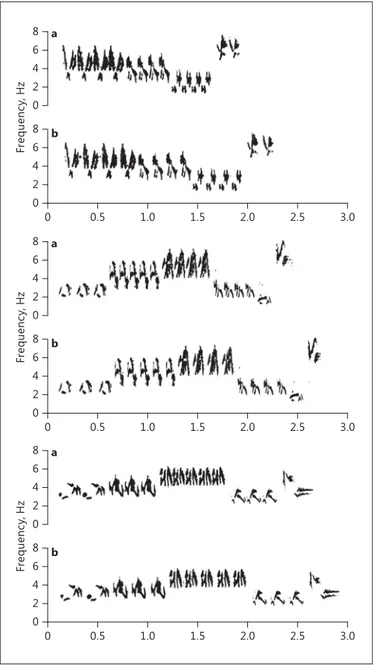
From the recorded songs, we selected 3 songs from each of 6 different males, with each song consisting of 4 trills with similar mean trill rates and performances. We generated treatment song files containing all 18 songs by generating 2 identical digital copies of each song. From one copy, we cut 15 ms of silence between each syllable of each trill (high-performance treatment) and pasted it into the corresponding inter-syllable space in the other copy (low-performance treatment; Fig. 1 ). Manipulated trills differed from each other (trill rate mean ± SEM: low performance 8.04 ± 0.23; high performance 9.76 ± 0.35; paired t test t = 12.81, p < 0.001; trill performance: low performance –0.41 ± 0.014; high performance –0.37 ± 0.15; paired t test t = 12.81, p < 0.001) and fell within the natural range of variation in trill rate and performance recorded for the study population.
Experimental Procedure
We used 8 sound-attenuation chambers each containing a cage with food cups, water bottles, and 2 perches, as well as a function-ing speaker on one end of the chamber and a nonfunctionfunction-ing speaker on the other end (Pioneer Corp. TS-G1040R). We bal-anced the side with the functioning speaker across the chambers and experimental treatments. We attached individual speakers to monoblock-amplifiers (Audiosource Amp 5.1A, Portland, OR, USA) that we interfaced (M-Audio Delta 1010, Irwindale, CA, USA) to a central computer (Apple Inc., Cupertino, CA, USA) si-multaneously broadcasting low-performance and high-perfor-mance songs to their respective chambers. We spatially inter-spersed the treatments and sexes among the 8 chambers, which were contained in one room, with one sex (one individual) and treatment per chamber. We switched treatment and sex assign-ments of the chambers between sessions.
Starting with the first session on February 10, 2013, we exposed all birds to their treatment songs (low- or high-trill performance) for one period that lasted a total of 5.25 h. During the 5.25 h, the treatment songs played for 20-min intervals with 10-min silent cy-cles between each interval. The treatment songs played in random order. An individual song lasted 2–3 s, and we interspersed songs with approximately 10 s of silence. Approximately 85 songs played per 20-min interval, and approximately 890 songs played over the entire 5.25 h of song exposure. Songs played at a peak amplitude of 70 dB 5 cm from the speaker [Sewall et al., 2013; Lyons et al., 2014].
In order to standardize the amount of time exposed to songs and allow time to collect brains at the conclusion of song exposure, we staggered the onset of song exposure for pairs of birds from op-posite treatments by 30 min. Therefore, within each group of birds, songs played from 5: 35 to 10: 50 a.m. for the first pair of birds and from 7: 05 a.m. to 12: 05 p.m. for the last pair of birds. We rapidly decapitated pairs of birds and collected their brains at the conclu-sion of the 5.25 h of song playback. We fresh froze one hemisphere
6 4 2 8
0
6 4 2 8
0
3.0 2.5 2.0 1.5 1.0 0.5 0
Fr
eq
ue
nc
y,
H
z
a
b
6 4 2 8
0
6 4 2 8
0
3.0 2.5 2.0 1.5 1.0 0.5 0
Fr
eq
ue
nc
y,
H
z
a
b
6 4 2 8
0
6 4 2 8
0
3.0 2.5 2.0 1.5 1.0 0.5 0
Fr
eq
ue
nc
y,
H
z
a
b
Lyons/Sockman
Brain Behav Evol 2017;89:219–230 DOI: 10.1159/000471784
222
on dry ice and held it at –80 ° C until we measured monoaminergic
activity in it using high-performance liquid chromatography with electrochemical detection (HPLC-ECD). We alternated between sex and treatments in the use of the hemisphere.
Quantification of Monoamines, Metabolites, and Protein
We used a cryostat to section the fresh frozen hemisphere from each brain into 300-μm sections in the sagittal plane. From the 300-μm sections, we used micropunches to collect tissue in CMM and NCM, using Field L as a guide as described previously [Sewall et al., 2013]. We collected a 0.5-mm diameter section from CMM and a 1-mm diameter section from NCM. Upon collection, we stored tissue samples in 1.9 mL polypropylene microcentrifuge tubes at –80 ° C until analysis.
When a monoamine is secreted from a pre-synaptic neuron, it may be metabolized [Moore, 1986; Eisenhofer et al., 2004; Meiser et al., 2013]. Therefore, in addition to quantifying serotonin, do-pamine, and norepinephrine, we quantified their respective pri-mary metabolites, 5-hydroxyindolacetic acid (5-HIAA),
3,4-dihy-droxyphenylacetic acid (DOPAC), and 3-methoxy-4-hydroxy-phenylglycol (MHPG), as indicators of secretion. However, since some of the secreted, non-metabolized monoamine can be taken back into the pre-synaptic neuron, and since monoamines can be metabolized intraneuronally [Moore, 1986; Eisenhofer et al., 2004; Meiser et al., 2013], these measurements may not capture the total amount of monoamine secreted.
We used methodology described previously [Sewall et al., 2013] to quantify monoamines and their metabolites by HPLC-ECD. We added 100 μL of mobile phase to each tissue sample tube. We son-icated tissue samples in the mobile phase solution, centrifuged them at 16,000 g at 4 ° C for 16 min, and then injected 10 μL of the
supernatant into an HTEC-500 stand-alone HPLC-ECD system (Eicom, San Diego, CA, USA) using a Midas autosampler (Spark Holland, Netherlands). The mobile phase solution was at pH 3.5 and was composed of citric acid (8.84 g), sodium acetate (3.10 g), sodium octyl sulfonate (215 mg), EDTA (5 mg), methanol (200 mL), and ultra-pure water (800 mL; Sigma-Aldrich, St. Louis, MO, USA). Monoamines and their metabolites were separated on an
Term Estimate SEM Denom.
df
F p value
Serotonin
Intercept 9.97 0.17
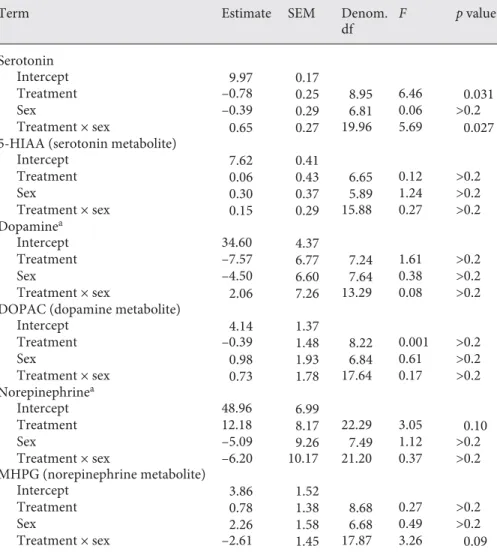
Treatment –0.78 0.25 8.95 6.46 0.031
Sex –0.39 0.29 6.81 0.06 >0.2
Treatment × sex 0.65 0.27 19.96 5.69 0.027
5-HIAA (serotonin metabolite)
Intercept 7.62 0.41
Treatment 0.06 0.43 6.65 0.12 >0.2
Sex 0.30 0.37 5.89 1.24 >0.2
Treatment × sex 0.15 0.29 15.88 0.27 >0.2 Dopaminea
Intercept 34.60 4.37
Treatment –7.57 6.77 7.24 1.61 >0.2
Sex –4.50 6.60 7.64 0.38 >0.2
Treatment × sex 2.06 7.26 13.29 0.08 >0.2 DOPAC (dopamine metabolite)
Intercept 4.14 1.37
Treatment –0.39 1.48 8.22 0.001 >0.2
Sex 0.98 1.93 6.84 0.61 >0.2
Treatment × sex 0.73 1.78 17.64 0.17 >0.2 Norepinephrinea
Intercept 48.96 6.99
Treatment 12.18 8.17 22.29 3.05 0.10
Sex –5.09 9.26 7.49 1.12 >0.2
Treatment × sex –6.20 10.17 21.20 0.37 >0.2 MHPG (norepinephrine metabolite)
Intercept 3.86 1.52
Treatment 0.78 1.38 8.68 0.27 >0.2
Sex 2.26 1.58 6.68 0.49 >0.2
Treatment × sex –2.61 1.45 17.87 3.26 0.09
Females and the low-performance treatment were coded as 0, males and the high-performance treatment were coded as 1. a Square root transformed.
Eicompak SC-30DS column (Eicom, San Diego, CA, USA) and were then passed over an electrode. The electrode maintained a potential of 750 mV against an Ag/AgCl reference electrode. The HPLC-ECD system determined the amount of each compound relative to a 2-point standard curve. The 2 standards were concen-trated at 1 pg/μL and 10 pg/μL of each of the 6 compounds of in-terest. We included with each standard and sample an internal standard (1 pg/μL isoproterenol, added prior to sample process-ing) to control for sample loss during preparation. We used Pow-erChrom software (eDAQ, Colorado Springs, CO, USA) to com-pare the area under the curve for each compound within each sam-ple to the area generated by the 2 standards. In all cases, we used the peak area ratio function in order to account for variation in isoproterenol across samples.
After determining the amount of each compound in the 10 μL of injected supernatant, we needed to account for variation in the amount of tissue from which the compounds were obtained. Therefore, we dissolved the remaining tissue sample in 0.2 M NaOH (20 μL for 0.5-mm diameter samples, 50 μL for 1-mm di-ameter samples) and used a Bradford protein-dye binding assay (Quickstart Bradford Protein Assay, BioRad, Hercules, CA, USA) to measure the amount of protein in each tissue sample. We used bovine serum albumin as a standard and performed all analyses on an UQuant microplate spectrophotometer (BioTek, Winooski, VT, USA). In situations in which the protein assay was unreliable and we were not able to repeat it due to low sample volume, we followed the protocol established previously [Sewall et al., 2013], and estimated the amount of protein as the average of the amount in the other tissue samples from the same brain region (CMM = 1 male, NCM = 3 females).
Analyses
The main goal of the study was to understand the influence of trill performance and sex on monoaminergic activity in the audi-tory system. We therefore ran separate analyses for each mono-amine and for each metabolite in each region of the auditory tel-encephalon. For these analyses of monoamine levels, we used lin-ear mixed effects models and included compound concentration as the dependent variable and log-transformed the values for nor-mality unless otherwise noted. We included treatment, sex, and their interaction as the independent variables. We included cham-ber as a random intercept and as a random coefficient for sex and treatment. We were unable to target CMM and NCM in tissue from one female. We fit all models using the R package lme4 [Bates et al., 2015], and used Satterthwaite Approximations for degrees of freedom for F tests of linear mixed effects models. We used R ver-sion 3.2.2 for all analyses [R Core Team, 2015].
Results
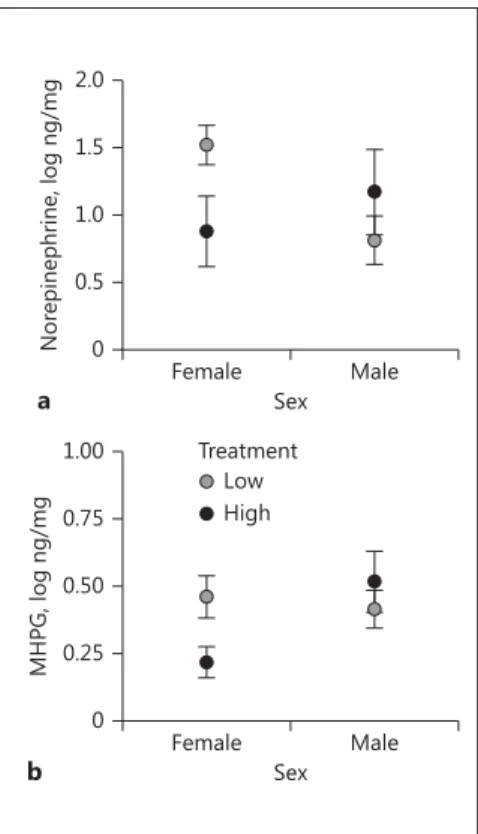
The major findings in this study were an interaction between the effects of song treatment and sex on levels of serotonin in CMM and on levels of serotonin metabolite (5-HIAA), norepinephrine, and norepinephrine metabo-lite (MHPG) in NCM. Post hoc analyses showed that fe-males in the high-performance treatment had lower levels
of both norepinephrine and MHPG in NCM compared to females in the low-performance treatment. There was no effect of treatment on any of the monoamines or me-tabolites in males. Below are the statistical details sup-porting these claims.
Monoamines and Metabolites in CMM
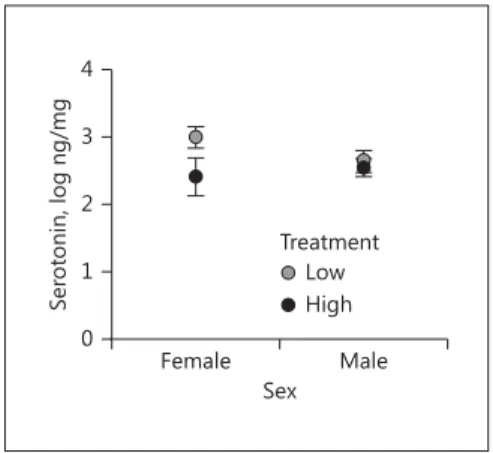
We found an effect of treatment and an interaction between the effects of treatment and sex on serotonin lev-els in CMM ( Table 1 ; Fig. 2 ). Post hoc analyses of sero-tonin levels did not detect a significant difference
be-tween the treatments within females (F1,10 = 3.28, p =
0.10) or males (F1,8.66 = 0.26, p > 0.2). We also did not
detect a significant difference between the sexes for either
the high (F1,13 = 0.24, p > 0.2) or low (F1,13 = 2.30, p = 0.15)
treatments.
We did not detect an effect of treatment, sex, or an in-teraction between the effects of treatment and sex on the levels of 5-HIAA, norepinephrine, dopamine or their me-tabolites in CMM ( Table 1 ). We also did not detect a cor-relation between any monoamine and its metabolite
within CMM ( p > 0.2).
Monoamines and Metabolites in NCM
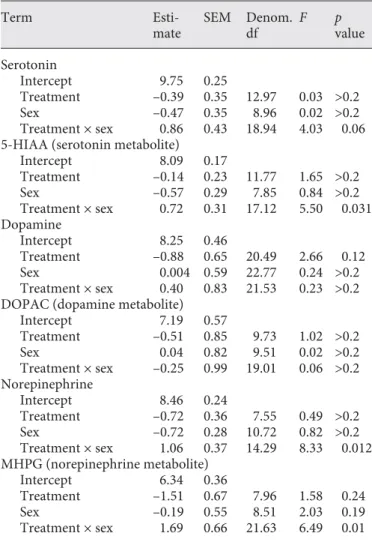
We found a trend for an interaction between the ef-fects of treatment and sex on serotonin levels. There was
Female Male
Sex 0
1 2 3 4
Ser
ot
onin, log ng/mg
Low Treatment
High
Lyons/Sockman
Brain Behav Evol 2017;89:219–230 DOI: 10.1159/000471784
224
also an interaction between the effects of treatment and sex on levels of the serotonin metabolite, 5-HIAA ( Ta-ble 2 ; Fig. 3 ). However, 1 male in the high-performance treatment had 5-HIAA levels greater than 2 SD above the mean. When this data point was omitted from the analy-sis there was no longer a significant interaction
(treat-ment X sex: F1,21.93 = 1.92, p = 0.18, Table 2 ). We
per-formed post hoc analyses on 5-HIAA. Post hoc analyses investigating the effects of treatment within each sex for 5-HIAA revealed that there was a trend for females in the high-performance treatment to have lower levels of 5-HIAA compared to females in the low-performance
treatment (F1,5.6 = 4.80, p = 0.074; Fig. 3 ). Within males,
we did not detect a significant effect of treatment on
5-HIAA ( p > 0.2). We also did not detect a significant
ef-fect of sex on 5-HIAA for either the high (F1,7.72 = 2.56,
p = 0.15) or low (F1,7.49 = 0.75, p > 0.2) treatments.
There was also a significant interaction between the effects of treatment and sex on norepinephrine levels ( Ta-ble 2 ; Fig. 4 a) as well as levels of the norepinephrine me-tabolite, MHPG ( Table 2 ; Fig. 4 b). There was one male in the high-performance treatment with norepinephrine levels greater than 2 SD above the mean, but after remov-al of this data point, the interaction between treatment
and sex remained significant (treatment X sex: F1,14.51 =
4.82, p = 0.045).
We performed post-hoc tests to investigate the within-sex effects of treatment on norepinephrine and MHPG in NCM. Females in the high-performance treatment had
lower levels of norepinephrine (F1,5.6 = 6.84, p = 0.042;
Fig. 4 a) and MHPG (square-root transformed): F1,10 =
5.67, p = 0.039; Fig. 4 b) than females in the
low-perfor-mance treatment. Within males, we did not detect a sig-nificant effect of treatment on norepinephrine or MHPG
( p > 0.2). We also performed post hoc tests to investigate
the within-treatment effects of sex on norepinephrine and MHPG in NCM. For norepinephrine, females in the low-performance treatment had higher levels of norepi-nephrine than males in the low-performance treatment
Female Male
Sex 0
0.5 1.0 1.5 2.0
5-HIAA
, log ng/mg
Low Treatment
High
Fig. 3. Effects of sex, the experimental treatment, and their interac-tion on the amount of 5-HIAA in the caudomedial nidopallium in Lincoln’s sparrows (Melospiza lincolnii) . The experimental treat-ment involved the digital manipulation of the trills in playback songs to be of either low or high performance. In statistical models, only the interaction term was significant; sex and treatment main effects were not significant. In post hoc analyses, there was a trend for females exposed to high-performance songs to have lower lev-els than females exposed to low-performance songs. There was not a significant effect of treatment in males, nor were there significant differences between the sexes within either treatment.
Table 2. Effects of the experimental treatment, sex, and their inter-action on levels of monoamines and their metabolites (ng/mg pro-tein) in the caudomedial nidopallium of Lincoln’s sparrows (Me-lospizalincolnii)
Term
Esti-mate
SEM Denom. df
F p
value
Serotonin
Intercept 9.75 0.25
Treatment –0.39 0.35 12.97 0.03 >0.2 Sex –0.47 0.35 8.96 0.02 >0.2 Treatment × sex 0.86 0.43 18.94 4.03 0.06 5-HIAA (serotonin metabolite)
Intercept 8.09 0.17
Treatment –0.14 0.23 11.77 1.65 >0.2 Sex –0.57 0.29 7.85 0.84 >0.2 Treatment × sex 0.72 0.31 17.12 5.50 0.031 Dopamine
Intercept 8.25 0.46
Treatment –0.88 0.65 20.49 2.66 0.12 Sex 0.004 0.59 22.77 0.24 >0.2 Treatment × sex 0.40 0.83 21.53 0.23 >0.2 DOPAC (dopamine metabolite)
Intercept 7.19 0.57
Treatment –0.51 0.85 9.73 1.02 >0.2
Sex 0.04 0.82 9.51 0.02 >0.2
Treatment × sex –0.25 0.99 19.01 0.06 >0.2 Norepinephrine
Intercept 8.46 0.24
Treatment –0.72 0.36 7.55 0.49 >0.2 Sex –0.72 0.28 10.72 0.82 >0.2 Treatment × sex 1.06 0.37 14.29 8.33 0.012 MHPG (norepinephrine metabolite)
Intercept 6.34 0.36
Treatment –1.51 0.67 7.96 1.58 0.24
Sex –0.19 0.55 8.51 2.03 0.19
Treatment × sex 1.69 0.66 21.63 6.49 0.01
(F1,6.31 = 26.35, p = 0.002; Fig. 4 a). Levels of norepineph-rine did not significantly differ between females and
males in the high-performance treatment (F1,7.43 = 0.75,
p > 0.2; Fig. 4 a). For MHPG, females in the
high-perfor-mance treatment had lower levels of MHPG than males
in the high-performance treatment (F1,13 = 4.72, p = 0.049;
Fig. 4 b). Levels of MHPG did not significantly differ be-tween females and males in the low-performance
treat-ment (F1,6.65 = 0.20, p > 0.2; Fig. 4 b).
We did not find an effect of treatment, sex, or an inter-active effect on levels of dopamine or its metabolite ( Ta-ble 2 ). When we tested for correlations between each monoamine and its metabolite, we found a correlation
between serotonin and 5-HIAA ( r s = 0.61, p < 0.001) and
a correlation between dopamine and DOPAC ( r s = 0.56,
p = 0.002). We did not detect a significant correlation
be-tween norepinephrine and MHPG ( r s = 0.15, p > 0.2).
Discussion
This study tested the hypothesis that the sexes differ in the auditory system’s monoaminergic response to variation in social signals. We found detectable differ-ences in monoaminergic responses to song performance in female but not male Lincoln’s sparrows. Females ex-posed to the high-performance songs had lower levels of both norepinephrine and its metabolite MHPG in NCM compared to females exposed to the low-performance songs. Males from the 2 treatments did not reliably differ in the levels of any of the monoamines or metabolites. When comparing the sexes within each treatment, in the low-performance treatment, females had higher levels of norepinephrine than males, while in the high-perfor-mance treatment, females had lower levels of MHPG than males. Females and males also differed in the influ-ence of the treatments on serotonin levels in CMM, and there was a trend for females exposed to high-perfor-mance songs to have lower levels of the serotonin me-tabolite 5-HIAA in the NCM than females exposed to low-performance songs. Together, the results from this study suggest that norepinephrine and potentially sero-tonin in the auditory telencephalon respond to differ-ences in trill performance more strongly in females than in males.
Several studies have detected sex differences in song perception and in brain regions that regulate song per-ception and production [Williams, 1985; Cynx and Not-tebohm, 1992; Del Negro et al., 2000; Del Negro and Ede-line, 2001; Gall et al., 2013]. The best known differences are sexual dimorphisms in the size and composition of the song-control nuclei, which regulate song learning and production and are typically larger in males [Nottebohm and Arnold, 1976; Arnold, 1992; Ball and Macdougall-Shackleton, 2001; Ball, 2016]. However, researchers have also detected effects of sex on gene expression and protein levels in the songbird auditory system as well as on audi-tory perception [Phillmore et al., 2003; Ikebuchi et al., 2003; Pinaud et al., 2006; Krentzel and Remage-Healey, 2015]. Similar to this study in which we found that mono-amines in the auditory forebrain discriminated between song performance in females but not males, many of these studies show female-biased sensitivity to songs or calls.
Female Male
Sex
b
0 0.25 0.50 0.75 1.00
MHP
G, log ng/mg
Low Treatment
High
Female Male
Sex
a
0 0.5 1.0 1.5 2.0
Nor
epinephrine, log ng/mg
Lyons/Sockman
Brain Behav Evol 2017;89:219–230 DOI: 10.1159/000471784
226
For example, song attractiveness modulates gene expres-sion in the NCM of female, but not male, zebra finches
(Taeniopygia guttata) [Gobes et al., 2009], and song nov-elty modulates heart rate in female, but not male,
Ben-galese finches (Lonchura striata) [Ikebuchi et al., 2003].
This study found that for a sexual signal that differs in valence between females and males, females have greater monoaminergic sensitivity to differences in the quality of the sexual signal than males. This finding is consistent with theoretical work predicting that it would be more costly for females to fail to discriminate between songs’ attractiveness than it would be for males to fail to dis-criminate between songs’ threat levels [Searcy and Bre-nowitz, 1988; Searcy, 1992].
The lack of an effect of song exposure on monoamines in males could indicate a lower sensitivity to song’s trill performance, as suggested above. However, male song-birds are behaviorally sensitive to trill performance, with free-ranging, territorial males of many species, including Lincoln’s sparrows, typically increasing aggressive behav-ior in response to an intruder song that is high-perfor-mance compared to low-perforhigh-perfor-mance [Illes et al., 2006; de Kort et al., 2009; Sewall et al., 2010; Moseley et al., 2013; Lyons, 2016]. Therefore, it is possible that males’ mono-aminergic responses to trill performance occur on a time-scale that differs from the one we measured. Future stud-ies that track the change in monoamine levels and the corresponding change in female discrimination and male competitive singing over the course of exposure to songs of different trill performance will further elucidate how exposure to song modulates monoamine-induced neuro-plasticity. Moreover, although this study focused on sen-sory regions of the brain, male behavioral responses to variation in sexual signals may principally manifest in other regions, such as motivational or motor regions, or they may be regulated principally through non-monoam-inergic systems [Sewall et al., 2010; Maney and Goodson, 2011; Rosvall et al., 2012].
Monoamines may act in the auditory telencephalon to integrate information about the value of song with infor-mation about the state of the individual to ultimately af-fect behavior [Sockman, 2007; Salvante et al., 2009; Sewall et al., 2013]. Several studies have found that extended ex-posure to songs of differing value influence neural activ-ity and behavior in female and male songbirds. One week of experience with more attractive compared to less at-tractive songs increased neural discrimination for male
song in the female European starling (Sturnus vulgaris)
[Sockman et al., 2002; Sockman et al., 2005] and de-creased behavioral responsiveness to male song in the
fe-male Lincoln’s sparrow [Lyons et al., 2014], suggesting that long-term experience with attractive songs increases female discrimination of song attractiveness [Bateson and Healy, 2005; Sockman, 2007; Lyons et al., 2014]. At the same time, male songbirds that experienced 1 week of exposure to high-quality songs increased singing effort more than males that experienced low-quality songs, in-dicating that males increase competitive behavior in re-sponse to experience with competitive signals [Salvante et al., 2009; Sewall et al., 2013].
In support of the hypothesis that monoamines in the auditory system mediate the influence of song exposure on neural and behavioral plasticity, previous studies in both European starling females and males and in Lin-coln’s sparrow males found that monoaminergic activity in CMM and NCM was higher following extended expo-sure to high-quality songs compared to low-quality songs [Sockman et al., 2002; Sockman and Salvante, 2008; Sal-vante et al., 2009; Sewall et al., 2013]. However, these studies measured both monoamine levels and behavior in birds on the morning following 1 week of exposure to songs. In this study, we measured monoaminergic activ-ity in the auditory telencephalon of females and males after one morning of exposure to songs, and thus the dif-ferent experiments captured the responses to difdif-ferent stimuli. In the previous experiments, changes in mono-amines may have reflected long-term changes in the brain (i.e., neuroplasticity) due to the weeklong exposure to stimuli, whereas in the current study, variation in mono-amines may have reflected short-term, real-time respons-es to the stimuli as they were occurring, even if those short-term responses might form an underlying basis to long-term plasticity.
Previous studies that have measured both mono-amines and synthesizing enzymes following exposure to song stimuli have often found that groups with higher levels of monoamines or metabolites following song posure also have higher levels of synthesizing enzyme ex-pression (e.g., [Sockman and Salvante, 2008; Matragrano et al., 2012a]). This pattern supports the interpretation that, at least in some situations, a higher level of mono-amine or metabolite following exposure to a stimulus cor-responds to an increase in synthesis. In addition, a differ-ence in metabolite levels between groups is often inter-preted as reflecting a difference in monoamine secretion. However, the metabolite measurements likely do not cap-ture the total amount of monoaminergic secretion due to reuptake of monoamines following secretion, and due to intraneuronal metabolism of monoamines [Moore, 1986; Eisenhofer et al., 2004; Meiser et al., 2013]. Therefore, al-though we tentatively interpret the monoamine and me-tabolite measurements in the current study to reflect syn-thesis and secretion activity preceding collection, this in-terpretation should be taken with caution. Future studies that use repeated measurements of monoamines and me-tabolites during song exposure could provide clearer in-sight into the dynamics of synthesis and secretion during song exposure.
Females from the high-performance treatment had lower levels of both norepinephrine and MHPG in NCM compared to females from the low-performance treat-ment. The difference in both compounds suggests that the treatment affected both synthesis and secretion of norepinephrine [Moore, 1986; Eisenhofer et al., 2004]. Norepinephrine regulates arousal, attention, and goal-di-rected behavior by enhancing responses to salient stimu-li and suppressing responses to nonsastimu-lient stimustimu-li [Ber-ridge and Waterhouse, 2003; Aston-Jones and Cohen, 2005; Sara, 2009]. However, noradrenergic secretion fol-lows 2 patterns of release. Tonic release likely regulates overall levels of arousal, while phasic release likely corre-sponds to stimulus-specific responses and goal-directed behavior [Berridge and Waterhouse, 2003; Aston-Jones and Cohen, 2005; Valentino and Van Bockstaele, 2008]. In this study, differences between the females in levels of norepinephrine and MHPG could occur through phasic release of norepinephrine in response to hearing songs, or through tonic release that corresponds with different levels of arousal.
We also examined sex differences in levels of norepi-nephrine and MHPG. We found that for the low-perfor-mance treatment, norepinephrine levels were higher in females than males, whereas for the high-performance
treatment norepinephrine levels did not significantly dif-fer between females and males. We detected a difdif-ferent pattern for MHPG; for the low-performance treatment, MHPG levels did not significantly differ between females and males, whereas for the high-performance treatment, MHPG levels were lower in females than males. Without measuring norepinephrine and MHPG prior to song ex-posure, it is not possible to determine how levels of the compounds changed in response to the songs. However, future studies that include a “no-song” treatment could help elucidate the direction of the song-induced change in noradrenergic activity for females and males [Sockman and Salvante, 2008].
Lyons/Sockman
Brain Behav Evol 2017;89:219–230 DOI: 10.1159/000471784
228
There was an interaction between the effects of treat-ment and sex on serotonin levels in the CMM, with fe-males differing more strongly (though not significantly) in their serotonergic response to the treatments than males. Serotonin may be an important modulator of au-ditory sensitivity [Hurley et al., 2004; Shepard et al., 2013]. Researchers have made great strides in under-standing the modulatory effects of serotonin in the mam-malian auditory system [Hurley and Hall, 2011]. In bats, adding serotonin to the auditory midbrain decreases re-sponses to conspecific vocalizations in most neurons but enhances the response in a select number of neurons. This results in a population level increase in selectivity of response to conspecific vocalizations [Hurley and Pollak, 2005]. This finding fits within a larger body of evidence that serotonin influences frequency tuning of auditory neurons by selectively enhancing or depressing respons-es to auditory signals [Hurley and Pollak, 1999, 2001; Hurley et al., 2002]. Less research has focused on the role of serotonin in songbird audition and perception.
How-ever, in female white-throated sparrows (Zonotrichia
al-bicollis) , serotonergic activity and innervation patterns in the auditory telencephalon are hormone dependent [Matragrano et al., 2012b]. In addition, exposure to sa-lient stimuli such as song (compared to tones) in female white-throated sparrows or exposure to high-quality song (compared to low quality) in male European star-lings increases serotonergic activity in the auditory telen-cephalon [Salvante et al., 2009; Matragrano et al., 2012b]. Therefore, serotonin in the auditory telencephalon could potentially modulate perceptual and behavioral respon-siveness to high-performance compared to low-perfor-mance songs.
There is evidence that NCM and CMM are both re-sponsible for processing socially relevant stimuli in song-birds [Theunissen et al., 2004; Salvante et al., 2009; Ma-tragrano et al., 2012a]. Studies support that these regions are responsible for recognizing conspecific song [Grace et al., 2003], and for processing female and male respons-es to variation in conspecific song [Gentner et al., 2001; Gentner et al., 2004; Sockman, 2007]. However, there is also some evidence for functional differences between NCM and CMM. The NCM appears important specifi-cally in processing aspects of song novelty and learning [Gentner et al., 2004; Velho et al., 2012], whereas the CMM appears to be important in processing song famil-iarity [Gentner and Margoliash, 2003; Gentner et al., 2004]. At the start of playback, all of our songs were nov-el but may have become familiar by the end of playback. We have only a single monoamine sampling time, which
is 5.25 h following the onset of playback. It could be the case that most of the monoaminergic response occurred immediately following the onset of song, that most of the response occurred near the end of playback, or that the response is an integration of many dynamic changes in monoamines over the entire course of playback. Thus, despite evidence for functional differences between NCM and CMM, it is not clear why the effects of the song treat-ments on monoaminergic activity differed between NCM and CMM in the current study.
Central monoamines are powerful neuromodulators that integrate information about the external environ-ment with information about the internal environenviron-ment and modulate synaptic connections [Gu, 2002; Briand et al., 2007]. In songbirds, the function of songs in the exter-nal environment and the state of the interexter-nal environ-ment differ between females and males that are reproduc-tively ready [Searcy and Brenowitz, 1988; Nowicki and Searcy, 2004]. For females, high-performance songs are attractive [Caro et al., 2010; Lyons et al., 2014], whereas for males, high-performance songs are threatening [Illes et al., 2006]. The finding of an interactive effect of song performance and sex on monoaminergic activity in the auditory telencephalon gives rise to the hypothesis that the evolution of sex differences in behavioral responses to sexual signals is mediated, at least in part, by monoamines in perceptual regions of the brain. Future studies that measure sex differences in discrimination of song after manipulating the serotonergic system in CMM or the noradrenergic system in NCM of females and males will further elucidate the role that these systems play in medi-ating auditory neuroplasticity in response to sexual sig-nals.
Acknowledgements
References
Appeltants D, Del Negro C, Balthazart J (2002): Noradrenergic control of auditory informa-tion processing in female canaries. Behav Brain Res 133: 221–235.
Arnold AP (1992): Developmental plasticity in neural circuits controlling birdsong: sexual differentiation and the neural basis of learn-ing. J Neurobiol 23: 1506–1528.
Aston-Jones G, Cohen JD (2005): An integrative theory of locus coeruleus-norepinephrine function: adaptive gain and optimal perfor-mance. Annu Rev Neurosci 28: 403–450. Ball GF, Macdougall-Shackleton SA (2001): Sex
differences in songbirds 25 years later: what have we learned and where do we go? Microsc Res Tech 54: 327–334.
Ball GF (2016): Species variation in the degree of sex differences in brain and behaviour related to birdsong: adaptations and constraints. Phi-los Trans R Soc Lond B Biol Sci 371: 20150117. Ballentine B, Hyman J, Nowicki S (2004): Vocal
performance influences female response to male bird song: an experimental test. Behav Ecol 15: 163–168.
Ballentine B (2009): The ability to perform physi-cally challenging songs predicts age and size in male swamp sparrows, Melospiza georgia-na . Anim Behav 77: 973–978.
Bao S, Chan VT, Merzenich MM (2001): Cortical remodelling induced by activity of ventral tegmental dopamine neurons. Nature 412: 79–83.
Bates D, Mächler M, Bolker B, Walker S (2015): Fitting linear mixed-effects models using lme4. J Stat Softw 67: 1–48.
Bateson M, Healy SD (2005): Comparative evalu-ation and its implicevalu-ations for mate choice. Trends Ecol Evol 20: 659–664.
Berridge CW, Waterhouse BD (2003): The locus coeruleus-noradrenergic system: modulation of behavioral state and state-dependent cog-nitive processes. Brain Res Brain Res Rev 42: 33–84.
Berridge KC, Robinson TE (1998): What is the role of dopamine in reward: hedonic impact, reward learning, or incentive salience? Brain Res Brain Res Rev 28: 309–369.
Briand LA, Gritton H, Howe WM, Young DA, Sarter M (2007): Modulators in concert for cognition: modulator interactions in the pre-frontal cortex. Prog Neurobiol 83: 69–91. Cardin JA, Schmidt MF (2004): Noradrenergic
inputs mediate state dependence of auditory responses in the avian song system. J Neurosci 24: 7745–7753.
Caro SP, Sewall KB, Salvante KG, Sockman KW (2010): Female Lincoln’s sparrows modulate their behavior in response to variation in male song quality. Behav Ecol 21: 562–569. Castelino CB, Schmidt MF (2010): What birdsong
can teach us about the central noradrenergic system. J Chem Neuroanat 39: 96–111. Cynx J, Nottebohm F (1992): Role of gender,
sea-son, and familiarity in discrimination of con-specific song by zebra finches (Taeniopygia
guttata) . Proc Natl Acad Sci USA 89: 1368– 1371.
de Kort SR, Eldermire ER, Cramer ER, Vehren-camp SL (2009): The deterrent effect of bird song in territory defense. Behav Ecol 20: 200– 206.
Del Negro C, Kreutzer M, Gahr M (2000): Sexu-ally stimulating signals of canary (Serinus ca-naria) songs: evidence for a female-specific auditory representation in the HVc nucleus during the breeding season. Behav Neurosci 114: 526.
Del Negro C, Edeline JM (2001): Differences in auditory and physiological properties of HVc neurons between reproductively active male and female canaries (Serinus canaria) . Eur J Neurosci 14: 1377–1389.
DuBois AL, Nowicki S, Searcy WA (2011): Dis-crimination of vocal performance by male swamp sparrows. Behav Ecol Sociobiol 65: 717–726.
Eisenhofer G, Kopin IJ, Goldstein DS (2004): Cat-echolamine metabolism: a contemporary view with implications for physiology and medicine. Pharmacol Rev 56: 331–349. Feenstra M, Vogel M, Botterblom MH, Joosten
RN, de Bruin JP (2001): Dopamine and nor-adrenaline efflux in the rat prefrontal cortex after classical aversive conditioning to an au-ditory cue. Eur J Neurosci 13: 1051–1054. Foote SL, Freedman R, Oliver AP (1975): Effects
of putative neurotransmitters on neuronal ac-tivity in monkey auditory cortex. Brain Res 86: 229–242.
Gall MD, Salameh TS, Lucas JR (2013): Songbird frequency selectivity and temporal resolution vary with sex and season. Proc Biol Sci 280: 20122296.
Gentner TQ, Hulse SH, Duffy D, Ball GF (2001): Response biases in auditory forebrain regions of female songbirds following exposure to sexually relevant variation in male song. J Neurobiol 46: 48–58.
Gentner TQ, Margoliash D (2003): Neuronal populations and single cells representing learned auditory objects. Nature 424: 669– 674.
Gentner TQ, Hulse SH, Ball GF (2004): Function-al differences in forebrain auditory regions during learned vocal recognition in song-birds. J Comp Physiol A Neuroethol Sens Neural Behav Physiol 190: 1001–1010. Gobes SM, Ter Haar SM, Vignal C, Vergne AL,
Mathevon N, Bolhuis JJ (2009): Differential responsiveness in brain and behavior to sex-ually dimorphic long calls in male and fe-male zebra finches. J Comp Neurol 516: 312– 320.
Grace JA, Amin N, Singh NC, Theunissen FE (2003): Selectivity for conspecific song in the zebra finch auditory forebrain. J Neurophysi-ol 89: 472–487.
Gu Q (2002): Neuromodulatory transmitter sys-tems in the cortex and their role in cortical plasticity. Neuroscience 111: 815–835.
Hurley LM, Pollak GD (1999): Serotonin differ-entially modulates responses to tones and fre-quency-modulated sweeps in the inferior col-liculus. J Neurosci 19: 8071–8082.
Hurley LM, Pollak GD (2001): Serotonin effects on frequency tuning of inferior colliculus neurons. J Neurophysiol 85: 828–842. Hurley LM, Thompson AM, Pollak GD (2002):
Serotonin in the inferior colliculus. Hear Res 168: 1–11.
Hurley LM, Devilbiss DM, Waterhouse BD (2004): A matter of focus: monoaminergic modulation of stimulus coding in mammali-an sensory networks. Curr Opin Neurobiol 14: 488–495.
Hurley LM, Pollak GD (2005): Serotonin modu-lates responses to species-specific vocaliza-tions in the inferior colliculus. J Comp Physi-ol A NeuroethPhysi-ol Sens Neural Behav PhysiPhysi-ol 191: 535–546.
Hurley LM, Hall IC (2011): Context-dependent modulation of auditory processing by sero-tonin. Hear Res 279: 74–84.
Ikebuchi M, Futamatsu M, Okanoya K (2003): Sex differences in song perception in Bengalese finches measured by the cardiac response. Anim Behav 65: 123–130.
Ikeda MZ, Jeon SD, Cowell RA, Remage-Healey L (2015): Norepinephrine modulates coding of complex vocalizations in the songbird auditory cortex independent of local neuro-estrogen synthesis. J Neurosci 35: 9356– 9368.
Illes AE, Hall ML, Vehrencamp SL (2006): Vocal performance influences male receiver re-sponse in the banded wren. Proc Biol Sci 273: 1907–1912.
Knudsen DP, Gentner TQ (2010): Mechanisms of song perception in oscine birds. Brain Lang 115: 59–68.
Krentzel AA, Remage-Healey L (2015): Sex differ-ences and rapid estrogen signaling: a look at songbird audition. Front Neuroendocrinol 38: 37–49.
Lynch KS, Ball GF (2008): Noradrenergic deficits alter processing of communication signals in female songbirds. Brain Behav Evol 72: 207– 214.
Lynch KS, Diekamp B, Ball GF (2012): Colocaliza-tion of immediate early genes in catechol-amine cells after song exposure in female ze-bra finches (Taeniopygia guttata) . Brain Be-hav Evol 79: 252–260.
Lyons SM, Beaulieu M, Sockman KW (2014): Contrast influences female attraction to per-formance-based sexual signals in a songbird. Biol Lett 10: 20140588.
Lyons SM (2016): Behavioral and Monoaminer-gic Responses to the Social Environment throughout the Life of a Songbird (Melospiza lincolnii). Chapel Hill, University of North Carolina.
Lyons/Sockman
Brain Behav Evol 2017;89:219–230 DOI: 10.1159/000471784
230
Maney DL (2013): The incentive salience of courtship vocalizations: hormone-mediated “wanting” in the auditory system. Hear Res 305: 19–30.
Matragrano LL, Beaulieu M, Phillip JO, Rae AI, Sanford SE, Sockman KW, Maney DL (2012): Rapid effects of hearing song on catechol-aminergic activity in the songbird auditory pathway. PLoS One 7:e39388.
Matragrano LL, Sanford SE, Salvante KG, Beau-lieu M, Sockman KW, Maney DL (2012): Es-tradiol-dependent modulation of serotoner-gic markers in auditory areas of a seasonally breeding songbird. Behav Neurosci 126: 110– 122.
Meiser J, Weindl D, Hiller K (2013): Complexity of dopamine metabolism. Cell Commun Sig-nal 11: 1–18.
Moore KE (1986): Drug-induced changes in the efflux of dopamine and serotonin metabolites from the brains of freely moving rats. Ann NY Acad Sci 473: 303–320.
Moseley DL, Lahti DC, Podos J (2013): Responses to song playback vary with the vocal perfor-mance of both signal senders and receivers. Proc Biol Sci 280: 20131401.
Nicholls TJ, Goldsmith AR, Dawson A (1988): Photorefractoriness in birds and comparison with mammals. Physiol Rev 68: 133–176. Nottebohm F, Arnold AP (1976): Sexual
dimor-phism in vocal control areas of the songbird brain. Science 194: 211–213.
Nowicki S, Searcy WA (2004): Song function and the evolution of female preferences: why birds sing, why brains matter. Ann NY Acad Sci 1016: 704–723.
Oades RD (1985): The role of noradrenaline in tuning and dopamine in switching between signals in the CNS. Neurosci Biobehav Rev 9: 261–282.
Pawlisch BA, Stevenson SA, Riters LV (2011): α 1
-Noradrenegic receptor antagonism disrupts female songbird responses to male song. Neu-rosci Lett 496: 20–24.
Phillmore LS, Bloomfield LL, Weisman RG (2003): Effects of songs and calls on ZENK ex-pression in the auditory telencephalon of field- and isolate-reared black capped chicka-dees. Behav Brain Res 147: 125–134.
Pinaud R, Fortes AF, Lovell P, Mello CV (2006): Calbindin-positive neurons reveal a sexual di-morphism within the songbird analogue of the mammalian auditory cortex. J Neurobiol 66: 182–195.
Pinaud R, Terleph TA (2008): A songbird fore-brain area potentially involved in auditory discrimination and memory formation. J Biosci 33: 145–155.
Podos J (1996): Motor constraints on vocal devel-opment in a songbird. Anim Behav 51: 1061– 1070.
Podos J (1997): A performance constraint on the evolution of trilled vocalizations in a songbird family (Passeriformes: Emberizidae). Evolu-tion 51: 537–551.
Podos J, Nowicki S, Peters S (1999): Permissive-ness in the learning and development of song syntax in swamp sparrows. Anim Behav 58: 93–103.
R Core Team (2015) R: A Language and Environ-ment for Statistical Computing. Vienna, R Foundation for Statistical Computing. Riters LV, Pawlisch BA (2007): Evidence that
nor-epinephrine influences responses to male courtship song and activity within song con-trol regions and the ventromedial nucleus of the hypothalamus in female European star-lings. Brain Res 1149: 127–140.
Rodriguez Moncalvo VG, Burmeister SS, Pfennig KS (2013): Social signals increase monoamine levels in the tegmentum of juvenile Mexican spadefoot toads (Spea multiplicata) . J Comp Physiol A Neuroethol Sens Neural Behav Physiol 199: 681–691.
Rosvall K, Bergeon Burns CM, Barske J, Goodson JL, Schlinger BA, Sengelaub DR, Ketterson ED (2012): Neural sensitivity to sex steroids predicts individual differences in aggression: implications for behavioural evolution. Proc Biol Sci 279: 3547–3555.
Salvante KG, Racke DM, Campbell CR, Sockman KW (2009): Plasticity in singing effort and its relationship with monoamine metabolism in the songbird telencephalon. Dev Neurobiol 70: 41–57.
Sara SJ (2009): The locus coeruleus and noradren-ergic modulation of cognition. Nat Rev Neu-rosci 10: 211–223.
Searcy WA, Brenowitz EA (1988): Sexual differ-ences in species recognition of avian song. Nature 332: 152–154.
Searcy WA (1992): Measuring responses of fe-male birds to fe-male song; in McGregor PK (ed): Playback and Studies of Animal Com-munication. Berlin, Springer, pp 175–189. Searcy WA, Beecher MD (2009): Song as an
ag-gressive signal in songbirds. Anim Behav 78: 1281–1292.
Sewall KB, Dankoski EC, Sockman KW (2010): Song environment affects singing effort and vasotocin immunoreactivity in the forebrain of male Lincoln’s sparrows. Horm Behav 58: 544–553.
Sewall KB, Caro SP, Sockman KW (2013): Song competition affects monoamine levels in sen-sory and motor forebrain regions of male Lin-coln’s sparrows (Melospiza lincolnii) . PLoS One 8:e59857.
Shepard KN, Kilgard MP, Liu RC (2013): Experi-ence-dependent plasticity and auditory cor-tex; in Cohen YE, Popper AN, Fay RR (eds): Neural Correlates of Auditory Cognition. New York, Springer, pp 293–327.
Sockman KW, Gentner TQ, Ball GF (2002): Re-cent experience modulates forebrain gene-ex-pression in response to mate-choice cues in European starlings. Proc Biol Sci 269: 2479– 2485.
Sockman KW, Gentner TQ, Ball GF (2005): Com-plementary neural systems for the experi-ence-dependent integration of mate-choice cues in European starlings. J Neurobiol 62: 72–81.
Sockman KW (2007): Neural orchestration of mate-choice plasticity in songbirds. J Orni-thol 148: 225–230.
Sockman KW, Salvante KG (2008): The integra-tion of song environment by catecholaminer-gic systems innervating the auditory telen-cephalon of adult female European starlings. Dev Neurobiol 68: 656–668.
Sockman KW (2009): Annual variation in vocal performance and its relationship with bill morphology in Lincoln’s sparrows. Anim Be-hav 77: 663–671.
Theunissen FE, Amin N, Shaevitz SS, Woolley SM, Fremouw T, Hauber ME (2004): Song se-lectivity in the song system and in the audi-tory forebrain. Ann NY Acad Sci 1016: 222– 245.
Valentino RJ, Van Bockstaele E (2008): Conver-gent regulation of locus coeruleus activity as an adaptive response to stress. Eur J Pharma-col 583: 194–203.
Vates GE, Broome BM, Mello CV, Nottebohm F (1996): Auditory pathways of caudal telen-cephalon and their relation to the song system of adult male zebra finches. J Comp Neurol 366: 613–642.
Vehrencamp SL, Yantachka J, Hall ML, De Kort SR (2013): Trill performance components vary with age, season, and motivation in the banded wren. Behav Ecol Sociobiol 67: 409–419.
Velho TA, Lu K, Ribeiro S, Pinaud R, Vicario D, Mello CV (2012): Noradrenergic control of gene expression and long-term neuronal ad-aptation evoked by learned vocalizations in songbirds. PLoS One 7:e36276.
Vyas A, Harding C, McGowan J, Snare R, Bogdan D (2008): Noradrenergic neurotoxin, N-(2-chloroethyl)-N-ethyl-2-bromobenzylamine hydrochloride (DSP-4), treatment eliminates estrogenic effects on song responsiveness in female zebra finches (Taeniopygia guttata) . Behav Neurosci 122: 1148–1157.
Williams H (1985): Sexual dimorphism of audi-tory activity in the zebra finch song system. Behav Neural Biol 44: 470–484.
Wilson DR, Bitton PP, Podos J, Mennill DJ (2014): Uneven sampling and the analysis of vocal performance constraints. Am Nat 183: 214–228.
Wingfield JC, Hahn TP, Wada M, Schoech SJ (1997): Effects of day length and temperature on gonadal development, body mass, and fat depots in white-crowned sparrows, Zono-trichia leucophrys pugetensis . Gen Comp En-docrinol 107: 44–62.