i
Total Synthesis of the Polyketide Natural Product (−)-Pironetin and Studies Directed Toward the Total Synthesis of Iriomoteolide 1a.
Anne-Marie Roe Dechert Schmitt
A dissertation submitted to the faculty of the University of North Carolina at Chapel Hill in partial fulfillment of the requirements for the degree of Doctor of Philosophy in the
Department of Chemistry.
Chapel Hill 2011
Approved by:
Advisor: Professor Michael T. Crimmins
Reader: Professor Erik Alexanian
ii ©2011
iii
ABSTRACT
Anne-Marie Roe Dechert Schmitt:
Total Synthesis of the Polyketide Natural Product (−)-Pironetin and Studies Directed Toward the Total Synthesis of Iriomoteolide 1a.
(Under the direction of Professor Michael T. Crimmins)
v
Acknowledgments
vi
TABLE OF CONTENTS
List of Tables………...ix
List of Schemes………...x
List of Figures………xiv
List of Abbreviations……….xv
Chapter 1: Total Synthesis of (-)-Pironetin ... 1
A. Introduction………..1
1. Isolation and Biological Significance………..1
2. Previous Syntheses………...3
2.1. Kawada's approach to (-)-pironetin………....3
2.2. Nelson's approach to (-)-pironetin………..5
2.3. Enders' approach to (-)-pironetin………....7
2.4. Cossy's approach to (-)-pironetin……….……...8
3. Use of the thiazolidinethione to access polyketide subunits………….…...10
3.1. Biosynthesis of polyketides……….…..10
3.2. Thiazolidinethione technology in the context of total synthesis...11
B. Total Synthesis of (-)-pironetin………..……….17
1. Retrosynthesis of (-)-pironetin……….……..…………17
2. Preparation of acetal 59……….………18
3. Attempts to improve the diastereselectivity in the reaction of N-acylthiazoldinethiones with dimethyl acetals……….………..21
4. Completion of (-)-pironetin……….…………22
C. Summary……….………..25
D. References……… ………..…………...27
vii
A. Isolation and biological activity………..…….30
B. Previous syntheses………..………32
1.1. Horne's approach to iriomoteolide 1a……….………..………33
1.2. Ghosh's total synthesis of the proposed structure of iriomoteolide 1a……….………..39
1.3. Yang's approach to iriomoteolide 1a……….…42
C. References………..………..48
Chapter 3: Studies Directed Toward the Total Synthesis of Iriomoteolide 1a………....50
A. Retrosynthesis of iriomoteolide 1a……….………...50
B. Preparation of the C16-C23 fragment of iriomoteolide 1a……….……51
C. Synthesis of the C12-C15 fragment……….….51
D. Cross metathesis attempts for form the C15-C16 bond……….…...56
E. Synthesis of the C1-C11 fragment……….…………...61
1.1. Cross metathesis attempts with aldehyde 3.7 and ester 3.8…………....63
1.2. A relay-cross metathesis strategy to form the C1-C11 fragment…….…64
1.2.1. Preparation of relay partner 3.75……….……….66
1.2.2 Cross metathesis attempts with relay substrate 3.75.…………67
1.3. Other potential strategies to access the C1-C11 fragment……….……..68
1.4. Attempts to form the C6 terminal olefin utilizing ethylene cross metathesis……….…...69
1.5. Cross metathesis attempts with terminal olefin 3.89 and aldehyde 3.7……….……….70
1.6. Cross metathesis attempts with dibromide 3.95……….……71
1.7. Attempts to complete the C1-C11 fragment……….………...73
F. Second generation strategy to access iriomoteolide 1a……….………...75
1.1. Protection of the C19 hydroxyl group as the PMB ether………….……..76
viii
1.3. Attempts to protect the C14 tertiary alcohol as the TES ether….……….81
1.4. Attempts to protect the C14 tertiary alcohol as the PMB ether.………...83
1.5. Protection of the C14 tertiary alcohol as the TBS ether………….……...86
1.6. Sucessful installation of the C11 exocyclic olefin………….………..88
1.7. Proposed completion of iriomoteolide 1a……….…92
G. Summary……….……….92
H. References……….………..94
Chapter 4: Experimental Procedures for Chapter 1……….…..98
ix
LIST OF TABLES
Table 1.1 Attempts to improve the diastereoselection in the acetal
aldol addition with various chiral auxiliaries……….…..21
Table 1.2 Optimization of key acetal aldol addition……….…...23
Table 3.1 Attempts to form terminal olefin 35……….……….55 Table 3.2 Attempts to perform a cross metathesis
between 3.95 and 3.94……….……….73
Table 3.3 Attempts to selectively deprotect the primary
TES ether of 3.104 to afford 3.105……….….75
Table 3.4 Attempts to protect the C10 hydroxyl as the PMB ether……….…….78
Table 3.5 Attempts to install the exocyclic olefin of iriomoteolide 1a………...80
Table 3.6 Conditions surveyed to protect the C14 tertiary alcohol
as the PMB ether……….………..84
Table 3.7 Efforts directed toward the protection of tertieary alcohol
x
LIST OF SCHEMES
Scheme 1.1 Kawada's retrosynthetic analysis of (−)-pironetin……….……..3
Scheme 1.2 Kawada's synthesis of aldehyde 2……….…………...4
Scheme 1.3 Kawada's approach to (−)-pironetin……….4
Scheme 1.4 Nelson's retrosynthetic analysis of (−)-pironetin……….…………5
Scheme 1.5 Nelson's total synthesis of (−)-pironetin………….………..6
Scheme 1.6 Enders' retrosynthetic analysis of (−)-pironetin………….………..7
Scheme 1.7 Preparation of enol silane 20……….………7
Scheme 1.8 Preparation of aldehyde 19……….………...8
Scheme 1.9 Completion of (−)-pironetin……….….………..….8
Scheme 1.10 Cossy's retrosynthetic analysis of (−)-pironetin……….…….9
Scheme 1.11 Cossy's total synthesis of (−)-pironetin……….………...10
Scheme 1.13 Iterative aldol reactions of thiazoldinethiones……….………11
Scheme 1.14 Retrosynthetic analysis of (−)-pironetin……….………..18
Scheme 1.15 Initial route to access dimethyl acetal 59……….………18
Scheme 1.16 Alternative approach to dimethyl acetal 59……….………19
Scheme 1.17 Preparation of acetal 59……….………20
Scheme 1.18 Preparation of aldol adduct 84……….……….24
Scheme 1.19 Completion of (−)-pironetin……….………...………25
Scheme 2.1 Horne's retrosynthetic analysis of iriomoteolide 1a……….….33
Scheme 2.2 Preparation of alkyl iodide 2.8……….………33
Scheme 2.3 Access to vinyl iodide 2.7……….………35
Scheme 2.4 Suzuki coupling of fragments 2.7 and 2.8……….……36
xi
Scheme 2.6 Horne's completion of 2.1……….………38
Scheme 2.7 Ghosh's retrosynthetic analysis of iriomoteolide 1a……….………39
Scheme 2.8 Preparation of aldehyde fragment 2.30……….……….40
Scheme 2.9 Completion of the proposed structures of iriomoteolide 1a and 1b……….………...41
Scheme 2.10 Yang's approach to (E)-iriomoteolide 1a……….……….43
Scheme 2.11 Yang's approach to the C16-C23 fragment………….………44
Scheme 2.12 Completion of E-iriomoteolide 1a……….……….46
Scheme 3.1 Retrosynthetic analysis of iriomoteolide 1a……….…..51
Scheme 3.2 Generation of the C21-C22 stereocenters……….………52
Scheme 3.3 An attempt to form nitrile 3.16 directly from alcohol 3.15……….…...53
Scheme 3.4 Access to nitrile 3.16……….………54
Scheme 3.5 Synthesis of tosylate 3.22……….………...54
Scheme 3.6 Paterson's reversal in results in the detosylation of 3.24 with LiEt3BH and LiAlH4……….………..55
Scheme 3.7 Synthesis of the C16-C23 fragment of iriomoteolide 1a……….….56
Scheme 3.8 Access to 3.6 from (S)-ethyl lactate……….………...56
Scheme 3.9 Initial attempts to prepare the C12-C15 fragment 3.6……….………….57
Scheme 3.10 Cross metathesis attempts between 3.33 and 3.5….……….……...58
Scheme 3.11 Cross metathesis of enone 3.32 with terminal……...59
Scheme 3.12 Attempts to prepare the C12-C23 fragment with a DMB protecting group at C13……….60
Scheme 3.13 Oxidative cleavage of silyl ethers with DDQ………..……….60
Scheme 3.14 Completion of the C16-C23 fragment of iriomoteolide 1a………61
Scheme 3.15 An approach to the C1-C6 fragment of iriomoteolide 1a………....62
xii
Scheme 3.17 Attempts to prepare the C1-C11 fragment
utilizing cross metathesis……….……..63
Scheme 3.18 Cross metathesis attempts to form the C6-C7 E olefin……….…….….64
Scheme 3.19 Use of relay RCM to form tetrasubstituted cyclopentenes……….……….….64
Scheme 3.20 Proposed relay-ring-closing-cross metathesis strategy to form 3.4……….……….…65
Scheme 3.21 Initial attempts to form enal 3.83……….………..66
Scheme 3.22 Synthesis of relay partner 3.75……….….…67
Scheme 3.23 Cross metathesis attempts with relay substrate 3.75………….………...67
Scheme 3.24 Potential strategies to access the C1-C6 fragment containing a terminal olefin with the correct orientation at C4-C5……….………..….68
Scheme 3.25 An attempt to install a terminal olefin with cinnamyl substrate 3.54, G2, and ethylene……….……..…….69
Scheme 3.26 Successful cross metathesis of free alcohol 3.55 and ethylene to generate terminal olefin 3.91……….….…70
Scheme 3.27 Generation of enoate 3.89 and cross metathesis attempts with aldehyde 3.7……….………...70
Scheme 3.28 An alternative approach to access the C1-C11 fragment………...71
Scheme 3.29 Formation of dibromide 3.95……….……….72
Scheme 3.30 Attempts to access 3.4 utilizing a Swern monodeprotection/oxidation strategy………...74
Scheme 3.31 A modified strategy to access iriomoteolide 1a………….……….76
Scheme 3.32 Selective mesylation of primary alcohol 3.21……….……….77
Scheme 3.33 Formation of ketone 3.106……….………78
Scheme 3.34 Synthesis of ketone 3.120………..………79
Scheme 3.35 Attempts to protect the C14 tertiary alcohol as a silyl ether………..………..81
xiii
Intermediate 3.126………..……….82
Scheme 3.37 Attempts to perform a selective deprotection of bis silyl ether 3.130……….……….83
Scheme 3.38 Preparation of a model system………...……….………….85
Scheme 3.39 Efforts toward the installation of an exocyclic methylene utilizing a model system……….…….87
Scheme 3.40 Ketalization of 3.142 with CSA………..…………88
Scheme 3.41 Synthesis of diol 3.152………..……….………….89
Scheme 3.42 Preparation of diol 3.157……….90
Scheme 3.43 Observed NOEs in acetonide 3.158……….…90
Scheme 3.44 Successful installation of the exocyclic methylene of iriomoteolide 1a……….…………...91
xiv
LIST OF FIGURES
Figure 1.1 (−)-Pironetin……….……….………...1
Figure 1.2 Secondary structure and binding model for (−)-pironetin binding to tubulin………..……….2
Figure 1.3 Other tubulin binding agents………..…2
Figure 1.4 Access to Evans syn and non-Evans syn aldol adducts from thiazolidinethiones……….………...13
Figure 1.5 Possible transition states to account for the Diastereoselectivity in the acetate aldol………....…14
Figure 1.6 Anti aldol reactions of N-acylthiazoldinethiones………..……….15
Figure 1.7 Access to anti-β-alkoxy-α-methyl aldol adducts……….….16
Figure 1.8 Transition state considerations……….………..21
Figure 1.9 Explanation of the high diastereoselectivity observed in the acetal aldol addition of 59 with 75……….……….23
Figure 2.1 Macrolides isolated from the Amphidinium strain HYA024….………...31
Figure 2.2 Ghosh's histogram of differences in C13 chemical shift for synthetic iriomoteolide 1a versus natural iriomoteolide 1a………...42
Figure 2.3 Other diastereomers of 2.43 prepared by Yang……….…….47
Figure 3.1 C16-C23 fragment of iriomoteolide 1a……….……….51
Figure 3.2 C1-C11 fragment of iriomoteolide 1a……….………61
xv
LIST OF ABBREVIATIONS
Ac acetyl
Bn benzyl
CSA 10-camphorsulfonic acid DCC dicycohexylcarbodiimide
DDQ 2,3-dichloro-5,6-dicyanon-1,4-benzoquinone DIAD diisopropylazadicarboxylate
DIBAL diisobutylaluminum hydride DIPEA N,N-diisopropylethylamine DMAP 4-N,N-dimethylamino pyridine DMF dimethylforamide
DMS dimethylsulfide DMSO dimethylsulfoxide
Et ethyl
HMPA hexamethyl phosphoramide KCN potassium cyanide
LiDBB 4,4'-di-tert-butyl-biphenyllithium LDA lithium diisopropylamine
Me methyl
MeOH methanol Mes mesityl
MOM methoxymethyl MS molecular sieves Ms methanesulfonyl
xvi
NOE nu
Ph phenyl
PMB para-methoxybenzyl PMP 4-methoxyphenyl
PPTS pyridinium para-toluenesulfonate
Pr propyl
p-TsOH p-toluenesulfonic acid
pyr pyridine
TBAF tetrabutyl ammonium fluoride TBS tert-butyldimethylsilyl
TEA triethylamine TES triethylsilyl
Tf trifluoromethanesulfonyl TIPS triisopropylsilyl
TMS trimethylsilyl THF tetrahydrofuran
1
Chapter 1
Total Synthesis of (−−−−)-Pironetin
A. Introduction
1. Isolation and Biological Significance
(−)-Pironetin (1, Figure 1.1) is a polyketide natural product that was independently isolated in 1994 by both the Yoshida and Kobayashi groups from the Streptomyces sp. NK10958a.1 Structurally, (−)-pironetin consists of an α,β
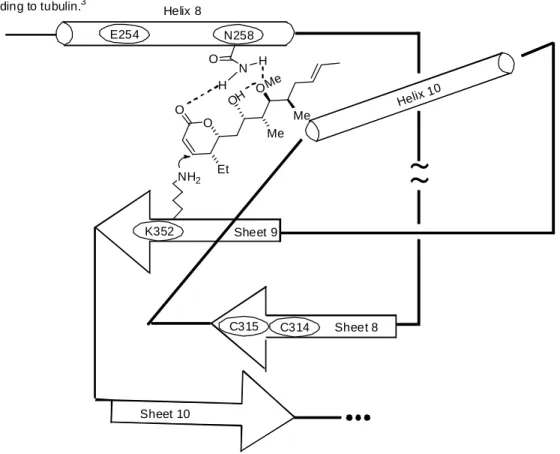
-unsaturated δ lactone possessing a linear alkyl chain containing four contiguous stereocenters and a trans-olefin. Initially determined to be a plant growth regulator1b, (− )-pironetin was also identified as having both immunosuppressant activity and antiproliferative activity against several tumor cell lines, including murine tumor cell line P388 leukemia (20 ng/mL), HeLa (10 ng/mL), A2780 (10 ng/mL), and K-NRK (10 ng/mL).2 Further examination of (−)-pironetin and its demethyl derivative (2, Figure 1.1), have shown that cell cycle progression is inhibited at the M-phase, which is where cells are most sensitive to radiation and DNA alkylating compounds.2 Investigation of the mechanism of action has revealed that pironetin is a potent inhibitor of tubulin assembly, by way of a covalent binding interaction between the Lys352 of α−tubulin with the α,β−unsaturated δ lactone of (− )-pironetin, through Michael addition (Figure 1.2).3
Et O OH
Me OR
Me
O
2
Though (−)-pironetin shows moderate effects against the tumor cell lines mentioned above and toxicity in vivo, it is viewed as a potential lead compound for the development of cancer therapeutics due to its structural simplicity compared to other notable tubulin binding agents, such as Rhizoxin and Taxol (Figure 1.3).4
Polyketides represent an important class of natural products due to their wealth of pharmacological properties.5 Because the synthesis of polyketides represents a worthy
N258 E254
Helix 1 0
Helix 8
~
~
K352 Sheet 9
C314 Sheet 8
C315
Sheet 10 NH2
O O
Et
Me Me O O
N H
H
Figure 1.2: Secondary structure and binding model for (-)-pironetin
binding to tubulin.3
Me
3
endeavor, several groups have developed methods to construct polyketide frameworks, and have applied these methods in the context of the total synthesis of (−)-pironetin.6
2. Previous Syntheses
2.1 Kawada's approach to (−−−−)-pironetin
The first total synthesis of (−)-pironetin was reported by Kawada and co-workers in 1995.6a Kawada's convergent approach relied on a Wittig olefination of aldehyde 3 and phosphonium salt 4 to form the C6-C7 bond (Scheme 1.1). Aldehyde 3 would be derived from commercially available glucopyranoside 5, which contains the correct configuration at C5, while phosphonium salt 4 takes advantage of the chiral pool by employing the (S)-Roche-ester 6, which contains the correct configuration for C8.
Beginning with commercially available glucopyranoside 5, in a series of four steps involving formation of the dimesylate, opening of the acetal, protection, and epoxide formation, epoxide 7 was formed in 53% over four steps (Scheme 1.2). Opening of the epoxide with EtMgCl in the presence of CuCl delivered the expected axial alcohol 8, with unexpected loss of the mesylate at C2. In three additional steps, the secondary alcohols
O O Et OH Me MeO Me (-)-Pironetin O MeO Et OR OR PPh3 TBDPSO Me MeO Me O epoxide
opening Grignardaddition Wittig
5
5
8
OO O
Ph OMe OH HO 5 OH MeO2C
Me
8 8
Scheme 1.1: Kawada's retrosynthetic analysis of (-)-pironetin
3 4
5 6
4
were protected as the benzyl ethers, the TBDPS ether was cleaved, and the resultant primary alcohol was oxidized to form aldehyde fragment 3.
Phosphonium salt fragment 4 was prepared in eleven steps from (S)-Roche ester (6), beginning with a protection of the primary alcohol as the benzyl ether, and a four step manipulation of the methyl ester to form allylic alcohol 9 (Scheme 1.3). At this point, an epoxidation of allylic alcohol 9 with m-CPBA takes advantage of A1,3-strain minimization to form the epoxide with the correct orientation at C9. Hydroxyl directed opening of the epoxide with Me2CuLi generated primary alcohol 10. In six steps, the primary alcohol was
OO O
Ph OMe OH HO OTBDPS O OMe MsO O
4 steps EtMgCl,CuCl
59% O OMe Et OBn OBn O OTBDPS O OMe HO Et HO
3 steps CHOO
OMe BnO Et BnO 53% 46% 5 5 5 2 2
Scheme 1.2: Kawada's synthesis of aldehyde 3.
5 7
8 3 3
OH MeO2C
Me OBn Me Me OH HO OBn Me HO 5 steps 1. m-CPBA 2. Me2CuLi 54% for 2 steps
6 steps n-BuLi
61% O MeO Et TBDPSO Me MeO Me OBn OBn I O OMe Et OBn OBn O
13 steps (-)-pironetin
27 steps 1% overall PPh3 TBDPSO Me MeO Me 10 61% 71% 7.2%
Scheme 1.3: Kawada's approach to (-)-pironetin.
6 9 10
4 3
5
protected as the TBDPS ether, the secondary alcohol was methylated, and the benzyl ether was transformed into phosphonium salt 4. A Wittig olefination between aldehyde 3 and phosphonium salt 4 formed the C6-C7 bond, to generate olefin 11. However, to complete the synthesis, an additional 13 steps were necessary for both protecting group and functional group manipulations, generating the natural product in 27 linear steps and 1% overall yield. Kawada's approach represents the first total synthesis of (−)-pironetin, and confirmed the absolute stereochemistry of the natural product.
2.2 Nelson's approach to (−−−−)-pironetin
Nelson's approach to (−)-pironetin showcases the acyl-halide aldehyde cyclocondensation (AAC) reactions developed in his laboratory.6k Beginning with easily prepared aldehyde 12 and propionyl chloride 13 (Scheme 1.4), Nelson utilizes the catalysts
14 and 15 to install all stereocenters of (−)-pironetin in an iterative fashion. N N OTMS OMe N N TMSO MeO 14 15 O O Et OH Me OMe Me (-)-Pironetin acyl halide aldehyde cyclocondensations O H OPMB O Cl 5 10 5 catalysts
14 or 15
Scheme 1.4: Nelson's retrosynthetic analysis of (-)-pironetin.
12 13
6
To form β-lactone 16, aldehyde 12, prepared in two steps from 1,3 propane diol, underwent an AAC reaction with catalyst 14 and propionyl chloride to furnish 16 in 90% yield, 99% ee, and 89:11 syn/anti ratio (Scheme 1.5). The stereoselectivity of this reaction relies on formation of a metal template, closed transition state 17.7
In two additional acyl-halide aldehyde cyclocondensation iterations, all six stereocenters of pironetin were formed in a modular fashion, in both high yield and high d.r. to arrive at β-lactone 18. Opening of the β-lactone, cleavage of the silyl protecting group, and formation of the 2-pyranone unit was accomplished in three steps, generating pironetin in 17 total steps and 5% overall yield. This AAC approach to polypropionate units
R = TBS R = TBS
O
H OPMB
10 mol% 14 LiI, i-Pr2NEt
EtCOCl O O
Me OPMB 2 steps O OPMB Me OR H
10 mol% 15 LiI, i-Pr2NEt
EtCOCl O O Me OR Me OPMB 7 steps Me OMe Me OR O H N
N Al N
Me CF3
iPr iPr
SO2CF3
ArO2S
i-Pr2NEt, BF3, n-PrCOBr
Me OMe Me OR O Me O
3 steps (-)-pironetin
17 total steps 5% overall R = TBS
R = TBS
5 5 10 10 90% 99% ee 89:11 sy n:anti
91% 95% de
65%, 95% de 93%
40%
37%
O O
NR3* R1
H R2 M
12 17 16
Scheme 1.5: Nelson's total synthesis of (-)-pironetin.
7
represents a useful variant in aldol chemistry, generating polypropionate subunits in the absence of chiral auxiliaries, catalytically, and in an iterative fashion.
2.3 Enders' approach to (−−−−)-pironetin
Enders approach to pironetin relied on the formation of three of the six stereocenters of (−)-pironetin utilizing RAMP/SAMP hydrazone alkylation and aldolization methodlogy.6l Hence, formation of pironetin would occur in a convergent manner from aldehyde 19 and silyl enol ether 20 through a Mukaiyama aldol addition (Scheme 1.6).
Construction of enol silane 20, began with an alkylation of hydrazone 21, followed by removal of the auxiliary under acidic conditions to reveal silyl enol ether 20 in 78% yield and 98% ee over 2 steps (Scheme 1.7).
To form the stereocenters at C4 and C5, an asymmetric hydrazone aldol employing butanal RAMP hydrazone 22, and aldehyde 23 generated aldol adduct 24 in 80%, 55% de, and 96% ee after protection after protection as TBS ether (Scheme 1.8). In five additional
N N
OMe
LiTMP
crotyl bromide N
N OMe
Me
OTMS
Me
10 Scheme 1.7: Preparation of enol silane 20.
20 21
78% for 2 steps
8
steps involving protecting group and functional group manipulations, aldehyde 19 was prepared.
Aldehyde fragment 19 and silyl enol ether fragment 20 were united through a Mukaiyama aldol, giving a mixture of diastereomers, favoring the desired aldol adduct 25 in 57% isolated yield (Scheme 1.9). A Tishchenko reduction of resultant ketone 25 generated secondary alcohol 26 which contains all 6 stereocenters of pironetin. In seven additional steps, pironetin was completed in 0.7% overall yield.
2.4 Cossy's Approach
Cossy's approach to (−)-pironetin relied on allylation chemistry to form 5 of the 6 stereocenters of pironetin.6m It also, as other approaches have done, takes advantage of the chiral pool by utilizing the (S)-Roche ester (6), which contains the correct configuration at C10 (Scheme 1.10).
N N
OMe
O
OBn
1. TiCl4, i-Pr2NEt
N N
OMe 2. TBSOTf ,
2,6-lutidine
OTBS OBn
5 steps OTBS
O
5 5
Scheme 1.8: Preparation of aldehyde 19.
19
22 23 24
80% 55% de 96% ee OTBS O 5 OTMS Me 10
BF3OEt2 57% desired O Me 10 Me OH OTBS 5 SmI2 acetaldehyde OH Me 10 Me OAc OTBS 5
7 steps (-)-pironetin
17 steps 0.7% overall
20 19 25
9
The synthesis began with a two step sequence to form aldehyde 27, which was then subjected to a diastereoselective crotylation utilizing Ti-TADDOL-complex 28, to generate secondary alcohol 29 in 95:5 d.r. and 60% yield over 3 steps (Scheme 1.11). Subsequent methylation and ozonolysis delivered aldehyde 30, which underwent an asymmetric allylation employing Ti-TADDOL-complex 31 to provide secondary alcohol 32 in 95:5 d.r. and 50% yield over 3 steps. In four steps, the tosylate was transformed into an internal alkyne, and the olefin was selectively cleaved to form aldehyde 33. A highly stereselective boron-mediated pentenylation, followed by acylation with acryloyl chloride yields dienyne 34.
In a single pot operation, dienyne 34 was hydrosilylated under Trost's conditions, RCM of the resultant triene forms the δ-lactone, and treatment with AgF leads to protodesilylation to provide the E-olefin present in the natural product. Deprotection of the TBS group provides (−)-pironetin in 64% over 2 steps, and in fourteen linear steps.
O O
Et OH
Me MeO
M e
(-)-Pironetin
5 10
pentenylation crotyltitanation allyltitanation
O OMe OH
Me
10
(S)-Roche ester
Scheme 1.10: Cossy's retrosythetic analysis of (-)-pironetin.
10
3. Use of the thiazolidinethione to access polyketide subunits
3.1 Biosynthesis of polyketides
Polyketides are structurally diverse secondary metabolites of plants, animals, fungus, or bacteria; and as such, possess a wealth of pharmacological activity, including anti-cancer, antibiotic, immunosupressent, and antifungal properties. Though polyketides are structurally diverse and have differing molecular complexity, the origin of these compounds is related through their biosynthesis.5 In the biosynthesis of polyketides, a "starter unit" (35) where R = H or alkyl, but most commonly R is either CH3 or C2H5,undergoes iterative chain
O OMe OH Me 10 (S)-Roche ester
2 steps OTs O
Me O Ph Ph O O O Ph Ph Ti complex 28 OTs Me OH Me 60% f or 3 steps
2 steps OTs
Me OMe Me O O Ph Ph O O O Ph Ph Ti OTs Me OMe Me OH complex 31
50% for 3 steps 95:5 d.r. 95:5 d.r. 4 steps Me MeO Me OTBS Me O 1. cis-2-pentene n-BuLi, t-BuOK
(-)-Ipc2BOMe,BF3OEt2
Me MeO
Me OR
Me O
R = TBS 2. acryloyl chloride
i-Pr2NEt 60% for 2 steps
21:1 d.r.
O
1. i. HSi(OEt)3
ii. [Cp*Ru(MeCN)3]PF6(1 mol %) iii. Grubbs II (5 mol %)
2. AgF 64% for 2 steps
(-)-pironetin 14 steps , 8.2% overall
complex 28 complex 31
6 27 29
30 32
33 34
11
extensions with a -CHR-CO- "extender units" (36) (Scheme 1.12).5 The starter unit is commonly derived from acetyl-CoA or propionyl-CoA, while the extender units are derivatives of malonic acid or a malonic acid thioester.5 Extension of the starter unit occurs via a condensation reaction involving decarboxylation of the malonate extender units. Enzymes which are responsible for building the initial polyketide chain are known as polyketides synthases (PKS), and during the process of chain formation, the resultant carbonyl group may be transformed by the aid of enzymes, or retain its identity.5 Some examples of enzymes that facilitate the production of polyketides include ketoreductases (KR) which reduce carbonyls to alcohols, dehydratases (DH) which eliminate alcohols to form olefins, and enoylreductases (ER) which reduces olefins to alkanes.5
3.2 Thiazolidinethione technology in the context of total synthesis
12
thiazolidinethione chiral auxiliary 37 to form aldol adduct 38, which could be followed by protection of the resultant hydroxyl, and cleavage of the chiral auxiliary directly to aldehyde
39 that could be utilized in a second aldol iteration with thioimide 37 (Scheme 1.13). Use of
the thiazolidinethione allows the entire process (C-C bond formation, protection, reduction to the aldehyde) to be accomplished in only three steps. Compared to the use of an oxazolidinone chiral auxiliary in an asymmetric aldol, the use of a thiazoldinethione chiral auxiliary represents a more direct approach as the aldol adduct of an oxazolidinone cannot be converted directly to an aldehyde. This strategy has previously been applied to the formal synthesis of deoxyerythronolide B.8
Several years ago, the Crimmins group disclosed a method to access both Evans syn and non-Evans syn aldol adducts from the same antipode of acyl thiazolidinethiones 37,
simply by varying the nature and equivalents of the amine base that is employed.9 To access non-Evans syn products, the N-acylthiazolidinethione (37) is treated with one equivalent of titanium tetrachloride, one equivalent of an amine base, and one equivalent of an aldehyde.9 The reaction is believed to proceed through the formation of steric-minimized chelated chair-like transition state 40, in which the nucleophilic thiocarbonyl chelates to the titanium metal center giving rise to non-Evans syn adduct 41.9 Alternatively, the use of two equivalents of (−)-sparteine or the use of NMP allows for Evans syn aldol adducts 42 to be
S N
S
R O
R1 condit ions O R2 S N S R O R1 OH R2
i. Pr otection
ii. iBu2AlH
O R1 OP R2 condit ions S N S R O R3 S N S R O R3 OH R1 OP R2 Scheme 1.13: Iterative aldol reactions of thiazolidinethiones.
37 38
39
13
obtained in high diastereoselectivities.9 This result is rationalized through a dipole and steric minimized transition state 43, in which the extra equivalent of (−)-sparteine or NMP is thought to coordinate to the titanium metal center, preventing coordination of the thiocarbonyl.9
Compared to the propionate aldol, the acetate aldol reaction has been more difficult to render highly diastereoselective with the same thiazolidinethione and oxazolidinone chiral auxiliaries, due to the lack of substitution on the α carbon. Mariam Shamszad, a former graduate student in the Crimmins lab, developed a highly diastereoselective acetate aldol addition utilizing a bulky mesityl substituted thiazolidinethione (Figure 1.5).10 Treatment of thiazolidinethione 44 with one equivalent of TiCl4, one equivalent of Hünig's base, and one
equivalent of an aldehyde generates aldol adduct 45 in high diastereoeselctivity, which is believed to arise through the formation of a chelated six membered chair-like transition state
46, in which the bulky mesityl group forces the R group of the aldehyde into a
pseudo-equatorial position to avoid 1,3 diaxial interactions between the auxiliary and a methyl group LxTi
O O H R1 N Me H S S R H S N S R O Me OH R1 "Evans syn" S N S R O
R =iBu, Bn
TiCl4, 2 equiv. TMEDA or (-)-sparteine O Ti O Cl Cl Cl H R1 Me H N S S R H S N S R O Me OH R1 "non-Evans syn" TiCl4,
amine (1 equiv) R1CHO
R1CHO
Figure 1.4: Access to Evans sy n and non-Evans syn aldol adducts f rom thiazolidinethione 37
37
40 41
14
of the mesityl.10 Another possible transition state (47) is also depicted in figure 1.5, in which the reaction proceeds through a dipole minimized nonchelated boat transition state.10
Direct access to the anti propionate aldol adduct utilizing alkyl substrates is not currently possible using the chlorotitanium enolates of N-acylthiazolidinethiones, and often requires expensive chiral auxiliaries or Lewis acids with other chiral auxiliary based approaches or exotic catalysts for non-auxiliary based approaches.11 These approaches are not always convienent or widely applicable to a broad array of substrates. Evans and coworkers have developed an anti aldol reaction to access anti β-hydroxy aldol adducts utilizing magnesium enolates of oxazolidinones or thiazoldinethiones and various aromatic aldehydes (Figure 1.6).12 Although aromatic aldehydes in combination with N-acylthiazolidinethiones give highly diastereoselective aldol adducts in high yields using this method, aliphatic aldehydes give significantly lower conversion. In this context, Mg facilitates formation of the Z-enolate of thioimide 37, and the reaction is thought to proceed through a dipole minimized boat-like transition state 48 to form a magnesium aldolate, which is irreversibly trapped by trimethylsilyl chloride to form the product 49, and regenerate the Mg catalyst.12
N S O
H
O Cl4Ti
R1 H S Me Me Me H S N S O O Ti O Cl Cl Cl H R1 H H N S S R H R1CHO
TiCl4, i-Pr2NEt
S N S O R1 OH S N S O
R1CHO TiCl4, i-Pr2NEt
S N S O R1 OH 44 44 46 45 47
15
Recently, Hoye and coworkers reported an extension of the Evans magnesium halide catalyzed anti aldol reaction employing aliphatic aldehydes and oxazolidinones.13 Because the primary byproducts in these reactions and related reactions with N-acyl thiazolidinethiones stem from the instability of the aldehyde, through silyl enol ether formation or self-aldol reactions of the aldehyde, it was reasoned that the use of a stoichiometric amount of the magnesium halide would result in an increase in the amount of enolate present in the reaction.13 Furthermore, syringe pump addition of the aldehyde should result in a higher steady state enolate to aldehyde ratio, resulting in higher yields of the aldol adduct.13 However, the yields reported in these instances remain subpar.
A viable alternative to generate the anti propionate subunit is through an N-acyl thiazolidinethione mediated acetal aldol, developed by Urpi, which allows access to anti β
16
This acetal aldol addition of N-acylthiazolidinethiones is highly advantageous for two reasons: it gives rise to the anti subunit, and it circumvents an additional O-alkylation step. Alkylation of β−hydroxy carbonyls is difficult due to the tendency of these substrates to undergo retro-aldol cleavage under basic conditions. Furthermore, the use of more reactive alkylating agents (methyl triflate and methyl fluorosulfonate), which do not require basic conditions, also readily alkylate biological tissues, and therefore represents a serious safety concern. One key aspect that we wished to explore was the effect of other thiazolidinethiones on the diastereoselection of the acetal aldol addition. It was thought that employing bulkier R group on chiral auxiliary 54 (Figure 1.7) would lead to formation of anti
β-alkoxy-α-methyl aldol adducts in higher diastereoselection, and this highly
diastereoselective reaction could be applied to the total synthesis of (−)-pironetin.
B. Synthesis of (−−−−)-pironetin
1. Retrosynthesis of (−−−−)-pironetin
R =iPr R =tBu
OR1 R1O R2, LA
S N S R O S N S R O Ln M H Me O R1 H R2 S N S R O Me OR1 R2
TiCl4, i-Pr2NEt
d.r. = 85:15
51:53 S N S R O Ln M H Me H O R2 R1 S N S R O Me OR1 R2 Figure 1.7: Access to antiβ-alkoxy-α-methyl aldol
adducts.
50 51
52 53
17
The retrosynthetic analysis of (−)-pironetin is shown in scheme 1.14. The synthesis of 1 relies on the formation of 5 out of 6 stereocenters through titanium tetrachloride mediated iterative aldol reactions utilizing the N-acylthiazolidinethione chiral auxiliary. It was envisioned that the Z-enoate of 1 would arise through a modified Horner-Emmons reaction with aldehyde 55. Aldehyde 55 would be synthesized via and Evans syn aldol reaction with aldehyde 56 and thiazolidinethione 57. Aldehyde 56 could be accessed via a highly diastereoselective acetate aldol reaction between mesityl substituted thiazolidinethione 44 and aldehyde 58. Aldehyde 58, in turn, would result from a highly diastereoselective acetal aldol addition between chiral dimethyl acetal 59 and propionate 60.
Et O OH Me OMe Me O
R = TES
O Et OR OR Me OMe Me O OR Me OMe Me Evans' syn aldol Ando-phosphonate olef ination +
R = TES
Me O OMe Me Acetate aldol +
Acetal aldol OMe
Me OMe + 1 5 8 9
10 10 5
10 9 8 10 10 1 55 56 57 58 44 59 60
18
2. Preparation of Acetal 59
Initial efforts to prepare acetal 59 centered on the use of an asymmetric alkylation employing crotyl bromide, propionamide 61, and LDA (Scheme 1.15) to form alkylated oxazolidinone 62. The auxiliary would then be reductively cleaved, and the resultant alcohol
oxidized to deliver an aldehyde, which could be stirred with methanol and catalytic acid to deliver acetal 59. It was found that under alkylation conditions which utilized 90% trans crotyl bromide, a 2:1 mixture of E/Z isomers resulted from the reaction conditions. This was attributed to isomerization of the crotyl bromide or product during the course of the reaction.
An alternative strategy to access 59 is outlined in scheme 1.16. Beginning with propionate 61, an asymmetric alkylation employing allyl iodide delivered terminal olefin 63 in 67% yield and 20:1 d.r. A cross metathesis15 between terminal olefin 63, Grubbs' 1st generation catalyst, and propene gas was expected to deliver the crotylated product in higher E selectivity than what was obtained in the asymmetric alkylation. The cross metathesis generated olefin 64 in 66% conversion and as a 5:1 mixture of E/Z isomers. Due to the modest increase in E selectivity, this route was not seen a viable option to access acetal 59.
O N
O O
LDA, Br O N
O O
85%
2:1E / Z isomers
1. LiAlH4 2. (COCl)2, DMSO
Et3N
THF, -78 °C
OMe
Me OMe
3. MeOH,pTsOH
Scheme 1.15: Initial route to access dimethyl acetal 59.
61
62
19
An alternative strategy to synthesize aldehyde 65, previously described by Evans, was instead employed in an effort to obtain acetal 59 (Scheme 1.17). Treatment of 3-buten-2-ol (66) with trimethyl orthoacetate and catalytic acid produced 67 in situ which underwent a Johnson-Claisen rearrangement to deliver isomerically pure ester 68.16 Ester 68 was saponified under basic conditions to form carboxylic acid 69, which was transformed into the mixed anhydride upon treatment with 70 and triethylamine, and displaced by the lithiated oxazolidinone 71 to deliver acylated oxazolidinone 72. An asymmetric alkylation employing LDA was used to install the stereocenter at C-10. Reductive cleavage of the oxazolindinone was affected utilizing LiAlH4 to afford alcohol 73, which was then oxidized under Swern
conditions, and stirred in the presence of MeOH and p-TsOH to provide dimethyl acetal 59 in 62% yield for 3 steps.
Scheme 1.16: Alternative approach to
access dimethyl acetal 59.
O N
O O
LDA, I
67%
O N
O O
O N
O O
CH2Cl2, rt
66% conversion
5:1 E /Z isomers
THF, -78 °C
OMe
Me OMe 3. MeOH, pT sOH
1. LiAlH4
2. (COCl)2 DMSO, Et3N 61
59 63
64
20
3. Attempts to improve the diastereoselectivity in the reaction of N-acyl
thiazoldinethiones with dimethyl acetals
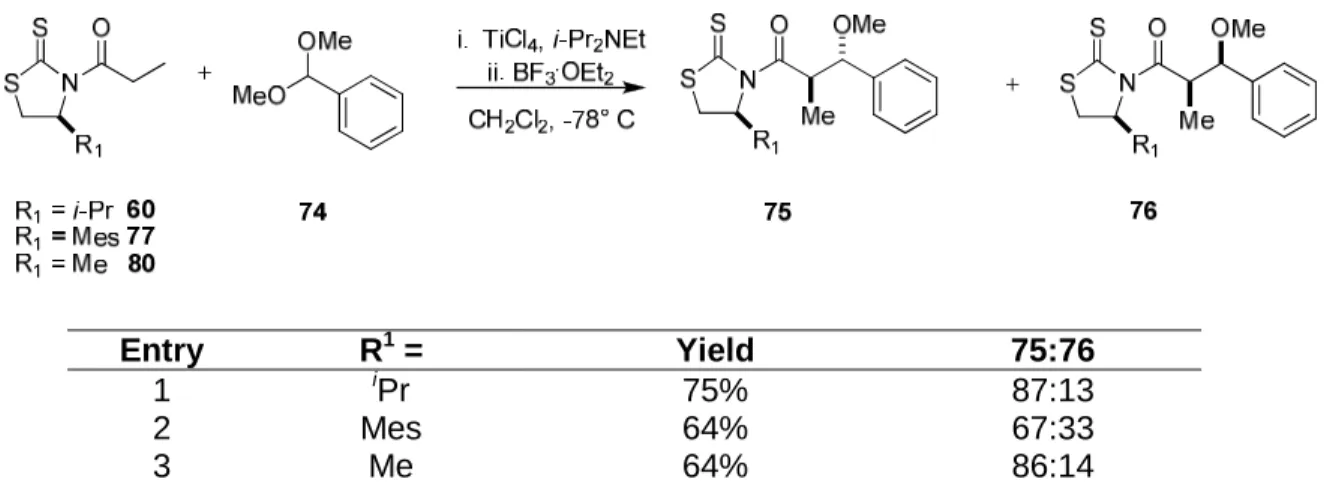
With dimethyl acetal 59 in hand, the key acetal aldol coupling was explored using a model system of benzaldehyde dimethyl acetal (74) and various thiazoldinethione chiral auxiliaries in attempts to improve the diastereoselection of the acetal aldol. Prior work by Urpi has shown that the use of benzaldehyde dimethyl acetal (74) in conjuction with valine derived thiazolidinethione chiral auxiliaries (60) can lead to anti aldol adducts (75) with moderate diastereoselection (Table 1.1, entry 1).14a Also formed in the reaction is the minor syn diastereomer 76.
OH O OEt O EtO aq. LiOH O HO
i. Et3N, PivCl
O NLi O ii. O O N O O O N O Me
LiAlH4 OH
Me
O
Me
(COCl)2, DMSO Et3N
H OMe Me MeO MeOH, p-TsOH 25 °C 67% over 2 steps
25 °C 62% f or 3 steps
THF, -78 °C to 0 °C 71%
THF, -78 °C 63% >20:1 dr
Et2O, 0 °C CH
2Cl2, -78 °C
ref lux
[3,3] CH3C(OC2H5)3
CH3COOH
i. NaHMDS ii. MeI
Scheme 1.17: Preparation of acetal 59.
59 65
66 67 68
69
70
71
21
It was initially speculated that the use of a thiazolidinethione chiral auxiliary with a bulkier R group, such as the mesityl substituted thiazolidinethione 77, would cause transition state 78 to be more favorable than transition state 79, and lead to the formation of aldol adduct 75 in higher diastereselectivities than what Urpi had obtained with the use of valine derived thiazoldienthione 60 (Figure 1.8). However, the use of mesityl substiututed thiazoldinethione 77 caused a dramatic decrease in the diastereoselection under Urpi's conditions (Table 1.1, entry 2), which was likely due to an increased steric interaction between the E-oxocarbenium ion14a and the methyl groups of the mesityl (Figure 1.8). Since the use of a bulky chiral auxiliary had resulted in a decrease in diastereoselection, it was reasoned that the use of a smaller R group on the thiazolidinethione, such as a methyl, may provide enough steric bulk to provide the necessary facial selectivity for C-C bond formation, but not cause an unfavorable steric interaction with the E-oxocarbenium in transition state
78, as the mesityl thiazoldinethione 77 had likely caused. A less sterically encumbered
thiazolidinethione chiral auxiliary, 80, derived from L-alaninol and prepared according to Le
Entry R1 = Yield 75:76
1 iPr 75% 87:13
2 Mes 64% 67:33
3 Me 64% 86:14
S N S O Ln M H Me O Me H Ph S N S O Ln M H Me H O Ph Me vs
Figure 1.8: Transition state considerations.
22
Corre's procedure17 was then used in the asymmetric acetal aldol with benzaldehyde dimethyl acetal. This resulted in the formation of the products in an 86:14 ratio, which was not significantly different from what Urpi had reported (Table 1, entry 3).
4. Completion of (−−−−)-pironetin
Instead of exploring the diastereoselectivity of the acetal aldol addition with chlorotitanium enolates of thiazolidinethiones further, the reaction conditions for the key acetal aldol reaction was probed employing dimethyl acetal 59 and valine derived thioimide
60 to form 81. Initial attempts to utilize BF3OEt2 as a Lewis acid generated the product in
low yields. Ultimately, SnCl4, a stronger Lewis acid, was found to significantly affect the
yield of the reaction (Table 1.2). The reaction was optimized by employing an excess of the
enolate (2 equivalents), using one equivalent of SnCl4, and one equivalent of acetal 59 to
generate aldol adduct 81 in 64% yield and 98:2 dr. The temperature of the reaction also had a pronounced effect, as the best yields were obtained when the reaction was warmed to -20 °C immediately following the addition of SnCl4 and dimethyl acetal 59. The high
Reaction
Temperature Yield
-78 °C 16% -50 °C 33% -20 °C 64%
S N
S O
OMe
Me MeO
TiCl4, i-Pr2NEt then SnCl4
98:2 d.r.
S N
S O
Me OMe
Me
Table 1.2: Optimization of the key acetal aldol
addition.
59 81
23
diastereoselectivity observed in this case is explained by the presence of the α stereocenter of the acetal, which reinforces the favored transition state through Felkin control (Figure 1.9)
With aldol adduct 81 in hand, the auxiliary was reductively cleaved with i-Bu2AlH to
afford aldehyde 58, which was immediately subjected to an acetate aldol reaction with thiazolidinethione 44 to afford alcohol 82 in 88% yield and 95:5 dr (Scheme 1.18). An excess of the enolate (1.5 equiv) was necessary to achieve complete conversion of the aldehyde to the aldol adduct. Protection of alcohol 82 as the triethylsilyl ether delivered thiazolidinethione 83. Reductive removal of the auxiliary with i-Bu2AlH18 furnished aldehyde 56, which was then subjected to an Evans syn aldol reaction9 with thioimide 57, affording aldol adduct 84 in >20:1 dr and 65% yield (Scheme 1.18).
S N
S O
Me OMe
Me
Me H
O H
Me
Nuc
S N
S
i-Pr
O Ln
M
H Me
O Me H
R1
Figure 1.9: Explanantion of the high diastereselectivity
observed in the acetal aldol addition of 59 with 75.
24
With all six stereocenters of (−)-pironetin installed, the synthesis proceeded with silylation of alcohol 84 to provide triethylsilyl ether 85, which was then exposed to i-Bu2AlH
to effect reductive cleavage of the chiral auxiliary affording aldehyde 55 (Scheme 1.19). Thus, three iterative aldol reactions allowed the incorporation of 5 of the 6 stereocenters of pironetin, affording aldehyde 55 in 8 steps from known acetal 59. To complete the synthesis, aldehyde 55 was treated with excess phosphonate 86, to effect formation of
Z-α, β unsaturated ester 87 as a 10:1 mixture of Z/E isomers.19 Exposure of 87 to PPTS in
10:1 CH2Cl2/MeOH provided only the unprotected diol; however, upon heating ester 87 with
25
C. Summary
26
D. References
(1)(a) Yoshida, T.; Koizumi, K.; Kawamura, Y.; Matsumoto, K.; Itazaki, H. Japanese Patent Kokai 5-310726, 1993; European Patent 60389 A1 1993. (b) Kobayashi, S.; Tsuchiya, K.; Harada, T.; Nishide, M.; Kurokawa,T.; Nakagawa, T.; Shimada, N.; Iitake, T.; Kobayashi, K. J. Antibiot. 1994, 47, 697. (c) Kobayashi, S.; Tsuchiya, K; Kurokawa, T.; Nakagawa, T.; Shimada, N.; Iitake, Y. J. Antibiot. 1994, 47, 703. (d) Tsuchiya, K; Kobayashi, S.; Harada, T.; Nishikiori, T.; Nakagawa, T.; Tatsuta, K. J. Antibiot. 1997, 50, 259.
(2) Kondoh, M.; Usui, T.; Kobayashi, S.; Tsuchiya, K.; Nishikawa, K.; Kiyohiro, N.; Nishikiori, T.; Mayumi, T.; Osada, H. Cancer Lett. 1998,126, 29.
(3) Usui, T.; Watanabe, H.; Nakayama, H.; Tada, Y.; Naoi, K.; Kondoh, M.; Asao, T.; Takio, K.; Watanabe, H.; Nishikawa, K.; Kitahara, T.; Osada, H. Chem. Biol. 2004, 11, 799.
(4) Correia, J. J. Pharmacol. Ther. 1991, 52, 127.
(5) For an excellent review on polyketides, see: Bentley, R.; Bennett, J. W. Annu. Rev. Microbiol. 1999, 53, 411.
(6)(a) Yasui, K.; Tamura, Y.; Nakatani, T.; Kawada, K; Ohtani, M. J. Org. Chem. 1995, 60, 7567. (b) Gurjar, M.; Henri, T.; Bose, D.; Rama Rao, A. Tetrahedron Lett. 1996, 37, 6615. (c) Gurjar, M.; Chakrabarti, A.; Rama Rao, A. Heterocycles 1997, 45, 7. (d) Chida, N.; Yoshinga, M.; Tobe, T.; Ogawa, S. Chem. Commun. 1997, 1043. (e) Watanabe, H.; Watanabe, H.; Kitahara, T. Tetrahedron Lett. 1998, 39, 8313. (f) Kitahara, T.; Watanabe, H. J. Synth. Org. Chem., Jpn. 1998, 56, 884. (g) Watanabe, H.; Watanabe, H.; Bando, M.; Kido, M.; Kitahara, T. Tetrahedron 1999, 55, 9755. (h) Watanabe, H.; Watanabe, H.; Usui, T.; Kondoh, M.; Osada, H.; Kitahara, T. J. Antibiot. 2000, 53, 540. (i) Keck, G. E.; Knutson, C. E.; Wiles, S. A. Org. Lett. 2001, 3, 707. (j) Dias, L. C.; de Olivera, L. G.; de Sousa, M. A. Org. Lett. 2003, 5, 265. (k) Shen, X.; Wasmuth, A. S.; Zhao, J.; Zhu, C.; Nelson, S. G. J. Am. Chem. Soc. 2006, 128, 7438. (l) Enders, D.; Dhulut, S.; Steinbusch, D.; Herrbach, A. Chem.-Eur. J. 2007, 13, 3942. (m) Bressy, C.; Vors, J.-P.; Hillebrand, S.; Arseniyadis, S.; Cossy, J. Angew. Chem., Int. Ed. 2008, 47, 10137. (n) Lin, J.; Yue, X.; Huang, P.; Cui, D.; Quing, F.-L. Synthesis, 2010, 2, 267. (o) Yadav, J. S.; Ather, H.; Rao, N.; Reddy, M.; Prasad, A. R. Synlett, 2010, 8, 1205. (p) Marco, J.; Garcia-Pla, J.; Carda, M.; Murga, J.; Falomir, E.; Trigili, C.; Notararigo, S.; Diaz, J. F.; Barasoain, I. Eur. J. Med. Chem. 2011, 46, 1630.
(7) Zhu, C.; Shen, X.; Nelson, S. G. J. Am. Chem. Soc. 2004, 126, 5352.
27
(9) (a) Crimmins, M. T.; Chaudhary, K. Org. Lett. 2000, 2, 775. (b) Crimmins, M. T.; King, B. W.; Tabet, E. A.; Chaudhary, K. J. Org. Chem. 2001, 66, 894.
(10) Crimmins, M. T.; Shamszad, M. Org. Lett. 2007, 9, 149.
(11) For some select examples, see: (a) Yomashita, Y.; Ishitani, H.; Shimizu, H.; Kobayahi, S. J. Am. Chem. Soc. 2002, 124, 3292. (b) Paterson, I.; Goodman, J. M.; Masahiko, I. Tetrahedron Lett. 1989, 30, 997. (c) Corey,E. J.; Kim, S. S. J. Am. Chem. Soc. 1990, 112, 4976. (d) Olivo, H. F.; Tovar-Miranda, R.; Barragan, E. J. Org. Chem. 2006, 71, 3287. (e) Hoye, T. R.; Zhao, H. Org. Lett. 1999, 1, 169. (f) Narasaka, K.; Miwa, T. Chem. Lett. 1985, 1217. (g) Duthaler, R. O.; Herold, P.; Wyler-Helfer, S.; Riediker, M. Helv. Chim. Acta 1990, 73, 659. (h) Meyers, A. I.; Yamamoto, Y. Tetrahedron 1984, 40, 2309. (i) Masamune, S.; Sato, T.; Kim, B.-M.; Wollman, T. A. J. Am. Chem. Soc. 1986, 108, 8279. (j) Reetz, M. T.; Rivadeneira, E.; Niemeyer, C. Tetrahedron Lett. 1990, 27, 3863. (k) Corey, E. J.; Kim, S. S. J. Am. Chem. Soc. 1990, 112, 4976. (l) Gennari, C.; Hewkin, C. T.; Molinari, F.; Bernardi, A.; Comotti, A.; Goodman, J. M.; Paterson, I. J. Org. Chem. 1992, 57, 5173. (m) Gennari, C.; Moresca, D.; Vieth, S.; Vulpetti, A. Angew. Chem., Int. Ed. Engl. 1993, 32, 1618. (n)Abiko, A.; Liu, J.-F.; Masamune, S. J. Am. Chem. Soc. 1997, 119, 2586.
(12) (a) Evans, D. A.; Tedrow, J. S.; Shaw, J. T.; Downey, C. W. J. Am. Chem. Soc. 2002, 124, 392. (b) Evans, D. A.; Downey, C. W.; Shaw, J. T.; Tedrow, J. S. Org. Lett. 2002, 4, 1127.
(13) May, A. E.; Connell, N. T.; Dahlmann, H. A.; Hoye, T. R. Synlett. 2010, 13, 1984.
(14) (a) Cosp, A.; Romea, P.; Talavera, P.; Urpí, F.; Vilarrasa, J.; Font- Baradia, M.; Solans, X. Org. Lett. 2001, 3, 615. (b) Cosp, A.; Larrosa, I.; Vilasis, I.; Romea, P.; Urpí, I.; Vilarrasa, J. Synlett 2003, 8, 1109. (c) Baiget, J.; Cosp, A.; Galvez, E.; Gomez-Pinal, L.; Romea, P.; Urpí, F. Tetrahedron 2008, 64, 5637.
(15) Chatterjee, A. K.; Choi, T.-L.; Sander, D. P.; Grubbs, R. H. J. Am. Chem. Soc. 2003, 125, 11360.
(16) Evans, D. A.; Weber, A. E. J. Am. Chem. Soc. 1986, 108, 6757.
(17) Delaunay, D.; Toupet, L.; Le Corre, M. J. Org. Chem. 1995, 60, 6604.
28
29
Chapter 2
Iriomoteolide 1a Background
A. Isolation and biological activity
30
The structures and relative sterochemistry of the iriomoteolides were elucidated utilizing detailed 2D-NMR studies, while the absolute stereochemistry was assigned using a modified variant of Mosher's method.2-4 Iriomoteolide 1a was originally identified to be a 20-membered macrolide, which contains three alcohols, one of which is tertiary. Other structural attributes include a hemiketal embedded in a tetrahydropyran ring, an exocyclic olefin, and three endogenous olefins.2 Notably, iriomoteolide 1a was identified as the first isolated member from the amphidinolide family of natural products which possesses a Z-olefin.2 Two other macrolides isolated, later identified as iriomoteolides 1b (2.2) and 1c (2.3), were also identified to contain a 20-membered macrocyclic ring system.3 Based on NMR data, iriomoteolide 1b is thought to have only a monocyclic ring system, and instead of a C9-C13 tetrahydropyran ring system, which iriomoteolide 1a possesess, iriomoteolide 1b contains a ketone at C13 in conjugation with an E alkene at C11-C12, and a free hydroxyl group at C9.3 Iriomoteolide 1c is thought to contain the same ring systems as iriomoteolide 1a, but has a 4-hydroxy-3-methyl pentyl sidechain at C19 containing two unidentified stereocenters, while iriomotelide 1a has a 3-hydroxy-2-methyl butyl side chain at C19.3
O OH Me HO Me O Me OH Me OH Me Me O H
iriomoteolide 1a (2.1)
Me Me HO Me O Me OH Me OH Me Me O
iriomoteolide 1b (2.2) O HO O OH Me HO Me O OH Me Me O H
iriomoteolide 1c (2.3) M e OH Me Me Me OH O O O H Me H HO HO
iriomoteolide 3a (2.4)
Figure 2.1: Macrolides isolated f rom A mphidinium strain HYA024.
31
Iriomoteolide 3a (2.4) was also isolated from strain HYA024, and is a 15-membered macrolide containing an allyl epoxide.4
Notably, iriomoteolide 1a exhibits potent cytotoxicity against the human B lymphocyte DG-75 cells (IC50 = 0.002 µg/mL), which is 20 times as potent as the anticancer
therapeutic drug doxorubicin (IC50 = 0.04 µg/mL), and is one of the most cytotoxic
macrolides isolated from the Amphidinium species to date.2 Iriomoteolide 1a has also been shown to possess potent cytotoxicity against Epstein-Barr virus (EBV) infected human B-lymphocyte Raji cells (IC50 = 0.003 µg/mL).2 Tsuda et al. speculate that this toxicity may be
due to the presence of the hemiketal embedded within a tetrahydropyran motif, as other highly cytotoxic marine natural products, an example being peloruside A, have also shown potent cytotoxicity and possess this architecture.2,5 Remarkably, iriomoteolide 1c, which also possesses a hemiketal embedded within a tetrahydropyran ring, has exhibited comparable cytotoxicity (IC50 = 0.002 µg/mL against human B lymphocyte DG-75 cells, IC50
= 0.004 µg/mL against Epstein-Barr virus (EBV) infected human B-lymphocyte Raji cells) to iriomoteolide 1a, while iriomoteolide 1b is 450 times less potent (IC50 = 0.09 µg/mL) against
human B lymphocyte DG-75 cells.3 This data seems to support Tsuda's hypothesis that the hemiketal motif of iriomoteolides 1a and 1c may play a significant role in the biological mechanism of action. To date, there are no reports of biological studies or biosynthetic studies of the iriomoteolides.
B. Previous Syntheses of Iriomoteolide 1a
32
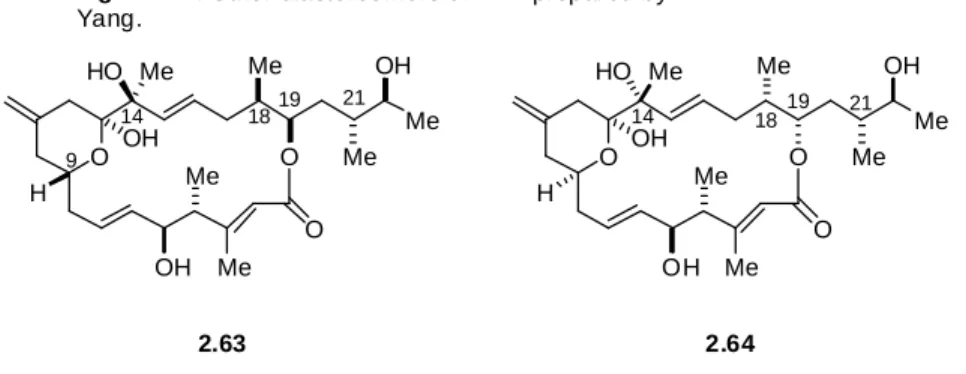
the course of their synthetic studies, Horne, Ghosh, and Yang independently ascertained that the proposed structure of iriomoteolide 1a had been misassigned.11-13 Their various approaches to the proposed structure and conclusions about the identity of the natural product are discussed in the proceeding sections.
1.1 Horne's Approach to Iriomoteolide 1a
Horne's retrosynthetic plan for iriomoteolide 1a is depicted in Scheme 2.1. Initially, it was believed that iriomoteolide 1a (2.1) would arise from an esterification of secondary alcohol 2.5 with acid 2.6, followed by a late stage RCM to form 2.1. Hemiketal 2.5 could be accessed from a β-alkyl Suzuki-Miyaura coupling of vinyl iodide 2.7 and alkyl iodide 2.8.11
33
to generate aldol adduct 2.13 containing the stereocenters at C18 and C19 in 92% yield, and as a single diastereomer. In four additional steps, the resultant C19 hydroxyl was protected, the chiral auxiliary was cleaved under standard reduction conditions, and the resultant primary alcohol was transformed into alkyl iodide 2.8 in 65% yield over 4 steps and 12 steps overall.14
Construction of vinyl iodide 2.7 commenced with a Sharpess asymmetric dihydroxylation of olefin 2.14 to furnish tertiary alcohol 2.15, which is the tertiary alcohol at C14 present in the natural product (Scheme 2.3).15 Protection of the resultant diol as PMP acetal 2.16, cleavage of the PMBz protecting group, followed by oxidation of the resultant primary alcohol provided aldehyde 2.17.14 In a three step sequence beginning with an Ohira-Bestmann reaction to produce alkyne 2.18, followed by hydrohalogenation by sequential treatment with tributyl tin hydride in the presence of Pd(PPh3)4 and then
iodination, E-vinyl iodide 2.19 was furnished. Deprotection of the PMP acetal under acidic conditions and protection of the resultant diol as the bis TES ether delivered 2.20, which underwent a selective primary TES ether deprotection in the presence of catalytic PPTS and MeOH. Oxidation of the primary alcohol with Dess-Martin periodinane, produced aldehyde
O MeO OH Me O MeO OH Me LDA, Br 92% 6 steps Me O Me OPMB Ph Me N O
SO2Mes Bn O (c-Hex)2BOTf
Et3N Ph
Me N
O
SO2Mes Bn O Me OH Me Me OPMB 92% 4 steps Me TESO Me Me OPMB I 40% 65% 23 23 23 23 Scheme 2.2: Preparation of alkyl iodide 2.8.
2.9 2.10 2.11
34
2.21. Subseqent use of 2.21 in a Sakuri reaction with allyl silane 2.22,15 allowed for the C12-C13 carbon-carbon bond to be forged. Protection of the resultant secondary alcohol as the acetate provided vinyl iodide fragment 2.7.
AD-mix-OTES SiMe3 I Me OTES AcO OTES 1. SnCl4,2.22
2. Ac2O, Et3N, DMAP 98% 99% ee
7
7 12
48% for 2 steps
HO Me OH OPMBz OPMBz OMe OMe MeO PPTS (cat) O OPMBz O Me PMP
1. NaOMe, MeOH 2. DMP
76%
90% for 2 steps O O O Me PMP Me O N2 P(OMe)2 O
MeOH, K2CO3 80%
O O Me
PMP 1. Bu3SnH, Pd(PPh3)4 2. I2
80% for 2 steps
O O Me PMP
I
1. TsOH.H
2O (cat), MeOH 2. TESOTf, 2,6-lutidine
TESO TESO Me
I 81% for 2 steps
1. PPTS (cat), MeOH 2. DMP 73% for 2 steps
TESO Me I O
Scheme 2.3:Access to vinyl iodide2.7.
2.14 2.15 2.16
2.17 2.18
2.19 2.20 2.21
2.22 2.7
14
35
With the two necessary fragments in hand, exposure of alkyl iodide 2.8 and vinyl iodide 2.7 to Suzuki reaction conditions smoothly coupled the two fragments to form the C16-C17 bond in 82% yield (Scheme 2.4). The acetate of 2.23 was then cleaved using LiAlH4 with concomitant loss of the tertiary TES ether, while the secondary TES ether
remained intact.14 Oxidation of the C13 hydroxyl delivered ketone 2.24; subseqent exposure to mild ketalization conditions to prevent migration of the C11 olefin into conjugation, furnished hemiketal 2.5.14
Attempts to complete the synthesis of the proposed structure hinged upon a successful Yamaguchi esterification of hemiketal 2.5 and acid 2.6. However, due to the instability of the hemiketal unit, a 50-60% yield of ester 2.25 was obtained utilizing Yamaguchi esterifcation conditions, and subsequent chromatographic separation of 2.25 from side products of the reaction proved problematic (Scheme 2.5).11
Me
TESO Me
Me OPMB I
t -BuLi, 9-MeO-BBN
then Pd(dppf)Cl2,
AsPh3, CsCO2
Me TESO AcO OTES Me TESO Me Me OPMB 82% I Me OTES AcO OTES
1. LiAlH4 2. SO3.pyr,
DMSO, i-Pr2NEt
Me HO O OTES Me TESO Me Me OPMB
HF.pyr, pyr
O OH Me HO Me OH Me OPMB Me H
63% for 2 steps 70%
Scheme 2.4: Suzuki coupling of f ragments 2.7 and 2.8.
36
Horne instead took an alternative approach to iriomoteolide 1a which would install the sensitive hemiketal functionality at the end of the synthesis. A few protecting group modifications were necessary in order to execute this strategy: the C9 TES ether was replaced as a PMB ether, while the C13 acetate was changed to a TBS ether to form new vinyl iodide 2.26 (Scheme 2.6).
To complete the synthesis, vinyl iodide fragment 2.26 was coupled under Suzuki conditions with alkyl iodide 2.8 to furnish the coupled product 2.27 (Scheme 2.6).11 Selective deprotection of the TES ether of C19 followed by Yamaguchi esterification with acid 2.6 afforded 2.28 in higher yields (84% for 2 steps) compared to attempts with the hemiketal moiety already installed (Scheme 2.5). Deprotection of the silyl protecting groups and oxidation of the resultant diol delivered ketone 2.29 which was exposed to DDQ to effect global deprotection of the PMB groups with concomitant hemiketal formation. Formation of the macrocycle with Grubbs' 2nd generation catalyst gave the proposed structure of iriomoteolide 1a (2.1) in 49% yield over 2 steps and in 23 steps as the longest linear sequence.11 O OH Me HO Me OH Me OPMB Me H OH Me
MeO OH
Me
2, 4, 6-trichlorbenzoyl chloride, Et3N, DMAP
37
Comparison between synthetic iriomoteolide 1a and what was reported in the literature for the natural material revealed that the natural product was misassigned. Horne notes that the main discrepancies between the two spectra reside with the proton and carbon chemical shifts at C4, as synthetic iriomoteolide 1a C4 proton appears at 3.95 ppm and the carbon shift for C4 occurs at 41.0 ppm, compared to the natural compound which occurs at 2.46 ppm and 47.9 ppm for proton and carbon, respectively. Horne speculates that the discrepancies between the natural product and synthetic iriomoteolide 1a may reside in the C2-C3 olefin geometry, suggesting that the C2-C3 olefin is actually an E olefin and not a Z olefin, as it was initially assigned.
Me
TESO Me
Me OPMB I
t -BuLi, 9-MeO-BBN
then Pd(dppf)Cl2,
AsPh3, CsCO2
Me TESO TBSO OPMB Me TESO Me Me OPMB 82% 23 23 7 1. DDQ 2. Grubbs II
O OH Me HO Me O Me OH Me OH Me Me O H 23 7 12 17 17 17 49% for 2 steps 12 23 steps I Me OTES TBSO OPMB
1. HF.pyr 2. 2,3,4,6-trichlorobenzoyl
chloride, Et3N
84% for 2 steps
Me TESO OPMB Me O Me Me OPMB O Me Me Me OPMB
TBSO 1. TBAF
2. SO3.pyr, DMSO
i-Pr2NEt 64% for 2 steps
Me HO OPMB Me O Me Me OPMB O Me Me Me OPMB O
CO2H
Me Me Me OH 2.8 2.26 2.27 2.6 2.28 2.29 2.1
Sch eme 2.6: Horne's completion of 2.1.
38
1.2 Ghosh's total synthesis of the proposed structure of iriomoteolide 1a
Ghosh concurrently published a synthesis of the proposed structure of iriomoteolide 1a in 2010. His approach, depicted in Scheme 2.7, relied on the convergency of two aldehyde 2.30 and sulfone 2.31 through a Julia- Kocienski olefination.12
Construction of aldehyde 2.30 began with an enzymatic kinetic resolution of Weinreb amide 2.32 to deliver enantiomerically enriched β-hydroxy amide 2.33 in 45% yield and 97% ee, containing the C9 stereocenter (Scheme 2.8). In nine steps, 2.33 was converted to allyl