REPLICATION AND PLACEMENT FOR SECURITY IN DISTRIBUTED SYSTEMS
Peng Li
A dissertation submitted to the faculty of the University of North Carolina at Chapel Hill in partial fulfillment of the requirements for the degree of Doctor of Philosophy in the Department of
Computer Science.
Chapel Hill 2014
Approved by:
James H. Anderson
Peter M. Chen
Debin Gao
Kevin Jeffay
©2014 Peng Li
ABSTRACT
Peng Li: Replication and placement for security in distributed systems (Under the direction of Michael K. Reiter)
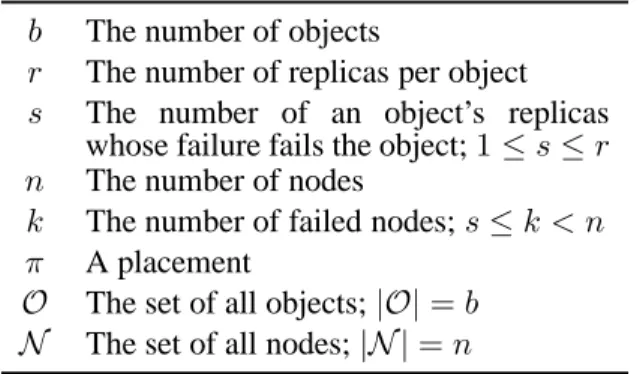
In this thesis we show how the security of replicated objects in distributed systems, in terms of
either the objects’ confidentiality or availability, can be improved through the placement of objects’
replicas so as to carefully manage the nodes on which objects’ replicas overlap.
In the first part of this thesis we present StopWatch , a system that defends against
timing-based side-channel attacks that arise from coresidency of victims and attackers in
infrastructure-as-a-service clouds and threaten confidentiality of victims’ data. StopWatch triplicates each
cloud-resident guest virtual machine (VM) and places replicas so that the three replicas of a guest VM
are coresident with nonoverlapping sets of (replicas of) other VMs. StopWatch uses the timing of
I/O events at a VM’s replicas collectively to determine the timings observed by each one or by an
external observer, so that observable timing behaviors are similarly likely in the absence of any other
individual, coresident VM. We detail the design and implementation ofStopWatch in Xen, evaluate
the factors that influence its performance, demonstrate its advantages relative to alternative defenses
against timing side-channels with commodity hardware, and address the problem of placing VM
replicas in a cloud under the constraints ofStopWatch so as to still enable adequate cloud utilization.
We then explore the problem of placing object replicas on nodes in a distributed system to
maxi-mize the number of objects that remain available when node failures occur. In our model, failing (the
nodes hosting) a given threshold of replicas is sufficient to disable each object, and the adversary
selects which nodes to fail to minimize the number of objects that remain available. We
specifi-cally explore placement strategies based on combinatorial structures calledt-packings; provide a lower bound for the object availability they offer; show that these placements offer availability that
previ-ous work. After quantifying the availability offered by random replica placement in our model, we
show that our combinatorial strategy yields placements with better availability than random replica
placement for many realistic parameter values. Finally, we provide parameter selection strategies to
ACKNOWLEDGEMENTS
The completion of this dissertation would not have been possible without the guidance of my
advisors, Prof. Mike Reiter and Prof. Debin Gao, whom I feel extremely fortunate to have met and
worked with and owe all my gratitude to. Throughout the last seven years, weekly meetings with
them have shaped the pace of my life and marked the path of my growth both as a researcher and as
a person. One afternoon back in 2007, a phone call from Debin brought me to Singapore, and the
days I spent there working with him were beyond pleasant and memorable. Through Debin I met
Mike, simply the best mind I have had the fortune to work with, not only because of his masterful
understanding and insight of the field, prompt and wise decisions he has made on all matters,
always-correct direction and advise, but also because of his willingness to share frustrations when things
turn out in an unexpected way and his embodiment of something beyond an academic advisor. His
high expectation kept me awake solving problems in many stressful nights, but it also lifted me up
to stand on a higher ground to watch around. For these many years, “Mike and Debin” have been
the most frequent openning of the emails I sent and the most reliable “oracles” for me to count on.
I would also like to thank Dr. James Anderson, Dr. Peter Chen, and Dr. Kevin Jaffey for
serving on my dissertation committee. I am very grateful for all of them to take time from their busy
schedules to hold meetings with me and providing invaluable feedbacks.
With all my friends in the security lab and in Chapel Hill, I do not feel I am alone. I appreciate
gratefully for their help in my academic studies and in my life.
One of the luckiest things that have ever happened to me was meeting with my wife Qing, who
moved to the States with all trust in me and supports me no matter what happens. She was born
with the abilities of viewing things positively, of being kind to and thinking good of other people,
and of discovering amazement in everyday life. I am the happiest man having her aside.
Studying and living abroad has been not easy, luckily I have my parents, my brother, and all my
PREFACE
Object replication, and careful placement of those replicas so as to manage the overlap between
any two objects’ replicas, can be used to support security goals in distributed systems. This
the-sis demonstrates two specific uses of replication and placement for this purpose, namely to limit
side-channel information leakage between virtual machines in compute clouds and to improve the
TABLE OF CONTENTS
LIST OF TABLES . . . xi
LIST OF FIGURES . . . xii
1 INTRODUCTION . . . 1
2 MITIGATING ACCESS-DRIVEN TIMING CHANNELS IN CLOUDS US-INGSTOPWATCH . . . 4
2.1 Related Work . . . 7
2.1.1 Timing Channel Defenses . . . 7
2.1.2 Replication . . . 8
2.2 Design . . . 9
2.2.1 Threat Model . . . 10
2.2.2 Defense Strategy . . . 10
2.2.3 Justification for the Median . . . 11
2.3 RTclocks . . . 14
2.3.1 Strategy . . . 14
2.3.2 Implementation in Xen . . . 15
2.3.2.1 Timer interrupts . . . 15
2.3.2.2 rdtsccalls and CMOS RTC values . . . 16
2.3.2.3 Reading counters . . . 17
2.4 IOclocks . . . 17
2.4.1 Strategy . . . 17
2.4.1.1 Disk and DMA interrupts . . . 18
2.4.2 Implementation in Xen . . . 20
2.4.2.1 Network card emulation . . . 20
2.4.2.2 Disk and DMA emulation . . . 22
2.5 Collaborative Attacks . . . 22
2.5.1 External Collaborators . . . 22
2.5.2 Collaborating Victim-VM Clients . . . 23
2.5.3 Collaborating Attacker VMs . . . 24
2.6 Performance Evaluation . . . 25
2.6.1 Selected Implementation Details . . . 25
2.6.2 Experimental setup . . . 26
2.6.3 Network Services . . . 27
2.6.3.1 File downloads . . . 27
2.6.3.2 NFS . . . 29
2.6.4 Computations . . . 30
2.7 Comparison to Alternatives . . . 31
2.7.1 Comparison to Uniformly Random Noise . . . 32
2.7.2 Comparison to Time Slicing . . . 33
2.7.2.1 Design . . . 34
2.7.2.2 Evaluation . . . 36
2.7.3 Discussion . . . 37
2.8 Replica Placement in the Cloud . . . 38
2.9 Conclusion . . . 45
3 REPLICA PLACEMENT FOR AVAILABILITY IN THE WORST CASE . . . 47
3.1 Related Work . . . 49
3.2 Overlap-Based Placement Strategies . . . 50
3.2.1 TheSimpleOverlap(x, λ)Placement Strategy . . . 51
3.2.2.1 Computing a ComboOverlap(λ0, . . . , λs−1) to
Maxi-mizelbAvailco(λ0, . . . , λs−1). . . 56
3.2.2.2 Sensitivity to Choice ofk . . . 57
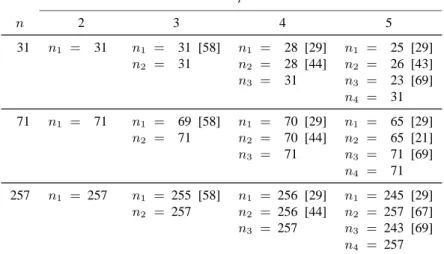
3.2.3 Parameter Selection . . . 58
3.3 Comparison to Random Replica Placement . . . 61
3.3.1 The Worst-Case Availability ofRandom. . . 61
3.3.2 Comparison Results . . . 64
3.3.3 Breakdown ofComboOverlapPlacements . . . 68
3.3.4 Thes= 1Case . . . 68
3.4 Conclusion . . . 74
4 CONCLUSION . . . 75
LIST OF TABLES
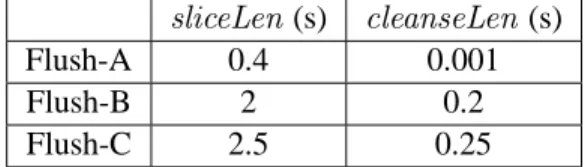
2.1 Length of time slice (sliceLen) and of cleansing (cleanseLen) . . . 34
LIST OF FIGURES
2.1 Justification for median; baseline distributionExp(λ),λ= 1, and victim
distributionExp(λ′) . . . 12
2.2 Delivering a packet to guest VM replicas. . . 19
2.3 Emulation of network I/O device inStopWatch . . . 21
2.4 Virtual inter-packet delivery times to attacker VM replicas with coresident victim (“two baselines, one victim”) and in a run where no replica was coresident with a victim (“three baselines”) . . . 21
2.5 HTTP and UDP file-retrieval latency. . . 28
2.6 Tests of NFS server usingnhfsstone . . . 29
2.7 Tests of PARSEC applications . . . 31
2.8 Expected delay induced by StopWatch vs. by uniform noise, as a func-tion of confidence with which attacker distinguishes the two distribufunc-tions (coresident victim or not) after the same number of observations; baseline distributionExp(λ),λ= 1; victim distributionExp(λ′) . . . 33
2.9 Time-sliced execution of three VMs . . . 34
2.10 StopWatch vs. time slicing: comparison of slowdown and delay . . . 37
2.11 Progress of file download via HTTP . . . 38
3.1 Notation . . . 51
3.2 Avail(π)−lbAvailso(x, λ)forn= 71,x= 1, andr = 3 . . . 53
3.3 lbAvail co (λ0,...,λs−1) lbAvailco(λ′ 0,...,λ′s−1) expressed as a percentage . . . 57
3.4 Values ofnxused in this chapter . . . 58
3.5 CDFs showing the fraction of system sizes n ∈ [50,800] for which the capacity gap (indicated on the horizontal axis, where lower is better) can be achieved using up tom= 3Steiner systems (µxi= 1) . . . 60
3.6 Re-plot of Figure 3.5 for r = 5 and x ∈ {2,3}, but allowing µx = lcm{µx1, . . . , µxm} ≥1 . . . 60
3.8 lbAvailco(λ0, . . . , λs−1)−prAvailrndfor an optimalComboOverlap(λ0, . . . , λs−1)
placement as a percentage of the maximum possible improvement b−
prAvailrnd . . . 65
3.9 lbAvailso(x, λ) −prAvailrnd for SimpleOverlap(x, λ) placements and lbAvailco(λ0, . . . , λs−1)−prAvailrndfor bestComboOverlap(λ0, . . . , λs−1)
placement (right most column) whens >2, as a percentage of the
maxi-mum possible improvementb−prAvailrnd, whenn= 31 . . . 69 3.10 lbAvailso(x, λ) −prAvailrnd for SimpleOverlap(x, λ) placements and
lbAvailco(λ0, . . . , λs−1)−prAvailrndfor bestComboOverlap(λ0, . . . , λs−1)
placement (right most column) whens >2, as a percentage of the
maxi-mum possible improvementb−prAvailrnd, whenn= 71 . . . 70 3.11 lbAvailso(x, λ) −prAvailrnd for SimpleOverlap(x, λ) placements and
lbAvailco(λ0, . . . , λs−1)−prAvailrndfor bestComboOverlap(λ0, . . . , λs−1)
placement (right most column) whens >2, as a percentage of the
maxi-mum possible improvementb−prAvailrnd, whenn= 257 . . . 71 3.12 ¡1−1
b ¢k⌊ℓ⌋
CHAPTER 1 INTRODUCTION
Traditionally, the topic of computer security has been characterized as protecting three attributes
of data (and/or computation) (e.g., [40, Chapter 1]): confidentiality or, in other words, that the
data is disclosed only to whom the data owner intends; integrity, or that the data is modified only
in intended ways and by intended parties; and availability, so that the data is accessible when
required and with the performance expected. Security is a field that adapts to include new computer
and data misuses as they become known, and some of these misuses (e.g., combating spam email)
stretch the above characterization of computer security. Still, this characterization is adequate for
the discussions of primary interest in this thesis.
It has long been argued that the goals of confidentiality, integrity and availability are themselves
in conflict, in the sense that availability focuses on ensuring data’s accessibility, whereas
confiden-tiality and integrity seek to limit its accessibility (to unintended disclosure and update, respectively).
This tension has specifically been highlighted in the use of data replication, since replicating data
to potentially far-flung locations might greatly enhance availability but put the data at risk of
unin-tended disclosure or modification (e.g., [83]). Conversely, keeping the data in a high-security vault
might enhance its confidentiality and integrity, but it might not be easily accessible when needed or
might be destroyed in a fire inside the vault, hurting its availibility.
There is a long history of research focused on striking a balance between availability by
replica-tion on the one hand, and confidentiality and integrity of the replicated data/computareplica-tion on the other.
Examples include the division of certificate authorities into online (highly available) and offline (and
hence more secure) components (e.g., [56]), data storage that combines redundancy for data
avail-ability with cryptographic techniques to enhance integrity and/or confidentiality (e.g., [46]), and
the entire field of Byzantine fault-tolerant computation (see, e.g., [55, 73, 24, 18, 45] and citations
Despite this attention, we show in this thesis that there is another facet of replication that,
to our knowledge, has not yet been exploited in the context of security but that provides a new
opportunity to explore the design space of secure systems—namely, the manner in which replicas
are placed on nodes. More specifically, in this thesis we explore two applications of the general idea
of constraining how the replicas of different data/computation objects overlap on nodes to improve
security for the objects. Specifically, this thesis leverages replica placement in two ways:
• In Chapter 2, we consider the problem of protecting virtual machines (VMs) submitted to
public compute clouds from the inference of their secrets by other VMs utilizing
timing-based side-channel attacks (e.g., [97]). We develop a strategy for the cloud to execute VMs
that involves replicating each VM and placing its replicas so that they overlap (reside on
the same host as) a limited number of replicas of any other VM. Then, by ensuring that the
timing of each event observable by any VM is an aggregation of the timings of this event
observable by (the machines hosting) its replicas, the limited-overlap policy ensures that any
(victim) VM can influence the timing of events observable by another (attacker) VM only
minimally. We show that timing-based side-channels available to an attacker VM are thereby
substantially mitigated. To our knowledge, this work is noteworthy in demonstrating how
replication can improve confidentiality of data by illustrating a scenario in which replication
supports confidentiality.
• In the context of using replication for availability, the previous work that considered replica
placement did so only in scenarios where computers fail probabilistically. Protecting the
se-curity of a system entails considering intelligent attackers, however, in particular ones whose
behaviors may not be characterized by a known distribution or who can target a system
adap-tively. Therefore, in Chapter 3 we study the problem of maximizing the availability of
repli-cated objects against an attacker who can disable computers in a targeted fashion, with
knowl-edge of where object replicas are placed and limited only by a budget on the total number
of computers it can disable. We show how carefully managing overlaps in the placement
of object replicas can substantially enhance object availability against this type of targeted
The above contributions do not eliminate the aforementioned tensions between replication on
the one hand and confidentiality and integrity on the other. However, they do provide new insights
into unchartered parts of the tradeoff space. Specifically, they provide new ways of using replication
and specifically replica placement to enhance a singular security goal—improved confidentiality via
timing side-channel defense in the first case above, and improved availability against targeted attacks
in the second—that might be possible to leverage in conjunction with other technologies previously
described (though we leave this exploration to future work). Together, we believe that these works
add a new dimension to previous thinking about security mechanisms for replicated systems, namely
that replica placement is a critical factor influencing the utility of replication for both conventional
CHAPTER 2 MITIGATING ACCESS-DRIVEN TIMING CHANNELS IN CLOUDS
USINGSTOPWATCH
Implicit timing-based information flows threaten the use of clouds for very sensitive
compu-tations. In an “infrastructure as a service” (IaaS) cloud, such an attack could be mounted by an
attacker submitting a virtual machine (VM) to the cloud that times the duration between events that
it can observe, to make inferences about a victim VM with which it is running simultaneously on
the same host but otherwise cannot access. Such “access-driven” attacks [97] were first studied
in the context of timing-based covert channels, in which the victim VM is infected with a Trojan
horse that intentionally signals information to the attacker VM by manipulating the timings that the
attacker VM observes. Of more significance in modern cloud environments, however, are
timing-based side channels, which leverage the same principles to attack an uninfected but oblivious victim
VM (e.g., [74, 97]).
In this chapter we propose an approach to defend against these timing attacks and a system,
calledStopWatch , that implements this method for IaaS clouds. A timing side-channel can arise
whenever an attacker VM uses an event sequence it observes to “time” another, independent event
sequence that might reflect the victim VM’s behavior [88]. StopWatch is thus designed to
system-atically remove independence of observable event sequences where possible, first by making all
real-time clocks accessible from a guest VM to be determined instead by the VM’s own execution.
To address event sequences on which it cannot intervene this way, namely for input/output
(I/O) events,StopWatch alters I/O timings observed by the attacker VM to mimic those of a replica
attacker VM that is not coresident with the victim. SinceStopWatch cannot identify attackers and
victims a priori, realizing this intuition in practice requires replicating each VM on multiple hosts
and enforcing that the replicas are coresident with nonoverlapping sets of (replicas of) other VMs
— so that, in particular, at most one attacker VM replica is coresident with a replica of the victim
“microaggregating” the delivery times planned by the VMMs hosting those replicas. Specifically,
StopWatch uses three replicas per VM that coreside with nonoverlapping sets of (replicas of) other
VMs and microaggregates the timing of I/O events by taking their median across all three replicas.
(Two replicas per VM seems not to be enough: one might be coresident with its victim, and by
symmetry, its I/O timings would necessarily influence the timings imposed on the pair.) Even if the
median timing of an I/O event is that which occurred at an attacker replica that is coresident with
a victim replica, timings both below and above the median occurred at attacker replicas that do not
coreside with the victim.
We detail the implementation of StopWatch in Xen, specifically to intervene on all real-time
clocks and, notably, to enforce this median behavior on “clocks” available via the I/O subsystem
(e.g., network interrupts). Moreover, for a uniprocessor VM (i.e., one limited to using only a single
virtual CPU, even when running on a physical platform with multiple physical CPUs),StopWatch
enforces deterministic execution across all of the VM’s replicas, making it impossible for an attacker
VM to utilize other internally observable clocks and ensuring the same outputs from the VM replicas.
By applying the median principle to the timing of these outputs,StopWatch further interferes with
inferences that an observer external to the cloud could make on the basis of output timings.
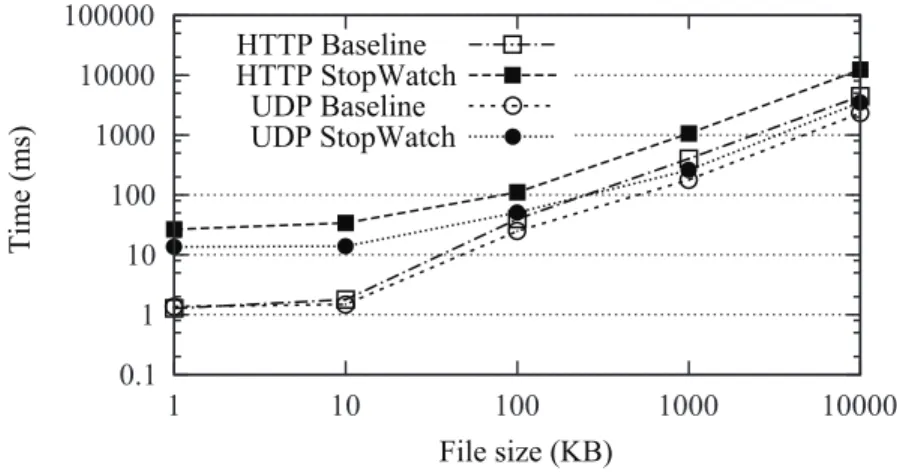
We evaluate the performance of our StopWatch prototype for supporting web service (file
downloads) and various types of computations. Our analysis shows that the latency overhead of
StopWatch is less than2.8×even for network-intensive applications. We also identify adaptations to a service that can vastly increase its performance when run over StopWatch , e.g., making file
download over StopWatch competitive with file download over unmodified Xen. For
computa-tional benchmarks, the latency induced by StopWatch is less than2.3×and is directly correlated with their amounts of disk I/O. Overall, the latency overhead of StopWatch is qualitatively
simi-lar to other modern systems that use VM replication for other reasons (e.g., [25]). Moreover, we
demonstrate thatStopWatch can substantially outperform competing defenses against timing
side-channel attacks, namely adding uniformly random noise to event timings or running VMs on shared
hardware in a time-slicing fashion.
We also study the impact ofStopWatch on cloud utilization, i.e., how many guest VMs can be
of (replicas of) other VMs. We show that for any c ≤ n−21, Θ(cn) guest VMs (three replicas of each) can be simultaneously executed; we also identify practical algorithms for placing replicas
to achieve this bound. We extend this result toΘ(dcn
max) guest VMs when guest VMs can place
different demands, up todmax, on machine resources of capacityc. These results distinguish
Stop-Watch from the alternative of simply running each guest VM on a separate computer, which permits
simultaneous execution of onlynguest VMs.
To summarize, our contributions are as follows: First, we introduce a novel approach for
defend-ing against access-driven timdefend-ing side-channel attacks in “infrastructure-as-a-service” (IaaS)
com-pute clouds that leverages replication of guest VMs with the constraint that the replicas of each
guest VM coreside with nonoverlapping sets of (replicas of) other VMs. The median timings of
I/O events across the three guest VM replicas are then imposed on these replicas to interfere with
their use of event timings to extract information from a victim VM with which one is coresident.
Second, we detail the implementation of this strategy in Xen, yielding a system calledStopWatch ,
and evaluate the performance ofStopWatch on a variety of workloads. This evaluation sheds light
on the features of workloads that most impact the performance of applications running on
Stop-Watch and how they can be adapted for best performance. We further extend this evaluation with
a comparison to other plausible alternatives for defending holistically against access-driven timing
side-channel attacks, such as adding random noise to the observable timing of events or running
VMs on shared hardware in a time-sliced fashion. Third, we show how to place replicas under the
constraints ofStopWatch to utilize a cloud infrastructure more effectively than running each guest
VM in isolation.
The rest of this chapter is structured as follows. We describe related work in Section 2.1. We
provide an overview of the design ofStopWatch in Section 2.2 and detail how we address classes
of internal “clocks” used in timing attacks in Section 2.3 and Section 2.4. In Section 2.5, we then
discuss how StopWatch extends to address richer attacks involving collaborators external to the
cloud or collaborative attacker VMs. We evaluate performance of our StopWatch prototype in
Section 2.6. We extend this evaluation to provide a comparison to other holistic timing side-channel
defenses in Section 2.7. Section 2.8 treats the replica placement problem that would be faced by
2.1 Related Work
2.1.1 Timing Channel Defenses
Defenses against information leakage via timing channels are diverse, taking numerous
differ-ent angles on the problem. Research on type systems and security-typed languages to eliminate
timing attacks offers powerful solutions (e.g., [3, 94, 96]), but this work is not immediately
appli-cable to our goal here, namely adapting an existing virtual machine monitor (VMM) to support
practical mitigation of timing channels today. Other research has focused on the elimination of
tim-ing side channels within cryptographic computations (e.g., [82]) or as enabled by specific hardware
components (e.g., [72, 54]), but we seek an approach that is comprehensive.
Askarov et al. [4] distinguish between internal timing channels that involve the implicit or
explicit measurement of time from within the system, and external timing channels that involve
measuring the system from the point of view of an external observer. Defenses for both internal
(e.g., [49, 3, 94, 85]) and external (e.g., [51, 39, 4, 42, 95]) timing channels have received
signif-icant attention individually, though to our knowledge, StopWatch is novel in addressing
access-driven timing channels through a combination of both techniques. StopWatch incorporates internal
defenses to interfere with an attacker’s use of real-time clocks or “clocks” that it might derive from
the I/O subsystem. In doing so,StopWatch imposes determinism on uniprocessor VMs and then
uses this feature to additionally build an effective external defense against such attacker VMs.
StopWatch ’s internal and external defense strategies also differ individually from prior work,
in interfering with timing channels by allowing replicas (in the internal defenses) and external
ob-servers (in the external defenses) to observe only median I/O timings across the three replicas. The
median offers several benefits over the alternative of obfuscating event timings by adding random
noise (without replicating VMs): to implement random noise, a distribution from which to draw the
noise must be chosen without reference to an execution in the absence of the victim—i.e., how the
execution “should have” looked—and so ensuring that the chosen noise distribution is sufficient to
suppress all timing channels can be quite difficult. StopWatch uses replication and careful replica
placement (in terms of the other VMs with which each replica coresides) exactly to provide such a
better than uniformly random noise allows for the same protection, as the distinctiveness of victim
behavior increases.
2.1.2 Replication
To our knowledge,StopWatch is novel in utilizing replication for timing channel defense. That
said, replication has a long history that includes techniques similar to those we use here. For
exam-ple, state-machine replication to mask Byzantine faults [78] ensures that correct replicas return the
same response to each request so that this response can be identified by “vote” (a technique related
to one employed inStopWatch ; see Section 2.2 and Section 2.5.1). To ensure that correct replicas
return the same responses, these systems enforce the delivery of requests to replicas in the same
order; moreover, they typically assume that replicas are deterministic and process requests in the
order they are received. Enforcing replica determinism has also been a focus of research in (both
Byzantine and benignly) fault-tolerant systems; most (e.g., [13, 64, 6]), but not all (e.g., [15]), do
so at other layers of the software stack thanStopWatch does.
More fundamentally, to our knowledge all prior systems that enforce timing determinism across
replicas permit one replica to dictate timing-related events for the others, which does not suffice
for our goals: that replica could be the one coresident with the victim, and so permitting it to
dictate timing related events would simply “copy” the information it gleans from the victim to the
other replicas, enabling that information to then be leaked out of the cloud. Rather, by forcing the
timing of events to conform to the median timing across three VM replicas, at most one of which
is coresident with the victim, the enforced timing of each event is either the timing of a replica not
coresident with the victim or else between the timing of two replicas that are not coresident with the
victim. This strategy is akin to ones used for Byzantine fault-tolerant clock synchronization (e.g.,
see [77, Section 5.2 ]) or sensor replication (e.g., see [78, Section 5.1 ]), though we use it here for
information hiding (versus integrity).
Aside from replication for fault tolerance, replication has been explored to detect server
pen-etration [34, 23, 66, 35]. These approaches purposely employ diverse replica codebases or data
representations so as to reduce the likelihood of a single exploit succeeding on multiple replicas.
but not others. In contrast to these approaches, StopWatch leverages (necessarily) identical guest
VM replicas to address a different class of attacks (timing side channels) than replica compromise.
Research on VM execution replay (e.g., [89, 32]) focuses on recording nondeterministic events
that alter VM execution and then coercing these events to occur the same way when the VM is
replayed. The replayed VM is a replica of the original, albeit a temporally delayed one, and so this
can also be viewed as a form of replication.StopWatch similarly coerces VM replicas to observe the
same event timings, but again, unlike these timings being determined by one replica (the original),
they are determined collectively using median calculations, so as to interfere with one attacker
VM replica that is coresident with the victim from simply propagating its timings to all replicas.
That said, the state-of-the-art in VM replay (e.g., [32]) addresses multiprocessor VM execution,
which our present implementation ofStopWatch does not. StopWatch could be extended to support
multiprocessor execution with techniques for deterministic multiprocessor scheduling (e.g., [27]).
Mechanisms for enforcing deterministic execution through O/S-level modifications (e.g., [5]) are
less relevant to our goals, as they are not easily used by an IaaS cloud provider that accepts arbitrary
VMs to execute.
2.2 Design
Our design is focused on “infrastructure as a service” (IaaS) clouds that accept virtual
ma-chine images, or “guest VMs,” from customers to execute. Amazon EC2 (http://aws.amazon.
com/ec2/) and Rackspace (http://www.rackspace.com/) are example providers of
pub-lic IaaS clouds. Given the concerns associated with side-channel attacks in cloud environments
(e.g., [74, 97]), we seek to develop virtualization software that would enable a provider to construct
a cloud that offers substantially stronger assurances against leakage via timing channels. This cloud
might be a higher assurance offering that a provider runs alongside its normal cloud (while
presum-ably charging more for the greater assurance it offers) or a private cloud with substantial assurance
2.2.1 Threat Model
Our threat model is a customer who submits attacker VMs for execution that are designed to
employ timing side channels. We presume that the attacker VM is designed to extract information
from a particular victim VM, versus trying to learn general statistics about the cloud such as its
average utilization. We assume that access controls prevent the attacker VMs from accessing victim
VMs directly or from escalating their own privileges in a way that would permit them to access
victim VMs. The cloud’s virtualization software (in our case, Xen and our extensions thereof) is
trusted.
According to Wray [88], to exploit a timing channel, the attacker VM measures the timing of
observable events using a clock that is independent of the timings being measured. While the most
common such clock is real time, a clock can be any sequence of observable events. With this general
definition of a “clock,” a timing attack simply involves measuring one clock using another. Wray
identified four possible clock sources in conventional computers [88]:
• TL: the “CPU instruction-cycle clock” (e.g., a clock constructed by executing a simple timing
loop);
• Mem: the memory subsystem (e.g., data/instruction fetches);
• IO: the I/O subsystem (e.g., network, disk, and DMA interrupts); and
• RT: real-time clocks provided by the hardware platform (e.g., time-of-day registers).
2.2.2 Defense Strategy
StopWatch is designed to interfere with the use ofIOandRTclocks and, for uniprocessor VMs,
TL orMemclocks, for timing attacks. (As discussed in Section 2.1, extension to multiprocessor
VMs is a topic of future work.)IOandRT(especiallyRT) clocks are an ingredient in every timing
side-channel attack in the research literature that we have found, undoubtedly because real time is
the most intuitive, independent and reliable reference clock for measuring another clock. So,
inter-vening on these clocks is of paramount importance. Moreover, the wayStopWatch does so forces
the scheduler in a uniprocessor guest VM to behave deterministically, interfering with attempts to
More specifically, to interfere with IO clocks, StopWatch replicates each attacker VM (i.e.,
every VM, since we do not presume to know which ones are attacker VMs) threefold so that the
three replicas of a guest VM are coresident with nonoverlapping sets of (replicas of) other VMs.
Then, when determining the timing with which an IOevent is made available to each replica, the
median timing value of the three is adopted. StopWatch addressesRTclocks by replacing a VM’s
view of real time with a virtual time that depends on the VM’s own progress, an idea due to Popek
and Kline [70].
A side effect of how StopWatch addressesIOand RTclocks is that it enforces deterministic
execution of uniprocessor attacker VM replicas, also disabling its ability to useTLorMemclocks.
These mechanisms thus deal effectively with internal observations of time, but it remains possible
that an external observer could glean information from the real-time duration between the arrival of
packets that the attacker VM sends. To interfere with this timing channel, we emit packets to an
external observer with timing dictated by, again, the median timing of the three VM replicas.
2.2.3 Justification for the Median
Permitting only the median timing of anIOevent to be observed limits the information that an
attacker VM can glean from being colocated with a victim VM of interest, because the distribution
of the median timings substantially dampens the visibility of a victim’s activities.
To see why, consider a victim VM that induces observable timings that are exponentially
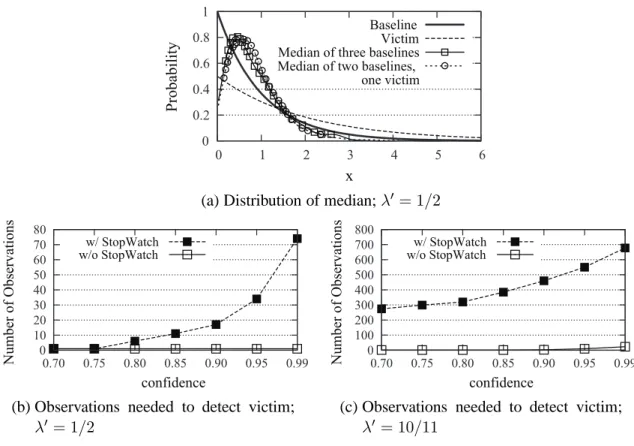
dis-tributed with rateλ′, versus a baseline (i.e., non-victim) exponential distribution with rateλ > λ′.1 Figure 2.1a plots example distributions of the attacker VMs’ observations underStopWatch when
an attacker VM is coresident with the victim (“Median of two baselines, one victim”) and when
attacker VM is not (“Median of three baselines”). This figure shows that these median distributions
are quite similar, even when λ is substantially larger than λ′; e.g., λ = 1 and λ′ = 1/2 in the example in Figure 2.1a. In this case, to even reject the null hypothesis that the attacker VM is not
coresident with the victim using aχ-square test, the attacker can do so with high confidence in the absence ofStopWatch with only a single observation, but doing so under StopWatch requires almost
1
0 0.2 0.4 0.6 0.8 1
0 1 2 3 4 5 6
Probability
x
Baseline Victim Median of three baselines Median of two baselines,
one victim
(a) Distribution of median;λ′= 1/2
0 10 20 30 40 50 60 70 80
0.70 0.75 0.80 0.85 0.90 0.95 0.99
Number of Observations
confidence w/ StopWatch w/o StopWatch
(b) Observations needed to detect victim; λ′ = 1/2
0 100 200 300 400 500 600 700 800
0.70 0.75 0.80 0.85 0.90 0.95 0.99
Number of Observations
confidence w/ StopWatch w/o StopWatch
(c) Observations needed to detect victim; λ′ = 10/11
Figure 2.1: Justification for median; baseline distribution Exp(λ),λ = 1, and victim distribution
Exp(λ′)
two orders of magnitude more (Figure 2.1b). This improvement becomes even more pronounced if
λandλ′are closer; the caseλ= 1,λ′= 10/11is shown in Figure 2.1c.
In terms of the number of observations needed to extract meaningful information from the
victim VM, this assessment is very conservative, since the attacker would face numerous pragmatic
difficulties that we have not modeled here [97]. But even this simple example shows the power
of disclosing only median timings of three VM replicas, and in Section 2.4.2 we will repeat this
illustration using actual message traces.
The above illustration of the benefits of allowing only the median timing of an IOevent to
be observed by an attacker is not specific to timing behaviors that are exponentially distributed.
independent random variablesX1,X2,X3defined as the difference in virtual times (or, in the case
of an external observer, real times) between two subsequentIOevents.
Specifically, due to the construction of StopWatch , the adversary is relegated to learning
in-formation from the difference between (i) the CDFF2:3(x)for random variables X1,X2,X3
cor-responding to attacker VM replicas that are not coresident with a victim VM of interest, and (ii)
the CDFF2:3′ (x)for random variablesX1′,X2,X3whereX1′ corresponds to an attacker VM that
is coresident with the victim VM of interest. An example measure of the distance between two
CDFs F(x) and Fˆ(x) is their Kolmogorov-Smirnov distance [28, p. 179], defined as D(F,Fˆ) = maxx
¯ ¯
¯F(x)−Fˆ(x) ¯ ¯ ¯.
The following theorem shows that adopting the median microaggregation function can only
interfere with the adversary’s goal:
Theorem 1. If the distributions of X2 and X3 are overlapping (i.e., for nox is F2(x) = 0 and
F3(x) = 1, orF2(x) = 1andF3(x) = 0), thenD(F2:3, F2:3′ )< D(F1, F1′).
Proof. Due to well-known results in order statistics (e.g., see G ¨ung¨or et al. [41, Result 2.4]):2
Fr:m(x) = m X
ℓ=r
(−1)ℓ−r
µ ℓ−1
r−1
¶ X
I⊆{1...m}:
|I|=ℓ Y
i∈I Fi(x)
In particular,
F2:3(x) =F1(x)F2(x) +F1(x)F3(x) +F2(x)F3(x)−2F1(x)F2(x)F3(x)
F2:3′ (x) =F1′(x)F2(x) +F1′(x)F3(x) +F2(x)F3(x)−2F1′(x)F2(x)F3(x)
whereF1′(x)represents the CDF ofX1′. So,
D(F2:3, F2:3′ ) = maxx
¯
¯[F2(x) +F3(x)−2F2(x)F3(x)][F1(x)−F1′(x)] ¯ ¯
Noting thatD(F1, F1′) = maxx|F1(x)−F1′(x)|, it suffices to show that|F2(x) +F3(x)−2F2(x)F3(x)|< 1for allx. However, sinceF2(x)∈[0,1]andF3(x)∈[0,1]for allx,|F2(x) +F3(x)−2F2(x)F3(x)| ≤
2
1and, moreover, equals1only if for somex, one ofF2(x)andF3(x)is1and the other is0. This
last case is precluded by the theorem.
In the limit, when the distributions ofX2andX3overlap exactly, we get a much stronger result:
Theorem 2. IfX2andX3are identically distributed, thenD(F2:3, F2:3′ )≤ 12D(F1, F1′).
Proof. In this case,F2=F3 and so
|F2(x) +F3(x)−2F2(x)F3(x)|
reaches its maximum value of 12 at the valuexyieldingF2(x) =F3(x) = 12.
2.3 RTclocks
Real-time clocks provide reliable and intuitive reference clocks for measuring the timings of
other events. In this section, we describe the high-level strategy taken inStopWatch to interfere with
their use for timing channels and detail the implementation of this strategy in Xen with
hardware-assisted virtualization (HVM).
2.3.1 Strategy
The strategy adopted inStopWatch to interfere with a VM’s use of real-time clocks is to
virtu-alize these real-time clocks so that their values observed by a VM are a deterministic function of the
VM’s instructions executed so far [70]. That is, after the VM executesinstr instructions, the virtual time observed from within the VM is
virt(instr)←slope ×instr +start (2.1)
To determinestart at the beginning of VM replica execution, the VMMs hosting the VM’s replicas exchange their current real times;startis initially set to the median of these values. slopeis initially set to a constant determined by the tick rate of the machines on which the replicas reside.
epoch, each VMM can send to the others the durationDkover which its replica executed those I instructions and its real timeRkat the end of that duration. Then, the VMMs can select the median real timeR∗kand the durationD∗kfrom that same machine and reset
startk+1←virtk(I) slopek+1←arg min
v∈[ℓ,u] ¯ ¯ ¯ ¯
R∗k−virtk(I) +Dk∗
I −v
¯ ¯ ¯ ¯
for a preconfigured constant range [ℓ,u], to yield the formula for virtk+1.3 The use of ℓ and u
ensures thatslopek+1is not too extreme and, ifℓ >0, thatslopek+1is positive. In this way,virtk+1
should approach real time on the computer contributing the median real timeR∗k over the next I instructions, assuming that the machine and VM workloads stay roughly the same. Of course, the
smallerI-values are, the morevirt follows real time and so poses the risk of becoming useful in timing attacks. So,virt should be adjusted only for tasks for which coarse synchronization with real time is important and then only with largeI values.
2.3.2 Implementation in Xen
Real-time clocks on a typical x86 platform include timer interrupts and various hardware
coun-ters. Closely related to these real-time clocks is the time stamp counter register, which is accessed
using therdtscinstruction and stores a count of processor ticks since reset.
2.3.2.1 Timer interrupts
Operating systems typically measure the passage of time by counting timer interrupts; i.e., the
operating system sets up a hardware device to interrupt periodically at a known rate, such as100
times per second [87]. There are various such hardware devices that can be used for this purpose.
Our current implementation of StopWatch assumes the guest VM uses a Programmable Interval
Timer (PIT) as its timer interrupt source, but our implementation for other sources would be similar.
The StopWatch VMM generates timer interrupts for a guest on a schedule dictated by that guest’s
3In other words, if(R∗
k−virtk(I) +D∗k)/I ∈ [ℓ,u]then this value becomesslopek+1. Otherwise, eitherℓoru does, whichever is closer to(R∗
virtual timevirt as computed in Equation 2.1. To do so, it is necessary for the VMM to be able to track the instruction countinstr executed by the guest VM.
In our present implementation,StopWatch uses the guest branch count forinstr, i.e., keeping track only of the number of branches that the guest VM executes. Several architectures support
hardware branch counters, but these are not sensitive to the multiplexing of multiple guests onto a
single hardware processor and so continue to count branches regardless of the guest that is currently
executing. So, to track the branch count for a guest,StopWatch implements a virtualized branch
counter for each guest.
A question is when to inject each timer interrupt. Intel VT augments IA-32 with two new
forms of CPU operations: virtual machine extensions (VMX) root operation and VMX non-root
operation [84]. While the VMM uses root operation, guest VMs use VMX non-root operation. In
non-root operation, certain instructions and events cause a VM exit to the VMM, so that the VMM
can emulate those instructions or deal with those events. Once completed, control is transferred
back to the guest VM via a VM entry. The guest then continues running as if it had never been
interrupted.
VM exits give the VMM the opportunity to inject timer interrupts into the guest VM as the
guest’s virtual time advances. However, so that guest VM replicas observe the same timer interrupts
at the same points in their executions, StopWatch injects timer interrupts only after VM exits that
are caused by guest execution. Other VM exits can be induced by events external to the VM, such as
hardware interrupts on the physical machine; these would generally occur at different points during
the execution of the guest VM replicas but will not be visible to the guest [50, Section 29.3.2 ]. For
VM exits caused by guest VM execution, the VMM injects any needed timer interrupts on the next
VM entry.
2.3.2.2 rdtsccalls and CMOS RTC values
Another way for a guest VM to measure time is viardtsc calls. Xen already emulates the
return values to these calls. More specifically, to produce the return value for a rdtsc call, the
Xen hypervisor computes the time passed since guest reset using its real-time clock, and then this
time value is scaled by a constant factor. StopWatch replaces this use of a real-time clock with the
A virtualized real-time clock (RTC) is also provided to HVM guests in Xen; this provides time
to the nearest second for the guest to read. The virtual RTC gets updated by Xen using its real-time
clock. StopWatch responds to requests to read the RTC using the guest’s virtual time.
2.3.2.3 Reading counters
The guest can also observe real time from various hardware counters, e.g., the PIT counter,
which repeatedly counts down to zero (at a pace dictated by real time) starting from a constant.
These counters, too, are already virtualized in modern VMMs such as Xen. In Xen, these return
values are calculated using a real-time clock;StopWatch uses the guest virtual time, instead.
2.4 IOclocks
IOclocks are typically network, disk and DMA interrupts. (Other device interrupts, such as
keyboards, mice, graphics cards, etc., are typically not relevant for guest VMs in clouds.) We
outline our strategy for mitigating their use to implement timing channels in Section 2.4.1, and then
in Section 2.4.2 we describe our implementation of this strategy inStopWatch .
2.4.1 Strategy
The method described in Section 2.3 for dealing withRT clocks by introducing virtual time
provides a basis for addressing sources ofIOclocks. A component of our strategy for doing so is to
synchronize I/O events across the three replicas of each guest VM in virtual time, so that every I/O
interrupt occurs at the same virtual time at all replicas. Among other things, this synchronization
will force uniprocessor VMs to execute deterministically, but it alone will not be enough to interfere
with IOclocks; it is also necessary to prevent the timing behavior of one replica’s machine from
imposing I/O interrupt synchronization points for the others, as discussed in Section 2.1–2.2. This
is simpler to accomplish for disk accesses and DMA transfers since replica VMs initiate these
themselves, and so we will discuss this case first. The more difficult case of network interrupts,
where we explicitly employ median calculations to dampen the influence of any one machine’s
2.4.1.1 Disk and DMA interrupts
The replication of each guest VM at start time includes replicating its entire disk image, and so
any disk blocks available to one VM replica will be available to all. By virtue of the fact that
(unipro-cessor) VMs execute deterministically inStopWatch , replicas will issue disk and DMA requests at
the same virtual time. Upon receiving such a request from a replica at timeV, the VMM adds an offset∆dto determine a “delivery time” for the interrupt, i.e., at virtual timeV + ∆d, and initiates the corresponding I/O activities (disk access or DMA transfer). The offset∆dmust be large enough
to ensure that the data transfer completes by the virtual delivery time. Once the virtual delivery time
has been determined, the VMM simply waits for the first VM exit caused by the guest VM (as in
Section 2.3.2) that occurs at a virtual time at least as large as this delivery time. The VMM then
injects the interrupt prior to the next VM entry of the guest. This interrupt injection also includes
copying the data into the address space of the guest, so as to prevent the guest VM from polling for
the data in advance of the interrupt to create a form of clock (e.g., see [49, Sec 4.2.2]).
2.4.1.2 Network interrupts
Unlike the initiation of disk accesses and DMA transfers, the activity giving rise to a network
interrupt, namely the arrival of a network packet that is destined for the guest VM, is not
synchro-nized in virtual time across the three replicas of the guest VM. So, the VMMs on the three machines
hosting these replicas must coordinate to synchronize the delivery of each network interrupt to the
guest VM replicas. To prevent the timing of one from dictating the delivery time at all three, these
VMMs exchange proposed delivery times and select the median, as discussed in Section 2.2. To
solicit proposed timings from the three, it is necessary, of course, that the VMMs hosting the three
replicas all observe each network packet. So,StopWatch replicates every network packet to all three
computers hosting replicas of the VM for which the packet is intended. This is done by a logically
separate “ingress node” that we envision residing on a dedicated computer in the cloud. (Of course,
there need not be only one such ingress for the whole cloud.)
When a VMM observes a network packet to be delivered to the guest, it sends its proposed
virtual time — i.e., in the guest’s virtual time, see Section 2.3 — for the delivery of that interrupt
proposals are not visible to the guest VM replicas.) Each VMM generates its proposed delivery
time by adding a constant offset ∆nto the virtual time of the guest VM at its last VM exit. ∆n
must be large enough to ensure that once the three proposals have been collected and the median
determined at all three replica VMMs, the chosen median virtual time has not already been passed
by any of the guest VMs. The virtual-time offset ∆n is thus determined using an assumed upper
bound on the real time it takes for each VMM to observe the interrupt and to propagate its proposal
to the others,4 as well as the maximum allowed difference between the fastest two replicas’ virtual
times. This difference can be limited by slowing the execution of the fastest replica.
Once the median proposed virtual time for a network interrupt has been determined at a VMM,
the VMM simply waits for the first VM exit caused by the guest VM (as in Section 2.3.2) that occurs
at a virtual time at least as large as that median value.5 The VMM then injects the interrupt prior to
the next VM entry of the guest. As with disk accesses and DMA transfers, this interrupt injection
also includes copying the data into the address space of the guest, so as to prevent the guest VM
from polling for the data in advance of the interrupt to create a form of clock (e.g., [49, Section 4.2.2
]).
Real me
V
ir
tu
a
l
m
e
R1
Replica A Replica B Replica C
B C A C A B
Arrival of packet at VMM
A’s proposal
Delivery of packet to guest
+∆n
+∆n +∆
n
B’s proposal C’s proposal
Real me Real me
R1 R1
R2 R2 R2
Arrival of proposal at VMM
Figure 2.2: Delivering a packet to guest VM replicas.
The process of determining the delivery time of a network packet to a guest VM’s replicas is
pictured in Figure 2.2. This figure depicts a real-time interval [R1, R2] at the three machines at
4
In distributed computing parlance, we thus assume a synchronous system, i.e., there are known bounds on processor execution rates and message delivery times.
5
which a guest VM is replicated, showing at each machine: the arrival of a packet at the VMM, the
proposal made by each VMM, the arrival of proposals from other replica machines, the selection of
the median, and the delivery of the packet to the guest replica. Each stepped diagonal line shows
the progression of virtual time at that machine.
2.4.2 Implementation in Xen
Xen presents to each HVM guest a virtualized platform that resembles a classic PC/server
plat-form with a network card, disk, keyboard, mouse, graphics display, etc. This virtualized platplat-form
support is provided by virtual I/O devices (device models) in Dom0, a domain in Xen with
spe-cial privileges. QEMU (http://fabrice.bellard.free.fr/qemu) is used to implement
device models. One instance of the device models is run in Dom0 per HVM domain.
2.4.2.1 Network card emulation
In the case of a network card, the device model running in Dom0 receives packets destined for
the guest VM. WithoutStopWatch modification, the device model copies this packet to the guest
address space and asserts a virtual network device interrupt via the virtual Programmable Interrupt
Controller (vPIC) exposed by the VMM for this guest. HVM guests cannot see real external
hard-ware interrupts since the VMM controls the platform’s interrupt controllers [50, Section 29.3.2 ].
InStopWatch , we modify the network card device model so as to place each packet destined
for the guest VM into a buffer hidden from the guest, rather than delivering it to the guest. The
device model then reads the current virtual time of the guest (as of the guest’s last VM exit), adds
∆n to this virtual time to create its proposed delivery (virtual) time for this packet, and multicasts
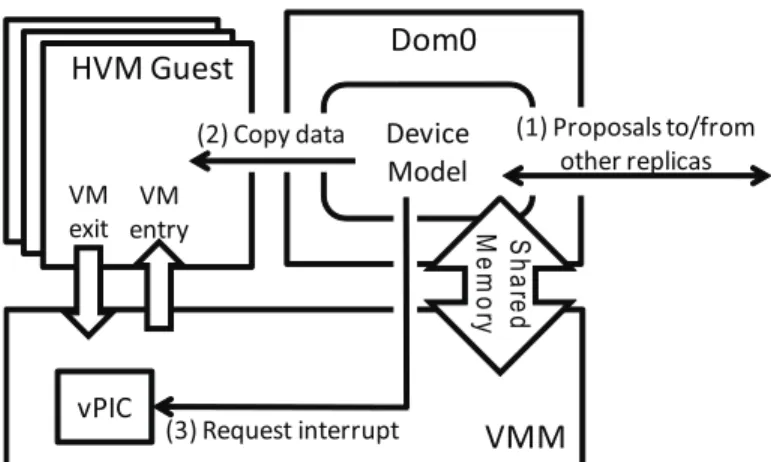
this proposal to the other two replicas (step 1 in Figure 2.3). A memory region shared between
Dom0 and the VMM allows device models in Dom0 to read guest virtual time.
Once the network device model receives the two proposals in addition to its own, it takes the
median proposal as the delivery time and stores this delivery time in the memory it shares with the
VMM. The VMM compares guest virtual time to the delivery time stored in the shared memory
upon every guest VM exit caused by guest VM execution. Once guest virtual time has passed the
delivery time, the network device model copies the packet into the guest address space (step 2 in
Dom0 HVM Guest
Device Model
VM exit
VM entry
(3) Request interrupt
vPIC
S
h
a
re
d
M
e
m
o
ry
(2) Copy data
VMM
(1) Proposals to/from other replicas
Figure 2.3: Emulation of network I/O device inStopWatch .
0.4 0.5 0.6 0.7 0.8 0.9 1
0 20000 40000 60000 80000
Probability
Inter-packet delivery times (virtual ) Median of three baselines
Median of two baselines, one victim
(a) Distribution of median (CDF)
0 20 40 60 80 100 120
0.70 0.75 0.80 0.85 0.90 0.95 0.99
Number of observations
confidence w/ StopWatch w/o StopWatch
(b) Observations needed to detect victim
Figure 2.4: Virtual inter-packet delivery times to attacker VM replicas with coresident victim (“two baselines, one victim”) and in a run where no replica was coresident with a victim (“three baselines”)
Figure 2.4a shows the CDF of virtual inter-packet delivery times to replicas of an attacker VM
in an actual run where one replica is coresident with a victim VM continuously serving a file, in
comparison to the virtual delivery times with no victim present. This plot is directly analogous
to that in Figure 2.1a but is generated from a realStopWatch run and shows the distribution as a
CDF for ease of readability. Figure 2.4b shows the number of observations needed to distinguish
the victim and no-victim distributions in Figure 2.4a using a χ-squared test, as a function of the desired confidence. This figure is analogous to Figure 2.1b and confirms thatStopWatch
strength-ens defstrength-ense against timing attacks by an order of magnitude in this scenario. Again, the absolute
number of observations needed to distinguish these distributions is likely quite conservative, owing
2.4.2.2 Disk and DMA emulation
The emulation of the IDE disk and DMA devices is similar to the network card emulation above.
StopWatch controls when the disk and DMA device models complete requests and notify the guest.
Instead of copying data read to the guest address space, the device model inStopWatch prepares a
buffer to receive this data. In addition, rather than asserting an appropriate interrupt via the vPIC
to the guest as soon as the data is available, theStopWatch device model reads the current guest
virtual time from memory shared with the VMM, adds∆d, and stores this value as the interrupt
delivery time in the shared memory. Upon the first VM exit caused by guest execution at which the
guest virtual time has passed this delivery time, the device model copies the buffered data into the
guest address space and asserts an interrupt on the vPIC. Disk writes are handled similarly, in that
the interrupt indicating write completion is delivered as dictated by adding∆dto the virtual time at
which the write was initiated.
2.5 Collaborative Attacks
The mechanisms described in Section 2.3–2.4 intervene on two significant sources of clocks;
though VM replicas can measure the progress of one relative to the other, for example, their
mea-surements will be the same and will reflect the median of their timing behaviors. Moreover, by
forcing each guest VM to execute (and, in particular, schedule its internal activities) on the basis
of virtual time and by synchronizing I/O events across replicas in virtual time, uniprocessor guest
VMs execute deterministically, stripping them of the ability to leverage TLand Memclocks, as
well. (More specifically, the progress of TLand Memclocks are functionally determined by the
progress of virtual time and so are not independent of it.) There nevertheless remains the
possibil-ity of various collaborative attacks that leverage an attacker VM in conjunction with other attacker
components that we discuss below.
2.5.1 External Collaborators
One possible collaborative attack involves conjoining the attacker VM with a collaborator with
intervene. By interacting with the attacker VM, the external collaborator might attempt to discern
information using the real-time behavior of his attacker VM.
Because guest VM replicas will run deterministically, they will output the same network
pack-ets in the same order. StopWatch uses this property to interfere with a VM’s ability to exfiltrate
information on the basis of its real-time behavior as seen by an external observer. StopWatch does
so by adopting the median timing across the three guest VM replicas for each output packet. The
median is selected at a separate “egress node” that is dedicated for this purpose (c.f., [90]),
anal-ogous to the “ingress node” that replicates every network packet destined to the guest VM to the
VM’s replicas (see Section 2.4). Like the ingress node, there need not be only one egress node for
the whole cloud.
To implement this scheme in Xen, every packet sent by a guest VM replica is tunneled by the
network device model on that machine to the egress node. The egress node forwards an output
packet to its destination after receiving the second copy of that packet (i.e., the same packet from
two guest VM replicas). Since the second copy of the packet it receives exhibits the median output
timing of the three replicas, this strategy ensures that the timing of the output packet sent toward its
destination is either the timing of a guest replica not coresident with the victim VM or else a timing
that falls between those of guest replicas not coresident with the victim.
An alternative strategy that the external collaborator might take is to send real-time timestamps
to his attacker VM, in the hopes of restoring a notion of real-time to that VM (that was stripped away
as described in Section 2.3). Again, however, since each packet to the attacker VM is delivered
on a schedule dictated by the median progress of the attacker VM replicas (Section 2.4), those
timestamps will reflect only on the behavior of the median replica. As such, it matters little whether
the external collaborator sends real-time timestamps to the attacker VM or the attacker VM sends
virtual-time timestamps (or events reflecting them) to the external collaborator; either way, the
power offered by the external collaborator is the same, namely relating progress of the median
progress of the attacker VM replicas to real time.
2.5.2 Collaborating Victim-VM Clients
While the type of external collaborator addressed in Section 2.5.1 interacts with the attacker
as one of its clients. This possibility raises the issue of remote timing attacks (e.g., [16]) that do not
involve coresidence of attacker VMs with victim VMs at all; such attacks are not our concern here,
as we are motivated only by access-driven attacks.
That said, recent investigations have paired remote timing attacks with access-driven elements:
e.g., Bates et al. [7] and Herzberg et al. [47] developed attacks by which a victim-VM’s client
could detect the impact of a coresident attacker-VM’s communication on the timing of the victim’s
communication to it, thereby confirming the coresidence of the attacker VM with the victim VM,
for example.
While the goal ofStopWatch is not to defend against all remote timing attacks, it does mitigate
the access-driven elements of attacks such as those of Bates et al. and Herzberg et al. Specifically,
inStopWatch the observable timing of a victim VM’s communication to its clients will be dictated
by the median progress of its three replicas (Section 2.5.1). As shown in Section 2.2.3, this reveals
quantifiably less information to the client than the observable impact of a coresident attacker VM
on a (non-replicated) victim VM would. In particular, an attacker VM could perturb the victim
VM’s observable communication timings only if it is coresident with the victim VM replica whose
progress is the median of the victim’s three replicas, and only then constrained above and below
according to the other replicas’ progress.
The defenses suggested by Herzberg et al. to the attack they investigate include a rate-limiting
firewall that interferes with the remote attacker’s ability to induce load on VMs hosted in the cloud.
Our ingress node (Section 2.4.1.2) could trivially be adapted to rate-limit inbound traffic, as well, as
a secondary defense against such attacks.
2.5.3 Collaborating Attacker VMs
Another possible form of attacker collaboration involves multiple attacker VMs working
to-gether to mount access-driven timing attacks. The apparent risks of such collaboration can be seen
in the following possibility: replicas of one attacker VM (“VM1”) reside on machines A, B, and
C; one replica of another attacker VM (“VM2”) resides on machine A; and a replica of the victim
VM resides on machine C. If VM2 induces significant load on its machines, then this may slow
among its replicas’ VMMs. The replicas of VM1 would then observe timings influenced by the
larger of the replicas on B and C — which may well reflect timings influenced by the victim.
Mounting such an attack, or any collaborative attack involving multiple attacker VMs on one
machine, appears to be difficult, however. Just as argued above that an attacker VM detecting its
coresidence with a victim VM is made much harder by StopWatch , one attacker VM detecting
coresidence with another using timing covert channels would also be impeded. If the cloud takes
measures to avoid disclosing coresidence of one VM with another by other channels, it should be
difficult for the attacker to even detect when he is in a position to mount such an attack or to interpret
the results of mounting such an attack indiscriminately.
If such attacks are nevertheless feared, they can be made harder still by increasing the
num-ber of replicas of each VM. If the numnum-ber were increased from three to, say, five, then inducing
sufficient load to marginalize one attacker replica from its median calculations would not
substan-tially increase the attacker’s ability to mount attacks on a victim. Rather, the attacker would need to
marginalize multiple of its replicas, along with accomplishing the requisite setup to do so.
2.6 Performance Evaluation
In this section we evaluate the performance of our StopWatch prototype. We present
addi-tional implementation details that impact performance in Section 2.6.1, our experimental setup in
Section 2.6.2, and our tests and their results in Section 2.6.3–2.6.4.
2.6.1 Selected Implementation Details
Our prototype is a modification of Xen version 4.0.2-rc1-pre, amounting to insertions or changes
of roughly 1500 source lines of code (SLOC) in the hypervisor. There were also about 2000 SLOC
insertions and changes to the QEMU device models distributed with that Xen version. In addition to
these changes, we incorporated OpenPGM (http://code.google.com/p/openpgm/) into
the network device model in Dom0. OpenPGM is a high-performance reliable multicast
implemen-tation, specifically of the Pragmatic General Multicast (PGM) specification [81]. In PGM, reliable
transmission is accomplished by receivers detecting loss and requesting retransmission of lost data.
that VM’s replicas and for communication among the VMMs hosting guest VM replicas. We also
extended the network device model on a host to tunnel each ethernet packet emitted from a local
VM replica to the appropriate egress node (see Section 2.5.1) over a persistent TCP connection.
Recall from Section 2.4 that each VMM proposes (via an OpenPGM multicast) a virtual
deliv-ery time for each network interrupt, and the VMMs adopt the median proposal as the actual delivdeliv-ery
time. As noted there, each VMM generates its proposal by adding a constant offset∆nto the
cur-rent virtual time of the guest VM.∆nmust be large enough to ensure that by the time each VMM
selects the median, that virtual time has not already passed in the guest VM. However, subject to
this constraint,∆nshould be minimized since the real time to which∆ntranslates imposes a lower
bound on the latency of the interrupt delivery. (Note that because ∆n is specified in virtual time
and virtual time can vary in its relationship to real time, the exact real time to which∆ntranslates
can vary during execution.) We selected∆nto accommodate timing differences in the arrivals of
packets destined to the guest VM at its three replicas’ VMMs, the delays for delivering each VMM’s
proposed virtual delivery time to the others, and the maximum allowed difference in progress
be-tween the two fastest guest VM replicas (whichStopWatch enforces by slowing the fastest replica,
if necessary). For the platform used in our experiments (see Section 2.6.2) and under diverse
net-working workloads, we found that a value of∆nthat typically translates to a real-time delay in the
vicinity of 7-12ms sufficed to meet the above criteria. The analogous offset∆dfor determining the
virtual delivery time for disk and DMA interrupts was determined based on the maximum observed
disk access times and translates to roughly 8-15ms.
2.6.2 Experimental setup
Our “cloud” consisted of three machines with the same hardware configuration: 4 Intel Core2
Quad Q9650 3.00GHz CPUs, 8GB memory, and a 70GB rotating hard drive. Dom0 was
config-ured to run Linux kernel version 2.6.32.25. Each HVM guest had one virtual CPU, 2GB memory
and 16GB disk space. Each guest ran Linux kernel 2.6.32.24 and was configured to use the
Pro-grammable Interrupt Controller (PIC) as its interrupt controller and a ProPro-grammable Interrupt Timer
(PIT) of 250Hz as its clock source. The Advanced Programmable Interrupt Controller (APIC) was