PIPELINE POLITICS:
THE IMPACT OF NORD STREAM 2 ON EUROPEAN ENERGY SECURITY
Andrew Herrin
A thesis submitted to the faculty at the University of North Carolina at Chapel Hill in partial fulfillment of the requirements for the degree of Masters of Arts in the Department of Political
Science.
Chapel Hill 2019
ABSTRACT
Andrew Herrin: Pipeline Politics: The Impact of Nord Stream 2 on European Energy Security (Under the direction of Dr. Robert Jenkins)
The recently salient issue of energy security is again a contentious policy area in the EU with the construction of the Nord Stream 2 pipeline. Although energy security has been
TABLE OF CONTENTS
LIST OF TABLES……….... vi
LIST OF FIGURES………...vii
LIST OF ABBREVIATIONS………...viii
CHAPTER 1: INTRODUCTION………..………..1
CHAPTER 2: CONCEPTUALIZING ENERGY SECURITY………..…….5
Defining Energy Security………..…..5
The Four A’s Approach in the Context of Key Security Questions………..………..9
CHAPTER 3: ENERGY POLICY IN THE EUROPEAN UNION………..14
Contemporary European Union Energy Policy……….17
Main Actors in EU Energy Policy Formation……….…..20
The European Energy Security Strategy and the Energy Union…………...………23
CHAPTER 4: EU ENERGY SECURITY, THE FOUR AS, AND SECURITY QUESTIONS...30
Availability………..……..30
Accessibility……….…..31
Affordability………..31
Acceptability……….…….32
CHAPTER 5: EUROPEAN UNION ENERGY SECURITY AND NORD STREAM 2……….36
From Nord Stream 1 to Nord Stream 2………..36
CHAPTER 6: DOES NORD STREAM2 ENHANCE OR UNDERMINE EU ENERGY
SECURITY?……….…….47
Availability………47
Accessibility………..48
Affordability………..49
Acceptability………..50
CHAPTER 7: CONCLUSION………..54
LIST OF TABLES
Table
LIST OF FIGURES
Figure 1: Nord Stream 2 Route………..…2 Figure 2: The Three Pillars of EU Energy Policy………..14 Figure 3: EU-28 Gross Inland Consumption: Energy Mix (%) Primary Products Only…..….…16 Figure 4: EU-28 Total Gas Imports BCM 1995-2016………..….17 Figure 5: Governance Structure of EU Energy Policy………...21 Figure 6: Figure 6: Development of gas prices for household consumer,
LIST OF ABBREVIATIONS
CEE - Central and Eastern European EU - European Union
SOS - Security of Supply
NRE - New and Renewable Energy
ECSC - European Coal and Steel Community EURATOM -European Atomic Energy Community PLEF - Pentalateral Energy Forum
NRA - National Regulatory Authority
ACER - Agency for the Cooperation of Energy Regulators LNG - Liquified Natural Gas
ENTSOG - European Network for Transmission System Operators for Gas BCM - Billion Cubic Meters
CHAPTER 1: INTRODUCTION
Concern over energy security is undoubtedly an important issue for European energy policy makers. Since the first oil crisis in the 1970s, energy security policy has focused primarily on concerns about oil disruption in oil-producing economies with particular focus on the Middle East. Since then, there has been an energy security paradigm shift. Concerns are not only
restricted to oil; all conventional energies are considered. Additionally, geographic concerns over oil-disruption are no longer focused on the Middle East, but Russia has become a dominant player in the European energy dialogue. The prominence of Russia, new environmental
commitments to energy supply, and the increasing importance of security of natural gas supply for European member states has handicapped the European Union in its ability to speak with one voice on all matters relating to energy policy. Growing divisions between core member states and CEE countries highlight the lack of common EU energy policy. A specific case where this fragmentation is evident is Nord Stream 2.
of increasing German-Russian commercial energy cooperation, it has wider implications on the future of EU energy security.
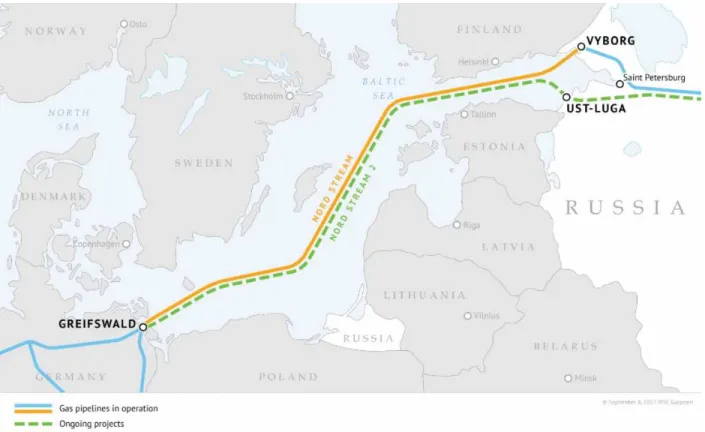
Figure 1: Nord Stream 2 Route
Source: Nord Stream AG, 2019
The construction of the pipeline raises a whole host of international and domestic political, economic, and legal issues, due to a new EU regulatory framework for energy
Only recently has EU energy policy been recognized as a fully-fledged EU policy. In its current form EU energy policy seeks to obtain energy security at an affordable price in addition to create an internal energy market and to develop a low carbon economy. During the last decade the energy security element has been the most discussed aspect of EU energy policy mostly because of the increasing energy dependence of member states on Russian imported resources and the numerous crises caused by disruptions of Russian gas supply. More recently, the crafting of the Energy Union Package represents the most serious and ambitious attempt to unify national regulatory frameworks into an integrated EU energy market. Launched in 2015, the Energy Union Package is based on five major objectives concerning: energy security and solidarity, creation of an integrated energy market, energy efficiency contributing to moderation of demand, decarbonizing the economy and increased research and competitiveness. Nord Stream 2 presents a challenge to these objectives, with arguments by CEE member states that the project decreases energy security.
This paper argues that the contentious debate around licensing Nord Stream 2 reflects a wider tension in EU energy policy thus contributing to an undermining of EU energy security. To this point, it addresses the dilemma of member state sovereignty in pursuing energy goals versus working within an emerging common policy that remains weakly represented in EU institutions. In that regard Nord Stream 2 reflects the strength of German energy policy over common EU policy.
First, this thesis reviews prominent literature and provides a conceptualization of energy security and ways in which it can be measured. Second, contemporary EU energy policy
CHAPTER 2: CONCEPTUALIZING ENERGY SECURITY
In social science literature, interest in energy security is based on the notion that an uninterrupted supply of energy is critical for the stability of a state and the functioning of an economy. However, an exact definition of energy security, or it's often used synonym, security of supply (SOS), is both hard to provide, and highly context dependent. In “Conceptualizing Energy Security,” Winzer states that energy security “is not clearly defined.”1 In defining energy
security, some researchers, including Jamasb and Pollitt,2 focus primarily on the security of supply aspect such as energy availability and prices, while other researchers, one being Vivoda, argue for a more comprehensive definition that includes effects such as the impact of economic and social welfare.3 This chapter covers the plethora of literature attempting to define energy
security and discusses possible indicators of how to measure energy security. Defining Energy Security
A definition of energy security remains elusive due to the fact that it is highly context dependent. Many academic journal publications leave the meaning of the term implicit,
assuming the meaning is agreed upon or does not need to be specified. For example, in his article “Conceptualizing Energy Security,” Christian Winzer included an appendix which listed
1 Winzer, 2012, 2.
seven definitions from scholarly articles.4 Daniel Yergin provides the common and conventional
definition of energy security as an objective “to assure adequate, reliable supplies of energy at reasonable prices and in ways that do not jeopardize major national values and objectives.”5 The
definition is straightforward but elements such as “reasonable prices” and ‘national values’ require further scrutiny. The International Energy Agency (IEA) defines energy security as the “uninterrupted availability of energy sources at an affordable price.”6 Both the IEA’s definition
and the classic formulation by Yergin share a common theme. They grow out of the study of global oil supply, and they are influenced by the experience of oil shocks in the late 20th century, particularly the 1973 oil crisis.
The theme of energy availability is present in many articles covering energy security. Hoogeveen and Perlot state that “Security of supply is a general term to indicate the access and availability of energy at all times.”7 In “A Quest for Energy Security in the 21st Century,” Intharak et al. also stress the idea of availability and price, defining energy security as “the ability of an economy to guarantee the availability of energy resource supply in a sustainable and timely manner with the energy price being at a level that will not adversely affect the economic performance of the economy.”8 Other definitions consider factors such as the environment,
sustainability, and societal dimensions. In a 2000 Green Paper titled “Towards a European Strategy for the Security of Energy Supply,” the European Commission stated that a
Strategy for energy supply security must be geared to ensuring, for the well-being of its citizens and the proper functioning of the economy, the uninterrupted physical
availability of energy products on the market, at a price which is affordable for all consumers (private and industrial), while respecting environmental concerns and looking towards sustainable development.9
Although the idea of guaranteed availability is continuously present across the related literature, it is evident that energy security is a complex concept and often used in a broad manner. It is also clear that the definition is constructed from the perspective of policymakers, public officials and decision-makers responsible for running a state. In fact, Yergin explicitly calls energy security an “objective,” differing it from a state or characteristic of the energy system. The general idea of energy security as a particular policy goal is included in the slightly more complicated though increasingly popular idea of the Four As of energy security:
availability, affordability, accessibility and acceptability.10
Expanding on the work presented in “A Quest for Energy Security in the 21st,” Intharak et al. cover the Four As in greater detail. Using the Four As framework, Intharak et al. merged the “availability” and “affordability with “acceptability” and “accessibility.” Availability refers to “Energy resource availability” which covers the major sources for energy such as
conventional oil, natural gas, coal, new and renewable energy (NRE), and biofuels. Accessibility refers to “Accessibility barriers” which covers impediments to accessing energy. Barriers can include geopolitical factors, global oil peak, dependency on massive infrastructure investments, transportation costs, human resource capacity, and lack of financial subsidization to NREs. Acceptability refers to “Environmental Acceptability” and includes the risks of environmental
sustainability from fossil fuels, toxic contamination resulting from nuclear power, and
unintended negative consequences from the use of biofuels. Affordability refers to “Investment cost Affordability” and “Besides geopolitical issues and imbalances between demand and supply that result in potential supply disruptions, investment in oil and gas upstream exploration and development is also a concern for supply security.”11 Additionally, the decline in LNG
infrastructure construction, stable price of coal, higher capital costs of nuclear power plants, and cost competitiveness in the NRE industry effect affordability. Lastly, Intharak et al. provide several energy security indicators which are diversification of energy sources and suppliers, net energy import dependency, non-carbon-based fuel portfolio, and net oil import dependency.
The Four As framework differs from the more conventional approaches to energy security in that it expands on guarantee of supply and guarantee of affordability. Both accessibility and acceptability dimensions are relevant to current debates over EU energy security due to the geopolitical nature of import dependence on Russia, environmental concerns over construction of pipelines such as Nord Stream 2, and aims by the EU to decarbonize the energy market. Furthermore, the four As approach helps shed light on the tension between member state energy policies and EU energy policies in that member states may have different interpretations how Nord Stream 2 may be beneficial to energy security in terms of meeting the four dimensions of energy security.
However, the Four As have been criticized as not addressing security questions.12 In “The
Concept of Energy Security: Beyond the Four As,” Cherp and Jewell assert that energy security is an instance of security in general “... and thus any concept of it should address three questions:
“Security for whom?”, “Security for which values?” and “Security from what threats?.”13 They
present their concept of energy security as “low vulnerability of vital energy systems.” In their view, this approach to energy security opens the door for detailed exploration of vulnerabilities as a combination of exposure to risk and resilience and of the links between vital energy systems and critical social functions. They cite Hempel in their assertion that a good social science concept should not aim to eliminate different meanings of a contested term, such as energy security, but rather to “reduce the limitations, ambiguities, and inconsistencies…[by enhancing] … the clarity and precision of these meanings as well as their ability to function in hypotheses and theories with explanatory and predictive force.”14 In “The Concept of Security,” Baldwin
points out that security as a concept has many forms. Energy security, like economic security, environmental security, and military security, are different forms of security. They are not fundamentally different concepts. He defines security as “a low probability of damage to acquired values,” and goes on to argue that his general definition should be applied to specific situations that encapsulate different forms of security.15 As he puts forth, the “closer
specifications of security” should answer “Security for whom? Security for which values? and Security from what threats?” While the Four As continue to be prominently used in
contemporary academic literature, Cherp’s and Jewell’s addition to energy security literature explicitly asks the three questions of security and provides insight into how the Four As framework can be better understood.
The Four As Approach in the Context of Key Security Questions
13 Cherp and Jewell, 2014, 3. 14 Ibid.
According to Cherp and Jewell, the widely used Four As approach “does not answer or even ask Security for whom?” Furthermore, they refer to Barry Buzan’s assertion that a concept of security that does not ask “Security for whom?” makes little sense. For Buzan, asking the question is linked to the “referent object” of security, usually this refers to the state but can also be other entities.16 In “Global Production Networks and the Extractive Sector: Governing Resource-Based Development,” Bridge expands on the classic energy security, in which the referent object is OECD oil importers, to include states of all levels of development that “extract, import, export and use a variety of energy sources and carriers.”17 As stated earlier, definitions
and interpretations of energy security are highly context dependent. Taking that into account, the question of ‘Security for whom?’ presents different opportunities for whom energy should be affordable or acceptable.
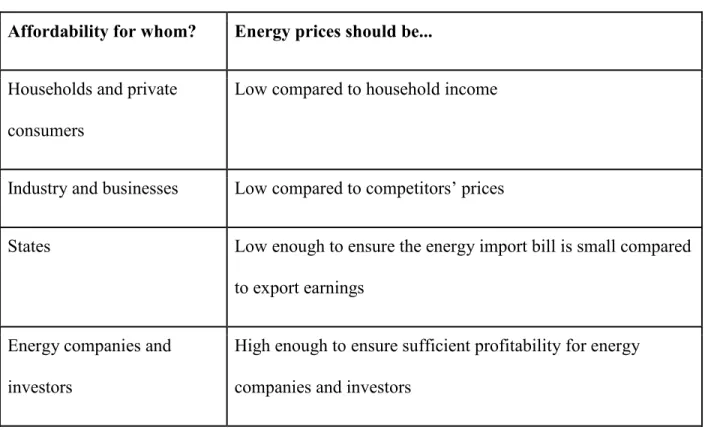
In terms of affordability, Intharak et al. use affordability to mean profitability of energy investments. By contrast, Kruyt et al. and Hughes interpret it as low energy prices for
consumers.18 Given the wide-ranging interpretations of how affordability guarantees security, the
table below presented by Cherp and Jewell attempts to answer “Security for whom?” in the context of affordability.
16 Cherp and Jewell, 2014, 11. 17 Bridge, 2008, 8.
Table 1. Interpretations of affordability in asking “Security for Whom?”19
Affordability for whom? Energy prices should be...
Households and private consumers
Low compared to household income
Industry and businesses Low compared to competitors’ prices
States Low enough to ensure the energy import bill is small compared to export earnings
Energy companies and investors
High enough to ensure sufficient profitability for energy companies and investors
Cherp and Jewell assert that identifying a valid referent object is important for clarifying the acceptability dimension. The often referred to “A Quest for Energy Security in the 21st Century…” report, Kruyt et al., and Winzer all link acceptability with environmental impacts of energy systems. To once again refer to Cherp and Jewell, the authors further their criticism of the contemporary energy security literature stating that “...without defining a referent object the term [environmental] acceptability loses any specific meaning.”20 Furthermore, they argue that the
Four As fall short of answering the two remaining questions of “Security for which values?” and “Security from what threats?”
Regarding the question “Security for which values?”, Cherp and Jewell criticize the Four As framework as merely being characteristics of energy systems and not human values, although they are linked to political, economic, social and other priorities. The values that are discussed in academic literature span from national values such as political independence and territorial integrity as traditional geo-political values to economic welfare as well as internal political and social stability. Unlike academic literature, governmental entities like the European Union are much more explicit in stating their values as they relate to energy security. Similar to the values question, the Four As are also not specific in answering “Security from what threats?”. The concepts of risks to existing energy systems and the resilience of those energy systems to future uncertainties are not embedded in the Four As. Cherp and Jewell end their criticism of the Four As saying that “... a concept of energy security cannot list all possible risks or vulnerabilities, but it should provide a framework for identifying, measuring and managing vulnerabilities.”21 Given that the Four As framework gained prominence in academic literature, it is also important to point out some of its shortcomings and explore alternative approaches.
Despite the criticism of the Four As approach, it along with the security questions presented by Cherp and Jewell will be utilized in the following sections because both better inform the interpretations of key actors in the EU energy security debate. Whether those actors are the European Commission or member states such as Germany, the Four As approach
provides a comprehensive look at the dimensions of energy security and can help determine what actors value in trying to achieve energy security. For example, environmental acceptability of the Nord Stream 2 project and how it can help guarantee energy security may be viewed differently by the European Commission than a member state such as Germany. The security questions of
for whom? for which values? and from which threats? expand upon the Four As framework and highlight key differences in how key actors shape their respective energy policies. Germany, of course, answers the questions differently from EU actors simply because EU actors have to respond with all member states in mind while Germany focuses mostly on its own citizens and companies when forming energy policies.
CHAPTER 3: ENERGY POLICY IN THE EUROPEAN UNION
The EU’s current energy policies aim to guarantee that European citizens are able to “...access secure, affordable and sustainable energy supplies.”22 Furthermore, main EU energy
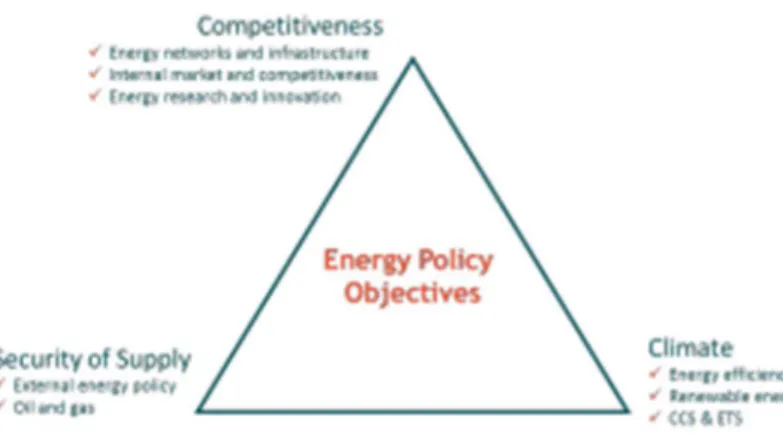
policy objectives since the 1990s are represented in three pillars: security of supply,
competitiveness and climate or sustainability (see figure). In order to achieve these aims, the EU is working in a number of policy areas, such as the energy union strategy, the energy security strategy, an interconnected energy grid, the ‘Clean Energy for All Europeans’ package, and increased safety across all EU energy sectors.
Figure 2: The Three Pillars of EU Energy Policy23
Today, the EU increasingly relies on natural gas compared to other petroleum energy sources. From 1995 to 2016 the gross inland consumption of energy products, measured in
million tons of oil equivalent (Mtoe) has changed significantly. According to a 2018
Figure 3: EU-28 Gross Inland Consumption: Energy Mix (%) Primary Products Only.24
Figure 4: EU-28 Total Gas Imports in BCM 1995-2016
Source: EC, 2019.
The increase in imports of natural gas as well as petroleum products has raised concerns over whether the EU can guarantee that it is energy secure. The following section will focus on EU energy policy formation and the key actors in the policy making process. It will provide a brief overview of the history of the main EU energy policy and major EU energy policy
strategies including the Energy Union Strategy and the EU Energy Security Strategy, it will then analyze the key actors in EU energy policy formation and the role each play in the policy making process before placing EU energy policy in the context of the four As approach and key security questions.
Contemporary European Union Energy Policy
The history of the European Union is rooted in energy issues. In 1951 the “Treaty establishing the European Coal and Steel Community” (ECSC), more commonly known as the Paris Treaty was signed, marking the beginning of the integration of Europe. With the
establishment of the ECSC, a common customs union was set up. The aim was to control
European Atomic Energy Community (EURATOM) six years later in 1957, another early institution of European cooperation was energy based.25
Despite these beginnings, European integration in the field of energy policy did not develop too smoothly. Not only did the importance of coal and therefore the ECSC diminish (with oil becoming the most important energy source), but the differences in energy mixes, transport routes or structures of energy markets resulted in the differing interests of the Member States hindering energy policy cooperation. The collaboration did become gradually closer – but the speed of this development varied strongly. Many of the more ambitious plans of the
European Commission for a coherent policy often failed in the face of opposition from Member States.
Although the primary treaties passed in the early years of what is known the EU, were applicable to the energy sector, the topic was sensitive to further integration as questions regarding national sovereignty of Member States arose. Member States did not initially transfer regulatory powers to the EU and until the 1980s, national energy monopolies were not under the effect of EU law.26
From 1980 to 1990, opening of national markets to competition started as a result of the assumption that competition would deliver efficiency and benefits to consumers in terms of lower prices and more choice of suppliers. In its quest for competitive energy product markets of European rather than national or regional scope, the Commission based its framework strategy on Commission directives, regulations, and harmonization legislation. The more recent goal of an integrated European gas market, enabling the free flow of energy throughout the EU through
interconnected infrastructure and without technical or regulatory barriers, is based on EU regulations that have been progressively introduced through different packages.
The EU had issued directives on energy matters in the past, but they were of minor significance, covered specific issues, and had little impact. The sequence of internal market directives began with relatively small issues, such as transparency and cross-border transit, and then moved to more important issues of discriminatory practices hindering the internal market, including utilities’ procurement and upstream licensing. The first Gas Market Directive appeared in 1998. This legislative instrument was later followed by two additional energy law packages in 2003 and 2009, and by a range of security of supply directives and regulations and green energy packages, including emissions trading, renewable energy, carbon capture and storage, and energy savings. The directives helped to identify legal obstacles and provide legal procedures for
facilitating market integration, but encountered difficulty in dealing with protectionism inherent in national culture, and the commercial, financial, and institutional set-up.27
Following the first 1998 Gas Market Directive, several other pieces of energy market legislation were adopted, shifting from market liberalization to energy market integration, and building the grounds for the Energy Union strategy. In 2003 and 2009, the second and third legislative packages respectively on the internal energy market entered into force. The third package introduced a clear separation of supply and production activities from network
operation, a more effective regulatory oversight by independent national energy regulators, and a reinforcement of consumer protection. The goal was to open up the gas markets in the EU, to enhance investments in energy infrastructure and cross-border trade. Including the First Energy
Package of 1998, the EU has passed eight main pieces of legislation and strategies concerning the gas sector.28
In recent decades, the EU has increasingly prioritized further integration in the field of energy policy. From its foundations that revolved around interconnected energy systems to the most recent efforts at increased energy integration, the EU’s energy policy since the Third Energy Package has emphasized energy security as one of its main goals. The following sections explore the key actors in EU energy policy as well the EU Energy Security Strategy and Energy Union.
Main Actors in EU Energy Policy Formation
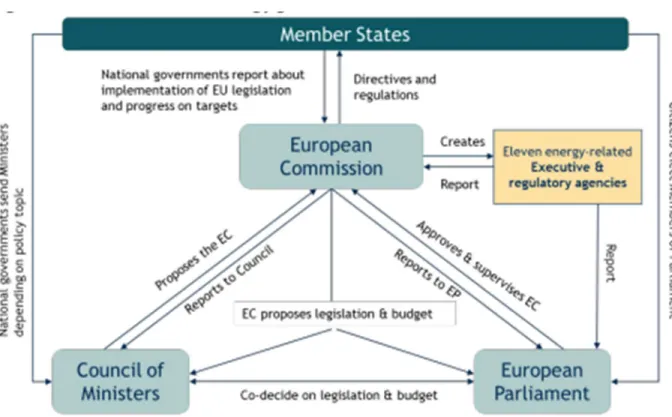
As in any area of policy formation, EU energy policy objectives consists of an interplay of the main EU institutions including the European Parliament, Commission and Council, as well as the EU member states. In addition to the main institutions and intergovernmental decision making of the member states, eleven executive and regulatory agencies contribute to the formation and execution of EU energy policies (see figure). The power to pass energy policy legislation lies with the European Parliament and the Council of Ministers, which co-decide on legislation proposed by the Commission. The Parliament plays a supervisory role over the
Commission, which has the power to enforce any approved legislation. Furthermore, the member states co-decide on legislation through the Council of Ministers and once legislation is passed they are tasked with transposing and applying legislation to national law.
Practically, there is a large difference in actual roles of each of the main actors depending on the specific energy topic. For example, on issues regarding external EU policy the High
Representative for Foreign Affairs and Security Policy acts as the equivalent of a foreign minister of the EU. This is especially relevant when dealing with policies of energy security.
Figure 5: Governance Structure of EU Energy Policy29
Regarding the integration of EU energy policy, the Commission is the most powerful actor in EU energy policy. The European Commission is divided into two Directorate-General (DGs) whose tasks revolve around issues relevant to EU energy governance. DG Energy is tasked with assisting Member States in the development and implementation of EU law into domestic energy policies and strategies, promoting the completion of the internal energy market, supporting the reinforcement of energy infrastructure, ensuring the safe and competitive
exploitation of indigenous sources, and monitoring the implementation of EU energy law as well as proposing new legislation. DG Climate Action is less relevant in the field of promoting energy
security but nonetheless is tasked with implementing international and domestic climate action policies, implementing decarbonization polices, and monitoring member state emission reduction targets. Under the Juncker administration, the Energy and Climate Action DGs are merged and under the supervision of Commission Vice-Presidents whose portfolios are most relevant for energy policies. These include the VP for Energy Union, and the VP for Jobs, Growth, Investment and Competitiveness, who is responsible for investments in energy infrastructure. The merging of DGs under Juncker represents the prioritization of energy as a policy issue for the EU and an effort to further a common EU energy policy rather than one that is heavily influenced by member states.30
The Council of Ministers and the European Parliament play an important role in energy governance due to the fact that they co-decide on proposals recommended by the European Commission. However, in terms of the security of supply pillar the member states and the
Commission remain the key actors. The member states play a dominant role due to their decisive power regarding national energy mixes. The Commission plays an increasingly important role in integrating national policies and the External Action Service coordinates EU diplomatic relations with key energy exporters. Although the implementation of energy policy is reserved for the Commission at the EU level, member states also contribute to energy policy formation and execution within regional cooperative bodies.
Aside from the EU level of energy governance, member states have initiated regional cooperation to address various energy policy concerns. The Pentalateral Energy Forum (PLEF) is the framework for regional cooperation in central-western Europe. Members of the PLEF include the Benelux countries, Germany, France, Austria, and Switzerland. The forum’s main priorities
focus on electricity market integration and security of gas supply. Since 2007, the PLEF has agreed to and successfully implemented various phases of market integration that became the target model for the whole of the EU energy market. Other regional cooperation groups include the Nordic action group on climate and energy, the Visegrad 4, and the North Sea countries offshore grid initiative. All such groups seek to foster closer regional cooperation on energy policies ranging from efforts to increase decarbonization efforts as with the Nordic action group; to the Visegrad 4 aiming to increase essential gas infrastructure meant to counter supply shocks like those in 2006 and 2009; and in the case of the North Sea countries, an offshore grid initiative to further integrate electricity grids. The emergence of regional cooperation groups focused on energy policy, creating models that could be used on an EU-wide level, points to the weakness of the EU to develop a common energy policy that can be accepted by all 28 of its member states.
The European Energy Security Strategy and the Energy Union
The major developments of contemporary EU energy security policy, including the European Energy Security Strategy and the Energy Union help chart the Commission’s priorities in the energy policy field and the importance it places on energy security.
In 2011, former President of the European Parliament Jerzy Buzek and former Commission President Jacques Delors called for a politicization of EU energy policy. They argued it involved a new focus on the regulatory issues and wanted to create a European Energy Community with a stronger emphasis on the challenges of energy security in CEE countries.31
However, the Commission and member state governments, not including CEE countries, did not show much interest in the idea. In part, the lack of enthusiasm for the idea was that in 2009 the EU passed the Third Energy Package and had made decisions concerning energy and climate
targets up to 2020. The main elements of the Third Energy Package included ownership unbundling to separate companies’ generation and sale operations from their transmission networks, the establishment of national regulatory authorities (NRA) for each member state, and the establishment of an Agency for the Cooperation of Energy Regulators (ACER) to provide a forum for NRAs to work together. Although the Third Energy Package was introduced, the EU experienced slow progress and partial renationalization rather than taking steps towards a common energy policy.
Poland’s former Prime Minister and current President of the European Council, Donald Tusk, addressed the stalemate in his provocative April 2014 article titled “A United Europe can end Russia’s energy Stranglehold.” In the article, Tusk argued for faster implementation of energy security policies and that climate and environmental policy were being given too much attention in EU energy policy.32 For CEE countries like Poland, questions over energy security, solidarity among EU member states, and concerns of Russian gas imports were and remain more important. He claimed that the inadequate EU gas market makes CEE countries vulnerable to economic pressures and potential disruptions of gas supplies from Russia. Tusk suggested the creation of an Energy Union with a focus on energy security, including more interventionist measures beyond regulation, to mitigate the security problems faced by CEE countries. Tusk’s proposal was founded on six pillars: jointly negotiating energy contracts with Russia; solidarity mechanisms; building energy infrastructure; full use of available fossil fuels; including coal and shale gas, diversification of external suppliers, and reinforcing the energy community.
Shortly after Tusk’s article, the Commission released the European Energy Security Strategy.33 The report covers current EU policy aimed at securing energy for its member states as well as lays out areas where further action is needed. It is cemented in the context of the 2006 and 2009 gas disruptions that disproportionately impacted eastern member states as well as the fears of major disruptions following the Russian annexation of Crimea. In light of past
disruptions, six-member states depend on a single external supplier, Russia, for the entirety of their gas imports. The report laid out areas in which further actions needed to be taken in order for the EU to guarantee security of supply into the future. The areas included
Immediate actions aimed at increasing the EU's capacity to overcome a major disruption during the winter 2014/2015; strengthening emergency/solidarity mechanisms including coordination of risk assessments and contingency plans; and protecting strategic
infrastructure; moderating energy demand; building a well-functioning and fully
integrated internal market; increasing energy production in the European Union; further developing energy technologies; diversifying external supplies and related infrastructure; improving coordination of national energy policies and speaking with one voice in external energy policy.34
Regarding the first point, which refers to the disruption caused by the conflict in Ukraine, the Commission recommended a number of actions to ensure that eastern member states were less reliant of Russia as a single gas supplier. Actions recommended included intensifying member state cooperation within the Gas Coordination Group, updated risk assessments, further developing energy security stress tests, and cooperating with gas suppliers and transmission system operators to identify possible sources for short term additional supplies, specifically liquified natural gas (LNG). In order to further strengthen solidarity, the Commission
recommended member states continue to build up and maintain their reserves of crude oil and
petroleum products. In this area member states have exceeded the minimum requirement of a 90-day supply. At the time the report was published, stocks represented about 120 90-days of
consumption, well above the minimum. In the area of preventing and mitigating gas disruption risks, the Commission urged member states to continue cooperating within the Gas Coordination Group. The Gas Coordination group not only comprises member states but also regulators and all companies who invest, build, and operate gas systems. Additional recommendations by the Commission included stress tests, protection of energy system infrastructure, and increased solidarity mechanisms.35
Another important area of the report was “building a well-functioning and fully
integrated internal market.” The Commission stated that “A European internal market for energy is a key factor in energy security and is the delivery mechanism to achieve it in a cost-effective way.”36 In order to attain this goal, the Commission covered three areas in which closer
integration of energy policy can lead to a well-functioning internal market for gas. The three areas covered were “Making the internal market for electricity and gas work better, Accelerating the construction of key interconnectors, and the European oil market.”37 The first section
discussed efforts by the EU Heads of State to ensure the completion of an internal gas market. Regional cooperation leading to European integration in the energy market had been decisive in terms of cross border exchanges as well as security of supply. The Nordic countries had achieved the most integration of their energy systems while; France, Germany, Belgium, the Netherlands, Luxembourg, and Austria had initiated integration projects in both their electricity and gas
35 Ibid.
markets. However, development of competitive and well-integrated markets was lacking in other regions of the EU. The Baltic states as well as states in South East Europe continued to lag behind, leaving them less equipped to manage future uncertainties regarding energy security. In 2015, Tusk assumed the office of President of the Council and the Commission released the Energy Union proposal.
The Energy Union package was released in February 2015 and set forth a framework with a goal to give EU consumers “secure, sustainable, competitive and affordable energy.”38In order to achieve the goals set forth in the package, the Commission proposed five dimensions designed to bring greater energy security, sustainability, and competitiveness. Those dimensions included energy security, solidarity, and trust; a fully integrated European energy market; energy efficiency contributing to moderation of demand; decarbonizing the economy, and research, innovation, and competitiveness.39
Expanding on the Energy Security Strategy released the year before, the Energy Union Package reiterated the EU’s commitment to providing energy security for EU citizens. Each of the main pillars presented in the security strategy proposal were discussed in more detail and in the context of the political challenges of the Russian annexation of Crimea and the conflict in Ukraine. The Energy Union proposal was meant to build on the security strategy as well as include sustainability and competitiveness pillars. The EU proposal largely supported existing EU policy for energy and the environment. Furthermore, Tusk’s desires to alter policy focus towards energy security and introduce additional intervention measures to deal with the single
market and energy security problems of CEE countries were largely omitted.40Although the
Energy Union was a first step towards integration of security of supply concerns it fell short of directly addressing the problems posed by the Russian gas which, remained concentrated, politicized, and outside EU jurisdiction. Western Europe and CEE countries concerns over energy security remain incompatible due to differing political relations with Moscow and
commercial relations with Gazprom. More recently, the Commission instituted the 2017 Security of Gas Supply Regulation which was meant to further encourage member state cooperation in the gas sector.
The 2017 Security of Gas Supply Regulation explicitly addressed the need to provide the EU energy security. Currently, about 25 percent of all the energy used in the EU is natural gas and many member states import nearly all of their natural gas supplies. Additionally, several member states are heavily reliant on a single source for much of their natural gas. In order to mitigate future gas disruptions similar to the one that occurred in 2009 following a gas dispute between Ukraine and Russia, the Security of Gas Supply aims to further integrate gas policy in the EU. The regulation has five main components: requiring the European Network for
Transmission System Operators for Gas (ENTSOG) to perform EU-wide gas supply and infrastructure stress tests in order to provide a comprehensive overview of major supply risks; require member states to cooperate in regional groups to assess common risks and to develop and agree on common preventative and emergency measures; introduce the solidarity principle which requires member states to assist each other to guarantee gas supply in case of an emergency disruption; improve transparency by requiring natural gas companies to inform their national authority of their long-term supply contracts that are relevant to security of gas supply; and
lastly, require transmission systems operators to enable permanent bi-directional capacity on all cross-border interconnections between EU member states.41 Increasing EU wide cooperation in the gas sector was especially important to CEE countries who insist that they are under more of a threat to supply shocks than their western neighbors. The Security of Gas Supply Regulation was a further step in realizing the energy security pillar of the Energy Union.
The approaches of the Commission to address energy policy take two broad approaches: decreasing reliance on Russian gas, and developing the internal market to further integrate energy systems. Two differences emerge in the Energy Security Strategy and Energy Union. The Strategy did not require any actual policy commitments, but the Energy Union required member state agreement. Clearly there was not a shared set of member state interests concerning Russian gas supply. Differences abound between core and CEE member states on how to best address energy security and the EU Commission with its largely technocratic mechanism have been unable to act on its own.
CHAPTER 4: EU ENERGY SECURITY, THE FOUR AS, AND SECURITY QUESTIONS
Assessing energy security for the EU is difficult due to the differences in national preferences for how to achieve energy security, namely the divide in how Western member states, like Germany, and CEE countries perceive the threat of import dependency on Russian gas. However, the EU Energy Security Strategy, the Energy Union proposal, and the Security of Gas Regulation aim to solidify differing concerns into a unified approach to address energy security. Using the four As approach to energy security and the security questions, this section will analyze whether EU policies are adequate in addressing the energy security needs of its member states.
Availability
In terms of availability, the major EU policies presented advocate for a diversification of suppliers. Although, EU policy documents advocate for diversification, it is evident that CEE countries continue to be concerned of Russia becoming a single supplier for natural gas. Furthermore, the supply shocks that have happened over the past decade have been a result of conflicts between Russia and Ukraine countries, an example being the supply shocks that
Accessibility
In the four As approach, the accessibility dimension of energy security is linked with geopolitical concerns. While the EU aims to speak for all member states in its policies concerning security, there are different geopolitical concerns among the member states. CEE countries persist that Russia uses its position as the largest single supplier of gas in order to achieve geopolitical goals of isolating the bloc from gas routes, while other countries like Germany take a softer stance towards Russian uses of energy to spilt the EU. In order to counter efforts by Russia to isolate CEE countries, the EU has proposed bi-directional transit of gas from Germany to countries including Poland. However, these measures have not convinced the CEE countries that they will be secure in case of future supply shocks and Russian intentions to deny CEE countries existing gas routes. Addressing the question “Security from what threats?” the EU has been unsuccessful in relieving the concerns that CEE countries regarding Russian
geopolitical ambitions to partition the bloc from gas routes by bypassing them with pipelines like Nord Stream and Nord Stream 2.
Affordability
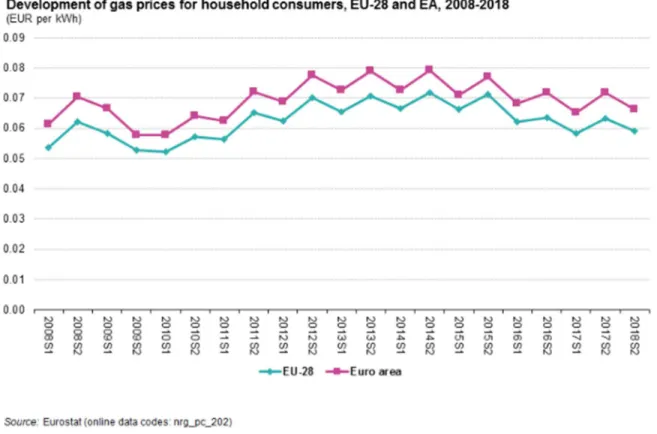
Figure 6: Development of gas prices for household consumer, EU-28 and EA, 2008-2018.42
Addressing the security question “Security for whom?” the EU’s policies of securing affordable energy prices have not had any detrimental effects on prices. Reasons for price stability range from promoting transitions to sustainable sources to more efficient energy sources.
Acceptability
Acceptability is linked to environmental concerns over how best to secure energy.
Proposals such as the Energy Union largely focus on how to transition energy systems in order to achieve de-carbonization of member state economies. However, the acceptability of increased
environmental standards across the EU has been met with criticism by CEE countries who assert that in order for them to achieve energy security it is necessary that they exploit their domestic energy sources, much of which is dirty fossil fuels like coal, in order to decrease import
dependency on Russian gas. On the other side of the coin are countries like Germany. Germany’s energy transition away from coal is linked with an increase on natural gas as a more efficient and cleaner fossil fuel, which means increasing their imports from Russia until sustainable energy sources increase to the point that fossil fuels are unnecessary. The contrast in approaches among EU member states presents differences in answering the security question “Security for which values?” While the CEE countries value greater energy independence even if it means reverting to dirtier forms of energy, Germany and Western EU member states value diversification of energy sources even if it means increasing gas imports in the short to medium term. In the case of acceptability, the EU has not resolved the values of its member states concerning energy security.
their ability to become energy secure. In the context of addressing “Security from what threats?” there is a tension between CEE member states and core member states like Germany. Germany, being the largest importer of Russian natural gas, does not consider Russia as a threat in the context of energy import dependency. The perception of Russia as a non-threat comes from close commercial ties as well as the power of the Social Democrats in maintaining a close relationship with the Kremlin and its energy companies, like Gazprom.
CEE countries also fear that a lack of diversification in supply routes coupled with increasing monopolization of suppliers, like Gazprom, will eventually lead to higher prices. In terms of affordability, prices have remained stable over the past decade for household
consumers. Core member states including Germany argue that new routes like Nord Stream 2 will decrease prices because of the direct connection of the pipeline from Russia to the center of the EU. However, CEE member states fear that the loss of transit fees will hurt their economies, leading to a reduction in services and investment in NREs. These divisions present tensions in answering the question “Security at what costs?” Differing positions within the EU over how to guarantee affordability undermine solidarity.
In terms of acceptability which focuses on the environmental aspect of energy security, major EU policies, including the Energy Union, place equal importance on achieving sustainable energy systems as to achieving energy security. Equal prioritization of sustainability and security concern CEE countries. Tusk’s 2014 article highlights the differences the EU Commission, EU Parliament, and CEE member states have in answering the question “Security for which values?” While Tusk argued that CEE countries should be able to tap domestic, dirtier forms of energy as to mitigate concerns over Russian supply shocks, the Commission and Parliament remain
that natural gas import dependence on Russia may rise in the short to medium term before sustainable energy systems are in place.
CHAPTER 5: EUROPEAN UNION ENERGY SECURITY AND NORD STREAM 2
Nord Stream 2 is currently the most controversial energy-related issue in Europe. While proponents insist it is purely a commercial project, its critics argue that it breaches EU legislation and the Energy Union, and is veiled by political interests. This chapter will provide a short description of Nord Stream before detailing the Nord Stream 2 project. It will present a picture of the implications of the project for the European Union as well as the interests that major
shareholders harbor. Finally, this chapter will attempt to assess whether Nord Stream 2 can be considered an obstacle for EU energy security in the framework of the Four As and in the context of Cherp and Jewell’s security questions.
From Nord Stream 1 to Nord Stream 2
Discussions of building an offshore pipeline in the Baltic Sea date back to the late nineties, when Gazprom, in partnership with Neste Oil, a Finnish energy company, created the North Transgas Company and began offshore surveys in the Baltic Sea. At the conclusion of bureaucratic hurdles, economic and strategic negotiations, as well as political shifts, the final agreement on the Nord Stream pipeline was signed in 2005 by German Chancellor Gerhard Schroeder and Russian President Vladimir Putin. Nord Stream AG has been in operation since 2006, with Gazprom holding 51 percent, the German energy companies E. ON Ruhrgas and BASF Wintershall holding 15.5 percent each, and the Dutch NV Nederlandse Gasunie and French Group GDF Suez both holding 9 percent each.43 The Nord Stream pipelines transports
gas from Vyborg, Russia, to Greifswald, Germany, through two lines, constructed in 2011 and 2012, respectively. The route crosses the Exclusive Economic Zones of Russia, Finland, Sweden, Denmark, and Germany, as well as the territorial waters of Russia, Denmark, and Germany. In order for the pipeline to exist there was a permit process by each affected country and the EU. The EU Commission labeled Nord Stream as a “priority project, which would contribute to increased competitiveness in the energy market and increase security of supply.”44 Before Nord
Stream became operational, nearly 80 percent of Russian gas imported to Europe passed through Ukraine. Germany, the United Kingdom, the Netherlands, France and Denmark are among the counties to receive gas via the Nord Stream pipeline.
At the Eastern Economic Forum, in early September 2015, Russia, Germany and a consortium of Western companies signed an agreement for the implementation of Nord Stream 2 project. The consortium consists of Gazprom, OMV, E.ON and BASF, Gasunie, Royal Dutch Shell, and Engie. Gazprom is the majority shareholder with 51 percent and each of the other shareholders got 10 percent; Engie initially got 9 percent, and eventually Gazprom sold its 1 percent. Interestingly enough, already in 2013, Nord Stream AG has issued a project on the planning and construction of additional two pipelines of the same capacity as the previous ones.45 The reemergence of the project in 2015, amid political conflicts in Eastern Europe, made it more controversial.
Current EU-Russia gas trade is based on three routes: the Yamal pipeline through Belarus, Nord Stream, and the Ukrainian pipeline infrastructure. Nord Stream 2 would add two more pipelines to the existing ones, which have a capacity of 55 billion cubic meters per year.
The overall capacity would double, bringing it to 110 bcm per year, enough to cover
approximately 75 percent of the current Russian natural gas export to EU, versus the capacity of the Ukrainian route which stands at 142 bcm per year. The pipeline only highlights the natural gas import dependency the EU, mainly CEE countries, have on Russian gas (see figure 7). In 2017, Germany used a record 53 billion cubic meters of Russian gas, which made up about 40 percent of Germany’s total gas consumption.46
Figure 7: Europe’s Dependence on Russian Gas, 2016
Source: Agency for the Cooperation of Energy Regulators
However, Gazprom was prevented by EU law from operating Nord Stream at its full capacity.47 OPAL, the onshore line on German territory, which connects Nord Stream to European markets, is currently operating at roughly 50 percent of its capacity. Here, the EU Commission defies the vertically integrated monopoly of Gazprom and blocks the full implementation on the basis of the Third Package “unbundling ownership” clause because Gazprom acts as the supplier and co-owner of the transmission infrastructure at the same time. Experts say that OPAL’s underutilization as well as the “third-party access” rule undermine Nord Stream 2 profitability. Russian involvement and the potential for Eastern Europe to lose revenue from transit fees have created strong opposition to the pipeline.48
Key Actors: Supporters and Opponents
Germany is the strongest supporter of Nord Stream 2. Nord Stream is transporting gas directly to Germany, allowing it to bypass Ukraine and CEE member states. Germany is
importing more natural gas from Russia and the demand is expected to increase in the following decades. Germany’s stance towards the project surprised many throughout the EU. Germany was among the first member state to enact sanctions against Russia as well as taking a leading role in the Minsk negotiations over the conflict in Eastern Ukraine. Many in the EU regard it as a renovation of the German-Russian relationship; others fear a return to Ostpolitik.49 In fact, the same day the Nord Stream 2 agreement was signed, BASF and Gazprom agreed to an asset exchange, allowing Germany to gain access to Siberian deposits in return for allowing Russia become a shareholder of industrial and storage systems in Germany’s territory. Moreover, the
47 Ibid.
Figure 8: Germany’s Primary Energy Consumption by Fuel Type as a Percent 2018
The construction of Nord Stream 2 will most likely decrease the transit importance of Ukraine and other CEE member states due to the doubling of capacity to 110 bcm per year. Gas transit through Ukraine towards Central Europe passes through Slovakia, the Czech Republic and Poland. The geographical position secured Ukraine transit fees and geostrategic leverage vis-à-vis Russia and the EU. In fact, Ukraine took advantage of its transit monopoly several times as a bargaining chip in price disputes. After the gas cuts of 2006 and 2009, which affected several EU members with shortages, Russia declared its firm intention to bypass Ukraine for its
exports.50 The Nord Stream 2 would cost Ukraine a loss of $2 billion a year in transit fees, hence
the concern of not only Ukraine, but also of EU members, which have been investing in the Ukrainian economy. For instance, if Ukraine loses its transit role, external financing to upgrade its pipeline network will decrease. Additionally, Ukraine has been financially supported by the EU and International Monetary Fund (IMF). New loans may be necessary to cover the transit fees loss, with no certainty that the Ukrainian government would be able to repay.
Recently, Ukraine has been supplied with gas through reverse flow from Poland,
Hungary and Slovakia. The EU Commission has estimated the share coming from EU as high as 50 percent. The process is part of EU’s aim to create an interconnected network of pipelines within EU, so that all members would be reliant on each other, will increase the EU’s energy security and decrease the risk of supply shocks. The EU also plans to further integrate Ukraine in the European energy market. If Nord Stream 2 is completed, the reverse flow to Ukraine will most likely increase. Chancellor Merkel, who supports Nord Stream 2 as a profitable business deal, has stated that Germany is interested in a solution where “Ukraine can also play a role as
transit country.”51 Former Foreign Minister Sigmar Gabriel, has stated, while visiting Poland,
that Nord Stream is viable only if Russia does not cut off gas flows to Ukraine and CEE countries.
The staunchest opponents of the project are CEE countries. Their position is that Nord Stream 2 would weaken EU’s energy security by increasing the EU’s dependence on Russian gas as well as undermining the Energy Union project of diversification of suppliers. In particular, Poland, which would lose its transit fees and importance in the pipelines network, sees the project as a German-Russian alliance. CEE countries accuse Nord Stream 2 of intentionally bypassing them. In 2004, the Baltic States and Poland proposed the Amber pipeline, which would run Russian gas through Latvia and Lithuania to Poland, where it would join Yamal towards Germany. Amber would, thus, contribute to diversification and avoid non-EU transit countries. The consortium rejected Amber over transit fees and higher costs of maintenance of an onshore pipeline.52 In 2008, when negotiations were held over Nord Stream, alternative pipelines
were suggested. The alternative pipeline proposed was Yamal 2 and it would have run parallel to Yamal 1, which carries Russian gas through Belarus and Poland to Germany. Yamal 2
proponents argued an onshore pipeline would have been cheaper; and Yamal was constructed so a second pipeline could be added.53 The Nord Stream consortium did not support Yamal 2 saying that it would be best to avoid politically unstable transit countries
In their continuing efforts to oppose Nord Stream 2, the Baltic States questioned the environmental impact assessment. It took roughly three years for the EIA for Nord Stream 1 to
51 Riley, 2015a, 20. 52 Ibid.
be issued. The Baltic countries are also concerned about their security. Baltic countries argue that another pipeline would justify Russia’s military presence in the Baltic Sea for its protection. In the aftermath of Ukrainian crisis, the Baltic States have shown their concern over their territorial integrity and security and intensified their support for NATO. Hungary, which has been building underground gas storage infrastructure, would lose its transit role and would buy gas from Austria.54 Southern European countries as well as Italy oppose Nord Stream 2 linking it to the
cancellation of South Stream, which deprived them of transit incomes. They argue Nord Stream 2 should be suspended on the same legal basis as South Stream.
As recent as February 2019, France and Germany reached a compromise on changing the Gas Directive, originally introduced in the Third Energy Package in 2017, the Commission already submitted an amendment to the Parliament and Council for approval. The amendment extended the Third Energy Package to gas import pipelines from third countries. In included the three following principles: third party access, unbundling, and transparency. A recent political agreement stemming from the 2017 amendment, made the Gas Directive applicable to pipelines from third countries. The proposal was an ad hoc instrument, aimed primarily at Nord Stream 2 and was advanced by the Commission with extreme urgency to enter into force prior to Nord Stream 2’s scheduled start of operation at the end of 2019. The amended directive is expected to be signed into law in May 2019 and enter into force in July 2019, with a nine-month waiting period set for its transposition into member states’ national legislation.55 As the amended
directive threatens to upset the regulatory framework for Nord Stream 2 and its rejection by the
EU Council would have been the best possible outcome for the project from the viewpoint of its supporters.
However, the political calculus changed dramatically when it transpired in February 2019 that France was going to support the amendment, thus depriving its opponents which, in addition to Germany, were understood to include Austria, the Netherlands, and Belgium of a blocking minority. France and Germany hastily agreed a last-minute compromise text of the amendment, the essence of which was that the applicability of the amended Directive would be restricted to the territory and the territorial sea of the member state where the first interconnection point with its network is located which in the case of Nord Stream 2 is Germany.
Far from being a victory for Nord Stream 2, the ‘Franco-German compromise’ was a damage limitation exercise, attempting to prevent further delay in hopes that the pipeline will eventually be completed. Although it can be categorized as a damage limitation exercise, France is unlikely to reverse its decision and German efforts to ensure the continued construction of Nord Stream 2 appear successful for now. While the compromise has removed some of the most contentious provisions of previous drafts, it has nonetheless left room for significant uncertainty in respect of Nord Stream 2’s future regulatory treatment.56
The tension over Nord Stream 2 illustrates a weakening in EU solidarity. Divisions over how to best introduce new pipeline projects have been contentious since the Amber pipeline proposed in 2004. Furthermore, construction and completion of pipelines seem to be controlled more by member states than the EU Commission. Member state power in setting energy policy only highlights how the EU Commission operated by largely technocratic mechanisms affecting the single market. Although Nord Stream 2 has had to jump through many hurdles on its way to
completion, it is likely that CEE opposition will not diminish even after the pipeline is
completed. The division of core member states and CEE member states over energy security and pipeline construction has a rich history in the 21st century and is likely to continue. Lingering
CHAPTER 6: DOES NORD STREAM 2 ENHANCE OR UNDERMINE EU ENERGY SECURITY?
The EU’s priorities concerning energy security, elaborated on in its Energy Security Strategy, focus on the guarantee of gas supply, reducing import dependency, as well as diversification of types of energy and sources of energy, Experts estimate that the EU’s dependence on Russian gas would exceed the 50 percent mark should Nord Stream 2 go into operation. Additionally, in 2017 Russian gas exports to Europe reached a record high of 193.9 bcm.57 Nord Stream 2 undermines a whole host of European energy issues and this section will outline each and then speak to whether Nord Stream 2 enhances or undermines EU energy security. Additionally, this section will analyze Nord Stream 2 in the Four As framework and indicators for energy security that appear in Intharak et al. as well as in the context of the Cherp and Jewell’s security questions.
Availability
In terms of availability, it can be argued that Nord Stream 2 enhances energy security for the EU because it can provide the Union with sufficient and safe energy resources. It is evident that gas demand in the EU is increasing and the European gas reserves and production are decreasing. Hence, it can be argued that the implementation of Nord Stream 2 is necessary because the project can satisfy the risks of gas supply shortages and, at the same time, secure its supply. Furthermore, Nord Stream 2 is considered by its supporters to be a viable option for the
EU bolster its gas reserves and production given that Russia holds the second largest natural gas resources in the world.58 Although Nord Stream 2 has the potential to meet the increasing demand for natural gas, the pipeline would decrease the diversity of gas suppliers. The
continuation of Russia’s and Gazprom’s domination in the EU energy market can lead to further monopolization of the energy market and increase risk due to the assumption that less sources of energy availability undermine energy security.
Accessibility
The accessibility of energy security holds geopolitical connotation because of large territorial variance between energy importer and exporter. In other words, the accessibility is not related to physical or diversification aspects. Accessibility implies that the actors in the
international or national arenas tend to use their energy resources as political tools in order to achieve specific political interests.59
Given that the accessibility is linked with geopolitics, opponents of Nord Stream 2 consider the project to be Russia’s tool in order to achieve its political interests in Europe. Those interests include drastically decreasing reliance on CEE transit countries in order to create fragmentation within the EU, while strengthening Russian control over the European energy market. Furthermore, opponents of the project argue that EU solidarity is at risk if the project continues. They claim that by supporting Nord Stream 2 and Russia’s interests in the EU energy market, the EU compromises its solidarity aspect which poses harm to the internal energy solidarity, evolution of the Energy Union and the EU neighborhood policy. The continued EU fragmentation between states that have private business interests in Nord Stream 2 and CEE
countries who are concerned about being cut off from the energy market, undermines EU energy security. Furthermore, addressing the question “Security from what threats?” is helpful in
determining whether Nord Stream 2 enhances or undermines EU energy security. Since Nord Stream 2 will likely lead to an increase of natural gas imports from Russia and a decrease of competition from suppliers other than Gazprom, both considered threats by the EU, namely the EU Commission, Nord Stream 2 will undermine EU energy security.
Affordability
The affordability dimension of energy security is emphasized by affordable and stable energy pricing and avoidance of single energy dominance in the market, ensuring competition. According to the affordability dimension, the monopolization in the energy market results in higher prices for energy supply and thus, endangers energy security. In order to assure that the energy prices are affordable and stable, and the domination of one main supplier is not possible, fair and transparent competition is important.60 The competitiveness aspect is emphasized in the
EU energy policy and considered to be an essential part of the effective European energy market. Thus, diversification of energy suppliers is needed for a fair and transparent competition The avoidance of one supplier domination results in stable pricings that assure energy affordability for energy customers.61
In addition, the affordability dimension also highlights the importance of energy pricing. CEE as well as the Commission have claimed that Russia through Gazprom does not propose fair prices of natural gas to the EU.62 The Russian gas that is being delivered to Western Europe
60 Westphal, 2006. 61 Ibid.
is cheaper than the same gas delivered to the CEE countries. As Polish President Duda states “the closer you sit, the more you pay. Just like the opera.”63 Nord Stream 2 not only diminishes competition but also exasperates unfair prices that disproportionally affect CEE countries.
Drawing on Table 1, the question of “Security for whom?” in the context of Nord Stream 2 may be detrimental to private consumers, industry, and states given that under monopolization prices increase.
Acceptability
In the Four As framework literature, the acceptability dimension is linked with
environmental acceptability. Throughout the EU, supporters and opponents of Nord Stream 2 have different views on the project and whether it secures or undermines the EU’s efforts in creating a sustainable energy market. One camp view Nord Stream 2 as an environmentally unacceptable project and the other views it as being in line with EU sustainability goals.
In 2017, the European Parliament sent a letter to President of the Council Donald Tusk and President of the EU Commission Jean-Claude Juncker calling for actions to stop the implementation of Nord Stream 2. The letter stated that “the Nord Stream 2 pipeline would be highly detrimental to both European security and climate policy [and] would undermine the provisions of the nascent European Energy Union.64 According to E3G, an independent climate change think tank, “in 2014, generation from new renewables installed over the past 10 years delivered gas savings equivalent to more than half the EU annual import capacity of Nord Stream 2.”65 Opponents of the pipeline have argued that investments into renewable energy and
63 Duda, 2016 64 EP, 2017.