TVNS IMPROVES EMOTION RECOGNITION ACCURACY
David P. Findley
A thesis submitted to the faculty of the University of North Carolina at Chapel Hill in partial fulfillment of the requirements for the degree of Master of Arts in the Department of
Psychology and Neuroscience.
Chapel Hill 2018
Approved By:
ABSTRACT
David P. Findley: tVNS improves emotion recognition accuracy (Under the direction of Barbara L. Fredrickson)
Growing evidence suggests that vagus nerve activity is an important aspect of social functioning. For instance, vagus nerve activity is linked to positive emotions, low-arousal states, social approach motivations, and emotion recognition, expression, and regulation. By modifying a relatively new manipulation technique – transcutaneous vagus nerve stimulation (tVNS) – we experimentally test the relationship between vagus nerve activity and social functioning, hypothesizing that participants receiving tVNS, compared to sham stimulation, will self-report more positive affect and less arousal, have greater accuracy in emotion recognition, perceive others as more trustworthy and less threatening, and have higher implicit and explicit motivations for social affiliation. One hundred and twenty-six
TABLE OF CONTENTS
LIST OF TABLES ... v
LIST OF FIGURES ... vi
LIST OF ABBREVIATIONS ... vii
CHAPTER 1: INTRODUCTION ... 1
CHAPTER 2: METHOD ... 8
Participants ... 8
transcutaneous Vagus Nerve Stimulation (tVNS) ... 9
Baseline Questionnaires ... 10
Primary Dependent Measures ... 11
Procedure ... 14
CHAPTER 3: RESULTS ... 18
Preliminary Analyses: Baseline Measures ... 18
Table 1. ... 18
Primary Analyses ... 18
Figure 2. ... 21
CHAPTER 4: DISCUSSION ... 23
LIST OF TABLES
LIST OF FIGURES
LIST OF ABBREVIATIONS BFI Big Five Inventory
CVT Cardiac Vagal Tone HRV Heart Rate Variability
MHC-SF Mental Health Continuum – Short Form MMG Multi Motive Grid
PA-IAT Pictorial Association Implicit Affect Test for Need for Affiliation PNS Parasympathetic Nervous System
RMET Reading the Mind in the Eyes Task RSA Respiratory Sinus Arrhythmia
CHAPTER 1: INTRODUCTION
Social interactions are vital components of our everyday human lives (Baumeister & Leary, 1995). These daily connections often bring moments of positive affect, resulting in measurable increases in well-being (Sandstrom & Dunn, 2014a, 2014b; Watson, Clark, McIntyre & Hamaker, 1992). Additionally, social interactions tend to build upon themselves, leading to more numerous and higher-quality social relationships. In turn, these relationships hold the capacity to improve physical health and even extend life expectancy (Cohen, 2004;
Holt-Lunstad, Smith, & Layton, 2010, Uchino, Cacioppo, & Kiecolt-Glaser, 1996). Impactful theories and growing empirical support suggest that vagus nerve activity is an important component of social functioning (Geisler, Kubiak, Siewert, & Weber, 2013; Kok & Fredrickson, 2010; Kok et al., 2013; Porges, 1995, 2001, 2007). The current study aims to test whether experimentally increasing vagus nerve activity could improve social functioning by shifting social perceptions and motivations: components of building better relationships and obtaining the host of benefits that they confer.
social environments, overwhelming the sympathetic branch of the autonomic nervous system, shutting down the HPA axis and inducing calm states, which prepare the body to “rest and digest” or “mend and befriend” (Porges, 2001; Movius & Allen, 2005). Polyvagal Theory suggests that vagus nerve activity leads to autonomic states that set the boundaries for social perceptions, motivations, and behaviors.
The Broaden and Build Theory provides additional theoretical scaffolding for the link between vagus nerve activity and social connections (Fredrickson, 2001, 2013; Kok et al., 2013). The Broaden and Build theory states that positive emotions do not merely feel good; they also broaden our perspectives and allow us to build numerous biological (e.g., cardiac vagal tone [CVT]), psychological, and social resources over time (Fredrickson, 1998, 2001, 2013).
Researchers have proposed that these built resources predict future, reciprocal gains, functioning in upward spirals dynamics (Fredrickson & Cohn, 2008; Fredrickson, 2018). This proposed relationship suggests that an increase in vagal tone could lead to improvements in well-being, social functioning, and physical health over time (Fredrickson & Joiner, 2002, Kok &
Fredrickson 2010; Kok et al., 2013).
in both positive emotions and social connectedness predicted increases in CVT over this same timespan (Kok & Fredrickson, 2010).
While testing a related set of hypotheses using the same sample, Kok and colleagues (2013) found a similar dynamic at play. For participants in the loving-kindness group, higher baseline CVT predicted greater increases in positive emotions (Kok et al., 2013). Additionally, increases in positive emotions predicted subsequent increases in perceived social connections and improvements in CVT over the duration of the study (Kok et al., 2013). Together, this evidence demonstrates the multidirectional relationships that exist among vagus nerve activity, positive emotions, and social connections.
Substantial research supports this suggested relationship between vagus nerve activity and social functioning. The majority of these studies focus on Heart Rate Variability (HRV) and Respiratory Sinus Arrhythmia (RSA), two proxies of the vagus nerve’s contribution to
parasympathetic nervous system activity. Multiple studies have shown that HRV predicts emotion recognition and emotion expression, two important components of social functioning (Quintana, Guastella, Outhred, Hickie, & Kemp, 2012; Tuck, Grant, Sollers, Booth, &
Consedine, 2016). Beyond that, Butler, Wilhelm, and Gross (2006) found that women who attempt to suppress and reappraise negative emotions, compared to women who are not
activity and social functioning (Kemp, et al., 2012b;Norman, et al. 2001). From emotion recognition to self-regulation and social motives, vagus nerve activity appears to regulate how humans function in social environments.
Evidence from research on clinical samples corroborates and extends the relationship between vagus nerve activity and social abilities. Social impairments are characteristic of many psychological disorders including major depression, anxiety disorders, schizophrenia, and autism spectrum disorders. In addition, numerous studies have found that individuals with depression and anxiety disorders display dampened baseline HRV while also showing impaired emotion recognition abilities (Bassett, et al., 2016; Demenescu, Kortekaas, den Boer, Aleman, 2010; Kemp, Quintana, Matthews & Jelinek, 2012a). Autism spectrum disorders and schizophrenia are also accompanied by low HRV, while higher HRV within these populations predicts positive social and functional outcomes (Hamilton et al., 2014; Patriquin, Scarpa, Friedman & Porges, 2013). The clinical research reviewed above indicates that low vagal tone co-occurs with reduced social functioning abilities, suggesting that vagus nerve activity doesn’t merely improve social abilities; it might actually be a necessary component of social functioning.
Thus far, the research discussed has been correlational. Research on medical
interventions, however, has shed light on the causal effects of vagus nerve activity by directly stimulating the nerve itself. This technique, Vagus Nerve Stimulation (VNS), involves
Although VNS was first developed to treat medication-resistant epilepsy, it has
serendipitously also shown positive effects on mood and social functioning (Dodrill & Morris, 2001; Elger, Hoppe, Falkai, Rush, & Elger, 2000; Howard, 2014). VNS also decreases negative symptoms and behaviors in patients with depression, anxiety disorders, and autism spectrum disorders (Levy et al., 2010; Rush et al., 2000; Sackeim, 2001). The positive effects of VNS are promising, however, the risk and costs associated with surgery limit its widespread use and potential for both research and clinical applications.
In recent years, a new method to non-invasively stimulate the vagus nerve—
transcutaneous Vagus Nerve Stimulation (tVNS)—has emerged as a promising empirical and clinical tool. This method involves attaching small electrodes to specific locations on the outside of the ear (e.g., tragus, concha, cymba concha) and mildly stimulating the bundles of vagus nerve endings that lie just below the surface of the skin (Van Leusden, Sellaro, & Colzato, 2015). Stimulation is delivered below the threshold of perception using a Transcutaneous Electrical Nerve Stimulation (TENS) device. Sham stimulation is often used as the control for research on tVNS (Van Leusden, Sellaro, & Colzato, 2015; Murray, Atkinson, Mahadi, Deuchars &
Research on tVNS shows this method shifts multiple physiological outcomes with few, low-consequence side-effects (e.g., itching, redness; Murray et al., 2016). For example, tVNS, compared to sham stimulation, increases PNS activity—measured as a low-frequency/high-frequency ratio—and decreases peripheral muscle sympathetic nervous activity, among healthy participants (Clancey, et al., 2014). tVNS also reduces the rate of sinoatrial node firing as well as the occurrence and duration of atrial fibrillation, two aspects of cardiac functioning under the control of the vagus nerve (Stavrakis, et al., 2015; Yu et al., 2013, Zhou et al., 2016).
Furthermore, as afferent vagal fibers project to the central nervous system, tVNS, relative to sham stimulation, produces changes in cortical and brainstem activity (Fang et al., 2016;
Frangos, Ellrich, & Komisaruk, 2015; Kraus, et al., 2007; Kraus, et al., 2013). Whether through autonomic regulation of the heart or via projections to the central nervous system, tVNS appears to affect vagus nerve activity. By applying this nascent method to research in social psychology, the current study seeks to further explore the relationship between vagus nerve activity and social functioning.
The research reviewed above indicates that vagus nerve activity is theoretically and empirically linked to positive emotions, low-arousal states, social approach motivations, and emotion recognition, expression, and regulation (Fredrickson 2001; Geisler et al., 2013; Kok et al., 2013; Kok & Fredrickson, 2010; Movius & Allen, 2005; Porges, 1995, 2001, 2007; Quintana et al., 2012; Tuck et al., 2016). In addition, the development of a relatively new manipulation technique—tVNS—offers a safe and effective means to experimentally increase vagus nerve activity (Murray, et al., 2016). Taken together, these findings provide the foundation for the current research to directly test the causal link between vagus nerve activity and social
CHAPTER 2: METHOD Participants
One hundred and twenty-six undergraduate students (86 female, 39 male, 1 NA, mean age = 18.9 years, age range 18-42 years) from the University of North Carolina at Chapel Hill participated in this experiment. Participants were recruited online via the Psychology
Department’s SONA system at the university.
To participate in the study, participants had to be 18 years or older and could not meet any of the exclusion criteria for using the CareTec IV TENS unit, including: having a cardiac pacemaker or defibrillator, epilepsy, any known heart conditions, cancer or cancerous lesions, serious arterial circulatory problems in the lower limbs, abdominal or inguinal hernia, ears with swollen, infected, inflamed areas or skin eruptions, earrings in their left ear that they are
unwilling or unable to remove, or if they were pregnant. To ensure no participants were pregnant at the time of the experiment, all female participants completed an HCG urinary pregnancy test (Fisherbrand™ Sure-Vue™ Serum/Urine hCG Test Kit) upon arrival to the laboratory, which was read by study personnel on-site. The only potential participant who was excluded from participation was unable to remove an earing from their left ear.
Research Ethics at the University of North Carolina at Chapel Hill approved this study, protocol and procedure.
transcutaneous Vagus Nerve Stimulation (tVNS)
In order to provide transcutaneous stimulation, this study used a CareTec IV TENS device attached to ear clip electrodes. The CareTec IV TENS unit is an over-the-counter, FDA-approved device. Both the TENS unit and the ear electrodes were manufactured by Roscoe Medical Supplies. Following the methods used by Clancey and colleagues (2014), stimulation was delivered at a pulse width of 200 μs and a pulse frequency of 30 Hz via a channel with 1000 ohms of resistance. The intensity of the stimulus was set just below the threshold of perception for each participant. In this study, sub-threshold stimulation was found to be 1 mA in all cases, which is comparable to two other recent tVNS studies using similar stimulation parameters (Colzato, Sellaro & Beste, 2017; Sellaro, de Gelder, Finisguerra & Colzato, 2018).
Varying from prior methodology, both electrodes were applied to the left ear of the participants, rather than attaching one electrode to each ear (Clancey et al., 2014). This was done for two reasons. First, it avoided the potential of electrical current traveling trans-cerebrally. Second, it avoided stimulating the right auricular branch of the vagus nerve, which has direct efferent connections to the heart, and may, in rare cases, lead to heart arrhythmias when stimulated (Kreuzer et al., 2007; Van Leusden, Sellaro, & Colzato, 2015).
the left ear. In the control condition, both electrodes were attached to the hard cartilage at the top of the ear.
Baseline Questionnaires
Big Five Inventory – Neuroticism and Extroversion subscales (BFI). The BFI is a 44-item questionnaire that evaluates five factors of personality: extraversion, agreeableness,
conscientiousness, neuroticism, and openness (John et al., 1991). For this study, only the 16 items that related to extraversion (α=.87) and neuroticism (α=.85) were used, as these two factors are the strongest predictors of perceived social connections and emotional intelligence (Lopes, Salovey, & Straus, 2003). Participants were asked to rate, on a scale from 1 (disagree strongly) to 5 (agree strongly), how much they agree or disagree with a series of statements about themselves (e.g., I see myself as someone who is talkative; I see myself as someone who gets nervous easily).
Revised UCLA Loneliness scale. The revised UCLA Loneliness Scale is a 20-item questionnaire that evaluates individuals’ feelings of loneliness and social isolation (Russell, et al., 1980). Participants are given 20 statements (e.g., I do not feel alone; I feel left out; People
are around me but not with me) and asked to respond on a scale from 1 (Never) to 4 (Often) how
frequently each statement describes them (α=.89). The version of the UCLA loneliness scale used in this study is a revision that reverse scores half of the questions and simplifies some of the wording used in earlier versions of the scale (Russell, Peplau, & Ferguson, 1978).
Keyes, 2009). However, for this sample, internal consistency was higher for the composite measure (α =.90) than for each of the three factors alone. Participants are asked to respond to each item by indicating the number of times in the last month, from 1 (Never) to 6 (Every day), that they have felt a certain way (e.g., happy, that people are basically good, that you liked most
parts of your personality).
Relationship Prioritization. The Relationship Prioritization questionnaire is a brief, 6-item measure (α=.77) that assesses how much an individual values their relationships and is motivated to engage in social interactions in their everyday life (Catalino, Seligman, & Fredrickson, n.d.). Participants are asked to rate, on a scale from 1 (disagree strongly) to 5 (agree strongly), how much they agree or disagree with a series of statements about themselves (e.g., I look for and nurture my relationships, what I decide to do with my time outside of work is
influenced by how much interpersonal connection I might experience).
Primary Dependent Measures
Affect Grid. The Affect Grid is a single-item measure that simultaneously assesses two factors of core affect – valence and arousal (Russell, Weiss & Mendelsohn, 1989). This measure consists of a 9x9 grid with arousal (low energy to high energy) on the x-axis and valence
Affect Grid has shown high consistency with more in-depth measures of valence and arousal, and can be used in a repeated-measures fashion due to its low participant burden (Russell et al., 1989; Russell, Ward & Pratt, 1981).
Facial Trait Rating Task. The pictures used in the Facial Trait Rating Task were selected from a database of facial images whose features had been morphed to represent a broad spectrum of several trait dimensions, such as aggressiveness and trustworthiness (Oosterhof & Todorov, 2008). The original database was created using the software Facegen Modeller Version 3.1 (see Oosterhof & Todorov, 2008 for the procedure used to create the faces). All stimuli were presented in color and displayed only the face region, from the neck up, without hair. All faces portrayed a neutral, emotionless expression. Participants saw an equal number of faces that had been pre-rated as male and female (Oosterhof & Todorov, 2008). The pre-tested scores for each trait were matched across gender.
Participants saw a series of 30 synthetic face stimuli. For each image, participants were asked to rate how much the person being portrayed represents the following trait dimensions: trustworthy, competent, threatening , likable, and attractive. Participants responded using a slider with a rating from 0 (not at all) to one hundred (completely). Participants were given unlimited time, but were asked to move quickly and “go with their gut,” as quick judgments have consistently shown to be both accurate and reliable (Ballew & Todorov, 2007; Willis & Todorov, 2006).
expressing an emotion or holding a thought in mind. The participant is asked to identify what the person in the image is “thinking or feeling” by selecting one choice from a bank of 4 possible answers. Of the 4 possible choices, there is only 1 correct response and 3 false responses. In order to get more accurate responses, the participants are asked to complete the task as quickly as possible, but there are no time limits put in place. Prior to the test phase, participants complete a one-question practice trial during which they are given feedback on the accuracy of their
response.
Pictorial Association Implicit Affect Test for Need for Affiliation (IAT). The PA-IAT tests for an implicit need for social affiliation (Slabbinck et al., 2012). The PA-PA-IAT is a pictorial adaptation to other Implicit Affect Tasks in which participants categorize target pictures in addition to target words. In this task, participants classify a series of Target Pictures into categories while simultaneously classifying a series of Target Words into categories. Target Pictures depict either situations of affiliation (e.g., kids walking hand-in-hand) or situations of non-affiliation (e.g., a mountaineer climbing solo) and are sorted into the categories “together” or “alone.” Target Words are all synonyms for either “pleasant” or “unpleasant” and are sorted into the categories “attractive” or “not attractive.” The Target Stimuli (Pictures and Words) are presented in the center of the screen and the categories are listed at the top left and right corners. Participants sort the Target Stimuli into categories by pressing either the “E” or “I” key
corresponding to categories in the left and right corners, respectively. Incorrect responses are met with a red “X” in the middle of the screen that only disappears when the correct category is selected.
or “not attractive” categories. Blocks 3 and 4 showed both Target Pictures and Target Words with both of their associated categories. Block 5 was identical to Block 2, except that the category positions (i.e., left and right corner) were switched. Blocks 6 and 7 were the same as Blocks 3 and 4 except that the category locations were reversed like they had been for Block 5. In Blocks 3, 4, 6, and 7, where both types of Target Stimuli were presented, the stimuli alternated between a Target Picture and a Target Word on every trial. Following the guidelines set forth by Greenwald, Nosek, and Banaji (2003), response time scores from the 4, combined-target blocks (3, 4, 6, and 7) were used to compute an implicit need for affiliation score. Higher scores on this measure represent higher implicit needs for social affiliation.
Multi Motive Grid (MMG). The MMG is a semi-projective measure that allows researchers to measure two facets of social motivations – Hope for Affiliation and Fear of
Rejection (Schmalt, 1999; Skolowski, Schmalt, Langens & Puca, 2000). In this task, participants see a series of 14 black and white images, depicting everyday situations, which are based on the earlier Thematic Apperception Test (Murray, 1943). Each image is paired with a series of statements that are related to Hope for Affiliation and Fear of Rejection, such as “Feeling good about meeting other people,” and “Being afraid of being rejected by others.” Across the 14 images, a total of 12 Hope for Affiliation and 12 Fear of Rejection statements were presented. Statements related to achievement and power motives were also present, but these motivational factors were not of interest in the current study and were, therefore, not analyzed. To complete the MMG, participants are asked to look at each picture, try to put themselves in the position of one person in the image, and then respond to each statement with a “yes” or “no” to indicate whether or not that statement describes how they would feel in that situation.
This study used a between-person experimental design with precautions in place to maintain a double-blind procedure. Upon arrival, each participant was greeted by study
personnel and escorted to a private room. Here, the researcher read all exclusion criteria aloud to the participant, who indicated whether or not they met the criteria (see section above for
complete list of exclusion criteria). At this point, each female participant provided a urine sample used for HCG pregnancy testing. If a participant was not excluded, the researcher gave them the written consent document to read and sign. They were given as much time as they wanted to review the document and the researcher stood by to answer any questions that the participant had about the study.
After completing the consent process, all participants were escorted to the data collection room where they were introduced to another experimenter. This experimenter instructed them on how to complete the study, guided them through the condition manipulation, and answered questions as they came up.
The participant began by completing an affect grid – a single measure item used to assess state levels of affective valence and arousal (Russell, Weiss, & Mendelsohn, 1989). They then completed 4 measures to identify any baseline, social and emotional differences between groups. First, they responded to the extroversion and neuroticism subscales of the BFI (John, Donahue & Kentle, 1991; John, Naumann & Soto, 2008). Second, they filled out the revised UCLA
After the baseline measures were completed, Qualtrics randomly assigned each
participant to one of two conditions: active vagus nerve stimulation (tVNS) or sham stimulation (control). In the tVNS condition, ear electrodes were attached to the tragus and auricular concha of the participant’s left ear – an area innervated by the auricular branch of the vagus nerve (Murray, et al., 2016). In the control condition, ear electrodes were attached to the hard
cartilage at the top of the left ear – an area with no vagus nerve innervation (Murray et al., 2016). To ensure that experimenters were blind to condition, all experimenters who applied electrodes to participants’ ears during a study visit were naïve to the effects of tVNS as well as the anatomical distribution of the vagus nerve bundles throughout the ear. Additionally, to remain naïve to experimental hypotheses, blind experimenters were not present during debriefing of participants when experimental hypotheses were discussed. For each study session, blind experimenters were merely shown a picture of a person’s ear with electrodes attached to it in either the tVNS or control configuration. The researchers were instructed to follow that electrode configuration when placing the TENS-activated ear clips on participants’ ear.
CHAPTER 3: RESULTS Preliminary Analyses: Baseline Measures
For each baseline measure, total scores and factor sub-scores were computed.
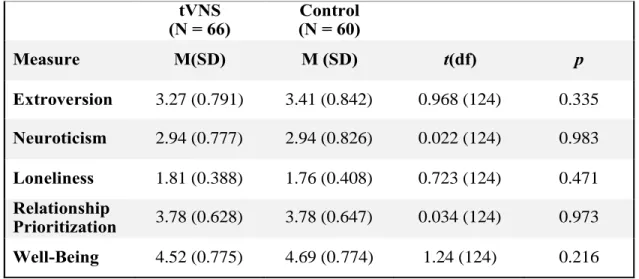
Independent samples t-tests were conducted for each measure to compare differences between those randomized to the tVNS vs. control groups. Across the board, no baseline differences between groups emerged, indicating that randomization created two conditions with adequately similar social and emotional characteristics (see Table 1 for summary).
Table 1. Summary of baseline measuares: t-test results showing no differences between tVNS and control groups on baseline measures
Primary Analyses
All statistical tests of hypotheses explored interactions with gender. No interaction effects emerged, so group analyses below are collapsed across gender.
tVNS
(N = 66) (N = 60) Control
Measure M(SD) M (SD) t(df) p
Extroversion 3.27 (0.791) 3.41 (0.842) 0.968 (124) 0.335
Neuroticism 2.94 (0.777) 2.94 (0.826) 0.022 (124) 0.983
Loneliness 1.81 (0.388) 1.76 (0.408) 0.723 (124) 0.471 Relationship
Affect: Affect Grid ratings were converted into two independent scores – Valence and Arousal – for each of the 4 time points (pre-stimulation, start of stimulation, end of stimulation, post-stimulation). A repeated-measures ANOVA was conducted to test the main effect of condition (tVNS, control) on Valence and Arousal as well as the interaction effect of condition (tVNS, control) and time (pre-stimulation, start of stimulation, end of stimulation,
post-stimulation) on Valence and Arousal. The main effect of condition was not significant for Valence , F(1, 123) = .917, p=.340 or Arousal, F(1, 123) = .018, p=.892. The interaction effect of condition and time was not significant for Valence, F(3, 121)=.128, p=.943 or Arousal, F(3,121)=2.299, p=.081. Taken together, these results indicate that tVNS did not have an effect on valence or arousal at any time during the study.
Trait-Level Perceptions: Average scores for each trait dimension on the Facial Trait Rating Task were computed for every participant. A multivariate ANOVA was used to compare average scores on each trait dimension (trustworthy, competent, threatening, likable, and
Table 2. Summary of Facial Trait Ratings showing no differences between tVNS and control conditions on ratings of facial traits.
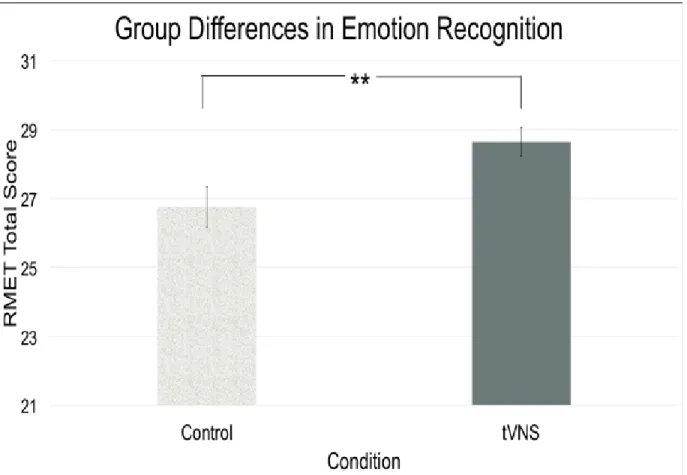
Emotion Recognition: Total scores on the RMET were computed by summing the total number of correct responses. Total scores on the RMET ranged from 14 to 36 (M=27.7,
SD=4.09). An independent samples t-test was used to compare the RMET total scores between the tVNS and control conditions. The independent samples t-test revealed a significant
difference between tVNS and control total scores on the RMET; t(124) = 2.642, p=0.009. Participants in the tVNS condition (M=28.6, SD=3.4) scored significantly higher on the RMET than participants in the control condition (M=26.8, SD=4.6), indicating that tVNS increases emotion perception accuracy relative to sham stimulation (see Figure 1). Furthermore, a medium effect size (d=0.47) was found for this analysis.
tVNS (N = 66)
Control (N = 60)
Measure M(SD) M (SD) F(df) p
Trustworthy 43.94 (1.96) 46.19 (2.05) 0.637 (1,124) 0.426
Competent 48.53 (1.90) 50.90 (2.00) 0.738 (1,124) 0.392
Threatening 30.14 (1.72) 28.24 (1.81) 0.586 (1,124) 0.445
Likeable 41.83 (1.76) 43.57 (1.85) 0.467 (1,124) 0.495
Figure 2. RMET scores by condition. Mean group scores indicate greater emotion recognition in the tVNS than control condition.
Emotion Recognition - Exploratory Analyses: Exploratory post-hoc analyses were performed on the RMET to match previous studies. RMET questions were divided into “easy” and “difficult” categories “positive,” “negative,” and “neutral” categories based on a median-splits from two past studies (Colzato, Sellaro, & Beste, 2017; Harkness, Sabbagh, Jacobson, Chowdrey, & Chen, 2005). No new interactions between condition and these categories emerged.
Affiliation, Fear of Rejection) between the tVNS and control conditions. Results of the ANOVA indicate that condition did not have a significant effect on social motivations for either Hope for Affiliation; F(1,123)=0.156, p=0.694, or Fear of Rejection; F(1,123)=1.359, p=0.246. This suggests that tVNS does not have an effect on social motivations.
Implicit Social Motivation: Following prior methods, response times on the PA-IAT that occurred below 300 ms and above 1000 ms were discarded as they represent abnormal data (Slabbinck et al., 2012). Scores were then calculated so that a higher PA-IAT score represents stronger implicit need for affiliation. Outliers and participants who made greater than 10% labeling errors were dropped (Slabbinck et al., 2012). This resulted in a total of 123 cases of usable data for the PA-IAT.
CHAPTER 4: DISCUSSION
The current study used tVNS to explore the effect of vagus nerve stimulation on several aspects of emotional and social functioning: affect, social perceptions, and social motivations. We predicted that tVNS would 1) increase positive affect and decrease levels of arousal, 2) increase emotion recognition accuracy, 3) lead to perceiving others as more Trustworthy and less Threatening, 4) increase implicit motivations for social affiliation, and 5) increase Hope for Affiliation and decrease Fear of Rejection. Only the second hypothesis – that tVNS would increase emotion recognition accuracy – was supported. Participants in the tVNS group performed significantly better than participants in the control group on the emotion recognition task.
The finding that tVNS, and presumed effects on vagus nerve activity, leads to higher emotion recognition is important to applied and theoretical realms alike. Recognizing another’s emotional and mental states is an integral component of behaving appropriately in social
Polyvagal Theory puts forth hypotheses that are supported by this finding. First, since the muscles of the face are innervated by the vagus nerve, Polyvagal Theory predicts that tVNS would increase the muscle activity needed for facial mimicry, a valuable component of emotion recognition (Adolphs, 2002; Oberman, Winkielman, & Ramachandran, 2007). Related to an upward spiral dynamic, we speculated that an increased ability to recognize other’s emotions could lead to more successful social interactions, a possible pathway for vagus nerve activity to improve social connections over time. The long-term effect of tVNS-induced increases emotion recognition accuracy are unknown, however, it is logical to think it could improve social
functioning. Supporting this logic, Fang and colleagues (2016) demonstrated that twice-daily doses of tVNS over a one-month period were safe for participants to self-administer, increased functional connectivity between several brain regions, and decreased symptoms of depression.
Although the effect of tVNS on emotion recognition is informative, one can only infer that vagus nerve activity caused the increase in emotion recognition. This study limitation stems from the lack of an online measure of vagus nerve activity (e.g., HRV), assessed concurrent with tVNS. Substantial past research corroborates that tVNS increases vagus nerve activity (see Murray et al., 2016 for review). However, without measuring it and analyzing it as a mediator between tVNS and emotion recognition capabilities, one can only speculate that vagus nerve activity is the likely cause of the increased emotion recognition capacity in the tVNS group.
The lack of simultaneous physiological measurement produces a second limitation as well. It remains unknown how much vagus nerve activity is ideal for optimal behavior –
and Mauss (2013) found a quadratic relationship between baseline CVT and several measures of well-being. Similarly, a non-linear relationship has also been found between vagus nerve activity and prosociality (Kogan et al., 2014). These two studies suggest that, when it comes to the vagus nerve, more isn’t always better. Without measuring physiological functioning during tVNS, this research is unable to shed light on the physiological states and stimulation parameters most suitable for beneficial tVNS.
Two other features of the study design provide potential alternative explanations for the lack of support for the remaining hypotheses. First, there was no mood- or emotion-inducing event. At first glance, this may seem unproblematic. However, Polyvagal Theory states the vagus nerve activity merely sets the boundaries for emotional experiences (Porges, 1995, 2001, 2007). The vagus nerve does not automatically induce specific emotional experiences. In other words, vagus nerve activity is necessary to experience positive, low-arousal emotions, but it may not be sufficient. If an emotion induction had been present in this study, participants
experienced during successful interactions could build incentive salience for these experiences, increasing motivations to engage in more rewarding social interactions in the future (Van Cappellen, Rice, Catalino, & Fredrickson, 2018).
The autonomic nervous system’s role in rapid regulation could also explain why there was a difference in state-level perceptions (i.e., RMET: emotion recognition) but not in trait-level perceptions (i.e., Trustworthy and Threatening ratings). Expressed emotions, not facial traits, can fluctuate rapidly within the environment and signal changes in threat and safety, which would be highly relevant to the social and physiological control of the vagus nerve (Porges, 1995, 2001, 2007). For example, even the most dominant-looking individual is unlikely to pose a significant threat the vast majority of the time. Alternatively, an individual with barred teeth and a grimaced look, who is seething with rage, is highly likely to pose an immediate threat.
Polyvagal theory states that the vagus nerve responds to cues of threat and safety in the social environment (Porges 2007). Since trait-level perceptions, compared to state-level perceptions, have low predictive capacity for threat and safety, augmented vagus nerve activity may do little to change perceptions of trait-level features.
Due to the novelty of the methodology used in the current research, replication should be a primary focus of future studies. In addition, the limitations of the current study suggest that integrating simultaneous measurement of vagus nerve activity during stimulation would
strengthen causal claims of future research. Beyond that, looking at longitudinal designs would allow researchers to directly test an upward spiral dynamic to see if changes in emotion
REFERENCES
Adler, N. E., Epel, E. S., Castellazzo, G., & Ickovics, J. R. (2000). Relationship of subjective and objective social status with psychological and physiological functioning: Preliminary data in healthy, White women. Health Psychology, 19(6),
586-592. http://dx.doi.org/10.1037/0278-6133.19.6.586
Adolphs, R. (2002). Recognizing emotion from facial expressions: psychological and
neurological mechanisms. Behavioral and cognitive neuroscience reviews, 1(1), 21-62. Ballew, C. C., & Todorov, A. (2007). Predicting political elections from rapid and unreflective
face judgments. Proceedings of the National Academy of Sciences, 104(46), 17948-17953.
Baron-Cohen, S., Wheelwright, S., Hill, J., Raste, Y., & Plumb, I., (2001). The "Reading the Mind in the Eyes" Test Revised Version: A Study with Normal Adults, and Adults with Asperger Syndrome or High-functioning Autism. The Journal of Child Psychology and
Psychiatry, 42(2), 241-251.
Baumeister, R. F. & Leary, M. R. (1995). The need to belong: Desire for interpersonal
attachments as a fundamental human motivation. Psychological Bulletin, 117, 497-529. doi:10.1037/0033-2909.117.3.497
Bassett, D., Bear, N., Nutt, D., Hood, S., Bassett, S., & Hans, D. (2016). Reduced heart rate variability in remitted bipolar disorder and recurrent depression. Australian & New
Zealand Journal of Psychiatry, 50(8), 793-804.
Beste, C., Steenbergen, L., Sellaro, R., Grigoriadou, S., Zhang, R., Chmielewski, W., ... Colzato, L. (2016). Effects of Concomitant Stimulation of the GABAergic and Norepinephrine System on Inhibitory Control - A Study Using Transcutaneous Vagus Nerve Stimulation.
Brain Stimulation, 9(6), 811–818.
Berntson, G. G., Thomas Bigger, J., Eckberg, D. L., Grossman, P., Kaufmann, P. G., Malik, M., ... & Van Der Molen, M. W. (1997). Heart rate variability: origins, methods, and
interpretive caveats. Psychophysiology, 34(6), 623-648.
Borovikova, L. V., Ivanova, S., Zhang, M., Yang, H., Botchkina, G. I., Watkins, L. R., ... & Tracey, K. J. (2000). Vagus nerve stimulation attenuates the systemic inflammatory response to endotoxin. Nature, 405(6785), 458.
Butler, E. A., Wilhelm, F. H., & Gross, J. J. (2006). Respiratory sinus arrhythmia, emotion, and emotion regulation during social interaction. Psychophysiology, 43(6), 612-622.
Clancey, J. A., Mary, D. A., Witte, K. K., Greenwood, J. P., Deichars, S. A., Deichars, J., (2014). Non-invasive Vagus Nerve Stimulation in Healthy Humans Reduces Sympathetic Nerve Activity. Brain Stimulation, 7, 871-877.
Clark, K. B., Krahl, S. E., Smith, D. C., and Jensen, R. A. (1995). Post-training unilateral vagal nerve stimulation enhances retention performance in the rat. Neurobiology of Learning
and Memory, 63, 213–216. doi: 10.1006/nlme.1995.1024
Clark, K. B., Naritoku, D. K., Smith, D. C., Browning, R. A., and Jensen, R. A. (1999). Enhanced recognition memory following vagus nerve stimulation in human subjects.
Nature Neuroscience, 2, 94–98. doi: 10.1038/4600
Cohen, S. (2004). Social relationships and health. American psychologist, 59(8), 676. DOI: 10.1037/0003-066X.59.8.676
Colzato, L. S., Sellaro, R., & Beste, C. (2017). Darwin revisited: The vagus nerve is a causal element in controlling recognition of other's emotions. Cortex, 92, 95-102.
Costa, P. T., & McCrae, R. R. (1980). Influence of extraversion and neuroticism on subjective well-being: Happy and unhappy people. Journal of Personality and Social Psychology, 38(4), 668-678
Dangardt, F., Volkmann, R., Chen, Y., Osika, W., Mårild, S., & Friberg, P. (2011). Reduced cardiac vagal activity in obese children and adolescents. Clinical physiology and
functional imaging, 31(2), 108-113.
Demenescu, L.R., Kortekaas, R., Boer den, J.A., Aleman, A., 2010. Impaired attribution of emotion to facial expressions in anxiety and major depression. PLoS ONE 5, e15058. Dodrill, C. B., & Morris, G. L. (2001). Effects of vagal nerve stimulation on cognition and
quality of life in epilepsy. Epilepsy & Behavior, 2(1), 46-53.
Elger, G., Hoppe, C., Falkai, P., Rush, A. J., & Elger, C., (2000). Vagus nerve stimulation is associated with mood improvements in epilepsy patients. Epilepsy Research 42, 203-210. Fang, J., Rong, P., Hong, Y., Fan, Y., Liu, J., Wang, H., …, Kong, J., (2016). Transcutaneous
Vagus Nerve Stimulation Modulates Default Mode Network in Major Depressive Disorder. Biological Psychiatry 17(4), 266-273.
Frangos, E., Ellrich, J., & Komisaruk, B. R. (2015). Non-invasive access to the vagus nerve central projections via electrical stimulation of the external ear: fMRI evidence in humans. Brain Stimulation: Basic, Translational, and Clinical Research in
Neuromodulation, 8(3), 624-636.
Fredrickson, B. L. (1998). What good are positive emotions?. Review of general
psychology, 2(3), 300.
Fredrickson, B. L. (2001). The role of positive emotions in positive psychology: The broaden-and-build theory of positive emotions. American psychologist, 56(3), 218.
http://dx.doi.org/10.1037/0003-066X.56.3.218
Fredrickson, B. L., (2013). Positive emotions broaden and build. Advances in Experimental
Social Psychology, 47, 1-55.
Fredrickson, B. L. (2018). Biological underpinnings of positive emotions and purpose. In J. P. Forgas & R. F. Baumeister (Eds.), The social psychology of living well. New York: Psychology Press.
Fredrickson, B. L., & Joiner, T. (2002). Positive emotions trigger upward spirals toward emotional well-being. Psychological Science, 13(2), 172-175.
Gallagher, M. W., Lopez, S. J., & Preacher, K. J. (2009). The hierarchical structure of well-being. Journal of Personality, 77, 1025-1049.
Geisler, F. C., Kubiak, T., Siewert, K., & Weber, H. (2013). Cardiac vagal tone is associated with social engagement and self-regulation. Biological psychology, 93(2), 279-286. Greenwald, A. G., Nosek, B. A., & Banaji, M. R. (2003). Understanding and using the Implic- it
Association Test: An improved scoring algorithm. Journal of Personality and Social
Psychology, 85(2), 197–216.
Groves, D. A., & Brown, V. J. (2005). Vagal nerve stimulation: a review of its applications and potential mechanisms that mediate its clinical effects. Neuroscience & Biobehavioral
Reviews, 29(3), 493-500.
Hasan, A., Wolff-Menzler, C., Pfeiffer, S., Falkai, P., Weidinger, E., Jobst, A., ... & Quast, S. (2015). Transcutaneous noninvasive vagus nerve stimulation (tVNS) in the treatment of schizophrenia: a bicentric randomized controlled pilot study. European archives of
psychiatry and clinical neuroscience, 265(7), 589-600.
Hamilton, H. K., Sun, J. C., Green, M. F., Kee, K. S., Lee, J., Sergi, M., … Kern, R. (2014). Social cognition and functional outcome in schizophrenia: The moderating role of cardiac vagal tone. Journal of abnormal psychology, 123(4), 764.
Harkness, K., Sabbagh, M., Jacobson, J., Chowdrey, N., & Chen, T. (2005). Enhanced accuracy of mental state decoding in dysphoric college students. Cognition & Emotion, 19(7), 999-1025.
Holt-Lunstad, J., Smith, T. B., & Layton, J. B. (2010). Social relationships and mortality risk: a meta-analytic review. PLoS medicine, 7(7), e1000316.
Howland RH. (2014) Vagus Nerve Stimulation. Current behavioral neuroscience reports. 1(2):64-73. doi:10.1007/s40473-014-0010-5.
John, O. P., Donahue, E. M., & Kentle, R. L. (1991). The Big Five Inventory--Versions 4a and 54. Berkeley, CA: University of California, Berkeley, Institute of Personality and Social Research.
John, O. P., Naumann, L. P., & Soto, C. J. (2008). Paradigm Shift to the Integrative Big-Five Trait Taxonomy: History, Measurement, and Conceptual Issues. In O. P. John, R. W. Robins, & L. A. Pervin (Eds.), Handbook of personality: Theory and research (pp. 114-158). New York, NY: Guilford Press.
Kemp, A.H., Quintana, D.S., Felmingham, K.L., Matthews, S., & Jelinek, H.F., (2012a). Depression, comorbid anxiety disorders, and heart rate variability in physically healthy, unmedicated patients: implications for cardiovascular risk. PLoS One 7 (2), e30777. Kemp, A.H., Quintana, D.S., Kuhnert, R.-L., Griffiths, K., Hickie, I.B., Guastella, A.J., (2012b).
Oxytocin increases heart rate variability in humans at rest: Implications for social approach-related motivation and capacity for social engagement. PLoS ONE 7 (8), e44014.
Keyes, C. L. M. (2005). The subjective well-being of America’s youth: Toward a comprehensive Assessment. Adolescent and Family Health, 4, 3-11.
Keyes, C. L. M. (2006). Mental Health in Adolescence: Is America’s Youth Flourishing?
American Journal of Orthopsychiatry, 76, 395-402.
Kogan, A., Gruber, J., Shallcross, A. J., Ford, B. Q., & Mauss, I. B. (2013). Too much of a good thing? Cardiac vagal tone’s nonlinear relationship with well-being. Emotion, 13(4), 599. Kogan, A., Oveis, C., Carr, E. W., Gruber, J., Mauss, I. B., Shallcross, A., ... & Keltner, D.
(2014). Vagal activity is quadratically related to prosocial traits, prosocial emotions, and observer perceptions of prosociality. Journal of Personality and Social Psychology, 107(6), 1051.
Kok, B. E., Coffey, K. A., Cohn, M. A., Calino, L. I., Vacharkulksemsuk, T., Algoe, S. B., Brantley, M., & Fredrickson, B. L. (2013). How positive emotions build physical health: Perceived positive social connections account for the upward spiral between positive emotions and vagal tone. Psychological Science, 24, 1123-1132.
Kok, B. E., & Fredrickson, B. L. (2010). Upward spirals of the heart: Autonomic flexibility, as indexed by vagal tone, reciprocally and prospectively predicts positive emotions and social connectedness. Biological psychology, 85(3), 432-436.
1485-Kraus, T., Kiess, O., Hösl, K., Terekhin, P., Kornhuber, J., & Forster, C. (2013). CNS BOLD fMRI effects of sham-controlled transcutaneous electrical nerve stimulation in the left outer auditory canal–a pilot study. Brain Stimulation: Basic, Translational, and Clinical
Research in Neuromodulation, 6(5), 798-804.
Kreuzer, P. M., Landgrebe, M., Husser, O., Resch, M., Schecklmann, M., Geisreiter, F., ... & Langguth, B. (2012). Transcutaneous vagus nerve stimulation: retrospective assessment of cardiac safety in a pilot study. Frontiers in psychiatry, 3, 70.
Levy, M. L., Levy, K. M., Hoff, D., Amar, A. P., Park, M. S., Conklin, J. M., Baird, L., Apuzzo, M. L., (2010). Vagus nerve stimulation therapy in patients with autism spectrum disorder and intractable epilepsy: results from the vagus nerve stimulation therapy patient
outcome registry. Journal of Neurosurgical Pediatrics. 5(6), 595-602
Lopes, P. N., Salovey, P., & Straus, R. (2003). Emotional intelligence, personality, and the perceived quality of social relationships. Personality and individual Differences, 35(3), 641-658.
Movius, H. L.,, Alen, J. J. B., (2005). Cardiac vagal tone, defensiveness, and motivational style.
Biological Psychology 68, 147-162.
Murray, H. A. (1943). Thematic Apperception Test. Cambridge, MA: Harvard University Press. Murray, A. R., Atkinson, L., Mahadi, M. K., Deuchars, S. A., & Deuchars, J. (2016). The strange
case of the ear and the heart: the auricular vagus nerve and its influence on cardiac control. Autonomic Neuroscience: Basic and Clinical, 199, 48-53.
Nemechek, P., Nemechek, J., & Colombo, J. (2017). Transcutaneous vagal nerve stimulation (tVNS) improves reversal of chronic autonomic dysfunction when added to a multi-faceted anti-inflammatory regimen. Brain Stimulation: Basic, Translational, and Clinical
Research in Neuromodulation, 10(2), 508.
Norman, G.J., Cacioppo, J.T., Morris, J.S., Malarkey, W.B., Berntson, G.G., DeVries, A.C., (2011). Oxytocin increases autonomic cardiac control: moderation by loneliness.
Biological Psychology 86, 174–180.
Oberman, L. M., Winkielman, P., & Ramachandran, V. S. (2007). Face to face: Blocking facial mimicry can selectively impair recognition of emotional expressions. Social
neuroscience, 2(3-4), 167-178.
Okruszek, Ł., Dolan, K., Lawrence, M., & Cella, M. (2017). The beat of social cognition: exploring the role of Heart Rate Variability as marker of mentalizing abilities. Social
neuroscience, 12(5), 489-493.
Park, G., & Thayer, J. F. (2014). From the heart to the mind: cardiac vagal tone modulates top-down and bottom-up visual perception and attention to emotional stimuli. Frontiers in
psychology, 5, 278.
Patriquin, M. A., Scarpa, A., Friedman, B. H., & Porges, S. W. (2013). Respiratory sinus arrhythmia: A marker for positive social functioning and receptive language skills in children with autism spectrum disorders. Developmental Psychobiology, 55(2), 101-112. Peuker, E. T., & Filler, T. J. (2002). The nerve supply of the human auricle. Clinical
Anatomy, 15(1), 35-37.
Porges, S. W. (1995). Orienting in a defensive world: Mammalian modifications of our evolutionary heritage. A polyvagal theory. Psychophysiology, 32(4), 301-318.
Porges, S. W. (2001). The polyvagal theory: phylogenetic substrates of a social nervous system.
International Journal of Psychophysiology, 42(2), 123-146.
Porges, S. W. (2007). The Polyvagal Perspective. Biological Psychology, 74(2), 116-143. Quintana, D. S., Guastella, A. J., Outhred, T., Hickie, I. B., & Kemp, A. H. (2012). Heart rate
variability is associated with emotion recognition: direct evidence for a relationship between the autonomic nervous system and social cognition. International Journal of
Psychophysiology, 86(2), 168-172.
Robitschek, C., & Keyes, C. L. M. (2009). The structure of Keyes’ Model of Mental Health and the Role of Personal Growth Initiative as a Parsimonious Predictor. Journal of
Counseling Psychology, 56, 321-329
Rush, A. J., George, M. S., Sackeim, H. A., Marangell, L. B., Husain, M. M., Giller, C., Nahas, Z., Haines, S., Simpson, R. K., Goodman, R., (2000). Vagus nerve stimulation (VNS) for treatment-resistant depressions: a multicenter study. Biological Psychiatry 47(4), 276-286.
Russell, D., Peplau, L. A., & Cutrona, C. I. (1980). The revised UCLA Loneliness Scale: Concurrent and Discriminant Validity Evidence. Journal of Personality and Social
Psychology, 39, 472-480.
Russell, D , Peplau, L. A.. & Ferguson, M. L. (1978). Developing a measure of loneliness.
Journal of Personality Assessment, 42, 290-294.
Russell, J. A., Ward, L. M., & Pratt, G. (1981). Affect quality attributed to environments: A factor analytic study. Environment and Behavior, 13, 259-288.
Sackeim, H. A., Rush, A. J., George, M. S., Marangell, L. B., Husain, M. M., Nahas, Z., ... & Simpson Jr, R. K. (2001). Vagus nerve stimulation (VNS™) for treatment-resistant depression: efficacy, side effects, and predictors of outcome. Neuropsychopharmacology, 25(5), 713-728.
Sandstrom, G. M., & Dunn, E. W. (2014a). Is efficiency overrated? Minimal social interactions lead to belonging and positive affect. Social Psychological and Personality Science, 5(4), 437-442.Schmalt, H. D. (1999). Assessing the Achievement Motive Using the Grid Technique. Journal of Research in Personality, 33, 1567-1577.
https://doi.org/10.1177/1948550613502990
Sandstrom, G. M., & Dunn, E. W. (2014b). Social interactions and well-being: The surprising power of weak ties. Personality and Social Psychology Bulletin, 40(7), 910-922. https://doi.org/10.1177/0146167214529799
Sellaro, R., de Gelder, B., Finisguerra, A., & Colzato, L. S. (2018). Transcutaneous vagus nerve stimulation (tVNS) enhances recognition of emotions in faces but not bodies. Cortex, 99, 213-223.
Sokolowski, K., Schmalt, H., D., Langens, T., A., and Puca, R., M., (2000). Assessing Achievement, Affiliation, and Power Motives All at Once: The Multi-Motive Grid (MMG). Journal of Personality Assessment, 74(1), 126-145.
Slabbinck, H., De Houwer, J., and Van Kenhove, P. (2012). The Pictorial Attitude Implicit Association Test for need for affiliation. Personality and Individual Differences, 53(7), 838-842.
Stavrakis, S., Humphrey, M. B., Scherlag, B. J., Hu, Y., Jackman, W. M., Nakagawa, H., ... & Po, S. S. (2015). Low-level transcutaneous electrical vagus nerve stimulation suppresses atrial fibrillation. Journal of the American College of Cardiology, 65(9), 867-875. Thayer, J. F., & Lane, R. D. (2007). The role of vagal function in the risk for cardiovascular
disease and mortality. Biological psychology, 74(2), 224-242.
Tuck, N. L., Grant, R. C., Sollers, J. J., Booth, R. J., & Consedine, N. S. (2016). Higher resting heart rate variability predicts skill in expressing some emotions. Psychophysiology,
53(12), 1852-1857.
Uchino, B. N., Cacioppo, J. T., & Kiecolt-Glaser, J. K. (1996). The relationship between social support and physiological processes: A review with emphasis on underlying mechanisms and implications for health. Psychological Bulletin, 119(3), 488-531.
http://dx.doi.org/10.1037/0033-2909.119.3.488
Van Leusden, J. W., Sellaro, R., & Colzato, L. S. (2015). Transcutaneous Vagal Nerve Stimulation (tVNS): a new neuromodulation tool in healthy humans? Frontiers in psychology, 6, 102.
Watson, D., Clark, L. A., McIntyre, C. W., Hamaker, S. (1992). Affect, personality, and social activity. Journal of Personality and Social Psychology, 63, 1011-1025.
doi:10.1037/0022-3514.63.6.1011
Willis, J., & Todorov, A. (2006). First impressions: Making up your mind after a 100-ms exposure to a face. Psychological science, 17(7), 592-598.
Yu, L., Scherlag, B. J., Li, S., Fan, Y., Dyer, J., Male, S., ... & Po, S. S. (2013). Low-level transcutaneous electrical stimulation of the auricular branch of the vagus nerve: a noninvasive approach to treat the initial phase of atrial fibrillation. Heart rhythm, 10(3), 428-435.
Zhou, X., Zhou, L., Wang, S., Yu, L., Wang, Z., Huang, B., ... & Jiang, H. (2016). The use of noninvasive vagal nerve stimulation to inhibit sympathetically induced sinus node
acceleration: a potential therapeutic approach for inappropriate sinus tachycardia. Journal