STRAINING SILENCING: YOUTH FILM-MAKING ON SCHOOLING’S SILENCING
Amy Senta
A dissertation submitted to the faculty at the University of North Carolina at Chapel Hill in partial fulfillment of the requirements for the degree of doctorate of philosophy in the area of
Culture, Curriculum, and Change in the School of Education.
Chapel Hill 2016
Approved by: George W. Noblit Karla Martin James Trier Jocelyn Glazier
ii © 2016 Amy Senta
iii ABSTRACT
Amy Senta: Straining Silencing: Youth film-making on schooling’s silencing (Under the direction of George W. Noblit)
For four years within their public elementary and middle schools in rural North Carolina, 24 youth worked together as a writing and film-making group to challenge schooling’s silencing. This dissertation is an analysis of the final year of that group. The dissertation consists of two framework layers.
First, using a post-critical approach (Noblit, Flores, & Murillo, 2004), which employs assumptions from both critical and constructionist epistemologies, I, the researcher-facilitator, analyzed the films as cases. The three films were about three forms of silencing: a) silencing of Spanish, b) silencing of romantic relationships, and c) silencing in classrooms. The ethnographic account is structured by the method of articulation (Hall, 1986). For each form of silencing, the articulation of one scene of silencing with one scene of social change of that silencing surfaced a focus film-making practice (Bourdieu, 1977) specific to that film group. The practices were: a) using extras, b) bonding, and c) adding alternate endings. The ethnographic account explores the students’ theorizing on schooling’s silencing, including their theorizing on how silencing works and their visions for how social change can happen. As part of this dissertation that theorizing engages with existing qualitative educational research on silencing.
iv
and exclusion that the research writing apparatuses had made exposed the contingency of the ethnographic account. The interpretations imploded the ethnographic account. Poststructuralists have called for posthumanist theories such as agential realism to be brought to bear on
qualitative research, but that project is only just underway, currently as theoretical engagement. This dissertation contributes to that project by providing a case in which agential realism was engaged with qualitative data.
The dissertation raised hauntings for both ethnographic and posthumanist research. Tensions, contradictions, and implications are discussed. The overall purpose of the multiplicity and complexity of the dissertation was to “strain” (Jackson & Mazzei, 2009) schooling’s
v
vi
ACKNOWLEDGEMENTS
The 24 youth participants, their peers, and their families invited educational research to become entwined with their school lives. To (all pseudonyms) Paola, LJ, Karla, Cindy, Indent, Bailey, Jordan, Wendi, Rory, Marcus, Eric, Nick, Fisher, Angel, Scott, Ty, Vicki, Gia, David, Quiana, Yasmin, Cole, Palmer, Hannah, Oscar, Eliza, Columbus, Cloud, Miles, Max, Ann-Marie, Chelsea, Hector, Olivia, Peaceful, Tyron, and Shea and your families: Thank you for the opportunity to work with you all in the time we had together. Your writing and film-making are tremendous gifts to education. Ms. Parker (a pseudonym), thank you for our friendship and may we continue the kids’ work through our trust and negotiation. Thank you to the school
administrators who saw promise in the work and supported us when schooling encroached. Thank you to Research Triangle Schools Partnership, who contributed financially to the third year of study activities.
Thank you to my committee and faculty mentors for your sheer determination to support your students as emerging scholars. In writing this dissertation I witnessed your fierce
commitments and intellectual histories become enacted in a single piece. Jim, you showed me that the world can always be otherwise. Nuanced validation of ideas and unconditional
invitation into discourses are hallmarks of your teaching, and they illuminate the creative
vii
must be done. Your work in and for communities inspires me to appreciate the work behind systemic change. Mary Kay, thank you for being alongside me in friendship, motherhood, and collegiality. From this I am learning to question the humanity of any way of living and working and to find invigoration in a fluid state of uncertainty. Dr. Rong, the ways in which your work speaks with such tailoring to such a plurality of contexts has shown me how wide the scope of commitment-driven work can reach. Dr. Horton, I could never thank you enough for taking me on and bringing me up as a teacher educator. Lynda, your caring lives. Our relationship feeds my soul, even through the nourished bodies of my babies.
George, through your work I continue to learn that scholarly isolation is an illusion. When I reached out to you as a teacher I felt renewal of possibility for the advancement of equity. I am forever grateful for your questioning, your hearing, and your trust that commitment will move good work. It is a privilege to have been becoming in your populace, and knowing that you are present through populace “g” will sustain both my work and me.
Owen and Connor, my sweet babies, and Steve, you are beauty. It is not easy to be child or husband to a post-critical ethnographer embedded in schools and it is all you have ever known. Connor, my “paper” is all done; no more paper. Owen, yes, I will still be your mom now that my “destination” is finished. Thank you for the love that was faith, freedom to transverse, and touch among body, family, and Earth, and for now going together into the new contexts that will become our lives.
Thank you to my colleagues past and present: Kea, Sharon, Matt, Ashley, Ali, Dani, Karla, Corliss, Kristal, Heather, Amy, Omar, Cary, Billye, Summer, Alison, Esme, Tim,
viii
UNC Wilmington for engaging me in their work and supporting scholarship towards the advancement of equity for North Carolina’s youth. Thank you to Durham’s youth and families and Durham Public Schools. A special shout out to my former students, who by now are no longer youth! Doris Walker, thank you for taking a chance on me. Cara Wijkowski, Susan Gragg, Myra Penuel, and Terri Gunter, from you I learned that good teaching is defined by the youth and families in local contexts. Thank you to Kate, Joe, Katherine, Kevin E., Cathy, Mike, Wendy, Virginia, Kevin O., Kelly, Josh, Irwin, Nina, Sam, Jon, The Blades, and The
ix
TABLE OF CONTENTS
LIST OF FIGURES………..xiii
CHAPTER 1: STUDY SET-UP AND INTRODUCTION TO THE DISSERTATION ... 1
Context of the Study ... 1
Style ... 1
Town ... 3
Schools ... 4
Participant Selection ... 5
Framework ... 6
Framework Layer 1: Participatory ethnographic account in contexts of silencing ... 7
Framework Layer 2: Agential realist reconsideration of the ethnographic account ... 36
Embarkation ... 40
CHAPTER 2: “THE HISPANIC MOVIE” ... 41
Introduction to the analysis ... 41
Group formation and meaning ... 43
Form of silencing as a problem and potential exceptions: The silencing of Spanish ... 48
Good from the silencing of Spanish... 49
Silencing form illustration: Silencing of Spanish – ISS scene and beyond ... 50
Form of silencing as wider social problem: Silencing of Spanish as systemic racism ... 60
x
Form of silencing as wider social problem and possibility for change
of that social problem: Hallway scene of “racism” and “justice” ... 64
Practice: Using extras ... 67
Exercising power ... 77
CHAPTER 3: “THE LOVE MOVIE” ... 82
Group formation and meaning ... 82
Form of silencing: The silencing of relationships... 89
Form of silencing as a problem and potential exceptions: The silencing of relationships ... 90
Good from the silencing of relationships ... 92
Silencing form illustration: Silencing of relationships—The “hallway” “love” scene ... 95
Form of silencing as a wider social problem: Silencing of relationships as isolation ... 99
Form of silencing as wider social problem and possibility for change of that social problem: Scene of “rebellion” and “inspiration” ... 101
Accomplishment ... 106
Practice: Bonding ... 107
Exercising Power ... 115
CHAPTER 4: THE “CLASSROOM” MOVIE ... 118
Group formation and meaning ... 118
Form of silencing as a problem and potential exceptions: Silencing in classrooms ... 125
Good from silencing in classrooms... 128
Silencing form illustration: The “writing” scene ... 130
Form of silencing as wider social problem and possibility for change of that social problem: Writing reimagined ... 134
xi
Exercising Power ... 139
CHAPTER 5: DISCUSSION ... 141
Silencing: “It’s really hard to describe it.”... 141
Youth accounting as foundational for conceptualizing silencing ... 142
Silencing experiences in students’ accountings ... 145
Isolation enclosing pain ... 146
Practices, power, change (movement of understanding) and silencing’s positioning in educational research ... 149
Group formation/dissolution ... 156
CHAPTER 6: RECONSIDERATION ... 163
Introduction of a Transition ... 163
Introduction of the (Re)analysis... 167
Containment of the Reanalysis Scope... 174
(Re)analysis strategizing: Poststructural interrogation of the classical analyses ... 178
Interpretations ... 179
Justifying cuts ... 180
Linearity and parallelism ... 182
Linguistic situation of understanding... 184
Individual things with own properties ... 189
Material opportune glimpses... 191
Epistemology and Ontology of Complementarity and Uncertainty ... 196
Exclusion and inclusion ... 199
xii
Problems for classical science ... 205
Problems for poststructural science ... 207
Hauntings for research ... 211
Reflexivity... 211
Design ... 212
Methods of analysis ... 213
“Conclusion”, or, Invitation to Imagine ... 214
EPILOGUE ... 216
APPENDIX 1: READER’S GUIDE TO RECONCILIATION ATTEMPT ... 220
APPENDIX 2: AUDIO TRACK LYRICS ... 223
xiii
LIST OF FIGURES
1
CHAPTER 1: STUDY SET-UP AND INTRODUCTION TO THE DISSERTATION
Context of the Study
This dissertation is based on participatory ethnographic facilitation of writing and film-making groups with 24 youth in public school together through 4th-8th grades in rural
southeastern United States. The study took place during 140 school days over four school years from 2009-2013. The dissertation is about the final year of the study, which consisted of an after-school writing and film-making group at the students’ middle school. The purpose of that group was to describe and challenge what we called school’s silencing.
Style
When I use the unspecified term “we” I am referring to the students and myself.
Although the youth in this research were all connected to one teacher through their shared status as former students in her elementary classroom, that teacher may appear to a reader who is unfamiliar with the youth and their practices to be minimally present in the writing. However, the teacher and I together arrived at a stylistic decision to contain the focus of the storying on the film-making at the middle school. We are writing as co-authors of other texts that center the teacher’s teaching, the researcher-teacher relationship, and emergence of the study over time. We view this dissertation as an important contributor in a set of texts that will describe and contextualize all of our experiences.
2
implications of case style he decided, “Race, as understood by my Rastafari interlocutors, carries a force deserving of capitalization, regardless of whether we embrace it as positive, focus on how it is used to debase, or fall somewhere within these poles. ‘Black’ is more likely to remind the reader of the salience of race than ‘black’ (Price, 2009, p. xv)”. My writing and my data transcription adhere to capitalized race descriptors for the purpose of reminding readers, including myself, of the salience of race.
I use the terms Latin@ and Hispanic and they are not interchangeable. “Hispanic” was a term first used by the United States government in what many argue was an attempt to erase ethnic identities. This term is often used to include people of both Latin American and European Spanish heritage. The term Latino/a was appropriated in recognition of the common experience of oppression of people in the United States that have Latin American ethnicity (Chomsky, 2007). In response to this historical storying, the term Hispanic appears here only within comments of original authors or speakers.
3
also certainly require study design that can allow for some understanding of those complexities within contexts.
Town
The research took place at the single elementary school and single middle school in the rural town “Gibson” (a pseudonym) in the southeastern United States. In this former flour mill town and many like it in its geographical area, the history of schooling has involved schools for Black “delinquents”, mill schools for Whites with whom the mill owners hoped to stock their industrializing mills in the absence of immigration, and university-sponsored private academies that served to socialize and insulate children of the privileged from war by preparing them for higher education, teaching, or elite roles in society.
4
jobs in academia and in medicine. Other common jobs held by Gibson residents included jobs in construction, health care, and manufacturing. For services such as banking, medical treatment, shopping, groceries, legal services, childcare, and dining, Gibson residents have had to travel by their own private transportation to nearby areas. Many residents attributed a lack of access to services to Gibson’s relatively low political power. The town is racially segregated, with many Black and Latin@ families living to the west and many White families living to the east.1 Schools
The elementary school and the middle school were the only non-charter public
elementary and middle schools in the town and they each served just under 500 students each. The state classified the student bodies as more than half White, about 25% African American, about 15% “Hispanic”, less than 1% American Indian or Alaska Native, and less than 1% Asian or Pacific Islander. The classroom demographics during the study were about the same as these overall school demographics, and the after-school film-making group in the final year of the study had proportionally more students of color than the classroom in which the study originated (see Figure 1.1). Both schools were full Title I schools and in any given year during the study between half and two thirds of the student body received free or reduced school meals (North Carolina Department of Public Instruction, 2009; U. S. Department of Education, 2015). Children qualify for free daily lunch and breakfast if earning an annual income below a given
1 Much of this information was drawn from a source that can’t be cited due to concerns for confidentiality and
5
threshold. The cost of elementary school lunch at the beginning of the study was $1.50 per day and the cost of middle school lunch at the end of the study was $2.70 per day. For reference, children in a family of four at the beginning of the study would be offered free lunch at or below an income of $27,560 (Child Nutrition Services, 2008). The district’s per pupil expenditure was over $9,000, ranking in the top third across the state (North Carolina Department of Public Instruction, 2013a). Almost half of that per pupil expenditure was generated from residents in the district taxing themselves, with that local taxation percentage ranking in the top few across the state (North Carolina Department of Public Instruction, 2013b).
Participant Selection
Participatory research with youth on schooling’s silencing can take place with any strategy for grouping people. Although for the purposes of encompassing the arguments in the dissertation as a whole I eventually drew from poststructural work of Jackson and Mazzei (2012) to understand our film-making as “straining” silencing, it could certainly be understood as “challenging silencing” and related to ongoing participatory silencing research with youth. By category of difference is one grouping approach that contributes to educational research’s challenge of silencing. For instance, Brown (2005) and Starr studied silencing by class and gender through the work of two groups of girls grouped by class. This study began with a selection strategy by category of difference, bringing together all of the youth in an elementary school who were in transition from an English as a Second Language (ESL) program. All of those youth described themselves as either Mexican or Mexican American at the time, and the strain on silencing targeted racialized silencing.
6
difference is a method that also contributes to silencing research. For instance, Brown (2005) wrote, “In my current work, I have attempted to create groups that cross class and race lines. While such groups struggle a good bit initially, in time they begin to name their experiences and imagine different realities than the limited ones offered them in school and society. This process holds the potential for deepening our and their understanding of the complicated intersections of gender, race, and class” (Brown, 2005, p. 161). Although the organization of this dissertation draws attention away from such intersections, the descriptions of the film-making work invite a reader to imagine influences of bringing youth together across category of difference for work on a shared problem. Silencing research purposes seem bolstered by youth work that has taken place in what Torre (2005) called “radically diverse groups” (p. 251) in “radically inclusive spaces” (p. 264). She argued that such spaces allow for, “The development of new ways of thinking and being in the world; of new subjectivities, subjectivities that having experienced the intoxicating intellectual, social, and political potential of such spaces desire more” (Torre, 2005, p. 266). The topic of schooling’s silencing certainly lends itself well to work both within and across categories of difference.
Group formation is a prominent theme in this dissertation not as a topical claim but instead as a contextualizer for outsider engagement with the youths’ film-making work. Although the cross category of difference participation in this study presents uncertainty for analytic writing, reading the dissertation as a teacher or as a classroom ethnographer can transfer that uncertainty to an excited expectation of complex insight.
Framework
film-7
making group. The writing and film-making group of the final year of the study consisted of three self-selected groups of youth. In the dissertation they are named “film groups”. The youth most often named these film groups as “The Hispanic Movie group”, “The Relationships group”, and “The Classrooms group”. The wider group comprised of the three film groups is named “film-making group”, “writing group”, or “writing and film-making group”. The first layer is a participatory ethnographic account of the work of the film groups. Being a multiple case study allows the dissertation to include previous studies and interpretations, “throughout the report without a special section” (Stake, 2006, p. 81). The previous studies and interpretations that appear in the fifth and sixth chapters of this dissertation serve to potentially deepen
understanding of the students’ theorizing as represented in Chapters 2, 3, and 4.
The second framework layer is an agential realist reconsideration of the participatory ethnographic account. In agential realist language, I often call it the “classical” account. The purpose of the second framework layer is to understand the dissertation analysis in a new way, rendering the account contingent and exploring both how it came to be and what it did.
Framework Layer 1: Participatory ethnographic account in contexts of silencing
I ascribe to Geertz’s (2003) research purpose of enlarging and enriching the human discourse and thick description as a means to that end.
8
I accompanied the 4th and 5th grade combination class during many whole school days, informal gatherings, school-wide events, and events outside of school hours. I had many roles at the school and in the classroom. My primary role was facilitator and researcher of writing and film-making groups. When a teacher or a student introduced me it was most often by saying, “my researcher”.
In my research of the experiences of students and teachers in classrooms, I used the interrelated techniques of participant observation, intensive interviewing, and document collection to develop a deeper and more complex understanding of the participants’ views (Glesne, 1999). I formally interviewed the students from the writing group, the students in the class, and the teachers. Interviews included many topics but generally focused on their
experiences with and perspectives on schooling. Finally, I analyzed documents including students’ writing and film footage from the writing groups, students’ work and personal
correspondence from their classrooms, and curriculum materials both used and developed by the teacher.
9
audiences that they have in mind, including “the proscientists”, or those they imagine to be working to make schools better for students. These methods of interviewing and participant observation complexify and deepen the students’ theorizing on silencing and therefore offer a fresh perspective on qualitative research methods in classrooms.
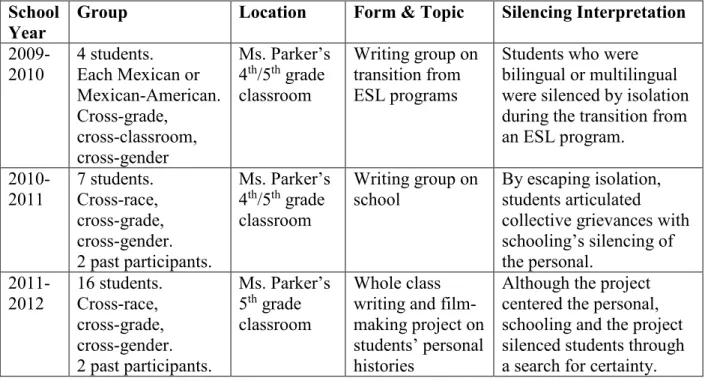
The research problem in this dissertation is schooling’s silencing. I did not set out to study anything about silencing. The problem of silencing emerged as the main research problem early in the study and has been the central problem throughout the study. I came to this claim through ongoing inductive (Coffey & Atkinson, 1996) analysis of the students’ accounts of their experiences with schooling. Because the study culminated as a writing and film-making project about schooling’s silencing, schooling’s silencing is situated as the research problem in this dissertation’s first framework layer. Figure 1.1 briefly overviews the study by year, including the context, participants, and major interpretation related to schooling’s silencing.
Figure 1.1: Study Interpretations Over Time
School Year
Group Location Form & Topic Silencing Interpretation
2009-2010
4 students. Each Mexican or Mexican-American. Cross-grade,
cross-classroom, cross-gender
Ms. Parker’s 4th/5th grade classroom
Writing group on transition from ESL programs
Students who were bilingual or multilingual were silenced by isolation during the transition from an ESL program.
2010-2011 7 students. Cross-race, cross-grade, cross-gender. 2 past participants.
Ms. Parker’s 4th/5th grade classroom
Writing group on school
By escaping isolation, students articulated collective grievances with schooling’s silencing of the personal. 2011-2012 16 students. Cross-race, cross-grade, cross-gender. 2 past participants.
Ms. Parker’s 5th grade classroom
Whole class writing and film-making project on students’ personal histories
10 2012-2013 15 students. Cross-race, cross-grade, cross-gender. Each a past participant.
After school at middle school for 6th-8th grades
Writing and film-making group on schooling’s silencing
Students strained schooling’s silencing through collective film-making about schooling’s silencing.
I began volunteering at the elementary school in early 2009 on Fridays for nine weeks. My teaching experience and research interest in the transition from ESL programs paired in a relationship of intervention with what was framed by the school staff as the district’s unjust policy to begin ESL in 1st grade. I began the work by holding push-in and pull-out groups for the bilingual students, all Latin@, in all five kindergarten classrooms. I designed bookmaking lessons and worked throughout the day to make photo books, stickered books, and other types of books with each of the five groups of students. For the remainder of the day I worked as a sort of literacy remediator for a Latino 5th grader in Ms. Parker’s (a pseudonym) class who was in transition from ESL. We spent most of our time together on decoding, comprehension, and critique of universally assigned class readings on the American Revolution. This is how I met Ms. Parker and we began to work out a study design that we perceived to be beneficial for the students, for the school, for her, and for me. Administrators and peers considered Ms. Parker to be an excellent teacher. Ms. Parker, a White woman from the Midwestern United States, was in her 20s and pursuing a Masters of Arts in Teaching through evening courses. In the fall of 2009 the ethnography began.
11
historical contexts of qualitative research, the arts have emerged as a particularly useful way to study knowledge-making processes (Leavy, 2009). This study brought art and science together in design, methodology, and representation. As Leavy (2009) explained, art and science can come together during any aspect of research to illuminate aspects of the human condition and therefore to advance knowledge. Language, and therefore writing, is entwined with the construction of knowledge, and narrative writing is a way that people make sense of their lives (Leavy, 2009). How a narrative is told and how a narrative is structured can shed light on how an individual relates to social contexts (Coffey & Atkinson, 1996). Thus, to explore experiences of the transition that was taking place, we wrote, and continued to do so throughout the study.
We met in the adjoining office inside Ms. Parker’s combination 4th/5th grade classroom. All of the students described themselves and their parents as either Mexican or Mexican
12
escaping isolation and they were persistent in pursuing escapes, which included the writing group meetings. The students were clear about their discontent with schooling’s silencing and I moved away from the previous research problem of underservice during the transition from ESL to the new research problem of schooling’s silencing.
The second year of the study was designed in response to the interpretations of the first year with the consideration that everyone looping up to 5th grade inside the classroom wanted to be in the writing group. Because the topic of the experiences of students that have transitioned out of ESL had not been the central focus of previous work, there had existed no single
theoretical perspective to guide a linear study of the experiences of the four students involved in the research thus far. Facing the need to expand participation in the writing group across
categories of difference, we fully embraced an emergent design paradigm. In an emergent design paradigm, the researcher adjusts her plans and strategies in response to what she is learning at the research site (Merz, 2002). Specifically, throughout the research process, I adjusted the
methodology (including both data collection and data analysis), research questions, and my use of related literature in order to honor the perspectives of the participants and to allow me to move towards some understanding of their experiences.
In our first major shift of design, Ms. Parker and I selected seven students across
13
school with a focus on writing, science, and events for parents for a total of 83 hours over 29 days. I conducted and transcribed 12 formal interviews and most of the interviews took place over two days. A focus emerged: collective grievances with schooling’s privileging of the technical and silencing of the personal. I also began to interpret power shifts within the group. The emergence of collective grievances with schooling and the shifts of power to heavily silenced students shifted my role to protector of the writing group. Schooling’s silencing of the personal became the research problem and we designed the next year of the study to legitimize speaking of the personal as valued knowledge at school.
Again, during the writing group all of the students in the class wanted to be in the writing group. The selection considerations that Ms. Parker and I had made the previous year created a context of opaque exclusion and hierarchy, particularly because we did not share all of our selection justification with the youth in the group or the entire class. Therefore, despite the significant changes to our own commitments, to the study activities, and to the classroom curriculum for a group of such size, we designed the third year of the study to include the entire class. This third year about half of the students had looped to 5th grade within Ms. Parker’s classroom and the other half were 5th graders from other 4th grade teachers’ classrooms. During the third school year of the study I gestated and birthed a child. Still, I observed the classroom with a focus on writing for a total of 50 hours over 25 days. I conducted and transcribed 19 formal interviews and 5 of those interviews were with pairs of students who self-selected to be interviewed together. Many of the interviews took place over two days. The students wrote about their personal histories in narrative, poetical, and theatrical form. They videotaped one another’s work and also videotaped each other speaking about the work. We used a $1,500 grant to
14
work into a one-hour film using my computer and software. The film included four sections: a) a story of the process of the personal histories project, b) a chapter for each student that included performance of the art bookended by the student’s comments during the work and a discussion with the artist, c) a section of students’ valuing statements about the project with a focus on statements about the personal, and d) a blooper reel. We held a screening of the film for school and district staff, families, and students and we distributed copies of the film. My primary role during this year of the study was organizer, as there were activities and stories taking place in a multiplicity of directions and forms and sustenance of the lengthy project inside schooling required an organizer role that involved me somewhat claiming charge of how things would emerge.
In my analysis of the data from the third year I interpreted that although the project centered the personal, schooling and the project silenced students through a search for certainty. Throughout the study many students named writing as a context for silencing in general, and situating the study during the writing period did not resolve that problem. Vicki, for example, said that silencing emerged as the topic of the final year of the writing group because of silencing during writing. She traced the earliest emergence of silencing as a topic to schooling
15
throughout the study. In other words, writing both challenged silencing and silenced. Cloud affirmed Hector’s analysis by responding to him, “That’s really good, dude.”
It was at this point in the study, the point at which a study even designed to challenge silencing was still implicated in schooling’s silencing, that I knew that in order to continue the work we would need to bring the writing and film-making groups relatively away from
schooling. Ultimately, although students who were new to the study evaluated the design as overwhelmingly positive, the students who had seen the writing groups taking place during the previous year were bitter that I had changed the design to involve a classroom project instead of a group.
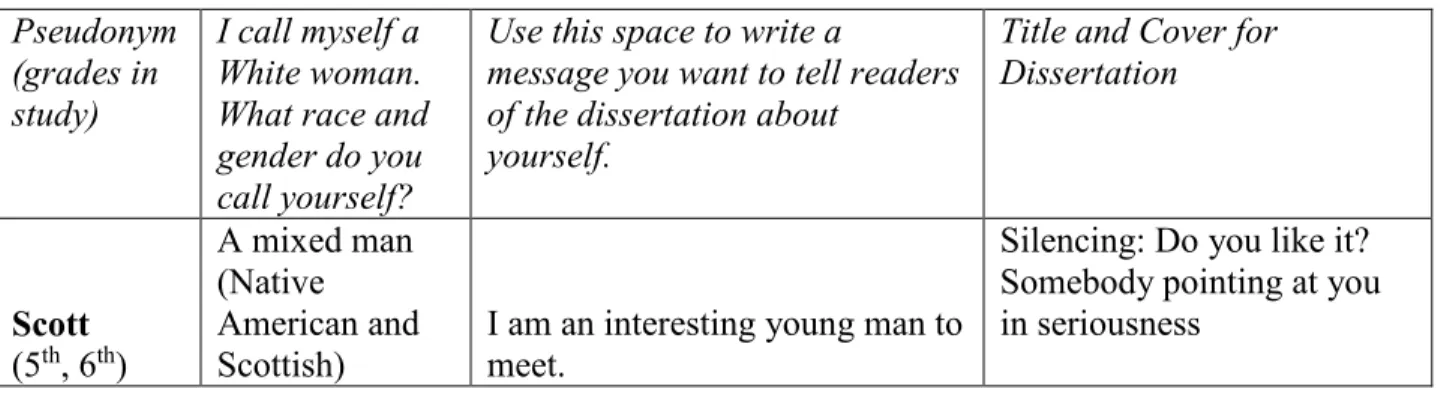
The fourth year of the study involved 15 students from the first three years of the study in an after-school writing and film-making group. The students asked that I follow them to their middle school and return to the group format for the study. We also invited all of the past participants who had since gone to the middle school to return to the writing and film-making group. Most of the 24 students still attended public school in the town and most of the 20 still attending were able to come to the group. Figure 1.2 includes the 15 students’ descriptions of themselves, their history of participation in the wider study, and their visions for the cover of a book based on this dissertation.
Figure 1.2: Students’ Pseudonyms and Self-descriptions 2013
Pseudonym (grades in study)
I call myself a White woman. What race and gender do you call yourself?
Use this space to write a
message you want to tell readers of the dissertation about
yourself.
Title and Cover for Dissertation
Scott (5th, 6th)
A mixed man (Native American and Scottish)
I am an interesting young man to meet.
16 Ann-Marie
(5th, 6th)
Puerto-Rican
and Chinese girl I love making stuff.
A Family’s Work: Made from Love
Black/White diagonal stripes
Chelsea
(5th, 6th) White girl
I’ve been writing since forever, and this group has helped me express myself through writing. I’m very bubbly and full of creativity.
Group: A Family Put
Together by Similarities and Differences
People’s hands together
Bailey (5th, 7th)
Mexican/Latina girl
I’m determined, crazy, sporty, and creative when I want to be.
Silenced 4 Life
A Latina kid with a finger on her lips
Wendi (4th, 5th, 7th)
Multi-racial young lady
I’m 13 years old. Has a colorful, bright, and sparkling personality. Loves the people all around me.
From a teen’s perspective Blocky writing, teen girl and boy hugging with foreheads and noses touching; “a couple kind of hug”
Cole
(4th, 5th, 6th) White boy
A kid who is very loud and gets agitated easily. Like a boss.
School Silencing
Blue cover with a picture of one of our scenes
Cloud
(5th, 6th) Brown man I’m awesome.
Silenced
Students working
Hector
(4th, 5th, 6th) Mexican
I am awesome. Stay fresh, stay fresh.
The Silencing Students Students working in the group
Gia
(4th, 5th, 6th)
Hispanic girl (female)
Energetic, crazy, friendly, (mean at times), pretty
Something We All Never Get Tired of Hearing Everyone in a crazy pose
Olivia (5th, 6th)
African-American girl
I’m fun, bubbly, and very creative. You will never find anyone like me.
Family: A Group of People Put Together By Love All of our hands together
Peaceful
(5th, 6th) Black female
With the deep dimples and her sparkling smile that brightens up our day.
How Silencing Affects Students
“What’s a symbol for silencing? I don’t know. That’s a good question.” Picture of a heart being broken
Quiana
(4th, 5th, 6th) Mexican female
It takes one person to change a room, one room to change a community, one community to change a nation, one nation to change the world.
17 Vicki
(4th, 5th, 6th) A Columbiana This is what I feel. Deal with it.
Silencing: The Truth About Schools
It would have all of our faces.
Yasmin (4th, 5th, 6th)
Hispanic girl/female
I’m lazy, friendly, kind, mean sometimes. I have manners and I make friends quickly. Pretty.
Awesomeness Students working
Karla (4th, 5th, 7th)
Mexican, and female.
Mexican/Latina /Meximerican
I am crazy, funny, and I love to talk, sing and act. Finally dedicated.
Silence
A person, mouth only, with no mustache, with a finger against her/his lips.
The following field note illustrates some of the issues raised with the concept of participation in the writing group.
The first day is marked by excitement. The main topic of discussion is who is here and who is not here. Also asking after families. Students show up who were not previously invited. We set up a long and wide conference table. The overwhelming topic is who should be here. Olivia and Peaceful protest my decision to only allow past group members…Yasmin explains to them that the reason we can't invite more people is, “Because no one would understand what we are doing. It took us so many years.” Vicki responds, “Exactly.” … Yasmin elaborates, “It took us three years to get the process of everything.”
It was clear to everyone that participation was enacted in a specific way when it came to exclusion and inclusion in the writing group. It is certain that participation could have been structured otherwise. I mention it here in order to highlight the 15 students’ participation over time as well as to note that participation had no fixed meaning among the group.
18
not the timing of the conflicting event was avoidable. For instance, they reported on each other’s appointments, health, trips out of town, and family commitments. In general, the only
universally accepted excuse for missing a group meeting was attention to family needs. This included, for example, visits to ill family members, care of younger siblings, and work to support family. My field notes on the emergency departure of Olivia during one meeting illustrate this interpretation well:
The Teacher and Classroom film group loses Olivia within the first few minutes of the work time. She approaches me in a disturbed state and says that something has happened to their grandmother so she needs to "go down there." She talks to her group and to her other friends in the writing group and everyone is very concerned. Everyone sends her very well wishes and she leaves quickly.
The students always knew where one another were and expected one another to attend group whenever possible. Students even arranged events with their families around group meeting days and monitored their actions at school in order to decrease the likelihood of being removed from school on the day of a group meeting. On one day Olivia “got in trouble” at school and her punishment was to return home on the school bus rather than attend group. This punishment upset the group so greatly that Olivia ended all discussion about it, got caught up with her film group’s work immediately upon return, and did not miss another group, even though her family had to make exceptionally extenuating accommodations to their schedule in order to pick up Olivia from group meetings. The students demonstrated a knowledge of attendance that was so exacting that we constructed an accurate attendance record on the last day of group without the assistance of any documentation.
19
generally proud of identifying themselves in this way. Peaceful’s description of the reputation of the after school writing and film-making group among their middle school peer groups was typical. She explained, “On Friday I get all excited to join group. They wish they was in Ms. Parker’s class.” Discussion followed on the topic of Ms. Parker and how great of a teacher she had been. Wendi added, “Ms. Parker was the best teacher I ever had. Now she’s a science administrator. What in the world?” We met on Mondays and Fridays and we always began by eating together and holding a “business meeting” around a makeshift conference table. They then sorted into three film groups to plan, cast, rehearse, direct, load, and edit their own scenes in film-making software using their personal video recording devices and school-issued laptop computers. I observed the group for a total of 74 hours over 23 days and I interviewed all of the students.
The three films emerged from the scenes of silencing that students wrote on the first day of the group when I shared schooling’s silencing as the main problem that emerged in the history of our work together over the years. The students seemed to understand the collective nature of their histories that convened on this particular writing and film-making group and agreed to center silencing. The following field notes document the group norms of the writing and film-making group that were set during the first two days.
20
defined by Hector as someone separate from me when he says to me, “You have no teacher authority.”).
With norms set, the work at hand began. After introducing the idea of film-making to address the problem of schooling’s silencing, the students took over with explication of scenes. I faded into the background as the students discussed their ideas, using interaction strategies such as asking each other to continue, repeating ideas in another way, summarizing scene themes,
offering related scenes, and evaluating scene quality based on the morality of the actions of those in the scene. In my field notes I documented my next methods move: “At this point they grasp the idea of the scene so well that I decide we should write.”
Students wrote summaries of scenes of silencing on papers and piled them onto the center of the conference table. My field notes read,
When it is time, I decide on the spot that they should sort the scenes on the wall into some sort of grouping. I tell them to take some, read them, and together sort them into something that makes sense to them. They surprise me by completing this in three minutes… jump into the collective task…moving together, arguing, coming to very fast decisions. They are in heavy analysis of their categories…Cole comments, “I think we did a lot of ideas.” Hector: “We did a whole lot.” Peaceful, Olivia, and Yasmin decide about the final few scenes. Peaceful reports to me with finality: “We're finished.” I ask them to explain their categories. Hector says, “subject” arranges them…They say there will be one Hispanic movie, one movie about relationships (this synthesis of categories is offered by Peaceful: “This one's relationships”, with Ann-Marie evaluating this as
“awesome”)…and one movie about teachers and classrooms.
The field note documents their swift analysis of the scene pile. The discussion’s culmination appeared in my transcript of early film footage:
Someone filmed the pile of scenes that was growing on our conference table. The voice over plays as follows:
Hector: “These are our skits.”
21 Gia: “They are scenes.”
Further description of the action around one of the scene categories illustrates their newfound forms of engagement. The first analysis move was made by five of the Latina students who said that their scenes all had the “same topic”, which was the prohibition of Spanish at school. Hector then offered the idea of a “Hispanics film” made by “all the Hispanics.” Cole responded that this would not work with his comment, “Man, I’m Caucasian,” which evoked universal loud laughter. The immediate centering of race was unique to this outside-of-class group in
comparison to the previous three groups, which had taken place inside classrooms. Engagement was also markedly heightened. There was heavy debate and conflict, and the scenes were flying into the center of the table. Some students were creating additional scenes and some had stopped writing in order to listen and talk about the idea of the prohibition of Spanish as silencing.
All of the students had written several scenes of silencing and contributed them to the pile of scenes. The four groups of sorted scenes included: scenes of silencing Spanish, classroom and teacher scenes, relationship scenes, and a group of visions for what should be that included a single scene. This single scene and its author’s idea was incorporated into the classroom and teacher film and the students began storyboarding and filming three films based on ideas they selected from the pile of scenes constructed by the group. The students self-selected themselves into three film groups, which all used different techniques to focus on the three topics.
22
This included a set of questions added to the interview guide: Tell me about a time in your life when silencing (related to your film topic) was good. What good came from the silencing? How was this time different from the time when silencing was a problem? How does good come from silencing?
Chapters 2, 3, and 4 provide understanding of the subsequent film-making work. Each day began and ended with a business meeting during which we ate together, discussed plans and problems, and shared ideas, conflicts, and decisions. The remainder of the time was devoted to writing, storyboarding, imagining, rehearsing, performing, creating, producing, and editing. I ascribed to the method of only using technology that was already available to the students. Each film group had access to at least one iPod or iTouch and school computer, and we troubleshot access issues as a whole group. I also committed to never touching that technology, including filming devices, downloading setups, and computer hardware and software. I mention these methods because they in particular surely influenced the films and practices.
23
involved the most preparation were usually filmed with the greatest sense of urgency and in the shortest amount of time. For instance, I wrote the following field note for one major scene:
Wendi has to leave at 4:00 and she needs to be in the auditorium scene. I notice that this is the only strategy that moves the filming along—when someone has to leave and the scene must be shot before the departure. This has sped along many scenes and I am amazed at the sense of urgency they get when one of the members needs to leave…They have the scene and we move to the auditorium with urgency to film the auditorium scene before Wendi leaves.
More on audiences
As indicated by their established discourse about and input into the dissertation as well as a moment at which they told me they, “approve of this wonderful book you shall make,” the youth had an understanding of the academic audience of my accounts of their work. The youths’ intended audiences for their work seemed to be academia, teacher education, and mainly, the film groups themselves.
The audiences of the films shifted around a bit during the film-making, but were
overwhelmingly the three film groups. The youth understood dissertation readers to be another audience. Dissertation readers, to the students, included professors and people studying to become teachers. In addition, since the study’s inception, the students envisioned a book that would eventually be published about their writing group over all four years.
24
the field notes I wrote that they neither wanted nor sought any feedback from me. On another day my field notes described a trend that I was being sent away from the groups to observe from the fringes because I was “slowing things down and out of the information loop of the team.” In my field notes I located the moment in which I realized that the students’ audiences for their films were their film groups. This moment occurred early in the study.2
At the end of each scene take that goes to the end of the scene without producing a blooper, the whole entire group erupts in clapping. The feeling of something finally having been accomplished in a final product after all of the hard work they have done together is overwhelming. The feeling of collegiality and collectiveness is stronger then when we showed the final video at the film screening premier [last year in the study]. This tells me that the production of a scene by a group involving other members in the group, also working on parallel projects, is much more powerful than the production of a product for an outside audience. This challenges my idea of the purpose of the film-making as speaking to audiences involved in schooling's silencing. They may in this case be speaking just to each other and that is enough.
Some description of the wider context of the study clarifies the significance of this comparison. During the previous year of the study each student in a combination 4th and 5th grade classroom wrote and produced an audiovisual representation of a story that was important to that student’s own personal history. We then edited the individual film footage along with footage of the entire
2 This exact moment was also significant because the day’s work showcased the incredible acting and improvisation
25
process, which took place during several months during the regular classroom writing period, into a feature film length video. We held a public screening and teachers, families, and district officials attended. This audience was an ultimate audience in that third year of the study, and as it was constructed by the youth, I had come to value it so highly that I assumed its permanence.
Interview Methods
The interview excerpts that appear in this dissertation are all from the final year of the film-making group. For purposing the interviews in relation to the films, I used Stake (2006) as a general guide. He wrote, “An interview should be less about the interviewee than about the case” (Stake, 2006, p. 31). This purposing also aligned with my careful intent to study the film-making work and practices rather than study the children themselves. Because the first
framework layer of the dissertation is organized into three cases, the interview excerpts generally serve to enrich understanding of each of the three cases rather than to claim caricature of any individual student. This was initiated through the interview topics being, for example, interpretation of the film, meaning of the film group, story of the film group, the film group’s form of silencing, silencing in general, and interpreting confusing or filling in incomplete observational field notes I had taken during their film-making work.
Much of the interviewing took place in pairs or triads of students. The students were familiar with choosing the configuration of their own interview groups and arranged and scheduled themselves. Because I was in large part studying the films as cases by the end of the study, I imposed on their arrangements that at least one interview session had to be closed to members of a film group. Our preparation for the interview included an explicit discussion about speaking for self or others during film group interviewing. I observed and recorded the
26
interviews. In this dissertation quoted material is speech that took place verbatim and unquoted speech is my own estimation of what was said. We used either our classroom or a conference room in the school office suite to conduct our interviews. Below is a field note documenting our planning of when the interviews would take place.
I bring up the question about pulling them from class for interviews. They argue for it. I decide to compile a list where they will write down their last two classes of the day, teachers, and which ones they can be pulled from (or want to be pulled from). There are critiques of classes, most notably, the study hall class called “learning lab” and AVID [Advancement Via Individual Determination]. They mostly argue for missing a class based on what they are doing in that class right now and how often other people get pulled from that class. A final issue is who will partner with whom for interviews and we spend some time working this out along with the list. When Yasmin says that she wants to be Gia’s partner Gia says, “I feel loved.” The partnership issue is important to them. I did not even think of it when I circulated the list idea but they were working under the assumption of coordination even before I realized they were doing so.
The interviews took place during the school day with a sign indicating that the closed door was not to be disturbed. Whenever an interview took place during class time it was with permission of that teacher on that day. In each case I used written confirmation or verbal confirmation with teachers. Most of the interviews took place at the end of the standardized testing season towards the end of the school year. In many cases, the classes were engaged in student-elected activities to celebrate that milestone, such as watching full-length feature films as a class or as a grade level. In no case would I have pulled a student out of class activities for an interview if the student and/or teacher declined the invitation. The students protected the class time most important to them using the collective scheduling tools described above and I followed their scheduling at all times of the school day during the final days of the study. The following field note illustrates a typical teacher reaction to an interview scheduling inquiry.
27
Hears a Who with another class… The make up tests have been finished this morning. She talks with her husband on the phone, eats her lunch, she is tired, as she has been proctoring for seven days straight. She told the office that they should not use her up. They laughed but she was serious. She feels she has been pulled more than anyone else for testing.
The general sense among the group when the interviewing was taking place during school was excitement. The students would sometimes meet me at the front door to make plans after they spotted my car pulling up. In one field note I wrote, “They are very excited. They do not want to go back to class. They want to be pulled. So I write slips for their teachers asking to pull if they are available. All come back with permission.” This field note indicates how at times a few students would convene in our classroom during school before or after their interviews. During those times they worked together on film-making tasks such as editing their films while I transcribed interviews. It was not unusual for students and I to work in parallel on research activities in school spaces outside of group meetings over the course of the study.
Methods of Analysis
The ethnographic account within this dissertation is organized by film topic, which included the silencing of Spanish as racism, the silencing of students’ romantic relationships, and silencing in classroom teaching. I began constructing the logic of this first analysis by using the analytic method of articulation, originating as a strategic theory/method in cultural studies (Hall, 1986). On articulation as method, Hall said,
The two parts are connected to each other, but through a specific linkage, that can be broken. An articulation is thus the form of the connection that can make a unity of two different elements, under certain conditions. It is a linkage which is not necessary, determined, absolute and essential for all time. You have to ask, under what circumstances can a connection be forged or made? So the so-called ‘unity’ of a discourse is really the articulation of different, distinct elements which can be
28
which it can, under certain historical conditions, but need not necessarily, be connected (Hall, 1986, p. 53).
Articulation served to enter the youths’ films in a way that could lead to case analysis. As anyone who facilitates the arts knows, children create in ways that don’t often subscribe to predictable structures. In the case of the film-making group, our following the design aspect of youth control of their own digital technologies allowed for the creation of films that challenge norms of cogency and linearity. Descriptions of some of these complexities appear later in the dissertation, and I mention them here to illustrate the need for some deductive (Coffey & Atkinson, 1996) method of analysis to set up a written account across the three very different films. The method of articulation beautifully recognizes that the film scenes have no inherent meaning but can also be employed in critical stance. The interpretations formed through the articulations are my “readings” of the films, keeping in mind the understandings built over time throughout the years of the study, namely, that the work at hand was critique of schooling’s silencing.
For each of the three analysis chapters I articulated a set of two scenes from one film group’s film. Chapters 2, 3, and 4 are the analyses of what the students called, “The Hispanic Movie”, “The Love Movie”, and the “Classrooms” movie, respectively. Each pair of scenes included one scene illustrating the form of schooling’s silencing on which the film group focused and one scene illustrating possibility for social change related to that form of schooling’s
29
using “extras”, “bonding”, and adding alternate endings. Through this structuring of the account, I both justify and mark as contingent the youths’ silencing theorizing using the practices going on (Hall, 1997, p. 9).
The methods of analysis for this dissertation relied on visual representation of still images from final film footage that the youth produced. In order to make a representational decision about stills of the scenes in a visual articulation I consulted a brief review of ethics and visual imagery research (Wiles, Prosser, Bagnoli, Clark, Davies, Holland, & Renold, 2008). The ethical considerations of research reporting on arts-based research with children are far more complex than the legal permissions that sufficiently cover this study’s activities. The emerging subfield most relevant to this dissertation focuses on representing youth participants’ own images of themselves, particularly when the youth and their families intend to move the art
post-production. Three major factors in that subfield are the dehumanization of post-production editing techniques for obscuring identity, violation of the artistry of visual images, and family review of each image for each instance of research representation. In a conservative attempt towards reconciling anonymity and the youths’ artistry, I edited the articulated scene still images with Kartoonizer software in the Old Comic setting. In addition, at places in which the students used their names to intentionally identify themselves for audiences of the dissertation and film footage, I opted to use pseudonyms instead.
In this dissertation I acknowledge that the nature of assumptions renders them in a state of inevitable contestation and I have aimed to be explicit about the assumptions underlying the project. If I had to name one tradition, I would describe the methodology of the first framework layer of the dissertation as post-critical (Noblit, Flores, & Murillo, 2004), which involves
30
traditions. The two traditions come together over the centering of power relations in social constructions. Critical ethnography emerged as a methodology when the power of the critic was problematized for critical theory and when colonialism was problematized for ethnography. Post-critical ethnography is about representation of a multiplicity of ideas in a political project that also acknowledges the role of the researcher in domination. In this dissertation project I work under the assumption that, “Theory is interpretation by a subjective, positioned, political,
ideological, historicized, emotional, situational, relational being” (Noblit et al., 2004, p. 34). The analysis is critical because I set up the analysis of each film using the method of articulation (Hall, 1986), but writing towards a local practice in each case leads me to view the analysis as predominantly constructionist.
31
Throughout the framework layers, I keep the critical roots of the analysis structuring in mind yet reconsider the analysis as a whole as constructionist. Exploring the nuances of the relationships between the critical and constructionist aspects of the account is certainly a project for a more extensive reconsideration than I have accounted here. But because that project would inevitably center me as the researcher rather than the youths’ film-making, I marginalize it for some other time. Considering my own education in a multiplicity of critical social theory traditions, it is not surprising that they are deployed together in order to represent an account of youths’ critique of their own schooling.
Post-critical ethnographers make no claims of objectivity and instead explore
representation ends involving strategies such as reflexivity that elaborates alternative possibilities in the research; the postpositivist notion of reliability is not a concept with which post-critical ethnographers work. In terms of validity, post-critical ethnographers do not aim to generalize across contexts. The closest concept in post-critical ethnography to the concept of validity is transferability. Transferability can only happen when an audience of the research representation interprets through the richness of the description that the research demonstrates trustworthiness and may be useful in another context. Therefore, in this dissertation I attempt to minimize application across contexts of schooling. Instead, I provide richness of description so that an audience of the dissertation might come to a deeper understanding of schooling’s silencing through the films.
32
1. What happened in the group that explicitly addressed silencing through film-making? 2. How did silencing play out over time in the processes of the three student film teams? 3. How did the students represent and evaluate silencing?
I coded line by line using Dedoose qualitative data analysis software. This software allowed me to code excerpts across the data and to export by code while maintaining links to cases. It also allowed me to export those same excerpts by case while filtering for coded data. Organizing by film group case emerged as the way in which I would analyze and account for the films and the film group practices. On the other hand, in order to allow for more detailed study of themes that had already been emerging, such as silencing, I also deployed a matrix approach for students’ interview comments about certain topics. With the students’ comments on silencing positioned as theorizing, the coding became somewhat abductive, which involves moving back and forth between data and theory. More specifically, this strategy begins with the particular, connecting the particular with broader concepts as the researcher aims to come to interpretations (Coffey & Atkinson, 1996). This strategy allowed me to consider how the data spoke to the students’ theorizing about silencing rather than confining interpretations to my existing understanding of silencing. Most notably, the matrix was instrumental in accounting about silencing. I organized the matrix by film group and then within film group by student. The matrix allowed me to better understand nuances between student perspectives. One important function of the matrix, for example, was distinguishing the nature of silencing from explanations for silencing. Such nuancing paired with the patterning function of thematic coding to provide a richer
33 Agency for social change
The first framework layer culminates with some sense of the students theorizing not only how silencing works but also how silencing can be challenged. Although Chapters 2, 3, and 4 are about the films and about the three forms of silencing taken on in the group, the first framework layer is more about the injustice of systemic silencing and the students’ calls for change.
Students seemed to feel as if they had agency for change. They did not seem to feel deterred, at least not completely, by social problems. I came to this interpretation not only for the problem of schooling’s silencing but also for other social problems. The following
discussion is a typical excerpt that led me to believe that the students felt some sense of agency when it came to social problems.
Quiana talks about Macklemore’s song about gay rights. Vicki argues for Ellen Degeneres.
Quiana: “It’s like sometimes standing up for what you believe in might cause you problems at first but sooner or later those problems go away and people will love you.” Vicki: On Ellen Degeneres, “She started from the bottom.” They know a lot of her biography.
About gay rights: Quiana: “The most hurtful kind of silencing is probably this one...They are just outcast. Like a nobody. Nobody gives a crap about them.”
In addition to providing an illustration of students’ theorizing on changing social problems, when considered in the context of the purposes of the film-making group, this excerpt also indicates that at least some of the time, students seemed to use the language “silencing” in order to
34
They talk about a gay student and a lesbian student [currently at their school] and how they have rights. They talk about examples from popular media too. Quiana said to her friends about the lesbian student, “She’s a person.”
Quiana: “People would rather remain voiceless than stand up for people who have had their rights stolen.”
This excerpt can serve as a reminder that students took a moral stance when it came to social problems. Thus, in this dissertation, I reject a relativistic argument on schooling’s silencing and its related social problems such as racism, isolation, and the many others that surfaced during our work together over the years, whether or not those problems glimmer in this dissertation.
Educational research offers many ideas for finding moral footing. In ethnographic accounting of participatory research with youth I seek moral stance in students’ perspectives on social
problems.
Furthermore, in the students’ work there is clear acceptance of the multiplicity of the silencing problem. They have no issue understanding that (as adults seem to). The problemness of silencing is what they come together on, and not even the problemness for an individual but the problemness for collectives. One student, for example, explained that the silencing topic brought them together as a group rather than having been a topic chosen by a collective with an existing groupness.
The following field note excerpt marked the first instance in which I interpreted any of the groups to be representing change in some way.
When I think about their films they are all about forms of silencing. One film is also about change for teachers and classrooms. This presents interesting visions for schooling I think, even if they are not scenes of navigation.
35
topics as a form of schooling’s silencing. The implications for the concept of change in this field note are also nested within evidence of a turn in the overall emerging design of the study.
Because for this dissertation I aimed to decenter my own experiences in the study, even as they relate to methodology, I include this field note excerpt as a mile marker in the story about students’ perspectives on changing social problems.
The students viewed the film-making itself as agentic for social change. The following data excerpt illustrates the furthest reaches of the representations of change. The excerpt documented the end of an interview with Gia and Yasmin.
Amy: “Anything else?”
Gia: “I wanna say one more thing. When you’re silenced, tell a teacher about this group. Well not about this group but about silencing...Say it’s silencing, maam.”
Amy: “What’s that gonna do?”
Yasmin: “Probably tell them why people talk back to them, cause they don’t like to be silenced.”
Amy: “What good will come out of it?”
Gia: “You teach the teacher. She finally has a lesson for herself, that silencing is silencing.”
Amy: “Could any bad come out of it?”
Yasmin: “She would probably feel bad. Like she was doing something bad?” Amy: “For you? The kids?”
Yasmin: “I don’t think so?”
Gia: “Yeah, if you say it in a mean way. If you say it in a respectful way you might not be in as trouble as you would.”
36
change. Second, the teacher finally having learned “a lesson for herself, that silencing is silencing,” can be understood as a movement of understanding taking place at that site. That movement of understanding is, in this case, specific to schooling’s silencing. Third, the students’ speculation about what would happen during that movement of understanding suggests a
boundary to their visions for social change. In other words, and most importantly, the alternative rendering that they worked to envision and create in their film-making stops at movement of understanding between teacher and student, leaving systems of and beyond schooling
unimagined beyond critique. Finally, this was Gia’s final comment, and she phrased it in a clear command for me. Throughout the ethnographic account of Framework Layer 1, I take students’ finality, brevity, and commanding as markers of valuing.
Framework Layer 2: Agential realist reconsideration of the ethnographic account
The second framework layer of this dissertation is an agential realist reconsideration of the three film analysis chapters. Despite having represented an account of the students’ film-making based on analytic and writing approaches I trusted as ethically sound, the
representation’s underlying message about the agency of the writing and film-making group was incompatible with our sense of agency lived. Static understanding evokes discontent in the way of knowing that produced the account. In a moment caused by a particular history of my
learning to research, I reached across paradigms to engage theory as a way to generate movement in understanding.