This is chapter will be published in: Triandafyllidou, A. and Gropas, R. (eds.), “European Immigration: A Sourcebook”, Second Edition, Aldershot: Ashgate (in print).
Chapter 22
The Netherlands
Saskia Bonjour and Peter Scholten
22.1 Introduction
In the late 1990s, the Netherlands still enjoyed an international reputation as an open and pluralist country, where migrants were granted extensive rights and anti-immigrant politics were relatively insignificant. Today, the ‘multicultural’ model is rejected perhaps more fiercely in the Netherlands than anywhere else, and the Netherlands are amongst the most vocal proponents of restrictive migration policies in Europe. In this chapter, we will discuss how the tumultuous developments of the last decade have affected migration trends, policies and debates in the Netherlands.
Already in the early 1990s, Dutch politicians had abandoned their famous ‘ethnic minority’ policy for a ‘migrant integration’ policy which emphasised socio-economic participation rather than cultural rights. In parallel, they strove to curtail immigration through a series of restrictive reforms of asylum and family migration policies, as well as by excluding irregular migrants from almost all public services. After the turn of the century however, Dutch public and political debate on immigration and integration took a radical turn as a result of the 9/11 attacks and – most importantly – the political success and murder of
anti-immigrant politician Pim Fortuyn in 2002. Mainstream political parties interpreted Fortuyn’s success as a consequence of their own failure to address the Dutch public’s concern over the migration issue, and adopted a much harder line so as to regain their voters’ confidence. As a result of the success of Geert Wilders´ Freedom Party since 2006, anti-immigrant politics remain a significant factor in Dutch politics until today.
tendencies, yearly immigration rates have continued to rise. Both the limited policy change and the rise of immigration flows are partly related to developments at EU level: the accession of countries in Central and Eastern Europe on the one hand, and the emerging European Asylum and Migration Policy on the other hand.
22.2 Major Developments in Migration Policy
The intense public and political debate about immigration over the last decades has resulted in restrictive policy reforms especially in the field of family migration. With regard to labour migration and asylum however, policy reforms have targeted efficiency and selectivity rather than closure. In all areas of migration policy, the impact of the European Union has increased substantially.
22.2.1 A new policy arena: the European Union
The Netherlands used to be among the most enthusiastic supporters of the
development of a European asylum and migration policy. It lobbied actively for granting the European Union competence to develop Community Law in the field of asylum and migration through the Treaty of Amsterdam (1997). Over the past decade, a body of EU laws on asylum and migration has been introduced and the EU court has started to develop its jurisprudence. This Europeanisation has limited the room for manoeuvre of Dutch policymakers in ways they had neither intended nor foreseen (Bonjour and Vink forthcoming).
Through a series of EU court rulings, the Netherlands has been obliged for instance to lower its income requirement for family migrants, to stop returning asylum seekers to Greece, to lower the administrative costs of residence permits, and to exempt Turkish citizens from obligatory civic integration programs. Mostly although not exclusively on the right side of the political spectrum, politicians resent the reduction of national sovereignty over immigration and the obstacles posed to restrictive reforms.
ambitious, but it continues to lobby for restrictive reform of EU law especially on family migration.
22.2.2 Family Migration Policies
Since the early 2000s, family migration has come to be considered the most problematic type of migration, not only because it constituted the largest inflow but also because of the vulnerable socio-economic position of many family migrants. Moreover, family migration was considered a symptom of problematic cultural and religious differences between native Dutch and Muslim migrants. Debates focused on Turkish and Moroccan family migrants who made up 30 per cent of family migration in the early 2000s. In 2003, 75 per cent of young people of Turkish and Moroccan background chose a partner from their country of origin (Hooghiemstra 2003). This was considered a symptom of failing integration into Dutch society.
In 2004, the income requirement was raised from 100 per cent to 120 per cent of the minimum wage and the minimum age was raised from 18 to 21 years. As of 2006, family migrants from ‘non-Western’ countries were obliged to pass an exam about Dutch language and society before being granted entry. In 2010, the level of this language exam was raised from A1 minus to A1 and a reading test was added. In the same year, the income requirement was lowered to 100 per cent of the minimum wage again as a result of the EU Court’s
Chakroun ruling.
There are a number of further restrictions which the Dutch government has wanted to introduce for years, such as education requirements for family migrants and sponsors, a minimum age for spouses of 24 years, and an income requirement of 120 per cent. However, the EU Family Reunification Directive does not allow for these reforms.
22.2.3 Asylum Policies
As asylum inflows have decreased substantially since the early 2000s, asylum no longer dominates public and political debates. However, the Dutch government has continued its efforts to shorten and simplify asylum procedures.
In 2000, the different types of residence permits for refugees and persons with
are granted the same temporary residence permit, which may be replaced by a permanent permit after five years.
In 2010, the asylum procedure was modified substantially. Decisions on asylum applications must normally be taken within six months, extended in exceptional
circumstances to one year. Since 1994, there was also a shortened procedure of four to six working days, in which ‘apparently unfounded’ cases were treated. Almost all applications were rejected in this shortened procedure. The new procedure introduced in 2010 stipulates that asylum seekers must be granted a ‘rest and preparation period’ of at least six days before the actual procedure starts. These preparations include a meeting with legal counsel, a medical examination, and document and identity checks. The ‘general asylum’ procedure which follows takes no more than eight working days, in which the first and second hearing must take place. Only complicated cases may be referred to the ‘extended procedure’ of six months. In 2011, 56 per cent of cases were decided in the eight-day ‘general procedure’. Of these, 39 per cent of applicants were granted a residence permit. The Dutch Council for Refugees, the major refugee interest group, is largely positive about this new procedure.
However, a very large group of asylum seekers who had applied many years ago under the old procedures were still in the Netherlands, often still awaiting a final decision on their application. In 2007, the centre-left Balkenende IV government implemented a ‘Pardon Regulation’ whereby all persons who had filed an asylum application before April 2001, had since stayed in the Netherlands and had not committed a crime, were eligible for
regularisation. In total, 28,000 persons were regularised through this pardon.
22.2.4 Labour Migration Policies
The large majority of labour migrants in the Netherlands are EU citizens, migrating under EU law on the free movement of workers. Intra-EU labour migration used to be
these concerns, restrictions on the labour market access of Bulgarians and Romanians will only be lifted at the latest possible date, that is in January 2014.
With regard to labour migration from third countries, the Dutch government strives to develop speedy and simple admission procedures for foreigners who are expected to
contribute to the Dutch economy. In 2004, the ‘Regulation Knowledge Migrants’ was
introduced. It provides facilitated entry for migrants with high salaries, which are currently at least €51,239 gross per year, or €37,575 for those less than 30 years old. PhD candidates and medical specialists in training who earn at least the minimum wage can also qualify.
Knowledge migrants’ family members are granted entry without further conditions. In 2011, 5,047 persons were granted entry to the Netherlands as knowledge migrants, and a third of these were from India.
Since 2006, the government has been working on a new labour migration policy. This ‘modern migration policy’ was adopted by Parliament in 2010, and is scheduled to enter into force in June 2013. Under the ‘modern migration policy’, companies and institutions are attributed increased responsibility for documentation and behaviour of their foreign employee(s), subject to administrative and financial penalties. After a solvability and reliability check, employers can be labelled as a ‘recognised sponsor’ by the Immigration Services. This status gives them access to facilitated procedures: all applications filed by ‘recognised sponsors’ should be treated within two weeks.
22.3 The Netherlands’ Immigrant Population and Migration Trends
22.3.1 Immigrant population
Table 22.1: Immigrant Population the Netherlands on 1 January 2012
Population As percentage of total population
Total population 16,730,348 100%
Foreign nationality of which EU citizens
786,057 360,847
5% 2% Foreign born
of which born in EU
1,772,204 433,260
11% 3% Foreign born or parent(s) foreign born
of which (parents) born in EU
3,494,193 946,621
21% 6% Source: Statistics Netherlands http://statline.cbs.nl (accessed: 11 March 2013)
Definitions also matter in determining whether the migrant population is on the rise. The percentage of foreign nationals is stable at five per cent since 1995. However, the
percentage of foreign born has risen from eight per cent in 1995 to the current 11 per cent, and the number of persons born abroad or with parent(s) born abroad has risen from 16 per cent in 1995 to the current 21 per cent.
Table 22.2 below lists the major groups of migrant backgrounds in the Netherlands. The five major groups, which each make up about 10 per cent of the total migrant background population, are of Turkish, Moroccan, Surinamese, Indonesian, and German origin. Germany is the largest neighbouring country, with which exchange and mobility has been high for centuries. The first Turkish and Moroccan migrants came to the Netherlands to work in the 1960s and 1970s: their number has since grown through family migration. Surinamese and Indonesian migration to the Netherlands peaked around the independence of these former colonies, in the 1970s and 1950s respectively.
Four other groups make up much smaller but still significant parts of the Dutch
migrant population. The population from the Dutch Antilles and Aruba increased especially in the 1990s. These islands are still part of the Dutch Kingdom, be it with different statuses, and their citizens may enter and reside in the Netherlands freely. Belgium of course is the
1970s. The Polish population finally is a relatively new population, which has increased steeply since 2004.
Table 2: Major Migrant Groups in the Netherlands on 1 January 2012 Total First generation:
foreign born
Second generation: parent(s) foreign born Total foreign
background population
3,494,193 1,772,204 1,721,989
Turkey 392,923 197,107 195,816
Indonesia 377,618 114,558 263,060
Germany 376,606 108,290 268,316
Morocco 362,954 168,214 194,740
Surinam 346,797 183,752 163,045
(former) Dutch Antilles and Aruba
143,992 82,693 61,299
Belgium 114,022 38,876 75,146
Poland 100,775 77,642 23,133
Former Yugoslavia 80,837 52,552 28,285
Source: Statistics Netherlands http://statline.cbs.nl (accessed: 11 March 2013)
22.3.2 Immigration Trends
Source: Statistics Netherlands http://statline.cbs.nl (accessed: 11 March 2013)
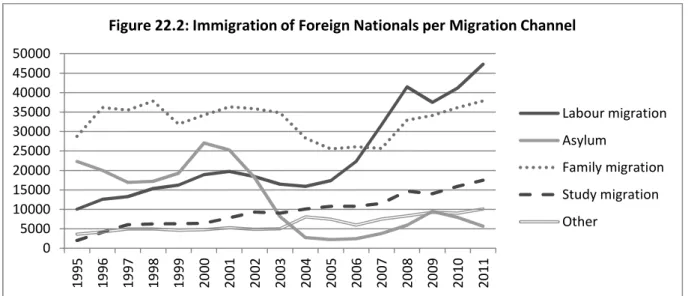
This fluctuation is related to major changes in the different migration channels since the mid-1990s, shown in Figure 22.2 below. In 1995, family migration was the major
migration channel, with asylum inflow just below that. The drop in overall immigration rates shown in Figure 22.1 above is explained by the sharp drop in asylum inflow after 2001, as well as by the less dramatic decrease of family migration after 2003. The rise in overall immigration rates after 2005 is explained in small part by the modest rise of family migration after 2007, but most of all by the steep increase in labour migration after 2007. Today, labour migration is the largest migration flow to the Netherlands, followed by family migration. The number of foreign students has risen steadily, especially from China and Germany. While in 1995, asylum was a major migration channel and student migration almost insignificant, in 2011 foreign students outnumbered asylum seekers three to one.
0 20000 40000 60000 80000 100000 120000 140000
Source: Statistics Netherlands http://statline.cbs.nl (accessed: 11 March 2013)
The decrease of family migration from 2004 until 2008 is most probably related to the raise of the age and income requirements for family migrants in 2004. Evaluations have shown that especially family migration from Morocco, Turkey, and Surinam dropped sharply immediately after these reforms. Since 2008, Moroccan and Turkish family migration has picked up slowly. The rise of family migration since 2008 is mostly due however to the families of workers from Central and Eastern Europe, particularly Poland, coming to the Netherlands.
The sharp decrease in asylum inflow to the Netherlands since 2001 is mostly related to global developments, such as the reduction of refugee flows from former Yugoslavia, the former USSR, Iraq and Afghanistan. Since 2007, refugee flows from Iraq and Somalia have increased again, but numbers remain relatively low. At least in part, the decrease may also be related to the reforms of the asylum procedure implemented in 2000: the shortening of asylum procedures and the reduction of appeal possibilities may have discouraged asylum seekers from coming to the Netherlands.
The sharp increase in labour migration flows is due mostly to rising flows from other EU countries. The percentage of EU nationals among labour migrants has risen from 65 per cent in 1995 to 80 per cent in 2011. Most of these new EU labour migrants come from Central and Eastern Europe, especially from Poland: in 2011, 27 per cent of all labour migrants were Polish. Labour migration from Southern European countries has also increased, probably as a result of the economic crisis. Labour migration from Italy, Spain, and Greece has more than doubled since 2008. The number of labour migrants from each of these countries remained below 2,000 in 2011, however, whereas the number of Polish labour migrants was 13,000.
0 5000 10000 15000 20000 25000 30000 35000 40000 45000 50000 1 9 9 5 1 9 9 6 1 9 9 7 1 9 9 8 1 9 9 9 2 0 0 0 2 0 0 1 2 0 0 2 2 0 0 3 2 0 0 4 2 0 0 5 2 0 0 6 2 0 0 7 2 0 0 8 2 0 0 9 2 0 1 0 2 0 1 1
Figure 22.2: Immigration of Foreign Nationals per Migration Channel
Labour migration
Asylum
Family migration
Study migration
Labour migration from Asia, especially India and China, has also increased sharply: about 1,500 Chinese and 2,000 Indian labour migrants came to the Netherlands in 2011. Most Indian migrants come as ‘knowledge migrants’ .1
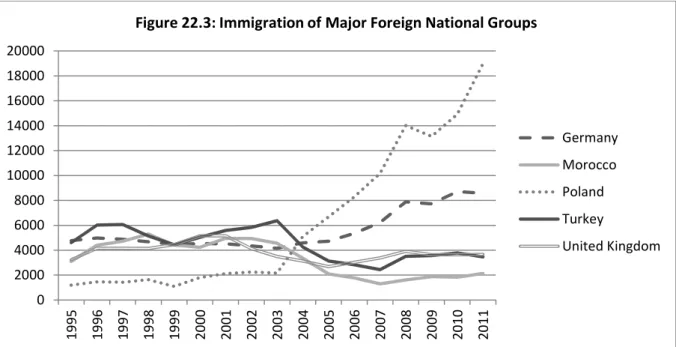
Figure 22.3 below shows the fluctuation of the yearly migration rates of the five groups with the highest immigration numbers since 1995. Until the early 2000s, Germans, British, Moroccan and Turkish nationals were the major immigrating groups. As of 2004, the immigration of Moroccans decreased sharply, while Turkish immigration decreased at a somewhat slower rate. As of 2008, Turkish and Moroccan immigration has started to rise again, but it is still far from the levels of the early 2000s. UK immigration has decreased slightly, while German immigration has increased. The most spectacular change however is the increase of Polish immigration. From 1995 until 2002, the yearly immigration of Poles was between one and two-thousand. Since the Polish accession to the EU in 2004, the number of Poles immigrating each year has risen steadily to reach almost 19,000 in 2011. This steep increase in Polish immigration is the most significant development in recent migration trends to the Netherlands.
Source: Statistics Netherlands http://statline.cbs.nl (accessed: 11 March 2013)
Finally, a short word on the ‘uncountable’: Van der Leun and Illies (2009) have estimated that the number of irregular migrants in the Netherlands was almost 90,000 between
1
see Jennissen 2012 for a detailed discussion of background and trends in different immigration types until 2009. 0 2000 4000 6000 8000 10000 12000 14000 16000 18000 20000 1 9 9 5 1 9 9 6 1 9 9 7 1 9 9 8 1 9 9 9 2 0 0 0 2 0 0 1 2 0 0 2 2 0 0 3 2 0 0 4 2 0 0 5 2 0 0 6 2 0 0 7 2 0 0 8 2 0 0 9 2 0 1 0 2 0 1 1
Figure 22.3: Immigration of Major Foreign National Groups
Germany
Morocco
Poland
Turkey
2000 and 2005. Most irregular migrants either overstay their visa, or fail to depart after being denied asylum.
22.4 Immigrant Rights and their Participation in Public Life
22.4.1 Migrant Integration Policies, Rights and Citizenship
Access to rights and citizenship for newcomers is regulated by the Civic Integration Act as part of Dutch civic integration policies (‘inburgeringsbeleid’). Permanent residency is granted only after immigrants have passed a (post-entry) civic integration test. Since 1998 there had already been an obligation to participate in civic integration courses, but the new act passed in 2006 stipulates that newcomers are obliged to pass this test. The civic integration test consists of a practical part (proving language proficiency and familiarity with Dutch society in real-life situations), and a theoretical part (proving basic knowledge of Dutch society and A2-level proficiency in Dutch). Since 2012, newcomers have to finance their participation in civic integration courses and select course providers themselves. Besides newcomers or newly arriving migrants applying for a permanent residence status, settled migrants (even with citizenship) can also be asked to take part in civic integration courses in case of dependency on welfare state benefits. Since 2010, passing this post-entry test is also a requirement for naturalization.
An evaluation in 2010 revealed that almost all participants were eventually able to pass the test, and 80 per cent of the participants even managed to pass the test on their first try. However, little is known of the more enduring effects on the participation or integration of those who have passed the post-entry (and in some cases also the pre-entry) integration tests. A recent evaluation revealed that almost half of the participants in the civic integration programs oriented towards employment did find a job within a reasonable period, but often also lost the job soon thereafter, possibly due to the economic crisis.
seven years. Active and passive political rights on the regional and national level are restricted to Dutch citizens only.
Naturalisation is seen as the end-result of successful integration. Apart from special regulations for persons of Dutch ancestry (where a form of ius sanguinis applies) or
inhabitants of the Dutch Kingdom (the former Dutch Antilles), Dutch citizenship can only be acquired if the applicant has a permanent resident status, has stayed in the Netherlands for at least five years without interruption (does not apply to family migrants) and has successfully completed the (post-entry) civic integration test. Formally, dual citizenship is not permitted (since 1997) and the applicant has to renounce the original citizenship; in practice, many exceptions apply, such as in cases of family migration and in cases where the country of origin does not allow for renouncing ones citizenship. However, the number of naturalisations has decreased sharply since the end of the 1990s; partly this is due to stricter rules but partly also to the disproportionally high numbers of naturalisation at the end of the 1990s by migrants who had already been in the Netherlands for a longer period. Since 2006, a
naturalisation ceremony is held to mark the status of the occasion. Since 2009, a declaration of solidarity is included as part of this ceremony to further mark the allegiance to Dutch society that is associated with citizenship.
22.4.2 Migrant Participation in Public Life
Data on participation of migrants in Dutch society is available for the first as well as the second generation of migrants, and allows for a distinction between different migrant groups as well (such as Moroccans, Turks, Surinamese and Antilleans). Recent data shows that the labour participation of immigrants has been hit particularly hard by the economic crisis in the Netherlands (CBS 2012). The decrease of labour participation at times of
economic slowdown was higher for non-western migrants than for the native population. The labour participation of Moroccans and Turks (about 50 per cent in2012) has been particularly low when compared to the native population (about 70 per cent). Whereas preceding the crisis, unemployment amongst non-western migrants had decreased from over 22 per cent in 1996 to less than 10 per cent in 2007 and 2008, it has increased to over 15 per cent in early 2012 (compared to over four per cent amongst the native population). Unemployment levels of Moroccans were especially worrying as they reached about 20 per cent in 2012. One of the explanations for the weak situation of migrants in the Dutch labour market is their
In terms of income and welfare, the position of migrants remains considerably weaker than of the native population. Not only do especially non-western migrants live on relatively low income levels, their dependency on welfare state benefits is also relatively high. This applies in particular to the first generation of non-western migrants; the situation for the second generation has improved considerably. In 2011, no less than 12 per cent of non-western migrants was dependent on some form of welfare state benefits, compared to less than two per cent for the native population. Welfare dependency has increased (also when compared to the native population) since the economic crisis began in 2008. Income levels of western migrants, like Polish migrants, are more comparable to the native population, though also somewhat lower.
In terms of housing, there is a persistent concentration of migrant groups in the large urban regions of the Netherlands, particularly Amsterdam, Rotterdam, The Hague, Utrecht and Eindhoven. Also within these cities, studies have shown that concentrations of migrants in specific boroughs persist and even increased at the end of the 2000s. About 50 Dutch city boroughs now have a population that consists for more than 50 per cent of non-western migrants. This is argued to be due to the emigration out of these boroughs of not only native families, but also relatively successful migrant families. A recent trend is that new western migrant groups, like the labour migrants from CEE countries, are also settling primarily in those boroughs with large non-western immigrant populations.
Education is often considered the key sector for migrant incorporation. Although non-western migrants are still behind their native peers in terms of educational achievements, there is clear evidence that the gap between migrants and natives in the educational sphere is decreasing. The gap still consists of higher drop-out rates, less representation in middle- and higher-educational levels and higher study delays. Also, data suggest a clear relationship between the language that children speak at home and their scores in language proficiency in primary education, explaining part of the lower scores of non-western migrants. However, the educational achievements of some groups, like Antilleans and some refugee groups (like Iranians), are almost similar to the native population. Also, especially second generation Moroccans and Turks are rapidly making up the difference with the native population as well. The (relative) progress of migrants in the educational sphere was reason for a recent
The Dutch Statistics Office also collects data on social-cultural orientation and on delinquency amongst migrants. This reveals clear differences between different migrant groups. The Antilleans and Surinamese are strongly oriented towards Dutch society, they identify themselves with the Netherlands and often speak Dutch at home as well. More than two-thirds of Moroccans and Turks identify primarily with their own (ethnic) community, and especially Turks have low rates of Dutch language proficiency. Most non-western migrants also show very little interest in Dutch politics, though an exception has to be made for high-education refugee groups like Iranians. However, identification with Dutch society has increased amongst second generation Moroccans and Turks. Also, research has indicated that most migrants, including Moroccans and Turks, tend to identify strongly with the city they live in (Entzinger 2009). In terms of delinquency, the percentage of individuals that has ever been suspect of police investigation is three to four times higher for specific migrants when compared to natives. This applies to Antilleans (5.9 per cent), Moroccans (5.2 per cent), and Somalis (4.6 per cent) in particular (compared to about one per cent for the native population). Moreover, for Moroccans and Turks, the suspect rates are higher amongst the second
generation than the first generation. Suspect rates amongst new western migrants from CEE countries are relatively low when compared to other migrant groups, and are at about 1,5 per cent.
These data clearly show how vulnerable the state of migrant integration is in the Netherlands. There are some positive signs such as a gradual increase of educational
achievements of migrants and a decrease in unemployment levels since the 1990s, as well as negative signs such as welfare state dependency, spatial concentration, persistent social-cultural cleavages and high delinquency rates. The Dutch case also clearly shows that the economic crisis is affecting migrants particularly hard, and has erased much of the progress that was made in terms of labour market participation in the years before the crisis.
22.5 Public and Media Discourses about Migration
Discourses on migration and integration in Dutch politics and media have changed considerably since the early 2000s. In 2000, a broad national minorities debate was triggered by a media article on ‘The Multicultural Tragedy’ by the public intellectual Paul Scheffer. However, the tone of the debate intensified significantly in what has become known as ‘the long year of 2002’ in Dutch politics, when the populist politician Pim Fortuyn made
immigrant integration the centre of public and political attention. Fortuyn called for ‘zero-immigration’ as the Netherlands was ‘full’, he called for a ‘cold war against Islam’ and dismissed Islam as ‘a backward culture’. International events such as the attacks on 11 September 2001 further contributed to growing concerns regarding Islam and immigration. When running for the 2002 parliamentary elections, Fortuyn was assassinated by an animal-rights activist on the same day that polls indicated that his party would come out first in the elections. However, his party was briefly involved in a government coalition that was formed in 2003, and his political agenda has changed the political landscape on migration and
integration ever since. Although the Fortuyn Party eventually fell into decline, populism and anti-immigrant political parties have remained a presence in Dutch politics ever since. In the period 2010-2011, the support of the anti-immigrant Freedom Party, led by Geert Wilders, was even essential to create a coalition government which was led by Prime Minister Rutte.
Before the events of the early 2000s, the Dutch case had often been perceived in terms of an alleged national multicultural model. Indeed, in the 1980s an Ethnic Minorities Policy was pursued that revealed some characteristics of multiculturalism. However, already by the early 1990s this multiculturalist model had been discarded for a more liberal-egalitarianist model that was oriented primarily at socio-economic participation. In fact, in the early 1990s the Dutch experienced their first national minorities debate, in which Islam and the desire to revaluate Dutch culture and history in the face of on-going immigration already played a key role. This debate provided a clear precursor for the events in the early 2000s. Since then, a counter discourse developed in which multiculturalism was associated with political correctness, taboos and being ‘too soft’ on migrants.
government’s immigrant integration policies clearly became more responsive to public opinion on immigration integration. The Verweij-Jonker Institute (2004: 201) refers to this as an emerging ‘articulation logic’ in Dutch politics, meaning that politicians strive to articulate the problems and feelings of society and ensure that the ‘voice from the street’ is taken seriously. Prins describes this in terms of ‘hyperrealism’, ‘in which the courage of speaking freely about specific problems and solutions became simply the courage to speak freely in itself’ (Prins 2002: 252). Also, hyperrealism would have replaced the old ‘political
correctness’ with a new political correctness that prohibits ‘saying something positive about the integration of immigrants, which would be naïve and would mean ignoring the problems’.
The Dutch communication scholar Vliegenthart has shown that, already in the 1990s, there were at least several competing discourses on migrant integration in the Netherlands (Vliegenthart 2007). Multiculturalism was then already just one of several discourses, such as a discourse on the emancipation of migrants (in particular migrant women), one on the need for restriction of migration, one that defined migrants as victims and one that focused primarily on Islam as a threat to Dutch society. It is remarkable that in the media, the ‘Islam as a threat’ frame of mind became en vogue much earlier than in parliamentary debate. Also it is notable that the multiculturalist frame nowadays seems to be used more frequently in parliamentary discussions, rather than in media debates as it was about a decade ago. It appears that the multicultural ‘model’ of integration is becoming more important as a counter-discourse against which new policy developments are to be juxtaposed.
The changes in discourses on integration and those on immigration are strongly related. In the 1990s, the relation between migration and integration was framed in terms of limiting immigration to allow for the effective integration of present migrants. In the early 2000s, this relation was reframed in a way that positioned integration measures such as the pre- and post-entry integration tests as tools to limit immigration, especially of particular groups of family migrants. In public and political discourses, strong issue connections were made between immigration regulation and concerns about gender and security. Gender played an especially central role in public discourses on family migration from countries like
Morocco and Turkey. For instance, the plans for the new Civic Integration and Civic Integration Abroad Acts, as well as restrictive family migration policy reforms, were
connection with security and radicalisation especially in media and political discourses. However, in policy documents this issue connection has remained weak.
The sharp tone of the national debate on migration and integration has to be
distinguished from the local dimension of these debates (Scholten 2012). Whereas in some cities, most notably Rotterdam, a similar assimilationist turn in public discourse can be discerned, in many other cities’ policy as well as media discourses have remained more pragmatic and sometimes even positive in relation to diversity. Some city administrations have even expressed resentment of national policy discourses negatively affecting local inter-ethnic relations, which undermines local efforts to promote inter-inter-ethnic relations. Amsterdam is one of the cities that, even in the context of the national developments of the 2000s, has maintained a more positive tone toward diversity and has attempted to shape a local identity that embraces diversity (‘We are all Amsterdammers’).
Since about 2011-2012, the Dutch debate on migration and integration seems to have entered a new stage. On the one hand, controversy over integration and Islam in particular seems to have gradually faded off the political and media agendas. Rather than defining migrant integration as a specific policy issue in itself, it is increasingly mainstreamed as a generic issue that relates to policy sectors such as education, housing and labour. Government also formally announced that it would no longer to use terminology that differentiates
between citizens of migrant or native descent (a much used but difficult to translate concept was ‘allochtonen’, which basically meant ‘those not from here’). Some argue that this
‘mainstreaming’ of migrant integration is in fact a signal of government withdrawal from this issue domain.
horticultural sector where many CEE migrants work. Perhaps most notoriously, in 2012, Wilders’ Freedom Party stirred controversy with the launch of a website that would field complaints for problems related to Polish migrants. An important issue connection is emerging between concerns about CEE migration and the growing Euroscepticism in the Netherlands.
22.6 Conclusion
The Netherlands only partially lives up to its new international reputation of an assimilationist, anti-immigrant country. Over the last decade, debates about migration and integration have intensified in the Netherlands, and ‘multiculturalism’ has come to be rejected perhaps more vehemently than anywhere else. However, restrictive policy reform has been more moderate than these debates might suggest. Civic integration policies and family
migration policies have been substantially tightened, but EU law and jurisprudence have taken some of the sharpest edges off these reforms. In the fields of labour migration and asylum, policy reforms have targeted efficiency and selectivity rather than closure. Migrant
integration and participation in Dutch society remains precarious, although improvements can be observed mainly in education. Immigration flows have increased rather than decreased, mostly as a result of new intra-EU migration from Central and Eastern Europe.
Today, cultural difference and fear of Islam no longer dominate Dutch public and political agendas. The migration debate in the Netherlands has a new focus: the
References
Bonjour, S. and De Hart, B. 2013. A proper wife, a proper marriage. Constructions of ‘us’ and ‘them’ in Dutch family migration policy. European Journal of Women’s Studies, 20(1): 61-76.
Bonjour, S. and Vink, M. (forthcoming). When Europeanization backfires. The normalization of European migration politics. Acta Politica.
Central Bureau of Statistics (CBS). 2012. Jaarrapport Integratie 2012. Den Haag: CBS.
Entzinger, H. 2009. Integratie, maar uit de gratie. Multi-etnisch samenleven onder Rotterdamse jongeren (Integration, but in bad grace. Multi-ethnic living together among Rotterdam youth). Migrantenstudies, 25(1): 8-23.
Hooghiemstra, E. 2003. Trouwen over de grens. Achtergronden van de partnerkeuze van Turken en Marokkanen in Nederland (Marrying across the border. Background of the partner choice of Turks and Moroccans in the Netherlands). The Hague: Sociaal-Cultureel Planbureau (SCP).
Jennissen, R.P.W. 2012. De Nederlandse migratiekaart. Achtergronden en ontwikkelingen van verschillende migratietypen (The Dutch migration map. Backgrounds and developments of different migration types). The Hague: CBS/WODC/BJU.
Prins, B. Het lef om taboes te doorbreken: nieuw realism in het Nederlandse discours over multiculturalisme. (The courage to break taboos: new realism in Dutch discourses on multiculturalism). In Migrantenstudies, 2002: 4.
Van der Leun, J. and Illies, M. 2009. Irregular Migration in the Netherlands. Counting the Uncountable. Policy Brief CLANDESTINO Project. Available online at:
www.clandestino.eliamep.gr (accessed: 11 March 2013).
Verwey-Jonker Institute. 2004. Bronnenonderzoek. Tijdelijke Commissie Onderzoek Integratiebeleid. The Hague: SDU.