TEN DAYS IN FERGUSON:
Examining the Performance of Repressing an Uprising
By
Meghan Alicia Watts
Senior Honors Thesis Department of Sociology 2019
The University of North Carolina at Chapel Hill Chapel Hill, North Carolina
April 01, 2019
ABSTRACT
This thesis examines to what extent performance plays a role in the repression of social
movements. The Ferguson Uprising of 2014-2015 offers a unique case study of protest
policing—from its spontaneous eruption to the swift and aggressive backlash it received—
and repression. The timeframe under study includes the ten days after the fatal shooting of
Michael Brown. I demonstrate that feminist theories of performativity can be applied to
repression research to develop a new way of analyzing the interactions between repressive
actors (i.e., the state) and their targets (i.e., the people). Some view theories of organizations,
power, or culture as single factors that explain repression, however repression in Ferguson
defies these conventional understandings. I study repression in Ferguson through an analysis
of mainstream media reports, published interviews, and social media accounts to conduct
both quantitative and qualitative analyses of repressive tactics. Through those analyses, I
challenge the current theories of repression, power, and performativity to show that the state
adapted to protest conditions in Ferguson by testing various levels of repression. Ferguson
changed the way the nation would view protest and police interactions. The Uprising’s
effects still echo throughout the country.
KEY WORDS
INTRODUCTION
The image is now iconic. A man, later identified as Edward Crawford, Jr., wearing an
American flag t-shirt and holding a bag of potato chips is captured mid-throw as he tosses a
smoking canister of tear gas back at police who had launched the chemical weapon in hopes
of dispersing the crowds that were gathered on the streets of Ferguson, Missouri. While most
protesters had gone home, several dozen were still at an intersection about one mile south of
the now-infamous QuikTrip gas station that was set on fire during a protest two days prior.
The growing protests were in response to the shooting death of Michael Brown, 18, by a
white Ferguson Police Department officer, Darren Wilson. Brown was unarmed and would
become one of almost 300 black men killed by police in 2014 alone.1 An accidental
participant in a night of protests, Crawford recalled that the scene he walked up to on West
Florissant Avenue—police officers in riot gear beating batons on their shields—was “like
something you’d see in a movie.”2 Later that evening, Crawford would be forcibly removed
from his car as he was leaving the site of the protest. According to Crawford, police officers
surrounded his vehicle and ripped his car door open. He was later charged with officer
interference and assault.3 This came on the night of August 13, 2014—four days after Brown’s death—as tensions between the Ferguson community and police were growing.
Crawford stated in a 2015 interview, “I didn’t throw a burning can back at police, I threw it
out of the way of children.”4
1 Sinyangwe, McKesson, and Packyetti, “Mapping Police Violence.”
2 Hunn, “Subject of Iconic Photo Speaks of Anger, Excitement.”
3 Ibid. Note: These charges were filed nearly a year after the incident.
The repressive arm of the state has become ever more adroit at crushing rebellions,
riots, and uprisings. In light of this, what can we learn about both the state and the people in
times of modern day extrajudicial killings of unarmed Black men? In this paper, I draw on
theories of repression, discourse, and performativity to provide a feminist intervention
contributing to scholarship on repression. I also examine theories of power and violence as
they pertain to state repression. How can we further our current understanding of the
repression used against protests that come in the wake of extreme state-sanctioned violence
and death? By scrutinizing the policing of the protest events in Ferguson, we can move
towards analyzing and predicting responses to other protest events. The Ferguson Uprising
offers a unique case study of protest policing due to its spontaneous eruption and the swift
and aggressive backlash it received. I aim to show that feminist theories of performativity
can be applied to repression research to develop a new way of analyzing the interactions
between repressive actors (i.e., the state) and their targets (i.e., the people).
The state’s use of lethal power has plagued Black communities in the United States
for centuries. When police were first formed and given authority by the state it was to
terrorize Black people in the form of slave catchers and has continued, as Angela Davis
states, in an “unbroken stream of racist violence.”5 This police terror has only evolved as
technology and society has advanced—more lethal and effective weaponry at their disposal,
more intricate systems of incarceration and intimidation, more rhetoric vilifying communities
of color as “terrorists” themselves.6 The Ferguson Uprising began on August 10th, 2014, the
day after Michael Brown was killed. Community members-turned-protesters were met with a
5 Davis, “From Michael Brown to Assata Shakur, the Racist State of America Persists.”
heavy police presence and officers equipped in riot gear as the peaceful march of close to one
thousand residents devolved into violence and looting.7 One marcher was quick to make the connection between the night’s activities and the shooting that had taken place the previous
day saying, “if they hadn't shot the kid, we wouldn't be doing this."8 This night would be the
first of dozens of protests over the course of the next year—some of which numbered less
than fifty while others swelled into the hundreds to nearly a thousand.9 In this paper, I
examine the protests that took place from August 10, 2014 to August 20, 2014. I focus on the
protests that occur in the evening and after nightfall.
Due to the longevity and variety in size, motivation, and state response, Ferguson
provides a unique case for studying state repression against social movements. In this
Missouri town, we have the four groups of state actors performing varying levels of
repressive tactics against the same group of people. The contentious community relations
between the Ferguson Police Department and residents of Ferguson coupled with
discriminatory policing practices created a hostile environment in Ferguson long before
August 2014. The United States Department of Justice report of their in-depth investigation
of the Ferguson Police Department indicates extensive patterns of constitutional rights
violations by the department.10 A history of disparate practices which disproportionately affect African American residents and serve to erode the trust of the community in the police
have led to a tense relationship in Ferguson among law enforcement officers and community
members. External law enforcement agencies such as the Missouri National Guard—which
7 Lippmann, “Peaceful Protest Against Police Brutality Turns Into Night Of Violence.”
8 Ibid.
9 Trump, Kris-Stella, Williamson, and Einstein.
was called in to Ferguson during various protests—were accused of harboring personnel with
openly fascist or racist inclinations.11 This suggests that research into the repression seen in Ferguson is not only timely but a necessary investigation of how various processes interact
with one another to inform decision making and collective action on the part of the state.
Brown’s death and the aftermath of his shooting has sparked studies in multiple
disciplines including, but not limited to, sociology, psychology, critical criminology, and
political science. Through my research, I bring into conversation the field of repression
research in sociology and feminist theorizing to analyze the ways in which the state’s tactics
and interactions are informed by various contributing factors. The study of repression in an
age of general political unrest is necessary so that we may develop a better understanding of
how the state adapts its performance of repression to the people’s performance of protest.
With growing police militarization and persistence of violence against Black protest, a theory
of repression that is informed by feminist theory is becoming increasingly important. As part
of my study I demonstrate how various domains of power work together to shape repressive
tactics used against protests. The domains of power—also known as the matrix of
domination—that was put forth by sociologist and Black feminist theorist Patricia Hill
Collins offers a path towards analyzing state repression in Ferguson through the four
domains: structural, disciplinary, hegemonic, and interpersonal (Allen 2009). This matrix
provides a useful tool of analysis by which we can understand the dynamics present in
Ferguson. The structural domain relates to the social structures of society such as the law.
The disciplinary domain “consists of bureaucratic organizations whose task it is to control
and organize human behavior through routinization, rationalization, and surveillance” (Allen
2009:8). The hegemonic domain lends credibility to oppression through dominant ideologies
and even the language used. Collins sees this as the domain that links all other domains
together. Finally, the interpersonal domain refers to the personal relationships and daily
interactions that make up our lives. These domains played out on the streets of Ferguson as
the state and protesters came into contact with one another.
In this paper, I first review relevant literature pertaining to theories of repression,
performativity, power, and discourse. Repression as broadly defined by some scholars of
sociology is an action by the state or private entities that serves to “prevent, control, or
constrain non-institutional, collective action (e.g. protest), including its initiation” (Earl
2011:263). This is the definition that I utilize while discussing repression throughout the
Ferguson Uprising. I take the “law enforcement characteristics”12 and “threat weakness”
approaches outlined by Jennifer Earl, Sarah A. Soule, and John D. McCarthy (2003). I also
briefly consider methods of political repression as outlined by Anthony J. Nocella II (2013).
In my review, I divide the literature into four categories: (1) defining repression, (2) the
power of repression, (3) the language of repression, and (4) the performance of repression. I
review literature that defines repression as collective action as well as literature on theorizing
repressive tactics (i.e., “threat weakness” and “law enforcement characteristics” (Earl, et al.
2003). In order to analyze the power of repression, I first look at militarization of police
departments using studies by Peter B. Kraska regarding the Pentagon’s Law Enforcement
Support Office—commonly known as the 1033 Program. I then turn to James Rule and
theories of collective violence. I consider the language of repression through concepts of
incrimination and terrorization. The scholar Robin Wagner-Pacifici provides a foundation for
this paper’s examination of incrimination while I return to Anthony J. Nocella II and his
theories on the “terrorization of dissent” (2013). Finally, I review literature on performativity
and assemblage. I examine the performative theory of assembly as put forth by Judith Butler
(2015). I also examine repression repertoires as theorized by prominent social movement
scholar Charles Tilly. I end the section on performance with Jeffrey Alexander and his
studies of the performance of power. In the review of the literature, I synthesize the above
fields to demonstrate that there is an opportunity to expand upon the literature for explaining
how the performances of repressive forces adapt over the course of a protest event as they
learn how to respond in the moment while still making calculations of how they ought to
perform repression in the future.
Next, I describe the methods used to gather and analyze data on the three protest
events described previously. I begin with applying Peter B. Kraska’s four dimension military
model to the law enforcement agencies involved in Ferguson to measure the extent of
militarization in each police department (2007:503). In order to analyze the protest events, I
use newspaper and media reports, published interviews, government issued reports, and
social media posts to determine the repressive tactics used by various law enforcement
agencies that were deployed in Ferguson throughout the year of protest. I show how the types
of repression tactics used varied across time. I use a textual analysis of new sources, written
first person accounts, and photographs to create a narrative of events. I code the protest event
by documenting the size of the police (and other agencies) presence, the types of tactics
used—ranging from militarized dress to weaponry usage, and number of arrests made during
an event. This methodology is informed by the operationalization developed by Earl, et al.
I find in my analysis of the law enforcement agencies involved in policing the
Ferguson Uprising that the more militarized the force, the more repressive the tactics that are
deployed—including frequent use of tear gas and riot control smoke canisters, greater arrests,
and repeated use of heavier artillery with little regard for rules of engagement. The less
militarized the force—specifically in the case of the Missouri State Highway Patrol—the less
repressive tactics were used against protesters. If an agency had at its disposal the means to
adopt and exaggerate a militaristic deployment, the more likely it was to utilize the resources
available even if the use of those tools and tactics were disproportionate to the given protest.
In this paper, I first review relevant literature. Then I describe the methodology that I
used to explore my research question. Next, I provide an analysis of the data I collected.
Finally, I discuss the results of my study. I make the case that the events of the Ferguson
Uprising offer a turning point in repression research and can show that the state is evolving
its tactics used against demonstrators. We can use this study as a tool for analyzing other
uprisings and the state’s response to collective action taken in the fight for racial justice.
LITERATURE REVIEW
Introduction
In 2014, police across the United States killed 1,131 people – 293 of which were
Black men13. These statistics are particularly alarming when we consider that Black men make up only 6 percent of the population14 yet constituted 26 percent of those killed by
police in 2014. That year also saw several “high profile” cases in which police killed
unarmed black men. Depictions of their deaths spread across social media and spawned
13 https://mappingpoliceviolence.org/
hashtag campaigns that would launch a movement. The months leading up to Michael
Brown’s death in Ferguson, Missouri on August 9, 2014, saw the murders of Eric Garner15
and John Crawford III16. After Brown’s death, Tamir Rice17 and Akai Gurley18 were also killed by police and generated outrage among the local community and the nation at large.
Given the tumultuous year filled with hundreds of extrajudicial killings of Black men, how
did this site of collective action become a stage for evolving tactics on the part of law
enforcement and demonstrators?
In this paper, I draw on theories of repression, discourse, and performativity to
provide a feminist intervention contributing to discussions on repression. I also examine
theories of power and violence as they pertain to state repression. How can we further our
current understanding of the repression used against protests that come in the wake of
extreme violence? By scrutinizing the policing of the protest events in Ferguson, we can
move towards analyzing and predicting responses to other protest events. The Ferguson
Uprising offers a unique case study of protest policing—from its spontaneous eruption to the
swift and aggressive backlash it received—and thus offers a potential for adding to the
current literature on repression. I aim to show that feminist theories of performativity can be
applied to repression research to develop a new way of analyzing the interactions between
repressive actors (i.e., the state) and their targets (i.e., the people). In this review, I synthesize
the fields examined below to demonstrate that there is an opportunity to expand upon the
15 Sullivan, “Man Dies after Suffering Heart Attack during Arrest.”
16 Green, “John Crawford Shooting.”
17 Fitzsimmons, “12-Year-Old Boy Dies After Police in Cleveland Shoot Him - The New York Times.”
present literature for explaining how the performances of repressive forces adapt over the
course of a protest event as they learn how to respond in the moment while still making
calculations of how they ought to perform repression in the future.
Defining Repression
Repression as Collective Action. Social movement scholars define collective action as
actions performed in concert by a collection of individuals to “promote the interest of one’s
in-group” (Montiel and Christie 2017). Collective action generally relates to movements by
marginalized groups or even advantaged groups on behalf of marginalized groups (e.g. white
college students participating in demonstrations supporting the Civil Rights Movement).
However, in this review, I apply this definition of collective action to the repressive state
forces in order to show how actions taken by various law enforcement agencies (both local
and federal) were a form of collective action that utilized tactics of repression. In studying
collective action as a feature of the state, we can expand our understanding of how the state
operates and expands its tactical repertoires as it approaches protest events.
Repression Theories. The dominant theoretical approaches that Jennifer Earl and
others discuss in several papers include the ideas of “threat and weakness” and “law
enforcement characteristics” (Earl 2003, 2011; Earl and Soule 2006; Earl, Soule, and
McCarthy 2006)which can be used to analyze the Ferguson Uprising - its inception and the
State’s response.Jennifer Earl, Sarah A. Soule, and John D. McCarthy test explanations of
policing protest through four theoretical perspectives which include “threat and weakness”
and “law enforcement characteristics”19 (2003). In this review, I focus on the application of
threat and weakness and law enforcement characteristics as tools for analysis of the state’s
response to the Ferguson Uprising. I also briefly consider methods of political repression as
outlined by Anthony J. Nocella II (2013).
Threat and Weakness. Earl argues the “threat weakness” theoretical approach sees
that movements are more likely to be targets of repression if they are viewed highly
threatening and weak (Earl 2003; Earl, Soule, and McCarthy 2003). This approach merges
the “threat model” and the “weakness model” to suggest that these models inform one
another and that a movement’s relative threat and weakness together determine the level of
repression it receives.
Law Enforcement Characteristics. Earl suggests that the characteristics of law
enforcement agencies predict the types of repression and level of repression used against
protesters (Earl 2003). These characteristics include “police administration openness to
protest, prior history of brutality by agency, and agency preparation” (Earl 2003:53). Earl et
al. indicate that there is little adjudication within repression research between the approaches
listed.
Political Repression. Anthony Nocella describes the four types of political repression
as: (1) incrimination; (2) infiltration; (3) interrogation; (4) incarceration (Nagel and Nocella
2013:13). In Ferguson, MO throughout the three protest events, there is clear evidence of the
use of incrimination and incarceration as weapons of repression. Nocella argues that labeling
theory (and more specifically stigmatization) is an integral tool of incrimination that allows
deviance to be pointed out and punished through repressive tactics. Nocella proposes that
repression of protest has evolved into the “terrorization of dissent” (2013:14). He goes on to
elaborate on the concept of political repression to encompass “legal and illegal targeting,
create political change” (2013:19). It is this definition that fits the model of repression
deployed in Ferguson by different levels of state agencies. Nocella indicates that dissent and
repression will increase in unison until the burden on those dissenting becomes too great
(2013:19). I suggest that Ferguson can offer more insight into the mechanisms of repression
given its particular climate and the events that led a community to make demands of the
state.
The Power of Repression
Militarization. Another contributing factor to the prevalence of police shootings is
the militarization of United States police forces. Increased militarization of United States law
enforcement agencies has become an area of study that is useful in examining repression of
social movements. Peter B. Kraska defines police militarization as the process by which
“civilian police increasingly draw from, and pattern themselves around, the military model”
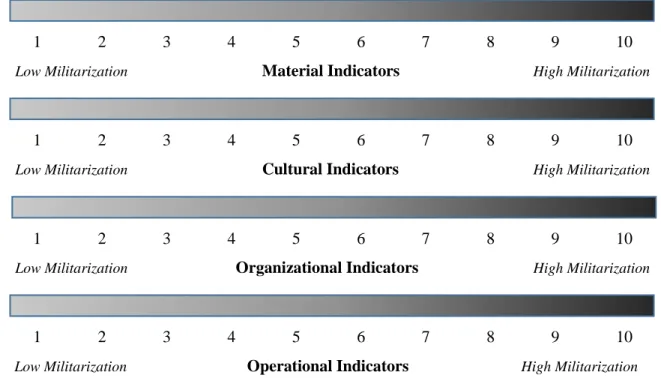
(2007:504). He proposes four different continuums by which militarization can be
understood (2007). He identifies those continuums as: (1) material, (2) cultural, (3)
organizational, and (4) operational (2007:504). Each of these operate on a scale of low to
high militarization. All indicators discussed by Kraska can be used as a metric by which to
analyze the response of the various law enforcement agencies throughout the protest cycle in
Ferguson. The Pentagon’s Law Enforcement Support Office20—known as the 1033
program—has allowed civilian police departments to gain access to military grade equipment
such as assault rifles, grenade launchers, and bullet-proof armored vehicles. Kraska also
details the ways in which the military has been repurposed at times throughout history to
serve various roles in the community (e.g. its use in the “War on Drugs”) which further blurs
the distinction between the police and the military (2007). Kraska and Victor E. Kappeler
(1997) document the exponential increase in paramilitary deployments to “barricaded
suspects and civil demonstrations” over the last five decades.
The Language of Repression
The process of incrimination as a repressive tactic serves to shape the discourse
surrounding protest which in turn determines the responses of state actors towards protesters.
Through strategies of stigmatization, certain actions by the repressive state can be justified—
even as those actions far exceed the perceived use of force that is required to manage even a
sizeable nonviolent protest.
Incrimination. The discourse surrounding who gets to show up and how they are able
to present themselves (Wagner-Pacifici 2000) shapes the response of both protesters and
police and their performance of their given roles in protest events. The expectation of
violence on the part of the police—due to rhetoric that criminalizes community members—
shapes their response just as the presentation of law enforcement (i.e. uniforms and
weaponry) shape the response of protesters. This performance of violence—both its
expression and repudiation—serve to create and reconcile tensions that exist within the
community-police dynamic (Wagner-Pacifici 2000). However, as Wagner-Pacific elucidates,
the discourse from law enforcement and government agents is “masquerading, fictionalizing
the real actions of those in power” (1994:7) which lends a legitimacy to their violence and a
criminality to the violence of demonstrators—both actual and perceived.
Nadine El-Enany suggests that the state has an interest in weaponizing their own
power to delegitimize and weaken the power of political protest activity (2015). Law
incrimination and stigmatization of protest on the part of law enforcement serves, in
El-Enany’s view, to “depoliticize” (2015:3) protest and legitimize the repressive response of the
state. By removing the political nature of the protest (i.e., stressing the importance of “law
and order” over justice and removing the inherently political nature of protest through
incrimination tactics), the state shifts the discourse and foundation upon which the protests
were built. I agree with this view point and her further assertion that police do not act from a
“neutral” position when on the periphery of a demonstration (2015:4). When entering the
protest area, already established views of the community—who El-Enany describes as “the
enemy within” (2015:5)—contribute to the eventual actions taken by law enforcement
officers. This perspective shapes the responses from government officials and their decisions
to call for reinforcement from outside forces. The ability to characterize protesters as
deviants allows for the uneven use of force on the community as a whole. A handful of
protesters participating in property destruction or alleged looting facilitate a heavy handed
approach to managing the crowd as a whole. El-Enany was writing prior to the grand jury’s
non-indictment verdict thus does not analyze the entire scope of protests that stemmed from
Michael Brown’s death. Due to the dozens of protests that occurred within the year following
August 9, 2014, this cycle of depoliticizing-labeling-repoliticizing that can occur during
protests can be expanded and applied to the other events in the scope of this study.
The Performance of Repression
Robin Wagner-Pacifici says of the police: “they constantly reveal the violence of the
state in their uniformed appearance and their methods” (1994:125). That the very presence of
protection and contributes to a tension and distrust of law enforcement within the
community.
Performative Theory of Assembly. We can see in Judith Butler’s view that people
gathered as a way to “struggle against precarity” (2015:69)—which, for Ferguson in August
of 2014, was a struggle against death via an extrajudicial killing by a police officer. But it
was also greater than that. The people of Ferguson were also struggling for space and
visibility within their community. However, the assemblage of various law enforcement
agencies over time in various capacities betrayed their supposed duties of protection. The
perceived disposability of the community of Ferguson gave rise to the performance of power
by law enforcement that was ultimately violent and disruptive. In what ways can we apply
Butler’s performative theory of assembly, then, to the law enforcement response in
Ferguson? To what extent is a theory that comes from an analysis of the marginalized useful
in analyzing power at the top? I suggest that this can be useful in understanding the state’s
response to a precarious group of people.
Repression Repertoires. As a long-time movement scholar, Charles Tilly has much to
contribute to the understanding of the actions that occurred in Ferguson. For the purpose of
this paper, I focus on his theory of contentious performances and the designation of
repertoires available to groups. In the context of the Ferguson uprising we can consider what
repertoires law enforcement agencies had at their disposal and which repertoires they used to
control dissent in the events under investigation. Tilly details four different types of
repertoires available to a given collective. Ranging from “no”, “weak”, “strong”, and “rigid”
(2008:15), we can apply these rubrics to repressive forces to discern what repertoires the
strong and rigid repertoires. Strong repertoires, per Tilly, allow for innovations (however
small) whereas rigid repertoires entail the repetition of routines (2008:15). The repertoires
used as part of their performances allowed for particular uses of force and violence within the
repressive framework. Tilly, in describing strong repertoires, states that combinations of
actions do not occur and that there are visible boundaries of performances (2008:68). I
diverge from Tilly here on two accounts. I contend, first, that there were a diversity of tactics
utilized in Ferguson by law enforcement. Second, I suggest that there is a discrepancy when
it comes to boundaries set by law enforcement agencies – that they did not stabilize and
acquire visible boundaries – these got murkier over time (2008:68).
Performing Power. For Jeffrey Alexander in his book Performance and Power,
performance in a movement situation can be understood as actors authentically performing a
script so as to persuade other actors to follow suit and participate in the performance
(2011:23). This definition of performance can be applied to the Ferguson uprising and the
performance of law enforcement officers.
Synthesis
The theories discussed in this section do not occur in isolation but as “ideal types”—
ways of neatly constructing analyses of repression and protest. However, none of the above
theories can stand alone as adequate methods of analysis. How can we approach repression
research from another angle that relies on both performance and discourse as factors and
shapers of protest responses – and the responses of the state to a given protest? In
synthesizing these fields of inquiry, we can create a deeper understanding of the relationship
between the (repressive) state and the people. It is possible to apply a theory of
repressive actions in order to fine tune and adapt to the increasing agitation that has been
festering throughout the United States.
METHODS
My research topic can be framed as this: to what extent is the state’s repressive
response to protest an act of performativity? Does the resource capacity of the law
enforcement agencies shape the types of tactics used? In order to answer that question, I
examine (1) the extent of militarization of the law enforcement agencies involved in
Ferguson, (2) if militarization played a central role in the repression tactics that were used
during protest episode, and (3) the characteristics of the protests that received the most severe
repression. In this study, I conducted an historical analysis of community-police relations in
Ferguson, constructed a timeline of events for the episode under investigation, and
determined what types of repression tactics were used through the protest wave to answer
how performativity plays a role in state interactions with the people during protest events.
There were different approaches I could have taken to answer the questions I
consider. I had intended to use a mix of available data and interviews in order to fully
contextualize the repression I was studying. However, in the process of collecting news
sources to examine for determining repressive tactics used, I found that conducting new
interviews would not be necessary. There were enough interviews within the texts that I was
analyzing for me to gain insight into the community’s response to Michael Brown’s death
and the protests and law enforcement responses that happened in the aftermath. The
extensive coverage of the St. Louis Post-Dispatch, a local Missouri newspaper, proved to be
a rich resource for data collection. Their coverage included almost daily updates to
St. Louis Post-Dispatch also had extensive video and photographic coverage of the events
under study. Their coverage of the Ferguson Uprising was compiled into an eBook available
on Apple iBooks titled #Ferguson. This book contained the Pulitzer Prize-Winning
Photography from the Post-Dispatch as well as supplementary commentary regarding the
impact of the photographs.
In addition to local news coverage, there was wide coverage of the protests by
national and international news groups. Several national news reporters were on the ground
in Ferguson and had negative interactions with law enforcement officials themselves. Out of
this coverage came a book by Wesley Lowery, a reporter for the Washington Post, titled
They Can’t Kill Us All: Ferguson, Baltimore, and a New Era in America’s Racial Justice
Movement. In this book, Lowery recounts his role in covering the Ferguson Uprising as well
as his own arrest two days after arriving in Ferguson. Through firsthand accounts and
interviews with Ferguson residents, Lowery gives a unique perspective of the situation that
developed in Ferguson as well as revisiting the city a year later as protests continued. This
book provided very useful information that gave me an insider’s perspective on the events
that transpired in Ferguson throughout the year.
I used a Lexis Nexis search of articles written about the Ferguson protest from August
9, 2014 to September 1, 2014 in order to construct an historical narrative of the events that
transpired during the episode. I was able to use both local and national news sources to
gather information for a timeline construction of each episode. At times, I followed
embedded links in the articles to find updates or reflective coverage that fell outside of the
original search timeframe. I compiled a set of 43 articles and live feeds pertaining to the
law enforcement agencies involved, protest size, police responses, and arrests made. A data
set compiled by an investigative team at NPR allowed for me to compile a list of military
equipment that was transferred to the St. Louis County Police through the 1033 weapons
exchange program21. I was also able to utilize a Reddit live feed which collected live streams,
social media posts, and scanner activity to report on the ground activity in Ferguson22. Defining the Episode
For this project, I initially identified three specific potential protests which I call
“episodes”—each of which occurred over the course of several days. The first protest episode
occurred in the days following the death of Brown (i.e., Episode One). The dates for Episode
One are August 10, 2014 through August 20, 2014. The second (i.e., Episode Two) came
after the non-indictment of Officer Wilson. The dates for Episode Two are November 24,
2014 through December 2, 2014. The third episode (i.e., Episode Three) I identified as the
protests that occurred after the one year anniversary of Brown’s death. Those dates include
August 9, 2015 through August 11, 2015. I used a data set developed by Vanessa
Williamson, Kris-Stella Trump, and Katherine Levine Einstein (2018) to identify highly
attended events throughout the year immediately following Brown’s death. I focused on
timespans that included multiple dates of protest and ones that had crowds of at least 50
people. I decided to focus on the first ten days of protests (i.e., Episode One) as this episode
had the most interactions between various degrees of militarized law enforcement agencies.
Each of the days saw interactions during the day as well as evening interactions between
protesters and law enforcement agencies. My data focuses on those interactions that occurred
21 Rezvani et al., “MRAPs And Bayonets.”
in the evening hours as these saw the most dynamic interactions. I also narrowed the
geography of the protests to those that occurred near Brown’s death on Canfield Drive as
well as those on West Flourissant Avenue.
Operationalizing the Indicators
To begin analyzing the militarization of the law enforcement agencies that interacted
in Ferguson, I examine the department using militarization indicator scales developed by
Peter B. Kraska. His indicators accounted for (1) material, (2) cultural, (3) organizational,
and (4) operational factors that can be measured on a continuum from “low militarization” to
“high militarization.” (2007).
Figure 1. Militarization Scale
1 2 3 4 5 6 7 8 9 10
Low Militarization Material Indicators High Militarization
1 2 3 4 5 6 7 8 9 10
Low Militarization Cultural Indicators High Militarization
1 2 3 4 5 6 7 8 9 10
Low Militarization Organizational Indicators High Militarization
1 2 3 4 5 6 7 8 9 10
Low Militarization Operational Indicators High Militarization
Material factors are described as the “extent of martial weaponry (e.g., automatic
weapons, armored personnel carriers) and equipment, and use of advanced military
Cultural factors describe “the extent of martial language, military style in appearance
(military battle-dress utilities or BDUs), extent of militarism (military belief,
values).”
Organizational indicators are the “extent of martial arrangements: ‘command
control’ centers (e.g., COMPSTAT), normalized use of elite squads of officers
(SWAT teams) patterned after military special operations (e.g., Navy Seals) teams.”
Operational indicators constitute the “extent of operational patterns modeled after
the military such as in the areas of intelligence gathering, supervision, handling
high-risk situations, highly aggressive and punitive operations such as some zero-tolerance
initiatives (e.g., SWAT teams used to conduct no-knock drug warrants” (Kraska
2007:504).
These scales allowed me to gauge the relative militarization of each of the law enforcement
agencies as a baseline for the types of repressive tactics that might be used against protesters.
The agencies I identified in the protests were the Ferguson Police Department (FPD), St.
Louis County Police (SLCP), Missouri State Highway Patrol (MSHP), and Missouri National
Guard (MNG). This scale is also useful in informing the ways I have coded protest event
data. Governmental reports also proved instrumental in analyzing the Ferguson department.
The National Defense Authorization Act (also known as the 1033 Program) allowed for a
record of weapons previously used for military purposes which were transferred to the St.
Louis County Police and Ferguson Police for use against civilians.
While Earl, et al. explain that “researchers [of repression] have typically employed
logistic regressions when studying the policing of protest events” (2003:589), I used mixed
qualitative analyses in order to code actions taken (and, sometimes, more importantly not
taken) by the various law enforcement agencies involved in Ferguson during the protest
events. Earl, et al. describe five categories of police responses to protests. These approaches
include:
Do Nothing: “officers show up at a protest event but take no further action”
Nothing to See Here: “officers show up and take only limited action (which excludes
making arrests or using force)”
Ounce of Prevention/Legal Eagles: “officers attempt to prevent disorder by erecting
barricades, reacting to protest by making arrests, or combining the use of barricades
with arrests”
Dirty Harry: “exclusively uses force (including hand-to-hand conflict and/or the use
of weapons)”
Calling All Cars: “officers combine both force and arrests/prevention” (2003:152)
I applied this rubric for coding varied police responses to the Ferguson protests. I gave “do
nothing” responses a score of two (2), “nothing to see here” responses a score of four (4),
“ounce of prevention” approaches a score of six (6), “dirty Harry” approaches a score of
eight (8), and “calling all cars” approaches a score of ten (10). I developed this scoring
technique in order for this data to be relative to the militarization continuum scores that were
on a scale of ten as well. At various points throughout the protests, law enforcement agencies
utilized these responses—often moving towards more repressive tactics as the day progressed
with the most repressive tactics saved for nighttime protests. After effectively locating each
agencies on Kraska’s continuum of militarization, I then coded the use of repressive tactics
coding method allowed me to determine the relationship between militarization and
performance in the Ferguson protest events.
Replicability
This research design is easily replicable to other protest events where repression is
used. The same research methodologies and coding strategies can be applied to less localized
events. Other research could be conducted on a larger scale to look at how protests in
response to police killings are repressed on a multi-city or national scale. Given that many
police departments across the country have been benefactors of the 1033 program23, the application of this method might provide insight into how repression has escalated with the
rise of militarized departments. It could develop into a useful tool for predicting state
responses to various protest episodes by recognizing patterns of performance in repressive
actions taken by state actors.
RESULTS
Given the proclaimed standards of “democracy” and “freedom” in the United States,
it is concerning to see the ways in which an escalating set of repressive forces were deployed
to a community of slightly over 20,000 residents (two-thirds of whom are Black)24. The scope, severity, and presence of “outside” forces created a situation that rested along a
continuum of various repressive actions that could come out of a scene from an authoritarian
dictatorship. As stated previously, repression is an action by the state or private entities that
serves to “prevent, control, or constrain non-institutional, collective action (e.g. protest),
23 79,288 assault rifles, 205 grenade launchers, and 11,959 bayonets—along with other gear and equipment—
were transferred nationally through the program from 2006 to 2014. (Rezvani et al. 2014)
including its initiation” (Earl 2011:263). I utilize this definition of repression in my analysis
of repression throughout the first ten days of the Ferguson Uprising.
The events that occurred between August 10, 2014 and August 20, 2014 were
emotionally charged and, at times, chaotic. Table 1 describes a few of the major daily events
as well as which agencies were involved each day. Some of these events would become the
impetus for more violent responses on the part of various law enforcement agencies and
protesters as the groups interacted. When new developments or even lack of progress towards
justice occurred, the state of relations between the state and the protesters would devolve into
hostility, anger, and violence. The reactions were largely dependent on which state actors
were on the streets each night.
Militarization
Charles Tilly writes extensively about collective action and explains that those who
perform collectively have a relatively small repertoire for action (Tilly 1978:151). When put
in the context of collective action by repressive actors we see that the interactions between
local and federal law enforcement agencies create advanced repertoires of violence through
militarized weaponry and militaristic tactical approaches. The escalation observed in
Ferguson through the protest episodes also displays a flexible repertoire that was available to
state actors allowing them to diversify the methods used to repress the Uprising. This was
particularly evident as more agencies were called in to attempt to quell the dissent taking
place in the streets. I analyzed the extent to which the four law enforcement agencies were
militarized via Kraska’s continuum of militarization and placed them on each of the scales25.
Table 1: Major events during protest episode and agencies involved.
Agency
Involved
Date Major Event(s)
FPD SL
CP M S HP M NG 10-Aug
Candlelit vigil for Brown begins the day
QuikTrip Gas station is burned down
SLCP immediately takes over from FPD following shooting
11-Aug Police form a staging area
Tear gas used to clear QuikTrip—a gathering spot for protest
12-Aug One officer suspended for threatening to kill protesters
Preliminary autopsy released
13-Aug
Reporters and aldermen are arrested
SWAT team deployed
Police fire tear gas, flashbangs, and rubber bullets
14-Aug
Gov. Nixon declares MSHP will take over operations
Attorney General Holder meets with Ferguson officials
Protests are peaceful for the night
15-Aug
FPD Chief releases video of Brown allegedly committing a robbery causing tensions to escalate
Wilson’s name is released to the public and violence increases
16-Aug Gov. Nixon declares State of Emergency
Curfew imposed from midnight to 5 am
17-Aug
Curfew continues
LRAD deployed
Second Brown autopsy is released
18-Aug
Gov. Nixon calls in Missouri National Guard; curfew lifted
Announce school closure from 8/19/14-8/21/14
Protester violence increases; Molotov cocktails thrown
19-Aug
Kajieme Powell, 25 year old Black man, killed by St. Louis City Police just 2 miles from where Brown was shot
Heavier police presence; increased media presence
20-Aug
Police raid a church being used as a meeting point and aid station for protesters
Chart 1. Assessing Extent of Militarization for Each Agency
Ferguson Police Department. The Ferguson Police Department (FPD) was placed
relatively low on the militarization continuum26 with an average score of 3.5/10. Given its perceived lack of excessive military weaponry, dress, and attitudes its material, its material
and cultural indicators were both scored a four (4). However, according to the Department of
Justice (DOJ) report, the FPD does have a history of “excessive force” given its reliance on
electronic control weapons (ECWs), also known as Tasers27, as a response to low-level crimes by non-threatening individuals28. The DOJ also reported the FPD does have a history of unreasonable use of canines29. The Department of Justice report on the police response to protests details the extensive first amendment violations committed by the department. As
outlined by the report in numerous areas, the FPD has a history of using disproportionately
26 See Chart 2
27 United States. Department of Justice. Civil Rights Division, Investigation of the Ferguson Police Department.
28 Ibid.
29 Ibid.
4 4
2
4 9
7
6 6
3
1 1 1
9 9 9 9
Material Cultural Organizational Operational
aggressive tactics to nonviolent and low level offenders in the community. The FPD strayed
slightly from Kraska’s description in that these militarized arrangements were not normalized
patterns in daily interactions outside of the specific protest episode under investigation. Their
tactics appear to be more informed by other agency interventions than by their own
routinized protocol. Because of this, I scored their operational indicators as a four (4) as well.
On the organizational indicator scale, I scored the FPD as a two (2). There did not seem to be
a pattern of using “martial arrangements” (Kraska 2007:504) or a history of elite officers
given that there are only 5330 officers in the department.
St. Louis County Police. The St. Louis County Police received an average score of
7.0/10 on the militarization scale. Due to regulations, tactical items from the 1033 program
can only be traced at a county level31. The results of transfers as part of the program were available for St. Louis County (where the city of Ferguson is located). From February 2012
until August 2014, St. Louis County reported receiving32:
6 night vision devices
15 reflector sights
3 night vision sights
1 laser borelight system
2 receiver-transmitters
12 - 5.56 millimeter rifles
30 Vicens, “Just How Segregated Is Ferguson?”. Note: 50 of those officers are white while only 3 are Black.
31 Wofford, “How America’s Police Became an Army.”
32 Rezvani et al., “MRAPs And Bayonets.”
6 - .45 caliber pistols
1 remote-controlled, heavy-duty robot
tEODor (telerob Explosive Ordnance
Disposal and observation robot)
9 utility trucks
I counted this equipment in the “material indicators” for militarization for the St. Louis
County Police. This data coupled with visuals of mine-resistant, ambush-protected
vehicles, or MRAPs, led me to place the St. Louis County Police high on the
militarization scale33 with a score of nine (9). The St. Louis County Police response to
protests often included large riot shields and face coverings. Pictures and reports from the
protests show officers in highly tactical gear, including camouflaged dress, protective
pads for their knees and elbows, and assault packs34. They would often approach crowds with guns drawn and pointed at unarmed people. This shows a lack of proper military
training but does suggest that officers were mimicking a militarized style engagement of
perceived combatants. In one particular incident with the SLCP on August 11, we can see
a half dozen officers in military fatigues, combat boots, helmets, knee padding, and
goggles approach an unarmed Black man with guns directly pointed at him35. This led me to place the SLCP with a score of seven (7) on the cultural indicator scale. Operational
indicators were also ranked highly on the militarization continuum with a score of six (6).
The tactics used by law enforcement were highly criticized as disproportionate to the
protests. During a protest event, snipers were stationed with guns trained on the crowd.
SWAT teams raided buildings used by protesters and reporters—including a church and a
McDonalds. Due to this, I placed their operational indicators as a six (6) as well.
33 See Chart 2
34 These were also acquired through the 1033 Program.
Missouri State Highway Patrol. In contrast to the other agencies, the Missouri
State Highway Patrol (MSHP) came to Ferguson without the backing of tanks and
automatic weapons. This led to their low overall ranking of 1.5/1036. The Patrol often showed up to protest events wearing standard patrol uniforms without helmets or body
armor. This agency did have access to smoke canisters and tear gas but seldom deployed
the control agents on crowds. I assigned a score of three (3) for their material indicators
and a one (1) for their cultural indicators. Their organizational indicators also scored a
one (1) as they took a much less martial angle to dealing with angry protesters. The
officers can often be seen in line with the protesters—even standing arm-in-arm with
them in daytime marches. At times the MSHP would move protesters away from other
agencies in an attempt to deescalate the situation and prevent violence from occurring.
This led me to assign a score of one (1) for their operational indicator as well. Overall,
this was the least militarized agency of the four and maintained the longest period of
non-violence on the part of protesters in the ten days of protest.
Missouri National Guard. The Missouri National Guard was activated by
Governor Jay Nixon on August 18 and withdrew on August 21, 2014. As a division of the
military, this necessarily positions the Missouri National Guard high on the militarization
scale37. They were given the highest score of the four agencies with a 9.0/10. James Rule states that collective violence is the “deliberate destruction of persons or property by
people acting together” (1998:11). Although this is generally applied to social
36 See Chart 2
movements generated at a grassroots level, we can suggest that the state—specifically in
the case of Ferguson—acted in accordance with this designation. The collective violence
that was performed by law enforcement agencies that were deployed in Ferguson cannot
be analyzed without also considering that the Missouri National Guard had been accused
of employing officers accused of holding explicitly white supremacist viewpoints and
discriminating against Black guard members38. This same Guard was deployed to Ferguson in order to provide support to local law enforcement agencies. We must then
ask: to what extent do these personal viewpoints contribute to collective action and
violence? I suggest that the views of fascists and racists must necessarily influence the
behavior of the group, thus determining the actions of the whole on behalf of the few.
Due to this history, I ranked the Missouri National Guard high on the cultural indicator
scale with a score of nine (9). Reports nearly a year after the uprising show that the MNG
also referred to protesters as “enemy forces”39 Because the Missouri National Guard is a
dual-function department comprised of “citizen-soldiers”40 who can be activated to
“domestic service”41 by the Governor for emergency purposes as well as service abroad,
National Guard members receive a ten-week basic training course along with
38 Editorial Board, “Missouri Guard Needs Outside Help to Fix Discrimination Problem.” and Messenger,
“Guard Officer Fired after Bias Complaints.”
39 Starr and Bruer, “Missouri Guard on Ferguson Protesters.”
40 Army National Guard, “Missouri | National Guard.”
individualized training upon completion42. This necessarily positions them high on each indicator in this scale.
While in this section I described the overall pattern of militarization of the
agencies involved, these militarization indicators shifted throughout the responses to the
protest episode—typically varying (i.e., becoming more militarized) as the day
progressed. My focus was to pay special attention to the responses of nighttime protests.
What would start out as a “do nothing” approach, would escalate to a “calling all cars”
approach while moving higher along the militarization continuum. Basic police uniforms
were quickly replaced with assault rifles and military style camouflage as well as riot
shields and assault vehicles. A reporter for the St. Louis Post-Dispatch describes the
evolution of the evening of August 19, 2014 in his notes:
As the hour gets later, the crowds get younger and more aggressive.
Then begins the familiar Ferguson ebb and flow of confrontations, bullhorn police warnings, street blockades, crowd dispersal and regrouping. They reach critical mass and erupt into scenes of tear gas clouds, pepper spray, masked men, pistol shots, breaking glass and stampeding crowds (Hampel 2014).
Robin Wagner-Pacifici says of the police: “they constantly reveal the violence of
the state in their uniformed appearance and their methods” (1994:125). That the very
presence of police officers can serve a repressive function in certain communities betrays
the notion of protection and contributes to a tension and distrust of law enforcement
within the community. Throughout the Ferguson Uprising, law enforcement officers and
National Guardsmen performed repressive actions through their clothing, comportment,
and advanced weaponry. They met grieving protesters with a force and urgency that did
not reflect the spirit of the demonstrations that were happening at the time. For example,
reporter Jamelle Bouie describes43 a demonstration on the afternoon of August 13th, 2014
that was large but largely peaceful and could have been handled through communication
with organizers:
Instead, they brought reinforcements. Police officers were replaced with
camouflaged SWAT teams—clad in helmets and body armor—and batons were replaced with shotguns, high-powered rifles, and dogs…they weren’t interested in actual crowd control. On at least two occasions, they refused to let uninvolved bystanders go to their cars or leave the area. No, from their stance to their numbers, this was about intimidation. Two snipers monitored the demonstrators from their armored vehicles, and other police began to close off side streets and other exits, to prevent anyone from coming in (or going out, for that matter)… With the arrival of SWAT teams, the demonstration escalated into a standoff. And an hour after the teams’ arrival, they [police] began marching down the street and shouting orders.
Agency Approaches
In Ferguson, we have witnessed the ways law enforcement characteristics (Earl
2003; Earl et al. 2003) have contributed to the tactics used (both by law enforcement
agents and protesters) and the degree of repression that protesters faced. On the afternoon
of August 9, 2014, crowds gathered in response to the fatal shooting of Brown. The
backlash from residents in the wake of the shooting prompted “more than 60 area police
officers to respond to the scene”44. The night of Michael Brown’s murder brought out
43 Bouie, “The Outrageous Police Actions in Ferguson, Missouri, Last Night.”
Ferguson residents for a protest. Nearly two hundred people gathered near Canfield
Drive, the site of the shooting. Tensions were high between community members and
police. As mourners gathered, they were surveilled by a St. Louis County police officer
in a SWAT vehicle. Police canines were brought out to “keep order” alongside police
officers with assault rifles. This was in response to approximately 100 residents who
gathered chanting “No Justice! No Peace!” outside of the Ferguson Police Department
headquarters. The next week and a half would see community persistence and police
responses escalate. The FPD would approach protests with an “ounce of prevention” that
related to its relative lack of militarization and department size.
On Sunday August 10, tensions continued to grow. Thirty two people are arrested
in the course of the evening. Public outcry regarding the police response during the first
days was quickly bolstered by outspoken military veterans who criticized the “rules of
engagement” on the part of St. Louis County Police45. Even journalists on the scene of
the initial Uprising were struck by the tactics used. Journalist Jelani Cobb recounts:
What transpired in the streets appeared to be a kind of municipal version of shock and awe [emphasis added]; the first wave of flash grenades and tear gas had played as a prelude to the appearance of an unusually large armored vehicle, carrying a military-style rifle mounted on a tripod. The message of all of this was something beyond the mere maintenance of law and order: it’s difficult to imagine how armored officers with what looked like a mobile military sniper’s nest could quell the anxieties of a community outraged by allegations regarding the
excessive use of force. It revealed itself as a raw matter of public intimidation.46
45 Capps, “War Veterans Criticize the Tactics of Military-Armed Police in Ferguson.”
In Ferguson, the nights that included property damage to local businesses significantly
influenced the ways in which narratives were constructed about Ferguson residents and
thus justified the presence of heavily armed militarized law enforcement agencies. This
betrays a mentality that is better aligned for “us versus them” instead of “protect and
serve.” A community in mourning becomes the enemy. It is due to this response that I
ranked the St. Louis County Police (SLCP) as taking a “calling all cars” approach.
A major shift in police tactics came in this episode when the Missouri State
Highway Patrol took over on August 15, 2014. Captain Ronald S. Johnson employed a
new approach and stated that he would “mak[e] sure we’re not taking resources out there
that we don’t need”47. Johnson even participated in an afternoon march with about 300
community members along West Flourissant Avenue48. This was a marked contrast from the previous displays and interactions on the part of the FPD and the St. Louis County
Police—and came with derision from those agencies who wanted to continue the hardline
approach to policing the protests. Capt. Johnson can be seen in photographs pulling other
officers back from protesters as most are dressed in basic police uniforms and others have
vests and gas masks49. Under the leadership of Capt. Johnson, the MSHP typically approached the protests with a “nothing to see here” approach. There was a more
community-centered policing approach taken and sensitivity to the emotions and
47 McDermott, “Commander Promises ‘Different Approach.’”
48 Ibid.
responses to the protesters. This is evidenced by the fact that only about 9%, or 26 total,
of the total arrests occurred August 14-17, 2014, the four days the MSHP was in charge50. Chart 2: Agency Response vs. Militarization
Despite the highest militarization score, the Missouri National Guard did not rank
the highest on the approach scale due to the fact that it does not have arrest authority in
Missouri51. This led to the designation of a “dirty Harry” approach for the MNG. The Guard was deployed by Gov. Nixon in an attempt to protect the police after the
breakdown of a brief period of peaceful relationships with the Missouri State Highway
Patrol. However, I argue that the presence of a highly militarized force contributed to the
performances of the other agencies that had higher militarization scores as well. For
example, the St. Louis County Police may not have had as an elite and well trained force
50 See Chart 3 for details.
51 Edelman, “National Guard Deployment in Ferguson Is Part of Governors’ Long Peacekeeping
Tradition.”
1.5
3.5
7
9
4
6
10 8
MHP FPD SLCP MNG
as the Missouri National Guard did, but they hyper-performed a militaristic style of
repression in Ferguson that belongs more in cinematic realms of combat performance
than on domestic streets.
St. Louis County Police ranked the highest on the agency approach scale and had
a rather high militarization score as well. I argue that this agency has the most dynamic
interactions between protesters given that this department was given control over policing
protests almost immediately after the death of Brown. Agents with this department were
very often hostile in their engagements with the communit. How did its comparatively
high militarization (especially compared to the FPD) as well as its ability to make arrests
(which the MNG was not able to do) contribute to its approach to the ten days of protest?
I argue that the response of the SLCP was escalated by the presence of a highly
militarized force (MNG) and the SLCP used its arrest powers to perform a more
aggressive response to protesters. The number of protesters each night was relatively
stable over the course of the protest episode. Yet there was a spike in arrests and force
used after a period of peace under the MSHP once the MNG was called in for
“reinforcement”52 These factors led me to designate the SLCP with a “calling all cars”
approach.
The state expanded and escalated its use of force by way of intimidation and
incarceration in an attempt to put an end to the protests and return control of the
community to law enforcement and government officials. We can see that, even with
relatively stable protest numbers, arrests varied wildly. The most arrests came in the first
day (32% of protesters arrested) and the last three days (22-39% of protesters arrested)53. Chart 3: Arrests Reported
Law enforcement agencies and protesters in Ferguson demonstrated different
types of power throughout the protest cycle which contributed to the varied responses to
individual protest events. By attempting to exert a specific power over demonstrators, the
law enforcement agencies involved in the repression of the Ferguson Uprising increased
their use of militarized force and violence upon the crowds that gathered in mourning and
defiance.
53 See Chart 3 for more detail
100 300 200 300 200 200 150 250 200 200 125 32 10 47 6 1 0 7 18 78 47 28
0 50 100 150 200 250 300 350
10-Aug-14 11-Aug-14 12-Aug-14 13-Aug-14 14-Aug-14 15-Aug-14 16-Aug-14 17-Aug-14 18-Aug-14 19-Aug-14 20-Aug-14
DISCUSSION
As a marginalized community with little institutional and political power, the
residents of Ferguson necessarily represented a relatively “weak” movement, but one that
posed a threat to the State due to the movement’s fervent response to the extrajudicial
killing of Michael Brown. Through the ten days of the protest episode under
investigation, the crowd’s characteristics and tactics shifted, leaving law enforcement
officials to request particular repressive tactics be used. As Earl describes throughout her
research, a movement that is both threatening and weak will be a major target of
repression (Earl 2003). However, once the first protest episode had culminated, how can
we understand the aggressive response of law enforcement as the movement grew and
gained power and notoriety? With sensational images of community
members-turned-activists on the front pages of newspapers and trending on social media54, the movement necessarily outgrew its “weak” designation while maintaining its threat to State power
through direct action. The state’s use of force during the episode under examination can
lead us to consider a new approach for understanding how movements outgrow or
transform their level of weakness and threat. In this way, we can move towards a more
nuanced concept of repression.
The Ferguson Uprising saw several different types of law enforcement agencies
attempt to squash the outcry from the community. The use of four different law
enforcement agencies spanning both local and federal departments—each with
increasingly militaristic repertoires of ammunition and equipment—can be viewed as a
collaboration of a spectrum of repressive state actors. Each of these agencies have at their
disposal a variety of weapons and tactical gear that they don in expectation of violence on
the part of protesters. Present in Ferguson, both by the Ferguson Police Department and
other State and Federal agencies that were called in for support, was an excess of
militarized equipment and gear—tanks, flashbang grenades, military-style camouflaged
uniforms, and short-barreled 5.56-mm rifles equipped with scopes55. State actors seem to anticipate reciprocal use of violence on the part of protesters. However, we can see that
protesters are largely unarmed in the case of Ferguson. Their only threats to these
agencies is the size of those that assembled and the inherent challenge to the legitimacy
of the state through mass defiance. By having certain lethal and militaristic equipment at
their disposal, law enforcement agencies are more inclined to utilize more force than
necessary to disperse crowds and discourage participation in protest. The Ferguson
Uprising complicates this perspective due to the layers of agencies that were utilized. Earl
et al. indicate that the better resourced and trained a department is, the less likely that
department is to use violence as a tactic for controlling a protest (2003:586-7). Ferguson
suggests that this is not the always the case. In Ferguson, we did not necessarily see a
blurring of the line but a marriage of militaristic forces. The less militarized agencies
tended to adopt hyperbolic performances of the more militarized agencies.