2019. 79 pages. Advisor: Mary Grace Flaherty
This paper explores how growth in the field of Chinese Studies has affected subject trends in academic publications, library holdings, and usage of Chinese Studies materials from 1992 to 2017. Using data on academic monographs published from EBSCO’s GOBI (Global Online Bibliographic Information), comparisons were made with subject trends found in the Chinese Studies print collection at the University of North Carolina at Chapel Hill. Contrary to expectation, there was no discernible increase in social science literature relative to other subjects. Meaningful findings included an increased diversity in topics covered and the continuity in traditional areas of strength for Chinese-language resources. This paper also describes the methodology for using library metadata to measure subject trends, and discusses potential explanations for specific findings.
Headings:
Academic library collection development Academic library use studies
by
Katie M. M. Odhner
A Master’s paper submitted to the faculty of the School of Information and Library Science of the University of North Carolina at Chapel Hill
in partial fulfillment of the requirements for the degree of Master of Science in
Library Science.
Chapel Hill, North Carolina April 2019
Approved by
Table of Contents
Introduction... 3
Literature Review ... 8
Studying Research Trends ... 8
Citation Studies ... 8
Subject Trends in Monograph Publishing ... 10
Publishing Trends in Chinese Studies ... 10
Collection Assessment Methods ... 11
Methods... 14
Overview ... 14
Data Collection and Processing ... 14
Data Analysis ... 20
Results ... 22
Publications ... 22
Holdings ... 25
Usage... 36
Discussion ... 43
Continuity in Areas of Strength... 44
Expanding Coverage ... 45
Changes in User Population ... 49
Changes in Researcher Interests ... 50
Influence of Current Events ... 51
Limitations ... 52
Future Directions ... 55
Conclusions ... 56
Acknowledgements ... 57
Introduction
With the political and economic rise of China, institutions of higher learning in the United States have experienced a corresponding growth in interest towards the Chinese language and Chinese studies. This paper explores how this growth has affected subject trends in publications, library holdings, and material usage by examining
publication trends and comparing them with trends in subject matter in the Chinese studies collection at the University of North Carolina at Chapel Hill.
Chinese Studies in the United States
As China’s diplomatic and economic relationship with the United States steadily gains relevance in our global system, interest in and institutional support for Chinese studies have increased dramatically. According to the Modern Language Association, the number of university students in the United States studying the Chinese language has increased 115% in the last 18 years (Walker 2016). From 2005 to 2010, the number of undergraduates majoring in Chinese studies increased by 86.3%, while the number of master’s students increased by 155%.i Though the number of students studying Mandarin
at the college level has decreased in the last five years,ii universities continue to add
courses, majors, and programs related to Chinese or Asian Studies, such as Duke University’s Masters in Critical Asian Humanities (begun 2018), or the new
undergraduate major in East Asian Studies at University of Northern Georgia (2019). As these changes have taken place, scholarship has expanded to include more work in the social sciences and other topics relevant to modern China. Some describe this shift less as an expansion and more as a move from the “area studies” framework towards “discipline-based approaches” (Zhou & Zhao 2013). According to Shen (2009), Chinese-language academic collections in America are shifting to accommodate these trends. However, no study has yet been undertaken to quantitatively measure subject changes in Chinese studies collection development in American universities. The goal of this study is to quantify subject shifts in English-language academic monographs on greater Chinaiii
published in a 20 year period, then compare these subject shifts with changes in
collecting practices and usage patterns in the University of North Carolina at Chapel Hill.
Academic programs in East Asian studies at UNC began in the 1950s. At that time, Cold War competition in the international sphere led the U.S. government to
support area studies through Title VI of the National Defense Education Act of 1958. The first full time faculty member to specialize in Chinese studies focused on Qing dynasty history and worked out of the geography department. The Vietnam War further increased student interest in East Asia, which led to additional faculty members being hired. By 1979, an official Curriculum on East Asian Studies was established. The courses and languages offered continued to expand until the Department of Asian Studies, which grants a Bachelors of Arts degree, was formed in 2003.
The UNC Libraries began systematically collecting materials on East Asia in 1964 in response to the growth in the academic programs. The strengths of UNC’s Chinese collection reflect faculty and student interests, and include language and literature, history, cinema studies, religion, social sciences and Chinese medicine. In a book chapter on the East Asian Collection at UNC written in 2013, Chinese Studies Librarian Hsi-chu Bolick anticipated that growth in academic programs in health-related fields, business, city planning, law and psychology would shape the directions in which the collection expands in the future.
Duke University, with whom UNC has an established cooperative collecting agreement, began developing its East Asian collection around the same time as UNC. Soon thereafter, the two universities agreed to share responsibility for collecting East Asian research materials. Duke University focused on developing its Japanese collection, while UNC concentrated its collecting in Chinese studies materials. In the 1990s,
led to increased support for Chinese resources, resulting in the rapid development of a Chinese-language collection. This close partnership between the two institutions has in some ways shaped the two collections, particularly with regard to shared electronic resources and efforts to minimize duplication.
Given the evolving subject trends of Chinese studies in the English-speaking world and at the University of North Carolina, this study will examine the following questions:
● What are the subject area trends in academic monographs published about Chinese studies? Is the range of topics in fact broadening? Is it deepening in certain areas?
● How do subject area developments in the collections at UNC for the last twenty years compare to changes in the research trends for the same period? In other words, is the collection keeping up with the trends?
● Do changes in subject area for publications reflect trends in usage for Chinese studies materials at UNC, as measured by circulation and interlibrary loan data? In other words, do the general research trends correspond to the interests of users in this community?
NOTES
i Digest of Education Statistics, 2017. Retrieved September 12, 2018, from
https://nces.ed.gov/programs/digest/d17/tables/dt17_325.59.asp
ii
https://asia.nikkei.com/Location/Rest-of-the-World/North-America/American-students-lose-interest-in-China-studies
iii Greater China here refers to mainland China (the People’s Republic of China) and other
Chinese-speaking areas with significant cultural or political ties to China, including Taiwan, Macau and Hong Kong.
Literature Review
Studying Research Trends
Citation Studies
Since providing access to current, relevant research is essential in the support of teaching and learning at an academic institution, keeping up with research trends is of paramount importance to a collection. This is especially true in a field like Chinese studies which is undergoing expansion into new areas. When formally assessing research trends for the sake of collection development, librarians typically pursue one of two options: citation analysis in an institution-specific context, or analysis of trends in publications.
partially predictive of faculty journal citation patterns,” so examining dissertations can be seen as killing two birds with one stone (pg. 86).
However, the research of Beile, Boote, & Killingsworth (2004) indicates that librarians may overestimate the expertise of doctoral candidates. Their study found that dissertations in the education field tended to draw the large majority of their citations from their home institution’s collection. Therefore, the presumption that PhD dissertation are reliable sources for developing “core journal lists” is flawed, since candidates appear to select their references based not on quality, but on the convenience of locally held resources. These results confirm those of Kuyper-Rushing (1999), who found when studying citations of music dissertations that “a core list of journals developed by studying a single institution’s dissertation citations may not reflect the needs of the user at either the institutional or the national level.” (pg. 161).
Other scholars have focused instead on citations in monographs by faculty members at the collecting institutions (Kellsey & Knievel, 2012). Unlike graduate students, it can be safely assumed that published scholars at a faculty level cite sources based on quality rather than convenience. In addition, as they “usually drive the direction of research at a research university,” they are a valuable population to analyze (pg. 570). However, Kellsey & Knievel fail to address the fact that areas of faculty research
interests influence collecting decisions, so the presence of cited materials in a collection could indicate tailored collecting practices rather than comprehensive development.
has been used to improve collection development and reference services (Dilevko & Dali, 2004). A similar process could be followed for citations in monographs on a standard list. However, for reasons mentioned below this study does not use citation analysis, and focuses instead on monograph publishing.
Subject Trends in Monograph Publishing
Monograph publishing data can be a rich source of information on research and publication trends within specific fields, particularly in the humanities. Knievel and Kellsey (2005) found that monographs constituted 74.3% on average of the citations in core journals in eight humanities fields. Within one field, the percentage of monographs cited was as high as 88.2% (pg. 149). So although citation studies often focus on journals, there is evidence that in the humanities monograph publishing is fairly representative of research in general. Therefore, analyzing monographs fits the aims of this study.
One tool used to assess publication information in the English-speaking world is GOBI (Global Online Bibliographic Information) from EBSCO (formerly YBP’s GOBI). As the database of the largest vendor of books to academic libraries in the United States, GOBI offers comprehensive coverage of scholarly monographs. The database also offers a great deal of metadata on the books they sell. Pisciotta and Frost (2013) used the database to assess trends in topics (for instance, particular time period, geographic locations and types of art) in the field of art history. Their methodology was effective in identifying the rise and decline of certain topics in relation to others within the field.
Publishing Trends in Chinese Studies
Studies? An Analysis of Publishers and Publishing Trends,” Chen and Wang used data collected from GOBI to examine publication trends in East Asian monographs, including such data points as publisher, publication location and subject area (2008). However, their coverage was relatively narrow (2000-2005). In addition, their primary concern was subject distribution within and among a few major publishers, and their focus was East Asia broadly rather than China specifically.
“A Scholarly Review of Chinese Studies in North America” edited by Haihui Zhang and colleagues offers a rich qualitative overview of current research in Chinese studies (2010). Zhang notes that “[t]he current areas of active research have extended beyond the traditional subdivisions of sinology into a rich variety of new methodological approaches and new subdisciplines” (pg. vi). However, this compilation of essays on a range of topics by subject specialists does not seek to quantify these shifts. This study aims to build on and quantify previous studies by utilizing the GOBI database to examine subject trends in Chinese studies over an extended period of time.
Collection Assessment Methods
Performing regular collection assessment is viewed as an essential component of managing an academic library collection. Academic libraries are obligated to provide collections which are “sufficient in quality, depth, diversity, format, and currency to support the research and teaching missions of the institution” (ALA Standards for Libraries in Higher Education, 2006). The studies in this section address frameworks for collection assessment and different indicators used to measure the success of a collection.
or three indicators from a basic six (general capacity, subject-specific standards, scholarly publishing, usage, users and environmental factors/social constructs), depending on the goals of their study. A large number of studies (Bronicki, et al., 2015, Chen, 2016, Ochola, 2002 and Grover 1999) approach collection assessment using the general capacity and usage indicators. These studies use data such as holdings by subject area (operationalized using Library of Congress classification), circulation data and
interlibrary loan data to measure the level of usage across subject areas in comparison to the portion of the collection occupied by those subject areas.
For performing analysis on holdings, circulation and interlibrary loan (ILL) data, two frequently-cited calculation methods have been suggested by Aguilar (1986) and Mills (1981) to evaluate collection usage. Aguilar proposed the Ratio of Borrowings to Holdings (RBH), a measure of the number of interlibrary loan requests in a collection or subject area relative to the holdings in that area. Theoretically, a high percentage of ILL requests relative to a small number of holdings indicates overuse in that area, while a low percentage of requests relative to a large number of holdings indicates underuse. Mills suggested the Percentage of Expected Use (PEU) measure. This calculates the ratio of the circulation for a subject area in relation to the holdings in that area as a percentage. In a well-balanced collection, the PEU for a given area will be close to 100%, because the holdings for that area will be at the same percentage as the usage for that area. The results from these two measures can aid collection developers in deselection, decisions about remote storage, and making overused areas more robust.
electronic holdings conform to the same measures as print holdings. For example, print collections are generally assessed at the item level. However, electronic books with multiple “volumes” are seldom stored in databases as separate items, making comparisons laborious. Bronicki, Turner, and Vaillancourt (2015) also reluctantly excluded electronic resources from their gap analysis because the data mined from their ILS (Sierra) for the study did not include Library of Congress call numbers for these materials, making subject analysis difficult.
Methods
Overview
This study examined the relationship between three types of trends in Chinese studies. Firstly, subject trends in academic monographs focusing on greater China, 1998-2018. Secondly, subject trends in print holdings for Chinese studies at UNC published 1992-2017. Finally, trends in circulation (2018) and ILL data (2013-2018) by subject area for Chinese studies. Though ideally the study would have analyzed trends within the same time frame for these different datasets, due to data constraints explained below, slightly offset time periods were selected. By comparing these three trends, two objectives were achieved. Firstly, we quantified anecdotal shifts in subject area for Chinese studies academic publishing in English, which provides useful information to Chinese studies librarians throughout the United States. Two, we evaluated the extent to which collecting practices at UNC reflect both these broad trends and the trends in usage by the patrons. Based on our initial hypothesis, we expected to see increasing growth in social sciences (H) and film, drama and graphic novels (PN) and decreasing growth in literature (P), history (D) and philosophy, psychology and religion (B).
Data Collection and Processing
For collecting data on academic monographs, we utilized the database of GOBI Library Solutions from EBSCO. GOBI’s coverage of English-language academic works was determined to be extensive enough to accurately approximate all scholarly
publications in the desired period (juvenile and popular works were excluded from the query). Examining twenty years of data (1998-2018) allowed us to capture the impact of geopolitical events relating to the rise of China during this period. Initially, the study intended to examine twenty-five years of data, 1992-2017, in alignment with the holdings data. However, due to very low publication numbers 1992-1997 (only 6 volumes were published in these 5 years), they were excluded. The publications from 2018 were added to bolster the data.
Following the methods of Chen and Wang (2008), we isolated publications on greater China through GOBI’s “geographical descriptor” field. We extracted publications categorized under China, Hong Kong, Taiwan, Macao, and Tibet. Other fields extracted were: Title, Author, Editor, Publisher, Place of Publication, Publication Year, Binding (this includes format information, such as e-book vs. print book), Call Number and Library of Congress Subject Headings. Some titles were duplicated in the list because multiple formats were published. In order to maintain a fair representation of different subject areas, these duplicates were deleted so that each edition of a book had only one entry in the dataset.
could be attributed to the fact that UNC sources its materials from GOBI. However, the comprehensive nature of GOBI’s holdings diminishes this potential effect.
Holdings Data
Since Chinese studies collections are interdisciplinary, there is no Library of Congress call number which groups Chinese materials in a single location. Therefore, defining and isolating the appropriate materials in the library system required a JSON query which could extract works about China from the ILS based on the assigned metadata (see Appendix I). First, we queried all works containing the terms China, Chinese, Hong Kong, Tibet, Taiwan or Macau in any 6xx fields of their MARC record. This set of fields captures all subject-related data assigned to a work, such as topical terms (650), geographic names (651), local topical terms (690), etc. According to cataloging practices established by the Library of Congress, at least one fifth of a work must be about a subject in order for it to be supplied. Therefore, any work containing the specified terms was in large part about China. However, Library of Congress Subject Headings (LCSH) may not have been assigned for all materials cataloged at UNC. Therefore, we also extracted all works which included the following terms in their title: China, Chinese, Hong Kong, Cathay (to account for older works), Tibet, Taiwan and Macau.
that the vast majority of Chinese-language works relate to the study of China. In addition to works solely in Chinese, multi-lingual works that used Chinese were included (based on MARC field 041). However, when processing the data it was found that works which were in a large number of languages were seldom truly about China. To minimize works in which the Chinese language did not play a significant role, items that were in more than three languages were deleted from the dataset. However, since there was a significant number of works in English, Japanese, Korean and Chinese, and these countries share a history of Sinocentrism, these items were maintained despite being written in four languages.
Due to reasons explained above in the literature review, microfilms, electronic resources, and multimedia materials were not included in the analysis. Twenty-five years of data (1992-2017) were examined. Since with the holdings data we were interested in collectingpractices rather than publicationtrends, ideally we would have collected data based on acquisition date rather than publication date. However, as this information is not stored in Sierra, we relied on publication date as a proxy. This assumes that a significant portion of the printed works were acquired soon after publication. In keeping with common practice for collection assessment, the records were retrieved at the item level, rather than the bibliographic level.
Sciences Library, where they had been assigned a local call number in the W class (which does not exist in standard Library of Congress classification). These were assigned to “R” (Medicine) under the assumption that they were all medicine-related. There were also several hundred art or auction catalogs which were assigned to “N” (Fine Arts). A large number of government documents in the collection were cataloged using the
Superintendent of Documents (SuDocs) Classification System. Due to the volume and subject variation of these documents, assigning them individual LC call numbers was deemed out of scope for the project. Therefore these items were excluded from the dataset. Finally, there were around two hundred items such as theses, some serials and others which were never assigned LC numbers. These were individually assigned numbers either by looking up call numbers used at peer institutions in OCLC WorldCat, or on the basis of subject headings (for those items which were not found in WorldCat).
The final fields extracted in the holdings query were: Title, Library of Congress Call Number, Publication Year, Last Year Circulation, Total Circulation, Material Type, Publisher/Vendor, OCLC Number, and Library of Congress Subject Headings.
Limitations of Holdings Data
macau*) or works containing *china* within the title (these were mostly
Russian-language items). The data was systematically searched using functions in Excel to ensure that such strings within words that weren’t captured in the final data set.
Other irrelevant works captured included those on flora or fauna originating in China which contain “Chinese” in their title, or works on porcelain (i.e. China) with subject headings which indicated they were not otherwise relevant to the country China. These were harder to systematically exclude, but were discovered and deleted as much as possible via visual search.
For unknown reasons, the query in Sierra captured several thousand titles which did not include the specified terms in the title or subject fields. Many of these titles included Asia in their subject headings, leading the researcher to conclude that the query executed properly but that Sierra somehow clusters subject data so these were pulled into the search. However, given that they did not fit the criteria, all items which did not meet the specifications of the original query were deleted from the dataset using functions in Excel.
Usage Data
At the UNC libraries, circulation data is stored in Sierra with holdings data. Unfortunately, the system only keeps total circulation data, checkouts in the last complete fiscal year (which in the case of this data would be all checkouts from July 1, 2017 to June 30, 2018) and checkouts for the current year to date. Therefore, longitudinal circulation data was not available for this study. In a small number of cases, circulation for the last fiscal year is higher than the total circulation. This data would seem
However, this anomaly is the result of a policy of counting checkouts from items on reserve into the yearly circulation, but not the total circulation. Therefore when viewing circulation data it should be keep in mind that in a small number of cases, items recently on reserve have a higher representation for last year’s circulation.
Data for interlibrary loan requests made by UNC users was retrieved from a spreadsheet kept internally from the interlibrary loan department at the UNC libraries. Unfortunately, the ILL department does not use MARC records for items that are requested from other libraries, so they do not keep subject headings data. Due to this limitation, isolating works on Chinese studies using the same methods as those used to query the holdings was not possible. The ILL department at UNC maintained a list of requests for works in East Asian languages for fiscal years 2014 through 2018. Therefore, for this portion of the usage we examined only Chinese-language works for those dates, not all works on China. Though this view of usage is more limited, it was compared with Chinese-language holdings to get a sense of how the two factors align.
Interview Data
Finally, an interview was performed with the Chinese Studies Librarian at UNC. This information helped to contextualize and explain collecting patterns. The interview was considered when analyzing the results in the discussion section. For a list of questions, see Appendix III.
Data Analysis
raw number. For instance, if we observed an “increase” in language and literature, this represents an increase in the percentage of language and literature between years, not necessarily an increase in the number of language and literature books. In addition to recording trends in the 21 major subject areas identified by the Library of Congress classification system, we performed more detailed analysis on areas which occupy a large portion of the collection or which exhibit strong trends. We also calculated a Ratio of Borrowings to Holdings (RBH), and a Percentage of Expected Use (PEU) for each subject area as described in the literature review above.
Our second point of analysis was Library of Congress subject headings, which were assigned to both the publication and the holdings data. In theory, subject headings provide a more accurate measure of subject matter, because they contain more detail than can be captured by a classification number. They allow for a book to be coded with more than one major subject area, which avoids the problem inherent in call numbers, i.e. that they categorize materials under a single subject. However, the disadvantage of subject headings is that they are necessarily more specific, and therefore decrease the numbers of books in a given category, making quantitative analysis that has significance more
Results
Publications
905 academic works about greater China published between 1998 and 2018 were found in GOBI’s database. In this 20 year span, the subject grouping which constituted the largest portion of the publications was social sciences (H) at 24.97% of the dataset, followed by history (D) at 19.89%, language and literature (P) at 13.149% and finally philosophy, psychology and religion at 8.07%. All of the other classification occupied less than 7%, with many below 1%. One challenge in measuring trends in these subjects across time, however, was the inconsistency in the number of publications by year. Publication volume varied widely, from a high count of 91 titles published in 2007 to a single title published in 1998. This inconsistency made it difficult to determine
significance in any trends observed, since lack of data for some years could lead to misleading percentages occupied by certain subject categories. In an attempt to partially compensate for this possibility, data was grouped into sets of two years for the subject analysis so that each group of two years would have at least 10 titles to analyze.
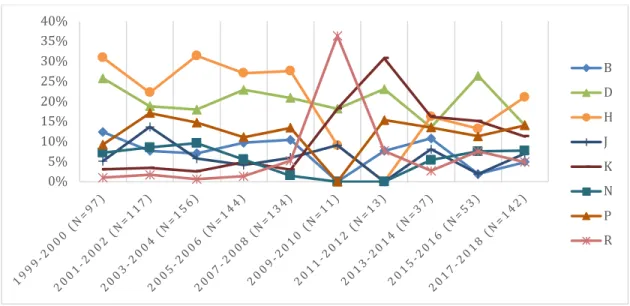
slight decline and the other traditional subjects appear to be holding steady. The only subject that appears to be growing with any significance is law (K).
However, one trend that appears evident is the decreasing variance between subjects (Figure 2). Sample variance was calculated using this expression in Microsoft Excel: . It measures the spread between data points. For instance, the variance between subject areas for 1999-2000 was relatively high (0.99%), because there were large numbers of works in some subject areas (like social sciences (H) and history (D)), but many subject areas that had only a few works published, and there weren’t many subjects published which were close to the mean value. In contrast, the subject variance for 2017-2018 was relatively low (0.35%) because there were more high-volume subjects closer to the mean value. The time periods 2009-2010 and 2011-2012 appear to be outliers to the trend; however, these two time periods are those in which there was a large drop in publishing volume (11 and 13 volumes published respectively), meaning that figures from those years could be unreliable.
Figure 1. Percentage of publications for top 8 subjects
Figure 2. Sample variance between subject areas for all publications In addition to performing analysis on subject areas as determined by LC classification, we also examined the LC Subject Headings assigned by GOBI to see if there were any trends in subject matter apparent. In the case of items from the
publications dataset, there was not sufficient overlap in subject headings to obtain a clear picture of trends over time. Below (Figure 3) is a list of the top 6 subject headings by volume in GOBI for 1999-2018. It should be kept in mind that multiple subject headings may be assigned per work, so some works may be counted more than once. Some themes that emerged were a strong emphasis on economics, politics and foreign relations.
0.99%
0.59% 0.71% 0.67% 0.67%
1.13% 0.81% 0.28% 0.53% 0.35% 0.00% 0.20% 0.40% 0.60% 0.80% 1.00% 1.20% 1.40% 199 9-2000 (n=97 ) 200 1-2002 (n=11 7) 200 3-2004 (n=15 6) 200 5-2006 (n=14 4) 200 7-2008 (n=13 4) 200 9-2010 (n=11 ) 201 1-2012 (n=13 ) 201 3-2014 (n=37 ) 201 5-2016 (n=53 ) 201 7-2018 (n=14 2)
Library of Congress Subject Headings Number of Times Assigned
China—Politics & Government--1976-2002 22
China—Economic Conditions--1976-2000 13
China—Economic Policy--2000- 12
China—Economic Policy 9
China—Foreign Relations—1976- 7
China—Economic Policy--1976-2000 7
Figure 3. Top six LC subject headings assigned in GOBI
Holdings
Overview
The dataset of Chinese-language and China-related works in UNC’s print
collection published between 1992 and 2017 totaled 102,760 items. Of these, 75.36% are Chinese-language, 22.47% are English-language, and small numbers are in Russian (0.49%), Korean (0.41%), French (0.38%), Japanese (0.23%) and various other
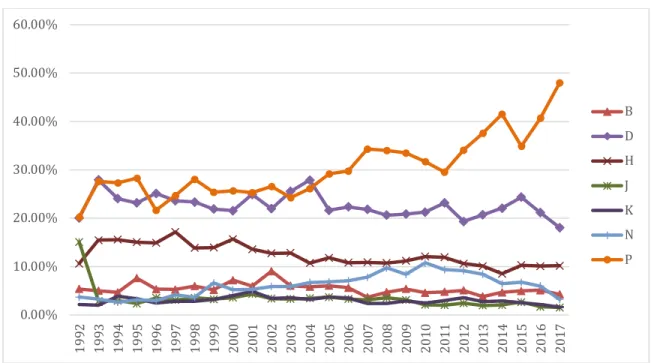
languages. Figure 4 (below) displays the change in broad subject area (based on the first letter of the LC Call Number) over time for the top seven subject areas by volume.i From
this overview, it can be seen that the trends predicted were not immediately evident in the data. In fact, language and literature (P) actually experienced growth in relation to other collection areas since approximately 2003. All other areas appear to be holding fairly consistent portions of the collection.
China--History 5
China—Description & Travel 5
China—Economic Conditions—2000- 5
China—Social Policy 5
China—Military Policy 5
China—History—20th Century 5
Taiwan—Relations--China 5
Popular Culture--China 5
Figure 4. Percentage of the Collection by Subject Area for Top 7 Subjects While manipulating the data, it became clear that the collecting patterns for English-language and Chinese-language data are fairly different. The most significant difference lies in the spread of the subjects. Though the core collecting areas remain the same (social sciences, history, language and literature, philosophy, psychology and religion, and art), the portions of the collection occupied by these areas is quite different. For English-language resources, the areas mentioned above seldom go above 25% or below 5% of the collection for a given year. History and social sciences are in
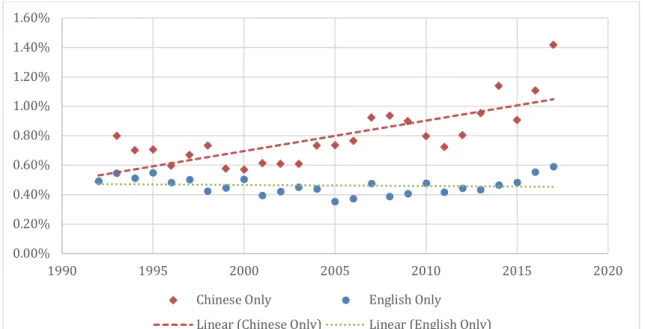
competition for greatest portion of the collection, often exchanging places for most collected by year. Philosophy, psychology and religion, art, political science (J) and law (K), constitute a smaller part of the collection, but still significant. In the 25 year period, the only area which seems to have experienced growth is language and literature, in parallel with the larger collection. Lack of significant changes in collection composition is demonstrated by a measure of variance between the data points by year (Figure 5).
In contrast, the Chinese-language collection consistently favors some collecting areas strongly over others. Language and literature have dominated the collection throughout the period, with history as a clear second, followed by philosophy,
psychology and religion, art and social science. Unlike with English-language resources, some changes in variance across time are in evidence among the Chinese-resources (Figure 5). This appears to be the result of steady growth in language and literature (already the largest collecting area). Most other areas have remained the same or slightly declined. In the following section, we will examine the seven largest subject areas for both languages: philosophy, psychology and religion, history, social sciences, political science, law, art, and language and literature.
Figure 5. Variance in subject spread by language
Subject Areas
Philosophy, Psychology and Religion (B)
Within B, the strongest collection areas are Buddhism (BQ), Philosophy (General)
(B), and Religions. Mythology. Rationalism (BL). In the period overall, B has constituted
0.00% 0.20% 0.40% 0.60% 0.80% 1.00% 1.20% 1.40% 1.60%
1990 1995 2000 2005 2010 2015 2020
Chinese Only English Only
5.37% of the collection. Both in the subject area at large and within the sub-categories there are few indications of any significant trends in subject matter. For Chinese-language resources only, there does appear to be a very slight downward trend in acquisitions relative to other subject areas, but this is not apparent for English-language resources and is of unclear significance. When comparing the two languages, areas of collection strengths are similar. However, in English Practical Theology (BV) holds a larger place in the collection, and does exhibit a downward trend, with a high point of 15.25% of B materials in 1996 and a low point of 0% in 2017.
History (D)
Throughout this period history is a significant and consistent part of the
collection, with no apparent increase or decrease in percentage. It constitutes an average of 22.51% of materials collected, with a high point of 27.92% in 2003 and a low point of 18.05% in 2017 (though this may be artificially low because the library has not had time to collect materials published recently). There is no difference in trends between English and Chinese. The vast majority of history materials falls in the DS700s, the history of China. The strongest two areas are DS770s (which cover Chinese history from the Boxer Rebellion (1899-1901) through present day) and the DS790s (which covers the local history and description of Hong Kong, Mongolia and Taiwan). The DS790s rise to a peak in the early 2000s (2002-2004) then slightly decline through the present (though still remaining the largest category). The DS730s (which include ethnography and early Chinese history) experience several peaks, the largest of which is in 2010. However, there appear to be no strong trends that are maintained for any period of time.
Like history, the social sciences remain a significant and consistent part of the collection, though they appear to have experienced a slight decline over the period, with a relatively higher portion of the collection falling into social sciences in the late 1990s (closer to 15%), and a somewhat lower portion in the 2010s (around 10%). However, this may be more reflective of slight growth in the 1990s than slight decline in the long term. In Chinese-language materials, this decline is less apparent than in English, where H has decreased steadily from a high of 27.03% in 2000 to a low of 15.59% in 2017.
Within the social sciences, strengths include Economic History and Conditions
(HC) (23.60% overall), Industries. Land Use. Labor (HD) (16.04%), and The Family. Marriage. Women (HQ) (11.37%). The largest category, Economic History and Conditions, underwent a steady decline from a high of 35.68% in 1994 to a low of 15.58% in 2004. This ten year downward trend may have been the result of an increasing interest in economic topics which did not relate to history. In this same period Industries. Land Use. Labor (HD), The Family. Marriage. Women (HQ), Social History and
Conditions. Social Problems (HN), Criminology (HV) and Commerce (HF) all underwent slight growth. Starting in 2005, Economic History and Conditions (HC) began to
Figure 6. Selected areas of social sciences (H)
Political Science (J)
In the collection as a whole, political science does not exhibit any significant growth or shrinkage in this period. There is a sudden spike in the proportion of holdings in 1992, but given that it only lasts for that single year, it is most likely an anomaly, such as the purchase of a large set or a donation in this area. Generally, political science constitutes an average of 3.35% of the collection. In the English-language collection, it holds a slightly larger place (7.12% on average), and does decline over the period, from a high of 12.93% in 2001 to a low of 2.99% in 2016. As with social science, there appears to be a significant decrease in the variance between sub-topics in Chinese-language political science materials (Figure 7), although the collecting patterns vary according to language.
For Chinese-language resources, the largest topic is Political institutions and public administration (Asia, Africa, Australia, Pacific Area, etc.) (JQ). Though it makes up 71.83% of the collection overall in this period, it has declined from a high point of 98.53% in 1992 to a low point of 40.00% in 2017. This change seems to be due to the
growth of Local government. Municipal government (JS), which rises from almost nothing in the early 1990s to nearly rivaling JQ in 2017. Political science (General) (JA) also experienced significant growth in the mid- to late 2000s.
For English-language resources, Political Institutions and public administration (United States) (JK) was the largest subject from 1992-2009, when it precipitously dropped to nothing. This corresponded with growth in Political institutions and public administration (Asia, Africa, Australia, Pacific Area, etc.) (JQ), International relations
(JZ), and Political theory (JC). The dramatic drop in the JK class may have to do less with a change in collecting practice, and may be related to a change in cataloging practice. Since many government documents fall into JK, it’s possible that in 2010 the SuDocs classification system came to be implemented for this portion of the collection, leading to an absence of items assigned JK call numbers. The obsolescence of
International Law (JX) in 1997 may also have contributed to the growth in International relations (JZ) and other J categories, though the influence does not appear to be
significant.
Figure 7. Selected areas of political science (J)
Law (K)
As with other subject areas, law in general does not appear to have undergone any significant trends. It constitutes around 3% of the collection on average during this period. Within the subject, there seems to be a significant increase in United States law
(KF) starting from around 2002. There is a jump in China (People's Republic, 1949- ) law (KNQ) around 2000-2001, followed by a decrease then a slight increase in the last 5 years. There is a lesser jump in China (Republic, 1949- ). Taiwanlaw (KNP) around 2003, followed by general decrease. Other areas of strength in the collection include Law in general. Comparative and uniform law. Jurisprudence (K) and China law (KNN) (See Figure 8)
Figure 8. Selected areas of law (K)
Art (N)
Art appears to have experienced a gradual but steady rise in comparison with other subject areas, from a low point of 2.63% in 1994 to a high point of 10.80% in 2010,
though it has declined slightly in recent years. Within the subject there are no apparent trends, neither are there any discernable difference in trends between languages.
Language and Literature (P)
Of all the subject areas, language and literature is the only one which
demonstrates obvious growth, rising more or less steadily from a low of 20.28% in 1992 to a high of 48.00% in 2017. The subject is divided between Chinese Language and Literature (PL1000-3000) and Literature (General) (PN), which contains drama, poetry, journalism, and film studies. The ratio between these two areas remains consistent through the period. Within the English-language collection language and literature holds a much smaller place overall (only around 14% of the collection as opposed to 36% of the Chinese-language collection). As with the collection as a whole, this subject area has grown significantly for English-language resources, from a low of 11.03% in 1999 to high of 26.16% in 2017. However, the percentages of Chinese language and literature
(PL) are lower for English-language works, as English literature (PR), American literature (PS) and Germanic literature (PT) occupy a larger percentage, along with several other categories.
Within the full collection, Chinese literature (PL2000s) takes up the largest portion. There is a logical decrease in Chinese literature—individual authors and works—1949-2000 (PL2800s) around 2000 and increase in Chinese literature—
individual authors and works—2001- (PL2900s), but no true trends are apparent. Within
Subject Heading Analysis
Examining subject headings gives an indication of which subject areas are most popular throughout this period. The below charts don’t give an indication of longitudinal popularity. It should be noted only 89.8% of the dataset were assigned at least one headings. For Chinese-language works, 87.05% have subject headings, while 98.17% of English-language works have them. In other words, English-language works will be over-represented in this analysis in comparison to their representation in the dataset as a whole. To compensate for this, and to determine differences between collecting practices between the two languages, separate lists were generated based on English only (Figure 11) and Chinese only (Figure 12). Because multiple volumes of periodicals and sets generally have a single record (and therefore have the same subject headings), they were eliminated from this analysis to give a fairer representation to all works in the collection.
Library of Congress Subject Heading Number of Times Assigned
Chinese literature -- 20th century -- History and criticism. 554 Chinese literature -- History and criticism. 346
China -- History. 246
Chinese fiction -- 20th century. 244 United States -- Foreign relations -- China. 238
China -- Politics and government -- 1976-2002. 225
China -- Economic conditions -- 1976-2000. 214
Chinese fiction. 193
China -- Economic policy -- 1976-2000. 185
Cao, Xueqin, approximately 1717-1763. Hong lou meng. 182
Figure 9. Top 10 primary LCSH for all languages
Library of Congress Subject Heading Number of Times Assigned
Chinese literature -- 20th century -- History and criticism 1046
China 1045
China -- Politics and government -- 1976-2002 676
China -- Economic policy -- 1976-2000 630
United States -- Foreign relations -- China 616
China -- Economic conditions -- 1976-2000 593
China -- Foreign relations -- United States 585
China -- Politics and government -- 2002- 584
China -- Economic conditions -- 2000- 583
China -- Civilization 577
Figure 10. Top 10 LCSH (first five headings combined) for all languages
Library of Congress Subject Heading Number of Times Assigned
United States -- Foreign relations -- China. 205
China -- Economic conditions -- 1976-2000. 143
China -- Economic policy -- 1976-2000. 117
China -- Politics and government -- 1976-2002. 96
China -- Economic conditions -- 2000- 92
China -- History. 74
Human rights -- China. 70
China -- Description and travel. 69
Investments, Foreign -- China. 64
Library of Congress Subject Headings Number of Times Assigned
Chinese literature -- 20th century -- History and criticism 496 Chinese literature -- History and criticism 313
Chinese fiction -- 20th century 255
Chinese fiction 200
Cao, Xueqin, approximately 1717-1763. Hong lou meng 171
China -- History 168
Chinese fiction -- 20th century -- History and criticism 160
Chinese fiction -- 21st century 155
Chinese essays -- 20th century 140
Short stories, Chinese 128
Figure 12. Top 10 primary LCSH for Chinese only
Though it is not possible to observe trends based on the above information, some notable collecting practices do emerge from the data. For instance, it is apparent that English and Chinese-language resources differ significantly in their subject area
strengths. For Chinese-language resources (Figure 12), nine of the top ten headings relate to language and literature. For English-language resources (Figure 11), the top ten results contain much more variety, and focus most strongly on politics, the economy, and foreign relations.
Usage
Circulation
Due to limitations noted in the methods section, there is no longitudinal
this ratio is to divide the percentage circulation by the percentage holdings, which yields the Percentage of Expected Use (PEU) contained in Figure 14. Allowing for a twenty percent margin, a PEU of more than 120% (marked in green) indicates overuse of the collection for that area, while a PEU of less than 80% (marked in red) indicates underuse.
Note that some of the areas with outsized PEU like Naval Science (V) or History of the Americas (F) constitute very small percentages of both the collection and the circulation, so these numbers may not be representative of significant over or underuse. This also applies to the apparent underuse of General Works (A), which contains non-circulating periodicals and reference works. Some of the more interesting results are the overuse of traditional areas like language and literature (P), philosophy, psychology and religion (B) and art (N). This, paired with the underuse of political science (J), social science (H) and science (Q), indicates that trends predicted on the basis of academic circles may not apply to the majority of users.
Figure 13. Percentage of holdings and percentage of circulation by subject
0.00% 5.00% 10.00% 15.00% 20.00% 25.00% 30.00% 35.00% 40.00%
A B C D E F G H J K L M N P Q R S T U V Z
Subject Area Percentage of Expected Use
General Works (A) 16.00%
Philosophy, Psych. & Religion (B) 126.38%
Auxiliary Sciences of History (C) 64.81%
History (D) 99.31%
History of the Americas (E) 188.66%
History of the Americas (F) 267.28%
Geography, Anthropology & Recreation (G) 115.06%
Social Sciences (H) 88.62%
Political Science (J) 78.34%
Law (K) 33.95%
Education (L) 97.50%
Music (M) 92.10%
Art (N) 122.07%
Language and Literature (P) 121.13%
Science (Q) 31.77%
Medicine (R) 76.30%
Agriculture (S) 79.70%
Technology (T) 122.98%
Military Science (U) 123.45%
Naval Science (V) 197.64%
Bibliography, Lib. Science, Info. Science (Z) 31.61%
Figure 14. Percentage of expected use based on FY 2018 circulation
Subject Headings Circulation
As demonstrated in Figures 15 and 16, when all languages are combined, the most popular topics are Chinese fiction, followed by the politics and economics of China from 1976 to the early 2000s. When only considering one subject heading per item (Figure 15), Mao Zedong also figures prominently in circulated items. As seen in Figures 17 and 18, there is a significant subject divide for the circulation of Chinese and English items. For Chinese-language works (Figure 18), the top eight results relate to language and
literature. For English (Figure 17), none of the top ten results relate to language and literature; rather, they are focused on economics, politics, foreign relations, Chinese civilization, and Chinese history.
Library of Congress Subject Heading Total Circulation
Martial arts fiction, Chinese. 2403 Chinese fiction -- 20th century. 1929 Short stories, Chinese. 854
Chinese fiction. 702
Mao, Zedong, 1893-1976. 691
Romance fiction, Chinese. 558
China -- Economic conditions -- 1976-2000. 558
United States -- Foreign relations -- China. 555
Chinese language -- Textbooks for foreign speakers -- English. 550
China -- Politics and government -- 1976-2002. 544
Figure 15. Top 10 primary LCSH for all languages
Library of Congress Subject Headings Total Circulation
Chinese fiction -- 20th century. 3239
Martial arts fiction, Chinese. 2414
China -- Politics and government -- 1976-2002. 2229
Authors, Chinese -- 20th century -- Biography. 1594
China -- Economic policy -- 1976-2000. 1383
China -- Economic conditions -- 1976-2000. 1371
China -- Civilization. 1246
Short stories, Chinese. 1070
Figure 16. Top 10 LCSH (first five headings combined) for all languages
Library of Congress Subject Headings Total Circulation
China -- Politics and government -- 1976-2002. 1624
China -- Economic policy -- 1976-2000. 1261
China -- Economic conditions -- 1976-2000. 1231
United States -- Foreign relations -- China. 861 China -- Foreign relations -- United States. 827
China -- Economic conditions -- 2000- 716
China -- Civilization. 707
China -- Social conditions -- 1976-2000. 707
Women -- China -- Social conditions. 641
China -- History. 514
Figure 17. Top 10 LCSH (first five headings combined), English only
Library of Congress Subject Headings Total Circulation
Chinese fiction -- 20th century. 3228 Martial arts fiction, Chinese. 2414
Authors, Chinese -- 20th century -- Biography. 1542
Short stories, Chinese. 1066
Chinese essays -- 20th century. 709
Chinese fiction. 703
Romance fiction, Chinese. 641
Reportage literature, Chinese. 627
China -- Politics and government -- 1976-2002. 602
China -- Civilization. 524
Figure 18. Top 10 LCSH (first five headings combined), Chinese only
Interlibrary Loan Requests
Unlike circulation, interlibrary loan requests do not measure usage of the
dataset, the results are of debatable significance. As seen in Figure 19, the five most requested areas were language and literature (P), history (D), art (N), social sciences (H) and philosophy, psychology and religion (B). It appears as though there may be a slight upward trend in requests for social sciences and language and literature. According to the Ratio of Borrowings to Holdings measure displayed in Figure 20, education (L), art (N), medicine (R), agriculture (S) and technology (T) are overused in the sense that they are being most heavily borrowed. Here overuse was determined by selecting those areas which were more than one standard deviation above the mean for the dataset (where S has been removed from the dataset because of lack of significance).
Figure 19. Borrowing trends for five largest subject areas
Call Number Ratio of Borrowings to Holdings
General Works (A) 45.85%
Philosophy, Psych. & Religion (B) 102.70%
Auxiliary Sciences of History (C) 50.61%
History (D) 108.01%
History of the Americas (E) n/a
History of the Americas (F) n/a
Geography, Anthropology & Recreation (G) 101.81%
Social Sciences (H) 61.86%
Political Science (J) 69.59%
Law (K) n/a
Education (L) 358.70%
Music (M) n/a
Art (N) 273.57%
Language and Literature (P) 70.56%
Science (Q) 34.25%
Medicine (R) 268.93%
Agriculture (S) 1000.18%
Technology (T) 426.98%
Military Science (U) 57.24%
Naval Science (V) n/a
Bibliography, Lib. Science, Info. Science (Z) 49.73% Figure 20. Ratio of borrowings to holdings
NOTES
i For a complete chart of percentages for all subject areas by year, 1992-2017, see
Appendix II
Discussion
This study was premised on the hypothesis that growth in the field of Chinese studies has resulted in an increase in the breadth of topics for Chinese studies academic publications and library collections, especially in areas related to the social sciences and popular culture. This hypothesis was not conclusively confirmed by the data. Contrary to expectations, academic publications demonstrated no strong growth in the social sciences in proportion to areas of traditional strength for sinology. Likewise, UNC’s Chinese studies collection did not appear to experience significant proportional growth in the social sciences, or over-circulation and requesting of social science works (which would indicate growth). In fact, in both datasets social sciences even experienced a slight decline from the late 1990s through the mid 2010s. There was also no evidence that PN, the classification which contains popular culture topics like manga, television and media studies, has undergone large growth in proportion to more traditional types of literature (PL).
and use insights gained from an interview with the Chinese Studies Librarian at UNC to help contextualize these patterns in UNC’s collection.
Continuity in Areas of Strength
One of the research questions we set out to answer was “How do subject area developments in the collections at UNC for the last twenty years compare to changes in the research trends for the same period?” When comparing English-language publications with the English-language collection at UNC, it was difficult to observe common trends between the datasets, although the top eight subjects held similar proportions of their respective datasets over the course of the period (Figure 21). The only trend observable in the publications dataset was a slight decline in social sciences. This was also evident in the UNC holdings. For both publications and holdings, traditional core areas in the humanities (art, history and literature) maintained their levels. In the case of UNC’s holdings, language and literature was even increasing. This indicates that UNC collection is generally aligned with trends in publication.
social science, political science and law tend to be underused. As we will see below, the principle of maintaining strengths and responding to circulation demand does not imply a lack of dynamism in collecting practices.
Subject Area Publications UNC Holdings
Language and Literature (P) 13.16% 14.85%
Social Science (H) 24.89% 21.02%
History (D) 19.91% 21.10%
Art (N) 6.53% 6.48%
Philosophy, Psychology, & Religion (B) 8.08% 7.05%
Political Science (J) 6.53% 7.09%
Law (K) 6.42% 6.67%
Figure 21. Percentage of dataset by subject area, 1999-2018
Expanding Coverage
While many major subject areas for both the publications and holdings datasets don’t appear to have experienced major trends at first glance, changes in the variance between subject areas indicate an expansion in the topics relating to China that are covered. For publications data, gradual increases in smaller areas like law and medicine, accompanied by slight decrease in large areas like history and social science have
resulted in decreased variance from the mean value. Within the more robust holdings data of UNC’s collection, this decrease in variance becomes even more clear. The term
in language and literature (P), which will be discussed below. When P is removed from the calculation, we find that variance between subject areas is decreasing for both English and Chinese resources (see Figure 22).
Figure 22. Variance between subject areas, excluding language and literature (P) Within specific subjects, three interconnected trends have emerged: decreased variance between all subcategories, decrease of traditionally strong areas relative to other areas, and increase of traditionally less strong areas. Take social science (H) as an
example. From 1992-2004, Economic History and Conditionsof China (HC420s) declined in favor of areas like Industries. Land Use. Labor (HD), The Family. Marriage. Women (HQ), and Social History and Conditions and Commerce (HF). Within political science, Political institutions and public administration (Asia, Africa, Australia, Pacific Area, etc.) (JQ) remained the strongest area without much decline, but other areas like
Local government. Municipal government (JS) and International relations (JZ) grew considerably. Within law (K), United States law (KF) increased in relation to the
strongest categories, China (People's Republic, 1949- )law (KNQ) and China (Republic, 0.00%
0.10% 0.20% 0.30% 0.40% 0.50% 0.60%
1990 1995 2000 2005 2010 2015 2020
1949- ). Taiwanlaw (KNP). These examples support the theory that the depth of what is being collected for Chinese studies is increasing for political science, social science and law.
The interview sheds light on some of the possible reasons behind these shifts. The Chinese Studies Librarian observed that traditionally in the West, the study of China has been categorized as an area study. Scholars “[focused] on the area and [wanted] to have…an overall broad understanding of the country…mostly [in reference] to arts and humanities, and later on social science. [They wanted to] try to understand this area from all aspects.” With an increase in Chinese intellectuals coming to study and research in the United States, Chinese studies is becoming more discipline-based. She pointed out, “they don't need to be introduced [to] Chinese culture…[so for instance,] they want to study sociology, they want to put sociology as the main focus, [and] put China as a
component.” A shift toward more discipline-based approaches would explain why the collection is becoming more diverse. Rather than simply reading books on the economic history of China or about the political institutions of China, users might want to read books in Chinese about industry generally, or about political theory.
Researchers connected to certain ethnic or social groups are interested in studying those groups. Researchers from the Chinese diaspora want to study that diaspora. This trend could also lend itself to creating greater diversity in the topics covered by the collection, as researchers expand away from mainstream topics.
It is also significant to note that although circulation from the 2018 fiscal year favored traditional areas of study (see Figure 14), within less traditional areas like political science and social science, circulation in emergent collecting areas like The Family. Marriage. Women (HQ), International Relations (JZ) and Local Government. Municipal Government (JS) is robust (see Figure 23 and Figure 24). This indicates that expansion in coverage has impacted not only specific researchers, but also a majority of users.
Subject Areas Percentage of Expected Use
Political Science (General) (JA) 73.87%
Political Theory (JC) 128.43%
Political institutions & public administration (JF) 112.12% Political instit. & public admin. (United States) (JK) 3.43%
Political instit. & public admin. (Europe) (JN) 269.09% Political instit. & public admin. (Asia, Africa, etc.) (JQ) 108.08%
Local Government. Municipal government (JS) 129.16%
Colonies. Emigration & Immigration. (JV) 164.19%
International Relations (JZ) 309.09%
Figure 23. Percentage of expected use within political science (J)
Subject Areas Percentage of Expected Use
Social Sciences (General) (H) 7.00%
Statistics (HA) 5.41%
Economic Theory. Demography (HB) 120.40%
Economic History and Conditions (HC) 83.62%
Industries. Land use. Labor (HD) 112.01%
Transportation and communications (HE) 42.70%
Commerce (HF) 77.82%
Finance (HG) 95.36%
Public Finance (HJ) 30.37%
Social history & conditions. Social problems &
reform (HN) 153.16%
The family. Marriage. Women (HQ) 137.52%
Societies: secret, benevolent, etc. (HS) 67.97%
Communities. Classes. Races (HT) 200.66%
Social pathology. Social & public welfare.
Criminology (HV) 114.75%
Socialism. Communism. Anarchism (HX) 123.80%
Figure 24. Percentage of expected use within social sciences (H)
Changes in User Population
The most immediately evident trend that emerged from the data was the growth in language and literature in the Chinese-language materials. While other strong areas like history and philosophy maintained their levels throughout the period, language and literature expanded from 20% of items collected in 1992 to nearly half of the collection in 2017. What could explain this upward trend? One strong possibility is changes in the user population. As the numbers of native Chinese speakers enrolled at UNC increases, the collection may have adapted to fit their needs. Many Chinese speakers are not studying Chinese studies explicitly, but may use the collection for leisure reading. Although no longitudinal user statistics are available, the circulation figures indicate heavy use of Chinese-language fiction published in this time period. For Chinese items in the dataset, language and literature make up 72.5% of all circulation. Martial arts fiction alone constitutes 3.5% of the total circulation! Other subject headings in the top ten most circulated for Chinese materials include romance fiction and reportage literature. These types of fiction tend to be used for leisure reading rather than research.
dataset. This growing demographic could easily also be reading Chinese-language fiction. It is worth noting, however, that for English-language resources language and literature has not experienced growth over the time period. It is also far less circulated, only making up 18.7% of the total English-language circulation. Therefore a growth in this area may indicate more about a change in users than a general change in the significance of language and literature for the field of Chinese studies in America.
When asked to comment on the growth in language and literature, the Chinese Studies Librarian responded that growth has been primarily driven by three factors. The first is the desire to build on the traditional core of the collection. UNC’s collection is the largest Chinese-language collection in the South, and literature has always been an area of strength. The second is response to high circulation volume. Finally, as a public university UNC serves not only the student body, but also the community. When using the collection for outreach, literature has a special appeal.
Another change the librarian noted in the user population was an increase in non-Chinese speakers who are interested in studying non-Chinese culture. This has led her to increase support for English-language materials. Although the data does not indicated a significant increase in the number of English-language materials acquired since 1992, these changes may predate that time, or may have resulted in more time or budget being allocated to the selection of English materials rather than an increase in volume.
Changes in Researcher Interests
mid-sized collection, the collection characteristics are very much affected by who is on board…my budget spending is strongly connected with…who is doing active research, including graduate students…that's where my collection dollars go and that's where the resources will be built, even if it's a new area.” She pointed out that after a scholar leaves, those research areas may experience stagnation as resources go toward new areas of interest for current faculty. As an example, she mentioned that the collection began acquiring works on Chinese medicine in the 1980s in response to a single faculty member who was doing research in that area. But since that researcher’s departure, Chinese medicine is no longer a collection priority.
This practice of allocating resources in response to the research needs of specific faculty members and graduate students may help to explain some of the short-lived peaks in certain collection areas. For instance, The Family. Marriage. Women (HQ)
experienced several swells and dips that lasted for a number of years. Given that the Chinese Studies Librarian mentioned researchers focusing on women studies, these patterns could be explained by the research interests of specific users.
Influence of Current Events
in the number of books in international relations (JZ) during Obama’s presidency (see Figure 7), which might relate to his “Pivot to Asia” initiative. The subject heading “Xi, Jinping” (which was incidentally the 17th most circulated in the 2018 fiscal year) rose
dramatically in 2012 when he came to power and continued to rise in number of
publications since that time. This could lead one to predict a rise in political science and law publications as China continues to grow on the international stage, though it could also be a simple indicator of the ebb and flow of topics within a collection in which political science may continue to play a comparatively small role.
Limitations
As with any study, in evaluating the results we need to consider whether or not our methodologies truly measured the phenomena we were hoping to capture. Our results showed a slight decline in social sciences, as well as relatively low usage for this area, both in the circulation and in the interlibrary loan statistics. Is this a true representation, or could our methods have failed in some way to measure a positive change in the publication, collection and usage of this or other areas? Before we conclude, we need to consider a number of factors that could have affected the results, including the exclusion of electronic resources from the study and the shortcomings of library metadata in measuring subject matter.
underrepresented due to the exclusion of e-resources from this study. Therefore, an apparent decrease in social sciences could be due to the rise of new publication formats and new usage patterns for this area, rather than a decrease in interest. So although this study may indicate a slight decrease in the publication and collection of print
monographs and serials for the social sciences, it does not necessarily capture larger trends.
Another limitation that could have affected the results is the difficulty in capturing information based on subject area from library metadata. As detailed in the methods section, call numbers have the disadvantage of only being able to measure a single subject area. As the librarian pointed out, not only is Chinese studies an interdisciplinary field, but “interdisciplinary curriculum has been really stressed in the last decade [at UNC], and this will not stop.” Since the core of Chinese studies has traditionally lain in history, language, literature and philosophy, it seems likely that catalogers would build on that precedent, favoring categorizing materials with multiple foci into those areas rather than less traditional areas. So analyzing subject area based on call number classification could result in undervaluing the contributions of works which add fresh, cross-discipline perspectives to the field.
Future Directions
One future direction for research on subject changes in Chinese studies would be to include electronic resources in the analysis. This step would help give a more