Raltegravir with Optimized Background Therapy
for Resistant HIV-1 Infection
Roy T. Steigbigel, M.D., David A. Cooper, M.D., D.Sc., Princy N. Kumar, M.D., Joseph E. Eron, M.D., Mauro Schechter, M.D., Ph.D., Martin Markowitz, M.D., Mona R. Loutfy, M.D., M.P.H., Jeffrey L. Lennox, M.D.,
Jose M. Gatell, M.D., Ph.D., Jurgen K. Rockstroh, M.D., Christine Katlama, M.D., Patrick Yeni, M.D., Adriano Lazzarin, M.D., Bonaventura Clotet, M.D., Jing Zhao, Ph.D., Joshua Chen, Ph.D., Desmond M. Ryan, B.S., Rand R. Rhodes, M.S., John A. Killar, M.S., Lucinda R. Gilde, B.S., Kim M. Strohmaier, B.S., Anne R. Meibohm, Ph.D., Michael D. Miller, Ph.D., Daria J. Hazuda, Ph.D., Michael L. Nessly, M.S., Mark J. DiNubile, M.D., Robin D. Isaacs, M.D.,
Bach-Yen Nguyen, M.D., and Hedy Teppler, M.D., for the BENCHMRK Study Teams*
ABS TR ACT
From the State University of New York at Stony Brook, Stony Brook (R.T.S.); Na-tional Centre in HIV Epidemiology and Clinical Research, University of New South Wales, Sydney (D.A.C.); Georgetown Uni-versity Medical Center, Washington, DC (P.N.K.); University of North Carolina, Chapel Hill (J.E.E.); Universidade Federal do Rio de Janeiro, Rio de Janeiro (M.S.); Aaron Diamond Research Center, Rocke-feller University, New York (M.M.); Uni-versity of Toronto, Toronto (M.R.L.); Emory University School of Medicine, Atlanta (J.L.L.); University of Barcelona, Barcelona (J.M.G.); University of Bonn, Bonn, Germany (J.K.R.); Hospital Pitié– Salpêtrière, Université Pierre et Marie Curie, Paris (C.K.); Hospital Bichat–Claude Bernard, Paris (P.Y.); San Raffaele Scien-tific Institute, Milan (A.L.); Hospital Ger-mans Trias i Pujol, Fundación Irsicaixa, Barcelona (B.C.); and Merck Research Laboratories, North Wales, PA (J.Z., J.C., D.M.R., R.R.R., J.A.K., L.R.G., K.M.S., A.R.M., M.D.M., D.J.H., M.L.N., M.J.D., R.D.I., B.-Y.N., H.T.). Address reprint re-quests to Dr. Teppler at Merck Research Laboratories, P.O. Box 1000, UG3D-56, North Wales, PA 19454-1099, or at hedy_ [email protected].
*The members of the BENCHMRK (Block-ing Integrase in Treatment Experienced Patients with a Novel Compound against HIV, Merck) study teams are listed in Supplementary Appendix 1, available with the full text of this article at www. nejm.org.
N Engl J Med 2008;359:339-54. Background
Raltegravir (MK-0518) is an inhibitor of human immunodeficiency virus type 1 (HIV-1) integrase active against HIV-1 susceptible or resistant to older antiretroviral drugs. Methods
We conducted two identical trials in different geographic regions to evaluate the safety and efficacy of raltegravir, as compared with placebo, in combination with optimized background therapy, in patients infected with HIV-1 that has triple-class drug resistance in whom antiretroviral therapy had failed. Patients were randomly assigned to raltegravir or placebo in a 2:1 ratio.
Results
In the combined studies, 699 of 703 randomized patients (462 and 237 in the ralte-gravir and placebo groups, respectively) received the study drug. Seventeen of the 699 patients (2.4%) discontinued the study before week 16. Discontinuation was related to the study treatment in 13 of these 17 patients: 7 of the 462 raltegravir recipients (1.5%) and 6 of the 237 placebo recipients (2.5%). The results of the two studies were consistent. At week 16, counting noncompletion as treatment failure, 355 of 458 raltegravir recipients (77.5%) had HIV-1 RNA levels below 400 copies per millili-ter, as compared with 99 of 236 placebo recipients (41.9%, P<0.001). Suppression of HIV-1 RNA to a level below 50 copies per milliliter was achieved at week 16 in 61.8% of the raltegravir recipients, as compared with 34.7% of placebo recipients, and at week 48 in 62.1% as compared with 32.9% (P<0.001 for both comparisons). Without adjustment for the length of follow-up, cancers were detect ed in 3.5% of raltegravir recipients and in 1.7% of placebo recipients. The overall frequencies of drug-related adverse events were similar in the raltegravir and placebo groups. Conclusions
H
ighly active antiretroviral ther-apy is the standard of care for patients with advanced humanimmunodeficien-cy virus (HIV) infection.1 Combination regimens
have resulted in improved survival, decreased morbidity, and cost-effective care for patients with a CD4 count of less than 350 per cubic
milli-meter.2-8 However, viral suppression cannot
al-ways be achieved or sustained with standard treat-ments because of the development of viral resistance, toxic effects of drugs, or lack of
ad-herence.9-18 The majority of HIV-infected patients
in whom highly active antiretroviral therapy fails
have resistant viral quasispecies.12-15,19,20
Cross-resistance to agents within a drug class may
ex-haust most available treatment options.1,21
Anti-retroviral drugs directed at new HIV targets are urgently needed for patients with unsuppressed
viremia despite treatment.14,22-24
Integrase is a viral enzyme that is essential for HIV type 1 (HIV-1) replication, catalyzing the insertion of proviral DNA into the host-cell
ge-nome.25 Because HIV-1 integrase represents a
distinct therapeutic target, integrase inhibitors would be expected to maintain activity against HIV-1 strains even when resistant to other classes
of antiretroviral drugs.26-28 Raltegravir (MK-0518;
Isentress, Merck) specifically inhibits proviral DNA-strand transfer, with potent in vitro activity against HIV-1 that is susceptible or resistant to
other classes of antiretroviral drugs.27,29,30 In
combination with optimized background ther-apy in a placebo-controlled, dose-ranging phase 2 study involving patients with resistant infection, raltegravir given at a dose of 200 mg, 400 mg, or 600 mg twice daily suppressed plasma HIV-1 RNA to a level below 50 copies per milliliter at week 24 in 56 to 67% of recipients across the dose groups, as compared with 13% of patients
re-ceiving optimized background therapy alone.31
Because the three doses tested in the phase 2 program were similarly efficacious and had ac-ceptable side-effect profiles, the middle dose of 400 mg twice daily was chosen for further study, providing a margin of safety and efficacy when raltegravir is coadministered with drugs that are inhibitors or inducers of its major metabolizing enzyme (uridine diphosphate
glucuronosyltrans-ferase isoform 1A1).29 In this report, we present
clinical trial data on the safety, adverse-effect profile, and virologic and immunologic effects of combining raltegravir (400 mg twice daily)
with optimized background therapy in HIV-in-fected adults with unsuppressed viremia despite antiretroviral therapy.
Methods
The studies were designed, managed, and ana-lyzed by the sponsor in conjunction with the aca-demic authors. The authors had access to all study data on request. This report was princi-pally drafted by two academic authors and four industry authors and was critically reviewed and approved by all the authors in its final form be-fore submission. All authors vouch for the com-pleteness and accuracy of the data.
Study Design
There are two ongoing BENCHMRK (Blocking Integrase in Treatment Experienced Patients with a Novel Compound against HIV, Merck) studies. BENCHMRK-1 (MK-0518 protocol 018, Merck) is a double-blind (including blinding of the sponsor), randomized, phase 3 clinical trial being conducted in Europe, Asia, Australia, and Peru. BENCHMRK-2 (MK-0518 protocol 019, Merck) in North and South America is identical in design to the concurrent BENCHMRK-1 trial. The protocol was approved by the institutional review board or ethics review committee at each site. All participants provided written informed consent. The planned total du-ration of each study is at least 156 weeks of the study therapy. This report presents efficacy re-sults through week 48 and all available safety data from the groups through August 3, 2007, for BENCHMRK-1 and July 31, 2007, for BENCHMRK-2 (the dates when the last patient remaining in the double-blind phase of the study completed the 48-week visit).
Patients
hepati-tis, uncontrolled substance abuse, and any medi-cal condition likely to interfere with the execu-tion or interpretaexecu-tion of the study. Pregnant or breast-feeding women were also excluded. Pa-tients with stable chronic hepatitis B or hepatitis C were eligible if their serum aminotransferase levels were less than five times the upper limit of the normal range. Patients with active cancer could be enrolled if chemotherapy was not re-quired and the cancer was not considered likely to obscure the study outcome.
Study Treatment
At entry, investigators selected optimized back-ground therapy for each patient on the basis of the history of antiretroviral treatment, results of avail-able drug-resistance tests, and previous or current laboratory data. Darunavir and tipranavir, which were investigational at the time of the studies, were permitted as part of optimized background therapy, subject to local regulatory approval, to en-sure the most active regimen for patients. The study drug and optimized background therapy were initiated concurrently. Subsequent changes to optimized background therapy were permitted only for management of toxic effects or if patients switched to open-label ral teg ra vir because of viro-logic failure after week 16.
Patients were randomly assigned to raltegra-vir or placebo in addition to their optimized background therapy, in a 2:1 ratio, through a central, interactive voice-response system, ac-cording to a computer-generated, randomized allocation schedule. Randomization was strati-fied according to both the use or nonuse of en-fuvirtide in the optimized background therapy and the degree of viral resistance to protease inhibitors (resistance to 1 vs. >1). Investigators, study site and sponsor personnel, patients, and laboratory personnel remained unaware of the treatment assignments and dose, with blinding accomplished through the use of placebo tablets that were identical in appearance to the raltegra-vir tablets. Participants were instructed to take one 400-mg tablet of raltegravir or placebo twice daily, 12 hours (±2 hours) apart, without regard to food intake.
Assessments
Clinical status was assessed at regularly sched-uled visits and as needed; protocol-mandated laboratory tests were performed in a central
lab-oratory. HIV-1 RNA levels were measured with the standard polymerase-chain-reaction (PCR) assay (Cobas Amplicor HIV-1 Monitor assay, ver-sion 1.5; Roche Diagnostics), with lower and up-per limits of quantification of 400 and 750,000 copies per milliliter, respectively. All samples for which the RNA levels were below the lower limit were evaluated with the use of a more sensitive PCR assay (Ultrasensitive Amplicor HIV-1 Moni-tor assay, version 1.5; Roche Diagnostics), with a lower quantification limit of 50 copies per milli-liter. Resistance testing (Pheno Sense GT, Mono-gram Biosciences), was mandated at baseline and at the time of virologic failure.
Sensitivity Scores
Genotypic and phenotypic sensitivity scores for the optimized background therapy were deter-mined from the results of baseline resistance tests. The genotypic and phenotypic sensitivity scores were the total number of antiretroviral drugs used as part of the optimized background therapy to which a patient’s HIV was fully sus-ceptible, as determined with the use of genotypic and phenotypic resistance testing, respectively. For the calculation of genotypic sensitivity scores, the drug-susceptibility results were interpreted on the basis of the Monogram algorithm avail-able at the time. For the calculation of pheno-typic sensitivity scores from the PhenoSense GT results, only antiretroviral drugs in the optimized background therapy that were active at concen-trations below the cutoff point established for the fully active drug were considered to be active. A score of 0 does not rule out reduced but clini-cally meaningful antiretroviral activity for drugs included in the optimized background therapy. Because resistance criteria for darunavir and en-fuvirtide were not available from the PhenoSense GT analysis during the study, each of the two drugs was counted (+1) in both phenotypic and genotypic sensitivity scores when used as part of the optimized background therapy in patients who had not previously been given that agent. Low-dose ritonavir (<600 mg per day) was not counted as a separate drug.
Virologic Failure
At or after week 16, virologic failure was consid-ered to have occurred if the patients did not have a decrease in the HIV-1 RNA level to less than
copies per milliliter from the baseline level; if they had an increase in the HIV-1 RNA level of
more than 1 log10 copies per milliliter from the
nadir level on two consecutive measurements; or if they had two consecutive HIV-1 RNA measure-ments of 400 or more copies per milliliter after having had a level of less than 400 copies per milliliter. Patients with virologic failure could opt to remain in the blinded portion of the study, enter an open-label phase and receive raltegravir as part of a new regimen, or withdraw from the study.
Adjudication of Events and Oversight by the Data and Safety Monitoring Board Events occurring during the studies that were suspected to indicate the presence of the acquired immunodeficiency syndrome (AIDS) (other than a CD4 cell count ≤200 cells per cubic millimeter) were reviewed by an independent adjudicator with expertise in HIV medicine who was unaware of the treatment assignment.
An independent data and safety monitoring board periodically reviewed the blinded safety and efficacy results and could request unblinded data and make nonbinding recommendations regarding the completion of enrollment and continuation of the studies. As planned, the data and safety monitoring board also reviewed the unblinded results of the primary analysis after all participants remaining in the double-blind phases of the studies had completed at least 16 weeks of follow-up (at which point the median duration of follow-up was 26 weeks [range, 1 to 39] in the raltegravir groups and 21 weeks [range, 4 to 40] in the placebo groups).
Statistical Analysis
The prespecified primary efficacy hypothesis for each BENCHMRK study was that, when used in combination with optimized background thera-py, raltegravir would have superior antiretroviral activity to that of placebo, based on the propor-tion of patients with HIV-1 RNA levels of less than 400 copies per milliliter after 16 weeks of study therapy. Assuming a true response rate at week 16 of 70% among raltegravir recipients and 50% among placebo recipients and anticipating a 10% rate of discontinuation for reasons not re-lated to treatment, we estimated that a study with a planned enrollment of 230 patients in the raltegravir group and 115 patients in the placebo
group would have a statistical power of 90% to show superiority of optimized background ther-apy with raltegravir over optimized background therapy with placebo. Additional prespecified ef-ficacy outcomes included the proportions of pa-tients with HIV-1 RNA levels of less than 50 cop-ies per milliliter and the change from baseline in CD4 cell counts.
All treated patients were included in the ef-ficacy and safety analyses. Missing virologic
data were handled in three prespecified ways.31
The primary analysis used a treatment-related discontinuation approach that considered pa-tients who discontinued the double-blind phase of the study owing to lack of efficacy or adverse events (or whose HIV-1 RNA level was ≥400 [or ≥50] copies per milliliter at the time of discon-tinuation for reasons not related to treatment) as having treatment failure at subsequent time points. HIV-1 RNA measurements that were missing because of skipped or mistimed visits were left as missing. A second, worst-case ap-proach considered noncompletion as treatment failure at subsequent time points. HIV-1 RNA measurements that were missing because of skipped or mistimed visits were imputed as treatment failures in the noncompletion analysis unless the values immediately before and after the missing value both indicated successful treat-ment, in which case the missing value was left as missing. A third, observed-failure approach con-sidered discontinuation due to lack of efficacy as treatment failure at subsequent time points. No other missing values were imputed.
A logistic-regression model was used to com-pare virologic-response rates between the two treatment groups, after adjustment for covariates that might affect the likelihood of achieving HIV RNA suppression. Independent variables incor-porated into the model were the HIV-1 RNA level at baseline, presence or absence of an active protease inhibitor in the optimized background therapy (as determined by phenotypic resistance testing), first use of darunavir in the optimized background therapy (vs. either use in patients previously treated with darunavir or nonuse), first use of enfuvirtide in the optimized back-ground therapy (vs. either use in patients previ-ously treated with enfuvirtide or nonuse), and the study drug.
esti-mates of treatment effects. For the combined analysis of the proportion of patients who had HIV-1 RNA levels of less than 400 copies per mil-liliter at week 16, a covariate for the BENCHMRK study and an interaction term between study drug and BENCHMRK study were included in the logistic-regression model to examine the homogeneity of the treatment effects between the two BENCHMRK studies.
Adverse events occurring during the double-blind phase of the study or within 14 days after discontinuation of blinded therapy were tabu-lated until the cutoff dates for each analysis. Investigators, while unaware of treatment as-signment, were to assess the relationship of each adverse event to the study therapy; adverse events were counted as drug-related if they were judged by the investigator as definitely, probably, or pos-sibly related to any of the study drugs (including drugs used in the optimized background thera-py). The severity of laboratory abnormalities was graded according to the 1992 Division of Ac-quired Immunodeficiency Syndrome (DAIDS) toxicity criteria for adults (http://rcc.tech-res-intl. com/tox_tables.htm). The frequencies of adverse events were not adjusted for duration of follow-up except for calculations of relative risk. Diag-noses of new, progressive, or recurrent cancers, regardless of histologic grade and including in situ anal carcinoma and nonmelanoma skin cancer, were tallied as cancers. Incidence, relative risk, and time to diagnosis of cancer were based solely on the first cancer diagnosed during the double-blind phase.
All statistical tests were two-sided. P values of less than 0.05 were considered to indicate statis-tical significance, except for the interaction be-tween study drug and BENCHMRK study, for which P values of less than 0.10 were considered to indicate statistical significance.
R esults
Enrollment, Follow-up, and Baseline Characteristics of Patients
Figure 1 in Supplementary Appendix 2 (available with the full text of this article at www.nejm.org) summarizes the enrollment and follow-up of pa-tients until the cutoff dates of August 3, 2007, for BENCHMRK-1 and July 31, 2007, for BENCHMRK-2. Because discontinuations for virologic failure and entry into the open-label phase occurred more
frequently among placebo recipients than among raltegravir recipients, the median duration of follow-up for the safety analysis during the dou-ble-blind phase was 57.4 weeks (range, 3.0 to 72.0) in the raltegravir groups and 37.6 weeks (range, 5.6 to 72.9) in the placebo groups for the combined BENCHMRK studies.
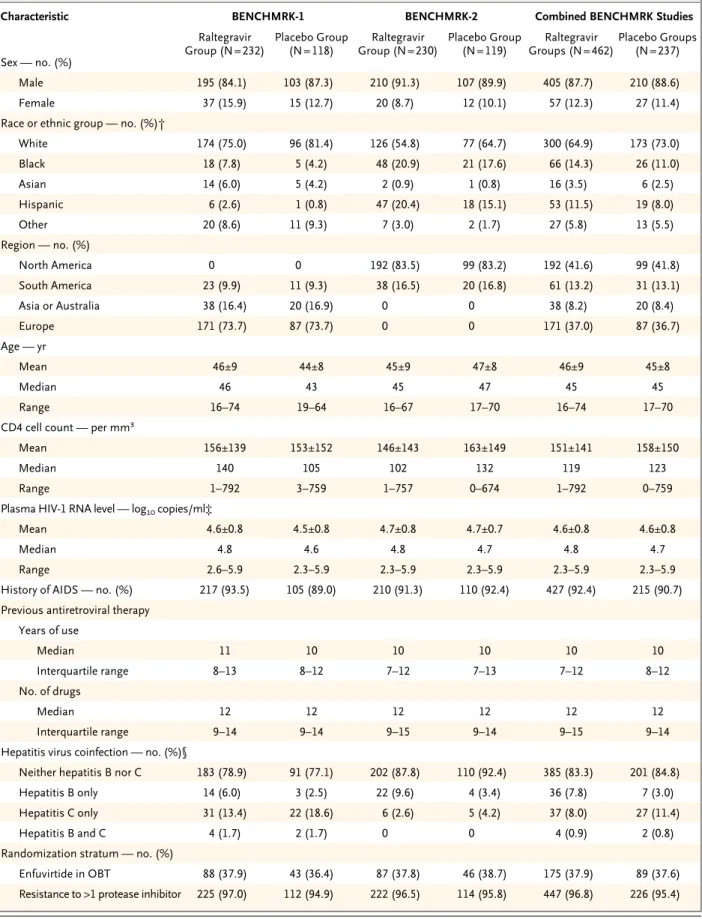
Baseline characteristics were generally bal-anced between the two treatment groups within each BENCHMRK study (Table 1). The majority of enrolled patients were heavily pretreated white men with AIDS. Overall, 12.0% of participants were women and 32.2% of participants were nonwhite. Before enrollment, 46.2% and 7.3% of patients had received enfuvirtide and darunavir, respectively. At entry, 16.2% of patients had chronic hepatitis B or hepatitis C coinfection and 20.0% had a history of cancer or a prema-lignant condition.
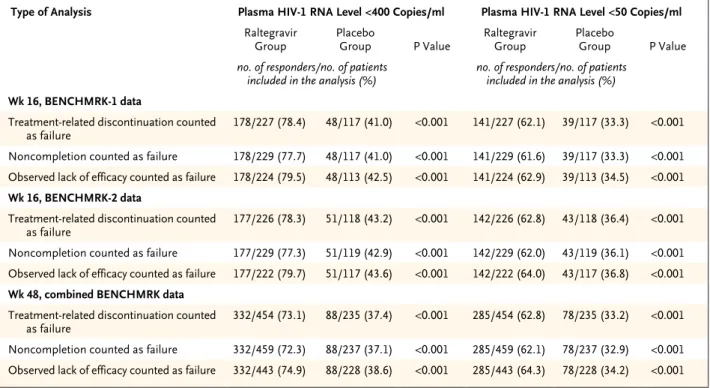
Virologic and Immunologic Responses Since few patients discontinued either BENCH-MRK study prematurely, the results of the three statistical approaches for handling missing data were similar (Table 2). The treatment effect was consistent between the two BENCHMRK studies (P>0.10 for homogeneity with each approach). On the basis of the primary, prespecified analy-sis counting treatment-related discontinuation as failure, HIV-1 RNA levels below 400 copies per milliliter at the primary (week 16) time point were achieved in 178 of 227 raltegravir recipients (78.4%) as compared with 48 of 117 placebo re-cipients (41.0%) in BENCHMRK-1 (P<0.001) and in 177 of 226 raltegravir recipients (78.3%) as compared with 51 of 118 placebo recipients (43.2%) in BENCHMRK-2 (P<0.001). According to the more stringent analysis counting any non-completion as treatment failure, HIV RNA levels were reduced to less than 400 copies per millili-ter at week 16 in 355 of 458 raltegravir recipients (77.5%) as compared with 99 of 236 placebo re-cipients (41.9%) (P<0.001 for each study individ-ually and the combined studies) (Fig. 1). HIV-1 RNA was suppressed to a level of less than 50 cop-ies per milliliter at 16 weeks in 61.8% of the ralte-gravir group as compared with 34.7% of the pla-cebo group (P<0.001 for each study individually and the combined studies).
Table 1. Selected Baseline Characteristics in the BENCHMRK Studies, According to Study Group.*
Characteristic BENCHMRK-1 BENCHMRK-2 Combined BENCHMRK Studies
Raltegravir
Group (N = 232) Placebo Group (N = 118) Group (N = 230)Raltegravir Placebo Group (N = 119) Groups (N = 462)Raltegravir Placebo Groups (N = 237)
Sex — no. (%)
Male 195 (84.1) 103 (87.3) 210 (91.3) 107 (89.9) 405 (87.7) 210 (88.6)
Female 37 (15.9) 15 (12.7) 20 (8.7) 12 (10.1) 57 (12.3) 27 (11.4)
Race or ethnic group — no. (%)†
White 174 (75.0) 96 (81.4) 126 (54.8) 77 (64.7) 300 (64.9) 173 (73.0)
Black 18 (7.8) 5 (4.2) 48 (20.9) 21 (17.6) 66 (14.3) 26 (11.0)
Asian 14 (6.0) 5 (4.2) 2 (0.9) 1 (0.8) 16 (3.5) 6 (2.5)
Hispanic 6 (2.6) 1 (0.8) 47 (20.4) 18 (15.1) 53 (11.5) 19 (8.0)
Other 20 (8.6) 11 (9.3) 7 (3.0) 2 (1.7) 27 (5.8) 13 (5.5)
Region — no. (%)
North America 0 0 192 (83.5) 99 (83.2) 192 (41.6) 99 (41.8)
South America 23 (9.9) 11 (9.3) 38 (16.5) 20 (16.8) 61 (13.2) 31 (13.1)
Asia or Australia 38 (16.4) 20 (16.9) 0 0 38 (8.2) 20 (8.4)
Europe 171 (73.7) 87 (73.7) 0 0 171 (37.0) 87 (36.7)
Age — yr
Mean 46±9 44±8 45±9 47±8 46±9 45±8
Median 46 43 45 47 45 45
Range 16–74 19–64 16–67 17–70 16–74 17–70
CD4 cell count — per mm3
Mean 156±139 153±152 146±143 163±149 151±141 158±150
Median 140 105 102 132 119 123
Range 1–792 3–759 1–757 0–674 1–792 0–759
Plasma HIV-1 RNA level — log10 copies/ml‡
Mean 4.6±0.8 4.5±0.8 4.7±0.8 4.7±0.7 4.6±0.8 4.6±0.8
Median 4.8 4.6 4.8 4.7 4.8 4.7
Range 2.6–5.9 2.3–5.9 2.3–5.9 2.3–5.9 2.3–5.9 2.3–5.9
History of AIDS — no. (%) 217 (93.5) 105 (89.0) 210 (91.3) 110 (92.4) 427 (92.4) 215 (90.7)
Previous antiretroviral therapy Years of use
Median 11 10 10 10 10 10
Interquartile range 8–13 8–12 7–12 7–13 7–12 8–12
No. of drugs
Median 12 12 12 12 12 12
Interquartile range 9–14 9–14 9–15 9–14 9–15 9–14
Hepatitis virus coinfection — no. (%)§
Neither hepatitis B nor C 183 (78.9) 91 (77.1) 202 (87.8) 110 (92.4) 385 (83.3) 201 (84.8)
Hepatitis B only 14 (6.0) 3 (2.5) 22 (9.6) 4 (3.4) 36 (7.8) 7 (3.0)
Hepatitis C only 31 (13.4) 22 (18.6) 6 (2.6) 5 (4.2) 37 (8.0) 27 (11.4)
Hepatitis B and C 4 (1.7) 2 (1.7) 0 0 4 (0.9) 2 (0.8)
Randomization stratum — no. (%)
Enfuvirtide in OBT 88 (37.9) 43 (36.4) 87 (37.8) 46 (38.7) 175 (37.9) 89 (37.6)
Table 1. (Continued.)
Characteristic BENCHMRK-1 BENCHMRK-2 Combined BENCHMRK Studies
Raltegravir
Group (N = 232) Placebo Group (N = 118) Group (N = 230)Raltegravir Placebo Group (N = 119) Groups (N = 462)Raltegravir Placebo Groups (N = 237)
No. of antiretroviral drugs in OBT
Median 4 4 4 4 4 4
Range 1–7 2–6 2–6 2–7 1–7 2–7
Enfuvirtide use in OBT — no. (%)
No 144 (62.1) 75 (63.6) 143 (62.2) 73 (61.3) 287 (62.1) 148 (62.4)
Yes, in patients who had
previ-ously used enfuvirtide 40 (17.2) 19 (16.1) 43 (18.7) 22 (18.5) 83 (18.0) 41 (17.3)
Yes, in patients who had not
used enfuvirtide¶ 48 (20.7) 24 (20.3) 44 (19.1) 24 (20.2) 92 (19.9) 48 (20.3)
Darunavir use in OBT — no. (%)
No 156 (67.2) 83 (70.3) 122 (53.0) 55 (46.2) 278 (60.2) 138 (58.2)
Yes, in patients who had
previ-ously used darunavir 14 (6.0) 5 (4.2) 4 (1.7) 4 (3.4) 18 (3.9) 9 (3.8)
Yes, in patients who had not
used darunavir§ 62 (26.7) 30 (25.4) 104 (45.2) 60 (50.4) 166 (35.9) 90 (38.0)
No. of active protease inhibitors in OBT — no. (%)‖
0 101 (43.5) 55 (46.6) 67 (29.1) 43 (36.1) 168 (36.4) 98 (41.4)
≥1 123 (53.0) 61 (51.7) 155 (67.4) 76 (63.9) 278 (60.2) 137 (57.8)
Missing data 8 (3.4) 2 (1.7) 8 (3.5) 0 16 (3.5) 2 (0.8)
Phenotypic sensitivity score — no. (%)**
0 45 (19.4) 21 (17.8) 24 (10.4) 23 (19.3) 69 (14.9) 44 (18.6)
1 67 (28.9) 39 (33.1) 78 (33.9) 33 (27.7) 145 (31.4) 72 (30.4)
2 67 (28.9) 33 (28.0) 75 (32.6) 33 (27.7) 142 (30.7) 66 (27.8)
≥3 44 (19.0) 21 (17.8) 41 (17.8) 27 (22.7) 85 (18.4) 48 (20.3)
Missing data 9 (3.9) 4 (3.4) 12 (5.2) 3 (2.5) 21 (4.5) 7 (3.0)
Genotypic sensitivity score — no. (%)**
0 70 (30.2) 34 (28.8) 45 (19.6) 32 (26.9) 115 (24.9) 66 (27.8)
1 76 (32.8) 48 (40.7) 102 (44.3) 48 (40.3) 178 (38.5) 96 (40.5)
2 57 (24.6) 22 (18.6) 54 (23.5) 27 (22.7) 111 (24.0) 49 (20.7)
≥3 26 (11.2) 13 (11.0) 25 (10.9) 10 (8.4) 51 (11.0) 23 (9.7)
Missing data 3 (1.3) 1 (0.8) 4 (1.7) 2 (1.7) 7 (1.5) 3 (1.3)
* Plus–minus values are means ±SD. Nominal P values for differences between the raltegravir and placebo groups in the data from the combined BENCHMRK studies were all greater than 0.05, with the exception of hepatitis virus coinfection, for which P=0.047. OBT de-notes optimized background therapy.
† Race or ethnic group was self-reported.
‡ The dynamic range of the standard polymerase-chain-reaction assay was 400 to 750,000 copies per milliliter.
§ Hepatitis B infection was defined as a positive test for hepatitis B surface antigen, and hepatitis C infection was defined as a positive test for hepatitis C antibody.
¶ For purposes of calculating the sensitivity scores, enfuvirtide use in patients who had not previously received enfuvirtide was always count-ed as one active drug in OBT, and darunavir use in patients who had not previously receivcount-ed darunavir was always countcount-ed as an active pro-tease inhibitor in OBT.
‖ The number of active protease inhibitors was determined by means of phenotypic resistance testing. For patients for whom there were miss ing results for genotypic or phenotypic resistance testing (or both), the number of active protease inhibitors in OBT was assigned a value of ≥1 when darunavir was used and the patient had not previously received darunavir.
milliliter in 332 of 459 raltegravir recipients (72.3%) as compared with 88 of 237 placebo recipients (37.1%) (P<0.001 for each study indi-vidually and the combined studies). In the com-bined analysis, HIV-1 RNA levels were sup-pressed to less than 50 copies per milliliter at week 48 in 285 of 459 raltegravir recipients (62.1%) as compared with 78 of 237 placebo re-cipients (32.9%) (P<0.001 for each study indi-vidually and the combined studies).
On the basis of the approach considering observed lack of efficacy as treatment failure,
the overall mean change in log10 HIV-1 RNA
copies per milliliter at week 48 was −1.7 (95% confidence interval [CI], −1.8 to −1.6) in the raltegravir groups and −0.8 (95% CI, −0.9 to −0.6) in the placebo groups (P<0.001 for both studies individually and combined) (Fig. 2 in Supplementary Appendix 2). The mean change in CD4 cell counts between baseline and week 48 was 109 per cubic millimeter (95% CI, 98 to 121) in the raltegravir groups as compared with 45 per cubic millimeter (95% CI, 32 to 57) in the
placebo groups (P<0.001 for each study individu-ally and the combined studies).
Confirmed AIDS-defining clinical events oc-curred by week 48 in 17 of the 462 patients (3.7%) in the raltegravir groups and 11 of the 237 patients (4.6%) in the placebo groups (Table A1 in Supplementary Appendix 2). In compar-isons of the numbers of patients with AIDS-defining conditions in the raltegravir groups and the placebo groups, based on the person-years of follow-up in the double-blind phases of both studies, the relative risk of an AIDS-defining event with raltegravir was 0.59 (95% CI, 0.26 to 1.40). The median time at which an AIDS-defin-ing event was diagnosed was 64 days (inter-quartile range, 52 to 110) among raltegravir re-cipients and 105 days (interquartile range, 19 to 118) among placebo recipients.
Safety, Adverse Events, and Side Effects During the double-blind phases from both BENCHMRK studies, clinical adverse events of any intensity were reported in 90.3% of patients Table 2. Results of Efficacy Analyses, According to the Statistical Approach Used to Handle Discontinuations and Other Missing Data.*
Type of Analysis Plasma HIV-1 RNA Level <400 Copies/ml Plasma HIV-1 RNA Level <50 Copies/ml
Raltegravir
Group Placebo Group P Value Raltegravir Group Placebo Group P Value
no. of responders/no. of patients
included in the analysis (%) no. of responders/no. of patients included in the analysis (%)
Wk 16, BENCHMRK-1 data
Treatment-related discontinuation counted
as failure 178/227 (78.4) 48/117 (41.0) <0.001 141/227 (62.1) 39/117 (33.3) <0.001
Noncompletion counted as failure 178/229 (77.7) 48/117 (41.0) <0.001 141/229 (61.6) 39/117 (33.3) <0.001
Observed lack of efficacy counted as failure 178/224 (79.5) 48/113 (42.5) <0.001 141/224 (62.9) 39/113 (34.5) <0.001
Wk 16, BENCHMRK-2 data
Treatment-related discontinuation counted
as failure 177/226 (78.3) 51/118 (43.2) <0.001 142/226 (62.8) 43/118 (36.4) <0.001
Noncompletion counted as failure 177/229 (77.3) 51/119 (42.9) <0.001 142/229 (62.0) 43/119 (36.1) <0.001
Observed lack of efficacy counted as failure 177/222 (79.7) 51/117 (43.6) <0.001 142/222 (64.0) 43/117 (36.8) <0.001
Wk 48, combined BENCHMRK data Treatment-related discontinuation counted
as failure 332/454 (73.1) 88/235 (37.4) <0.001 285/454 (62.8) 78/235 (33.2) <0.001
Noncompletion counted as failure 332/459 (72.3) 88/237 (37.1) <0.001 285/459 (62.1) 78/237 (32.9) <0.001
Observed lack of efficacy counted as failure 332/443 (74.9) 88/228 (38.6) <0.001 285/443 (64.3) 78/228 (34.2) <0.001
36p6
100
HIV-1 RNA Level <400 Copies/ml (%)
80 60 40 20 0
0 2 4 8 12 16 24 32 40 48 Raltegravir group Placebo group
Raltegravir group Placebo group
Weeks
100
HIV-1 RNA Level <50 Copies/ml (%)
80 60 40 20 0
0 2 4 8 12 16 24 32 40 48 Weeks A BENCHMRK-1
No. of Patients Raltegravir Placebo 232 118 231 118 229 117 232 118 231 118 230 118 229 118 AUTHOR: FIGURE: JOB: 4-C H/T RETAKE SIZE
ICM CASE EMail
Line H/T Combo
Revised
AUTHOR, PLEASE NOTE:
Figure has been redrawn and type has been reset.
Please check carefully.
REG F Enon 1st 2nd 3rd
DiNubile (Steigbigel)
1 of 1
07-24-08 ARTIST: ts 35904 ISSUE: 100
HIV-1 RNA Level <400 Copies/ml (%)
80 60 40 20 0
0 2 4 8 12 16 24 32 40 48 Raltegravir group Placebo group
Raltegravir group Placebo group
Weeks
100
HIV-1 RNA Level <50 Copies/ml (%)
80 60 40 20 0
0 2 4 8 12 16 24 32 40 48 Weeks B BENCHMRK-2
No. of Patients Raltegravir Placebo 230 119 227 118 229 119 229 119 228 119 228 119 224 119 100
HIV-1 RNA Level <400 Copies/ml (%)
80 60 40 20 0
0 2 4 8 12 16 24 32 40 48
Raltegravir groups Placebo groups Raltegravir groups Placebo groups
Weeks
100
HIV-1 RNA Level <50 Copies/ml (%)
80 60 40 20 0
0 2 4 8 12 16 24 32 40 48 Weeks C
Combined BENCHMRK Studies
No. of Patients Raltegravir Placebo 462 237 458 236 458 236 461 237 459 237 458 237 453 237 P<
0.001 at wk 16 and wk 48
P<
0.001 at wk 16 and wk 48
P<
0.001 at wk 16 and wk 48
P<
0.001 at wk 16 and wk 48
P<
0.001 at wk 16 and wk 48
P<
0.001 at wk 16 and wk 48
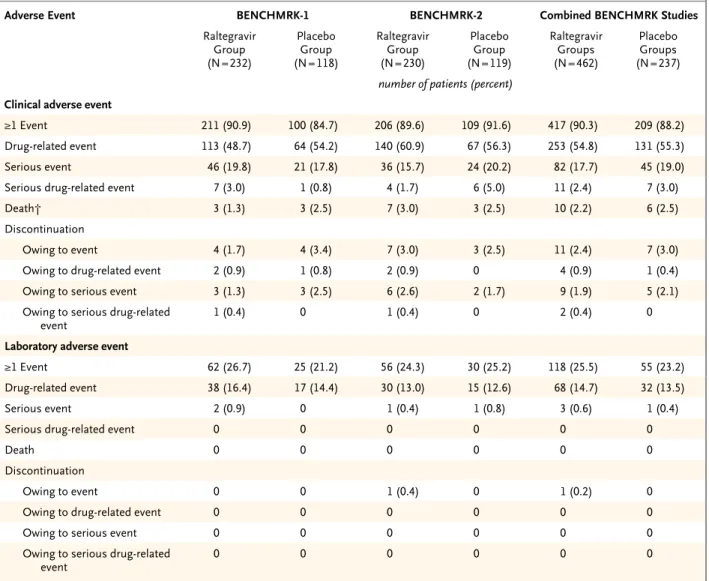
in the raltegravir groups and 88.2% of patients in the placebo groups and were considered to be related to any drug in the study regimen in 54.8% of patients receiving raltegravir and 55.3% of those receiving placebo; laboratory adverse events occurred in 25.5% of raltegravir recipients and 23.2% of placebo recipients and were considered to be drug-related in 14.7% and 13.5%, respec-tively (Table 3). Other than local reactions at the site of enfuvirtide injections, the most common drug-related clinical adverse events in both treat-ment groups were diarrhea, nausea, and
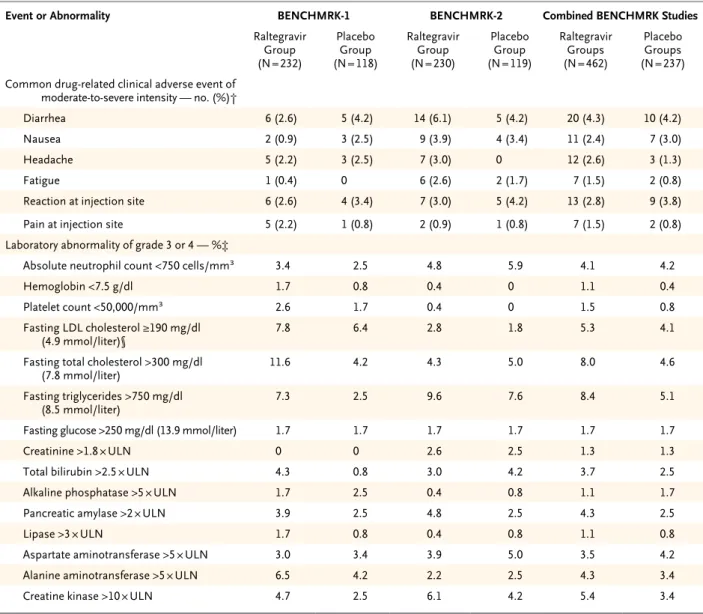
head-ache. The most common drug-related laboratory adverse events were increased serum cholesterol, triglyceride, and aminotransferase levels in the raltegravir groups and increased cholesterol and creatinine levels and decreased neutrophil counts in the placebo groups. Moderate-to-severe clini-cal adverse events and laboratory abnormalities of grade 3 or 4 are reported in Table 4. Supple-mentary Appendix 2 lists all serious clinical ad-verse events (Table A2), clinical adad-verse events of any intensity or causality that occurred in 2% or more of patients in either treatment group (Table
Table 3. Types and Frequencies of Clinical and Laboratory Adverse Events during Double-Blind Phases of the BENCHMRK Studies.*
Adverse Event BENCHMRK-1 BENCHMRK-2 Combined BENCHMRK Studies
Raltegravir Group (N = 232)
Placebo Group (N = 118)
Raltegravir Group (N = 230)
Placebo Group (N = 119)
Raltegravir Groups (N = 462)
Placebo Groups (N = 237)
number of patients (percent)
Clinical adverse event
≥1 Event 211 (90.9) 100 (84.7) 206 (89.6) 109 (91.6) 417 (90.3) 209 (88.2)
Drug-related event 113 (48.7) 64 (54.2) 140 (60.9) 67 (56.3) 253 (54.8) 131 (55.3)
Serious event 46 (19.8) 21 (17.8) 36 (15.7) 24 (20.2) 82 (17.7) 45 (19.0)
Serious drug-related event 7 (3.0) 1 (0.8) 4 (1.7) 6 (5.0) 11 (2.4) 7 (3.0)
Death† 3 (1.3) 3 (2.5) 7 (3.0) 3 (2.5) 10 (2.2) 6 (2.5)
Discontinuation
Owing to event 4 (1.7) 4 (3.4) 7 (3.0) 3 (2.5) 11 (2.4) 7 (3.0)
Owing to drug-related event 2 (0.9) 1 (0.8) 2 (0.9) 0 4 (0.9) 1 (0.4)
Owing to serious event 3 (1.3) 3 (2.5) 6 (2.6) 2 (1.7) 9 (1.9) 5 (2.1)
Owing to serious drug-related
event 1 (0.4) 0 1 (0.4) 0 2 (0.4) 0
Laboratory adverse event
≥1 Event 62 (26.7) 25 (21.2) 56 (24.3) 30 (25.2) 118 (25.5) 55 (23.2)
Drug-related event 38 (16.4) 17 (14.4) 30 (13.0) 15 (12.6) 68 (14.7) 32 (13.5)
Serious event 2 (0.9) 0 1 (0.4) 1 (0.8) 3 (0.6) 1 (0.4)
Serious drug-related event 0 0 0 0 0 0
Death 0 0 0 0 0 0
Discontinuation
Owing to event 0 0 1 (0.4) 0 1 (0.2) 0
Owing to drug-related event 0 0 0 0 0 0
Owing to serious event 0 0 0 0 0 0
Owing to serious drug-related
event 0 0 0 0 0 0
* For the combined data, there were no significant differences between the raltegravir and placebo groups for any type of clinical or laboratory adverse event listed in the table. Drug-related events were those determined by an investigator to be possibly, probably, or definitely related to use of any drug in the study regimen.
A3), and laboratory abnormalities of DAIDS grade 2, 3, or 4 (Table A4).
As of the cutoff dates for this analysis, 10 of the 462 patients (2.2%) in the raltegravir groups and 6 of the 237 patients (2.5%) in the placebo
groups had died during the double-blind phases of the two studies. In the raltegravir groups, the fatal adverse events were pneumonia, rectal bleeding, and septic shock; cryptococcal meningi-tis; atypical mycobacterial infection, T-cell
lym-Table 4. Clinical Adverse Events and Laboratory Abnormalities during Double-Blind Phases of the BENCHMRK Studies.*
Event or Abnormality BENCHMRK-1 BENCHMRK-2 Combined BENCHMRK Studies
Raltegravir Group (N = 232)
Placebo Group (N = 118)
Raltegravir Group (N = 230)
Placebo Group (N = 119)
Raltegravir Groups (N = 462)
Placebo Groups (N = 237) Common drug-related clinical adverse event of
moderate-to-severe intensity — no. (%)†
Diarrhea 6 (2.6) 5 (4.2) 14 (6.1) 5 (4.2) 20 (4.3) 10 (4.2)
Nausea 2 (0.9) 3 (2.5) 9 (3.9) 4 (3.4) 11 (2.4) 7 (3.0)
Headache 5 (2.2) 3 (2.5) 7 (3.0) 0 12 (2.6) 3 (1.3)
Fatigue 1 (0.4) 0 6 (2.6) 2 (1.7) 7 (1.5) 2 (0.8)
Reaction at injection site 6 (2.6) 4 (3.4) 7 (3.0) 5 (4.2) 13 (2.8) 9 (3.8)
Pain at injection site 5 (2.2) 1 (0.8) 2 (0.9) 1 (0.8) 7 (1.5) 2 (0.8)
Laboratory abnormality of grade 3 or 4 — %‡
Absolute neutrophil count <750 cells/mm3 3.4 2.5 4.8 5.9 4.1 4.2
Hemoglobin <7.5 g/dl 1.7 0.8 0.4 0 1.1 0.4
Platelet count <50,000/mm3 2.6 1.7 0.4 0 1.5 0.8
Fasting LDL cholesterol ≥190 mg/dl
(4.9 mmol/liter)§ 7.8 6.4 2.8 1.8 5.3 4.1
Fasting total cholesterol >300 mg/dl
(7.8 mmol/liter) 11.6 4.2 4.3 5.0 8.0 4.6
Fasting triglycerides >750 mg/dl
(8.5 mmol/liter) 7.3 2.5 9.6 7.6 8.4 5.1
Fasting glucose >250 mg/dl (13.9 mmol/liter) 1.7 1.7 1.7 1.7 1.7 1.7
Creatinine >1.8 × ULN 0 0 2.6 2.5 1.3 1.3
Total bilirubin >2.5 × ULN 4.3 0.8 3.0 4.2 3.7 2.5
Alkaline phosphatase >5 × ULN 1.7 2.5 0.4 0.8 1.1 1.7
Pancreatic amylase >2 × ULN 3.9 2.5 4.8 2.5 4.3 2.5
Lipase >3 × ULN 1.7 0.8 0.4 0.8 1.1 0.8
Aspartate aminotransferase >5 × ULN 3.0 3.4 3.9 5.0 3.5 4.2
Alanine aminotransferase >5 × ULN 6.5 4.2 2.2 2.5 4.3 3.4
Creatine kinase >10 × ULN 4.7 2.5 6.1 4.2 5.4 3.4
* Nominal P values for differences between the raltegravir and placebo groups in the data from the combined BENCHMRK studies were all greater than 0.05. Table A3 in Supplementary Appendix 2 lists all clinical adverse events of any intensity (whether drug-related or not) occur-ring in 2% or more of the patients in either treatment group in the combined analysis, along with point estimates and 95% confidence
inter-vals for the difference between the two treatment groups for each organ system. Adverse event terms are from the Medical Dictionary for
Regula tory Activities (MedDRA), version 10.1. Table A4 in Supplementary Appendix 2 lists all laboratory abnormalities of grade 2, 3, or 4, according to the Division of AIDS (DAIDS) criteria (http://rcc.tech-res-intl.com/tox_tables.htm), occurring in patients in the combined BENCHMRK studies. LDL denotes low-density lipoprotein, and ULN upper limit of the normal range.
† The clinical adverse events listed are those present in 2% or more of patients in either treatment group and determined by an investigator to be possibly, probably, or definitely related to the use of a study drug. Reaction at injection site and pain at injection site were considered to be attributable to enfuvirtide injection.
‡ The laboratory-abnormality grade was assigned on the basis of the DAIDS criteria. Except for creatine kinase, the laboratory test results re-ported in the table were specified to be graded before the data were unblinded.
phoma, shock and multiorgan failure; coronary artery disease; cardiorespiratory arrest; non-Hodgkin’s lymphoma; hepatocellular carcinoma; esophageal candidiasis; the wasting syndrome; and mixed infection with tuberculosis and asper-gillosis. In the placebo groups, the fatal adverse events were pneumonia; urosepsis; worsening of end-stage AIDS; AIDS dementia complex; failure to thrive, dehydration, and respiratory failure; and sepsis.
As of the cutoff dates for this analysis, 16 of 462 raltegravir recipients (3.5%) and 4 of 237 placebo recipients (1.7%) had been given a diag-nosis of new, recurrent, or progressive cancer during the double-blind phases of the two stud-ies (Table 5). All cancers were reported as seri-ous adverse events not related to a study drug, except for lymphoma in one placebo recipient that was considered to be possibly drug related. With adjustment for person-years of follow-up during the double-blind phases of the two stud-ies, the relative risk of cancer in the raltegravir groups as compared with the placebo groups was 1.54 (95% CI, 0.50 to 6.34). The median time during the study when cancer was diagnosed
was 68 days (interquartile range, 30 to 118) among raltegravir recipients and 285 days (inter-quartile range, 246 to 336) among placebo re-cipients. Except for two raltegravir recipients, by the time of the cancer diagnosis, patients had had a response to the study therapy: an increase in the CD4 cell count by 50 or more per cubic millimeter, a decrease in the HIV-1 RNA level by
1 log10 copies per milliliter or more, or an HIV-1
RNA level of less than 400 copies per milliliter. In three raltegravir recipients, immune reconsti-tution was considered by the investigators to have possibly contributed to the diagnosis of can-cer. Five of the patients with cancer in the ralte-gravir group had died by the cutoff dates for this analysis.
Discussion
Highly active antiretroviral therapy effectively suppresses viremia in most patients with ad-vanced HIV infection who comply with their an-tiretroviral regimen, but drug-resistant virus
emerges in some patients.12-14,20,32-34 In addition,
transmission of resistant HIV places patients
Table 5. Cancers Diagnosed during Double-Blind Phases of the Combined BENCHMRK Studies.*
Type of Cancer Raltegravir Groups (N = 462) Placebo Groups (N = 237)
New Relapse New Relapse
no. of patients
Any 10 6 3 1
Kaposi’s sarcoma 1 1 0 0
Non-Hodgkin’s lymphoma
B cell 1 1 0 0
T cell 1 0 0 0
Unspecified 0 0 1 0
Anal squamous-cell carcinoma
Invasive 2 0 2 0
In situ carcinoma 1 2 0 0
Rectal adenocarcinoma 1 0 0 0
Hepatocellular carcinoma 1 0 0 0
Skin cancer
Basal-cell carcinoma 0 1 0 1
Squamous-cell carcinoma 2 1 0 0
Laryngeal squamous-cell carcinoma 1 0 0 0
who have not previously received treatment at risk for suboptimal responses to first-line
regimens.10,15-18,35,36 Historically, as compared
with the initial regimens, subsequent antiretrovi-ral regimens used in patients with resistant virus after treatment failures have been much less
suc-cessful in suppressing viremia.1,12,20,21,32,33,37,38
Raltegravir inhibits HIV-1 replication through a mechanism of action distinct from that of other currently approved antiretroviral drugs and thus offers the promise of potent activity against
mul-tidrug-resistant virus.26-28,31
In patients infected with HIV that had triple-class drug resistance, raltegravir given at a dose of 400 mg twice daily at intervals of 12 (±2) hours, with optimized background therapy, had a rapid and potent antiretroviral effect that was superior to the effect of optimized background therapy alone at week 48. These results were consistent between the two BENCHMRK stud-ies. The majority of patients in both studies had AIDS at entry and had failure of multiple previ-ous antiretroviral regimens, with the emergence of highly resistant virus. The inferior virologic responses in the placebo groups as compared with the raltegravir groups were consistent with the findings in other studies targeting similar populations and attest to the shortcomings of
older treatment options in this context.39-47
Im-munologic benefits evidenced by increased CD4 cell counts were also observed during raltegravir therapy.
Overall, adverse-event profiles were generally similar for the raltegravir and placebo regimens. The disproportionate diagnosis of several can-cers in the raltegravir groups as compared with the placebo groups at the time of the 16-week analyses in the two BENCHMRK studies prompt-ed a comprehensive review of all cancers
occur-ring in the four phase 2–3 trials of raltegravir.31,48,49
Data from three studies of heavily pretreated patients were combined with data from one study of previously untreated patients and were adjusted for the duration of follow-up during the
double-blind phases.50 The relative risk of cancer
associated with raltegravir, as compared with placebo, was 1.2 (95% CI, 0.4 to 4.1) in the most current analysis, with a composite rate of 2.2 cancers per 100 patient-years in the raltegravir groups (vs. 1.8 per 100 patient-years in the pla-cebo groups). The types and frequencies of can-cers were similar to those reported in patients
with advanced HIV infection.51 Most patients
with a diagnosis of cancer had favorable viro-logic and immunoviro-logic responses. Cancers were generally detected earlier after the initiation of study therapy in the raltegravir groups than in the placebo groups. Although usually associated with AIDS-related opportunistic infections, the immune reconstitution syndrome has been linked
to the detection of cancer.52-62 No evidence of
carcinogenicity was apparent from the preclinical data on raltegravir. Continued vigilance in the monitoring of safety is nonetheless warranted.
Our results should be interpreted in the con-text of the prelicensure experience with this new class of drugs in a limited number of patients to
date.31,48,49 Data on the efficacy, safety, and
tol-erability of raltegravir given for 48 or more
weeks are accumulating.49,63 The durability of
viral suppression and the tolerability of longer-term therapy with raltegravir-based combination regimens continue to be assessed in the ongoing BENCHMRK studies. The development of resis-tance to integrase inhibitors is a particular con-cern when raltegravir is by necessity used as functional monotherapy (in which there are no fully active drugs in the optimized background
therapy).12,20,48,64,65 Although viral suppression
has been found in some patients whose opti-mized background therapy had a genotypic or phenotypic sensitivity score of 0, some drugs used in the optimized background therapy may
have retained partial antiretroviral activity.48 In
contrast, baseline resistance testing may have failed to detect archived resistance mutations present at frequencies below the limit of detec-tion of the assay, thereby possibly inflating some sensitivity scores in both treatment groups.
In patients with few remaining treatment op-tions, raltegravir combined with optimized background therapy provided superior HIV-1 suppression as compared with optimized back-ground therapy alone, despite the presence of virus that has triple-class drug resistance. The potent suppression of viremia seen at week 16 in raltegravir recipients was usually achieved by week 4 and sustained through week 48. As with other new antiretroviral agents under develop-ment that work through novel mechanisms of
action,66 raltegravir as part of an optimized
combination regimen offers hope for the sup-pression of HIV-1 infection that is resistant to
Supported by Merck.
Dr. Steigbigel reports serving as an investigator for Merck, Pfizer, and Boehringer Ingelheim; Dr. Cooper, serving as an in-vestigator for and receiving speaker’s and advisory fees from Merck; Dr. Kumar, serving as an investigator for and receiving consulting and lecture fees from Merck; Dr. Eron, serving as an investigator for Merck, GlaxoSmithKline, Abbott, and Panacos and receiving consulting or lecture fees from Merck, Gilead, Bristol-Myers Squibb, GlaxoSmithKline, Abbott, Trimeris, Roche, Virco, Monogram, and Panacos; Dr. Schechter, serving as an investigator for Merck and receiving consulting fees or lecture fees from Merck, Gilead, Bristol-Myers Squibb, Abbott, Roche, and Pfizer; Dr. Markowitz, serving as an investigator for Merck, GlaxoSmithKline, Gilead, and Tibotec and receiving consulting fees from Merck, Gilead, GlaxoSmithKline, Sequoia Pharmaceu-ticals, and Quintiles and grant support from Merck and Pfizer; Dr. Loutfy, serving as an investigator for Merck; Dr. Lennox, serving as an investigator for Merck, Gilead, Pfizer, Tibotec, Schering, and Abbott and receiving consulting fees from Merck, Roche, and Abbott; Dr. Gatell, receiving grant support or lecture or advisory fees from Merck, Roche, GlaxoSmithKline, Bristol-Myers Squibb, Tibotec, Pfizer, Gilead, Abbott, and Boehringer Ingelheim; Dr. Rockstroh, receiving lecture or advisory fees from Merck, Roche, GlaxoSmithKline, Bristol-Myers Squibb,
Tibotec, Pfizer, Gilead, Abbott, and Boehringer Ingelheim; Dr. Katlama, receiving advisory or lecture fees from Merck, Gilead, Roche, GlaxoSmithKline, Tibotec, Bristol-Myers Squibb, and Boehringer Ingelheim; Dr. Yeni, receiving grant support and advisory fees from Tibotec, Merck, GlaxoSmithKline, Pfizer, Gilead, Abbott, and Boehringer Ingelheim; Dr. Lazzarin, receiving advisory fees from Merck and consulting and lecture fees from Gilead, Roche, Bristol-Myers Squibb, GlaxoSmithKline, Tibotec, Boehringer Ingelheim, Pfizer, Merck, and Abbott; Dr. Clotet, re-ceiving consulting and lecture fees from Gilead, Roche, Bristol-Myers Squibb, GlaxoSmithKline, Tibotec, Boehringer Ingelheim, Pfizer, Merck, and Abbott; and Drs. Zhao, Chen, Meibohm, Miller, Hazuda, DiNubile, Isaacs, Nguyen, and Teppler, Mr. Ryan, Mr. Rhodes, Mr. Killar, Ms. Gilde, Ms. Strohmaier, and Mr. Nessly, being employees of Merck and owning stock or stock op-tions or both in the company. No other potential conflict of in-terest relevant to this article was reported.
We thank all the patients and their caregivers who partici-pated in the BENCHMRK studies; the investigators who enrolled their patients in these trials for their important contributions; Keith Gottesdiener for his thoughtful advice; and Joann DiLullo, Karyn Davis, Anita Jain, Andrea Karian, Hong Wan, Jennifer Reinert, Bernard Akyena, Xia Xu, and Anthony Rodgers for their expert assistance.
References
Hammer SM, Saag MS, Schechter M,
1.
et al. Treatment for adult HIV infection: 2006 recommendations of the Interna-tional AIDS Society-USA panel. JAMA 2006;296:827-43.
Freedberg KA, Losina E, Weinstein
2.
MC, et al. The cost effectiveness of combi-nation antiretroviral therapy for HIV dis-ease. N Engl J Med 2001;344:824-31.
Gebo KA, Chaisson RE, Folkemer JG,
3.
Bartlett JG, Moore RD. Costs of HIV med-ical care in the era of highly active antiret-roviral therapy. AIDS 1999;13:963-9.
Hornberger J, Kilby JM, Wintfeld N,
4.
Green J. Cost-effectiveness of enfuvirtide in HIV therapy for treatment-experienced patients in the United States. AIDS Res Hum Retroviruses 2006;22:240-7.
Li TS, Tubiana R, Katlama C, Calvez V,
5.
Ait Mohand H, Autran B. Long-lasting re-covery in CD4 T-cell function and viral-load reduction after highly active antiret-roviral therapy in advanced HIV-1 disease. Lancet 1998;351:1682-6.
Mocroft A, Vella S, Benfield TL, et al.
6.
Changing patterns of mortality across Eu-rope in patients infected with HIV-1. Lan-cet 1998;352:1725-30.
Palella FJ Jr, Delaney KM, Moorman
7.
AC, et al. Declining morbidity and mor-tality among patients with advanced hu-man immunodeficiency virus infection. N Engl J Med 1998;338:853-60.
Vittinghoff E, Scheer S, O’Malley P,
8.
Colfax G, Holmberg SD, Buchbinder SP. Combination antiretroviral therapy and recent declines in AIDS incidence and mortality. J Infect Dis 1999;179:717-20.
Barreto CC, Nishyia A, Araújo LV,
Fer-9.
reira JE, Busch MP, Sabino EC. Trends in antiretroviral drug resistance and clade distributions among HIV-1–infected blood
donors in Sao Paulo, Brazil. J Acquir Im-mune Defic Syndr 2006;41:338-41.
Gentz M, Levin TP, Klibanov OM,
10.
Feingold A, Condoluci DV. Three-class an-tiretroviral resistance in a patient with acute HIV-1 infection. AIDS Patient Care STDS 2006;20:741-4.
Kijak GH, Pampuro SE, Avila MM, et
11.
al. Resistance profiles to antiretroviral drugs in HIV-1 drug-naive patients in Ar-gentina. Antivir Ther 2001;6:71-7.
Kolber MA, Campo RE, Dickinson
12.
GM. Development of anti-retroviral resis-tance of HIV-1 infected individuals on therapy: is it inevitable? IUBMB Life 2004; 56:301-7.
Richman DD, Morton SC, Wrin T, et al.
13.
The prevalence of antiretroviral drug resis-tance in the United States. AIDS 2004; 18:1393-401.
Tozzi V, Zaccarelli M, Bonfigli S, et al.
14.
Drug-class-wide resistance to antiretrovi-rals in HIV-infected patients failing ther-apy: prevalence, risk factors and virologi-cal outcome. Antivir Ther 2006;11:553-60. Truong HM, Grant RM, McFarland W,
15.
et al. Routine surveillance for the detec-tion of acute and recent HIV infecdetec-tions and transmission of antiretroviral resis-tance. AIDS 2006;20:2193-7.
Turner D, Wainberg MA. HIV
trans-16.
mission and primary drug resistance. AIDS Rev 2006;8:17-23.
Van Laethem K, De Munter P,
Schroo-17.
ten Y, et al. No response to first-line tenofovir+lamivudine+efavirenz despite optimization according to baseline resis-tance testing: impact of resistant minority variants on efficacy of low genetic barrier drugs. J Clin Virol 2007;39:43-7.
Viani RM, Peralta L, Aldrovandi G, et
18.
al. Prevalence of primary HIV-1 drug
re-sistance among recently infected adoles-cents: a multicenter adolescent medicine trials network for HIV/AIDS interventions study. J Infect Dis 2006;194:1505-9.
Ross L, Liao Q, Gao H, et al. Impact of
19.
HIV type 1 drug resistance mutations and phenotypic resistance profile on virologic response to salvage therapy. AIDS Res Hum Retroviruses 2001;17:1379-85.
Temesgen Z, Cainelli F, Poeschla EM,
20.
Vlahakis SA, Vento S. Approach to salvage antiretroviral therapy in heavily antiretro-viral-experienced HIV-positive adults. Lan-cet Infect Dis 2006;6:496-507.
de Béthune MP, Hertogs K. Screening
21.
and selecting for optimized antiretroviral drugs: rising to the challenge of drug re-sistance. Curr Med Res Opin 2006;22: 2603-12.
De Clercq E. Emerging anti-HIV drugs.
22.
Expert Opin Emerg Drugs 2005;10:241-73. Gulick RM. New antiretroviral drugs.
23.
Clin Microbiol Infect 2003;9:186-93. Torti C, Quiros-Roldan E, Regazzi M,
24.
et al. A randomized controlled trial to evaluate antiretroviral salvage therapy guided by rules-based or phenotype-driv-en HIV-1 gphenotype-driv-enotypic drug-resistance inter-pretation with or without concentration-controlled intervention: the Resistance and Dosage Adapted Regimens (RADAR) study. Clin Infect Dis 2005;40:1828-36.
Savarino A. A historical sketch of the
25.
discovery and development of HIV-1 inte-grase inhibitors. Expert Opin Investig Drugs 2006;15:1507-22.
Espeseth AS, Felock P, Wolfe A, et al.
26.
Hazuda DJ, Felock P, Witmer M, et al.
27.
Inhibitors of strand transfer that prevent integration and inhibit HIV-1 replication in cells. Science 2000;287:646-50.
Hazuda DJ, Young SD, Guare JP, et al.
28.
Integrase inhibitors and cellular immu-nity suppress retroviral replication in rhe-sus macaques. Science 2004;305:528-32.
Kassahun K, McIntosh I, Cui D, et al.
29.
Metabolism and disposition in humans of raltegravir (MK-0518), an anti-AIDS drug targeting the human immunodeficiency virus 1 integrase enzyme. Drug Metab Dispos 2007;35:1657-63.
Markowitz M, Morales-Ramirez JO,
30.
Nguyen BY, et al. Antiretroviral activity, pharmacokinetics, and tolerability of MK-0518, a novel inhibitor of HIV-1 integrase, dosed as monotherapy for 10 days in treatment-naïve HIV-1-infected individu-als. J Acquir Immune Defic Syndr 2006; 43:509-15. [Erratum, J Acquir Immune Defic Syndr 2007;44:492.]
Grinsztejn B, Nguyen B-Y, Katlama C,
31.
et al. Safety and efficacy of the HIV-1 in-tegrase inhibitor raltegravir (MK-0518) in treatment-experienced patients with multi-drug-resistant virus: a phase II randomised controlled trial. Lancet 2007;369:1261-9.
Karmochkine M, Si Mohamed A,
32.
Piketty C, et al. The cumulative occur-rence of resistance mutations in the HIV-1 protease gene is associated with failure of salvage therapy with ritonavir and saqui-navir in protease inhibitor-experienced patients. Antiviral Res 2000;47:179-88.
Lorenzi P, Opravil M, Hirschel B, et al.
33.
Impact of drug resistance mutations on virologic response to salvage therapy: Swiss HIV Cohort Study. AIDS 1999;13: F17-F21.
Machouf N, Thomas R, Nguyen VK, et
34.
al. Effects of drug resistance on viral load in patients failing antiretroviral therapy. J Med Virol 2006;78:608-13.
Bezemer D, de Ronde A, Prins M, et
35.
al. Evolution of transmitted HIV-1 with drug-resistance mutations in the absence of therapy: effects on CD4+ T-cell count and HIV-1 RNA load. Antivir Ther 2006; 11:173-7.
Welles SL, Bauer GR, LaRussa PS,
Col-36.
grove RC, Pitt J. Time trends for HIV-1 antiretroviral resistance among antiretro-viral-experienced and naive pregnant women in New York City during 1991 to early 2001. J Acquir Immune Defic Syndr 2007;44:329-35.
Luber AD. Treatment strategies for
37.
highly treatment-experienced HIV-infect-ed patients. Expert Rev Anti Infect Ther 2005;3:815-23.
Vallejo A, Olivera M, Rubio A,
Sán-38.
chez-Quijano A, Lissen E, Leal M. Geno-typic resistance profile in treatment-expe-rienced HIV-infected individuals after abacavir and efavirenz salvage regimen. Antiviral Res 2004;61:129-32.
Madruga JV, Cahn P, Grinsztejn B, et
39.
al. Efficacy and safety of TMC125 (etra-virine) in treatment-experienced HIV-1-infected patients in DUET-1: 24-week re-sults from a randomised, double-blind, placebo-controlled trial. Lancet 2007;370: 29-38.
Cahn P, Villacian J, Lazzarin A, et al.
40.
Ritonavir-boosted tipranavir demonstrates superior efficacy to ritonavir-boosted pro-tease inhibitors in treatment-experienced HIV-infected patients: 24-week results of the RESIST-2 trial. Clin Infect Dis 2006; 43:1347-56.
Gathe J, Cooper DA, Farthing C, et al.
41.
Efficacy of the protease inhibitors tipra-navir plus ritotipra-navir in treatment-experi-enced patients: 24-week analysis from the RESIST-1 trial. Clin Infect Dis 2006;43: 1337-46.
Hicks CB, Cahn P, Cooper DA, et al.
42.
Durable efficacy of tipranavir-ritonavir in combination with an optimised back-ground regimen of antiretroviral drugs for treatment-experienced HIV-1-infected patients at 48 weeks in the Randomized Evaluation of Strategic Intervention in multi-drug reSistant patients with Tipra-navir (RESIST) studies: an analysis of combined data from two randomised open-label trials. Lancet 2006;368:466-75.
Lalezari JP, Henry K, O’Hearn M, et al.
43.
Enfuvirtide, an HIV-1 fusion inhibitor, for drug-resistant HIV infection in North and South America. N Engl J Med 2003;348: 2175-85. [Erratum, N Engl J Med 2003; 349:1100.]
Lazzarin A, Clotet B, Cooper D, et al.
44.
Efficacy of enfuvirtide in patients infected with drug-resistant HIV-1 in Europe and Australia. N Engl J Med 2003;348:2186-95. Katlama C, Esposito R, Gatell JM, et
45.
al. Efficacy and safety of TMC114/ritona-vir in treatment-experienced HIV patients: 24-week results of POWER 1. AIDS 2007; 21:395-402.
Molina JM, Cohen C, Katlama C, et al.
46.
Safety and efficacy of darunavir (TMC114) with low-dose ritonavir in treatment- experienced patients: 24-week results of POWER 3. J Acquir Immune Defic Syndr 2007;46:24-31.
Lazzarin A, Campbell T, Clotet B, et
47.
al. Efficacy and safety of TMC125 (etra-virine) in treatment-experienced HIV-1-infected patients in DUET-2: 24-week re-sults from a randomised, double-blind, placebo-controlled trial. Lancet 2007;370: 39-48.
Cooper DA, Steigbigel RT, Gatell JM,
48.
et al. Subgroup and resistance analyses of raltegravir for resistant HIV-1 infection. N Engl J Med 2008;359:355-65.
Markowitz M, Nguyen B-Y, Gotuzzo
49.
E, et al. Rapid and durable antiretroviral effect of the HIV-1 integrase inhibitor raltegravir as part of combination therapy in treatment-naive patients with HIV-1
in-fection: results of a 48-week controlled study. J Acquir Immune Defic Syndr 2007; 46:125-33.
Raltegravir NDA 22-145. (Accessed
50.
June 30, 2008, at http://www.fda.gov/ ohrms/dockets/ac/07/slides/2007-4314s1-06-connelly_files/slide0089.htm.)
Grulich AE, van Leeuwen MT, Falster
51.
MO, Vajdic CM. Incidence of cancers in people with HIV/AIDS compared with immunosuppressed transplant recipients: a meta-analysis. Lancet 2007;370:59-67.
Arici C, Ripamonti D, Ravasio V, et al.
52.
Long-term clinical benefit after highly ac-tive antiretroviral therapy in advanced HIV-1 infection, even in patients without immune reconstitution. Int J STD AIDS 2001;12:573-81.
Hirsch HH, Kaufmann G, Sendi P,
53.
Battegay M. Immune reconstitution in HIV-infected patients. Clin Infect Dis 2004; 38:1159-66.
Hoffmann C, Horst HA, Weichenthal
54.
M, Hauschild A. Malignant melanoma and HIV infection — aggressive course despite immune reconstitution. Onkolo-gie 2005;28:35-7.
Knysz B, Kuliszkiewicz-Janus M, Jelen
55.
M, Podlasin R, Gladysz A. Non-Hodgkin’s lymphoma as a rare manifestation of im-mune reconstitution disease in HIV-1 positive patients. Postepy Hig Med Dosw (Online) 2006;60:547-51.
Knysz B, Zalewska M, Rzeszutko M,
56.
Gladysz A. Lung cancer as an immune re-constitution disease in an HIV-1 positive man receiving HAART. Postepy Hig Med Dosw (Online) 2006;60:181-3.
Powles T, Thirlwell C, Nelson M,
57.
Bower M. Immune reconstitution inflam-matory syndrome mimicking relapse of AIDS related lymphoma in patients with HIV 1 infection. Leuk Lymphoma 2003;44: 1417-9.
Ratnam I, Chiu C, Kandala NB,
East-58.
erbrook PJ. Incidence and risk factors for immune reconstitution inflammatory syn-drome in an ethnically diverse HIV type 1-infected cohort. Clin Infect Dis 2006; 42:418-27.
Robertson J, Meier M, Wall J, Ying J,
59.
Fichtenbaum CJ. Immune reconstitution syndrome in HIV: validating a case defini-tion and identifying clinical predictors in persons initiating antiretroviral therapy. Clin Infect Dis 2006;42:1639-46.
Robertson P, Scadden DT. Immune
60.
reconstitution in HIV infection and its re-lationship to cancer. Hematol Oncol Clin North Am 2003;17:703-16.
Venkataramana A, Pardo CA,
McAr-61.
thur JC, et al. Immune reconstitution in-flammatory syndrome in the CNS of HIV-infected patients. Neurology 2006;67:383-8. Mermet I, Guerrini JS,
Cairey-Remon-62.
pa-tient: a manifestation of immune restora-tion syndrome. Eur J Dermatol 2007;17: 149-52.
Grinsztejn B, Nguyen B, Katlama C, et
63.
al. 48 Week efficacy and safety of MK-0518, a novel HIV-1 integrase inhibitor, in patients with triple-class resistant virus. Presented at the 47th Interscience Confer-ence on Antimicrobial Agents and Chemo-therapy, Chicago, September 17–20, 2007. abstract.
Youle M, Staszweski S, Clotet B, et al.
64.
Concomitant use of an active boosted
protease inhibitor with enfuvirtide in treatment-experienced, HIV-infected indi-viduals: recent data and consensus rec-ommendations. HIV Clin Trials 2006;7: 86-96.
Poveda E, de Mendoza C,
Martin-65.
Carbonero L, et al. Prevalence of daruna-vir resistance mutations in HIV-1-infect-ed patients failing other protease inhibitors. J Antimicrob Chemother 2007; 60:885-8.
Gulick RM, Su Z, Flexner C, et al.
66.
Phase 2 study of the safety and efficacy of
vicriviroc, a CCR5 inhibitor, in HIV-1- infected treatment-experienced patients. J Infect Dis 2007;196:304-12.
Napravnik S, Keys JR, Quinlivan EB,
67.
Wohl DA, Mikeal OV, Eron JJ Jr. Triple-class antiretroviral drug resistance: risk and predictors among HIV-1-infected pa-tients. AIDS 2007;21:825-34.
Cahn P, Sued O. Raltegravir: a new
68.