PLATINUM SYSTEM WITH κ1-COORDINATING 2,2'-BIPYRIDINE: INVESTIGATING C3-FUNCTIONALIZATION OF POLYENES
Marshall Grant Nisbeth
A thesis submitted to the faculty at the University of North Carolina at Chapel Hill in partial fulfillment of the requirements for the degree of Masters of Arts in the Department of Chemistry.
Chapel Hill 2013
Approved by: Cynthia Schauer
Michel Gagné Maurice Brookhart
ii © 2013
iii
ABSTRACT
Marshall Nisbeth: Platinum System With κ1-coordinating 2,2'-Bipyridine: Investigating C3-Functionalization of Polyenes
(Under the direction of Michel Gagné)
Polyene cyclization and functionalization is an area that the Gagné group and many others have focused their efforts. These atom-economical reactions have the potential to form multiple bonds and stereocenters in a single step and are one pathway in stereospecific natural product synthesis. Catalytic cyclization and fluorination of polyenes has been demonstrated by members of the Gagné group. I will discuss my investigation into the mechanism of this process as well as the platinum (IV) species that was used. This new species forms when an electrophilic halide source is
introduced to a square planar platinum (II) species with a κ1-coordinating 2,2'-bipyridine. This
iv
TABLE OF CONTENTS
LIST OF FIGURES……..………v
LIST OF ABREVIATIONS AND SYMBOLS ……..……….…………vi
CHAPTER 1: INTRODUCTION………1
1.1 Implications of Polyolefin Cascade Cyclization………1
1.2 Platinum Catalyzed Cyclization and C3-Fluorination………....3
CHAPTER 2: INVESTIGATING THE ELECTROPHILIC FLUORINATION MECHANISM………...5
2.1 Using Nitrogen Ligands to Stabilize a Platinum (IV) Fluoride………...5
2.2 Synthesis of κ1-Coordinating 2,2'-Bipyridine Platinum (II) Species………..6
2.3 Introduction of Electrophilic Fluorine to Form Platinum (IV) Fluoride………...7
2.4 Conclusion……….10
CHAPTER 3: C3-FUNCTIONALIZATION WITH OTHER HALIDES……….. ..12
3.1 Introduction………...12
3.2 Promoting Fluoride Ligand Exchange………....12
3.3 Generating Pt(IV) with Nucleophilic Reagents………..…….13
3.4 Using Anions to Promote Reductive Elimination………...15
3.5 Conclusion……….16
Experimental………...17
v
LIST OF FIGURES
Figure 1 – Squalene-Hopene Cyclase………....…..1
Figure 2 – Some common pharmaceuticals………..……….….2
Figure 3 – Steroid Backbone Numbering Convention………...4
Figure 4 – Mechanistic Cycle for Pt Initiated Cyclization and Fluorination of a Polyene…………....4
Figure 5 – Proposed Trapping Mechanism for Pt(ΙV) Fluoride Using DPPE as the P2 Ligand….….6 Figure 6 – Bidentate Nitrogen Ligands Used……….…7
Figure 7 – 19F NMR Showing Pentafluorobenzonitrile, XeF 2, and BF4-………..9
Figure 8 – 19F NMR Showing Pt(ΙV)-F Peaks………..………..9
Figure 9 – Enantiomers and Diastereomers of Pt(ΙV) Fluoride Complex……….10
vi
LIST OF ABREVIATIONS AND SYMBOLS
“F+” Electrophilic fluorine source β-H Beta hydride elimination allyl MgCl Allylmagnesium chloride bipy 2,2'-Bipyridine
bipyridine 2,2'-Bipyridine tBu tert-butyl
Cl Chlorine
DIB (Diacetoxyiodo)benzene
Dppe 1,2-Bis(diphenylphosphino)ethane EtMgBr Ethylmagnesium bromide
F Fluorine
GC-MS Gas chromatography–mass spectrometry J NMR coupling constant
Me Methyl
MeLi Methyl lithium Me2Zn Dimethyl zinc NaCN Sodium Cyanide NaOH Sodium Hydroxide NBS N-Bromosuccinimide
NCR 2,3,4,5,6-Pentafluorobenzonitrile NCS N-Chlorosuccinimide
vii p-tolyl MgBr p-Tolylmagnesium bromide PET Positron emission tomography Ph Phenyl group
Pt Platinum
(S)-xylyl-PHANEPHos (S)-(+)-4,12-Bis[di(3,5-xylyl)phosphino]-[2.2]-paracyclophane TBAB Tetrabutylammonium bromide
TBAC Tetrabutylammonium chloride TBACN Tetrabutylammonium cyanide TBAF Tetrabutylammonium fluoride
1
1 Introduction
1.1 Implications of Polyolefin Cascade Cyclization
Many fused rings are prevalent in nature, cyclized from polyprenoid substrates with the use of various enzymes. One such enzyme is Squalene-Hopene Cyclase, which transforms the polyolefin squalene into hopene, selectively generating nine stereocenters and five rings in a highly efficient cascading cyclization that forms only one of 128 possible isomers (Figure 1).2 Much research has been done to explain exactly how this progresses in the body and what chemists can do to mimic this reactivity. An early breakthrough was the Stork-Eschenmoser Hypothesis, which asserted that in polyolefin cyclizations, Z alkenes give a cis ring juncture whereas E alkenes give the kinetically favored trans ring juncture.3 This gave chemists the ability to confidently predict the stereochemistry of cyclized products from starting materials.
An alternate useful process involving squalene is epoxidation by Squalene-Epoxidase then cyclization by Oxidosqualene Cyclase to Lanesterol, which is a tetracyclic triterpenoid with seven stereocenters and is a precursor to cholesterol.4 Steroids have a tetracyclic 6-6-6-5 backbone
2
formed selectively and efficiently by enzymes in nature, and attempts to mimic this enzymatic activity have been pursued for years.
W. S. Johnson was a pioneer in the early development of cascade cyclization. He introduced sulfonate esters and acetals as initiators, used silanes and acetylenic groups as terminators, and showed that fluorine was effective for cation stabilization.5 In addition to this early work, he has also shown that chirality in the polyolefin backbone leads to diastereoselectivity of the product, which has been expanded on by Corey’s work in aluminum-based Lewis acid catalysts.6 The use of
mercuric salts proved to be key in the first inorganic methods used to cyclize polyolefins, leading to the range of inorganics used today.7 Of these inorganics, group 10 metals in particular have been shown to, unlike commonly used Lewis acids, uniquely coordinate to less substituted olefins, which is very useful in achieving full cyclization of various starting materials.
3
1.2 Platinum Catalyzed Cyclization and C3-Fluorination
Another important area of study is carbon fluorination. About 20% of pharmaceuticals and 30% of agrochemicals contain carbon-fluorine bonds, which have shown great utility in a wide berth of uses.9 Fluorine is noted for its high electronegativity and small van der Waals radius, which influences a molecule’s dipole moment, hydrogen bonding, the acidity of adjacent atoms and moieties, and molecular conformation.10 All these properties serve to influence drug function, namely by blocking metabolic sites for enzymes, altering target-binding affinities, and influencing biological properties such as biostability and bioavailability.9 Another great use for fluorinated biochemical agents is in the field of positron emission tomography (PET) as an imaging agent.11 Fluorodeoxyglucose, a fluorinated glucose derivative, is already widely used to monitor metabolic activity and investigate cancer metastasis in patients.
Despite the usefulness and prevalence of fluorinated organic compounds, there still exists a disproportionately low number of methods for selective carbon fluorination as opposed to other types of halogenation.12 This deficiency of methods is especially true in the asymmetric fluorination of nonenolate-based carbon nucleophiles.13 Using the examples previously mentioned in Advair Diskus and Locacorten, it is apparent that C6 and C9 are commonly fluorinated sites in the steroid backbone. This is not, however, due to the vastly superior effect of fluorinating these sites over others, but rather the inability to fluorinate other sites in the steroid backbone effectively. Since attempts to functionalize other sites in the backbone post-cyclization have been largely
4
Figure 3: Steroid Backbone Numbering Convention
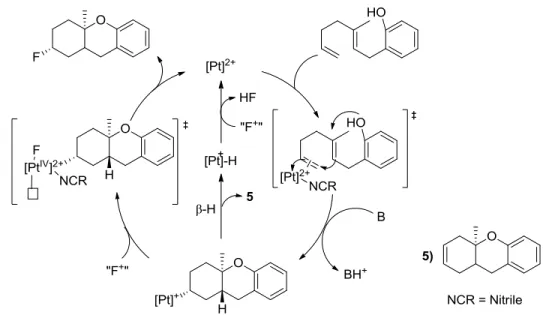
The Gagné group has used a variety of bi- and tri-dentate ligands to extensively explore the reactivity of Pt(ΙΙ) catalysts toward mechanisms that resemble sterol biosynthesis with cation-olefin cascade cyclization of polyenes.14 This research has led to method development for cyclizing and functionalizing model polyenes in a catalytic, efficient, and enantioselective process. Of specific interest, the C3 site on several cyclized products has been fluorinated as part of the proposed mechanistic cycle (Figure 4).15 This proceeds in a highly efficient and enantioselective manner and is consistent with a concerted reductive elimination through a Pt(IV) intermediate. The C3-fluorinated products generated by this type of reactivity offer the possibility of testing new reactivity in
pharmaceuticals as well as providing a pathway to further functionalization.
5
2 Investigating the Electrophilic Fluorination Mechanism
2.1 Using Nitrogen Ligands to Stabilize a Platinum (IV) Fluoride
The mechanism of the cascade cyclization and subsequent C3-fluorination proposed by Cochrane, Nguyen, and Gagné suggests that after platinum coordination and cyclization of the alkyl, which is an intermediate that can be observed via 31P NMR, the xenon difluoride acts as an
electrophilic fluorine source to create a putative six coordinate Pt(IV) fluoride (Figure 4)15. This pathway competes with β-hydride elimination, which forms the undesirable product (5). The Pt(IV) intermediate is thought to quickly reductively eliminate to give the C3-fluorinated product and regenerate the dicationinc Pt(ΙΙ) catalyst. Evidence for this intermediate is lacking, although both this pathway and the β-H elimination pathway are supported with previous literature.16,13h Direct observation of a six coordinate Pt(IV)-F would be useful in fully understanding the mechanism. Octahedral Pt(ΙV) complexes often undergo reductive elimination through the initial loss of a ligand to give a five-coordinate species that is much more reactive than its six-coordinate precursor. If this disassociation does not transpire, the reductive elimination can be quite slow even if it would
otherwise be a favorable reaction.17 The versatility of nitrogen-donor ligands in stabilizing the Pt(IV) products has been shown to be far greater than the pervasive tertiary phosphine ligands, likely due to the strong σ-donor and weak π-acceptor properties of the nitrogen-donors coupled with steric components.18 As the C3-fluorination system exists, there is no way to directly observe a
six-coordinate species, therefore the work presented herein is focused on utilizing a κ1 coordinating nitrogen ligand on the Pt(ΙΙ) alkyl and trapping the fluorine Pt(ΙV) alkyl by a quick coordination
6
high enough to prevent access to the five-coordinate species, thus preventing the facile reductive elimination of the Pt(ΙV) complex.
Figure 5: Proposed Trapping Mechanism for Pt(ΙV) Fluoride Using DPPE as the P2 Ligand
This work could then be expanded to include different electrophilic reagents such as
N-chlorosuccinimide and N-bromosuccinimide in order to introduce different functionalization to the C3 position.
2.2 Synthesis of κ1-Coordinating 2,2'-Bipyridine Platinum (II) Species
Initial tests utilizing bidentate nitrogen based ligands focused on screening multiple
derivatives of easily accessible ligands. Conditions were held consistent with previous studies in our group for the stoichiometric cyclization of a model polyolefin, which was selected based on the rate of cyclization and percent conversion previously recorded.14 In these systems, (dppe)PtI
2 (dppe= 1,2-Bis(diphenylphosphino)ethane) was used because of its known ability to cyclize the model polyolefin, low cost, and well-behaved nature. The most effective and enantioselective diphosphine ligand reported in the catalytic fluorination work is (S)-xylyl-PHANEPHos, but initial studies did not place an emphasis on chirality. Additionally, (S)-xylyl-PHANEPHos is a costly ligand that is prone to unforeseen reactivity resulting in complex reaction mixtures. Once the
[(dppe)Pt(alkyl)(NCC6F5)][BF4] complex was generated and identified by 31P NMR, which is useful for observing the in situ formation over other techniques as the complex is non-isolable because of
7
The appropriate nitrogen ligands were determined by their bite angle and size, taking the bulk of the dppe ligand into account.14g The ligands chosen were derivatives of ethylenediamine, which was considered for its flexibility and small steric effect19; 2-picolylamine, which was shown to be effective as a hemi-labile ligand in other systems20; and bipyridine, which would presumably adopt a conformation placing the uncoordinated nitrogen in a ready-to-bind state (Figure 6). These ligands were also convenient because many substituted variants exist, lending to the possibility of changing the steric and electronic effects as needed.
Figure 6: Bidentate Nitrogen Ligands Used
2.3 Introduction of Electrophilic Fluorine to Form Platinum (IV) Fluoride
Once the nitrogen ligand is bound, the next step is to introduce an “F+” source that does not interact with the free nitrogen or coordinated substrate and is able to attack the Pt(ΙΙ) center. Earlier attempts were made to catalytically and stoichiometrically fluorinate polyolefins with (dppe)Pt2+ utilizing multiple fluorinating agents such as Selectfluor, fluoropyridinium tetrafluoroborate, N-Fluorobenzenesulfonimide, and xenon difluoride.14h Of these fluorinating reagents, xenon difluoride was best suited to reliably react and give desired product, which could be attributed to its unique linear nature. This previous success of xenon difluoride served as rationale for its use as the platinum fluorinating agent.
8
expected chemical shifts between Pt(ΙV) fluorides and Pt(ΙΙ) fluorides, which span from -220 ppm to -280ppm.22 New signals were also apparent in the 31P NMR, which showed a decrease in 195Pt-31P coupling. This decrease in coupling is quite expected and has been well documented. When oxidized from a square planar complex to an octahedral Pt(ΙV), the s-orbital character in the Pt-P bond is reduced, which is in agreement with the smaller coupling observed.21 These phosphorus signals were only apparent when the bidentate nitrogen ligand was bipyridine. In fact, using symmetric bipyridine derivatives that incorporated methyl and tert-butyl groups, such as 4,4′-Dimethyl-2,2′-dipyridyl, proved to be unsuccessful as well. Due to these failures as well as the failures of all ethylenediamine derivatives and 2-picolylamine, it seems bipyridine is the most equipped ligand for this reaction.
This experiment was repeated in a more controlled manner several times but continually demonstrated unreliable behavior and gave a multitude of platinum complexes. This prompted a change of the solvent system. While nitromethane worked well for previous fluorinations, it proved to be incompatible with this system and was replaced by dichloromethane after screening for a new solvent. The amount of observable species and the reliability of the reaction greatly improved once this was implemented.
9
This arises because the platinum center is chiral, indicating it is likely six coordinate, which would support the addition of an “F+“ onto the metal center. This is an underdeveloped aspect of this chemistry and the cause of the abundance of diastereomers is not fully understood.
Figure 7: 19F NMR Showing Pentafluorobenzonitrile, XeF2, and BF4-
10
Figure 9: Enantiomers and Diastereomers of Pt(ΙV) Fluoride Complex
2.4 Conclusion
The fluorinated Pt(ΙV) species is often formed along with another complex that appears to be symmetrical and increases in abundance with the disappearance of fluorinated Pt(ΙV).
Independent synthesis of (dppe)Pt(bipy)2+ matches the symmetrical species present, and it most likely occurs initially with coordination of bipyridine to residual dicationic (dppe)Pt with no coordinated alkyl. Since the abundance increases throughout the reaction, it suggests that the fluorinated Pt(ΙV) converts to (dppe)Pt(bipy)2+, likely through reductive elimination producing a C3-fluorinated cyclized polyolefin. This C-F coupled organic compound has been observed by GC-MS in addition to other cyclized compounds, suggesting a need for further investigation.
11
diastereoselectivity observed it is difficult to definitively assert direct, stereoretentive reductive elimination as the mechanism. In order to further investigate the mechanism proposed by Cochrane et al.,15 it would be necessary to devise a new approach. This could include the use of a chiral
phosphine ligand instead of dppe or it could utilize different trapping reagents such as acetonitrile or iodide.
This work started specifically tailored to the investigation of the mechanism of catalytic fluorination of platinum activated polyenes. Other work in our group has approached this same goal in a different way. Acetonitrile is known to coordinate strongly with platinum, and irreversibly with dicationic Pt(ΙΙ) complexes.23 Addition and coordination of acetonitrile as a trapping reagent could raise the energy barrier high enough to prevent access to the five-coordinate species, conceivably stabilizing the Pt(IV) complex long enough for characterization. To this purpose, XeF2 was dissolved in CH3CN and added as a solution to (dppe)Pt(alkyl)I at low temperature. When a 19F NMR was taken of the resulting solution, two peaks with satellites appeared at -287 ppm and -289 ppm, suggesting again a six-coordinate fluorinated Pt(IV) complex was present.
Preliminary evidence acquired suggests that the trapping of a Pt(IV)-F complex is feasible, but this project is still in its elementary stages of development. Multiple species generated through quick isomerization of ligands around the metal center, the wide range of overlap in 19F NMR that impairs decisive assertion of the presence of a fluorinated Pt(ΙV) complex as opposed to a Pt(ΙΙ) complex, and the irreversibility of coordinating acetonitrile to platinum are all obstacles that should be overcome to give insight into the system in the future. A large obstacle in characterizing this system as well as the bipyridine system is isolating the fluorinated platinum complexes. As it exists now, these systems are being observed in situ along with tetrafluoroborate, pentafluorobenzonitrile, and other compounds. This has been challenging but is not insurmountable. Hopefully,
12
3 C3-Functionalization with Other Halides
3.1 Introduction
Using the κ1 bipyridine bound Pt(II) to access a platinum (IV) species and inducing subsequent reductive elimination to give a coupled organic product was the next focus of this research. The use of a different electrophilic atom or group would allow for observation and characterization of the Pt(IV) complex as well as the product. With this goal in mind, experiments were undertaken to mimic the reactivity of XeF2 starting with electrophilic halide sources and comparable groups. Attempts to exchange the platinum bound fluorine in the platinum (IV)
complex for other, similar moieties were also investigated. These experiments necessitated the use of reagents with preferably ionically bound moieties that could act as nucleophiles to promote ligand exchange with the fluoride.
3.2 Promoting Fluoride Ligand Exchange
Once the conditions for reliably generating the fluorinated Pt(ΙV) complex were determined and utilized, attempts were made to introduce other moieties that could influence reactivity or bioactivity at the C3 site. Attempts to exchange the platinum bound fluorine for bromine, chlorine, and trifluoromethane at low temperatures using TMSBr, TMSCl, Togni’s reagent, and other sources were unsuccessful. Dicationic (dppe)Pt(bipy) was observed after reaction of Pt(IV) fluoride with Togni’s reagent, indicating that either: (1)the compounds failed to react or (2)exchange and
13
suggests that reductive elimination from the Pt(IV) fluoride may be occurring at a higher energy level than what is necessary to substitute the trifluoromethyl group in place of the fluorine.
This process is inherently wasteful due to the use of expensive XeF2 to create a platinum (IV) complex as a precursor. Besides being expensive and wasteful, this process adds an extra step that might be circumvented with the use of nucleophilic reagents in place of XeF2. For these reasons, work on this system was suspended early on with little success. This approach should not be considered as a viable pathway unless it is the only route to a specifically desired complex or a very cheap, readily available reagent could be used to exchange the Pt(IV) bound fluoride.
3.3 Generating Pt(IV) with Nucleophilic Reagents
Exchange of the Fluoride ligand with nucleophiles was fruitless and inherently wasteful, so electrophilic halogenating reagents such as NCS, NBS, and others were introduced to the κ1
-coordinated bipyridine Pt(II) complex with hopes of forming Pt(IV) halide complexes similar to the
14
Interestingly, the disparity between Pt(IV) diastereomers that is seen in the XeF2 system is not observed for the Pt(IV)-Cl diastereomers. The 31P NMR spectra show a similar abundance of Pt(IV) diastereomers, but the “inverted” chlorinated organic product that is formed through reductive elimination of the alkyl group and the chloride is present in above 15:1 dr. This is similar to the product generated from the reductive elimination of the Pt(IV)-F complex. The reductive elimination that the Pt(IV) halide appears to be undergoing has been studied in depth and first involves the disassociation of the halide followed by SN2 type attack at the platinum bound carbon. The mechanism for this “inverted” product was determined by testing the rate dependence of reductive elimination on Cl- concentration.
Figure 10: Possible Mechanisms for the Elimination of Pt(IV)-Cl- Species
Two mechanisms can be considered for the elimination of the C3 functionalized alkene (Figure 10). In the first mechanism, the rate is not dependent on Cl- concentration as it is involved in the rate expression for the equilibrium step as well as the SN2 type attack step. In the bottom
-15
source revealed a dependence on chloride concentration, increasing the rate of reaction dramatically, which indicates nucleophilic Cl- attack on the six coordinate Pt(IV) complex.
The possibility of oxidizing Pt(II) by introducing a “Br+” moiety through a hypervalent iodine mechanism was also explored. When combined, LiBr and DIB form a hypervalent iodine bonded to benzene, bromine, and an acetate group. This can be generated in situ and serves as an
effective “Br+” source, successfully oxidizing the κ1-bound 2,2'-bipyridine Pt(II) complex to a Pt(IV)-Br. To insure that this reactivity comes from the combination of LiBr and DIB, DIB was added to a solution of the Pt(II) species without any LiBr. After 3 days at 273 K, there was no observed reactivity with the DIB and almost no degradation of the Pt(II) species; however, the Pt(IV)-Br began to reveal itself almost immediately upon addition of LiBr to this solution that had been sitting for three days at 273 K. This was exciting to observe and speaks to the stability of the reactants, as the system retained its potency for several days and only reacted upon the introduction of LiBr. The C3-brominated organic product, as is the case when using NBS, is the “inverted” product that, presumably, is formed from nucleophilic attack of Br- on the six-coordinate Pt(IV)-Br. This method of introducing bromine is quickly oxidizing and forms limited side products, giving it a leg up on the NBS pathway.
3.4 Using Anions to Promote Reductive Elimination
16
the steroid backbone. This approach was explored with the Pt(IV)-Br complex and the Pt(IV)-Cl complex with many reagents including TBAB, TBACN, TBAC, NaCN, MeLi, TBAF and
Phenyltrifluorosilane, Me2Zn, EtMgBr, p-tolyl MgBr, allyl MgCl, Sodium thiosulfate, phenol, sodium methanethiolate, NaOH, and several others. Unfortunately, none of these reagents produced a C3 coupled product when reacted with either Pt(IV) complex. It was specifically interesting that no C-Cl coupled product was observed when TBAC was added to Pt(IV)-Br and no C-Br coupled product was observed when TBAB was added to Pt(IV)-Cl. It is not fully understood why these reactions failed while addition of TBAC to Pt(IV)-CL complex significantly sped up the reductive elimination. Immediate work to fully characterize the systems in place, especially to isolate and crystalize the existing Pt(IV) complexes to further establish their identity is underway and will be useful in understanding the reactivity observed as well as the viability of the proposed mechanism.
3.5 Conclusion
NBS, LiBr and DIB, and NCS were added to κ1 bipyridine bound Pt(II) to access multiple new platinum (IV) species by, and subsequent reductive elimination gave the stereoinvertive coupled organic product. Addition of appropriate anion to the Pt(IV) halide dramatically increased the rate of reductive elimination, leading to the adoption of a mechanism which involved an SN2 type attack of the Pt(IV) complex at the platinum bound carbon. Due to the proposed mechanism for this reductive elimination, a wide array of nucleophilic reagents were added to the Pt(IV) halide in an attempt to incorporate new functionalities to the cyclized polyene. These efforts were unproductive, but provide an interesting perspective on the role of added anion in the rate enhancement of
17
Experimental:
Forming the Pt(ΙV) Halogen –
In a N2 filled glove box, (dppe)PtI2 (0.012 mmol), NCC6F5 (.060 mmol), and AgBF4 (0.030 mmol) were weighed into a 2-mL screw top vial wrapped in aluminum foil. CD2Cl2 (0.30 mL) was added and the contents were stirred for 1 hour. The substrate (0.024 mmol) and resin base (0.024 mmol) were massed into a separate 4-mL screw top vial that was cooled in the cold well with liquid N2. The contents of the first vial were filtered through a syringe filter and combined with the substrate and base, washing with additional CD2Cl2 (0.20 mL). The reaction mixture was stirred at 0 C for the appropriate reaction time (approximately 6 hours). Bipyridine (.012 mmol) was massed into a separate 4-mL screw top vial. CD2Cl2 (0.10 mL) was added and the vial was purged with N2
before being cooled to 0 C. The contents of the second vial were filtered through a syringe filter and combined with the bipyridine, which was given adequate time to coordinate (approximately 4 hours). The contents of the third vial were then transferred to an air-free NMR tube with septum and
cooled to -41 C. For XeF2, NBS, LiBr-DIB, or NCS, the halogen source (.012 mmol) was massed and added to an NMR tube, which was purged of air, filled with nitrogen, dissolved in 0.10 mL
18
REFERENCES
1. Njardarson, J. J. Chem. Ed. 2010, 87, 1348.
2. Wendt, K.; Schulz, G.; Corey, E.; Liu D. Angew. Chem. Int. Ed. 2000, 39, 2812.
3. (a) Stork, G.; Burgstahler, A. J. Am. Chem. Soc. 1955, 77, 5068. (b) Eschenmoser, A.; Ruzicka, L.; Jeger, O. Arigoni, D. Helv. Chem. Acta 1955 38 1890.
4. Hoshino, T.; Sato, T. Chem. Comm. 2002, 291.
5. (a) Johnson, W. Acc. Chem. Res. 1968, 1, 1. (b) Johnson, W. Angew. Chem. Int. Ed. 1976, 15, 9. (c) Yoder, R; Johnston, J. Chem. Rev. 2005, 105, 4730.
6. (a) Corey, E.; Lee, J. J. Am. Chem. Soc. 1993, 115, 8873. (b) Corey, E.; Lin, S. J. Am. Chem. Soc.
1996, 118, 8765. (c) Corey, E.; Wood, H. J. Am. Chem. Soc. 1996, 118, 11982. (d) Mi, Y.; Schreiber, J. Corey, E. J. Am. Chem. Soc. 2002, 124, 3647.
7. Khokhar, S.; Wirth, T. Angew. Chem. Int. Ed. 2004, 43, 631.
8. (a) Hahn, C. Chem. Eur. J. 2004, 10, 5888. (b) Surendra, K.; Corey, E. J. Am. Chem. Soc. 2008,
130, 8865.
9. (a) Hung, M.; Farnham, W.; Feiring, A.; Rozen, S. Fluoropolymers: Synthesis 1999, 1, 51. b) Jeschke, P; ChemBioChem. 2004, 5, 570. (c) Muller, K.; Faeh, C.; Diederich, F. Science 2007,
317, 1881. (d) Purser, S.; Moore, P.; Swallow, S.; Gouverneur, V. Chem. Soc. Rev. 2008, 37, 320.
10. O’Hagan, D. Chem. Soc. Rev. 2008, 37, 308.
11. (a) Ametamey, S.; Honer, M.; Schubiger, P. Chem. Rev. 2008, 108, 1501. (b) Harki, D.; Satyamurthy, N; Stout, D.; Phelps, M.; Dervan, P. Proc. Natl. Acad. Sci. U.S.A., 2008, 105, 13039.
12. Kirk, K. Org. Process Res. Dev. 2008, 12, 305.
13. Ma, J.; Cahard, D. Chem. Rev. 2008, 108, PR1. (b) Lectard, S.; Hamashima, Y.; Sodeoka, M. Adv. Synth. Catal. 2010, 352, 2708. (c) Furuya, T.; Kamlet, A.; Ritter, T. Nature 2011, 473, 470. 14. (a) Koh, J.; Gagné, M. Angew. Chem. Int. Ed. 2004, 43, 3459. (b) Kerber, W.; Koh, J.; Gagné, M. Org. Lett. 2004, 6, 3013. (c) Kerber, W.; Gagné, M. Org. Lett. 2005, 7, 3379. (d) Mullen, C.; Gagné, M. J. Am. Chem. Soc. 2007, 129, 11880. (e) Mullen, C.; Campbell, A.; Gagné, M. Angew. Chem. Int. Ed. 2008, 47, 6011. (f) Feducia, J.; Gagné, M. J. Am. Chem. Soc. 2008, 130, 592. (g) Sokol, J.; Korapala, C; White, P.; Becker, J.; Gagné, M. Angew. Chem. Int. Ed. 2011,
50, 5658. (h) Zhao, S.; Wang, R.; Nguyen, H.; Becker, J.; Gagné, M. Chem. Commun. 2012, 48, 443. (i) Geier, M.; Gagné, M. Organometallics, 2013, 32, 380.
15. Cochrane, N.; Nguyen, H.; Gagné, M. J. Am. Chem. Soc. 2013, 135, 628.
16. (a) Furuya, T.; Ritter, T. J. Am. Chem. Soc. 2008, 130, 10060. (b) Wang, T.; Love, J. Organometallics 2008, 27, 3290. (c) Ball, N.; Sanford, M. J. Am. Chem. Soc. 2009, 131, 3796. (d) Vigalok, A.; Kaspi, A. Top. Organomet. Chem. 2010, 31, 19. (e) Furuya, T.; Benitez, D.; Tkatchouk, E.; Strom, A.; Tang, P.; Goddard, W.; Ritter, T. J. Am. Chem. Soc. 2010, 132, 3793. (f) Yahav-Levi, A.; Goldberg, I.; Vigalok, A. J. Fluorine Chem. 2010, 131, 1100. (g) Grice, K.; Scheuermann, M.; Goldberg, K.; Canty, A. In Top. Organomet. Chem.; Springer: Berlin/Heidelberg, 2011; Vol. 503; pp 1. (h) Racowski, J.; Gary, J.; Sanford, M. Angew. Chem., Int. Ed. 2012, 51, 3414.
17. (a)Redfield, D.; Nelson, J.; Henry, R.,: Moore, D.; Jonassen, H. J. Am. Chem. Soc. 1974, 96, 6298 (b) Tatsumi, K.; Nakamura, A.; Komiya, S.; Yamamoto, A.; Yamamoto, T. J. Am. Chem. Soc. 1984, 206, 8181 and references therein.
19
20. Ros, A.; Estepa, B.; Álvarez, E.; Fernández, R.; Lassaletta, J. Angew. Chem. Int. Ed. 2011, 50, 11724.
21. Webb, G.; Barsukov, I. Nuclear Magnetic Resonance. Cambridge: Royal Society of Chemistry, 1999; 166-167.
22. Zhang, F.; Broczkowski, M.; Jennings, M.; Puddephatt, J. Canadian Journal of Chemistry, 2005, 595.