French Army Strategy and Strategic Culture
during the Algerian War, 1954-1958
Wynne M. Beers
A thesis submitted to the faculty of the University of North Carolina at
Chapel Hill in partial fulfillment of the requirements for the degree of
Master of Arts in the Department of History
Chapel Hill
2011
Approved By:
Wayne Lee
Joe Glatthaar
ABSTRACT
French Army Strategy and Strategic Culture during the Algerian War, 1954-1958
(Under the direction of Wayne Lee)
This thesis examines the various means by which “strategy” was communicated
to field commanders during the first half of the French war in Algeria, from 1954 to
1958, and then explores how the actions of a particular regimental commander and his
subordinates provides testimony of how they synthesized the concept of “strategy” for
them.
Studying wartime strategy solely from the perspective of military and civilian
high command leadership is insufficient because it only addresses one of several
influences (schools, doctrine, past and current warfighting experiences, and logistical
structure, to name a few) that interact together to modify how field commanders actually
think about and conduct war.
This thesis proposes that studying an army’s strategic culture, understood as the
expression of a “way of war,” rather than simply an army’s “strategy,” provides a suitable
synthetic approach by which historians and strategists can answer useful and specific
Table of Contents
INTRODUCTION ...1
HISTORIOGRAPHY...8
THE WAR IN ALGERIA - AN OVERVIEW...17
FRENCH STRATEGIC THINKING AT THE END OF INDOCHINA...23
ÉLY AND NEMO:SUMMARIES OF INDOCHINA...23
LACHEROY:ALESSON IN REVOLUTIONARY WARFARE...30
FIELD MANUALS OF THE WAR IN INDOCHINA...34
1954- 1956: THE WAR TAKES SHAPE UNDER SOUSTELLE AND LORILLOT ...41
ARMY INITIATIVES EARLY IN THE WAR...45
SOUSTELLE’S DIRECTIVES...48
SAS–SPECIAL ADMINISTRATIVE SECTIONS...53
SOUSTELLE’S PUBLIC WORKS PROGRAM...55
LOGISTICS IN THE ALGERIAN WAR...60
ENTERING 1956:PERCEPTIONS ON THE GROUND...63
1956-1958: LACOSTE AND SALAN INTENSIFY PACIFICATION...64
LACOSTE –ARMY COOPERATION,SOCIAL &ADMINISTRATIVE REFORMS...65
LACOSTE’S 3-STEP PROGRAM FOR PACIFICATION...70
REGROUPEMENT...73
HARKI UNITS AND AUTO-DÉFENSE...74
CENTER FOR TRAINING IN SUBVERSIVE WAR...84
BROAD SUMMARY OF THE POLICIES FROM 1954-1958 ...86
THE FORMATION OF STRATEGIC CULTURE...86
OPERATIONAL EXPERIENCES AT THE SECTOR LEVEL...92
THE 117THREGIMENT OF INFANTRY IN BLIDA –ARRIVAL IN 1956 ...93
A SAMPLE TRANSMISSION OF SEVERAL ORDERS...95
EXPERIENCES WITH HARKI AND AUTO-DÉFENSE FORCES...101
EXPERIENCES WORKING WITH SAS ...110
REGROUPEMENT IN THE BLIDA SECTOR...113
CONCLUSION ...117
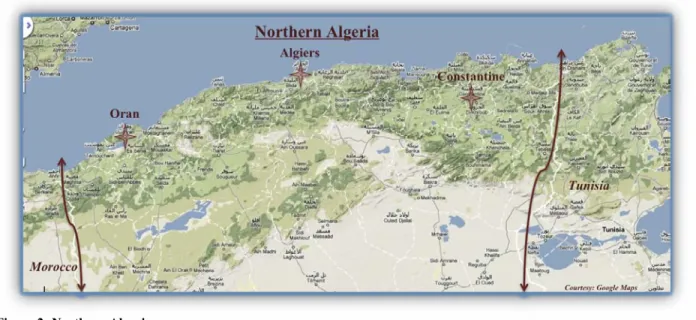
Figure 2: Northern Algeria... 41
Figure 3: Cost of Army Operations, 1956 ... 59
Figure 4: Model of Strategic Culture... 90
Figure 5: Sub-Division of Blida... 93
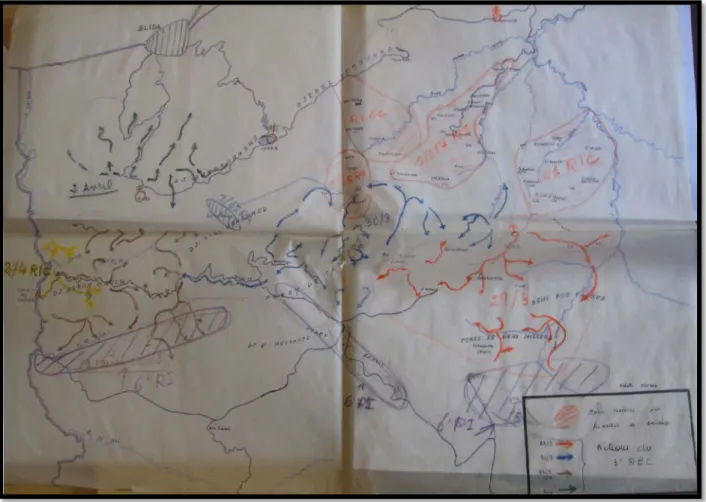
Figure 6: OPERATION ATLAS I (29 March – 2 April 1957)... 104
Figure 7: French Paratroopers marching through the Blidean hills... 106
Figure 8: French officer issuing hunting rifle to Harki member, c. 1960... 109
Figure 9: Regrouped Village in the Sand Hills... 113
French Army Strategy and Strategic Culture
during the Algerian War, 1954-1958
I
NTRODUCTIONFrance’s empire was one of the first casualties of WWII.1 Following the defeat of
the French Republic at the hands of Nazi Germany, the Vichy Regime took over
administrative responsibilities for France’s far-flung colonies. In September 1940,
Marshal Philippe Pétain permitted the Japanese to station troops in Indochina in return
for retaining administrative control of the country.2
France’s defeat by Germany and its subsequent virtual abdication to Japan led
colonized peoples from the West Indies, North Africa, Madagascar, and farther east to
Indochina to share a joint realization: the French were not as invincible as they once
seemed. Vietnamese leader Ho Chi Minh declared Indochina independent on September
2, 1945 by reason that “from the summer of 1940, our country had in fact ceased to be a
French colony, and had become a Japanese possession,” and using other language cribbed
from American Declaration of Independence.3 The ensuing war for independence started
1 John S. Ambler, The French Army in Politics, 1945-1962 (Columbus: Ohio State University Press, 1966), 93.
2 Bernard B. Fall, Street Without Joy, Indochina at War, 1946-54 (Harrisburg, Pa. Stackpole, 1964), 23.
slowly but continually built steam. Negotiations began and ended indecisively several
times. When a bold French gamble in 1954 to interdict Viet Minh supplies by controlling
a little-known crossroads called Dien Bien Phu ended in disaster, the French negotiating
position crumbled. French forces evacuated the country in disgrace following the July
1954 Geneva Accords.4
In contrast to Vietnam, Algeria’s location and history tied it more intimately to
France. Algeria lies only 500 miles south of the Mediterranean port of Marseilles and had
been a part of the French Empire since 1830. Indochina was lost at the expense of
approximately 75,000 French Union forces but without causing lasting political damage
in France.5 Algeria, on the other hand, cost fewer French soldiers’ lives (nearly 20,000),
but would only gain independence after toppling an entire French government in the
process.6
Mere months after the Geneva accords, on November 1, 1954, operatives of the
independence-seeking National Liberation Front (FLN) launched simultaneous attacks
against several points in Algeria. Algerians who identified more strongly with Arabic,
Berber, or Kabyle culture rather than French culture saw the FLN as a vehicle for
self-determination that promised more than the idle talk of previous pro-Algerian groups.
France, reeling from defeat in Indochina and in the midst of dealing with nationalist
movements in Morocco, Tunisia, and Madagascar, now faced a demand for independence
4 Ambler, The French Army in Politics, 155. 5 Fall, Street Without Joy, 313.
in a region considered integral to the patrie (the French concept of “fatherland”).
Following a long and costly war in both blood and treasure on both sides, Algeria gained
its independence in March 1962, with the signing of peace accords in Evian, Switzerland,
by President Charles de Gaulle and representatives of the FLN.7
These few sentences necessarily obscure the complexity of the French army's
experiences of these two wars, how they were connected, and how the army adjusted to
the challenge of fighting them. The French engaged in what we now refer to as
counterinsurgency, a type of war that by its very nature pitted a government-sponsored
conventionally-organized force against a rebellious unconventional opponent.8 Since the
adversary could hide among the civilian populace, and was in fact drawn from the civil
body, numerous legal, tactical, and strategic complexities entered the sphere of military
decision-making.
This thesis examines how the French army constructed their strategies, and how
they translated their overall strategic conceptions into specific operational orders, and
then how those orders were transmitted to and executed by leaders on the ground. While
it is convenient to imagine that each war has its own well-defined “strategy,” the truth is
that “strategy” can exist only perfectly in the mind of the person, or perhaps even staff,
7 Counterinsurgencies by nature are difficult wars to follow due to the lack of front lines, the presence of irregular forces, and the preclusion of any traditional “score-keeping.” The Algerian War is especially tough because of the many names, populated areas, and natural features unfamiliar to American readers. As such, this chronology will adhere to those events and personalities most salient to this discussion.
8 I define “counterinsurgency” as the use of state-supported forces, both indigenous and
that constructs it (and not often even then). The various acts of trying to communicate
strategy, whether through orders, directives, doctrine, military schooling, or military
journals, will create different meanings for different people. Often, historical analysis of
wartime strategy focuses either on a high command or operations. This project will
attempt to link these two levels, and in so doing chart the course of the French strategy as
it reached commanders. Since this strategy is by nature diffused through the interaction of
many actors, events, and influences, at a certain point removed from the general’s desk or
the politicians’ chambers using the term “strategy” fails to capture the breadth of
experience and variety in application. I will refer to the end result – the aggregate of these
communicated visions of war as played out in operations – as the French “strategic
culture” of the Algerian War. The purpose of this thesis is to help encapsulate a better
understanding of how the French “strategic culture” – one could use the phrase “way of
war” – developed as a result of multiple inputs, filters through various echelons, and
experiences on the ground. The result will be not only a better understanding of how the
French army created and disseminated its strategy, but in theoretical terms, I intend to
open a dialogue on the difficulty of communicating complex strategy to highlight the
diffusion that naturally occurs in modern warfare.9
9 Keegan makes an interesting case for the level of heroic-style leadership required by generals as the locus of command moves farther from the scene of battle, as exhibited by Alexander,
Wellington, Grant, and Hitler. Without supporting his final conclusion that the modern ere, the nuclear age, requires abandonment of the heroic model entirely, his identification of this notion of distance from the battlefield led me to consider how much easier it must have been for an
Rather than simply taking at face value the idea that there were some simple
governing principles or strategies during the war, this paper will demonstrate that a key
element in making a strategy work is to communicate it effectively. The greatest plan
must be translated into action before it produces any positive outcomes. Usually,
strategists and historians focus primarily on the evidence of operational plans and orders
passed conceived at the general-officer level to paint a picture of “strategy.” While this
paper will perform this key analytic task, I will also demonstrate how other factors not
directly related to operational orders served to influence the perspectives of and
circumscribe the options open to a French officer in command of a battalion or regiment.
How did these men, standing at the nexus between received strategy and
boots-on-the-ground, perceive the strategy of the war and how did they attempt to translate that into
actions that would serve strategic purposes?
Following the historiography and a brief general chronology, this thesis consists
of four sections. The first section examines pre-existing ideas about revolutionary war
that prevailed in the French Army in 1954 at the start of the Algeria War. Specific studies
written in the wake of defeat in Indochina were passed on officially to officers, providing
a baseline of ideas within the French army against which later communications about
strategy would contend, whether intentionally or not. The next two sections then analyze
the multiple programs developed by both civilian and military leaders to communicate
strategy in the first two phases of the war, from 1954 to 1955, and 1956 to 1958. This
study ends in 1958 because by this point the army had fully internalized practices that
were only introduced in the first years of the war. Some of the army’s common practices
groundwork performed in this study would make for an excellent addendum. The final
section of this thesis retraces 1956 through 1958 through the experiences of several
ground commanders to demonstrate how battalion and regimental commanders put their
received orders into practice. This section demonstrates at the ground level how the
accrual policies over the first several years increasingly constrained the options available
to commanders because higher headquarters placed so many expectations on them that
lay outside the standard realm of combat operations.
Methodologically, the first three sections of this paper (Indochina and policy
sections, 1954-1956, and 1956-1958) will construct a body of military literature (written
orders, directives, and field manuals) directed at field commanders (typically field grade
officers: majors, lieutenant colonels, and colonels) that best approximates the war’s
strategy as seen by high command. Certain aspects of this strategy not only guided field
commanders’ behavior in the conventional sense but also constrained his possible options
by creating persistent requirements that demanded the perpetual use of a certain portion
of forces. These examples include the employment of local pro-French Algerian militias
(Harkis), the deployment of thousands of special officers who worked with villages and
tribes, the focus on public works projects, and even the structure of logistics. I categorize
these kinds of policies as “structural elements” (essentially, the format of the wartime
environment expressed by policies and programs that dictate how forces are garrisoned,
by what means they move, how they are supplied logistically, and how they are expected
to interact with other players, such as government-supported militias) and I argue that
they play a critical role in narrowing the range of options commanders can use in
or the “way of war.” Commanders are always constrained by how they task-organize
their forces, how they will be supplied, what kinds of accommodations they will live in,
what sorts of transportation they must use, yet it appears that these limitations often
operate below the conscious surface and are not consistently treated as crucial framing
elements to strategic culture.
I suggest that we consider strategic culture as emerging from the nexus between
the expectations of strategy, itself a combination of conscious calculation and precedent
embedded in doctrine, schools, journals, and so on, and the limitations of structural
elements. In this sense, strategic culture derives both from top-down and bottom-up.
Policies and orders directed commanders to take certain actions. Some of these actions
(typically conceived of as missions and campaigns) are very specific and limited in space
and time. Others, often taking the form of persisting policies and programs, have no
well-defined endstate in the sense of goal to be accomplished or a time until expiration.
Campaigns and missions will heavily influence how a commander deploys his soldiers in
the field in terms of tactics, and generally receive the lion’s share of attention by military
historians because it is here that the actual warfighting occurs. Continuing policies and
programs receive far less interest. They simply are not as “sexy.” Yet these enduring
requirements soak into the daily life of a unit in a far more pervasive manner, sucking up
soldiers, time, and energy in little batches as each new policy, program, or reporting
requirement is absorbed into the unit’s operating cycle. Examples we will explore include
the expectation that the army field SAS officers and that units work with them closely;
that the army devote soldiers in each unit to train local militias; that the army regroup
and that army units provide officers to fill the role of civilian administrator. While most
field units may not have been affected by every one of these requirements, and accepting
that some of these policies were probably very wise, they were also issued to the army
like a shotgun round designed to spray pellets into every inch of target space. These
policies applied to every field unit, although they affected them differently according to
the circumstances of the local environment. As we will see, it is these kinds of area-target
policies that while capable of affecting change across the entire country, also inflict a
death of a thousand pricks upon the commander’s freedom of creativity, maneuver, and
will.
H
ISTORIOGRAPHYTwo fields of scholarship inform this work – a historical literature concerned with
the Algerian war, and a field focused on the concepts of strategy and strategic culture. As
such, this work synthesizes scholarship in French history and military history, and while
my conclusions rely on French history, I expect them to carry broader methodological
implications for military history and strategic studies.
Scholarship on the Algerian war developed contemporaneously with the conflict
itself, spawning a number of early works by the mid-1960s that examined not only the
narrative history of the war, its causes, and reasons for French defeat, but also the French
army’s role in the downfall of the Fourth Republic in 1958.10 Aside from academics,
several notable combatants and administrators published memoirs and sketches of the
war.11 Other prominent period work focused on the influence of theories of revolutionary
war on French strategy.12 Although a few new projects were written in the late 1960s,
1970s, and early 1980s, these scholars only enjoyed limited access to the war’s official
military archives.13 Scholarship toward the end of the twentieth century, led primarily by
British and French historians, turned toward a “new military history” approach that began
to answer “who” the combatants were, to better describe the experiences of war in
Algeria, and to consider issues of memory.14 Two American scholars considered the war
(Ann Arbor: University of Michigan Press, 1962); Edgar S. Furniss, De Gaulle and the French Army: a Crisis in Civil-Military Relations (New York: Twentieth Century Fund, 1964); George Armstrong Kelly, Lost Soldiers: the French Army and Empire in Crisis, 1947-1962 (Cambridge, Mass. M.I.T. Press, 1965); Ambler, The French Army in Politics.
11 Roger Barberot, Malaventure en Algérie avec le général Paris de Bollardière (Paris: Plon, 1957); Jules Roy, The war in Algeria (New York: Grove Press, 1961); Jacques Soustelle, L’Espérance Trahie, 1958-1961 (Paris: Éditions de l’Alma, 1962); Jean-Jacques Servan-Schreiber, Lieutenant en Algérie (Paris: René Julliard, 1957); Henri Alleg, La Question (Paris: Éditions de Minuit, 1958).
12 Gabriel Bonnet, Les Guerres Insurrectionnelles et Révolutionnaire (Paris: Payot, 1958); Peter Paret, French Revolutionary Warfare from Indochina to Algeria, the Analysis of a Political and Military Doctrine (New York: Praeger, 1964); Roger Trinquier, Modern Warfare; a French View of Counterinsurgency (New York: Praeger, 1964).
13 Orville D Menard, The Army and the Fifth Republic (Lincoln, Nebraska: University of Nebraska Press, 1967); Edgar O’Ballance, The Algerian Insurrection, 1954-62 (Hamden, Connectiicut: Archon Books, 1967); Charles S Maier and Dan S White, The Thirteenth of May: the Advent of De Gaulle’s Republic (New York: Oxford University Press, 1968); Alf Andrew Heggoy, Insurgency and Counterinsurgency in Algeria (Bloomington: Indiana University Press, 1972); Horne, A Savage War of Peace; John Talbott, The War Without a Name: France in Algeria, 1954-1962 (New York: Knopf, 1980); Henri Le Mire, Histoire Militaire de la Guerre d’Algérie (Paris: Albin Michel, 1982).
14 Benjamin Stora, La Gangrène et l’Oubli: la Mémoire de la Guerre d'Algérie (Paris: La
from the international political level in very successful monographs.15 Scholarship
conducted from the mid-1990s onward has also benefitted from a progressive opening of
the French military archival records from the war, heavily restricted for the first 25 years
after the war’s conclusion. Despite a recent resurgence of academic interest in the war,
the Algerian War remains an underappreciated conflict for many American strategists
and historians who would probably find in its history many insights if not for the barriers
of language and the dominant role of Korea and Vietnam in most Anglophone Cold War
studies.
The best-known English-language general histories of the Algerian war are
probably Alistair Horne, A Savage War of Peace (1972) and Michael Connelly’s A
Diplomatic Revolution (2002). Surprisingly for a near 40-year old work and its lack of
use of the archives now available to scholars, Horne’s work is one of the most-recognized
histories of the war. Although his narrative is littered with political intrigue, character
sketches of leaders on both sides, and meandering tangential narratives, these
characteristics, oddly, seem to capture the character of the time he was writing about,
even though the history seems disjointed in places. His major shortcoming, and that of
any historian writing before the mid-1990s, was a lack of access to archival material.
and Diplomacy (Portland, Or. Frank Cass, 2002); Martin S Alexander, Martin Evans, and John F. V. Keiger, The Algerian war and the French Army, 1954-62: Experiences, Images, Testimonies (New York: Palgrave Macmillan, 2002); Guy Dugas, Par la Plume ou le Fusil: les Intellectuels-Soldats dans la Guerre d’Algérie (Pézenas: Domens, 2004); Pierre Cyril Pahlavi, La Guerre Révolutionnaire De l’Armée Française En Algérie, 1954-1961: Entre Esprit De Conquête Et Conquête Des Esprits (Paris: L’Harmattan, 2004).
15 Matthew Connelly, A Diplomatic Revolution: Algeria’s Fight for Independence and the Origins of the Post-Cold War Era (Oxford: Oxford University Press, 2002); Todd Shepard, The Invention of Decolonization: the Algerian War and the Remaking of France (Ithaca, N.Y. Cornell
Instead he relied on interviews, newspaper accounts, and early contemporary works to
inform his narrative. His work and the others by Kelly, Furniss, and Meisel preceding it,
give the historian a good sense of what were considered to be the most important issues at
the time in shaping the course of the war, and provide a substantial starting point for
archival-based re-evaluations.
Rather than simply offering a straightforward narrative, Connelly’s Diplomatic
Revolution suggests that the FLN’s ability to internationalize the war in a way that
elevated it beyond French domestic politics into the Cold War international arena, which
in turn critically undermined the French position more than did the military events on the
ground. Connelly’s argument does not invalidate research about the war’s strategy,
however, but rather underlines the importance of better understanding it, especially given
the apparent disconnect between military activity and the determinative international
political shifts. My research does not attempt to give the military side of the conflict a
more important place than it should hold, but rather seeks to understand why the military
developed the kinds of practices in Algeria that it did.
The relatively recent edited volumes produced by British historians Martin
Alexander, Martin Evans, and John Keiger should not be overlooked. This trio published
two volumes in 2002, one focused on the French army during the war, and the other
focused on operations, strategy, and diplomacy. Prominent French historian Jean-Charles
Jauffret edited a 2001 book about soldiers and guerrillas in the war, successfully
gathering case studies from prominent scholars. Both made use of recent access to
archives, and provide several particularly illuminating case studies that have informed my
particular general’s strategy, the experience of a single regiment in the field, the
comparison between conscript and regular troops, or the life of Foreign Legionnaire.
These types of studies are vital for the advancement of the field of research in the
Algerian war, and allow work such as mine to synthesize broader trends and to
understand the varied nature of the war far better than any general history can.
Moving from the particular of the Algerian War to the general realm of military
history, my thesis interacts with a vein of strategic studies research concerned with what
is sometimes called “strategic culture.” In its most basic understanding, strategic culture
is the way an army wages war, though its use implies both a rootedness in a particular
time, place, and conflict while admitting the possibility that some characteristics will
transfer within an army between sites of conflict, administrations, and leading
practitioners.
One such example of both rootedness in a particular “military culture” but
transmission between time and locations plays out in Isabel Hull’s Absolute Destruction:
Military Culture and Practices of War in Imperial Germany (2005).16 Hull’s research
charts the incremental progress of the German army’s strategic culture from a goal of
decisive but negotiated victory in 1871 toward a desire for complete annihilation of the
enemy in the First World War. In the process she provides a thoroughly helpful
discussion of how “military culture” develops. In particular, her work is “the story of how
the means overwhelms the ends, indeed became the ends. Its focus is therefore not on
ideology but on military practices and the basic assumptions behind them. “These
habitual practices, default programs, hidden assumptions, and unreflected cognitive
frames I understand in an anthropological and organizational-cultural sense as military
culture.”17 The special terminology that she employs seeks to break from other scholars
who blamed a particular German ideology for creating the Great War German army; she
places the mode of causality in the workings of military practice, with the understanding
that what an organization actually does shapes its future self just as strongly as the
statements it makes about how it would like to act: “organizational culture is more likely
to determine action than is explicit policy or ideology.” (92)
This paper will make use of some of her methodology to explore how the French
army’s experiences in Indochina, and its practices during the first years of the war in
Algeria, contributed to the development of a French “strategic culture” by 1959.
Although she uses the phrase “military culture,” I prefer “strategic culture” because I
think it carries a clearer implication for an ends-means connection than the more vague
“military culture” which could apply to many other aspects of a military, both in war and
in peace.18 Strategic culture also implies the effort to capture the army’s practices at a
higher point in the multi-tier structure of military operations. Rather than being
concerned with tactics and how the practice of soldier-tasks and small-unit tasks reflects
special insights about the French military, I am concerned with how field-grade officers
(majors, lieutenant colonels, and colonels) conceived of their purpose as it related to the
17 Hull, Absolute Destruction, 2.
war’s “strategy.” I choose them because they are the leaders of battalions and regiments
in the field; leaders who would have personally directed missions and lived closer to the
points of action (even if often in headquarters). French battalion and regimental
commanders retained a degree of autonomy, which permits a historian to make the claim
that they had in theory a wide range of choices available, but they were also supposed to
nest their operations to fit into a grander vision – the strategy – for the war. In a
counterinsurgency in particular, these men represented the nexus between orders and
operations. They were autonomous on many levels, but they were also expected to think
about their unit’s purpose on a higher level. It is here that I plan to implement an
examination of practices to determine what routines these officers adopted during the first
years of the war and how this reflected and modified a French “strategic culture.”
Other historians – and some political scientists – have taken to the task of
explaining strategic culture or “how armies fight” through studies of doctrine, several
specifically about the French military in the early 20th century. Barry Posen’s The
Sources of Military Doctrine: France, Britain, and Germany between the World Wars
(1984), which remains well-cited among political science works examining military
strategy, uses “organizational theory” and “balance of power theory” to determine why
his target states had “deterrent,” “defensive,” or “offensive” strategies prior to the Second
World War.19 Rather than examining military doctrine, Posen is actually concerned with
matters of international security above the army level, and “doctrine” for him is not
contained in manuals but refers to a broader approach to war. His military culture could
be considered meta-level. By contrast, Elizabeth Kier in Imagining War: French and
British Military Doctrine between the wars (1997) enters in the well-mined field of
interwar doctrinal research by contesting the role of realist and power politics
approaches. She argues that the French and British failed to exercise enough imagination
in framing the kind of wars they would fight next and that their specific military cultures
inhibited the adoption of more offensive strategies. She defines military culture as the
“set of basic assumptions, values, norms, beliefs, and formal knowledge that shape [its]
collective understandings.”20 This seems like a robust definition of military culture, and
while Kier supports her argument convincingly, she bases it on the importance of values
and norms, which is opposite to Hull’s habits-based approach. Another important
difference is that both Hull and I seek to examine the culture of armies actively engaged
in war, while Posen, Kier, and Robert Doughty (Seeds of Disaster: The Development of
French Army Doctrine, 1919-1939) all examine armies between wars. Doughty explained
that the French officer corps “implicitly accepted doctrine as a substitute for thinking and
an alternative to creative, imaginative actions. And few soldiers questioned the verities
uttered in lecture halls or published in field manuals or official journals.”21 The focus in
his research, like the other two works, focuses on the relationship between doctrine,
thoughts about war, and culture. Although his research explores trials of new tank
technology and French attempts to try out doctrine in training simulations, he and the
others necessarily grant an importance to ideology and doctrine that I argue informs
20 Elizabeth Kier, Imagining War: French and British Military Doctrine between the Wars (Princeton, N.J. Princeton University Press, 1997), 28.
strategic culture early in war but is trumped by military experience over time. Or, in
other words, strategic culture necessarily evolves, but wartime conditions greatly hasten
T
HEW
AR INA
LGERIA-
A
NO
VERVIEWFigure 1: Algeria in the Mediterranean
This work encompasses the full, if often twisted chronology of the war, from
1954 through to 1962, although France did not commit broadly to the war until the fall of
1955 and began to pull out in early 1961. In essence the years between 1954 and 1962
witnessed three general phases. The three major phases are (1) 1954 through 1955, (2)
1956 through 1958, and (3) 1959 to 1962.22 This thesis is concerned with the creation of a
French strategic culture during the first two phases.
First, from 1954 to 1955, the FLN increased its numbers and its control over the
country while consolidating power over the other nationalist groups. Following the initial
terrorist attacks of November 1, 1954, most locals waited expectantly for the French
forces to decisively destroy the uprising. Six months later, the rebels continued to build
strength, generally unopposed.23 The French government tried to defuse the situation with
locally based army and police, although neither the commanding general of French forces
in Algeria nor the civilian resident minister led the development of any coherent unified
strategy. By the end of 1955, rebels had built a strong presence in the Kabylie region east
of Algiers along the coast and had boosted their numbers nationally to about 25,000.24
With regard to strategic culture, some of the first programs that would serve as structural
elements shaping military decision-making came into effect, notably the creation of the
Special Administrative Sections (SAS), the establishment of auto-defense units generally
known as harki, and a widespread army commitment to assisting with public works
programs.
During the second phase, from 1956 to early 1958, the French Army began to
regain the initiative, most notably with the late 1957 military victory in the “Battle of
Algiers” and by the completion of the Morice Line along the Tunisian border. In
December 1956, General Raoul Salan replaced General Henri Lorillot and began to
develop a more robust approach to fighting the war. By the end of 1957, he determined
that the rebel presence in the capital, Algiers, needed to be eliminated regardless of the
political cost. The Battle of Algiers effectively neutralized the FLN operatives in the
capital, although its success hinged on the use of torture, extra-judicial arrests, and a
disregard for French civil protections. The Morice Line, a border-spanning barbed-wire
fence along the Algerian-Tunisian border and patrolled by guards located at regularly
spaced reinforced outposts, dramatically interdicted the movement of personnel, supplies,
and intelligence between the “exterior” FLN headquarter in Tunisia and the “interior”
forces fighting in Algeria.25
The addition of French conscripts (all reservists), beginning with the August 1955
call-up of over 50,000 reservists, provided needed manpower at the expense of quality.26
This alteration to the composition of the military would serve as another structural
element affecting the scope of operational flexibility available to commanders. By
mid-1956, the army’s presence swelled to nearly 500,000 by mid-1956.27 This number would
remain essentially constant through 1961. Compared with the eight million mostly native
Algerians, the one million European-descended Algerians, and the roughly ten thousand
FLN fighters, France’s troop commitment appears enormous. Although the soldiers
received basic training prior to deployment, the army faced an enormous challenge in
efforts to convey the complexities of counter-guerrilla warfare to the poorly motivated,
under-funded, often-maligned reserve conscripts.28
25 Horne, A Savage War of Peace, 230.
26 Pierre Montagnon, Histoire de l’Armée Française: des Milices Royales à l'Armée de Métier (Paris: Pygmalion, 1997), 295.
27 Heggoy, Insurgency and Counterinsurgency in Algeria, 156-161.
Several changes in the political atmosphere in Algeria during this period are
worth noting. Paris sent Robert Lacoste to replace Jacques Soustelle as resident minister
in March 1956. On one side, European-descended Algerians (pied-noirs) demanded a
more active government response to the increased rebel strength of 1956 and 1957. On
the other side, native Algerians demanded long overdue institutional reforms, such as
better access to government and inclusion within the national government. Lacoste,
caught between these conflicting interests, both tried to improve the working relationship
between military leaders and civilian administrators while also providing civil reforms to
the Algerian people.29 For the more moderate Algerian leaders in particular, expanded
access to government and cooperation with government came too little, too late to
prevent the allure of the FLN’s more extreme measures from building broad local public
support.
The war’s third phase lasted from May 1958 through the eventual termination of
hostilities. Pied-noirs rioting in Algiers against weak government prosecution of the war,
with support from the military, led to the collapse of the government in Paris on May 13,
1958. Charles de Gaulle returned to power in a combination of arrogant self-initiative,
political maneuvering, and good timing first as Prime Minister and then as President. He
created the new Fifth Republic under a constitution granting the president a more
proactive role with far more control over policy. He leveraged the conditions under which
he came to power – representing many values to many different groups – by initially
offering fairly vague policy outlooks. Although many military leaders expected de Gaulle
to support French Algeria in return for the military’s early support in May, he was careful
to keep his plans secret. He instead offered rhetoric that could either sound like support
for an independent Algeria or maintenance of the status quo, depending on the listener’s
predilections. In fact, focused on restoring French autonomy and power within Europe,
de Gaulle started a gradual policy shift towards Algerian independence.30
At the beginning of 1959 de Gaulle appointed air force general Maurice Challe to
the command of forces in Algeria. Through a re-organization of forces – what I would
describe as a reframing of structural elements, and better use of native harki units,
Challe’s command steadily whittled down FLN units across the country while
maintaining control of the villages and settlements along the way. While his strategy,
known as the Challe Plan, succeeded militarily, it also expanded the regroupement policy
that forcibly relocated nearly a million Algerians into squalid army-guarded shantytowns.
The last two years of the war witnessed less open confrontation both due to the
success of the Challe Plan, de Gaulle’s now open support of an independent Algeria, and
the FLN leadership’s desire to conserve fighting power in order to seize control of
government in the period of fresh independence that appeared increasingly inevitable. In
September 1959, de Gaulle publicly declared the Algerians’ right to self-determination.
This news, not well received by the pied-noirs, led to the attempt by conservative-led
factions to replicate the 1870 Paris Commune in the streets of Algiers. After a week of
stressful drama in Algiers, de Gaulle finally weighed in by directly addressing the nation.
His characteristic élan so demoralized the protesters that they returned home within
days.31 In the intervening period between his return to power and the fall of 1959, his
continually ambiguous attitude toward Algeria’s future status had created political space
for the rise of the Front d’Algérie Française, which bitterly opposed independence, even
after his pronouncement. Nevertheless, a violent country-wide demonstration by Muslims
in support of Algérie Algerienne during de Gaulle’s December 1960 country visit left no
doubt in anyone’s minds that independence was now only a matter of time.32 De Gaulle is
said to have remarked years later about early 1961: “the war was all but over. Military
success was achieved. Operations had been reduced to next to nothing. Instead politics
dominated the scene.”33 Counterinsurgency operations after this point became an
economy of force mission, buying time until the conclusion of negotiations at Evian in
spring 1962.
Even this basic outline of events should convey a sense of the complexity and
shifting nature of French strategy in Algeria. Before returning to Algeria, however, we
will explore French army thoughts about revolutionary war at the end of the war in
Indochina, since some 40% of the army in Algeria had first defended the French Union in
the jungles of Southeast Asia. Their experiences were hard-won and not necessarily
easily forgotten when they were reassigned to confront nationalists in Algeria.
F
RENCHS
TRATEGICT
HINKING AT THE END OFI
NDOCHINA“Moreover, the skilled leaders, both the officers and the NCOs, are composed in large part, we mustn't forget, by men who arrived in North Africa coming from Indochina, and who have been in the breach for many years.” – Senator de Maupeou, January 195734
By the end of the war in Indochina in 1954, many French officers had begun
engaging concepts of revolutionary war in earnest. Although the analysis here focuses on
the Algerian War, French officers' experiences in the jungles of Southeast Asia clearly
influenced their understanding of how to deal with the new guerre révolutionnaire they
faced in late 1954. The French officers developed attitudes about pacification operations
and the complexities of war waged in the midst of a civilian environment during their war
in Indochina. As we will see, French officers authored various reports, lectures, and even
field manuals that institutionalized these views just as the army was getting started
fighting insurgents in Algeria. These views then became the baseline against which the
army would compare its experiences in North Africa.
É
LY ANDN
EMO:
S
UMMARIES OFI
NDOCHINATwo army-sponsored studies emerged after Dien Bien Phu, Colonel Jean Nemo’s
“The Ground War in Tonkin, from 1946 to 1954,” completed in January 1955, and
Commanding General Paul Ély’s “Lessons from the War in Indochina,” completed at the
end of May 1955. Both contained insights from the war that reflected a seemingly
objective self-criticism of operational successes and failures and provided some
categories by which to evaluate the nascent conflict in Algeria.
Nemo’s report, which he admits received poor self-editing and suffered from
hasty compilation, nonetheless comprehensively covered the war from start to end, and
focused on extracting “lessons learned.” In one section of his study, he summarized all
the major command directives from the war. Several rang tones that would sound familiar
later in the Aurés or Nemetcha mountains of Algeria, such as the benefits of working
with local forces to achieve political effects. A 1949 command directive on “pacification”
instructed troops to “associate to the greatest extent with Vietnamese troops” to “give the
population the feeling that they have been liberated by their compatriots.”35 Most of the
77 summarized directives however, dealt with tactics for destroying Viet Minh forces,
controlling mobility corridors, or gathering intelligence, rather than focusing on methods
for pacification. Nemo did mention in another section of the report that cannon fire and
aerial bombardment could lead the local population to lose confidence in French forces
and believe that the French only fought in “a spirit of racial domination.”36 Yet his
overriding focus on destruction of the armed sections of the insurgent forces rather than
dismantling the enemy “administrative-political structure” (as it was known later in
Algeria and not mentioned as such in this report) seems to reflect accurately the general
approach many French officers would adopt when first confronting the FLN in Algeria:
destroy the armed rebels to defeat the insurgency. Other sections of Nemo’s several
35 Jean Nemo, Annexe III - Analyse de principales directives, La Guerre en Surface au Tonkin de 1946 à 1954 (Quang Yen, 1955), 18, 10H 2509, SHAT.
hundred-page report examined the performance of each of the combat and support arms
(such as infantry, armor, artillery, signal and logistics). In his short section on
pacification operations, he concluded that they were poorly planned, insufficiently
defined, often hastily led, and “very rarely succeeded.”37
To improve upon efforts in Indochina, he recommended that future pacification
efforts follow a three-phase approach. He valued the first phase, planning, above the
others, judging that sufficient propaganda and preparation of the people to receive a new
civil administration was paramount before rushing into the execution phase that followed.
Notably, despite the report’s overall focus on defeating the rebels militarily, he advocated
using the minimum force necessary to destroy or “repress” the enemy bands. He also
recommended selecting an administrative team that would stay behind to turn the village
into the next “market and school.” This would occur during the final phase,
consolidation.38 Despite his mentions of pacification, however, the bulk of Nemo’s
analysis of “guerre en surface,” or ground war, really concentrated on the failures in
operations – to maintain open lines of communication, to destroy the enemy armed force,
and almost as an afterthought at times, to integrate an effective new civil administration.
Several months later, General Paul Ély, the final commander of French Forces in
South Vietnam and later Army Chief of Staff from 1956 to 1959, published his staff’s
findings. Using over 1400 reports from officers of all ranks along with training circulars
and command directives, his report intended to be a more synthetic and institutional
37 Jean Nemo, Enseignements: A - L’Infanterie, La Guerre en Surface au Tonkin de 1946 à 1954 (Quang Yen, 1955), 36, 10H 2509, SHAT.
product than Colonel Nemo’s. The report was a three-volume publication: the first
volume dealt with matters of statecraft and national policy, the second volume with
summaries of major lessons from fighting, and the third recommended what French
forces should do in the next war of this nature.39
Several key observations about the nature of revolutionary war emerged from this
study. For example, the author identified a “pre-insurgency” period and suggested
“authorities charged to maintain order must intervene more in political, economic, and
social affairs than in police matters” and that “while the rebel leaders have to be prudent
and careful [before the conflict escalates to full-blown war], we must not use savage
repression.” And while the effective collection of these various forms of information
would require the “assistance” of civil servants, this gesture to positive civil-military
cooperation was not an endorsement of either an equal partnership and certainly not
subordination of military command to civilian. Once rebellious activity had tipped over
to the point that force was necessary, Ély warned that military operations should be short
and decisive, using the least amount of troops necessary, and that clearing operations
should be avoided if possible because the population viewed them as harassment rather
than as a means to root out destabilizing elements. 40
39 The second volume is the only one that I have found. Although it is not the volume with specific lessons for French forces, it does contain over 300 pages of observations about the various successful and unsuccessful aspects of the war, certainly more than enough to give a reader the sense of where volume three was leading. Paul Ély, A Translation from the French Lessons of the War in Indochina, trans. V.J. Croizat, May 1967, iii-iv. RAND translated Volume II alone in 1967, intending its content for US forces in Vietnam, though there is not much evidence to indicate the translation reached a wide audience. Though I reference this study, the translations found are my own directly from the French.
During combat operations, Ély’s staff stressed the difficulty of fighting against an
ideologically-focused enemy with no ideology of one’s own, the poor results made to
shift Vietnamese loyalties, and the often counter-productive effect of direct action: “In
regions obedient to the Viet Minh, where we sometimes made incursions, we nearly
always paid for a little military advantage by substantially antagonizing the population.”41
This single sentence not only typified the nature of a vast body of problems in North
Africa, but pointed to the importance of a fine sense of discretion and judgment at all
levels of command.
Ély and Nemo differed somewhat with regard to how they viewed the types of
operations needed. Ély described three types of ground operations: those that maintained
“axes of control,” those that sought “area control,” and finally, pacification. These three
forms of action most concerned the sector-controlling static forces (the “implantées,”
which conveys the sense of being rooted to the ground). The mobile groups, smaller in
absolute number but concentrated into larger maneuver units, were to be used primarily
for large-scale clearing and destruction of major enemy formations. Static forces could
undertake those operations on a limited scale, if needed.42 The implication was that fixed
forces kept operations on an even keel while the mobile groups truly made the gains –
destruction of the enemy – that would win the war.
Nemo considered both the static forces and the mobile groups together, rather
than differentiating between them as sharply as Ély did. Nemo structured the variety as
41 Ély, Engeignements de la Guerre d’Indochine, 17. “Désaffection” could also be “alienation” or “estrangement.”
defensive operations (to protect sensitive points, routes, and convoys), sector operations
(“radiating operations,” pacification), intelligence-gathering operations, and destructive
operations. “Radiating” operations (rayonnement) were to be entrusted to infantry
officers who had a large share of “human, not just technical, skill" so that they could
interact with the population on a permanent and local basis, and favor political to military
solutions. They were expected to employ a variety of techniques at their level that
included psychological warfare.43
While conventional operational requirements (size and type of unit) might be
determined by calculating factors about the opposing force, Nemo theorized that the
complexities of “guerre en surface” required a different “barometer” for success, in
particular gauging force size against surface area and inhabitants. He theorized (using a
few supporting examples) that a minimum of 5 uniformed regular soldiers per square
kilometer and 1 soldier per 100 inhabitants were needed for effective pacification.44
These force ratios could not guarantee success, certainly, but they seemed to him to be a
greater indicator of likely successful pacification. This metric is a noticeable difference
from Ély’s apparent focus on the mobile groups. Both officers’ reports seemed to weight
the value of destroying enemy forces as equal to or more important than “pacifying”
through political means, but Nemo’s insistence on a ratio of static troops to inhabitants
and area gave more value to those types of forces. Regardless, both reports favored the
43 Nemo, Enseignements: A - L’Infanterie, 16-18. Rayonnement conveys the imagery of the sun’s rays radiating away, just as the success of pacification would spread out from the French camp. 44 Nemo, Enseignements: A - L’Infanterie, 19-21. At the height of French troop levels in Algeria, around 440,000 in 1956, the ratio of soldiers to civilians would have been closer to 1:50.
mobile groups, and this disparity in perceived value reflected the split that occurred first
in Indochina, and then carried over to Algeria, between the forces that carried out mobile
operations and those that provided static defense. Airborne and Foreign Legion units
typically performed the more exciting mobile mission, while conscripted reservists
increasingly performed the duller static mission.45
A composite picture of revolutionary war from Nemo and Ély would emphasize
the necessity of employing both static forces and mobile groups in proportion, even if
they differed over which force was more decisive. Both reports also cautioned against
unilateral military operations although neither explicitly encouraged a full partnership
with civilian officials in any specific manner either. Nonetheless, military force alone was
not sufficient, and both authors agreed that much care needed be taken regarding the right
timing and manner of direct action when local populations would incur derivative harm.
Finally, psychological war, still methodologically inchoate, carried powerful potential,
though no consensus emerged regarding whether specialists in the techniques or
specialists in the local regions were best suited to direct psychological operations.
The effects that any reports, manuals, or memoranda have on an organization can
be difficult to assess. The added security classification of these two studies complicates
that process. Despite this, however, these reports, particularly Ély’s robust sampling of
1400 officer reports, give us an idea of what many officers may have thought about
revolutionary war as the French army’s chapter in Indochina came to a close.
L
ACHEROY:
A
L
ESSON INR
EVOLUTIONARYW
ARFAREWhile Nemo and Ély’s reports may have been contained perspectives considered
best-reserved for the highest staff levels, one report appears to have gained currency in
military circles: Colonel Charles Lacheroy’s “Viet-Minh and Communist Action in
Indochina,” subtitled, perhaps somewhat optimistically, “A Lesson in Revolutionary
War”. Lacheroy, a veteran of Indochina and later major figure in French psychological
warfare, particularly during the Battle of Algiers, delivered his paper as a lecture to the
Advanced Studies Institute for National Defense and to the officers of the French Armed
Forces General Staff in April and May 1955, around the same time as Ély’s report was
finalized. Lacheroy brought a radically different message concerning why Indochina
failed and how the campaign in Algeria would not. He centered his focus on the future of
psychological warfare, and appeared to take every opportunity to win adherents to his
camp.46
Lacheroy analyzed four common reasons given for the French loss in Indochina:
“lukewarm public opinion at home, uncertainty and loss of vigor and unity of
governmental directives, lack of unity of action between France and the United States,
and instability of the High Command.” For him, none of these common perceptions about
the war could contend with the power of the “New Weapon,” a strategic invention of the
Viet Minh that synthesized two new tools. Working together, three “parallel hierarchies”
and psychological war could literally own the country’s people, body and soul.47
Parallel hierarchies restructured social and political life in Vietnam. The Viet
Minh movement grouped everyone into two different frameworks that required
mandatory participation. The Social Hierarchy split men and women, and then divided
them by age groups (young men, young women, middle-aged men, old women, etc).
Communist party leaders charged with identifying and “denouncing the slightest
defiance” convened these groups regularly for “self-criticism” sessions to conduct
political education.48 Together with the Territorial Hierarchy, which treated the village as
the basic social unit, the two hierarchies destroyed family bonds. The family was not a
recognized social group under the Communist system; first allegiances were owed to the
Social Hierarchy’s age- and sex-differentiated groups, rather than to family members.
Mobilizing people for fighting or supporting roles became far easier because specific
groups could be summoned and sent off on a variety of missions fitting their age, sex, and
abilities. The third hierarchy, selectively built around a three to four man Communist
party cell, executed policy at successive levels, and included at most a tenth of the
population.49
47 Charles Lacheroy, Action Viet-Minh et Communiste en Indochine, April 25, 1955, 1, 10H 397, SHAT.
48“Self-criticism” was a process of political purification whose culminating act required members to write out all their sins against the Party and then allow the leader to read their confession out to the assembled group. Lacheroy described one such meeting in which a young initiate finally denounced his father “in order to be perfectly purified”. Lacheroy, Action Viet-Minh et Communiste en Indochine, 13.
While the three-fold hierarchy controlled people's bodies, Lacheroy deduced that
the Communist use of psychological war or “moral techniques” could “take possession of
souls.” The National Resistance Committee, which Lacheroy referred to as the “military
brain” controlled and unified the propaganda used upon the people. The theory was
analogous to “when one solidly holds the vessel he may fill it with what he wishes.”
Since the hierarchical structure kept people ordered through mandated meetings and
self-criticism sessions, the political officers could structure those events to suit their needs.50
Having seen these parallel hierarchies reap tremendous benefit for the Viet Minh,
Lacheroy emphatically concluded that democracies must use this “New Weapon,”
psychological war, combined with parallel hierarchies unless they desired to lose the next
revolutionary war as well. Ironically, the closest French parallel that Lacheroy observed
was a French naval officer, appointed as Chief of Indochinese Youth Movements from
1941 to 1945, who used the Vichy regime’s youth movement structure to mobilize
Vietnamese young men. Lacheroy acknowledged that “universal morals and the human
conscience” caused “grave problems” with implementing such drastic social
re-engineering for political purposes.51
Colonel Lacheroy’s “lessons” from the war spoke of a very different conflict from
the much more conventional recommendations of Nemo and Ély. Communist ideology
pervaded his work, and while his more intimate understanding of that organization
certainly enhanced his knowledge, his insistence on mirroring the enemy’s strategy
50 Although controlling the body in order to control the soul may sound superficially post-structuralist, I am not aware of any connection to post-structuralist thought. Lacheroy, Action Viet-Minh et Communiste en Indochine, 19-20.
probably blinded him to its faults as well. Lacheroy's report may have been uniquely
influential. Despite much critical reflection about the war, only limited evidence speaks
to how widely the French command may have disseminated the “official” post-conflict
reports. Though little is known about the legacy of Ély’s and Nemo’s reports, Lacheroy’s
paper remained in the canon of the French army’s Center for Instruction in Pacification
and Counter-Guerrilla War until at least as late as May 1959.52
Two other reports are known to have reached wide distribution within the army:
one that covered combat in the last 70 days of battle following the May 7, 1954, defeat at
Dien Bien Phu, and another that examined aerial support to ground forces in the last two
years of the war. The first report, of most interest here, concluded that although Dien
Bien Phu was not a negligible defeat, “the cease fire was not imposed by a military
situation sufficiently degraded to impose an immediate suspension of arms.” The report
credited the enemy’s guerrilla actions with undeniable successes, but associated the
victory more directly with the Communist ability to mobilize people toward the clear
goal of liberating the country and “absolute faith in final success.”53 The French army in
Algeria would experience an eerily similar situation in 1962, as the French army’s
intelligence reported the rebel army to have been at one of its weakest points, but the
political situation, which supported negotiating a peace with the FLN, ultimately
prevailed.
52 Centre d’Instruction Pacification et Contre-guerilla, CIPCG Training Documents (Arzew: Centre d’Instruction Pacification et Contre-Guerilla, May 1959), 1H 1115, SHAT.
F
IELDM
ANUALS OF THEW
AR INI
NDOCHINAIn addition to these reports, the Indochina war left the army with several field
manuals that discussed the means of waging counter-guerrilla war and pacification in
various ways. The first was “A Note on Combat in the Jungle and in Guerrilla War”
(1954), a doctrinal manual published in Algeria at the Cherchell military college, for
graduating officers bound for Indochina.54 The 10th Military Region Command, the
organization charged with security in Algeria before and during the Algerian War,
authored the forty-page tactical primer, although it is not apparent what use the command
made of this manual after Indochina wrapped up. Interestingly, this manual explained
how to fight in the jungle as guerrillas in order to destroy guerrilla forces, and it covered
a number of tactical concerns such as team composition, mission, orders, patrolling,
ambushes, reflexive firing, hand-to-hand fighting, signals, tracking, etc. Small-unit junior
officers would be expected to put it to good use.55
The very first few pages discussed the nature of guerrilla war and indicated
attitudes toward that kind of war held not simply by units in Indochina, but also actually
espoused by the early 1950s staff in Algeria. Nowhere does this document mention
communism, although it does express the importance of co-opting the support of the local
inhabitants to the extent that they can join an intelligence network or even become locally
54 The manual is undated but references requirements for fighting in Indochina and the different terrain one might encounter. The manual is located in an Algerian War carton at the archives titled “Subversive War and Psychological Action” under the general grouping of cartons reserved for the Operations Section of the 10th Military Region. 3rd Bureau, Chef-Etat Major, Notice sur le combat de la jungle et de la guerilla, Règlement, 1954, 2-5, 1H 1942, SHAT.
recruited guerrillas. Destruction of sensitive sites and the destruction and harassment of
enemy forces were the clearly stated “general missions” while raising a partisan force and
earnestly seeking local cooperation seemed to fit more distinctly into missions only
necessary if the French guerrillas were undertaking insurrection. In Indochina, then, it
seems the army forces would be expected to focus on destroying the enemy guerrilla
bands rather than targeting enemy support in the population or dismantling the
political-administrative structure.
The other manual, Le Poste, a thick volume that focused on establishing an
independent but highly defensible “post,” was clearly intended for junior officers and
senior sergeants.56 The manual employed two stereotypes: a foolish chief of post and a
smart chief of post. Often employing cartoons to show the pitfalls into which the former
would stumble through laziness, or the obstacles the latter would avoid through planning
and hard work, Le Poste was intentionally accessible to someone of middling literacy.
Despite its tactical focus, however, several pages worth of pacification notes instructed
the more persevering junior leader in some finer points of winning over recalcitrant
peoples.
Aside from admonitions to avoid alienating local leaders by smirking at local
customs, failing to recognize the village hierarchy, or not delivering on promises of
supplies or protection, Le Poste emphasized the importance of partnering with local
leadership more pointedly: “All pillaging, all acts of violence or useless brutality, all
humiliating and arbitrary decisions, all spectacles of drunkenness, all fights, are as direct
attacks to the prestige of France and expand skepticism, distrust, or hate of those whom
we intend to attract to us and guide toward a better future.” Furthermore, “the Vietnam
that we desire will not happen without the assistance of the Vietnamese themselves, and
our action will have no lasting effect unless it is welcomed by the consent of the
population.”57
Such strong wording must have touched at least a few hardened veterans in the
summer of 1953, when Le Poste was first distributed. Yet the manual’s three-step
approach to achieve the “conquest of hearts” (step 3) followed a path that Nemo and Ély
would have approved. Step 1 was “conquest of the land,” achieved by the “destruction
and dismantling of enemy forces.” Next, an “untiring propaganda campaign among the
peoples under rebel control” would achieve step 2, “conquest of spirits.” The final,
elusive, “conquest of hearts” required “demonstrating to the rallied populations that they
have chosen the good cause and that they must take part in the battle.”58Le Poste did not
provide the requisite instruction on propaganda or much insight on how to form
indigenously-recruited forces to combat the Viet Minh. By its combination of strong
rhetoric and rather weak specific recommendations, this manual fit into the same mold as
other French official documents of the era.
Le Poste’s primary purpose was not to inform junior leaders on the intricacies of
pacification, and its authors could perhaps be forgiven for not elucidating further, they
would have been well-served by pointing their readers to the one manual, published twice