WEARING HIGH-HEELED SHOES:
THE DISCUSSION OF MODERN “FOOTBINDING” IN REPUBLICAN CHINA
YUE LIANG
A thesis submitted to the faculty of the University of North Carolina at Chapel Hill in partial fulfillment of the requirements for the degree of Masters of Arts in the Department
of History.
Chapel Hill 2015
©2015 Yue Liang
ABSTRACT
YUE LIANG: Wearing High-Heeled Shoes: The Discussion of Modern “Footbinding” in Republican China
(Under the direction of Michael Tsin)
This thesis focuses on the discussion of women wearing high-heeled shoes in the Republican
period (1912-1949), particularly the analogy drawn by Chinese intellectuals between footbinding
and the wearing of high-heeled shoes. From the late 1910s onward, Chinese women appreciated
having high-heeled shoes as part of their everyday wardrobes, not just as imported commercial
objects, but more importantly, as signs of modern feminine beauty and a new fashionable
lifestyle. The popularity of high-heeled shoes between the 1920s and the 1940s, however,
sparked great debate over their impact on women’s health. Some intellectuals compared the
wearing of high-heeled shoes to footbinding, based upon the assumption that both inflicted
harmful effects on women’s bodies, and social lives, which in turn led to the ‘failure’ of the
nation. Dissenters in this debate, on the other hand, considered such comparisons unfounded and
ridiculous. They believed that women’s feelings, demands, and daily practice of wearing
high-heeled shoes deserved more attention from intellectuals. This thesis argues that these different
voices reflect the anxiety that Chinese intellectuals shared in the face of the changing world
around them during the Republican period.
TABLE OF CONTENTS Chapter
I. INTRODUCTION………..……… 1
II. NOT THE MAIN ACTOR: WEARING HIGH-HEELED SHOES IN THE LATE
QING……….. 7
III. THE MODERN GOLDEN LOTUS: WEARING HIGH-HEELED SHOES IN THE
REPUBLICAN PERIOD ………. 14
The Modern Golden Lotus…...……….……….16
The Ideal High-Heeled Shoes……...……….…..……..22
IV. BENEFICIAL EXPERIENCE: THE EXALTAION OF WEARING HIGH-HEELED
SHOES………..30
V. CONCLUSION...……….………...……. 35
BIBLIOGRAPHY…….……….……….………..39
LIST OF FIGURES
Figure 2.1 – A surgical operation to remove a tumor.………....……...… 10
Figure 2.2 – Women returned home ………..……….. 11
Figure 2.3 – Lin Huiyin and her classmates ……….………... 13
Figure 3.1 – Horseshoe-shaped feet and flat feet ……….………... 19
Figure 3.2 – Four ideal high-heeled shoes ……….……….. 24
Figure 3.3 – Three types of high-heeled shoes ……… 25
Figure 3.4 – Students graduated from senior high Fudan University ………...…... 27
Figure 3.5 – Hong Kong famous celebrities ……….……... 27
Figure 3.6 – New outfits in the Fall ………. 28
CHAPTER I INTRODUCTION
This thesis examines perceptions during the Republican period (1912-1949) with regard to
the wearing of high-heeled shoes as an everyday practice of modern life in the Western world
that was imported to China, and how this practice was linked to footbinding as embodied in the
experience of many Han Chinese women from the twelfth to twentieth centuries. This thesis also
examines ways that such a linkage was questioned and challenged at the same time. As the
popularity of wearing high-heeled shoes grew in China from the late 1910s onward, criticism of
this fashion trend appeared in newspapers, magazines, and other publications. Many of the
criticisms compared the wearing of high heels to footbinding on the basis of the similar terrible
effects they both had on women’s feet. Meanwhile, dissenters disapproved of this comparison,
arguing that the similarities between footbinding and wearing high heels were unfounded and
ridiculous. These opposing voices indicate the varying degrees to which Chinese intellectuals
understood the new wave of fashion and the rapidly changing world around them between the
1920s and the 1940s.
In the late nineteenth century, discussions about women’s feet and shoes were accompanied
by the simultaneous growth of nationalism. The Qing government’s defeat in the first
Sino-Japanese War of 1894-1895 particularly heightened the sense of wangguo 亡国 (“lost country”),
time, was a matter of first importance. In addition to the xinzheng 新政 (“New Policies”) in the
late Qing period, one of the changes that common people recognized and/or experienced was the
anti-footbinding movement. This period was the moment when footbinding, as a sign of the Han
civilization and a form of feminine beauty, started to be doubted and criticized by male
intellectuals under the pressure of critical Western eyes. Women’s bound feet, footbinding cloth,
and shoes in turn became emblems of national humiliation and failure. From the early rhetoric of
tianzu 天足 (“natural feet”) to the government ban on binding feet, the practice of fangzu 放足 (anti-footbinding movement) had almost come to an end by the late 1920s and early 1930s
(except for the few lotus lovers who insisted on the beauty of women’s bounded feet of the
recently dated).1 However, the conversation about women’s feet and shoes simply did not leave
public focus.
From the late 1920s on, the Western impact on Chinese society had become more and more
obvious. With the expansion of foreign trade, cultural interactions, and personal exchanges, large
quantities of foreign goods entered the Chinese market and affected the daily lives of millions of
Chinese people. Imported products, such as motor vehicles, electric lamps, radios, washing
machines, electric fans, sofas, cigars, beer, soda, Swiss watches, Parisian dresses, perfume, and
high-heeled shoes, presented a new world that symbolized the modernization process in China.2
Permed wavy hair, a dab of lipstick, the latest qipao 旗袍 (“female long gown”), and a pair of
new high heels made up the main fashion interests of modern women of the day. The discussion
of women’s feet and shoes at this time shifted from footbinding to the wearing of high-heeled
1 Dorothy Ko, Cinderella’s Sisters: a Revisionist History of Footbinding (Berkeley, Calif.:
University of California Press, 2005), 10-‐85.
2 Leo Ou-‐fan Lee, Shanghai Modern: the Flowering of a New Urban Culture in China, 1930-‐
shoes. Popular publications, as an efficient information channel, provided one of the most
important public spaces for intellectuals to express their opinions.
Between the 1920s and the 1940s, the term ‘high-heeled shoes’ referred to a wide range of
styles, colors, and patterns of shoes shown in newspapers, magazines, and other publications. In
short, there was not a precise definition of high heels at that time. Firstly, high-heeled shoes were
made of different fabrics, such as leather, silk, and cloth. Some shoe uppers were even decorated
with embroidered flowers. In addition, high-heeled shoes had a variety of shapes, including
wedged shoes, slender-toed shoes, round-toed shoes, sling-back shoes, spiked-heel shoes, and so
forth. Furthermore, high-heeled shoes did not necessarily mean shoes worn only by women in
everyday life. The term also was used to signify Beijing opera singers’ shoes and
height-increasing platform shoes favored by men.3
Thus, it is important to clarify here that this thesis focuses on the high-heeled shoes designed
particularly for women. However, as the title indicates, the main concern of this study is not so
much on the shoes per se, but on the fact that women wore high-heeled shoes as a daily
experience and that wearing high heels was a reality in the Republican period. In other words,
this thesis does not present research into high-heeled shoes as objects, but in terms of their social
impact, relationship with women’s health, and as a metaphor for current national anxiety.
During the Republican period, Chinese intellectuals approached the concept of footbinding
and the wearing of high-heeled shoes was strikingly similar. First of all, wearing high heels was
considered by some to be the modern version of binding feet. As Western medical science
replaced male literary imagination to reveal the cruel aspects of footbinding, a huge supply of
3 Tan Fei谭飞, “Bing wu qi shi” 并无其事 (“This is not the Case”), Shenbao 申报 [Shanghai
medical knowledge was cited to prove that wearing high heels caused the deformation of
women’s feet and other possible bodily injuries. The resultant unhealthy condition of women’s
bodies was further used as a metaphor for the weakness of the nation.4
The discussion of footbinding and high-heeled shoes implied Chinese intellectuals’ anxiety
about the relationship between China and the West. Male intellectuals often cited Western
women’s natural feet in their criticism of footbinding. The shapes of Chinese and Western
women’s feet represented opposite poles of the global spectrum, in which the former usually
signified the barbarianism, backwardness, and inferiority of the nation. In this sense, Chinese
women were required to learn from their foreign sisters to release their feet not only for personal
health but also for national salvation. Although wearing high-heeled shoes was a common trend
shared by women around the world, Chinese intellectuals portrayed Western women as rational
and knowledgeable, who either knew to abandon the wearing of high heels or knew how to wear
them properly and to apply scientific methods to protect their feet from physical harm. Chinese
women, by contrast, were described as unintelligent and blind lovers of high-heeled shoes who
needed to be educated. Western women were still the role models for Chinese women.
Women’s personal experiences and inner feelings about binding feet and/or wearing high
heels were usually not the main concerns in the discussion held by intellectuals in the late
nineteenth and early twentieth centuries. In order to make those weak voices heard, this thesis
attempts to search in detail the small number of magazine articles that recorded female
intellectuals’ attitudes to the wearing of high-heeled shoes. More importantly, the popularity of
4 For the development and origins of the medical rhetoric and iconography that linked an
image of China as sick or diseased – the “Sick Man of Asia” – with bodily pathology at the onset of modernity, see Larissa Heinrich, The Afterlife of Images: Translating the
photography in the Republican period offered an alternative way to ‘see’ women’s voices.
Photos in popular publications exhibited a visual fact, which is that women in most cases did not
wear the types of high-heeled shoes that were fiercely attacked at the time. In other words, the
criticism of high heels and the reality of women wearing high heels did not always match,
creating tension between the intelligentsia and everyday reality and between women’s personal
practice and the nationalist discourse proposed mostly by male intellectuals.
This thesis consists of five chapters. In addition to the introductory Chapter I, Chapter II,
Not the Main Actor: Wearing High-Heeled Shoes in the Late Qing, explores women’s lukewarm responses to the imported high-heeled shoes in late Qing society. Expect for the ‘flowerpot’
shoes worn by Manchu women of the upper classes, flat shoes were well received by women of
the day with both bound and unbound feet. It was not until the late 1910s that women from rich
families began to wear high-heeled shoes. In the following decades, high-heeled shoes were
greatly appreciated by almost all women as one of the key elements required for them to enter
modern social life in the Republican period. However, the popularity of high-heeled shoes was
paralleled by many criticisms.
Chapter III, The Modern Golden Lotus: Wearing High-Heeled Shoes in the Republican
Period, addresses the most prevailing criticism of wearing high-heeled shoes at the time, that the practice was the modern version of footbinding. Western medical knowledge had become a
powerful weapon to reveal the negative side of wearing high heels, such as the deformation of
the feet, feelings of fatigue, restrictions in activities, all of which led to the weakness of the
nation. It is worthwhile to note that not all critics were opposed to women wearing high-heeled
shoes. Some critics proposed the concept of ‘ideal high-heeled shoes’ that emphasized two
Chapter IV, Beneficial Experience: the Exaltation of Wearing High-Heeled Shoes, examines
other intellectuals’ defenses of women wearing high-heeled shoes. These passionate defenders
used Western doctors’ statements and their own experience to convince readers that wearing
high heels was good for building muscles, keeping a good sense of balance, and accentuating the
beauty of women’s legs and feet.
Chapter V is the conclusion that provides a summary of the viewpoints presented in the
CHAPTER II
NOT THE MAIN ACTOR: WEARING HIGH-HEELED SHOES IN THE LATE QING
On August 29, 1842, Qing imperial commissioners Qiying耆英, Yilibu伊里布, and Sir
Henry Pottinger signed the Treaty of Nanjing on the British warship Cornwallis, which marked
the end of the First Opium War of 1840-1942. One of the clauses in the treaty entitled British
consuls to live and manage foreign trade in five Chinese ports: Guangzhou, Fuzhou, Xiamen,
Ningbo, and Shanghai. In the following half century, the number of treaty ports increased as a
result of the serial Qing military defeats. Modern industrial technology and products were
introduced to China through these ports and greatly changed the life of Chinese people. The first
company to provide running water in Shanghai was established in 1881. In 1900, the installation
of streetlights in Beijing was completed. In 1903, people in Shanghai saw motor vehicles for the
first time and named them ‘four-wheeled monsters’.5 Cameras, electric lamps, telephones, the
phonograph, and other imported items quickly captured people’s attention, including the Manchu
and Han nobility. In 1903, the 68-year-old Empress Dowager Cixi became obsessed with
Western photography and invited Western photographers to take her photograph in the
Forbidden City.6 For common Chinese people, running water, electric lights, matches, and
machine-woven cloth gradually became their daily necessities.
People’s mode of attire also changed around the same time. The growing population of
foreigners in China, particularly in the treaty ports, brought popular items to Chinese society and
created new demands for dress. In the settlements, foreign merchants opened tailor shops and
boutiques one after the other to meet the needs of not only foreigners but also local people.
Western brands were considered the height of fashion, leading to a new set of cultural values
based on a desire to emulate the West. Chinese merchants also seized this business opportunity.
They invested and even became partners in joint ventures.7 As early as the 1870s, several
workshops in Shanghai were making Western style shoes, including high heels. Some of the
most famous shoe stores were Bajia 拔佳, Meizuishi 美最时, and Huazao 华草. Shoemakers at
that time referenced European patterns and made shoes in leather, silk, and machine-woven
shoes.8 Westerners, employees in the foreign firm industry, and returning students were their
regular customers. Suits and ties, Parisian outfits, patent leather, and high-heeled shoes were
beginning to compete with mandarin jackets, long gowns, waistcoats, and cotton shoes.
In the last decades of the Qing dynasty, women’s high-heeled shoes were, at best, trendy
foreign objects. They were neither a discussion point for the public nor a requisite fashion
symbol for most Chinese women in their everyday lives. Pictorial magazines constitute an
6 Yuan Ze and Hu Yue, Bai nian yi shang: 20 shi ji Zhongguo fu zhuang liu bian 百年衣裳: 20
世纪中国服装流变 (A Hundred Year Clothing: the Change of Chinese Clothing in the Twentieth Century) (Xianggang: Xianggang zhong he chu ban you xian gong si, 2011), 37.
7 Ye Xiaoqing, The Dianshizhai Pictorial: Shanghai Urban Life, 1884-‐1898 (Ann Arbor, Mich.:
Center for Chinese Studies, University of Michigan, 2003), 117.
8 Yuan Ze and Hu Yue, 166.
important medium for better understanding the indifferent attitude to high heels in Chinese
society. With the burgeoning of a print and visual culture, the number of pictorial magazines
increased dramatically in the late Qing period. Especially after the abolition of the imperial
examination system in 1905, more and more intellectuals began to find new ways to make a
living. Some of them joined publishing companies, while others started magazines by
themselves. They included fascinating pictures and commentaries in their publications to present
a society that was undergoing dramatic changes. Although few pictorial magazines continued for
a long time, their cheap price, easy-to-read informal language, and vivid illustrations were the
three main characteristics that attracted a much wider readership than the ordinary text media of
the time. Dianshizhai huabao 点石斋画报 (Dianshizhai Pictorial, 1884-1898), for instance, had
a multi-channel distribution system, which included individuals, companies, foreign firms, and
private postal services.9 These pictorial magazines, in turn, had a significant effect on people’s
minds and way of life.
Images of women’s high-heeled shoes occasionally appeared in illustrated news stories
published by late Qing pictorial magazines. The wearers were nearly always foreign women
dressing in Western style attire. In 1885, Dianshizhai pictorial carried the story of a Western
woman doctor who performed a surgical operation to remove a patient’s breast tumor. The
doctor was called Li Ying and she was competent in general surgery and worked at Tongren
Hospital in Hongkou. The Chinese patient came from Anhui. She was an aged woman who had
suffered from the pain of the tumor for years. The operation process is described as follows:
“The doctor took out a sharp knife, cut the tumor off, and then applied medicine to the patient.”
The effectiveness of Western surgery particularly was emphasized as the patient was reported to
have been cured a few months after the surgery. 10 Figure 2.1 shows the scene of the operation:
the doctor is wearing high-heeled shoes, whereas the patient has bound feet.
Fig 2.1 A Surgical Operation to Remove a Tumor (Dianshizhai huabao 1885)
The Western doctor’s high heels and the shoes for the patient’s bound feet constitute a sharp
contrast rather than a similarity in this illustration. The pictorial paid no attention to the high
heels, probably because the focus at the time was on women’s footbinding as both a sign of Han
civilization and femininity. Footbinding was a prevailing practice among the majority of Han
Chinese women in the Qing dynasty. It was once a debated issue in the initial stage of Qing’s
rule. Different from their insistence on cutting men’s queue, the Qing governors compromised by
allowing Han women to bind their feet. Footbinding had thus become a symbol to distinguish
between Manchu and Han women. Normally, Han women wore special shoes for their bound
feet, whereas Manchu women wore ‘flowerpot’ shoes. This traditional distinction with regard to
10 Ye Xiaoqing, 139.
women’s feet and shoes began to be blurred in the late Qing period. Beijing bai hua hui tu ri bao
北京白话画图日报 (Beijing Vernacular Pictorial Daily) reported the story of a woman who had
run away from home and later was persuaded to return (see Figure 2.2).11 The four women in the
illustration all wear long gowns, one combs her hair in the Manchu style whereas the other three
women have a Han hairstyle. The two women who are tussling with each other are wearing
flowerpot shoes. The mixture of Manchu and Han hairstyles, attire, and shoes in the picture
makes it difficult to distinguish the ethnicity of the two women.
Fig. 2.2 Women Returned Home (Beijing bai hua hua tu ri bao 1909)
11 The story is that family B has a row with family A because the child of family A hit the
child of family B. Neighbors were persuading the mother of family A to return home. See in
Qing mo min chu bao kan tu hua ji cheng 清末民初报刊图画集成 (The Collection of
Compared to the bound feet of the patient shown in the story of the surgical operation
(Figure 2.1), the feet of two of the women on the left-hand side of this picture (Figure 2.2) are
much bigger and appear to be ‘natural’ feet. The question is, why did they not bind their feet?
One possible reason is that they are Manchu but do not have Manchu hairstyles. The other
possibility is that they are Han women who have responded to the anti-footbinding movement of
the day on the one hand, while on the other hand, they wear flowerpot shoes to make their feet
look smaller. In the late Qing period, footbinding once again became a highly controversial topic
among male intellectuals and represented the conflict between old and new ideas. In 1895, Kang
Youwei康有为 (1858-1927) established the first anti-footbinding group in Guangzhou. Since
that time, intellectuals stepped up their demands that footbinding should be abolished. The
process of setting women’s feet free, however, was never unidirectional from bound feet to
natural feet, but was full of reversals and zigzags.12
The diverse styles of shoes that women wore in the late Qing period show that
anti-footbinding had become acceptable. Around the early 1910s, women’s shoes could be separated
into two main categories: one for bound feet and the other for natural feet. Many of the shoes
were made of blue, black, purple, and stone blue satin, decorated with embroidery. Except for
‘flowerpot’ shoes, the soles of almost all other styles of women’s shoes were flat.13
At the same time, female students’ campus attire represented one of the most fashionable
dress styles. Under the influence of Japanese apparel, campus wear included a high collared
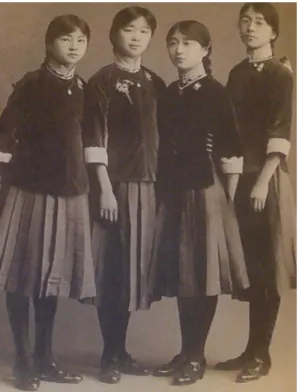
blouse, black skirt, and Western style leather shoes.14 A photo of Lin Huiyin 林徽因
12 Dorothy Ko, 6.
13 Yuan Ze and Hu Yue, 52-‐53.
1955)15 and her classmates taken in 1916 (see Figure 2.3) shows the young women wearing
school uniforms and shoes with heels. But the heights of the heels appear to be different, because
the heels of Lin’s shoes (Lin is the figure on the left) look slightly lower than those of her
classmates.
Fig 2.3 Lin Huiyin and Her Classmates (1916)
15 Lin Huiyin 林徽因 was a famous Chinese architect and writer. Born in Hangzhou, she was
CHAPTER III
THE MODERN GOLDEN LOTUS: WEARING HIGH-HEELED SHOES IN THE REPUBLICAN PERIOD
In the late 1910s, women from rich families began to wear high-heeled shoes, which forecast
the coming golden age of wearing high heels in China between the 1920s and the 1940s. High
heels were not only immensely popular with Chinese women but also designed in various styles
to meet consumers’ needs. Their popularity relied on the flood of imported high-heeled shoes
that entered the Chinese market, which diversified women’s choices. Pictorials, newspaper
supplements, advertisements, and other mass media played a crucial role in introducing the latest
styles and promoting new ideas about high-heeled shoes. Different from the sketches drawn in
the late Qing pictorials, photographs were used extensively in Republican publications to display
high heels in an accurate, current, and real way.
High-heeled shoes, together with perfume, permed wavy hair, lipstick, and silk stockings,
became fashionable necessities for women during the Republican period. Shoe stores supplied
high heels of various styles. In addition to the leather shoes wore during the day, multiple colors
of satin high-heeled slippers were available for women to wear at home in the evening. If
economic conditions permitted, almost all women who followed fashion at that time wished to
own a pair of high heels. Even women who had just given up footbinding wanted to wear
high-heeled shoes, so they put wads of cotton in the shoes to make them fit. As an article published in
fashionable, even though the styles of the latest dress change over time.16 Fashion ideas quickly
permeated Chinese social life and impacted the way people presented themselves. High-heeled
shoes were not only objects for commercial sale, but also were requisites for realizing the fantasy
of a modern social life. In urban areas, high heels were ‘must-haves’ for women walking in parks,
going to coffee houses, shopping malls, dance halls, banks, and other public places. Wearing
high-heeled shoes, to some extent, indicated Chinese women’s desire and gradual acceptance of
Western modern social life.
Women, especially young women, who did not like wearing high-heeled shoes, were
perceived as outdated and unfashionable. In 1933, the magazine Kong Jun 空军 published a
story of an old-fashioned wife who is disliked by her husband. The wife comes from a rural area,
is virtuous, nice, and shows deep affection for her husband and even cares for his parents. One
night, the husband asked his wife to ‘doll herself up’ for a dinner party, which included that she
must wear high-heeled shoes. After her repeated failure to walk normally, the wife gave up
trying to wear high heels in despair. The husband was ashamed of his wife and went to the party
alone. Other women’s delicate gestures and ability to walk gracefully at the party further added
to his sense of shame. When he returned home, the husband asked his wife to leave the city and
go back to the countryside.17
This story reveals the importance of women wearing high-heeled shoes as part of urban life
in the Republican period. For typical social occasions, high heels were an integral part of the
dress code. When most city women wore high heels to go to parties, wearing flat shoes seemed
16 Anonymity, “Ji zhong jiao shang de zhuang shi” 几种脚上的装饰 (“Several Feet
Decorations”), Da gong bao大公报, May 3, 1928.
odd. The wife in the story even lost her opportunity to attend the party at all simply because she
could not wear high heels. Meanwhile, the story presents the husband as the dominant character
who must guide his wife to wear high-heeled shoes. Living in the city for several years, he was
more familiar with the urban lifestyle than his wife. For him, the wearing of high heels to attend
social activities was basic social decorum. He was dismayed at the thought that his wife could
not accept high heels, which indicated the wife’s inability to become accustomed to modern
social life. His wife’s adoration for him and care for his parents could not alleviate the husband’s
sense of shame.
The Modern Golden Lotus
During the Republican period, not all intellectuals (including both men and women)
encouraged women to wear high-heeled shoes. As soon as high heels became popular in the late
1910s and early 1920s, the criticisms began to appear. In 1921, Shenbao 申报 (Shanghai Daily,
1872-1949) published an article about the problems associated with women’s dress in general.
High-heeled shoes were juxtaposed with short-sleeved garments, short pants, and revealing
clothing as improper and undignified ways of dressing. If serious women wore high heels, they
would then look like figures of sex and allure.18 In addition to the matter of public decency,
women who liked to wear high heels in everyday life were often seen as unqualified housewives,
passive men’s playthings, and unsuitable female citizens.19
18 Lao Xiang老芗, “Fu nü de yi fu wen ti” 妇女的衣服问题 (“The Issue of Women’s
Clothing”), Shenbao 申报 [Shanghai Daily] April 20, 1921.
19 Ding鼎, “Ren jia xing bai de guan cha” 人家兴败的观察 (“The Observation of Household
The criticisms of women wearing high heels between the 1920s and the 1940s were
presented in different ways. Feng Yuxiang冯玉祥 (1928-1930)20 made his attitude clear in1933
in the magazine Xian dai fu mu现代父母 (Modern Parents). Feng considered that women who
wore high-heeled shoes exhibited bad habits that promoted gender inequality in Chinese society.
High heels denied women their right to be independent individuals and in turn sharpened the gap
between men and women. From Feng’s point of view, wearing high heels was far from civilized
behavior that represented women’s acceptance of modern social life; rather, it was a symbol of a
barrier that stopped China from being transformed into a civilized nation.21
Although wearing high-heeled shoes was criticized on a number of grounds, these articles
hardly used convincing evidence to explain the reasons that high heels made women appear
frivolous, extravagant, or reactionary. In fact, many intellectuals at the time began to doubt the
effectiveness of these ‘impractical’ critics and turned to find sound scientific evidence to support
their points. In 1931, an article published in Yi xue zhou kan ji 医学周刊集 (The Collection of
Medical Weekly Magazine) quoted a research report in the American magazine Hygeia. The
researcher was an American doctor Du An杜安who organized a physical examination for
senior students at Goucher College. His purpose was to determine to what extent wearing
high-heeled shoes would affect people’s health. Through analyzing statistical data, the doctor came to
the conclusion that wearing high heels was potentially harmful to women’s feet and would cause
20 Feng Yuxiang 冯玉祥 was a warlord and leader in Republican China from Chaohu, Anhui. He
joined forces with revolutionaries against the Qing Dynasty in 1911. Later, he joined the Nationalist Party and supported the Northern Expedition. In 1933, he broke with Chiang Kai-shek in resisting Japanese incursions in 1933.
21 Feng Yuxiang冯玉祥, “Dui mo deng nü zi zhi gao gen xie hong zui chun you gan” 对摩登女
a series of problems such as fatigue, aches, weakness, and menstrual cramps. The Chinese author
of the article that discussed wearing high-heeled shoes in the 1930s quoted his research findings.
Compared with the government’s discouragement of wearing high heels and idle talk without
evidence, the American doctor’s medical studies seemed more persuasive in the eyes of the
Chinese author.22
In the mid-nineteenth century, missionaries introduced Western medical science to China
through the treaty ports. For the first few years, medical knowledge, especially surgical
operations, had often been demonized. It was not until the late nineteenth century that Western
medical science was widely accepted by Chinese intellectuals. The report of the oncology
surgery mentioned in the previous chapter is an example. At the high tide of the anti-footbinding
movement in the late Qing, medical knowledge was used to explain foot deformity as a
disastrous effect of binding women’s feet.23 Footbinding was criticized as one manifestation of
traditional social abuse. It constricts the nerves in the feet and legs and in turn severely limited
women’s activities. At that time, Chinese women’s bound feet and Western women’s natural feet
were seen as a binary mode. In the nationalist discourse, the binary mode was formed as a
cognitive paradigm of the collective to represent the disparity between China and the West. In
this process, Western medical science was deemed to be representative of Western civilization
and progress.
In the golden age of wearing high-heeled shoes in China, Western medical knowledge was
often seen in the writings of intellectuals as a way of argumentation. Similar to the disputes over
22 Ke Gang克纲, “Gao gen xie you mei you hai chu” 高跟鞋有没有害处 (“Weather High-‐
Heeled Shoes are Bad”), Yi xue zhou kan ji 医学周刊集 [The Collection of Medical Weekly Magazine], 4 (1931), 34.
footbinding in the late Qing, women’s physical conditions, particularly foot deformity, were the
main focus of discussions about women wearing high heels. An article published in Yi yao xue
医药学 (Medicine) in 1935 expounded the harmful effects of wearing high heels by elaborating
the structure of people’s feet (see Figure 3.1). Some knowledge of anatomy helped the author Yu
Shaoji 余绍基 to explain that human feet are made up of twenty-six small delicate bones. The
arches of the feet also play an important role in supporting the body’s weight and being able to
perform daily activities. Wearing high-heeled shoes would bring two changes to the shape of
women’s feet. The first change is the deformation of the pedal protractor muscle, which results
in the inflexion of the feet. Even if women take off high heels, their horseshoe-shaped feet would
not be able to return to their original position. The second change to women’s feet is that they
would become flat. To relieve the tiredness attributed to wearing high heels, women would bend
their knees and increase pressure on their feet. The consequence would be the dislocation of the
dorsalis pedis and in turn expand the contact area between the feet and the ground. Flat feet not
only look unattractive but also make people feel tired easily.24
Fig. 3.1 Horseshoe-Shaped Feet and Flat Feet (Yi yao xue 1935)
24 Yu Shao Ji余绍基, “Gei shi mao de gao gen xie nü zi, bing tai jiao” 给时髦的高跟鞋女子,
Many Chinese intellectuals in the Republican period attributed the deformity of women’s
feet that came as a result of wearing high-heeled shoes to the modern version of footbinding.
Growing up in a time when the notion of footbinding was harshly attacked, these intellectuals
were familiar with the rhetoric that was used to promote setting free the feet and managed to
incorporate this same rhetoric tactfully in their discussion of high heels. For them, it was less
about footbinding being wrong than wearing high-heeled shoes being right.25 Intellectuals
usually emphasized two similarities between footbinding and the wearing of high heels. The first
common point is the unrecoverable deformity of women’s feet. In 1941, Jian kang sheng huo 健
康生活 (Healthy Life) published an article written by an American doctor, A. Owen Penney,
who had more than forty years of experience of diagnosis and treatment of women’s feet. One of
the worst forms of damage caused by wearing high heels is, as is the same for footbinding, the
malformation of the foot, toes, and ankle. Once the shape of the foot becomes fixed and
unchangeable, Dr. Penney argued that it is very difficult to return it to normality.26
The second common point between wearing high heels and footbinding is the effect of pain
and movement restrictions. Zhao Zhuguang赵竹光 recounted her sad experience of wearing
high heels in an article published in Dong fang za zhi 东方杂志 (Eastern Miscellany, 1904-1948)
in 1934. Zhao was an active participant of revolutionary demonstrations. One day, she wore a
pair of high-heeled shoes and took part in a parade. After returning home, she lost all sensation
in her feet through cramp. Her toes, carrying most of her weight in the pointed high-heeled shoes,
25 Lü Chunnian吕椿年, “Bai bu he wu shi bu” 百步和五十步 (“A Hundred Step and Fifty
Steps”), Liangyou huabao 良友画报 [Liangyou Pictorial], 42 (1930), 34.
26 Qiu Yan秋燕, “Gao gen xie hai le ta” 高跟鞋害了她 (“High-Heeled Shoes Destroy Her”),
were killing her. The lack of circulation led to nerve compression and then to dizziness,
backache, and lumbar acid.27 The pain reminded the author of that associated with women’s
footbinding. Zhao’s mother once had her feet bound as a form of beautification and had told the
author about the miserable experience. From Ms. Zhao’s point of view, wearing high-heeled
shoes not only meant physical suffering but also turned out to be a major obstacle to women’s
participation in massive demonstrations and other outdoor activities. As Feng Yuxiang argued,
the wearing of high heels, like footbinding, is a manifestation of gender inequality as well as the
backwardness of the nation.
However, it is important to note that footbinding was a unique practice conducted by only a
select group of Chinese women. From the mid-nineteenth century on, this practice had been
continually jeered in interactions between China and foreign countries. Gradually, footbinding
was standardized as the ‘other’ of Western civilization and modern society. Chinese intellectuals
contrasted Chinese bound feet with Western natural feet and in turn used the difference to
emphasize that China lagged behind other countries in the world. Between the 1920s and the
1940s, the wearing of high-heeled shoes was associated with the future of the nation in the same
way and was a common concern of both Chinese and Western intellectuals. Western women also
experienced backache, menstrual pain, the sense of fatigue, and deformity of their feet due to
high heels. But in their writings, Chinese intellectuals emphasized that Western women had a
clearer sense of the harm of wearing high-heeled shoes. As Ms. Zhao mentioned in her article,
most women in Western countries took good care of their feet. After wearing high heels, they
typically soothed their aching feet in soda water, applied olive oil to their feet, and exercised
27 Zhao Zuguang赵竹光, “Gao gen xie dui yu fu nü jiang kang zhi ying xiang” 高跟鞋对于妇
their feet for a few minutes on a daily basis. The purpose was to relax their muscles, relieve
stress, and improve circulation.28 In addition to foot care, some Western women began to
abandon wearing high heels altogether. In 1937, the magazine Ling Long玲珑 published an
article that claimed that most Hollywood stars refused to wear high-heeled shoes. Carol
Lombard’s legs and feet were deemed the most beautiful among the Hollywood stars29 because
she hardly ever wore high heels in everyday life. The author also invoked Dr. Lai Ludun’s来路
敦 words to affirm that wearing high-heeled shoes would have negative effects on the beauty of
women’s feet. When more and more Western women realized the disadvantages of wearing high
heels, the author indicated regretfully that women in China were still obsessed with them.30
The Ideal High-Heeled Shoes
The criticisms of women wearing high heels often contain two main understandings of the
concept of ‘high-heeled shoes’. In the broad sense, the term ‘high-heeled shoes’ referred to all
women’s shoes with heels, without detailed criteria. Intellectuals normally favored flat shoes and
disapproved of any shoes designed for women with heels. For another group of intellectuals,
however, high-heeled shoes meant shoes with pointed toes and with spiked heels higher than one
and a half inches. Based on these ideas, these intellectuals proposed more targeted and focused
criticisms of high heels. The point they argued against was not the fact that many Chinese
28 Zhao Zuguang, Dong fang za zhi 东方杂志 [Eastern Miscellany], 19 (1934), 209.
29 In the November issue of magazine Screen Art, an image of Carol Lombard was taken by
Edwin Bower Hesser. Edwin argued that few screen actresses have legs and ankles as beautiful as those of Carol Lombard.
30 Anonymity, “Zai mo luo zhong de gao gen xie” 在没落中的高跟鞋 (“The Decline of High-‐
women in the Republican period wore high-heeled shoes; rather, it was the type of high heels
that women wore in their everyday lives. Consequently, the concept ‘ideal high-heeled shoes’
became popular in public discussion.
Many writers appealed for scientific principles in the design and fabrication of high-heeled
shoes, but very few of them provided a specific plan.31 In 1934, Zhao Zuguang argued that ideal
high heels share three characteristics. The first includes both the height and quality of the heel,
which should be less than one and a half inches and made of resilient rubber, respectively. The
pressure on the feet would thus be relieved. The second characteristic refers to the shape of the
toes. Wide-toed shoes were preferred because they would provide enough space for the toes. The
third ideal characteristic is the shoe style. Each line of stitching needs to be straight and the shoes
must be shaped like natural human feet. In order to make her views amply clear to readers, Ms.
Zhao introduced four sketches of ideal high-heeled shoes that the Western medical community
recommended (see Figure 3.2). The uppermost image shown in Figure 3.2 illustrates a shoe that
should fits well at any time. The next one is designed for running. The third one could be used
for participating in celebrations. For going out on business, the bottom one would be the best
choice. Except for the top high-heeled shoe, all the rest have heels, but they are neither stilettos
nor pointed-toe shoes. The toes are rounded and the heels do not appear to be high.
31 Yu Shaoji, Yi yao xue 医药学 [Medicine], 12 (1935), 1-13; Anonymity, “Gao gen xie de hai
Fig. 3.2 Four Ideal High-Heeled Shoes (Dong fang za zhi 1934)
Ms. Zhao’s view of ideal high-heeled shoes was borrowed from Bernarr Macfadden, who
was a well-known body-builder in American sports circles and editor-in-chief of Physical
Culture. In general terms, Ms. Zhao agreed with Macfadden’s idea that wearing high-heeled shoes, like wearing a corset, was a relic of barbarianism and needed to be taken seriously in the
twentieth century as a health risk. Both writers highlighted the importance of choosing good high
heels.32 An article about preventing and curing flat feet published in Physical Culture in 1917
offered some revelation and reference for Ms. Zhao to make suggestions to Chinese readers (see
Figure 3.3). The article includes illustrations of three types of high-heeled shoes and particularly
stresses the shoe toes and heels. The bottom image is a typical fashionable shoe with its
foot-deforming tendencies. Its pointed toe and stiletto heel would tend to force the great toe over
toward the other toes. Mr. Macfadden considered the middle shoe to be fairly satisfactory for
dress, but the upper two are corrective in design because they have straight inner lines, rounded
32 Zhao Zuguang, Dong fang za zhi 东方杂志 [Eastern Miscellany], 19 (1934), 207-209.
toes, and stable heels compared to the bottom shoe. These characteristics are the same as those
that Ms. Zhao mentioned in her article.33 Different from the issue of footbinding, the wearing of
high-heeled shoes was not completely opposed by both Chinese and Western intellectuals. The
emphasis was on whether the shoes would cause deformity. In this regard, the shape of the toe
and the height and form of the heel were two of the most important judging criteria.
Fig. 3.3 Three Types of High-Heeled Shoes (Physical Culture 1917)
The next question is to what extent did the criticism of high-heeled shoes and the promotion
of ideal high heels influence women’s choices of the time? This question is difficult to answer
because there are two variable factors. The first factor is the definition of ‘ideal’ high-heeled
shoes. How rounded should the toe cap be in order to leave adequate space for the toes? If the
height of a pair of shoes is slightly more than one and a half inches, for example, 1.6 inches,
could the shoes still be called ‘ideal’ high heels? What about pointed shoes with heels less than
one and a half inches? The various fabrics, styles, and patterns of high-heeled shoes further
complicated the definition of ideal high heels. The second factor refers to the different shapes of
women’s feet and women’s various degrees of pain perception. For instance, some women’s feet
are broader than other women’s feet. Even if they wear the same pair of ideal high-heeled shoes,
their feelings and attitudes toward the shoes would be widely varied. Meanwhile, women from
rich families usually travel by car and seldom walked. The degree of comfort of their shoes
might not be her primary consideration in selecting high heels.34
One way to observe women’s shoes in the Republican period is to look at pictures in popular
publications. Photography was introduced to China in the late Qing period. At first only high
officials, the rich and powerful, and famous courtesans could afford to have their photographs
taken. Between the 1920s and the 1940s, taking photographs had become part of everyday life.
Many newspapers and periodicals chose to use photos to record joys and sorrows, happiness and
sufferings of the world, including government activities, military training, campus life, backstage
stories, and personal experience. Photos of women engaging in public affairs and private
gatherings became important components of popular publications (see Figure 3.4 and 3.5).
High-heeled shoes as an everyday fashion necessity are frequently seen in these photos, and most of
the shoes look like the ideal high heels recommended by Chinese intellectuals. In other words,
the heel height and toe shape of the shoes in these photos do not match the shoes with stiletto
heels and pointed toes that critics described in their writings.
34 Hu Lanqi胡兰畦, “Chang qipao he gao gen xie” 长旗袍和高跟鞋 (“Long Qipao and High-‐
Fig. 3.4 Students Graduated from Senior High Fudan University (Liangyou huabao 1928)
Fig. 3.5 Hong Kong Famous Celebrities (Liangyou huabao 1928)
The next question is, who were the real targets of the bitter criticisms during the Republican
period? Take Liangyou huabao as an example. Most women who wore non-ideal high heels were
film stars and dancing girls. The backgrounds of the photographs were mostly their working
places, such as film studios, public places, and dance halls. Readers would have no idea what
heels that was heavily criticized was often shown in sketches rather than in life photos (see
Figures 3.6 and 5.7). Liangyou huabao has a column about the latest women’s fashion in every
issue. Editors always made sketches of models to illustrate clothes, and the models are shown
wearing shoes with pointed toes and stiletto heels. These shoes are almost identical to the ones
intellectuals criticized in their writings. In this regard, the degree to which literary criticisms of
women’s high-heeled shoes reflect social reality needs to be further elucidated. Perhaps the
criticism derived from intellectuals’ growing sense of unease that more and more ordinary
Chinese women would blindly follow the new wave of beauty fashion came from abroad. Under
such circumstances, the memories and experiences of footbinding and anti-footbinding came just
at the right moment. Recognizing same terrible results of binding feet and wearing high-heeled
shoes, critics attempted to convince readers of the serious social and national harm caused by the
popularity of high heels.
CHAPTER IV
BENEFICIAL EXPERIENCE: THE EXALTATION OF WEARING HIGH-HEELED SHOES
The promotion of ideal high-heeled shoes was based on an assumption shared by many
Chinese intellectuals between the 1920s and the 1940s. That is, only a few styles of high heels
actually met the health standards provided by women’s shoes. Pointed shoes with stiletto heels
would not only cause deformity of the feet but also body aches and pains. As mentioned
previously, critics described at great length how the wearing of non-ideal high-heeled shoes
would cause physical and mental deterioration. All these conclusions came from Western
medical knowledge. However, Western medical theories and doctors’ attitudes toward the
wearing of high-heeled shoes did not form a coherent view at that time. Some medical voices in
support of wearing high heels were also introduced to the public discussion.
Shortly after the critical article about women’s high-heeled shoes was published in Shenbao,
the magazine Zi lan hua pian 紫兰华片 carried a defensive article in 1924. At the beginning of
the article, the author stated clearly that the purpose of the article was to console those women
who were worried about the bad results of wearing high heels. Instead of praising the wearer of
high-heeled shoes according to his/her personal taste, the author quoted the opinions of a British
doctor and a French doctor who believed that wearing high heels was beneficial to women’s
health. From the French doctor’s point of view, wearing high heels was a good toe exercise. As
force the toes to grip the ground and in turn exercise the toe muscles.35 His point contrasted
sharply with the idea mentioned in the previous chapter that wearing high heels usually led to
deformity of the toes. On the one hand, the French doctor did not consider the effects of the
shape of shoes on women’s feet. On the other hand, he insisted that the toes are able to bear the
pressure of the body rather than grinding against each other, leading to pain and deformity.
Interestingly, the viewpoint of the British doctor made up most of the article. His approval of
wearing high-heeled shoes focused less on arguing against the deformity of feet than on the
health of the whole body. The doctor pointed out that the spine must remain perpendicular and
erect in order to support the upper body and keep muscles relatively fixed. Women wearing high
heels would unconsciously lean forward. To straighten the body, back muscles and the spine
needed to maintain the body’s balance and in turn would get some exercise. In this sense,
wearing high-heeled shoes helps women build body muscles. However, any connection between
strong muscles and feet was not elaborated in the article.36
In fact, most articles that used Western medical science to support women wearing
high-heeled shoes kept silent about the potential for deformity of the feet. The focus was instead on
maintaining balance and muscle development. In 1939, Ke xue huabao 科学画报 (Science
Pictorial) reprinted a body balance test published in the American magazine Popular Science of
that year. A Boston doctor, Walter Mendenhall, invited two women to join in the experiment and
asked one of them to wear high-heeled shoes. Both women placed a metal pencil on their heads
to record their wavering graphs on smoked paper while walking a line. Dr. Mendenhall found
35 Anonymity, “Wei nü zi gao gen xie bian hu” 为女子高跟鞋辩护 (“The Defense of Women’s
High-Heeled Shoes”), Zi lan hua pian 紫兰华片, 17 (1924), 69-‐72.
that the woman who wore high heels could often stand and walk more steadily than the barefoot
woman.37 Another article published in Xian dai jia ting 现代家庭 (Modern Family) in 1940
focuses on the positive effect of wearing high-heeled shoes on the growth of muscles. The author
Yan Ran言然 argued that women who wore high heels would exercise every major muscle
group of the lower body, which not only maintains their bodily curves but also enhances their
sexual desire. He disagreed with the idea that wearing high heels might damage the visceral
structure; rather, it is effective in curing the retroversion of the uterus.38 In this regard, the virtues
of wearing high heels seemed more important than the bad results it might cause.
However, not every supporter of wearing high-heeled shoes avoided the subject of feet.
Women’s feelings and demands for wearing high heels engaged the attention of a few
intellectuals, although these voices were barely audible. The discussion can be broadly split into
two basic types. The first type challenged the linkage between the wearing of high heels and
footbinding. In 1932, Ms. Li Fei 丽菲 published an article in the journal Ling Long opposing
hygienists’ criticism of women wearing high heels. At the beginning of the article, she admits
that she is a keen supporter of high heels and always wear them. According to her everyday
experience, Ms. Li Fei did not think that wearing high heels would lead to feet deformity.
Western medical theories, in her mind, do not always fit the facts. She particularly regarded the
analogy between footbinding and wearing high-heeled shoes as ridiculous and outdated. Instead
37 P. A. W., “Gao gen xie wei ke hou fei” 高跟鞋未可厚非 (“High-Heeled Shoes are not All
Bad”), Ke xue huabao 科学画报 [Science Pictorial], 3 (1939), 33.
38 Yan Ran言然, “Guan yu zhuo gao gen xie zhi wo jian” 关于着高跟鞋之我见 (“Some
of reading and writing theoretical articles at home, Ms. Li Fei appealed to the critics to look at
women’s feet and see whether their feet are as deformed as bound feet in the past.39
In fact, most critics failed to confirm the common consequence of binding feet and wearing
high-heeled shoes. First, critical articles used sketches rather than medical photos to illustrate the
deformity of women’s feet as a result of wearing high heels. Compared with intellectuals’
passion for revealing the “truth” of footbinding through X-ray cameras, critics of high-heeled
shoes usually made their arguments via plain words and/or sketches. Thus, the reliability of these
articles might be questionable. In addition, the wearing of high heels, unlike footbinding, is not
an ongoing continuous practice. It is impossible for women to wear high heels all day long or
wear them on a daily basis. Women were free to choose not only whether or not to wear high
heels but also what style of high heels to wear. If one pair of shoes caused blisters, she could take
them off after arriving at home and wear flat shoes or shoes with low heels the next day.
Furthermore, as illustrated in the photos published in newspapers and journals, the majority of
Chinese women did not wear pointed shoes with high heels in everyday life. The above three
points indicate that the criticisms of wearing high heels focused less on the rectification of
women’s severely deformed feet, which would be similar to the anti-footbinding movement, than
on the prevention of abnormalities of women’s feet.
The second type of discussion of women’s feelings and demands for wearing high-heeled
shoes affirms the positive effects of high heels that include allowing women to feel more
attractive. High heels make women’s feet look delicate and tiny, especially the beautiful curve of
the insteps. Also, every step a woman takes in high heels modifies her leg muscles and provides
a long leg line. Especially for small Asian women with short legs, high heels cover up their
High-physical imperfections.40 The enhancement of women’s physical beauty in turn increases
self-confidence and their courage to participate actively in social works and activities. Wearing
high-heeled shoes, instead of blocking women’s career paths, can inspire more and more women to
seek a more public life.41 In the eyes of critics, these weak voices that defend high heels might
either be misinterpreting Western medical knowledge or might be relying too much on personal
emotion and experience. However, it is these voices that reflected and contributed to the
diversity of the discourse about women wearing high-heeled shoes in the Republican period.
When critics were anxious about the popularity of high heels, which represented the importation
of a new wave of fashion trend dominated by the West, supporters attempted to find another way
to make use of the new trend and meet the demands of Chinese women for their everyday lives.
40 Xue Liying薛丽英, “Nan zi ye yao chuan gao gen xie” 男子也要穿高跟鞋 (“Men Also Need
to Wear High-‐Heeled Shoes”), Ling Long 玲珑47 (1932), 1897.
41 Li Fei, Ling Long 玲珑 73 (1932), 1061.
CHAPTER V CONCLUSION
This thesis focuses on discussions of women wearing high-heeled shoes in the Republican
period. These discussions represent contention over the fashion of the time and the
accompanying changes in Chinese society. The issue of footbinding and its relationship to the
wearing of high heels became a key concern of both critics and supporters of high heels. The
linkage between footbinding and the wearing of high heels was not accidental. As the
anti-footbinding movement progressed, the understanding of female beauty and fashion began its
modern turn. From the twelfth to the late nineteenth centuries, women’s bound feet were seen as
a symbol of beauty, created by male intellectuals in their literary works. However, in the late
Qing period, the aesthetic appreciation of footbinding had lost its legitimacy and footbinding was
considered a brutal practice that catered to patriarchy. Natural feet became the new standard of
female beauty in the years of the anti-footbinding movement. Wearing flat shoes accordingly
came into fashion.
The popularity of high-heeled shoes between the 1920s and the 1940s, however, gave rise to
the paradoxical anxiety of many Chinese intellectuals. On the one hand, wearing high-heeled
shoes was an important component of modern social life. Different from footbinding, the
popularity of high heels represented the successful importation of Western ideas about beauty
and fashion into China. On the other hand, wearing high heels seemed to be as cruel as
Western medical science, a group of intellectuals argued that the deformity of feet was a highly
possible consequence of wearing high heels. This deformity in turn carried over to pain in the
whole body, the restriction of women’s activities, and manifestation of the nation’s
backwardness and barbarism. Such paradoxical attitudes towards the wearing of high heels led to
the emergence of the concept of ideal high-heeled shoes. Special requirements for the shape of
the toe of the shoe and the height of the heel temporarily alleviated intellectuals’ anxious feelings.
It seemed that they had found a path of compromise in understanding the popularity of high heels
in Chinese society of the time.
Nevertheless, not all intellectuals accepted this path of reconciliation at that time. Dissenters
believed that the linkage between footbinding and the wearing of high-heeled shoes was
unfounded. Instead of sounding the death-knell of women’s health, these intellectuals used
Western medical knowledge to prove that wearing high heels would effectively strengthen
muscles and increase a sense of balance. From this perspective, intellectuals’ anxiety about high
heels was unnecessary. In addition, they regarded the connection between the wearing of high
heels and the discourse on the nation’s failure as simply the intellectuals’ imagination. To answer
the question of whether wearing high-heeled shoes is a good or bad practice, the focus needs to
be women’s personal feelings and demands in their everyday lives. Individuals had the
opportunity to choose the style of high heels they would like to wear. Furthermore, photos in
popular publications provided other unheard voices that reflected the social conditions of the
time. Critics of high heels seemed to build their arguments on assumptions without solid
evidence. Not all Chinese women in the Republican period wore the pointed high heels that some
intellectuals criticized. Moreover, almost no medical photos were published to prove that