Cost-effectiveness of laparoscopic hysterectomy with
morcellation compared to abdominal hysterectomy for
presumed fibroids
Sarah E. RUTSTEIN, PhD1,2, Matthew T. SIEDHOFF, MD, MSCR3, Elizabeth J. GELLER, MD3, Kemi M. DOLL, MD3, Jennifer M. WU, MD, MPH3, Daniel L. CLARKE-PEARSON, MD3, and Stephanie B. WHEELER, PhD, MPH1
1Department of Health Policy and Management, The University of North Carolina at Chapel Hill
2Department of Medicine, The University of North Carolina at Chapel Hill
3Department of Obstetrics & Gynecology, The University of North Carolina at Chapel Hill
Abstract
Study objective—Hysterectomy for presumed leiomyomata is one of the most common surgical procedures performed in non-pregnant women in the United States. Laparoscopic hysterectomy (LH) with morcellation is an appealing alternative to abdominal hysterectomy (AH), but may result in dissemination of malignant cells and worse outcomes in the setting of an occult leiomyosarcoma. We sought to evaluate the cost-effectiveness of LH versus AH.
Study Design—Decision-analytic model of 100,000 women in the United States assessing the incremental cost-effectiveness ratio (ICER) in $/QALY gained.
Design Classification—Canadian Task Force Classification III
Setting—U.S. hospitals.
Patients—Adult premenopausal women undergoing LH or AH for presumed benign leiomyomata.
Interventions—We developed a decision-analytic model from a provider perspective across five-years, comparing the cost-effectiveness of LH to AH in terms of dollar (2014 USD) per quality adjusted life-year (QALY) gained. The model included average total direct medical costs and utilities associated with the procedures, complications, and clinical outcomes. Baseline estimates and ranges for cost and probability data were drawn from the existing literature.
Measurements and Main Results—Estimated overall deaths were lower in LH vs AH (98 vs 103). Death due to leiomyosarcoma was more common in LH vs AH (86 vs 71). Base-case
Corresponding author: Sarah E. Rutstein, CB#7411, University of North Carolina, Chapel Hill, NC 27599, [email protected], Phone: +1 206-419-8151, Fax: +1 919-966-6961.
Publisher's Disclaimer: This is a PDF file of an unedited manuscript that has been accepted for publication. As a service to our
customers we are providing this early version of the manuscript. The manuscript will undergo copyediting, typesetting, and review of the resulting proof before it is published in its final citable form. Please note that during the production process errors may be
HHS Public Access
Author manuscript
J Minim Invasive Gynecol. Author manuscript; available in PMC 2017 February 01.
Published in final edited form as:
J Minim Invasive Gynecol. 2016 February 1; 23(2): 223–233. doi:10.1016/j.jmig.2015.09.025.
Author Manuscript
Author Manuscript
Author Manuscript
assumptions estimated that average per person costs were lower in LH vs AH - a savings of $2,193 ($24,181 vs $26,374). Over five years, women in LH group experienced 4.99 QALY, versus women in AH group with 4.91 QALY (incremental gain of 0.085 QALYs). LH dominated AH in base-case estimates - LH being both less expensive and yielding greater QALY gains. The ICER was sensitive to operative costs for LH and AH. Varying operative costs of AH yielded an ICER of $87,651/QALY gained (minimum) to AH being dominated (maximum). Probabilistic sensitivity analyses, in which all input parameters and costs were varied simultaneously, demonstrated a relatively robust model. The AH approach was dominated 68.9% of the time. 17.4% of simulations fell above the willingness-to-pay threshold of $50,000/QALY gained.
Conclusions—When considering total direct hospital costs, complications, and morbidity, LH was less costly and yielded more QALYs gained versus AH. Driven by the rarity of occult leiomyosarcoma and the reduced incidence of intra- and postoperative complications, LH with morcellation may be a more cost-effective and less invasive alternative to AH and should remain an option for women needing hysterectomy for leiomyomata.
Introduction
Hysterectomy for presumed leiomyomata (fibroids) is one of the most common surgical procedures performed in non-pregnant women in the United States, with over 200,000 performed annually 1. Surgeons increasingly employ less invasive laparoscopic techniques for both supracervical and total hysterectomies, shortening hospital stay and recuperation time 2,3. In laparoscopic procedures, when the uterus is too large to be removed intact vaginally, the specimen must be cut into smaller pieces for removal via the smaller abdominal incisions. This dissection of solid tissue, so-called morcellation, may result in unintentional intra-abdominal spread of tissue fragments 4,5. In the setting of previously undiagnosed leiomyosarcoma, morecellation may result in dissemination of malignant cells. The consequences of morcellation in the context of occult malignancy has sparked a heated debate regarding the risks associated with laparoscopic hysterectomy and morcellation 6.
The prevalence of occult leiomyosarcoma among women undergoing hysterectomy for presumed fibroids is not precisely known, but available reports indicate it is extremely rare 5,7–9, and difficult to distinguish from benign disease preoperatively 10. For women with large fibroids, the benefits of a laparoscopic approach to hysterectomy—lower overall mortality, fewer intraand postoperative complications, improved quality of life, and lower cost—must be weighed against the uncommon risk of morcellation of an occult
malignancy 3,10,11. With governing bodies and hospital systems struggling with how to best address this clinical problem, additional insights into both the health and economic
consequences of laparoscopic and abdominal hysterectomies are critically needed.
In this study, we evaluated the cost-effectiveness of laparoscopic hysterectomy with morcellation for removal of presumed fibroids as compared to abdominal hysterectomy. We estimated the total per person direct hospital costs associated with both procedures and the anticipated associated intraoperative and postoperative complications from existing literature. Our primary outcome was the incremental cost-effectiveness per quality adjusted life year (QALY) gained.
Author Manuscript
Author Manuscript
Author Manuscript
Methods
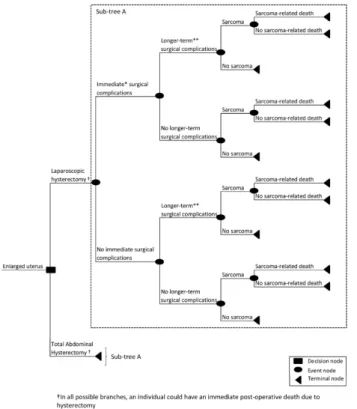
We developed a decision-tree model (Figure 1), constructed using Excel™ 2010 (Microsoft Corp, Redmond, WA, USA) and TreePlan™ (TreePlan Software, San Francisco, California) to simulate costs, outcomes, and incremental cost-effectiveness ratios (ICERs) comparing laparoscopic hysterectomy with morcellation (LH) to abdominal hysterectomy (AH). AH is considered the base case scenario, with LH evaluated as the alternative. An ICER in which the alternative (LH) is less expensive and more effective (more QALYs gained) compared to AH would be interpreted as “dominant” 12. Costs and outcomes were evaluated across a 5-year time horizon. This study was considered exempt from review by the Institutional Review Board at the University of North Carolina at Chapel Hill, as it involved synthesis and analysis of existing published data.
Mortality, complications, and quality of life
Assumptions regarding anticipated clinical events and associated QALYs are presented elsewhere 13. Briefly, we simulated a hypothetical cohort of 100,000 adult premenopausal (i.e., still menstruating) women undergoing either LH or AH for presumed benign
leiomyomata. This hypothetical cohort is limited to women with a uterus large enough that it would either require laparotomy or laparoscopy with morcellation. Women who could have intact removal through the vagina are not included as they are not the focus of this
investigation. We examined frequency of transfusion, wound infection, venous
thromboembolism (VTE), incisional hernia, vaginal cuff dehiscence, overall mortality, and complications associated with occult leiomyosarcoma. All women were at risk for surgical complications associated with hysterectomy, represented as unique and independent health states in the model. The base-case estimates and ranges for mortality, probabilities of complications, and utilities were determined by literature review (Table 1). We derived leiomyoscarcama estimates, weighting high-quality more recent studies with larger sample size that used pathologic diagnostic criteria. The base case estimate for leiomoysarcoma risk (6/5084; 0.0012) was derived using mean estimates of leiomoysarcoma rates from the four highest-quality studies – 0.00089, 0.0007 7, 0.0009 5, 0.00238. The range that was used in one-way and probabilistic sensitivity analyses use the lowest and highest reported rate of occult disease among studies with a sample size greater than 1000, ranging from 0.00077 to 0.0049 14, a range inclusive of the most recent FDA estimate6.
In terms of sarcoma-related mortality, the estimates from death from sarcoma were taken from SEER based 5-year mortality reporting on LMS outcomes in the United States and varied depending on if a woman underwent TAH or TLH based on the presumed up-staging of disease due to dissemination during morcellation. We assumed that women with
metastatic disease would be identified preoperatively and would not be included in this hypothetical cohort. Survival of women with distant metastases is likely driven by the metastatic disease, so morcellation would not change their stage nor impact overall survival, meaning the post-operative prognosis would not vary for women with preoperative stage IV disease. We assumed that occult LMS in a woman undergoing TAH is represented by International Federation of Gynecology and Obstetrics stage I or stage II diagnosis (confined to the pelvis) and that morcellation (TLH), with its theoretical dissemination of cancer cells,
Author Manuscript
Author Manuscript
Author Manuscript
would, at worst lend the same poor prognosis as spontaneous cancer metastasis, a stage III diagnosis (extra-pelvic disease). Therefore, the probability of death following sarcoma after TAH was set as 5 year death rate of stage I–II (weighted average) disease (0.59), and the probability of death following sarcoma after TLH was set at 5 year death rate of stage III disease: 0.7215. Thus all women with occult LMS who underwent TLH were given a worse prognosis than those undergoing TAH. The survival was not calculated annually, as the best population-estimates available are traditional 5-year rates. We also examined more recent observational studies of LMS cohorts, including 315 patients treated from 1982 – 2010 16–18. These were similar to the population-based SEER estimates and therefore the estimates were not changed. We assumed that patients with LMS received adjuvant chemotherapy regimens (gemcitabine and carboplatin).
Health utility estimates were derived for each health state, accounting for the average duration that an individual would remain in that state.
Cost inputs
We used a provider perspective and included direct medical costs associated with surgical procedures, intraoperative or postoperative complications, and cancer-related care, as reported in the literature (Table 1). For women with leiomyosarcoma, we included costs associated with cancer-directed treatment and/or palliative care, as reported in the literature. The costs that we report are direct medical costs or reimbursed medical costs in US dollars for care delivered, as opposed to prices charged. We chose this approach to costing because prices charged vary substantially across hospitals and settings, may not be generalizable to all patients, and may not be indicative of actual resources required to deliver services. Because we employed the provider perspective, indirect, non-medical costs (such as patient transportation costs) were not relevant and were not included in our analysis.
All costs (in 2014 USD) were derived from published literature. Costs collected prior to 2014 were inflated using historical consumer price index data for urban consumers, medical care expenditure category 19. Procedural costs for abdominal and laparoscopic
hysterectomies were derived from retrospective cohort analyses 20,21, and a randomized clinical trial 22. In this case, surgical procedural costs were derived from micro-costing approaches and included operative expenses, supplies, equipment and instruments, and physician and staff costs. Operative expenses were derived using accounting ledgers, where costs were associated with operative time (staffing costs) using an institutional time-based linear algorithm. Both of the retrospective trials were conducted in the US. By contrast, the randomized clinical trial was conducted in Sweden, and in that setting, the procedural costs, including equipment and OR-related staffing expenses, were considerably less than those reported by the US-based trials. Accordingly, we used the Swedish estimates as the low-end of the cost range for procedure-associated costs.
Costs for surgery-related complications were derived from several sources. Transfusion costs included total direct hospital costs for laboratory services, staff labor, and
materials23,24. Total direct hospital costs for management of surgical site infections were derived from patient-level micro-costing approach based on supplies and staff-time 25, and ICD-9 diagnosis codes for postoperative surgical site infections in gynecologic surgical
Author Manuscript
Author Manuscript
Author Manuscript
procedures 26. Total direct hospital costs for hernia repair were based on a retrospective analysis of patients who underwent repair for a ventral hernia27. Estimates included average total direct hospital cost associated with length of stay, operating room time, time in intensive care units, resuscitation, and any costs associated with related readmissions. We were unable to identify costs associated with repair of vaginal cuff dehiscence and therefore assumed that the costs would be similar to those of hernia repair, based on the invasiveness of treatment and spectrum of clinical complications.
Published hospital cost data were not available for VTE or leiomyosarcoma therapy and associated end-of-life care. The best available studies rely on reimbursement, which is related to hospital costs, but not identical. However, we conducted sensitivity analyses to assess the impact of these cost inputs on overall model-projected cost and cost-effectiveness estimates. Costs for VTE were based on a retrospective cohort analysis of reimbursed costs from administrative insurance claims databases in large US private health care plans 28, and a retrospective analysis from a national database of hospital claims evaluating provider payments and reimbursements for cost of hospitalization 29. Chemotherapy costs were derived from Medicare reimbursements processed from ICD-9 diagnosis codes and procedural codes (CPT and HCPCS codes) for the treatment of leiomyosarcoma assuming six one-month cycles of concurrent docetaxel and gemcitabine, and included drug costs and costs associated with drug-related toxicities (neuropathy and neutropenia), weighted probabilistically based on the likelihood that such toxicities occur30. In addition to drug and toxicity management costs, cancer care costs included physician visits, all infusion and related /treatment charges, and the costs of standard pretreatment medications. We assumed that patients who did not respond to the first six-month cycle of chemotherapy would incur costs associated with a second six-month cycle and eventually end-of-life care. Costs associated with end-of-life care were based on reimbursements from Medicaid
administrative claims data among beneficiaries who died after a cancer diagnosis compared to a matched cohort of beneficiaries who died of other causes, using reimbursed costs specific to gynecologic cancer patients31.
Base case analysis
We used base case cost and utility estimates to compare differences between AH and LH. We subtracted the base case AH costs from LH costs and base case AH utilities from LH utilities, and then divided the cost difference (incremental cost) by the difference in utilities (incremental effectiveness) to yield the base case ICER.
Sensitivity analyses
We performed one-way, deterministic sensitivity analyses for parameters identified as major drivers of the ICER outcome, holding all else constant. We conducted a probabilistic sensitivity analysis (PSA) using Monte Carlo simulations (1000 trials) for the ICER outcome (Crystal Ball version 11.1.2.3 [Oracle, Redwood Shores, CA, USA]). In this process, probability distributions are assigned based upon expected ranges for all input parameters (probabilities, utilities, and costs) and then values for each parameter are drawn randomly from within these distributions to generate our outcome of interest 3233. Table 1 details the distributions that we used in the PSA. For example, for an input parameter with a
Author Manuscript
Author Manuscript
Author Manuscript
triangular distribution, with each simulation, the value of that point estimate may be anywhere within the pre-defined parameter range, with values closer to the base case being more likely to be drawn than those towards the tail (minimum and maximum). In this way, we vary the inputs across the parameter range in 1000 distinct scenarios, and in doing so, examine the uncertainty around all ranges. The probabilistic sensitivity analysis allows for natural stochasticity due to chance as well as uncertainty in the value of input parameters that may arise across diverse studies and samples.
The range of probability parameters are detailed elsewhere13. In brief, all probabilities were selected using literature review of primary data, with preference to higher quality and more recent studies that appropriately reflect advances in the field. Table 1 details the base case parameter values employed as well as relevant ranges selected for sensitivity analyses. Probabilities and utility estimates assumed triangular distributions. Given limited reports on utilities for the health states in our model, all utilities were varied by 20% above and below the case estimate. We assumed a gamma distribution for costs considering the base-case estimate evaluated over the literature-informed range12. Gamma distributions were selected for utilities in that this distribution is constrained to be positive and fully continuous.
Because total direct hospital cost data were not available for VTE or leiomyosarcoma-related costs (chemotherapy and/or end-of-life care), we conducted extensive a priori individual one-way sensitivity analyses with these cost inputs, varying base case estimates by +/− 40%.
In an alternative scenario, we modeled the effect of patients with progressive
leiomyosarcoma dying in year two of the model, rather than surviving to year five. In this analysis, patients with leiomyosarcoma who did not respond to the initial six-month course of chemotherapy no longer contributed QALYs to the model beyond year two. These women still received a second course of chemo and end-of-life care. This represents a more conservative scenario that would tend to favor AH, as more women in the LH arm may have progressive leiomyosarcoma.
Results
In our model of 100,000 premenopausal women undergoing hysterectomy for presumed leiomyomata, we estimated that overall deaths were lower in LH vs AH (98 vs 103). However, death due to leiomyosarcoma was more common in LH vs AH (86 vs 71). Using base-case assumptions, we estimated average per person costs as lower in LH compared to AH, resulting in a savings of $2,193 for LH patients ($24,181 vs $26,374) (Table 2). Over five years, women in the LH group experienced 4.99 QALY, compared to women in the AH group with 4.91 QALY, for an incremental gain of 0.085 QALYs. As such, LH dominated AH in base-case estimates, with LH being both less expensive and yielding greater QALY gains.
Author Manuscript
Author Manuscript
Author Manuscript
Sensitivity analyses
In one-way sensitivity analyses, we estimated the potential range of ICERs across the probable range of input parameters (Table 3). The ICER was especially sensitive to operative costs and the estimated quality-of-life decrement associated with AH. Using the minimum ($7,268) and maximum ($35,584) estimate for LH operative costs, the ICER comparing LH to AH varied from AH being dominated (negative ICER) to LH resulting in $120,259/QALY gained, which is above the commonly accepted $50,000/QALY gained threshold, indicating that we would not adopt LH over AH. Univariate analyses that varied operative costs of AH between minimum ($12,281) and maximum ($32,648) yielded an ICER of $87,651/QALY gained when evaluated at the minimum AH operative cost, to AH being dominated at the maximum AH operative cost. These analyses suggest that the ICER is very sensitive to the operating costs of LH and AH. Varying the utility estimate for the health-related quality of life associated with undergoing AH (0.72, 1.0) continued to demonstrate that LH dominated AH across the predefined range of utilities for this parameter.
Because we had to rely on reimbursement instead of total direct hospital costs for VTE, leiomyosarcoma treatment, and end-of-life care, we conducted one-way sensitivity analyses for the inputs, extending the range +/−40% of base case. Results suggest that the ICER outcome was not sensitive to these costs; AH remained dominated across the wide range of costs for each parameter.
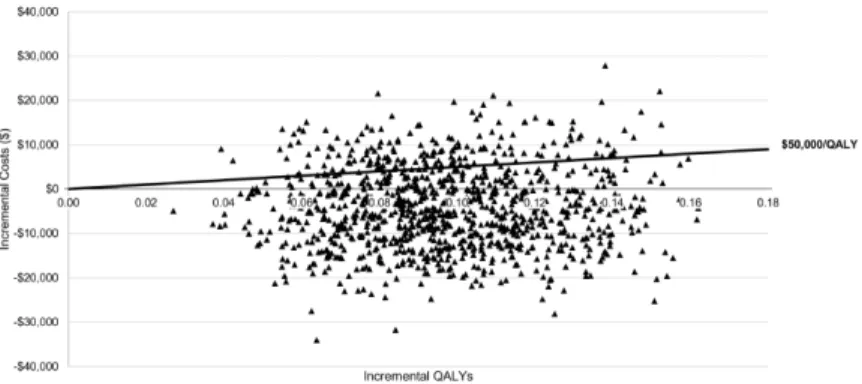
Probabilistic sensitivity analyses, in which all input parameters and costs were varied simultaneously, demonstrates a relatively robust model. Each draw results in a new incremental cost and incremental effectiveness of LH compared with AH. Resulting point estimates (Figure 2) represent the ICERs of the 1000 draws executed through Montel Carlo simulations. The AH approach is dominated (i.e., the strategy is both less effective and more costly compared with LH) 68.9% of the time. The remaining 31.1% of simulations lie in the “tradeoff” zone in which LH is both more effective and more costly than AH; 17.4% of simulations fell above the willingness-to-pay threshold of $50,000/QALY gained.
The base-case ICERs continued to demonstrate LH dominating AH when women with leiomyosarcoma died in year two of the model, rather than living at reduced quality-of-life for years three to five.
Discussion
In our base case analysis, we found that LH dominated AH. When considering the total direct medical costs associated with each procedure, resulting complications, and morbidity, LH was less costly and yielded more QALYs gained compared to AH. Despite the potential risks associated with dissemination of malignant tissue during the morcellation process, the rarity of preoperatively undiagnosed leiomyosarcoma and the reduced intra- and
postoperative complication rates suggest that on a population level, across the probable range of inputs, LH is likely a more cost-effective alternative compared to AH. Probabilistic sensitivity analyses demonstrate robust model performance with simultaneous and random draws from the probable range of complication probabilities, estimated utilities, and
Author Manuscript
Author Manuscript
Author Manuscript
associated costs. In simulations, the majority of ICER outcomes were negative; that is, compared to AH, LH was less costly and marginally more effective in terms of QALYs gained.
The incremental QALYs gained were minimal comparing LH to AH. This suggests that despite the less-invasive laparoscopic approach, LH is associated with only moderate benefits in terms of QALYs once the risk of leiomyosarcoma is considered. This limited variability in QALYs is likely driven by the fact that most women proceed through the model without experiencing any complication. Women in the LH group who do not experience complications are modeled as having a health-related quality-of-life of 1 (maximum utility) throughout the five-year model time horizon. Conversely, women in the AH group who do not sustain complications, the majority of women, experience decreased health-related quality-of-life associated with recovery from an open surgical procedure (0.9) for the six-month period immediately following surgery 34. However, even in a sensitivity analysis adopting the more conservative assumption that women undergoing AH do not have any health-related quality-of-life decrement postoperatively, the ICER for LH continued to dominate AH.
Importantly, perceived utility of a given health state, and thus the estimated QALY resulting from occupying that health state, may vary according to age, income status, and other socioeconomic factors. Granular detail specifying this level variation within this particular patient population is not currently available, and therefore, aggregate health utility estimates may mask some of the demographic and socioeconomic variation in these values. We attempted to mitigate this limitation by varying all utility estimates by 20% above and below the base-case estimate. However, future studies should seek to explore sub-population specific variation in health related quality of life reporting.
Women undergoing AH were more likely to experience an immediate (i.e., transfusion) and/or longer-term (i.e., hernia) complication. Vaginal cuff dehiscence was the only complication that was more common among women undergoing LH35–37, perhaps attributable to electrosurgical rather than sharp colpotomy or inadequate tissue inclusion during cuff closure38,39. The consequences of vaginal cuff dehiscence are highly variable, depending on the degree of evisceration. We did not explicitly model the variability of dehiscence complications, but rather focus on its average morbidity and costs.
Total direct hospital cost data were drawn primarily from US-based studies. Operative costs for AH and LH, the major driver of ICER outcomes, were from studies conducted in the last five years. More recent cost estimates for some complications, including transfusion, surgical site infection, and VTE, were not available. However, these costs did nto
dramatically influence ICER estimates in sensitivity analyses. There was variability in the method of ascertaining costs across studies, resulting in uncertainty regarding the estimated costs. Ideally, all costs, including those associated with the procedure and any follow-up interventions due to procedural complications, would be assessed using micro-costing techniques in which a cohort of patients was followed prospectively and all costs obtained using hospital data. However, this highly intensive approach was not feasible and was beyond the scope of this study. Nevertheless, in sensitivity analyses, we were able to address
Author Manuscript
Author Manuscript
Author Manuscript
the uncertainty associated with costs and found that despite varying reimbursement-derived costs by a generous +/−40% range and other costs according to the best available data, AH remained dominated by LH in the majority of simulations, demonstrating that these costs were not a major driver of our ICER outcome. Indeed, in extensive sensitivity analyses pursued in this study, the only costs that had a substantial influence on ICER outcomes were the procedural costs of LH and AH, which came from robust cohort and randomized trials using total direct hospital cost estimates. Assessment and inclusion of indirect costs were beyond the scope of this study due to our provider perspective. However, inclusion of indirect costs, such as time away from work (lost wages, lost productivity), would likely favor LH over AH given differences in expected recovery time.
Our original decision analysis and this cost-effectiveness analysis focused on laparoscopic hysterectomy. Data are mixed regarding cost robotically-assisted hysterectomy40–42. If the robotic platform indeed raises the cost of the operation, it would temper the benefit observed for laparoscopy in this cost analysis. That said, while clear advantages for laparoscopy over laparotomy in patient outcomes, there are no demonstrable advantages for robotic
laparoscopy over conventional laparoscopy. In the context of this model, morcellation captures all procedures involving the cutting of uterine tissue to facilitate laparoscopic removal. Data are lacking regarding safety differences between various morcellation techniques, preventing stratification by type of morcellation. The few studies that suggest survival differences in patients with leiomyosarcoma comparing surgery with and without morcellation include a heterogeneous set of extraction modalities11,43.
There are limited and highly variable data regarding the incidence of occult leiomyosarcoma in the setting of hysterectomy for presumed leiomyomata5,7–9,14,44–48. We modeled the increased risk of disease progression and mortality in the setting of morcellation with LH compared to AH. Even at the highest incidence estimate, the ICER for LH continued to dominate AH. Ongoing endeavors to develop improved containment tools during uterine extraction or improved diagnostics to distinguish between benign and malignant myomata could markedly reduce risk associated with tissue dissemination during morcellation. We chose to focus specifically on leiomyosarcoma because this is the malignancy which mimics large leiomyomata and our knowledge of the effect of morcellation on leiomyosarcoma (limited as it is) is better understood than the effect on other malignancies 49. We did not model endometrial or cervical cancers explicitly, as these are distinct entities from leiomyosarcoma in that we have significantly better preoperative diagnostic testing for endometrial and cervical cancer. Furthermore, uteri with occult endometrial or cervical cancer can presumably be much more frequently be delivered intact through the vagina, avoiding morcellation altogether, and thus are less relevant to the model as designed here.
This cost-effectiveness analysis, and the clinical outcomes analysis that preceded it 13, are meant to inform policymakers, clinicians, and other decision makers in what has emerged as the most debated issue in gynecologic surgery. Like all medical procedures, a woman's decision to undergo laparoscopic or abdominal hysterectomy should include a thorough discussion of risks, and must consider patient-specific circumstances, values, preferences, and risk-aversion. Driven by the rarity of occult leiomyosarcoma and the reduced incidence of intra- and postoperative complications, LH with morcellation may be a more
cost-Author Manuscript
Author Manuscript
Author Manuscript
effective and less invasive alternative to AH and ought to remain an option for women needing hysterectomy for large fibroids.
Acknowledgments
SER is funded by F30 MH098731 and T32 GM008719
Source of funding: None.
References
1. Wright JD, Herzog TJ, Tsui J, et al. Nationwide trends in the performance of inpatient hysterectomy in the United States. Obstet Gynecol. Aug; 2013 122(2 Pt 1):233–241. [PubMed: 23969789] 2. Lee J, Jennings K, Borahay MA, et al. Trends in the national distribution of laparoscopic
hysterectomies from 2003 to 2010. J Minim Invasive Gynecol. Jul-Aug;2014 21(4):656–661. [PubMed: 24462854]
3. Nieboer TE, Johnson N, Lethaby A, et al. Surgical approach to hysterectomy for benign gynaecological disease. Cochrane Database Syst Rev. 2009; 3:CD003677. [PubMed: 19588344] 4. Leren V, Langebrekke A, Qvigstad E. Parasitic leiomyomas after laparoscopic surgery with
morcellation. Acta Obstet Gynecol Scand. Oct; 2012 91(10):1233–1236. [PubMed: 22574911] 5. Seidman MA, Oduyebo T, Muto MG, Crum CP, Nucci MR, Quade BJ. Peritoneal dissemination
complicating morcellation of uterine mesenchymal neoplasms. PLoS One. 2012; 7(11):e50058. [PubMed: 23189178]
6. [Accessed April 17, 2014] Laparoscopic Uterine Power Morcellation in Hysterectomy and Myomectomy: FDA Safety Communication. 2014. http://www.fda.gov/MedicalDevices/Safety/ AlertsandNotices/ucm393576.htm2014
7. Kamikabeya TS, Etchebehere RM, Nomelini RS, Murta EF. Gynecological malignant neoplasias diagnosed after hysterectomy performed for leiomyoma in a university hospital. Eur J Gynaecol Oncol. 2010; 31(6):651–653. [PubMed: 21319509]
8. Leung F, Terzibachian JJ. Re: “The impact of tumor morcellation during surgery on the prognosis of patients with apparently early uterine leiomyosarcoma”. Gynecol Oncol. Jan; 2012 124(1):172–173. author reply 173. [PubMed: 21955481]
9. Parker WH, Fu YS, Berek JS. Uterine sarcoma in patients operated on for presumed leiomyoma and rapidly growing leiomyoma. Obstet Gynecol. Mar; 1994 83(3):414–418. [PubMed: 8127535] 10. Vilos GA, Marks J, Ettler HC, Vilos AG, Prefontaine M, Abu-Rafea B. Uterine smooth muscle
tumors of uncertain malignant potential: diagnostic challenges and therapeutic dilemmas. Report of 2 cases and review of the literature. J Minim Invasive Gynecol. May-Jun;2012 19(3):288–295. [PubMed: 22546421]
11. George S, Barysauskas C, Serrano C, et al. Retrospective cohort study evaluating the impact of intraperitoneal morcellation on outcomes of localized uterine leiomyosarcoma. Cancer. Oct 15; 2014 120(20):3154–3158. [PubMed: 24923260]
12. Drummond, MF.; Sculpher, M.; Torrance, GW.; O'Brien, BJ.; Stoddart, GL. Methods for the Economic Evaluation of Health Care Programmes. 3rd ed. Oxford University Press; New York: 2005.
13. Siedhoff MT, Wheeler SB, Rutstein SE, et al. Laparoscopic hysterectomy with morcellation versus abdominal hysterectomy for presumed fibroids: a decision analysis. American Journal of
Gynecology. 2015 In press.
14. Leibsohn S, d'Ablaing G, Mishell DR Jr, Schlaerth JB. Leiomyosarcoma in a series of hysterectomies performed for presumed uterine leiomyomas. Am J Obstet Gynecol. Apr; 1990 162(4):968–974. discussion 974–966. [PubMed: 2327466]
15. Kosary, C. Cancer survival among adults: U.S. SEER program, 1988–2001, patient and tumor characteristics. In: Ries, L.; Young, J.; Kell, G.; Eisner, M.; Lin, D.; Horner, M., editors. Cancer of the corpus uteri. National Cancer Institute, SEER Program, NIH; Bethesda: 2007. p. 123-132.
Author Manuscript
Author Manuscript
Author Manuscript
16. Raut CP, Nucci MR, Wang Q, et al. Predictive value of FIGO and AJCC staging systems in patients with uterine leiomyosarcoma. Eur J Cancer. Nov; 2009 45(16):2818–2824. [PubMed: 19647426]
17. Zivanovic O, Leitao MM, Iasonos A, et al. Stage-specific outcomes of patients with uterine leiomyosarcoma: a comparison of the international Federation of gynecology and obstetrics and american joint committee on cancer staging systems. J Clin Oncol. Apr 20; 2009 27(12):2066– 2072. [PubMed: 19255317]
18. Lim D, Wang WL, Lee CH, Dodge T, Gilks B, Oliva E. Old versus new FIGO staging systems in predicting overall survival in patients with uterine leiomyosarcoma: a study of 86 cases. Gynecol Oncol. Feb; 2013 128(2):322–326. [PubMed: 23153591]
19. [Accessed February 6, 2014] Bureau of Labor Statistics, Consumer Price Index. 2014. http:// www.bls.gov/cpi/2014
20. Wright KN, Jonsdottir GM, Jorgensen S, Shah N, Einarsson JI. Costs and outcomes of abdominal, vaginal, laparoscopic and robotic hysterectomies. JSLS. Oct-Dec;2012 16(4):519–524. [PubMed: 23484557]
21. Jonsdottir GM, Jorgensen S, Cohen SL, et al. Increasing minimally invasive hysterectomy: effect on cost and complications. Obstet Gynecol. May; 2011 117(5):1142–1149. [PubMed: 21508754] 22. Lonnerfors C, Reynisson P, Persson J. A Randomized Trial Comparing Vaginal and Laparoscopic
Hysterectomy vs Robot-Assisted Hysterectomy. J Minim Invasive Gynecol. Jan; 2015 22(1):78– 86. [PubMed: 25045857]
23. Blumberg N, Kirkley SA, Heal JM. A cost analysis of autologous and allogeneic transfusions in hip-replacement surgery. Am J Surg. Mar; 1996 171(3):324–330. [PubMed: 8615466]
24. Cremieux PY, Barrett B, Anderson K, Slavin MB. Cost of outpatient blood transfusion in cancer patients. J Clin Oncol. Jul; 2000 18(14):2755–2761. [PubMed: 10894876]
25. Dimick JB, Chen SL, Taheri PA, Henderson WG, Khuri SF, Campbell DA Jr. Hospital costs associated with surgical complications: a report from the private-sector National Surgical Quality Improvement Program. J Am Coll Surg. Oct; 2004 199(4):531–537. [PubMed: 15454134] 26. de Lissovoy G, Fraeman K, Hutchins V, Murphy D, Song D, Vaughn BB. Surgical site infection:
incidence and impact on hospital utilization and treatment costs. Am J Infect Control. Jun; 2009 37(5):387–397. [PubMed: 19398246]
27. Stey AM, Danzig M, Qiu S, Yin S, Divino CM. Cost-utility analysis of repair of reducible ventral hernia. Surgery. Jun; 2014 155(6):1081–1089. [PubMed: 24856128]
28. Bullano MF, Willey V, Hauch O, Wygant G, Spyropoulos AC, Hoffman L. Longitudinal evaluation of health plan cost per venous thromboembolism or bleed event in patients with a prior venous thromboembolism event during hospitalization. J Manag Care Pharm. Oct; 2005 11(8): 663–673. [PubMed: 16194130]
29. Spyropoulos AC, Lin J. Direct medical costs of venous thromboembolism and subsequent hospital readmission rates: an administrative claims analysis from 30 managed care organizations. J Manag Care Pharm. Jul-Aug;2007 13(6):475–486. [PubMed: 17672809]
30. Havrilesky LJ, Pokrzywinski R, Revicki D, et al. Cost-effectiveness of combination versus sequential docetaxel and carboplatin for the treatment of platinum-sensitive, recurrent ovarian cancer. Cancer. Jan 15; 2012 118(2):386–391. [PubMed: 21598242]
31. Tangka, FK.; Subramanian, S.; Sabatino, SA., et al. Health Serv Res. Nov 25. 2014 End-of-Life Medical Costs of Medicaid Cancer Patients.
32. Whang W, Sisk JE, Heitjan DF, Moskowitz AJ. Probabilistic sensitivity analysis in
cost-effectiveness. An application from a study of vaccination against pneumococcal bacteremia in the elderly. Int J Technol Assess Health Care. Summer;1999 15(3):563–572. [PubMed: 10874382] 33. Muennig, P. Cost-Effectiveness Analysis in Health: A Practical Approach. John Wiley & Sons;
San Francisco: 2008.
34. O'Sullivan AK, Thompson D, Chu P, Lee DW, Stewart EA, Weinstein MC. Cost-effectiveness of magnetic resonance guided focused ultrasound for the treatment of uterine fibroids. Int J Technol Assess Health Care. Jan; 2009 25(1):14–25. [PubMed: 19126247]
Author Manuscript
Author Manuscript
Author Manuscript
35. Hur HC, Donnellan N, Mansuria S, Barber RE, Guido R, Lee T. Vaginal cuff dehiscence after different modes of hysterectomy. Obstet Gynecol. Oct; 2011 118(4):794–801. [PubMed: 21934442]
36. Koo YJ, Kim DY, Kim JH, Kim YM, Kim YT, Nam JH. Vaginal cuff dehiscence after hysterectomy. Int J Gynaecol Obstet. Sep; 2013 122(3):248–252. [PubMed: 23800718] 37. Uccella S, Ceccaroni M, Cromi A, et al. Vaginal cuff dehiscence in a series of 12,398
hysterectomies: effect of different types of colpotomy and vaginal closure. Obstet Gynecol. Sep; 2012 120(3):516–523. [PubMed: 22914459]
38. Hur HC, Guido RS, Mansuria SM, Hacker MR, Sanfilippo JS, Lee TT. Incidence and patient characteristics of vaginal cuff dehiscence after different modes of hysterectomies. J Minim Invasive Gynecol. May-Jun;2007 14(3):311–317. [PubMed: 17478361]
39. Cronin B, Sung VW, Matteson KA. Vaginal cuff dehiscence: risk factors and management. Am J Obstet Gynecol. Apr; 2012 206(4):284–288. [PubMed: 21974989]
40. Pasic RP, Rizzo JA, Fang H, Ross S, Moore M, Gunnarsson C. Comparing robot-assisted with conventional laparoscopic hysterectomy: impact on cost and clinical outcomes. J Minim Invasive Gynecol. Nov-Dec;2010 17(6):730–738. [PubMed: 20850391]
41. Sarlos D, Kots L, Stevanovic N, Schaer G. Robotic hysterectomy versus conventional laparoscopic hysterectomy: outcome and cost analyses of a matched case-control study. Eur J Obstet Gynecol Reprod Biol. May; 2010 150(1):92–96. [PubMed: 20207063]
42. Venkat P, Chen LM, Young-Lin N, et al. An economic analysis of robotic versus laparoscopic surgery for endometrial cancer: costs, charges and reimbursements to hospitals and professionals. Gynecol Oncol. Apr; 2012 125(1):237–240. [PubMed: 22120176]
43. Park JY, Park SK, Kim DY, et al. The impact of tumor morcellation during surgery on the prognosis of patients with apparently early uterine leiomyosarcoma. Gynecol Oncol. Aug; 2011 122(2):255–259. [PubMed: 21565389]
44. Reiter RC, Wagner PL, Gambone JC. Routine hysterectomy for large asymptomatic uterine leiomyomata: a reappraisal. Obstet Gynecol. Apr; 1992 79(4):481–484. [PubMed: 1553162] 45. Rowland M, Lesnock J, Edwards R, et al. Occult uterine cancer in patients undergoing
laparoscopic hysterectomy with morcellation. Gynecol Oncol. Oct.2012 127(1 Suppl):S29. 46. Sinha R, Hegde A, Mahajan C, Dubey N, Sundaram M. Laparoscopic myomectomy: do size,
number, and location of the myomas form limiting factors for laparoscopic myomectomy? J Minim Invasive Gynecol. May-Jun;2008 15(3):292–300. [PubMed: 18439500]
47. Takamizawa S, Minakami H, Usui R, et al. Risk of complications and uterine malignancies in women undergoing hysterectomy for presumed benign leiomyomas. Gynecol Obstet Invest. 1999; 48(3):193–196. [PubMed: 10545745]
48. Theben JU, Schellong AR, Altgassen C, Kelling K, Schneider S, Grosse-Drieling D. Unexpected malignancies after laparoscopic-assisted supracervical hysterectomies (LASH): an analysis of 1,584 LASH cases. Arch Gynecol Obstet. Mar; 2013 287(3):455–462. [PubMed: 23053310] 49. Hill AJ, Carroll AW, Matthews CA. Unanticipated uterine pathologic finding after morcellation
during robotic-assisted supracervical hysterectomy and cervicosacropexy for uterine prolapse. Female Pelvic Med Reconstr Surg. Mar-Apr;2014 20(2):113–115. [PubMed: 24566217] 50. Favero G, Miglino G, Kohler C, et al. Vaginal Morcellation Inside Protective Pouch: A Safe
Strategy for Uterine Extration in Cases of Bulky Endometrial Cancers: Operative and Oncological Safety of the Method. J Minim Invasive Gynecol. Apr 24.2015
51. Landeen LB, Bell MC, Hubert HB, Bennis LY, Knutsen-Larson SS, Seshadri-Kreaden U. Clinical and cost comparisons for hysterectomy via abdominal, standard laparoscopic, vaginal and robot-assisted approaches. S D Med. Jun; 2011 64(6):197–199. 201–203. passim. [PubMed: 21710804] 52. Wallenstein MR, Ananth CV, Kim JH, et al. Effect of surgical volume on outcomes for
laparoscopic hysterectomy for benign indications. Obstet Gynecol. Apr; 2012 119(4):709–716. [PubMed: 22433333]
53. Wiser A, Holcroft C, Tolandi T, Abenhaim H. Abdominal versus laparoscopic hysterectomies for benign diseases: Evaluation of morbidity and mortality among 465,798 cases. Gynecological surgery. 2013; 10:117–122.
Author Manuscript
Author Manuscript
Author Manuscript
54. Klarenbach S, Manns B, Reiman T, et al. Economic evaluation of erythropoiesis-stimulating agents for anemia related to cancer. Cancer. Jul 1; 2010 116(13):3224–3232. [PubMed: 20564645] 55. Chatterjee A, Krishnan NM, Rosen JM. Complex ventral hernia repair using components
separation with or without synthetic mesh: a cost-utility analysis. Plast Reconstr Surg. Jan; 2014 133(1):137–146. [PubMed: 24374673]
56. Perencevich EN, Sands KE, Cosgrove SE, Guadagnoli E, Meara E, Platt R. Health and economic impact of surgical site infections diagnosed after hospital discharge. Emerg Infect Dis. Feb; 2003 9(2):196–203. [PubMed: 12603990]
57. Harkki-Siren P, Sjoberg J, Kurki T. Major complications of laparoscopy: a follow-up Finnish study. Obstet Gynecol. Jul; 1999 94(1):94–98. [PubMed: 10389725]
58. Ritch JM, Kim JH, Lewin SN, et al. Venous thromboembolism and use of prophylaxis among women undergoing laparoscopic hysterectomy. Obstet Gynecol. Jun; 2011 117(6):1367–1374. [PubMed: 21606747]
59. Spangler EL, Dillavou ED, Smith KJ. Cost-effectiveness of guidelines for insertion of inferior vena cava filters in high-risk trauma patients. J Vasc Surg. Dec; 2010 52(6):1537–1545. e1531–1532. [PubMed: 20843631]
60. Bickenbach KA, Karanicolas PJ, Ammori JB, et al. Up and down or side to side? A systematic review and meta-analysis examining the impact of incision on outcomes after abdominal surgery. Am J Surg. Sep; 2013 206(3):400–409. [PubMed: 23570737]
61. Brown SR, Goodfellow PB. Transverse verses midline incisions for abdominal surgery. Cochrane Database Syst Rev. 2005; 4:CD005199. [PubMed: 16235395]
62. Hussain A, Mahmood H, Singhal T, Balakrishnan S, Nicholls J, El-Hasani S. Long-term study of port-site incisional hernia after laparoscopic procedures. JSLS. Jul-Sep;2009 13(3):346–349. [PubMed: 19793475]
63. Le Huu Nho R, Mege D, Ouaissi M, Sielezneff I, Sastre B. Incidence and prevention of ventral incisional hernia. J Visc Surg. Oct; 2012 149(5 Suppl):e3–14. [PubMed: 23142402]
64. Swank HA, Mulder IM, la Chapelle CF, Reitsma JB, Lange JF, Bemelman WA. Systematic review of trocar-site hernia. Br J Surg. Mar; 2012 99(3):315–323. [PubMed: 22213083]
65. Hynes DM, Stroupe KT, Luo P, et al. Cost effectiveness of laparoscopic versus open mesh hernia operation: results of a Department of Veterans Affairs randomized clinical trial. J Am Coll Surg. Oct; 2006 203(4):447–457. [PubMed: 17000387]
66. McPherson K, Metcalfe MA, Herbert A, et al. Severe complications of hysterectomy: the VALUE study. BJOG. Jul; 2004 111(7):688–694. [PubMed: 15198759]
67. Reichardt P, Leahy M, Garcia Del Muro X, et al. Quality of Life and Utility in Patients with Metastatic Soft Tissue and Bone Sarcoma: The Sarcoma Treatment and Burden of Illness in North America and Europe (SABINE) Study. Sarcoma. 2012; 2012:740279. [PubMed: 22550425] 68. KRAS Testing for Anti-EGFR Therapy in Advanced Colorectal Cancer: An Evidence-Based and
Economic Analysis. Ont Health Technol Assess Ser. 2010; 10(25):1–49.
Author Manuscript
Author Manuscript
Author Manuscript
Figure 1. Decision Tree
Women requiring hysterectomy for an enlarged uterus could undergo laparoscopic or abdominal hysterectomy. In either approach, death could occur immediately after the procedure. Women who survive the procedure could experience immediate surgical
complications (blood transfusion, wound infection, or vaginal cuff dehiscence) and/or longer term surgical complications (hernia and venous thromboembolism). Women who had occult leiomyosarcoma at the time of the procedure would undergo treatment, after which point they could recover or die (sarcoma-related death). (Reproduced with permission from reference 13)
Author Manuscript
Author Manuscript
Author Manuscript
Figure 2. Laparoscopic vs. abdominal hysterectomy incremental cost-effectiveness plane In the ICER plane, the horizontal axis represents the difference in QALY gained between LH and AH. The vertical axis represents the difference in cost. These differences are therefore the incremental effectiveness (QALY gained) and incremental costs (dollars) when comparing LH to AH. Each triangle represents an ICER corresponding to the outcome observed in the probabilistic sensitivity analysis. The dark solid line from the origin extending into the upper right quadrant represents the willingness-to-pay threshold of $50,000/QALY gained – any point falling above this line would exceed that threshold. Approximately 17% of all estimated ICER points fall above this line. Points that fall to the right of 0 on the x-axis and below 0 on the y-axis represent scenarios in which LH is both more effective and less costly than AH. This represents a dominant scenario. Approximately 68% of all estimated ICER points are cost savings where LH is dominant.
Author Manuscript
Author Manuscript
Author Manuscript
Author Manuscript
Author Manuscript
Author Manuscript
Author Manuscript
Table 1
Input probabilities, utilities, and costs Parameter
Laparoscopic hysterectomy 1 Abdominal hysterectomy 1 Refs (prob) Utility 1 [range] a Refs (utility) Cost 2 ,
b ($)
[range] Refs (cost) Prob [range] Prob. [range]
Hysterectomy for fibroids (LH)
--23,218 [7,268, 35,584] 20 – 22
Hysterectomy for fibroids (AH)
--0.9 [0.72, 1.0] 34 21,889 [12,281, 32,648] 20 ,21 ,51 Transfusion 0.024 [0.013, 0.035] 0.047 [0.043, 0.047] 3 ,52 ,53 0.48 [0.38, 0.58] 54 3,254 [2,293, 4,445] 23 ,24
Surgical site infection
0.015 [0.00055, 0.015] 0.063 Not varied 3 ,52 0.607 [0.49, 0.73] 55 7,766 [5,934, 20,143] 25 ,26 ,56
Vaginal cuff dehiscence
0.0064 [0.0002, 0.0089] 0.0029 [0.0015, 0.006] 35 – 37 0.54 [0.43, 0.65] 55 39,601 c [26,647, 58904] 27 Venous thromboembolism 0.0069 [0.003, 0.009] 0.0084 [0.0072, 0.0084] 3 ,52 ,53 ,57 ,58 0.8 [0.64, 0.96] 59 15,086 [13,003, 23,241] 28 ,29 Hernia 0.0071 [0.0014, 0.09] 0.00880 [0.045, 0.098] 60 – 64 0.77 [0.62, 0.92] 65 39,601 [26,647, 58,904] 27
Occult leiomyosarcoma incidence
0.0012 [0.0007, 0.0049] 0.0012 [0.0007, 0.0049] 5 ,7 – 9 ,14 --Procedure-related death 0.00012 [0.000096, 0.00012] 0.00032 [0.00032, 0.00038] 52 ,53 ,66
--5-year mortality from leiomyosarcoma
0.72 Not varied 0.59 Not varied 15 --Leiomyosarcoma (1
st 6-month
chemotherapy) --0.76 [0.61, 0.91] 67 43,179 [34,543, 51,815] 30
Leiomyosarcoma progression nd(2
6-month chemotherapy) --0.66 [0.53, 0.79] 67 43,179 [34,543, 51,815] 30
Leiomyosarcoma progression (palliative care)
--0.71 [0.57, 0.85] 68 47,967 [38,374, 57,560] 31
Author Manuscript
Author Manuscript
Author Manuscript
Author Manuscript
Table 2
Base-case cost-effectiveness of laparoscopic vs abdominal hysterectomy
Total direct costs (per person)
Total QALYs
* (per person)
Incremental costs
Incremental effectiveness (QALYs)
ICER ($/QALY gained)
Laparoscopic hysterectomy
$24,181
4.99
−$2,192
0.085
dominates
Abdominal hysterectomy
$26,374
4.91
Author Manuscript
Author Manuscript
Author Manuscript
Author Manuscript
Table 3
One-way sensitivity analyses Parameter
Minimum input
ICER ($/QALY gained)
Maximum input
ICER ($/QALY gained)
Operative cost (LH)
$7,268
dominates
$35,584
120,259
Operative cost (AH)
$12,281
87,651
$32,648
dominates
Utility associated with hysterectomy for fibroids (AH)
0.72
dominates
1.0
dominates